Previous Year Paper

SSC CGL Tier 2 Quant Previous Year Paper (Held On: 18 November 2020)

Held in 2020

100 questions120 minutes
With answers
Free

Paper last updated:

Practise under exam conditions

Take this paper as a timed mock test. Review your answers after you submit.

Attempt timed test

Questions & answers

Read the paper at your pace. Open an explanation when you need it.

Quantitative Aptitude (100 questions)

Question 1

In an examination, 92% of the students passed and 480 students failed. If so, how many students appeared in the examination?

  1. AOption (a)

    6000

  2. BOption (b)

    5000

  3. COption (c)

    5800

  4. DOption (d)

    6200

View answer & explanation

Correct answer

Answer: (a)A.

6000

Why this answer is correct

Shortcut Trick

Total percentage of students = 100%

Failure percentage = 100% − 92% = 8%

Given: 8% = 480 students

100% = (480 ÷ 8) × 100 = 60 × 100 = 6000

∴ The correct answer is 6000 students.

Alternate Method

Given:

Pass percentage = 92%

Number of failed students = 480

Formula Used:

Total Students = (Number of Failed Students ÷ Fail Percentage) × 100

Calculations:

Let the total number of students be x.

⇒ Fail Percentage = 100% − 92%

⇒ Fail Percentage = 8%

⇒ 8% of x = 480

⇒ (8 ÷ 100) × x = 480

⇒ x = (480 × 100) ÷ 8

⇒ x = 60 × 100

⇒ x = 6000

∴ The correct answer is 6000 students.

Additional Information

Percentage to Fraction Conversion

8% is equivalent to 8/100 or 2/25. This means if 2 units represent the failures (480), then 1 unit = 240, and the total students (25 units) = 25 × 240 = 6000.

Concept of Base Change

When solving percentage problems, always identify the base (100%). In exams, the total number of students or the maximum marks usually represents the 100% base.

Total Students Rule

Total Students = Number of Passed Students + Number of Failed Students. Since 92% passed, the number of passed students = 6000 − 480 = 5520.
Question 2

An article is listed at Rs. 7,600 and the discount offered for the unit is 10%. What additional discount must be given to bring the net selling price to Rs. 5,814?

  1. AOption (a)

    15%

  2. BOption (b)

    12%

  3. COption (c)

    8%

  4. DOption (d)

    10%

View answer & explanation

Correct answer

Answer: (a)A.

15%

Why this answer is correct

Shortcut Trick

Marked Price = ₹7,600

Price after 1st discount (10%) = 7,600 − 760 = ₹6,840

Remaining amount to be discounted = 6,840 − 5,814 = ₹1,026

Additional discount % = (1,026 ÷ 6,840) × 100 = 15%

∴ The correct answer is 15%.

Alternate Method

Given:

Listed Price (MP) = ₹7,600

First Discount (D1) = 10%

Net Selling Price (SP) = ₹5,814

Formula Used:

Final SP = MP × (100 − D1)/100 × (100 − D2)/100

Calculations:

⇒ Price after 1st discount = 7,600 × (90/100) = ₹6,840

⇒ Let the second discount be x%.

⇒ 5,814 = 6,840 × (100 − x)/100

⇒ 5,814 ÷ 6,840 = (100 − x)/100

⇒ 0.85 = (100 − x)/100

⇒ 85 = 100 − x

⇒ x = 100 − 85 = 15%

∴ The correct answer is 15%.

Additional Information

Successive Discount Formula

When two discounts a% and b% are given, the single equivalent discount is (a + b − (a × b)/100)%.

Marked Price and Selling Price Relation

Selling Price = Marked Price − Discount. Also, SP = CP × (100 + Profit%)/100.

Discount Percentage

Discount% is always calculated on the Marked Price (MP): Discount% = (Discount ÷ MP) × 100.

Question 3

A and B can do a work together in 18 days. A is three times as efficient as B. In how many days can B alone complete the work?

  1. AOption (a)

    54 days

  2. BOption (b)

    64 days

  3. COption (c)

    72 days

  4. DOption (d)

    60 days

View answer & explanation

Correct answer

Answer: (c)C.

72 days

Why this answer is correct

Shortcut Trick

Efficiency Ratio (A : B) = 3 : 1

Combined Efficiency (A + B) = 3 + 1 = 4 units/day

Total Work = Combined Efficiency × Combined Time = 4 × 18 = 72 units

Days taken by B alone = Total Work ÷ Efficiency of B = 72 ÷ 1 = 72 days

∴ The correct answer is 72 days.

Alternate Method

Given: Time taken by A and B together = 18 days. A is three times as efficient as B.

Formula Used: Total Work = Efficiency × Time

PersonDaysTotal WorkEfficiency
A + B18724
A243
B721

⇒ Let the efficiency of B be 1 unit/day.

⇒ Then, efficiency of A = 3 × 1 = 3 units/day.

⇒ Total efficiency of A and B = 3 + 1 = 4 units/day.

⇒ Total work = Combined efficiency × Number of days taken together = 4 × 18 = 72 units.

⇒ Time taken by B alone = Total work ÷ B’s efficiency = 72 ÷ 1 = 72 days.

∴ The correct answer is 72 days.

Additional Information

Efficiency-Time Relationship

Efficiency is inversely proportional to the time taken. If Efficiency ratio is a : b, then Time ratio is b : a.

Combined Work Formula

If A does a work in ’x’ days and B does it in ’y’ days, then together they take (x × y) ÷ (x + y) days.

Man-Days Concept

The amount of work is proportional to the product of efficiency and duration, expressed as M1D1 = M2D2.

Question 4

The number of lead balls, each 3 cm in diameter, that can be made from a solid lead sphere of diameter 42 cm is:

  1. AOption (a)

    2744

  2. BOption (b)

    2742

  3. COption (c)

    4722

  4. DOption (d)

    7244

View answer & explanation

Correct answer

Answer: (a)A.

2744

Why this answer is correct

Shortcut Trick

Number of identical smaller spheres obtained by melting a larger sphere is the cube of the ratio of their dimensions.

Ratio of Diameters = Large Diameter ÷ Small Diameter = 42 ÷ 3 = 14.

Number of balls = (Ratio)3 = 143.

Number of balls = 14 × 14 × 14 = 2744.

∴ The correct answer is 2744 balls.

Alternate Method

Given:

Diameter of the solid lead sphere (D) = 42 cm

Diameter of each small lead ball (d) = 3 cm

Formula Used:

Volume of a sphere = (4/3) × π × r3

Number of balls = Volume of large sphere ÷ Volume of one small ball

Calculations:

⇒ Radius of large sphere (R) = 42 ÷ 2 = 21 cm

⇒ Radius of small ball (r) = 3 ÷ 2 = 1.5 cm

⇒ Number of balls (N) = [(4/3) × π × R3] ÷ [(4/3) × π × r3]

⇒ N = R3 ÷ r3 = (R ÷ r)3

⇒ N = (21 ÷ 1.5)3

⇒ N = (14)3

⇒ N = 14 × 14 × 14 = 2744

∴ The correct answer is 2744 balls.

Additional Information

Recasting Rule

When one solid object is melted and recast into multiple smaller objects of the same or different shapes, the total volume remains constant (VolumeInitial = VolumeFinal).

Volume of Hemisphere

The volume of a hemisphere is exactly half of the volume of a sphere: Volume = (2/3) × π × r3.

Total Surface Area of Sphere

The total surface area of a sphere with radius r is given by the formula: Area = 4 × π × r2.

Question 5

The sum of length, breadth and height of a cuboid is 20 cm. If the length of the diagonal is 12 cm, then find the total surface area of cuboid.

  1. AOption (a)

    364 cm2

  2. BOption (b)

    264 cm2

  3. COption (c)

    356 cm2

  4. DOption (d)

    256 cm2

View answer & explanation

Correct answer

Answer: (d)D.

256 cm2

Why this answer is correct

Shortcut Trick

Direct formula for Total Surface Area (TSA) when Sum (S) and Diagonal (D) are given:

TSA = (Sum of dimensions)2 − (Length of diagonal)2

⇒ TSA = (20)2 − (12)2

⇒ TSA = 400 − 144 = 256 cm2

∴ The correct answer is 256 cm2.

Alternate Method

Given:

Sum of length, breadth, and height (l + b + h) = 20 cm

Length of the diagonal (d) = 12 cm

Formula Used:

  1. Diagonal (d) = √(l2 + b2 + h2)
  2. Total Surface Area (TSA) = 2(lb + bh + hl)
  3. Algebraic Identity: (l + b + h)2 = l2 + b2 + h2 + 2(lb + bh + hl)

Calculations:

⇒ From the diagonal formula: d2 = l2 + b2 + h2

⇒ 122 = l2 + b2 + h2 ⇒ 144 = l2 + b2 + h2

⇒ Using the identity: (20)2 = (l2 + b2 + h2) + TSA

⇒ 400 = 144 + TSA

⇒ TSA = 400 − 144

⇒ TSA = 256 cm2

∴ The correct answer is 256 cm2.

Additional Information

Volume of a Cuboid

The volume of a cuboid is the product of its dimensions: V = l × b × h.

Lateral Surface Area (LSA)

The area of the four side walls of the cuboid is given by: LSA = 2h(l + b).

Properties of a Cube

A cube is a special cuboid where l = b = h = a. Here, TSA = 6a2 and Diagonal = a√3.

Diagonal and Sum relation

For any rectangular parallelepiped, the sum of dimensions, the diagonal, and the surface area are related by (l+b+h)2 = d2 + TSA.

Question 6

Anil bought two articles A and B at a total cost of Rs. 10,000. He sold the article A at 15% profit and the article B at 10% loss. In the whole deal, he made no profit or no loss. Find the selling price of the article A.

  1. AOption (a)

    Rs. 4,200

  2. BOption (b)

    Rs. 5,400

  3. COption (c)

    Rs. 4,500

  4. DOption (d)

    Rs. 4,600

View answer & explanation

Correct answer

Answer: (d)D.

Rs. 4,600

Why this answer is correct

Shortcut Trick

Ratio of CP of A to CP of B by Alligation = |0 − (−10)| : |15 − 0| = 10 : 15 = 2 : 3

Total units = 2 + 3 = 5 units → ₹10,000

CP of article A = 2 units = (10,000 ÷ 5) × 2 = ₹4,000

SP of article A = 115% of CP = 1.15 × 4,000 = ₹4,600

∴ The correct answer is ₹4,600.

Alternate Method

Given:

Total Cost Price (CP) of A and B = ₹10,000

Profit on article A = 15%

Loss on article B = 10%

Net Profit/Loss = 0%

Formula Used:

Selling Price (SP) = CP × (100 + Profit%)/100

Using Alligation to find the ratio of CP of two articles:

Calculations:

⇒ Let CP of A be 2x and CP of B be 3x.

⇒ 2x + 3x = 10,000

⇒ 5x = 10,000

⇒ x = 2,000

⇒ Cost Price of A (CPA) = 2 × 2,000 = ₹4,000

⇒ Selling Price of A (SPA) = CPA + 15% of CPA

⇒ SPA = 4,000 + (15/100) × 4,000

⇒ SPA = 4,000 + 600 = ₹4,600

∴ The correct answer is ₹4,600.

Additional Information

Alligation Rule in Profit and Loss

When two articles are sold, the ratio of their Cost Prices is given by the ratio of the differences between the individual profit/loss percentages and the overall profit/loss percentage.

No Profit No Loss Condition

In a "no profit no loss" scenario, the absolute value of the profit earned on one article must be exactly equal to the absolute value of the loss incurred on the other article: Profit on A = Loss on B.

Selling Price Formula

SP = CP × (100 ± P/L)% where '+' is used for profit and '−' is used for loss.

Question 7

The ratio of boys and girls in a school is 27 : 23. If the difference between the number of boys and girls is 200, then find the number of boys.

  1. AOption (a)

    1200

  2. BOption (b)

    1300

  3. COption (c)

    1250

  4. DOption (d)

    1350

View answer & explanation

Correct answer

Answer: (d)D.

1350

Why this answer is correct

Shortcut Trick

Ratio of Boys : Girls = 27 : 23

Difference in ratio units = 27 − 23 = 4 units

Given: 4 units = 200 ⇒ 1 unit = 50

Number of boys = 27 units = 27 × 50 = 1350

∴ The correct answer is 1350.

Alternate Method

Given:

Ratio of boys to girls = 27 : 23

Difference between boys and girls = 200

Let the number of boys be 27x and the number of girls be 23x.

According to the question:

⇒ 27x − 23x = 200

⇒ 4x = 200

⇒ x = 200 ÷ 4

⇒ x = 50

Now, find the number of boys:

⇒ Number of boys = 27x

⇒ Number of boys = 27 × 50

⇒ Number of boys = 1350

∴ The correct answer is 1350.

Additional Information

Ratio and Proportion Basics

A ratio a:b can be represented as a fraction a/b. If a:b = c:d, then ad = bc (Product of extremes = Product of means).

Total Value from Ratio

To find the total quantity when parts are given in ratio a:b and difference is D, Total = [(a + b) × D] ÷ |a − b|.

Duplicate and Triplicate Ratios

Duplicate ratio of a:b is a2:b2 and triplicate ratio is a3:b3.

Question 8

The interior angle of a regular polygon exceeds its exterior angle by 90°.The number of sides of the polygon is:

  1. AOption (a)

    6

  2. BOption (b)

    10

  3. COption (c)

    8

  4. DOption (d)

    12

View answer & explanation

Correct answer

Answer: (c)C.

8

Why this answer is correct

Shortcut Trick

Interior Angle (I) + Exterior Angle (E) = 180°

Given: I − E = 90°

Adding the two: 2I = 270° ⇒ I = 135°

Subtracting the two: 2E = 90° ⇒ E = 45°

Number of sides (n) = 360° ÷ Exterior Angle = 360° ÷ 45° = 8

∴ The correct answer is 8.

Alternate Method

Given:

Interior angle (I) − Exterior angle (E) = 90°

Formula Used:

  1. Interior angle + Exterior angle at any vertex = 180°
  2. Number of sides of a regular polygon (n) = 360° ÷ Exterior angle

Calculations:

⇒ Let the interior angle be I and the exterior angle be E.

⇒ I − E = 90° --- (Equation 1)

⇒ I + E = 180° --- (Equation 2)

⇒ Subtracting (1) from (2):

⇒ (I + E) − (I − E) = 180° − 90°

⇒ 2E = 90°

⇒ E = 45°

⇒ Number of sides (n) = 360° ÷ E

⇒ n = 360° ÷ 45°

⇒ n = 8

∴ The correct answer is 8.

Additional Information

Sum of Interior Angles

The sum of all interior angles of a polygon with n sides is given by (n − 2) × 180°.

Each Interior Angle of a Regular Polygon

For a regular polygon, each interior angle = [(n − 2) × 180°] ÷ n.

Sum of Exterior Angles

The sum of all exterior angles of any convex polygon is always equal to 360°.

Relation between Side and Exterior Angle

For a regular polygon, each exterior angle = 360° ÷ n, where n is the number of sides.

Question 9

The radii of two cylinders are in the ratio 3 : 4 and their heights are in the ratio 8 : 5. The ratio of their volumes is equal to:

  1. AOption (a)

    7 : 10

  2. BOption (b)

    9 : 11

  3. COption (c)

    9 : 10

  4. DOption (d)

    8 : 9

View answer & explanation

Correct answer

Answer: (c)C.

9 : 10

Why this answer is correct

Shortcut Trick

Volume of a cylinder (V) ∝ r2h

Ratio of volumes V1 : V2 = (r1/r2)2 × (h1/h2)

V1 : V2 = (3/4)2 × (8/5) = (9/16) × (8/5)

V1 : V2 = (9 × 1) : (2 × 5) = 9 : 10

∴ The correct answer is 9 : 10.

Alternate Method

Given:

Ratio of radii (r1 : r2) = 3 : 4

Ratio of heights (h1 : h2) = 8 : 5

Formula Used:

Volume of a cylinder (V) = πr2h

Calculations:

Let the radii be 3x and 4x, and the heights be 8y and 5y.

⇒ Volume of first cylinder (V1) = π × (3x)2 × 8y

⇒ V1 = π × 9x2 × 8y = 72πx2y

⇒ Volume of second cylinder (V2) = π × (4x)2 × 5y

⇒ V2 = π × 16x2 × 5y = 80πx2y

⇒ Ratio V1 : V2 = 72πx2y : 80πx2y

⇒ Ratio V1 : V2 = 72 : 80

⇒ Ratio V1 : V2 = 9 : 10

∴ The correct answer is 9 : 10.

Additional Information

Curved Surface Area (CSA) of a Cylinder

The lateral surface area of a cylinder is given by the formula CSA = 2πrh, where r is the radius and h is the height.

Total Surface Area (TSA) of a Cylinder

The total surface area includes the curved surface and the two circular bases: TSA = 2πrh + 2πr2 = 2πr(h + r).

Ratio of Volumes of Cones

Similar to cylinders, the ratio of the volumes of two cones with the same radii and height ratios is also (r1/r2)2 × (h1/h2), as V = 1/3 πr2h.

Question 10

Find the least number which when divided by 12, 18, 24 and 30 leaves 4 as remainder in each case, but when divided by 7 leaves no remainder.

  1. AOption (a)

    366

  2. BOption (b)

    634

  3. COption (c)

    384

  4. DOption (d)

    364

View answer & explanation

Correct answer

Answer: (d)D.

364

Why this answer is correct

Shortcut Trick

Identify the number that is exactly divisible by 7 from the given options.

Option 1: 366 ÷ 7 → Remainder = 2

Option 2: 634 ÷ 7 → Remainder = 4

Option 3: 384 ÷ 7 → Remainder = 6

Option 4: 364 ÷ 7 = 52 → Remainder = 0

Since 364 is the only option divisible by 7, it is the required number.

∴ The correct answer is 364.

Alternate Method

Given: Divisors = 12, 18, 24, 30; Common Remainder = 4; Special Divisor = 7.

Formula Used: Number = LCM(Divisors) × k + Remainder

⇒ Prime factors of 12 = 22 × 3

⇒ Prime factors of 18 = 2 × 32

⇒ Prime factors of 24 = 23 × 3

⇒ Prime factors of 30 = 2 × 3 × 5

⇒ LCM (12, 18, 24, 30) = 23 × 32 × 5 = 8 × 9 × 5 = 360

⇒ General form of the number = 360k + 4

⇒ To satisfy divisibility by 7: (360k + 4) ÷ 7 must have remainder 0

⇒ (360k + 4) = (7 × 51k) + (3k + 4)

⇒ For the number to be divisible by 7, (3k + 4) must be divisible by 7.

⇒ If k = 1: 3(1) + 4 = 7 (Divisible by 7)

⇒ Least number = 360(1) + 4 = 364

∴ The correct answer is 364.

Additional Information

LCM and Remainder Concept

When a number is divided by x, y, z and leaves remainder r in each case, the general form is LCM(x, y, z) × k + r.

Divisibility Rule of 7

Double the last digit and subtract it from the remaining number. If the result is divisible by 7, the original number is also divisible by 7.

Modular Arithmetic Shortcut

For (Ak + B) mod n = 0, reduce A and B by dividing with n to find the smallest value of k quickly.

Question 11

At what rate of interest will a sum of Rs. 4,500 amount to Rs. 6,525 at simple interest for 5 years?

  1. AOption (a)

    8%

  2. BOption (b)

    9%

  3. COption (c)

    10%

  4. DOption (d)

    12%

View answer & explanation

Correct answer

Answer: (b)B.

9%

Why this answer is correct

Shortcut Trick

Interest = 6525 − 4500 = ₹2025

Total Interest Percentage = (Interest ÷ Principal) × 100

⇒ Total Interest % = (2025 ÷ 4500) × 100 = 45%

Rate per annum = Total Interest % ÷ Time

⇒ Rate = 45% ÷ 5 = 9%

∴ The correct answer is 9%.

Alternate Method

Given:

Principal (P) = ₹4500

Amount (A) = ₹6525

Time (T) = 5 years

Formula Used:

Simple Interest (SI) = (P × R × T) ÷ 100

Amount (A) = Principal (P) + Simple Interest (SI)

Calculations:

⇒ SI = Amount − Principal

⇒ SI = 6525 − 4500 = ₹2025

⇒ 2025 = (4500 × R × 5) ÷ 100

⇒ 2025 = 45 × R × 5

⇒ 2025 = 225 × R

⇒ R = 2025 ÷ 225

⇒ R = 9

∴ The correct answer is 9%.

Additional Information

Simple Interest Formula

Simple Interest remains constant every year and is calculated only on the initial principal: SI = (P × R × T) ÷ 100.

Relationship between A, P, and R

Amount is the sum of Principal and Interest: A = P × (1 + (R × T) ÷ 100). Rate can be derived as R = (SI × 100) ÷ (P × T).

Units of Time

Always ensure time (T) is in years. If given in months, divide by 12; if given in days, divide by 365.

Question 12

An athlete runs an 800 m race in 96 seconds. His speed (in km / h) is:

  1. AOption (a)

    30 km / h

  2. BOption (b)

    20 km / h

  3. COption (c)

    40 km / h

  4. DOption (d)

    25 km / h

View answer & explanation

Correct answer

Answer: (a)A.

30 km / h

Why this answer is correct

Shortcut Trick

Speed = Distance ÷ Time

Speed = 800 ÷ 96 m/s

To directly convert m/s to km/h, multiply by 18/5.

Speed = (800 ÷ 96) × (18 ÷ 5) = (25 ÷ 3) × (18 ÷ 5) = 30 km/h

∴ The correct answer is 30 km/h.

Alternate Method

Given:

Distance (D) = 800 m

Time (T) = 96 seconds

Formula Used:

Speed (S) = Distance ÷ Time

Conversion: 1 m/s = 18/5 km/h

Calculations:

⇒ Speed in m/s = 800 ÷ 96

⇒ Speed = 100 ÷ 12 = 25 ÷ 3 m/s

⇒ Converting the speed to km/h:

⇒ Speed in km/h = (25 ÷ 3) × (18 ÷ 5)

⇒ Speed = 5 × 6

⇒ Speed = 30 km/h

∴ The correct answer is 30 km/h.

Additional Information

Conversion of Units

To convert km/h to m/s, multiply the speed by 5/18. To convert m/s to km/h, multiply the speed by 18/5.

Average Speed

Average Speed = Total Distance ÷ Total Time taken.

Relative Speed

If two bodies move in the same direction, Relative Speed = Difference of their speeds. If they move in opposite directions, Relative Speed = Sum of their speeds.

Question 13

An umbrella is marked for Rs. 150 and sold for Rs. 138. The rate of discount is:

  1. AOption (a)

    9%

  2. BOption (b)

    8%

  3. COption (c)

    6%

  4. DOption (d)

    5%

View answer & explanation

Correct answer

Answer: (b)B.

8%

Why this answer is correct

Shortcut Trick

Discount amount = Marked Price − Selling Price = 150 − 138 = 12

Discount % = (Discount ÷ Marked Price) × 100

Discount % = (12 ÷ 150) × 100 = 8%

∴ The correct answer is 8%.

Alternate Method

Given:

Marked Price (MP) = ₹150

Selling Price (SP) = ₹138

Formula Used:

Discount Percentage = [(Marked Price − Selling Price) ÷ Marked Price] × 100

Calculations:

⇒ Discount = 150 − 138

⇒ Discount = ₹12

⇒ Discount % = (12 ÷ 150) × 100

⇒ Discount % = (4 ÷ 50) × 100

⇒ Discount % = 4 × 2

⇒ Discount % = 8%

∴ The correct answer is 8%.

Additional Information

Marked Price (MP)

The price printed on the label of an article is known as the Marked Price or List Price. Discount is always calculated on this price.

Selling Price (SP) formula

SP = MP − Discount. If a discount % is given, then SP = MP × (100 − Discount %) ÷ 100.

Successive Discounts

If two discounts d1% and d2% are given, the single equivalent discount is (d1 + d2 − d1d2/100)%.

Question 14

The volume of a hemisphere is 242512;cm3.2425 \frac 1 2;cm^3. Find its radius.

(Take π = 227\frac {22} 7)

  1. AOption (a)

    9.5 cm

  2. BOption (b)

    12 cm

  3. COption (c)

    10.5 cm

  4. DOption (d)

    10 cm

View answer & explanation

Correct answer

Answer: (c)C.

10.5 cm

Why this answer is correct

Shortcut Trick

Volume of Hemisphere = (2/3) × π × r3

Convert mixed fraction: 2425 1/2 = 4851/2 cm3

4851/2 = (2/3) × (22/7) × r3

r3 = (4851 × 21) / (2 × 44) = (441 × 21) / 8 = 213 / 23

r = 21/2 = 10.5 cm

∴ The correct answer is 10.5 cm.

Alternate Method

Given:

Volume of hemisphere (V) = 2425 1/2 cm3 = 4851/2 cm3

Value of π = 22/7

Formula used:

Volume of a hemisphere = (2/3) × π × r3

Calculations:

⇒ 4851/2 = (2/3) × (22/7) × r3

⇒ 4851/2 = (44/21) × r3

⇒ r3 = (4851 × 21) / (2 × 44)

⇒ r3 = (441 × 11 × 21) / (2 × 4 × 11)

⇒ r3 = (212 × 21) / 8

⇒ r3 = 9261 / 8

⇒ r = ³√(9261 / 8)

⇒ r = 21 / 2

⇒ r = 10.5 cm

∴ The correct answer is 10.5 cm.

Additional Information

Curved Surface Area of Hemisphere

The area of the curved part of a hemisphere is 2πr2.

Total Surface Area of Hemisphere

The total surface area (including the flat circular base) is 3πr2.

Volume of a Sphere

A hemisphere is exactly half of a sphere. Volume of a full sphere is (4/3)πr3.

Surface Area of a Sphere

The total surface area of a full sphere is 4πr2.

Question 15

On selling 38 balls at Rs. 2,240, there is a loss equal to the cost price of 6 balls. The cost price of a ball is equal to:

  1. AOption (a)

    Rs. 50

  2. BOption (b)

    Rs. 60

  3. COption (c)

    Rs. 70

  4. DOption (d)

    Rs. 80

View answer & explanation

Correct answer

Answer: (c)C.

Rs. 70

Why this answer is correct

Shortcut Trick Loss = CP − SP ⇒ CP of 6 balls = CP of 38 balls − SP of 38 balls. Rearranging: SP of 38 balls = CP of (38 − 6) balls. ⇒ SP of 38 balls = CP of 32 balls. ⇒ ₹ 2,240 = 32 × CP of 1 ball. ⇒ CP of 1 ball = 2240 ÷ 32 = 70. ∴ The correct answer is ₹ 70.

Alternate Method Given: Total balls sold = 38 Total Selling Price (SP) = ₹ 2,240 Loss = Cost Price (CP) of 6 balls

Calculations: Let the CP of one ball be ₹ x. ⇒ CP of 38 balls = 38x ⇒ Loss = CP of 6 balls = 6x We know that: SP = CP − Loss ⇒ 2240 = 38x − 6x ⇒ 2240 = 32x ⇒ x = 2240 ÷ 32 ⇒ x = 70 ∴ The correct answer is ₹ 70.

Additional Information Basic Profit and Loss Formulas Profit = SP − CP (when SP > CP) and Loss = CP − SP (when CP > SP). Percentage Profit/Loss Profit% = (Profit ÷ CP) × 100 and Loss% = (Loss ÷ CP) × 100. Both are always calculated on the CP unless stated otherwise. Selling Price in terms of CP SP = CP × (100 + Profit%) ÷ 100 or SP = CP × (100 − Loss%) ÷ 100.

Question 16

The exterior angle obtained on producing the base of a triangle both the ways are 121° and 104°. What is the measure of the largest angle of the triangle?

  1. AOption (a)

    76°

  2. BOption (b)

    66°

  3. COption (c)

    75°

  4. DOption (d)

    74°

View answer & explanation

Correct answer

Answer: (a)A.

76°

Why this answer is correct

​

Shortcut Trick


Supplement of x = 104° is 180° − 104° = 76°

Supplement of y = 121° is 180° − 121° = 59°

Sum of angles of triangle = 180° ⇒ z = 180° − 76° − 59° = 45°

Largest angle among 76°, 59°, 45° is 76°

∴ The correct answer is 76°.

Alternate Method

Given:

First exterior angle = 121°

Second exterior angle = 104°

Concept Used:

Sum of all exterior angles of a triangle = 360°

Interior angle + Exterior angle = 180°

Calculation:

⇒ Let the third exterior angle = x

⇒ 121° + 104° + x = 360°

⇒ x = 360° - 225°

⇒ x = 135°

⇒ First interior angle = 180° - 121° = 59°

⇒ Second interior angle = 180° - 104° = 76°

⇒ Third interior angle = 180° - 135° = 45°

⇒ Largest angle = 76°

∴ The measure of the largest angle of the triangle is 76°.

Additional Information

Sum of Exterior Angles

The sum of the exterior angles of any polygon (one at each vertex) is always 360°.

Exterior Angle Theorem

An exterior angle of a triangle is equal to the sum of the two opposite interior angles (e.g., Ext ∠ABD = ∠BAC + ∠ACB).

Types of Triangles by Angles

Acute triangle (all angles < 90°), Right triangle (one angle = 90°), and Obtuse triangle (one angle > 90°).

Question 17

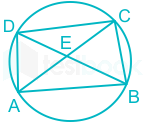
In the given figure, ∠DBC = 65°, ∠BAC = 35° and AB = BC, then the measure of ∠ECD is equal to:

  1. AOption (a)

    65°

  2. BOption (b)

    50°

  3. COption (c)

    45°

  4. DOption (d)

    55°

View answer & explanation

Correct answer

Answer: (c)C.

45°

Why this answer is correct

Shortcut Trick

In ΔABC, AB = BC ⇒ ∠BCA = ∠BAC = 35°.

Angle in same segment: ∠BDC = ∠BAC = 35°.

In ΔBCD, ∠BCD = 180° − (∠DBC + ∠BDC) = 180° − (65° + 35°) = 80°.

∠ECD (same as ∠ACD) = ∠BCD − ∠BCA = 80° − 35° = 45°.

∴ The correct answer is 45°.

Alternate Method

Given: ∠DBC = 65°, ∠BAC = 35°, AB = BC. Points A, B, C, D are on the circumference of a circle.

Formula Used:

  1. Angles subtended by the same chord at the circumference are equal.
  2. Angles opposite to equal sides in a triangle are equal.
  3. Sum of angles in a triangle = 180°.

Calculations:

⇒ In ΔABC, given AB = BC.

⇒ ∴ ∠BCA = ∠BAC = 35° (Angles opposite to equal sides).

⇒ ∠BDC = ∠BAC = 35° (Angles in the same segment subtended by chord BC).

⇒ In ΔBCD, ∠DBC + ∠BDC + ∠BCD = 180°.

⇒ 65° + 35° + ∠BCD = 180°.

⇒ 100° + ∠BCD = 180°.

⇒ ∠BCD = 180° − 100° = 80°.

⇒ From the figure, ∠BCD = ∠BCA + ∠ACD.

⇒ 80° = 35° + ∠ACD.

⇒ ∠ACD = 80° − 35° = 45°.

⇒ Point E lies on the diagonal BD, so ∠ECD is the same as ∠ACD.

⇒ ∠ECD = 45°.

∴ The correct answer is 45°.

Additional Information

Angles in Same Segment

Angles subtended by a chord at any point on the same arc of the circle are equal.

Isosceles Triangle Property

In a triangle, if two sides are equal, the angles opposite to those sides are also equal.

Cyclic Quadrilateral

In a cyclic quadrilateral, the sum of opposite angles is 180° (∠A + ∠C = 180° and ∠B + ∠D = 180°).

Question 18

Ramesh started a business investing a sum of Rs. 40,000. Six months later, Kevin joined by investing Rs. 20,000. If they make a profit of Rs. 10,000 at the end of the year, how much is the share of Kevin?

  1. AOption (a)

    Rs. 2,000

  2. BOption (b)

    Rs. 2,500

  3. COption (c)

    Rs. 4,000

  4. DOption (d)

    Rs. 3,000

View answer & explanation

Correct answer

Answer: (a)A.

Rs. 2,000

Why this answer is correct

Shortcut Trick

Profit Ratio = (Capital × Time)Ramesh : (Capital × Time)Kevin

Ramesh : Kevin = (40,000 × 12) : (20,000 × 6)

Ratio = 480,000 : 120,000 = 4 : 1

Kevin’s share = 1 / (4 + 1) × 10,000 = 1/5 × 10,000 = Rs. 2,000

∴ The correct answer is Rs. 2,000.

Alternate Method

Given:

Ramesh’s Investment = Rs. 40,000

Kevin’s Investment = Rs. 20,000

Total Profit = Rs. 10,000

Time period = 1 year (12 months)

Formula: Profit Share ∝ Capital × Time

⇒ Ramesh’s total investment units = 40,000 × 12 = 4,80,000

⇒ Kevin’s total investment units = 20,000 × 6 = 1,20,000

⇒ Ratio of their profits = 4,80,000 : 1,20,000

⇒ Ratio = 4 : 1

⇒ Sum of ratio parts = 4 + 1 = 5

⇒ Kevin’s share = (1 / 5) × 10,000

⇒ Kevin’s share = Rs. 2,000

∴ The correct answer is Rs. 2,000.

Additional Information

Simple Partnership

If the investment period is same for all partners, the profit is divided in the ratio of their capitals.

Compound Partnership

When investments are for different time periods, Profit Ratio = (C1 × T1) : (C2 × T2).

Ratio of Capitals

Capital Ratio = (Profit1 / Time1) : (Profit2 / Time2).

Question 19

The train ticket fare from places A to B in 2nd class AC and 3rd class AC is Rs. 2,500 and Rs. 2,000, respectively. If the fares of 2nd class AC and 3rd class AC are increased by 20% and 10%, respectively, then find the ratio of the new fares of 2nd class AC and 3rd class AC.

  1. AOption (a)

    13 : 11

  2. BOption (b)

    15 : 11

  3. COption (c)

    15 : 13

  4. DOption (d)

    12 : 11

View answer & explanation

Correct answer

Answer: (b)B.

15 : 11

Why this answer is correct

Shortcut Trick

Ratio of new fares = (Initial Fare1 × Increase Multiplier1) : (Initial Fare2 × Increase Multiplier2)

⇒ New Ratio = (2500 × 120%) : (2000 × 110%)

⇒ New Ratio = (25 × 120) : (20 × 110)

⇒ New Ratio = (5 × 12) : (4 × 11) = 60 : 44 = 15 : 11

∴ The correct answer is 15 : 11.

Alternate Method

Given:

Initial Fare of 2nd AC = ₹2500

Initial Fare of 3rd AC = ₹2000

Increase in 2nd AC fare = 20%

Increase in 3rd AC fare = 10%

Formula Used:

New Fare = Original Fare × (100 + Increase)%

Calculations:

⇒ New Fare of 2nd AC = 2500 × (120/100) = 25 × 120 = ₹3000

⇒ New Fare of 3rd AC = 2000 × (110/100) = 20 × 110 = ₹2200

⇒ New Ratio = 3000 : 2200

⇒ New Ratio = 300 / 220 = 15 / 11

⇒ New Ratio = 15 : 11

∴ The correct answer is 15 : 11.

Additional Information

Percentage Increase Formula

New Value = Original Value × (1 + Rate/100). If the rate is 20%, the multiplying factor is 1.20.

Ratio Simplification

To simplify a ratio A : B, divide both terms by their Highest Common Factor (HCF). Here, HCF of 3000 and 2200 is 200.

Direct Ratio of Change

New Ratio = (Aold × %ChangeA) : (Bold × %ChangeB). This bypasses calculating absolute values.

Question 20

Evaluate:

115+135+163+199+1143\frac 1 {15} + \frac 1 {35} + \frac 1 {63} + \frac 1 {99} + \frac 1 {143}

  1. AOption (a)

    439\frac 4 {39}

  2. BOption (b)

    539\frac 5 {39}

  3. COption (c)

    739\frac 7 {39}

  4. DOption (d)

    1039\frac {10} {39}

View answer & explanation

Correct answer

Answer: (b)B.

539\frac 5 {39}

Why this answer is correct

Given:

115+135+163+199+1143\frac{1}{15} + \frac{1}{35} + \frac{1}{63} + \frac{1}{99} + \frac{1}{143} = ?

Formula used:

Sum = 1d(1a−1l)\frac{1}{d} (\frac{1}{a} - \frac{1}{l})

Where d = difference between factors, a = first factor of first term, l = last factor of last term

Calculation:

⇒ 13×5+15×7+17×9+19×11+111×13\frac{1}{3 \times 5} + \frac{1}{5 \times 7} + \frac{1}{7 \times 9} + \frac{1}{9 \times 11} + \frac{1}{11 \times 13}

⇒ 12×(13−15+15−17+17−19+19−111+111−113)\frac{1}{2} \times (\frac{1}{3} - \frac{1}{5} + \frac{1}{5} - \frac{1}{7} + \frac{1}{7} - \frac{1}{9} + \frac{1}{9} - \frac{1}{11} + \frac{1}{11} - \frac{1}{13})

⇒ 12×(13−113)\frac{1}{2} \times (\frac{1}{3} - \frac{1}{13})

⇒ 12×(13−339)\frac{1}{2} \times (\frac{13 - 3}{39})

⇒ 12×1039\frac{1}{2} \times \frac{10}{39}

⇒ 539\frac{5}{39}

∴ The correct answer is option (2).

Question 21

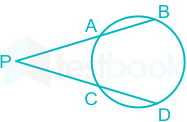
In the figure, chords AB and CD of a circle intersect externally at P. If AB = 4 cm, CD = 11 cm and PD = 15 cm, then the length of PB is:

  1. AOption (a)

    10 cm

  2. BOption (b)

    12 cm

  3. COption (c)

    8 cm

  4. DOption (d)

    14 cm

View answer & explanation

Correct answer

Answer: (a)A.

10 cm

Why this answer is correct

Shortcut Trick

For secants intersecting externally at point P, the property is: PA × PB = PC × PD.

Given: AB = 4 cm, CD = 11 cm, PD = 15 cm.

PC = PD − CD = 15 − 11 = 4 cm.

Product PC × PD = 4 × 15 = 60.

We need factors of 60 (PA and PB) such that their difference |PB − PA| = chord AB = 4 cm.

Factors of 60 with a difference of 4 are 10 and 6 (since 10 × 6 = 60 and 10 − 6 = 4).

∴ The correct answer is 10 cm.

Alternate Method

Given:

Length of chord AB = 4 cm

Length of chord CD = 11 cm

Length of external segment PD = 15 cm

Formula Used:

The Secant-Secant Power Theorem states that if two secant segments are drawn to a circle from an exterior point, then the product of the measures of one secant segment and its external secant segment is equal to the product of the measures of the other secant segment and its external secant segment.

PA × PB = PC × PD

Calculations:

⇒ PC = PD − CD

⇒ PC = 15 − 11 = 4 cm

⇒ Let the length of segment PB be x cm.

⇒ Then, PA = PB − AB = x − 4 cm

⇒ Applying the theorem: PA × PB = PC × PD

⇒ (x − 4) × x = 4 × 15

⇒ x2 − 4x = 60

⇒ x2 − 4x − 60 = 0

⇒ x2 − 10x + 6x − 60 = 0

⇒ x(x − 10) + 6(x − 10) = 0

⇒ (x − 10)(x + 6) = 0

⇒ x = 10 or x = −6 (Length cannot be negative)

⇒ x = 10 cm

∴ The correct answer is 10 cm.

Additional Information

Intersecting Chords Theorem (Internal)

When two chords intersect inside a circle, the product of the segments of one chord is equal to the product of the segments of the other: PA × PB = PC × PD.

Tangent-Secant Theorem

If a tangent and a secant are drawn to a circle from an exterior point, the square of the tangent segment equals the product of the whole secant and its external part: PT2 = PA × PB.

Secant Segment Relation

The length of the entire secant segment is the sum of the external segment and the chord length: Whole Secant = External Segment + Chord.

Question 22

The sum of three numbers is 280. If the ratio between the first and second numbers is 2 : 3 and the ratio between second and third numbers is 4 : 5, find the second number.

  1. AOption (a)

    96

  2. BOption (b)

    90

  3. COption (c)

    80

  4. DOption (d)

    86

View answer & explanation

Correct answer

Answer: (a)A.

96

Why this answer is correct

Shortcut Trick

Combine ratios: A:B = 2:3 and B:C = 4:5.

To equalize B, multiply first ratio by 4 and second by 3.

Combined Ratio A : B : C = (2×4) : (3×4) : (3×5) = 8 : 12 : 15.

Sum of ratio parts = 8 + 12 + 15 = 35 units.

35 units = 280 → 1 unit = 8. ∴ 2nd number = 12 × 8 = 96.

∴ The correct answer is 96.

Alternate Method

Given:

Sum of three numbers (A + B + C) = 280

Ratio A : B = 2 : 3

Ratio B : C = 4 : 5

Formula Used:

Combined Ratio A : B : C = (a × c) : (b × c) : (b × d) where A:B = a:b and B:C = c:d.

Calculations:

⇒ First : Second = 2 : 3

⇒ Second : Third = 4 : 5

⇒ Multiplying the ratios to make the Second number common:

⇒ A : B = (2 × 4) : (3 × 4) = 8 : 12

⇒ B : C = (4 × 3) : (5 × 3) = 12 : 15

⇒ Combined Ratio A : B : C = 8 : 12 : 15

⇒ Let the numbers be 8x, 12x, and 15x.

⇒ Sum = 8x + 12x + 15x = 35x

⇒ 35x = 280

⇒ x = 280 ÷ 35 = 8

⇒ Second number (B) = 12x = 12 × 8 = 96

∴ The correct answer is 96.

Additional Information

Ratio Balancing

To combine two ratios A:B and B:C, find the LCM of the common term B to make its value equal in both ratios.

Direct Combination Formula

If A:B = a:b and B:C = c:d, then the continuous ratio A:B:C is calculated as (a×c) : (b×c) : (b×d).

Proportional Parts

Value of any part = (Ratio of that part ÷ Sum of all ratios) × Total Value.

Question 23

If 8+2333+5=a3−b,\frac {8 + 2\sqrt 3}{3\sqrt 3 + 5} = a\sqrt 3 - b, then the value of a + b is equal to:

  1. AOption (a)

    15

  2. BOption (b)

    16

  3. COption (c)

    18

  4. DOption (d)

    24

View answer & explanation

Correct answer

Answer: (c)C.

18

Why this answer is correct

Shortcut Trick

Rationalize the denominator by multiplying the numerator and denominator by the conjugate (5 − 3√3).

Numerator: (8 + 2√3) × (5 − 3√3) = 40 − 24√3 + 10√3 − 18 = 22 − 14√3.

Denominator: (5 + 3√3) × (5 − 3√3) = 52 − (3√3)2 = 25 − 27 = −2.

Simplified Result: (22 − 14√3) ÷ (−2) = −11 + 7√3 = 7√3 − 11.

Comparing with a√3 − b, we get a = 7 and b = 11.

Calculation: a + b = 7 + 11 = 18.

∴ The correct answer is 18.

Alternate Method

Given: (8 + 2√3) ÷ (3√3 + 5) = a√3 − b

Formula Used: Rationalization using (x + y)(x − y) = x2 − y2

⇒ Expression = (8 + 2√3) / (5 + 3√3)

⇒ Multiply by conjugate (5 − 3√3): [(8 + 2√3) × (5 − 3√3)] / [(5 + 3√3) × (5 − 3√3)]

⇒ Numerator = 8(5) − 8(3√3) + 2√3(5) − 2√3(3√3)

⇒ Numerator = 40 − 24√3 + 10√3 − 6(3) = 40 − 14√3 − 18 = 22 − 14√3

⇒ Denominator = 52 − (3√3)2 = 25 − 27 = −2

⇒ Value = (22 − 14√3) / (−2) = −11 + 7√3

⇒ Compare 7√3 − 11 with a√3 − b

⇒ a = 7, b = 11

⇒ a + b = 7 + 11 = 18

∴ The correct answer is 18.

Additional Information

Rationalization of Surds

To rationalize a denominator of the form (x + √y), multiply both numerator and denominator by its conjugate (x − √y) to eliminate the radical.

Conjugate Rule

The conjugate of (a + √b) is (a − √b). Their product always results in a rational number: (a + √b)(a − √b) = a2 − b.

Equality of Irregular Numbers

If x + y√n = a + b√n (where x, y, a, b are rational and √n is irrational), then x = a and y = b.

Question 24

If sec⁡θ+tan⁡θsec⁡θ−tan⁡θ=25179,\frac {\sec θ + \tan θ }{\sec θ - \tan θ } = 2 \frac {51}{79},  then the value of sin θ is equal to:

  1. AOption (a)

    3572\frac {35}{72}

  2. BOption (b)

    91144\frac {91}{144}

  3. COption (c)

    65144\frac {65}{144}

  4. DOption (d)

    3972\frac {39}{72}

View answer & explanation

Correct answer

Answer: (c)C.

65144\frac {65}{144}

Why this answer is correct

Shortcut Trick

Convert mixed fraction: 2 51/79 = (2 × 79 + 51) ÷ 79 = 209/79.

Apply Componendo and Dividendo: (sec θ + tan θ + sec θ − tan θ) ÷ (sec θ + tan θ − (sec θ − tan θ)) = (209 + 79) ÷ (209 − 79).

2 sec θ ÷ 2 tan θ = 288 ÷ 130 ⇒ sec θ ÷ tan θ = 144 ÷ 65.

Since sec θ ÷ tan θ = (1/cos θ) ÷ (sin θ/cos θ) = 1/sin θ.

1/sin θ = 144/65 ⇒ sin θ = 65/144.

∴ The correct answer is 65/144.

Alternate Method

Given:

(sec θ + tan θ) ÷ (sec θ − tan θ) = 2 51/79

Formula Used:

Componendo and Dividendo: If a/b = c/d, then (a + b)/(a − b) = (c + d)/(c − d).

Trigonometric relations: sec θ = 1/cos θ and tan θ = sin θ/cos θ.

Calculations:

⇒ (sec θ + tan θ) ÷ (sec θ − tan θ) = (2 × 79 + 51) ÷ 79

⇒ (sec θ + tan θ) ÷ (sec θ − tan θ) = 209/79

⇒ Applying Componendo and Dividendo:

⇒ [(sec θ + tan θ) + (sec θ − tan θ)] ÷ [(sec θ + tan θ) − (sec θ − tan θ)] = (209 + 79) ÷ (209 − 79)

⇒ (2 sec θ) ÷ (2 tan θ) = 288 ÷ 130

⇒ sec θ ÷ tan θ = 144 ÷ 65

⇒ (1/cos θ) ÷ (sin θ/cos θ) = 144/65

⇒ 1/sin θ = 144/65

⇒ sin θ = 65/144

∴ The correct answer is 65/144.

Additional Information

Componendo and Dividendo Rule

It is a method used to simplify equations involving ratios. If a/b = c/d, then (a+b)/(a−b) = (c+d)/(c−d).

Pythagorean Identity

A fundamental identity in trigonometry is sec2θ − tan2θ = 1, which implies (sec θ + tan θ)(sec θ − tan θ) = 1.

Reciprocal Ratios

sec θ = 1/cos θ, cosec θ = 1/sin θ, and cot θ = 1/tan θ.

Question 25

The graphs of the linear equations 4x - 2y = 10 and 4x + ky = 2 intersect at a point (a, 4). The value of k is equal to:

  1. AOption (a)

    -4

  2. BOption (b)

    4

  3. COption (c)

    -3

  4. DOption (d)

    3

View answer & explanation

Correct answer

Answer: (a)A.

-4

Why this answer is correct

Shortcut Trick

Since the point (a, 4) lies on both lines, substitute y = 4 in the first equation.

4x − 2(4) = 10 ⇒ 4x − 8 = 10 ⇒ 4x = 18.

In the second equation 4x + ky = 2, substitute 4x = 18 and y = 4 directly.

18 + k × 4 = 2 ⇒ 4k = 2 − 18 ⇒ 4k = −16.

k = −16 ÷ 4 = −4.

∴ The correct answer is −4.

Alternate Method

Given:

Equation 1: 4x − 2y = 10

Equation 2: 4x + ky = 2

Intersection point: (a, 4)

Formula Used:

For a point (x1, y1) to be the intersection of two lines, it must satisfy both equations simultaneously.

Step 1: Substitute the coordinates of the intersection point (a, 4) into Equation 1.

⇒ 4(a) − 2(4) = 10

⇒ 4a − 8 = 10

⇒ 4a = 18

⇒ a = 18 ÷ 4 = 4.5

Step 2: Substitute x = 4.5 and y = 4 into Equation 2.

⇒ 4(4.5) + k(4) = 2

⇒ 18 + 4k = 2

⇒ 4k = 2 − 18

⇒ 4k = −16

⇒ k = −16 ÷ 4

⇒ k = −4

∴ The correct answer is −4.

Additional Information

Condition for Unique Solution

For two linear equations a1x + b1y = c1 and a2x + b2y = c2 to have a unique intersection point, a1/a2 ≠ b1/b2.

Parallel Lines (No Solution)

Lines are parallel and never intersect if a1/a2 = b1/b2 ≠ c1/c2.

Coincident Lines (Infinite Solutions)

Lines overlap completely if a1/a2 = b1/b2 = c1/c2.

Question 26

Find the sum of 6 + 8 + 10 + 12 + 14 + ............. + 40.

  1. AOption (a)

    424

  2. BOption (b)

    400

  3. COption (c)

    1600

  4. DOption (d)

    414

View answer & explanation

Correct answer

Answer: (d)D.

414

Why this answer is correct

Shortcut Trick

Identify the series as an Arithmetic Progression (AP) where the first term is 6 and the last term is 40.

Average of an AP = (First term + Last term) ÷ 2 = (6 + 40) ÷ 2 = 23.

Number of terms (n) = [(Last − First) ÷ Common Difference] + 1 = [(40 − 6) ÷ 2] + 1 = 18.

Sum of the series = Average × n = 23 × 18 = 414.

∴ The correct answer is 414.

Alternate Method

Given series: 6, 8, 10, 12, 14, ............., 40

First term (a) = 6

Last term (l) = 40

Common difference (d) = 8 − 6 = 2

Formula for the nth term of an AP: l = a + (n − 1)d

⇒ 40 = 6 + (n − 1) × 2

⇒ 40 − 6 = (n − 1) × 2

⇒ 34 = (n − 1) × 2

⇒ n − 1 = 17

⇒ n = 18

Formula for the Sum (Sn) of an AP: Sn = (n/2) × (a + l)

⇒ S18 = (18 ÷ 2) × (6 + 40)

⇒ S18 = 9 × 46

⇒ S18 = 414

∴ The correct answer is 414.

Additional Information

Arithmetic Progression (AP)

A sequence where the difference between consecutive terms is constant. nth term Tn = a + (n − 1)d.

Sum of First n Natural Numbers

The sum of the first n positive integers is calculated as [n × (n + 1)] ÷ 2.

Sum of First n Even Numbers

The sum of the first n even natural numbers starting from 2 is given by n × (n + 1).

General Sum Formula

For any AP, the sum is also Sn = (n/2) × [2a + (n − 1)d].

Question 27

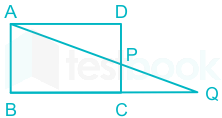
In the given figure, ABCD is a rectangle and P is a point on DC such that BC = 24 cm, DP = 10 cm, and CD = 15 cm. If AP produced intersects BC produced at Q, then find the length of AQ.

  1. AOption (a)

    26 cm

  2. BOption (b)

    39 cm

  3. COption (c)

    35 cm

  4. DOption (d)

    24 cm

View answer & explanation

Correct answer

Answer: (b)B.

39 cm

Why this answer is correct

Shortcut Trick

In right-angled ΔADP, AP = √(AD2 + DP2) = √(242 + 102) = 26 cm.

By similar triangles, ΔADP ∼ ΔQCP (since AD || QC and A, P, Q are collinear).

The side ratio is DP : CP = 10 : (15 − 10) = 10 : 5 = 2 : 1.

Therefore, AP : PQ = 2 : 1 ⇒ PQ = 26 ÷ 2 = 13 cm.

Total length AQ = AP + PQ = 26 + 13 = 39 cm.

∴ The correct answer is 39 cm.

Alternate Method

Given: ABCD is a rectangle, BC = 24 cm, DP = 10 cm, CD = 15 cm.

Formula: AP = √(AD2 + DP2) and Similarity Ratio: AP/PQ = DP/PC.

⇒ In rectangle ABCD, AD = BC = 24 cm and CD = AB = 15 cm.

⇒ Point P is on CD such that DP = 10 cm, so PC = CD − DP = 15 − 10 = 5 cm.

⇒ In right-angled ΔADP, using Pythagoras Theorem:

⇒ AP2 = AD2 + DP2 = 242 + 102 = 576 + 100 = 676

⇒ AP = √676 = 26 cm.

⇒ In ΔADP and ΔQCP, ∠ADP = ∠QCP = 90° and ∠APD = ∠QPC (vertically opposite).

⇒ ∴ ΔADP ∼ ΔQCP (by AA similarity).

⇒ AP / PQ = DP / CP ⇒ 26 / PQ = 10 / 5

⇒ 26 / PQ = 2 ⇒ PQ = 13 cm.

⇒ AQ = AP + PQ = 26 + 13 = 39 cm.

∴ The correct answer is 39 cm.

Additional Information

AA Similarity Criterion

If two angles of one triangle are equal to two angles of another triangle, then the two triangles are similar, and their corresponding sides are in the same ratio.

Pythagoras Theorem

In a right-angled triangle, the square of the hypotenuse is equal to the sum of the squares of the other two sides: a2 + b2 = c2.

Properties of a Rectangle

Opposite sides are equal and parallel, and each interior angle is 90°. In this problem, AD || BC implies AD || CQ.

Question 28

A delivery boy started from his office at 10 a.m. to deliver an article. He rode his scooter at a speed of 32 km / h. He delivered the article and waited for 15 minutes to get the payment. After the payment was made, he reached his office at 11:25 a.m., travelling at a speed of 24 km / h. Find the total distance travelled by the boy.

  1. AOption (a)

    35 km

  2. BOption (b)

    40 km

  3. COption (c)

    32 km

  4. DOption (d)

    30 km

View answer & explanation

Correct answer

Answer: (c)C.

32 km

Why this answer is correct

Shortcut Trick

Total time spent = 11:25 a.m. − 10:00 a.m. = 1 hour 25 minutes = 85 minutes.

Actual travelling time = 85 minutes − 15 minutes (wait) = 70 minutes = 7/6 hours.

Average speed for the entire journey = (2 × S1 × S2) / (S1 + S2) = (2 × 32 × 24) / 56 = 192/7 km/h.

Total distance = Average speed × Total travelling time = (192/7) × (7/6) = 32 km.

∴ The correct answer is 32 km.

Alternate Method

Given:

Departure time = 10:00 a.m. | Arrival time = 11:25 a.m. | Wait time = 15 minutes.

Speed to delivery point (S1) = 32 km/h | Speed back to office (S2) = 24 km/h.

Formula Used:

Time = Distance ÷ Speed

Calculations:

⇒ Total duration = 1 hour 25 minutes = 85 minutes.

⇒ Total travel time = 85 − 15 = 70 minutes = 70/60 hours = 7/6 hours.

⇒ Let the distance to the delivery point be d km.

⇒ (d / 32) + (d / 24) = 7 / 6

⇒ LCM of 32 and 24 is 96.

⇒ (3d + 4d) / 96 = 7 / 6

⇒ 7d / 96 = 7 / 6

⇒ d / 96 = 1 / 6

⇒ d = 96 / 6 = 16 km.

⇒ Total distance travelled = 2 × d = 2 × 16 = 32 km.

∴ The correct answer is 32 km.

Additional Information

Average Speed for Equal Distances

When a person travels the same distance at two different speeds x and y, the average speed for the whole journey is given by (2xy) / (x + y).

Speed-Time Relation

For a constant distance, speed is inversely proportional to time (S ∝ 1/T). The ratio of speeds is the inverse of the ratio of times taken.

Relative Speed in Same Direction

When two objects move in the same direction, their relative speed is the difference of their individual speeds |S1 − S2|.

Question 29

If 3 sin x + 4 cos x = 2, then the value of 3 cos x - 4 sin x is equal to:

  1. AOption (a)

    21

  2. BOption (b)

    21\sqrt {21}

  3. COption (c)

    23\sqrt {23}

  4. DOption (d)

    29\sqrt {29}

View answer & explanation

Correct answer

Answer: (b)B.

21\sqrt {21}

Why this answer is correct

Shortcut Trick

If a sin x + b cos x = c, then b sin x − a cos x = √(a2 + b2 − c2).

Here, a = 3, b = 4, and c = 2.

Value = √(32 + 42 − 22)

Value = √(9 + 16 − 4) = √21

∴ The correct answer is √21.

Alternate Method

Given: 3 sin x + 4 cos x = 2

To find: 3 cos x − 4 sin x

Formula: (a sin x + b cos x)2 + (a cos x − b sin x)2 = a2 + b2

⇒ Let 3 cos x − 4 sin x = y

⇒ Squaring and adding both equations:

⇒ (3 sin x + 4 cos x)2 + (3 cos x − 4 sin x)2 = 22 + y2

⇒ (9 sin2x + 16 cos2x + 24 sin x cos x) + (9 cos2x + 16 sin2x − 24 sin x cos x) = 4 + y2

⇒ 9(sin2x + cos2x) + 16(cos2x + sin2x) = 4 + y2

⇒ 9(1) + 16(1) = 4 + y2

⇒ 25 = 4 + y2

⇒ y2 = 21

⇒ y = √21

∴ The correct answer is √21.

Additional Information

Trigonometric Coefficient Identity

For any angle x and constants a and b, the sum of the squares of (a sin x + b cos x) and (a cos x − b sin x) is always independent of x and equal to a2 + b2.

Maximum and Minimum Values

The expression a sin x + b cos x has a maximum value of √(a2 + b2) and a minimum value of −√(a2 + b2).

Secant and Tangent Relation

If a sec x + b tan x = c, then a related identity for tangent and secant is (a tan x + b sec x)2 = c2 − (a2 − b2).

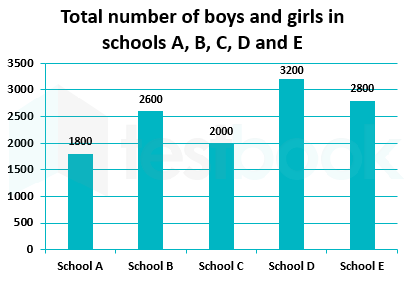
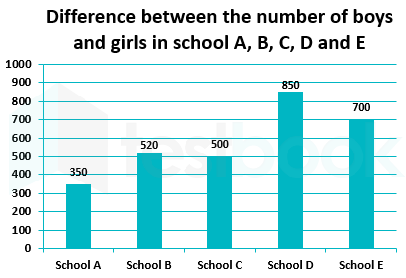
Study the following bar graph and answer the questions given below.

<br>

Note : In every school, Number of boys > Number of girls

Question 30

The number of boys in school B is what percentage of the total number of students in that school?

  1. AOption (a)

    55%

  2. BOption (b)

    50%

  3. COption (c)

    60%

  4. DOption (d)

    40%

View answer & explanation

Correct answer

Answer: (c)C.

60%

Why this answer is correct

Given:

Total boys and girls in school B is 2600

Difference of boys and girls in school B is 520

Formula used:

% Boys in B = Total boys in B/Total students in school B  × 100

Calculation:

Let the boys and girls in School B be x, y

⇒ x + y = 2600, x – y = 520

Adding those two equations we get 2x = 3120

⇒ x = 1560

∴ Percentage of boys in School B = 1560 × 100/2600 = 60%

Question 31

The average of five positive numbers is 56. If the first number is three-fourth of the sum of the last four numbers, then the average of the last four numbers is:

  1. AOption (a)

    50

  2. BOption (b)

    35

  3. COption (c)

    30

  4. DOption (d)

    40

View answer & explanation

Correct answer

Answer: (d)D.

40

Why this answer is correct

Shortcut Trick

Total sum of 5 numbers = 56 × 5 = 280.

Ratio of First Number : Sum of last 4 numbers = 3 : 4.

Total parts = 3 + 4 = 7 parts → 280.

1 part = 280 ÷ 7 = 40.

Sum of last 4 numbers = 4 parts = 4 × 40 = 160.

Average of last 4 numbers = 160 ÷ 4 = 40.

∴ The correct answer is 40.

Alternate Method

Given:

Average of 5 numbers = 56

First number = 3/4 × (Sum of last 4 numbers)

Formula Used:

Sum of observations = Average × Number of observations

Average = Sum of observations ÷ Number of observations

Calculations:

⇒ Total sum of 5 numbers = 56 × 5 = 280

⇒ Let the sum of the last four numbers be S.

⇒ First number = 3/4 × S = 3S/4

⇒ Sum of all 5 numbers = First number + Sum of last 4 numbers

⇒ 280 = 3S/4 + S

⇒ 280 = (3S + 4S) ÷ 4

⇒ 280 = 7S/4

⇒ S = (280 × 4) ÷ 7

⇒ S = 40 × 4 = 160

⇒ Average of last 4 numbers = S ÷ 4

⇒ Average of last 4 numbers = 160 ÷ 4 = 40

∴ The correct answer is 40.

Additional Information

Basic Average Formula

The average of n numbers is calculated as Sum of all numbers ÷ n. To find the sum, use Average × n.

Weighted Average

When two groups with averages x1 and x2 and sizes n1 and n2 are combined, the new average is (n1x1 + n2x2) ÷ (n1 + n2).

Average of Consecutive Numbers

For any arithmetic progression, the average is exactly the middle term or (First term + Last term) ÷ 2.

Question 32

If the radius of a cylinder is decreased by 20% and the height is increased by 20% to form a new cylinder, then the volume will be decreased by:

  1. AOption (a)

    22.3%

  2. BOption (b)

    32.2%

  3. COption (c)

    23.2%

  4. DOption (d)

    20.5%

View answer & explanation

Correct answer

Answer: (c)C.

23.2%

Why this answer is correct

Shortcut Trick

Volume of Cylinder ∝ r2h

Successive change in Radius (r × r): −20% and −20% ⇒ −20 − 20 + (−20 × −20)/100 = −36%

Net change with Height (+20%): −36 + 20 + (−36 × 20)/100

Net change = −16 − 7.2 = −23.2%

∴ The correct answer is 23.2%.

Alternate Method

Given: Radius (r) decreased by 20%, Height (h) increased by 20%.

Formula: Volume (V) = πr2h

⇒ Let original radius r1 = 5 and original height h1 = 5.

⇒ Original Volume V1 = π × (5)2 × 5 = 125π.

⇒ New radius r2 = 5 − (20% of 5) = 4.

⇒ New height h2 = 5 + (20% of 5) = 6.

⇒ New Volume V2 = π × (4)2 × 6 = 16 × 6 × π = 96π.

⇒ Decrease in volume = 125π − 96π = 29π.

⇒ Percentage decrease = (29π / 125π) × 100

⇒ Percentage decrease = (29 / 125) × 100 = 23.2%.

∴ The correct answer is 23.2%.

Additional Information

Successive Percentage Change

For two percentage changes a% and b%, the net change is given by [a + b + (ab/100)]%. For three changes, apply this formula twice.

Cylinder Formulas

Volume = πr2h | Curved Surface Area (CSA) = 2πrh | Total Surface Area (TSA) = 2πr(h + r).

Proportionality in Geometry

When dimensions of a 3D shape change, the volume changes according to the product of the change factors of its dimensions (e.g., V ∝ r2h for cylinders, V ∝ a3 for cubes).

Question 33

The length of the shadow of a vertical tower on level ground increases by 10 m when the altitude of the sun changes from 45° to 30°. The height of the tower is:

  1. AOption (a)

    10(√3 + 1) m

  2. BOption (b)

    5√3 m

  3. COption (c)

    5(√3 + 1) m

  4. DOption (d)

    10√3 m

View answer & explanation

Correct answer

Answer: (c)C.

5(√3 + 1) m

Why this answer is correct

Shortcut Trick

Direct formula for height (h) when shadow increases by distance (d) as angle changes from θ1 to θ2:

h = d ÷ (cot θ2 − cot θ1)

Here, d = 10 m, θ2 = 30°, and θ1 = 45°

h = 10 ÷ (cot 30° − cot 45°) = 10 ÷ (√3 − 1)

By rationalizing: h = [10 × (√3 + 1)] ÷ [(√3 − 1)(√3 + 1)] = 10(√3 + 1) ÷ 2 = 5(√3 + 1)

∴ The correct answer is 5(√3 + 1) m.

Alternate Method

Given:

Increase in shadow length (CD) = 10 m

Angle of elevation at initial position (C) = 45°

Angle of elevation at final position (D) = 30°

Calculations:

⇒ Let the height of the tower AB be h.

⇒ In right-angled ▵ABC, tan 45° = AB ÷ BC

⇒ 1 = h ÷ BC → BC = h

⇒ In right-angled ▵ABD, tan 30° = AB ÷ BD

⇒ 1 ÷ √3 = h ÷ BD → BD = h√3

⇒ Given CD = BD − BC = 10 m

⇒ h√3 − h = 10

⇒ h(√3 − 1) = 10

⇒ h = 10 ÷ (√3 − 1)

⇒ h = [10 × (√3 + 1)] ÷ [(√3 − 1)(√3 + 1)]

⇒ h = 10(√3 + 1) ÷ (3 − 1) = 10(√3 + 1) ÷ 2

⇒ h = 5(√3 + 1) m

∴ The correct answer is 5(√3 + 1) m.

Additional Information

Trigonometric Ratios for Standard Angles

tan 30° = 1/√3, tan 45° = 1, tan 60° = √3. Cot is the reciprocal: cot 30° = √3, cot 45° = 1, cot 60° = 1/√3.

Shadow and Angle Relation

As the altitude of the sun decreases, the length of the shadow of a vertical object increases.

Rationalization Rule

To rationalize a denominator of the form (a − √b), multiply both numerator and denominator by its conjugate (a + √b).

Question 34

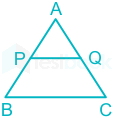
In a triangle ABC, P, and Q are points on AB and AC, respectively, such that AP = 1 cm, PB = 3 cm, AQ = 1.5 cm, and CQ = 4.5 cm. If the area of ΔAPQ is 12 cm2, then find the area of BPQC.

  1. AOption (a)

    190 cm2

  2. BOption (b)

    182 cm2

  3. COption (c)

    180 cm2

  4. DOption (d)

    192 cm2

View answer & explanation

Correct answer

Answer: (c)C.

180 cm2

Why this answer is correct

Shortcut Trick

Ratio of sides AP : AB = 1 : (1 + 3) = 1 : 4

Ratio of sides AQ : AC = 1.5 : (1.5 + 4.5) = 1.5 : 6 = 1 : 4

Ratio of Area(ΔAPQ) : Area(ΔABC) = (Side Ratio)2 = (1 : 4)2 = 1 : 16

Area(ΔABC) = 12 × 16 = 192 cm2

Area(BPQC) = Area(ΔABC) − Area(ΔAPQ) = 192 − 12 = 180 cm2

∴ The correct answer is 180 cm2.

Alternate Method

Given: AP = 1 cm, PB = 3 cm, AQ = 1.5 cm, CQ = 4.5 cm, Area(ΔAPQ) = 12 cm2.

Formula Used: Area of Similar Triangles Ratio = (Corresponding Sides Ratio)2

⇒ Total length AB = AP + PB = 1 + 3 = 4 cm

⇒ Total length AC = AQ + CQ = 1.5 + 4.5 = 6 cm

⇒ In ΔAPQ and ΔABC:

⇒ AP/AB = 1/4 and AQ/AC = 1.5/6 = 1/4

⇒ ∠A is common to both triangles.

⇒ By SAS similarity criterion, ΔAPQ ~ ΔABC.

⇒ Area(ΔAPQ) / Area(ΔABC) = (AP / AB)2 = (1/4)2

⇒ 12 / Area(ΔABC) = 1/16

⇒ Area(ΔABC) = 12 × 16 = 192 cm2

⇒ Area of quadrilateral BPQC = Area(ΔABC) − Area(ΔAPQ)

⇒ Area(BPQC) = 192 − 12 = 180 cm2

∴ The correct answer is 180 cm2.

Additional Information

SAS Similarity Theorem

If one angle of a triangle is equal to one angle of another triangle and the sides including these angles are proportional, then the two triangles are similar.

Area Ratio Property

The ratio of the areas of two similar triangles is equal to the square of the ratio of their corresponding sides: Area1/Area2 = (s1/s2)2.

Basic Proportionality Theorem (Thales Theorem)

If a line is drawn parallel to one side of a triangle to intersect the other two sides in distinct points, the other two sides are divided in the same ratio.

Question 35

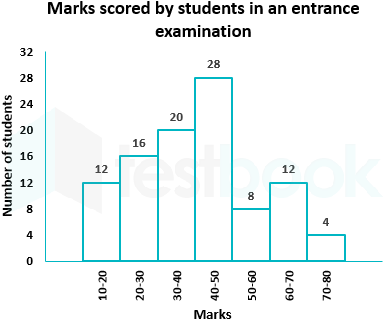
Study the following histogram and answer the given question.

What is the ratio of the number of students who scored 30 or more marks, but below 40 marks, to the total number of students in the entrance examination?

  1. AOption (a)

    1 : 5

  2. BOption (b)

    3 : 5

  3. COption (c)

    2 : 5

  4. DOption (d)

    2 : 3

View answer & explanation

Correct answer

Answer: (a)A.

1 : 5

Why this answer is correct

Calculation:

Total Students who got marks between 30 – 40 is 20

Total Students = 12 + 16 + 20 + 28 + 8 + 12 + 4 = 100

∴ Ratio is 20 ∶ 100 = 1 ∶ 5

Question 36

If the perimeter of an isosceles right triangle is 8(√2 + 1) cm, then the length of the hypotenuse of the triangle is:

  1. AOption (a)

    12 cm

  2. BOption (b)

    8 cm

  3. COption (c)

    24 cm

  4. DOption (d)

    10 cm

View answer & explanation

Correct answer

Answer: (b)B.

8 cm

Why this answer is correct

Shortcut Trick

For an isosceles right triangle with hypotenuse h, the Perimeter is given by h × (√2 + 1).

Given Perimeter = 8 × (√2 + 1) cm.

By comparing the two expressions: h(√2 + 1) = 8(√2 + 1).

⇒ h = 8 cm.

∴ The correct answer is 8 cm.

Alternate Method

Given: Perimeter of isosceles right triangle = 8(√2 + 1) cm.

Formula: Perimeter = a + a + h, where a is the leg and h is the hypotenuse (h = a√2).

⇒ Perimeter = 2a + h

⇒ Perimeter = 2(h/√2) + h = h√2 + h

⇒ Perimeter = h(√2 + 1)

⇒ 8(√2 + 1) = h(√2 + 1)

⇒ h = 8 cm

∴ The correct answer is 8 cm.

Additional Information

Area of Isosceles Right Triangle

Area can be calculated using legs as a2/2 or using hypotenuse as h2/4.

Side Ratio Property

In a 45°−45°−90° triangle, the sides are always in the ratio 1 : 1 : √2.

Inradius and Circumradius

Circumradius (R) = h/2 and Inradius (r) = (2a − h)/2 for an isosceles right triangle.

Question 37

A container contains 20 L mixture in which there is 10% sulphuric acid. Find the quantity of sulphuric acid to be added in it to make the solution to contain 25% sulphuric acid.

  1. AOption (a)

    3 L

  2. BOption (b)

    4 L

  3. COption (c)

    2 L

  4. DOption (d)

    5 L

View answer & explanation

Correct answer

Answer: (b)B.

4 L

Why this answer is correct

Shortcut Trick

By Alligation: Initial mixture (10% acid) vs Pure acid (100% acid) to get 25% acid.

Ratio of Initial mixture to Added acid = (100 − 25) : (25 − 10) = 75 : 15 = 5 : 1.

Initial volume is 20 L, which represents 5 units.

5 units = 20 L ⇒ 1 unit = 4 L.

∴ The correct answer is 4 L.

Alternate Method

Initial Mixture = 20 L

Initial Acid percentage = 10%

Required Acid percentage = 25%

⇒ Quantity of acid in initial mixture = 10% of 20 = 2 L

⇒ Quantity of water in initial mixture = 20 − 2 = 18 L

⇒ Since only acid is added, the quantity of water remains constant at 18 L.

⇒ In the final solution, acid is 25%, so water must be 100% − 25% = 75%.

⇒ 75% of New Total Mixture = 18 L

⇒ New Total Mixture = 18 ÷ (75/100) = 18 × (4/3) = 24 L

⇒ Quantity of acid added = New Total − Initial Total = 24 − 20 = 4 L

∴ The correct answer is 4 L.

Additional Information

Alligation Rule

It is used to find the ratio in which two ingredients at given prices or concentrations must be mixed to produce a mixture of a desired price or concentration: (Quantity of Cheaper / Quantity of Dearer) = (CP of Dearer − Mean Price) / (Mean Price − CP of Cheaper).

Constant Product / Constant Quantity Rule

When a substance is added to or removed from a mixture, the quantity of the other component (which is neither added nor removed) remains constant. Using this constant value to equate percentages is often the fastest method.

Successive Dilution

If x units are removed from a container of C units of pure liquid and replaced by water, after n operations, the quantity of pure liquid remaining = C × [1 − (x/C)]n.

Question 38

If x2+1x2=7,x^2 + \frac 1 {x^2} = 7, then the value of x3+1x3x^3 + \frac 1 {x^3} where x > 0 is equal to:

  1. AOption (a)

    16

  2. BOption (b)

    18

  3. COption (c)

    12

  4. DOption (d)

    15

View answer & explanation

Correct answer

Answer: (b)B.

18

Why this answer is correct

Shortcut Trick

If x2 + 1/x2 = a, then x + 1/x = √(a + 2).

Given a = 7 ⇒ x + 1/x = √(7 + 2) = √9 = 3.

If x + 1/x = k, then x3 + 1/x3 = k3 − 3k.

Here k = 3, so x3 + 1/x3 = 33 − 3(3) = 27 − 9 = 18.

∴ The correct answer is 18.

Alternate Method

Given: x2 + 1/x2 = 7 and x > 0

Formula: (a + b)2 = a2 + b2 + 2ab and (a + b)3 = a3 + b3 + 3ab(a + b)

⇒ x2 + 1/x2 + 2 = 7 + 2

⇒ (x + 1/x)2 = 9

⇒ x + 1/x = 3 (since x > 0)

⇒ (x + 1/x)3 = 33

⇒ x3 + 1/x3 + 3(x)(1/x)(x + 1/x) = 27

⇒ x3 + 1/x3 + 3(3) = 27

⇒ x3 + 1/x3 = 27 − 9

⇒ x3 + 1/x3 = 18

∴ The correct answer is 18.

Additional Information

Algebraic Power Reduction

To go from power 2 to power 1: x + 1/x = √(x2 + 1/x2 + 2) and x − 1/x = √(x2 + 1/x2 − 2).

Difference of Cubes

If x − 1/x = k, then x3 − 1/x3 = k3 + 3k.

Higher Power Relation

If x + 1/x = k, then x4 + 1/x4 = (k2 − 2)2 − 2.

Question 39

Rahul invested equal sums of money at compound interest under two schemes A and B. Under scheme A, the interest rate was 10% per annum and under scheme B, the interest rate was 12% p.a. The compound interest after two years on the sum invested in scheme A was Rs. 1,050. How much is the interest earned under scheme B after two years, if the interest is compounded annually in both schemes?

  1. AOption (a)

    Rs. 1,272

  2. BOption (b)

    Rs. 1,270

  3. COption (c)

    Rs. 1,372

  4. DOption (d)

    Rs. 1,722

View answer & explanation

Correct answer

Answer: (a)A.

Rs. 1,272

Why this answer is correct

Shortcut Trick

Effective interest rate for 2 years at 10% = 10 + 10 + (10 × 10)/100 = 21%

Effective interest rate for 2 years at 12% = 12 + 12 + (12 × 12)/100 = 25.44%

Given: 21% of Sum = ₹1,050

Interest for Scheme B = (1050 ÷ 21) × 25.44 = 50 × 25.44 = ₹1,272

∴ The correct answer is Rs. 1,272.

Alternate Method

Given:

Sum invested (P) = Equal for both schemes

Rate of interest for Scheme A (r1) = 10% p.a.

Rate of interest for Scheme B (r2) = 12% p.a.

Time (n) = 2 years

Compound Interest Scheme A (CIA) = ₹1,050

Formula Used:

CI = P[(1 + r/100)n − 1]

Calculations:

For Scheme A:

⇒ 1050 = P[(1 + 10/100)2 − 1]

⇒ 1050 = P[(11/10)2 − 1]

⇒ 1050 = P[121/100 − 1]

⇒ 1050 = P[21/100]

⇒ P = (1050 × 100) ÷ 21

⇒ P = 50 × 100 = ₹5,000

For Scheme B (using same P = 5000):

⇒ CIB = 5000[(1 + 12/100)2 − 1]

⇒ CIB = 5000[(1.12)2 − 1]

⇒ CIB = 5000[1.2544 − 1]

⇒ CIB = 5000 × 0.2544

⇒ CIB = ₹1,272

∴ The correct answer is Rs. 1,272.

Additional Information

Successive Percentage Change

Compound interest for 2 years can be calculated using the formula: Effective Rate = (x + y + xy/100)% where x and y are annual rates.

Difference between SI and CI

For 2 years, the difference between CI and SI on the same principal is given by: D = P(r/100)2.

Amount in Compound Interest

The total amount A after n years is A = P(1 + r/100)n. Then Interest CI = A − P.

Question 40

A and B can do a piece of work in 18 days. B and C together can do it in 30 days. If A is twice as good a workman as C, find in how many days B alone can do the work?

  1. AOption (a)

    90 days

  2. BOption (b)

    80 days

  3. COption (c)

    75 days

  4. DOption (d)

    100 days

View answer & explanation

Correct answer

Answer: (a)A.

90 days

Why this answer is correct

Shortcut Trick

Total work = LCM(18, 30) = 90 units.

Efficiency of (A + B) = 90 ÷ 18 = 5 units and (B + C) = 90 ÷ 30 = 3 units.

Difference in efficiency: (A + B) − (B + C) = A − C = 5 − 3 = 2 units.

Given A = 2C, so 2C − C = 2 ⇒ C's efficiency = 2 units.

Efficiency of B = Eff(B + C) − Eff(C) = 3 − 2 = 1 unit.

Time taken by B alone = 90 ÷ 1 = 90 days.

∴ The correct answer is 90 days.

Alternate Method

Given:

Time taken by (A + B) = 18 days

Time taken by (B + C) = 30 days

Efficiency of A = 2 × Efficiency of C

Formula Used:

Efficiency = Total Work ÷ Time taken

PersonDaysTotal WorkEfficiency
A + B1890 (LCM of 18, 30)5
B + C303

⇒ Efficiency of (A + B) = 5

⇒ Efficiency of (B + C) = 3

⇒ (A + B) − (B + C) = 5 − 3

⇒ A − C = 2

⇒ Since A = 2C, substitute A: 2C − C = 2 ⇒ C = 2 units/day

⇒ Efficiency of B = (B + C) − C = 3 − 2 = 1 unit/day

⇒ Days taken by B alone = Total Work ÷ Efficiency of B

⇒ Days taken by B = 90 ÷ 1 = 90 days

∴ The correct answer is 90 days.

Additional Information

Total Work Concept

Total Work = Efficiency × Time. When work is constant, Efficiency is inversely proportional to Time.

Efficiency Comparison

If A is n times as good as B, then the ratio of their efficiencies is n : 1 and the ratio of time taken to complete the same work is 1 : n.

Combined Work Rule

If person X takes x days and Y takes y days, together they take (x × y) ÷ (x + y) days to complete the work.

Question 41

In a triangle ABC, AB = 6√3 cm, AC = 12 cm and BC = 6 cm. Then measure of ∠B is equal to:

  1. AOption (a)

    45°

  2. BOption (b)

    70°

  3. COption (c)

    90°

  4. DOption (d)

    60°

View answer & explanation

Correct answer

Answer: (c)C.

90°

Why this answer is correct

Shortcut Trick

Check the relationship between the squares of the sides: AB = 6√3, AC = 12, BC = 6.

Calculate squares: AB2 = 108, AC2 = 144, BC2 = 36.

Observe that 108 + 36 = 144, which means AB2 + BC2 = AC2.

According to the Converse of Pythagoras Theorem, the angle opposite to the longest side (AC) must be 90°.

∴ The correct answer is 90°.

Alternate Method

Given: In ΔABC, AB = 6√3 cm, AC = 12 cm, BC = 6 cm.

Formula Used: Cosine Rule: cos B = (a2 + c2 − b2) ÷ (2ac)

Calculations:

⇒ Let a = BC = 6, b = AC = 12, c = AB = 6√3

⇒ cos B = (62 + (6√3)2 − 122) ÷ (2 × 6 × 6√3)

⇒ cos B = (36 + 108 − 144) ÷ (72√3)

⇒ cos B = (144 − 144) ÷ (72√3)

⇒ cos B = 0 ÷ 72√3

⇒ cos B = 0

⇒ Since cos 90° = 0, ∴ ∠B = 90°

∴ The correct answer is 90°.

Additional Information

Converse of Pythagoras Theorem

If the square of one side of a triangle is equal to the sum of the squares of the other two sides, then the angle opposite the first side is a right angle (90°).

General Cosine Rule

For any triangle with sides a, b, c and angles A, B, C, the rule is b2 = a2 + c2 − 2ac cos B.

30-60-90 Triangle Property

In a right triangle where sides are in ratio 1 : √3 : 2, the angles are always 30°, 60°, and 90° respectively.

Question 42

ABCD is a rhombus with ∠ABC = 52°. The measure of ∠ACD is:

  1. AOption (a)

    48°

  2. BOption (b)

    54°

  3. COption (c)

    64°

  4. DOption (d)

    26°

View answer & explanation

Correct answer

Answer: (c)C.

64°

Why this answer is correct

Shortcut Trick

In a rhombus, adjacent angles are supplementary: ∠ABC + ∠BCD = 180°.

Given ∠ABC = 52°, then ∠BCD = 180° − 52° = 128°.

Diagonals of a rhombus bisect the vertex angles, so diagonal AC bisects ∠BCD.

∠ACD = ∠BCD ÷ 2 = 128° ÷ 2 = 64°.

∴ The correct answer is 64°.

Alternate Method

Given: ABCD is a rhombus and ∠ABC = 52°.

In a rhombus, opposite sides are parallel (AB || DC and AD || BC).

⇒ ∠ABC + ∠BCD = 180° (Sum of interior angles on the same side of a transversal)

⇒ 52° + ∠BCD = 180°

⇒ ∠BCD = 180° − 52° = 128°

⇒ In a rhombus, the diagonals bisect the interior angles of the vertices.

⇒ ∠ACD = ∠ACB = ∠BCD ÷ 2

⇒ ∠ACD = 128° ÷ 2

⇒ ∠ACD = 64°

∴ The correct answer is 64°.

Additional Information

Diagonals Property

The diagonals of a rhombus bisect each other at right angles (90°).

Area of a Rhombus

Area = 1/2 × d1 × d2, where d1 and d2 are the lengths of the diagonals.

Relation between Side and Diagonals

4 × (side)2 = d12 + d22.

Angle Bisector Property

Each diagonal of a rhombus bisects the internal angles of the vertices it joins.

Question 43

The sum of two positive numbers is 240 and their HCF is 15. Find the number of pairs of numbers satisfying the given condition.

  1. AOption (a)

    8

  2. BOption (b)

    2

  3. COption (c)

    4

  4. DOption (d)

    5

View answer & explanation

Correct answer

Answer: (c)C.

4

Why this answer is correct

Shortcut Trick

Step 1: Divide the Sum by the HCF → 240 ÷ 15 = 16.

Step 2: Find pairs of co-prime numbers (a, b) such that a + b = 16.

Step 3: Co-prime pairs are (1, 15), (3, 13), (5, 11), and (7, 9).

Total number of such valid pairs = 4.

∴ The correct answer is 4 pairs.

Alternate Method

Given:

Sum of two numbers = 240

HCF of the numbers = 15

Formula Used:

If the HCF of two numbers is H, then the numbers can be represented as H × a and H × b, where a and b are co-prime integers (&gcd;(a, b) = 1).

Calculations:

⇒ Let the two positive numbers be 15a and 15b.

⇒ According to the problem: 15a + 15b = 240

⇒ 15(a + b) = 240

⇒ a + b = 240 ÷ 15

⇒ a + b = 16

⇒ Since a and b must be co-prime (having no common factor other than 1), we check possible pairs:

⇒ (1, 15) → &gcd;(1, 15) = 1 (Valid)

⇒ (2, 14) → &gcd;(2, 14) = 2 (Invalid)

⇒ (3, 13) → &gcd;(3, 13) = 1 (Valid)

⇒ (4, 12) → &gcd;(4, 12) = 4 (Invalid)

⇒ (5, 11) → &gcd;(5, 11) = 1 (Valid)

⇒ (6, 10) → &gcd;(6, 10) = 2 (Invalid)

⇒ (7, 9) → &gcd;(7, 9) = 1 (Valid)

⇒ (8, 8) → &gcd;(8, 8) = 8 (Invalid)

⇒ Total valid pairs = 4.

∴ The correct answer is 4 pairs.

Additional Information

HCF and Sum Property

The HCF of two numbers always divides their sum, their difference, and their LCM. If H is the HCF, then Sum = H × (a + b).

Co-prime Numbers

Two numbers are co-prime if their highest common factor is 1. When finding pairs using HCF, the remaining factors must be co-prime to maintain the given HCF.

Euler's Totient Function φ(n)

For finding the number of co-prime integers less than n, we use φ(n). The number of pairs (a, b) such that a + b = n and &gcd;(a, b) = 1 is φ(n) ÷ 2.

Question 44

The selling price of one article after allowing a discount of 15% on its cost price, is the same as the selling price of another article after allowing a discount of 25% on its cost price. If the sum of the cost prices of both the articles is Rs. 640, then find the selling price of each article.

  1. AOption (a)

    Rs. 250

  2. BOption (b)

    Rs. 255

  3. COption (c)

    Rs. 280

  4. DOption (d)

    Rs. 340

View answer & explanation

Correct answer

Answer: (b)B.

Rs. 255

Why this answer is correct

Shortcut Trick

SP1 = SP2 ⇒ 85% of CP1 = 75% of CP2

Ratio CP1 : CP2 = 75 : 85 = 15 : 17

Total units = 15 + 17 = 32 units = ₹640 ⇒ 1 unit = ₹20

CP1 = 15 × 20 = ₹300

SP = 85% of 300 = ₹255

∴ The correct answer is ₹255.

Alternate Method

Given:

Sum of Cost Prices (CP1 + CP2) = ₹640

Discount on CP1 = 15%

Discount on CP2 = 25%

Selling Price SP1 = SP2

Calculations:

⇒ Let the cost price of the first article be CP1 and the second be CP2.

⇒ SP1 = CP1 − 15% of CP1 = 85% of CP1

⇒ SP2 = CP2 − 25% of CP2 = 75% of CP2

⇒ Since SP1 = SP2:

⇒ 0.85 × CP1 = 0.75 × CP2

⇒ CP1 / CP2 = 0.75 / 0.85 = 75 / 85 = 15 / 17

⇒ Let CP1 = 15k and CP2 = 17k

⇒ 15k + 17k = 640

⇒ 32k = 640

⇒ k = 640 ÷ 32 = 20

⇒ CP1 = 15 × 20 = ₹300

⇒ CP2 = 17 × 20 = ₹340

⇒ SP = 85% of 300 = (85/100) × 300 = 85 × 3 = ₹255

⇒ Verification: SP = 75% of 340 = (75/100) × 340 = 0.75 × 340 = ₹255

∴ The correct answer is ₹255.

Additional Information

Selling Price and Discount

Generally, discount is offered on Marked Price (MP), so SP = MP × (100 − D%)/100. If specifically stated on CP, then SP = CP × (100 − D%)/100.

Ratio of Cost Prices

When selling prices are equal and losses/discounts are given on CP, the ratio of cost prices is inversely proportional to the remaining value: CP1 : CP2 = (100 − L2%) : (100 − L1%).

Successive Discounts

The single equivalent discount for two successive discounts a% and b% is given by (a + b − ab/100)%.

Question 45

If x+1x=3,\sqrt x + \frac 1 {\sqrt x} = 3, then the value of x3+1x3x^3 + \frac 1 {x^3} is:

  1. AOption (a)

    322

  2. BOption (b)

    326

  3. COption (c)

    324

  4. DOption (d)

    422

View answer & explanation

Correct answer

Answer: (a)A.

322

Why this answer is correct

Shortcut Trick

If √x + 1/√x = k, then x + 1/x = k2 − 2.

Given k = 3 ⇒ x + 1/x = 32 − 2 = 7.

If x + 1/x = m, then x3 + 1/x3 = m3 − 3m.

Using m = 7 ⇒ x3 + 1/x3 = 73 − 3(7) = 343 − 21 = 322.

∴ The correct answer is 322.

Alternate Method

Given:

√x + 1/√x = 3

Formula Used:

(a + b)2 = a2 + b2 + 2ab

(a + b)3 = a3 + b3 + 3ab(a + b)

Calculations:

Squaring the given expression on both sides:

⇒ (√x + 1/√x)2 = 32

⇒ (√x)2 + (1/√x)2 + 2 × (√x) × (1/√x) = 9

⇒ x + 1/x + 2 = 9

⇒ x + 1/x = 7

Now, cubing both sides of the derived equation:

⇒ (x + 1/x)3 = 73

⇒ x3 + (1/x)3 + 3 × (x) × (1/x) × (x + 1/x) = 343

⇒ x3 + 1/x3 + 3 × (x + 1/x) = 343

⇒ x3 + 1/x3 + 3(7) = 343

⇒ x3 + 1/x3 + 21 = 343

⇒ x3 + 1/x3 = 343 − 21

⇒ x3 + 1/x3 = 322

∴ The correct answer is 322.

Additional Information

Algebraic Identities for Squares

If x + 1/x = k, then x2 + 1/x2 = k2 − 2. If x − 1/x = k, then x2 + 1/x2 = k2 + 2.

Algebraic Identities for Cubes

If x + 1/x = k, then x3 + 1/x3 = k3 − 3k. If x − 1/x = k, then x3 − 1/x3 = k3 + 3k.

Higher Powers

To find x4 + 1/x4, square the expression for x2 + 1/x2 and subtract 2. For x5, use (x2 + 1/x2)(x3 + 1/x3) − (x + 1/x).

Question 46

If cos⁡2θcot⁡2θ−cos⁡2θ=3,\frac {\cos^2 θ }{\cot^2 θ - \cos^2 θ} = 3, where 0° < θ < 90° then the value of θ is:

  1. AOption (a)

    60°

  2. BOption (b)

    50°

  3. COption (c)

    45°

  4. DOption (d)

    30°

View answer & explanation

Correct answer

Answer: (a)A.

60°

Why this answer is correct

Shortcut Trick Test the given options in the equation: cos2 θ / (cot2 θ − cos2 θ) = 3. Put θ = 60°, then cos 60° = 1/2 and cot 60° = 1/√3. LHS = (1/2)2 / ((1/√3)2 − (1/2)2) LHS = (1/4) / (1/3 − 1/4) = (1/4) / (1/12) = 12/4 = 3. Since LHS = RHS = 3, the value of θ is 60°. ∴ The correct answer is 60°.Alternate Method Given: cos2 θ / (cot2 θ − cos2 θ) = 3 Where 0° < θ < 90°. Formula Used: cot θ = cos θ / sin θ sin 60° = √3 / 2

Calculations: ⇒ cos2 θ / (cot2 θ − cos2 θ) = 3 ⇒ cos2 θ = 3 × (cot2 θ − cos2 θ) ⇒ cos2 θ = 3cot2 θ − 3cos2 θ ⇒ 4cos2 θ = 3 × (cos2 θ / sin2 θ) ⇒ 4 = 3 / sin2 θ (Since θ ≠ 90°, cos θ ≠ 0) ⇒ sin2 θ = 3/4 ⇒ sin θ = √3 / 2 ⇒ θ = 60° ∴ The correct answer is 60°.Additional Information Trigonometric Identities Fundamental identities include sin2 θ + cos2 θ = 1, 1 + tan2 θ = sec2 θ, and 1 + cot2 θ = cosec2 θ. Standard Trigonometric Values For θ = 60°: sin 60° = √3/2, cos 60° = 1/2, tan 60° = √3, and cot 60° = 1/√3. Ratio Relations tan θ = sin θ / cos θ and cot θ = cos θ / sin θ = 1 / tan θ.

Question 47

A and B together can do a piece of work in 12 days. A alone can do it in 18 days. In how many days can B alone can do the work?

  1. AOption (a)

    30 days

  2. BOption (b)

    36 days

  3. COption (c)

    24 days

  4. DOption (d)

    32 days

View answer & explanation

Correct answer

Answer: (b)B.

36 days

Why this answer is correct

Shortcut Trick

Use the direct formula for finding the time of the second person when combined time and one person's time are given:

Days taken by B = (X × Y) ÷ (Y − X)

Where X = combined days of A and B = 12, and Y = days of A alone = 18.

Days taken by B = (18 × 12) ÷ (18 − 12) = (18 × 12) ÷ 6 = 3 × 12 = 36 days.

∴ The correct answer is 36 days.

Alternate Method

Given:

Time taken by (A + B) = 12 days

Time taken by A alone = 18 days

PersonDaysTotal WorkEfficiency
A + B12363
A182

Calculations:

⇒ Total work = LCM of 12 and 18 = 36 units.

⇒ Efficiency of (A + B) = Total Work ÷ Days = 36 ÷ 12 = 3 units/day.

⇒ Efficiency of A = Total Work ÷ Days = 36 ÷ 18 = 2 units/day.

⇒ Efficiency of B = Efficiency of (A + B) − Efficiency of A = 3 − 2 = 1 unit/day.

⇒ Time taken by B alone = Total Work ÷ Efficiency of B

⇒ Time taken by B alone = 36 ÷ 1 = 36 days.

∴ The correct answer is 36 days.

Additional Information

Efficiency and Time Relationship

Efficiency is inversely proportional to the time taken to complete a work. If the ratio of efficiency is x:y, the ratio of time taken is y:x.

Work and Wages

Wages are always distributed in the ratio of the work done or in the ratio of efficiencies when the time period of work for all workers is the same.

Pipes and Cisterns

The same LCM logic applies where filling pipes have positive efficiency and leakage or outlet pipes have negative efficiency.

Question 48

The base of a right prism is a square having side of 15 cm. If its height is 8 cm, then the total surface area.

  1. AOption (a)

    920 cm2

  2. BOption (b)

    900 cm2

  3. COption (c)

    940 cm2

  4. DOption (d)

    930 cm2

View answer & explanation

Correct answer

Answer: (d)D.

930 cm2

Why this answer is correct

Shortcut Trick

Perimeter of square base = 4 × 15 = 60 cm

Lateral Surface Area (LSA) = 60 × 8 = 480 cm2

Area of two square bases = 2 × (15 × 15) = 450 cm2

Total Surface Area (TSA) = 480 + 450 = 930 cm2

∴ The correct answer is 930 cm2.

Alternate Method

Given:

Side of the square base (s) = 15 cm

Height of the prism (h) = 8 cm

Formula Used:

Total Surface Area (TSA) of Prism = Lateral Surface Area + 2 × Base Area

Lateral Surface Area (LSA) = Perimeter of Base × Height

Calculations:

⇒ Area of the square base = s2 = 152 = 225 cm2

⇒ Perimeter of the square base = 4 × s = 4 × 15 = 60 cm

⇒ Lateral Surface Area = Perimeter × height = 60 × 8 = 480 cm2

⇒ Total Surface Area = LSA + 2 × Base Area

⇒ Total Surface Area = 480 + 2 × 225

⇒ Total Surface Area = 480 + 450 = 930 cm2

∴ The correct answer is 930 cm2.

Additional Information

Volume of a Prism

The volume is calculated by multiplying the area of the base by the vertical height: Volume = Base Area × Height.

Right Prism Properties

In a right prism, the joining edges and faces are perpendicular to the base faces. This means the height is equal to the length of the lateral edges.

Diagonal of Square Base Prism

The longest diagonal of a prism with a square base can be found using the formula √(2s2 + h2).

Question 49

If the surface area of a sphere is 1386 cm2, then its volume is:

(Take π = 227\frac {22} 7)

  1. AOption (a)

    5418 cm3

  2. BOption (b)

    8451 cm3

  3. COption (c)

    4851 cm3

  4. DOption (d)

    4581 cm3

View answer & explanation

Correct answer

Answer: (c)C.

4851 cm3

Why this answer is correct

Shortcut Trick

Surface Area of Sphere = 4πr2 = 1386 cm2.

r2 = (1386 × 7) ÷ (4 × 22) ⇒ r2 = (63 × 7) ÷ 4 = 441 ÷ 4 ⇒ r = 21 ÷ 2 = 10.5 cm.

Volume must be a multiple of 11 since π = 22/7 is in the formula.

Check options for 11 divisibility: For 4851, (4+5) − (8+1) = 9 − 9 = 0. Hence, 4851 is divisible by 11.

∴ The correct answer is 4851 cm3.

Alternate Method

Given:

Surface area of sphere = 1386 cm2

π = 22/7

Formula Used:

Surface area of sphere = 4πr2

Volume of sphere = (4/3)πr3

Calculations:

⇒ 4 × (22/7) × r2 = 1386

⇒ r2 = (1386 × 7) ÷ (4 × 22)

⇒ r2 = (63 × 7) ÷ 4 = 441 ÷ 4

⇒ r = √(441 ÷ 4) = 21 ÷ 2 = 10.5 cm

⇒ Volume = (4/3) × (22/7) × (21/2)3

⇒ Volume = (4/3) × (22/7) × (21/2) × (21/2) × (21/2)

⇒ Volume = 11 × 21 × 21

⇒ Volume = 11 × 441 = 4851 cm3

∴ The correct answer is 4851 cm3.

Additional Information

Hemisphere Formulas

Curved Surface Area = 2πr2 | Total Surface Area = 3πr2 | Volume = (2/3)πr3.

Sphere vs. Hemisphere

A sphere does not have a base, so its CSA and TSA are identical (4πr2), whereas a hemisphere has a flat circular base.

Ratio of Volume to Surface Area

For a sphere, the ratio of Volume to Surface Area is [(4/3)πr3] ÷ [4πr2] = r ÷ 3.

Question 50

The numerator of a fraction is 6 less than its denominator. If the numerator is decreased by 1 and the denominator is increased by 5, then the denominator becomes 4 times the numerator. Find the fraction.

  1. AOption (a)

    4/11

  2. BOption (b)

    3/11

  3. COption (c)

    5/11

  4. DOption (d)

    7/11

View answer & explanation

Correct answer

Answer: (c)C.

5/11

Why this answer is correct

Given:

Numerator = Denominator - 6

New Numerator = Numerator - 1

New Denominator = Denominator + 5

New Denominator = 4 × New Numerator

Formula used:

Fraction = NumeratorDenominator\frac{Numerator}{Denominator}

Calculation:

Let Denominator = x

Numerator = x - 6

⇒ x + 5 = 4 × (x - 6 - 1)

⇒ x + 5 = 4 × (x - 7)

⇒ x + 5 = 4x - 28

⇒ 33 = 3x

⇒ x = 11

⇒ Numerator = 11 - 6 = 5

⇒ Fraction = 511\frac{5}{11}

∴ The correct answer is option (3).

Question 51

What is the ratio of number of boys to the number of girls in school E?

  1. AOption (a)

    4 : 3

  2. BOption (b)

    5 : 4

  3. COption (c)

    7 : 4

  4. DOption (d)

    5 : 3

View answer & explanation

Correct answer

Answer: (d)D.

5 : 3

Why this answer is correct

Given:

Total number of students in school E = 2800

Difference between the number of boys and girls in school E = 700

Formula used:

Number of boys in a school = (Total number of students in the school + Difference between the number of boys and girls in school E)/2

Number of girls in a school = Total number of students in the school - Number of boys in the school.

Calculations:

Number of boys in a school = (Total number of students in the school + Difference between the number of boys and girls in school E)/2

⇒ (2800 + 700)/2

⇒ 1750

Number of girls in a school = Total number of students in the school - Number of boys in the school.

⇒ 2800 - 1750

⇒ 1050

The ratio of number of boys to the number of girls in school E = 1750 ∶ 1050

⇒ 5 ∶ 3

∴ The ratio of number of boys to the number of girls in school E is 5 ∶ 3.

Question 52

If ba=0.7,\frac b a = 0.7, find the value of a−ba+b+1134.\frac {a-b}{a+b} + \frac {11}{34}.

  1. AOption (a)

    1

  2. BOption (b)

    0.2

  3. COption (c)

    0.3

  4. DOption (d)

    0.5

View answer & explanation

Correct answer

Answer: (d)D.

0.5

Why this answer is correct

Shortcut Trick

Given b/a = 0.7 = 7/10. Let a = 10 and b = 7.

Value of (a − b) / (a + b) = (10 − 7) / (10 + 7) = 3/17.

Expression = 3/17 + 11/34 = 6/34 + 11/34.

Expression = 17/34 = 0.5.

∴ The correct answer is 0.5.

Alternate Method

Given: b/a = 0.7

Formula: Ratio substitution and addition of fractions.

⇒ b/a = 0.7 = 7/10

⇒ We can write (a − b) / (a + b) by dividing both numerator and denominator by a:

⇒ (1 − b/a) / (1 + b/a)

⇒ (1 − 0.7) / (1 + 0.7) = 0.3 / 1.7

⇒ 0.3 / 1.7 = 3/17

⇒ Total Value = 3/17 + 11/34

⇒ Total Value = (3 × 2) / 34 + 11/34

⇒ Total Value = 6/34 + 11/34 = 17/34

⇒ Total Value = 1/2 = 0.5

∴ The correct answer is 0.5.

Additional Information

Componendo and Dividendo Rule

If x/y = p/q, then (x + y)/(x − y) = (p + q)/(p − q). This is useful for solving symmetric fractional expressions quickly.

Fraction Addition

To add fractions like a/b + c/d, find the Least Common Multiple (LCM) of the denominators to create a common base.

Decimal to Ratio Conversion

Converting decimals to simplest fractions (e.g., 0.7 = 7/10) allows for easier substitution in algebraic expressions involving ratios.

Question 53

If x−3x=6,;x≠0,x - \frac 3 x = 6,; x \ne 0, then the value of x4−27x2x2−3x−3\frac {x^4 - \frac {27}{x^2}}{x^2 - 3x - 3} is:

  1. AOption (a)

    54

  2. BOption (b)

    270

  3. COption (c)

    80

  4. DOption (d)

    90

View answer & explanation

Correct answer

Answer: (d)D.

90

Why this answer is correct

Shortcut Trick

Divide the numerator and denominator by x to simplify the expression.

Numerator becomes x3 − 27/x3 and Denominator becomes x − 3 − 3/x.

Given x − 3/x = 6, the denominator is 6 − 3 = 3.

Using the cube shortcut: x3 − 27/x3 = 63 + 3 × 3 × 6 = 216 + 54 = 270.

The final value is 270 ÷ 3 = 90.

∴ The correct answer is 90.

Alternate Method

Given: x − 3/x = 6, x ≠ 0

Formula Used: (a − b)3 = a3 − b3 − 3ab(a − b)

Expression = (x4 − 27/x2) / (x2 − 3x − 3)

⇒ Dividing numerator and denominator by x:

⇒ [ (x4 − 27/x2) ÷ x ] / [ (x2 − 3x − 3) ÷ x ]

⇒ (x3 − 27/x3) / (x − 3 − 3/x)

⇒ Denominator = (x − 3/x) − 3 = 6 − 3 = 3

⇒ Cubing the given equation: (x − 3/x)3 = 63

⇒ x3 − (3/x)3 − 3 × x × (3/x) × (x − 3/x) = 216

⇒ x3 − 27/x3 − 9 × (6) = 216

⇒ x3 − 27/x3 = 216 + 54 = 270

⇒ Expression = 270 ÷ 3 = 90

∴ The correct answer is 90.

Additional Information

Algebraic Cubes with Reciprocals

If x − k/x = n, then x3 − k3/x3 = n3 + 3kn. This is derived from (a−b)3 = a3−b3−3ab(a−b).

Algebraic Squares with Reciprocals

If x − k/x = n, then x2 + k2/x2 = n2 + 2k. Note that the sign changes to positive for the square term.

Expression Simplification Trick

In complex algebraic fractions involving powers of x, dividing both numerator and denominator by xn often reduces the problem to basic reciprocal identities.

Question 54

A divisor is 15 times the quotient and 3 times the remainder. If the remainder is 40, find the dividend.

  1. AOption (a)

    1000

  2. BOption (b)

    600

  3. COption (c)

    750

  4. DOption (d)

    900

View answer & explanation

Correct answer

Answer: (a)A.

1000

Why this answer is correct

Shortcut Trick Given: Remainder = 40 Divisor = 3 × Remainder = 3 × 40 = 120 Quotient = Divisor ÷ 15 = 120 ÷ 15 = 8 Dividend = (Divisor × Quotient) + Remainder Dividend = (120 × 8) + 40 = 960 + 40 = 1000 ∴ The correct answer is 1000. Alternate Method Given: Remainder (R) = 40 Divisor (D) = 3 × R = 15 × Q (where Q is Quotient) Formula Used: Dividend = (Divisor × Quotient) + Remainder

⇒ Divisor (D) = 3 × 40 = 120 ⇒ 15 × Quotient (Q) = 120 ⇒ Q = 120 ÷ 15 = 8 ⇒ Dividend = (120 × 8) + 40 ⇒ Dividend = 960 + 40 ⇒ Dividend = 1000 ∴ The correct answer is 1000. Additional Information Division Algorithm For any integer dividend a and divisor b, there exist unique integers q and r such that a = b × q + r, where 0 ≤ r < |b|. Remainder Property The remainder is always smaller than the divisor. If the remainder is 0, the dividend is exactly divisible by the divisor. Finding Divisor or Quotient Divisor = (Dividend − Remainder) ÷ Quotient | Quotient = (Dividend − Remainder) ÷ Divisor.

Question 55

What is the difference between the number of girls in school A and the number of girls in school C?

  1. AOption (a)

    25

  2. BOption (b)

    30

  3. COption (c)

    35

  4. DOption (d)

    20

View answer & explanation

Correct answer

Answer: (a)A.

25

Why this answer is correct

GIVEN:

Sum of the boys and girls(B + G) of School A = 1800 and Difference between Boys and Girls (B - G )of School A = 350

Sum of the boys and girls(B + G) of School C = 2000 and Difference between Boys and Girls (B - G )of School C = 500

CALCULATION:

For School A,

B + G = 1800      ----(I)

B - G = 350      ----(II)

Adding I and II we get

So 2G = 1450      ----(III)

⇒ Girls in school A = 725

For School C,

B + G = 2000      ----(IV)

B - G = 500      ----(V)

Adding I and II we get

So 2G = 1500

⇒ G = 750      ----(VI)

∴ Difference = 750 - 725 = 25

Question 56

A, B, and C can do a work separately in 18, 36 and 54 days, respectively. They started the work together, but B and C left 5 days and 10 days, respectively, before the completion of the work. In how many days was the work finished?

  1. AOption (a)

    12 days

  2. BOption (b)

    13 days

  3. COption (c)

    15 days

  4. DOption (d)

    14 days

View answer & explanation

Correct answer

Answer: (b)B.

13 days

Why this answer is correct

Shortcut Trick

Assume Total Work = LCM(18, 36, 54) = 108 units.

Efficiencies: A = 6, B = 3, C = 2. Combined efficiency = 11.

Shortcut for 'leaving before completion': Add the work those people would have done to the total work.

New Total Work = 108 + (B's 5 days work) + (C's 10 days work) = 108 + (5 × 3) + (10 × 2) = 143 units.

Total time taken = New Total Work ÷ Total Efficiency = 143 ÷ 11 = 13 days.

∴ The correct answer is 13 days.

Alternate Method

Given:

Time taken by A = 18 days

Time taken by B = 36 days

Time taken by C = 54 days

PersonDaysTotal WorkEfficiency
A18108 (LCM)6
B363
C542

Let the total time to complete the work be 'x' days.

⇒ A worked for all x days.

⇒ B left 5 days before, so B worked for (x − 5) days.

⇒ C left 10 days before, so C worked for (x − 10) days.

⇒ Total work = (EffA × x) + (EffB × (x − 5)) + (EffC × (x − 10))

⇒ 108 = (6 × x) + (3 × (x − 5)) + (2 × (x − 10))

⇒ 108 = 6x + 3x − 15 + 2x − 20

⇒ 108 = 11x − 35

⇒ 11x = 108 + 35

⇒ 11x = 143

⇒ x = 143 ÷ 11 = 13 days

∴ The correct answer is 13 days.

Additional Information

Work and Time Relationship

Total Work = Efficiency × Time. For a constant work, Efficiency is inversely proportional to Time.

Leaving After Starting

If a person leaves after 'n' days of starting, subtract their 'n' days of work from the total work and then solve for remaining workers.

Work and Wages

Wages are always distributed in the ratio of the total units of work actually completed by each individual.

Direction: Study the following pie-chart and table to answer the questions.

Total number of students admitted to a university in various fields = 5000

FieldsNo. of Boys
Economics56%
CS44%
IT65%
ECE72%
EEE68%
Hotel Management80%

Question 57

What is the average number of boys in CS, ECE and EEE fields?

  1. AOption (a)

    514

  2. BOption (b)

    506

  3. COption (c)

    406

  4. DOption (d)

    516

View answer & explanation

Correct answer

Answer: (b)B.

506

Why this answer is correct

GIVEN: 

Total number of students admitted to a university in various fields = 5000

CALCULATION:

FieldsNo. of Boys
Economics56%
CS44%
IT65%
ECE72%
EEE68%
Hotel Management80%


⇒ Total number of students admitted to a university in various fields = 5000

⇒ 100% = 5000

⇒ 1% = 50

FieldsTotal number of studentsPercentage of Boys
Economics12% = 12 × 50 = 600600 × 56% = 336
CS15% = 15 × 50 = 750750 × 44% = 330
IT14% = 14 × 50 = 700700 × 65% = 455
ECE16% = 16 × 50 = 800800 × 72% = 576
EEE18% = 18 × 50 = 900900 × 68% = 612
Hotel Management255% = 25 × 50 = 12501250 × 80% = 1000

⇒  the average number of boys in CS, ECE and EEE fields = (330 + 576 + 612)/3

⇒ 1518/3

⇒ 506

∴  the average number of boys in CS, ECE and EEE fields is 506

Question 58

If sin (x + y) = cos (x - y), then the value of cos2 x is:

  1. AOption (a)

    3

  2. BOption (b)

    5

  3. COption (c)

    1 / 4

  4. DOption (d)

    1 / 2

View answer & explanation

Correct answer

Answer: (d)D.

1 / 2

Why this answer is correct

Shortcut Trick

In trigonometry, if sin A = cos B, then the sum of the angles is 90° (A + B = 90°).

Here, (x + y) + (x − y) = 90°.

2x = 90° ⇒ x = 45°.

cos2 45° = (1 / √2)2 = 1 / 2.

∴ The correct answer is 1 / 2.

Alternate Method

Given: sin (x + y) = cos (x − y)

Formula Used: cos θ = sin (90° − θ)

⇒ sin (x + y) = sin [90° − (x − y)]

⇒ x + y = 90° − x + y

⇒ x + x = 90° + y − y

⇒ 2x = 90°

⇒ x = 45°

⇒ cos x = cos 45° = 1 / √2

⇒ cos2 x = (1 / √2)2

⇒ cos2 x = 1 / 2

∴ The correct answer is 1 / 2.

Additional Information

Complementary Ratios

Trigonometric ratios of complementary angles satisfy: sin θ = cos (90° − θ), tan θ = cot (90° − θ), and sec θ = cosec (90° − θ).

Standard Values

Standard values for cos θ are: cos 0° = 1, cos 30° = √3/2, cos 45° = 1/√2, cos 60° = 1/2, and cos 90° = 0.

Pythagorean Identity

For any angle θ, the identity sin2 θ + cos2 θ = 1 always holds true.

Question 59

The value of 5−8+2154−18+2155 - \frac {8 + 2 \sqrt {15}} 4 - \frac {1}{8 + 2\sqrt {15}} is equal to:

  1. AOption (a)

    1

  2. BOption (b)

    1 / 4

  3. COption (c)

    2 / 3

  4. DOption (d)

    1 / 2

View answer & explanation

Correct answer

Answer: (a)A.

1

Why this answer is correct

Given:

5−8+2154−18+2155 - \frac{8 + 2\sqrt{15}}{4} - \frac{1}{8 + 2\sqrt{15}} = ?

Formula used:

Rationalization: (a + b)(a - b) = a2 - b2

Calculation:

5−8+2154−18+2155 - \frac{8 + 2\sqrt{15}}{4} - \frac{1}{8 + 2\sqrt{15}}

⇒ 18+215=1×(8−215)(8+215)×(8−215)\frac{1}{8 + 2\sqrt{15}} = \frac{1 \times (8 - 2\sqrt{15})}{(8 + 2\sqrt{15}) \times (8 - 2\sqrt{15})}

⇒ 18+215=8−21582−(215)2\frac{1}{8 + 2\sqrt{15}} = \frac{8 - 2\sqrt{15}}{8^2 - (2\sqrt{15})^2}

⇒ 18+215=8−21564−60=8−2154\frac{1}{8 + 2\sqrt{15}} = \frac{8 - 2\sqrt{15}}{64 - 60} = \frac{8 - 2\sqrt{15}}{4}

Substitute back into the expression:

⇒ 5−8+2154−8−21545 - \frac{8 + 2\sqrt{15}}{4} - \frac{8 - 2\sqrt{15}}{4}

⇒ 5−(8+215+8−2154)5 - (\frac{8 + 2\sqrt{15} + 8 - 2\sqrt{15}}{4})

⇒ 5−1645 - \frac{16}{4}

⇒ 5 - 4

⇒ 1

∴ The correct answer is option (1).

Question 60

If cosec 39° = x, then the value of 1cosec2;51∘+sin⁡239∘+tan⁡251∘−1sin⁡251∘sec⁡239∘\frac 1 {\rm cosec^2;51^\circ} + \sin^2 39^\circ + \tan^2 51^\circ - \frac 1 {\sin^2 51^\circ\sec^2 39^\circ} is:

  1. AOption (a)

    x2−1\sqrt {x^2 - 1}

  2. BOption (b)

    x2 - 1

  3. COption (c)

    1 - x2

  4. DOption (d)

    1−x2\sqrt {1 - x^2}

View answer & explanation

Correct answer

Answer: (b)B.

x2 - 1

Why this answer is correct

Shortcut Trick

Convert all angles to 39° using 51° + 39° = 90°.

1/cosec² 51° = sin² 51° = cos² 39° and tan² 51° = cot² 39°.

The term 1/(sin² 51° sec² 39°) = 1/(cos² 39° sec² 39°) = 1/1 = 1.

Expression = (cos² 39° + sin² 39°) + cot² 39° − 1.

Expression = 1 + cot² 39° − 1 = cot² 39° = cosec² 39° − 1.

Given cosec 39° = x, the value is x² − 1.

∴ The correct answer is x2 − 1.

Alternate Method

Given: cosec 39° = x

Formula Used: sin(90°−θ) = cosθ, tan(90°−θ) = cotθ, sin²θ + cos²θ = 1, cot²θ = cosec²θ−1

Let the expression be E:

⇒ E = 1/cosec² 51° + sin² 39° + tan² 51° − 1/(sin² 51° sec² 39°)

⇒ E = sin² 51° + sin² 39° + cot² 39° − 1/(cos² 39° sec² 39°) [Since 51° = 90° − 39°]

⇒ E = (cos² 39° + sin² 39°) + cot² 39° − 1/1 [Since cos θ × sec θ = 1]

⇒ E = 1 + cot² 39° − 1

⇒ E = cot² 39°

⇒ E = cosec² 39° − 1 [Using identity 1 + cot²θ = cosec²θ]

⇒ E = x² − 1

∴ The correct answer is x2 − 1.

Additional Information

Complementary Angle Identities

For any angle θ, sin(90°−θ) = cosθ, tan(90°−θ) = cotθ, and sec(90°−θ) = cosecθ.

Pythagorean Identities

Standard identities include sin²θ + cos²θ = 1, 1 + tan²θ = sec²θ, and 1 + cot²θ = cosec²θ.

Reciprocal Relations

Primary reciprocal pairs are sinθ = 1/cosecθ, cosθ = 1/secθ, and tanθ = 1/cotθ.

Question 61

If sec θ + tan θ = 3, then the value of sec θ is:

  1. AOption (a)

    3 / 5

  2. BOption (b)

    5 / 3

  3. COption (c)

    3 / 4

  4. DOption (d)

    4 / 3

View answer & explanation

Correct answer

Answer: (b)B.

5 / 3

Why this answer is correct

Shortcut Trick

If sec θ + tan θ = x, then sec θ = (x2 + 1) / 2x.

Given the value of sec θ + tan θ = 3, we take x = 3.

Substituting x = 3 into the shortcut formula:

sec θ = (32 + 1) / (2 × 3) = (9 + 1) / 6 = 10 / 6

sec θ = 5 / 3

∴ The correct answer is 5 / 3.

Alternate Method

Given: sec θ + tan θ = 3

Formula Used: sec2 θ − tan2 θ = 1

⇒ We know that sec2 θ − tan2 θ = 1

⇒ (sec θ + tan θ)(sec θ − tan θ) = 1

⇒ 3 × (sec θ − tan θ) = 1

⇒ sec θ − tan θ = 1 / 3 ... (Eqn 1)

⇒ Given: sec θ + tan θ = 3 ... (Eqn 2)

⇒ Adding (Eqn 1) and (Eqn 2):

⇒ (sec θ − tan θ) + (sec θ + tan θ) = (1 / 3) + 3

⇒ 2 sec θ = (1 + 9) / 3

⇒ 2 sec θ = 10 / 3

⇒ sec θ = 10 / (3 × 2)

⇒ sec θ = 10 / 6 = 5 / 3

∴ The correct answer is 5 / 3.

Additional Information

Trigonometric Identity

The fundamental identity connecting sec and tan is 1 + tan2 θ = sec2 θ, which implies sec2 θ − tan2 θ = 1.

Conjugate Property

If (sec θ + tan θ) = x, then (sec θ − tan θ) = 1/x because their product must equal 1.

Component Formulas

For a given sum x = sec θ + tan θ, sec θ = (x2 + 1) / 2x and tan θ = (x2 − 1) / 2x.

Pythagorean Triplets

In this case, the ratios correspond to a 3-4-5 triangle where Base = 3, Perpendicular = 4, and Hypotenuse = 5.

Question 62

The ratio of the number of boys in Economics to the number of students in Economics is:

  1. AOption (a)

    12 : 25

  2. BOption (b)

    17 : 25

  3. COption (c)

    14 : 25

  4. DOption (d)

    13 : 25

View answer & explanation

Correct answer

Answer: (c)C.

14 : 25

Why this answer is correct

Given:

Number of students in Economics = 12% of total students

Numbers of boys in Economics = 56% of total students in economics

Calculations:

⇒ Total number of student Economics = 5000 × 12% = 600

⇒ Number of boys students in Economics = 56% × 600 = 336

⇒ Boys in economics / total number of student in economics = 336/600 

⇒ Boys in economics/total number of student = 14 : 25

∴ The ratio of Boys in economics and the total number of student is 14 : 25

Question 63

A man walks at a speed of 8 km / h. After every kilometre, he takes a rest for 4 minutes. How much time will he take to cover a distance of 6 km?

  1. AOption (a)

    70 minutes

  2. BOption (b)

    69 minutes

  3. COption (c)

    65 minutes

  4. DOption (d)

    60 minutes

View answer & explanation

Correct answer

Answer: (c)C.

65 minutes

Why this answer is correct

Shortcut Trick

Walking time = (Total distance ÷ Speed) × 60 = (6 ÷ 8) × 60 = 45 minutes.

Number of rest stops = (Total distance ÷ Interval) − 1 = (6 ÷ 1) − 1 = 5 stops.

Total rest time = 5 × 4 = 20 minutes.

Total time = Walking time + Rest time = 45 + 20 = 65 minutes.

∴ The correct answer is 65 minutes.

Alternate Method

Given:

Speed = 8 km/h

Total Distance = 6 km

Rest Interval = After every 1 km

Rest Duration = 4 minutes

Formula Used:

Time = Distance ÷ Speed

Calculations:

⇒ Walking time in hours = Distance ÷ Speed = 6 ÷ 8 hours

⇒ Walking time in minutes = (6 ÷ 8) × 60 = 45 minutes

⇒ Number of times the man rests = (6 ÷ 1) − 1 = 5 times

⇒ (Note: The rest after the last kilometer is not counted as he reaches the destination)

⇒ Total rest time = 5 × 4 = 20 minutes

⇒ Total time taken = Walking time + Rest time

⇒ Total time taken = 45 + 20 = 65 minutes

∴ The correct answer is 65 minutes.

Additional Information

Rest Stops in Distance Problems

If a person rests after every x km for a total distance D, the number of rests is (D/x) − 1 if D is perfectly divisible by x. If not divisible, use the floor value of (D/x).

Speed Conversion

To convert Speed from km/h to m/s, multiply by 5/18. To convert from m/s to km/h, multiply by 18/5.

Average Speed with Rests

Average Speed = Total Distance ÷ (Walking Time + Stoppage Time). Stoppages always reduce the average speed of the journey.

Question 64

If cos⁡θ=513,\cos θ = \frac 5 {13}, then the value of tan2 θ + sec2 θ is equal to:

  1. AOption (a)

    31325\frac {313}{25}

  2. BOption (b)

    32325\frac {323}{25}

  3. COption (c)

    23325\frac {233}{25}

  4. DOption (d)

    30325\frac {303}{25}

View answer & explanation

Correct answer

Answer: (a)A.

31325\frac {313}{25}

Why this answer is correct

Shortcut Trick

Given: cos θ = 5/13. In a right-angled triangle, (Base, Hypotenuse) = (5, 13).

Using Pythagorean triplet (5, 12, 13), Perpendicular = 12.

tan θ = Perpendicular / Base = 12/5 and sec θ = Hypotenuse / Base = 13/5.

Required value = (12/5)2 + (13/5)2 = 144/25 + 169/25 = 313/25.

∴ The correct answer is 313/25.

Alternate Method

Given:

cos θ = 5/13

Formula Used:

  1. sec θ = 1/cos θ
  2. tan2 θ = sec2 θ − 1
  3. In a right triangle, P2 + B2 = H2

Calculations:

⇒ cos θ = Base / Hypotenuse = 5 / 13

⇒ Base (B) = 5, Hypotenuse (H) = 13

⇒ Perpendicular (P) = √(H2 − B2) = √(132 − 52)

⇒ P = √(169 − 25) = √144 = 12

⇒ tan θ = P / B = 12 / 5

⇒ sec θ = H / B = 13 / 5

⇒ Expression = tan2 θ + sec2 θ

⇒ Expression = (12/5)2 + (13/5)2

⇒ Expression = 144/25 + 169/25

⇒ Expression = (144 + 169) / 25

⇒ Expression = 313/25

∴ The correct answer is 313/25.

Additional Information

Trigonometric Identities

Standard identities include: sin2 θ + cos2 θ = 1, 1 + tan2 θ = sec2 θ, and 1 + cot2 θ = cosec2 θ.

Pythagorean Triplets

Sets of three integers (a, b, c) that satisfy a2 + b2 = c2, such as (3, 4, 5), (5, 12, 13), (8, 15, 17), and (7, 24, 25).

Reciprocal Ratios

Secant (sec θ) is the reciprocal of Cosine (cos θ), and Tangent (tan θ) is the ratio of Sine to Cosine (sin θ / cos θ).

Question 65

In a triangle ABC, AB = AC and the perimeter of ΔABC is 8(2 + √2) cm. If the length of BC is √2 times the length of AB, then find the area of ΔABC.

  1. AOption (a)

    16 cm2

  2. BOption (b)

    32 cm2

  3. COption (c)

    28 cm2

  4. DOption (d)

    36 cm2

View answer & explanation

Correct answer

Answer: (b)B.

32 cm2

Why this answer is correct

Shortcut Trick

Ratio of sides AB : AC : BC = 1 : 1 : √2 (since AB = AC and BC = √2AB).

Sum of ratios for perimeter = 1 + 1 + √2 = 2 + √2.

Comparing with given perimeter 8(2 + √2), the multiplier is 8.

Sides are AB = 8 cm and AC = 8 cm.

Since 82 + 82 = (8√2)2, it is a right-angled triangle at A.

Area = (1/2) × 8 × 8 = 32 cm2.

∴ The correct answer is 32 cm2.

Alternate Method

Given:

AB = AC

BC = √2 × AB

Perimeter of ΔABC = 8(2 + √2) cm

Formula Used:

Perimeter = Sum of all sides

Area of right triangle = (1/2) × base × height

Calculations:

Let the length of AB be x cm. Then AC = x cm and BC = √2x cm.

⇒ x + x + √2x = 8(2 + √2)

⇒ 2x + √2x = 8(2 + √2)

⇒ x(2 + √2) = 8(2 + √2)

⇒ x = 8 cm

Now, checking for right-angled triangle property:

⇒ AB2 + AC2 = 82 + 82 = 64 + 64 = 128

⇒ BC2 = (8√2)2 = 64 × 2 = 128

⇒ Since AB2 + AC2 = BC2, the triangle is right-angled at A.

⇒ Area = (1/2) × AB × AC

⇒ Area = (1/2) × 8 × 8

⇒ Area = 32 cm2

∴ The correct answer is 32 cm2.

Additional Information

Right Isosceles Triangle

A triangle where two sides are equal and the angle between them is 90°. The side ratios are always 1 : 1 : √2.

Heron's Formula

For any triangle with sides a, b, and c, Area = √[s(s−a)(s−b)(s−c)], where s is the semi-perimeter (a+b+c)/2.

Pythagoras Theorem

In a right-angled triangle, the square of the hypotenuse is equal to the sum of the squares of the other two sides: a2 + b2 = c2.

Question 66

ABC is an equilateral triangle with side 12 cm and AD is the median. Find the length of GD if G is the centroid of ΔABC.

  1. AOption (a)

    3√3 cm

  2. BOption (b)

    6√3 cm

  3. COption (c)

    4√3 cm

  4. DOption (d)

    2√3 cm

View answer & explanation

Correct answer

Answer: (d)D.

2√3 cm

Why this answer is correct

Shortcut Trick

In an equilateral triangle, the height/median AD = (√3/2) × side.

The centroid G divides the median AD in the ratio 2 : 1 (AG : GD = 2 : 1).

Length GD = 1/3 × Median AD = 1/3 × (√3/2) × 12.

GD = 2√3 cm.

∴ The correct answer is 2√3 cm.

Alternate Method

Given:

Side of equilateral triangle (a) = 12 cm

AD is the median (also the altitude in an equilateral triangle).

G is the centroid.

Formula Used:

Height (h) of equilateral triangle = (√3/2) × a

Centroid divides the median in ratio 2 : 1 ⇒ GD = 1/3 × Median

Calculations:

⇒ Median (AD) = (√3/2) × 12

⇒ AD = 6√3 cm

⇒ G is the centroid, so it divides AD into AG and GD in ratio 2 : 1.

⇒ GD = [1 / (2 + 1)] × AD

⇒ GD = 1/3 × 6√3

⇒ GD = 2√3 cm

∴ The correct answer is 2√3 cm.

Additional Information

Inradius of Equilateral Triangle

The distance GD is also the inradius (r) of the equilateral triangle. Formula: r = a / (2√3).

Circumradius of Equilateral Triangle

The distance AG is the circumradius (R) of the equilateral triangle. Formula: R = a / √3.

Centroid Property

In any triangle, the centroid divides each median in the ratio 2 : 1 from the vertex to the base.

Special Case of Equilateral Triangle

In an equilateral triangle, the centroid, circumcenter, orthocenter, and incenter all coincide at the same point G.

Question 67

If A's income is 60% less than B's income, then B's income is what percentage more than that of A's income?

  1. AOption (a)

    120%

  2. BOption (b)

    150%

  3. COption (c)

    40%

  4. DOption (d)

    80%

View answer & explanation

Correct answer

Answer: (b)B.

150%

Why this answer is correct

Shortcut Trick

Ratio of A : B = (100 − 60) : 100 = 40 : 100 = 2 : 5.

B is more than A by = 5 − 2 = 3 units.

Percentage more = (Difference ÷ Base A) × 100 = (3 ÷ 2) × 100.

Percentage more = 1.5 × 100 = 150%.

∴ The correct answer is 150%.

Alternate Method

Given:

A's income is 60% less than B's income.

Formula Used:

Percentage More = [(New Value − Original Value) ÷ Original Value] × 100

Calculations:

⇒ Let B's income be ₹100.

⇒ A's income = 100 − 60% of 100 = 100 − 60 = ₹40.

⇒ Difference between B and A = 100 − 40 = ₹60.

⇒ Percentage more = (60 ÷ 40) × 100.

⇒ Percentage more = (3 ÷ 2) × 100.

⇒ Percentage more = 150%.

∴ The correct answer is 150%.

Additional Information

Percentage Base Change Rule

If A is x% less than B, then B is [x ÷ (100 − x)] × 100% more than A.

Percentage to Fraction Conversion

60% = 3/5. If B is 5 units, A is 5 − 3 = 2 units. The increase required from A to B is 3 units on base 2, which is 3/2 = 150%.

Inverse Proportion / Product Constancy

When the product of two variables is constant, an x% decrease in one requires a [x/(100−x)] × 100% increase in the other to maintain the product.

Question 68

What is the reflection of the point (5, -3) in the line y = 3?

  1. AOption (a)

    (5, -6)

  2. BOption (b)

    (5, 3)

  3. COption (c)

    (5, 9)

  4. DOption (d)

    (-5, 3)

View answer & explanation

Correct answer

Answer: (c)C.

(5, 9)

Why this answer is correct

Shortcut Trick

Reflection of a point (x, y) in the line y = k is (x, 2k − y).

Here, (x, y) = (5, −3) and k = 3.

Reflected y-coordinate = 2 × 3 − (−3) = 6 + 3 = 9.

The x-coordinate remains unchanged as 5.

∴ The correct answer is (5, 9).

Alternate Method

Given:

Point P = (5, −3)

Line of reflection L: y = 3

Formula Used:

Reflection of point (x1, y1) about the horizontal line y = k is given by (x1, 2k − y1).

Calculations:

⇒ The distance of point P(5, −3) from the line y = 3 is |3 − (−3)| = 6 units.

⇒ The reflected point P' will be at the same distance of 6 units from the line y = 3, but on the opposite side.

⇒ x-coordinate of P' = x-coordinate of P = 5.

⇒ y-coordinate of P' = 3 + (Distance) = 3 + 6 = 9.

⇒ Reflected point = (5, 9).

∴ The correct answer is (5, 9).

Additional Information

Reflection in X-axis and Y-axis

Reflection of (x, y) in the x-axis (y = 0) is (x, −y). Reflection in the y-axis (x = 0) is (−x, y).

Reflection in Vertical Line x = h

Reflection of point (x, y) in the line x = h is given by (2h − x, y).

Reflection in line y = x

Reflection of point (x, y) in the line y = x results in the coordinates swapping to (y, x).

Question 69

The sum of weights of A and B is 80 kg. 50% of A's weight is 56\frac 5 6 times the weights of B. Find the difference between their weights.

  1. AOption (a)

    10 kg

  2. BOption (b)

    15 kg

  3. COption (c)

    20 kg

  4. DOption (d)

    25 kg

View answer & explanation

Correct answer

Answer: (c)C.

20 kg

Why this answer is correct

Shortcut Trick 50% of A = 5/6 of B ⇒ (1/2) × A = (5/6) × B Ratio of weights A : B = (5/6) × 2 : 1 = 10/6 : 1 = 5 : 3 Total ratio parts = 5 + 3 = 8 units → 80 kg 1 unit = 10 kg Difference between weights = 5 − 3 = 2 units = 2 × 10 kg = 20 kg ∴ The correct answer is 20 kg.

Alternate Method Given: Sum (A + B) = 80 kg Condition: 50% of A = 5/6 of B

⇒ (50/100) × A = (5/6) × B ⇒ (1/2) × A = (5/6) × B ⇒ A = (5/6) × 2 × B ⇒ A = (5/3)B Substitute A in the sum equation: ⇒ (5/3)B + B = 80 ⇒ (8/3)B = 80 ⇒ B = (80 × 3) ÷ 8 ⇒ B = 30 kg ⇒ A = 80 − 30 = 50 kg ⇒ Difference = 50 − 30 = 20 kg ∴ The correct answer is 20 kg.

Additional Information Ratio and Sum Distribution If the total sum S is divided in the ratio a:b, then the first part is S×a/(a+b) and the second part is S×b/(a+b). Percentage to Fraction Conversion Common conversions include 50% = 1/2, 25% = 1/4, 20% = 1/5, and 33.33% = 1/3, which simplify calculation steps. Difference via Ratio The difference between two quantities in ratio a:b (where a > b) is S×(a−b)/(a+b).

Question 70

If x+16x=8,x + \frac {16} x = 8,  then the value of x2+32x2x^2 + \frac {32}{x^2}  is:

  1. AOption (a)

    24

  2. BOption (b)

    18

  3. COption (c)

    20

  4. DOption (d)

    16

View answer & explanation

Correct answer

Answer: (b)B.

18

Why this answer is correct

Shortcut Trick

Identify the algebraic pattern: If x + k/x = 2√k, then x = √k.

In the given equation x + 16/x = 8, here k = 16 and 2√16 = 8.

⇒ x = √16 = 4.

Substitute x = 4 into the required expression: x2 + 32/x2 = 42 + 32/42 = 16 + 32/16 = 18.

∴ The correct answer is 18.

Alternate Method

Given: x + 16/x = 8

Formula Used: (a − b)2 = a2 − 2ab + b2

⇒ Multiply the given equation by x: x(x + 16/x) = 8x

⇒ x2 + 16 = 8x

⇒ x2 − 8x + 16 = 0

⇒ (x − 4)2 = 0

⇒ x − 4 = 0 ⇒ x = 4

Now, calculate the value of the required expression:

⇒ x2 + 32/x2 = (4)2 + 32 / (4)2

⇒ 16 + 32/16

⇒ 16 + 2

⇒ 18

∴ The correct answer is 18.

Additional Information

Quadratic Identities

Perfect square trinomials like a2 − 2ab + b2 = (a − b)2 help in finding single values for variables in equations like x + k/x.

Special Cases for x + 1/x

If x + 1/x = 2, then x = 1. If x + 1/x = −2, then x = −1. These are specific cases of the √k rule.

Nature of Roots

When the discriminant b2 − 4ac = 0, the quadratic equation has two equal real roots, as seen in x2 − 8x + 16 = 0.

Question 71

The curved surface area of a cylinder is five times the area of its base. Find the ratio of radius and height of the cylinder.

  1. AOption (a)

    2 : 3

  2. BOption (b)

    3 : 4

  3. COption (c)

    2 : 5

  4. DOption (d)

    3 : 5

View answer & explanation

Correct answer

Answer: (c)C.

2 : 5

Why this answer is correct

Shortcut Trick

According to the question, Curved Surface Area = 5 × Area of Base

2πrh = 5 × πr2

Dividing both sides by πr:

2h = 5r

r/h = 2/5

∴ The correct answer is 2 : 5.

Alternate Method

Given:

Curved Surface Area (CSA) of the cylinder = 5 × Area of the base

Formula Used:

Curved Surface Area of a cylinder = 2πrh

Area of the base of a cylinder = πr2

Calculations:

⇒ CSA = 5 × Base Area

⇒ 2πrh = 5 × πr2

⇒ 2 × h = 5 × r (Since π and one r are common on both sides)

⇒ r / h = 2 / 5

⇒ r : h = 2 : 5

∴ The correct answer is 2 : 5.

Additional Information

Total Surface Area of Cylinder

The Total Surface Area (TSA) includes the CSA and the area of both circular bases: TSA = 2πrh + 2πr2 = 2πr(h + r).

Volume of Cylinder

The volume of a cylinder represents the capacity and is calculated as Base Area × Height: Volume = πr2h.

Relationship between Dimensions

If CSA = Base Area, then 2πrh = πr2, which simplifies to r = 2h or r : h = 2 : 1.

Question 72

If (sin θ + cosec θ)2 + (cos θ + sec θ)2 = k + tan2 θ + cot2 θ, then the value of k is equal to:

  1. AOption (a)

    5

  2. BOption (b)

    7

  3. COption (c)

    2

  4. DOption (d)

    9

View answer & explanation

Correct answer

Answer: (b)B.

7

Why this answer is correct

Shortcut Trick

Use substitution method: Let θ = 45°.

At θ = 45°, sin θ = cos θ = 1/√2, and cosec θ = sec θ = √2.

LHS = (1/√2 + √2)2 + (1/√2 + √2)2 = (3/√2)2 + (3/√2)2 = 4.5 + 4.5 = 9.

RHS = k + tan2 45° + cot2 45° = k + 1 + 1 = k + 2.

Equating LHS and RHS: 9 = k + 2 ⇒ k = 7.

∴ The correct answer is 7.

Alternate Method

Given: (sin θ + cosec θ)2 + (cos θ + sec θ)2 = k + tan2 θ + cot2 θ

Formula Used: (a + b)2 = a2 + b2 + 2ab; sin θ × cosec θ = 1; cos θ × sec θ = 1

⇒ LHS = (sin2 θ + cosec2 θ + 2 × sin θ × cosec θ) + (cos2 θ + sec2 θ + 2 × cos θ × sec θ)

⇒ LHS = sin2 θ + cosec2 θ + 2(1) + cos2 θ + sec2 θ + 2(1)

⇒ LHS = (sin2 θ + cos2 θ) + cosec2 θ + sec2 θ + 4

⇒ LHS = 1 + (1 + cot2 θ) + (1 + tan2 θ) + 4

⇒ LHS = 7 + tan2 θ + cot2 θ

⇒ 7 + tan2 θ + cot2 θ = k + tan2 θ + cot2 θ

⇒ k = 7

∴ The correct answer is 7.

Additional Information

Fundamental Trigonometric Identities

sin2 θ + cos2 θ = 1; 1 + tan2 θ = sec2 θ; 1 + cot2 θ = cosec2 θ.

Reciprocal Relations

cosec θ = 1/sin θ; sec θ = 1/cos θ; cot θ = 1/tan θ.

Pythagorean Property

In a right triangle with sides p, b and hypotenuse h, p2 + b2 = h2.

Question 73

In a two-digit number, its unit digit exceeds its tens digit by 2 and that the product of the given number and the sum of its digits is equal to 460. The number is:

  1. AOption (a)

    64

  2. BOption (b)

    48

  3. COption (c)

    46

  4. DOption (d)

    36

View answer & explanation

Correct answer

Answer: (c)C.

46

Why this answer is correct

Shortcut Trick

Check the conditions against the given options.

Condition 1: Unit digit − Tens digit = 2.

Condition 2: Number × (Sum of digits) = 460.

For option (3) 46: Unit digit 6 − Tens digit 4 = 2 (Satisfied).

46 × (4 + 6) = 46 × 10 = 460 (Satisfied).

∴ The correct answer is 46.

Alternate Method

Given:

Let the tens digit be x and the units digit be y.

Difference condition: y − x = 2 ⇒ y = x + 2.

Number = 10x + y.

Product condition: (10x + y)(x + y) = 460.

Calculations:

⇒ Substitute y = x + 2 into the product equation:

⇒ (10x + x + 2)(x + x + 2) = 460

⇒ (11x + 2)(2x + 2) = 460

⇒ 2(11x + 2)(x + 1) = 460

⇒ (11x + 2)(x + 1) = 230

⇒ 11x2 + 11x + 2x + 2 = 230

⇒ 11x2 + 13x − 228 = 0

⇒ Using quadratic formula: x = [−13 ± √(132 − 4 × 11 × (−228))] / (2 × 11)

⇒ x = [−13 ± √(169 + 10032)] / 22

⇒ x = [−13 ± √10201] / 22 = (−13 ± 101) / 22

⇒ Taking positive value: x = 88 / 22 = 4

⇒ y = 4 + 2 = 6

⇒ Number = 10(4) + 6 = 46

∴ The correct answer is 46.

Additional Information

Two-Digit Number Representation

A two-digit number with tens digit 'a' and units digit 'b' is always represented as 10a + b.

Digit Reversal Rule

If the digits are reversed, the new number is 10b + a. The difference between the original and reversed number is always 9 × (a − b).

Divisibility by 11

The sum of a two-digit number and its reverse (10a + b + 10b + a) is 11(a + b), which is always divisible by 11.

Question 74

The ratio between the present ages of A and B is 3 : 5. If the ratio of their ages five years after becomes 13 : 20, then the present age of B is:

  1. AOption (a)

    40 years

  2. BOption (b)

    35 years

  3. COption (c)

    30 years

  4. DOption (d)

    32 years

View answer & explanation

Correct answer

Answer: (b)B.

35 years

Why this answer is correct

Shortcut Trick

Present ratio (A : B) = 3 : 5 (difference = 2 parts)

Ratio after 5 years = 13 : 20 (difference = 7 parts)

Make the difference same: Multiply (3 : 5) by 7 and (13 : 20) by 2

New ratios: Present (21 : 35) and Future (26 : 40)

Increase in parts = 26 − 21 = 5 units, which is equal to 5 years.

1 unit = 1 year ∴ Present age of B = 35 units = 35 years.

∴ The correct answer is 35 years.

Alternate Method

Given: Present age ratio A : B = 3 : 5. Ratio after 5 years = 13 : 20.

Let the present ages of A and B be 3x and 5x respectively.

According to the question:

⇒ (3x + 5) / (5x + 5) = 13 / 20

⇒ 20 × (3x + 5) = 13 × (5x + 5)

⇒ 60x + 100 = 65x + 65

⇒ 100 − 65 = 65x − 60x

⇒ 35 = 5x

⇒ x = 35 ÷ 5 = 7

⇒ Present age of B = 5x = 5 × 7 = 35 years.

∴ The correct answer is 35 years.

Additional Information

Constant Age Difference

The difference between the ages of two individuals remains the same throughout their lives. If A is 2 years older than B today, A will always be 2 years older than B.

Cross-Multiplication Method in Ratios

For ratios (a:b) changing to (c:d) after an increase 'k', the shortcut formula is x = k(d − c) / (ad − bc), where x is the common multiplier for the initial ratio.

Ratio Balancing

To find the common multiplier directly, multiply the terms of one ratio by the difference of terms of the other ratio to ensure the gap between terms is consistent.

Question 75

In how much time will the simple interest on a certain sum of money be 65\frac 6 5 times of the sum at 20% per annum?

  1. AOption (a)

    6 years

  2. BOption (b)

    5 years

  3. COption (c)

    7 years

  4. DOption (d)

    8 years

View answer & explanation

Correct answer

Answer: (a)A.

6 years

Why this answer is correct

Shortcut Trick

Ratio of Simple Interest to Principal = 6/5

Rate (R) = 20% per annum

Using the relation: Time = (SI / Principal) × (100 / R)

Time = (6/5) × (100 / 20)

Time = 6/5 × 5 = 6 years

∴ The correct answer is 6 years.

Alternate Method

Given:

Rate (R) = 20% per annum

Simple Interest (SI) = 6/5 × Principal (P)

Formula Used:

Simple Interest (SI) = (P × R × T) ÷ 100

Calculations:

⇒ SI = (P × R × T) / 100

⇒ (6/5)P = (P × 20 × T) / 100

⇒ 6/5 = (20 × T) / 100

⇒ 6/5 = T / 5

⇒ 6 × 5 = 5 × T

⇒ T = 6 years

∴ The correct answer is 6 years.

Additional Information

Simple Interest Concept

Simple Interest is calculated only on the principal amount for the entire duration. Formula: SI = (P × R × T) ÷ 100.

Amount in Simple Interest

The total amount (A) after T years is the sum of Principal and Interest: A = P + SI = P(1 + RT/100).

Effective Rate of Interest

The total percentage interest over the entire period is R × T. Here, 6/5 as a percentage is (6/5) × 100 = 120%. Thus, R × T = 120%.

Question 76

If x(3−2x)=3x,x\left(3 - \frac 2 x\right) = \frac 3 x, then the value of x3−1x3x^3 - \frac 1 {x^3} is equal to:

  1. AOption (a)

    6227\frac {62}{27}

  2. BOption (b)

    5227\frac {52}{27}

  3. COption (c)

    6127\frac {61}{27}

  4. DOption (d)

    827\frac {8}{27}

View answer & explanation

Correct answer

Answer: (a)A.

6227\frac {62}{27}

Why this answer is correct

Shortcut Trick

Simplify given eq: x(3 − 2/x) = 3/x ⇒ 3x − 2 = 3/x ⇒ x − 1/x = 2/3

Shortcut: If x − 1/x = k, then x3 − 1/x3 = k3 + 3k

Here k = 2/3, so x3 − 1/x3 = (2/3)3 + 3 × (2/3)

⇒ 8/27 + 2 = (8 + 54) / 27 = 62/27

∴ The correct answer is 62/27.

Alternate Method

Given equation: x(3 − 2/x) = 3/x

Formula used: (a − b)3 = a3 − b3 − 3ab(a − b)

⇒ 3x − 2 = 3/x

⇒ 3x − 3/x = 2

⇒ 3(x − 1/x) = 2

⇒ x − 1/x = 2/3

Cubing both sides of the equation:

⇒ (x − 1/x)3 = (2/3)3

⇒ x3 − 1/x3 − 3 × x × (1/x) × (x − 1/x) = 8/27

⇒ x3 − 1/x3 − 3 × (2/3) = 8/27

⇒ x3 − 1/x3 − 2 = 8/27

⇒ x3 − 1/x3 = 8/27 + 2

⇒ x3 − 1/x3 = (8 + 54) / 27

⇒ x3 − 1/x3 = 62/27

∴ The correct answer is 62/27.

Additional Information

Algebraic Identity for Addition

If x + 1/x = k, then the value of x3 + 1/x3 = k3 − 3k.

Square Identity

If x − 1/x = k, then x2 + 1/x2 = k2 + 2. Similarly, if x + 1/x = k, then x2 + 1/x2 = k2 − 2.

Relation between Sum and Difference

(x + 1/x)2 − (x − 1/x)2 = 4. This is used to convert between addition and subtraction forms.

Question 77

In the given figure, the measure of ∠A is:

  1. AOption (a)

    60°

  2. BOption (b)

    20°

  3. COption (c)

    40°

  4. DOption (d)

    50°

View answer & explanation

Correct answer

Answer: (c)C.

40°

Why this answer is correct

Shortcut Trick

Check the ratios of the corresponding sides of ▵ABC and ▵PQR.

AB/QR = 3.8/7.6 = 1/2, BC/PQ = 6/12 = 1/2, AC/PR = 3√3/6√3 = 1/2.

Since all side ratios are equal (1/2), ▵ABC ∼ ▵RQP by SSS similarity.

Corresponding angles are equal ⇒ ∠A = ∠R.

In ▵PQR, ∠R = 180° − (∠P + ∠Q) = 180° − (60° + 80°) = 40°.

∴ The correct answer is 40°.

Alternate Method

Given: In ▵ABC, AB = 3.8, BC = 6, AC = 3√3. In ▵PQR, PQ = 12, QR = 7.6, PR = 6√3, ∠P = 60°, ∠Q = 80°.

Formula Used: SSS Similarity Criterion: If corresponding sides of two triangles are in the same ratio, then the triangles are similar and their corresponding angles are equal.

⇒ AB/QR = 3.8 / 7.6 = 1/2

⇒ BC/PQ = 6 / 12 = 1/2

⇒ AC/PR = 3√3 / 6√3 = 1/2

⇒ Since AB/QR = BC/PQ = AC/PR, ▵ABC ∼ ▵RQP

⇒ By properties of similar triangles, ∠A = ∠R, ∠B = ∠Q, ∠C = ∠P

⇒ In ▵PQR, ∠P + ∠Q + ∠R = 180° (Angle Sum Property)

⇒ 60° + 80° + ∠R = 180°

⇒ 140° + ∠R = 180°

⇒ ∠R = 180° − 140° = 40°

⇒ ∴ ∠A = ∠R = 40°

∴ The correct answer is 40°.

Additional Information

SSS Similarity Criterion

If in two triangles, sides of one triangle are proportional to the sides of the other triangle, then their corresponding angles are equal and the triangles are similar.

AA Similarity Criterion

If two angles of one triangle are respectively equal to two angles of another triangle, then the two triangles are similar.

Properties of Similar Triangles

For two similar triangles, the ratio of their areas is equal to the square of the ratio of their corresponding sides: Area(▵1)/Area(▵2) = (Side1/Side2)2.

Question 78

A man travelled a distance of 42 km in 5 hours. He travelled partly on foot at the rate of 6 km/h and partly on bicycle at the rate of 10 km/h. The distance travelled on foot is:

  1. AOption (a)

    10 km

  2. BOption (b)

    12 km

  3. COption (c)

    18 km

  4. DOption (d)

    15 km

View answer & explanation

Correct answer

Answer: (b)B.

12 km

Why this answer is correct

Shortcut Trick

Average speed of the whole journey = 42 ÷ 5 = 8.4 km/h.

Apply Alligation on speeds: (Foot: 6) and (Bicycle: 10) with Mean (8.4).

Ratio of Time (Foot : Bicycle) = (10 − 8.4) : (8.4 − 6) = 1.6 : 2.4 = 2 : 3.

Total time parts = 2 + 3 = 5 units. Since total time is 5 hours, 1 unit = 1 hour.

Time on foot = 2 hours. Distance on foot = Speed × Time = 6 × 2 = 12 km.

∴ The correct answer is 12 km.

Alternate Method

Given:

Total Distance = 42 km

Total Time = 5 hours

Speed on foot = 6 km/h

Speed on bicycle = 10 km/h

Formula Used:

Distance = Speed × Time

Let the time travelled on foot be 't' hours.

Then, the time travelled on bicycle = (5 − t) hours.

⇒ Distance on foot + Distance on bicycle = Total Distance

⇒ (6 × t) + 10 × (5 − t) = 42

⇒ 6t + 50 − 10t = 42

⇒ −4t + 50 = 42

⇒ 4t = 50 − 42

⇒ 4t = 8

⇒ t = 2 hours

⇒ Distance on foot = 6 km/h × 2 hours = 12 km.

∴ The correct answer is 12 km.

Additional Information

Average Speed

It is the total distance divided by the total time taken for the entire journey. Formula: Average Speed = Total Distance ÷ Total Time.

Alligation Method for Speed

When alligation is applied to speeds, the resulting ratio is always the ratio of the time taken for each part of the journey.

Relative Speed

Speed of one object with respect to another. Same direction: S1 − S2 | Opposite direction: S1 + S2.

Question 79

In a triangle ABC, D is a point on BC such that ABAC=BDDC.\frac {AB}{AC} = \frac {BD}{DC}. If ∠B = 68° and ∠C = 52°, then the measure of ∠BAD is equal to:

  1. AOption (a)

    40°

  2. BOption (b)

    30°

  3. COption (c)

    60°

  4. DOption (d)

    50°

View answer & explanation

Correct answer

Answer: (b)B.

30°

Why this answer is correct

Shortcut Trick

The property AB/AC = BD/DC implies that AD is the internal bisector of ∠BAC.

∠A = 180° − (∠B + ∠C) = 180° − (68° + 52°) = 60°.

As AD is the bisector, ∠BAD = ∠A / 2 = 60° / 2 = 30°.

∴ The correct answer is 30°.

Alternate Method

Given:

In ΔABC, ∠B = 68° and ∠C = 52°

Point D lies on BC such that AB/AC = BD/DC

Formula Used:

  1. Sum of interior angles of a triangle = 180°
  2. Internal Angle Bisector Theorem: If a line segment AD divides the opposite side BC such that AB/AC = BD/DC, then AD is the angle bisector of ∠BAC.

Calculations:

⇒ In ΔABC, ∠A + ∠B + ∠C = 180°

⇒ ∠A + 68° + 52° = 180°

⇒ ∠A + 120° = 180°

⇒ ∠A = 180° − 120° = 60°

⇒ According to the Angle Bisector Theorem, since AB/AC = BD/DC, AD bisects ∠BAC.

⇒ ∠BAD = ∠A / 2

⇒ ∠BAD = 60° / 2 = 30°

∴ The correct answer is 30°.

Additional Information

Internal Angle Bisector Theorem

The internal bisector of an angle of a triangle divides the opposite side in the ratio of the sides containing the angle: BD/DC = AB/AC.

External Angle Bisector Theorem

If AD is the external bisector of ∠A meeting BC produced at D, then AB/AC = BD/CD.

Angle Sum Property

The sum of the three interior angles of any triangle is always constant and equal to 180°.

Question 80

At what rate per cent per annum will a sum of Rs. 15,625 amount to Rs. 21,952 in three years, if the interest is compounded annually?

  1. AOption (a)

    12%

  2. BOption (b)

    10%

  3. COption (c)

    9%

  4. DOption (d)

    8%

View answer & explanation

Correct answer

Answer: (a)A.

12%

Why this answer is correct

Shortcut Trick

For a period of 3 years, the ratio of Amount to Principal is (1 + R/100)3.

Ratio A : P = 21952 : 15625

Take cube root for 1-year ratio ⇒ √321952 : √315625 = 28 : 25

Rate % = [(28 − 25) ÷ 25] × 100 = (3 ÷ 25) × 100 = 12%

∴ The correct answer is 12%.

Alternate Method

Given:

Principal (P) = ₹15,625

Amount (A) = ₹21,952

Time (n) = 3 years

Formula Used:

A = P(1 + R/100)n

Calculations:

⇒ 21952 = 15625 × (1 + R/100)3

⇒ 21952 ÷ 15625 = (1 + R/100)3

⇒ (28/25)3 = (1 + R/100)3

⇒ 28/25 = 1 + R/100

⇒ R/100 = 28/25 − 1

⇒ R/100 = 3/25

⇒ R = (3 × 100) ÷ 25

⇒ R = 12%

∴ The correct answer is 12%.

Additional Information

Standard Compound Interest Formula

The total amount A = P(1 + r/n)nt, where P is principal, r is annual rate, n is compounding frequency, and t is time in years.

Effective Rate of Interest

For two years at R%, the effective CI rate is (R + R + R2/100)%. For three years, it is (3R + 3R2/100 + R3/1002)%.

Difference between CI and SI

Difference for 2 years: D = P(R/100)2. Difference for 3 years: D = P(R/100)2 × (3 + R/100).

Question 81

Find the number of prime factors in the product (30)5 × (24)5.

  1. AOption (a)

    35

  2. BOption (b)

    45

  3. COption (c)

    10

  4. DOption (d)

    30

View answer & explanation

Correct answer

Answer: (a)A.

35

Why this answer is correct

Shortcut Trick

Factorize the bases into prime numbers: 30 = 2 × 3 × 5 and 24 = 2 × 2 × 2 × 3.

Count the number of prime factors in each base: 3 prime factors in 30 and 4 prime factors in 24.

The total number of prime factors is the sum of (count of prime factors in base × exponent).

Total = (3 × 5) + (4 × 5) = 15 + 20 = 35.

∴ The correct answer is 35.

Alternate Method

Given: (30)5 × (24)5

Method: Prime factorization of the entire expression.

⇒ 30 = 21 × 31 × 51

⇒ 24 = 2 × 2 × 2 × 3 = 23 × 31

⇒ (30)5 = (21 × 31 × 51)5 = 25 × 35 × 55

⇒ (24)5 = (23 × 31)5 = 215 × 35

⇒ (30)5 × (24)5 = (25 × 35 × 55) × (215 × 35)

⇒ Combining the powers of common bases: 2(5+15) × 3(5+5) × 55

⇒ Resulting prime form: 220 × 310 × 55

⇒ Total number of prime factors = Sum of all exponents = 20 + 10 + 5 = 35

∴ The correct answer is 35.

Additional Information

Number of Prime Factors

The number of prime factors of N = ap × bq × cr is given by the sum of exponents (p + q + r), where a, b, and c are prime numbers.

Total Number of Factors

The total number of divisors or factors (including 1 and the number itself) for N = ap × bq × cr is (p + 1) × (q + 1) × (r + 1).

Distinct Prime Factors

Distinct prime factors refer only to the unique prime bases used in the factorization. For 220 × 310 × 55, the distinct prime factors are 2, 3, and 5 (total 3).

Question 82

The radius and height of a cylinder are in the ratio 4 : 7 and its volume is 2816 cm3. Find its radius. (Take π = 227\frac {22} 7)

  1. AOption (a)

    5 cm

  2. BOption (b)

    7 cm

  3. COption (c)

    6 cm

  4. DOption (d)

    8 cm

View answer & explanation

Correct answer

Answer: (d)D.

8 cm

Why this answer is correct

Shortcut Trick

Ratio of Radius (r) : Height (h) = 4 : 7

Let r = 4x and h = 7x

Volume = πr2h = (22/7) × (4x)2 × 7x = 2816

22 × 16x2 × x = 2816 ⇒ 352x3 = 2816

x3 = 8 ⇒ x = 2

Radius = 4 × 2 = 8 cm

∴ The correct answer is 8 cm.

Alternate Method

Given:

Ratio of radius to height (r : h) = 4 : 7

Volume of the cylinder = 2816 cm3

π = 22/7

Formula Used:

Volume of a Cylinder = πr2h

Calculations:

Let the radius be 4x and the height be 7x.

⇒ Volume = π × (4x)2 × (7x)

⇒ 2816 = (22/7) × 16x2 × 7x

⇒ 2816 = 22 × 16x2 × x

⇒ 2816 = 352x3

⇒ x3 = 2816 ÷ 352

⇒ x3 = 8

⇒ x = ³√8 = 2

⇒ Radius (r) = 4x = 4 × 2 = 8 cm

∴ The correct answer is 8 cm.

Additional Information

Curved Surface Area (CSA) of Cylinder

The area of the curved surface is given by the formula 2πrh.

Total Surface Area (TSA) of Cylinder

The sum of the area of the curved surface and the two circular bases: TSA = 2πr(h + r).

Relation with Cone

The volume of a cylinder is three times the volume of a cone with the same radius and height: VolumeCylinder = 3 × VolumeCone.

Question 83

A, B and C together invests Rs. 53,000 in a business. A invests Rs. 5,000 more than B and B invests Rs. 6,000 more than C. Out of a total profit of Rs. 31,800, find the share of A.

  1. AOption (a)

    Rs. 12,500

  2. BOption (b)

    Rs. 13,800

  3. COption (c)

    Rs. 12,80

  4. DOption (d)

    Rs. 13,500

View answer & explanation

Correct answer

Answer: (b)B.

Rs. 13,800

Why this answer is correct

Shortcut Trick

Total excess amount over C: (6,000 for B) + (6,000 + 5,000 for A) = ₹17,000.

Base investment (C) = (53,000 − 17,000) ÷ 3 = ₹12,000.

A's investment = 12,000 + 11,000 = ₹23,000.

Ratio of investments A : B : C = 23,000 : 18,000 : 12,000 = 23 : 18 : 12.

Sum of ratio parts = 23 + 18 + 12 = 53 units.

A's Profit share = (23 ÷ 53) × 31,800 = 23 × 600 = ₹13,800.

∴ The correct answer is ₹13,800.

Alternate Method

Given:

Total investment = ₹53,000

Total profit = ₹31,800

A = B + 5,000

B = C + 6,000

Formula Used:

Profit share of a partner = (Partner's investment × Time period) ÷ (Total investment × Time period)

Calculations:

⇒ Let C's investment be x.

⇒ B's investment = x + 6,000

⇒ A's investment = (x + 6,000) + 5,000 = x + 11,000

⇒ x + (x + 6,000) + (x + 11,000) = 53,000

⇒ 3x + 17,000 = 53,000

⇒ 3x = 36,000

⇒ x = 12,000

⇒ Capital A = 12,000 + 11,000 = ₹23,000

⇒ Capital B = 12,000 + 6,000 = ₹18,000

⇒ Capital C = ₹12,000

⇒ Ratio of Capitals A : B : C = 23 : 18 : 12

⇒ Total Ratio units = 23 + 18 + 12 = 53

⇒ A's Profit share = (23 ÷ 53) × 31,800

⇒ A's Profit share = 23 × 600 = ₹13,800

∴ The correct answer is ₹13,800.

Additional Information

Partnership Ratio

Profit is distributed in the ratio of (Investment × Time). If time is the same for all, profit is simply in the ratio of capitals.

Types of Partners

An active partner manages the firm and may take a salary before profit distribution; a sleeping partner only contributes capital.

Compound Partnership

When partners invest different amounts for different time periods, the ratio is P1:P2 = C1×T1 : C2×T2.

Question 84

A dealer sold an article at a loss of 2%. Had he sold it for Rs. 44 more, he would have gained 20%. Find the cost price of the article

  1. AOption (a)

    Rs. 250

  2. BOption (b)

    Rs. 200

  3. COption (c)

    Rs. 400

  4. DOption (d)

    Rs. 300

View answer & explanation

Correct answer

Answer: (b)B.

Rs. 200

Why this answer is correct

Shortcut Trick

Total percentage gap = Gain% − (−Loss%) = 20% + 2% = 22%.

According to the question, this 22% gap represents Rs. 44.

1% of Cost Price = 44 ÷ 22 = Rs. 2.

Cost Price (100%) = 2 × 100 = Rs. 200.

∴ The correct answer is Rs. 200.

Alternate Method

Given:

Initial Loss% = 2%

New Gain% = 20%

Difference in Selling Price (SP) = Rs. 44

Formula:

Cost Price (CP) = [Difference in SP ÷ (Gain% + Loss%)] × 100

Calculations:

⇒ Let the Cost Price (CP) of the article be Rs. x.

⇒ Initial Selling Price (SP1) = x − 2% of x = 0.98x

⇒ New Selling Price (SP2) = x + 20% of x = 1.20x

⇒ Difference between SP2 and SP1 = 1.20x − 0.98x = 0.22x

⇒ Given: 0.22x = 44

⇒ x = 44 ÷ 0.22

⇒ x = 4400 ÷ 22

⇒ x = 200

∴ The correct answer is Rs. 200.

Additional Information

Profit and Loss on CP

Profit and Loss percentages are always calculated on the Cost Price (CP) unless the question specifically mentions the Selling Price (SP).

Marked Price and Discount

Marked Price (MP) is the listed price. Discount is always calculated on MP. SP = MP × (100 − Discount%) ÷ 100.

Successive Changes

If an article is sold through multiple dealers with profit/loss percentages a and b, the net result is given by [a + b + (ab ÷ 100)]%.

Question 85

What is the difference between the number of girls in IT and number of girls in ECE?

  1. AOption (a)

    30

  2. BOption (b)

    25

  3. COption (c)

    21

  4. DOption (d)

    20

View answer & explanation

Correct answer

Answer: (c)C.

21

Why this answer is correct

Given:

Number of  students in IT = 14% of total student

Number of students in ECE = 16% of total student

Calculation:

Number of student in IT = (14/100) × 5000

⇒ Number of girl student in IT = (14/100) × 5000 × (35/100)

⇒ Number of girl student in IT = 245

Number of student in ECE = (16/100) × 5000

⇒ Number of girl student in ECE = (16/100) × 5000 × (28/100)

⇒ Number of girl student in ECE = 224

∴ Difference between the number of girls in IT and number of girls in ECE is 21

Question 86

The ratio of the height and the diameter of a right circular cone is 6 : 5 and its volume is 22007\frac {2200}{7} cm3. What is its slant height?

(Take π = 227\frac {22} 7)

  1. AOption (a)

    5 cm

  2. BOption (b)

    25 cm

  3. COption (c)

    26 cm

  4. DOption (d)

    13 cm

View answer & explanation

Correct answer

Answer: (d)D.

13 cm

Why this answer is correct

Shortcut Trick

Height (h) : Diameter (d) = 6 : 5 ⇒ Height (h) : Radius (r) = 12 : 5.

For a right circular cone, h, r, and slant height (l) form a Pythagorean triplet.

Triplet (5, 12, 13) fits perfectly, meaning l should be a multiple of 13.

Checking Volume: (1/3) × (22/7) × 52 × 12 = 2200/7. This matches the given volume.

Since the volume matches with x = 1, the slant height is exactly 13 cm.

∴ The correct answer is 13 cm.

Alternate Method

Given:

Ratio of Height : Diameter = 6 : 5

Volume (V) = 2200/7 cm3

π = 22/7

Formula Used:

Volume of Cone = (1/3) × π × r2 × h

Slant height (l) = √(h2 + r2)

⇒ Let Height (h) = 6k and Diameter (d) = 5k

⇒ Radius (r) = d/2 = 2.5k

⇒ Volume = (1/3) × (22/7) × (2.5k)2 × 6k = 2200/7

⇒ (1/3) × (22/7) × 6.25k2 × 6k = 2200/7

⇒ (22/7) × 12.5k3 = 2200/7

⇒ 12.5k3 = 100

⇒ k3 = 100 ÷ 12.5 = 8

⇒ k = 2

⇒ Height (h) = 6 × 2 = 12 cm

⇒ Radius (r) = 2.5 × 2 = 5 cm

⇒ Slant height (l) = √(122 + 52)

⇒ l = √(144 + 25) = √169 = 13 cm

∴ The correct answer is 13 cm.

Additional Information

Curved Surface Area of Cone

The area of the curved part is given by CSA = πrl, where r is the radius and l is the slant height.

Total Surface Area of Cone

The total area including the base is TSA = πr(l + r).

Relationship between h, r, and l

For any right circular cone, l2 = h2 + r2 based on the Pythagorean theorem.

Pythagorean Triplets

Common triplets used in exams include (3, 4, 5), (5, 12, 13), (7, 24, 25), and (8, 15, 17).

Question 87

A sum of Rs. 1,50,000 is distributed among three persons - A, B and C - so that they receive 20%, 30% and 50% of the total sum respectively. A receives the same amount from another sum of money which is distributed among them in the way that they receive 50%, 30% and 20% of the another sum respectively. Find the total amount received by B from both sums of money.

  1. AOption (a)

    Rs. 55,000

  2. BOption (b)

    Rs. 60,000

  3. COption (c)

    Rs. 63,000

  4. DOption (d)

    Rs. 58,000

View answer & explanation

Correct answer

Answer: (c)C.

Rs. 63,000

Why this answer is correct

Shortcut Trick

A share from first sum = 20% of 1,50,000 = 30,000.

A share from second sum (50%) = 30,000 → Second sum = 60,000.

Since B receives 30% from both sums, calculate 30% of the combined total.

Total amount for B = 30% of (1,50,000 + 60,000) = 30% of 2,10,000.

Total amount for B = 63,000.

∴ The correct answer is ₹63,000.

Alternate Method

Given:

Sum 1 = ₹1,50,000 | A1 = 20%, B1 = 30%, C1 = 50%

Sum 2 = S2 | A2 = 50%, B2 = 30%, C2 = 20%

Condition: A1 share = A2 share

Calculations:

⇒ A's share from Sum 1 = 20/100 × 1,50,000 = ₹30,000

⇒ A's share from Sum 2 = 50% of S2 = ₹30,000

⇒ S2 = (30,000 × 100) ÷ 50 = ₹60,000

⇒ B's share from Sum 1 = 30/100 × 1,50,000 = ₹45,000

⇒ B's share from Sum 2 = 30/100 × 60,000 = ₹18,000

⇒ Total B = 45,000 + 18,000 = ₹63,000

∴ The correct answer is ₹63,000.

Additional Information

Percentage and Total Relationship

If a specific share (A) is equal across two different totals, the ratio of the totals is inversely proportional to the percentage of that share: Total1 ÷ Total2 = %Share2 ÷ %Share1.

Common Percentage Base

When calculating the same percentage (e.g., 30%) on different bases, you can add the bases first: (x% of A) + (x% of B) = x% of (A + B).

Successive Percentage Change

The net change for successive percentages x% and y% is given by [x + y + (x × y)/100]%.

Question 88

If x = −3+3+87+43\sqrt {-\sqrt 3 + \sqrt {3 + 8\sqrt {7 + 4\sqrt 3}}} where x > 0, then the value of x is equal to:

  1. AOption (a)

    1

  2. BOption (b)

    2

  3. COption (c)

    4

  4. DOption (d)

    3

View answer & explanation

Correct answer

Answer: (b)B.

2

Why this answer is correct

Given:

x = −3+3+87+43\sqrt{-\sqrt{3} + \sqrt{3 + 8\sqrt{7 + 4\sqrt{3}}}}

Formula used:

(a + b)2 = a2 + b2 + 2ab

Calculation:

⇒ 7+43=22+(3)2+2×2×3\sqrt{7 + 4\sqrt{3}} = \sqrt{2^2 + (\sqrt{3})^2 + 2 \times 2 \times \sqrt{3}}

⇒ 7+43=(2+3)2=2+3\sqrt{7 + 4\sqrt{3}} = \sqrt{(2 + \sqrt{3})^2} = 2 + \sqrt{3}

⇒ x = −3+3+16+83\sqrt{-\sqrt{3} + \sqrt{3 + 16 + 8\sqrt{3}}}

⇒ x = −3+19+83\sqrt{-\sqrt{3} + \sqrt{19 + 8\sqrt{3}}}

⇒ 19+83=42+(3)2+2×4×3\sqrt{19 + 8\sqrt{3}} = \sqrt{4^2 + (\sqrt{3})^2 + 2 \times 4 \times \sqrt{3}}

⇒ 19+83=(4+3)2=4+3\sqrt{19 + 8\sqrt{3}} = \sqrt{(4 + \sqrt{3})^2} = 4 + \sqrt{3}

⇒ x = −3+4+3\sqrt{-\sqrt{3} + 4 + \sqrt{3}}

⇒ x = 4\sqrt{4}

⇒ x = 2

∴ The correct answer is option (2).

Question 89

A man sells two articles at Rs. 9,975 each. He gains 5% on one article and loses 5% on the other. Find his overall gain or loss.

  1. AOption (a)

    Profit Rs. 50

  2. BOption (b)

    Loss Rs. 60

  3. COption (c)

    Profit Rs. 60

  4. DOption (d)

    Loss Rs. 50

View answer & explanation

Correct answer

Answer: (d)D.

Loss Rs. 50

Why this answer is correct

Shortcut Trick

When the Selling Price (SP) of two articles is same and the gain % on one equals the loss % on the other (x%), there is always an overall loss.

Overall Loss % = x2 / 100 = 52 / 100 = 0.25%.

Total SP = 2 × 9,975 = ₹19,950.

Since Total SP represents (100% − 0.25%) = 99.75% of Total CP,

Overall Loss = (Total SP ÷ 99.75) × 0.25 = (19,950 ÷ 99.75) × 0.25 = 200 × 0.25 = ₹50.

∴ The correct answer is Loss ₹50.

Alternate Method

Given:

Selling Price of each article (SP1 = SP2) = ₹9,975

Profit on article 1 = 5% | Loss on article 2 = 5%

Formula Used:

Cost Price (CP) = [100 / (100 ± Profit or Loss %)] × SP

Calculations:

⇒ CP of first article = [100 / (100 + 5)] × 9,975

⇒ CP1 = (100 / 105) × 9,975 = 100 × 95 = ₹9,500

⇒ CP of second article = [100 / (100 − 5)] × 9,975

⇒ CP2 = (100 / 95) × 9,975 = 100 × 105 = ₹10,500

⇒ Total CP = 9,500 + 10,500 = ₹20,000

⇒ Total SP = 2 × 9,975 = ₹19,950

⇒ Overall Loss = Total CP − Total SP = 20,000 − 19,950 = ₹50

∴ The correct answer is Loss ₹50.

Additional Information

Case: When Cost Price (CP) is the same

If two articles are bought at the same CP and sold at x% profit and x% loss respectively, there is No Profit and No Loss (0% change).

Successive Percentage Formula

The effective percentage change for two successive changes x% and y% is given by [x + y + (x × y)/100] %.

Marked Price and Discount

Selling Price = Marked Price − Discount. Discount % is always calculated on the Marked Price (MP).

Question 90

The price of a variety of a commodity is Rs. 7/kg and that of another is Rs. 12/kg. Find the ratio in which two varieties should be mixed so that the price of the mixture is Rs. 10/kg.

  1. AOption (a)

    2 : 5

  2. BOption (b)

    3 : 4

  3. COption (c)

    2 : 3

  4. DOption (d)

    4 : 5

View answer & explanation

Correct answer

Answer: (c)C.

2 : 3

Why this answer is correct

Shortcut Trick Using the Rule of Alligation: Price of Variety 1 = ₹7/kg, Price of Variety 2 = ₹12/kg, Mixture Price = ₹10/kg Required Ratio = (Higher Price − Mixture Price) : (Mixture Price − Lower Price) Ratio = (12 − 10) : (10 − 7) = 2 : 3 ∴ The correct answer is 2 : 3. Alternate Method Given: Cost Price of Variety 1 (CP1) = ₹7/kg Cost Price of Variety 2 (CP2) = ₹12/kg Mean Price (M) = ₹10/kg

Formula Used: Quantity of Cheaper / Quantity of Dearer = (CP of Dearer − Mean Price) / (Mean Price − CP of Cheaper) Calculations: ⇒ Required Ratio = (12 − 10) / (10 − 7) ⇒ Required Ratio = 2 / 3 ⇒ Ratio = 2 : 3 ∴ The correct answer is 2 : 3. Additional Information Rule of Alligation It is used to find the ratio in which two or more ingredients at their respective prices must be mixed to produce a mixture at a given price. Formula: n1/n2 = (c2 − m)/(m − c1). Mean Price (Weighted Average) The mean price always lies between the cheaper price and the dearer price (Cheaper Price < Mean Price < Dearer Price). Application in Percentages The same cross-subtraction method can be applied to profit/loss percentages, interest rates, and population growth rates to find quantity ratios.

Question 91

The average ages of Kishore, his wife and their child 6 years ago was 38 years and that of his wife and their child 8 years ago was 32 years. Find the present age of Kishore.

  1. AOption (a)

    48 years

  2. BOption (b)

    52 years

  3. COption (c)

    55 years

  4. DOption (d)

    50 years

View answer & explanation

Correct answer

Answer: (b)B.

52 years

Why this answer is correct

Shortcut Trick

Present sum of Kishore, Wife and Child = (38 + 6) × 3 = 132 years

Present sum of Wife and Child = (32 + 8) × 2 = 80 years

Kishore's present age = 132 − 80 = 52 years

∴ The correct answer is 52 years.

Alternate Method

Given:

Average age of (Kishore + Wife + Child) 6 years ago = 38 years

Average age of (Wife + Child) 8 years ago = 32 years

Formula Used:

Sum = Average × Number of persons

Present age = Age 'n' years ago + n

Calculations:

⇒ Sum of ages of (Kishore + Wife + Child) 6 years ago = 38 × 3 = 114 years

⇒ Total years to add for 3 people to reach present = 3 × 6 = 18 years

⇒ Present Sum (Kishore + Wife + Child) = 114 + 18 = 132 years

⇒ Sum of ages of (Wife + Child) 8 years ago = 32 × 2 = 64 years

⇒ Total years to add for 2 people to reach present = 2 × 8 = 16 years

⇒ Present Sum (Wife + Child) = 64 + 16 = 80 years

⇒ Kishore's Present Age = (Present Sum of all three) − (Present Sum of Wife & Child)

⇒ Kishore's Present Age = 132 − 80 = 52 years

∴ The correct answer is 52 years.

Additional Information

Average Age Property

If the average age of a group of 'n' people is 'x' years, then after 't' years, their average age will be (x + t) years.

Sum of Ages

Sum = Average × Number of observations. When dealing with multiple people, remember to add/subtract the time 't' for every individual in the group.

Inclusion/Exclusion Rule

Age of new person = (New Average × New Total Persons) − (Old Average × Old Total Persons).

Question 92

What is to be added to 15% of 180 so that the sum is equal to 20% of 360?

  1. AOption (a)

    60

  2. BOption (b)

    50

  3. COption (c)

    45

  4. DOption (d)

    40

View answer & explanation

Correct answer

Answer: (c)C.

45

Why this answer is correct

Given:

Value 1 = 15% of 180

Value 2 = 20% of 360

Formula used:

x% of y = x100×y\frac{x}{100} \times y

Calculation:

Let the added number be x

(15100×180)+x=(20100×360)(\frac{15}{100} \times 180) + x = (\frac{20}{100} \times 360)

⇒ 27+x=7227 + x = 72

⇒ x=72−27x = 72 - 27

⇒ x=45x = 45

∴ The correct answer is option (3).

Question 93

If 2=x+11+15+12,2 = x + \frac 1 {1 + \frac 1 {5 + \frac 1 2}}, then the value of x is equal to:

  1. AOption (a)

    1

  2. BOption (b)

    1315\frac {13}{15}

  3. COption (c)

    1513\frac {15}{13}

  4. DOption (d)

    1413\frac {14}{13}

View answer & explanation

Correct answer

Answer: (c)C.

1513\frac {15}{13}

Why this answer is correct

Given:

2 = x + 11+15+12 \frac{1}{1 + \frac{1}{5 + \frac{1}{2}}}

Formula used:

Basic fraction simplification and reciprocal rule: 1ab=ba \frac{1}{\frac{a}{b}} = \frac{b}{a}

Calculations:

⇒ 2 = x + 11+1112 \frac{1}{1 + \frac{1}{\frac{11}{2}}}

⇒ 2 = x + 11+211 \frac{1}{1 + \frac{2}{11}}

⇒ 2 = x + 11311 \frac{1}{\frac{13}{11}}

⇒ 2 = x + 1113 \frac{11}{13}

⇒ x = 2 - 1113 \frac{11}{13}

⇒ x = 26−1113 \frac{26 - 11}{13}

⇒ x = 1513 \frac{15}{13}

∴ The correct answer is option (3).

Question 94

Evaluate the following:

5 - [96 ÷ 4 of 3 - (16 - 55 ÷ 5)] = ?

  1. AOption (a)

    2

  2. BOption (b)

    0

  3. COption (c)

    3

  4. DOption (d)

    4

View answer & explanation

Correct answer

Answer: (a)A.

2

Why this answer is correct

Given:

5 - [96 ÷ 4 of 3 - (16 - 55 ÷ 5)] = ?

Formula used:

BODMAS Rule (Bracket, Of, Division, Multiplication, Addition, Subtraction)

Calculations:

5 - [96 ÷ 4 of 3 - (16 - 55 ÷ 5)] = ?

⇒ 5 - [96 ÷ (4 × 3) - (16 - 11)] = ?

⇒ 5 - [96 ÷ 12 - 5] = ?

⇒ 5 - [8 - 5] = ?

⇒ 5 - 3 = 2

∴ The correct answer is option (1).

Question 95

The base of a pyramid is an equilateral triangle of side 10 m. If the height of the pyramid is 40√3 m, then the volume of the pyramid is:

  1. AOption (a)

    900 m3

  2. BOption (b)

    800 m3

  3. COption (c)

    1000 m3

  4. DOption (d)

    1200 m3

View answer & explanation

Correct answer

Answer: (c)C.

1000 m3

Why this answer is correct

Shortcut Trick

Volume of a Pyramid = (1/3) × Base Area × Height

Base Area (Equilateral Triangle) = (√3/4) × side2 = (√3/4) × 10 × 10 = 25√3 m2

Volume = (1/3) × 25√3 × 40√3

Volume = (1/3) × 1000 × 3 = 1000 m3

∴ The correct answer is 1000 m3.

Alternate Method

Given:

Side of equilateral triangle base (a) = 10 m

Height of the pyramid (h) = 40√3 m

Formula Used:

Area of equilateral triangle = (√3/4) × a2

Volume of Pyramid = (1/3) × Base Area × Height

Calculations:

⇒ Base Area = (√3/4) × (10)2

⇒ Base Area = (√3/4) × 100

⇒ Base Area = 25√3 m2

⇒ Volume of Pyramid = (1/3) × 25√3 × 40√3

⇒ Volume = (1/3) × 25 × 40 × (√3 × √3)

⇒ Volume = (1/3) × 1000 × 3

⇒ Volume = 1000 m3

∴ The correct answer is 1000 m3.

Additional Information

Total Surface Area of Pyramid

TSA = Lateral Surface Area + Base Area. For a regular pyramid, LSA = (1/2) × Perimeter of base × Slant height (l).

Slant Height Relationship

Slant height (l) = √(h2 + r2), where h is the vertical height and r is the in-radius of the base (for equilateral triangle, r = a / (2√3)).

Volume Comparison

The volume of a pyramid is exactly one-third the volume of a prism having the same base area and height.

Question 96

A cyclic quadrilateral ABCD is such that AB = BC, AD = DC and AC, BD intersect at O and BD is angle bisector of ∠B. If ∠CAD = 46°, then the measure of ∠AOB is equal to:

  1. AOption (a)

    84°

  2. BOption (b)

    86°

  3. COption (c)

    80°

  4. DOption (d)

    90°

View answer & explanation

Correct answer

Answer: (d)D.

90°

Why this answer is correct

Shortcut Trick

Given AB = BC and AD = DC, the quadrilateral ABCD is a kite by definition.

A fundamental property of any kite is that its diagonals intersect at right angles (90°).

The diagonals AC and BD intersect at point O.

Regardless of the given angle ∠CAD = 46°, the intersection ∠AOB remains 90° due to symmetry.

∴ The correct answer is 90°.

Alternate Method

Given: ABCD is a cyclic quadrilateral where AB = BC and AD = DC. ∠CAD = 46°.

⇒ In ▵ADC, since AD = DC, the triangle is isosceles ⇒ ∠DAC = ∠DCA = 46°.

⇒ In ▵ABC, since AB = BC, the triangle is isosceles ⇒ ∠BAC = ∠BCA.

⇒ Consider ▵ABD and ▵CBD:

⇒ AB = BC (Given)

⇒ AD = DC (Given)

⇒ BD = BD (Common side)

⇒ ∴ ▵ABD ≅ ▵CBD by SSS congruence criterion.

⇒ This implies that diagonal BD is the axis of symmetry for the kite ABCD.

⇒ The axis of symmetry of a kite is the perpendicular bisector of the other diagonal AC.

⇒ ∴ BD ⊥ AC, which means ∠AOB = 90°.

∴ The correct answer is 90°.

Additional Information

Cyclic Kite Property

A cyclic kite is a kite that can be inscribed in a circle. In such a kite, at least two opposite angles must be 90° each to sum to 180°.

Perpendicular Diagonals

Quadrilaterals with perpendicular diagonals include squares, rhombuses, and kites. The area is given by (d1 × d2) ÷ 2.

Angles in Same Segment

Angles subtended by the same arc at any point on the remaining part of the circle are equal (e.g., ∠CAD = ∠CBD).

Question 97

If 14.263=0.2346,\frac 1 {4.263} = 0.2346, find the value of 10.0004263.\frac 1 {0.0004263}.

  1. AOption (a)

    2.346

  2. BOption (b)

    2346

  3. COption (c)

    4263

  4. DOption (d)

    4.263

View answer & explanation

Correct answer

Answer: (b)B.

2346

Why this answer is correct

Given:

14.263=0.2346\frac{1}{4.263} = 0.2346

Formula used:

Decimal shifting logic: 1a×10−n=1a×10n\frac{1}{a \times 10^{-n}} = \frac{1}{a} \times 10^n

Calculation:

10.0004263=14.263×10⁻⁴\frac{1}{0.0004263} = \frac{1}{4.263 \times 10^{-4}}

⇒ 14.263×10⁴\frac{1}{4.263} \times 10^4

⇒ 0.2346 × 10000

⇒ 2346

∴ The correct answer is option (2).

Question 98

A conical tent has to accommodate 25 persons. Each person must have 4 m2 of space on the ground and 80 m3 of air to breathe. Find the height of the tent.

  1. AOption (a)

    50 m

  2. BOption (b)

    45 m

  3. COption (c)

    60 m

  4. DOption (d)

    40 m

View answer & explanation

Correct answer

Answer: (c)C.

60 m

Why this answer is correct

Shortcut Trick

Height of a conical tent is given by: h = 3 × (Total Volume ÷ Total Base Area)

Since both Volume and Area are proportional to the number of persons, the ratio remains the same for one person.

h = 3 × (Air required per person ÷ Ground space per person)

h = 3 × (80 ÷ 4) = 3 × 20

h = 60 m

∴ The correct answer is 60 m.

Alternate Method

Given:

Number of persons = 25

Ground space for 1 person = 4 m2

Air required for 1 person = 80 m3

Formula used: Volume of cone (V) = (1/3) × πr2h, where πr2 is the base area.

Calculations:

⇒ Total ground space (Base Area) = 25 × 4 = 100 m2

⇒ Total air required (Volume) = 25 × 80 = 2000 m3

⇒ Volume = (1/3) × Base Area × h

⇒ 2000 = (1/3) × 100 × h

⇒ 2000 = (100 × h) ÷ 3

⇒ 6000 = 100 × h

⇒ h = 6000 ÷ 100

⇒ h = 60 m

∴ The correct answer is 60 m.

Additional Information

Slant Height of a Cone

The distance from the apex to any point on the circular edge of the base, given by l = √(r2 + h2).

Curved Surface Area (CSA)

The area of the curved part of the cone, calculated as π × r × l.

Total Surface Area (TSA)

The sum of the curved surface area and the area of the circular base: πr(l + r).

Question 99

If sin θ + sin2 θ = 1, then the value of cos2 θ + cos4 θ is equal to:

  1. AOption (a)

    0

  2. BOption (b)

    5

  3. COption (c)

    1 / 2

  4. DOption (d)

    1

View answer & explanation

Correct answer

Answer: (d)D.

1

Why this answer is correct

Shortcut Trick

Given the identity sin θ + sin2 θ = 1, we find sin θ = 1 − sin2 θ = cos2 θ.

Squaring this result gives sin2 θ = cos4 θ.

The required expression is cos2 θ + cos4 θ, which converts to sin θ + sin2 θ.

Since sin θ + sin2 θ is given as 1, the result is 1.

∴ The correct answer is 1.

Alternate Method

Given: sin θ + sin2 θ = 1

Formula Used: sin2 θ + cos2 θ = 1 ⇒ cos2 θ = 1 − sin2 θ

⇒ sin θ + sin2 θ = 1

⇒ sin θ = 1 − sin2 θ

⇒ sin θ = cos2 θ --- (Equation 1)

⇒ Squaring both sides of Equation 1:

⇒ (sin θ)2 = (cos2 θ)2

⇒ sin2 θ = cos4 θ --- (Equation 2)

⇒ Now, we need to find the value of: cos2 θ + cos4 θ

⇒ Substituting values from Equation 1 and Equation 2:

⇒ cos2 θ + cos4 θ = sin θ + sin2 θ

⇒ Since sin θ + sin2 θ = 1 (given), then cos2 θ + cos4 θ = 1.

∴ The correct answer is 1.

Additional Information

Pythagorean Identities

There are three fundamental trigonometric identities: sin2θ + cos2θ = 1, 1 + tan2θ = sec2θ, and 1 + cot2θ = csc2θ.

Power Relations in Trigonometry

If sinθ + sin2θ = 1, then higher order relations like cos12θ + 3cos10θ + 3cos8θ + cos6θ = 1 can also be derived by successive cubing.

Range of Trigonometric Functions

For any real θ, the values of sin θ and cos θ always lie within the interval [−1, 1], meaning −1 ≤ sin θ ≤ 1 and −1 ≤ cos θ ≤ 1.

Question 100

If α + β = 90° and α = 2β, then the value of 3 cos2 α - 2 sin2 β is equal to:

  1. AOption (a)

    3 / 4

  2. BOption (b)

    1 / 4

  3. COption (c)

    4 / 3

  4. DOption (d)

    3 / 2

View answer & explanation

Correct answer

Answer: (b)B.

1 / 4

Why this answer is correct

Shortcut Trick

Given α : β = 2 : 1 and sum is 90°.

Total units = 3 → 90°, so 1 unit = 30°.

α = 60° and β = 30°.

3(cos 60°)2 − 2(sin 30°)2 = 3(1/2)2 − 2(1/2)2 = 3/4 − 2/4 = 1/4.

∴ The correct answer is 1/4.

Alternate Method

Given: α + β = 90° and α = 2β

Formula Used: cos 60° = 1/2, sin 30° = 1/2

⇒ α + β = 90°

⇒ 2β + β = 90°

⇒ 3β = 90°

⇒ β = 30°

⇒ α = 2 × 30° = 60°

⇒ Expression = 3 cos2 α − 2 sin2 β

⇒ Expression = 3 cos2 60° − 2 sin2 30°

⇒ Expression = 3 × (1/2)2 − 2 × (1/2)2

⇒ Expression = 3 × (1/4) − 2 × (1/4)

⇒ Expression = 3/4 − 2/4 = 1/4

∴ The correct answer is 1/4.

Additional Information

Complementary Angles

If θ1 + θ2 = 90°, then sin θ1 = cos θ2 and cos θ1 = sin θ2.

Trigonometric Table Values

sin 30° = 1/2, cos 30° = √3/2, sin 60° = √3/2, cos 60° = 1/2.

Pythagorean Identity

sin2 θ + cos2 θ = 1 for any angle θ.

100 questions in the full paper