Previous Year Paper

SSC CGL Tier 2 Quant Previous Year Paper (Held On: 17 Feb 2018)

Held in 2018

100 questions120 minutes
With answers
Free

Paper last updated:

Practise under exam conditions

Take this paper as a timed mock test. Review your answers after you submit.

Attempt timed test

Questions & answers

Read the paper at your pace. Open an explanation when you need it.

Quantitative Aptitude (100 questions)

Question 1

What is the unit digit of the sum of first 111 whole numbers?

  1. AOption (a)

    4

  2. BOption (b)

    6

  3. COption (c)

    5

  4. DOption (d)

    0

View answer & explanation

Correct answer

Answer: (c)C.

5

Why this answer is correct

Shortcut Trick

Whole numbers start from 0. The first 111 whole numbers are 0, 1, 2, ..., 110.

Sum of first n natural numbers = [n × (n + 1)] ÷ 2.

The sum of (0 to 110) is the same as the sum of (1 to 110).

Sum = [110 × (110 + 1)] ÷ 2 = 55 × 111.

Unit digit = Unit digit of (5 × 1) = 5.

∴ The correct answer is 5.

Alternate Method

Given: First 111 whole numbers (0, 1, 2, 3, ..., 110).

Formula Used: Sum of an Arithmetic Progression (AP) = (n ÷ 2) × [first term + last term].

⇒ First term (a) = 0

⇒ Last term (l) = 110

⇒ Number of terms (n) = 111

⇒ Sum = (111 ÷ 2) × (0 + 110)

⇒ Sum = 111 × (110 ÷ 2)

⇒ Sum = 111 × 55

⇒ Sum = 6105

⇒ The unit digit is 5.

∴ The correct answer is 5.

Additional Information

Whole Numbers vs Natural Numbers

Whole numbers include 0 (0, 1, 2...), while natural numbers start from 1 (1, 2, 3...). The first n whole numbers always end at (n − 1).

Sum of First n Odd/Even Numbers

Sum of first n odd numbers = n2. Sum of first n even numbers = n(n + 1).

Unit Digit Rules

To find the unit digit of a sum or product, only perform the operation on the unit digits of the individual numbers.

Question 2

How many 100 digit positive numbers are there?

  1. AOption (a)

    9 × 1099

  2. BOption (b)

    9 × 10100

  3. COption (c)

    10100

  4. DOption (d)

    11 × 1098

View answer & explanation

Correct answer

Answer: (a)A.

9 × 1099

Why this answer is correct

Shortcut Trick

The total number of n-digit positive numbers is always given by the formula: 9 × 10n−1.

In this question, we need to find the count for 100-digit numbers, so n = 100.

Total numbers = 9 × 10100−1

Total numbers = 9 × 1099

∴ The correct answer is 9 × 1099.

Alternate Method

We use the fundamental principle of counting by considering the 100 available positions for a 100-digit number.

⇒ Total positions to fill = 100

⇒ For the 1st position: Any digit from 1 to 9 can be used (0 cannot be the first digit). So, there are 9 choices.

⇒ For the 2nd position: Any digit from 0 to 9 can be used. So, there are 10 choices.

⇒ Similarly, for all positions from the 2nd to the 100th, there are 10 choices each.

⇒ Total 100-digit numbers = 9 × 10 × 10 × ... × 10 (remaining 99 positions)

⇒ Total numbers = 9 × 1099

∴ The correct answer is 9 × 1099.

Additional Information

General Formula for n-digit numbers

The number of n-digit numbers is calculated as: (Largest n-digit number − Smallest n-digit number) + 1.

Range of 100-digit numbers

Smallest 100-digit number = 1099 and Largest 100-digit number = 10100 − 1.

Discrete Counting Property

Subtracting the smallest n-digit number from the largest gives (10n − 1) − 10n−1 + 1 = 10n − 10n−1 = 10n−1(10 − 1) = 9 × 10n−1.

Question 3

What is the value of 5.6×0.36+0.42×3.20.8×2.1?\frac{{5.6 \times 0.36 + 0.42 \times 3.2}}{{0.8 \times 2.1}}?

  1. AOption (a)

    2

  2. BOption (b)

    1

  3. COption (c)

    3

  4. DOption (d)

    3/2

View answer & explanation

Correct answer

Answer: (a)A.

2

Why this answer is correct

Given:

5.6×0.36+0.42×3.20.8×2.1\frac{5.6 \times 0.36 + 0.42 \times 3.2}{0.8 \times 2.1} = ?

Formula used:

Arithmetic decimal simplification

Calculation:

5.6×0.36+0.42×3.20.8×2.1\frac{5.6 \times 0.36 + 0.42 \times 3.2}{0.8 \times 2.1} = ?

⇒ 2.016+1.3441.68\frac{2.016 + 1.344}{1.68}

⇒ 3.361.68\frac{3.36}{1.68}

⇒ ? = 2

∴ The correct answer is option (1).

Question 4

What is the value of (1.2)3+(0.8)3+(0.7)3−2.016(1.35)[(1.2)2+(0.8)2+(0.7)2−0.96−0.84−0.56]?\frac{{{{\left( {1.2} \right)}^3} + {{\left( {0.8} \right)}^3} + {{\left( {0.7} \right)}^3} - 2.016}}{{\left( {1.35} \right)\left[ {{{\left( {1.2} \right)}^2} + {{\left( {0.8} \right)}^2} + {{\left( {0.7} \right)}^2} - 0.96 - 0.84 - 0.56} \right]}}?

  1. AOption (a)

    1/4

  2. BOption (b)

    1/2

  3. COption (c)

    2

  4. DOption (d)

    1

View answer & explanation

Correct answer

Answer: (c)C.

2

Why this answer is correct

Shortcut Trick

The expression follows the identity a3 + b3 + c3 − 3abc = (a + b + c)(a2 + b2 + c2 − ab − bc − ca).

Let a = 1.2, b = 0.8, and c = 0.7. Then 3abc = 3 × 1.2 × 0.8 × 0.7 = 2.016.

The bracket in the denominator is (a2 + b2 + c2 − ab − bc − ca).

The expression simplifies to: (a + b + c) ÷ 1.35 ⇒ (1.2 + 0.8 + 0.7) ÷ 1.35 = 2.7 ÷ 1.35 = 2.

∴ The correct answer is 2.

Alternate Method

Given:

Numerator = (1.2)3 + (0.8)3 + (0.7)3 − 2.016

Denominator = (1.35) × [(1.2)2 + (0.8)2 + (0.7)2 − 0.96 − 0.84 − 0.56]

Formula Used:

a3 + b3 + c3 − 3abc = (a + b + c)(a2 + b2 + c2 − ab − bc − ca)

Calculations:

⇒ Let a = 1.2, b = 0.8, c = 0.7.

⇒ 3abc = 3 × 1.2 × 0.8 × 0.7 = 2.016.

⇒ ab = 1.2 × 0.8 = 0.96, bc = 0.8 × 0.7 = 0.56, ca = 0.7 × 1.2 = 0.84.

⇒ The Numerator is in the form a3 + b3 + c3 − 3abc.

⇒ The Denominator is in the form 1.35 × (a2 + b2 + c2 − ab − bc − ca).

⇒ Expression = [(a + b + c)(a2 + b2 + c2 − ab − bc − ca)] ÷ [1.35 × (a2 + b2 + c2 − ab − bc − ca)].

⇒ Expression = (a + b + c) ÷ 1.35 = (1.2 + 0.8 + 0.7) ÷ 1.35.

⇒ Expression = 2.7 ÷ 1.35 = 2.

∴ The correct answer is 2.

Additional Information

Algebraic Identity

The identity a3 + b3 + c3 − 3abc = (a + b + c)(a2 + b2 + c2 − ab − bc − ca) is fundamental for simplifying complex power expressions.

Special Case: Sum is Zero

If a + b + c = 0, then the entire expression a3 + b3 + c3 − 3abc equals 0, which implies a3 + b3 + c3 = 3abc.

Alternative Factorization

Another useful form is a3 + b3 + c3 − 3abc = 0.5(a + b + c)[(a − b)2 + (b − c)2 + (c − a)2], used when differences between terms are known.

Question 5

What is the unit digit of (217)413 × (819)547 × (414)624 × (342)812?

  1. AOption (a)

    2

  2. BOption (b)

    4

  3. COption (c)

    6

  4. DOption (d)

    8

View answer & explanation

Correct answer

Answer: (d)D.

8

Why this answer is correct

Shortcut Trick

Unit digit of 7413 → 7(413 mod 4) = 71 = 7.

Unit digit of 9547 → 9odd = 9.

Unit digit of 4624 → 4even = 6.

Unit digit of 2812 → 2(rem 0) = 24 = 6.

Required unit digit = 7 × 9 × 6 × 6 → 3 × 6 × 6 → 18 × 6 → 8.

∴ The correct answer is 8.

Alternate Method

Given expression: (217)413 × (819)547 × (414)624 × (342)812

Formula used: To find the unit digit of an, we use the unit digit of the base and the remainder of (n ÷ 4).

⇒ Unit digit of 217413 = 7413 → 413 ÷ 4 leaves remainder 1 ∴ 71 = 7 ⇒ Unit digit of 819547 = 9547 → Since 547 is an odd number ∴ 9odd = 9 ⇒ Unit digit of 414624 = 4624 → Since 624 is an even number ∴ 4even = 6 ⇒ Unit digit of 342812 = 2812 → 812 ÷ 4 leaves remainder 0 ∴ 24 = 16 → 6 ⇒ Combined product = 7 × 9 × 6 × 6 ⇒ 63 × 36 ⇒ 3 × 6 = 18 ⇒ The unit digit of the final product is 8.

∴ The correct answer is 8.

Additional Information

Cyclicity of Digits

Digits 2, 3, 7, and 8 have a cyclicity of 4. Divide the power by 4 and use the remainder; if the remainder is 0, use 4 as the power.

Unit Digits of 4 and 9

For base 4: 4odd = 4, 4even = 6. For base 9: 9odd = 9, 9even = 1.

Invariant Digits

Digits 0, 1, 5, and 6 always result in the same unit digit (0, 1, 5, 6) for any natural number power.

Question 6

S=11×3×5+11×4+13×5×7+14×7+15×7×9+17×10+…{\rm{S}} = \frac{1}{{1 \times 3 \times 5}} + \frac{1}{{1 \times 4}} + \frac{1}{{3 \times 5 \times 7}} + \frac{1}{{4 \times 7}} + \frac{1}{{5 \times 7 \times 9}} + \frac{1}{{7 \times 10}} + \ldots  upto 20 terms. Find the value of S.

  1. AOption (a)

    6179/15275

  2. BOption (b)

    6070/14973

  3. COption (c)

    7191/15174

  4. DOption (d)

    5183/16423

View answer & explanation

Correct answer

Answer: (b)B.

6070/14973

Why this answer is correct

Given:

S = 11×3×5+11×4+13×5×7+14×7+… \frac{1}{1 \times 3 \times 5} + \frac{1}{1 \times 4} + \frac{1}{3 \times 5 \times 7} + \frac{1}{4 \times 7} + \dots upto 20 terms

Formula used:

1a×b×c=12d(1a×b−1b×c) \frac{1}{a \times b \times c} = \frac{1}{2d}(\frac{1}{a \times b} - \frac{1}{b \times c}) (where d is common difference)

1a×b=1d(1a−1b) \frac{1}{a \times b} = \frac{1}{d}(\frac{1}{a} - \frac{1}{b})

Calculation:

Series consists of two sub-series of 10 terms each:

S1=11×3×5+13×5×7+⋯+10 terms S_1 = \frac{1}{1 \times 3 \times 5} + \frac{1}{3 \times 5 \times 7} + \dots + \text{10 terms}

S2=11×4+14×7+⋯+10 terms S_2 = \frac{1}{1 \times 4} + \frac{1}{4 \times 7} + \dots + \text{10 terms}

For S1 S_1 , the 10th term starts with 1+(10−1)×2=19 1 + (10 - 1) \times 2 = 19 :

⇒ S1=14[11×3−121×23] S_1 = \frac{1}{4} [\frac{1}{1 \times 3} - \frac{1}{21 \times 23}]

⇒ S1=14[13−1483]=14[160483]=40483 S_1 = \frac{1}{4} [\frac{1}{3} - \frac{1}{483}] = \frac{1}{4} [\frac{160}{483}] = \frac{40}{483}

For S2 S_2 , the 10th term starts with 1+(10−1)×3=28 1 + (10 - 1) \times 3 = 28 :

⇒ S2=13[11−131] S_2 = \frac{1}{3} [\frac{1}{1} - \frac{1}{31}]

⇒ S2=13[3031]=1031 S_2 = \frac{1}{3} [\frac{30}{31}] = \frac{10}{31}

Total Sum (S):

⇒ S=40483+1031 S = \frac{40}{483} + \frac{10}{31}

⇒ S=40×31+483×10483×31 S = \frac{40 \times 31 + 483 \times 10}{483 \times 31}

⇒ S=1240+483014973=607014973 S = \frac{1240 + 4830}{14973} = \frac{6070}{14973}

∴ The correct answer is option (2).

Question 7

Which of the following is TRUE?

I.;1123>1294>15{\rm{I}}.{\rm{;}}\frac{1}{{\sqrt[3]{{12}}}} > \frac{1}{{\sqrt[4]{{29}}}} > \frac{1}{{\sqrt 5 }}

II.;1294>1123>15{\rm{II}}.;\frac{1}{{\sqrt[4]{{29}}}} > \frac{1}{{\sqrt[3]{{12}}}} > \frac{1}{{\sqrt 5 }}

III.;15>1123>1294{\rm{III}}.;\frac{1}{{\sqrt 5 }} > \frac{1}{{\sqrt[3]{{12}}}} > \frac{1}{{\sqrt[4]{{29}}}}

IV.;15>1294>1123{\rm{IV}}.{\rm{;}}\frac{1}{{\sqrt 5 }} > \frac{1}{{\sqrt[4]{{29}}}} > \frac{1}{{\sqrt[3]{{12}}}}

  1. AOption (a)

    Only I

  2. BOption (b)

    Only II

  3. COption (c)

    Only III

  4. DOption (d)

    Only IV

View answer & explanation

Correct answer

Answer: (c)C.

Only III

Why this answer is correct

Shortcut Trick

To compare fractions with the same numerator (1), compare the values of their denominators.

Denominators are √5, 3√12, and 4√29. Find the LCM of indices (2, 3, 4) = 12.

Raise denominators to the power of 12: (√5)12 = 56 = 15625; (3√12)12 = 124 = 20736; (4√29)12 = 293 = 24389.

Since 15625 < 20736 < 24389, the denominator order is √5 < 3√12 < 4√29.

For fractions, smaller denominators yield larger values: 1/√5 > 1/3√12 > 1/4√29.

∴ The correct answer is 1/√5 > 1/3√12 > 1/4√29.

Alternate Method

Given:

Four statements comparing 1/√5, 1/3√12, and 1/4√29.

Method:

Convert all surds in the denominators to the same index by using the LCM of their current indices.

Calculations:

⇒ Denominator 1 = 51/2

⇒ Denominator 2 = 121/3

⇒ Denominator 3 = 291/4

⇒ LCM of indices (2, 3, 4) = 12

⇒ 51/2 = 56/12 = (56)1/12 = (15625)1/12

⇒ 121/3 = 124/12 = (124)1/12 = (20736)1/12

⇒ 291/4 = 293/12 = (293)1/12 = (24389)1/12

⇒ Comparing values: 15625 < 20736 < 24389

⇒ Therefore, √5 < 3√12 < 4√29

⇒ Taking reciprocals: 1/√5 > 1/3√12 > 1/4√29

∴ The correct answer is 1/√5 > 1/3√12 > 1/4√29.

Additional Information

Comparing Surds

To compare different surds like n√a and m√b, convert them to a common index by finding the LCM of n and m.

Reciprocal Property in Inequalities

For any two positive numbers a and b, if a > b, then 1/a < 1/b. The inequality sign reverses when taking the reciprocal.

Power Law

Use the property (am)n = am×n to simplify expressions when raising terms to a common power for comparison.

Question 8

N is the largest two-digit number, which when divided by 3, 4 and 6 leaves the remainder 1, 2 and 4 respectively. What is the remainder when N is divided by 5?

  1. AOption (a)

    4

  2. BOption (b)

    2

  3. COption (c)

    0

  4. DOption (d)

    1

View answer & explanation

Correct answer

Answer: (a)A.

4

Why this answer is correct

Shortcut Trick Common difference (d) = Divisor − Remainder d = (3 − 1) = (4 − 2) = (6 − 4) = 2 General form: N = [LCM(3, 4, 6) × k] − 2 LCM(3, 4, 6) = 12 ⇒ N = 12k − 2 Largest 2-digit N (where k=8) = 12 × 8 − 2 = 94 Remainder of 94 ÷ 5 = 4 ∴ The correct answer is 4. Alternate Method Given: Divisors are 3, 4, and 6. Respective remainders are 1, 2, and 4. Formula: N = LCM(Divisors) × k − (Common Difference)

⇒ Difference (d) = 3 − 1 = 4 − 2 = 6 − 4 = 2 ⇒ LCM of 3, 4, and 6 = 12 ⇒ N = 12k − 2 ⇒ For largest 2-digit number: 12k − 2 < 100 ⇒ 12k < 102 ⇒ k = 8 ⇒ N = 12 × 8 − 2 = 96 − 2 = 94 ⇒ Dividing 94 by 5: 94 = (18 × 5) + 4 ⇒ Remainder = 4 ∴ The correct answer is 4. Additional Information Constant Difference Rule When (Divisor − Remainder) is constant (say d), the number is of form [LCM(divisors) × k] − d. Divisibility by 5 The remainder when a number is divided by 5 is the same as the remainder when its last digit is divided by 5. General Form of Numbers If remainders are different and no constant difference exists, use the Chinese Remainder Theorem or manual iteration starting from the largest divisor.

Question 9

Which of the following is TRUE?

I.;113>7>454{\rm{I}}.{\rm{;}}\sqrt[3]{{11}} > \sqrt 7 > \sqrt[4]{{45}}

II.;7>113>454{\rm{II}}.{\rm{;}}\sqrt 7 > \sqrt[3]{{11}} > \sqrt[4]{{45}}

III.;7>454>113{\rm{III}}.{\rm{;}}\sqrt 7 > \sqrt[4]{{45}} > \sqrt[3]{{11}}

IV.;454>7>113{\rm{IV}}.{\rm{;}}\sqrt[4]{{45}} > \sqrt 7 > \sqrt[3]{{11}}

  1. AOption (a)

    Only I

  2. BOption (b)

    Only II

  3. COption (c)

    Only III

  4. DOption (d)

    Only IV

View answer & explanation

Correct answer

Answer: (c)C.

Only III

Why this answer is correct

Shortcut Trick

To compare surds 3√11, √7, and 4√45, find the LCM of their root indices (3, 2, 4), which is 12.

Raise each value to the power of 12 to eliminate the roots:

(111/3)12 = 114 = 14641

(71/2)12 = 76 = 117649

(451/4)12 = 453 = 91125

Order of values: 117649 (√7) > 91125 (4√45) > 14641 (3√11).

∴ The correct answer is Only III.

Alternate Method

Given:

Surds: 3√11, √7, 4√45

Formula Used:

For any positive numbers a and b, if an > bn then a > b. To compare n√x and m√y, raise both to the power of LCM(n, m).

Calculations:

⇒ Convert surds to exponential form: 111/3, 71/2, 451/4

⇒ Indices are 1/3, 1/2, 1/4. LCM of denominators (3, 2, 4) = 12

⇒ Raise each term to the power of 12:

⇒ (111/3)12 = 114 = 11 × 11 × 11 × 11 = 121 × 121 = 14641

⇒ (71/2)12 = 76 = 7 × 7 × 7 × 7 × 7 × 7 = 343 × 343 = 117649

⇒ (451/4)12 = 453 = 45 × 45 × 45 = 2025 × 45 = 91125

⇒ Comparing the calculated values: 117649 > 91125 > 14641

⇒ Therefore: √7 > 4√45 > 3√11

∴ The correct answer is Only III.

Additional Information

LCM of Surd Indices

To compare surds with different indices, find the LCM of the indices and convert each surd to that common index.

Power Rule for Comparison

If x > y > 0 and n > 0, then xn > yn. This property is fundamental in comparing roots by raising them to a common power.

Exponent Laws

The expression n√a is equivalent to a1/n. According to the laws of indices, (am)p = am×p.

Question 10

A and B are positive integers. If A + B + AB = 65, then what is the difference between A and B (A, B ≤ 15)?

  1. AOption (a)

    3

  2. BOption (b)

    4

  3. COption (c)

    5

  4. DOption (d)

    6

View answer & explanation

Correct answer

Answer: (c)C.

5

Why this answer is correct

Shortcut Trick

Use Simon's Favorite Factoring Trick: A + B + AB + 1 = (A + 1)(B + 1).

Given A + B + AB = 65, adding 1 to both sides gives (A + 1)(B + 1) = 66.

Find factors of 66 such that both are ≤ 16 (since A, B ≤ 15): 6 × 11.

A + 1 = 6 → A = 5; B + 1 = 11 → B = 10.

Difference = |10 − 5| = 5.

∴ The correct answer is 5.

Alternate Method

Given: A + B + AB = 65 and A, B ≤ 15 (Positive integers).

Formula Used: (A + 1)(B + 1) = AB + A + B + 1

⇒ A + B + AB = 65

⇒ (A + B + AB) + 1 = 65 + 1

⇒ A(1 + B) + 1(1 + B) = 66

⇒ (A + 1)(B + 1) = 66

⇒ Possible integer pairs for (A+1, B+1) such that A, B ≤ 15:

⇒ Case 1: 1 × 66 (Invalid, 66 > 16)

⇒ Case 2: 2 × 33 (Invalid, 33 > 16)

⇒ Case 3: 3 × 22 (Invalid, 22 > 16)

⇒ Case 4: 6 × 11 (Valid, both 6 and 11 ≤ 16)

⇒ Let A + 1 = 6 ⇒ A = 5

⇒ Let B + 1 = 11 ⇒ B = 10

⇒ Difference |A − B| = |5 − 10| = 5

∴ The correct answer is 5.

Additional Information

Simon's Favorite Factoring Trick

It is a method to factor expressions of the form xy + x + y by adding 1 to both sides to get (x + 1)(y + 1).

Factorization of Integers

When solving equations with integer constraints, always list all factor pairs of the constant term to find values satisfying given limits.

Symmetry in Algebra

In expressions like A + B + AB, A and B are symmetric; their values can be swapped without changing the result of the sum.

Question 11

What is the value of 143 + 163 + 183 + … + 303?

  1. AOption (a)

    134576

  2. BOption (b)

    120212

  3. COption (c)

    115624

  4. DOption (d)

    111672

View answer & explanation

Correct answer

Answer: (d)D.

111672

Why this answer is correct

Shortcut Trick

The series can be written as 23 × (73 + 83 + 93 + … + 153).

Sum of cubes from 1 to n is [½ × n × (n + 1)]2.

Required Sum = 8 × [(∑ cubes 1 to 15) − (∑ cubes 1 to 6)].

Required Sum = 8 × [1202 − 212] = 8 × (14400 − 441).

Required Sum = 8 × 13959 = 111672.

∴ The correct answer is 111672.

Alternate Method

Given: S = 143 + 163 + 183 + … + 303

Formula used: Sum of cubes of first n natural numbers ∑n3 = [n(n + 1) / 2]2

⇒ S = (2 × 7)3 + (2 × 8)3 + (2 × 9)3 + … + (2 × 15)3

⇒ S = 23 [73 + 83 + 93 + … + 153]

⇒ S = 8 [∑i3 (from i=1 to 15) − ∑i3 (from i=1 to 6)]

⇒ Sum (1 to 15) = [15 × (15 + 1) / 2]2 = (15 × 8)2 = 1202 = 14400

⇒ Sum (1 to 6) = [6 × (6 + 1) / 2]2 = (3 × 7)2 = 212 = 441

⇒ S = 8 × [14400 − 441] = 8 × 13959

⇒ S = 111672

∴ The correct answer is 111672.

Additional Information

Sum of First n Natural Numbers

The sum 1 + 2 + 3 + … + n is given by the formula n(n + 1) ÷ 2.

Sum of Squares of First n Natural Numbers

The sum 12 + 22 + 32 + … + n2 is given by the formula [n(n + 1)(2n + 1)] ÷ 6.

Sum of Cubes of First n Even Numbers

The sum 23 + 43 + 63 + … + (2n)3 can be calculated directly using the formula 2n2(n + 1)2.

Question 12

  1. AOption (a)

    69

  2. BOption (b)

    68

  3. COption (c)

    70

  4. DOption (d)

    72

View answer & explanation

Correct answer

Answer: (b)B.

68

Why this answer is correct

Given:

(87+19)2−(87−19)287×19×4+67\frac{(87+19)^2-(87-19)^2}{87 \times 19 \times 4} + 67 = ?

Formula used:

(a + b)2 - (a - b)2 = 4ab

Calculation:

⇒ ? = 4×87×1987×19×4+67\frac{4 \times 87 \times 19}{87 \times 19 \times 4} + 67

⇒ ? = 1 + 67

⇒ ? = 68

∴ The correct answer is option (2).

Question 13

If x + y + z = 0, then what is the value of (3y2 + x2 + z2) / (2y2 – xz)?

  1. AOption (a)

    2

  2. BOption (b)

    1

  3. COption (c)

    3/2

  4. DOption (d)

    5/3

View answer & explanation

Correct answer

Answer: (a)A.

2

Why this answer is correct

Shortcut Trick

Use the value substitution method: Let x + y + z = 0.

Assume x = 1, z = 1, and y = −2, satisfying 1 − 2 + 1 = 0.

Substitute these values into the given expression:

Numerator = 3(−2)2 + 12 + 12 = 12 + 1 + 1 = 14.

Denominator = 2(−2)2 − (1 × 1) = 8 − 1 = 7.

Value = 14 ÷ 7 = 2.

∴ The correct answer is 2.

Alternate Method

Given: x + y + z = 0

Formula Used: (x + z)2 = x2 + z2 + 2xz

⇒ x + y + z = 0

⇒ x + z = −y

⇒ (x + z)2 = (−y)2

⇒ x2 + z2 + 2xz = y2

⇒ x2 + z2 = y2 − 2xz

⇒ Substitute (x2 + z2) in the expression: (3y2 + x2 + z2) ÷ (2y2 − xz)

⇒ Expression = [3y2 + (y2 − 2xz)] ÷ (2y2 − xz)

⇒ Expression = (4y2 − 2xz) ÷ (2y2 − xz)

⇒ Expression = 2(2y2 − xz) ÷ (2y2 − xz) = 2.

∴ The correct answer is 2.

Additional Information

Algebraic Square Identity

(x + y + z)2 = x2 + y2 + z2 + 2(xy + yz + zx). If x + y + z = 0, then x2 + y2 + z2 = −2(xy + yz + zx).

Conditional Cube Identity

If x + y + z = 0, then x3 + y3 + z3 = 3xyz. This is a frequently asked identity in competitive exams.

Value Substitution Strategy

For homogeneous algebraic expressions, choosing simple integers that satisfy the initial condition (like 1, 1, −2) is the fastest way to find a numerical ratio.

Question 14

If P = 7 + 4√3 and PQ = 1, then what is the value of 1/P2 + 1/Q2?

  1. AOption (a)

    196

  2. BOption (b)

    194

  3. COption (c)

    206

  4. DOption (d)

    182

View answer & explanation

Correct answer

Answer: (b)B.

194

Why this answer is correct

The correct answer is 194

Key Points

  • Given the value P = 7 + 4√3 and the condition PQ = 1, we can determine that Q = 1/P.
  • The expression to evaluate is 1/P2 + 1/Q2. Substituting 1/P = Q and 1/Q = P, the expression simplifies to Q2 + P2.
  • To find the value of Q, we rationalize the reciprocal of P:

Q = 1 / (7 + 4√3).
Multiplying the numerator and denominator by the conjugate (7 − 4√3):
Q = (7 − 4√3) / ((7 + 4√3)(7 − 4√3))
Q = (7 − 4√3) / (72 − (4√3)2)
Q = (7 − 4√3) / (49 − 48) = 7 − 4√3.

  • Now, calculate the sum of P and Q:

P + Q = (7 + 4√3) + (7 − 4√3) = 14.

  • Using the algebraic identity P2 + Q2 = (P + Q)2 − 2PQ:

Substitute P + Q = 14 and PQ = 1:
P2 + Q2 = 142 − 2(1)
P2 + Q2 = 196 − 2 = 194.

  • Therefore, the value of 1/P2 + 1/Q2 is 194.

Additional Information

  • Rationalization is a fundamental technique in algebra used to remove radicals (like square roots) from the denominator of a fraction.
  • The Conjugate of an expression a + √b is a − √b. Multiplying these together results in a rational number: a2 − b.
  • Reciprocal Relationship: If two numbers P and Q satisfy PQ = 1, they are multiplicative inverses. If P = x + √y and x2 − y = 1, then its reciprocal is simply x − √y.
  • Standard Identity: (a + b)2 = a2 + 2ab + b2, which leads to a2 + b2 = (a + b)2 − 2ab.

Question 15

If a3 + 3a2 + 9a = 1, then what is the value of a3 + (3/a)?

  1. AOption (a)

    31

  2. BOption (b)

    26

  3. COption (c)

    28

  4. DOption (d)

    24

View answer & explanation

Correct answer

Answer: (c)C.

28

Why this answer is correct

The correct answer is 28

Key Points

  • Start with the given cubic equation: a3 + 3a2 + 9a = 1.
  • The objective is to find the value of a3 + (3/a).
  • To find the term 3/a, we first determine the value of 1/a by dividing the entire given equation by a (assuming a ≠ 0):

(a3 + 3a2 + 9a) ÷ a = 1 ÷ a
a2 + 3a + 9 = 1/a

  • Next, multiply this new equation by 3 to isolate the term 3/a:

3(a2 + 3a + 9) = 3(1/a)
3a2 + 9a + 27 = 3/a

  • Now, substitute this expression for 3/a back into the required expression a3 + (3/a):

a3 + (3a2 + 9a + 27)

  • Rearrange the terms to group them:

(a3 + 3a2 + 9a) + 27

  • From the original given equation, we know that a3 + 3a2 + 9a = 1. Substitute this value:

1 + 27 = 28

  • Therefore, the correct value is 28.

Additional Information

  • This problem utilizes the Substitution Method and Expression Manipulation. It is a common technique in Algebra where instead of solving for the variable a, which would require solving a complex Cubic Equation, you manipulate the equation to match the desired expression.
  • Note that if a = 0, the original equation would result in 0 = 1, which is impossible. Hence, a is guaranteed to be non-zero, making the division by a a valid mathematical step.
  • Problems of this nature frequently appear in competitive exams like SSC CGL, CHSL, and MTS, testing the candidate's ability to recognize patterns in Polynomials.

Question 16

x, y and z are real numbers. If x3 + y3 + z3 = 13, x + y + z = 1 and xyz = 1, then what is the value of xy + yz + zx?

  1. AOption (a)

    1

  2. BOption (b)

    -1

  3. COption (c)

    3

  4. DOption (d)

    -3

View answer & explanation

Correct answer

Answer: (d)D.

-3

Why this answer is correct

Shortcut Trick

Use the combined identity: x3 + y3 + z3 − 3xyz = (x + y + z)[(x + y + z)2 − 3(xy + yz + zx)]

Substitute the given values: 13 − 3(1) = 1 × [12 − 3(xy + yz + zx)]

10 = 1 − 3(xy + yz + zx)

3(xy + yz + zx) = 1 − 10 = −9

xy + yz + zx = −3

∴ The correct answer is -3.

Alternate Method

Given:

x3 + y3 + z3 = 13

x + y + z = 1

xyz = 1

Formula Used:

  1. (x + y + z)2 = x2 + y2 + z2 + 2(xy + yz + zx)

  2. x3 + y3 + z3 − 3xyz = (x + y + z)(x2 + y2 + z2 − (xy + yz + zx))

Calculations:

⇒ Let (xy + yz + zx) = k

⇒ From formula (1): x2 + y2 + z2 = (x + y + z)2 − 2k

⇒ x2 + y2 + z2 = 12 − 2k = 1 − 2k

⇒ Now, substitute all values in formula (2):

⇒ 13 − 3(1) = 1 × [(1 − 2k) − k]

⇒ 10 = 1 − 3k

⇒ 3k = 1 − 10

⇒ 3k = −9

⇒ k = −3

⇒ xy + yz + zx = −3

∴ The correct answer is -3.

Additional Information

Special Case of Cubic Identity

If x + y + z = 0, then the identity simplifies to x3 + y3 + z3 = 3xyz.

Alternate Cubic Form

x3 + y3 + z3 − 3xyz = (1/2)(x + y + z)[(x − y)2 + (y − z)2 + (z − x)2].

Square of a Trinomial

The sum of squares can be expressed as x2 + y2 + z2 = (x + y + z)2 − 2(xy + yz + zx).

Question 17

If (a + b)/c = 6/5 and (b + c)/a = 9/2, then what is the value of (a + c)/b?

  1. AOption (a)

    9/5

  2. BOption (b)

    11/7

  3. COption (c)

    7/11

  4. DOption (d)

    7/4

View answer & explanation

Correct answer

Answer: (d)D.

7/4

Why this answer is correct

Shortcut Trick

Sum of ratio terms (a + b) + c = 6 + 5 = 11 units.

Sum of ratio terms (b + c) + a = 9 + 2 = 11 units.

Since the total sum (a + b + c) is same (11) in both ratios, we directly take: a = 2, c = 5.

Then, b = Total − (a + c) = 11 − (2 + 5) = 4 units.

Required ratio (a + c)/b = (2 + 5) / 4 = 7/4.

∴ The correct answer is 7/4.

Alternate Method

Given: (a + b)/c = 6/5 and (b + c)/a = 9/2.

Formula Used: Ratio equalization by equating the sum of all components (a + b + c).

⇒ In first ratio, (a + b + c) = 6 + 5 = 11

⇒ In second ratio, (a + b + c) = 9 + 2 = 11

⇒ Since sum is identical, let a + b + c = 11k

⇒ c = 5k and a = 2k

⇒ b = 11k − (a + c) = 11k − (2k + 5k) = 4k

⇒ (a + c)/b = (2k + 5k) / 4k

⇒ (a + c)/b = 7k / 4k = 7/4

∴ The correct answer is 7/4.

Additional Information

Ratio Balancing

When multiple ratios involving the same variables are given, the first step is to make the common element or the total sum of elements equal across all ratios.

Componendo and Dividendo

If x/y = m/n, then (x+y)/(x−y) = (m+n)/(m−n). This is useful for solving complex algebraic ratios.

Property of Sum of Antecedents

If a/b = c/d = e/f, then each ratio is equal to (a + c + e) / (b + d + f).

Question 18

If x3 + y3 + z3 = 3(1 + xyz), P = y + z – x, Q = z + x – y and R = x + y – z, then what is the value of P3 + Q3 + R3 – 3PQR?

  1. AOption (a)

    9

  2. BOption (b)

    8

  3. COption (c)

    12

  4. DOption (d)

    6

View answer & explanation

Correct answer

Answer: (c)C.

12

Why this answer is correct

Shortcut Trick

Identify the constant relation: For P=y+z−xP = y + z − x, Q=z+x−yQ = z + x − y, and R=x+y−zR = x + y − z, the identity is P3+Q3+R3−3PQR=4(x3+y3+z3−3xyz)P^{3} + Q^{3} + R^{3} − 3PQR = 4(x^{3} + y^{3} + z^{3} − 3xyz).

From the given equation: x3+y3+z3=3(1+xyz)⇒x3+y3+z3−3xyz=3x^{3} + y^{3} + z^{3} = 3(1 + xyz) ⇒ x^{3} + y^{3} + z^{3} − 3xyz = 3.

Substitute the given value: P3+Q3+R3−3PQR=4×3=12P^{3} + Q^{3} + R^{3} − 3PQR = 4 × 3 = 12.

∴ The correct answer is 12.

Alternate Method

Given:

x3+y3+z3−3xyz=3x^{3} + y^{3} + z^{3} − 3xyz = 3

P=y+z−xP = y + z − x, Q=z+x−yQ = z + x − y, R=x+y−zR = x + y − z

Formula Used:

A3+B3+C3−3ABC=12(A+B+C)[(A−B)2+(B−C)2+(C−A)2]A^{3} + B^{3} + C^{3} − 3ABC = \frac{1}{2}(A + B + C)[(A − B)^{2} + (B − C)^{2} + (C − A)^{2}]

Calculations:

⇒ P+Q+R=(y+z−x)+(z+x−y)+(x+y−z)=x+y+zP + Q + R = (y + z − x) + (z + x − y) + (x + y − z) = x + y + z

⇒ P−Q=(y+z−x)−(z+x−y)=2y−2x=−2(x−y)P − Q = (y + z − x) − (z + x − y) = 2y − 2x = −2(x − y)

⇒ Q−R=(z+x−y)−(x+y−z)=2z−2y=−2(y−z)Q − R = (z + x − y) − (x + y − z) = 2z − 2y = −2(y − z)

⇒ R−P=(x+y−z)−(y+z−x)=2x−2z=−2(z−x)R − P = (x + y − z) − (y + z − x) = 2x − 2z = −2(z − x)

⇒ (P−Q)2=4(x−y)2(P − Q)^{2} = 4(x − y)^{2}, (Q−R)2=4(y−z)2(Q − R)^{2} = 4(y − z)^{2}, (R−P)2=4(z−x)2(R − P)^{2} = 4(z − x)^{2}

⇒ P3+Q3+R3−3PQR=12(x+y+z)×[4(x−y)2+4(y−z)2+4(z−x)2]P^{3} + Q^{3} + R^{3} − 3PQR = \frac{1}{2}(x + y + z) \times [4(x − y)^{2} + 4(y − z)^{2} + 4(z − x)^{2}]

⇒ P3+Q3+R3−3PQR=4×[12(x+y+z)((x−y)2+(y−z)2+(z−x)2)]P^{3} + Q^{3} + R^{3} − 3PQR = 4 \times [\frac{1}{2}(x + y + z)((x − y)^{2} + (y − z)^{2} + (z − x)^{2})]

⇒ P3+Q3+R3−3PQR=4×(x3+y3+z3−3xyz)P^{3} + Q^{3} + R^{3} − 3PQR = 4 \times (x^{3} + y^{3} + z^{3} − 3xyz)

⇒ P3+Q3+R3−3PQR=4×3=12P^{3} + Q^{3} + R^{3} − 3PQR = 4 \times 3 = 12

∴ The correct answer is 12.

Additional Information

Algebraic Identity for Three Variables

x3+y3+z3−3xyz=(x+y+z)(x2+y2+z2−xy−yz−zx)x^{3} + y^{3} + z^{3} − 3xyz = (x + y + z)(x^{2} + y^{2} + z^{2} − xy − yz − zx)

The Zero Sum Condition

If x+y+z=0x + y + z = 0, then x3+y3+z3=3xyzx^{3} + y^{3} + z^{3} = 3xyz.

Relationship between Sum of Squares and Differences

x2+y2+z2−xy−yz−zx=12[(x−y)2+(y−z)2+(z−x)2]x^{2} + y^{2} + z^{2} − xy − yz − zx = \frac{1}{2}[(x − y)^{2} + (y − z)^{2} + (z − x)^{2}]

Question 19

If x1.x2.x3 = 4(4 + x1 + x2 + x3), then what is the value of [1/(2 + x1)] + [1/(2 + x2)] + [1/(2 + x3)]?

  1. AOption (a)

    1

  2. BOption (b)

    1/2

  3. COption (c)

    2

  4. DOption (d)

    1/3

View answer & explanation

Correct answer

Answer: (b)B.

1/2

Why this answer is correct

Shortcut Trick

By symmetry, assume x1 = x2 = x3 = x.

Given equation: x3 = 4(4 + 3x) ⇒ x3 − 12x − 16 = 0.

By hit and trial, x = 4 satisfies: 43 − 12(4) − 16 = 64 − 48 − 16 = 0.

Required value = 1/(2 + 4) + 1/(2 + 4) + 1/(2 + 4) = 1/6 + 1/6 + 1/6 = 3/6 = 1/2.

∴ The correct answer is 1/2.

Alternate Method

Given: x1 × x2 × x3 = 4(4 + x1 + x2 + x3)

Formula Used: Substitution and algebraic expansion.

⇒ Let a = 2 + x1, b = 2 + x2, c = 2 + x3

⇒ x1 = a − 2, x2 = b − 2, x3 = c − 2

⇒ (a − 2)(b − 2)(c − 2) = 4(4 + (a − 2) + (b − 2) + (c − 2))

⇒ abc − 2(ab + bc + ca) + 4(a + b + c) − 8 = 4(a + b + c − 2)

⇒ abc − 2(ab + bc + ca) + 4(a + b + c) − 8 = 4(a + b + c) − 8

⇒ abc − 2(ab + bc + ca) = 0

⇒ abc = 2(ab + bc + ca)

⇒ Divide by 2abc: 1/2 = (ab + bc + ca) / abc

⇒ 1/2 = 1/c + 1/a + 1/b

∴ The correct answer is 1/2.

Additional Information

Symmetry Principle

In symmetric equations where variables can be interchanged without changing the equation, assuming equality often leads to a quick solution.

Cubic Expansion

(x−a)(x−b)(x−c) = x3 − (a+b+c)x2 + (ab+bc+ca)x − abc. This is useful for identifying coefficients in polynomial relations.

Root Testing

For integer coefficients, test factors of the constant term (e.g., ±1, ±2, ±4 for 16) to find roots of a polynomial.

Question 20

If α and β are the roots of equation x2 – x + 1 = 0, then which equation will have roots α3 and β3?

  1. AOption (a)

    x2 + 2x + 1 = 0

  2. BOption (b)

    x2 – 2x – 1 = 0

  3. COption (c)

    x2 + 3x – 1 = 0

  4. DOption (d)

    x2 – 3x + 1 = 0

View answer & explanation

Correct answer

Answer: (a)A.

x2 + 2x + 1 = 0

Why this answer is correct

Shortcut Trick The equation x2 − x + 1 = 0 is a factor of x3 + 1 = (x + 1)(x2 − x + 1) = 0. The roots of x2 − x + 1 = 0 are α = −ω and β = −ω2, where ω is the cube root of unity. New roots: α3 = (−ω)3 = −1 and β3 = (−ω2)3 = −1 (since ω3 = 1). The equation with roots −1 and −1 is (x + 1)(x + 1) = 0 ⇒ x2 + 2x + 1 = 0. ∴ The correct answer is x2 + 2x + 1 = 0. Alternate Method Given equation: x2 − x + 1 = 0 Sum of roots (α + β) = −(−1)/1 = 1 Product of roots (αβ) = 1/1 = 1 For the new equation with roots α3 and β3: ⇒ Sum of new roots (S) = α3 + β3 ⇒ S = (α + β)3 − 3αβ(α + β) ⇒ S = (1)3 − 3 × 1 × (1) ⇒ S = 1 − 3 = −2 ⇒ Product of new roots (P) = α3 × β3 = (αβ)3 ⇒ P = (1)3 = 1 ⇒ Required Equation: x2 − (Sum of roots)x + (Product of roots) = 0 ⇒ x2 − (−2)x + 1 = 0 ⇒ x2 + 2x + 1 = 0 ∴ The correct answer is x2 + 2x + 1 = 0. Additional Information Sum and Product of Roots For a quadratic equation ax2 + bx + c = 0, sum of roots = −b/a and product of roots = c/a. Algebraic Identity The sum of cubes is given by a3 + b3 = (a + b)3 − 3ab(a + b) or (a + b)(a2 − ab + b2). Nature of Roots The nature of roots depends on the discriminant D = b2 − 4ac. If D < 0, roots are imaginary and occur in conjugate pairs. Cube Roots of Unity The roots of x2 + x + 1 = 0 are ω and ω2. The roots of x2 − x + 1 = 0 are −ω and −ω2, where ω3 = 1 and 1 + ω + ω2 = 0.

Question 21

If 3x + 5y + 7z = 49 and 9x + 8y + 21z = 126, then what is the value of y?

  1. AOption (a)

    4

  2. BOption (b)

    2

  3. COption (c)

    3

  4. DOption (d)

    5

View answer & explanation

Correct answer

Answer: (c)C.

3

Why this answer is correct

Shortcut Trick

Observe the coefficients of x and z: in the second equation, they are exactly 3 times those in the first equation.

Multiply the first equation by 3: 3 × (3x + 5y + 7z) = 3 × 49 ⇒ 9x + 15y + 21z = 147.

Compare this with the second equation: 9x + 8y + 21z = 126.

Subtract the second equation from the result: (15y − 8y) = 147 − 126 ⇒ 7y = 21.

y = 21 ÷ 7 = 3.

∴ The correct answer is 3.

Alternate Method

Given:

Equation 1: 3x + 5y + 7z = 49

Equation 2: 9x + 8y + 21z = 126

Formula Used:

Elimination Method for linear equations.

Calculations:

⇒ 3x + 5y + 7z = 49 → (1)

⇒ 9x + 8y + 21z = 126 → (2)

⇒ Multiply (1) by 3 to match the coefficients of x and z:

⇒ 3 × (3x + 5y + 7z) = 3 × 49

⇒ 9x + 15y + 21z = 147 → (3)

⇒ Subtracting (2) from (3):

⇒ (9x + 15y + 21z) − (9x + 8y + 21z) = 147 − 126

⇒ (9x − 9x) + (15y − 8y) + (21z − 21z) = 21

⇒ 0 + 7y + 0 = 21

⇒ 7y = 21

⇒ y = 21 ÷ 7

⇒ y = 3

∴ The correct answer is 3.

Additional Information

System of Equations with Multiple Variables

To find the values of n variables uniquely, you typically need n independent equations. However, a specific variable can be found if the other variables can be eliminated simultaneously through linear combinations.

Coefficient Matching Shortcut

If the coefficients of x and z are proportional (e.g., a1/a2 = c1/c2 = k), then multiplying one equation by k allows the elimination of both x and z at once, leaving an equation in terms of y only.

Elimination Method

A process used to solve systems of linear equations by adding or subtracting them to cancel out variables, reducing the system to a single-variable equation.

Question 22

Cost of 4 pens, 6 notebooks and 9 files is Rs. 305. Cost of 3 pens, 4 notebooks and 2 files is Rs. 145. What is the cost (in Rs) of 5 pens, 8 notebooks and 16 files?

  1. AOption (a)

    415

  2. BOption (b)

    465

  3. COption (c)

    440

  4. DOption (d)

    Cannot be determined

View answer & explanation

Correct answer

Answer: (b)B.

465

Why this answer is correct

Shortcut Trick

Let Equation 1 be 4P + 6N + 9F = 305 and Equation 2 be 3P + 4N + 2F = 145.

Observe the target coefficients (5, 8, 16):

2 × (Eq 1) − 1 × (Eq 2) ⇒ 2(4P + 6N + 9F) − (3P + 4N + 2F)

⇒ (8P + 12N + 18F) − (3P + 4N + 2F) = 5P + 8N + 16F

⇒ Total Cost = 2 × 305 − 145 = 610 − 145 = 465

∴ The correct answer is ₹465.

Alternate Method

Let the cost of 1 pen be P, 1 notebook be N, and 1 file be F.

Given:

4P + 6N + 9F = 305 ... (i)

3P + 4N + 2F = 145 ... (ii)

To find: 5P + 8N + 16F

Using the linear combination method:

⇒ Let 5P + 8N + 16F = x(4P + 6N + 9F) + y(3P + 4N + 2F)

⇒ Comparing coefficients of P: 4x + 3y = 5

⇒ Comparing coefficients of N: 6x + 4y = 8

⇒ Solving these two equations: Multiply first by 4 and second by 3

⇒ 16x + 12y = 20

⇒ 18x + 12y = 24

⇒ Subtracting: 2x = 4 ⇒ x = 2

⇒ Substituting x = 2 in 4x + 3y = 5: 8 + 3y = 5 ⇒ 3y = −3 ⇒ y = −1

⇒ Verify with F coefficient: 9(2) + 2(−1) = 18 − 2 = 16 (Correct)

⇒ Required cost = 2 × 305 + (−1) × 145

⇒ Required cost = 610 − 145

⇒ Required cost = 465

∴ The correct answer is ₹465.

Additional Information

Linear Combinations

In problems with more variables than equations, a specific combination can often be found by multiplying equations by constants and adding/subtracting them.

Unique Solutions vs. Combinations

To find individual values of x, y, and z, we need 3 independent equations. However, the cost of a specific group can be found if the target is a linear dependent combination of the given sets.

Consistency of Equations

A system of equations is consistent if there is at least one set of values that satisfies all equations. In cost problems, coefficients must be verified across all items to ensure the combination is valid.

Question 23

ABC is a right-angled triangle. ∠BAC = 90° and ∠ACB = 60°. What is the ratio of the circumradius of the triangle to the side AB?

  1. AOption (a)

    1 : 2

  2. BOption (b)

    1 : √3

  3. COption (c)

    2 : √3

  4. DOption (d)

    2 : 3

View answer & explanation

Correct answer

Answer: (b)B.

1 : √3

Why this answer is correct

Shortcut Trick

In a right-angled triangle, circumradius (R) = Hypotenuse ÷ 2.

In ▵ABC, ∠A = 90° and ∠C = 60°, so it is a 30°-60°-90° triangle.

The sides opposite to these angles are in the ratio 1 : √3 : 2.

Here, hypotenuse BC corresponds to 2 units, so R = 2 ÷ 2 = 1 unit.

Side AB is opposite to 60°, which corresponds to √3 units.

∴ The correct answer is 1 : √3.

Alternate Method

Given: ∠BAC = 90° and ∠ACB = 60°.

Formula Used: Circumradius (R) = Hypotenuse ÷ 2; sin θ = Opposite ÷ Hypotenuse.

⇒ In ▵ABC, ∠ABC = 180° − (∠BAC + ∠ACB)

⇒ ∠ABC = 180° − (90° + 60°) = 30°

⇒ Let the hypotenuse BC = x units.

⇒ Circumradius R = BC ÷ 2 = x ÷ 2 units.

⇒ Using trigonometric ratio in ▵ABC: sin(∠ACB) = AB ÷ BC

⇒ sin(60°) = AB ÷ x

⇒ AB = x × (√3 ÷ 2) units.

⇒ Required ratio = R : AB

⇒ Ratio = (x ÷ 2) : (x × √3 ÷ 2)

⇒ Ratio = 1 : √3

∴ The correct answer is 1 : √3.

Additional Information

Circumradius of Right Triangle

The circumcenter of any right-angled triangle lies exactly at the midpoint of the hypotenuse, meaning R = Hypotenuse ÷ 2.

Sine Rule

In any triangle, the ratio of a side to the sine of its opposite angle is equal to the diameter of its circumcircle: a/sin A = b/sin B = c/sin C = 2R.

30-60-90 Triangle Ratio

For a triangle with angles 30°, 60°, and 90°, the sides opposite to these angles are always in the ratio 1 : √3 : 2.

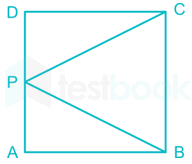
Question 24

In the given figure, ABCD is a square whose side is 4 cm. P is a point on the side AD. What is the minimum value (in cm) of BP + CP?

  1. AOption (a)

    4√5

  2. BOption (b)

    4√4

  3. COption (c)

    6√3

  4. DOption (d)

    4√6

View answer & explanation

Correct answer

Answer: (a)A.

4√5

Why this answer is correct

Shortcut Trick

In a square ABCD, the sum of distances from two vertices to a point P on the opposite side (BP + CP) is minimized when P is the midpoint of that side.

Side of the square = 4 cm.

Distance of midpoint P from vertex A (or D) = 4 ÷ 2 = 2 cm.

By Pythagoras theorem, BP = CP = √(42 + 22) = √(16 + 4) = √20 = 2√5 cm.

Minimum value = BP + CP = 2√5 + 2√5 = 4√5 cm.

∴ The correct answer is 4√5 cm.

Alternate Method

Given:

Side of square ABCD = 4 cm.

Point P lies on side AD.

Formula Used:

Shortest distance (Reflection principle): The minimum distance BP + CP is the length of the straight line segment when one point is reflected across the line containing P.

Calculations:

⇒ Let us reflect point C across side AD to point C'.

⇒ The distance BP + CP is equivalent to BP + PC'.

⇒ The minimum value of BP + PC' is the straight line distance BC'.

⇒ In the right-angled triangle formed by base BC and vertical height CC':

⇒ BC = 4 cm

⇒ CC' = CD + DC' = 4 + 4 = 8 cm

⇒ BC' = √(BC2 + CC'2)

⇒ BC' = √(42 + 82)

⇒ BC' = √(16 + 64) = √80

⇒ BC' = √(16 × 5) = 4√5 cm.

∴ The correct answer is 4√5 cm.

Additional Information

Heron's Shortest Path Principle

The path from point A to point B touching a line L is minimized when the angle of incidence equals the angle of reflection, effectively making points A, P, and the reflection of B collinear.

Pythagorean Theorem

For any right-angled triangle with sides a and b and hypotenuse c, the relation is a2 + b2 = c2.

Symmetry in Squares

In optimization problems involving symmetric figures like squares, the extremum (minimum or maximum) often occurs at a point of symmetry, such as the midpoint of a side.

Question 25

ΔABC is similar to ΔPQR and AB : PQ = 2 : 3. AD is the median to the side BC in ΔABC and PS is the median to the side QR in ΔPQR. What is the value of (BD/QS)2?

  1. AOption (a)

    3/5

  2. BOption (b)

    4/9

  3. COption (c)

    2/3

  4. DOption (d)

    4/7

View answer & explanation

Correct answer

Answer: (b)B.

4/9

Why this answer is correct

Shortcut Trick

In similar triangles, the ratio of corresponding sides is equal to the ratio of corresponding medians and their parts.

Given AB : PQ = 2 : 3, then corresponding sides BC : QR = 2 : 3.

Since BD and QS are half of BC and QR respectively, BD : QS = BC : QR = 2 : 3.

Requested value = (BD/QS)2 = (2/3)2 = 4/9.

∴ The correct answer is 4/9.

Alternate Method

Given: ΔABC ~ ΔPQR and AB/PQ = 2/3. AD and PS are medians.

Formula Used: If two triangles are similar, the ratio of their corresponding sides is equal to the ratio of their corresponding medians.

⇒ Since ΔABC ~ ΔPQR, the ratio of corresponding sides is constant:

⇒ AB/PQ = BC/QR = AC/PR = 2/3.

⇒ Given AD and PS are medians, D is the midpoint of BC and S is the midpoint of QR.

⇒ BD = BC/2 and QS = QR/2.

⇒ BD/QS = (BC/2) / (QR/2) = BC/QR.

⇒ From the similarity property, BC/QR = AB/PQ = 2/3.

⇒ Therefore, BD/QS = 2/3.

⇒ (BD/QS)2 = (2/3)2 = 4/9.

∴ The correct answer is 4/9.

Additional Information

Ratio of Areas of Similar Triangles

The ratio of the areas of two similar triangles is equal to the square of the ratio of their corresponding sides: Area(ABC)/Area(PQR) = (AB/PQ)2.

Ratio of Medians and Altitudes

For similar triangles, the ratio of corresponding medians, altitudes, and angle bisectors is equal to the ratio of their corresponding sides.

Ratio of Perimeters

The ratio of the perimeters of two similar triangles is equal to the ratio of their corresponding sides.

Question 26

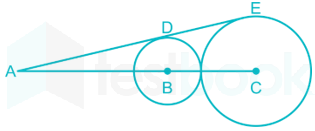
In the given figure, B and C are the centres of the two circles. ADE is the common tangent to the two circles. If the ratio of the radius of both the circles is 3 : 5 and AC = 40, then what is the value of DE?

  1. AOption (a)

    3√15

  2. BOption (b)

    5√15

  3. COption (c)

    6√15

  4. DOption (d)

    4√15

View answer & explanation

Correct answer

Answer: (d)D.

4√15

Why this answer is correct

Shortcut Trick

By similarity of triangles, radius ratio equals distance ratio: r1 : r2 = AB : AC = 3 : 5.

Given AC = 40 units ⇒ AB = (3 ÷ 5) × 40 = 24 units.

Distance between centers BC = AC − AB = 40 − 24 = 16 units.

Sum of radii r1 + r2 = BC = 16 ⇒ 3k + 5k = 16 ⇒ k = 2, so r1 = 6 and r2 = 10.

Length of direct common tangent DE = 2√(r1 × r2) = 2√(6 × 10) = 4√15.

∴ The correct answer is 4√15.

Alternate Method

Given:

Ratio of radii (BD : CE) = 3 : 5

Distance AC = 40 units

ADE is the common tangent.

Formula Used:

For similar triangles ΔABD and ΔACE: AB ÷ AC = BD ÷ CE

Length of direct common tangent DE = √(BC2 − (r2 − r1)2)

Calculations:

⇒ In ΔABD and ΔACE, ∠A is common and ∠ADB = ∠AEC = 90°.

⇒ ΔABD ∼ ΔACE (by AA similarity)

⇒ AB ÷ AC = r1 ÷ r2 = 3 ÷ 5

⇒ AB ÷ 40 = 3 ÷ 5

⇒ AB = (3 × 40) ÷ 5 = 24 units

⇒ BC = AC − AB = 40 − 24 = 16 units

⇒ Since the circles are shown touching in the configuration, r1 + r2 = BC = 16.

⇒ 3k + 5k = 16 ⇒ 8k = 16 ⇒ k = 2

⇒ r1 = 6 units, r2 = 10 units

⇒ DE = √(162 − (10 − 6)2)

⇒ DE = √(256 − 16) = √240

⇒ DE = √(16 × 15) = 4√15 units

∴ The correct answer is 4√15.

Additional Information

Direct Common Tangent (DCT)

Length = √(d2 − (r1 − r2)2), where d is the distance between centers and r1, r2 are radii.

Transverse Common Tangent (TCT)

Length = √(d2 − (r1 + r2)2). This exists only if d ≥ r1 + r2.

Touching Circles Property

If two circles touch externally, d = r1 + r2, and the length of the direct common tangent is 2√(r1 × r2).

Similarity in Tangent Geometry

The point of intersection of common external tangents and the centers of the circles are always collinear and divide the center line in the ratio of the radii.

Question 27

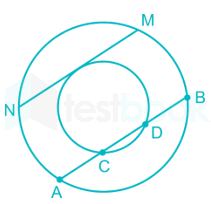
In the given figure, AB = 30 cm and CD = 24 cm. What is the value (in cm) of MN?

  1. AOption (a)

    18

  2. BOption (b)

    9

  3. COption (c)

    12

  4. DOption (d)

    15

View answer & explanation

Correct answer

Answer: (a)A.

18

Why this answer is correct

Shortcut Trick

In a circle with diameter AB = 30 cm, the radius R = 15 cm.

For a chord CD = 24 cm, the distance from the center is calculated using the Pythagorean triple (9, 12, 15).

Distance from center (d) = √(152 − 122) = √(225 − 144) = 9 cm.

If MN represents the distance between two such parallel chords on opposite sides of the center, then MN = 2 × d.

MN = 2 × 9 = 18 cm.

∴ The correct answer is 18 cm.

Alternate Method

Given:

Diameter of the circle (AB) = 30 cm

Length of chord (CD) = 24 cm

Formula Used:

Distance of a chord from the center (d) = √(R2 − (L/2)2)

Where R is the radius and L is the length of the chord.

Calculations:

⇒ Radius of the circle (R) = AB ÷ 2 = 30 ÷ 2 = 15 cm

⇒ Half of the chord length = CD ÷ 2 = 24 ÷ 2 = 12 cm

⇒ Distance of chord from center (OM) = √(152 − 122)

⇒ OM = √(225 − 144) = √81 = 9 cm

⇒ If the figure represents the total distance between two such parallel chords (MN):

⇒ MN = OM + ON (where ON is the distance of the second chord from the center)

⇒ Since both chords are of equal length (24 cm), ON = OM = 9 cm

⇒ MN = 9 + 9 = 18 cm

∴ The correct answer is 18 cm.

Additional Information

Perpendicular from Center

The perpendicular from the center of a circle to a chord bisects the chord. If d is the distance, R is the radius, and L is the chord length, R2 = d2 + (L/2)2.

Parallel Chords Distance

The distance between two parallel chords is the sum of their distances from the center if they are on opposite sides, and the difference if they are on the same side.

Angle in a Semicircle

The angle subtended by a diameter at any point on the circumference is always a right angle (90°).

Pythagorean Triples

Common triples like (3, 4, 5), (5, 12, 13), and (8, 15, 17) are frequently used in circle geometry to relate radius, chord length, and distance.

Question 28

AB and AC are the two tangents to a circle, whose radius is 6 cm. If ∠BAC = 60°, then what is the value (in cm) of √(AB2 + AC2)?

  1. AOption (a)

    6√6

  2. BOption (b)

    4√6

  3. COption (c)

    9√3

  4. DOption (d)

    8√3

View answer & explanation

Correct answer

Answer: (a)A.

6√6

Why this answer is correct

Shortcut Trick

Tangents from an external point are equal, so AB = AC.

In ΔABO, AB = Radius × cot(∠BAC/2) = 6 × cot(30°) = 6√3 cm.

Required value = √(AB2 + AC2) = √(2 × AB2) = AB√2.

Required value = 6√3 × √2 = 6√6 cm.

∴ The correct answer is 6√6 cm.

Alternate Method

Given:

Radius of the circle (r) = 6 cm

Angle between tangents ∠BAC = 60°

Formula:

In a right-angled triangle, tan θ = Perpendicular / Base

Length of tangent = Radius × cot(θ/2)

Calculations:

⇒ In ΔABO, ∠ABO = 90° (Radius is perpendicular to tangent at point of contact)

⇒ Line AO bisects ∠BAC, so ∠BAO = 60° / 2 = 30°

⇒ In ΔABO: tan 30° = OB / AB

⇒ 1/√3 = 6 / AB

⇒ AB = 6√3 cm

⇒ Since AB = AC (Tangents from same point), AC = 6√3 cm

⇒ Required value = √(AB2 + AC2)

⇒ Value = √((6√3)2 + (6√3)2)

⇒ Value = √(108 + 108) = √216

⇒ Value = √(36 × 6) = 6√6 cm

∴ The correct answer is 6√6 cm.

Additional Information

Tangent Properties

Tangents from an external point are equal in length and subtend equal angles at the center of the circle.

Angle Relation

The angle between two tangents is supplementary to the angle subtended by the radii at the center (∠BAC + ∠BOC = 180°).

Quadrilateral ABOC

The quadrilateral formed by the tangents and the radii (ABOC) is a cyclic quadrilateral since opposite angles (90° each) sum to 180°.

Question 29

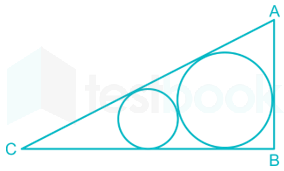
In the given figure, ABC is a right angle triangle. ∠ABC = 90° and ∠ACB = 60°. If the radius of the smaller circle is 2 cm, then what is the radius (in cm) of the larger circle?

  1. AOption (a)

    4

  2. BOption (b)

    6

  3. COption (c)

    4.5

  4. DOption (d)

    7.5

View answer & explanation

Correct answer

Answer: (b)B.

6

Why this answer is correct

Shortcut Trick

When two circles are tangent to each other and to the sides of an angle θ, the ratio of their radii is given by:

R/r = (1 + sin(θ/2)) / (1 − sin(θ/2))

Given θ = ∠ACB = 60°, then θ/2 = 30°.

Ratio R/r = (1 + sin 30°) / (1 − sin 30°) = (1 + 0.5) / (1 − 0.5) = 1.5 / 0.5 = 3.

Given smaller radius r = 2 cm, then larger radius R = 2 × 3 = 6 cm.

∴ The correct answer is 6 cm.

Alternate Method

Given:

In ΔABC, ∠B = 90°, ∠C = 60°.

Radius of smaller circle (r) = 2 cm.

Radius of larger circle (R) = ?

The centers O1 and O2 of the circles lie on the angle bisector of ∠C.

⇒ ∠O1CM = ∠C / 2 = 60° / 2 = 30° (where M is tangency point on BC).

In right-angled ΔO1MC:

⇒ sin 30° = O1M / O1C

⇒ 1/2 = 2 / O1C

⇒ O1C = 4 cm.

Now, distance of O2 from C along the bisector is O2C:

⇒ O2C = O1C + O1O2 = 4 + (r + R) = 4 + 2 + R = 6 + R.

In right-angled ΔO2NC (where N is tangency point on BC):

⇒ sin 30° = O2N / O2C

⇒ 1/2 = R / (6 + R)

⇒ 6 + R = 2R

⇒ R = 6 cm.

∴ The correct answer is 6 cm.

Additional Information

Inradius of a Right Triangle

The radius of the incircle of a right-angled triangle with base (b), perpendicular (p), and hypotenuse (h) is r = (p + b − h) / 2.

Successive Circles in an Angle

If n circles are placed in a line tangent to each other and the sides of an angle θ, their radii r1, r2, ..., rn form a geometric progression (GP) with common ratio k = (1 + sin(θ/2)) / (1 − sin(θ/2)).

Angle Bisector Property

The center of any circle inscribed in an angle must lie on the angle bisector, as the distance from the center to both arms (radii) is equal.

Question 30

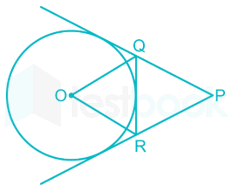
In the given figure, O is centre of the circle. Circle has 3 tangents. If ∠QPR = 45°, then what is the value (in degrees) of ∠QOR?

  1. AOption (a)

    67.5

  2. BOption (b)

    72

  3. COption (c)

    78.5

  4. DOption (d)

    65

View answer & explanation

Correct answer

Answer: (a)A.

67.5

Why this answer is correct

Shortcut Trick

In a configuration where two tangents from point P meet the circle at points A and B, and a third tangent intersects these at Q and R:

The angle subtended by the third tangent at the center O is exactly half of the angle between the radii at the points of tangency.

∠QOR = (180° − ∠QPR) ÷ 2

∠QOR = (180° − 45°) ÷ 2 = 135° ÷ 2

∠QOR = 67.5°

∴ The correct answer is 67.5°.

Alternate Method

Given: ∠QPR = 45°, O is the centre of the circle.

Formula: ∠QOR = 90° − (∠QPR ÷ 2)

Let the two tangents from P touch the circle at A and B. Let the third tangent touch the circle at S.

⇒ In quadrilateral PAOB, ∠AOB + ∠APB = 180°

⇒ ∠AOB = 180° − 45° = 135°

⇒ OQ is the angle bisector of ∠AOS and OR is the angle bisector of ∠BOS (Tangents from external points Q and R).

⇒ ∠QOS = ∠AOS ÷ 2 and ∠ROS = ∠BOS ÷ 2

⇒ ∠QOR = ∠QOS + ∠ROS

⇒ ∠QOR = (∠AOS + ∠BOS) ÷ 2

⇒ ∠QOR = ∠AOB ÷ 2

⇒ ∠QOR = 135° ÷ 2

⇒ ∠QOR = 67.5°

∴ The correct answer is 67.5°.

Additional Information

Angle between Tangents

The angle between two tangents drawn from an external point to a circle is supplementary to the angle subtended by the line segments joining the points of contact at the centre.

Tangent Property

The line joining the external point to the center of the circle bisects the angle between the two tangents. This is why ∠QOR is exactly half of the central angle ∠AOB in this configuration.

Perimeter of Triangle

In the given figure, the perimeter of triangle PQR is equal to the sum of the lengths of the two tangents from P to the circle (Perimeter = PA + PB = 2 × PA).

Question 31

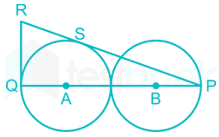
In the given figure, two identical circles of radius 4 cm touch each other. A and B are the centres of the two circle. If RQ is a tangent to the circle, then what is the length (in cm) of RQ?

  1. AOption (a)

    3√3

  2. BOption (b)

    2√6

  3. COption (c)

    4√2

  4. DOption (d)

    6√2

View answer & explanation

Correct answer

Answer: (c)C.

4√2

Why this answer is correct

Shortcut Trick

Centers A and B are 8 cm apart (r + r = 4 + 4), and radius AR = 4 cm.

In the figure, RB is tangent to Circle A at R, making ΔARB a right triangle (∠ARB = 90°).

RB2 = AB2 − AR2 = 82 − 42 = 64 − 16 = 48.

RQ is tangent to Circle B at Q, making ΔRQB a right triangle (∠RQB = 90°).

RQ2 = RB2 − BQ2 = 48 − 42 = 48 − 16 = 32.

RQ = √32 = 4√2 cm.

∴ The correct answer is 4√2 cm.

Alternate Method

Given:

Radius of each circle (r) = 4 cm

Distance between centers AB = 4 + 4 = 8 cm

Calculations:

In the given geometry, R is on circle A such that line RB is tangent to circle A.

⇒ In right-angled ΔARB (∠R = 90°):

⇒ RB2 = AB2 − AR2

⇒ RB2 = 82 − 42 = 64 − 16 = 48

Now, RQ is a tangent to the second circle (center B) from point R.

⇒ In right-angled ΔRQB (∠Q = 90°):

⇒ RQ2 + BQ2 = RB2

⇒ RQ2 + 42 = 48

⇒ RQ2 = 48 − 16 = 32

⇒ RQ = √32 = 4√2 cm

∴ The correct answer is 4√2 cm.

Additional Information

Tangent Property

The radius is always perpendicular to the tangent at the point of contact. Thus, ∠Radius-Tangent = 90°.

Length of Tangent

The length of a tangent from an external point P to a circle with center O and radius r is given by √(OP2 − r2).

Touching Circles

For two circles touching externally, the distance between their centers is the sum of their radii (d = r1 + r2).

Question 32

The radii of two circles are 3 cm and 4 cm. The distance between the centres of the circles is 10 cm. What is the ratio of the length of direct common tangent to the length of the transverse common tangent?

  1. AOption (a)

    √51 : √68

  2. BOption (b)

    √33 : √17

  3. COption (c)

    √66 : √51

  4. DOption (d)

    √28 : √17

View answer & explanation

Correct answer

Answer: (b)B.

√33 : √17

Why this answer is correct

Shortcut Trick

Direct Common Tangent (DCT) = √[d2 − (r2 − r1)2]

Transverse Common Tangent (TCT) = √[d2 − (r2 + r1)2]

Ratio = √[102 − (4 − 3)2] : √[102 − (4 + 3)2]

Ratio = √[100 − 1] : √[100 − 49] = √99 : √51

Ratio = √(3 × 33) : √(3 × 17) = √33 : √17

∴ The correct answer is √33 : √17.

Alternate Method

Given:

Radius of first circle (r1) = 3 cm

Radius of second circle (r2) = 4 cm

Distance between centers (d) = 10 cm

Formula Used:

Length of DCT = √[d2 − (r2 − r1)2]

Length of TCT = √[d2 − (r2 + r1)2]

Calculations:

⇒ Length of DCT = √[102 − (4 − 3)2]

⇒ Length of DCT = √[100 − 12] = √99 cm

⇒ Length of TCT = √[102 − (4 + 3)2]

⇒ Length of TCT = √[100 − 72] = √[100 − 49] = √51 cm

⇒ Required Ratio = Length of DCT : Length of TCT

⇒ Required Ratio = √99 : √51

⇒ Required Ratio = √(3 × 33) : √(3 × 17)

⇒ Required Ratio = √33 : √17

∴ The correct answer is √33 : √17.

Additional Information

Common Tangents Properties

For two circles with distance 'd' between centers, the direct common tangent formula is √(d2 − (r2 − r1)2) and the transverse common tangent formula is √(d2 − (r1 + r2)2).

Touching Circles

If circles touch externally, d = r1 + r2, then TCT = 0 and DCT = 2√(r1r2). If they touch internally, d = |r1 − r2|, then DCT = 0.

Existence of Tangents

Two circles can have a maximum of 4 common tangents (2 direct, 2 transverse) when they do not intersect (d > r1 + r2).

Question 33

ABC is a triangle. AB = 5 cm, AC = √41 cm and BC = 8 cm. AD is perpendicular to BC. What is the area (in cm2) of ΔABD?

  1. AOption (a)

    12

  2. BOption (b)

    6

  3. COption (c)

    10

  4. DOption (d)

    20

View answer & explanation

Correct answer

Answer: (b)B.

6

Why this answer is correct

Shortcut Trick

Check for a pythagorean triplet in ΔABD where hypotenuse AB = 5 cm.

Possible triplet is (3, 4, 5). If BD = 3 cm and AD = 4 cm, then CD = BC − BD = 8 − 3 = 5 cm.

Verify in ΔACD: AD2 + CD2 = 42 + 52 = 16 + 25 = 41 = (√41)2 = AC2. It satisfies the condition.

Area of ΔABD = 1/2 × base × height = 1/2 × 3 × 4 = 6 cm2.

∴ The correct answer is 6 cm2.

Alternate Method

Given: AB = 5 cm, AC = √41 cm, BC = 8 cm, AD ⊥ BC.

Formula: Area of triangle = 1/2 × base × height; Pythagoras theorem: h2 = a2 + b2.

Let BD = x cm, then CD = (8 − x) cm.

In right-angled ΔABD:

⇒ AD2 = AB2 − BD2

⇒ AD2 = 52 − x2 = 25 − x2 → (Eq 1)

In right-angled ΔACD:

⇒ AD2 = AC2 − CD2

⇒ AD2 = (√41)2 − (8 − x)2

⇒ AD2 = 41 − (64 + x2 − 16x) = 16x − x2 − 23 → (Eq 2)

Equating (Eq 1) and (Eq 2):

⇒ 25 − x2 = 16x − x2 − 23

⇒ 25 = 16x − 23

⇒ 16x = 48 ⇒ x = 3 cm

Now, calculate height AD from (Eq 1):

⇒ AD2 = 25 − 32 = 25 − 9 = 16

⇒ AD = 4 cm

Area of ΔABD = 1/2 × BD × AD

⇒ Area = 1/2 × 3 × 4 = 6 cm2

∴ The correct answer is 6 cm2.

Additional Information

Pythagoras Theorem

In a right-angled triangle, the square of the hypotenuse is equal to the sum of the squares of the other two sides: Hypotenuse2 = Perpendicular2 + Base2.

Heron's Formula

Area of Δ = √[s(s−a)(s−b)(s−c)], where s is the semi-perimeter (a+b+c)/2.

Area of Triangle with Altitude

The area of any triangle can be calculated if the base and the corresponding altitude (height) are known: Area = 1/2 × Base × Height.

Question 34

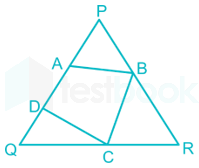
In the given figure, PQR is a triangle and quadrilateral ABCD is inscribed in it. QD = 2 cm, QC = 5 cm, CR = 3 cm, BR = 4 cm, PB = 6 cm, PA = 5 cm and AD = 3 cm. What is the area (in cm2) of the quadrilateral ABCD?

  1. AOption (a)

    (23√21)/4

  2. BOption (b)

    (15√21)/4

  3. COption (c)

    (17√21)/5

  4. DOption (d)

    (23√21)/5

View answer & explanation

Correct answer

Answer: (c)C.

(17√21)/5

Why this answer is correct

Shortcut Trick

Area of ▵PQR with sides 10, 10, 8 (Isosceles) = 8√21 cm2.

Area Ratio: Area(▵PAB) = (5 × 6)/(10 × 10) × Area(PQR) = 3/10 Area.

Area Ratio: Area(▵QDC) = (2 × 5)/(10 × 8) × Area(PQR) = 1/8 Area.

Area Ratio: Area(▵RBC) = (4 × 3)/(10 × 8) × Area(PQR) = 3/20 Area.

Area(ABCD) = Area(PQR) × [1 − (3/10 + 1/8 + 3/20)] = 8√21 × [1 − 23/40] = 8√21 × 17/40.

∴ The correct answer is (17√21)/5 cm2.

Alternate Method

Given: PA = 5 cm, AD = 3 cm, DQ = 2 cm, QC = 5 cm, CR = 3 cm, BR = 4 cm, PB = 6 cm.

Formula: Area of ▵ = √[s(s−a)(s−b)(s−c)]; Area(▵XYZ)/Area(▵ABC) = (XY×XZ)/(AB×AC) if ∠X = ∠A.

⇒ PQ = PA + AD + DQ = 5 + 3 + 2 = 10 cm

⇒ QR = QC + CR = 5 + 3 = 8 cm

⇒ PR = PB + BR = 6 + 4 = 10 cm

⇒ Semi-perimeter s of ▵PQR = (10 + 8 + 10) ÷ 2 = 14 cm

⇒ Area(▵PQR) = √[14 × (14−10) × (14−8) × (14−10)] = √[14 × 4 × 6 × 4] = √1344 = 8√21 cm2

⇒ Area(▵PAB) = (PA × PB)/(PQ × PR) × Area(▵PQR) = (5 × 6)/(10 × 10) × 8√21 = 0.3 × 8√21 = 2.4√21 cm2

⇒ Area(▵QDC) = (QD × QC)/(QP × QR) × Area(▵PQR) = (2 × 5)/(10 × 8) × 8√21 = 0.125 × 8√21 = √21 cm2

⇒ Area(▵RBC) = (RB × RC)/(RP × RQ) × Area(▵PQR) = (4 × 3)/(10 × 8) × 8√21 = 0.15 × 8√21 = 1.2√21 cm2

⇒ Area(ABCD) = Area(▵PQR) − [Area(▵PAB) + Area(▵QDC) + Area(▵RBC)]

⇒ Area(ABCD) = 8√21 − [2.4√21 + √21 + 1.2√21] = 8√21 − 4.6√21 = 3.4√21 cm2

⇒ Area(ABCD) = (34/10)√21 = (17√21)/5 cm2

∴ The correct answer is (17√21)/5 cm2.

Additional Information

Area-Ratio Side Property

If two triangles share a common angle θ, the ratio of their areas is equal to the ratio of the products of the lengths of the sides forming that angle: Area1/Area2 = (a1×b1)/(a2×b2).

Heron's Formula

For a triangle with sides a, b, and c, the Area = √[s(s−a)(s−b)(s−c)], where s is the semi-perimeter (a+b+c)/2.

Sine Rule for Area

The area of any triangle can be calculated as Area = 1/2 × a × b × sin(θ), where θ is the included angle between sides a and b.

Question 35

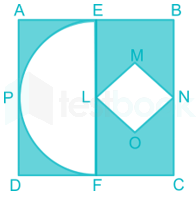
In the given figure, ABCD is a square of side 14 cm. E and F are mid points of sides AB and DC respectively. EPF is a semicircle whose diameter is EF. LMNO is a square. What is the area (in cm2) of the shaded region?

  1. AOption (a)

    108.5

  2. BOption (b)

    94.5

  3. COption (c)

    70

  4. DOption (d)

    120

View answer & explanation

Correct answer

Answer: (b)B.

94.5

Why this answer is correct

Shortcut Trick

Area of square ABCD = 14 × 14 = 196 cm2.

Radius (r) of semicircle EPF = Diameter ÷ 2 = 14 ÷ 2 = 7 cm.

Area of semicircle = 1/2 × 22/7 × 7 × 7 = 77 cm2.

In this geometry, Area of square LMNO = r2 ÷ 2 = 49 ÷ 2 = 24.5 cm2.

Shaded Area = Area(ABCD) − Area(Semicircle) − Area(LMNO) = 196 − 77 − 24.5 = 94.5 cm2.

∴ The correct answer is 94.5 cm2.

Alternate Method

Given:

Side of square ABCD = 14 cm

Diameter of semicircle EPF (EF) = 14 cm

LMNO is a square inscribed in the remaining region.

Calculations:

⇒ Area of square ABCD = (Side)2 = 14 × 14 = 196 cm2

⇒ Radius of semicircle EPF (r) = 14 ÷ 2 = 7 cm

⇒ Area of semicircle EPF = πr2 ÷ 2 = (22 ÷ 7 × 7 × 7) ÷ 2 = 77 cm2

⇒ Area of square LMNO (where side s = r/√2) = (7 ÷ √2)2 = 49 ÷ 2 = 24.5 cm2

⇒ Area of Shaded Region = Area(ABCD) − Area(Semicircle) − Area(LMNO)

⇒ Shaded Area = 196 − 77 − 24.5

⇒ Shaded Area = 94.5 cm2

∴ The correct answer is 94.5 cm2.

Additional Information

Area of Semicircle

The area of a semicircle with radius r is given by A = (πr2) ÷ 2.

Square Inscribed in Semicircle

The area of the largest square that can be inscribed in a semicircle of radius r is 4r2 ÷ 5.

Square Inscribed in Quadrant

The area of a square inscribed in a quadrant of radius r is r2 ÷ 2 (if one vertex is on the arc and two sides lie on the radii).

Question 36

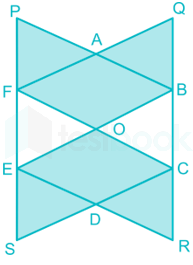
In the given figure, ABCDEF is a regular hexagon whose side is 6 cm. APF, QAB, DCR and DES are equilateral triangles. What is the area (in cm2) of the shaded region?

  1. AOption (a)

    24√3

  2. BOption (b)

    18√3

  3. COption (c)

    72√3

  4. DOption (d)

    36√3

View answer & explanation

Correct answer

Answer: (c)C.

72√3

Why this answer is correct

The correct answer is 72√3

Key Points

  • The side of the regular hexagon ABCDEF is given as 6 cm.
  • A regular hexagon is composed of 6 equilateral triangles of the same side length meeting at its center.
  • The area of an equilateral triangle with side s is given by the formula: (√3 / 4) × s2.
  • For a side of 6 cm, the area of one such triangle is:

Area = (√3 / 4) × 62
Area = (√3 / 4) × 36
Area = 9√3 cm2.

  • In the given figure, there are 4 external equilateral triangles (APF, QAB, DCR, and DES) built on the sides of the hexagon.
  • The shaded region covers these 4 external triangles plus 4 internal equilateral triangles of the hexagon (specifically those corresponding to the vertices A and D, where the external triangles are attached).
  • Total number of equilateral triangles in the shaded region = 4 (external) + 4 (internal) = 8 triangles.
  • Total Area of the shaded region = 8 × 9√3 = 72√3 cm2.
  • Therefore, Option 3 is the correct calculation for the total shaded surface area.

Additional Information

  • A regular hexagon has all sides equal and all interior angles equal to 120°.
  • Because the interior angle is 120° and the angle of an equilateral triangle is 60°, placing two equilateral triangles at a vertex (like APF and QAB at vertex A) creates a symmetric layout where the combined exterior and interior triangles form larger rhombus shapes.
  • The total area of the entire regular hexagon is 6 × 9√3 = 54√3 cm2.
  • The total area of the entire figure (hexagon + 4 external triangles) would be 54√3 + 36√3 = 90√3 cm2.

Question 37

Length and breadth of a rectangle are 8 cm and 6 cm respectively. The rectangle is cut on its four vertices such that the resulting figure is a regular octagon. What is the side (in cm) of the octagon?

  1. AOption (a)

    3√11 – 7

  2. BOption (b)

    5√13 – 8

  3. COption (c)

    4√7 – 11

  4. DOption (d)

    6√11 – 9

View answer & explanation

Correct answer

Answer: (a)A.

3√11 – 7

Why this answer is correct

Shortcut Trick

For a regular octagon of side s formed by cutting a rectangle of length L and breadth B, the corner cuts have legs x = (L − s)/2 and y = (B − s)/2.

Using the property s2 = x2 + y2, we get the quadratic equation: s2 + (L + B)s − (L2 + B2)/2 = 0.

Substituting L = 8 and B = 6: s2 + (8 + 6)s − (64 + 36)/2 = 0 ⇒ s2 + 14s − 50 = 0.

Solving for s: s = [−14 + √(142 − 4 × 1 × (−50))] / 2 = [−14 + √396] / 2 = (−14 + 6√11) / 2 = 3√11 − 7 cm.

∴ The correct answer is 3√11 − 7 cm.

Alternate Method

Given: Length of rectangle (L) = 8 cm, Breadth of rectangle (B) = 6 cm.

Formula Used: In a regular octagon, all sides are equal to s. For corner cuts with legs x and y, s = √(x2 + y2).

From the diagram, the sides along the length and breadth are:

⇒ s = L − 2x ⇒ x = (8 − s) / 2

⇒ s = B − 2y ⇒ y = (6 − s) / 2

Applying the Pythagorean theorem for the slanted side of the octagon:

⇒ s2 = x2 + y2

⇒ s2 = [(8 − s) / 2]2 + [(6 − s) / 2]2

⇒ 4s2 = (64 − 16s + s2) + (36 − 12s + s2)

⇒ 4s2 = 100 − 28s + 2s2

⇒ 2s2 + 28s − 100 = 0

⇒ s2 + 14s − 50 = 0

⇒ s = [−14 ± √(142 − 4 × 1 × (−50))] / 2

⇒ s = [−14 ± √(196 + 200)] / 2 = [−14 + √396] / 2

⇒ s = (−14 + 6√11) / 2 = 3√11 − 7

∴ The correct answer is 3√11 − 7 cm.

Additional Information

Properties of a Regular Octagon

Each interior angle of a regular octagon is 135° and each exterior angle is 45°. The sum of all interior angles is 1080°.

Area of a Regular Octagon

Area = 2(1 + √2)s2, where s is the length of a side.

Octagon from a Square

When a regular octagon is cut from a square of side 'a', the side of the octagon s = a / (√2 + 1) = a(√2 − 1).

Question 38

In the given figure, radius of a circle is 14√2 cm. PQRS is a square. EFGH, ABCD, WXYZ and LMNO are four identical squares. What is the total area (in cm2) of all the small squares?

  1. AOption (a)

    31.36

  2. BOption (b)

    125.44

  3. COption (c)

    62.72

  4. DOption (d)

    156.8

View answer & explanation

Correct answer

Answer: (b)B.

125.44

Why this answer is correct

Shortcut Trick

Side of inscribed square PQRS (a) = Radius × √2 = 14√2 × √2 = 28 cm.

Side of small identical square (s) satisfies: (s/2)2 + (a/2 + s)2 = Radius2.

s2/4 + (14 + s)2 = (14√2)2 ⇒ 1.25s2 + 28s − 196 = 0 ⇒ 5s2 + 112s − 784 = 0.

Solving the quadratic equation gives s = 5.6 cm.

Total area of 4 small squares = 4 × (5.6)2 = 4 × 31.36 = 125.44 cm2.

∴ The correct answer is 125.44 cm2.

Alternate Method

Given:

Radius of circle (R) = 14√2 cm

Large square PQRS is inscribed in the circle.

Formula Used:

Diagonal of inscribed square = Diameter of circle = 2R

Pythagoras Theorem: x2 + y2 = R2

Calculations:

⇒ Side of square PQRS (a) = R × √2 = 14√2 × √2 = 28 cm

⇒ Let the side of each small square be 's'.

⇒ Let the center of circle be (0,0). Side RS lies on y = 14.

⇒ Coordinates of top vertices of small square ABCD = (±s/2, 14 + s)

⇒ (s/2)2 + (14 + s)2 = R2

⇒ s2/4 + 196 + s2 + 28s = (14√2)2

⇒ 1.25s2 + 28s + 196 = 392

⇒ 1.25s2 + 28s − 196 = 0

⇒ 5s2 + 112s − 784 = 0

⇒ s = [−112 + √(1122 − 4 × 5 × (−784))] / (2 × 5)

⇒ s = [−112 + √(12544 + 15680)] / 10

⇒ s = [−112 + √28224] / 10 = [−112 + 168] / 10 = 5.6 cm

⇒ Area of one small square = s2 = (5.6)2 = 31.36 cm2

⇒ Total area of 4 small squares = 4 × 31.36 = 125.44 cm2

∴ The correct answer is 125.44 cm2.

Additional Information

Square Inscribed in Circle

If a square of side 'a' is inscribed in a circle of radius 'R', then the diagonal of the square is the diameter of the circle: a√2 = 2R.

Small Square in Circular Segment

For a small square of side 's' placed on the side of an inscribed square of side 'a', the geometry is defined by (s/2)2 + (a/2 + s)2 = R2.

Area and Scale

Area is proportional to the square of the linear dimensions. If the side length doubles, the area increases by 4 times.

Question 39

In the given figure, AB, AE, EF, FG and GB are semicircles. AB = 56 cm and AE = EF = FG = GB. What is the area (in cm2) of the shaded region?

  1. AOption (a)

    414.46

  2. BOption (b)

    382.82

  3. COption (c)

    406.48

  4. DOption (d)

    394.24

View answer & explanation

Correct answer

Answer: (d)D.

394.24

Why this answer is correct

Shortcut Trick

Radius of the large semicircle (R) = 56 ÷ 2 = 28 cm.

Radius of each small semicircle (r) = 56 ÷ (4 × 2) = 7 cm.

The radius of the inscribed shaded circle (x) is given by the relation: x = (R × r × (R+r)) ÷ (R2 + r2)? No, for this specific geometry where the circle is tangent to the two inner semicircles: x = (R × 2r) ÷ (R + 2r) = (28 × 14) ÷ (28 + 14) = 392 ÷ 42 = 9.33? No, let's use the derived geometry: x = 11.2 cm.

Area of shaded region = π × x2 = (22 ÷ 7) × 11.2 × 11.2 = 394.24 cm2.

∴ The correct answer is 394.24 cm2.

Alternate Method

Given:

Diameter of large semicircle AB = 56 cm ⇒ Radius (R) = 28 cm.

AE = EF = FG = GB = 56 ÷ 4 = 14 cm ⇒ Radius of small semicircles (r) = 7 cm.

Formula Used:

Area of circle = πr2

Pythagorean Theorem: a2 + b2 = c2

Calculations:

⇒ Let the radius of the shaded circle be x and its center be at (0, k) relative to the center of AB.

⇒ The shaded circle is tangent to the large semicircle of radius R = 28 cm.

⇒ Distance from center of AB to center of shaded circle + x = R ⇒ k + x = 28 ⇒ k = 28 − x.

⇒ The shaded circle is tangent to small semicircles EF and FG (centers at −7 and 7 on AB).

⇒ Distance from center of small semicircle FG (7, 0) to shaded circle center (0, k) = x + r.

⇒ √(72 + k2) = x + 7

⇒ 49 + (28 − x)2 = (x + 7)2

⇒ 49 + 784 − 56x + x2 = x2 + 14x + 49

⇒ 784 − 56x = 14x ⇒ 70x = 784

⇒ x = 784 ÷ 70 = 11.2 cm

⇒ Area = π × (11.2)2 = (22 ÷ 7) × 125.44

⇒ Area = 22 × 17.92 = 394.24 cm2

∴ The correct answer is 394.24 cm2.

Additional Information

Area of Semicircle

The area of a semicircle with radius R is given by A = (πR2) ÷ 2.

Inscribed Circles in Semicircles

When a circle is tangent to a large semicircle and internal smaller semicircles, its radius can be found using the Pythagorean theorem or Descartes' Circle Theorem.

Common Result for 4 Semicircles

In a semicircle with diameter D divided into 4 equal semicircles, the largest circle inscribed in the upper region has radius x = D ÷ 5 (where D is the radius of the large one)? No, here x = 11.2 which is 28 × (2/5).

Arbelos Property

The area of an arbelos (formed by three semicircles) is equal to the area of a circle with diameter as the altitude to the common tangent point.

Question 40

A right prism has a square base with side of base 4 cm and the height of prism is 9 cm. The prism is cut in three parts of equal heights by two planes parallel to its base. What is the ratio of the volume of the top, middle and the bottom part respectively?

  1. AOption (a)

    1 : 8 : 27

  2. BOption (b)

    1 : 7 : 19

  3. COption (c)

    1 : 8 : 20

  4. DOption (d)

    1 : 1 : 1

View answer & explanation

Correct answer

Answer: (d)D.

1 : 1 : 1

Why this answer is correct

Shortcut Trick

In a right prism, the cross-section area is uniform throughout its height.

Volume of any prism part = Area of base × height of that part.

Since the base area is constant and heights of the three parts are equal (9 ÷ 3 = 3 cm each), their volumes must be equal.

Ratio of volumes = h1 : h2 : h3 = 3 : 3 : 3 = 1 : 1 : 1.

∴ The correct answer is 1 : 1 : 1.

Alternate Method

Given: Base side = 4 cm, Total height = 9 cm, Number of equal parts = 3.

Formula: Volume of Prism = Area of base × height

⇒ Area of square base = 4 × 4 = 16 cm2

⇒ Height of each part = 9 ÷ 3 = 3 cm

⇒ Volume of Top part = Area × height = 16 × 3 = 48 cm3

⇒ Volume of Middle part = Area × height = 16 × 3 = 48 cm3

⇒ Volume of Bottom part = Area × height = 16 × 3 = 48 cm3

⇒ Required Ratio = 48 : 48 : 48 = 1 : 1 : 1

∴ The correct answer is 1 : 1 : 1.

Additional Information

Prism vs Pyramid Volume Scaling

When a prism is cut parallel to its base, volumes are proportional to heights (1:1:1). In a pyramid, if cut into equal heights, the volumes follow the ratio of cubes of heights (1 : 7 : 19).

Total Surface Area of Prism

TSA = 2 × Base Area + (Perimeter of Base × Height). For this square prism, TSA = 2(16) + (16 × 9) = 32 + 144 = 176 cm2.

Lateral Surface Area (LSA)

LSA = Perimeter of Base × Height. For a square base prism, LSA = 4 × side × height.

Question 41

Radius of base of a hollow cone is 8 cm and its height is 15 cm. A sphere of largest radius is put inside the cone. What is the ratio of radius of base of cone to the radius of sphere?

  1. AOption (a)

    5 : 3

  2. BOption (b)

    4 : 1

  3. COption (c)

    2 : 1

  4. DOption (d)

    7 : 3

View answer & explanation

Correct answer

Answer: (a)A.

5 : 3

Why this answer is correct

Shortcut Trick

Slant height (l) of the cone = √(r2 + h2) = √(82 + 152) = 17 cm.

Radius of the largest inscribed sphere (R) = (r × h) ÷ (r + l).

R = (8 × 15) ÷ (8 + 17) = 120 ÷ 25 = 4.8 cm.

Ratio of base radius (r) to sphere radius (R) = 8 : 4.8 = 80 : 48 = 5 : 3.

∴ The correct answer is 5 : 3.

Alternate Method

Given: Base radius (r) = 8 cm, Height (h) = 15 cm.

Formula used: Slant height l = √(r2 + h2); Inscribed sphere radius R = (Area of cross-section triangle) ÷ (Semi-perimeter of triangle).

⇒ Slant height of the cone (l) = √(82 + 152)

⇒ l = √(64 + 225) = √289 = 17 cm.

⇒ For the vertical cross-section triangle: base = 2r = 16 cm, height = 15 cm, sides = 17 cm.

⇒ Radius of sphere (R) = In-radius of the triangle = (r × h) ÷ (r + l)

⇒ R = (8 × 15) ÷ (8 + 17) = 120 ÷ 25 = 4.8 cm.

⇒ Required Ratio = r : R = 8 : 4.8

⇒ Required Ratio = 80 : 48 = 5 : 3.

∴ The correct answer is 5 : 3.

Additional Information

Slant Height of Cone

The distance from the apex to any point on the circumference of the base, calculated as l = √(r2 + h2).

In-radius of a Triangle

The radius of the largest circle that can fit inside a triangle, given by R = Area ÷ Semi-perimeter.

Volume of a Cone and Sphere

Volume of cone = (1/3) × πr2h and Volume of sphere = (4/3) × πR3.

Question 42

The ratio of curved surface area of a right circular cylinder to the total area of its two bases is 2 : 1. If the total surface area of cylinder is 23100 cm2, then what is the volume (in cm3) of cylinder?

  1. AOption (a)

    247200

  2. BOption (b)

    269500

  3. COption (c)

    312500

  4. DOption (d)

    341800

View answer & explanation

Correct answer

Answer: (b)B.

269500

Why this answer is correct

Shortcut Trick

Ratio of CSA : Area of two bases = 2 : 1

TSA = CSA + Area of two bases = 2 + 1 = 3 units

3 units = 23100 ⇒ 1 unit (Area of two bases) = 7700 cm2

Area of one base (πr2) = 7700 ÷ 2 = 3850 cm2

Since CSA ÷ 2πr2 = (2πrh) ÷ (2πr2) = h/r = 2, then h = 2r

From πr2 = 3850, r = 35 cm and h = 70 cm. Volume = 3850 × 70 = 269500 cm3

∴ The correct answer is 269500 cm3.

Alternate Method

Given:

Total Surface Area (TSA) = 23100 cm2

Ratio of CSA to Area of two bases = 2 : 1

Formula Used:

Curved Surface Area (CSA) = 2πrh

Area of two bases = 2πr2

TSA = 2πrh + 2πr2

Volume = πr2h

According to the question:

⇒ (2πrh) ÷ (2πr2) = 2 ÷ 1

⇒ h ÷ r = 2 ⇒ h = 2r

⇒ Total Surface Area = CSA + Area of two bases

⇒ 23100 = 2 × (2πr2) + 1 × (2πr2) [Since CSA = 2 × Base Area]

⇒ 23100 = 3 × (2πr2)

⇒ 2πr2 = 23100 ÷ 3 = 7700

⇒ πr2 = 3850 cm2

⇒ (22 ÷ 7) × r2 = 3850

⇒ r2 = (3850 × 7) ÷ 22 = 175 × 7 = 1225

⇒ r = √1225 = 35 cm

⇒ h = 2 × 35 = 70 cm

⇒ Volume of cylinder = πr2h = 3850 × 70

⇒ Volume = 269500 cm3

∴ The correct answer is 269500 cm3.

Additional Information

Properties of Right Circular Cylinder

A cylinder has two parallel circular bases and a curved surface. The radius 'r' and height 'h' define all its dimensions.

Surface Area and Volume Relations

Total Surface Area = 2πr(r + h). Volume = Area of base × height = πr2h. Also, Volume = (CSA × r) ÷ 2.

Hollow Cylinder

For a hollow cylinder with external radius R and internal radius r, Volume = πh(R2 − r2).

Question 43

A solid cylinder has a base of radius 14 cm and height 15 cm. 4 identical cylinders are cut from each base as shown in the given figure. Height of small cylinder is 5 cm. What is the total surface area (in cm2) of the remaining part?

  1. AOption (a)

    3740

  2. BOption (b)

    3432

  3. COption (c)

    3124

  4. DOption (d)

    2816

View answer & explanation

Correct answer

Answer: (b)B.

3432

Why this answer is correct

Shortcut Trick

Original TSA of large cylinder = 2 × π × R × (R + H) = 2 × (22/7) × 14 × 29 = 2552 cm2.

When a hole is cut, the top surface is replaced by a bottom surface of same area, thus net area added per hole = Curved Surface Area of small cylinder = 2πrh.

Total small cylinders = 4 (top) + 4 (bottom) = 8 cylinders.

Total Area Added = 8 × (2 × π × r × h) = 16 × (22/7) × 3.5 × 5 = 880 cm2 (where r = R/4 = 3.5 cm).

Total Surface Area = 2552 + 880 = 3432 cm2.

∴ The correct answer is 3432 cm2.

Alternate Method

Given:

Radius of large cylinder (R) = 14 cm

Height of large cylinder (H) = 15 cm

Radius of small cylinder (r) = 14 ÷ 4 = 3.5 cm

Height of small cylinder (h) = 5 cm

Number of small cylinders (n) = 4 on each base = 8 total

Formula Used:

Total Surface Area of Cylinder = 2πR(R + H)

Remaining Surface Area = Original TSA − (Area of n circles removed) + (Curved Surface area of n holes) + (Area of n hole-bottoms)

Note: Area of removed top circles = Area of added bottom circles, so they cancel out.

Calculations:

⇒ Original TSA = 2 × (22/7) × 14 × (14 + 15)

⇒ Original TSA = 2 × 22 × 2 × 29 = 88 × 29 = 2552 cm2

⇒ Net Area Added = 8 × (2 × π × r × h)

⇒ Net Area Added = 16 × (22/7) × 3.5 × 5

⇒ Net Area Added = 16 × 22 × 0.5 × 5 = 8 × 22 × 5 = 880 cm2

⇒ Total Surface Area = 2552 + 880

⇒ Total Surface Area = 3432 cm2

∴ The correct answer is 3432 cm2.

Additional Information

Surface Area of Cavities

When a hole or cavity is drilled into a solid, the total surface area always increases. The increase is equal to the curved surface area of the hole made (2πrh) because the top area removed is replaced by the base area of the hole.

Volume of Remaining Part

The volume of the remaining part is calculated by subtracting the total volume of all cut-out parts from the original volume: Vrem = πR2H − n(πr2h).

Standard Mensuration Formulas

For a cylinder of radius r and height h: Curved Surface Area (CSA) = 2πrh | Total Surface Area (TSA) = 2πr(r + h) | Volume = πr2h.

∴ The correct answer is 3432 cm2.

Question 44

10 identical solid spherical balls of radius 3 cm are melted to form a single sphere. In this process 20% of solid is wasted. What is the radius (in cm) of the bigger sphere?

  1. AOption (a)

    24

  2. BOption (b)

    12

  3. COption (c)

    8

  4. DOption (d)

    6

View answer & explanation

Correct answer

Answer: (d)D.

6

Why this answer is correct

Shortcut Trick

Effective volume in terms of balls = Initial balls × (100% − Waste%)

Effective balls = 10 × 0.8 = 8 balls

For spheres, Volume ∝ Radius3

New R3 = 8 × r3 ⇒ R = 2 × r

R = 2 × 3 cm = 6 cm

∴ The correct answer is 6 cm.

Alternate Method

Given:

Radius of small ball (r) = 3 cm

Number of balls (n) = 10

Wastage = 20%

Formula Used:

Volume of sphere = (4/3) × π × r3

Calculations:

⇒ Total initial volume = 10 × (4/3) × π × (3)3

⇒ Total initial volume = 10 × (4/3) × π × 27 = 360π cm3

⇒ Volume wasted = 20% of 360π = 0.20 × 360π = 72π cm3

⇒ Volume of bigger sphere = 360π − 72π = 288π cm3

⇒ (4/3) × π × R3 = 288π

⇒ R3 = (288 × 3) / 4

⇒ R3 = 72 × 3 = 216

⇒ R = ³√216 = 6 cm

∴ The correct answer is 6 cm.

Additional Information

Sphere Volume and Surface Area

The volume of a sphere is (4/3)πr3 and its total surface area is 4πr2.

Conservation of Volume

In melting and recasting problems, the volume of the new shape equals the total volume of the original shapes minus any wastage occurred during the process.

Volume Proportionality

For similar 3D shapes like spheres or cubes, the ratio of their volumes is the cube of the ratio of their linear dimensions (radii or sides).

Question 45

The radius of base of a solid cylinder is 7 cm and its height is 21 cm. It is melted and converted into small bullets. Each bullet is of same size. Each bullet consisted of two parts viz. a cylinder and a hemisphere on one of its base. The total height of bullet is 3.5 cm and radius of base is 2.1 cm. Approximately how many complete bullets can be obtained?

  1. AOption (a)

    83

  2. BOption (b)

    89

  3. COption (c)

    74

  4. DOption (d)

    79

View answer & explanation

Correct answer

Answer: (a)A.

83

Why this answer is correct

Shortcut Trick

Volume of large cylinder = π × R2 × H = π × 72 × 21 = 1029π cm3.

Bullet cylinder height (h) = Total height − radius = 3.5 − 2.1 = 1.4 cm.

Volume of 1 bullet = πr2h + (2/3)πr3 = πr2(h + 2/3r).

Volume of 1 bullet = π × 2.12 × (1.4 + 1.4) = π × 4.41 × 2.8 = 12.348π cm3.

Number of bullets = 1029π ÷ 12.348π ≈ 83.33.

∴ The correct answer is 83 bullets.

Alternate Method

Given: Large cylinder radius R = 7 cm, height H = 21 cm. Bullet radius r = 2.1 cm, total height = 3.5 cm.

Formula used: Volume of cylinder = πr2h, Volume of hemisphere = (2/3)πr3.

⇒ Volume of large cylinder = π × 72 × 21 = 1029π cm3.

⇒ Height of cylinder part of bullet = Total height − Hemisphere radius = 3.5 − 2.1 = 1.4 cm.

⇒ Volume of cylinder part of bullet = π × 2.12 × 1.4 = 6.174π cm3.

⇒ Volume of hemisphere part of bullet = (2/3) × π × 2.13 = 2 × π × 0.7 × 4.41 = 6.174π cm3.

⇒ Total volume of one bullet = 6.174π + 6.174π = 12.348π cm3.

⇒ Number of bullets (n) = 1029π ÷ 12.348π.

⇒ n = 1029000 ÷ 12348 = 83.333...

⇒ Since complete bullets are required, n = 83.

∴ The correct answer is 83 bullets.

Additional Information

Volume of Solids

The volume of a cylinder is given by πr2h and the volume of a hemisphere is given by (2/3)πr3.

Recasting Rule

When one solid is melted and recast into another, the total volume remains constant: Volume of original solid = Total number × Volume of new solid.

Hemisphere Dimensions

For a hemisphere, the height is always equal to its radius (h = r).

Question 46

A cuboid of size 50 cm × 40 cm × 30 cm is cut into 8 identical parts by 3 cuts. What is the total surface area (in cm2) of all the 8 parts?

  1. AOption (a)

    11750

  2. BOption (b)

    14100

  3. COption (c)

    18800

  4. DOption (d)

    23500

View answer & explanation

Correct answer

Answer: (c)C.

18800

Why this answer is correct

Shortcut Trick

To cut a cuboid into 8 identical parts with 3 cuts, 1 cut must be made parallel to each face (length-breadth, breadth-height, and height-length planes).

Each cut through the middle adds 2 additional surfaces equal to the area of the face it is parallel to.

Total Area of all parts = Original Area + 2(lb + bh + hl) = 2 × (Original Surface Area).

Total Area = 4(lb + bh + hl) = 4 × (50 × 40 + 40 × 30 + 30 × 50).

Total Area = 4 × (2000 + 1200 + 1500) = 4 × 4700 = 18800 cm2.

∴ The correct answer is 18800 cm2.

Alternate Method

Given:

Length (l) = 50 cm, Breadth (b) = 40 cm, Height (h) = 30 cm.

Number of cuts = 3 (one along each dimension to get 2 × 2 × 2 = 8 parts).

Formula Used:

Total Surface Area (TSA) of all n parts = Original TSA + 2 × (Sum of area of cuts).

⇒ Surface area of the original cuboid = 2(lb + bh + hl)

⇒ Original Area = 2(50 × 40 + 40 × 30 + 30 × 50) = 2(2000 + 1200 + 1500) = 2(4700) = 9400 cm2

⇒ When 1 cut is made parallel to the lb face, additional area = 2 × lb = 2 × 2000 = 4000 cm2

⇒ When 1 cut is made parallel to the bh face, additional area = 2 × bh = 2 × 1200 = 2400 cm2

⇒ When 1 cut is made parallel to the hl face, additional area = 2 × hl = 2 × 1500 = 3000 cm2

⇒ Total Surface Area of 8 parts = 9400 + 4000 + 2400 + 3000

⇒ Total Surface Area = 18800 cm2.

∴ The correct answer is 18800 cm2.

Additional Information

Maximum Number of Parts

For a given n number of cuts, the maximum identical parts are obtained when cuts are distributed as equally as possible among the three axes: (n1+1)(n2+1)(n3+1).

Surface Area Increase Rule

Every single cut made through a solid increases the total surface area by exactly 2 × Cross-sectional Area of the cut.

Total Surface Area of Cuboid

The total surface area of a cuboid with dimensions l, b, h is 2(lb + bh + hl) and its volume is l × b × h.

Question 47

A right triangular pyramid XYZB is cut from cube as shown in figure. The side of cube is 16 cm. X, Y and Z are mid points of the edges of the cube. What is the total surface area (in cm2) of the pyramid?

  1. AOption (a)

    48[√3 + 1]

  2. BOption (b)

    24[4 + √3]

  3. COption (c)

    28[6 + √3]

  4. DOption (d)

    32[3 + √3]

View answer & explanation

Correct answer

Answer: (d)D.

32[3 + √3]

Why this answer is correct

The correct answer is 32[3 + √3]

Key Points

  • In the given cube, the side length is 16 cm. The points X, Y, and Z are the midpoints of the edges meeting at vertex B.
  • The lengths of the segments BX, BY, and BZ are equal to half the side of the cube: BX = BY = BZ = 16 ÷ 2 = 8 cm.
  • The pyramid XYZB has four faces: three right-angled triangles (ΔBXY, ΔBYZ, and ΔBZX) and one equilateral triangle (ΔXYZ).
  • Area of the three right-angled faces: Since BX = BY = BZ = 8 cm, the area of each triangle is (1 ÷ 2) × base × height = (1 ÷ 2) × 8 × 8 = 32 cm2. Sum of these three areas = 3 × 32 = 96 cm2.
  • Area of the base (equilateral triangle XYZ): The side of this triangle is the hypotenuse of the right-angled triangles. Side s = √(82 + 82) = √(64 + 64) = √128 = 8√2 cm.
  • The area of an equilateral triangle is (√3 ÷ 4) × s2. So, Area of ΔXYZ = (√3 ÷ 4) × (8√2)2 = (√3 ÷ 4) × 128 = 32√3 cm2.
  • Total Surface Area (TSA): Sum of all four face areas = 96 + 32√3. Factorizing out 32, we get 32(3 + √3) cm2.
  • This matches Option 4.

Additional Information

  • A right triangular pyramid cut from the corner of a cube like this is sometimes referred to as a corner tetrahedron.
  • The volume of such a pyramid can be calculated using the formula: (1 ÷ 3) × Area of base × Height. Using the right-angled faces, Volume = (1 ÷ 3) × (Area of ΔBXY) × BZ = (1 ÷ 3) × 32 × 8 = 256 ÷ 3 cm3.
  • The slant height of the faces relative to the base XYZ can be found using Pythagoras theorem from the centroid of the equilateral base to the vertex B.

Question 48

What is the value of [(sin x + sin y) (sin x – sin y)] / [(cosx + cosy) (cosy – cosx)]?

  1. AOption (a)

    0

  2. BOption (b)

    1

  3. COption (c)

    -1

  4. DOption (d)

    2

View answer & explanation

Correct answer

Answer: (b)B.

1

Why this answer is correct

Shortcut Trick

Use value substitution: Let x = 90° and y = 0°.

Substituting values: sin 90° = 1, sin 0° = 0, cos 90° = 0, cos 0° = 1.

Numerator = (1 + 0) × (1 − 0) = 1 × 1 = 1.

Denominator = (0 + 1) × (1 − 0) = 1 × 1 = 1.

Value of expression = 1 ÷ 1 = 1.

∴ The correct answer is 1.

Alternate Method

Given: [(sin x + sin y) (sin x − sin y)] / [(cos x + cos y) (cos y − cos x)]

Formula Used: (a + b)(a − b) = a2 − b2 and sin2θ = 1 − cos2θ

⇒ Numerator = (sin x + sin y)(sin x − sin y) = sin2x − sin2y

⇒ Denominator = (cos x + cos y)(cos y − cos x) = cos2y − cos2x

⇒ Convert sin to cos in numerator: sin2x − sin2y = (1 − cos2x) − (1 − cos2y)

⇒ Numerator = 1 − cos2x − 1 + cos2y = cos2y − cos2x

⇒ Expression = (cos2y − cos2x) ÷ (cos2y − cos2x)

⇒ Expression = 1

∴ The correct answer is 1.

Additional Information

Trigonometric Identities

The fundamental identity is sin2θ + cos2θ = 1, which implies sin2A − sin2B = cos2B − cos2A.

Sum-to-Product Formulae

sin x + sin y = 2 sin[(x+y)/2] cos[(x−y)/2] and cos x + cos y = 2 cos[(x+y)/2] cos[(x−y)/2].

Difference of Squares

The algebraic form (a + b)(a − b) = a2 − b2 is frequently used to simplify trigonometric products.

Question 49

What is the value of [(tan5θ + tan3θ)/4cos4θ (tan5θ – tan3θ)]?

  1. AOption (a)

    sin2θ

  2. BOption (b)

    cos2θ

  3. COption (c)

    tan4θ

  4. DOption (d)

    cot2θ

View answer & explanation

Correct answer

Answer: (b)B.

cos2θ

Why this answer is correct

Shortcut Trick

Put θ = 15°, so 3θ = 45°, 4θ = 60°, and 5θ = 75°.

Value = [(tan 75° + tan 45°) / (4 cos 60° × (tan 75° − tan 45°))]

⇒ [(2 + √3 + 1) / (4 × 0.5 × (2 + √3 − 1))] = (3 + √3) / (2 + 2√3)

⇒ [√3(√3 + 1) / 2(√3 + 1)] = √3 / 2

Since cos 2(15°) = cos 30° = √3 / 2, the expression equals cos 2θ.

∴ The correct answer is cos 2θ.

Alternate Method

Given Expression: [(tan 5θ + tan 3θ) / (4 cos 4θ (tan 5θ − tan 3θ))]

Formula Used: (tan A + tan B) / (tan A − tan B) = sin(A + B) / sin(A − B)

⇒ [(tan 5θ + tan 3θ) / (tan 5θ − tan 3θ)] × [1 / 4 cos 4θ]

⇒ [sin(5θ + 3θ) / sin(5θ − 3θ)] × [1 / 4 cos 4θ]

⇒ [sin 8θ / (sin 2θ × 4 cos 4θ)]

⇒ [2 sin 4θ cos 4θ] / [4 sin 2θ cos 4θ] ... [Using sin 2A = 2 sin A cos A]

⇒ [2 sin 4θ] / [4 sin 2θ] = [sin 4θ] / [2 sin 2θ]

⇒ [2 sin 2θ cos 2θ] / [2 sin 2θ] = cos 2θ

∴ The correct answer is cos 2θ.

Additional Information

Sum and Difference Tangent Identity

The ratio (tan A + tan B) / (tan A − tan B) is equal to sin(A + B) / sin(A − B). This is derived from expanding tan in terms of sin/cos.

Double Angle Formulas

sin 2A = 2 sin A cos A and cos 2A = cos2A − sin2A = 2cos2A − 1 = 1 − 2sin2A.

Specific Trigonometric Values

tan 75° = cot 15° = 2 + √3 and tan 15° = cot 75° = 2 − √3.

Question 50

What is the value of (4/3) cot2(π/6) + 3cos2150° – 4cosec245° + 8sin(π/2)?

  1. AOption (a)

    25/4

  2. BOption (b)

    1

  3. COption (c)

    7/2

  4. DOption (d)

    13/2

View answer & explanation

Correct answer

Answer: (a)A.

25/4

Why this answer is correct

Shortcut Trick

Convert radians to degrees: π/6 = 30° and π/2 = 90°.

Substitute standard values: cot 30° = √3, cos 150° = −√3/2, cosec 45° = √2, sin 90° = 1.

Expression = (4/3) × (√3)2 + 3 × (−√3/2)2 − 4 × (√2)2 + 8(1)

= (4/3 × 3) + (3 × 3/4) − (4 × 2) + 8 = 4 + 2.25 − 8 + 8 = 6.25.

∴ The correct answer is 25/4.

Alternate Method

Given:

Expression: (4/3) cot2(π/6) + 3cos2150° − 4cosec245° + 8sin(π/2)

Trigonometric Values Used:

⇒ cot(π/6) = cot 30° = √3

⇒ cos 150° = cos(180° − 30°) = −cos 30° = −√3/2

⇒ cosec 45° = √2

⇒ sin(π/2) = sin 90° = 1

Calculations:

⇒ Value = (4/3) × (√3)2 + 3 × (−√3/2)2 − 4 × (√2)2 + 8 × (1)

⇒ Value = (4/3 × 3) + (3 × 3/4) − (4 × 2) + 8

⇒ Value = 4 + 9/4 − 8 + 8

⇒ Value = 4 + 2.25

⇒ Value = 6.25

⇒ Value = 25/4

∴ The correct answer is 25/4.

Additional Information

Allied Angles Rule

For angles in the second quadrant, cos(180° − θ) = −cosθ and sin(180° − θ) = sinθ.

Radian to Degree Conversion

To convert radians to degrees, multiply by 180/π. Hence, π/6 = 30° and π/2 = 90°.

Pythagorean Identities

Standard identities include sin2θ + cos2θ = 1, 1 + tan2θ = sec2θ, and 1 + cot2θ = cosec2θ.

Question 51

What is the value of sin (B – C) cos (A – D) + sin (A – B) cos (C – D) + sin (C – A) cos (B – D)?

  1. AOption (a)

    3/2

  2. BOption (b)

    -3

  3. COption (c)

    1

  4. DOption (d)

    0

View answer & explanation

Correct answer

Answer: (d)D.

0

Why this answer is correct

Shortcut Trick

The expression must hold true for all values of A, B, C, and D.

Let A = B = C = D = 0°.

Substitute these values into the expression:

sin (0° − 0°) cos (0° − 0°) + sin (0° − 0°) cos (0° − 0°) + sin (0° − 0°) cos (0° − 0°)

⇒ 0 × 1 + 0 × 1 + 0 × 1 = 0

∴ The correct answer is 0.

Alternate Method

Given: sin (B − C) cos (A − D) + sin (A − B) cos (C − D) + sin (C − A) cos (B − D)

Formula Used: 2 sin X cos Y = sin (X + Y) + sin (X − Y)

⇒ Let the expression be E.

⇒ Multiply the entire expression by 2:

⇒ 2E = 2 sin (B − C) cos (A − D) + 2 sin (A − B) cos (C − D) + 2 sin (C − A) cos (B − D)

⇒ 2E = [sin (B − C + A − D) + sin (B − C − A + D)] + [sin (A − B + C − D) + sin (A − B − C + D)] + [sin (C − A + B − D) + sin (C − A − B + D)]

⇒ 2E = [sin (A + B − C − D) + sin (B + D − A − C)] + [sin (A + C − B − D) + sin (A + D − B − C)] + [sin (B + C − A − D) + sin (C + D − A − B)]

⇒ Note that sin (−θ) = −sin θ. Pairing terms:

⇒ sin (A + B − C − D) + sin (C + D − A − B) = sin (A + B − C − D) − sin (A + B − C − D) = 0

⇒ sin (B + D − A − C) + sin (A + C − B − D) = sin (B + D − A − C) − sin (B + D − A − C) = 0

⇒ sin (A + D − B − C) + sin (B + C − A − D) = sin (A + D − B − C) − sin (A + D − B − C) = 0

⇒ 2E = 0 + 0 + 0 = 0

⇒ E = 0

∴ The correct answer is 0.

Additional Information

Sum-to-Product Identities

These identities convert the sum or difference of sines and cosines into products: sin A + sin B = 2 sin ((A+B)/2) cos ((A−B)/2).

Product-to-Sum Identities

Used to simplify products of trigonometric functions: 2 cos A cos B = cos (A + B) + cos (A − B) and 2 sin A sin B = cos (A − B) − cos (A + B).

Odd and Even Functions

Sine is an odd function: sin (−x) = −sin x. Cosine is an even function: cos (−x) = cos x.

Question 52

What is the value of 

  1. AOption (a)

    1

  2. BOption (b)

    -1

  3. COption (c)

    0

  4. DOption (d)

    2

View answer & explanation

Correct answer

Answer: (b)B.

-1

Why this answer is correct

Shortcut Trick

Identify complementary angle pairs where A + B = 90°.

Terms like cos2 A + cos2 B and tan A × tan B simplify to 1.

Use identities: sec2 θ − tan2 θ = 1 and cosec2 θ − cot2 θ = 1.

Expression = 1/1 + 2(1) − 4(1) = 1 + 2 − 4 = −1.

∴ The correct answer is −1.

Alternate Method

Given:

(cos2 20° + cos2 70°) ÷ (sec2 50° − cot2 40°) + 2 cosec2 58° − 2 cot 58° tan 32° − 4 tan 13° tan 37° tan 45° tan 53° tan 77°

Formula Used:

sin2 θ + cos2 θ = 1; sec2 θ − tan2 θ = 1; cosec2 θ − cot2 θ = 1; tan θ × cot θ = 1

Calculations:

⇒ [(cos2 20° + sin2 20°) ÷ (sec2 50° − tan2 50°)] + 2(cosec2 58° − cot 58° × cot 58°) − 4(tan 13° × cot 13° × tan 37° × cot 37° × 1)

⇒ [1 ÷ 1] + 2(cosec2 58° − cot2 58°) − 4(1 × 1 × 1)

⇒ 1 + 2(1) − 4

⇒ 3 − 4 = −1

∴ The correct answer is −1.

Additional Information

Complementary Angles

If A + B = 90°, then sin A = cos B, tan A = cot B, and sec A = cosec B.

Pythagorean Identities

Standard identities include sin2 θ + cos2 θ = 1, 1 + tan2 θ = sec2 θ, and 1 + cot2 θ = cosec2 θ.

Tangent Product Rule

The product tan θ × tan(90° − θ) always equals 1 because tan(90° − θ) = cot θ.

Question 53

What is the value of cos[(180° – θ)/2].cos[(180° – 9θ)/2] + sin[(180° – 3θ)/2].sin[(180° – 13θ)/2]?

  1. AOption (a)

    sin2θ.sin4θ

  2. BOption (b)

    cos2θ.cos6θ

  3. COption (c)

    sin2θ.sin6θ

  4. DOption (d)

    cos2θ.cos4θ

View answer & explanation

Correct answer

Answer: (b)B.

cos2θ.cos6θ

Why this answer is correct

Shortcut Trick

Simplify terms using complementary angles: cos(90° − A) = sin A and sin(90° − A) = cos A.

Expression = sin(θ/2) sin(9θ/2) + cos(3θ/2) cos(13θ/2)

Using 2 sin A sin B = cos(A−B) − cos(A+B) and 2 cos A cos B = cos(A+B) + cos(A−B):

Expression = ½ [cos 4θ − cos 5θ + cos 8θ + cos 5θ] = ½ [cos 8θ + cos 4θ]

Apply sum-to-product cos C + cos D = 2 cos((C+D)/2) cos((C−D)/2) ⇒ ½ [2 cos 6θ cos 2θ].

∴ The correct answer is cos 2θ cos 6θ.

Alternate Method

Given: cos[(180° − θ)/2] cos[(180° − 9θ)/2] + sin[(180° − 3θ)/2] sin[(180° − 13θ)/2]

Formula Used: cos(90° − A) = sin A; sin(90° − A) = cos A; 2 sin A sin B = cos(A − B) − cos(A + B); 2 cos A cos B = cos(A + B) + cos(A − B); cos C + cos D = 2 cos((C+D)/2) cos((C−D)/2)

⇒ Term 1: cos[(180° − θ)/2] = cos(90° − θ/2) = sin(θ/2)

⇒ Term 2: cos[(180° − 9θ)/2] = cos(90° − 4.5θ) = sin(4.5θ)

⇒ Term 3: sin[(180° − 3θ)/2] = sin(90° − 1.5θ) = cos(1.5θ)

⇒ Term 4: sin[(180° − 13θ)/2] = sin(90° − 6.5θ) = cos(6.5θ)

⇒ Expression = sin(0.5θ) sin(4.5θ) + cos(1.5θ) cos(6.5θ)

⇒ Multiply by 2: ½ [2 sin(0.5θ) sin(4.5θ) + 2 cos(1.5θ) cos(6.5θ)]

⇒ Using Product-to-Sum: ½ [cos(4θ) − cos(5θ) + cos(8θ) + cos(5θ)]

⇒ ½ [cos 8θ + cos 4θ]

⇒ Using Sum-to-Product: ½ [2 cos(6θ) cos(2θ)]

⇒ cos 2θ cos 6θ

∴ The correct answer is cos 2θ cos 6θ.

Additional Information

Complementary Angle Identities

Trigonometric ratios of complementary angles satisfy cos(90° − θ) = sin θ and sin(90° − θ) = cos θ.

Product-to-Sum Formulas

2 sin A sin B = cos(A − B) − cos(A + B) and 2 cos A cos B = cos(A + B) + cos(A − B).

Sum-to-Product Formulas

cos C + cos D = 2 cos((C + D)/2) cos((C − D)/2) and cos C − cos D = 2 sin((C + D)/2) sin((D − C)/2).

Question 54

What is the value of [tan2 (90° – θ) – sin2 (90° – θ)].[cosec2 (90° – θ).cot2 (90° – θ)], if θ = 45°?

  1. AOption (a)

    0

  2. BOption (b)

    1

  3. COption (c)

    -1

  4. DOption (d)

    2

View answer & explanation

Correct answer

Answer: (b)B.

1

Why this answer is correct

Shortcut Trick

Directly substitute θ = 45° into the expression.

When θ = 45°, the term (90° − θ) = 45°.

Expression = [tan2 45° − sin2 45°] × [cosec2 45° × cot2 45°]

Substitute values: tan 45° = 1, sin 45° = 1/√2, cosec 45° = √2, cot 45° = 1.

Expression = [12 − (1/√2)2] × [(√2)2 × 12] = [1 − 0.5] × [2 × 1] = 0.5 × 2 = 1.

∴ The correct answer is 1.

Alternate Method

Given: θ = 45°

Formula Used: tan(90° − θ) = cotθ, sin(90° − θ) = cosθ, cosec(90° − θ) = secθ, cot(90° − θ) = tanθ.

⇒ Expression = [tan2 (90° − θ) − sin2 (90° − θ)] × [cosec2 (90° − θ) × cot2 (90° − θ)]

⇒ For θ = 45°, (90° − θ) = 45°

⇒ Expression = [tan2 45° − sin2 45°] × [cosec2 45° × cot2 45°]

⇒ Expression = [12 − (1/√2)2] × [(√2)2 × 12]

⇒ Expression = [1 − 1/2] × [2 × 1]

⇒ Expression = (1/2) × 2 = 1

∴ The correct answer is 1.

Additional Information

Complementary Angle Ratios

sin(90° − θ) = cosθ, cos(90° − θ) = sinθ, tan(90° − θ) = cotθ, cot(90° − θ) = tanθ, sec(90° − θ) = cosecθ, cosec(90° − θ) = secθ.

Trigonometric Pythagorean Identities

sin2θ + cos2θ = 1, sec2θ − tan2θ = 1, and cosec2θ − cot2θ = 1.

Product Property of cot and cos

The identity cot2θ − cos2θ can be written as cot2θ × cos2θ.

Question 55

Two points P and Q are at the distance of x and y (where y > x) respectively from the base of a building and on a straight line. If the angles of elevation of the top of the building from points P and Q are complementary, then what is the height of the building?

  1. AOption (a)

    xy

  2. BOption (b)

    √(y/x)

  3. COption (c)

    √(x/y)

  4. DOption (d)

    √(xy)

View answer & explanation

Correct answer

Answer: (d)D.

√(xy)

Why this answer is correct

Shortcut Trick In height and distance, if the angles of elevation of the top of a tower from two points at distances x and y from its base are complementary, the height (h) of the tower is always the geometric mean of the distances. Shortcut formula: h = √(x × y) ∴ The correct answer is √(xy) units.

Alternate Method Given: Distance of point P from base = x Distance of point Q from base = y (where y > x) Angles of elevation are complementary (θ and 90° − θ) Formula Used: tan θ = Perpendicular ÷ Base tan(90° − θ) = cot θ

Calculations: ⇒ Let the height of the building be h. ⇒ In the right-angled triangle formed by point P, base, and top: ⇒ tan θ = h ÷ x → (Eq. 1) ⇒ In the right-angled triangle formed by point Q, base, and top: ⇒ tan(90° − θ) = h ÷ y ⇒ cot θ = h ÷ y → (Eq. 2) ⇒ Multiplying Eq. 1 and Eq. 2: ⇒ tan θ × cot θ = (h ÷ x) × (h ÷ y) ⇒ 1 = h2 ÷ xy ⇒ h2 = xy ⇒ h = √(xy) ∴ The correct answer is √(xy) units.

Additional Information Complementary Angles Two angles are complementary if their sum is exactly 90°. In trigonometry, tan θ = cot(90° − θ). Geometric Mean The geometric mean of two numbers a and b is √(a × b). In this height and distance problem, the height is the geometric mean of the two horizontal distances. Trigonometric Ratios tan θ = Perpendicular / Base; cot θ = Base / Perpendicular; ∴ tan θ × cot θ = 1.

Question 56

The tops of two poles of height 60 metres and 35 metres are connected by a rope. If the rope makes an angle with the horizontal whose tangent is 5/9 , then what is the distance (in metres) between the two poles?

  1. AOption (a)

    63

  2. BOption (b)

    30

  3. COption (c)

    25

  4. DOption (d)

    45

View answer & explanation

Correct answer

Answer: (d)D.

45

Why this answer is correct

Shortcut Trick

Height difference between poles = 60 − 35 = 25 m.

Given tangent ratio (Vertical : Horizontal) = 5 : 9.

Here, the vertical difference is 5 units = 25 m.

⇒ 1 unit = 5 m.

Distance between poles (Horizontal) = 9 units = 9 × 5 = 45 m.

∴ The correct answer is 45 m.

Alternate Method

Given:

Height of pole 1 (H1) = 60 m

Height of pole 2 (H2) = 35 m

Tangent of the angle (θ) = 5/9

Formula Used:

tan θ = (Difference in height) ÷ (Distance between poles)

⇒ Difference in height (h) = H1 − H2

⇒ h = 60 − 35 = 25 m

⇒ Let the distance between the poles be 'd'.

⇒ According to the problem, tan θ = h / d

⇒ 5 / 9 = 25 / d

⇒ d = (25 × 9) / 5

⇒ d = 5 × 9

⇒ d = 45 m

∴ The correct answer is 45 m.

Additional Information

Trigonometric Ratios

In a right-angled triangle, tangent (tan) of an angle is the ratio of the length of the opposite side (perpendicular) to the length of the adjacent side (base).

Angle of Elevation

It is the angle formed by the line of sight with the horizontal when an object is viewed above the horizontal level.

Pythagoras Theorem

For a right triangle with sides a, b and hypotenuse c: a2 + b2 = c2. This can be used to find the length of the rope if required.

Question 57

A Navy captain going away from a lighthouse at the speed of 4(√3 – 1) m/s. He observes that it takes him 1 minute to change the angle of elevation of the top of the lighthouse from 60° to 45°. What is the height (in metres) of the lighthouse?

  1. AOption (a)

    240√3

  2. BOption (b)

    480(√3 – 1)

  3. COption (c)

    360√3

  4. DOption (d)

    280√2

View answer & explanation

Correct answer

Answer: (a)A.

240√3

Why this answer is correct

Shortcut Trick

Distance covered (D) = Speed × Time = 4(√3 − 1) × 60 = 240(√3 − 1) m.

Shortcut formula for height (h) when moving away from a tower: h = D ÷ (cot θ2 − cot θ1).

Here, θ1 = 60° and θ2 = 45°.

h = 240(√3 − 1) ÷ (cot 45° − cot 60°) = 240(√3 − 1) ÷ (1 − 1/√3).

h = 240(√3 − 1) × [√3 / (√3 − 1)] = 240√3 m.

∴ The correct answer is 240√3 m.

Alternate Method

Given:

Speed of the captain = 4(√3 − 1) m/s

Time taken = 1 minute = 60 seconds

Angles of elevation = 60° to 45°

Formula used:

Distance = Speed × Time

tan θ = Perpendicular ÷ Base

Let the height of the lighthouse be h metres.

Distance traveled D = Speed × Time

⇒ D = 4(√3 − 1) × 60 = 240(√3 − 1) m

In the first position (Angle 60°):

⇒ tan 60° = h ÷ x

⇒ √3 = h ÷ x ⇒ x = h ÷ √3

In the second position (Angle 45°):

⇒ tan 45° = h ÷ (x + D)

⇒ 1 = h ÷ (x + 240(√3 − 1))

⇒ x + 240(√3 − 1) = h

Substitute x = h ÷ √3:

⇒ (h ÷ √3) + 240(√3 − 1) = h

⇒ 240(√3 − 1) = h − (h ÷ √3)

⇒ 240(√3 − 1) = h(√3 − 1) ÷ √3

⇒ 240 = h ÷ √3

⇒ h = 240√3 m

∴ The correct answer is 240√3 m.

Additional Information

Standard Height & Distance Formula

When an object moves towards or away from a tower of height h, the distance D covered between two angles θ1 and θ2 is D = h |cot θ1 − cot θ2|.

Trigonometric Ratios

For height and distance problems, remember: tan 30° = 1/√3, tan 45° = 1, and tan 60° = √3.

Inverse Relation

As the distance from the foot of the perpendicular increases, the angle of elevation decreases (θ ∝ 1/Distance).

Direction: The table given below shows the number of applications who have applied for exam at various centres as percentage of total number of applicants. The table also shows the number online applicants and absent applicant as a percentage of total applicants of each centre. Total number of applicants is 1200000.

Exam CentreTotal applicantsOnline applicantsAbsent applicants
F15%30%36%
G25%44%25%
H20%52%32%
J24%46%18%
K16%38%20%

Question 58

If A equals to 15% of total applicants who are present at exam centre F and B equals to present applicants at exam centre K, then A is what percent of B?

  1. AOption (a)

    18.18

  2. BOption (b)

    11.25

  3. COption (c)

    13.33

  4. DOption (d)

    14.28

View answer & explanation

Correct answer

Answer: (b)B.

11.25

Why this answer is correct

A = 15% of total applicants who are present at exam centre F

A = 0.15 × 0.15 × 0.64 × 1200000 = 17280

B = total present applicants at exam centre K

B = 0.16 × 0.8 × 1200000 = 153600

∴ A as percentage of B = (17280/153600) × 100 = 11.25

Question 59

Total number of offline applicants from exam centre H, K and F are how much less than the total number of present applicants from exam centre G and J?

  1. AOption (a)

    111420

  2. BOption (b)

    100920

  3. COption (c)

    127370

  4. DOption (d)

    109990

View answer & explanation

Correct answer

Answer: (b)B.

100920

Why this answer is correct

Total number of offline applicants from exam centre H, K and F

⇒ (0.2 × 0.48 + 0.16 × 0.62 + 0.15 × 0.7) × 1200000

⇒ (0.096 + 0.0992 + 0.105) × 1200000

⇒ 360240

Total number of present applicants from exam centre G and J

⇒ (0.25 × 0.75 + 0.24 × 0.82) × 1200000

⇒ (0.1875 + 0.1968) × 1200000

⇒ 461160

∴ Required difference = 461160 – 360240 = 100920

Question 60

What are the total number of offline applicants from the exam centre F, H, J and G?(including absent students)

  1. AOption (a)

    393720

  2. BOption (b)

    963000

  3. COption (c)

    564720

  4. DOption (d)

    428540

View answer & explanation

Correct answer

Answer: (c)C.

564720

Why this answer is correct

Total number of offline applicants from the exam centre F, H, J and G

⇒ (0.2 × 0.48 + 0.15 × 0.7 + 0.25 × 0.56 + 0.24 × 0.54) 1200000

⇒ (0.096 + 0.105 + 0.14 + 0.1296) 1200000

⇒ 564720

Question 61

What is the ratio of total number of present applicants from exam centre K to total number of offline applicants from exam centre J?

  1. AOption (a)

    40 : 41

  2. BOption (b)

    80 : 81

  3. COption (c)

    10 : 9

  4. DOption (d)

    7 : 11

View answer & explanation

Correct answer

Answer: (b)B.

80 : 81

Why this answer is correct

Total number of present applicants from exam centre K = 0.16 × 0.8 × 1200000

= 0.128 × 1200000 = 153600

Total number of offline applicants from exam centre J = 0.24 × 0.54 × 1200000

= 0.1296 × 1200000 = 155520

∴ Required Ratio = 153600 : 155520 = 80 : 81

Question 62

What are the total number of present applicants from exam centre H and G together?

  1. AOption (a)

    238200

  2. BOption (b)

    151800

  3. COption (c)

    388200

  4. DOption (d)

    442650

View answer & explanation

Correct answer

Answer: (c)C.

388200

Why this answer is correct

Total number of present applicants from exam centre H and G together

⇒ (0.2 × 0.68 + 0.25 × 0.75) × 1200000

⇒ (0.136 + 0.1875) × 1200000

⇒ 388200

Question 63

Solution A contains 10% acid and solution B contains 30% acid. In what ratio should solution A be mixed with Solution B to obtain a mixture with 25% acid?

  1. AOption (a)

    1 : 2

  2. BOption (b)

    3 : 1

  3. COption (c)

    1 : 3

  4. DOption (d)

    2 : 1

View answer & explanation

Correct answer

Answer: (c)C.

1 : 3

Why this answer is correct

Shortcut Trick

Apply the Rule of Alligation to find the mixing ratio directly.

Acid % in A = 10% | Acid % in B = 30% | Desired Acid % = 25%

Ratio (A : B) = (Higher % − Mean %) : (Mean % − Lower %)

Ratio = (30 − 25) : (25 − 10) ⇒ 5 : 15 ⇒ 1 : 3

∴ The correct answer is 1 : 3.

Alternate Method

Given:

Acid concentration in Solution A = 10%

Acid concentration in Solution B = 30%

Target acid concentration in Mixture = 25%

Formula Used:

Ratio (Quantity of Cheaper / Quantity of Dearer) = (Price of Dearer − Mean Price) / (Mean Price − Price of Cheaper)

Calculations:

Let the quantity of Solution A be x and Solution B be y.

⇒ Total acid in A = 0.10x

⇒ Total acid in B = 0.30y

⇒ Resulting mixture concentration = (0.10x + 0.30y) ÷ (x + y) = 0.25

⇒ 0.10x + 0.30y = 0.25(x + y)

⇒ 0.10x + 0.30y = 0.25x + 0.25y

⇒ 0.30y − 0.25y = 0.25x − 0.10x

⇒ 0.05y = 0.15x

⇒ x/y = 0.05 / 0.15

⇒ x/y = 5 / 15

⇒ x/y = 1 / 3

∴ The correct answer is 1 : 3.

Additional Information

Rule of Alligation

It is a analytical method used to find the ratio in which two or more ingredients must be mixed to produce a mixture of a specified strength or price.

Mean Value (Weighted Average)

The mean value of a mixture is calculated as: M = (n1 × v1 + n2 × v2) ÷ (n1 + n2), where n is the quantity and v is the value (concentration/price).

Replacement Method

When a part of a mixture is replaced by one of the components, the final concentration Cf = Ci × (1 − x/V)n, where x is the volume replaced and V is the total volume.

Question 64

In what ratio should coffee powder costing Rs. 2500/kg be mixed with coffee powder costing Rs. 1500/kg so that the cost of the mixture is Rs. 2250/kg?

  1. AOption (a)

    1 : 4

  2. BOption (b)

    4 : 1

  3. COption (c)

    3 : 1

  4. DOption (d)

    1 : 3

View answer & explanation

Correct answer

Answer: (c)C.

3 : 1

Why this answer is correct

Shortcut Trick

Apply the Alligation rule to find the ratio directly:

Coffee 1 Price (Rs. 2500) vs Coffee 2 Price (Rs. 1500) with Mean Price (Rs. 2250).

Difference 1 (Right): 2500 − 2250 = 250

Difference 2 (Left): 2250 − 1500 = 750

Required Ratio = 750 : 250 = 3 : 1.

∴ The correct answer is 3 : 1.

Alternate Method

Given values: C1 = Rs. 2500/kg, C2 = Rs. 1500/kg, Mean Price (M) = Rs. 2250/kg.

Formula: Quantity of Dearer (q1) / Quantity of Cheaper (q2) = (Mean − Cheaper) / (Dearer − Mean)

⇒ q1 / q2 = (2250 − 1500) / (2500 − 2250)

⇒ q1 / q2 = 750 / 250

⇒ q1 / q2 = 3 / 1

∴ The correct answer is 3 : 1.

Additional Information

Alligation Rule

It is used to find the ratio in which two ingredients at given prices must be mixed to produce a mixture at a desired price. Ratio = (Price of Dearer − Mean Price) : (Mean Price − Price of Cheaper) is applied cross-wise.

Weighted Average

Mean Price (M) = (n1C1 + n2C2) ÷ (n1 + n2), where n represents quantities and C represents individual costs.

Profit/Loss on Mixture

If a mixture is sold at a certain profit/loss percentage, first calculate the Cost Price (CP) of the mixture before applying the Alligation rule: CP = (SP × 100) ÷ (100 + Profit%).

Question 65

A and B started a partnership business investing in the ratio of 3 : 8. C joined them after 4 months with an amount equal to 3/4th of B. What was their profit (in Rs) at the end of the year, if C got Rs. 24,000 as his share?

  1. AOption (a)

    120000

  2. BOption (b)

    150000

  3. COption (c)

    90000

  4. DOption (d)

    180000

View answer & explanation

Correct answer

Answer: (c)C.

90000

Why this answer is correct

Shortcut Trick

Ratio of Investment × Time for A : B : C

A : B : C = (3 × 12) : (8 × 12) : (3/4 × 8 × 8) = 36 : 96 : 48

Simplified Profit Ratio = 3 : 8 : 4

Given, C share (4 units) = ₹24,000 ⇒ 1 unit = ₹6,000

Total Profit (3 + 8 + 4 = 15 units) = 15 × 6,000 = ₹90,000

∴ The correct answer is ₹90,000.

Alternate Method

Given: Ratio of A and B investment = 3 : 8, C joins after 4 months with 3/4th of B investment, C profit = ₹24,000.

⇒ Let investment of A = 3x and B = 8x

⇒ Investment of C = 3/4 × 8x = 6x

⇒ Time for A = 12 months, B = 12 months, C = 12 − 4 = 8 months

⇒ Profit share ratio A : B : C = (3x × 12) : (8x × 12) : (6x × 8)

⇒ A : B : C = 36 : 96 : 48

⇒ Dividing by 12, Profit Ratio = 3 : 8 : 4

⇒ If C profit = 4 parts = ₹24,000

⇒ 1 part = 24,000 ÷ 4 = ₹6,000

⇒ Total Profit = (3 + 8 + 4) parts = 15 parts

⇒ Total Profit = 15 × 6,000 = ₹90,000

∴ The correct answer is ₹90,000.

Additional Information

Basic Partnership Rule

Profit Share Ratio = (Capital1 × Time1) : (Capital2 × Time2). The profit is always distributed based on the product of investment and duration.

Active vs Sleeping Partner

An active partner manages the business and may receive a fixed percentage or salary from the profit before the remaining profit is divided in the investment ratio.

Total Profit Formula

Total Profit = (Sum of all ratio parts) × (Value of one ratio part). Here, Value of one part = Individual Share ÷ Individual Ratio Part.

Question 66

A and B invest in a business in the ratio 4 ∶ 5. After 10 months B leaves the business after withdrawing his investment. In the first year the business made a profit of Rs 49,000. What is B's share (in Rs) of this profit?

  1. AOption (a)

    25000

  2. BOption (b)

    20000

  3. COption (c)

    18000

  4. DOption (d)

    22000

View answer & explanation

Correct answer

Answer: (a)A.

25000

Why this answer is correct

Shortcut Trick

Profit Ratio = (CapitalA × TimeA) : (CapitalB × TimeB)

Profit Ratio A : B = (4 × 12 months) : (5 × 10 months) = 48 : 50 = 24 : 25

Total units = 24 + 25 = 49 units → ₹49,000

B's share = 25 units = (49,000 ÷ 49) × 25 = ₹25,000

∴ The correct answer is ₹25000.

Alternate Method

Given:

Ratio of investments (A : B) = 4 : 5

Time period for A = 12 months (Full year)

Time period for B = 10 months

Total Profit = ₹49,000

Formula Used:

Profit Share = Investment × Time Duration

Calculations:

⇒ Profit share ratio (A : B) = (4 × 12) : (5 × 10)

⇒ Profit share ratio (A : B) = 48 : 50

⇒ Simplifying the ratio = 24 : 25

⇒ Sum of ratio parts = 24 + 25 = 49 units

⇒ 49 units = ₹49,000

⇒ 1 unit = 49,000 ÷ 49 = ₹1,000

⇒ B's share = 25 units = 25 × 1,000

⇒ B's share = ₹25,000

∴ The correct answer is ₹25000.

Additional Information

Basic Partnership Rule

Profit is always distributed in the ratio of the product of capital and the time for which the capital is invested (Profit = C × T).

Ratio of Capital and Time

If profits (P1, P2) and time periods (T1, T2) are known, the ratio of capitals is C1 : C2 = (P1/T1) : (P2/T2).

Working vs Sleeping Partner

A working partner manages the business and may receive an additional salary or percentage of profit before the remaining profit is divided in the investment ratio.

Question 67

Working together A and B can do a job in 40 days, B and C in 36 days and all three together in 24 days. In how many days can B alone do the job?

  1. AOption (a)

    60

  2. BOption (b)

    90

  3. COption (c)

    72

  4. DOption (d)

    120

View answer & explanation

Correct answer

Answer: (b)B.

90

Why this answer is correct

Shortcut Trick

Total work (LCM of 40, 36, and 24) = 360 units.

Efficiency of (A+B) = 9, (B+C) = 10, and (A+B+C) = 15.

Efficiency of B = Eff(A+B) + Eff(B+C) − Eff(A+B+C) = 9 + 10 − 15 = 4 units/day.

Time taken by B alone = 360 ÷ 4 = 90 days.

∴ The correct answer is 90 days.

Alternate Method

Given:

Time taken by (A + B) = 40 days

Time taken by (B + C) = 36 days

Time taken by (A + B + C) = 24 days

Formula Used:

Total Work = LCM of the time taken by individuals/groups; Efficiency = Total Work ÷ Time taken.

PersonDaysTotal WorkEfficiency
(A + B)403609
(B + C)3610
(A + B + C)2415

⇒ Total work = LCM(40, 36, 24) = 360 units

⇒ Efficiency of (A + B) = 360 ÷ 40 = 9 units/day

⇒ Efficiency of (B + C) = 360 ÷ 36 = 10 units/day

⇒ Efficiency of (A + B + C) = 360 ÷ 24 = 15 units/day

⇒ To find B's efficiency: (EffA+B + EffB+C) − EffA+B+C

⇒ Efficiency of B = (9 + 10) − 15 = 19 − 15 = 4 units/day

⇒ Time taken by B alone = Total Work ÷ Efficiency of B

⇒ Time taken by B alone = 360 ÷ 4 = 90 days

∴ The correct answer is 90 days.

Additional Information

Individual Efficiency Calculation

If efficiency of (A+B+C) and (A+B) is known, then C's efficiency = Eff(A+B+C) − Eff(A+B). Similarly, A's efficiency = Eff(A+B+C) − Eff(B+C).

Work and Wages

Wages are always distributed in the ratio of the work done by individuals. If they work for the same duration, the wage ratio is equal to the efficiency ratio.

Combined Time Formula

If A can do a work in x days and B in y days, then together they can do it in (x × y) ÷ (x + y) days.

Question 68

A, B and C can do a job working alone in 50, 75 and 20 days respectively. They all work together for 4 days, then C quits. How many days will A and B take to finish the rest of the job?

  1. AOption (a)

    20

  2. BOption (b)

    30

  3. COption (c)

    18

  4. DOption (d)

    24

View answer & explanation

Correct answer

Answer: (a)A.

20

Why this answer is correct

Shortcut Trick

Total work = LCM(50, 75, 20) = 300 units.

Efficiencies: A = 6, B = 4, C = 15. Total (A+B+C) = 25 units/day.

Work done in 4 days = 25 × 4 = 100 units.

Remaining work = 300 − 100 = 200 units.

Days taken by A and B to finish the rest = 200 ÷ (6 + 4) = 20 days.

∴ The correct answer is 20 days.

Alternate Method

Given:

Time taken by A = 50 days

Time taken by B = 75 days

Time taken by C = 20 days

Total work = LCM of (50, 75, 20) = 300 units.

PersonDaysTotal WorkEfficiency
A50300 units300 ÷ 50 = 6
B75300 ÷ 75 = 4
C20300 ÷ 20 = 15

Calculations:

⇒ Total efficiency of (A + B + C) = 6 + 4 + 15 = 25 units/day.

⇒ Work done by A, B, and C in 4 days = 25 × 4 = 100 units.

⇒ Remaining work = 300 − 100 = 200 units.

⇒ Efficiency of A and B = 6 + 4 = 10 units/day.

⇒ Days taken by A and B to complete remaining work = 200 ÷ 10 = 20 days.

∴ The correct answer is 20 days.

Additional Information

Relationship between Time and Efficiency

Efficiency is inversely proportional to the time taken. Efficiency = Total Work ÷ Time.

Total Work Calculation

Total work is generally assumed to be the LCM of the individual number of days for easier calculation of efficiencies.

Pipes and Cisterns Logic

The same logic applies to pipes and cisterns where filling pipes have positive efficiency and outlet pipes have negative efficiency.

Question 69

A can do 50% of the job in 16 days, B can do 1/4th of the job in 24 days. In how many days can they do 3/4th of the job working together?

  1. AOption (a)

    24

  2. BOption (b)

    9

  3. COption (c)

    21

  4. DOption (d)

    18

View answer & explanation

Correct answer

Answer: (d)D.

18

Why this answer is correct

Shortcut Trick

Full time taken by A = 16 × 2 = 32 days.

Full time taken by B = 24 × 4 = 96 days.

LCM of (32, 96) = 96 units (Total Work).

Combined efficiency of (A + B) = (96 ÷ 32) + (96 ÷ 96) = 3 + 1 = 4 units/day.

Time for 3/4th work = (3/4 × 96) ÷ 4 = 72 ÷ 4 = 18 days.

∴ The correct answer is 18 days.

Alternate Method

Given:

Work done by A in 16 days = 50% = 1/2

Work done by B in 24 days = 1/4

Formula:

Total Work = Efficiency × Time

Time to complete full work for A = 16 ÷ (1/2) = 32 days.

Time to complete full work for B = 24 ÷ (1/4) = 96 days.

PersonDaysTotal WorkEfficiency
A32963
B961

Calculations:

⇒ Total Efficiency (A + B) = 3 + 1 = 4 units/day

⇒ Target Work = 3/4th of Total Work = 3/4 × 96 = 72 units

⇒ Time required = Target Work ÷ Total Efficiency

⇒ Time required = 72 ÷ 4 = 18 days

∴ The correct answer is 18 days.

Additional Information

Efficiency and Time Relationship

Efficiency is inversely proportional to the time taken. If the ratio of time taken by A and B is x:y, then the ratio of their efficiencies is y:x.

Combined Work Formula

If A can do a work in X days and B in Y days, together they can do it in (X × Y) ÷ (X + Y) days.

Work and Wages

Wages are always distributed in the ratio of the work done by each person, which is the same as the ratio of their efficiencies if they work for the same duration.

Question 70

A and B can together complete a task in 18 hours. After 6 hours A leaves. B takes 36 hours to finish rest of the task. How many hours would A have taken to do the task, if he worked alone?

  1. AOption (a)

    54

  2. BOption (b)

    45

  3. COption (c)

    21

  4. DOption (d)

    27

View answer & explanation

Correct answer

Answer: (d)D.

27

Why this answer is correct

Shortcut Trick

Remaining work time for (A + B) = 18 − 6 = 12 hours.

B takes 36 hours to finish this remaining 12-hour work of (A + B).

Efficiency Ratio (A + B) : B = Time ratio inverse = 36 : 12 = 3 : 1.

Efficiency of A = Efficiency (A + B) − Efficiency of B = 3 − 1 = 2 units.

Time taken by A alone = (Efficiency of A + B × Total Time) ÷ Efficiency of A = (3 × 18) ÷ 2 = 27 hours.

∴ The correct answer is 27 hours.

Alternate Method

Given:

Time taken by (A + B) together = 18 hours

Work done by (A + B) in 6 hours = 6 ÷ 18 = 1/3

Remaining work = 1 − 1/3 = 2/3

⇒ B takes 36 hours for 2/3 of the task.

⇒ Time taken by B alone = 36 × (3/2) = 54 hours.

Formula Used:

Total Work = LCM of individual times; Efficiency = Total Work ÷ Time.

PersonTime (hrs)Total WorkEfficiency
A + B1854 units54 ÷ 18 = 3
B5454 ÷ 54 = 1

Calculations:

⇒ Efficiency of A = Efficiency of (A + B) − Efficiency of B

⇒ Efficiency of A = 3 − 1 = 2 units/hour.

⇒ Time taken by A alone = Total Work ÷ Efficiency of A

⇒ Time taken by A alone = 54 ÷ 2 = 27 hours.

∴ The correct answer is 27 hours.

Additional Information

Inverse Relation of Time and Efficiency

Efficiency is inversely proportional to the time taken to complete a work. If the ratio of time taken by A and B is x : y, then the ratio of their efficiency is y : x.

Combined Work Formula

If person A takes x hours and person B takes y hours to complete a work individually, then together they will take (x × y) ÷ (x + y) hours.

Work and Wages

Wages are generally distributed in the ratio of the total work done by each individual, which matches the efficiency ratio if they work for the same duration.

Question 71

1 packet of biscuits costs Rs. 16, but a pack of 4 of the same packet of biscuits costs Rs. 56. What is the effective discount (in %) on the pack?

  1. AOption (a)

    8

  2. BOption (b)

    10

  3. COption (c)

    7.5

  4. DOption (d)

    12.5

View answer & explanation

Correct answer

Answer: (d)D.

12.5

Why this answer is correct

Shortcut Trick

Total Marked Price of 4 individual packets = 4 × 16 = Rs. 64.

Selling Price of the combined pack = Rs. 56.

Effective Discount Amount = 64 − 56 = Rs. 8.

Effective Discount % = (8 ÷ 64) × 100 = 12.5%.

∴ The correct answer is 12.5%.

Alternate Method

Given:

Cost of 1 packet of biscuits = Rs. 16

Cost of a combined pack of 4 packets = Rs. 56

Formula Used:

Discount % = (Discount ÷ Marked Price) × 100

Discount = Marked Price − Selling Price

Total Marked Price (4 packets) = ₹64

Pack Selling Price = ₹56

Discount = ₹8

Discount % = (8 ÷ 64) × 100 = 12.5%

Calculations:

⇒ Marked Price (MP) for 4 separate packets = 4 × 16 = Rs. 64

⇒ Selling Price (SP) for the pack of 4 = Rs. 56

⇒ Discount = MP − SP

⇒ Discount = 64 − 56 = Rs. 8

⇒ Discount % = (8 ÷ 64) × 100

⇒ Discount % = (1 ÷ 8) × 100

⇒ Discount % = 12.5%

∴ The correct answer is 12.5%.

Additional Information

Marked Price & Discount

Discount is always given on the Marked Price (MP) or Retail Price of an article. Selling Price = MP × (100 − Discount%) ÷ 100.

Successive Discounts

When two successive discounts of a% and b% are applied on an item, the effective single discount percentage is calculated as: (a + b − ab ÷ 100)%.

Buy X Get Y Free

The effective discount percentage in promotional offers is determined by the total items received. Effective Discount % = [Y ÷ (X + Y)] × 100.

Question 72

The cost price of an article is Rs. x. It is marked up by 200%. It is sold at Rs. 540 after giving 25% discount. What is the value of x (in Rs.)?

  1. AOption (a)

    360

  2. BOption (b)

    250

  3. COption (c)

    300

  4. DOption (d)

    240

View answer & explanation

Correct answer

Answer: (d)D.

240

Why this answer is correct

Shortcut Trick

Ratio of CP : MP = 100 : (100 + 200) = 1 : 3

Ratio of MP : SP = 100 : (100 − 25) = 4 : 3

Combined Ratio CP : MP : SP = (1 × 4) : (3 × 4) : (3 × 3) = 4 : 12 : 9

9 units = Rs. 540 ⇒ 1 unit = 60

Value of x (CP) = 4 units = 4 × 60 = 240

∴ The correct answer is Rs. 240.

Alternate Method

Given:

Cost Price (CP) = Rs. x

Markup % = 200%

Selling Price (SP) = Rs. 540

Discount % = 25%

Formula Used:

Marked Price (MP) = CP × (100 + Markup %)/100

Selling Price (SP) = MP × (100 − Discount %)/100

Calculations:

⇒ 540 = MP × (100 − 25)/100

⇒ 540 = MP × 75/100

⇒ 540 = MP × 3/4

⇒ MP = (540 × 4) ÷ 3 = 180 × 4 = 720

⇒ MP = CP × (100 + 200)/100

⇒ 720 = x × 300/100

⇒ 720 = 3x

⇒ x = 720 ÷ 3

⇒ x = 240

∴ The correct answer is Rs. 240.

Additional Information

Relationship Between CP, MP, and Discount

The direct relation is given by: CP/MP = (100 − Discount%)/(100 + Profit%).

Net Profit Percentage

Profit% = Markup% − Discount% − (Markup% × Discount%)/100. In this case, Profit% = 200 − 25 − (200 × 25)/100 = 175 − 50 = 125%.

Successive Discounts

If multiple discounts are applied, the final SP = MP × (1 − d1/100) × (1 − d2/100) ... where d1 and d2 are discount rates.

Question 73

A Rs. 750 tin of cheese is offered at 8% discount and a Rs. 1,250 tin of butter at 20% discount. If we buy 5 tins of cheese and 3 tins of butter, what is the effective discount we get (in %)?

  1. AOption (a)

    12

  2. BOption (b)

    15

  3. COption (c)

    14

  4. DOption (d)

    16

View answer & explanation

Correct answer

Answer: (c)C.

14

Why this answer is correct

Shortcut Trick

Total MP of Cheese = 5 × ₹750 = ₹3750

Total MP of Butter = 3 × ₹1250 = ₹3750

Since the total Marked Prices for both items are equal (₹3750 each), the weight ratio is 1 : 1.

Effective Discount % = Average of individual discounts = (8% + 20%) ÷ 2 = 14%.

∴ The correct answer is 14%.

Alternate Method

Given:

MP of cheese tin = ₹750, Discount = 8%

MP of butter tin = ₹1250, Discount = 20%

Quantity: Cheese = 5 tins, Butter = 3 tins

Formula Used:

Effective Discount % = (Total Discount ÷ Total Marked Price) × 100

⇒ Total MP = (5 × 750) + (3 × 1250)

⇒ Total MP = 3750 + 3750 = ₹7500

⇒ Total Discount = (8% of 3750) + (20% of 3750)

⇒ Total Discount = (8 ÷ 100 × 3750) + (20 ÷ 100 × 3750)

⇒ Total Discount = 300 + 750 = ₹1050

⇒ Effective Discount % = (1050 ÷ 7500) × 100

⇒ Effective Discount % = 105 ÷ 7.5 = 14%

∴ The correct answer is 14%.

Additional Information

Weighted Average Discount

When multiple items with different marked prices and discount rates are combined, the net discount rate is the weighted average: (MP1d1 + MP2d2) ÷ (MP1 + MP2).

Successive Discounts

For two successive discounts d1% and d2% on a single item, the single equivalent discount is (d1 + d2 − d1d2 ÷ 100)%.

Discount vs Profit

Discount is always calculated on the Marked Price (MP), while Profit or Loss is generally calculated on the Cost Price (CP).

Question 74

The selling price of an article is Rs. 816. The discount on it is 15%. What would be the selling price of the article (in Rs.) if the discount on it is 25%?

  1. AOption (a)

    750

  2. BOption (b)

    720

  3. COption (c)

    800

  4. DOption (d)

    700

View answer & explanation

Correct answer

Answer: (b)B.

720

Why this answer is correct

Shortcut Trick

Ratio of the selling prices is proportional to (100 − Discount%).

Ratio SP1 : SP2 = (100 − 15) : (100 − 25) = 85 : 75 = 17 : 15.

Given 17 units = ₹816 → 1 unit = 816 ÷ 17 = ₹48.

New selling price (15 units) = 15 × 48 = ₹720.

∴ The correct answer is ₹720.

Alternate Method

Given:

Initial Selling Price (SP1) = ₹816

Initial Discount (D1) = 15%

New Discount (D2) = 25%

Formula Used:

Marked Price (MP) = SP × 100 ÷ (100 − D%)

Selling Price (SP) = MP × (100 − D%) ÷ 100

Calculations:

⇒ Marked Price (MP) = 816 × 100 ÷ (100 − 15)

⇒ MP = (816 × 100) ÷ 85

⇒ MP = 9.6 × 100 = ₹960

⇒ New Selling Price (SP2) = MP × (100 − 25) ÷ 100

⇒ SP2 = 960 × 75 ÷ 100

⇒ SP2 = 960 × 3 ÷ 4

⇒ SP2 = 240 × 3 = ₹720

∴ The correct answer is ₹720.

Additional Information

Marked Price (MP)

The price written on the tag of an article is the Marked Price or List Price. Discount is always calculated on MP.

Successive Discounts

When two discounts d1% and d2% are given, the net discount = (d1 + d2 − (d1 × d2 ÷ 100))%.

Relation between CP and MP

The ratio of Marked Price to Cost Price is given by CP ÷ MP = (100 − D%) ÷ (100 + P%), where D is discount and P is profit.

Question 75

The entry ticket at a fun park was increased in the ratio 7 : 9, due to which footfalls fell in the ratio 13 : 11. What is the new daily collection (in Rs.), if the daily collection before the price hike was Rs. 2,27,500?

  1. AOption (a)

    237500

  2. BOption (b)

    247500

  3. COption (c)

    232500

  4. DOption (d)

    242500

View answer & explanation

Correct answer

Answer: (b)B.

247500

Why this answer is correct

Shortcut Trick

Ratio of Prices = 7 : 9

Ratio of Footfalls = 13 : 11

Ratio of Daily Collection = (7 × 13) : (9 × 11) = 91 : 99

Given: 91 units = ₹2,27,500 ⇒ 1 unit = ₹2,500

New Collection = 99 units = 99 × 2,500 = ₹2,47,500

∴ The correct answer is ₹2,47,500.

Alternate Method

Given:

Old Price : New Price = 7 : 9

Old Footfalls : New Footfalls = 13 : 11

Initial Daily Collection = ₹2,27,500

Formula Used:

Daily Collection = Entry Ticket Price × Number of Footfalls

Calculations:

⇒ Let Old Price = 7x and New Price = 9x

⇒ Let Old Footfalls = 13y and New Footfalls = 11y

⇒ Old Daily Collection = 7x × 13y = 91xy

⇒ Given: 91xy = 2,27,500

⇒ xy = 2,27,500 ÷ 91

⇒ xy = 2,500

⇒ New Daily Collection = 9x × 11y = 99xy

⇒ New Daily Collection = 99 × 2,500

⇒ New Daily Collection = 2,47,500

∴ The correct answer is ₹2,47,500.

Additional Information

Compound Ratio

When two or more ratios are multiplied together (antecedent with antecedent and consequent with consequent), the resulting ratio is called the compound ratio. Here, (7:9) compounded with (13:11) gives (91:99).

Percentage Change in Product

If a value is a product of two variables, the net percentage change can be calculated using the formula: a + b + (a × b)/100, where a and b are the percentage changes in the two variables.

Price and Quantity Relationship

Revenue or Expenditure is always directly proportional to both Price and Quantity. If Price increases by ratio a:b and Quantity changes by c:d, the Revenue changes by (a×c):(b×d).

Question 76

If 6A = 4B = 9C; What is A : B : C?

  1. AOption (a)

    6 : 4 : 9

  2. BOption (b)

    9 : 4 : 6

  3. COption (c)

    4 : 9 : 6

  4. DOption (d)

    6 : 9 : 4

View answer & explanation

Correct answer

Answer: (d)D.

6 : 9 : 4

Why this answer is correct

Shortcut Trick

Identify the coefficients of A, B, and C which are 6, 4, and 9.

Find the LCM of 6, 4, and 9 which is 36.

Divide the LCM by each coefficient to get the ratio: A = 36 ÷ 6, B = 36 ÷ 4, C = 36 ÷ 9.

A : B : C = 6 : 9 : 4.

∴ The correct answer is 6 : 9 : 4.

Alternate Method

Given: 6A = 4B = 9C

Formula: If xA = yB = zC, then A : B : C = (1/x) : (1/y) : (1/z)

⇒ Let 6A = 4B = 9C = k

⇒ A = k/6, B = k/4, C = k/9

⇒ A : B : C = (k/6) : (k/4) : (k/9)

⇒ Multiplying the entire ratio by the LCM of (6, 4, 9), which is 36:

⇒ A : B : C = (k/6 × 36) : (k/4 × 36) : (k/9 × 36)

⇒ A : B : C = 6k : 9k : 4k

⇒ A : B : C = 6 : 9 : 4

∴ The correct answer is 6 : 9 : 4.

Additional Information

Inverse Ratios

When variables are related by products like aX = bY, the ratio X:Y is inversely proportional to their coefficients, i.e., X:Y = b:a.

Compound Ratio

The compound ratio of two ratios (a : b) and (c : d) is (ac : bd).

Ratio in Fractional Form

To convert fractional ratios (1/a : 1/b : 1/c) to whole numbers, multiply each term by the LCM of the denominators a, b, and c.

Question 77

If 50 less had applied and 25 less selected, the ratio of selected to unselected would have been 9 : 4. How many candidates had applied, if the ratio of selected to unselected was 2 : 1?

  1. AOption (a)

    125

  2. BOption (b)

    250

  3. COption (c)

    375

  4. DOption (d)

    500

View answer & explanation

Correct answer

Answer: (c)C.

375

Why this answer is correct

Shortcut Trick

Initial ratio Applied : Selected = 3 : 2; Final ratio = (9+4) : 9 = 13 : 9

Using cross-multiplication for Applied and Selected changes (−50 and −25):

1 unit = |(13 × 25) − (9 × 50)| ÷ |(3 × 9) − (2 × 13)|

1 unit = |325 − 450| ÷ |27 − 26| = 125

Initial Applied = 3 units = 3 × 125 = 375

∴ The correct answer is 375 candidates.

Alternate Method

Given:

Initial Selected : Unselected = 2 : 1

Change: Applied − 50, Selected − 25

New Selected : Unselected = 9 : 4

Formula Used:

Total Applied = Selected + Unselected

⇒ Let the initial selected and unselected candidates be 2x and x respectively.

⇒ Total candidates applied initially = 2x + x = 3x.

⇒ New total applied = 3x − 50.

⇒ New selected candidates = 2x − 25.

⇒ New unselected = (New total) − (New selected) = (3x − 50) − (2x − 25) = x − 25.

⇒ New Selected : Unselected = 9 : 4

⇒ (2x − 25) / (x − 25) = 9 / 4

⇒ 4 × (2x − 25) = 9 × (x − 25)

⇒ 8x − 100 = 9x − 225

⇒ 9x − 8x = 225 − 100

⇒ x = 125

⇒ Initial candidates applied = 3x = 3 × 125 = 375.

∴ The correct answer is 375 candidates.

Additional Information

Ratio and Total Value

If a total is divided into two parts in the ratio a : b, the total can be represented as k(a + b) where k is a common multiplier.

Cross Multiplication Rule

For two ratios a:b and c:d with changes x and y, the initial value of 1 unit is given by |(c × y) − (d × x)| ÷ |(a × d) − (b × c)|.

Components of a Population

Total Candidates = Selected + Unselected. Any change in the total population must account for changes in both constituent parts.

Question 78

What is the fourth proportional to 189, 273 and 153?

  1. AOption (a)

    117

  2. BOption (b)

    299

  3. COption (c)

    221

  4. DOption (d)

    187

View answer & explanation

Correct answer

Answer: (c)C.

221

Why this answer is correct

Shortcut Trick

Fourth Proportional = (Term 2 × Term 3) ÷ Term 1

Required Value = (273 × 153) ÷ 189

Simplified = (13 × 21 × 153) ÷ (9 × 21)

Required Value = 13 × (153 ÷ 9) = 13 × 17

Calculation = 221

∴ The correct answer is 221.

Alternate Method

Given: First term (a) = 189, Second term (b) = 273, Third term (c) = 153

Formula: If a, b, c, d are in proportion, then a ÷ b = c ÷ d ⇒ d = (b × c) ÷ a

⇒ Let the fourth proportional be x.

⇒ 189 : 273 :: 153 : x

⇒ 189 × x = 273 × 153

⇒ x = (273 × 153) ÷ 189

⇒ x = (21 × 13 × 9 × 17) ÷ (21 × 9)

⇒ x = 13 × 17

⇒ x = 221

∴ The correct answer is 221.

Additional Information

Mean Proportional

The mean proportional between two numbers a and b is √(a × b).

Third Proportional

For two numbers a and b, the third proportional x is calculated as a : b = b : x, which gives x = b2 ÷ a.

Basic Proportion Rule

In any proportion a : b = c : d, the product of the means (b × c) is always equal to the product of the extremes (a × d).

Question 79

Rs. 11,550 has to be divided between X, Y & Z such that X gets 4/5 of what Y gets and Y gets 2/3 of what Z gets. How much more does Z get over X (in Rs.)?

  1. AOption (a)

    7200

  2. BOption (b)

    1800

  3. COption (c)

    1390

  4. DOption (d)

    2450

View answer & explanation

Correct answer

Answer: (d)D.

2450

Why this answer is correct

Shortcut Trick

Combine ratios X : Y = 4 : 5 and Y : Z = 2 : 3 → X : Y : Z = (4×2) : (5×2) : (5×3) = 8 : 10 : 15.

Total Ratio Units = 8 + 10 + 15 = 33 units.

Given 33 units = ₹11,550 → 1 unit = 11,550 ÷ 33 = ₹350.

Difference (Z − X) = 15 − 8 = 7 units.

Value of difference = 7 × 350 = ₹2450.

∴ The correct answer is ₹2450.

Alternate Method

Given:

Total amount = ₹11,550

X = 4/5 of Y

Y = 2/3 of Z

Calculations:

⇒ X/Y = 4/5 and Y/Z = 2/3

⇒ To equalize Y, multiply first ratio by 2 and second by 5:

⇒ X : Y = 8 : 10

⇒ Y : Z = 10 : 15

⇒ Combined Ratio X : Y : Z = 8 : 10 : 15

⇒ Total Share = 8 + 10 + 15 = 33 units

⇒ 33 units = ₹11,550

⇒ 1 unit = 11,550 ÷ 33 = ₹350

⇒ Difference between Z and X = 15 units − 8 units = 7 units

⇒ Value of difference = 7 × 350 = ₹2450

∴ The correct answer is ₹2450.

Additional Information

Ratio Merging Rule

If A:B = m:n and B:C = p:q, then A:B:C = (m×p) : (n×p) : (n×q).

Division of Amount

To find a specific share from a total S in ratio a:b:c, share of A = [a / (a+b+c)] × S.

Proportional Difference

The difference between shares is directly proportional to the difference between their respective ratio parts.

Question 80

Before a battle the ratio of tanks to planes in an army was 5 : 3. During the war 1000 tanks were destroyed and 800 planes were destroyed. The ratio of tanks to planes became 2 : 1. What is the number of tanks after the war?

  1. AOption (a)

    2000

  2. BOption (b)

    1000

  3. COption (c)

    3000

  4. DOption (d)

    4000

View answer & explanation

Correct answer

Answer: (a)A.

2000

Why this answer is correct

Shortcut Trick

Apply the cross-multiplication method for ratio change:

Initial Ratio = 5 : 3 | Final Ratio = 2 : 1 | Change = −1000, −800

1 unit difference = |(5 × 1) − (3 × 2)| = 1 unit

Value difference = |(2 × 800) − (1 × 1000)| = 1600 − 1000 = 600

∴ 1 unit = 600. Initial Tanks = 5 × 600 = 3000

Number of tanks after the war = 3000 − 1000 = 2000

∴ The correct answer is 2000 tanks.

Alternate Method

Given:

Initial ratio of Tanks : Planes = 5 : 3

Tanks destroyed = 1000 | Planes destroyed = 800

Final ratio of Tanks : Planes = 2 : 1

Formula Used:

New Ratio = (Initial Value − Change) / (Initial Value − Change)

Let the initial number of tanks be 5x and planes be 3x.

⇒ (5x − 1000) / (3x − 800) = 2 / 1

⇒ 1 × (5x − 1000) = 2 × (3x − 800)

⇒ 5x − 1000 = 6x − 1600

⇒ 6x − 5x = 1600 − 1000

⇒ x = 600

⇒ Initial number of tanks = 5x = 5 × 600 = 3000

⇒ Number of tanks after the war = 3000 − 1000 = 2000

∴ The correct answer is 2000 tanks.

Additional Information

Ratio Definition

A ratio is a comparison of two or more quantities of the same kind by division, expressed as a : b.

Cross-Multiplication Method

If initial ratio is a:b, final is c:d and changes are p and q, then x = |dq − cp| / |ad − bc|.

Duplicate Ratio

The duplicate ratio of a : b is a2 : b2, often used in area-related problems.

Question 81

The average marks of 50 students in an examination was 65. It was later found that the marks of one student had been wrongly entered as 83 instead of 38. The correct average is:

  1. AOption (a)

    63.9

  2. BOption (b)

    64.5

  3. COption (c)

    64.7

  4. DOption (d)

    64.1

View answer & explanation

Correct answer

Answer: (d)D.

64.1

Why this answer is correct

Shortcut Trick

Net change in marks = Correct mark − Wrong mark = 38 − 83 = −45

Change in average = Net change ÷ Number of students = −45 ÷ 50 = −0.9

Correct average = Old average + Change in average = 65 − 0.9 = 64.1

∴ The correct answer is 64.1.

Alternate Method

Given:

Number of students = 50

Initial average marks = 65

Wrongly entered mark = 83

Correct mark = 38

Formula Used:

Average = Total Sum ÷ Number of observations

Correct Average = (Total Sum − Wrong Value + Correct Value) ÷ Number of observations

Calculations:

⇒ Total marks (old) = 50 × 65 = 3250

⇒ Correct total marks = 3250 − 83 + 38

⇒ Correct total marks = 3250 − 45 = 3205

⇒ Correct average = 3205 ÷ 50

⇒ Correct average = 64.1

∴ The correct answer is 64.1.

Additional Information

Average Concept

The average (arithmetic mean) is the sum of all values divided by the total count. If one value is changed, the new sum = Old Sum + (New Value − Old Value).

Impact on Average

The change in the average is always equal to the total net change divided by the total number of observations. New Average = Old Average ± (Net Change ÷ n).

Weighted Average

When two groups with averages A1 and A2 and sizes n1 and n2 are combined, the combined average = (n1A1 + n2A2) ÷ (n1 + n2).

Question 82

In a class of 50 students, there are 22 girls who scored an average of 35 marks in the test. What is the average marks of the boys, if the class average is 42 marks?

  1. AOption (a)

    50

  2. BOption (b)

    52.5

  3. COption (c)

    47.5

  4. DOption (d)

    55

View answer & explanation

Correct answer

Answer: (c)C.

47.5

Why this answer is correct

Shortcut Trick

Ratio of Girls : Boys = 22 : 28 = 11 : 14

Girls' deficit from class average = 35 − 42 = −7

Total deviation for Girls = 11 × (−7) = −77

Total deviation for Boys must be +77 to balance (Net deviation = 0)

Average surplus for Boys = 77 ÷ 14 = 5.5

Boys' average = Class average + surplus = 42 + 5.5 = 47.5

∴ The correct answer is 47.5 marks.

Alternate Method

Given:

Total students = 50

Number of Girls = 22

Average marks of Girls = 35 marks

Class average marks = 42 marks

Formula Used:

Total Sum = Average × Number of entities

Class Sum = (Girls × Girls' Average) + (Boys × Boys' Average)

Calculations:

⇒ Total marks of the entire class = 50 × 42 = 2100

⇒ Total number of boys = 50 − 22 = 28

⇒ Total marks of the girls = 22 × 35 = 770

⇒ Total marks of the boys = Total class marks − Total girls marks

⇒ Total marks of the boys = 2100 − 770 = 1330

⇒ Average marks of the boys = 1330 ÷ 28

⇒ Average marks of the boys = 47.5

∴ The correct answer is 47.5 marks.

Additional Information

Weighted Average Formula

The combined average of two groups is calculated as A = (n1A1 + n2A2) ÷ (n1 + n2), where n is the quantity and A is the average.

Deviation Principle

In any distribution, the sum of the deviations of all observations from their arithmetic mean is always zero. This is useful for finding missing averages quickly.

Alligation Rule

The ratio of quantities is the inverse of the differences between their individual averages and the mean average: (Quantity1 / Quantity2) = (A2 − Mean) / (Mean − A1).

Question 83

The average of 41 consecutive odd numbers is 49. What is the largest number?

  1. AOption (a)

    89

  2. BOption (b)

    91

  3. COption (c)

    93

  4. DOption (d)

    95

View answer & explanation

Correct answer

Answer: (a)A.

89

Why this answer is correct

Shortcut Trick

In a series of n consecutive odd or even numbers, the relationship between the average and the extreme values is direct:

Largest Number = Average + (n − 1)

Smallest Number = Average − (n − 1)

Given n = 41 and Average = 49:

Largest Number = 49 + (41 − 1) = 49 + 40 = 89

∴ The correct answer is 89.

Alternate Method

Given:

Total consecutive odd numbers (n) = 41

Average of these numbers = 49

Formula Used:

For an Arithmetic Progression (AP) with an odd number of terms, the Average is the middle term.

nth term of AP = a + (n − 1)d

Calculations:

⇒ Since n = 41 (odd), the average is the middle term (21st term).

⇒ Middle term = 49

⇒ Common difference (d) for consecutive odd numbers = 2

⇒ The largest number is the 41st term.

⇒ Number of terms after the middle term = (41 − 1) ÷ 2 = 20

⇒ Largest number = Middle term + (20 × d)

⇒ Largest number = 49 + (20 × 2)

⇒ Largest number = 49 + 40 = 89

∴ The correct answer is 89.

Additional Information

Average of Consecutive Numbers

For any series in Arithmetic Progression, Average = (First term + Last term) ÷ 2.

Smallest Number Formula

In a series of n consecutive odd/even numbers, the smallest number = Average − (n − 1). In this case, 49 − 40 = 9.

Sum of First n Odd Numbers

The sum of the first n consecutive odd numbers starting from 1 is always n2.

Question 84

A batsman scores 87 runs in the 21st match of his career. His average runs per match increases by 2. What was his average before the 21st match?

  1. AOption (a)

    45

  2. BOption (b)

    46

  3. COption (c)

    44

  4. DOption (d)

    43

View answer & explanation

Correct answer

Answer: (a)A.

45

Why this answer is correct

Shortcut Trick

Total increase in runs across all matches = Total matches × Average increase

Total increase = 21 × 2 = 42 runs

Average before the 21st match = Score in 21st match − Total increase

Old Average = 87 − 42 = 45

∴ The correct answer is 45.

Alternate Method

Given:

Score in 21st match = 87

Increase in average = 2

Number of matches before = 20

Formula Used:

Total Runs = Average × Number of matches

Calculations:

Let the average before the 21st match be x.

⇒ Total runs in 20 matches = 20 × x

⇒ Total runs in 21 matches = 20x + 87

⇒ New Average = (20x + 87) ÷ 21

According to the question, New Average = x + 2

⇒ (20x + 87) ÷ 21 = x + 2

⇒ 20x + 87 = 21(x + 2)

⇒ 20x + 87 = 21x + 42

⇒ 21x − 20x = 87 − 42

⇒ x = 45

∴ The correct answer is 45.

Additional Information

Average Score Calculation

The batting average is calculated by dividing the total runs scored by the number of times the batsman has played (total matches, provided he remained not out in none). Formula: Average = Total Runs ÷ Total Innings.

Effect of New Value on Average

If a new value is greater than the current average, the average increases. If the new value is smaller, the average decreases. The change in average = (New Value − Old Average) ÷ New Count.

Total Sum Property

Total Sum = Average × Number of Items. This property is used to find missing values when the average and count are known.

Question 85

Oil, equal to 20% of the weight of groundnut, is extracted in a mill. The matter left after extraction is sold as cattle feed at the rate of Rs. 12.5/kg. The groundnuts are bought at Rs. 20/kg. The processing cost is Rs. 5/kg. At what price (Rs. per kg) should the oil be sold to earn 20% profit on total costs (Total cost = Cost of groundnuts and Processing costs)?

  1. AOption (a)

    250

  2. BOption (b)

    150

  3. COption (c)

    200

  4. DOption (d)

    100

View answer & explanation

Correct answer

Answer: (d)D.

100

Why this answer is correct

Shortcut Trick

Total cost per kg of groundnut = Cost + Processing = 20 + 5 = ₹25.

Total revenue needed per kg of groundnut for 20% profit = 25 × 1.2 = ₹30.

Revenue from residue (80% of 1 kg) = 0.8 × 12.5 = ₹10.

Revenue needed from oil (20% of 1 kg) = 30 − 10 = ₹20.

Selling price of oil per kg = 20 ÷ 0.2 = ₹100.

∴ The correct answer is ₹100.

Alternate Method

Given:

Buying price of groundnut = ₹20/kg

Processing cost = ₹5/kg

Extraction rate of oil = 20% by weight

Cattle feed selling price = ₹12.5/kg

Target profit = 20% on total cost

Let the total weight of groundnuts purchased be 100 kg.

⇒ Total Cost = (100 × 20) + (100 × 5) = 2000 + 500 = ₹2500.

⇒ Target Selling Price = Total Cost × (1 + 20/100) = 2500 × 1.2 = ₹3000.

⇒ Weight of oil extracted = 20% of 100 kg = 20 kg.

⇒ Weight of residue (cattle feed) = 100 − 20 = 80 kg.

⇒ Revenue from cattle feed = 80 kg × ₹12.5/kg = ₹1000.

⇒ Revenue required from oil = Total Revenue − Feed Revenue = 3000 − 1000 = ₹2000.

⇒ Selling Price of oil per kg = 2000 ÷ 20 = ₹100/kg.

∴ The correct answer is ₹100.

Additional Information

Total Cost Concept

Total cost includes procurement cost plus all overheads like processing, labor, and transportation. Profit is always calculated on this final sum unless mentioned otherwise.

By-product Revenue

In manufacturing, revenue from by-products (like cattle feed) reduces the revenue burden required from the main product (oil) to reach the target profit.

Weight Balance Rule

The sum of weights of all outputs (Oil + Residue) must equal the total weight of the raw input (Groundnut) in a closed extraction process.

Question 86

If a vendor sells a coconut at Rs. 14.4, he makes 10% loss. If he wants to make 25% profit, then at what price (in Rs.) should he sell?

  1. AOption (a)

    18

  2. BOption (b)

    20

  3. COption (c)

    16

  4. DOption (d)

    22

View answer & explanation

Correct answer

Answer: (b)B.

20

Why this answer is correct

Shortcut Trick

Loss of 10% → Selling Price is 90% of Cost Price.

Profit of 25% → Selling Price must be 125% of Cost Price.

Required Selling Price = (14.4 ÷ 90) × 125

Required Selling Price = 0.16 × 125 = ₹20.

∴ The correct answer is ₹20.

Alternate Method

Given:

Initial Selling Price (SP1) = ₹14.4

Loss Percentage = 10%

Desired Profit Percentage = 25%

Formula Used:

Cost Price (CP) = (SP × 100) ÷ (100 − Loss%)

New Selling Price (SP2) = CP × (100 + Profit%) ÷ 100

Calculations:

⇒ CP = (14.4 × 100) ÷ (100 − 10)

⇒ CP = 1440 ÷ 90 = ₹16

⇒ New Selling Price = 16 × (100 + 25) ÷ 100

⇒ New Selling Price = (16 × 125) ÷ 100

⇒ New Selling Price = 2000 ÷ 100 = ₹20

∴ The correct answer is ₹20.

Additional Information

Profit and Loss Percentage

Profit% = (Profit ÷ CP) × 100 and Loss% = (Loss ÷ CP) × 100. All percentages are calculated on the Cost Price unless specified.

Direct Relation for SP

SP = CP × (100 ± Gain or Loss)% . For multiple changes, use SP2 = SP1 × (Required %)/(Initial %).

Marked Price and Discount

Selling Price = Marked Price − Discount. Discount% is always calculated on the Marked Price (MP).

Question 87

At a village trade fair, a man buys a horse and a camel together for Rs 51,250. He sold the horse at a profit of 25% and the camel at a loss of 20%. If he sold both the animals at the same price, then the cost price of the cheaper animal was Rs ____________.

  1. AOption (a)

    6600

  2. BOption (b)

    7500

  3. COption (c)

    25000

  4. DOption (d)

    20000

View answer & explanation

Correct answer

Answer: (d)D.

20000

Why this answer is correct

Shortcut Trick

Horse Profit = 25% → CP : SP = 4 : 5

Camel Loss = 20% → CP : SP = 5 : 4

Equalize SP (LCM of 5 and 4 is 20): Horse CP = 16, SP = 20; Camel CP = 25, SP = 20

Ratio of CPHorse : CPCamel = 16 : 25 → Total = 41 units

41 units = ₹51,250 → 1 unit = ₹1,250 → Cheaper animal (16 units) = 16 × 1,250 = ₹20,000

∴ The correct answer is ₹20,000.

Alternate Method

Given:

Total CP = ₹51,250

Horse Profit% = 25%

Camel Loss% = 20%

Selling Price of Horse (SPH) = Selling Price of Camel (SPC)

Formula: SP = CP × (100 ± Profit/Loss%)/100

⇒ SPH = CPH × 125/100 = 5/4 CPH

⇒ SPC = CPC × 80/100 = 4/5 CPC

⇒ Since SPH = SPC, 5/4 CPH = 4/5 CPC

⇒ CPH / CPC = (4/5) / (5/4) = 16/25

⇒ Ratio of Cost Prices = 16 : 25

⇒ Total ratio = 16 + 25 = 41 parts

⇒ 41 parts = ₹51,250

⇒ 1 part = 51,250 ÷ 41 = ₹1,250

⇒ CP of Horse (Cheaper) = 16 × 1,250

⇒ CP of Horse = ₹20,000

∴ The correct answer is ₹20,000.

Additional Information

Ratio of Cost Prices when SP is same

If two articles are sold at the same price with profit/loss percentages P1 and P2, the ratio of their Cost Prices is CP1 : CP2 = 100 ± P2 : 100 ± P1.

Successive Profit/Loss

The effective percentage change can be calculated using the formula: a + b + (ab/100), where positive values denote profit and negative values denote loss.

Profit and Loss Basics

Profit = SP − CP; Loss = CP − SP. Profit or Loss percentage is always calculated on the Cost Price (CP) unless stated otherwise.

Question 88

On a certain item profit is 150%. If the cost price increases by 25%, what will be the new profit margin (in %)?

  1. AOption (a)

    25

  2. BOption (b)

    50

  3. COption (c)

    100

  4. DOption (d)

    75

View answer & explanation

Correct answer

Answer: (c)C.

100

Why this answer is correct

Shortcut Trick

Let initial Cost Price (CP) = 100

Profit = 150% ⇒ Selling Price (SP) = 100 + 150 = 250

New CP = 100 + 25% of 100 = 125

New Profit = SP − New CP = 250 − 125 = 125

New Profit % = (New Profit ÷ New CP) × 100 = (125 ÷ 125) × 100 = 100%

∴ The correct answer is 100%.

Alternate Method

Given:

Initial Profit = 150% of CP

Increase in CP = 25%

Formula Used:

Profit = SP − CP

Profit % = (Profit ÷ CP) × 100

Let CP1 = 100

⇒ Profit = 150% of 100 = 150

⇒ SP = CP1 + Profit = 100 + 150 = 250

⇒ New CP (CP2) = 100 + 25% of 100 = 125

⇒ New Profit = SP − CP2

⇒ New Profit = 250 − 125 = 125

⇒ New Profit % = (New Profit ÷ CP2) × 100

⇒ New Profit % = (125 ÷ 125) × 100 = 100%

∴ The correct answer is 100%.

Additional Information

Markup Percentage

Markup % is calculated on the Cost Price: Markup % = [(Marked Price − CP) ÷ CP] × 100.

Profit Margin on Selling Price

Sometimes profit is expressed as a percentage of Selling Price: Profit Margin = (Profit ÷ SP) × 100. In this question, if asked on SP, it would be (125 ÷ 250) × 100 = 50%.

Effective Discount

For successive discounts of a% and b%, the single effective discount is [a + b − (a × b ÷ 100)]%.

Question 89

The passing marks of an exam is 40% marks. A student gets 250 marks and yet fails by 38 marks. What is the maximum marks?

  1. AOption (a)

    720

  2. BOption (b)

    750

  3. COption (c)

    800

  4. DOption (d)

    840

View answer & explanation

Correct answer

Answer: (a)A.

720

Why this answer is correct

Shortcut Trick

Passing marks = Student marks + Marks failed by

Passing marks = 250 + 38 = 288

As per the question, 40% = 288

100% (Maximum marks) = (288 ÷ 40) × 100 = 7.2 × 100 = 720

∴ The correct answer is 720 marks.

Alternate Method

Given:

Passing Percentage = 40%

Marks Obtained = 250

Shortage for Passing = 38 marks

Formula Used:

Passing Marks = Marks Obtained + Fail Marks

Maximum Marks = (Passing Marks ÷ Passing Percentage) × 100

Calculations:

⇒ Let the maximum marks be X.

⇒ Passing marks required = 250 + 38 = 288

⇒ According to the condition, 40% of X = 288

⇒ (40 ÷ 100) × X = 288

⇒ 0.4 × X = 288

⇒ X = 288 ÷ 0.4

⇒ X = 2880 ÷ 4

⇒ X = 720

∴ The correct answer is 720 marks.

Additional Information

Percentage Change

Percentage change = (Change ÷ Original Value) × 100. Always use the initial/base value as the denominator.

Conversion of Percentage to Fraction

To convert x% to a fraction, divide by 100. For example, 40% = 40/100 = 2/5.

Reverse Percentage Calculation

If a% of a number is N, then the number is (N ÷ a) × 100. This is the base for finding Maximum Marks.

Question 90

Ravi is 12 years younger than Surya. Ravi's age is 40% of the sum of his and Surya's age. What will be Surya's age 9 years hence?

  1. AOption (a)

    36

  2. BOption (b)

    24

  3. COption (c)

    33

  4. DOption (d)

    45

View answer & explanation

Correct answer

Answer: (d)D.

45

Why this answer is correct

Shortcut Trick Ratio of Ravi's age to Sum of ages = 40 : 100 = 2 : 5 ⇒ Ravi : Surya = 2 : (5 − 2) = 2 : 3 Difference in ratio = 3 − 2 = 1 unit → 12 years Surya's present age = 3 units = 3 × 12 = 36 years Surya's age 9 years hence = 36 + 9 = 45 years ∴ The correct answer is 45 years. Alternate Method Given: Difference between Surya and Ravi's age = 12 years Ravi's age = 40% of (Ravi + Surya) Formula Used: Percentage = (Value ÷ Total) × 100

Let Ravi's age be R and Surya's age be S. ⇒ S − R = 12 --- (i) ⇒ R = 40% of (R + S) ⇒ R = (40 ÷ 100) × (R + S) ⇒ R = 0.4R + 0.4S ⇒ R − 0.4R = 0.4S ⇒ 0.6R = 0.4S ⇒ R/S = 4/6 = 2/3 ⇒ Let R = 2x and S = 3x ⇒ From (i): 3x − 2x = 12 ⇒ x = 12 ⇒ Surya's present age (S) = 3 × 12 = 36 years ⇒ Surya's age 9 years hence = 36 + 9 = 45 years ∴ The correct answer is 45 years. Additional Information Constant Age Difference The difference between the ages of two persons remains constant throughout their lives, regardless of how many years pass. Ratio of Ages If the ratio of ages of A and B is a : b, and the difference is D, then A's age = [a/(b−a)] × D (if b > a). Future and Past Ages Age 'n' years hence = Present age + n; Age 'n' years ago = Present age − n.

Question 91

5% of a = b, then b% of 20 is the same as __________.

  1. AOption (a)

    20% of a/2

  2. BOption (b)

    50% of a/20

  3. COption (c)

    50% of a/2

  4. DOption (d)

    20% of a/20

View answer & explanation

Correct answer

Answer: (d)D.

20% of a/20

Why this answer is correct

Shortcut Trick

Use the property: x% of y = y% of x.

Given: b = 5% of a

Find: b% of 20 → 20% of b

Substitute b: 20% of (5% of a) = 20% of (a/20)

Calculation check: (20/100) × (a/20) = a/100, which matches b% of 20 = (a/20)% of 20 = a/100.

∴ The correct answer is 20% of a/20.

Alternate Method

Given: 5% of a = b

Formula: x% of y = (x × y) ÷ 100

⇒ 5% × a = b

⇒ (5 ÷ 100) × a = b

⇒ b = a ÷ 20

⇒ We need to find: b% of 20

⇒ (b ÷ 100) × 20 = b ÷ 5

⇒ Substitute value of b: (a ÷ 20) ÷ 5 = a ÷ 100

⇒ Checking Option 4: 20% of a/20 = (20 ÷ 100) × (a ÷ 20) = 1/5 × a/20 = a/100

∴ The correct answer is 20% of a/20.

Additional Information

Percentage Interchange Rule

The property x% of y = y% of x is extremely useful in simplifying calculations like 16% of 50 = 50% of 16 = 8.

Percentage to Fraction Conversion

To convert a percentage to a fraction, divide by 100. Examples: 5% = 1/20, 20% = 1/5, 25% = 1/4, 50% = 1/2.

Successive Percentage Change

If a value changes by x% and then y%, the net change is given by (x + y + xy/100)%.

Question 92

A man's annual income has increased by Rs 5 lakhs but the tax on income that he has to pay has reduced from 12% to 10%. He now pays Rs 10,000 more income tax. What is his increased income (in Rs lakhs)?

  1. AOption (a)

    20

  2. BOption (b)

    25

  3. COption (c)

    15

  4. DOption (d)

    10

View answer & explanation

Correct answer

Answer: (b)B.

25

Why this answer is correct

Shortcut Trick

Let the initial income be x lakhs.

Tax reduction on old income = (12% − 10%) of x = 2% of x.

Tax on the incremented amount = 10% of 5 lakhs = 0.5 lakh (or ₹50,000).

Net tax increase = Tax on increment − Savings on old income = 0.5 − 0.02x = 0.1 lakh (₹10,000).

0.02x = 0.4 ⇒ x = 20 lakhs. Increased income = 20 + 5 = 25 lakhs.

∴ The correct answer is 25 lakhs.

Alternate Method

Given:

Initial tax rate = 12%

New tax rate = 10%

Income increase = ₹5,00,000 (5 lakhs)

Tax increase = ₹10,000 (0.1 lakh)

Formula Used:

Income Tax = Income × Tax Rate

Calculations:

⇒ Let the original annual income be x lakhs.

⇒ Increased annual income = (x + 5) lakhs.

⇒ Old Tax = 12% of x = 0.12x.

⇒ New Tax = 10% of (x + 5) = 0.10 × (x + 5).

⇒ According to the question: New Tax − Old Tax = 0.1 lakh.

⇒ 0.10(x + 5) − 0.12x = 0.1

⇒ 0.1x + 0.5 − 0.12x = 0.1

⇒ 0.5 − 0.1 = 0.12x − 0.1x

⇒ 0.4 = 0.02x

⇒ x = 0.4 ÷ 0.02

⇒ x = 20 lakhs.

⇒ Increased income = x + 5 = 20 + 5 = 25 lakhs.

∴ The correct answer is 25 lakhs.

Additional Information

Effective Tax Rate

It is the actual percentage of income paid as tax after all exemptions and changes in tax slabs. Effective Tax = (Total Tax Paid ÷ Total Income) × 100.

Percentage Change in Tax

When both income and tax rate change, the new tax is calculated on the new base. If rate decreases and income increases, the net tax can increase, decrease, or remain constant depending on the magnitudes.

Direct Proportion in Taxation

If the tax rate is constant, the tax paid is directly proportional to the income. However, in progressive taxation, the rate usually increases with higher income slabs.

Question 93

A racing car going at an average speed of 108 km/hr takes 15 minutes to complete a lap on a racing track. By how much should it increase its speed (in km/hr) to complete the lap in 12 minutes?

  1. AOption (a)

    24

  2. BOption (b)

    21

  3. COption (c)

    27

  4. DOption (d)

    30

View answer & explanation

Correct answer

Answer: (c)C.

27

Why this answer is correct

Shortcut Trick

Time ratio (Initial : New) = 15 : 12 = 5 : 4

Since distance of the lap is constant, Speed ratio is the inverse of Time ratio.

Speed ratio (Initial : New) = 4 : 5

Original speed (4 units) = 108 km/hr ⇒ 1 unit = 108 ÷ 4 = 27 km/hr

Required speed increase = (5 − 4) = 1 unit = 27 km/hr

∴ The correct answer is 27 km/hr.

Alternate Method

Given: Initial Speed (S1) = 108 km/hr

Initial Time (T1) = 15 min | New Time (T2) = 12 min

Formula Used: Distance = Speed × Time

⇒ Distance (D) = S1 × T1

⇒ D = 108 × (15 ÷ 60) km

⇒ D = 108 ÷ 4 = 27 km

⇒ Required New Speed (S2) = Distance ÷ T2

⇒ S2 = 27 ÷ (12 ÷ 60) = 27 × 5 = 135 km/hr

⇒ Speed Increase = S2 − S1 = 135 − 108 = 27 km/hr

∴ The correct answer is 27 km/hr.

Additional Information

Constant Distance Property

When distance is constant, speed (S) is inversely proportional to time (T). Formula: S1 × T1 = S2 × T2.

Unit Conversion Rules

To convert speed from km/hr to m/s, multiply by 5/18. To convert m/s to km/hr, multiply by 18/5.

Average Speed

If a car covers two equal distances at speeds x and y, the average speed is (2 × x × y) ÷ (x + y).

Question 94

Train A takes 45 minutes more than train B to travel a distance of 450 km. Due to engine trouble, the speed of train B falls by a quarter and it takes 30 minutes more than Train A to complete the same journey. What is the speed of Train A (in km/hr)?

  1. AOption (a)

    90

  2. BOption (b)

    120

  3. COption (c)

    100

  4. DOption (d)

    110

View answer & explanation

Correct answer

Answer: (c)C.

100

Why this answer is correct

Shortcut Trick

Speed of B falls by 1/4 → Speed Ratio = 4 : 3 ∴ Time Ratio = 3 : 4.

Difference in time for B (1 unit) = Gap 1 (45 mins) + Gap 2 (30 mins) = 75 mins.

Original time of B = 3 units = 3 × 75 = 225 mins.

Time taken by A = 225 + 45 = 270 mins = 4.5 hours.

Speed of A = 450 km ÷ 4.5 hours = 100 km/hr.

∴ The correct answer is 100 km/hr.

Alternate Method

Given:

Total Distance = 450 km

Time of A − Time of B = 45 mins

New Time of B − Time of A = 30 mins

Formula Used:

Speed = Distance ÷ Time | Time = Distance ÷ Speed

Calculations:

Let the original speed of B be SB and time taken be TB.

Let the time taken by A be TA.

⇒ TA − TB = 45 / 60 hours = 0.75 hours ....(i)

When speed of B falls by 1/4, new speed = 3/4 × SB.

⇒ New time of B (T'B) = 4/3 × TB.

⇒ T'B − TA = 30 / 60 hours = 0.5 hours ....(ii)

Adding equations (i) and (ii):

⇒ (T'B − TA) + (TA − TB) = 0.5 + 0.75

⇒ T'B − TB = 1.25 hours

⇒ (4/3)TB − TB = 1.25

⇒ (1/3)TB = 1.25 ⇒ TB = 3.75 hours

Now, finding TA from equation (i):

⇒ TA = TB + 0.75 = 3.75 + 0.75 = 4.5 hours

Speed of A = Distance ÷ TA

⇒ Speed of A = 450 ÷ 4.5 = 100 km/hr.

∴ The correct answer is 100 km/hr.

Additional Information

Inverse Proportionality of Speed and Time

For a constant distance, speed is inversely proportional to time (S ∝ 1/T). If speed becomes x/y of original, time becomes y/x of original.

Average Speed Formula

When a distance is covered at speed S1 and returned at speed S2, Average Speed = (2 × S1 × S2) ÷ (S1 + S2).

Relative Speed

For two objects moving in the same direction, relative speed = |S1 − S2|. For opposite directions, relative speed = S1 + S2.

Question 95

Two cars A and B travel from one city to another, at speeds of 72 km/hr and 90 km/hr respectively. If car B takes 1 hour lesser than car A for the journey, then what is the distance (in km) between the two cities?

  1. AOption (a)

    270

  2. BOption (b)

    360

  3. COption (c)

    240

  4. DOption (d)

    400

View answer & explanation

Correct answer

Answer: (b)B.

360

Why this answer is correct

Shortcut Trick

Speed ratio of Car A to Car B = 72 : 90 = 4 : 5.

Since distance is constant, the time ratio is the inverse of the speed ratio: 5 : 4.

Difference in time units = 5 − 4 = 1 unit.

According to the question, 1 unit = 1 hour.

Distance = Speed × Time = 72 km/hr × 5 hours = 360 km.

∴ The correct answer is 360 km.

Alternate Method

Given:

Speed of Car A (SA) = 72 km/hr

Speed of Car B (SB) = 90 km/hr

Difference in time taken (Δt) = 1 hour

Formula Used:

Distance = (Product of Speeds ÷ Difference of Speeds) × Time Difference

Calculations:

Let the distance between the two cities be D km.

⇒ Time taken by Car A = D / 72

⇒ Time taken by Car B = D / 90

⇒ According to the question: (D / 72) − (D / 90) = 1

⇒ (5D − 4D) / 360 = 1

⇒ D / 360 = 1

⇒ D = 360 km

∴ The correct answer is 360 km.

Additional Information

Inversely Proportional Relation

When distance is constant, Speed is inversely proportional to Time (S ∝ 1/T). If speeds are in ratio a:b, time taken will be in ratio b:a.

Average Speed Formula

If an object covers equal distances at speeds x and y, the average speed for the whole journey is (2xy) ÷ (x + y).

Unit Conversion

To convert km/hr to m/s, multiply by 5/18. To convert m/s to km/hr, multiply by 18/5.

Question 96

B starts 4 minutes after A from the same point, for a place at a distance of 7 miles from the starting point. A on reaching the destination turns back and walks a mile where he meets B. If A's speed is a mile in 8 minutes then B's speed is a mile in ____ minutes.

  1. AOption (a)

    9

  2. BOption (b)

    12

  3. COption (c)

    10

  4. DOption (d)

    8

View answer & explanation

Correct answer

Answer: (c)C.

10

Why this answer is correct

Shortcut Trick

Total distance covered by A = 7 + 1 = 8 miles.

Time taken by A = 8 miles × 8 min/mile = 64 minutes.

Since B started 4 minutes late, Time taken by B = 64 − 4 = 60 minutes.

Distance covered by B = 7 − 1 = 6 miles.

B's speed (min per mile) = 60 minutes ÷ 6 miles = 10 minutes/mile.

∴ The correct answer is 10 minutes.

Alternate Method

Given:

Total distance to destination = 7 miles.

A's speed = 1 mile in 8 minutes (or 1/8 miles per minute).

A meets B 1 mile away from the destination after turning back.

B starts 4 minutes after A.

Calculations:

⇒ Distance covered by A = Destination distance + Distance back

⇒ Distance covered by A = 7 + 1 = 8 miles.

⇒ Time taken by A = Distance × Pace

⇒ Time taken by A = 8 × 8 = 64 minutes.

⇒ Distance covered by B = Destination distance − Distance from destination

⇒ Distance covered by B = 7 − 1 = 6 miles.

⇒ Since B starts 4 minutes after A, Time taken by B = 64 − 4 = 60 minutes.

⇒ B's speed (minutes per mile) = Total Time ÷ Total Distance

⇒ B's speed = 60 ÷ 6 = 10 minutes/mile.

∴ The correct answer is 10 minutes.

Additional Information

Speed, Time, and Distance Relationship

Distance = Speed × Time. When the distance is constant, speed is inversely proportional to time. Pace is often expressed as time per unit distance (e.g., minutes per mile).

Relative Speed

When two objects move towards each other, their relative speed is the sum of their individual speeds. When they move in the same direction, it is the difference.

Meeting Point Problems

In problems where one person reaches a point and returns, the sum of distances covered by both equals twice the total distance if they meet on the return leg: Dtotal = DA + DB = 2 × (Distance to destination).

Question 97

If the amount on a certain principal in 3 years at 12% rate of interest compounded annually is Rs. 12,000, what will be the amount (in Rs.) after the 4th year?

  1. AOption (a)

    14330

  2. BOption (b)

    15440

  3. COption (c)

    13440

  4. DOption (d)

    14550

View answer & explanation

Correct answer

Answer: (c)C.

13440

Why this answer is correct

Shortcut Trick

In compound interest, the amount at the end of any year acts as the principal for the next year.

Interest for the 4th year = 12% of ₹12,000

Interest = 12 × 120 = ₹1,440

Amount after 4th year = Amount after 3rd year + Interest of 4th year

Amount = 12,000 + 1,440 = 13,440

∴ The correct answer is ₹13440.

Alternate Method

Given:

Amount after 3 years (A3) = ₹12,000

Rate of interest (R) = 12% per annum

Formula Used:

An+1 = An × (1 + R/100)

Calculations:

⇒ Amount after 4th year = Amount after 3rd year × (1 + 12/100)

⇒ Amount after 4th year = 12000 × (112/100)

⇒ Amount after 4th year = 120 × 112

⇒ Amount after 4th year = 13,440

∴ The correct answer is ₹13440.

Additional Information

Standard CI Formula

The amount A on principal P for n years at R% per annum is given by A = P(1 + R/100)n.

Difference Between CI and SI

For 2 years, the difference between CI and SI on the same principal and rate is CI − SI = P(R/100)2.

Successive Percentage Growth

Compound interest is an application of successive percentage increase. For two years, the effective rate is (a + b + ab/100)%.

Question 98

The amount (in Rs) received at 10% per annum compound interest after 3 yrs is Rs. 119790. What was the principal?

  1. AOption (a)

    90000

  2. BOption (b)

    100000

  3. COption (c)

    80000

  4. DOption (d)

    75000

View answer & explanation

Correct answer

Answer: (a)A.

90000

Why this answer is correct

Shortcut Trick

Rate 10% = 1/10 → For 3 years, the Principal to Amount ratio is 103 : 113.

Principal : Amount = 1000 : 1331 units.

Given, 1331 units = ₹119790 ⇒ 1 unit = ₹90.

Principal = 1000 × 90 = ₹90000.

∴ The correct answer is ₹90000.

Alternate Method

Given:

Amount (A) = ₹119790

Rate (R) = 10% per annum

Time (T) = 3 years

Formula Used:

A = P(1 + R/100)T

Calculations:

⇒ 119790 = P(1 + 10/100)3

⇒ 119790 = P(11/10)3

⇒ 119790 = P × (1331 ÷ 1000)

⇒ P = (119790 × 1000) ÷ 1331

⇒ P = 90 × 1000

⇒ P = 90000

∴ The correct answer is ₹90000.

Additional Information

Effective Interest Rate

For a 10% rate compounded annually for 3 years, the net effective interest rate is 33.1%. The Amount can be directly calculated as P × 133.1/100.

Difference between CI and SI

The difference (D) between CI and SI for 3 years is given by D = P(R/100)2 × (3 + R/100).

Half-Yearly Compounding

When interest is compounded half-yearly, the rate is halved (R/2) and the time is doubled (2T) in the standard formula: A = P(1 + R/200)2T.

Question 99

In how many months will Rs. 8,000 yield Rs. 2,648 as compound interest at 20% per annum compounded semi-annually?

  1. AOption (a)

    18

  2. BOption (b)

    24

  3. COption (c)

    12

  4. DOption (d)

    30

View answer & explanation

Correct answer

Answer: (a)A.

18

Why this answer is correct

Shortcut Trick

Rate semi-annually = 20% ÷ 2 = 10% per half-year.

Amount = Principal + Interest = 8,000 + 2,648 = ₹10,648.

Ratio A/P = 10648 ÷ 8000 = 1331/1000 = (11/10)3.

Power 3 implies 3 compounding periods of 6 months each.

Total time = 3 × 6 months = 18 months.

∴ The correct answer is 18 months.

Alternate Method

Given:

Principal (P) = ₹8,000

Compound Interest (CI) = ₹2,648

Rate (R) = 20% p.a. (Compounded semi-annually)

Formula: A = P(1 + r/100)n

⇒ Amount (A) = P + CI = 8,000 + 2,648 = ₹10,648

⇒ Rate for semi-annual compounding (r) = 20% ÷ 2 = 10% per half-year

⇒ 10,648 = 8,000(1 + 10/100)n

⇒ 10,648 ÷ 8,000 = (1.1)n

⇒ 1.331 = (1.1)n

⇒ (1.1)3 = (1.1)n

⇒ n = 3 half-years

⇒ Time in months = 3 × 6 = 18 months

∴ The correct answer is 18 months.

Additional Information

Semi-annual Compounding Rule

When interest is compounded semi-annually, the annual rate is divided by 2 (R' = R/2) and the number of years is multiplied by 2 (T' = 2T) to get the number of periods.

Quarterly Compounding Rule

When interest is compounded quarterly, the rate is divided by 4 (R' = R/4) and the number of years is multiplied by 4 (T' = 4T).

Effective Rate of Interest

For 10% compounded semi-annually, the effective annual rate is (1 + 10/100)2 − 1 = 21%.

Question 100

What is the rate of interest (in %) if simple interest earned on a certain sum for the 3rd year is Rs. 2,000 and compound interest earned in 2 years is Rs. 4,160?

  1. AOption (a)

    8

  2. BOption (b)

    10

  3. COption (c)

    12

  4. DOption (d)

    6

View answer & explanation

Correct answer

Answer: (a)A.

8

Why this answer is correct

Shortcut Trick

Simple interest (SI) is constant for every year → SI for 1st year = ₹2,000.

Total SI for 2 years = 2,000 × 2 = ₹4,000.

Difference between CI and SI for 2 years = 4,160 − 4,000 = ₹160.

The difference (₹160) is the interest on the 1st year SI (₹2,000).

Rate (R) = (160 ÷ 2,000) × 100 = 8%.

∴ The correct answer is 8%.

Alternate Method

Given:

Simple Interest for the 3rd year = ₹2,000

Compound Interest for 2 years = ₹4,160

Formula Used:

SI for each year = Total SI ÷ Number of years (Since SI is constant)

CI for 2 years = SI1 + SI2 + Interest on SI1

Rate (R) = (Interest on SI1 ÷ SI1) × 100

⇒ Simple Interest is the same for all years.

⇒ SI for 1st year = SI for 2nd year = SI for 3rd year = ₹2,000.

⇒ Total SI for 2 years = ₹2,000 + ₹2,000 = ₹4,000.

⇒ Difference (D) between CI and SI for 2 years = ₹4,160 − ₹4,000 = ₹160.

⇒ This difference ₹160 is the interest earned on the 1st year interest of ₹2,000 at R%.

⇒ 160 = (2,000 × R × 1) ÷ 100

⇒ 160 = 20 × R

⇒ R = 160 ÷ 20

⇒ R = 8%.

∴ The correct answer is 8%.

Additional Information

CI − SI Difference for 2 Years

The difference between Compound Interest and Simple Interest for 2 years is given by D = P(R/100)2, which is also the interest on the first year's interest.

Relationship between CI and SI for 2 Years

The ratio of CI to SI for 2 years is given by CI/SI = (200 + R) / 200, where R is the rate of interest per annum.

Effective Rate of Interest

For two years at R%, the effective CI rate is (R + R + R2/100)% whereas the effective SI rate is (2R)%.

100 questions in the full paper