Previous Year Paper

SSC CGL Tier 2 Quant Previous Year Paper (Held On: 15 November 2020)

Held in 2020

100 questions120 minutes
With answers
Free

Paper last updated:

Practise under exam conditions

Take this paper as a timed mock test. Review your answers after you submit.

Attempt timed test

Questions & answers

Read the paper at your pace. Open an explanation when you need it.

Quantitative Aptitude (100 questions)

Question 1

The value of 

3 ÷ 18 of 3 × 6 + 21 × 6 ÷ 18 - 3 ÷ 2 + 3 - 3 ÷ 9 of 3 × 9 is:

  1. AOption (a)

    29/6

  2. BOption (b)

    41/9

  3. COption (c)

    47/6

  4. DOption (d)

    35/9

View answer & explanation

Correct answer

Answer: (c)C.

47/6

Why this answer is correct

Given:

3÷18 of 3×6+21×6÷18−3÷2+3−3÷9 of 3×93 ÷ 18 \text{ of } 3 \times 6 + 21 \times 6 ÷ 18 - 3 ÷ 2 + 3 - 3 ÷ 9 \text{ of } 3 \times 9 = ?

Formula used:

BODMAS rule (Bracket, Of, Division, Multiplication, Addition, Subtraction)

Calculation:

? = 3 ÷ (18 × 3) × 6 + 21 × 6 ÷ 18 - 3 ÷ 2 + 3 - 3 ÷ (9 × 3) × 9

⇒ ? = 3 ÷ 54 × 6 + 126 ÷ 18 - 1.5 + 3 - 3 ÷ 27 × 9

⇒ ? = 354×6+7−1.5+3−327×9\frac{3}{54} \times 6 + 7 - 1.5 + 3 - \frac{3}{27} \times 9

⇒ ? = 118×6+7−32+3−19×9\frac{1}{18} \times 6 + 7 - \frac{3}{2} + 3 - \frac{1}{9} \times 9

⇒ ? = 13+7−32+3−1\frac{1}{3} + 7 - \frac{3}{2} + 3 - 1

⇒ ? = 13−32+9\frac{1}{3} - \frac{3}{2} + 9

⇒ ? = 2−9+546\frac{2 - 9 + 54}{6}

⇒ ? = 476\frac{47}{6}

∴ The correct answer is option (3).

Question 2

In ΔABC, D and E are the midpoints of sides BC and AC, respectively, If AD = 10.8 cm, BE = 14.4 cm and AD and BE intersect at G at a right angle, then the area (in cm2) of ΔABC is:

  1. AOption (a)

    103.68

  2. BOption (b)

    56.76

  3. COption (c)

    80.64

  4. DOption (d)

    53.76

View answer & explanation

Correct answer

Answer: (a)A.

103.68

Why this answer is correct

Shortcut Trick

When two medians m1 and m2 of a triangle intersect at 90°, the area of the triangle is given by the formula:

Area of ΔABC = (2 ÷ 3) × m1 × m2

Area = (2 ÷ 3) × 10.8 × 14.4

Area = 2 × 3.6 × 14.4 = 7.2 × 14.4 = 103.68 cm2

∴ The correct answer is 103.68 cm2.

Alternate Method

Given: Median AD = 10.8 cm, Median BE = 14.4 cm, AD ⊥ BE.

Formula Used: Centroid divides medians in 2 : 1 ratio. Area of ΔABC = 3 × Area of ΔGAB.

⇒ G is the centroid of ΔABC.

⇒ AG = (2 ÷ 3) × AD = (2 ÷ 3) × 10.8 = 7.2 cm

⇒ BG = (2 ÷ 3) × BE = (2 ÷ 3) × 14.4 = 9.6 cm

⇒ Since AD ⊥ BE, ∠AGB = 90°.

⇒ Area of ΔGAB = (1 ÷ 2) × AG × BG

⇒ Area of ΔGAB = (1 ÷ 2) × 7.2 × 9.6 = 3.6 × 9.6 = 34.56 cm2

⇒ Total Area of ΔABC = 3 × Area of ΔGAB

⇒ Area of ΔABC = 3 × 34.56 = 103.68 cm2

∴ The correct answer is 103.68 cm2.

Additional Information

Centroid Ratio Property

The centroid (G) divides each median into two parts in the ratio 2 : 1 from the vertex to the midpoint of the opposite side.

Area and Medians

The three medians of a triangle divide it into six smaller triangles of equal area.

General Area Formula via Medians

If m1, m2, and m3 are medians, Area of ΔABC = (4 ÷ 3) × √[sm(sm−m1)(sm−m2)(sm−m3)], where sm is the semi-sum of medians.

Orthogonal Medians Relation

If medians AD and BE are perpendicular, then the side lengths satisfy the relation AB2 + BC2 + CA2 related properties, specifically 5c2 = a2 + b2 where c is the side BC.

Question 3

Rishu saves x% of her income. If her income increases by 26% and the expenditure increases by 20%, then her savings increase by 50%. What is the value of x?

  1. AOption (a)

    30

  2. BOption (b)

    10

  3. COption (c)

    20

  4. DOption (d)

    25

View answer & explanation

Correct answer

Answer: (c)C.

20

Why this answer is correct

Shortcut Trick

Apply Alligation between Expenditure and Savings percentage changes.

Expenditure change = 20%, Savings change = 50%, Mean (Income) change = 26%.

Ratio of Exp : Sav = (50 − 26) : (26 − 20) = 24 : 6 = 4 : 1.

Total Income = 4 + 1 = 5 units.

Savings percentage (x) = (Savings / Income) × 100 = (1 / 5) × 100 = 20%.

∴ The correct answer is 20%.

Alternate Method

Given:

Income increase = 26%

Expenditure increase = 20%

Savings increase = 50%

Initial Savings = x% of Income

Calculations:

Let original Income = 100

Original Savings = x, Original Expenditure = 100 − x

New Income = 100 + 26% of 100 = 126

New Expenditure = (100 − x) + 20% of (100 − x)

⇒ New Expenditure = 1.20 × (100 − x) = 120 − 1.2x

New Savings = x + 50% of x = 1.5x

Since Income = Expenditure + Savings:

⇒ 126 = (120 − 1.2x) + 1.5x

⇒ 126 = 120 + 0.3x

⇒ 6 = 0.3x

⇒ x = 6 ÷ 0.3

⇒ x = 20

∴ The correct answer is 20%.

Additional Information

Income-Expenditure Formula

Income = Expenditure + Savings. Any percentage change in income is the weighted average of percentage changes in expenditure and savings.

Alligation in Percentage Changes

If two components of a sum change by different percentages, the ratio of the components can be found using alligation: (Sav% change − Inc% change) : (Inc% change − Exp% change).

Base Value Concept

When solving percentage increase/decrease problems, assuming the initial total value (like income) as 100 simplifies the linear equations significantly.

Question 4

If 4553=1a+1b+1c−25,\frac{{45}}{{53}} = \frac{1}{{a + \frac{1}{{b + \frac{1}{{c - \frac{2}{5}}}}}}}, where a, b and c are positive integers, then what is the value of (4a - b + 3c)

  1. AOption (a)

    6

  2. BOption (b)

    4

  3. COption (c)

    7

  4. DOption (d)

    5

View answer & explanation

Correct answer

Answer: (d)D.

5

Why this answer is correct

Shortcut Trick

Perform repeated inversion (reciprocal) on 45/53 to extract integer parts.

Step 1: 53 ÷ 45 = 1 (rem 8) → a = 1.

Step 2: 45 ÷ 8 = 5 (rem 5) → b = 5.

Step 3: 8 ÷ 5 = c − 2/5 ⇒ 1.6 = c − 0.4 ⇒ c = 2.

Value = 4(1) − 5 + 3(2) = 4 − 5 + 6 = 5.

∴ The correct answer is 5.

Alternate Method

Given: 45/53 = 1 / (a + 1 / (b + 1 / (c − 2/5)))

⇒ 45/53 = 1 / (53/45)

⇒ 53/45 = 1 + 8/45 (Comparing with a + ..., a = 1)

⇒ 8/45 = 1 / (45/8)

⇒ 45/8 = 5 + 5/8 (Comparing with b + ..., b = 5)

⇒ 5/8 = 1 / (8/5)

⇒ 8/5 = c − 2/5

⇒ 1.6 = c − 0.4

⇒ c = 1.6 + 0.4 = 2

⇒ We have a = 1, b = 5, c = 2

⇒ Value = 4a − b + 3c = 4(1) − 5 + 3(2)

⇒ Value = 4 − 5 + 6 = 5

∴ The correct answer is 5.

Additional Information

Continued Fraction Properties

A rational number can always be expressed as a finite continued fraction using the Euclidean algorithm process.

Reciprocal Rule

To simplify fractions of the form 1/x = y, we can always write x = 1/y to solve for variables in the denominator.

Integer Constraint

When a, b, c are specified as integers, the decomposition must result in whole numbers for these variables at each step of the division.

Question 5

A person divides a certain amount among his three sons in the ratio of 3 ∶ 4 ∶ 5. If he had divided this amount in the ratio of 1/3,1/4,1/5, his son, who had got the lowest share earlier, would get Rs.1,188 more. Find the amount (in Rs).

  1. AOption (a)

    5,640

  2. BOption (b)

    6,840

  3. COption (c)

    6,768

  4. DOption (d)

    7,008

View answer & explanation

Correct answer

Answer: (c)C.

6,768

Why this answer is correct

Shortcut Trick

Ratio 1 = 3 : 4 : 5 (Sum = 12)

Ratio 2 = 1/3 : 1/4 : 1/5 → 20 : 15 : 12 (Sum = 47)

To compare, equate sums: LCM(12, 47) = 564 units.

Lowest share son (Ratio 1) = 3/12 × 564 = 141 units.

His share (Ratio 2) = 20/47 × 564 = 240 units.

Difference = 240 − 141 = 99 units → ₹1188 ∴ 1 unit = ₹12. Total = 564 × 12 = ₹6768.

∴ The correct answer is ₹6768.

Alternate Method

Given:

Ratio 1 = 3 : 4 : 5

Ratio 2 = 1/3 : 1/4 : 1/5

Difference in share of the first son = ₹1188

Formula:

Individual Share = (Individual Ratio / Sum of Ratios) × Total Amount

Calculations:

⇒ Let the total amount be T.

⇒ Sum of Ratio 1 = 3 + 4 + 5 = 12

⇒ Initial share of the son with lowest share (3) = (3/12) × T = T/4

⇒ Ratio 2 = 1/3 : 1/4 : 1/5 = 20 : 15 : 12 (by multiplying by LCM 60)

⇒ Sum of Ratio 2 = 20 + 15 + 12 = 47

⇒ New share of the same son = (20/47) × T

⇒ According to the question: (20T / 47) − (T / 4) = 1188

⇒ (80T − 47T) / 188 = 1188

⇒ 33T / 188 = 1188

⇒ T = (1188 × 188) / 33

⇒ T = 36 × 188 = 6768

∴ The correct answer is ₹6768.

Additional Information

Ratio Conversion

To convert a fractional ratio a/b : c/d to integers, multiply all terms by the LCM of denominators (b, d).

Inverse Ratio

The inverse ratio of a : b : c is 1/a : 1/b : 1/c, which is used in problems involving speed/time or efficiency/days.

Proportional Division

If an amount A is divided in ratio a : b : c, the shares are [a/(a+b+c)]×A, [b/(a+b+c)]×A, and [c/(a+b+c)]×A.

Question 6

The value of sec⁡2θ(2+tan⁡2θ+cot⁡2θ)÷(sin⁡2θ−tan⁡2θ);(cosec2θ+sec⁡2θ)(1+cot⁡2θ)2\frac{{{{\sec }^2}\theta \left( {2 + {{\tan }^2}\theta + {{\cot }^2}\theta } \right) \div \left( {{{\sin }^2}\theta - {{\tan }^2}\theta } \right);}}{{\left( {cose{c^2}\theta + {{\sec }^2}\theta } \right){{\left( {1 + {{\cot }^2}\theta } \right)}^2}}} is:

  1. AOption (a)

    2

  2. BOption (b)
    • 2
  3. COption (c)
    • 1
  4. DOption (d)

    1

View answer & explanation

Correct answer

Answer: (c)C.
  • 1

Why this answer is correct

Shortcut Trick

Substitute θ = 45° in the given expression.

sec 45° = √2, tan 45° = 1, cot 45° = 1, sin 45° = 1/√2, cosec 45° = √2.

Numerator = (√2)2 (2 + 12 + 12) ÷ ((1/√2)2 − 12) = 2(4) ÷ (1/2 − 1) = 8 ÷ (−1/2) = −16.

Denominator = ((√2)2 + (√2)2) (1 + 12)2 = (2 + 2) (2)2 = 4 × 4 = 16.

Final Value = Numerator ÷ Denominator = −16 ÷ 16 = −1.

∴ The correct answer is − 1.

Alternate Method

Given: Expression = [sec2θ (2 + tan2θ + cot2θ) ÷ (sin2θ − tan2θ)] / [(cosec2θ + sec2θ)(1 + cot2θ)2]

Formula Used: 1 + tan2θ = sec2θ, 1 + cot2θ = cosec2θ, and sin2θ + cos2θ = 1.

⇒ Numerator Component 1: 2 + tan2θ + cot2θ = (1 + tan2θ) + (1 + cot2θ) = sec2θ + cosec2θ.

⇒ Numerator Component 2: sin2θ − tan2θ = sin2θ − sin2θ/cos2θ = sin2θ(1 − 1/cos2θ) = sin2θ((cos2θ − 1)/cos2θ) = −sin4θ / cos2θ.

⇒ Total Numerator = [sec2θ (sec2θ + cosec2θ)] ÷ [−sin4θ / cos2θ].

⇒ Denominator = (cosec2θ + sec2θ) × (cosec2θ)2 = (sec2θ + cosec2θ) × cosec4θ.

⇒ Final Expression = [sec2θ (sec2θ + cosec2θ) / (−sin4θ / cos2θ)] / [(sec2θ + cosec2θ) cosec4θ].

⇒ Canceling common terms: Final Value = [sec2θ / (−sin4θ / cos2θ)] / cosec4θ.

⇒ Final Value = [(1/cos2θ) × (−cos2θ / sin4θ)] / (1/sin4θ) = [−1 / sin4θ] / [1 / sin4θ] = −1.

∴ The correct answer is − 1.

Additional Information

Fundamental Identities

The three basic identities are sin2θ + cos2θ = 1, 1 + tan2θ = sec2θ, and 1 + cot2θ = cosec2θ.

Secant and Cosecant Sum

sec2θ + cosec2θ = 1/cos2θ + 1/sin2θ = (sin2θ + cos2θ) / (sin2θ cos2θ) = 1 / (sin2θ cos2θ) = sec2θ × cosec2θ.

Reciprocal Relations

sin θ = 1/cosec θ, cos θ = 1/sec θ, and tan θ = 1/cot θ.

Question 7

Study the given graph and answer the question that follows.

The number of patients aged 10 or more years but below 40 years is what per cent less than the number of patients aged 50 or more years but below 80 years?

  1. AOption (a)

    27.5

  2. BOption (b)

    30.2

  3. COption (c)

    25

  4. DOption (d)

    34

View answer & explanation

Correct answer

Answer: (a)A.

27.5

Why this answer is correct

Given:

Age of person between 10 to 40 years = 14 + 20 + 24

Age of person between 50 to 80 years = 32 + 26 + 22

Formula used:

Required Percentage = (Age b/w 50 - 80 – Age b/w 10 - 40)/Age b/w 50 - 80 × 100

Calculation:

Age of person between 10 to 40 years = 14 + 20 + 24

⇒ Age b/w 10 - 40 = 58

Age of person between 50 to 80 years = 32 + 26 + 22

⇒ Age b/w 50 - 80 = 80

Required Percentage = (Age b/w 50 - 80 – Age b/w 10 - 40)/Age b/w 50 - 80 × 100

⇒ Required percentage = (80 – 58)/80 × 100

⇒ Required percentage = 22/80 × 100

⇒ Required percentage = 27.5%

∴ The required percentage is 27.5%.

Question 8

If (x + 20)% of 250 is 25% more than x% of 220, then 10% of (x + 50) is what percent less than 15% of x?

  1. AOption (a)

    162316 \frac{2}{3}

  2. BOption (b)

    331333 \frac{1}{3}

  3. COption (c)

    8138 \frac{1}{3}

  4. DOption (d)

    131313 \frac{1}{3}

View answer & explanation

Correct answer

Answer: (a)A.

162316 \frac{2}{3}

Why this answer is correct

Given:

(x + 20)% of 250 = 125% of (x% of 220)

Formula used:

a% of b = a×b100\frac{a \times b}{100}

Percentage less = Base−ValueBase×100\frac{Base - Value}{Base} \times 100

Calculation:

x+20100×250=125100×x×220100\frac{x + 20}{100} \times 250 = \frac{125}{100} \times \frac{x \times 220}{100}

⇒ 2.5×(x+20)=1.25×2.2x2.5 \times (x + 20) = 1.25 \times 2.2x

⇒ 2.5x+50=2.75x2.5x + 50 = 2.75x

⇒ 0.25x=500.25x = 50

⇒ x=200x = 200

10% of (x + 50) = 10% of (200 + 50) = 25

15% of x = 15% of 200 = 30

⇒ Required % = 30−2530×100\frac{30 - 25}{30} \times 100

⇒ 530×100=1006=1623%\frac{5}{30} \times 100 = \frac{100}{6} = 16 \frac{2}{3}\%

∴ The correct answer is option (1).

Question 9

Remi earns a profit of 20% on selling an article at a certain price If she sells the articles for Rs. 8 more, she will gain 30% What is the original cost price of 16 such articles?

  1. AOption (a)

    Rs. 1,200

  2. BOption (b)

    Rs. 1,120

  3. COption (c)

    Rs. 1, 152

  4. DOption (d)

    Rs. 1,280

View answer & explanation

Correct answer

Answer: (d)D.

Rs. 1,280

Why this answer is correct

Shortcut Trick

Difference in profit percentage = 30% − 20% = 10%

This 10% difference corresponds to the price increase of ₹8.

Cost Price (100%) of 1 article = (8 ÷ 10) × 100 = ₹80

Cost Price of 16 articles = 16 × 80 = ₹1280

∴ The correct answer is ₹1280.

Alternate Method

Given:

Initial profit = 20%

Final profit = 30%

Increase in Selling Price (SP) = ₹8

Number of articles = 16

Formula Used:

SP = CP × (100 + Profit%) ÷ 100

Calculations:

Let the Cost Price (CP) of one article be x.

⇒ Initial SP1 = 1.20x

⇒ New SP2 = 1.30x

⇒ According to question: SP2 − SP1 = 8

⇒ 1.30x − 1.20x = 8

⇒ 0.10x = 8

⇒ x = 8 ÷ 0.10 = 80

⇒ CP of 1 article = ₹80

⇒ CP of 16 articles = 16 × 80

⇒ Total CP = ₹1280

∴ The correct answer is ₹1280.

Additional Information

Profit and Loss Percentage

Profit % = (Profit ÷ CP) × 100. Profit and loss are always calculated on the Cost Price unless specified otherwise.

Successive Percentage Change

When there are two successive changes of a% and b%, the effective change is [a + b + (a × b) ÷ 100] %.

Marked Price and Discount

Discount is always calculated on the Marked Price (MP). SP = MP − Discount. The relation is CP × (100 + P%) = MP × (100 − D%).

Question 10

In ΔPQR, O is the in-center and ∠R = 42°. Find the measure of ∠QOP.

  1. AOption (a)

    121° 

  2. BOption (b)

    138°

  3. COption (c)

    111°

  4. DOption (d)

    132°

View answer & explanation

Correct answer

Answer: (c)C.

111°

Why this answer is correct

Shortcut Trick

In any triangle, the angle formed at the in-center by two vertices is 90° + half of the third vertex angle.

Formula: ∠QOP = 90° + (∠R ÷ 2)

Given ∠R = 42°

∠QOP = 90° + (42° ÷ 2) = 90° + 21° = 111°

∴ The correct answer is 111°.

Alternate Method

Given: O is the in-center of ΔPQR and ∠R = 42°.

Formula: Angle at in-center = 90° + (Opposite Angle ÷ 2)

In ΔPQR, the sum of internal angles is 180°.

⇒ ∠P + ∠Q + ∠R = 180°

⇒ ∠P + ∠Q = 180° − 42° = 138°

The in-center (O) is the intersection of angle bisectors.

⇒ In ΔQOP: ∠QOP + ∠OPQ + ∠OQP = 180°

⇒ ∠QOP + (∠P ÷ 2) + (∠Q ÷ 2) = 180°

⇒ ∠QOP = 180° − [(∠P + ∠Q) ÷ 2]

⇒ ∠QOP = 180° − (138° ÷ 2) = 180° − 69°

⇒ ∠QOP = 111°

∴ The correct answer is 111°.

Additional Information

In-center Property

The in-center is the point of intersection of the internal angle bisectors of a triangle and is equidistant from all sides.

Circumcenter Angle

The angle subtended by a side at the circumcenter is twice the angle at the opposite vertex: ∠QCP = 2 × ∠R.

Orthocenter Angle

The angle subtended at the orthocenter (H) and the opposite vertex angle are supplementary: ∠QHP = 180° − ∠R.

Ex-center Angle

The angle at the ex-center (E) opposite to vertex R is given by: ∠QEP = 90° − (∠R ÷ 2).

Question 11

The sum of the presents age of a father and son is 52 years Four years hence, the son's age will be 1/4 that of the father. What will be the ratio of the age of the son and father, 10 years from now?

  1. AOption (a)

    3 : 8

  2. BOption (b)

    1 : 3

  3. COption (c)

    2 : 7

  4. DOption (d)

    2 : 5

View answer & explanation

Correct answer

Answer: (b)B.

1 : 3

Why this answer is correct

Shortcut Trick

Total sum of ages 4 years hence = 52 + (4 × 2) = 60 years.

Ratio 4 years hence (Son : Father) = 1 : 4.

Total parts = 1 + 4 = 5 parts ⇒ 5 parts = 60 ⇒ 1 part = 12.

Ages 4 years hence: Son = 12 years, Father = 48 years.

Ages 10 years from now (6 years after the 4-year mark): Son = 12 + 6 = 18, Father = 48 + 6 = 54.

Required Ratio = 18 : 54 = 1 : 3.

∴ The correct answer is 1 : 3.

Alternate Method

Given:

Sum of present ages (F + S) = 52 years

Let Son's present age = x years, Father's present age = (52 − x) years

Calculations:

According to the question, 4 years hence:

⇒ (x + 4) = (1/4) × ((52 − x) + 4)

⇒ 4 × (x + 4) = 56 − x

⇒ 4x + 16 = 56 − x

⇒ 4x + x = 56 − 16

⇒ 5x = 40

⇒ x = 8

Present ages: Son = 8 years, Father = 52 − 8 = 44 years.

Ages 10 years from now:

⇒ Son's age = 8 + 10 = 18 years

⇒ Father's age = 44 + 10 = 54 years

⇒ Required Ratio = 18 : 54 = 1 : 3

∴ The correct answer is 1 : 3.

Additional Information

Sum of Ages Change

If the sum of ages of 'n' people is S, then after 't' years, the new sum will be S + (n × t).

Constant Age Difference

The difference between the ages of two individuals remains constant regardless of the number of years that pass.

Ratio and Scaling

If a ratio is given as a : b and the sum is S, then the values are (a / (a+b)) × S and (b / (a+b)) × S.

Question 12

(1cos⁡θ−1sin⁡θ)+1cosec θ−cot⁡θ−1sec⁡θ+tan⁡θ=?\left(\frac{1}{\cos\theta}-\frac{1}{\sin\theta}\right)+\frac{1}{\text{cosec}\ \theta-\cot\theta}-\frac{1}{\sec\theta+\tan\theta}=?

  1. AOption (a)

    sinθ cosθ 

  2. BOption (b)

    sinθ tanθ

  3. COption (c)

    cosecθ cotθ

  4. DOption (d)

    secθ cosecθ

View answer & explanation

Correct answer

Answer: (d)D.

secθ cosecθ

Why this answer is correct

Shortcut Trick

Assume θ = 45°, so sinθ = 1/√2, cosθ = 1/√2, tanθ = 1, cotθ = 1, secθ = √2, cosecθ = √2.

Substitute in expression: (1/(1/√2) − 1/(1/√2)) + 1/(√2 − 1) − 1/(√2 + 1)

⇒ (√2 − √2) + (√2 + 1) − (√2 − 1) = 0 + 2 = 2.

Check options at 45°: Option (4) sec45° × cosec45° = √2 × √2 = 2.

This matches the value of the expression.

∴ The correct answer is secθ cosecθ.

Alternate Method

Given: (1/cosθ − 1/sinθ) + 1/(cosecθ − cotθ) − 1/(secθ + tanθ)

Formulas: cosec2θ − cot2θ = 1 and sec2θ − tan2θ = 1

⇒ Expression = (secθ − cosecθ) + (cosecθ + cotθ) − (secθ − tanθ)

⇒ Expression = secθ − cosecθ + cosecθ + cotθ − secθ + tanθ

⇒ Expression = cotθ + tanθ

⇒ Expression = (cosθ/sinθ) + (sinθ/cosθ)

⇒ Expression = (cos2θ + sin2θ) / (sinθ cosθ)

⇒ Expression = 1 / (sinθ cosθ) = secθ cosecθ

∴ The correct answer is secθ cosecθ.

Additional Information

Trigonometric Conjugates

1/(secθ + tanθ) = secθ − tanθ and 1/(cosecθ − cotθ) = cosecθ + cotθ because their products result in 1.

Pythagorean Identities

sin2θ + cos2θ = 1; 1 + tan2θ = sec2θ; 1 + cot2θ = cosec2θ.

Reciprocal Relations

secθ = 1/cosθ, cosecθ = 1/sinθ, tanθ = sinθ/cosθ, and cotθ = cosθ/sinθ.

Question 13

A takes 2 hours more than B to cover a distance of 40 km. If A doubles his speed, he takes 1121\frac{1}{2} hours more than B to cover 80 km. To cover a distance of 90 km, how much time will B take travelling at his same speed?

  1. AOption (a)

    1131 \frac{1}{3} hours

  2. BOption (b)

    1381 \frac{3}{8}hours

  3. COption (c)

    1181 \frac{1}{8}hours

  4. DOption (d)

    1161 \frac{1}{6} hours

View answer & explanation

Correct answer

Answer: (c)C.

1181 \frac{1}{8}hours

Why this answer is correct

Shortcut Trick

For 40 km, Time difference (A − B) = 2 hours.

For 80 km at 2 × Speed A, A's time is the same as for 40 km at Speed A.

New difference for 80 km: Time A (for 40 km) − Time B (for 80 km) = 1.5 hours.

Difference in B's times for 80 km and 40 km = 2 − 1.5 = 0.5 hours.

B covers the extra 40 km in 0.5 hours ⇒ Speed of B = 40 ÷ 0.5 = 80 kmph.

Time for 90 km = 90 ÷ 80 = 1 1/8 hours.

∴ The correct answer is 1 1/8 hours.

Alternate Method

Given:

Distance 1 = 40 km, Distance 2 = 80 km, Time difference 1 = 2 hours, Time difference 2 = 1.5 hours.

Calculations:

Let SA and SB be the speeds of A and B respectively.

⇒ Case 1: 40/SA − 40/SB = 2 ... (i)

⇒ Case 2: 80/(2SA) − 80/SB = 1.5

⇒ 40/SA − 80/SB = 1.5 ... (ii)

⇒ From (i), 40/SA = 40/SB + 2

⇒ Substitute this in (ii): (40/SB + 2) − 80/SB = 1.5

⇒ 2 − 1.5 = 80/SB − 40/SB

⇒ 0.5 = 40/SB

⇒ SB = 40 ÷ 0.5 = 80 kmph

⇒ Time taken by B to cover 90 km = 90 ÷ 80

⇒ Time = 9/8 = 1 1/8 hours.

∴ The correct answer is 1 1/8 hours.

Additional Information

Basic Speed-Distance Formula

Speed = Distance ÷ Time | Distance = Speed × Time | Time = Distance ÷ Speed

Relative Speed

When two objects move in the same direction, relative speed = S1 − S2. When they move in opposite directions, relative speed = S1 + S2.

Average Speed

For the same distance covered at speeds x and y, Average Speed = (2 × x × y) ÷ (x + y).

Inverse Proportion

For a constant distance, speed is inversely proportional to time (S ∝ 1/T). If speed doubles, time is halved.

Question 14

On selling an article for Rs 123.40, the gain is 20% more than the amount of loss incurred on selling it for Rs.108. If the article is sold for Rs. 120.75, then what is the gain/loss per cent?

  1. AOption (a)

    Loss 5%

  2. BOption (b)

    Gain 5%

  3. COption (c)

    Gain 2.5%

  4. DOption (d)

    Loss 2.5%

View answer & explanation

Correct answer

Answer: (b)B.

Gain 5%

Why this answer is correct

Shortcut Trick

Ratio of Gain : Loss = 120 : 100 = 6 : 5.

Difference between SP1 and SP2 = 123.40 − 108 = 15.40.

Total ratio units (6 + 5) = 11 units ⇒ 1 unit = 15.40 ÷ 11 = 1.40.

Loss = 5 units = 5 × 1.40 = 7 ⇒ CP = 108 + 7 = 115.

New Gain = 120.75 − 115 = 5.75 ⇒ Gain % = (5.75 ÷ 115) × 100 = 5%.

∴ The correct answer is Gain 5%.

Alternate Method

Given:

Selling Price 1 (SP1) = ₹ 123.40 (Gain case)

Selling Price 2 (SP2) = ₹ 108 (Loss case)

New Selling Price (SP3) = ₹ 120.75

Formula Used:

Profit = SP − CP | Loss = CP − SP | Gain% = (Gain ÷ CP) × 100

⇒ Let the loss incurred at ₹ 108 be x.

⇒ Profit at ₹ 123.40 = x + 20% of x = 1.2x.

⇒ CP = SP2 + Loss = 108 + x.

⇒ CP = SP1 − Gain = 123.40 − 1.2x.

⇒ 108 + x = 123.40 − 1.2x

⇒ x + 1.2x = 123.40 − 108

⇒ 2.2x = 15.40

⇒ x = 15.40 ÷ 2.2 = 7.

⇒ CP = 108 + 7 = ₹ 115.

⇒ New Profit = SP3 − CP = 120.75 − 115 = ₹ 5.75.

⇒ Gain % = (5.75 ÷ 115) × 100 = (575 ÷ 115)% = 5%.

∴ The correct answer is Gain 5%.

Additional Information

Profit and Loss Percentage

Profit % = (Profit/CP) × 100 and Loss % = (Loss/CP) × 100. Always calculate percentage on Cost Price unless stated otherwise.

Successive Percentage Change

If an article is sold through multiple hands at a, b, and c percents, effective multiplier = (1 ± a/100) × (1 ± b/100) × (1 ± c/100).

Relation between CP and SP

SP = CP × [(100 ± P or L%)/100]. Use this to jump directly between CP and SP.

Question 15

In ΔPQR, ∠Q = 84°, ∠R = 48°, PS ⊥ QR at S and the bisector of ∠P meets QR at T. What is the measure of ∠SPT?

  1. AOption (a)

    24° 

  2. BOption (b)

    21° 

  3. COption (c)

    12° 

  4. DOption (d)

    18° 

View answer & explanation

Correct answer

Answer: (d)D.

18° 

Why this answer is correct

Shortcut Trick

The angle between the altitude and the internal angle bisector from the same vertex is half the absolute difference of the other two angles.

Formula: ∠SPT = 1/2 |∠Q − ∠R|

Given ∠Q = 84° and ∠R = 48°.

∠SPT = 1/2 |84° − 48°|

∠SPT = 1/2 × 36° = 18°

∴ The correct answer is 18°.

Alternate Method

Given: In ΔPQR, ∠Q = 84°, ∠R = 48°, PS ⊥ QR, and PT is the bisector of ∠P.

Formula Used: Sum of angles in a triangle = 180°; Angle bisector divides the angle into two equal parts.

⇒ In ΔPQR, ∠P + ∠Q + ∠R = 180°

⇒ ∠P + 84° + 48° = 180°

⇒ ∠P = 180° − 132° = 48°

⇒ Since PT is the angle bisector of ∠P, ∠QPT = ∠P ÷ 2 = 48° ÷ 2 = 24°

⇒ In right-angled ΔPQS, ∠PSQ = 90° and ∠PQS = 84°

⇒ ∠QPS = 180° − (90° + 84°) = 180° − 174° = 6°

⇒ ∠SPT = ∠QPT − ∠QPS

⇒ ∠SPT = 24° − 6° = 18°

∴ The correct answer is 18°.

Additional Information

Altitude-Bisector Relation

In any triangle, the angle between the altitude and the internal angle bisector drawn from the same vertex is equal to half the positive difference of the other two angles of the triangle.

Sum of Angles Property

The sum of all internal angles of any triangle is always 180°. This is used to find the third angle when two angles are known.

Angle Bisector Theorem

An angle bisector divides the opposite side into two segments that are proportional to the other two sides of the triangle: QT/TR = PQ/PR.

Question 16

In ΔABC, ∠A = 90° AD is the bisector of ∠A meeting BC at D, and DE ⊥ AC at E. If AB = 10 cm and AC = 15 cm, then the length of DE, in cm, is:

  1. AOption (a)

    7.5

  2. BOption (b)

    6

  3. COption (c)

    6.25

  4. DOption (d)

    8

View answer & explanation

Correct answer

Answer: (b)B.

6

Why this answer is correct

Shortcut Trick

In a right-angled ΔABC (at A), the length of the perpendicular DE from the angle bisector AD to a side is given by the side of the square rule.

Length of DE = (AB × AC) ÷ (AB + AC)

DE = (10 × 15) ÷ (10 + 15)

DE = 150 ÷ 25 = 6 cm.

∴ The correct answer is 6 cm.

Alternate Method

Given: AB = 10 cm, AC = 15 cm, ∠A = 90°, AD is the bisector of ∠A, and DE ⊥ AC.

Formula: In ΔABC, if AD is the angle bisector of ∠A, then ∠BAD = ∠DAC = ∠A/2.

⇒ Since AD is the bisector of ∠A (90°), ∠DAC = 45°.

⇒ In right-angled ΔADE, ∠AED = 90° and ∠DAE = 45°.

⇒ ∠ADE = 180° − (90° + 45°) = 45°.

⇒ Since ∠DAE = ∠ADE = 45°, ΔADE is an isosceles right triangle, so AE = DE.

⇒ Let DE = AE = x cm. Then CE = AC − AE = 15 − x cm.

⇒ In ΔCDE and ΔCAB, ∠C is common and ∠CED = ∠CAB = 90°.

⇒ ΔCDE ≈ ΔCAB (By AA similarity criterion).

⇒ DE ÷ AB = CE ÷ AC

⇒ x ÷ 10 = (15 − x) ÷ 15

⇒ 15x = 10(15 − x)

⇒ 15x = 150 − 10x

⇒ 25x = 150

⇒ x = 150 ÷ 25 = 6 cm.

∴ The correct answer is 6 cm.

Additional Information

Internal Angle Bisector Theorem

The internal bisector of an angle of a triangle divides the opposite side internally in the ratio of the sides containing the angle. BD ÷ DC = AB ÷ AC.

Length of Angle Bisector

In any triangle ABC, the length of the internal angle bisector AD is given by (2bc cos(A/2)) ÷ (b + c).

Inradius of a Right Triangle

The radius of the incircle of a right-angled triangle is r = (Perpendicular + Base − Hypotenuse) ÷ 2.

Question 17

The base of a pyramid is a square of side 10 cm. If its height is 10 cm, then the area (in cm2) of its lateral suface is:

  1. AOption (a)

    50√5

  2. BOption (b)

    100√5

  3. COption (c)

    100

  4. DOption (d)

    100(√5 + 1)

View answer & explanation

Correct answer

Answer: (b)B.

100√5

Why this answer is correct

Shortcut Trick

Side of square base (s) = 10 cm, Height (h) = 10 cm.

Slant height (l) = √(h2 + (s/2)2) = √(102 + 52) = √125 = 5√5 cm.

Lateral Surface Area = 2 × s × l = 2 × 10 × 5√5 = 100√5 cm2.

∴ The correct answer is 100√5 cm2.

Alternate Method

Given: Side of square base (s) = 10 cm, Height of pyramid (h) = 10 cm.

Formula Used: Lateral Surface Area = 1/2 × Perimeter of base × Slant height (l)

⇒ Distance from center of base to midpoint of side = 10 ÷ 2 = 5 cm.

⇒ Slant height (l) = √(Height2 + 52) = √(102 + 52)

⇒ l = √(100 + 25) = √125 = 5√5 cm.

⇒ Perimeter of square base = 4 × 10 = 40 cm.

⇒ Lateral Surface Area = 1/2 × 40 × 5√5

⇒ Lateral Surface Area = 20 × 5√5 = 100√5 cm2.

∴ The correct answer is 100√5 cm2.

Additional Information

Total Surface Area (TSA)

The total surface area of a pyramid is the sum of the lateral surface area and the area of the base. TSA = LSA + Base Area.

Volume of a Pyramid

The volume is one-third of the product of the base area and the vertical height. Volume = 1/3 × Base Area × Height.

Slant Edge Formula

The slant edge (e) can be calculated using the slant height (l) and half the side (s/2): e = √(l2 + (s/2)2).

Question 18

The compound interest on a sum of Rs. 5,500 at 15% p.a. for 2 years, when the interest is compounded every 8 months, is:

  1. AOption (a)

    Rs. 1,820.50

  2. BOption (b)

    Rs. 1,880

  3. COption (c)

    Rs. 1,850

  4. DOption (d)

    Rs. 1,773.75

View answer & explanation

Correct answer

Answer: (a)A.

Rs. 1,820.50

Why this answer is correct

Shortcut Trick

Rate for 8 months = (15% ÷ 12) × 8 = 10%.

Number of periods in 2 years (24 months) = 24 ÷ 8 = 3 periods.

Effective Compound Interest for 3 periods at 10% = 33.1%.

CI = 33.1% of 5,500 = 0.331 × 5,500 = 1,820.50.

∴ The correct answer is Rs. 1,820.50.

Alternate Method

Given:

Principal (P) = Rs. 5,500

Rate (R) = 15% p.a.

Time (T) = 2 years = 24 months

Compounding Period = Every 8 months

Calculations:

⇒ Effective Rate (r) = (15 ÷ 12) × 8 = 10% per 8-month period.

⇒ Number of periods (n) = 24 months ÷ 8 months = 3.

⇒ Amount (A) = P × (1 + r/100)n

⇒ A = 5500 × (1 + 10/100)3

⇒ A = 5500 × (1.1)3

⇒ A = 5500 × 1.331

⇒ A = Rs. 7,320.50

⇒ Compound Interest (CI) = A − P

⇒ CI = 7,320.50 − 5,500

⇒ CI = Rs. 1,820.50

∴ The correct answer is Rs. 1,820.50.

Additional Information

Effective Rate for Compounding

When interest is compounded every 'k' months, the new rate r' = (Annual Rate ÷ 12) × k and new periods n' = (Total months ÷ k).

Effective CI Percentage (Successive %)

For 3 periods at r%, the effective percentage is 3r + (3r2/100) + (r3/10000). For 10%, it is 3(10) + 3(100)/100 + 1000/10000 = 33.1%.

Difference between CI and SI

For 2 periods, CI − SI = P(r/100)2. For 3 periods, CI − SI = P(r/100)2 × (3 + r/100).

Question 19

The value of (2.4ˉ×0.6ˉ×30×0.16ˉ)×[0.27ˉ×(0.83ˉ÷0.16ˉ)]\left( {2.\bar 4 \times 0.\bar 6 \times 30 \times 0.1\bar 6} \right) \times \left[ {0.2\bar 7 \times \left( {0.8\bar 3 \div 0.1\bar 6} \right)} \right] is

  1. AOption (a)

    01̅1̅ 

  2. BOption (b)

    1.3̅6̅ 

  3. COption (c)

    11.3

  4. DOption (d)

    1.8̅1̅4̅ 

View answer & explanation

Correct answer

Answer: (c)C.

11.3

Why this answer is correct

Given:

(2.4ˉ×0.6ˉ×30×0.16ˉ)×[0.27ˉ×(0.83ˉ÷0.16ˉ)](2.\bar{4} \times 0.\bar{6} \times 30 \times 0.1\bar{6}) \times [0.2\bar{7} \times (0.8\bar{3} \div 0.1\bar{6})]

Formula used:

Conversion of recurring decimals to fractions: 0.aˉ=a90.\bar{a} = \frac{a}{9} and 0.abˉ=ab−a900.a\bar{b} = \frac{ab - a}{90}

Calculation:

2.4ˉ=2+49=2292.\bar{4} = 2 + \frac{4}{9} = \frac{22}{9}

⇒ 0.6ˉ=69=230.\bar{6} = \frac{6}{9} = \frac{2}{3}

⇒ 0.16ˉ=16−190=1590=160.1\bar{6} = \frac{16-1}{90} = \frac{15}{90} = \frac{1}{6}

⇒ 0.27ˉ=27−290=2590=5180.2\bar{7} = \frac{27-2}{90} = \frac{25}{90} = \frac{5}{18}

⇒ 0.83ˉ=83−890=7590=560.8\bar{3} = \frac{83-8}{90} = \frac{75}{90} = \frac{5}{6}

⇒ (229×23×30×16)×[518×(56÷16)]( \frac{22}{9} \times \frac{2}{3} \times 30 \times \frac{1}{6} ) \times [ \frac{5}{18} \times ( \frac{5}{6} \div \frac{1}{6} ) ]

⇒ (229×23×5)×[518×5]( \frac{22}{9} \times \frac{2}{3} \times 5 ) \times [ \frac{5}{18} \times 5 ]

⇒ 22027×2518\frac{220}{27} \times \frac{25}{18}

⇒ 5500486=2750243≈11.3168\frac{5500}{486} = \frac{2750}{243} \approx 11.3168

⇒ ≈11.3\approx 11.3

∴ The correct answer is option 3

Question 20

A sold a watch to B at a profit of 20%. B sold it to C at 30% profit. C sold it to D at 10% loss. If B's profit is Rs. 80 more than that of A, then D bought it for.

  1. AOption (a)

    Rs. 702

  2. BOption (b)

    Rs. 700

  3. COption (c)

    Rs. 680

  4. DOption (d)

    Rs. 652

View answer & explanation

Correct answer

Answer: (a)A.

Rs. 702

Why this answer is correct

Shortcut Trick

Let Cost Price (CP) of A = 100 units.

A profit = 20% of 100 = 20 units. B CP = 120 units.

B profit = 30% of 120 = 36 units.

Difference in profits = 36 − 20 = 16 units → Given as ₹80.

16 units = ₹80 ⇒ 1 unit = ₹5.

D CP = (120 + 36) × 90% = 156 × 0.9 = 140.4 units → 140.4 × 5 = ₹702.

∴ The correct answer is ₹702.

Alternate Method

Given:

A profit% = 20%

B profit% = 30%

C loss% = 10%

Difference between B's profit and A's profit = ₹80

Formula Used:

Selling Price (SP) = CP × (100 + P%)/100 or CP × (100 − L%)/100

Profit = SP − CP

Calculations:

Let CP for A = 100x

⇒ Profit of A = 20% of 100x = 20x

⇒ SP for A = CP for B = 100x + 20x = 120x

⇒ Profit of B = 30% of 120x = 36x

⇒ According to question: 36x − 20x = 80

⇒ 16x = 80 ⇒ x = 5

⇒ CP for C = SP for B = 120x + 36x = 156x

⇒ CP for D = SP for C = 156x × (100 − 10)/100

⇒ CP for D = 156x × 0.9 = 140.4x

⇒ D bought it for = 140.4 × 5 = ₹702

∴ The correct answer is ₹702.

Additional Information

Successive Profit/Loss Formula

If an object is sold through multiple parties with change percentages a%, b%, and c%, the final SP = Initial CP × (1 ± a/100) × (1 ± b/100) × (1 ± c/100).

Effective Percentage Change

For two successive changes x% and y%, the net change is given by [x + y + (xy/100)]%.

Relationship between SP and CP

SP = CP + Profit or SP = CP − Loss. Profit% is always calculated on the CP unless mentioned otherwise.

Question 21

The value of [47;of;245×123−(312−216)]÷(315÷412;of;;513)\left[ {\frac{4}{7}\rm ;of;2\frac{4}{5} \times 1\frac{2}{3} - \left( {3\frac{1}{2} - 2\frac{1}{6}} \right)} \right] \div \left( {3\frac{1}{5} \div 4\frac{1}{2};\rm of;;5\frac{1}{3}} \right) is:

  1. AOption (a)

    10

  2. BOption (b)

    7127\frac{1}{2}

  3. COption (c)

    1131\frac{1}{3}

  4. DOption (d)

    15

View answer & explanation

Correct answer

Answer: (a)A.

10

Why this answer is correct

Given:

[47 of 245×123−(312−216)]÷(315÷412 of 513)\left[ \frac{4}{7} \text{ of } 2\frac{4}{5} \times 1\frac{2}{3} - \left( 3\frac{1}{2} - 2\frac{1}{6} \right) \right] \div \left( 3\frac{1}{5} \div 4\frac{1}{2} \text{ of } 5\frac{1}{3} \right)

Formula used:

BODMAS Rule (Bracket, Of, Division, Multiplication, Addition, Subtraction)

Calculations:

⇒ [47×145×53−(72−136)]÷(165÷(92×163))\left[ \frac{4}{7} \times \frac{14}{5} \times \frac{5}{3} - \left( \frac{7}{2} - \frac{13}{6} \right) \right] \div \left( \frac{16}{5} \div \left( \frac{9}{2} \times \frac{16}{3} \right) \right)

⇒ [85×53−(21−136)]÷(165÷24)\left[ \frac{8}{5} \times \frac{5}{3} - \left( \frac{21 - 13}{6} \right) \right] \div \left( \frac{16}{5} \div 24 \right)

⇒ [83−86]÷(165×124)\left[ \frac{8}{3} - \frac{8}{6} \right] \div \left( \frac{16}{5} \times \frac{1}{24} \right)

⇒ [83−43]÷215\left[ \frac{8}{3} - \frac{4}{3} \right] \div \frac{2}{15}

⇒ 43÷215\frac{4}{3} \div \frac{2}{15}

⇒ 43×152\frac{4}{3} \times \frac{15}{2} = 2 × 5 = 10

∴ The correct answer is option (1).

Question 22

The average score in Mathematics of 90 students of sections A and B of class IX was 63. The number of students in A were 10 more than those in B. The average score of students in A was 30% more than that of students in B. The average score of students in B is:

  1. AOption (a)

    60

  2. BOption (b)

    50

  3. COption (c)

    54

  4. DOption (d)

    56

View answer & explanation

Correct answer

Answer: (c)C.

54

Why this answer is correct

Shortcut Trick

Ratio of students in A and B = (90 + 10)/2 : (90 − 10)/2 = 50 : 40 = 5 : 4

Ratio of average scores A : B = 130% : 100% = 13 : 10

Let average score of B be 10k and A be 13k.

Weighted average = (5 × 13k + 4 × 10k) ÷ (5 + 4) = 105k ÷ 9

63 = 105k ÷ 9 ⇒ k = (63 × 9) ÷ 105 = 5.4 → Average of B = 10 × 5.4 = 54

∴ The correct answer is 54.

Alternate Method

Given: Total students = 90, Combined Average = 63, NA − NB = 10, AvgA = 1.3 × AvgB.

Formula: Combined Average = (n1a1 + n2a2) ÷ (n1 + n2)

⇒ NA + NB = 90 and NA − NB = 10

⇒ Adding both: 2NA = 100 ⇒ NA = 50; NB = 40

⇒ Let Average of Section B = x, then Average of Section A = 1.3x

⇒ Total Marks = (50 × 1.3x) + (40 × x) = 65x + 40x = 105x

⇒ Combined Average = Total Marks ÷ Total Students

⇒ 63 = 105x ÷ 90

⇒ 105x = 63 × 90 ⇒ x = 5670 ÷ 105 = 54

∴ The correct answer is 54.

Additional Information

Weighted Average Formula

It is the average of two or more groups where each group has a different number of members: xavg = (n1x1 + n2x2 + ...) ÷ (n1 + n2 + ...).

Alligation Rule

The ratio of the quantities of two components is inversely proportional to the difference between their averages and the combined average: n1/n2 = (x2 − xavg) ÷ (xavg − x1).

Percentage Average Increase

If an average increases by r%, the new average is calculated as New Average = Original Average × (1 + r/100).

Question 23

The curved surface area of a right cylinder is 3696 cm2. Its height is three times its radius. What is the capacity (in litres) of the cylinder? (take π =227\frac{22}{7})

  1. AOption (a)

    19.008 litres

  2. BOption (b)

    30.87 litres

  3. COption (c)

    25.872 litres

  4. DOption (d)

    29.75 litres

View answer & explanation

Correct answer

Answer: (c)C.

25.872 litres

Why this answer is correct

Shortcut Trick

Given: CSA = 3696 cm2 and h = 3r.

CSA = 2 × π × r × (3r) = 6 × πr2 = 3696.

Base Area (πr2) = 3696 ÷ 6 = 616 cm2.

πr2 = 616 ⇒ (22/7) × r2 = 616 ⇒ r2 = 196 ⇒ r = 14 cm.

Volume = Base Area × h = 616 × (3 × 14) = 25872 cm3.

Capacity = 25872 ÷ 1000 = 25.872 litres.

∴ The correct answer is 25.872 litres.

Alternate Method

Given:

Curved Surface Area (CSA) = 3696 cm2

Height (h) = 3 × Radius (r)

Formula Used:

Curved Surface Area of Cylinder = 2 × π × r × h

Volume of Cylinder = π × r2 × h

1 Litre = 1000 cm3

Calculations:

⇒ 2 × π × r × h = 3696

⇒ 2 × (22/7) × r × 3r = 3696

⇒ (132/7) × r2 = 3696

⇒ r2 = (3696 × 7) / 132

⇒ r2 = 28 × 7 = 196

⇒ r = √196 = 14 cm

⇒ h = 3 × 14 = 42 cm

⇒ Volume = (22/7) × 14 × 14 × 42

⇒ Volume = 22 × 2 × 14 × 42

⇒ Volume = 25872 cm3

⇒ Capacity in litres = 25872 / 1000

⇒ Capacity = 25.872 litres

∴ The correct answer is 25.872 litres.

Additional Information

Total Surface Area of Cylinder

The total surface area includes the curved area and the areas of the two circular bases: TSA = 2πr(h + r).

Volume and Capacity Relation

1 cm3 = 1 mL and 1000 cm3 = 1 Litre. Also, 1 m3 = 1000 Litres = 1 kilolitre.

Volume in terms of CSA

The volume can be expressed as Volume = (CSA × r) ÷ 2. This is useful when radius and CSA are known.

Question 24

The sides BA and DE of a regular pentagon are produced to meet at F. What is a measure of ∠EFA?

  1. AOption (a)

    60° 

  2. BOption (b)

    72° 

  3. COption (c)

    36° 

  4. DOption (d)

    54° 

View answer & explanation

Correct answer

Answer: (c)C.

36° 

Why this answer is correct

Shortcut Trick

Each exterior angle of a regular polygon is given by 360° ÷ n.

For a regular pentagon (n = 5), each exterior angle = 360° ÷ 5 = 72°.

In the triangle FAE formed by extending the sides, the angles at A and E are the exterior angles.

Sum of angles in ΔFAE = 180°, so ∠EFA = 180° − (72° + 72°).

∠EFA = 180° − 144° = 36°.

∴ The correct answer is 36°.

Alternate Method

Given: A regular pentagon ABCDE where sides BA and DE are produced to meet at point F.

Formula Used: Interior angle of a regular polygon = [(n − 2) × 180°] ÷ n

⇒ Interior angle of pentagon = [(5 − 2) × 180°] ÷ 5

⇒ Interior angle = (3 × 180°) ÷ 5 = 108°

⇒ ∠BAE = 108° and ∠AED = 108°

⇒ Since BAF and DEF are straight lines:

⇒ ∠FAE = 180° − ∠BAE = 180° − 108° = 72°

⇒ ∠FEA = 180° − ∠AED = 180° − 108° = 72°

⇒ In ΔFAE, ∠EFA + ∠FAE + ∠FEA = 180°

⇒ ∠EFA + 72° + 72° = 180°

⇒ ∠EFA + 144° = 180°

⇒ ∠EFA = 180° − 144° = 36°

∴ The correct answer is 36°.

Additional Information

Regular Polygon Angles

For a regular polygon with n sides, the exterior angle is 360° ÷ n and the interior angle is 180° − (360° ÷ n).

Sum of Exterior Angles

The sum of the exterior angles of any convex polygon is always 360°, regardless of the number of sides.

Polygon Interior Sum

The sum of all interior angles of a polygon with n sides is given by (n − 2) × 180°.

Question 25

The expression 15(10+5)10;+20+40−5−80\frac{{15\left( {\sqrt {10} + \sqrt 5 } \right)}}{{\sqrt {10;} + \sqrt {20} + \sqrt {40} - \sqrt 5 - \sqrt {80} }} is equal to:

  1. AOption (a)

    5(3 + 2√2)

  2. BOption (b)

    5 - 2√5

  3. COption (c)

    5 + 2√2

  4. DOption (d)

    10(3 + 2√5)

View answer & explanation

Correct answer

Answer: (a)A.

5(3 + 2√2)

Why this answer is correct

Given:

15(10+5)10+20+40−5−80\frac{15(\sqrt{10} + \sqrt{5})}{\sqrt{10} + \sqrt{20} + \sqrt{40} - \sqrt{5} - \sqrt{80}}

Formula used:

(a - b)(a + b) = a2 - b2

(a + b)2 = a2 + b2 + 2ab

Calculation:

Expression = 15(10+5)10+25+210−5−45\frac{15(\sqrt{10} + \sqrt{5})}{\sqrt{10} + 2\sqrt{5} + 2\sqrt{10} - \sqrt{5} - 4\sqrt{5}}

⇒ 15(10+5)310−35\frac{15(\sqrt{10} + \sqrt{5})}{3\sqrt{10} - 3\sqrt{5}}

⇒ 15(10+5)3(10−5)\frac{15(\sqrt{10} + \sqrt{5})}{3(\sqrt{10} - \sqrt{5})}

⇒ 5(10+5)10−5\frac{5(\sqrt{10} + \sqrt{5})}{\sqrt{10} - \sqrt{5}}

⇒ 5(10+5)10−5×10+510+5\frac{5(\sqrt{10} + \sqrt{5})}{\sqrt{10} - \sqrt{5}} \times \frac{\sqrt{10} + \sqrt{5}}{\sqrt{10} + \sqrt{5}}

⇒ 5(10+5)210−5\frac{5(\sqrt{10} + \sqrt{5})^2}{10 - 5}

⇒ 5(10+5+250)5\frac{5(10 + 5 + 2\sqrt{50})}{5}

⇒ 15+10215 + 10\sqrt{2}

⇒ 5(3+22)5(3 + 2\sqrt{2})

∴ The correct answer is option (1).

Question 26

A person has to cover a distance of 150 km in 15 hours. If he traveled with the speed of 11.8 km/hr for 10 hours. At what speed he has to travel to cover the remaining distance in the remaining time?

  1. AOption (a)

    6 km/hr

  2. BOption (b)

    8 km/hr

  3. COption (c)

    6.5 km/hr

  4. DOption (d)

    6.4 km/hr

View answer & explanation

Correct answer

Answer: (d)D.

6.4 km/hr

Why this answer is correct

Shortcut Trick

Distance covered in first 10 hours = 11.8 × 10 = 118 km.

Remaining distance to be covered = 150 − 118 = 32 km.

Remaining time available = 15 − 10 = 5 hours.

Required speed for remaining part = 32 ÷ 5 = 6.4 km/hr.

∴ The correct answer is 6.4 km/hr.

Alternate Method

Given:

Total Distance = 150 km

Total Time = 15 hours

Initial Speed = 11.8 km/hr for Time = 10 hours

Formula Used:

Distance = Speed × Time

Speed = Distance ÷ Time

⇒ Distance covered in first 10 hours = 11.8 km/hr × 10 hr = 118 km

⇒ Remaining Distance = Total Distance − Distance covered

⇒ Remaining Distance = 150 km − 118 km = 32 km

⇒ Remaining Time = Total Time − Time already spent

⇒ Remaining Time = 15 hr − 10 hr = 5 hours

⇒ Required Speed = Remaining Distance ÷ Remaining Time

⇒ Required Speed = 32 km ÷ 5 hr = 6.4 km/hr

∴ The correct answer is 6.4 km/hr.

Additional Information

Average Speed Formula

Average Speed = Total Distance ÷ Total Time. In this problem, the overall average speed is 150 ÷ 15 = 10 km/hr.

Unit Conversion for Speed

To convert km/hr to m/s, multiply by 5/18. To convert m/s to km/hr, multiply by 18/5.

Constant Distance Relationship

When distance is constant, speed is inversely proportional to time (S1/S2 = T2/T1).

Question 27

The height of a solid cylinder is 30 cm and the diameter of its base is 10 cm. Two identical conical holes each of radius 5 cm and height 12 cm are drilled out. What is the surface area (in cm2) of the remaining solid?

  1. AOption (a)

    430π

  2. BOption (b)

    120π

  3. COption (c)

    33π 

  4. DOption (d)

    230π

View answer & explanation

Correct answer

Answer: (a)A.

430π

Why this answer is correct

Shortcut Trick

Surface Area of remaining solid = Curved Surface Area of Cylinder + 2 × Curved Surface Area of Cone

Slant height of cone (l) = √(52 + 122) = √(25 + 144) = 13 cm

Remaining Area = (2 × π × 5 × 30) + 2 × (π × 5 × 13)

Remaining Area = 300π + 130π = 430π

∴ The correct answer is 430π cm2.

Alternate Method

Given:

Height of cylinder (hc) = 30 cm

Diameter of cylinder = 10 cm → Radius (r) = 5 cm

Radius of conical holes (r) = 5 cm

Height of conical holes (hk) = 12 cm

Formula Used:

Curved Surface Area (CSA) of Cylinder = 2πrh

Curved Surface Area (CSA) of Cone = πrl

Slant height of cone (l) = √(r2 + h2)

Calculations:

⇒ Slant height of cone (l) = √(52 + 122)

⇒ l = √(25 + 144) = √169 = 13 cm

⇒ CSA of Cylinder = 2 × π × 5 × 30 = 300π cm2

⇒ CSA of one cone = π × 5 × 13 = 65π cm2

⇒ Since holes are drilled out from both bases, original base areas are replaced by conical internal surfaces.

⇒ Total Surface Area = CSA of Cylinder + 2 × (CSA of Cone)

⇒ Total Surface Area = 300π + 2 × 65π

⇒ Total Surface Area = 300π + 130π = 430π cm2

∴ The correct answer is 430π cm2.

Additional Information

Cylinder Properties

Volume = πr2h | Total Surface Area = 2πr(h + r) | CSA = 2πrh.

Cone Properties

Volume = (1/3)πr2h | Slant height l = √(r2 + h2) | CSA = πrl.

Combined Solids Rule

When a cavity is removed, Volume decreases (Vtotal − Vremoved) but Surface Area often increases as new internal surfaces are exposed.

Question 28

If 9x2 + y2 = 37 and xy = 2, x, y > 0, then the value of (27x3 + y3) is:

  1. AOption (a)

    256

  2. BOption (b)

    301

  3. COption (c)

    207

  4. DOption (d)

    217

View answer & explanation

Correct answer

Answer: (d)D.

217

Why this answer is correct

Given:

9x2 + y2 = 37

xy = 2

Formula used:

(a + b)2 = a2 + b2 + 2ab

a3 + b3 = (a + b)(a2 - ab + b2)

Calculation:

3xy = 3 × 2 = 6

⇒ (3x + y)2 = (9x2 + y2) + 2(3xy)

⇒ (3x + y)2 = 37 + 2(6)

⇒ (3x + y)2 = 37 + 12 = 49

⇒ 3x + y = 7

⇒ 27x3 + y3 = (3x + y)((9x2 + y2) - 3xy)

⇒ 27x3 + y3 = 7 × (37 - 6)

⇒ 27x3 + y3 = 7 × 31

⇒ 27x3 + y3 = 217

∴ The correct answer is option 4.

Question 29

The value of cosec230∘sin⁡245∘+sec⁡260∘tan60∘cosec245∘−sec⁡260∘tan45∘\frac{{\rm cose{c^2}30^\circ {{\rm \sin }^2}45^\circ + {{\rm \sec }^2}60^\circ }}{{\rm tan60^\circ \rm cose{c^2}45^\circ - {{\rm \sec }^2}60^\circ \rm tan45^\circ }} is:

  1. AOption (a)

    -3(2 + √3)

  2. BOption (b)

    2(√3 - 2)

  3. COption (c)

    3/(2 + √3)

  4. DOption (d)

    -3/(√3 - 2)

View answer & explanation

Correct answer

Answer: (a)A.

-3(2 + √3)

Why this answer is correct

Shortcut Trick

Substitute standard trigonometric values: Numerator = 22 × (1/√2)2 + 22 = 6.

Denominator = √3 × (√2)2 − 22 × 1 = 2√3 − 4.

Divide Numerator by Denominator: 6 / (2√3 − 4) = 3 / (√3 − 2).

Rationalize the denominator: 3(√3 + 2) / (3 − 4) = −3(2 + √3).

∴ The correct answer is -3(2 + √3).

Alternate Method

Given: (cosec2 30° sin2 45° + sec2 60°) ÷ (tan 60° cosec2 45° − sec2 60° tan 45°)

Formula Used: Substitution of standard trigonometric ratios: cosec 30° = 2, sin 45° = 1/√2, sec 60° = 2, tan 60° = √3, cosec 45° = √2, tan 45° = 1.

⇒ Numerator = (2)2 × (1/√2)2 + (2)2

⇒ Numerator = 4 × (1/2) + 4 = 2 + 4 = 6

⇒ Denominator = (√3) × (√2)2 − (2)2 × (1)

⇒ Denominator = √3 × 2 − 4 = 2√3 − 4

⇒ Expression = 6 / (2√3 − 4)

⇒ Expression = 3 / (√3 − 2)

⇒ Rationalizing the denominator: [3 × (√3 + 2)] ÷ [(√3 − 2) × (√3 + 2)]

⇒ Expression = [3(√3 + 2)] ÷ (3 − 4) = [3(√3 + 2)] ÷ (−1)

⇒ Expression = −3(2 + √3)

∴ The correct answer is -3(2 + √3).

Additional Information

Standard Trigonometric Values

It is essential to memorize ratios for 0°, 30°, 45°, 60°, and 90°. For example, sin 30° = 1/2, cos 30° = √3/2, and tan 45° = 1.

Reciprocal Ratios

Cosec θ = 1/sin θ, Sec θ = 1/cos θ, and Cot θ = 1/tan θ. Powers of these ratios follow the same reciprocal logic.

Rationalization Rule

To remove a radical from the denominator of a fraction like a/(√b − c), multiply both the numerator and denominator by the conjugate (√b + c).

Question 30

Given that ΔDEF ~ ΔABC. If the area of ΔABC is 9 cm2 and area of ΔDEF is 12cm2 , BC = 2.1 cm, then the length of EF is:

  1. AOption (a)

    835cm\frac{8\sqrt3}{5}cm

  2. BOption (b)

    375cm\frac{3\sqrt7}{5}cm

  3. COption (c)

    475cm\frac{4\sqrt7}{5}cm

  4. DOption (d)

    735cm\frac{7\sqrt3}{5}cm

View answer & explanation

Correct answer

Answer: (d)D.

735cm\frac{7\sqrt3}{5}cm

Why this answer is correct

Shortcut Trick

For similar triangles, the ratio of areas is equal to the square of the ratio of their corresponding sides.

Area(ΔDEF) ÷ Area(ΔABC) = (EF ÷ BC)2

12 ÷ 9 = (EF ÷ 2.1)2 ⇒ 4 ÷ 3 = (EF ÷ 2.1)2

Taking square root: EF ÷ 2.1 = 2 ÷ √3 ⇒ EF = 4.2 ÷ √3 = (4.2 × √3) ÷ 3 = 1.4√3 cm.

Since 1.4 = 7/5, EF = 7√3/5 cm.

∴ The correct answer is 7√3/5 cm.

Alternate Method

Given: Area of ΔABC = 9 cm2, Area of ΔDEF = 12 cm2, Side BC = 2.1 cm.

Formula Used: Ratio of areas of two similar triangles = (Ratio of corresponding sides)2.

⇒ Area(ΔDEF) ÷ Area(ΔABC) = (EF ÷ BC)2

⇒ 12 ÷ 9 = (EF ÷ 2.1)2

⇒ 4 ÷ 3 = (EF ÷ 2.1)2

⇒ EF ÷ 2.1 = √(4 ÷ 3) = 2 ÷ √3

⇒ EF = (2.1 × 2) ÷ √3 = 4.2 ÷ √3

⇒ EF = (4.2 ÷ √3) × (√3 ÷ √3) = 4.2√3 ÷ 3

⇒ EF = 1.4 × √3 = (14 ÷ 10) × √3 = 7√3 ÷ 5 cm

∴ The correct answer is 7√3/5 cm.

Additional Information

Ratio of Perimeters

The ratio of the perimeters of two similar triangles is equal to the ratio of their corresponding sides: P1 ÷ P2 = s1 ÷ s2.

Ratio of Medians and Altitudes

For similar triangles, the ratio of corresponding medians, altitudes, and angle bisectors is also equal to the ratio of their corresponding sides.

Basic Proportionality Theorem (BPT)

If a line is drawn parallel to one side of a triangle to intersect the other two sides, then the other two sides are divided in the same ratio.

Question 31

If a + b + c = 6, a3 + b3 + c3 - 3 abc = 342,and a2 + b2 + c2 = 50, then what is the value of ab + bc + ca?

  1. AOption (a)

    5

  2. BOption (b)
    • 5
  3. COption (c)
    • 7
  4. DOption (d)

    8

View answer & explanation

Correct answer

Answer: (c)C.
  • 7

Why this answer is correct

Shortcut Trick

Use the basic algebraic expansion: (a + b + c)2 = a2 + b2 + c2 + 2(ab + bc + ca)

Substitute the given values: 62 = 50 + 2(ab + bc + ca)

36 = 50 + 2(ab + bc + ca)

2(ab + bc + ca) = 36 − 50 = −14

ab + bc + ca = −14 ÷ 2 = −7

∴ The correct answer is - 7.

Alternate Method

Given: a + b + c = 6, a2 + b2 + c2 = 50, and a3 + b3 + c3 − 3abc = 342

Formula Used: a3 + b3 + c3 − 3abc = (a + b + c)(a2 + b2 + c2 − (ab + bc + ca))

⇒ 342 = 6 × (50 − (ab + bc + ca))

⇒ 342 ÷ 6 = 50 − (ab + bc + ca)

⇒ 57 = 50 − (ab + bc + ca)

⇒ ab + bc + ca = 50 − 57

⇒ ab + bc + ca = −7

∴ The correct answer is - 7.

Additional Information

Sum of Cubes Identity

The identity is a3 + b3 + c3 − 3abc = (a + b + c)(a2 + b2 + c2 − ab − bc − ca). It is also written as ½(a + b + c)[(a − b)2 + (b − c)2 + (c − a)2].

Zero Sum Property

If a + b + c = 0, then the expression a3 + b3 + c3 − 3abc becomes zero, which implies a3 + b3 + c3 = 3abc.

Square of a Trinomial

The square of the sum of three terms is (a + b + c)2 = a2 + b2 + c2 + 2(ab + bc + ca).

Question 32

If 3x2 - 5x + 1 = 0, then the value of (x2+19x2)(x^2+\frac{1}{9x^2}) is:

  1. AOption (a)

    (5/3)

  2. BOption (b)

    (4/3)

  3. COption (c)

    (19/9)

  4. DOption (d)

    (7/2)

View answer & explanation

Correct answer

Answer: (c)C.

(19/9)

Why this answer is correct

Shortcut Trick

Divide the equation 3x2 − 5x + 1 = 0 by 3x to get x + 1/3x = 5/3.

Square both sides: (x + 1/3x)2 = (5/3)2.

Apply the identity: x2 + 1/9x2 + 2 × (1/3) = 25/9.

Subtract 2/3 from both sides: x2 + 1/9x2 = 25/9 − 6/9 = 19/9.

∴ The correct answer is 19/9.

Alternate Method

Given:

3x2 − 5x + 1 = 0

Formula Used:

(a + b)2 = a2 + b2 + 2ab

Calculations:

⇒ 3x2 + 1 = 5x

⇒ (3x2 + 1) ÷ 3x = 5x ÷ 3x

⇒ (3x2 ÷ 3x) + (1 ÷ 3x) = 5/3

⇒ x + 1/3x = 5/3

⇒ Squaring both sides: (x + 1/3x)2 = (5/3)2

⇒ x2 + (1/3x)2 + 2 × x × (1/3x) = 25/9

⇒ x2 + 1/9x2 + 2/3 = 25/9

⇒ x2 + 1/9x2 = 25/9 − 2/3

⇒ x2 + 1/9x2 = (25 − 6) ÷ 9

⇒ x2 + 1/9x2 = 19/9

∴ The correct answer is 19/9.

Additional Information

Algebraic Expansion

The identity (a + b)2 = a2 + b2 + 2ab is essential for solving problems involving sums of squares of reciprocal terms.

Reciprocal Property

If x + 1/x = k, then x2 + 1/x2 = k2 − 2. This is a common shortcut used in competitive exams.

Generalized Reciprocal Case

If ax + 1/bx = k, then (ax)2 + 1/(bx)2 = k2 − 2 × (a/b). This formula allows direct calculation without full squaring.

Question 33

A spherical metallic shell with 6 cm external radius mass 6688 g. What is the thickness of the shell if the density of metal is 10.5 g per cm3 ?

  1. AOption (a)

    2 cm

  2. BOption (b)

    4 cm

  3. COption (c)

    2122 \frac{1}{2} cm

  4. DOption (d)

    3 cm

View answer & explanation

Correct answer

Answer: (a)A.

2 cm

Why this answer is correct

Shortcut Trick

Volume of shell = Mass ÷ Density = 6688 ÷ 10.5 = 636.95 ≈ 637 cm3.

Volume formula: (4/3) × π × (R3 − r3) = 637.

External radius R = 6, so (88/21) × (216 − r3) = 637.

216 − r3 = (637 × 21) ÷ 88 = 152.

r3 = 216 − 152 = 64 ⇒ r = 4 cm.

Thickness = R − r = 6 − 4 = 2 cm.

∴ The correct answer is 2 cm.

Alternate Method

Given:

External Radius (R) = 6 cm

Mass of the shell = 6688 g

Density of the metal = 10.5 g/cm3

Formula used: Volume = Mass ÷ Density | Volume of Spherical Shell = (4/3) × π × (R3 − r3)

Calculations:

⇒ Volume of the shell = 6688 ÷ 10.5

⇒ Volume = 6688 ÷ (21/2) = (6688 × 2) ÷ 21 = 13376 ÷ 21 cm3

⇒ (4/3) × (22/7) × (63 − r3) = 13376 ÷ 21

⇒ (88/21) × (216 − r3) = 13376 ÷ 21

⇒ 88 × (216 − r3) = 13376

⇒ 216 − r3 = 13376 ÷ 88

⇒ 216 − r3 = 152

⇒ r3 = 216 − 152

⇒ r3 = 64

⇒ r = √364 = 4 cm

⇒ Thickness of the shell = R − r = 6 − 4 = 2 cm

∴ The correct answer is 2 cm.

Additional Information

Volume of a Solid Sphere

The volume of a solid sphere is given by V = (4/3)πr3, where r is the radius.

Surface Area of a Sphere

The total surface area of a sphere is 4πr2. For a shell, the external surface area is 4πR2.

Density, Mass, and Volume Relation

Density = Mass ÷ Volume. For objects made of a specific material, the mass is proportional to the volume of the material used.

Thickness of Hollow Objects

For any hollow symmetric object, Thickness = External Radius (R) − Internal Radius (r).

Question 34

Two positive numbers differ by 1280. When the greater number is divided by the smaller number, the quotient is 7 and the remainder is 50. The greater number is:

  1. AOption (a)

    1585

  2. BOption (b)

    1458

  3. COption (c)

    1558

  4. DOption (d)

    1485

View answer & explanation

Correct answer

Answer: (d)D.

1485

Why this answer is correct

Shortcut Trick Difference between numbers = 1280 From division rule: Greater − Smaller = 1280 Given: Greater = 7 × Smaller + 50 Substitute: (7 × Smaller + 50) − Smaller = 1280 ⇒ 6 × Smaller = 1230 Smaller number = 1230 ÷ 6 = 205 Greater number = 205 + 1280 = 1485 ∴ The correct answer is 1485.

Alternate Method Given: Difference (D) = 1280 Quotient (Q) = 7 Remainder (R) = 50 Formula Used: Dividend = (Divisor × Quotient) + Remainder

Let the smaller number be y and the greater number be x. ⇒ x − y = 1280 --- (1) ⇒ x = 7y + 50 --- (2) Substitute the value of x from equation (2) into equation (1): ⇒ (7y + 50) − y = 1280 ⇒ 6y + 50 = 1280 ⇒ 6y = 1280 − 50 ⇒ 6y = 1230 ⇒ y = 1230 ÷ 6 ⇒ y = 205 Substitute y = 205 in equation (1) to find x: ⇒ x − 205 = 1280 ⇒ x = 1280 + 205 ⇒ x = 1485 ∴ The correct answer is 1485.

Additional Information Division Algorithm It states that for any two positive integers a and b, there exist unique integers q and r such that a = bq + r, where 0 ≤ r < b. Remainder Property The remainder in any division is always non-negative and strictly less than the divisor. If the remainder is 0, the dividend is exactly divisible by the divisor. Linear Equations in Two Variables A system of two linear equations like x − y = k1 and x = my + k2 can be solved efficiently using the substitution or elimination method.

Question 35

A can do a piece of work in 15 days. B is 25% more efficient than A and C is 40% more efficient than B. A and C work together for 3 days and then C leaves. A and B together will complete the remaining work in:

  1. AOption (a)

    2122\frac{1}{2} days

  2. BOption (b)

    3123\frac{1}{2} days

  3. COption (c)

    4 days

  4. DOption (d)

    3 days

View answer & explanation

Correct answer

Answer: (d)D.

3 days

Why this answer is correct

Shortcut Trick

Efficiency ratio A : B : C = 100 : 125 : (125 × 1.4) = 100 : 125 : 175 = 4 : 5 : 7

Total work = Efficiency of A × Days = 4 × 15 = 60 units

Work done by (A + C) in 3 days = (4 + 7) × 3 = 33 units

Remaining work = 60 − 33 = 27 units

Time taken by (A + B) for remaining work = 27 ÷ (4 + 5) = 3 days

∴ The correct answer is 3 days.

Alternate Method

Given:

Time taken by A = 15 days

Efficiency of B = 125% of A

Efficiency of C = 140% of B

Formula Used:

Total Work = Efficiency × Time

PersonDaysTotal WorkEfficiency
A15604
B125
C60/77

Calculations:

⇒ Let Efficiency of A = 4 units/day

⇒ Efficiency of B = 4 × (125/100) = 5 units/day

⇒ Efficiency of C = 5 × (140/100) = 7 units/day

⇒ Total Work = 15 × 4 = 60 units

⇒ Work done by A and C in 3 days = (Efficiency of A + Efficiency of C) × 3

⇒ Work done by A and C = (4 + 7) × 3 = 33 units

⇒ Remaining Work = 60 − 33 = 27 units

⇒ Time taken by A and B = Remaining Work ÷ (Efficiency of A + Efficiency of B)

⇒ Time taken by A and B = 27 ÷ (4 + 5) = 27 ÷ 9 = 3 days

∴ The correct answer is 3 days.

Additional Information

Efficiency and Time Relationship

Efficiency is inversely proportional to the time taken to complete a work. If the ratio of efficiencies is x : y, the ratio of time taken is y : x.

Work and Wages

Wages are always distributed in the ratio of the work done by each individual, which is equal to the ratio of their efficiencies if they work for the same duration.

Combined Efficiency

When multiple people work together, their net efficiency is the sum of their individual efficiencies. Total Work = (E1 + E2 + ... + En) × Time.

Question 36

The base of a right prism is a regular hexagon of a side 5 cm. If its height is 12√3 cm, then its volume (in cm3) is:

  1. AOption (a)

    1800

  2. BOption (b)

    900

  3. COption (c)

    1350

  4. DOption (d)

    670

View answer & explanation

Correct answer

Answer: (c)C.

1350

Why this answer is correct

Shortcut Trick

Volume of Right Prism = Area of Base × Height

Area of Regular Hexagon = (3√3 ÷ 2) × side2

Volume = (3√3 ÷ 2) × 52 × 12√3

Volume = (3√3 ÷ 2) × 25 × 12√3 = 1.5 × 25 × 12 × 3

Volume = 37.5 × 36 = 1350 cm3

∴ The correct answer is 1350 cm3.

Alternate Method

Given:

Side of regular hexagon (a) = 5 cm

Height of prism (h) = 12√3 cm

Formula Used:

Area of regular hexagon = 6 × (√3 ÷ 4) × a2

Volume of prism = Area of base × height

Calculations:

⇒ Area of base = 6 × (√3 ÷ 4) × 52

⇒ Area of base = 6 × (√3 ÷ 4) × 25

⇒ Area of base = 1.5 × 25 × √3

⇒ Area of base = 37.5√3 cm2

⇒ Volume of prism = 37.5√3 × 12√3

⇒ Volume of prism = 37.5 × 12 × (√3 × √3)

⇒ Volume of prism = 450 × 3

⇒ Volume of prism = 1350 cm3

∴ The correct answer is 1350 cm3.

Additional Information

Volume of Right Prism

The volume is always the product of the base area and the vertical height: V = Area of base × h.

Total Surface Area (TSA) of Prism

TSA = 2 × Base Area + Lateral Surface Area = 2 × Base Area + (Perimeter of base × h).

Regular Hexagon Properties

A regular hexagon consists of 6 equilateral triangles. Area = 6 × (√3 ÷ 4) × side2. Perimeter = 6 × side.

Question 37

Let x=(√1875√3888÷√1200768)×√175√1792x = \left( {\frac{{√ {1875} }}{{√ {3888} }} \div \frac{{√ {1200} }}{{\sqrt 768}}} \right) \times \frac{{√ {175} }}{{√ {1792} }}. Then √x is equal to:

  1. AOption (a)

    4/9

  2. BOption (b)

    5/9

  3. COption (c)

    5/12

  4. DOption (d)

    7/12

View answer & explanation

Correct answer

Answer: (c)C.

5/12

Why this answer is correct

Given:

x=(18753888÷1200768)×1751792x = \left( \frac{\sqrt{1875}}{\sqrt{3888}} \div \frac{\sqrt{1200}}{\sqrt{768}} \right) \times \frac{\sqrt{175}}{\sqrt{1792}}

Formula used:

a×b=a×b\sqrt{a \times b} = \sqrt{a} \times \sqrt{b}

Calculations:

x = (625×31296×3÷400×3256×3)×25×7256×7 \left( \frac{\sqrt{625 \times 3}}{\sqrt{1296 \times 3}} \div \frac{\sqrt{400 \times 3}}{\sqrt{256 \times 3}} \right) \times \frac{\sqrt{25 \times 7}}{\sqrt{256 \times 7}}

⇒ x = (253363÷203163)×57167 \left( \frac{25\sqrt{3}}{36\sqrt{3}} \div \frac{20\sqrt{3}}{16\sqrt{3}} \right) \times \frac{5\sqrt{7}}{16\sqrt{7}}

⇒ x = (2536×1620)×516 \left( \frac{25}{36} \times \frac{16}{20} \right) \times \frac{5}{16}

⇒ x = 59×516 \frac{5}{9} \times \frac{5}{16}

⇒ x = 25144 \frac{25}{144}

⇒ x=25144\sqrt{x} = \sqrt{\frac{25}{144}}

⇒ x=512\sqrt{x} = \frac{5}{12}

∴ The correct answer is option (3).

Question 38

The area of the base of a right circular cone is 81π cm2 and its height is 12 cm. What is the curved surface area (in cm2) of the cone?

  1. AOption (a)

    144 π 

  2. BOption (b)

    108 π

  3. COption (c)

    126 π 

  4. DOption (d)

    135 π 

View answer & explanation

Correct answer

Answer: (d)D.

135 π 

Why this answer is correct

Shortcut Trick

Base Area = πr2 = 81π ⇒ Radius (r) = 9 cm.

Height (h) = 12 cm. Using Pythagorean triplet (9, 12, 15), Slant Height (l) = 15 cm.

Curved Surface Area (CSA) = π × r × l

CSA = π × 9 × 15 = 135π cm2.

∴ The correct answer is 135π cm2.

Alternate Method

Given:

Base Area of Cone = 81π cm2

Height of Cone (h) = 12 cm

Formula Used:

  1. Area of circular base = πr2
  2. Slant height (l) = √(r2 + h2)
  3. Curved Surface Area (CSA) = πrl

Calculations:

⇒ πr2 = 81π

⇒ r2 = 81

⇒ r = √81 = 9 cm

⇒ l = √(r2 + h2)

⇒ l = √(92 + 122)

⇒ l = √(81 + 144) = √225

⇒ l = 15 cm

⇒ Curved Surface Area = π × r × l

⇒ CSA = π × 9 × 15

⇒ CSA = 135π cm2

∴ The correct answer is 135π cm2.

Additional Information

Total Surface Area (TSA) of Cone

The TSA includes both the curved surface and the base area: TSA = πrl + πr2 = πr(l + r).

Volume of Cone

The volume is one-third the volume of a cylinder with the same radius and height: Volume = (1/3)πr2h.

Slant Height Relationship

The height (h), radius (r), and slant height (l) of a right circular cone form a right-angled triangle, satisfying l2 = r2 + h2.

Question 39

The value of 2sin⁡238∘sec⁡252∘+cos64∘;sin26∘+sin⁡264∘tan⁡223∘+cot⁡223∘−sec⁡267∘−cosec267∘\frac{{2{{\sin }^2}38^\circ {{\sec }^2}52^\circ + \rm cos64^\circ ;sin26^\circ + {{\sin }^2}64^\circ }}{{{{\tan }^2}23^\circ + {{\cot }^2}23^\circ - {{\sec }^2}67^\circ - \rm cose{c^2}67^\circ }} is:

  1. AOption (a)

    3/2

  2. BOption (b)

    2

  3. COption (c)
    • 2
  4. DOption (d)

    -3/2

View answer & explanation

Correct answer

Answer: (d)D.

-3/2

Why this answer is correct

Shortcut Trick

Identify complementary angle pairs: (38°, 52°), (64°, 26°), and (23°, 67°).

Numerator: 2(sin 38° × sec 52°)2 + (cos 64° × sin 26° + sin2 64°) = 2(1) + (cos2 64° + sin2 64°) = 2 + 1 = 3.

Denominator: (tan2 23° − sec2 67°) + (cot2 23° − cosec2 67°) = (tan2 23° − cosec2 23°) + (cot2 23° − sec2 23°)? No.

Correct Denominator: (tan2 23° − cosec2 67°) = (tan2 23° − sec2 23°) = −1 and (cot2 23° − sec2 67°) = (cot2 23° − cosec2 23°) = −1.

Final Result = 3 ÷ (−1 − 1) = 3 ÷ (−2) = −3/2.

∴ The correct answer is −3/2.

Alternate Method

Given expression: (2 sin2 38° sec2 52° + cos 64° sin 26° + sin2 64°) ÷ (tan2 23° + cot2 23° − sec2 67° − cosec2 67°)

Step 1: Simplify the Numerator

⇒ 2 sin2 38° sec2 (90° − 38°) + cos 64° sin (90° − 64°) + sin2 64°

⇒ 2 sin2 38° cosec2 38° + cos 64° cos 64° + sin2 64°

⇒ 2 (sin 38° × cosec 38°)2 + cos2 64° + sin2 64°

⇒ 2 (1)2 + 1 = 3

Step 2: Simplify the Denominator

⇒ tan2 23° + cot2 23° − sec2 67° − cosec2 67°

⇒ tan2 23° + cot2 23° − cosec2 (90° − 67°) − sec2 (90° − 67°)

⇒ tan2 23° + cot2 23° − cosec2 23° − sec2 23°

⇒ (tan2 23° − sec2 23°) + (cot2 23° − cosec2 23°)

Using identities sec2 θ − tan2 θ = 1 and cosec2 θ − cot2 θ = 1:

⇒ (−1) + (−1) = −2

Step 3: Calculate the Final Value

⇒ Value = 3 ÷ (−2) = −3/2

∴ The correct answer is −3/2.

Additional Information

Complementary Angle Trigonometric Ratios

sin (90° − θ) = cos θ | cos (90° − θ) = sin θ | tan (90° − θ) = cot θ | sec (90° − θ) = cosec θ.

Trigonometric Identities

sin2 θ + cos2 θ = 1 | sec2 θ − tan2 θ = 1 | cosec2 θ − cot2 θ = 1.

Reciprocal Ratios

sin θ × cosec θ = 1 | cos θ × sec θ = 1 | tan θ × cot θ = 1.

Question 40

Study the given graph and answer the question that follows.

The total revenue in 2015 and 2017 is what per cent of the total expenditure of the company in 2016, 2018 and 2019 (correct to one decimal place?

  1. AOption (a)

    86.3

  2. BOption (b)

    88.2

  3. COption (c)

    86.5

  4. DOption (d)

    89.1

View answer & explanation

Correct answer

Answer: (b)B.

88.2

Why this answer is correct

Given:

The revenue in 2015 and 2017 is 210 crores and 240 crores respectively

The expenditure of the company in 2016, 2018 and 2019 is 175 crores, 165 crores and 170 crores respectively

Concept Used:

Concept of percentage. It is calculated on the base of 100

For Example, x% means x out of 100

Calculation:

The total revenue in 2015 and 2017 is (210 + 240) crores

⇒ 450 crores

The total expenditure of the company in 2016, 2018 and 2019 is (175 + 165 + 170) crores

⇒ 510 crores

The required percentage is {(450/510) × 100}%

⇒ 88.23%

∴ The total revenue in 2015 and 2017 is 88.2% of the total expenditure of the company in 2016, 2018 and 2019 (correct to one decimal place)

Question 41

In ΔABC, ∠C = 90°, Point P and Q are on the sides AC and BC, respectively, such that AP : PC = BQ : QC = 1 : 2 then, AQ2+BP2AB2\frac{AQ^2+BP^2}{AB^2} is equal to:

  1. AOption (a)

    4/9

  2. BOption (b)

    8/3

  3. COption (c)

    4/3

  4. DOption (d)

    13/9

View answer & explanation

Correct answer

Answer: (d)D.

13/9

Why this answer is correct

Shortcut Trick

Assume lengths AC=3AC = 3 and BC=3BC = 3 for simplicity.

Given AP:PC=1:2AP : PC = 1 : 2, then PC=2PC = 2 and AC=3AC = 3.

Given BQ:QC=1:2BQ : QC = 1 : 2, then QC=2QC = 2 and BC=3BC = 3.

By Pythagoras, $AQ2 = 32 + 22 = 13and and BP2 = 32 + 22 = 13$.

Also, $AB2 = 32 + 32 = 18$.

Ratio $(AQ2 + BP2) ÷ AB2 = (13 + 13) ÷ 18 = 26 ÷ 18 = 13/9$.

∴ The correct answer is 13/9.

Alternate Method

Given:

In ΔABC, ∠C = 90°

AP : PC = 1 : 2 ⇒ AC = 3x, PC = 2x

BQ : QC = 1 : 2 ⇒ BC = 3y, QC = 2y

Formula Used:

Pythagoras Theorem: Hypotenuse2 = Perpendicular2 + Base2

Calculations:

⇒ In right-angled ΔAQC: AQ2 = AC2 + QC2

⇒ AQ2 = (3x)2 + (2y)2 = 9x2 + 4y2 --- (i)

⇒ In right-angled ΔBPC: BP2 = BC2 + PC2

⇒ BP2 = (3y)2 + (2x)2 = 9y2 + 4x2 --- (ii)

⇒ Adding (i) and (ii): AQ2 + BP2 = 9x2 + 4y2 + 9y2 + 4x2

⇒ AQ2 + BP2 = 13x2 + 13y2 = 13(x2 + y2) --- (iii)

⇒ In right-angled ΔABC: AB2 = AC2 + BC2

⇒ AB2 = (3x)2 + (3y)2 = 9x2 + 9y2 = 9(x2 + y2) --- (iv)

⇒ Dividing (iii) by (iv): (AQ2 + BP2) ÷ AB2 = [13(x2 + y2)] ÷ [9(x2 + y2)]

⇒ (AQ2 + BP2) ÷ AB2 = 13/9

∴ The correct answer is 13/9.

Additional Information

Pythagoras Theorem

In any right-angled triangle, the square of the hypotenuse is equal to the sum of the squares of the other two sides: H2 = P2 + B2.

Median Property in Right Triangle

If AD and BE are medians of ΔABC (right angled at C), then 4(AD2 + BE2) = 5AB2.

Apollonius Theorem

For any triangle ABC and median AD: AB2 + AC2 = 2(AD2 + BD2).

Question 42

The marked price of an article is 40% above its cost price. If its selling price is 7312%73 \frac{1}{2}\% of the marked price, then the profit percentage is:

  1. AOption (a)

    3.1%

  2. BOption (b)

    2.4%

  3. COption (c)

    2.7%

  4. DOption (d)

    2.9%

View answer & explanation

Correct answer

Answer: (d)D.

2.9%

Why this answer is correct

Shortcut Trick

Let the Cost Price (CP) of the article be 100 units.

Marked Price (MP) = 140% of 100 = 140 units.

Selling Price (SP) = 73.5% of 140 = 0.735 × 140 = 102.9 units.

Profit % = SP − CP = 102.9 − 100 = 2.9%.

∴ The correct answer is 2.9%.

Alternate Method

Given:

Markup percentage = 40% above CP

Selling Price (SP) = 73 1/2% of MP = 73.5% of MP

Formula Used:

MP = CP × (100 + Markup%)/100

SP = MP × (SP percentage of MP)/100

Profit % = [(SP − CP) / CP] × 100

Calculations:

Let CP = 100

⇒ MP = 100 + 40% of 100 = 140

⇒ SP = 73.5% of 140

⇒ SP = (73.5 ÷ 100) × 140

⇒ SP = 0.735 × 140 = 102.9

⇒ Profit = SP − CP = 102.9 − 100 = 2.9

⇒ Profit % = (2.9 ÷ 100) × 100 = 2.9%

∴ The correct answer is 2.9%.

Additional Information

Markup Percentage

It is the percentage by which the cost price is increased to set the marked price. Markup % = [(MP − CP) ÷ CP] × 100.

Discount and SP Relation

Discount is always calculated on the Marked Price. SP = MP − Discount. If SP is given as a percentage of MP, then Discount % = 100% − (SP as % of MP).

Effective Profit Formula

Profit % can also be found using: Profit % = Markup % − Discount % − [(Markup % × Discount %) ÷ 100].

Question 43

ABCD is a cyclic quadrilateral. Diagonals BD and AC intersect each other at E. If ∠BEC = 128° and ∠ECD = 25°, then what is the measure of ∠BAC?

  1. AOption (a)

    52° 

  2. BOption (b)

    103° 

  3. COption (c)

    93° 

  4. DOption (d)

    98° 

View answer & explanation

Correct answer

Answer: (b)B.

103° 

Why this answer is correct

Shortcut Trick

∠BEC and ∠CED form linear pair ⇒ ∠CED = 180° − 128° = 52°

In ▵CDE: ∠CDE = 180° − (52° + 25°) = 103°

∠BAC = ∠BDC = ∠CDE (same arc BC)

∴ The correct answer is 103°.

Alternate Method

Given:

ABCD is a cyclic quadrilateral. The diagonals BD and AC intersect each other at point E. If ∠BEC = 128° and ∠ECD = 25°.

Concept Used:

Angles standing on the same arc in a cyclic quadrilateral are always equal.

Calculation:

∠BEC and ∠CED lie on the same straight line.

∠BEC = 128°

∠CED = 180° - 128°

⇒ ∠CED = 52°

In ΔCDE, ∠CED = 52° and ∠DCE = 25°

∠CDE = 180° - (52° + 25°)

⇒ ∠CDE = 103°

∠BAC and ∠BDC stand on the same arc BC.

We know that angles standing on the same arc in a cyclic quadrilateral are always equal.

∠BAC = 103°

∴ The measure of ∠BAC is 103°.

Additional Information

Angles in the Same Segment

Angles subtended by the same arc at any point on the remaining part of the circle are equal.

Cyclic Quadrilateral Property

The sum of the opposite angles of a cyclic quadrilateral is always 180° (∠A + ∠C = 180° and ∠B + ∠D = 180°).

Exterior Angle Theorem

The exterior angle of a triangle is equal to the sum of its two interior opposite angles.

Question 44

A certain sum amounts to Rs. 15,500 in 2 years at 12% p.a. simple interest. If the same sum is compounded half-yearly at 10% per annum for 1121 \frac{1}{2} years, what will be the amount received?

  1. AOption (a)

    Rs. 14,470

  2. BOption (b)

    Rs. 15,125

  3. COption (c)

    Rs. 14,360

  4. DOption (d)

    Rs. 13,460

View answer & explanation

Correct answer

Answer: (a)A.

Rs. 14,470

Why this answer is correct

Shortcut Trick

Total SI rate for 2 years at 12% p.a. = 24%.

Principal (P) = 15500 ÷ (100% + 24%) = 15500 ÷ 1.24 = ₹12,500.

For CI (half-yearly): Rate = 10% / 2 = 5% and Time = 1 1/2 years = 3 periods.

Effective CI rate for 5% for 3 periods = 15.7625%.

Final Amount = 12500 × (100% + 15.7625%) = 12500 × 1.157625 ≈ ₹14,470.

∴ The correct answer is ₹14,470.

Alternate Method

Given:

SI Amount (Asi) = ₹15,500, Time (Tsi) = 2 years, Rate (Rsi) = 12% p.a.

CI Rate (Rci) = 10% p.a. (compounded half-yearly), Time (Tci) = 1 1/2 years.

Formula Used:

Amount in SI = P × (1 + RT/100)

Amount in CI = P × (1 + r/100)n

Step 1: Find Principal from SI data

⇒ 15500 = P × (1 + (12 × 2)/100)

⇒ 15500 = P × (1 + 0.24)

⇒ 15500 = P × 1.24

⇒ P = 15500 ÷ 1.24 = ₹12,500

Step 2: Calculate CI Amount (compounded half-yearly)

⇒ New rate (r) = 10% ÷ 2 = 5% per half-year

⇒ Time periods (n) = 1.5 × 2 = 3 half-years

⇒ Amount = 12500 × (1 + 5/100)3

⇒ Amount = 12500 × (1.05)3

⇒ Amount = 12500 × 1.157625

⇒ Amount = ₹14,470.3125 ≈ ₹14,470

∴ The correct answer is ₹14,470.

Additional Information

CI Compounding Rules

When compounded half-yearly, the annual rate is halved (R/2) and the time is doubled (2T). For quarterly compounding, the rate is divided by 4 and time is multiplied by 4.

Effective Interest Rate

The effective rate for 3 successive changes of x% is calculated as [3x + 3x2/100 + x3/10000]%. For x=5%, it is 15% + 0.75% + 0.0125% = 15.7625%.

SI vs CI Difference

Difference for 2 years: D = P(R/100)2. Difference for 3 years: D = P(R/100)2 × (3 + R/100).

Question 45

A and B start moving towards each other from places X and Y, respectively, at the same time on the same day. The speed of A is 20% more than that of B. After meeting on the way, A and B take p hours and 7157\frac{1}{5}hours, respectively, to reach Y and X, respectively. What is the value of p?

  1. AOption (a)

    5.5

  2. BOption (b)

    6

  3. COption (c)

    4.5

  4. DOption (d)

    5

View answer & explanation

Correct answer

Answer: (d)D.

5

Why this answer is correct

Shortcut Trick

Speed ratio SA : SB = 120 : 100 = 6 : 5.

Time taken after meeting: TA = p and TB = 7.2 hours (since 7 1/5 = 36/5).

Using shortcut: (SA / SB)2 = TB / TA

⇒ (6 / 5)2 = 7.2 ÷ p

⇒ 36 / 25 = 7.2 / p ⇒ p = (7.2 × 25) ÷ 36 = 180 ÷ 36 = 5.

∴ The correct answer is 5.

Alternate Method

Given:

Speed of A (SA) = Speed of B (SB) × 1.20

Time taken by A after meeting to reach Y (TA) = p hours

Time taken by B after meeting to reach X (TB) = 7⅕ hours = 36/5 hours = 7.2 hours

Formula Used:

When two objects start from X and Y simultaneously and move towards each other, after meeting they take TA and TB time to reach their destinations, then: SA / SB = √(TB / TA)

Calculations:

⇒ SA / SB = 120 / 100 = 6 / 5

⇒ 6 / 5 = √(7.2 / p)

Squaring both sides:

⇒ (6 / 5)2 = 7.2 / p

⇒ 36 / 25 = 7.2 / p

⇒ 36 × p = 7.2 × 25

⇒ 36p = 180

⇒ p = 180 ÷ 36

⇒ p = 5

∴ The correct answer is 5.

Additional Information

Meeting Time Formula

The time 't' elapsed from the start until they meet is given by t = √(TA × TB). In this case, t = √(5 × 7.2) = √36 = 6 hours.

Speed-Time Relation

For a fixed distance covered before and after meeting, the ratio of speeds is the square root of the inverse ratio of the times taken to cover the remaining distances.

Total Distance Calculation

Total Distance XY = SA × (t + TA) or SB × (t + TB). Using the values, Distance = 6k(6 + 5) = 66k or 5k(6 + 7.2) = 5k(13.2) = 66k.

Question 46

If secθ=ab,b≠0,then1−tan⁡2θ2−sin⁡2θsec\theta = \frac{a}{b},b \ne 0,then\frac{{1 - {{\tan }^2}\theta }}{{2 - {{\sin }^2}\theta }}=?

  1. AOption (a)

    b2(2b2−a2)a2(a2+b2)\frac{{{b^2}\left( {2{b^2} - {a^2}} \right)}}{{{a^2}\left( {{a^2} + {b^2}} \right)}}

  2. BOption (b)

    b2(2b2+a2)a2(a2+b2)\frac{{{b^2}\left( {2{b^2} + {a^2}} \right)}}{{{a^2}\left( {{a^2} + {b^2}} \right)}}

  3. COption (c)

    a2(2b2−a2)b2(a2+b2)\frac{{{a^2}\left( {2{b^2} - {a^2}} \right)}}{{{b^2}\left( {{a^2} + {b^2}} \right)}}

  4. DOption (d)

    a2(2b2−a2)a2(a2−b2)\frac{{{a^2}\left( {2{b^2} - {a^2}} \right)}}{{{a^2}\left( {{a^2} - {b^2}} \right)}}

View answer & explanation

Correct answer

Answer: (c)C.

a2(2b2−a2)b2(a2+b2)\frac{{{a^2}\left( {2{b^2} - {a^2}} \right)}}{{{b^2}\left( {{a^2} + {b^2}} \right)}}

Why this answer is correct

Shortcut Trick

Given sec θ = a/b ⇒ cos θ = b/a.

Express the numerator: 1 − tan2θ = 1 − (sec2θ − 1) = 2 − sec2θ = 2 − (a/b)2 = (2b2 − a2) / b2.

Express the denominator: 2 − sin2θ = 2 − (1 − cos2θ) = 1 + cos2θ = 1 + (b/a)2 = (a2 + b2) / a2.

Required Ratio = [(2b2 − a2) / b2] ÷ [(a2 + b2) / a2] = a2(2b2 − a2) / b2(a2 + b2).

∴ The correct answer is a2(2b2 − a2) / b2(a2 + b2).

Alternate Method

Given: sec θ = a/b

Formula Used: sin θ = Perpendicular / Hypotenuse; cos θ = Base / Hypotenuse; tan θ = Perpendicular / Base

⇒ From the triangle, sec θ = Hypotenuse / Base = a/b.

⇒ Perpendicular = √(a2 − b2).

⇒ tan θ = √(a2 − b2) / b ⇒ tan2θ = (a2 − b2) / b2.

⇒ sin θ = √(a2 − b2) / a ⇒ sin2θ = (a2 − b2) / a2.

⇒ Numerator = 1 − [(a2 − b2) / b2] = (b2 − a2 + b2) / b2 = (2b2 − a2) / b2.

⇒ Denominator = 2 − [(a2 − b2) / a2] = (2a2 − a2 + b2) / a2 = (a2 + b2) / a2.

⇒ Expression = [(2b2 − a2) / b2] × [a2 / (a2 + b2)] = a2(2b2 − a2) / b2(a2 + b2).

∴ The correct answer is a2(2b2 − a2) / b2(a2 + b2).

Additional Information

Trigonometric Identities

Standard identities: sin2θ + cos2θ = 1 and 1 + tan2θ = sec2θ. These allow for rapid conversion between terms.

Reciprocal Relations

Key reciprocals: secθ = 1/cosθ, cosecθ = 1/sinθ, and cotθ = 1/tanθ.

Pythagorean Triplet Logic

For any right-angled triangle, a2 + b2 = c2, where c is the hypotenuse. In trigonometry, H2 = P2 + B2.

Question 47

If sin3A = cos(30° - A), where A is an acute angle, then what is the value of 2cosecA + tan22A - cot2A

  1. AOption (a)

    17/2

  2. BOption (b)

    5

  3. COption (c)

    4

  4. DOption (d)

    7/4

View answer & explanation

Correct answer

Answer: (c)C.

4

Why this answer is correct

Shortcut Trick

If sin X = cos Y, then X + Y = 90°.

Equating the angles: 3A + (30° − A) = 90° ⇒ 2A = 60° ⇒ A = 30°.

Substitute A = 30° in 2cosecA + tan22A − cot2A.

Expression = 2cosec 30° + tan2 60° − cot2 30° = 2(2) + (√3)2 − (√3)2 = 4.

∴ The correct answer is 4.

Alternate Method

Given: sin 3A = cos(30° − A), where A is an acute angle.

Formula Used: cos θ = sin(90° − θ)

⇒ sin 3A = cos(30° − A)

⇒ sin 3A = sin(90° − (30° − A))

⇒ 3A = 90° − 30° + A

⇒ 3A − A = 60°

⇒ 2A = 60°

⇒ A = 30°

Now, calculate the value of 2cosecA + tan22A − cot2A:

⇒ 2cosec 30° + tan2(2 × 30°) − cot2 30°

⇒ 2cosec 30° + tan2 60° − cot2 30°

⇒ 2 × 2 + (√3)2 − (√3)2

⇒ 4 + 3 − 3

⇒ 4

∴ The correct answer is 4.

Additional Information

Complementary Trigonometric Ratios

For any acute angle θ, the ratios of complementary angles are: sin θ = cos(90° − θ), tan θ = cot(90° − θ), and sec θ = cosec(90° − θ).

Standard Trigonometric Values

Key values for this problem: sin 30° = 1/2, cosec 30° = 2, tan 60° = √3, and cot 30° = √3.

Trigonometric Identities

Fundamental square identities: sin2θ + cos2θ = 1, 1 + tan2θ = sec2θ, and 1 + cot2θ = cosec2θ.

Question 48

When x is added to each of 9, 15, 21 and 31, the numbers so obtained are in proportion. What is the mean proportional between the numbers (3x - 2) and (5x + 4)?

  1. AOption (a)

    30

  2. BOption (b)

    42

  3. COption (c)

    35

  4. DOption (d)

    20

View answer & explanation

Correct answer

Answer: (c)C.

35

Why this answer is correct

Shortcut Trick

For numbers a, b, c, d to be in proportion after adding x: x = (ad − bc) / ((b + c) − (a + d))

Here, a = 9, b = 15, c = 21, d = 31 ⇒ x = (9 × 31 − 15 × 21) / ((15 + 21) − (9 + 31))

x = (279 − 315) / (36 − 40) = −36 / −4 = 9

Mean proportional between (3x − 2) and (5x + 4) = √((3 × 9 − 2) × (5 × 9 + 4)) = √(25 × 49) = 5 × 7 = 35

∴ The correct answer is 35.

Alternate Method

Given: x is added to 9, 15, 21, and 31 such that (9+x), (15+x), (21+x), and (31+x) are in proportion.

Formula: If a, b, c, d are in proportion, then a/b = c/d.

⇒ (9 + x) / (15 + x) = (21 + x) / (31 + x)

⇒ (9 + x)(31 + x) = (21 + x)(15 + x)

⇒ 279 + 31x + 9x + x2 = 315 + 15x + 21x + x2

⇒ 279 + 40x = 315 + 36x

⇒ 40x − 36x = 315 − 279

⇒ 4x = 36 ⇒ x = 9

⇒ (3x − 2) = 3(9) − 2 = 25

⇒ (5x + 4) = 5(9) + 4 = 49

⇒ Mean proportional = √(25 × 49) = 5 × 7 = 35

∴ The correct answer is 35.

Additional Information

Mean Proportional

The mean proportional between two numbers a and b is the square root of their product: √(a × b).

Third Proportional

If a, b, and c are in continued proportion (a/b = b/c), then c is the third proportional to a and b, given by c = b2/a.

Fourth Proportional

In the proportion a:b :: c:d, d is the fourth proportional to a, b, and c, calculated as d = (b × c) / a.

Properties of Proportion

Product of extremes (a × d) = Product of means (b × c). Also, Componendo and Dividendo states if a/b = c/d, then (a+b)/(a−b) = (c+d)/(c−d).

Question 49

In ΔPQR, ∠Q = 90°. If cot R=13,\frac{1}{3}, then what is the value of secP(cosR+sinP)cosecR(sinR−cosecP)\frac{secP(cosR+sinP)}{cosecR(sinR-cosec P)}?

  1. AOption (a)

    27\frac{2}{7}

  2. BOption (b)

    −23-\frac{2}{3}

  3. COption (c)

    −27-\frac{2}{7}

  4. DOption (d)

    23\frac{2}{3}

View answer & explanation

Correct answer

Answer: (c)C.

−27-\frac{2}{7}

Why this answer is correct

Shortcut Trick

In ΔPQR, since ∠Q = 90°, P and R are complementary angles.

Using identities: sec P = cosec R, sin P = cos R, and cosec P = sec R.

Substitute these in the expression: [cosec R(cos R + cos R)] / [cosec R(sin R − sec R)]

Simplified form: 2 cos R / (sin R − sec R).

Given cot R = 1/3 (Base/Perpendicular), then sin R = 3/√10, cos R = 1/√10, and sec R = √10.

Result = (2/√10) / (3/√10 − √10) = (2/√10) / (−7/√10) = −2/7.

∴ The correct answer is −2/7.

Alternate Method

Given:

In ΔPQR, ∠Q = 90°

cot R = 1/3

Formula Used:

cot θ = Base / Perpendicular

In a right triangle at Q, P + R = 90° ⇒ sin P = cos R, sec P = cosec R, cosec P = sec R

Calculations:

⇒ cot R = Base / Perpendicular = QR / PQ = 1 / 3

⇒ PR = √(PQ2 + QR2) = √(32 + 12) = √10

⇒ sin R = 3 / √10, cos R = 1 / √10, cosec R = √10 / 3

⇒ Since ∠Q = 90°, P = 90° − R

⇒ sin P = cos R = 1 / √10

⇒ sec P = cosec R = √10 / 3

⇒ cosec P = sec R = √10 / 1 = √10

⇒ Numerator = sec P(cos R + sin P) = (√10 / 3) × (1/√10 + 1/√10) = (√10 / 3) × (2/√10) = 2 / 3

⇒ Denominator = cosec R(sin R − cosec P) = (√10 / 3) × (3/√10 − √10) = (√10 / 3) × ((3 − 10)/√10) = −7 / 3

⇒ Required Value = (2 / 3) / (−7 / 3) = −2 / 7

∴ The correct answer is −2/7.

Additional Information

Complementary Angle Identities

In a right-angled triangle, if ∠A + ∠B = 90°, then sin A = cos B, tan A = cot B, and sec A = cosec B.

Pythagorean Identities

Fundamental identities include sin2θ + cos2θ = 1, 1 + tan2θ = sec2θ, and 1 + cot2θ = cosec2θ.

Reciprocal Relations

Trigonometric reciprocals are sin θ = 1/cosec θ, cos θ = 1/sec θ, and tan θ = 1/cot θ.

Question 50

Amit, after giving a 12% discount on the marked price, sells an article for Rs. 369.60. If he had not given any discount he would have gained 20%. Find the cost price of the item.

  1. AOption (a)

    Rs. 320

  2. BOption (b)

    Rs. 400

  3. COption (c)

    Rs. 380

  4. DOption (d)

    Rs. 350

View answer & explanation

Correct answer

Answer: (d)D.

Rs. 350

Why this answer is correct

Shortcut Trick

Marked Price (MP) = Selling Price ÷ (1 − Discount%) = 369.60 ÷ 0.88 = 420.

If no discount is given, MP becomes the new Selling Price.

Cost Price (CP) = MP ÷ (1 + Gain%) = 420 ÷ 1.20 = 350.

∴ The correct answer is Rs. 350.

Alternate Method

Given:

Selling Price (SP) = Rs. 369.60

Discount (d) = 12%

Gain (g) if no discount = 20%

Formula Used:

MP = [SP × 100] ÷ [100 − d]

CP = [MP × 100] ÷ [100 + g]

Calculations:

⇒ 88% of MP = 369.60

⇒ MP = (369.60 × 100) ÷ 88

⇒ MP = 4.2 × 100 = Rs. 420

⇒ If no discount is given, New SP = MP = Rs. 420

⇒ In this case, Profit = 20%

⇒ 120% of CP = 420

⇒ CP = (420 × 100) ÷ 120

⇒ CP = 420 ÷ 1.2 = Rs. 350

∴ The correct answer is Rs. 350.

Additional Information

CP and MP Relation Formula

The ratio of Cost Price to Marked Price is given by CP/MP = (100 − Discount%) / (100 + Profit%).

Markup Percentage

Markup % = [(MP − CP) / CP] × 100. It represents how much the price is increased above the cost price.

Successive Discounts

If two successive discounts of a% and b% are given, the equivalent single discount is [a + b − (a × b / 100)]%.

Question 51

When positive numbers x, y and z are divided by 31, the remainders are 17, 24 and 27, respectively. When (4x - 2y + 3z) is divided by 31, the remainder will be:

  1. AOption (a)

    8

  2. BOption (b)

    19

  3. COption (c)

    16

  4. DOption (d)

    9

View answer & explanation

Correct answer

Answer: (a)A.

8

Why this answer is correct

Shortcut Trick

Directly substitute the remainders into the given expression to find the net remainder.

Given: x → 17, y → 24, z → 27

Expression: 4(17) − 2(24) + 3(27)

Expression: 68 − 48 + 81 = 101

Final Remainder: 101 ÷ 31 = 3 with remainder 8

∴ The correct answer is 8.

Alternate Method

Given: x = 31k1 + 17, y = 31k2 + 24, z = 31k3 + 27

Formula: Remainder of sum/difference/product of numbers is equal to the sum/difference/product of their individual remainders.

⇒ Substitute individual remainders into the expression: 4x − 2y + 3z

⇒ Value = 4(17) − 2(24) + 3(27)

⇒ Value = 68 − 48 + 81

⇒ Value = 20 + 81 = 101

⇒ To find the remainder when 101 is divided by 31:

⇒ 101 = 31 × 3 + 8

⇒ Remainder = 8

∴ The correct answer is 8.

Additional Information

Remainder Theorem (Arithmetic)

The remainder of a polynomial or arithmetic expression f(x,y,z) divided by n is f(remx, remy, remz) mod n.

Additive and Multiplicative Properties

(A + B) mod n = (A mod n + B mod n) mod n and (A × B) mod n = (A mod n × B mod n) mod n.

Negative Remainder Concept

If a calculation results in a negative remainder −r, the positive equivalent is (divisor − r). For example, −2 mod 31 = 31 − 2 = 29.

Question 52

As observed from the top of a lighthouse, 120√3 m above the sea level, the angle of depression of a ship sailing towards it changes from 30° to 60°. The distance travelled by ship during the period of observation is:

  1. AOption (a)

    180√3 m

  2. BOption (b)

    180 m

  3. COption (c)

    240 m

  4. DOption (d)

    240√3 m

View answer & explanation

Correct answer

Answer: (c)C.

240 m

Why this answer is correct

Shortcut Trick

The distance d between two points of observation for height h is: d = h(cot θ1 − cot θ2)

Given h = 120√3 m, θ1 = 30° (far) and θ2 = 60° (near).

d = 120√3 × (cot 30° − cot 60°)

d = 120√3 × (√3 − 1/√3) = 120√3 × (2/√3)

d = 120 × 2 = 240 m.

∴ The correct answer is 240 m.

Alternate Method

Given: Height of lighthouse (h) = 120√3 m. Initial angle of depression = 30°. Final angle = 60°.

⇒ Let AB be the lighthouse of height 120√3 m.

⇒ In ▵ABC: tan 60° = AB/BC

⇒ √3 = 120√3 / BC ⇒ BC = 120 m

⇒ In ▵ABD: tan 30° = AB/BD

⇒ 1/√3 = 120√3 / BD ⇒ BD = 120√3 × √3 = 120 × 3 = 360 m

⇒ Distance travelled by ship (CD) = BD − BC

⇒ CD = 360 − 120 = 240 m

∴ The correct answer is 240 m.

Additional Information

Trigonometric Ratios for Distance

For a given height h, the distance d between two angles θ1 and θ2 on the same side is d = h |cot θ1 − cot θ2|.

Standard Values

tan 30° = 1/√3, tan 60° = √3, cot 30° = √3, and cot 60° = 1/√3.

Angle of Depression

The angle of depression from the top is numerically equal to the angle of elevation at the base due to alternate interior angles.

Question 53

Study the given graph and answer the question that follows.

In which years was the revenue 3313%33 \frac{1}{3}\% more than the average expenditure of the company during 2014 to 2019?

  1. AOption (a)

    2017

  2. BOption (b)

    2016

  3. COption (c)

    2018

  4. DOption (d)

    2015

View answer & explanation

Correct answer

Answer: (c)C.

2018

Why this answer is correct

Concept Used-

Average = Sum of Observations/Number of Observations

Calculation-

Average expenditure of the company during 2014 to 2019 = (130 + 150 + 175 + 200 + 165 + 170)/6

⇒ 990/6

⇒ 165

Now, we have to to look for the year in which the revenue is 3313%33 \frac{1}{3}\% more than 165

3313%33 \frac{1}{3}\% more than 165 = 165 + 165(3313%33 \frac{1}{3}\%)

i.e 165 × 4/3

⇒ 220 

∴ The required year is 2018

Question 54

The value of cos⁡4θ+sin⁡4θ+2sin⁡2θcos⁡2θcosecθsec⁡θ(sin⁡θ+cos⁡θ−1)(sin⁡θ+cos⁡θ+1)\frac{{{{\cos }^4}\theta + {{\sin }^4}\theta + 2{{\sin }^2}\theta {{\cos }^2}\theta }}{{cosec\theta \sec\theta \left( {\sin\theta + \cos\theta - 1} \right)\left( {\sin\theta + \cos\theta + 1} \right)}} is:

  1. AOption (a)

    1/2

  2. BOption (b)

    1

  3. COption (c)

    3

  4. DOption (d)

    2

View answer & explanation

Correct answer

Answer: (a)A.

1/2

Why this answer is correct

Shortcut Trick

Substitute θ = 45° into the expression as it works for all valid angles.

Numerator = (cos2 45° + sin2 45°)2 = 12 = 1.

Denominator = csc 45° × sec 45° × [(sin 45° + cos 45°)2 − 1].

Denominator = √2 × √2 × [(√2)2 − 1] = 2 × (2 − 1) = 2.

Final Value = Numerator ÷ Denominator = 1/2.

∴ The correct answer is 1/2.

Alternate Method

Given:

Expression = (cos4θ + sin4θ + 2sin2θ cos2θ) ÷ [cscθ secθ (sinθ + cosθ − 1)(sinθ + cosθ + 1)]

Formula Used:

  1. a2 + b2 + 2ab = (a + b)2
  2. (a − b)(a + b) = a2 − b2
  3. sin2θ + cos2θ = 1

Calculations:

Simplifying the numerator:

⇒ cos4θ + sin4θ + 2sin2θ cos2θ

⇒ (cos2θ + sin2θ)2

⇒ (1)2 = 1

Simplifying the denominator:

⇒ cscθ secθ [(sinθ + cosθ) − 1] [(sinθ + cosθ) + 1]

⇒ (1/sinθ × 1/cosθ) × [(sinθ + cosθ)2 − 12]

⇒ [1 / (sinθ cosθ)] × [sin2θ + cos2θ + 2sinθ cosθ − 1]

⇒ [1 / (sinθ cosθ)] × [1 + 2sinθ cosθ − 1]

⇒ [1 / (sinθ cosθ)] × [2sinθ cosθ]

⇒ 2

Expression value:

⇒ Numerator ÷ Denominator = 1 ÷ 2

∴ The correct answer is 1/2.

Additional Information

Pythagorean Identities

The fundamental identities are sin2θ + cos2θ = 1, 1 + tan2θ = sec2θ, and 1 + cot2θ = csc2θ.

Reciprocal Relations

Trigonometric ratios are related as cscθ = 1/sinθ, secθ = 1/cosθ, and cotθ = 1/tanθ.

Algebraic Expansion in Trig

Expressions like (sinθ + cosθ)2 simplify to 1 + 2sinθcosθ using the identity sin2θ + cos2θ = 1.

Question 55

A certain sum is lent at 4% p.a. for 3 years, 8% p.a. for the next 4 years, and 12% p.a. beyond 7 years. If for a period of 11 years, the simple interest obtained is Rs. 27,600, then the sum is (in Rs):

  1. AOption (a)

    27,000

  2. BOption (b)

    30,000

  3. COption (c)

    25,000

  4. DOption (d)

    32,000

View answer & explanation

Correct answer

Answer: (b)B.

30,000

Why this answer is correct

Shortcut Trick

Calculate the total effective interest percentage for the entire period.

Total interest % = (4% × 3 years) + (8% × 4 years) + (12% × 4 years)

Total interest % = 12% + 32% + 48% = 92%

Given, 92% of Sum = ₹27,600

⇒ 1% of Sum = 27,600 ÷ 92 = 300

⇒ 100% (Sum) = 300 × 100 = 30,000

∴ The correct answer is ₹30,000.

Alternate Method

Given:

Rate 1 (R1) = 4%, Time 1 (T1) = 3 years

Rate 2 (R2) = 8%, Time 2 (T2) = 4 years

Rate 3 (R3) = 12%, Time 3 (T3) = 11 − (3 + 4) = 4 years

Total Simple Interest (SI) = ₹27,600

Formula Used:

SI = (P × R × T) ÷ 100

Let the Sum be P.

⇒ Total SI = (P × R1 × T1)/100 + (P × R2 × T2)/100 + (P × R3 × T3)/100

⇒ 27600 = (P × 4 × 3)/100 + (P × 8 × 4)/100 + (P × 12 × 4)/100

⇒ 27600 = (12P + 32P + 48P) ÷ 100

⇒ 27600 = 92P ÷ 100

⇒ P = (27600 × 100) ÷ 92

⇒ P = 300 × 100

⇒ P = 30,000

∴ The correct answer is ₹30,000.

Additional Information

Total Amount in Simple Interest

Amount (A) = Principal (P) + Simple Interest (SI). In percentage terms, A = 100% + (R × T)%.

Effective Interest Rate

When rates vary over different time periods, the net effective rate is the sum of (Ratei × Timei) for each period.

Simple Interest Property

Simple interest is always calculated on the original principal throughout the entire duration of the loan.

Question 56

The areas of three adjacent faces of a cuboidal tank are 3 m2, 12 m2 and 16 m2. the capacity of the tank, in litres, is:

  1. AOption (a)

    48000

  2. BOption (b)

    72000

  3. COption (c)

    24000

  4. DOption (d)

    36000

View answer & explanation

Correct answer

Answer: (c)C.

24000

Why this answer is correct

Shortcut Trick

Volume of a cuboid (V) = √(Product of areas of three adjacent faces)

V = √(3 × 12 × 16) = √576 = 24 m3

Since 1 m3 = 1000 litres, Capacity = 24 × 1000 = 24000 litres.

∴ The correct answer is 24000 litres.

Alternate Method

Given:

Area of Face 1 (A1) = 3 m2

Area of Face 2 (A2) = 12 m2

Area of Face 3 (A3) = 16 m2

Formula Used:

Volume of Cuboid (V) = length (l) × breadth (b) × height (h)

Adjacent areas: A1 = lb, A2 = bh, A3 = lh

Relationship: V = √(A1 × A2 × A3)

Calculations:

⇒ Let the dimensions of the tank be l, b, and h.

⇒ lb = 3, bh = 12, lh = 16

⇒ (lb) × (bh) × (lh) = 3 × 12 × 16

⇒ l2b2h2 = 576

⇒ (lbh)2 = 576

⇒ lbh = √576 = 24 m3

⇒ Volume of the tank (V) = 24 m3

⇒ We know that 1 m3 = 1000 litres

⇒ Capacity in litres = 24 × 1000 = 24000 litres

∴ The correct answer is 24000 litres.

Additional Information

Total Surface Area of a Cuboid

The total surface area (TSA) is given by 2(lb + bh + hl), which is the sum of the areas of all six faces.

Length of Diagonal of a Cuboid

The longest rod that can be placed in a cuboidal room is the diagonal, calculated as √(l2 + b2 + h2).

Volume of a Cube

For a cube where all sides are equal (l = b = h = a), the volume is V = a3.

Capacity Conversion Units

1 m3 = 1000 litres | 1 litre = 1000 cm3 | 1000 litres = 1 kilolitre (kL).

Question 57

A train of length 287 m, running at 80 km/h, crosses another train moving in the opposite direction at 37 km/h in 18 seconds. What is the length of the other train?

  1. AOption (a)

    285 m

  2. BOption (b)

    300 m

  3. COption (c)

    298 m

  4. DOption (d)

    289 m

View answer & explanation

Correct answer

Answer: (c)C.

298 m

Why this answer is correct

Shortcut Trick

Relative Speed in opposite direction = 80 + 37 = 117 km/h

Relative Speed in m/s = 117 × 5/18 = 32.5 m/s

Total distance (sum of lengths) = Relative Speed × Time = 32.5 × 18 = 585 m

Length of the other train = 585 − 287 = 298 m

∴ The correct answer is 298 m.

Alternate Method

Given:

Length of first train (L1) = 287 m

Speed of first train (S1) = 80 km/h

Speed of second train (S2) = 37 km/h

Time taken (t) = 18 s

Formula: (L1 + L2) = (S1 + S2) × Time

⇒ Relative speed = (80 + 37) km/h = 117 km/h

⇒ Relative speed in m/s = 117 × (5/18) m/s

⇒ Relative speed = 6.5 × 5 = 32.5 m/s

⇒ Total distance = L1 + L2 = 287 + L2

⇒ 287 + L2 = 32.5 × 18

⇒ 287 + L2 = 585

⇒ L2 = 585 − 287

⇒ L2 = 298 m

∴ The correct answer is 298 m.

Additional Information

Relative Speed (Opposite Direction)

When two objects move in opposite directions, their relative speed is the sum of their individual speeds: Srel = S1 + S2.

Relative Speed (Same Direction)

When two objects move in the same direction, their relative speed is the difference of their individual speeds: Srel = |S1 − S2|.

Speed Conversion

To convert speed from km/h to m/s, multiply by 5/18. To convert from m/s to km/h, multiply by 18/5.

Total Crossing Distance

When a train crosses another train or a bridge, the total distance covered is the sum of the lengths of both objects (L1 + L2).

Question 58

Study the given graph and answer the question that follows.

The number of employees = 3000

The total number of employees working in departments A and C exceeds the total number of employees working in departments B and D by x. The value of x lies between:

  1. AOption (a)

    20 and 28

  2. BOption (b)

    44 and 52

  3. COption (c)

    28 and 36

  4. DOption (d)

    36 and 44

View answer & explanation

Correct answer

Answer: (b)B.

44 and 52

Why this answer is correct

Given:

Total number of employees = 3000

Formula Used:

Number of employees in a department = (x/360°) × Total number of employees

where, x → Angle for employees in department

Calculations:

Total number of employees = 3000

Employees in department A = 64.2° 

⇒ Employees in department A = (64.2°/360°) × 3000 = 535

Employees in department C = 72° 

⇒ Employees in department C = (72°/360°) × 3000 = 600

Total Employees in department A and C = 535 + 600 = 1135      ----(1) 

Employees in department B = 73.8° 

⇒ Employees in department B = (73.8°/360°) × 3000 = 615

Employees in department D = 57° 

⇒ Employees in department D = (57°/360°) × 3000 = 475

Total Employees in department B and D = 615 + 475 = 1090      ----(2) 

Required difference = 1135 – 1090 = 45

⇒ x lies between 44 and 52

Alternate Method

Total angle corresponding to people working in A and C together = 64.2° + 72° = 136.2° 

Total angle corresponding to people working in B and D together = 73.8° + 57° = 130.8° 

Difference between (A + C) and (B + D) = 136.2° - 130.8° = 5.4° Converting the angle to number = 5.4/360 × 3000 = 45

∴ The value of x lies between 44 and 52.

Question 59

Study the given and answer the question that follows.

The number of employees = 3000

If 20% of the employees working in department E are transferred to department A, then the difference between the number of employees in A and 124% of the employes working in department C is:

  1. AOption (a)

    50

  2. BOption (b)

    64

  3. COption (c)

    60

  4. DOption (d)

    54

View answer & explanation

Correct answer

Answer: (d)D.

54

Why this answer is correct

Given:

Total number of employees = 3000

Formula Used:

If P and Q have x and y things and z things are transferred from P to Q, then

Number of things in P = x – z

Number of things in Q = y + z

Calculations:

Total number of employees = 3000

Employees in department E = 93° 

⇒ Employees in department E = (93°/360°) × 3000 = 775

20% of Employees of department E = (20/100) × 775

⇒ 20% of Employees of department E = 155

Employees in department A = 64.2° 

⇒ Employees in department A = (64.2°/360°) × 3000 = 535

Now, 20% of the employees working in department E are transferred to department A

⇒ Employees in department A = 535 + 155 = 690      ----(1)

Employees in department C = 72° 

⇒ Employees in department E = (72°/360°) × 3000 = 600

124% of Employees in department C = (124/100) × 600 = 744      ----(2)

Required difference = (2) – (1)

⇒ Required difference = 744 – 690 = 54

∴ The difference between the number of employees in A and 124% of the employees working in department C is 54.

Question 60

If 542+3+223−22−3−223+22=a+b2 \frac{5}{4{\sqrt 2 }} + \frac{{3 + 2\sqrt 2 }}{{3 - 2\sqrt 2 }} - \frac{{3 - 2\sqrt 2 }}{{3 + 2\sqrt 2 }} = a + b\sqrt 2 , then what is the value of (3a + 4b)?

  1. AOption (a)

    991299\frac{1}{2}

  2. BOption (b)

    94

  3. COption (c)

    981298\frac{1}{2}

  4. DOption (d)

    98

View answer & explanation

Correct answer

Answer: (c)C.

981298\frac{1}{2}

Why this answer is correct

Shortcut Trick

Using identity: [(x + y)/(x − y)] − [(x − y)/(x + y)] = 4xy / (x2 − y2)

Middle terms = [4 × 3 × 2√2] / [32 − (2√2)2] = 24√2 / (9 − 8) = 24√2

Expression = 5/(4√2) + 24√2 = 5√2/8 + 24√2 = (197/8)√2

Comparing with a + b√2 → a = 0, b = 197/8

Value of (3a + 4b) = 3(0) + 4(197/8) = 197/2 = 98½

∴ The correct answer is 98½.

Alternate Method

Given:

5/(4√2) + (3 + 2√2)/(3 − 2√2) − (3 − 2√2)/(3 + 2√2) = a + b√2

Formula Used:

Rationalization and Algebraic Identity: (x + y)2 − (x − y)2 = 4xy

Calculations:

⇒ Rationalizing first term: 5 / (4√2) = (5 × √2) / (4√2 × √2) = 5√2 / 8

⇒ Simplifying fractions: [(3 + 2√2)2 − (3 − 2√2)2] / [(3 − 2√2)(3 + 2√2)]

⇒ Applying identity: [4 × 3 × 2√2] / [32 − (2√2)2]

⇒ [24√2] / [9 − 8] = 24√2

⇒ Total LHS = (5/8)√2 + 24√2 = (5/8 + 24)√2 = (197/8)√2

⇒ a + b√2 = 0 + (197/8)√2

⇒ On comparison: a = 0 and b = 197/8

⇒ Required value = 3a + 4b = 3(0) + 4(197/8)

⇒ 0 + 197/2 = 98.5 or 98½

∴ The correct answer is 98½.

Additional Information

Rationalization of Surds

To rationalize a denominator of the form (x − y), multiply both numerator and denominator by its conjugate (x + y) so that (x − y)(x + y) = x2 − y2.

Standard Algebraic Identities

(a + b)2 − (a − b)2 = 4ab and (a + b)2 + (a − b)2 = 2(a2 + b2). These are frequently used to simplify symmetric surd fractions.

Comparing Coefficients

When an equation is in the form x + y√k = a + b√k, then x = a and y = b, provided x, y, a, b are rational and √k is irrational.

Question 61

Study the given graph and answer the question that follows.

In how many years was the profit (Revenue - Expenditure) as a percentage of the revenue, more than 25% ?

  1. AOption (a)

    4

  2. BOption (b)

    3

  3. COption (c)

    1

  4. DOption (d)

    2

View answer & explanation

Correct answer

Answer: (d)D.

2

Why this answer is correct

Formula Used:

Profit = Revenue – Expenditure

Percentage Revenue = Profit/Revenue × 100

Calculations:

Profit of company in 2014 = Rs.(150 – 130) cr

⇒ Profit of company in 2014 = Rs. 20 cr

Percentage Revenue = Profit/Revenue × 100

Percentage Revenue of company in 2014 = 20/150 × 100 = 13.33%      ----(1)

Profit of company in 2015 = Rs.(210 – 150) cr

⇒ Profit of company in 2015 = Rs. 60 cr

Percentage Revenue of company in 2015 = 60/210 × 100 = 28.57%      ----(2)

Profit of company in 2016 = Rs.(200 – 175) cr

⇒ Profit of company in 2016 = Rs. 25 cr

Percentage Revenue of company in 2016 = 25/200 × 100 = 12.5%      ----(3)

Profit of company in 2017 = Rs.(240 – 200) cr

⇒ Profit of company in 2017 = Rs. 40 cr

Percentage Revenue of company in 2017 = 40/240 × 100 = 16.67%      ----(4)

Profit of company in 2018 = Rs.(220 – 165) cr

⇒ Profit of company in 2018 = Rs. 55 cr

Percentage Revenue of company in 2018 = 55/220 × 100 = 25%      ----(5)

Profit of company in 2019 = Rs.(255 – 170) cr

⇒ Profit of company in 2019 = Rs. 85 cr

Percentage Revenue of company in 2019 = 85/255 × 100 = 33.33%      ----(6)

We observe that only (2) and (6) have profit more than 25%

⇒ Number of years in which profit is more than 25% = 2

∴ The number of years in which profit is more than 25% is 2.

Question 62

A and B are solutions of acid and water. The ratios of water and acid in A and B are 4 : 5 and 1 : 2 respectively. If x liters of A is mixed with y liters of B, then the ratio of water and acid in the mixture becomes 8 : 13 What is x : y?

  1. AOption (a)

    5 : 6

  2. BOption (b)

    3 : 4

  3. COption (c)

    2 : 3

  4. DOption (d)

    2 : 5

View answer & explanation

Correct answer

Answer: (b)B.

3 : 4

Why this answer is correct

Shortcut Trick

Water fraction in A = 4/9 and in B = 1/3.

Water fraction in the resultant mixture = 8/21.

Using Alligation: x : y = (8/21 − 1/3) : (4/9 − 8/21).

x : y = (1/21) : (4/63) ⇒ 3/63 : 4/63 = 3 : 4.

∴ The correct answer is 3 : 4.

Alternate Method

Given:

Ratio of water and acid in A = 4 : 5

Ratio of water and acid in B = 1 : 2

Final ratio in mixture = 8 : 13

Formula Used:

Alligation Rule: (Quantity of A / Quantity of B) = (Fraction in B − Mean Fraction) / (Mean Fraction − Fraction in A)

Calculations:

⇒ Fraction of water in solution A = 4 / (4 + 5) = 4/9

⇒ Fraction of water in solution B = 1 / (1 + 2) = 1/3

⇒ Fraction of water in the final mixture = 8 / (8 + 13) = 8/21

⇒ x / y = (8/21 − 1/3) ÷ (4/9 − 8/21)

⇒ x / y = [(8 − 7) / 21] ÷ [(28 − 24) / 63]

⇒ x / y = (1/21) ÷ (4/63)

⇒ x / y = (1/21) × (63/4)

⇒ x / y = 3 / 4

∴ The correct answer is 3 : 4.

Additional Information

Alligation Rule

It is used to find the ratio in which two ingredients at given prices/concentrations must be mixed to produce a mixture of a desired price/concentration.

Component Consistency

When applying alligation, ensure all values represent the same component (either all acid fractions or all water fractions).

Mean Value Property

The mean value (mixture concentration) must always lie between the individual concentrations of the two components being mixed.

Question 63

The numerator of fraction is 3 more than the denominator. When 5 is added to the numerator and 2 is subtracted from the denominator, the fraction becomes 8/3, When the original fraction is divided by 5125 \frac{1}{2}, the fraction so obtained is:

  1. AOption (a)

    1/2

  2. BOption (b)

    2/3

  3. COption (c)

    3/4

  4. DOption (d)

    1/4

View answer & explanation

Correct answer

Answer: (d)D.

1/4

Why this answer is correct

Shortcut Trick

Assume Denominator = x, then Numerator = x + 3.

Condition: (x + 3 + 5) ÷ (x − 2) = 8/3 ⇒ (x + 8) / (x − 2) = 8/3.

By cross-multiplication: 3x + 24 = 8x − 16 ⇒ 5x = 40 ⇒ x = 8.

Original Fraction = (8 + 3) / 8 = 11/8.

New Fraction = (11/8) ÷ (11/2) = (11/8) × (2/11) = 1/4.

∴ The correct answer is 1/4.

Alternate Method

Given:

Numerator (N) = Denominator (D) + 3

Divisor = 5 1/2 = 11/2

Formula used: Division of fractions (a/b) ÷ (c/d) = (a/b) × (d/c)

⇒ Let the denominator be d.

⇒ Numerator = d + 3.

⇒ According to the question: (d + 3 + 5) / (d − 2) = 8/3

⇒ (d + 8) / (d − 2) = 8/3

⇒ 3 × (d + 8) = 8 × (d − 2)

⇒ 3d + 24 = 8d − 16

⇒ 8d − 3d = 24 + 16

⇒ 5d = 40

⇒ d = 8

⇒ Original fraction = (d + 3) / d = 11/8

⇒ Mixed fraction 5 1/2 = 11/2

⇒ Result = (11/8) ÷ (11/2) = (11/8) × (2/11)

⇒ Result = 2/8 = 1/4

∴ The correct answer is 1/4.

Additional Information

Proper and Improper Fractions

A proper fraction has a numerator smaller than the denominator (e.g., 1/4), while an improper fraction has a numerator equal to or greater than the denominator (e.g., 11/8).

Division of Fractions

To divide one fraction by another, multiply the first fraction by the reciprocal of the second fraction: (a/b) ÷ (c/d) = (a/b) × (d/c).

Mixed Numbers to Improper Fractions

To convert a mixed number x a/b, use the formula: (x × b + a) / b. For example, 5 1/2 = (5 × 2 + 1) / 2 = 11/2.

Question 64

In ΔABC, the bisector of ∠A intersects side BC at D. If AB = 12 cm, AC = 15 cm and BC = 18 cm, then the length of BD is

  1. AOption (a)

    8 cm

  2. BOption (b)

    9.6 cm

  3. COption (c)

    7.5 cm

  4. DOption (d)

    9 cm

View answer & explanation

Correct answer

Answer: (a)A.

8 cm

Why this answer is correct

Shortcut Trick

By Angle Bisector Theorem, the bisector of an angle divides the opposite side in the ratio of the other two sides.

Ratio of BD : DC = AB : AC = 12 : 15 = 4 : 5.

Total units = 4 + 5 = 9 units.

Given total length BC = 18 cm.

BD = (4 ÷ 9) × 18 = 8 cm.

∴ The correct answer is 8 cm.

Alternate Method

Given:

Triangle ABC where AB = 12 cm, AC = 15 cm, and BC = 18 cm.

AD is the internal bisector of ∠A meeting BC at D.

Formula Used:

Internal Angle Bisector Theorem: In ΔABC, if AD is the bisector of ∠A, then AB / AC = BD / DC.

Calculations:

⇒ BD / DC = AB / AC

⇒ BD / DC = 12 / 15

⇒ BD / DC = 4 / 5

⇒ Let BD = 4x and DC = 5x

⇒ BC = BD + DC = 4x + 5x = 9x

⇒ 18 = 9x

⇒ x = 18 ÷ 9 = 2

⇒ BD = 4x = 4 × 2 = 8 cm

∴ The correct answer is 8 cm.

Additional Information

Internal Angle Bisector Theorem

The internal bisector of an angle of a triangle divides the opposite side internally in the ratio of the sides containing the angle: BD/DC = AB/AC.

External Angle Bisector Theorem

The external bisector of an angle of a triangle divides the opposite side externally in the ratio of the sides containing the angle: BE/CE = AB/AC.

Length of the Angle Bisector

The length of the internal bisector AD can be calculated using the formula: AD2 = AB × AC − BD × DC.

Incenter Property

The three internal angle bisectors of a triangle are concurrent at a point called the incenter, which is equidistant from all sides of the triangle.

Question 65

The lengths of two sides of a parallelogram are 3 cm and 10 cm. What is the sum of the squares of the diagonals of the parallelogram?

  1. AOption (a)

    218 cm2

  2. BOption (b)

    109 cm2

  3. COption (c)

    169 cm2

  4. DOption (d)

    206 cm2

View answer & explanation

Correct answer

Answer: (a)A.

218 cm2

Why this answer is correct

Shortcut Trick

Sum of squares of diagonals = 2 × (Sum of squares of adjacent sides)

Adjacent sides are 3 cm and 10 cm.

Sum = 2 × (32 + 102)

Sum = 2 × (9 + 100) = 2 × 109 = 218 cm2.

∴ The correct answer is 218 cm2.

Alternate Method

Given: Sides of parallelogram a = 10 cm and b = 3 cm.

Formula Used: d12 + d22 = 2(a2 + b2), where d1 and d2 are the diagonals.

⇒ Let the two diagonals be d1 and d2.

⇒ Using the property: d12 + d22 = 2(side12 + side22)

⇒ d12 + d22 = 2(102 + 32)

⇒ d12 + d22 = 2(100 + 9)

⇒ d12 + d22 = 2 × 10⁹

⇒ d12 + d22 = 218 cm2.

∴ The correct answer is 218 cm2.

Additional Information

Area of Parallelogram

The area of a parallelogram is given by Base × Height or a × b × sin(θ), where θ is the angle between adjacent sides.

Diagonal Properties

The diagonals of a parallelogram bisect each other. They divide the parallelogram into two congruent triangles and four triangles of equal area.

Rhombus Special Case

For a rhombus, where all sides (a) are equal, the formula becomes d12 + d22 = 4a2, and the diagonals bisect each other at 90°.

Question 66

The monthly incomes of A and B are in the ration 3 : 5 and the ratio of their savings is 2 : 3 If the income of B is equal to three times the savings of A, then what is the ratio of the expenditures of A and B?

  1. AOption (a)

    8 : 15

  2. BOption (b)

    7 : 11

  3. COption (c)

    5 : 8

  4. DOption (d)

    5 : 7

View answer & explanation

Correct answer

Answer: (a)A.

8 : 15

Why this answer is correct

Shortcut Trick

Income ratio A : B = 3 : 5 and Savings ratio A : B = 2 : 3.

Condition: Income of B = 3 × Savings of A.

To align units, make Income of B (5 parts) equal to 3 × Savings of A (2 parts) ⇒ 5x = 6y ⇒ x/y = 6/5.

New Income A : B = (3×6) : (5×6) = 18 : 30.

New Savings A : B = (2×5) : (3×5) = 10 : 15.

Expenditure ratio = (18−10) : (30−15) = 8 : 15.

∴ The correct answer is 8 : 15.

Alternate Method

Given:

Ratio of monthly incomes (A : B) = 3 : 5

Ratio of savings (A : B) = 2 : 3

Condition: Income of B = 3 × Savings of A

Formula Used:

Expenditure = Income − Savings

Calculations:

⇒ Let Income of A = 3x and Income of B = 5x

⇒ Let Savings of A = 2y and Savings of B = 3y

⇒ According to the condition: 5x = 3 × 2y

⇒ 5x = 6y

⇒ x/y = 6/5

⇒ Let x = 6 and y = 5

⇒ Income of A = 3 × 6 = 18 units

⇒ Income of B = 5 × 6 = 30 units

⇒ Savings of A = 2 × 5 = 10 units

⇒ Savings of B = 3 × 5 = 15 units

⇒ Expenditure of A = 18 − 10 = 8 units

⇒ Expenditure of B = 30 − 15 = 15 units

⇒ Ratio of Expenditures = 8 : 15

∴ The correct answer is 8 : 15.

Additional Information

Income-Expenditure Fundamental

The basic accounting identity used in such problems is Income = Expenditure + Savings.

Ratio Balancing Technique

To compare two different ratios, we must find a common link (multiplier) based on the given constraint to bring them to the same unit scale.

Percentage Change in Expenditure

If income increases by a% and savings increase by b%, the new expenditure can be found using the same linear relationship: Inew − Snew = Enew.

Question 67

X and Y enter into a partnership with capital in the ratio 3 ∶ 5 After 5 months X adds 50% of his capital, while Y withdraws 60% of his capital. What is the share (in Rs. lakhs) of X in the annual profit of Rs. 6.84 lakhs?

  1. AOption (a)

    3.12

  2. BOption (b)

    3.6

  3. COption (c)

    3.72

  4. DOption (d)

    4.2

View answer & explanation

Correct answer

Answer: (c)C.

3.72

Why this answer is correct

Shortcut Trick

Ratio of Investment × Time for X = (3 × 5) + (4.5 × 7) = 46.5

Ratio of Investment × Time for Y = (5 × 5) + (2.0 × 7) = 39.0

Ratio of Profit X : Y = 46.5 : 39.0 = 31 : 26

Total units = 31 + 26 = 57 → ₹ 6.84 lakhs

X's share (31 units) = (6.84 ÷ 57) × 31 = 0.12 × 31 = ₹ 3.72 lakhs

∴ The correct answer is ₹ 3.72 lakhs.

Alternate Method

Given:

Initial capital ratio X : Y = 3 : 5

After 5 months: X adds 50% of 3 = 1.5 | Y withdraws 60% of 5 = 3

Total Time = 12 months | Total Profit = ₹ 6.84 lakhs

Formula Used:

Profit Ratio = (Investment1 × Time1) : (Investment2 × Time2)

Calculations:

⇒ Investment of X for 1st 5 months = 3 units

⇒ Investment of X for next 7 months = 3 + 50% of 3 = 4.5 units

⇒ Investment of Y for 1st 5 months = 5 units

⇒ Investment of Y for next 7 months = 5 − 60% of 5 = 2 units

⇒ Total investment-period for X = (3 × 5) + (4.5 × 7) = 15 + 31.5 = 46.5

⇒ Total investment-period for Y = (5 × 5) + (2 × 7) = 25 + 14 = 39

⇒ Ratio of Profit X : Y = 46.5 : 39 = 31 : 26

⇒ X's share = [31 ÷ (31 + 26)] × 6.84

⇒ X's share = (31 ÷ 57) × 6.84 = 31 × 0.12 = ₹ 3.72 lakhs

∴ The correct answer is ₹ 3.72 lakhs.

Additional Information

Basic Rule of Partnership

Profit is always distributed in the ratio of the product of Capital and Time (P = C × T).

Variable Capital

When capital changes during the period, calculate equivalent monthly capital: ∑(Capitali × Timei).

Working vs Sleeping Partner

A working partner may receive an additional salary or commission from the gross profit before the remaining profit is divided.

Question 68

The average of three numbers a, b and c is 12 more than c. The average of a and b is 48. If d is 10 less than c, then the average of c and d is:

  1. AOption (a)

    38

  2. BOption (b)

    36

  3. COption (c)

    35

  4. DOption (d)

    25

View answer & explanation

Correct answer

Answer: (d)D.

25

Why this answer is correct

Shortcut Trick

Average of a and b = 48 → Sum (a + b) = 96.

Average of a, b, c = c + 12 → (96 + c) ÷ 3 = c + 12.

96 + c = 3c + 36 ⇒ 2c = 60 ⇒ c = 30.

Given d = c − 10 ⇒ d = 30 − 10 = 20.

Average of c and d = (30 + 20) ÷ 2 = 25.

∴ The correct answer is 25.

Alternate Method

Given:

Average of a, b, c = c + 12

Average of a, b = 48

d = c − 10

Formula Used:

Average = (Sum of values) ÷ (Number of values)

Calculations:

⇒ (a + b) ÷ 2 = 48

⇒ a + b = 48 × 2 = 96

⇒ (a + b + c) ÷ 3 = c + 12

⇒ 96 + c = 3(c + 12)

⇒ 96 + c = 3c + 36

⇒ 3c − c = 96 − 36

⇒ 2c = 60 ⇒ c = 30

⇒ d = c − 10 = 30 − 10 = 20

⇒ Average (c, d) = (30 + 20) ÷ 2

⇒ Average = 50 ÷ 2 = 25

∴ The correct answer is 25.

Additional Information

Arithmetic Average Properties

If every number in a set is increased or decreased by a constant k, the average also increases or decreases by k.

Weighted Average Formula

When two groups with averages A1 and A2 and sizes n1 and n2 are combined, the new average is (n1A1 + n2A2) ÷ (n1 + n2).

Average of Consecutive Numbers

For a series in Arithmetic Progression (AP), the average is simply (First term + Last term) ÷ 2.

Question 69

The radius and height of a right circular cone are in the ratio 3 : 4. If its curved surface area (in cm2) is 240 π, then its volume (in cm3) is:

  1. AOption (a)

    1536 π 

  2. BOption (b)

    768 π 

  3. COption (c)

    384 π

  4. DOption (d)

    2304 π 

View answer & explanation

Correct answer

Answer: (b)B.

768 π 

Why this answer is correct

Shortcut Trick

Ratio of r : h : l = 3 : 4 : 5 (standard Pythagorean triplet).

Let r = 3x, h = 4x, and slant height l = 5x.

Curved Surface Area (CSA) = πrl = π × (3x) × (5x) = 15πx2.

Given CSA = 240π ⇒ 15πx2 = 240π ⇒ x2 = 16 ⇒ x = 4.

Volume = (1/3) × π × (3x)2 × (4x) = 12πx3 = 12π × (4)3 = 12π × 64 = 768π cm3.

∴ The correct answer is 768π cm3.

Alternate Method

Given:

Ratio of radius (r) and height (h) = 3 : 4

Curved Surface Area (CSA) = 240π cm2

Formula Used:

Slant height (l) = √(r2 + h2)

Curved Surface Area (CSA) = πrl

Volume of Cone (V) = (1/3) × π × r2 × h

Let radius r = 3x and height h = 4x.

⇒ l = √((3x)2 + (4x)2) = √(9x2 + 16x2) = √(25x2) = 5x cm

⇒ CSA = π × r × l = π × 3x × 5x = 15πx2

⇒ 15πx2 = 240π

⇒ x2 = 240 ÷ 15 = 16

⇒ x = √16 = 4

⇒ Radius (r) = 3 × 4 = 12 cm

⇒ Height (h) = 4 × 4 = 16 cm

⇒ Volume (V) = (1/3) × π × (12)2 × 16

⇒ Volume (V) = (1/3) × π × 144 × 16

⇒ Volume (V) = 48 × 16 × π = 768π cm3

∴ The correct answer is 768π cm3.

Additional Information

Total Surface Area (TSA)

The TSA of a cone is the sum of its curved area and base area: TSA = πrl + πr2 = πr(l + r).

Pythagorean Relation in Cone

In any right circular cone, the height, radius, and slant height always satisfy l2 = h2 + r2.

Volume Comparison

The volume of a cone is exactly 1/3 the volume of a cylinder with the same radius and height: Vcone = (1/3)Vcylinder.

Frustum Volume

For a frustum of a cone with radii R and r and height h: Volume = (1/3)πh(R2 + r2 + Rr).

Question 70

Anuja owns 6623%66 \frac{2}{3}\% of a property. If 30% of the property that she owns is worth Rs. 1,25,000, then 45% of the value (in Rs) of the property is:

  1. AOption (a)

    2,62,500

  2. BOption (b)

    2,81,250

  3. COption (c)

    2,25,000

  4. DOption (d)

    2,70,000

View answer & explanation

Correct answer

Answer: (b)B.

2,81,250

Why this answer is correct

Shortcut Trick

Anuja share = 66 2/3% = 2/3 of total property.

Given 30% of her share = 30% × 2/3 = 1/5 of total property.

1/5 unit = ₹1,25,000.

Total Property (1 unit) = ₹1,25,000 × 5 = ₹6,25,000.

Required 45% of property = 45% of 6,25,000 = ₹2,81,250.

∴ The correct answer is ₹2,81,250.

Alternate Method

Given:

Anuja ownership = 66 2/3% of the total property.

30% of Anuja ownership = ₹1,25,000.

Formula Used:

Value = Total × Ownership Fraction × Part Fraction

Calculations:

⇒ Let the total value of the property be V.

⇒ Anuja share = 66 2/3% of V = (200/3)% × V = 2/3 × V.

⇒ 30% of Anuja share = 30/100 × (2/3 × V) = 1,25,000.

⇒ (3/10) × (2/3) × V = 1,25,000.

⇒ (1/5) × V = 1,25,000.

⇒ V = 1,25,000 × 5 = ₹6,25,000.

⇒ Required value = 45% of V = (45/100) × 6,25,000.

⇒ Required value = 45 × 6,250 = ₹2,81,250.

∴ The correct answer is ₹2,81,250.

Additional Information

Percentage to Fraction conversion

Common fractions include 33 1/3% = 1/3, 66 2/3% = 2/3, and 20% = 1/5. Using fractions simplifies multiplication in multi-step percentage problems.

Successive Percentage formula

When calculating a percentage of a percentage, the net percentage is (x/100) × (y/100) × 100. For example, 30% of 66 2/3% results in exactly 20% of the base value.

Unitary Method in Percentage

If a specific percentage 'p' of a quantity equals 'x', then 100% of the quantity equals (x ÷ p) × 100.
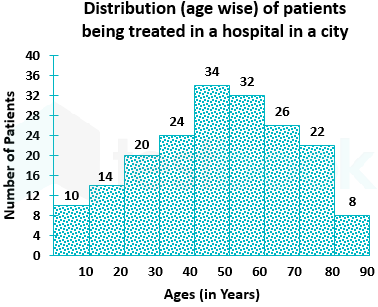
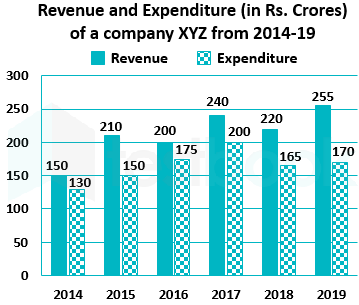
Question 71

The sum of radii spheres A and B is 14 cm, the radius of A being larger than that of B. The difference between their surface areas is 112 π. What is the ratio of the volumes of A and B?

  1. AOption (a)

    64 : 27

  2. BOption (b)

    8  :1

  3. COption (c)

    27 : 8

  4. DOption (d)

    125 : 64

View answer & explanation

Correct answer

Answer: (a)A.

64 : 27

Why this answer is correct

Shortcut Trick Sum of radii (RA + RB) = 14 cm Difference in Surface Areas: 4π(RA2 − RB2) = 112π RA2 − RB2 = 28 ⇒ (RA + RB)(RA − RB) = 28 14 × (RA − RB) = 28 ⇒ RA − RB = 2 cm Solving RA+RB=14 and RA−RB=2 gives RA = 8 cm and RB = 6 cm Ratio of Radii = 8 : 6 = 4 : 3 ⇒ Volume Ratio = 43 : 33 = 64 : 27 ∴ The correct answer is 64 : 27.

Alternate Method Given: Radius of Sphere A = RA, Radius of Sphere B = RB (RA > RB) Sum: RA + RB = 14 cm Surface Area of Sphere = 4πr2 Volume of Sphere = (4/3)πr3

According to the question: ⇒ 4πRA2 − 4πRB2 = 112π ⇒ 4π(RA2 − RB2) = 112π ⇒ RA2 − RB2 = 112 / 4 = 28 ⇒ (RA + RB)(RA − RB) = 28 ⇒ 14 × (RA − RB) = 28 ⇒ RA − RB = 2 Adding the two equations: ⇒ (RA + RB) + (RA − RB) = 14 + 2 ⇒ 2RA = 16 ⇒ RA = 8 cm ⇒ RB = 14 − 8 = 6 cm Ratio of Volumes = [(4/3)πRA3] / [(4/3)πRB3] ⇒ Volume Ratio = (RA / RB)3 ⇒ Volume Ratio = (8 / 6)3 = (4 / 3)3 ⇒ Volume Ratio = 64 / 27 ∴ The correct answer is 64 : 27.

Additional Information Properties of Spheres The surface area (S) of a sphere is 4πr2 and the volume (V) is (4/3)πr3. Ratios of Similar 3D Figures If the ratio of the radii of two spheres is a : b, then the ratio of their surface areas is a2 : b2 and the ratio of their volumes is a3 : b3. Algebraic Identities in Geometry The identity a2 − b2 = (a + b)(a − b) is frequently used to solve difference in area problems when the sum or difference of dimensions is known.

Question 72

The perimeters of ΔABC and ΔDEF are 43.2 cm and 28.8 cm, respectively, and ΔABC ~ ΔDEF. If DE = 12 cm, then the length of AB is:

  1. AOption (a)

    18 cm

  2. BOption (b)

    20 cm

  3. COption (c)

    18.4 cm

  4. DOption (d)

    20.4 cm

View answer & explanation

Correct answer

Answer: (a)A.

18 cm

Why this answer is correct

Shortcut Trick

For similar triangles, the ratio of perimeters is equal to the ratio of corresponding sides.

Perimeter(ΔABC) ÷ Perimeter(ΔDEF) = AB ÷ DE

43.2 ÷ 28.8 = AB ÷ 12

1.5 = AB ÷ 12

AB = 1.5 × 12 = 18 cm

∴ The correct answer is 18 cm.

Alternate Method

Given:

Perimeter of ΔABC (P1) = 43.2 cm

Perimeter of ΔDEF (P2) = 28.8 cm

Length of side DE = 12 cm

ΔABC ~ ΔDEF

Formula Used:

If ΔABC ~ ΔDEF, then AB ÷ DE = BC ÷ EF = AC ÷ DF = Perimeter(ΔABC) ÷ Perimeter(ΔDEF)

Calculations:

⇒ AB ÷ DE = Perimeter(ΔABC) ÷ Perimeter(ΔDEF)

⇒ AB ÷ 12 = 43.2 ÷ 28.8

⇒ AB ÷ 12 = 432 ÷ 288

⇒ AB ÷ 12 = 3 ÷ 2 (Dividing both by 144)

⇒ AB = (3 × 12) ÷ 2

⇒ AB = 36 ÷ 2

⇒ AB = 18 cm

∴ The correct answer is 18 cm.

Additional Information

Area Ratio Property

If two triangles are similar, the ratio of their areas is equal to the square of the ratio of their corresponding sides: Area(Δ1) ÷ Area(Δ2) = (Side1 ÷ Side2)2.

Altitude and Median Ratio

For similar triangles, the ratio of their corresponding altitudes, medians, and angle bisectors is also equal to the ratio of their corresponding sides and perimeters.

AA Similarity Criterion

Two triangles are similar if two angles of one triangle are equal to two angles of the other triangle (Angle-Angle similarity).

Question 73

If 27(x + y)3 - 8(x - y)3 = (x + 5y)(Ax2 + By2 + Cxy), then what is the value of (A + B - C)?

  1. AOption (a)

    13

  2. BOption (b)

    16

  3. COption (c)

    18

  4. DOption (d)

    11

View answer & explanation

Correct answer

Answer: (b)B.

16

Why this answer is correct

Shortcut Trick

Apply the value substitution method by letting x = 1 and y = −1.

LHS = 27(1 − 1)3 − 8(1 − (−1))3 = 27(0) − 8(2)3 = −64.

RHS = (1 + 5(−1))(A(1)2 + B(−1)2 + C(1)(−1)) = −4(A + B − C).

Equating LHS and RHS: −64 = −4(A + B − C) ⇒ A + B − C = 16.

∴ The correct answer is 16.

Alternate Method

Given: 27(x + y)3 − 8(x − y)3 = (x + 5y)(Ax2 + By2 + Cxy)

Formula used: a3 − b3 = (a − b)(a2 + b2 + ab)

⇒ Let a = 3(x + y) and b = 2(x − y).

⇒ (a − b) = 3(x + y) − 2(x − y) = 3x + 3y − 2x + 2y = x + 5y.

⇒ a2 = [3(x + y)]2 = 9(x2 + y2 + 2xy) = 9x2 + 9y2 + 18xy.

⇒ b2 = [2(x − y)]2 = 4(x2 + y2 − 2xy) = 4x2 + 4y2 − 8xy.

⇒ ab = 3(x + y) × 2(x − y) = 6(x2 − y2) = 6x2 − 6y2.

⇒ (a2 + b2 + ab) = (9x2 + 4x2 + 6x2) + (9y2 + 4y2 − 6y2) + (18xy − 8xy) = 19x2 + 7y2 + 10xy.

⇒ Comparing coefficients with Ax2 + By2 + Cxy: A = 19, B = 7, C = 10.

⇒ A + B − C = 19 + 7 − 10 = 16.

∴ The correct answer is 16.

Additional Information

Sum and Difference of Cubes

The fundamental identities are a3 + b3 = (a + b)(a2 − ab + b2) and a3 − b3 = (a − b)(a2 + ab + b2).

Algebraic Expansion

The cube of a binomial is (a + b)3 = a3 + b3 + 3a2b + 3ab2 and (a − b)3 = a3 − b3 − 3a2b + 3ab2.

Identity Matching

When an identity holds for all values of x and y, you can substitute arbitrary values (like x = 1, y = 0 or y = −1) to find the values of unknown constants A, B, and C quickly.

Question 74

When 1062, 1134 and 1182 are divided by the greatest numbers x, remainder in each case is y. What is the value of (x - y)?

  1. AOption (a)

    19

  2. BOption (b)

    17

  3. COption (c)

    18

  4. DOption (d)

    16

View answer & explanation

Correct answer

Answer: (c)C.

18

Why this answer is correct

Shortcut Trick

When numbers leave the same remainder, the divisor x is the HCF of their differences.

Differences: (1134 − 1062) = 72 and (1182 − 1134) = 48.

x = HCF(72, 48) = 24.

y = Remainder when 1062 ÷ 24 = 6.

Value of (x − y) = 24 − 6 = 18.

∴ The correct answer is 18.

Alternate Method

Given: Numbers are 1062, 1134, and 1182. Divisor is x and common remainder is y.

Formula Used: If n1, n2, n3 leave the same remainder y when divided by x, then x = HCF(|n1 − n2|, |n2 − n3|, |n3 − n1|).

⇒ First difference = 1134 − 1062 = 72

⇒ Second difference = 1182 − 1134 = 48

⇒ Third difference = 1182 − 1062 = 120

⇒ x = HCF(72, 48, 120)

⇒ 72 = 24 × 3, 48 = 24 × 2, 120 = 24 × 5

⇒ x = 24

⇒ To find y, divide 1062 by 24: 1062 = (24 × 44) + 6

⇒ y = 6

⇒ Required value = x − y = 24 − 6 = 18

∴ The correct answer is 18.

Additional Information

HCF and Same Remainder Property

The largest number that divides several numbers leaving the same remainder is the HCF of the absolute differences between those numbers.

Case of Known Remainder

If the remainder R is given, then the greatest divisor is HCF of (Number1 − R), (Number2 − R), and (Number3 − R).

Euclidean Algorithm

HCF(a, b) = HCF(b, a mod b). This is the fastest way to calculate the HCF of two large numbers manually.

Question 75

Pipes A and B can fill a tank in 43.2 minutes and 108 minutes, respectively. Pipe C can empty it at 3 litres/minute. When all the three pipes are opened together, they fill the tank in 54 minutes. The capacity (in litres) of the tank is:

  1. AOption (a)

    160

  2. BOption (b)

    216

  3. COption (c)

    200

  4. DOption (d)

    180

View answer & explanation

Correct answer

Answer: (b)B.

216

Why this answer is correct

Shortcut Trick

Convert times to a common base: Pipe A = 43.2 = 216/5 min, Pipe B = 108 min, All = 54 min.

Take LCM of (216/5, 108, 54) = 216 units as total capacity.

Efficiencies: A = 5, B = 2, (A+B−C) = 4 units/min.

Efficiency of Pipe C = (Eff A + Eff B) − (Combined Eff) = (5 + 2) − 4 = 3 units/min.

Since Efficiency of C is 3 litres/min, then 3 units = 3 litres ⇒ 1 unit = 1 litre.

∴ The correct answer is 216 litres.

Alternate Method

Given:

Time taken by Pipe A = 43.2 minutes = 216/5 minutes

Time taken by Pipe B = 108 minutes

Time taken by (A + B − C) = 54 minutes

Rate of Pipe C = 3 litres/minute

Formula Used:

Efficiency = Total Work ÷ Time

Capacity = Total Work units × (Actual rate ÷ Calculated efficiency)

PersonDaysTotal WorkEfficiency
Pipe A216/5 min216 units5
Pipe B108 min2
A + B − C54 min4

Calculations:

⇒ Efficiency of Pipe C = Efficiency of A + Efficiency of B − Efficiency of (A + B − C)

⇒ Efficiency of Pipe C = 5 + 2 − 4

⇒ Efficiency of Pipe C = 3 units/minute

⇒ According to the question, efficiency of C = 3 litres/minute

⇒ 3 units = 3 litres

⇒ 1 unit = 1 litre

⇒ Total capacity of the tank = 216 units = 216 × 1 litre

⇒ Total capacity = 216 litres

∴ The correct answer is 216 litres.

Additional Information

Pipes and Cisterns Basic Rule

If a pipe fills a tank in X hours and another empties it in Y hours, the net work done in 1 hour is (1/X − 1/Y). A positive result means the tank is filling.

Capacity Calculation

Capacity of tank = (Emptying rate in L/min) × (Time taken by the emptying pipe alone to empty the full tank).

LCM Method for Fractions

LCM of fractions = LCM of numerators ÷ HCF of denominators. This is used when time is given in decimals or fractions like 43.2 = 216/5.

Question 76

Given that x8 - 34x4 + 1 = 0, x > 0. What is the value of (x3 + x-3)?

  1. AOption (a)

    6√2

  2. BOption (b)

    5√4

  3. COption (c)

    10√2

  4. DOption (d)

    5√6

View answer & explanation

Correct answer

Answer: (c)C.

10√2

Why this answer is correct

Shortcut Trick Divide x8 − 34x4 + 1 = 0 by x4 ⇒ x4 + 1/x4 = 34. To find x2 + 1/x2: √(34 + 2) = √36 = 6. To find x + 1/x: √(6 + 2) = √8 = 2√2. For x3 + 1/x3, use k3 − 3k where k = 2√2: (2√2)3 − 3(2√2) = 16√2 − 6√2 = 10√2. ∴ The correct answer is 10√2.

Alternate Method Given: x8 − 34x4 + 1 = 0 and x > 0. Formula Used: If xn + 1/xn = k, then xn/2 + 1/xn/2 = √(k + 2). Also, x3 + 1/x3 = (x + 1/x)3 − 3(x + 1/x).

⇒ x8 − 34x4 + 1 = 0 ⇒ x8/x4 − 34x4/x4 + 1/x4 = 0 ⇒ x4 + 1/x4 = 34 ⇒ (x2 + 1/x2)2 = x4 + 1/x4 + 2 = 34 + 2 = 36 ⇒ x2 + 1/x2 = √36 = 6 (Since x > 0) ⇒ (x + 1/x)2 = x2 + 1/x2 + 2 = 6 + 2 = 8 ⇒ x + 1/x = √8 = 2√2 ⇒ x3 + x−3 = x3 + 1/x3 = (x + 1/x)3 − 3(x + 1/x) ⇒ x3 + 1/x3 = (2√2)3 − 3(2√2) ⇒ x3 + 1/x3 = (8 × 2√2) − 6√2 = 16√2 − 6√2 = 10√2 ∴ The correct answer is 10√2.

Additional Information Standard Algebraic Identity For any non-zero x, if x + 1/x = k, then x2 + 1/x2 = k2 − 2 and x3 + 1/x3 = k3 − 3k. Reverse Square Identity If x2 + 1/x2 = m, then x + 1/x = √(m + 2) and x − 1/x = √(m − 2). Negative Exponents The term x−n is mathematically equivalent to the reciprocal 1/xn.

Question 77

A solid metallic sphere of radius 15 cm is melted and recast into spherical balls of radius 3 cm each. What is the ratio of the surface area of original sphere and sum of the surface areas of all the balls?

  1. AOption (a)

    1 : 10

  2. BOption (b)

    1 : 5

  3. COption (c)

    5 : 27

  4. DOption (d)

    3 : 40

View answer & explanation

Correct answer

Answer: (b)B.

1 : 5

Why this answer is correct

Shortcut Trick

Ratio of original Surface Area to the sum of Surface Areas of n small balls is given by r : R.

Here, R = Radius of large sphere = 15 cm.

r = Radius of small balls = 3 cm.

Ratio = 3 : 15 = 1 : 5.

∴ The correct answer is 1 : 5.

Alternate Method

Given:

Radius of large sphere (R) = 15 cm

Radius of small ball (r) = 3 cm

Formula:

Volume of Sphere = (4/3)πr3

Surface Area of Sphere = 4πr2

Calculations:

⇒ Number of small balls (n) = (Volume of large sphere) ÷ (Volume of one small ball)

⇒ n = [(4/3) × π × 153] ÷ [(4/3) × π × 33]

⇒ n = 153 ÷ 33 = (15/3)3 = 53 = 125 balls

⇒ Surface Area of original sphere (SA1) = 4 × π × 152 = 4 × π × 225 = 900π cm2

⇒ Total Surface Area of all small balls (SA2) = 125 × (4 × π × 32)

⇒ SA2 = 125 × 4 × π × 9 = 4500π cm2

⇒ Required Ratio = SA1 : SA2 = 900π : 4500π

⇒ Ratio = 900 : 4500 = 1 : 5

∴ The correct answer is 1 : 5.

Additional Information

Melting and Recasting

When a solid is melted and recast into another shape, the total volume remains constant (Volumeinitial = Volumefinal).

Scaling of Properties

If the linear dimensions are changed by a factor k, the surface area changes by k2 and the volume changes by k3.

Total Surface Area vs Single Surface Area

While volume is conserved during recasting, the total surface area always increases when a larger object is broken into multiple smaller objects.

Question 78

The value of 0.0203×2.920.7×0.0365×2.9÷(12.12)2−(8.12)2(0.25)2+(0.25)(19.99)\frac{{0.0203 \times 2.92}}{{0.7 \times 0.0365 \times 2.9}} \div \frac{{{{\left( {12.12} \right)}^2} - {{\left( {8.12} \right)}^2}}}{{{{\left( {0.25} \right)}^2} + \left( {0.25} \right)\left( {19.99} \right)}} is:

  1. AOption (a)

    0.05

  2. BOption (b)

    0.01

  3. COption (c)

    0.1

  4. DOption (d)

    0.5

View answer & explanation

Correct answer

Answer: (a)A.

0.05

Why this answer is correct

Given:

0.0203×2.920.7×0.0365×2.9÷(12.12)2−(8.12)2(0.25)2+(0.25)(19.99)\frac{0.0203 \times 2.92}{0.7 \times 0.0365 \times 2.9} \div \frac{(12.12)^2 - (8.12)^2}{(0.25)^2 + (0.25)(19.99)}

Formula used:

a2 - b2 = (a + b)(a - b)

Calculation:

0.0203×2.920.7×0.0365×2.9÷(12.12)2−(8.12)2(0.25)2+(0.25)(19.99)\frac{0.0203 \times 2.92}{0.7 \times 0.0365 \times 2.9} \div \frac{(12.12)^2 - (8.12)^2}{(0.25)^2 + (0.25)(19.99)}

⇒ 203×292×10−67×365×29×10−6÷(12.12+8.12)(12.12−8.12)0.25(0.25+19.99)\frac{203 \times 292 \times 10^{-6}}{7 \times 365 \times 29 \times 10^{-6}} \div \frac{(12.12 + 8.12)(12.12 - 8.12)}{0.25(0.25 + 19.99)}

⇒ 29×292365×29÷20.24×40.25×20.24\frac{29 \times 292}{365 \times 29} \div \frac{20.24 \times 4}{0.25 \times 20.24}

⇒ 45÷40.25\frac{4}{5} \div \frac{4}{0.25}

⇒ 0.8÷160.8 \div 16

⇒ 0.05

∴ The correct answer is option (1).

Question 79

cosA(secA - cosA)(cotA + tanA)=?

  1. AOption (a)

    tan A

  2. BOption (b)

    sec A

  3. COption (c)

    sin A

  4. DOption (d)

    cot A

View answer & explanation

Correct answer

Answer: (a)A.

tan A

Why this answer is correct

Shortcut Trick

Put A = 45° in the expression.

cos 45° = 1/√2, sec 45° = √2, cot 45° = 1, tan 45° = 1.

Expression = (1/√2) × (√2 − 1/√2) × (1 + 1).

Expression = (1/√2) × (1/√2) × 2 = (1/2) × 2 = 1.

From the options, tan 45° = 1.

∴ The correct answer is tan A.

Alternate Method

Given: cos A (sec A − cos A) (cot A + tan A)

Formula Used: sec A = 1/cos A; cot A = cos A/sin A; tan A = sin A/cos A; sin2 A + cos2 A = 1.

⇒ cos A (1/cos A − cos A) (cos A/sin A + sin A/cos A)

⇒ (cos A × 1/cos A − cos2 A) ((cos2 A + sin2 A) / (sin A cos A))

⇒ (1 − cos2 A) (1 / (sin A cos A))

⇒ sin2 A × (1 / (sin A cos A))

⇒ (sin A × sin A) / (sin A × cos A)

⇒ sin A / cos A

⇒ tan A

∴ The correct answer is tan A.

Additional Information

Pythagorean Identities

Fundamental identities include sin2 A + cos2 A = 1, 1 + tan2 A = sec2 A, and 1 + cot2 A = cosec2 A.

Reciprocal Relations

Trigonometric ratios are related as sec A = 1/cos A, cosec A = 1/sin A, and cot A = 1/tan A.

Combined Ratio Identity

The sum of tan A and cot A always simplifies to 1 / (sin A × cos A) or sec A × cosec A.

Question 80

Directions

Study the given graph and answer the question that follows.

The number of employees = 3000

The number of employees in department B is what percent of the total number of employees working in department D and E?

  1. AOption (a)

    48.6

  2. BOption (b)

    45.8

  3. COption (c)

    50.4

  4. DOption (d)

    49.3

View answer & explanation

Correct answer

Answer: (d)D.

49.3

Why this answer is correct

Given:

Total number of Employees = 3000

The number of employees in department B (in degree) = 74° 

The number of employees in department D (in degree) = 57°

The number of employees in department E (in degree)= 93°

Concept:

360° represent 100% in a pie chart.

Detailed Solution:

The number of employees in department B  = (74°/360°) × 3000 = 616.6

The number of employees in department D  = (57°/360°) × 3000 = 475

The number of employees in department E = (93°/360°) × 3000 = 775

The number of employees in department D and E together = 475 + 775 = 1250

⇒ Required percentage =Number of employees in department B Number of employees in department D and E Number \ of \ employees \ in \ department \ B \ \over Number \ of \ employees \ in \ department \ D \ and \ E \ × 100 = (616.6/1250) × 100 = 49.3% 

∴ The required percentage is 49.3% 

Shortcut Trick

Short Solution:

The number of employees in department B (in degree) = 74° 

The number of employees in department D and E (in degree) = 57° + 93° = 150° 

⇒ Required percentage =employees in departmentB (in degree)employees in department D and E (in degree) employees \ in \ department B \ (in \ degree)\over employees \ in \ department \ D \ and \ E \ (in\ degree) × 100 = (74°/150°) × 100 = 49.3% 

∴ The required percentage is 49.3%

Question 81

If the 5-digit number 535ab is divisible by 3, 7 and 11 then what is the value of (a2 - b2 + ab)?

  1. AOption (a)

    83

  2. BOption (b)

    89

  3. COption (c)

    95

  4. DOption (d)

    77

View answer & explanation

Correct answer

Answer: (c)C.

95

Why this answer is correct

Shortcut Trick

LCM of 3, 7, and 11 is 231.

Dividing 53500 by 231 gives a remainder of 139.

The number is 53500 + (231 − 139) = 53592.

Comparing 53592 with 535ab gives a = 9 and b = 2.

Value = 92 − 22 + (9 × 2) = 81 − 4 + 18 = 95.

∴ The correct answer is 95.

Alternate Method

Given that the 5-digit number 535ab is divisible by 3, 7, and 11.

LCM of 3, 7, 11 = 3 × 7 × 11 = 231.

⇒ Assume the maximum possible value for the number is 53599.

⇒ 53599 ÷ 231 ⇒ Quotient = 232, Remainder = 7.

⇒ Correct multiple = 53599 − 7 = 53592.

⇒ Comparing 53592 with 535ab ⇒ a = 9, b = 2.

⇒ Required expression: (a2 − b2 + ab)

⇒ Value = 92 − 22 + (9 × 2)

⇒ Value = 81 − 4 + 18 = 95.

∴ The correct answer is 95.

Additional Information

Divisibility Rule of 3, 7, and 11

A number is divisible by 3, 7, and 11 if it is divisible by their LCM, which is 231. This is because 3, 7, and 11 are prime numbers.

Divisibility Rule of 11

The difference between the sum of digits at odd places and even places must be 0 or a multiple of 11. For 53592: (5 + 5 + 2) − (3 + 9) = 12 − 12 = 0.

LCM of Prime Numbers

For any set of prime numbers, the Least Common Multiple (LCM) is the product of those numbers: LCM(p1, p2, p3) = p1 × p2 × p3.

Question 82

If the radius of the base of a right circular cylinder is increased by 20% and the height is decreased by 30%, then what is the percentage increase/decrease in the volume?

  1. AOption (a)

    Decrease 0.8%

  2. BOption (b)

    Increase 2%

  3. COption (c)

    Increase 0.8%

  4. DOption (d)

    Decrease 2%

View answer & explanation

Correct answer

Answer: (c)C.

Increase 0.8%

Why this answer is correct

Shortcut Trick

Volume of cylinder is proportional to r2h.

Net multiplier = (1 + 20/100)2 × (1 − 30/100)

Net multiplier = (1.2)2 × 0.7 = 1.44 × 0.7 = 1.008

Change = (1.008 − 1) × 100 = 0.8% increase.

∴ The correct answer is Increase 0.8%.

Alternate Method

Given:

Radius increase = 20%

Height decrease = 30%

Formula Used:

Volume of Right Circular Cylinder (V) = πr2h

Calculations:

⇒ Let original radius = r and original height = h

⇒ Original Volume (V1) = πr2h

⇒ New radius (r′) = r + 20% of r = 1.2r

⇒ New height (h′) = h − 30% of h = 0.7h

⇒ New Volume (V2) = π(1.2r)2(0.7h)

⇒ V2 = π(1.44r2)(0.7h) = 1.008 πr2h

⇒ Change in volume = V2 − V1 = 1.008πr2h − πr2h = 0.008πr2h

⇒ % Change = (0.008πr2h ÷ πr2h) × 100 = 0.8%

∴ The correct answer is Increase 0.8%.

Additional Information

Cylinder Properties

Volume = πr2h | Curved Surface Area = 2πrh | Total Surface Area = 2πr(r + h).

Successive Percentage for 3D Figures

If dimensions change by a%, b%, and c%, then net volume change multiplier is (1 + a/100)(1 + b/100)(1 + c/100).

Comparison with Sphere/Cone

Sphere volume V = (4/3)πr3 (depends on r3). Cone volume V = (1/3)πr2h (same factor dependency as cylinder).

Question 83

The area (in sq. units) of the triangle formed by the graphs of 8x + 3y = 24, 2x + 8 = y and the x-axis is:

  1. AOption (a)

    14

  2. BOption (b)

    28

  3. COption (c)

    15

  4. DOption (d)

    24

View answer & explanation

Correct answer

Answer: (b)B.

28

Why this answer is correct

Shortcut Trick

Intersection with x-axis (set y = 0):

Line 1 (8x + 3y = 24) → 8x = 24 → x = 3. Point: (3, 0)

Line 2 (2x + 8 = y) → 2x = −8 → x = −4. Point: (−4, 0)

Base on x-axis = 3 − (−4) = 7 units.

Intersection of both lines (Height): 8x + 3(2x + 8) = 24 ⇒ 14x = 0 ⇒ x = 0, y = 8. Height = 8 units.

Area = 1/2 × Base × Height = 1/2 × 7 × 8 = 28.

∴ The correct answer is 28 sq. units.

Alternate Method

Given:

Line 1: 8x + 3y = 24

Line 2: 2x − y = −8

Line 3: y = 0 (x-axis)

Formula Used:

Area of Triangle = 1/2 × Base × Height

Calculations:

To find the vertices of the triangle:

Vertex A: Intersection of 8x + 3y = 24 and y = 0.

⇒ 8x + 3(0) = 24 ⇒ 8x = 24 ⇒ x = 3. Point A = (3, 0).

Vertex B: Intersection of 2x + 8 = y and y = 0.

⇒ 2x + 8 = 0 ⇒ 2x = −8 ⇒ x = −4. Point B = (−4, 0).

Vertex C: Intersection of 8x + 3y = 24 and 2x − y = −8.

From second line, y = 2x + 8. Substitute in first line:

⇒ 8x + 3(2x + 8) = 24

⇒ 8x + 6x + 24 = 24

⇒ 14x = 0 ⇒ x = 0.

⇒ y = 2(0) + 8 = 8. Point C = (0, 8).

Base of triangle (on x-axis) = xA − xB = 3 − (−4) = 7 units.

Height of triangle = y-coordinate of vertex C = 8 units.

⇒ Area = 1/2 × Base × Height

⇒ Area = 1/2 × 7 × 8 = 28 sq. units.

∴ The correct answer is 28 sq. units.

Additional Information

Area using Coordinates

For vertices (x1, y1), (x2, y2), and (x3, y3), Area = 1/2 |x1(y2−y3) + x2(y3−y1) + x3(y1−y2)|.

Intercept Form

A line ax + by = c can be written as x/(c/a) + y/(c/b) = 1, where c/a is the x-intercept and c/b is the y-intercept.

Intersection with Axes

To find the x-intercept, set y = 0. To find the y-intercept, set x = 0 in the linear equation.

Question 84

A is 80% more than B and C is 48(4/7) % less than the sum of A and B. By what per cent is C less than A?

  1. AOption (a)

    30

  2. BOption (b)

    20

  3. COption (c)

    25

  4. DOption (d)

    15

View answer & explanation

Correct answer

Answer: (b)B.

20

Why this answer is correct

Given:

A = B + 80% of B

C = (A + B) - 4847\frac{4}{7}% of (A + B)

Formula used:

Percentage less = DifferenceBase×100\frac{Difference}{Base} \times 100

Calculation:

Let B = 100

⇒ A = 100 + 80 = 180

⇒ A + B = 180 + 100 = 280

⇒ 4847\frac{4}{7}% = 3407%=340700=1735\frac{340}{7} \% = \frac{340}{700} = \frac{17}{35}

⇒ C = 280 × (1−1735)(1 - \frac{17}{35})

⇒ C = 280 × 1835\frac{18}{35}

⇒ C = 8 × 18 = 144

⇒ Difference between A and C = 180 - 144 = 36

⇒ Percentage less = 36180×100\frac{36}{180} \times 100

⇒ 15×100\frac{1}{5} \times 100 = 20%

∴ The correct answer is option (2).

Question 85

In a school 3/8 of the number of students are girls and the rest are boys. One-third of the number of boys are below 10 years and 2/3 the number of girls are also below 10 years. If the number of students of age 10 or more years is 260. then the number of boys in the school is:

  1. AOption (a)

    312

  2. BOption (b)

    280

  3. COption (c)

    234

  4. DOption (d)

    300

View answer & explanation

Correct answer

Answer: (d)D.

300

Why this answer is correct

Shortcut Trick

Let Total Students = 24 units (LCM of 8 and 3).

Girls = 3/8 × 24 = 9 units; Boys = 15 units.

Boys 10+ years = 15 × (1 − 1/3) = 15 × 2/3 = 10 units.

Girls 10+ years = 9 × (1 − 2/3) = 9 × 1/3 = 3 units.

Total 10+ years = 10 + 3 = 13 units → 260 students.

1 unit = 20 ∴ Boys = 15 × 20 = 300.

∴ The correct answer is 300.

Alternate Method

Given:

Ratio of Girls = 3/8 of total students

Ratio of Boys = 5/8 of total students

Boys below 10 years = 1/3 of boys

Girls below 10 years = 2/3 of girls

Students 10 years or more = 260

Formula used:

Part = Total × Fraction

⇒ Let total students be x.

⇒ Number of Girls = (3/8)x

⇒ Number of Boys = (5/8)x

⇒ Boys 10 years or older = (1 − 1/3) × (5/8)x = (2/3) × (5/8)x = (10/24)x

⇒ Girls 10 years or older = (1 − 2/3) × (3/8)x = (1/3) × (3/8)x = (3/24)x

⇒ Total students (10+ years) = (10/24)x + (3/24)x = (13/24)x

⇒ (13/24)x = 260

⇒ x = (260 × 24) ÷ 13

⇒ x = 20 × 24 = 480

⇒ Number of Boys = (5/8) × 480 = 5 × 60 = 300

∴ The correct answer is 300.

Additional Information

Fractional Breakdown

If a group is divided into parts A and B, and a sub-fraction f of A is selected, the absolute value is Total × (Ratio of A) × f.

Unitary Method for Ratios

When fractions have different denominators (8 and 3), assuming the total as their LCM (24) simplifies calculations by avoiding decimals.

Complementary Fractions

If a fraction p is below a threshold, the remaining part is always (1 − p). This is useful for finding "10 years or older" when "below 10 years" is given.

Question 86

A certain number of students from school X appeared in an examination and 30% of the students failed. 150% more students than those from school X, appeared in the same examination from school Y. If 80% of the total number of students who appeared from X and Y passed, then what is the percentage of students who failed from Y?

  1. AOption (a)

    24

  2. BOption (b)

    16

  3. COption (c)

    20

  4. DOption (d)

    18

View answer & explanation

Correct answer

Answer: (b)B.

16

Why this answer is correct

Shortcut Trick

Ratio of students in School X : School Y = 100 : (100 + 150) = 100 : 250 = 2 : 5.

Total Fail% = 100% − 80% = 20%.

Using Weighted Average: (RatioX × Fail%X + RatioY × Fail%Y) ÷ Total Ratio = Total Fail%.

(2 × 30 + 5 × Fail%Y) ÷ 7 = 20 ⇒ 60 + 5 × Fail%Y = 140.

5 × Fail%Y = 80 ⇒ Fail%Y = 16%.

∴ The correct answer is 16%.

Alternate Method

Given:

Fail % in School X = 30%

Students in School Y = 150% more than School X

Total Pass % (X + Y) = 80%

Calculations:

⇒ Let the number of students from School X = 100

⇒ Students from School Y = 100 + 150% of 100 = 100 + 150 = 250

⇒ Total students (X + Y) = 100 + 250 = 350

⇒ Total Pass rate = 80% ⇒ Total Fail rate = 100% − 80% = 20%

⇒ Total number of failed students = 20% of 350 = 70

⇒ Failed students from School X = 30% of 100 = 30

⇒ Failed students from School Y = Total failed − Failed from X = 70 − 30 = 40

⇒ Percentage of failed students from Y = (Failed from Y ÷ Total from Y) × 100

⇒ Fail % in Y = (40 ÷ 250) × 100 = 16%

∴ The correct answer is 16%.

Additional Information

Percentage Change and "More Than" Concept

If a value B is x% more than A, then B = A × (1 + x/100). If B is x% of A, then B = A × (x/100).

Weighted Average Formula

The combined average of two groups with sizes n1, n2 and averages a1, a2 is given by (n1a1 + n2a2) ÷ (n1 + n2).

Alligation Rule

Ratio of quantities = (Higher Value − Mean Value) : (Mean Value − Lower Value). This is useful for finding individual group percentages.

Question 87

The radii of two right circular cylinders are in the ratio 3 : 2 and the of their volumes is 27 : 16. What is the ratio of their heights?

  1. AOption (a)

    4 : 3

  2. BOption (b)

    9 : 8

  3. COption (c)

    3 : 4

  4. DOption (d)

    8 : 9

View answer & explanation

Correct answer

Answer: (c)C.

3 : 4

Why this answer is correct

Shortcut Trick

Volume of a cylinder (V) ∝ r2 × h

⇒ Height (h) ∝ V ÷ r2

Ratio of heights (h1 : h2) = (V1 ÷ r12) : (V2 ÷ r22)

⇒ h1 : h2 = (27 ÷ 32) : (16 ÷ 22) = (27 ÷ 9) : (16 ÷ 4) = 3 : 4

∴ The correct answer is 3 : 4.

Alternate Method

Given:

Ratio of radii (r1 : r2) = 3 : 2

Ratio of volumes (V1 : V2) = 27 : 16

Formula Used:

Volume of cylinder (V) = πr2h

Calculations:

⇒ Let radii be 3x and 2x, and heights be h1 and h2.

⇒ V1 / V2 = (π × r12 × h1) / (π × r22 × h2)

⇒ 27 / 16 = (32 × h1) / (22 × h2)

⇒ 27 / 16 = (9 × h1) / (4 × h2)

⇒ h1 / h2 = (27 × 4) / (16 × 9)

⇒ h1 / h2 = (3 × 1) / (4 × 1)

⇒ h1 : h2 = 3 : 4

∴ The correct answer is 3 : 4.

Additional Information

Surface Area of Cylinder

Curved Surface Area (CSA) = 2πrh and Total Surface Area (TSA) = 2πr(h + r).

Volume Ratios for Solid Figures

For a cone, V = (1/3)πr2h. The ratio of volumes depends on both r2 and h, similar to the cylinder.

Relationship between Dimensions

If height is constant, V1/V2 = (r1/r2)2. If radius is constant, V1/V2 = h1/h2.

Question 88

An article is marked 35% above its cost. If a profit of 20% is earned by selling the article, then the discount per cent offered on the marked price of the article is:

  1. AOption (a)

    1119%11\frac{1}{9}\%

  2. BOption (b)

    15%

  3. COption (c)

    12%

  4. DOption (d)

    1019%10\frac{1}{9}\%

View answer & explanation

Correct answer

Answer: (a)A.

1119%11\frac{1}{9}\%

Why this answer is correct

Shortcut Trick

Let Cost Price (CP) = 100.

Marked Price (MP) = 100 + 35 = 135.

Selling Price (SP) = 100 + 20 = 120 (since Profit = 20%).

Discount = MP − SP = 135 − 120 = 15.

Discount % = (Discount ÷ MP) × 100 = (15 ÷ 135) × 100 = 100/9 % = 11 1/9 %.

∴ The correct answer is 11 1/9 %.

Alternate Method

Given:

Markup Percentage = 35%

Profit Percentage = 20%

Formula Used:

Selling Price (SP) = CP × (1 + Profit/100)

Marked Price (MP) = CP × (1 + Markup/100)

Discount % = [(MP − SP) ÷ MP] × 100

Calculations:

⇒ Let the Cost Price (CP) of the article be ₹100.

⇒ Marked Price (MP) = 100 + 35% of 100 = 100 + 35 = ₹135.

⇒ Profit = 20% on Cost Price.

⇒ Selling Price (SP) = 100 + 20% of 100 = 100 + 20 = ₹120.

⇒ Discount offered on Marked Price = MP − SP

⇒ Discount = 135 − 120 = ₹15.

⇒ Discount % = (Discount ÷ MP) × 100

⇒ Discount % = (15 ÷ 135) × 100

⇒ Discount % = (1 ÷ 9) × 100

⇒ Discount % = 100/9 % = 11 1/9 %.

∴ The correct answer is 11 1/9 %.

Additional Information

The CP-MP Relationship

The ratio of Marked Price to Cost Price can be expressed as: MP ÷ CP = (100 + Profit %) ÷ (100 − Discount %).

Effective Profit Formula

Profit % = Markup % − Discount % − [(Markup % × Discount %) ÷ 100]. This is derived from the successive percentage change formula.

Discount Calculation

Discount is always calculated on the Marked Price (MP), whereas Profit or Loss is generally calculated on the Cost Price (CP).

Question 89

How many kg of rice costing Rs. 42 per kg should be mixed with 7127\frac{1}{2} kg rice costing Rs. 50 per kg so that by selling the mixture at Rs. 53.10 per kg, there is gain of 18%?

  1. AOption (a)

    121212\frac{1}{2}

  2. BOption (b)

    101210\frac{1}{2}

  3. COption (c)

    8

  4. DOption (d)

    9

View answer & explanation

Correct answer

Answer: (a)A.

121212\frac{1}{2}

Why this answer is correct

Shortcut Trick

Step 1: Calculate the Mean Cost Price (CP) of the mixture = 53.10 ÷ 1.18 = ₹45/kg.

Step 2: Use Alligation ratio of Rice1 (₹42) and Rice2 (₹50) with Mean (₹45).

Step 3: Ratio = (50 − 45) : (45 − 42) = 5 : 3.

Step 4: 3 units represent 7.5 kg (given), so 1 unit = 2.5 kg.

Step 5: Quantity of first rice = 5 units = 5 × 2.5 = 12.5 kg.

∴ The correct answer is 12½ kg.

Alternate Method

Given:

Cost of Rice1 (CP1) = ₹42/kg

Cost of Rice2 (CP2) = ₹50/kg

Quantity of Rice2 (Q2) = 7.5 kg = 15/2 kg

Selling Price of mixture (SPm) = ₹53.10/kg

Profit percentage = 18%

Formula Used:

Cost Price (CP) = [Selling Price (SP) × 100] ÷ [100 + Profit%]

Rule of Alligation: Q1/Q2 = (CP2 − Mean CP) ÷ (Mean CP − CP1)

Calculations:

⇒ CP of mixture = (53.10 × 100) ÷ (100 + 18)

⇒ CP of mixture = 5310 ÷ 118 = ₹45/kg

⇒ Ratio of Rice1 to Rice2 = (50 − 45) : (45 − 42)

⇒ Q1 : Q2 = 5 : 3

⇒ Given Q2 = 7.5 kg

⇒ 3 units = 7.5 kg

⇒ 1 unit = 7.5 ÷ 3 = 2.5 kg

⇒ Q1 = 5 × 2.5 kg = 12.5 kg

∴ The correct answer is 12½ kg.

Additional Information

Rule of Alligation

It is a rule that enables us to find the ratio in which two or more ingredients at the given price must be mixed to produce a mixture of a desired price. Ratio = (Dearer Price − Mean Price) : (Mean Price − Cheaper Price).

Cost Price Calculation

When profit is made, CP = SP × [100 / (100 + Profit%)]. Alligation should always be performed on the Cost Price, never directly on the Selling Price unless the profit/loss is zero.

Weighted Average Method

Alternatively, the mean price can be calculated as Pm = (n1p1 + n2p2) / (n1 + n2), where n is the quantity and p is the price per unit.

Question 90

A, B and C started a business. Twice the investment of A is equal to thrice the investment of B and also five times the investment of C. If the total profit after a year is Rs. 15.5 lakhs, then the share of B in the profit is (in Rs. lakhs):

  1. AOption (a)

    5

  2. BOption (b)

    7.5

  3. COption (c)

    4.5

  4. DOption (d)

    3

View answer & explanation

Correct answer

Answer: (a)A.

5

Why this answer is correct

Shortcut Trick

Given: 2A = 3B = 5C

Direct Ratio A : B : C = (3 × 5) : (2 × 5) : (2 × 3) = 15 : 10 : 6

Total Ratio Units = 15 + 10 + 6 = 31 units

B's Profit Share = (10 ÷ 31) × 15.5 lakhs = 10 × 0.5 = 5 lakhs

∴ The correct answer is ₹5 lakhs.

Alternate Method

Given:

Total profit after 1 year = ₹15.5 lakhs

Relation between investments: 2 × Investment of A = 3 × Investment of B = 5 × Investment of C

Formula Used:

Profit Ratio = (InvestmentA × TimeA) : (InvestmentB × TimeB) : (InvestmentC × TimeC)

Calculations:

Let 2A = 3B = 5C = k

⇒ A = k/2, B = k/3, C = k/5

⇒ Ratio of investments A : B : C = k/2 : k/3 : k/5

⇒ Multiplying by LCM(2, 3, 5) = 30:

⇒ Ratio = (30/2) : (30/3) : (30/5) = 15 : 10 : 6

⇒ Since time period is the same (1 year), Profit Ratio = Investment Ratio = 15 : 10 : 6

⇒ Sum of ratio parts = 15 + 10 + 6 = 31 units

⇒ 31 units = ₹15.5 lakhs

⇒ 1 unit = 15.5 ÷ 31 = ₹0.5 lakhs

⇒ B's share = 10 units = 10 × 0.5 = ₹5 lakhs

∴ The correct answer is ₹5 lakhs.

Additional Information

Capital and Profit Relationship

In any partnership business, if the time period of investment is the same for all partners, the profit is distributed strictly in the ratio of their capitals (Investments).

Inverse Ratio Calculation

When coefficients are given as xA = yB = zC, the ratio A:B:C is found by taking the reciprocal (1/x : 1/y : 1/z) and multiplying by the LCM of the denominators.

Variable Investment Time

If partners invest for different time durations, the profit ratio is (C1 × T1) : (C2 × T2) : (C3 × T3).

Question 91

In a circle with center O, BC is a chord. Points P and A are on the circle, on the opposite side of BC, such that ∠ PBC = 28°  and BP = PC. What is the measure of the inverse angle of BOC?

  1. AOption (a)

    112° 

  2. BOption (b)

    96° 

  3. COption (c)

    98° 

  4. DOption (d)

    84° 

View answer & explanation

Correct answer

Answer: (a)A.

112° 

Why this answer is correct

Shortcut Trick

In isosceles ▵PBC, ∠BPC = 180° − (2 × ∠PBC) = 180° − (2 × 28°) = 124°.

Since P is on the minor arc and A is on the major arc, ∠BAC = 180° − ∠BPC = 180° − 124° = 56°.

Central angle ∠BOC = 2 × ∠BAC = 2 × 56° = 112°.

∴ The correct answer is 112°.

Alternate Method

Given: ∠PBC = 28°, BP = PC, O is the center, P and A are on opposite sides of chord BC.

⇒ In ▵PBC, since BP = PC, ∠PCB = ∠PBC = 28°.

⇒ Sum of angles in ▵PBC = 180°

⇒ ∠BPC = 180° − (28° + 28°) = 180° − 56° = 124°.

⇒ Since points A, B, P, C lie on the circle and A, P are on opposite sides of BC, BAPC is a cyclic quadrilateral.

⇒ ∠BAC + ∠BPC = 180° (Opposite angles of a cyclic quad)

⇒ ∠BAC = 180° − 124° = 56°.

⇒ By the central angle theorem, angle at center = 2 × angle at circumference.

⇒ ∠BOC = 2 × ∠BAC = 2 × 56° = 112°.

∴ The correct answer is 112°.

Additional Information

Inscribed Angle Theorem

The angle subtended by an arc at the center is double the angle subtended by it at any point on the remaining part of the circle (∠Center = 2 × ∠Circumference).

Cyclic Quadrilateral Property

A quadrilateral is cyclic if all its vertices lie on a circle. The sum of its opposite angles is always 180°.

Angles in an Isosceles Triangle

In a triangle, if two sides are equal, the angles opposite to those sides are also equal.

Question 92

A can do 20% of a work in 4 days. B can do 33.33% work in 10 days. They worked together for 9 days. C complete the remaining work in 6 days. B and C together will complete 75% of the same work in:

  1. AOption (a)

    15 days

  2. BOption (b)

    12 days

  3. COption (c)

    10 days

  4. DOption (d)

    9 days

View answer & explanation

Correct answer

Answer: (c)C.

10 days

Why this answer is correct

Shortcut Trick

Total time for A = 4 ÷ 20% = 20 days; B = 10 ÷ 33.33% = 30 days.

Total Work (LCM of 20, 30) = 60 units. Efficiency: A = 3, B = 2.

Work by (A+B) in 9 days = (3 + 2) × 9 = 45 units. Remaining = 15 units.

Efficiency of C = 15 ÷ 6 = 2.5. Combined Eff (B+C) = 2 + 2.5 = 4.5.

Required Time (75% of 60) = (60 × 0.75) ÷ 4.5 = 45 ÷ 4.5 = 10 days.

∴ The correct answer is 10 days.

Alternate Method

Given:

A does 20% work in 4 days ⇒ 100% work in (4 × 100/20) = 20 days.

B does 33.33% work in 10 days ⇒ 100% work in (10 × 3) = 30 days.

PersonDaysTotal WorkEfficiency
A2060 (LCM)3
B302

⇒ Work done by A and B together in 9 days = (3 + 2) × 9 = 45 units.

⇒ Remaining work = Total Work − Work done = 60 − 45 = 15 units.

⇒ Remaining work completed by C in 6 days ⇒ Efficiency of C = 15 ÷ 6 = 2.5 units/day.

⇒ Target work = 75% of Total Work = 60 × 0.75 = 45 units.

⇒ Efficiency of B and C together = 2 + 2.5 = 4.5 units/day.

⇒ Time taken by B and C = 45 ÷ 4.5 = 10 days.

∴ The correct answer is 10 days.

Additional Information

Work and Efficiency Relation

Total Work = Efficiency × Time. If work is constant, Efficiency ∝ 1/Time.

Combined Efficiency

Total efficiency of multiple people working together is the sum of their individual efficiencies (Etotal = E1 + E2 + ...).

Percentage to Fraction Conversion

33.33% is equivalent to 1/3, and 20% is equivalent to 1/5. Using fractions simplifies calculations in time and work problems.

Question 93

Shashi sells two articles for Rs. 5,000 each with no loss and no profit in the overall transaction. If one article is sold at 1623%16 \frac{2}{3}\% loss, then the other is sold at a profit of:

  1. AOption (a)

    1813%18 \frac{1}{3}\%

  2. BOption (b)

    25%

  3. COption (c)

    24%

  4. DOption (d)

    1623%16 \frac{2}{3}\%

View answer & explanation

Correct answer

Answer: (b)B.

25%

Why this answer is correct

Shortcut Trick

Loss of 16 2/3% = 1/6. This means CP1 = 6 units and SP1 = 5 units.

Since SP is same for both articles, SP2 = 5 units. Total SP = 5 + 5 = 10 units.

No profit no loss implies Total CP = Total SP = 10 units.

CP2 = Total CP − CP1 = 10 − 6 = 4 units.

Profit on 2nd article = SP2 − CP2 = 5 − 4 = 1 unit.

Profit % = (1 ÷ 4) × 100 = 25%.

∴ The correct answer is 25%.

Alternate Method

Given:

Selling Price of each article (SP) = ₹5,000

Total Selling Price = 5,000 + 5,000 = ₹10,000

Overall Profit/Loss = 0% ⇒ Total Cost Price = ₹10,000

Loss on first article = 16 2/3% = 50/3 %

Calculations:

⇒ CP1 = [SP1 × 100] ÷ [100 − Loss%]

⇒ CP1 = [5,000 × 100] ÷ [100 − 50/3]

⇒ CP1 = 5,00,000 ÷ (250/3) = (5,00,000 × 3) ÷ 250 = ₹6,000

⇒ Loss on 1st article = 6,000 − 5,000 = ₹1,000

⇒ To have no profit/loss overall, Profit on 2nd article must be ₹1,000.

⇒ CP2 = SP2 − Profit = 5,000 − 1,000 = ₹4,000

⇒ Profit % on 2nd article = (1,000 ÷ 4,000) × 100 = 25%

∴ The correct answer is 25%.

Additional Information

Overall No Profit No Loss

In transactions involving two articles where SP is same and there is no overall profit or loss, the numerical value of loss on one article must equal the numerical value of profit on the other.

Successive Discounts

Equivalent single discount for two successive discounts a% and b% is given by the formula: [a + b − (a × b)/100]%.

Profit/Loss Percentage Base

Profit or Loss percentage is always calculated on the Cost Price (CP) unless specified otherwise. Formula: Profit% = (Profit/CP) × 100.

Question 94

sinθ[(1−tanθ)tanθ+sec⁡2θ](1−sin⁡θ)tan⁡θ(1+tanθ)(secθ+tanθ)\frac{{sin\theta [\left( {1 - tan\theta } \right)tan\theta + {{\sec }^2}\theta ]}}{{\left( {1 - \sin \theta } \right)\tan \theta \left( {1 + tan\theta } \right)\left( {sec\theta + tan\theta } \right)}} is equal to:

  1. AOption (a)

    sinθ cosθ 

  2. BOption (b)

    -1

  3. COption (c)

    cosecθ secθ 

  4. DOption (d)

    1

View answer & explanation

Correct answer

Answer: (d)D.

1

Why this answer is correct

Shortcut Trick

Substitute θ = 45° as it is a standard value that does not make any term undefined.

Numerator = sin 45° [(1 − tan 45°) tan 45° + sec2 45°] = (1/√2) [(1 − 1) × 1 + (√2)2] = (1/√2) × 2 = √2.

Denominator = (1 − sin 45°) tan 45° (1 + tan 45°) (sec 45° + tan 45°) = (1 − 1/√2) × 1 × 2 × (√2 + 1).

Denominator = [(√2 − 1)/√2] × 2 × (√2 + 1) = √2 × (√2 − 1)(√2 + 1) = √2 × (2 − 1) = √2.

Expression = Numerator ÷ Denominator = √2 ÷ √2 = 1.

∴ The correct answer is 1.

Alternate Method

Given Expression: {sinθ [(1 − tanθ)tanθ + sec2θ]} ÷ {(1 − sinθ) tanθ (1 + tanθ) (secθ + tanθ)}

Formula used: sec2θ − tan2θ = 1 and secθ + tanθ = (1 + sinθ)/cosθ

⇒ Numerator = sinθ (tanθ − tan2θ + sec2θ)

⇒ Numerator = sinθ (tanθ + (sec2θ − tan2θ)) = sinθ (tanθ + 1)

⇒ Expression = [sinθ (1 + tanθ)] ÷ [(1 − sinθ) tanθ (1 + tanθ) (secθ + tanθ)]

⇒ Expression = sinθ ÷ [(1 − sinθ) tanθ (secθ + tanθ)]

⇒ Substitute tanθ = sinθ/cosθ and (secθ + tanθ) = (1 + sinθ)/cosθ

⇒ Expression = sinθ ÷ [(1 − sinθ) × (sinθ/cosθ) × ((1 + sinθ)/cosθ)]

⇒ Expression = sinθ × [cos2θ ÷ (sinθ × (1 − sinθ)(1 + sinθ))]

⇒ Expression = cos2θ ÷ (1 − sin2θ) = cos2θ ÷ cos2θ = 1

∴ The correct answer is 1.

Additional Information

Fundamental Trigonometric Identities

Standard Pythagorean identities: sin2θ + cos2θ = 1, 1 + tan2θ = sec2θ, and 1 + cot2θ = cosec2θ.

Reciprocal and Quotient Identities

tanθ = sinθ/cosθ, cotθ = cosθ/sinθ, secθ = 1/cosθ, and cosecθ = 1/sinθ.

Useful Conjugate Forms

secθ + tanθ = 1 ÷ (secθ − tanθ) and cosecθ + cotθ = 1 ÷ (cosecθ − cotθ).

Question 95

In a circle with center O, a diameter AB is produced to a point P lying outside the circle and PT is a tangent to the circle at the point C on it. If ∠BPT = 36°, then what is the measure of ∠BCP?

  1. AOption (a)

    27° 

  2. BOption (b)

    14° 

  3. COption (c)

    36° 

  4. DOption (d)

    18° 

View answer & explanation

Correct answer

Answer: (a)A.

27° 

Why this answer is correct

Shortcut Trick

OC ⊥ PT (tangent ⊥ radius) ⇒ in ▵OCP, ∠COP = 90° − 36° = 54°

OB = OC (radii) ⇒ ▵OBC isosceles ⇒ ∠OCB = (180° − 54°)/2 = 63°

ABP is a straight line ⇒ ∠CBP = 180° − 63° = 117°

In ▵BCP: ∠BCP = 180° − 117° − 36° = 27°

∴ The correct answer is 27°.

Alternate Method

Given:

AB is the diameter of the circle whose centre is at O.

AB has been extended to P.

PT is the tangent at C.

∠BPT = 36°

Concept used:

The tangent at any point of a circle is perpendicular to the radius through the point of contact.

The sum of all angles of a triangle is 180°.

Calculation:

OC ⊥ PT at C

So, ΔOCP is a right-angled triangle at C.

Then, ∠COP = 90° - 36° = 54°

Here, OA = OB = OC = Radii of the circle.

So, ΔOBC is an isosceles triangle.

Then, ∠BCO = ∠CBO = (180° - 54°) ÷ 2 = 63°

Here, ABP is a straight line.

So, ∠CBP = 180° - 63° = 117°

Here, ΔBCP is a triangle.

So,

∠BCP + ∠CBP + ∠BPC = 180°

⇒ ∠BCP = 180° - 117° - 36°

⇒ ∠BCP = 27°

∴ The measure of ∠BCP is 27°.

Additional Information

Alternate Segment Theorem

The angle between a chord and a tangent through one of the end points of the chord is equal to the angle in the alternate segment.

Angle in a Semicircle

The angle subtended by a diameter at any point on the circumference of the circle is always 90°.

Tangent-Radius Property

A tangent to a circle is perpendicular to the radius at the point of contact (i.e., angle = 90°).

Question 96

Surekha borrowed a sum of money and returned it in two equal annual installments of Rs. 5,547 each. If the rate of interest was 712%7 \frac{1}{2}\% p.pa compounded yearly, then the total interest paid by her was:

  1. AOption (a)

    Rs. 1,134

  2. BOption (b)

    Rs. 1,144

  3. COption (c)

    Rs. 1,126

  4. DOption (d)

    Rs. 1,096

View answer & explanation

Correct answer

Answer: (a)A.

Rs. 1,134

Why this answer is correct

Shortcut Trick

Rate R = 7.5% = 3/40 → Ratio = 43/40 (Installment/Principal)

For 2 years, equalize installments: Year 1 = 40×43 : 43×43 = 1720 : 1849; Year 2 = 402 : 432 = 1600 : 1849.

Total Principal = 1720 + 1600 = 3320 units; Total Paid = 1849 × 2 = 3698 units.

Interest = 3698 − 3320 = 378 units.

Given 1849 units = ₹5,547 → 1 unit = ₹3. Interest = 378 × 3 = ₹1,134.

∴ The correct answer is ₹1,134.

Alternate Method

Given: Each Installment (I) = ₹5,547, Rate (R) = 7.5% p.a., Time (n) = 2 years.

Formula: Principal (P) = I ÷ (1 + R/100) + I ÷ (1 + R/100)2

⇒ Rate factor = 1 + 7.5/100 = 1 + 3/40 = 43/40

⇒ P = 5547 × (40/43) + 5547 × (40/43)2

⇒ P = 5547 × (40/43 + 1600/1849)

⇒ P = 5547 × ((1720 + 1600) / 1849)

⇒ P = 5547 × (3320 / 1849)

⇒ Since 1849 × 3 = 5547, P = 3 × 3320 = ₹9,960

⇒ Total Amount Paid = 2 × 5,547 = ₹11,094

⇒ Total Interest Paid = Total Paid − Principal = 11094 − 9960 = ₹1,134

∴ The correct answer is ₹1,134.

Additional Information

Compound Interest Installment Formula

For a sum P repaid in n equal annual installments I at rate R%, P = I[x + x2 + ... + xn] where x = 100/(100+R).

Total Interest Calculation

Total Interest = (Number of installments × Value of each installment) − Principal borrowed.

Effective Rate of Interest

When interest is compounded more than once a year, the effective annual rate is (1 + r/n)n − 1, where n is the number of compounding periods.

Question 97

The graphs of the equations 3x - 20y - 2 = 0 and 11x - 5y + 61 = 0 intersect at P(a, b). What is the value of (a2 + b2 - ab)/(a2 - b2 + ab)?

  1. AOption (a)

    4131\frac{41}{31}

  2. BOption (b)

    3141\frac{31}{41}

  3. COption (c)

    3735\frac{37}{35}

  4. DOption (d)

    57\frac{5}{7}

View answer & explanation

Correct answer

Answer: (b)B.

3141\frac{31}{41}

Why this answer is correct

Shortcut Trick

Multiply the second equation by 4 to equate the y-coefficients: 44x − 20y = −244.

Subtract the first equation (3x − 20y = 2) from this: 41x = −246 ⇒ x = −6.

Substitute x = −6 in the first equation: 3(−6) − 20y = 2 ⇒ −20y = 20 ⇒ y = −1.

Therefore, a = −6 and b = −1.

Required value = ((−6)2 + (−1)2 − (−6)(−1)) / ((−6)2 − (−1)2 + (−6)(−1)) = (36 + 1 − 6) / (36 − 1 + 6) = 31/41.

∴ The correct answer is 31/41.

Alternate Method

Given Equations: 3x − 20y = 2 and 11x − 5y = −61

⇒ Equation 1: 3x − 20y = 2

⇒ Equation 2: 11x − 5y = −61

⇒ Multiply Eq (2) by 4: 44x − 20y = −244 ... (3)

⇒ Subtracting (1) from (3): (44x − 3x) = −244 − 2

⇒ 41x = −246 ⇒ x = −6

⇒ Substitute x = −6 in (1): 3(−6) − 20y = 2

⇒ −18 − 20y = 2 ⇒ −20y = 20 ⇒ y = −1

⇒ Intersection point P(a, b) = (−6, −1) ⇒ a = −6, b = −1

⇒ Value = (a2 + b2 − ab) / (a2 − b2 + ab)

⇒ Value = [(−6)2 + (−1)2 − (−6)(−1)] / [(−6)2 − (−1)2 + (−6)(−1)]

⇒ Value = (36 + 1 − 6) / (36 − 1 + 6) = 31/41.

∴ The correct answer is 31/41.

Additional Information

Intersection of Linear Equations

Two lines a1x + b1y + c1 = 0 and a2x + b2y + c2 = 0 intersect at a unique point if a1/a2 ≠ b1/b2.

Cramer's Rule

The solution (x, y) can be found using x = (b1c2 − b2c1)/(a1b2 − a2b1) and y = (c1a2 − c2a1)/(a1b2 − a2b1).

Algebraic Identities

The expression involves standard squares: (x + y)2 = x2 + y2 + 2xy and (x − y)2 = x2 + y2 − 2xy.

Question 98

If (10a3 + 4b3) : (11a3 - 15b3) = 7 : 5, then (3a + 5b) : (9a - 2b) =?

  1. AOption (a)

    3 : 2

  2. BOption (b)

    10 : 13

  3. COption (c)

    8 : 7

  4. DOption (d)

    5 : 4

View answer & explanation

Correct answer

Answer: (b)B.

10 : 13

Why this answer is correct

Shortcut Trick

Cross-multiply: 5(10a3 + 4b3) = 7(11a3 − 15b3)

50a3 + 20b3 = 77a3 − 105b3 ⇒ 27a3 = 125b3

Taking cube root: a/b = 5/3

Substitute a = 5, b = 3 in (3a + 5b) : (9a − 2b)

(15 + 15) : (45 − 6) = 30 : 39 = 10 : 13

∴ The correct answer is 10 : 13.

Alternate Method

Given:

(10a3 + 4b3) : (11a3 − 15b3) = 7 : 5

Formula Used:

If a : b = c : d, then ad = bc.

Calculations:

⇒ (10a3 + 4b3) / (11a3 − 15b3) = 7 / 5

⇒ 5 × (10a3 + 4b3) = 7 × (11a3 − 15b3)

⇒ 50a3 + 20b3 = 77a3 − 105b3

⇒ 20b3 + 105b3 = 77a3 − 50a3

⇒ 125b3 = 27a3

⇒ a3/b3 = 125/27

⇒ a/b = 3√(125/27) = 5/3

⇒ Now, substitute a = 5k and b = 3k in the required expression:

⇒ [3(5k) + 5(3k)] : [9(5k) − 2(3k)]

⇒ (15k + 15k) : (45k − 6k)

⇒ 30k : 39k

⇒ 30 : 39 = 10 : 13

∴ The correct answer is 10 : 13.

Additional Information

Triplicate Ratio

The triplicate ratio of a : b is defined as a3 : b3. Conversely, the sub-triplicate ratio is the cube root ratio.

Componendo and Dividendo Rule

If a/b = c/d, then (a + b)/(a − b) = (c + d)/(c − d). This is often used to solve ratio equations involving higher powers.

Ratio as Fraction

A ratio a : b can always be treated as a fraction a/b for algebraic manipulation, maintaining the equality across cross-multiplication.

Question 99

In ΔABC, ∠A - ∠B = 33°, ∠B - ∠C = 18° What is the sum of the smallest and the largest angles of the triangle?

  1. AOption (a)

    92°

  2. BOption (b)

    143° 

  3. COption (c)

    125° 

  4. DOption (d)

    108° 

View answer & explanation

Correct answer

Answer: (c)C.

125° 

Why this answer is correct

Shortcut Trick Let ∠B = x. Given ∠A − ∠B = 33° and ∠B − ∠C = 18°. ⇒ ∠A = x + 33° and ∠C = x − 18°. Sum of angles: (x + 33°) + x + (x − 18°) = 180° ⇒ 3x + 15° = 180° ⇒ x = 55°. Largest ∠A = 55° + 33° = 88° and Smallest ∠C = 55° − 18° = 37°. Sum of Smallest and Largest = 88° + 37° = 125°. ∴ The correct answer is 125°.

Alternate Method Given: ∠A − ∠B = 33° ∠B − ∠C = 18° Formula: In any triangle ABC, ∠A + ∠B + ∠C = 180°

Step-by-step Calculation: ⇒ ∠A = ∠B + 33° ⇒ ∠C = ∠B − 18° Substituting values in the angle sum formula: ⇒ (∠B + 33°) + ∠B + (∠B − 18°) = 180° ⇒ 3 × ∠B + 15° = 180° ⇒ 3 × ∠B = 180° − 15° ⇒ 3 × ∠B = 165° ⇒ ∠B = 165° ÷ 3 = 55° Finding all individual angles: ⇒ ∠A = 55° + 33° = 88° (Largest angle) ⇒ ∠C = 55° − 18° = 37° (Smallest angle) Calculation of the required sum: ⇒ Sum = ∠A + ∠C = 88° + 37° = 125° ∴ The correct answer is 125°.

Additional Information Angle Sum Property The sum of all interior angles in any Euclidean triangle is always 180°. Angle-Side Relationship In a triangle, the side opposite the largest angle is the longest side, and the side opposite the smallest angle is the shortest side. Exterior Angle Theorem An exterior angle of a triangle is equal to the sum of the two opposite interior angles (e.g., Exterior ∠A = ∠B + ∠C). Classification by Angles Triangles are classified as Acute (all angles < 90°), Right (one angle = 90°), or Obtuse (one angle > 90°).

Question 100

Three men and 4 women can do a piece of work in 7 days, whereas 2 men and 1 woman can do it in 14 days. Seven women will complete the same work in:

  1. AOption (a)

    8 days

  2. BOption (b)

    9 days

  3. COption (c)

    10 days

  4. DOption (d)

    12 days

View answer & explanation

Correct answer

Answer: (c)C.

10 days

Why this answer is correct

Shortcut Trick

Equate total work: (3M + 4W) × 7 = (2M + 1W) × 14

⇒ 3M + 4W = 2(2M + 1W) ⇒ 3M + 4W = 4M + 2W ⇒ 1M = 2W

Total work in terms of women = (3 × 2W + 4W) × 7 = 70W

Number of days for 7 women = 70W ÷ 7W = 10 days

∴ The correct answer is 10 days.

Alternate Method

Given: (3M + 4W) complete work in 7 days; (2M + 1W) complete work in 14 days.

Formula Used: Total Work = Efficiency × Time; Efficiency × Time = Constant

GroupDaysTotal Work (LCM)Efficiency
3M + 4W714 units2
2M + 1W141

⇒ Efficiency of 3M + 4W = 2 −−− (i)

⇒ Efficiency of 2M + 1W = 1 −−− (ii)

⇒ From (i) and (ii): 3M + 4W = 2(2M + 1W)

⇒ 3M + 4W = 4M + 2W ⇒ 1M = 2W

⇒ Substitute M = 2W in (ii): 2(2W) + 1W = 1 ⇒ 5W = 1 ⇒ W = 1/5 unit/day

⇒ Efficiency of 7 women = 7 × W = 7 × (1/5) = 7/5 units/day

⇒ Time taken by 7 women = Total Work ÷ Efficiency = 14 ÷ (7/5)

⇒ Time = 14 × (5/7) = 10 days

∴ The correct answer is 10 days.

Additional Information

M-D-H Relation

For group work, use (M1×D1×H1)/W1 = (M2×D2×H2)/W2 to compare different sets of workers and work done.

Efficiency and Time

Efficiency is inversely proportional to the time taken to complete the same amount of work. If Time ratio is x:y, Efficiency ratio is y:x.

Work and Wages

Wages are always distributed in the ratio of the work done by individuals, which is (Efficiency × Time).

100 questions in the full paper