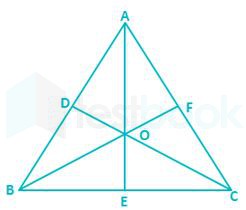
According to the angle bisector theorem, a line that bisects an angle of a triangle, divides the opposite side into segments that are proportional to the other two sides
Let AB = x, BC = y and AC = z
Considering ∆ACD and ∆BCD,
⇒ CO/OD = AC/AD = BC/DB = 3/2
⇒ AD = (2/3)AC
⇒ DB = (2/3)BC
⇒ AB = AD + DB = (2/3)(AC + BC)
⇒ x = (2/3)(y + z)
⇒ 3x = 2y + 2z ----(1)
Similarly, considering ∆ACE and ∆ABE,
⇒ AO/OE = AC/EC = AB/BE = 5/4
⇒ EC = (4/5)AC
⇒ BE = (4/5)AB
⇒ BC = BE + EC = (4/5)(AB + AC)
⇒ y = (4/5)(x + z)
⇒ 5y = 4x + 4z
Substituting for z from (1),
⇒ 5y = 4x + 2(3x - 2y)
⇒ 5y = 4x + 6x - 4y
⇒ 9y = 10x
⇒ y = (10/9)x ----(2)
Similarly, considering ∆ABF and ∆BCF,
⇒ BO/OF = AB/AF = BC/FC = s(let)
⇒ AF = AB/s
⇒ FC = BC/s
⇒ AC = AF + FC = (AB + BC)/s
⇒ z = (x + y)/s
⇒ sz = x + y
Substituting for z from (1),
⇒ s(3x - 2y)/2 = x + y
⇒ 3sx - 2sy = 2x + 2y
⇒ 3sx - 2x = 2sy + 2y
⇒ x(3s - 2) = y(2s + 2)
Substituting for y from (2),
⇒ x(3s - 2) = (10/9)x(2s + 2)
⇒ 9(3s - 2) = 10(2s + 2)
⇒ 27s - 18 = 20s + 20
⇒ 27s - 20s = 18 + 20
⇒ 7s = 38
⇒ s = 38/7
∴ BO/OF = 38/7
Alternate Method
Given:
O is the incenter of the triangle ABC.
AO/OE = 5/4
CO/OD = 3/2
Concept used:
If O is incentre of the ΔABC, then
1.) AO/OE = (AB + AC)/BC
2.) BO/OF = (AB + BC)/CA
3.) CO/OD = (AC + BC)/AB
Calculations:
O is the incenter of the triangle ABC. If AO/OE = 5/4 and CO/OD = 3/2, then what is the value of BO/OF?
AO/OE = 5/4
⇒ (AB + AC)/BC = 5/4
⇒ (AB + AC + BC)/BC = (5 + 4)/4
⇒ (AB + AC + BC)/BC = 9/4
⇒ BC/(AB + BC + CA) = 4/9 ----(1)
⇒ (AC + BC)/AB = 3/2 CO/OD = 3/2
⇒ (AC + BC + AB)/AB = (3 + 2)/2
⇒ (AB + BC + CA)/AB = 5/2 ----(2)
From equation (1) and (2)
| BC | AB + BC + CA | AB |
|---|
| 4 × 5 = 20 | 9 × 5 = 45 | |
| 5 × 9 = 45 | 2 × 9 = 18 |
So,BC = 20
AB + BC + CA = 45
AB = 18
Now, CA = (AB + BC + CA) - (AB + BC)
⇒ CA = 45 - (20 + 18)
⇒ CA = 7
Now, BO/OF = (AB + BC)/CA
⇒ BO/OF = (18 + 20)/7
⇒ BO/OF = 38/7
∴ The correct answer is 38/7