ABCD is a quadrilateral in which diagonal BD = 70 cm. AL ⊥ BD and CM ⊥ BD such that AL = 18 cm and CM = 20. Find the area (in cm²) of the quadrilateral ABCD.
- AOption (a)
1320
- BOption (b)
1310
- COption (c)
1330
- DOption (d)
1300
View answer & explanationHide answer & explanation
Correct answer
1330
Why this answer is correct

Shortcut Trick
The area of a general quadrilateral equals half the product of its diagonal and the sum of perpendiculars dropped on it.
⇒ Area = 1/2 × Diagonal × (Sum of perpendiculars)
⇒ Area = 1/2 × 70 × (18 + 20)
⇒ Area = 35 × 38 = 1330
∴ The correct answer is 1330 cm2.

Alternate Method
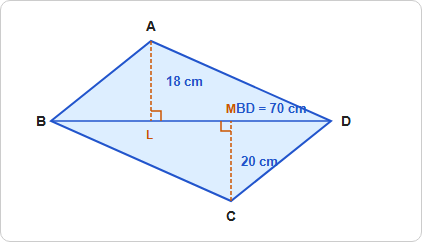
Given:
Diagonal BD = 70 cm
Perpendicular AL = 18 cm
Perpendicular CM = 20 cm
Formula Used:
Area of a triangle = 1/2 × base × height
Area of Quadrilateral ABCD = Area of ΔABD + Area of ΔBCD
Calculation:
⇒ Area of ΔABD = 1/2 × BD × AL
⇒ Area of ΔABD = 1/2 × 70 × 18 = 630 cm2
⇒ Area of ΔBCD = 1/2 × BD × CM
⇒ Area of ΔBCD = 1/2 × 70 × 20 = 700 cm2
⇒ Total Area = 630 + 700 = 1330 cm2
∴ The correct answer is 1330 cm2.

Additional Information
Area of Rhombus
The area is calculated as half the product of its diagonals: Area = 1/2 × d1 × d2.
Area of Trapezium
Calculated as half the sum of parallel sides multiplied by the distance between them: Area = 1/2 × (a + b) × h.
Cyclic Quadrilateral
A quadrilateral whose vertices all lie on a single circle. Its area can be found using Brahmagupta's formula: Area = √((s−a)(s−b)(s−c)(s−d)), where s is the semi-perimeter.