Previous Year Paper

SSC CGL 2024 Tier-I Official Paper (Held On: 26 Sept, 2024 Shift 3) (Previous Year Paper)

Held in 2024

100 questions60 minutes
With answers
Free

Paper last updated:

Practise under exam conditions

Take this paper as a timed mock test. Review your answers after you submit.

Attempt timed test

Questions & answers

Read the paper at your pace. Open an explanation when you need it.

General Intelligence and Reasoning (25 questions)

Question 1

In this question, three statements are given, followed by three conclusions numbered I, II and III. Assuming the statements to be true, even if they seem to be at variance with commonly known facts, decide which of the conclusions logically follow(s) from the statements.

Statements:

All phones are TVs.

Some TVs are cars.

Some big are cars.

Conclusions:

I. Some TVs are phones.

II. Some big are TVs.

III. All big are cars.

  1. AOption (a)

    Only conclusions I follows.

  2. BOption (b)

    None of the conclusions follows.

  3. COption (c)

    Only conclusion III follows.

  4. DOption (d)

    Only conclusions II and III follow.

View answer & explanation

Correct answer

Answer: (a)A.

Only conclusions I follows.

Why this answer is correct

Statements:

All phones are TVs.

Some TVs are cars.

Some big are cars.

The least possible Venn diagram is as follows:

Conclusions:

I. Some TVs are phones. - True (because All phones are TVs given. So, Some TVs are phones too)

II. Some big are TVs. - False (because there is no direct relation between big and TVs. So, it can be possible but not definite)

III. All big are cars. - False (because Some big are cars given. So, it can be possible but not definite).

Hence, the correct answer is "Only conclusions I follows".

Question 2

Four letter-clusters have been given, out of which three are alike in some manner and one is different. Select the letter-

cluster that is different.

Note: The odd one out is not based on the number of consonants/vowels or their position in the letter cluster.

  1. AOption (a)

    YWA

  2. BOption (b)

    LJO

  3. COption (c)

    JHL

  4. DOption (d)

    OMQ

View answer & explanation

Correct answer

Answer: (b)B.

LJO

Why this answer is correct

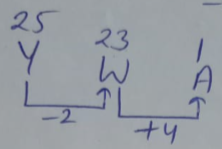
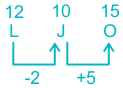
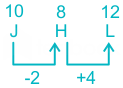
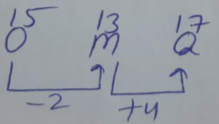
The logic followed here is:

1)  YWA

2)  LJO

3)  JHL

4)  OMQ

Hence, the correct answer is "LJO".

Question 3

Which of the following terms will replace the question mark (?) in the given series?

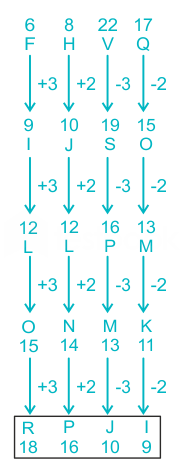
FHVQ, IJSO, LLPM, ONMK, ?

  1. AOption (a)

    RPJI

  2. BOption (b)

    RPKJ

  3. COption (c)

    ROJI

  4. DOption (d)

    OPJI

View answer & explanation

Correct answer

Answer: (a)A.

RPJI

Why this answer is correct

The logic followed here is:

Hence, the correct answer is "RPJI".

Question 4

Six letters I, O, A, Y, Z and X are written on different faces of a dice. Two positions of this dice are shown in the figures below. Find the letter on the face opposite to O.

  1. AOption (a)

    A

  2. BOption (b)

    Z

  3. COption (c)

    X

  4. DOption (d)

    Y

View answer & explanation

Correct answer

Answer: (d)D.

Y

Why this answer is correct

For find the opposite surface of 'O', we need to compare the common surface in the given dices,

So, From Dice 1 and Dice 2,

From both dices, I is common and on the same surface. So, all remaining surface will be opposite to each other.

A is opposite to Z.

So, Y will be opposite to O.

Hence, the correct answer is "Y".

Question 5

Three of the following number-pairs are alike in some manner and hence form a group. Which number-pair does not belong to that group?

(NOTE: Operations should be performed on the whole numbers, without breaking down the numbers into its constituent

digits. E.g. 13 – Operations on 13 such as adding/subtracting/multiplying etc. to 13 can be performed. Breaking down 13 into

1 and 3 and then performing mathematical operations on 1 and 3 is not allowed.)

  1. AOption (a)

    12 – 225

  2. BOption (b)

    8 – 100

  3. COption (c)

    9 – 121

  4. DOption (d)

    6 – 64

View answer & explanation

Correct answer

Answer: (a)A.

12 – 225

Why this answer is correct

The logic followed here is: (1st number + 2)2 = 2nd number

1)  12 – 225 → (12 + 2)2 = 142 = 196 

2)   8 – 100 → (8 + 2)2 = 102 = 100

3)  9 – 121 → (9 + 2)2 = 112 = 121

4)  6 – 64 → (6 + 2)2 = 82 = 64

Hence, the correct answer is "12 – 225".

Question 6

Select the number from among the given options that can replace the question mark (?) in the following series.

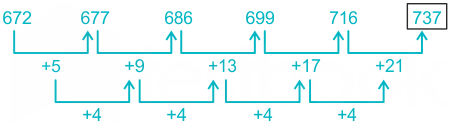
672, 677, 686, 699, 716, ?

  1. AOption (a)

    747

  2. BOption (b)

    749

  3. COption (c)

    757

  4. DOption (d)

    737

View answer & explanation

Correct answer

Answer: (d)D.

737

Why this answer is correct

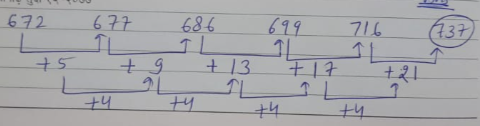
The logic followed here is:

Hence, the correct answer is "737".

Question 7

In a certain code language,

‘A + B’ means ‘A is the mother of B’;

‘A − B’ means ‘A is the brother of B’;

‘A × B’ means ‘A is the wife of B’ and

‘A ÷ B’ means ‘A is the father of B’.

Based on the above, how is 4 related to 1 if ‘4 × 3 − 2 − 1’?

  1. AOption (a)

     Mother

  2. BOption (b)

    Father’s sister

  3. COption (c)

    Sister

  4. DOption (d)

    Brother’s wife

View answer & explanation

Correct answer

Answer: (d)D.

Brother’s wife

Why this answer is correct

Family Chart:

Decoding the Symbols:

Symbol+-×÷
MeaningMotherBrotherWifeFather


Given: 4 × 3 − 2 − 1

It means: 4 is the wife of 3, 3 is the brother of 2 and 2 is the brother of 1.

So, 4 is the 'Brother's wife' of 1.

Hence, the correct answer is "Brother's wife".

Question 8

The position of how many letters will remain unchanged if all the letters in the word MOLTEN are arranged in English alphabetical order?

  1. AOption (a)

    One

  2. BOption (b)

    Two

  3. COption (c)

    None

  4. DOption (d)

    Three

View answer & explanation

Correct answer

Answer: (c)C.

None

Why this answer is correct

Given word: 'MOLTEN'

After arranged in alphabetical order:

AlphabetsMOLTEN
Alphabetical orderELMNOT


Now,

there is no alphabet that will remain unchanged if each of the letters in the word 'MOLTEN' is arranged in English alphabetical order.

Hence, the correct answer is "Option 3".

Question 9

What will come in the place of the question mark (?) in the following equation if '+' and '×' are interchanged and '−' and '÷' are interchanged?

95 − 19 × 4 + 6 ÷ 16 = ?

  1. AOption (a)

    13

  2. BOption (b)

    12

  3. COption (c)

    14

  4. DOption (d)

    11

View answer & explanation

Correct answer

Answer: (a)A.

13

Why this answer is correct

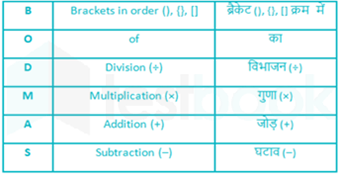
BODMAS Table: 

After decoding signs:

SignsDecoded signs
÷-
-÷
×+
+×


Given equation: 95 − 19 × 4 + 6 ÷ 16 = ?

After interchanging the signs then:

⇒ 95 ÷ 19 + 4 × 6 - 16 = ?

⇒ ? = 5 + 4 × 6 - 16

⇒ ? = 5 + 24 - 16

⇒ ? = 29 - 16 = 13

Hence, the correct answer is "13".

Question 10

What will come in place of the question mark (?) in the following equation, if '+' and '-' are interchanged and '×' and '÷' are interchanged?

2736 × 8 - 55 + 105 ÷ 2 = ?

  1. AOption (a)

    127

  2. BOption (b)

    137

  3. COption (c)

    187

  4. DOption (d)

    177

View answer & explanation

Correct answer

Answer: (c)C.

187

Why this answer is correct

Given equation: 2736 × 8 - 55 + 105 ÷ 2 = ?

Decoding signs:

SignsInterchanged signs
+-
-+
×÷
÷×


⇒ 2736 ÷ 8 + 55 - 105 × 2 = ?

⇒ ? = 342 + 55 - 105 × 2

⇒ ? = 342 + 55 - 210

⇒ ? = 397 - 210

⇒ ? = 187

Hence, the correct answer is "187".

Question 11

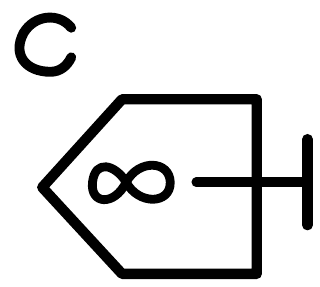
Identify the figure given in the options which when put in place of the question mark (?) will logically complete the series?

  1. AOption (a)

  2. BOption (b)

  3. COption (c)

  4. DOption (d)

View answer & explanation

Correct answer

Answer: (b)B.

Why this answer is correct

The logic followed here is:

All symbols are shifting their position in clockwise direction.

Hence, the correct answer is "Option 2".

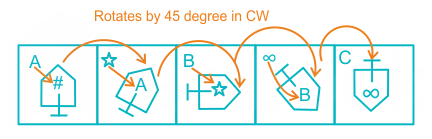
Question 12

Select the figure from among the given options that can replace the question mark (?) and logically complete the series.

  1. AOption (a)

  2. BOption (b)

  3. COption (c)

  4. DOption (d)

View answer & explanation

Correct answer

Answer: (b)B.

Why this answer is correct

The logic followed here is:

Pentagon type shape rotates in clockwise direction by 45°.

Top-left corner symbol shifts inside the pentagon and a new symbol is added at the top-left corner.

Hence, the correct answer is "Option 2".

Question 13

624 is related to 160 following a certain logic. Following the same logic, 448 is related to 116. To which of the following is 528 related, following the same logic? (NOTE : Operations should be performed on the whole numbers, without breaking down the numbers into its constituent digits. E.g. 13 – Operations on 13 such as adding /deleting /multiplying etc., to 13 can be performed. Breaking down 13 into 1 and 3 and then performing mathematical operations on 1 and 3 is not allowed.)

  1. AOption (a)

    136

  2. BOption (b)

    148

  3. COption (c)

    130

  4. DOption (d)

    128

View answer & explanation

Correct answer

Answer: (a)A.

136

Why this answer is correct

The logic followed here is:

Logic: (1st number + 16) ÷ 4 = 2nd number.

Now,

For, 624 : 160

⇒ (624 + 16) ÷ 4 = 640 ÷ 4 = 160

For, 448 : 116

⇒ (448 + 16) ÷ 4 = 464 ÷ 4 = 116 

Similarly, for 528 : ?

⇒ (528 + 16) ÷ 4 = 544 ÷ 4 = 136

Hence, the correct answer is "Option 1".

Question 14

80 is related to 99 following certain logic. Following the same logic, 0 is related to 3. To which of the following numbers is 35 related, following the same logic? (NOTE : Operations should be performed on the whole numbers, without breaking down the numbers into its constituent digits. E.g. 13 – Operations on 13 such as adding /deleting /multiplying etc., to 13 can be performed. Breaking down 13 into 1 and 3 and then performing mathematical operations on 1 and 3 is not allowed.)

  1. AOption (a)

    46

  2. BOption (b)

    44

  3. COption (c)

    42

  4. DOption (d)

    48

View answer & explanation

Correct answer

Answer: (d)D.

48

Why this answer is correct

The logic follows here is:

Logic: n2 - 1.

Now,

80 is related to 99

→ 92 - 1 = 81 - 1 = 80,

→ 102 - 1 = 100 - 1 = 99,

0 is related to 3

→ 12 - 1 = 1 - 1 = 0,

→ 22 - 1 = 4 - 1 = 3,

Similarly, for 35 and 49

→ 62 - 1 = 36 - 1 = 35,

→ 72 - 1 = 49 - 1 = 48.

Hence, the correct answer is "Option 4".

Additional InformationTheir is a logic followed here,  logic is n^2-1 and next is (n+1)^2 -1 

Like:- 35 is 6^2 -1 then for next number (n+1)^2 -1

Question 15

In the following number-pairs, the second number is obtained by applying certain mathematical operations to the first number. Select the set in which the numbers are related in the same way as are the numbers of the following sets.

(NOTE: Operations should be performed on the whole numbers, without breaking down the numbers into its constituent digits. E.g., 13 – Operations on 13 such as adding/deleting/multiplying etc., to 13 can be performed. Breaking down 13 into 1 and 3 and then performing mathematical operations on 1 and 3 is not allowed.)

(96, 29)

(112, 33)

  1. AOption (a)

     (204, 55)

  2. BOption (b)

    (176, 45)

  3. COption (c)

    (188, 52)

  4. DOption (d)

    (108, 30)

View answer & explanation

Correct answer

Answer: (c)C.

(188, 52)

Why this answer is correct

The logic followed here is:

Logic: (2nd number × 3) + (2nd number - 20) = 1st number.

Now,

For, 96 : 29

⇒ (29 × 3) + (29 - 20) = 87 + 9 = 96.

For, 112 : 33

⇒ (33 × 3) + (33 - 20) = 99 + 13 = 112.

Similarly, for 188 : 52

⇒ (52 × 3) + (52 - 20) = 156 + 32 = 188.

Hence, the correct answer is "Option 3".

Question 16

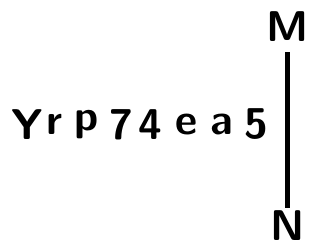
Select the correct mirror image of the given figure when the mirror is placed at MN.

  1. AOption (a)

  2. BOption (b)

  3. COption (c)

  4. DOption (d)

View answer & explanation

Correct answer

Answer: (c)C.

Why this answer is correct

The correct mirror image of the given figure is:

Hence, the correct answer is "Option 3".

Question 17

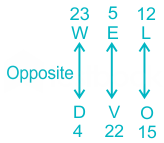
Select the option that is related to the fifth letter-cluster in the same way as the second letter-cluster is related to the first letter-cluster and the fourth letter-cluster is related to the third letter-cluster:

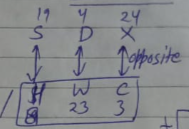
WEL: DVO :: FOR: ULI :: SDX: ?

  1. AOption (a)

    HWC

  2. BOption (b)

    GWG

  3. COption (c)

    HXC

  4. DOption (d)

    GXC

View answer & explanation

Correct answer

Answer: (a)A.

HWC

Why this answer is correct

The logic followed here is:

WEL : DVO

FOR : ULI

Similarly, SDX : ?

Hence, the correct answer is "HWC".

Question 18

Select the correct mirror image of the given figure when the mirror is placed at MN as shown below.

  1. AOption (a)

  2. BOption (b)

  3. COption (c)

  4. DOption (d)

View answer & explanation

Correct answer

Answer: (d)D.

Why this answer is correct

The correct mirror image of the given figure is:

Hence, the correct answer is "Option 3".

Question 19

A square sheet of paper is folded along the dotted line successively along the directions shown and is then punched in the

last. How would the paper look when unfolded?

  1. AOption (a)

  2. BOption (b)

  3. COption (c)

  4. DOption (d)

View answer & explanation

Correct answer

Answer: (d)D.

Why this answer is correct

The paper look when unfolded:

Hence, the correct answer is "Option 4".

Question 20

Select the option that is related to the fifth letter cluster in the same way as the second letter cluster is related to the first letter cluster and the fourth letter cluster is related to the third letter cluster.

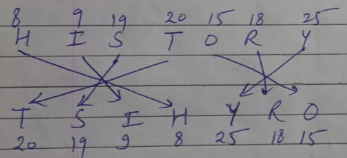
IMPROVE : RPMIEVO :: HISTORY : TSIHYRO :: JOURNEY : ?

  1. AOption (a)

    RUOJYEN

  2. BOption (b)

    JOURYEN

  3. COption (c)

    NEYJOUR

  4. DOption (d)

    YENRUOJ

View answer & explanation

Correct answer

Answer: (a)A.

RUOJYEN

Why this answer is correct

The logic followed here is:

IMPROVE : RPMIEVO

HISTORY : TSIHYRO

Similarly, JOURNEY : ?

Hence, the correct answer is "RUOJYEN".

Question 21

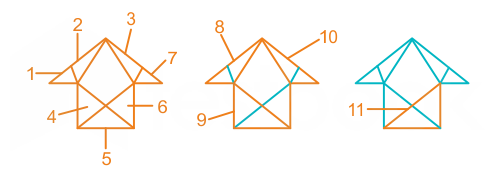
How many triangles are there in the given figure?

  1. AOption (a)

    13

  2. BOption (b)

    12

  3. COption (c)

    10

  4. DOption (d)

    11

View answer & explanation

Correct answer

Answer: (d)D.

11

Why this answer is correct

Counting the triangles are there in the given figure:

Hence, the correct answer is "11".

Question 22

Three statements are given followed by three conclusions numbered I, II and III. Assuming the statements to be true, even if

they seem to be at variance with commonly known facts, decide which of the conclusions logically follow(s) from the

statements.

Statements:

Some cups are glasses.

No glass is a stone.

All stones are metals.

Conclusions:

I. All cups can never be stones.

II. No cup is a metal.

III. All metals can never be glasses.

  1. AOption (a)

    Only II and III conclusion follow

  2. BOption (b)

    All I, II and III conclusion follow

  3. COption (c)

    Only conclusion I follows

  4. DOption (d)

    Only I and III conclusion follow

View answer & explanation

Correct answer

Answer: (d)D.

Only I and III conclusion follow

Why this answer is correct

Statements:

Some cups are glasses.

No glass is a stone.

All stones are metals.

The least possible Venn diagram is as follows:

Conclusions:

I. All cups can never be stones. - True (because Some cups are glasses and No glass is a stone. As there is no direct relation between cups and stones. So, All cups can never be stones it is true)

II. No cup is a metal. - False (because there is no direct relation between cups and metal. So, it can be possible but not definite)

III. All metals can never be glasses. - True (because All stones are metals and No glass is a stone. So, All metals can never be glasses it is true)

Hence, the correct answer is "Only I and III conclusion follow".

Question 23

Select the option that represents the letters that, when sequentially placed from left to right in the blanks below, will complete the letter series.

_ V D W Y _ D W Y V _ W Y _ D _

  1. AOption (a)

    YVYVW

  2. BOption (b)

    YVDVW

  3. COption (c)

    YWDVW

  4. DOption (d)

    YVDVY

View answer & explanation

Correct answer

Answer: (b)B.

YVDVW

Why this answer is correct

The logic followed here is:

Given Sequence: _ V D W Y _ D W Y V _ W Y _ D _

Now, putting the letters in the blank spaces given in the option one by one:

Option 1) YVYVW → Y V D W / Y V D W / Y V Y W / Y V D W

Option 2) YVDVW → Y V D W / Y V D W / Y V D W / Y V D W

Here, 'Y V D W' is the pattern.

Option 3) YWDVW → Y V D W / Y W D W / Y V D W / Y V D W

Option 4) YVDVY → Y V D W / Y V D W / Y V D W / Y V D Y

Hence, the correct answer is "YVDVW".

Question 24

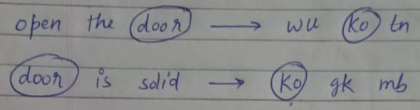
In a certain code language, ‘open the door’ is coded as 'wu ko tn' and ‘door is solid’ is coded as ‘ko gk mb’. How is ‘door’ coded in the given language?

  1. AOption (a)

    tn

  2. BOption (b)

    ko

  3. COption (c)

    gk

  4. DOption (d)

    wu

View answer & explanation

Correct answer

Answer: (b)B.

ko

Why this answer is correct

According to the given information:

Thus 'door' will be coded as 'ko'.

Hence, the correct answer is "ko".

Question 25

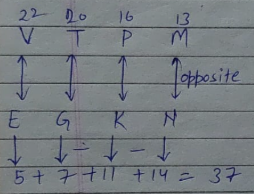
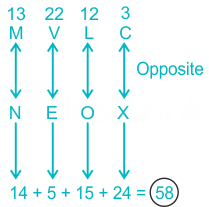
In a certain code language, 'VTPM' is coded as '37' and 'CGNK' is coded as '73'. How will 'MVLC' be coded in the same language?

  1. AOption (a)

    64

  2. BOption (b)

    58

  3. COption (c)

    81

  4. DOption (d)

    72

View answer & explanation

Correct answer

Answer: (b)B.

58

Why this answer is correct

The logic followed here is:

'VTPM' is coded as '37'

'CGNK' is coded as '73'

Similarly, 'MVLC' will be coded as:

Hence, the correct answer is "58".

General Awareness (25 questions)

Question 26

In which of the following places did Mahatma Gandhi, along with other Indians, establish the Natal Congress to fight against racial discrimination?

  1. AOption (a)

    South Africa

  2. BOption (b)

    India

  3. COption (c)

    England

  4. DOption (d)

    France

View answer & explanation

Correct answer

Answer: (a)A.

South Africa

Why this answer is correct

The correct answer is South Africa.

Key Points

  • Mahatma Gandhi, along with other Indians, established the Natal Indian Congress in 1894 in South Africa.
  • The organization was formed to fight against racial discrimination faced by Indians in South Africa.
  • The Natal Indian Congress played a significant role in the civil rights movement in South Africa and later influenced Gandhi's methods in India's struggle for independence.
  • It was Gandhi's first major involvement in non-violent resistance, which he termed "Satyagraha".

Additional Information

  • Natal Indian Congress (NIC)
  • The NIC was an organization aimed at opposing the discriminatory laws and practices against Indians in the Natal region of South Africa.
  • The NIC was formed due to the increasing racial prejudice and discriminatory policies targeting the Indian community in South Africa.
  • Gandhi's leadership in the NIC marked the beginning of his transformation into a prominent leader of the Indian community and set the foundation for his future activities in India.
  • The NIC also provided a platform for Indians in South Africa to voice their grievances and seek justice through legal and non-violent means.
  • Satyagraha
  • Satyagraha is a form of non-violent resistance or civil resistance, conceived and developed by Mahatma Gandhi.
  • It is based on the principles of truth and non-violence and aims to achieve social and political goals through peaceful means.
  • The concept of Satyagraha played a crucial role in India's struggle for independence from British rule.
  • Gandhi's successful implementation of Satyagraha in South Africa laid the groundwork for its adoption in the Indian independence movement.
  • Gandhi's Influence in South Africa
  • Gandhi's experiences in South Africa significantly shaped his philosophy and strategies in the fight against colonial rule in India.
  • His efforts in South Africa helped to galvanize the Indian community and brought international attention to the plight of Indians in the region.
  • Gandhi's work in South Africa also demonstrated the effectiveness of non-violent resistance, which became a hallmark of his leadership in India's independence movement.
  • The lessons learned and the networks established in South Africa were instrumental in Gandhi's subsequent activities in India.

Question 27

In February 2023, BVR Subrahmanyam was appointed as the ______.

  1. AOption (a)

    Chief Vigilance Commissioner

  2. BOption (b)

    Comptroller General Of India

  3. COption (c)

    CEO NITI Aayog

  4. DOption (d)

    Chief Election Commissioner

View answer & explanation

Correct answer

Answer: (c)C.

CEO NITI Aayog

Why this answer is correct

The correct answer is CEO NITI Aayog.

Key Points

  • BVR Subrahmanyam was appointed as the CEO of NITI Aayog in February 2023.
  • He succeeded Parameswaran Iyer, who was appointed as the Executive Director of World Bank.
  • NITI Aayog, or the National Institution for Transforming India, is the premier policy think tank of the Government of India.
  • It aims to foster cooperative federalism and ensure that the states and the central government work together on key policy issues.

Additional Information

  • Chief Vigilance Commissioner
  • The Chief Vigilance Commissioner (CVC) is the head of the Central Vigilance Commission.
  • The CVC is appointed by the President of India to address governmental corruption.
  • The position is pivotal for ensuring transparency and accountability in the public administration.
  • Comptroller General of India
  • The Comptroller and Auditor General of India (CAG) is an authority established by the Constitution of India.
  • The CAG audits all receipts and expenditure of the Government of India and the state governments, including those of bodies and authorities substantially financed by the government.
  • The role of CAG is critical in maintaining the financial accountability of the government to the Parliament and the legislature.
  • Chief Election Commissioner
  • The Chief Election Commissioner (CEC) heads the Election Commission of India.
  • The CEC is responsible for administering election processes in India at both the national and state levels.
  • This role ensures free and fair elections, which are fundamental to the democratic process.
  • NITI Aayog
  • NITI Aayog stands for National Institution for Transforming India.
  • It was established in 2015, replacing the Planning Commission of India.
  • NITI Aayog is responsible for formulating policies and strategies for the economic development of the country.
  • It acts as a catalyst for innovation and promotes cooperative federalism by involving state governments in the policy-making process.

Question 28

Which type of well-managed industry was established in India at the time of independence?

  1. AOption (a)

    Electronics and Electricals

  2. BOption (b)

    Steel and Electronics

  3. COption (c)

    Steel and Cotton

  4. DOption (d)

    Cement and Sugar

View answer & explanation

Correct answer

Answer: (c)C.

Steel and Cotton

Why this answer is correct

The correct answer is Steel and Cotton.

Key Points

  • Steel industry was well-established in India by the time of independence, with the Tata Iron and Steel Company (TISCO) being founded in 1907.
  • Cotton industry also had a significant presence, with the first cotton mill set up in Bombay (now Mumbai) in 1854.
  • Both industries played a crucial role in the Indian economy, providing employment and contributing to export revenues.
  • The development of these industries was part of India’s strategy to achieve self-sufficiency and reduce dependency on foreign goods.

Additional Information

  • Steel Industry in India:
  • The steel industry is a major contributor to the Indian economy and has been instrumental in the country's industrial development.
  • India is one of the largest producers of steel in the world, with significant contributions from both public and private sector companies.
  • Key players in the steel industry include Tata Steel, Steel Authority of India Limited (SAIL), and JSW Steel.
  • Steel production in India has grown significantly since independence, driven by infrastructure development and demand from various sectors such as construction, automotive, and manufacturing.
  • Cotton Industry in India:
  • The cotton industry has a rich history in India, dating back to ancient times when India was known for its fine cotton textiles.
  • The establishment of cotton mills during the British colonial period marked the beginning of organized cotton manufacturing in India.
  • Post-independence, the cotton industry has expanded and modernized, with India becoming one of the largest producers and exporters of cotton textiles in the world.
  • The cotton industry is a major source of employment in India, particularly in rural areas, and plays a key role in the agricultural and industrial economy.

Question 29

Yakshagan is a folk dance of which of the following states?

  1. AOption (a)

    Odisha

  2. BOption (b)

    West Bengal

  3. COption (c)

    Madhya Pradesh

  4. DOption (d)

    Karnataka

View answer & explanation

Correct answer

Answer: (d)D.

Karnataka

Why this answer is correct

The correct answer is Karnataka.

Key Points

  • Yakshagana is a traditional theatre form that combines dance, music, dialogue, costume, make-up, and stage techniques with a unique style and form.
  • It is predominantly performed in the state of Karnataka, especially in the districts of Uttara Kannada, Udupi, Dakshina Kannada, Shimoga, and Kasaragod in Kerala.
  • Yakshagana is believed to have evolved from pre-classical music and theatre during the period of the Bhakti movement.
  • The performances are usually based on stories from Hindu epics such as the Ramayana, Mahabharata, and Bhagavata.

Additional Information

  • Yakshagana
  • Yakshagana is a traditional Indian theatre form that developed in Karnataka and Kerala, particularly in the Malnad and coastal regions, and Kasaragod in Kerala.
  • The word "Yakshagana" means the song (gana) of a Yaksha. Yakshas were an exotic tribe mentioned in the Sanskrit literature of ancient India.
  • It is believed to have originated somewhere between the 11th and 16th centuries, but the form in its current structure is a product of the early 17th century.
  • Yakshagana is known for its unique combination of dance, music, and acting, and its elaborate and colorful costumes and makeup.
  • Performance and Components
  • The performance usually depicts mythological stories and Puranas.
  • The art form involves a narrator who narrates the story, while the characters enact the story through dance and dialogues.
  • The dance form is known for its vigorous and elaborate dance movements and its rich footwork.
  • The musical instruments used in Yakshagana include the Chande (a drum), Maddale (another drum), harmonium, and the Taala (cymbals).
  • Costumes and Makeup
  • The costumes in Yakshagana are distinctive and elaborate, consisting of large headgear, colored faces, and elaborate costumes.
  • The makeup is very intricate and is designed to give the characters a larger-than-life appearance.
  • The colors and designs of the costumes and makeup are specific to the characters being portrayed, with gods and heroes wearing different styles compared to demons and villains.
  • Yakshagana Today
  • Yakshagana continues to be a popular art form in Karnataka and parts of Kerala.
  • There are many professional troupes and amateur groups that perform Yakshagana regularly.
  • The art form has also seen some modernization, with new stories being written to address contemporary issues while still using the traditional Yakshagana format.

Question 30

Which of the following options best describes the primary cause of the per capita income decline?

  1. AOption (a)

    Equitable distribution of income

  2. BOption (b)

    Increase in the population growth

  3. COption (c)

    Decline in the population growth

  4. DOption (d)

    Decline in the gross domestic product

View answer & explanation

Correct answer

Answer: (b)B.

Increase in the population growth

Why this answer is correct

The correct answer is Increase in the population growth.

Key Points

  • An increase in population growth means that there are more people to share the national income, which can lead to a decrease in per capita income if the national income does not increase at the same rate.
  • Rapid population growth can strain resources and infrastructure, leading to lower levels of productivity and economic growth.
  • Higher population growth often requires more investment in social services such as education and healthcare, which can reduce the funds available for other productive investments.
  • In many developing countries, high population growth rates can lead to higher levels of unemployment and underemployment, which can also contribute to lower per capita income.

Additional Information

  • Per Capita Income
  • Per capita income is a measure of the amount of money earned per person in a nation or geographic region.
  • It is calculated by dividing the total income of the country by its population.
  • Per capita income is often used as an indicator of the standard of living and economic well-being of the population.
  • Gross Domestic Product (GDP)
  • Gross Domestic Product (GDP) is the total monetary or market value of all the finished goods and services produced within a country's borders in a specific time period.
  • It is a comprehensive measure of a nation's overall economic activity and an indicator of its economic health.
  • GDP can be calculated using three approaches: production (or output), income, and expenditure approaches.
  • Population Growth
  • Population growth refers to the increase in the number of individuals in a population.It is influenced by factors such as birth rates, death rates, immigration, and emigration.
  • High population growth rates can have both positive and negative impacts on a country's economy and resources.
  • Economic Growth
  • Economic growth is an increase in the production of goods and services in an economy over a period of time.
  • It is typically measured as the percent rate of increase in real gross domestic product (GDP).
  • Economic growth is important because it can lead to higher living standards and reduced poverty rates.

Question 31

Which television channel presents the IMMIES Awards every year with an aim to reward the best talent in the Indian music industry?

  1. AOption (a)

    B4U Music

  2. BOption (b)

    MTV

  3. COption (c)

    Channel V

  4. DOption (d)

    9XM

View answer & explanation

Correct answer

Answer: (b)B.

MTV

Why this answer is correct

The correct answer is MTV.

Key Points

  • MTV is a popular television channel known for its focus on music and youth culture.
  • The IMMIES Awards are presented annually by MTV to recognize and reward the best talent in the Indian music industry.
  • MTV has a significant influence on the Indian music scene, often showcasing the latest music trends and emerging artists.
  • The IMMIES Awards are considered prestigious within the Indian music industry, providing recognition and exposure to talented musicians.

Additional Information

  • MTV
  • MTV, originally an acronym for Music Television, is a renowned American cable and satellite television channel launched on August 1, 1981.
  • It initially aired music videos guided by on-air hosts known as "video jockeys" or VJs.
  • The channel has significantly evolved over the years, diversifying its content to include reality shows, scripted series, and other entertainment programs.
  • In India, MTV India has become a major platform for music, entertainment, and youth culture since its launch in 1996.
  • IMMIES Awards
  • The IMMIES Awards were introduced to honor and celebrate excellence in the Indian music industry.
  • These awards cover various categories, including best album, best song, best music video, and best new artist, among others.
  • The awards ceremony is a star-studded event, featuring performances by prominent artists and attendance by notable figures from the music and entertainment industry.
  • Winning an IMMIES Award is considered a significant achievement for artists, providing them with increased recognition and credibility.

Question 32

The first Indian Olympic Games was hosted by which of the following cities?

  1. AOption (a)

    Lahore

  2. BOption (b)

    Madras

  3. COption (c)

    Bombay

  4. DOption (d)

    Allahabad

View answer & explanation

Correct answer

Answer: (a)A.

Lahore

Why this answer is correct

The correct answer is Lahore.

Key Points

  • The first Indian Olympic Games were hosted in Lahore in 1924.
  • Lahore, now in Pakistan, was part of undivided India during the British rule.
  • The event was organized by the Indian Olympic Association, which was founded in 1927.
  • The Indian Olympic Games were the precursor to the National Games of India.

Additional Information

  • Indian Olympic Association (IOA)
  • The Indian Olympic Association (IOA) is the body responsible for selecting athletes to represent India at the Olympic Games, Asian Games, and other international athletic meets.
  • It is also responsible for managing the Indian teams at these events.
  • The IOA was established in 1927, and its first president was Sir Dorabji Tata.
  • The IOA is recognized by the International Olympic Committee (IOC).
  • National Games of India
  • The National Games of India are held every two years, with the aim of promoting sports and identifying talents at the national level.
  • The format is similar to that of the Olympic Games, with athletes from different states and union territories of India competing in various sports.
  • The first National Games were held in 1924 in Lahore as the Indian Olympic Games.
  • The event was renamed the National Games after Indian independence in 1947.
  • Olympic Games
  • The Olympic Games are a leading international sporting event featuring summer and winter sports competitions in which thousands of athletes from around the world participate in a variety of competitions.
  • The Olympic Games are considered the world's foremost sports competition, with more than 200 nations participating.
  • The Games are held every four years, with the Summer and Winter Games alternating by occurring every four years but two years apart.
  • The Olympic Games were first held in 1896 in Athens, Greece.

Question 33

Pushyabhuti dynasty, after Prabhakaravardhana, strengthened its position in the regions of Punjab and Haryana after defeating which of the following dynasties?

  1. AOption (a)

    Maukharis

  2. BOption (b)

    Hunas

  3. COption (c)

    Chalukyas

  4. DOption (d)

    Maitrakas

View answer & explanation

Correct answer

Answer: (b)B.

Hunas

Why this answer is correct

The correct answer is Hunas.

Key Points

  • The Pushyabhuti dynasty, also known as the Vardhana dynasty, was a prominent ruling dynasty in northern India.
  • After the death of Prabhakaravardhana, his son Harsha Vardhana ascended the throne and expanded the kingdom.
  • The Hunas were a central Asian tribe who invaded and occupied parts of northern India before being defeated by Indian rulers.
  • Harsha Vardhana successfully defeated the Hunas, which helped consolidate his control over the regions of Punjab and Haryana.

Additional Information

  • Pushyabhuti Dynasty
  • The Pushyabhuti dynasty was an ancient Indian dynasty that ruled over parts of northern India during the 6th and 7th centuries.
  • Prabhakaravardhana was an important king of this dynasty who laid the foundation for its expansion.
  • His son, Harsha Vardhana, is considered one of the greatest rulers of the dynasty and is known for his military conquests and cultural achievements.
  • Hunas
  • The Hunas were a group of nomadic tribes from Central Asia who invaded India during the late 5th and early 6th centuries.
  • They are often identified with the Hephthalites or White Huns who were known for their invasions in various regions.
  • Their invasion led to significant disruption and eventual decline of the Gupta Empire.
  • Indian rulers, including the Vardhana dynasty, eventually managed to repel the Hunas and restore stability to the affected regions.
  • Harsha Vardhana
  • Harsha Vardhana, also known as Harshavardhana, was a prominent emperor of the Pushyabhuti dynasty who ruled from 606 to 647 CE.
  • He is known for his successful military campaigns that expanded his kingdom across northern India.
  • Harsha was a patron of arts and culture, and his reign is often associated with a flourishing of arts, literature, and religious activities.
  • He is also known for his religious tolerance and support for both Buddhism and Hinduism.
  • Punjab and Haryana
  • Punjab and Haryana are regions in northern India that have a rich historical and cultural heritage.
  • These regions were significant centers of political power and cultural development during various historical periods.
  • The control over these regions was crucial for the expansion and consolidation of power for many ruling dynasties, including the Pushyabhuti dynasty.

Question 34

Which law states that endothermic animals from cold climates have smaller extremities or appendages than closely related species from warm climates?

  1. AOption (a)

    Harper's rule

  2. BOption (b)

    Reich's rule

  3. COption (c)

    Allen's rule

  4. DOption (d)

    Miller's rule

View answer & explanation

Correct answer

Answer: (c)C.

Allen's rule

Why this answer is correct

The correct answer is Allen's rule.

Key Points

  • Allen's rule is a biological principle that explains how the body shapes and sizes of endotherms vary with climate.
  • It states that endothermic animals from colder climates generally have shorter extremities or appendages compared to those from warmer climates.
  • This adaptation helps reduce heat loss in cold environments by minimizing the surface area to volume ratio.
  • Allen's rule is named after the American zoologist Joel Asaph Allen, who first formulated this rule in 1877.

Additional Information

  • Endothermic Animals:
  • Endothermic animals, also known as warm-blooded animals, are those that maintain a constant body temperature independent of the environment.
  • Examples include mammals and birds.
  • These animals have metabolic mechanisms to generate heat when it is cold and to dissipate heat when it is hot.
  • Adaptation to Climate:
  • Adaptations are traits that have evolved through natural selection, allowing organisms to better survive and reproduce in their environments.
  • In cold climates, endothermic animals develop shorter limbs, ears, and tails to conserve heat.
  • In contrast, in warm climates, longer extremities help with heat dissipation.
  • Other Biological Rules:
  • Bergmann's Rule: States that within a broadly distributed taxonomic group, larger-sized species are found in colder environments, and smaller-sized species are found in warmer ones.
  • Gloger's Rule: States that dark pigments increase in animals living in warm and humid habitats.

Question 35

The Union Public Service Commission (UPSC) is a Constitutional Body established under Article ________ of the Indian Constitution.

  1. AOption (a)

    315

  2. BOption (b)

    324

  3. COption (c)

    326

  4. DOption (d)

    332

View answer & explanation

Correct answer

Answer: (a)A.

315

Why this answer is correct

The correct answer is Article 315.

Key Points

  • Article 315 of the Indian Constitution provides for the establishment of a Public Service Commission for the Union and a Public Service Commission for each State.
  • The Union Public Service Commission (UPSC) is a central recruiting agency in India responsible for appointments to and examinations for All India Services and Group A & B of Central services.
  • The State Public Service Commissions (SPSCs) are responsible for conducting examinations for appointments to the services of the respective state governments.
  • While Article 315 deals with the establishment of these bodies, Article 320 specifies the functions of the Public Service Commissions, which include conducting examinations for appointments to the services.

Additional Information

  • Union Public Service Commission (UPSC)
  • The UPSC is an independent constitutional body established under Article 315 of the Indian Constitution.
  • It is tasked with conducting examinations for All India Services, Central Services, and public services of the centrally administered territories.
  • The commission consists of a chairman and other members appointed by the President of India.
  • The term of office of the members of the Commission is six years or until they attain the age of 65 years, whichever is earlier.
  • State Public Service Commissions (SPSCs)
  • Each state in India has its own Public Service Commission established under Article 315 to conduct examinations for appointments to the services of the state.
  • The SPSCs advise the state government on all matters relating to recruitment, promotions, transfers, and disciplinary actions.
  • The members of the SPSC are appointed by the Governor of the respective state.
  • The term of office for SPSC members is also six years or until the age of 62 years, whichever is earlier.

Question 36

Which of the following states suffers from 'Loo'?

  1. AOption (a)

    Karnataka

  2. BOption (b)

    Kerala

  3. COption (c)

    Assam

  4. DOption (d)

    Rajasthan

View answer & explanation

Correct answer

Answer: (d)D.

Rajasthan

Why this answer is correct

The correct answer is Rajasthan.

Key Points

  • Rajasthan is known for its extreme weather conditions, especially in the summer months.
  • The 'Loo' is a strong, hot, and dry wind that blows during the day in the summer season in North India, particularly in the Thar Desert region of Rajasthan.
  • The 'Loo' can raise temperatures to extremely high levels, often crossing 45°C (113°F).
  • These winds are known to cause heat strokes and dehydration, making them particularly dangerous.

Additional Information

  • Loo Winds
  • The 'Loo' is a type of hot wind that is prevalent in the plains of North India and Pakistan.
  • It typically blows from the west or northwest and is common during the months of May and June.
  • The 'Loo' can cause severe heat strokes, especially in regions with limited access to water and shade.
  • Precautions such as staying hydrated, avoiding direct exposure to the sun, and wearing light clothing are essential to mitigate the effects of the 'Loo'.
  • Climate of Rajasthan
  • Rajasthan experiences a desert climate in the Thar region, characterized by extreme temperatures and low humidity.
  • Summers are scorching with temperatures often exceeding 45°C (113°F), while winters can be quite cold, dropping to near freezing points.
  • The region receives scanty rainfall, making it one of the driest states in India.
  • Despite the harsh conditions, Rajasthan is known for its rich cultural heritage and vibrant festivals.
  • Heat Strokes
  • Heat strokes occur when the body fails to regulate its temperature due to prolonged exposure to high temperatures.
  • Symptoms include high body temperature, altered mental state, nausea, rapid breathing, and a rapid pulse.
  • Immediate medical attention is required to treat heat strokes, including cooling the body and rehydration.
  • Preventive measures include drinking plenty of fluids, wearing loose-fitting clothes, and avoiding strenuous activities during peak heat hours.

Question 37

Pandit Ram Narayan was associated with which of the following musical instruments?

  1. AOption (a)

    Sarod

  2. BOption (b)

    Rudra veena

  3. COption (c)

    Sarangi

  4. DOption (d)

    Mohan veena

View answer & explanation

Correct answer

Answer: (c)C.

Sarangi

Why this answer is correct

The correct answer is Sarangi.

Key Points

  • Pandit Ram Narayan is a renowned musician who is credited with popularizing the Sarangi as a solo concert instrument in Hindustani classical music.
  • He was born on December 25, 1927, in Udaipur, Rajasthan, India.
  • Ram Narayan started his career as an accompanist for vocalists but later became a solo performer, showcasing the versatility and expressive capacity of the Sarangi.
  • He has received numerous awards and honors for his contribution to Indian classical music, including the Padma Vibhushan in 2005, one of India's highest civilian honors.

Additional Information

  • Sarangi
  • The Sarangi is a bowed, short-necked string instrument from the Indian subcontinent, used primarily in Hindustani classical music.
  • It is said to most resemble the sound of the human voice, able to imitate vocal ornaments such as gamaks (shakes) and meends (sliding movements).
  • The Sarangi is typically played while sitting cross-legged, with the instrument held vertically in front of the player.
  • The instrument is played with a bow, and the main strings are stopped with the cuticles or nails of the left hand, while the other fingers are used to modulate the pitch and resonance.
  • Rudra Veena
  • The Rudra Veena is a large plucked string instrument used in Hindustani classical music.
  • It is considered one of the most ancient and revered instruments in Indian music.
  • The instrument consists of a long tubular body with two large resonating gourds at either end.
  • Sarod
  • The Sarod is another prominent string instrument used in Hindustani classical music.
  • It is known for its deep, weighty, introspective sound and is used both for solo performances and as an accompaniment.
  • The Sarod is played with a plectrum, and the strings are stopped with the nails of the left hand.
  • Mohan Veena
  • The Mohan Veena is a modified slide guitar used in Indian classical music.
  • It was popularized by Pandit Vishwa Mohan Bhatt, who won a Grammy Award for his performance with Ry Cooder in "A Meeting by the River".
  • The instrument is played with a slide, and it combines techniques and sounds from both Indian and Western musical traditions.

Question 38

The Tripartite struggle happened among the Palas, the Pratiharas and the ______.

  1. AOption (a)

    Chandelas

  2. BOption (b)

    Maukharis

  3. COption (c)

    Rashtrakutas

  4. DOption (d)

    Chalukyas

View answer & explanation

Correct answer

Answer: (c)C.

Rashtrakutas

Why this answer is correct

The correct answer is Rashtrakutas.

Key Points

  • The Tripartite Struggle, also known as the Kannauj Triangle Wars, was a prolonged conflict in the Indian subcontinent from the 8th to the 10th century.
  • The struggle was primarily among three major powers: the Palas of Bengal, the Pratiharas of Malwa, and the Rashtrakutas of the Deccan.
  • This conflict was primarily over the control of the city of Kannauj, a symbol of prestige and political power in northern India during that time.
  • The Rashtrakutas were a prominent dynasty that ruled large parts of the Indian subcontinent between the 6th and 10th centuries.

Additional Information

  • Palas:
  • The Pala Empire was an imperial power during the late classical period on the Indian subcontinent, which originated in the region of Bengal.
  • They were known for their patronage of Buddhism and the establishment of famous institutions such as the Vikramashila and Nalanda universities.
  • The Palas were also known for their contributions to art, architecture, and literature.
  • Key rulers included Gopala, the founder, and Dharmapala, who greatly expanded the empire.
  • Pratiharas:
  • The Pratiharas, also known as the Gurjara-Pratiharas, were an important dynasty that ruled much of northern India from the 6th to the 11th century.
  • They are noted for their resistance against the Arab invasions and their efforts to unify and protect northern India.
  • Their capital was initially at Ujjain and later at Kannauj, which became a significant center of power.
  • Key rulers included Nagabhata I and Mihira Bhoja.
  • Rashtrakutas:
  • The Rashtrakutas were a dynasty that ruled large parts of the Indian subcontinent from the 6th to the 10th century, with their capital at Manyakheta in the Deccan region.
  • They were known for their military prowess and their successful expeditions into northern India, including the capture of Kannauj.
  • The Rashtrakutas were also great patrons of art and architecture, with the rock-cut temples at Ellora being one of their most famous contributions.Key rulers included Dantidurga, the founder, and Krishna I, who commissioned the Kailasa temple at Ellora.

Question 39

Guru Ghasidas led which of the following movements to improve the social condition of leather workers in British India?

  1. AOption (a)

    Arya Samaj Movement

  2. BOption (b)

    Satya Shodhak Samaj

  3. COption (c)

    Narayan Movement

  4. DOption (d)

    Satnami Movement

View answer & explanation

Correct answer

Answer: (d)D.

Satnami Movement

Why this answer is correct

The correct answer is Satnami Movement.

Key Points

  • Guru Ghasidas was the founder of the Satnami sect in the early 19th century in the Chhattisgarh region of India.
  • The Satnami Movement aimed at uplifting the social status of the untouchables, primarily the leather workers, by promoting a monotheistic faith.
  • Under Guru Ghasidas' leadership, the movement advocated for social equality, non-violence, and abstinence from alcohol and meat.
  • The Satnamis believe in the worship of a single god, Satnam, which translates to "true name."

Additional Information

  • Arya Samaj Movement
  • Founded by Swami Dayananda Saraswati in 1875.
  • Aimed at reforming Hinduism and promoting values of the Vedas.
  • Focused on eradicating social evils like caste discrimination, child marriage, and promoting education for all.
  • Satya Shodhak Samaj
  • Founded by Jyotirao Phule in 1873 in Maharashtra.
  • Worked towards the upliftment of oppressed classes and women.
  • Opposed Brahminical dominance and promoted equality and education.
  • Narayan Movement
  • Founded by Narayan Guru in Kerala.
  • Focused on social reform and spiritual upliftment of marginalized communities, especially the Ezhavas.
  • Promoted the idea of "One Caste, One Religion, One God."

Question 40

Which of the following statements is INCORRECT regarding water remaining colder in an earthen pot (matka)?

  1. AOption (a)

    Water gets evaporated at the surface of the earthen pot.

  2. BOption (b)

    The earthen pot is porous.

  3. COption (c)

    Environmental water vapour enters the pot through pores.

  4. DOption (d)

    The water oozes out through the pores in an earthen pot.

View answer & explanation

Correct answer

Answer: (c)C.

Environmental water vapour enters the pot through pores.

Why this answer is correct

The correct answer is Environmental water vapour enters the pot through pores.

Key Points

  • Water gets evaporated at the surface of the earthen pot: The evaporation process helps in cooling the water inside the pot.
  • The earthen pot is porous: The porous nature of the pot allows water to seep through and evaporate, aiding in the cooling effect.
  • The water oozes out through the pores in an earthen pot: This oozing water evaporates from the surface, taking away heat from the water inside and thus keeping it cool.
  • Environmental water vapour does not enter the pot through pores: The cooling mechanism is due to the evaporation of water from inside the pot, not due to external water vapor entering through the pores.

Additional Information

  • Evaporation: It is the process by which water changes from a liquid to a gas or vapor. In the case of an earthen pot, the evaporation of water through the pores takes away heat, thereby cooling the water inside.
  • Porous Nature: The earthen pot is made of clay that has tiny holes or pores which allow water to seep through. This characteristic is crucial for the cooling process.
  • Cooling Mechanism: The continuous evaporation of water from the surface of the pot leads to a cooling effect. This is because the evaporation process requires heat, which is taken from the water inside the pot, thus lowering its temperature.
  • Heat Transfer: The process of heat transfer during evaporation involves the removal of heat from the water inside the pot, making it cooler compared to the external environment.

Question 41

Each of the following statements includes two terms. In three cases, the two terms mean the same as each other. In which of the following cases do the two terms NOT mean the same as each other?

  1. AOption (a)

    Nominal GDP and GDP at current prices

  2. BOption (b)

    The base period and the reference period

  3. COption (c)

    Changes in real GDP and the GDP deflator

  4. DOption (d)

    Real GDP and GDP at constant prices

View answer & explanation

Correct answer

Answer: (c)C.

Changes in real GDP and the GDP deflator

Why this answer is correct

The correct answer is Changes in real GDP and the GDP deflator.

Key Points

  • Changes in real GDP measure the actual growth of an economy's output of goods and services, adjusted for inflation.
  • The GDP deflator is a price index that converts nominal GDP into real GDP by accounting for inflation.
  • While changes in real GDP reflect the economy's actual growth, the GDP deflator measures the price level changes over time.
  • Therefore, the terms "changes in real GDP" and "GDP deflator" do not mean the same thing.

Additional Information

  • Nominal GDP and GDP at current prices
  • Nominal GDP measures the total value of all goods and services produced in an economy at current market prices without adjusting for inflation.
  • GDP at current prices is another term for nominal GDP, thus they mean the same.
  • The base period and the reference period
  • Both terms refer to a specific time period used for comparison in economic measures, such as price indices or GDP calculations.
  • Thus, they mean the same thing.
  • Real GDP and GDP at constant prices
  • Real GDP measures the value of economic output adjusted for price changes (inflation or deflation).
  • GDP at constant prices is another term for real GDP, indicating that it is measured in the prices of a base year.
  • Thus, they mean the same thing.
  • Changes in real GDP and GDP deflator
  • Changes in real GDP reflect the growth rate of an economy's output of goods and services, adjusted for inflation.
  • The GDP deflator is a measure of the level of prices of all new, domestically produced, final goods and services in an economy.
  • The GDP deflator is calculated as (Nominal GDP / Real GDP) * 100.
  • Therefore, these two terms do not mean the same thing.

Question 42

What is the unit of specific resistance?

  1. AOption (a)

    Farad

  2. BOption (b)

    Ampere

  3. COption (c)

    Coulomb

  4. DOption (d)

    Ohm meter

View answer & explanation

Correct answer

Answer: (d)D.

Ohm meter

Why this answer is correct

The correct answer is Ohm meter.

Key Points

  • Specific resistance (or resistivity) is a fundamental property of a material that quantifies how strongly it resists electric current flow.
  • The unit of specific resistance (resistivity) in the International System of Units (SI) is the Ohm meter (Ω·m).
  • A material with a high resistivity has a high resistance to the flow of electric current, whereas a material with low resistivity allows electric current to flow more easily.
  • Resistivity is often denoted by the Greek letter ρ (rho).

Additional Information

  • Farad (F)
  • It is the SI unit of capacitance.
  • One farad is equal to the capacitance when one coulomb of charge causes a potential difference of one volt.
  • Ampere (A)
  • It is the SI unit of electric current.
  • One ampere is equal to one coulomb of charge passing through a given point in one second.
  • Coulomb (C)
  • It is the SI unit of electric charge.
  • One coulomb is equivalent to approximately 6.242 × 10¹⁸ elementary charges.
  • Ohm (Ω)
  • It is the SI unit of electrical resistance.
  • One ohm is the resistance between two points of a conductor when a constant potential difference of one volt applied to these points produces a current of one ampere.

Question 43

The National Youth Policy 2014 defines youth as population between the ages of ________ and _________.

  1. AOption (a)

    20; 29

  2. BOption (b)

    15; 25

  3. COption (c)

    15; 29

  4. DOption (d)

    10; 19

View answer & explanation

Correct answer

Answer: (c)C.

15; 29

Why this answer is correct

The correct answer is 15; 29.

Key Points

  • The National Youth Policy 2014 categorizes youth as individuals aged between 15 and 29 years.
  • The policy aims to empower the youth of the country to achieve their full potential.
  • This policy outlines the Government of India's vision towards the youth and their role in the nation's development.
  • It focuses on key areas such as education, employment, entrepreneurship, health, and sports to ensure holistic development.

Additional Information

  • National Youth Policy 2014
  • The National Youth Policy 2014 was launched to cater to the needs and aspirations of the youth in India.
  • It aims to empower the youth to achieve their full potential and participate actively in the nation-building process.
  • The policy focuses on five main areas: Education, Employment & Skill Development, Entrepreneurship, Health & Healthy Lifestyle, and Sports.
  • It also emphasizes the participation of youth in governance and inclusive development.
  • Importance of Youth Empowerment
  • Youth empowerment is crucial for the overall development of a country.
  • Empowered youth can contribute positively to the economy and social fabric of the nation.
  • By providing opportunities for education, skill development, and employment, the youth can be prepared to face global challenges.
  • Healthy and well-informed youth are better equipped to make informed decisions and drive progressive change.
  • Educational and Skill Development Initiatives for Youth
  • Various schemes like Skill India, Digital India, and Start-up India aim to provide vocational training and skill development opportunities for the youth.
  • These initiatives focus on enhancing the employability and entrepreneurial skills of young individuals.
  • They also aim to bridge the gap between education and industry requirements.
  • By equipping the youth with the necessary skills, these initiatives help in reducing unemployment and underemployment.
  • Health and Well-being of Youth
  • Ensuring the physical and mental well-being of youth is essential for their overall development.
  • Programs such as the National Adolescent Health Programme (Rashtriya Kishor Swasthya Karyakram) focus on the health needs of adolescents.
  • These programs address issues related to nutrition, mental health, substance abuse, and reproductive health.
  • Promoting healthy lifestyles and providing access to healthcare services are key to empowering the youth.

Question 44

What gave a major impetus to the cotton textile industry in India?

  1. AOption (a)

    Partition of India in 1947

  2. BOption (b)

    Export of raw cotton to England

  3. COption (c)

    Swadeshi movement

  4. DOption (d)

    Development of railway network

View answer & explanation

Correct answer

Answer: (c)C.

Swadeshi movement

Why this answer is correct

The correct answer is Swadeshi movement.

Key Points

  • The Swadeshi movement was a significant part of the Indian independence struggle, encouraging the use of Indian-made goods and boycotting British products.
  • It played a major role in reviving the domestic industries, including the cotton textile industry.
  • This movement fostered a sense of national pride and self-reliance among Indians, leading to increased demand and production of Indian goods.
  • The Swadeshi movement laid the foundation for the growth of indigenous industries.

Additional Information

  • Partition of India in 1947
  • The partition of India in 1947 led to the division of the country into India and Pakistan. While it had significant socio-political impacts, it did not directly give a major impetus to the cotton textile industry.
  • Export of raw cotton to England
  • During the British colonial period, India was a major exporter of raw cotton to England. However, this did not benefit the Indian cotton textile industry, as raw materials were sent to England for manufacturing finished goods.
  • Development of railway network
  • The development of the railway network in India did contribute to the overall industrial growth by improving transportation and connectivity. However, it was not the major driving force behind the cotton textile industry's growth.
  • Swadeshi Movement
  • The Swadeshi movement was a part of the Indian independence movement that encouraged the boycott of British products and the use of Indian-made goods.
  • It significantly boosted the domestic cotton textile industry by increasing the demand for Indian textiles and reducing dependence on British imports.
  • The movement also encouraged the establishment of new textile mills in India, leading to the growth of the industry.

Question 45

Which of the following is a key focus area of the ‘Amrit Dharohar’ scheme launched by the Prime Minister Narendra Modi on World Environment Day, 2023?

  1. AOption (a)

    Preservation of ancient Indian heritage sites

  2. BOption (b)

    Development of rural infrastructure

  3. COption (c)

    To promote values of local communities in conserving wetland ecosystem

  4. DOption (d)

    Promotion of organic farming

View answer & explanation

Correct answer

Answer: (c)C.

To promote values of local communities in conserving wetland ecosystem

Why this answer is correct

The correct answer is To promote values of local communities in conserving wetland ecosystem.

Key Points

  • The 'Amrit Dharohar' scheme was launched by Prime Minister Narendra Modi on World Environment Day, 2023.
  • The scheme aims to encourage the preservation and restoration of wetlands in India by involving local communities.
  • It focuses on the sustainable use of wetland resources while ensuring ecological balance and biodiversity conservation.
  • Local communities are key stakeholders in this initiative, and their traditional knowledge and practices play a crucial role in wetland conservation.

Additional Information

  • Wetlands
  • Wetlands are areas where water covers the soil, or is present either at or near the surface of the soil all year or for varying periods of time during the year.
  • They include swamps, marshes, bogs, and similar areas.
  • Wetlands provide numerous ecosystem services such as water purification, flood control, and habitat for a wide variety of wildlife.
  • Ecological Balance
  • Ecological balance refers to a state of dynamic equilibrium within a community of organisms in which genetic, species, and ecosystem diversity remain relatively stable.
  • It is achieved through the interactions among organisms and their environment.
  • Conservation efforts like the 'Amrit Dharohar' scheme help maintain ecological balance by protecting and restoring natural habitats.
  • Biodiversity Conservation
  • Biodiversity conservation is the practice of protecting and preserving the variety of species in a particular habitat.
  • It ensures the survival of species and the health of ecosystems.
  • Efforts to conserve biodiversity include protecting natural habitats, restoring degraded ecosystems, and implementing sustainable resource management practices.
  • Traditional Knowledge
  • Traditional knowledge refers to the knowledge, innovations, and practices of indigenous and local communities developed from experience gained over the centuries and adapted to the local culture and environment.
  • This knowledge is passed down through generations and is an integral part of their cultural heritage.
  • In the context of wetland conservation, traditional knowledge can provide valuable insights into sustainable management practices and the maintenance of ecological balance.

Question 46

Subansiri, Jia Bharali, Dhansiri and Puthimari are the major tributaries of which river?

  1. AOption (a)

    Godavari

  2. BOption (b)

    Mahanadi

  3. COption (c)

    Brahmaputra

  4. DOption (d)

    Bhagirathi

View answer & explanation

Correct answer

Answer: (c)C.

Brahmaputra

Why this answer is correct

The correct answer is Brahmaputra.

Key Points

  • The Brahmaputra is one of the major rivers of the world, originating from the Angsi Glacier in the Himalayas in Tibet.
  • It flows through Tibet, India, and Bangladesh, covering a length of approximately 3,848 km.
  • In India, it flows through the states of Arunachal Pradesh and Assam.
  • Subansiri, Jia Bharali, Dhansiri, and Puthimari are significant tributaries contributing to its flow, especially in the Assam region.

Additional Information

  • Brahmaputra River
  • The Brahmaputra River is known for its vast drainage basin and significant discharge, making it one of the largest rivers in the world.
  • It is known by different names in different regions: Tsangpo in Tibet, Siang/Dihang in Arunachal Pradesh, and Jamuna in Bangladesh.
  • The river is prone to flooding during the monsoon season, which can cause extensive damage in the regions it flows through.
  • The Brahmaputra Basin supports a rich biodiversity, including numerous species of fish, birds, and other wildlife.
  • Tributaries of the Brahmaputra
  • Subansiri: It is the largest tributary of the Brahmaputra, originating in Tibet and flowing through Arunachal Pradesh and Assam.
  • Jia Bharali: It originates in Arunachal Pradesh and joins the Brahmaputra near Tezpur in Assam.
  • Dhansiri: It flows through Nagaland and Assam, joining the Brahmaputra near the town of Dhubri in Assam.
  • Puthimari: This river originates in the Bhutan Himalayas and flows into Assam, joining the Brahmaputra near the town of Barpeta.

Question 47

Which Article of the Indian Constitution mentions about the 'Promotion of educational and economic interests of Scheduled Castes, Scheduled Tribes and other weaker sections'?

  1. AOption (a)

    Article 45 

  2. BOption (b)

    Article 48

  3. COption (c)

    Article 47

  4. DOption (d)

    Article 46

View answer & explanation

Correct answer

Answer: (d)D.

Article 46

Why this answer is correct

The correct answer is Article 46.

Key Points

  • Article 46 of the Indian Constitution falls under the Directive Principles of State Policy (Part IV).
  • It mandates the State to promote the educational and economic interests of Scheduled Castes, Scheduled Tribes, and other weaker sections of society.
  • The article aims at protecting these groups from social injustice and all forms of exploitation.
  • It emphasizes the need for providing special care to the educational and economic development of these vulnerable sections.

Additional Information

  • Directive Principles of State Policy (DPSP):
  • These are guidelines or principles given to the federal institutes governing the state of India, to be kept in consideration while framing laws and policies.
  • They are non-justiciable in nature, meaning they are not enforceable by the courts for their violation.
  • However, they are fundamental in the governance of the country and aim to create social and economic conditions under which the citizens can lead a good life.
  • The Directive Principles are inspired by the Irish Constitution and are aimed at ensuring social and economic democracy.
  • Scheduled Castes (SCs):
  • These are historically disadvantaged groups recognized in the Indian Constitution.
  • They are provided with positive discrimination or affirmative action to uplift their status in society.
  • Special provisions are made for their representation in various sectors such as education, employment, and legislature.
  • Scheduled Tribes (STs):
  • These are indigenous communities who are distinct from the mainstream population in terms of culture, language, and social practices.
  • Like SCs, STs are also provided with affirmative action to protect their rights and promote their development.
  • Efforts are made to preserve their cultural heritage and ensure their socio-economic development.
  • Other Weaker Sections:
  • This term generally refers to other socially and economically disadvantaged groups that are not classified as SCs or STs.
  • Special measures are taken to ensure their upliftment and integration into the mainstream society.
  • These measures may include reservations, scholarships, and other welfare schemes.

Question 48

Vishu festival is celebrated in which of the following states?

  1. AOption (a)

    Kerala And Karnataka

  2. BOption (b)

    Kerala And Tamil Nadu

  3. COption (c)

    Madhya Pradesh & Rajasthan

  4. DOption (d)

    Gujarat and Maharashtra

View answer & explanation

Correct answer

Answer: (b)B.

Kerala And Tamil Nadu

Why this answer is correct

The correct answer is Kerala And Tamil Nadu.

Key Points

  • Vishu is a significant festival in Kerala and Tamil Nadu, marking the beginning of the Malayalam new year.
  • The festival usually falls in the month of April and is celebrated with great enthusiasm and traditional rituals.
  • One of the key highlights of Vishu is the Vishukkani, an arrangement of auspicious items meant to be the first thing one sees on the morning of Vishu.
  • It is a time for family gatherings, feasts, and the exchange of gifts, emphasizing prosperity and well-being for the coming year.

Additional Information

  • Vishu
  • The word 'Vishu' means 'equal' in Sanskrit and marks the completion of the spring equinox, when day and night are of equal duration.
  • The celebrations include traditional music, dance, and fireworks, making it a vibrant and joyous occasion.
  • In Tamil Nadu, Vishu is celebrated as Puthandu or Tamil New Year with similar customs and traditions.
  • Vishu is also known for the practice of giving money as gifts, called Vishukkaineetam, symbolizing blessings and good fortune.
  • Malayalam New Year
  • The Malayalam calendar is a solar calendar used in Kerala, with Vishu marking the first day of the month of Medam.
  • Unlike other Indian festivals that follow the lunar calendar, Vishu follows the solar cycle, aligning with the sun's transit.
  • The Malayalam New Year is an important cultural and religious event, reflecting Kerala's agrarian roots and seasonal cycles.
  • It signifies new beginnings, growth, and the hope for a prosperous year ahead.

Question 49

At which Olympic games did Abhinav Bindra win the gold medal?

  1. AOption (a)

    Athens 2004

  2. BOption (b)

    Rio 2016

  3. COption (c)

    Beijing 2008

  4. DOption (d)

    London 2012

View answer & explanation

Correct answer

Answer: (c)C.

Beijing 2008

Why this answer is correct

The correct answer is Beijing 2008.

Key Points

  • Abhinav Bindra won the gold medal in the men's 10m air rifle event at the 2008 Beijing Olympics.
  • This victory marked India's first individual gold medal in Olympic history.
  • The event took place on August 11, 2008, and Abhinav Bindra scored a total of 700.5 points.
  • His achievement was a significant milestone for Indian sports, inspiring future generations of athletes.

Additional Information

  • Olympic Games
  • The Olympic Games are a leading international sporting event featuring summer and winter sports competitions.
  • Thousands of athletes from around the world participate in a variety of competitions.
  • The Games are held every four years, with the Summer and Winter Games alternating every two years within the four-year period.
  • The Olympics are governed by the International Olympic Committee (IOC), which was established in 1894.
  • 10m Air Rifle Event
  • The 10m air rifle event is a shooting sport where competitors aim at a target from a distance of 10 meters.
  • Each shooter uses a .177 caliber air rifle, and the target consists of ten concentric scoring rings, with the highest score of 10 points in the center.
  • The competition consists of a qualification round and a final round, with the top eight shooters from the qualification advancing to the final.
  • In the final, each shooter fires additional shots, and their scores are added to the qualification scores to determine the winner.
  • Abhinav Bindra
  • Abhinav Bindra is an Indian Olympic shooter and a businessman.
  • He was born on September 28, 1982, in Dehradun, India.
  • In addition to his Olympic gold medal, he has won numerous medals in World Championships, Commonwealth Games, and Asian Games.
  • He is also known for his contributions to the development of sports in India and his advocacy for better training facilities for athletes.

Question 50

Which of the following organisations is associated with the development of the web version: e-GOPALA application?

  1. AOption (a)

    National Dairy Development Board (NDDB)

  2. BOption (b)

    Indian Council of Agricultural Research

  3. COption (c)

    National Dairy Research Institute (NDRI)

  4. DOption (d)

    National Institute of Agricultural Extension Management

View answer & explanation

Correct answer

Answer: (a)A.

National Dairy Development Board (NDDB)

Why this answer is correct

The correct answer is National Dairy Development Board (NDDB).

Key Points

  • The National Dairy Development Board (NDDB) was established in 1965 with the mission to promote, finance, and support producer-owned and controlled organizations.
  • NDDB's programs and activities seek to strengthen farmer cooperatives and support national policies that are favorable to the growth of such institutions.
  • NDDB has been instrumental in the success of Operation Flood, which was the world's largest dairy development program that transformed India into one of the largest milk producers.
  • The e-GOPALA app is an initiative by NDDB to provide farmers with a digital platform for managing their livestock, including services related to breeding, nutrition, and health.

Additional Information

  • e-GOPALA Application
  • The e-GOPALA (Generation of wealth through Productive Livestock) application is a comprehensive digital platform developed to help farmers manage their livestock.
  • It offers a range of services such as expert advice on animal health, breeding, and nutrition, and also provides information on the availability of quality breeding services, veterinary first aid, and AI services.
  • The app also includes functionalities for buying and selling livestock, and it helps farmers track the reproductive cycle of their animals.
  • e-GOPALA aims to enhance the productivity and profitability of dairy farmers by providing them with timely and relevant information.
  • National Dairy Development Board (NDDB)
  • NDDB was founded by Dr. Verghese Kurien, known as the Father of the White Revolution in India.
  • NDDB's headquarters is located in Anand, Gujarat, India.
  • The board works with various stakeholders including dairy cooperatives, state governments, and international organizations to implement dairy development programs.
  • NDDB's initiatives have played a significant role in improving the livelihoods of millions of dairy farmers across India.
  • Operation Flood
  • Operation Flood was launched in 1970 by NDDB and is often referred to as the White Revolution of India.
  • The program aimed at creating a nationwide milk grid that would link milk producers throughout India with consumers in over 700 towns and cities.
  • It helped in transforming India's dairy industry from being a milk-deficient nation to one of the largest milk producers in the world.
  • Operation Flood has significantly contributed to the socio-economic development of rural India by providing a stable income to millions of dairy farmers.

Quantitative Aptitude (25 questions)

Question 51

If the altitude from two vertices of a triangle to the opposite sides are equal, then the triangle will be:

  1. AOption (a)

    Isosceles triangle

  2. BOption (b)

    Equilateral triangle

  3. COption (c)

    Scalene triangle

  4. DOption (d)

    Obtuse angle triangle

View answer & explanation

Correct answer

Answer: (a)A.

Isosceles triangle

Why this answer is correct

Shortcut Trick

The area of any triangle can be calculated as: Area = 1/2 × base × altitude.

If two altitudes of a triangle are equal, their corresponding base sides must also be equal to maintain the same total area.

A triangle with two equal sides is geometrically defined as an isosceles triangle.

∴ The correct answer is Isosceles triangle.

Alternate Method

Given:

Let ΔABC be a triangle with altitudes BE and CF on sides AC and AB respectively.

Length of altitude BE = Length of altitude CF.

     A B C E F 90° 90° ΔABC with altitudes BE = CF

Formula Used:

RHS Congruency Criterion: If the hypotenuse and one side of a right-angled triangle are equal to the corresponding hypotenuse and side of another right-angled triangle, the two triangles are congruent.

Calculations:

⇒ In right-angled triangles ΔBFC and ΔCEB:

⇒ Hypotenuse BC = Hypotenuse BC (Common side shared by both triangles)

⇒ Side CF = Side BE (Given that the altitudes are equal)

⇒ ∠BFC = ∠CEB = 90° (Since BE and CF are drawn perpendicular to the opposite sides)

⇒ By RHS congruence criterion, ΔBFC ≅ ΔCEB.

⇒ Since ΔBFC ≅ ΔCEB, their corresponding parts are equal.

⇒ ∠FBC = ∠ECB (Corresponding base angles of congruent triangles)

⇒ In ΔABC, the base angles opposite to sides AC and AB are equal.

⇒ Since these angles are equal, the sides opposite to them must also be equal (∴ AB = AC).

⇒ A triangle having two equal sides is called an isosceles triangle.

∴ The correct answer is Isosceles triangle.

Additional Information

Orthocenter of a Triangle

The exact point of intersection where all three altitudes of a given triangle meet is known as the orthocenter.

Properties of Isosceles Triangle

Two sides and two opposite angles are equal. The altitude drawn directly to the unequal side also acts as both the median and the angle bisector.

Equilateral Triangle

A triangle where all three sides, three interior angles (each strictly 60°), and all three altitudes are identical to each other.

Centroid of a Triangle

The point of intersection of the three medians of the triangle. It consistently divides each median in a distinct 2:1 ratio measured from the vertex.

Question 52

A secant PAB is drawn from an external point P to the circle with the centre at O, intersecting it at A and B. If OP = 18 cm, PA = 12 cm and PB = 22.5 cm, then the radius of the circle is:

  1. AOption (a)

    23\sqrt{23} cm

  2. BOption (b)

    41\sqrt{41} cm

  3. COption (c)

    37\sqrt{37} cm

  4. DOption (d)

    54\sqrt{54} cm

View answer & explanation

Correct answer

Answer: (d)D.

54\sqrt{54} cm

Why this answer is correct

Shortcut Trick

By the Power of a Point theorem, for a secant from an external point to the center of a circle:

PA × PB = OP2 − r2

12 × 22.5 = 182 − r2

270 = 324 − r2

r2 = 54 ⇒ r = √54

∴ The correct answer is √54 cm.

Alternate Method

Given:

Distance from external point to center OP = 18 cm

Secant segment PA = 12 cm and full secant length PB = 22.5 cm

Let the radius of the circle be r.

O P A B X Y

12 cm 10.5 cm

r r

OP = 18 cm

Formula Used:

According to the Secant Intersection Theorem, if a secant is drawn from an external point P intersecting a circle at A and B, and a line passes through the center O intersecting the circle at X and Y, then:

PA × PB = PX × PY

Since PX = OP − r and PY = OP + r:

PA × PB = (OP − r) × (OP + r) = OP2 − r2

Calculations:

⇒ 12 × 22.5 = 182 − r2

⇒ 270 = 324 − r2

⇒ r2 = 324 − 270

⇒ r2 = 54

⇒ r = √54 cm

∴ The correct answer is √54 cm.

Additional Information

Power of a Point Theorem

The product of the distances from an external point to the intersections of any secant line through the circle is constant. (PA × PB = PC × PD)

Tangent-Secant Theorem

If a tangent segment PT and a secant segment PAB are drawn from an external point P, then PT2 = PA × PB.

Chords Intersection Theorem

If two chords AB and CD intersect inside a circle at point P, the product of their segments is equal. (PA × PB = PC × PD)

Question 53

An article costs ₹1,000 for a salesman. He fixes its marked price as ₹1,500. He sells it to a customer at a discount of 20%. He gives a further discount of 10% for each cash payment. Find the percentage of loss or gain that the salesman makes on sale.

  1. AOption (a)

    gain 8%

  2. BOption (b)

    gain 10%

  3. COption (c)

    loss 8%

  4. DOption (d)

    loss 10%

View answer & explanation

Correct answer

Answer: (a)A.

gain 8%

Why this answer is correct

Shortcut Trick

Net discount % for 20% and 10% = 20 + 10 − (20 × 10) ÷ 100 = 28%

Selling Price (SP) = 1500 × (100 − 28)% = 1500 × 0.72 = ₹1080

Cost Price (CP) = ₹1000 ⇒ Gain = 1080 − 1000 = ₹80

Gain % = (80 ÷ 1000) × 100 = 8%

∴ The correct answer is 8% gain.

Alternate Method

Given:

Cost Price (CP) = ₹1000

Marked Price (MP) = ₹1500

Discounts = 20% and 10%

Formula Used:

SP = MP × (1 − d1/100) × (1 − d2/100)

Gain % = [(SP − CP) ÷ CP] × 100

Calculations:

⇒ Price after 20% discount = 1500 × (100 − 20) ÷ 100 = 1500 × 0.8 = ₹1200

⇒ Price after 10% discount (SP) = 1200 × (100 − 10) ÷ 100 = 1200 × 0.9 = ₹1080

⇒ Gain = SP − CP = 1080 − 1000 = ₹80

⇒ Gain % = (80 ÷ 1000) × 100 = 8%

∴ The correct answer is 8% gain.

Additional Information

Successive Discounts

When two discounts a% and b% are applied successively, the effective net discount is calculated using the formula: Net Discount = a + b − (a × b) ÷ 100.

Marked Price (MP) vs Selling Price (SP)

Marked Price is the printed or labeled price. Discounts are always calculated on the Marked Price. Formula: SP = MP × (100 − Discount%) ÷ 100.

Profit and Loss Rules

Both profit and loss are inherently calculated on the Cost Price (CP) unless stated otherwise. Profit = SP − CP, and Profit% = (Profit ÷ CP) × 100.

Question 54

\()\()Simplify

626 × 2912 ÷ 8138

  1. AOption (a)

    285

  2. BOption (b)

    224

  3. COption (c)

    364

  4. DOption (d)

    310

View answer & explanation

Correct answer

Answer: (b)B.

224

Why this answer is correct

Given:

Expression: 626 × 2912 ÷ 8138

Calculation:

626 × 2912 ÷ 8138

⇒ 626 × 2912 × 1/8138

⇒ 2912 × 1/13

⇒ 224

Hence, the correct answer is option 2.

Question 55

The monthly incomes of A, B and C are in the ratio 2 : 9 : 3 and their expenses are in the ratio 3 : 9 : 5. If A’s saving is half of his total income, then savings of A, B and C are, respectively, in the ratio of:

  1. AOption (a)

    3 : 9 : 2

  2. BOption (b)

    2 : 5 : 2

  3. COption (c)

    3 : 18 : 4

  4. DOption (d)

    1 : 2 : 1

View answer & explanation

Correct answer

Answer: (c)C.

3 : 18 : 4

Why this answer is correct

Shortcut Trick

Let Income ratio A : B : C = 2x : 9x : 3x and Expense ratio = 3y : 9y : 5y

A's saving = Income ÷ 2 ⇒ 2x − 3y = 2x ÷ 2 ⇒ x = 3y

Substitute x = 3y to balance the ratios, new Income ratio = 6y : 27y : 9y

Savings = Income − Expense

Savings ratio = (6y − 3y) : (27y − 9y) : (9y − 5y) = 3y : 18y : 4y = 3 : 18 : 4

∴ The correct answer is 3 : 18 : 4.

Alternate Method

Given:

Income ratio of A, B, and C = 2 : 9 : 3

Expense ratio of A, B, and C = 3 : 9 : 5

A's saving is half of his total income.

Calculations:

Let the incomes of A, B, and C be 2x, 9x, and 3x respectively.

Let the expenses of A, B, and C be 3y, 9y, and 5y respectively.

⇒ Saving = Income − Expense

⇒ Saving of A = 2x − 3y

According to the given condition, A's saving is half of his total income:

⇒ 2x − 3y = 2x ÷ 2

⇒ 2x − 3y = x

⇒ x = 3y

Now, substitute x = 3y to convert all incomes into terms of y:

⇒ Income of A = 2(3y) = 6y

⇒ Income of B = 9(3y) = 27y

⇒ Income of C = 3(3y) = 9y

Calculate the individual savings by subtracting expenses from the new income values:

⇒ Saving of A = 6y − 3y = 3y

⇒ Saving of B = 27y − 9y = 18y

⇒ Saving of C = 9y − 5y = 4y

⇒ Ratio of savings = 3y : 18y : 4y = 3 : 18 : 4

∴ The correct answer is 3 : 18 : 4.

Additional Information

Income, Expense and Saving Relation

Income = Expense + Saving. This fundamental equation is primarily used to establish relationships between ratio variables by solving for a common multiplier.

Ratio Multipliers

When two distinct ratios (like Income and Expense) are provided, you must always assign two different algebraic variables (e.g., x and y) to represent their actual numeric quantities.

Compound Ratio Substitution

Once a relationship between two multipliers is found (like x = 3y), substituting one into the other uniformly scales all associated values, allowing direct addition or subtraction across previously unlinked ratios.

Question 56

A tank is filled in 45 minutes by two pipes, A and B. Pipe B fills the tank twice as fast as A. How much time (in minutes) will pipe A alone take to fill the tank?

  1. AOption (a)

    135

  2. BOption (b)

    140

  3. COption (c)

    125

  4. DOption (d)

    115

View answer & explanation

Correct answer

Answer: (a)A.

135

Why this answer is correct

Shortcut Trick

Efficiency ratio of A and B = 1 : 2

Combined efficiency of (A + B) = 1 + 2 = 3 units/minute

Total capacity of the tank = Combined efficiency × Time = 3 × 45 = 135 units

Time taken by A alone = Total capacity ÷ Efficiency of A = 135 ÷ 1 = 135 minutes

∴ The correct answer is 135 minutes.

Alternate Method

Given:

Time taken by pipes A and B to fill the tank together = 45 minutes

Pipe B fills the tank twice as fast as Pipe A.

Formula Used:

Total Work = Efficiency × Time

Time = Total Work ÷ Efficiency

PipeTime (minutes)Total WorkEfficiency
A + B451353
B67.52
A1351

Calculations:

⇒ Let the efficiency of Pipe A be 1 unit/minute.

⇒ Since Pipe B is twice as fast, efficiency of Pipe B = 2 × 1 = 2 units/minute.

⇒ Combined efficiency of A and B = 1 + 2 = 3 units/minute.

⇒ Total capacity of the tank = Combined efficiency × Time taken together = 3 × 45 = 135 units.

⇒ Time taken by Pipe A alone = Total capacity ÷ Efficiency of A = 135 ÷ 1 = 135 minutes.

∴ The correct answer is 135 minutes.

Additional Information

Pipes & Cisterns Concept

If a pipe can fill a tank in x hours and another can fill it in y hours, their combined 1 hour work is (1/x + 1/y).

Work & Efficiency Relation

Efficiency is inversely proportional to the time taken to complete a work. If A is twice as efficient as B, A will take exactly half the time B takes to finish the same work.

Emptying Pipes (Leakage)

If a tank has an emptying pipe, its efficiency is taken as negative. Net efficiency = (Efficiency of filling pipes) − (Efficiency of emptying pipes).

Question 57

In a circular race of 1600 m in length, Bhaskar and Vinay start with speeds of 27 km/h and 45 km/h starting at the same time from the same point. When will they meet for the first time on the track when running in the opposite directions and the same direction, respectively?

  1. AOption (a)

    1 minute 20 seconds and 5 minutes 20 seconds

  2. BOption (b)

    1 minute 40 seconds and 5 minutes 20 seconds

  3. COption (c)

    2 minutes 40 seconds and 5 minutes 40 seconds

  4. DOption (d)

    2 minutes 20 seconds and 4 minutes 20 seconds

View answer & explanation

Correct answer

Answer: (a)A.

1 minute 20 seconds and 5 minutes 20 seconds

Why this answer is correct

Shortcut Trick

Speeds in m/s: Bhaskar = 27 × 5/18 = 7.5 m/s, Vinay = 45 × 5/18 = 12.5 m/s.

Relative speed (Opposite) = 7.5 + 12.5 = 20 m/s ⇒ Time = 1600 ÷ 20 = 80 s = 1 minute 20 seconds.

Relative speed (Same) = 12.5 − 7.5 = 5 m/s ⇒ Time = 1600 ÷ 5 = 320 s = 5 minutes 20 seconds.

∴ The correct answer is 1 minute 20 seconds and 5 minutes 20 seconds.

Alternate Method

Given:

Length of the track = 1600 m

Speed of Bhaskar = 27 km/h

Speed of Vinay = 45 km/h

Formulas Used:

Speed in m/s = Speed in km/h × 5/18

Time to meet (opposite direction) = Distance ÷ (S1 + S2)

Time to meet (same direction) = Distance ÷ |S1 − S2|

Calculations:

⇒ Speed of Bhaskar (S1) = 27 × 5/18 = 7.5 m/s

⇒ Speed of Vinay (S2) = 45 × 5/18 = 12.5 m/s

⇒ Case 1: Running in opposite directions

⇒ Relative Speed = S1 + S2 = 7.5 + 12.5 = 20 m/s

⇒ Time taken to meet = 1600 ÷ 20 = 80 seconds = 1 minute 20 seconds

⇒ Case 2: Running in the same direction

⇒ Relative Speed = |S1 − S2| = 12.5 − 7.5 = 5 m/s

⇒ Time taken to meet = 1600 ÷ 5 = 320 seconds = 5 minutes 20 seconds

∴ The correct answer is 1 minute 20 seconds and 5 minutes 20 seconds.

Additional Information

Meeting at the Starting Point

The time taken to meet at the starting point for the first time is the LCM of the times taken by each person to complete one full round independently: LCM(T1, T2).

Number of Distinct Meeting Points

If the ratio of their speeds is a : b (in its simplest form), they will meet at (a + b) distinct points when running in opposite directions, and at |a − b| distinct points when running in the same direction.

First Meeting Anywhere on Track

For meeting anywhere on the track for the very first time, use the relative speed directly. Opposite direction relative speed = S1 + S2 | Same direction relative speed = |S1 − S2|.

Question 58

The greatest value of sin4θ + cos4θ is:

  1. AOption (a)

    2

  2. BOption (b)

    1

  3. COption (c)

    3

  4. DOption (d)

    4

View answer & explanation

Correct answer

Answer: (b)B.

1

Why this answer is correct

Shortcut Trick

For trigonometric expressions of the form sinnθ + cosnθ (where n is an even integer), the maximum value is always 1.

This maximum value occurs at θ = 0° or 90°.

Substitute θ = 0° into the given expression:

⇒ sin4(0°) + cos4(0°) = 04 + 14 = 1

∴ The correct answer is 1.

Alternate Method

Given:

Expression = sin4θ + cos4θ

Formula Used:

(a + b)2 = a2 + b2 + 2ab

sin2θ + cos2θ = 1

sin2θ = 2sinθcosθ

Calculations:

⇒ We know that (sin2θ + cos2θ)2 = 1

⇒ sin4θ + cos4θ + 2sin2θcos2θ = 1

⇒ sin4θ + cos4θ = 1 − 2sin2θcos2θ

⇒ Multiply and divide the second term by 2:

⇒ sin4θ + cos4θ = 1 − (1/2) × 4sin2θcos2θ

⇒ sin4θ + cos4θ = 1 − (1/2)(2sinθcosθ)2

⇒ sin4θ + cos4θ = 1 − (1/2)sin22θ

⇒ To find the greatest value of the expression, the subtracted term (1/2)sin22θ must be minimum.

⇒ Since the square of a real number is always non-negative, the minimum value of sin22θ is 0.

⇒ Greatest value = 1 − (1/2) × 0 = 1

∴ The correct answer is 1.

Additional Information

Max and Min of sinnθ + cosnθ

For even powers of n, the maximum value is always 1 (occurring at θ = 0° or 90°). The minimum value occurs at θ = 45°.

Minimum value for power 4

Substituting θ = 45° in sin4θ + cos4θ, the minimum value is (1/√2)4 + (1/√2)4 = 1/4 + 1/4 = 1/2.

Useful Trigonometric Identities

sin4θ + cos4θ = 1 − 2sin2θcos2θ and sin6θ + cos6θ = 1 − 3sin2θcos2θ

Question 59

The given table shows the expenditure of a company (in lakh rupees) per annum over the years.


YearSalaryFuel and TransportBonusInterest on LoanTaxes
2005212784.0024.688
2006225984.2529.7110
20072361054.7536.8125
20082471255.5542.3103
20092951456.2549.6118
20103251556.8558.4135

The total expenditure on all these categories in 2006 is what percentage (rounded off to two places of decimals) of the total expenditure in 2009?

  1. AOption (a)

    66.09%

  2. BOption (b)

    78.06%

  3. COption (c)

    76.07%

  4. DOption (d)

    66.07%

View answer & explanation

Correct answer

Answer: (c)C.

76.07%

Why this answer is correct

Given:

Expenditure in 2006:

Salary: 225 , Fuel and Transport: 98 , Bonus: 4.25 , Interest on Loan: 29.7 , Taxes: 110

Expenditure in 2009:

Salary: 295, Fuel and Transport: 145 , Bonus: 6.25 , Interest on Loan: 49.6 , Taxes: 118

Formula used:

Percentage = (Total Expenditure in 2006 / Total Expenditure in 2009) × 100

Calculations:

Total Expenditure in 2006 = 225 + 98 + 4.25 + 29.7 + 110 = 466.95

Total Expenditure in 2009 = 295 + 145 + 6.25 + 49.6 + 118 = 613.85

Percentage = (466.95 / 613.85) × 100

⇒ Percentage ≈ 76.06%

∴ The total expenditure in 2006 is approximately 76.06% of the total expenditure in 2009.

Question 60

Simplify 4x2−49y22x+7y+7y−2x\text{Simplify } \frac{4x^2 - 49y^2}{2x + 7y} + 7y - 2x

  1. AOption (a)

    4x−14y

  2. BOption (b)

    7 y

  3. COption (c)

    4 x

  4. DOption (d)

    0

View answer & explanation

Correct answer

Answer: (d)D.

0

Why this answer is correct

Shortcut Trick

For an algebraic expression matching the form: (a2 − b2) / (a + b) + b − a.

Applying the algebraic identity directly simplifies the fraction part: (a2 − b2) / (a + b) = (a − b).

Substitute a = 2x and b = 7y into the given equation format.

We get: (2x − 7y) + 7y − 2x = 0.

∴ The correct answer is 0.

Alternate Method

Given:

Expression: (4x2 − 49y2) / (2x + 7y) + 7y − 2x

Formula Used:

a2 − b2 = (a − b)(a + b)

Calculations:

⇒ 4x2 − 49y2 = (2x)2 − (7y)2

⇒ Using the formula, (2x)2 − (7y)2 = (2x − 7y)(2x + 7y)

⇒ Substitute this back into the expression:

⇒ [(2x − 7y)(2x + 7y)] / (2x + 7y) + 7y − 2x

⇒ Cancel out the common term (2x + 7y) from the numerator and denominator:

⇒ (2x − 7y) + 7y − 2x

⇒ Rearranging the terms together based on their variables:

⇒ 2x − 2x − 7y + 7y

⇒ 0

∴ The correct answer is 0.

Additional Information

Standard Algebraic Identities

The most commonly used algebraic square identities are (a + b)2 = a2 + 2ab + b2 and (a − b)2 = a2 − 2ab + b2.

Sum and Difference of Cubes

Formulas for standard cubic identities include a3 + b3 = (a + b)(a2 − ab + b2) and a3 − b3 = (a − b)(a2 + ab + b2).

Simplification Rules

Always simplify variable expressions following the BODMAS rule by operating on Brackets, Orders (powers and roots), Division, Multiplication, Addition, and finally Subtraction.

Question 61

In a triangle PQR, ∠P + ∠Q = 84°. Find the value of ∠R.

  1. AOption (a)

    74°

  2. BOption (b)

    96°

  3. COption (c)

    80°

  4. DOption (d)

    102°

View answer & explanation

Correct answer

Answer: (b)B.

96°

Why this answer is correct

Shortcut Trick

The sum of all interior angles in any triangle is always 180°.

∠R = 180° − (∠P + ∠Q)

∠R = 180° − 84° = 96°

∴ The correct answer is 96°.

Alternate Method

Given:

In ΔPQR, the sum of two angles is:

∠P + ∠Q = 84°

Formula Used:

Angle Sum Property of a Triangle: The sum of the interior angles of a triangle equals 180°.

∠P + ∠Q + ∠R = 180°

Calculation:

⇒ We are given that ∠P + ∠Q = 84°

⇒ Substituting this sum into the angle sum property equation:

⇒ 84° + ∠R = 180°

⇒ ∠R = 180° − 84°

⇒ ∠R = 96°

∴ The correct answer is 96°.

Additional Information

Types of Triangles Based on Angles

  1. Acute Triangle: All three angles are less than 90°.

  2. Right Triangle: Exactly one angle is exactly equal to 90°.

  3. Obtuse Triangle: Exactly one angle is greater than 90° (like the triangle in this question).

Exterior Angle Property

The measure of an exterior angle of a triangle is equal to the sum of the measures of its two remote interior angles.

Sum of Exterior Angles

For any convex polygon, including triangles, the sum of all exterior angles (one at each vertex) is always 360°.

Question 62

Find the volume of a cone having base radius 3.5 cm and height 18 cm.

  1. AOption (a)

    241 cm3

  2. BOption (b)

    221 cm3

  3. COption (c)

    201 cm3

  4. DOption (d)

    231 cm3

View answer & explanation

Correct answer

Answer: (d)D.

231 cm3

Why this answer is correct

Shortcut Trick

Since the volume formula for a cone involves π (22/7), the answer is generally a multiple of 11.

Check the given options for divisibility by 11 using the alternating sum of digits:

⇒ 241 → 2 − 4 + 1 = −1  |  221 → 2 − 2 + 1 = 1 (Neither is divisible)

⇒ 201 → 2 − 0 + 1 = 3  |  231 → 2 − 3 + 1 = 0 (Only 231 is divisible by 11)

∴ The correct answer is 231 cm3.

Alternate Method

Given:

Radius of the base (r) = 3.5 cm = 7/2 cm

Height of the cone (h) = 18 cm

Formula Used:

Volume of a cone = 1/3 × π × r2 × h

Calculation:

⇒ Volume = 1/3 × (22/7) × (7/2)2 × 18

⇒ Volume = 1/3 × 22/7 × 49/4 × 18

⇒ Volume = 22/7 × 49/4 × 6

⇒ Volume = 22 × 7/4 × 6

⇒ Volume = 154 × 1.5

⇒ Volume = 231

∴ The correct answer is 231 cm3.

Additional Information

Curved Surface Area of a Cone

The lateral or curved surface area is given by πrl, where l = √(r2 + h2) is the slant height.

Total Surface Area of a Cone

The total surface area includes the base area and is calculated as πr(r + l).

Frustum of a Cone

When a cone is cut by a plane parallel to the base, the volume of the remaining lower part (frustum) is 1/3 × πh × (R2 + r2 + Rr).

Question 63

The following pie-chart shows the distribution of students at graduate level in different institutes in a town. Study the given chart and answer the question that follows.

Distribution of students at graduate level institutes

If the total number of students at the graduate level is 2,46,000, then how many students of institutes A and B are studying

at graduate level?

  1. AOption (a)

    76,260

  2. BOption (b)

    74,580

  3. COption (c)

    86,190

  4. DOption (d)

    78,370

View answer & explanation

Correct answer

Answer: (a)A.

76,260

Why this answer is correct

Given:

Total number of students at the graduate level = 2,46,000

Percentage of students in institute A = 17%

Percentage of students in institute B = 14%

Formula used:

Number of students = (Percentage) × (Total number of students)

Calculations:

Number of students in institute A = (17/100) × 2,46,000 = 41,820

Number of students in institute B = (14/100) × 2,46,000 = 34,440

Total number of students in institutes A and B = 41,820 + 34,440 = 76,260

∴ The total number of students in institutes A and B is: 76,260

Question 64

Ram's income is 2.5% more than Shyam's income. By what percentage is Shyam's income less than Ram's income?

  1. AOption (a)

    2.43%

  2. BOption (b)

    3.43%

  3. COption (c)

    1.43%

  4. DOption (d)

    4.43%

View answer & explanation

Correct answer

Answer: (a)A.

2.43%

Why this answer is correct

Shortcut Trick

If a value A is R% more than B, then B is less than A by: [R ÷ (100 + R)] × 100%

Here, R = 2.5

Required % = [2.5 ÷ (100 + 2.5)] × 100%

Required % = (2.5 ÷ 102.5) × 100% = 100 ÷ 41% ≈ 2.43%

∴ The correct answer is 2.43%.

Alternate Method

Given:

Ram's income is 2.5% more than Shyam's income.

Formula Used:

Percentage Less = (Difference ÷ Reference Value) × 100%

Calculations:

⇒ Let Shyam's income be 100 units.

⇒ Ram's income = 100 + 2.5 = 102.5 units.

⇒ Difference in income = 102.5 − 100 = 2.5 units.

⇒ We need to calculate what percentage Shyam's income is less than Ram's income.

⇒ Here, the base reference value is Ram's income (102.5).

⇒ Required Percentage = (2.5 ÷ 102.5) × 100%

⇒ Required Percentage = (25 ÷ 1025) × 100%

⇒ Required Percentage = 100 ÷ 41 %

⇒ 100 ÷ 41 = 2.439... ≈ 2.43%

∴ The correct answer is 2.43%.

Additional Information

Percentage More / Less Rule

If A is R% more than B, then B is less than A by [R ÷ (100 + R)] × 100%. Conversely, if A is R% less than B, then B is more than A by [R ÷ (100 − R)] × 100%.

Identifying the Base Value

In percentage comparison problems, the value immediately following the terms than or of is typically taken as the base (denominator) for the final calculation.

Successive Percentage Change

If a value is increased by X% and then decreased by Y%, the net percentage change is given by the standard formula: X − Y − (X × Y) ÷ 100 %.

Question 65

How much rice of ₹4 per kg should be mixed to 15 kg of rice of ₹10 per kg, so as to make a mixture worth ₹6.50 per kg?

  1. AOption (a)

    15 kg

  2. BOption (b)

    21 kg

  3. COption (c)

    30 kg

  4. DOption (d)

    40 kg

View answer & explanation

Correct answer

Answer: (b)B.

21 kg

Why this answer is correct

Shortcut Trick

Using the Alligation Method directly:

Ratio of cheaper to dearer rice = (10 − 6.5) : (6.5 − 4) = 3.5 : 2.5 = 7 : 5.

Here, the 5 ratio parts correspond to the 15 kg of dearer rice.

1 part = 15 ÷ 5 = 3 kg.

Required quantity of cheaper rice (7 parts) = 7 × 3 = 21 kg.

∴ The correct answer is 21 kg.

Alternate Method

Given:

Price of cheaper rice (C) = ₹4 per kg

Price of dearer rice (D) = ₹10 per kg

Quantity of dearer rice = 15 kg

Mean price of mixture (M) = ₹6.50 per kg

Formula Used:

By the rule of alligation:

Quantity of Cheaper / Quantity of Dearer = (D − M) / (M − C)

Calculation:

⇒ Ratio of quantities = (10 − 6.50) : (6.50 − 4)

⇒ Ratio = 3.5 : 2.5 = 7 : 5

⇒ Quantity of cheaper rice / Quantity of dearer rice = 7 / 5

⇒ Quantity of cheaper rice / 15 = 7 / 5

⇒ Quantity of cheaper rice = (7 / 5) × 15

⇒ Quantity of cheaper rice = 7 × 3 = 21 kg

∴ The correct answer is 21 kg.

Additional Information

Rule of Alligation

It states that when different quantities of different costs are mixed, the ratio of their quantities is inversely proportional to the differences in their cost from the mean cost.

Weighted Average

The mean value of a mixture can also be algebraically calculated using the weighted average formula: M = (C × Q1 + D × Q2) ÷ (Q1 + Q2).

Replacement Method

When a quantity y is removed from a mixture of volume x and replaced with water n times, the remaining quantity of pure liquid is given by x(1 − y/x)n.

Question 66

The number of applicants appeared and qualified in a 4-wheeler driving licence test during the last four months of 2022 from a city are listed in the following table. Study the table carefully and answer the question that follows.

MonthAppeared ApplicantsQualified Applicants
September25001200
October20001100
November2100900
December30001500

What is the percentage of disqualified applicants for the driving licence test in September?

  1. AOption (a)

    54%

  2. BOption (b)

    50%

  3. COption (c)

    48%

  4. DOption (d)

    52%

View answer & explanation

Correct answer

Answer: (d)D.

52%

Why this answer is correct

Given:

In September, the number of applicants who appeared = 2500

In September, the number of applicants who qualified = 1200

Formula used:

Percentage of disqualified applicants = Disqualified applicantsTotal applicants×100\frac{{\text{Disqualified applicants}}}{{\text{Total applicants}}} \times 100

Calculations:

Number of disqualified applicants in September = Total applicants - Qualified applicants

Disqualified applicants = 2500 - 1200 = 1300

Percentage of disqualified applicants = 13002500×100\frac{{1300}}{{2500}} \times 100  = 52%

∴ The percentage of disqualified applicants in September is: 52%

Question 67

If xx2−2x+1=13\frac{x}{x^2 - 2x + 1} = \frac{1}{3} then the value of x3+1x3x^3 + \frac{1}{x^3} is:

  1. AOption (a)

    110

  2. BOption (b)

    130

  3. COption (c)

    150

  4. DOption (d)

    180

View answer & explanation

Correct answer

Answer: (a)A.

110

Why this answer is correct

Shortcut Trick

Divide the numerator and denominator of LHS by x to get: 1 / (x − 2 + 1/x) = 1/3

⇒ x + 1/x − 2 = 3 ⇒ x + 1/x = 5

Use the standard algebraic shortcut: If x + 1/x = k, then x3 + 1/x3 = k3 − 3k

⇒ Value = 53 − 3 × 5 = 125 − 15 = 110

∴ The correct answer is 110.

Alternate Method

Given:

x / (x2 − 2x + 1) = 1/3

Formula Used:

(a + b)3 = a3 + b3 + 3ab(a + b)

Calculations:

⇒ Cross-multiplying the given equation, we get: 3x = x2 − 2x + 1

⇒ x2 − 5x + 1 = 0

⇒ Dividing the entire equation by x (since x ≠ 0):

⇒ x − 5 + 1/x = 0

⇒ x + 1/x = 5

⇒ Cubing both sides:

⇒ (x + 1/x)3 = 53

⇒ x3 + 1/x3 + 3(x)(1/x)(x + 1/x) = 125

⇒ x3 + 1/x3 + 3(1)(5) = 125

⇒ x3 + 1/x3 + 15 = 125

⇒ x3 + 1/x3 = 125 − 15

⇒ x3 + 1/x3 = 110

∴ The correct answer is 110.

Additional Information

Algebra Identity for Squares

If x + 1/x = k, then the sum of their squares is given by x2 + 1/x2 = k2 − 2.

Algebra Identity for Cubes (Negative)

If x − 1/x = k, then the difference of their cubes is given by x3 − 1/x3 = k3 + 3k.

Powers of 5

To find the 5th power directly, use the combination formula: x5 + 1/x5 = (x2 + 1/x2) × (x3 + 1/x3) − (x + 1/x).

Sign Conversion Trick

To rapidly switch between positive and negative base forms: If x + 1/x = k, then x − 1/x = √(k2 − 4).

Question 68

If x = a sec θ cos ϕ, y = b sec θ sin ϕ and z = c tan θ, then the value of x2a2+y2b2−z2c2\frac{x^2}{a^2} + \frac{y^2}{b^2} - \frac{z^2}{c^2} is equal to:

  1. AOption (a)

    2

  2. BOption (b)

    1

  3. COption (c)

    3

  4. DOption (d)

    0

View answer & explanation

Correct answer

Answer: (b)B.

1

Why this answer is correct

Shortcut Trick

Put θ = 0° and φ = 0° in the given equations.

⇒ x = a sec(0°) cos(0°) = a × 1 × 1 = a

⇒ y = b sec(0°) sin(0°) = 0, z = c tan(0°) = 0

⇒ x2/a2 + y2/b2 − z2/c2 = a2/a2 + 0 − 0 = 1

∴ The correct answer is 1.

Alternate Method

Given:

x = a sec θ cos φ

y = b sec θ sin φ

z = c tan θ

Formula Used:

sin2 φ + cos2 φ = 1

sec2 θ − tan2 θ = 1

Calculations:

We need to find the value of x2/a2 + y2/b2 − z2/c2.

⇒ x/a = sec θ cos φ

⇒ y/b = sec θ sin φ

⇒ z/c = tan θ

Squaring and substituting the values into the expression:

⇒ (sec θ cos φ)2 + (sec θ sin φ)2 − (tan θ)2

⇒ sec2 θ cos2 φ + sec2 θ sin2 φ − tan2 θ

⇒ sec2 θ (cos2 φ + sin2 φ) − tan2 θ

⇒ sec2 θ (1) − tan2 θ

⇒ sec2 θ − tan2 θ = 1

∴ The correct answer is 1.

Additional Information

Basic Trigonometric Identities

sin2 θ + cos2 θ = 1, which implies that sin2 θ = 1 − cos2 θ.

Secant and Tangent Relationship

sec2 θ − tan2 θ = 1, which can also be written as sec2 θ = 1 + tan2 θ.

Cosecant and Cotangent Relationship

csc2 θ − cot2 θ = 1, which implies csc2 θ = 1 + cot2 θ.

Value Substitution Technique

For trigonometric expressions independent of variables, substituting standard angles (0°, 30°, 45°, 60°, 90°) provides a quick answer. Avoid values that make the expression undefined.

Question 69

In how much time will ₹5,000 at 4% per annum simple interest produce the same interest as ₹8,000 in 2122\frac{1}{2} years at 8% per annum simple interest?

  1. AOption (a)

    8 years

  2. BOption (b)

    5 years

  3. COption (c)

    4 years

  4. DOption (d)

    2 years

View answer & explanation

Correct answer

Answer: (a)A.

8 years

Why this answer is correct

Shortcut Trick

Since the simple interest in both cases is the same, we can equate P × R × T directly.

P1 × R1 × T1 = P2 × R2 × T2

5000 × 4 × T1 = 8000 × 8 × 2.5

20000 × T1 = 160000 ⇒ T1 = 8

∴ The correct answer is 8 years.

Alternate Method

Given:

Principal for case 1 (P1) = ₹5,000

Rate of interest for case 1 (R1) = 4%

Principal for case 2 (P2) = ₹8,000

Rate of interest for case 2 (R2) = 8%

Time for case 2 (T2) = 2.5 years

Formula Used:

Simple Interest (SI) = (P × R × T) ÷ 100

Calculations:

⇒ Interest for case 2 = (8000 × 8 × 2.5) ÷ 100

⇒ Interest for case 2 = 160000 ÷ 100 = ₹1600

⇒ Interest for case 1 = (5000 × 4 × T1) ÷ 100 = 200 × T1

Since the simple interest produced is the same for both cases:

⇒ 200 × T1 = 1600

⇒ T1 = 1600 ÷ 200

⇒ T1 = 8 years

∴ The correct answer is 8 years.

Additional Information

Total Amount in Simple Interest

The total amount (A) after T years is the sum of Principal and Simple Interest: A = P × [1 + (R × T) ÷ 100].

Equating Simple Interests

When two different sums yield the same simple interest, the relation P1 × R1 × T1 = P2 × R2 × T2 always holds true as the denominator 100 cancels out from both sides.

Effective Rate Percentage

In Simple Interest, the effective interest rate for T years is calculated simply by R × T %. For instance, 8% for 2.5 years generates an overall effective rate of 20% on the given principal.

Question 70

A shopkeeper has a fault of 100 g in a 3 kg weight. He sold 3 kg of potatoes to Charu using the same faulty weight for ₹46. The cost price of the potatoes for the seller was ₹12 per kg. How much profit (in ₹) did he earn on the potatoes?

  1. AOption (a)

    11.6

  2. BOption (b)

    10.2

  3. COption (c)

    11.2

  4. DOption (d)

    10

View answer & explanation

Correct answer

Answer: (c)C.

11.2

Why this answer is correct

Shortcut Trick

Actual weight given by shopkeeper = 3 kg − 0.1 kg = 2.9 kg

Actual CP for 2.9 kg = 2.9 × 12 = ₹34.8

Profit = Selling Price (SP) − Actual CP = 46 − 34.8 = ₹11.2

∴ The correct answer is ₹11.2.

Alternate Method

Given:

⇒ Claimed weight = 3 kg = 3000 g

⇒ Fault in weight = 100 g

⇒ Cost Price (CP) of potatoes = ₹12 per kg

⇒ Selling Price (SP) charged to Charu = ₹46

Calculations:

⇒ Actual weight of potatoes given to Charu = 3000 g − 100 g

⇒ Actual weight = 2900 g = 2.9 kg

⇒ Actual Cost Price (CP) incurred by the shopkeeper = Actual weight × CP per kg

⇒ Actual CP = 2.9 × 12 = ₹34.8

⇒ Profit earned = Selling Price (SP) − Actual Cost Price (CP)

⇒ Profit = 46 − 34.8 = ₹11.2

∴ The correct answer is ₹11.2.

Additional Information

Dishonest Dealer (Weight Fault)

When a shopkeeper uses a false weight to cheat customers, the absolute actual cost price (CP) is calculated strictly on the true amount of goods given, while the selling price (SP) is obtained from the customer based on the false claimed weight.

Basic Profit & Loss Formula

Profit occurs when Selling Price (SP) is greater than the Cost Price (CP). The fundamental equation is Profit = SP − CP. If percentage is asked, Profit % = (Profit ÷ CP) × 100%.

Marked Price & Discount

Sellers often mark up their goods above the original CP and then provide a discount. The Selling Price is derived as SP = Marked Price (MP) − Discount. The final realized profit remains SP − Actual CP.

Question 71

In triangle XYZ, A is a point on YZ such that XA = YA. If ∠XYA = 50° and ∠AXZ  = 19° , what is the degree measure of ∠XZA?

  1. AOption (a)

    61

  2. BOption (b)

    53

  3. COption (c)

    49

  4. DOption (d)

    41

View answer & explanation

Correct answer

Answer: (a)A.

61

Why this answer is correct

Shortcut Trick

In ΔXYA, since XA = YA, the angles opposite to these sides are equal, giving ∠YXA = ∠XYA = 50°.

Using the angle sum property in ΔXYA, we find ∠XAY = 180° − (50° + 50°) = 80°.

For ΔAXZ, ∠XAY acts as an exterior angle, which is equal to the sum of its interior opposite angles.

∠XAY = ∠AXZ + ∠XZA ⇒ 80° = 19° + ∠XZA.

∠XZA = 80° − 19° = 61°.

∴ The correct answer is 61°.

Alternate Method

Given:

XA = YA

∠XYA = 50°

∠AXZ = 19°

Formula Used:

Sum of angles in a triangle = 180°

Exterior angle of a triangle = Sum of two interior opposite angles.

50°

50°

19°

61°

Y Z X A

Calculations:

⇒ In ΔXYA, sides XA and YA are equal (Given).

⇒ Therefore, angles opposite to these sides must be equal.

⇒ ∠YXA = ∠XYA = 50°

⇒ By the angle sum property in ΔXYA:

⇒ ∠XAY = 180° − (∠YXA + ∠XYA)

⇒ ∠XAY = 180° − (50° + 50°) = 80°

⇒ Now, consider ΔAXZ. Here, ∠XAY serves as the exterior angle.

⇒ By exterior angle theorem: ∠XAY = ∠AXZ + ∠XZA

⇒ 80° = 19° + ∠XZA

⇒ ∠XZA = 80° − 19° = 61°

∴ The correct answer is 61°.

Additional Information

Isosceles Triangle Property

If two sides of a triangle are equal, then the angles opposite to those sides are strictly equal, maintaining symmetry along its altitude.

Exterior Angle Theorem

The measure of an exterior angle of a triangle is always equal to the sum of the measures of its two remote interior angles (∠Exterior = ∠Interior1 + ∠Interior2).

Angle Sum Property

In classical Euclidean geometry, the sum of all three interior angles of any triangle evaluates precisely to 180°.

Question 72

Find the value of the unknowns:

x + 1.5y + 2z = 5.5

x + 5y + 7z = 15

3x + 11y + 13z = 25

  1. AOption (a)

     x = 2,y = -3,z = 4

  2. BOption (b)

    x = -3,y = 2,z = 4

  3. COption (c)

    x = 4,y = -3,z = 2

  4. DOption (d)

    x = 2,y = 4,z = -3

View answer & explanation

Correct answer

Answer: (a)A.

 x = 2,y = -3,z = 4

Why this answer is correct

Shortcut Trick

The fastest way to solve this system in an exam is by substituting the options into the equations.

Test Option 1 values: x = 2, y = -3, z = 4 in the first equation:

⇒ x + 1.5y + 2z = 2 + 1.5 × (-3) + 2 × 4

⇒ 2 − 4.5 + 8 = 5.5 (Satisfies Equation 1)

Test in Equation 2: 2 + 5 × (-3) + 7 × 4 = 2 − 15 + 28 = 15 (Satisfies Equation 2)

∴ The correct answer is x = 2, y = -3, z = 4.

Alternate Method

Given:

x + 1.5y + 2z = 5.5     --- (1)

x + 5y + 7z = 15     --- (2)

3x + 11y + 13z = 25     --- (3)

Calculation:

⇒ Multiply equation (2) by 3:

⇒ 3x + 15y + 21z = 45     --- (4)

⇒ Subtract equation (3) from equation (4):

⇒ (3x + 15y + 21z) − (3x + 11y + 13z) = 45 − 25

⇒ 4y + 8z = 20 ⇒ y + 2z = 5 ⇒ y = 5 − 2z     --- (5)

⇒ Multiply equation (1) by 2:

⇒ 2x + 3y + 4z = 11     --- (6)

⇒ Multiply equation (2) by 2:

⇒ 2x + 10y + 14z = 30     --- (7)

⇒ Subtract equation (6) from equation (7):

⇒ (2x + 10y + 14z) − (2x + 3y + 4z) = 30 − 11

⇒ 7y + 10z = 19

⇒ Substitute y = 5 − 2z into the above equation:

⇒ 7(5 − 2z) + 10z = 19

⇒ 35 − 14z + 10z = 19

⇒ 4z = 16 ⇒ z = 4

⇒ Substitute z = 4 in equation (5):

⇒ y = 5 − 2(4) = 5 − 8 = -3

⇒ Substitute y = -3 and z = 4 in equation (2):

⇒ x + 5(-3) + 7(4) = 15

⇒ x − 15 + 28 = 15 ⇒ x = 2

∴ The correct answer is x = 2, y = -3, z = 4.

Additional Information

Cramer's Rule

A system of linear equations can be solved using determinants where x = Dx ÷ D, y = Dy ÷ D, and z = Dz ÷ D. D is the determinant of the given variable coefficients.

Consistency of Equations

If the determinant D ≠ 0, the linear system is consistent and has a unique exact solution. If D = 0, the system may have infinitely many solutions or no solution at all.

Elimination Method

A sequential algebraic technique where equations are multiplied by scalars and subtracted to eliminate a variable entirely, allowing the subsequent unknowns to be solved easily.

Question 73

The following table shows the production (in units) and sales, of different items of a steel company. Study the table and answer the question that follows.

ItemProduction (Units)Sales (Units)
Plate252190
Bowl356307
Spoon185133
Pipe220155
Holder458419

In which item is there the least number of unsold items?

  1. AOption (a)

    Spoon

  2. BOption (b)

    Holder

  3. COption (c)

    Plate

  4. DOption (d)

    Pipe

View answer & explanation

Correct answer

Answer: (b)B.

Holder

Why this answer is correct

Given:

The production (in units) and sales, of different items of a steel company.

Formula used:

Unsold items = Production - Sales

Calculation:

For Plate: Unsold items = 252 - 190 = 62

For Bowl: Unsold items = 356 - 307 = 49

For Spoon: Unsold items = 185 - 133 = 52

For Pipe: Unsold items = 220 - 155 = 65

For Holder: Unsold items = 458 - 419 = 39

Hence,

Holder is the item which has least number of unsold items.

Question 74

715 + 716 + 717 is divisible by which of the following given numbers?

  1. AOption (a)

    3

  2. BOption (b)

    5

  3. COption (c)

    2

  4. DOption (d)

    4

View answer & explanation

Correct answer

Answer: (a)A.

3

Why this answer is correct

Shortcut Trick

Take the smallest power common to simplify the expression directly.

Given: 715 + 716 + 717

⇒ 715 × (1 + 7 + 49) = 715 × 57

Since 57 is divisible by 3 (5 + 7 = 12), the whole expression is divisible by 3.

∴ The correct answer is 3.

Alternate Method

Given:

The expression is 715 + 716 + 717

Calculations:

⇒ Factor out the term with the smallest exponent, which is 715.

⇒ Expression = 715 × (1 + 71 + 72)

⇒ Evaluate the terms inside the bracket.

⇒ Expression = 715 × (1 + 7 + 49)

⇒ Expression = 715 × 57

⇒ Now, find the prime factorization of 57.

⇒ 57 = 3 × 19

⇒ Expression = 715 × 19 × 3

⇒ Since 3 is one of the factors, the entire expression is completely divisible by 3.

∴ The correct answer is 3.

Additional Information

Divisibility Rule of 3

A number is divisible by 3 if the sum of all its digits is divisible by 3. For 57, the sum is 5 + 7 = 12, which is easily divisible by 3.

Divisibility Rule of 2

A number is divisible by 2 if its last digit is 0, 2, 4, 6, or 8 (i.e., it must be an even number).

Factoring Exponents Trick

When checking divisibility for a sum of consecutive powers like ax + ax+1 + ax+2, always factor out the smallest power ax to leave a simple integer multiplier.

Question 75

If cotθ = √11 , then the value of cosec2θ−sec2θcosec2θ+sec2θ\frac{cosec^{2}θ - sec^{2}θ}{cosec^2θ + sec^2θ} is:

  1. AOption (a)

    35\frac{3}{5}

  2. BOption (b)

    56\frac{5}{6}

  3. COption (c)

    45\frac{4}{5}

  4. DOption (d)

    67\frac{6}{7}

View answer & explanation

Correct answer

Answer: (b)B.

56\frac{5}{6}

Why this answer is correct

Shortcut Trick

Divide the numerator and denominator by cosec2θ to simplify the expression.

The expression becomes (1 − tan2θ) / (1 + tan2θ).

Given cotθ = √11, so tanθ = 1/√11 ⇒ tan2θ = 1/11.

Required value = (1 − 1/11) / (1 + 1/11) = (10/11) / (12/11).

Value = 10 / 12 = 5/6.

∴ The correct answer is 5/6.

Alternate Method

Given:

cotθ = √11

Formula Used:

cotθ = Base / Perpendicular

cosecθ = Hypotenuse / Perpendicular

secθ = Hypotenuse / Base

Calculations:

⇒ cotθ = √11 / 1 ⇒ Base = √11, Perpendicular = 1

⇒ Hypotenuse = √(Base2 + Perpendicular2) = √(11 + 1) = √12

⇒ cosecθ = √12 / 1 = √12 ⇒ cosec2θ = 12

⇒ secθ = √12 / √11 ⇒ sec2θ = 12/11

⇒ Numerator = 12 − 12/11 = 12 × (1 − 1/11) = 12 × 10/11 = 120/11

⇒ Denominator = 12 + 12/11 = 12 × (1 + 1/11) = 12 × 12/11 = 144/11

⇒ Expression = (120/11) ÷ (144/11) = 120 / 144 = 5 / 6

∴ The correct answer is 5/6.

Additional Information

Trigonometric Identities

The three fundamental identities are: sin2θ + cos2θ = 1, sec2θ − tan2θ = 1, and cosec2θ − cot2θ = 1.

Pythagorean Theorem

In any right-angled triangle, the square of the hypotenuse is equal to the sum of the squares of the other two sides: Hypotenuse2 = Base2 + Perpendicular2.

Reciprocal Ratios

The primary trigonometric ratios have reciprocal counterparts: sinθ = 1/cosecθ, cosθ = 1/secθ, and tanθ = 1/cotθ.

Double Angle Formulas

The expression (1 − tan2θ) / (1 + tan2θ) simplifies directly to cos(2θ), an important identity often used to bypass lengthier hypotenuse calculations.

English Comprehension (25 questions)

Question 76

Select the most appropriate ANTONYM of the given word.

Astute

  1. AOption (a)

    Stupid

  2. BOption (b)

    Temporary

  3. COption (c)

    Illegal

  4. DOption (d)

    Dispute

View answer & explanation

Correct answer

Answer: (a)A.

Stupid

Why this answer is correct

The correct answer is: Stupid.

Key Points

  • The word "Astute" means having or showing an ability to accurately assess situations or people and turn this to one's advantage. (चतुर)
  • Example: He was an astute businessman who could easily identify the best investment opportunities.
  • "Stupid" refers to lacking intelligence or common sense. (मूर्ख)
  • Example: It was stupid of him to forget the keys inside the car.
  • Hence, we can infer that the opposite of 'Astute' is 'Stupid'.

Therefore, the correct answer is: Stupid.

Additional Information

Here are the other options explained along with their Hindi meanings and example sentences:

  • Temporary (अस्थायी): Lasting for only a limited period of time.
  • Example: The temporary suspension of the service caused inconvenience to the users.
  • Illegal (अवैध): Contrary to or forbidden by law.
  • Example: Illegal activities such as smuggling are severely punishable.
  • Dispute (विवाद): A disagreement or argument.
  • Example: The land dispute between the neighbors has been going on for years.

Question 77

Sentences of a paragraph are given below in jumbled order. Select the option that arranges the sentences in the correct logical sequence to form a meaningful and coherent paragraph.

a. This figure is predicted to climb as the percentage of Americans residing in rural areas falls by an average of 1.6% annually.

b. The United Nations reports that India’s urban population is growing at a rate of 1.1 percent annually, while the country's rural population is shrinking at a rate of 0.37 percent annually.

c. While 82% of Americans live in urban settings, only 30% of Indians do so.

d. It's still a considerably smaller percentage of the Indian population than it is in the US that resides in urban areas.

  1. AOption (a)

    d, b, a, c

  2. BOption (b)

    a, c, b, d

  3. COption (c)

    b, d, c, a

  4. DOption (d)

    b, d, a, c

View answer & explanation

Correct answer

Answer: (c)C.

b, d, c, a

Why this answer is correct

The correct answer is Option 3.


Key Points

  • The paragraph provides a comparative analysis of the urban and rural population trends in India and the US.
  • Sentence B is the first sentence as it presents the data on India's urban and rural population growth rates:
  • "The United Nations reports that India’s urban population is growing at a rate of 1.1 percent annually, while the country's rural population is shrinking at a rate of 0.37 percent annually."
  • Sentence D follows as it relates to the comparison mentioned in sentence B:
  • "It's still a considerably smaller percentage of the Indian population than it is in the US that resides in urban areas."
  • Sentence C is the third sentence because it provides the current percentages of urban populations in the US and India:
  • "While 82% of Americans live in urban settings, only 30% of Indians do so."
  • Sentence A is the fourth as it discusses the prediction related to the US population:
  • "This figure is predicted to climb as the percentage of Americans residing in rural areas falls by an average of 1.6% annually."
  • The correct sequence is BDCA.


Coherent paragraph after rearrangement:

"The United Nations reports that India’s urban population is growing at a rate of 1.1 percent annually, while the country's rural population is shrinking at a rate of 0.37 percent annually. It's still a considerably smaller percentage of the Indian population than it is in the US that resides in urban areas. While 82% of Americans live in urban settings, only 30% of Indians do so. This figure is predicted to climb as the percentage of Americans residing in rural areas falls by an average of 1.6% annually."

Question 78

Parts of a sentence are given below in jumbled order. Arrange the parts in the correct order to form a meaningful sentence.

(A) to become severely seasick

(B) a world tour, but he was

(C) a nervous flyer and tended

(D) he wanted to go on

  1. AOption (a)

    BADC

  2. BOption (b)

    ADBC

  3. COption (c)

    CADB

  4. DOption (d)

    DBCA

View answer & explanation

Correct answer

Answer: (d)D.

DBCA

Why this answer is correct

The correct answer is Option 4.


Key Points

  • The sentence describes someone's conflicting desires and conditions: wanting to go on a world tour while dealing with fears and health issues related to travel.
  • Part D is the first part as it initiates the subject's desire: "he wanted to go on".
  • Part B follows providing the object of the desire: "a world tour, but he was".
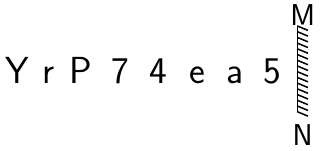
  • Part C is next detailing his condition: "a nervous flyer and tended".
  • Part A completes the sentence by adding the second condition: "to become severely seasick".
  • The correct sequence is DBCA.


Coherent sentence after rearrangement:

"He wanted to go on a world tour, but he was a nervous flyer and tended to become severely seasick."

Question 79

Select the option that can be used as a one-word substitute for the given group of words.

Study of flying airplanes

  1. AOption (a)

    Aviation

  2. BOption (b)

    Alchemy

  3. COption (c)

    Astronomy

  4. DOption (d)

    Acoustics

View answer & explanation

Correct answer

Answer: (a)A.

Aviation

Why this answer is correct

The correct answer is: Option 1.

Key Points

  • The word "Aviation" means the study or practice of flying airplanes. (विमानन)
  • Example: He studied aviation to become a commercial pilot.
  • "Aviation" refers to the designing, development, production, operation, and use of aircraft, especially heavier-than-air aircraft. (विमानन)
  • Example: The aviation industry has seen rapid growth in the last decade.

Therefore, the correct answer is: Option 1.

Additional Information

Here are the other options explained along with their Hindi meanings and example sentences:

  • Alchemy (रसायन विद्या): A medieval forerunner of chemistry, concerned with the transmutation of matter.
  • Example: Alchemy was once believed to be capable of turning base metals into gold.
  • Astronomy (खगोल विज्ञान): The scientific study of celestial objects, space, and the universe as a whole.
  • Example: Astronomy helps us understand the universe and our place in it.
  • Acoustics (ध्वनिविज्ञान): The science concerned with the study of sound.
  • Example: The acoustics of the concert hall enhance the musical experience.

Question 80

Select the option that expresses the given sentence in passive voice.

A famous company conducted the workshop for its customers.

  1. AOption (a)

    The workshop were conducted by a famous company for its customers.

  2. BOption (b)

    The workshop had been conducted by a famous company for its customers.

  3. COption (c)

    The workshop was conducted by a famous company for its customers.

  4. DOption (d)

    The workshop is conducted by a famous company for its customers.

View answer & explanation

Correct answer

Answer: (c)C.

The workshop was conducted by a famous company for its customers.

Why this answer is correct

The correct answer is Option 3.


Key Points

  • Passive voice structure: The object of the active voice sentence becomes the subject of the passive voice sentence.
  • In the active voice, the sentence is: "A famous company conducted the workshop for its customers."
  • To convert to passive voice: Place the object "the workshop" at the beginning.
  • Change the active verb form "conducted" to "was conducted" (past simple passive).
  • Add the preposition "by" followed by the original subject "a famous company."
  • Ensure the prepositional phrase "for its customers" remains at the end of the sentence for clarity.

Therefore, the correct answer is Option 3.


Correct Sentence: "The workshop was conducted by a famous company for its customers."


Additional Information

  • Option 1: "The workshop were conducted by a famous company for its customers." – Incorrect subject-verb agreement.
  • Option 2: "The workshop had been conducted by a famous company for its customers." – Incorrect past perfect tense.
  • Option 4: "The workshop is conducted by a famous company for its customers." – Incorrect present simple tense.

Question 81

Select the option that expresses the given sentence in active voice.

How have they been ordered by the minister?

  1. AOption (a)

    How have the minister ordered them?

  2. BOption (b)

    How had the minister ordered them?

  3. COption (c)

    How did the minister order them?

  4. DOption (d)

    How has the minister ordered them?

View answer & explanation

Correct answer

Answer: (d)D.

How has the minister ordered them?

Why this answer is correct


The correct answer is **Option 4**.


![](https://storage.googleapis.com/yourmocktest-papers/papers/latex/fallback/6c52935c9af177937aa1a8b3c66865e892bd1524d18db2c6a8a5d3a366553f27.png)

**Key Points**

- Passive voice structure: The object of the active voice sentence becomes the subject of the passive voice sentence.
- In the active voice, the sentence is: "How have they been ordered by the minister?"
- To convert to active voice: Place the subject "the minister" at the beginning.
- Change the passive verb form "have been ordered" to "has ordered" (present perfect active).
- Ensure that the object "they" remains after the verb for clarity.

Therefore, the correct answer is **Option 4**.


**Correct Sentence:** *"How has the minister ordered them?"*


![](https://storage.googleapis.com/yourmocktest-papers/papers/latex/fallback/caab9f56afc9e7fc5d52ec9fb0412f1563ca59474d5e3caf2df6bfe1456ebb8f.png)

**Additional Information**

- **Option 1:** "How have the minister ordered them?" – Incorrect subject-verb agreement.
- **Option 2:** "How had the minister ordered them?" – Incorrect tense (past perfect).
- **Option 3:** "How did the minister order them?" – Incorrect tense (simple past).

Question 82

Select the most appropriate option to substitute the underlined part of the following sentence.

The playwright has faced many ups and downs in his literary career, which spanned for almost 30 years.

  1. AOption (a)

    much truth and falsehood

  2. BOption (b)

    many agreements and disagreements

  3. COption (c)

    much light and darkness

  4. DOption (d)

    many good and bad times

View answer & explanation

Correct answer

Answer: (d)D.

many good and bad times

Why this answer is correct

The correct answer is '4' i.e. many good and bad times.

Key Points

  • The underlined part of the sentence "ups and downs" refers to the varying fortunes and experiences that an individual faces.
  • In this context, the phrase "many good and bad times" appropriately captures the essence of "ups and downs".
  • The other options do not directly relate to the varied experiences in a person's career.

Hence, the correct answer is option 4.

Question 83

Select the most appropriate option that can substitute the underlined segment in the given sentence. If no substitution is required, select ‘No substitution’.

The chief guest concluded his speech as he requested to stop by the organisers.

  1. AOption (a)

    no substitution

  2. BOption (b)

    he was requested

  3. COption (c)

    he has requested

  4. DOption (d)

    he will be requested

View answer & explanation

Correct answer

Answer: (b)B.

he was requested

Why this answer is correct

The correct answer is '2' i.e. he was requested.

Key Points

  • The sentence implies that the chief guest concluded his speech because he was asked to do so by the organisers.
  • The phrase "he was requested" correctly indicates that the request was made by the organisers in past tense and aligns with the past tense of the verb "concluded".
  • The other options do not fit the context of the sentence correctly:
  • "He has requested" would suggest that the chief guest made the request, which changes the meaning.
  • "He will be requested" implies a future event, which contradicts the past tense "concluded".

Hence, the correct answer is option 2.

Question 84

The following sentence has been split into four segments. Identify the segment that contains an error.

He was (a) bad injured (b) in the (c) last match.

  1. AOption (a)

    last match

  2. BOption (b)

    in the

  3. COption (c)

    bad injured

  4. DOption (d)

    He was

View answer & explanation

Correct answer

Answer: (c)C.

bad injured

Why this answer is correct

The correct answer is Option 3.

Key Points

  • The primary issue in the sentence is the incorrect usage of the word "bad" instead of "badly."
  • The adverb "badly" should be used to modify the verb "injured".
  • The correct phrase should be "badly injured," ensuring grammatical correctness and clarity.
  • Thus, the error is located in part 3 of the sentence.

Therefore, the correct answer is 3.


Correct Sentence: "He was badly injured in the last match."

Additional Information

  • 1: "last match" – This part of the sentence is grammatically correct and does not require any changes.
  • 2: "in the" – This part of the sentence is grammatically correct and does not require any changes.
  • 4: "He was" – This part of the sentence is grammatically correct and does not require any changes.

Question 85

Select the most appropriate synonym of the word in brackets to fill in the blank.

She ________ requested him to pay the bills. (persistently)

  1. AOption (a)

    impetuously

  2. BOption (b)

    obtrusively

  3. COption (c)

    tremendously

  4. DOption (d)

    continuously

View answer & explanation

Correct answer

Answer: (d)D.

continuously

Why this answer is correct

The correct answer is: Option 4.

Key Points

  • The word "persistently" means continuing firmly or obstinately in a course of action in spite of difficulty or opposition. (दृढ़ता से)
  • Example: She persistently called every day to check on the status of her application.
  • "Continuously" refers to something that happens without stopping or being interrupted. (लगातार)
  • Example: The river flowed continuously through the valley.
  • Hence, we can infer that a synonym for 'persistently' is 'continuously'.

Therefore, the correct answer is: Option 4.

Additional Information

Here are the other options explained along with their Hindi meanings and example sentences:

  • Impetuously (उतावलेपन से): Acting or done quickly and without thought or care.
  • Example: He impetuously decided to quit his job without having another one lined up.
  • Obtrusively (ज़ोर-ज़ोर से, असभ्यता से, बिना बुलाए हस्तक्षेप करके): In a noticeable or prominent way that is unwelcome or intrusive.
  • Example: The advertisement was obtrusively displayed in the middle of the article.
  • Tremendously (बेहद): To a very great extent; extremely.
  • Example: She was tremendously excited about her upcoming trip.

Question 86

Select the most appropriate ANTONYM of the given word.

Coy

  1. AOption (a)

    Shy

  2. BOption (b)

    Upright

  3. COption (c)

    Recent

  4. DOption (d)

    Extroverted

View answer & explanation

Correct answer

Answer: (d)D.

Extroverted

Why this answer is correct

The correct answer is: Extroverted.

Key Points

  • The word "coy" means being shy or modest, often in a playful or provocative way. (लजीला)
  • Example: She gave him a coy smile before looking away.
  • "Extroverted" refers to being outgoing, sociable, and openly expressive. (बहिर्मुखी)
  • Example: John is very extroverted and loves meeting new people.
  • Hence, we can infer that the opposite of 'coy' is 'extroverted'.

Therefore, the correct answer is: Extroverted.

Additional Information

Here are the other options explained along with their Hindi meanings and example sentences:

  • Shy (शर्मीला): Being reserved or having a timid nature.
  • Example: He is too shy to speak in front of the class.
  • Upright (ईमानदार): Being honest or morally correct.
  • Example: She is known for her upright character and integrity.
  • Recent (हाल का): Something that happened a short time ago.
  • Example: The recent news of the merger surprised everyone.

Question 87

Complete the sentence with the most appropriate set of ANTONYMS of the highlighted word.

'Grisly'

The other day Jimmy behaved ______ with Jammy and that was quite ______ for me.

  1. AOption (a)

    rudely, attractive

  2. BOption (b)

    disgusting, atrocious

  3. COption (c)

    ghastly, shameless

  4. DOption (d)

    pleasantly, comforting

View answer & explanation

Correct answer

Answer: (d)D.

pleasantly, comforting

Why this answer is correct

The correct answer is: Option 4.

Key Points

  • The word "Grisly" means something that is causing horror or disgust. (भयानक)
  • Example: The grisly scene of the accident left everyone in shock.
  • "Pleasantly" refers to something that is enjoyable, pleasing, or agreeable. (सुखद)
  • Example: She was pleasantly surprised by the unexpected gift.
  • "Comforting" means providing comfort or solace. (सांत्वना देने वाला)
  • Example: His comforting words helped ease her anxiety.
  • Hence, we can infer that the antonyms of 'Grisly' are 'Pleasantly' and 'Comforting'.

Therefore, the correct answer is: Option 4.

Additional Information

Here are the other options explained along with their Hindi meanings and example sentences:

  • Option 1: Rudely, attractive
  • Rudely (असभ्यतापूर्वक): In an impolite or disrespectful manner.
  • Example: He rudely interrupted the speaker in the middle of the presentation.
  • Attractive (आकर्षक): Pleasing or appealing to the senses.
  • Example: The garden was filled with attractive flowers and plants.
  • Option 2: Disgusting, atrocious
  • Disgusting (घिनौना): Arousing revulsion or strong indignation.
  • Example: The food was disgusting and had a foul odor.
  • Atrocious (क्रूर): Horrifyingly wicked or of a very poor quality.
  • Example: The atrocious crime shocked the entire community.
  • Option 3: Ghastly, shameless
  • Ghastly (भयानक): Causing great horror or fear.
  • Example: The ghastly sight of the haunted house scared the children.
  • Shameless (बेशर्म): Showing a lack of shame or modesty.
  • Example: His shameless behavior at the party was unacceptable.

Question 88

Select the most appropriate ANTONYM of the given word.

Customary

  1. AOption (a)

    Fashion

  2. BOption (b)

    Protection

  3. COption (c)

    Habitual

  4. DOption (d)

    Unusual

View answer & explanation

Correct answer

Answer: (d)D.

Unusual

Why this answer is correct

The correct answer is: Option 4.

Key Points

  • The word "Customary" means something that is according to the customs or usual practices; it implies being typical or expected. (रिवाज के अनुसार)
  • Example: It is customary to remove your shoes before entering a temple.
  • "Unusual" refers to something that is not common or typical; it is out of the ordinary. (असामान्य)
  • Example: Her choice of outfit was quite unusual for the formal event.
  • Hence, we can infer that the opposite of 'Customary' is 'Unusual'.

Therefore, the correct answer is: Option 4.

Additional Information

Here are the other options explained along with their Hindi meanings and example sentences:

  • Fashion (फैशन): A popular trend, especially in styles of dress and ornament.
  • Example: She always keeps up with the latest fashion.
  • Protection (सुरक्षा): The action of protecting someone or something.
  • Example: Wearing a helmet provides protection during cycling.
  • Habitual (आदतन): Done or doing constantly or as a habit.
  • Example: He is a habitual latecomer to meetings.

Question 89

Select the most appropriate homophone to fill in the blank.

The _____ of the flowers spread everywhere when they bloom.

  1. AOption (a)

    sent

  2. BOption (b)

    saint

  3. COption (c)

    scent

  4. DOption (d)

    cent

View answer & explanation

Correct answer

Answer: (c)C.

scent

Why this answer is correct

The correct answer is: Option 3.

Key Points

  • The word "scent" means a distinctive smell, especially one that is pleasant. (सुगंध)
  • Example: The scent of jasmine filled the air in the garden.
  • "Scent" refers to a pleasant smell that is often associated with flowers, perfumes, and other fragrant items. (सुगंध)
  • Example: The scent of the flowers spread everywhere when they bloom.
  • Hence, we can infer that the appropriate homophone to fill in the blank is "scent".

Therefore, the correct answer is: Option 3.

Additional Information

Here are the other options explained along with their Hindi meanings and example sentences:

  • Sent (भेजा): Past tense of send, meaning to cause something to go or be taken to a particular destination.
  • Example: She sent a letter to her friend in another city.
  • Saint (संत): A person acknowledged as holy or virtuous and typically regarded as being in heaven after death.
  • Example: Mother Teresa is often referred to as a saint for her charitable work.
  • Cent (सेंट): A monetary unit equal to one hundredth of the basic unit of currency in many countries.
  • Example: The candy costs fifty cents.

Question 90

The following sentence has been divided into four segments. Identify the segment that contains a grammatical error.

My sister and I work very hard / nevertheless my brother does not do / any task assigned to him.

  1. AOption (a)

    nevertheless my brother does not do

  2. BOption (b)

    work very hard

  3. COption (c)

    any task assigned to him.

  4. DOption (d)

    My sister and I

View answer & explanation

Correct answer

Answer: (a)A.

nevertheless my brother does not do

Why this answer is correct

The correct answer is Option 1.

Key Points

  • The primary issue in the sentence is the incorrect usage of the conjunction "nevertheless" instead of "but" or "however."
  • "Nevertheless" typically begins a new sentence or clause and indicates a contrast after a period or semicolon.
  • The correct phrase should be "but / however my brother does not do," aligning with the structure of the sentence.
  • Thus, the error is located in part 1 of the sentence.

Therefore, the correct answer is 1.


Correct Sentence: "My sister and I work very hard, but my brother does not do any task assigned to him."

Additional Information

  • 2: "work very hard" – This part of the sentence is grammatically correct and does not require any changes.
  • 3: "any task assigned to him." – This part of the sentence is grammatically correct and does not require any changes.
  • 4: "My sister and I" – This part of the sentence is grammatically correct and does not require any changes.

Question 91

Select the correct meaning of the underlined idiom in the following sentence.

Lucy’s conceited conduct with her colleagues has left her high and dry

  1. AOption (a)

    Helpless

  2. BOption (b)

    Suspending

  3. COption (c)

    Impoverished

  4. DOption (d)

    Surrounded by people

View answer & explanation

Correct answer

Answer: (a)A.

Helpless

Why this answer is correct

The correct answer is: Option 1.

Key Points

  • The idiom "high and dry" means being left in a difficult or helpless situation without support. (मुश्किल स्थिति में छोड़ देना)
  • Example: After the company went bankrupt, the employees were left high and dry without any severance pay.
  • Helpless refers to a state where one is unable to defend oneself or act without assistance. (बेबस)
  • Example: The flood victims were helpless and had to wait for rescue teams to arrive.

Therefore, the correct answer is: Option 1.

Additional Information

Here are the other options explained along with their Hindi meanings and example sentences:

  • Suspending (निलंबित करना): To temporarily prevent from continuing or being in force.
  • Example: The teacher was suspending the class for the day due to an emergency.
  • Impoverished (गरीब): Made poor or deprived of strength or vitality.
  • Example: The impoverished village needed urgent aid to survive the harsh winter.
  • Surrounded by people (लोगों से घिरा हुआ): Being in the middle of a crowd or group.
  • Example: She felt overwhelmed, surrounded by people at the concert.

Question 92

Select the correct spelling of the word that means 'to replace'.

  1. AOption (a)

    Superceed

  2. BOption (b)

    Supresed

  3. COption (c)

    Superseed

  4. DOption (d)

    Supersede

View answer & explanation

Correct answer

Answer: (d)D.

Supersede

Why this answer is correct

The correct answer is: Option 4.

Key Points

  • The word "supersede" means to take the place of a person or thing previously in authority or use; to replace. (प्रतिस्थापित करना)
  • Example: The new law will supersede the old one.
  • "Supersede" is the correct spelling of the word that means to replace. (प्रतिस्थापित करना)
  • Example: Smartphones have largely superseded traditional mobile phones.

Therefore, the correct answer is: Option 4.

Additional Information

Here are the other options explained along with their Hindi meanings and example sentences:

  • Superceed (सुपरसीड): This is an incorrect spelling of the word "supersede".
  • Example: This is not a correct word.
  • Supresed (सुप्रेस्ड): This is an incorrect spelling of the word "supersede".
  • Example: This is not a correct word.
  • Superseed (सुपरसीड): This is an incorrect spelling of the word "supersede".
  • Example: This is not a correct word.

Question 93

Select the word segment that can substitute the bracketed word segment correctly and complete the sentence meaningfully.

We will have to (put the meeting away) as the Director is not well.

  1. AOption (a)

    put the meeting off

  2. BOption (b)

    put the meeting up

  3. COption (c)

    put the meeting on

  4. DOption (d)

    put the meeting again

View answer & explanation

Correct answer

Answer: (a)A.

put the meeting off

Why this answer is correct

The correct answer is '1' i.e. put the meeting off.

Key Points

  • The phrase "put off" means to postpone or delay an event or meeting.
  • In the given sentence, the Director is not well, so the meeting needs to be postponed.
  • The other options do not convey the correct meaning:
  • "Put the meeting up" does not make sense in the context of postponing.
  • "Put the meeting on" suggests scheduling or starting the meeting, not postponing it.
  • "Put the meeting again" is not a grammatically correct phrase.

Hence, the correct answer is option 1.

Question 94

Parts of a sentence are given below in jumbled order. Arrange the parts in the correct order to form a meaningful sentence.

(a) one of the primary obstacles encountered

(b) is the risk of sample contamination

(c) during the analysis of controlled dangerous substance (CDS)

(d) from improper handling and collecting methodologies

(e) proof bloodstain patterns and DNA evidence

  1. AOption (a)

    eacdb

  2. BOption (b)

    acebd

  3. COption (c)

    aecdb

  4. DOption (d)

    abcde

View answer & explanation

Correct answer

Answer: (b)B.

acebd

Why this answer is correct

The correct answer is Option 2 i.e. acebd.


Key Points

  • The sentence identifies a specific technical challenge within the field of forensic investigation and substance analysis.
  • Part (a) is the first part as it introduces the primary subject: "one of the primary obstacles encountered".
  • Part (c) follows to provide the context of the struggle: "during the analysis of controlled dangerous substance (CDS)". This connects the "obstacles" to a specific scientific process.
  • Part (e) is the third part as it lists the specific forensic evidence being analyzed alongside CDS: "proof bloodstain patterns and DNA evidence".
  • Part (b) follows as it introduces the linking verb 'is' and defines the obstacle: "is the risk of sample contamination".
  • Part (d) is the final part as it explains the origin or cause of the aforementioned risk: "from improper handling and collecting methodologies".
  • The correct sequence is acebd.


Coherent sentence after rearrangement:

"One of the primary obstacles encountered during the analysis of controlled dangerous substance (CDS) proof bloodstain patterns and DNA evidence is the risk of sample contamination from improper handling and collecting methodologies."


Additional Information

  • Structural Breakdown: The sentence follows a standard Subject + Qualifier + Verb + Complement pattern.
  • Subject: One of the primary obstacles (a)
  • Qualifier: encountered during the analysis... (c + e)
  • Verb: is (b)
  • Complement: the risk of sample contamination... (b + d)
  • Forensic Context: In forensic science, "Controlled Dangerous Substances" (CDS) and "DNA evidence" are highly sensitive to "contamination," making the link between parts (b) and (d) logically essential.

Question 95

Select the INCORRECTLY spelt word.

  1. AOption (a)

    Convinient

  2. BOption (b)

    Embarrass

  3. COption (c)

    National

  4. DOption (d)

    Discipline

View answer & explanation

Correct answer

Answer: (a)A.

Convinient

Why this answer is correct

The correct answer is: Option 1.

Key Points

  • The word "Convinient" is incorrectly spelt; the correct spelling should be "Convenient". (सुविधाजनक)
  • Example: It is convenient to shop online because you can do it from home.
  • "Embarrass" means to cause someone to feel awkward, self-conscious, or ashamed. (शर्मिंदा करना)
  • Example: He tried to embarrass me in front of the whole class.
  • "National" refers to something that relates to a nation or country as a whole. (राष्ट्रीय)
  • Example: The national flag was hoisted on Independence Day.
  • "Discipline" means the practice of training people to obey rules or a code of behaviour, using punishment to correct disobedience. (अनुशासन)
  • Example: Discipline is essential for maintaining order in the classroom.

Therefore, the correct answer is: Option 1.

Additional Information

Here are the other options explained along with their Hindi meanings and example sentences:

  • Embarrass (शर्मिंदा करना): To cause someone to feel awkward, self-conscious, or ashamed.
  • Example: He tried to embarrass me in front of the whole class.
  • National (राष्ट्रीय): Relating to a nation or country as a whole.
  • Example: The national flag was hoisted on Independence Day.
  • Discipline (अनुशासन): The practice of training people to obey rules or a code of behaviour, using punishment to correct disobedience.
  • Example: Discipline is essential for maintaining order in the classroom.

In the following passage, some words have been deleted. Read the passage carefully and select the most appropriate option to fill in each blank.

Global warming is a major problem. The result will be the problems created by the rising temperatures of the Arctic region. As a result of global warming, (1)_________ in rainfall and plant distribution affect the migration patterns, feeding behaviour, and breeding preferences of numerous bird species. The increase in the temperature may also alter ocean currents, which may alter the (2)__________ ecology as a whole. Greenhouse gas emissions are responsible for the ongoing melting of the Arctic. This will result in a (3)loop since greenhouse gases trap the heat in the atmosphere and the additional emissions may (4) the global warming process. Now, the only way to reverse the harm is for every person to be environmentally sensitive. This may offer us hope that we will be able to leave a green planet to our future generations, who presently appear to face (5)__________.

Question 96

Based on Passage: View directions & passage

Select the most appropriate option to fill in blank number 1.

  1. AOption (a)

    stabilisation

  2. BOption (b)

    stagnation

  3. COption (c)

    fixation

  4. DOption (d)

    alterations

View answer & explanation

Correct answer

Answer: (d)D.

alterations

Why this answer is correct

The correct answer is 'alterations'.

Key Points

  • The passage discusses how global warming impacts rainfall and plant distribution.
  • The suitable word should indicate changes or variations in rainfall and plant distribution due to global warming.
  • "Alterations" is appropriate as it denotes changes or modifications, fitting the context.
  • Other options ("stabilisation", "stagnation", "fixation") do not fit the context of describing the changes in rainfall and plant distribution.

Therefore, the correct answer is 'Option 4'.

Question 97

Based on Passage: View directions & passage

​Select the most appropriate option to fill in blank number 2.

  1. AOption (a)

    grassland

  2. BOption (b)

    biosphere

  3. COption (c)

    marine

  4. DOption (d)

    landscape

View answer & explanation

Correct answer

Answer: (c)C.

marine

Why this answer is correct

The correct answer is 'marine'.


Key Points

  • The passage discusses how global warming affects ocean currents and, consequently, the ecology.
  • The appropriate word should relate to the ocean or sea environment.
  • "Marine" is suitable as it pertains to the ocean and sea, aligning with the context of ocean currents and their impact.
  • Other options ("grassland", "biosphere", "landscape") do not specifically connect to oceanic ecology.

Therefore, the correct answer is 'Option 3'.


Complete Passage: Global warming is a major problem. The result will be the problems created by the rising temperatures of the Arctic region. As a result of global warming, (1) alterations in rainfall and plant distribution affect the migration patterns, feeding behaviour, and breeding preferences of numerous bird species. The increase in the temperature may also alter ocean currents, which may alter the (2) marine ecology as a whole. Greenhouse gas emissions are responsible for the ongoing melting of the Arctic. This will result in a (3) feedback loop since greenhouse gases trap the heat in the atmosphere and the additional emissions may (4) accelerate *the global warming process. Now, the only way to reverse the harm is for every person to be environmentally sensitive. This may offer us hope that we will be able to leave a green planet to our future generations, who presently appear to face (5)*uncertainty.


Additional Information

  • Grassland: "Grassland" refers to a large open area of country covered with grass, especially one used for grazing, which does not fit the context of discussing ocean currents.
  • Biosphere: "Biosphere" refers to the global sum of all ecosystems, which is too broad for the specific context of ocean ecology.
  • Landscape: "Landscape" refers to all the visible features of an area of land, which is unrelated to marine/ocean ecology.

Question 98

Based on Passage: View directions & passage

Select the most appropriate option to fill in blank number 3.

  1. AOption (a)

    feeble

  2. BOption (b)

    gentle

  3. COption (c)

    vicious

  4. DOption (d)

    moderate

View answer & explanation

Correct answer

Answer: (c)C.

vicious

Why this answer is correct

The correct answer is 'vicious'.


Key Points

  • The passage discusses how the melting of the Arctic and greenhouse gas emissions create a loop that exacerbates global warming.
  • The suitable word should describe a loop that intensifies or worsens the situation.
  • "Vicious" is appropriate as it denotes something severe and harmful, often used to describe cycles that worsen over time.
  • Other options ("feeble", "gentle", "moderate") do not convey the severity or the intensifying nature of the loop.

Therefore, the correct answer is 'Option 3'.


Complete Passage: Global warming is a major problem. The result will be the problems created by the rising temperatures of the Arctic region. As a result of global warming, (1) alterations in rainfall and plant distribution affect the migration patterns, feeding behaviour, and breeding preferences of numerous bird species. The increase in the temperature may also alter ocean currents, which may alter the (2) marine ecology as a whole. Greenhouse gas emissions are responsible for the ongoing melting of the Arctic. This will result in a (3) vicious loop since greenhouse gases trap the heat in the atmosphere and the additional emissions may (4) accelerate *the global warming process. Now, the only way to reverse the harm is for every person to be environmentally sensitive. This may offer us hope that we will be able to leave a green planet to our future generations, who presently appear to face (5)*uncertainty.


Additional Information

  • Feeble: "Feeble" means weak and does not match the context of an intensifying, worsening loop.
  • Gentle: "Gentle" implies mildness, which is inappropriate for describing a severe and worsening cycle in the context.
  • Moderate: "Moderate" suggests average intensity, failing to capture the severity of the harmful loop described.

Question 99

Based on Passage: View directions & passage

Select the most appropriate option to fill in blank number 4.

  1. AOption (a)

    hinder

  2. BOption (b)

    repress

  3. COption (c)

    restrain

  4. DOption (d)

    accelerate

View answer & explanation

Correct answer

Answer: (d)D.

accelerate

Why this answer is correct

The correct answer is 'accelerate'.


Key Points

  • The passage discusses the impact of greenhouse gas emissions on global warming.
  • The sentence mentions the ongoing melting of the Arctic due to greenhouse gases, suggesting that the process is speeding up.
  • "Accelerate" means to increase the speed of something, which fits the context of worsening or hastening the global warming process.
  • Other options ("hinder", "repress", "restrain") imply slowing down or stopping progress, which is contrary to the context of the passage.

Therefore, the correct answer is 'Option 4'.


Complete Passage: Global warming is a major problem. The result will be the problems created by the rising temperatures of the Arctic region. As a result of global warming, (1) alterations in rainfall and plant distribution affect the migration patterns, feeding behaviour, and breeding preferences of numerous bird species. The increase in the temperature may also alter ocean currents, which may alter the (2) marine ecology as a whole. Greenhouse gas emissions are responsible for the ongoing melting of the Arctic. This will result in a (3) vicious loop since greenhouse gases trap the heat in the atmosphere and the additional emissions may (4) accelerate *the global warming process. Now, the only way to reverse the harm is for every person to be environmentally sensitive. This may offer us hope that we will be able to leave a green planet to our future generations, who presently appear to face (5)*uncertainty.


Additional Information

  • Hinder: "Hinder" means to create difficulties that result in delay or obstruction.
  • Repress: "Repress" means to subdue something by force.
  • Restrain: "Restrain" means to hold back from action or to control something.

Question 100

Based on Passage: View directions & passage

Select the most appropriate option to fill in blank number 5.

  1. AOption (a)

    renovation

  2. BOption (b)

    extinction

  3. COption (c)

    redemption

  4. DOption (d)

    salvation

View answer & explanation

Correct answer

Answer: (b)B.

extinction

Why this answer is correct

The correct answer is 'extinction'.


Key Points

  • The context of the passage is global warming and its consequences, emphasizing the severe impact it can have on the planet.
  • The last sentence of the passage talks about offering hope to leave a green planet to future generations who presently appear to face the most critical consequence due to ongoing environmental issues.
  • "Extinction" fits this context best as it conveys the severity of the environmental threat facing future generations, implying the complete loss and disappearance of species.
  • Other options ("renovation", "redemption", "salvation") do not fit appropriately in the context of describing such a severe threat as "extinction."

Therefore, the correct answer is 'extinction'.


Complete Passage: Global warming is a major problem. The result will be the problems created by the rising temperatures of the Arctic region. As a result of global warming, (1) alterations in rainfall and plant distribution affect the migration patterns, feeding behaviour, and breeding preferences of numerous bird species. The increase in temperature may also alter ocean currents, which may alter the (2) marine ecology as a whole. Greenhouse gas emissions are responsible for the ongoing melting of the Arctic. This will result in a (3) vicious loop since greenhouse gases trap the heat in the atmosphere and the additional emissions may (4) accelerate the global warming process. Now, the only way to reverse the harm is for every person to be environmentally sensitive. This may offer us hope that we will be able to leave a green planet to our future generations, who presently appear to face (5) extinction.


Additional Information

  • Renovation: "Renovation" refers to the action of renovating a building, structure, etc., which is not applicable in this context.
  • **Redemption: "**Redemption" means the action of saving or being saved from sin, error, or evil, which does not fit the context of the passage.
  • Salvation: "Salvation" means deliverance from harm, ruin, or loss, which does not fit the context accurately.

100 questions in the full paper