Previous Year Paper

SSC CGL 2024 Tier-I Official Paper (Held On: 12 Sept, 2024 Shift 2) (Previous Year Paper)

Held in 2024

100 questions60 minutes
With answers
Free

Paper last updated:

Practise under exam conditions

Take this paper as a timed mock test. Review your answers after you submit.

Attempt timed test

Questions & answers

Read the paper at your pace. Open an explanation when you need it.

General Intelligence and Reasoning (25 questions)

Question 1

Three of the following numbers are alike in a certain way and one is different. Pick the odd one out.

(NOTE : Operations should be performed on the whole numbers, without breaking down the numbers into its constituent

digits. E.g. 13 – Operations on 13 such as adding /deleting /multiplying etc., to 13 can be performed. Breaking down 13 into 1

and 3 and then performing mathematical operations on 1 and 3 is not allowed.)

  1. AOption (a)

    12 – 7 – 209

  2. BOption (b)

    19 – 11 – 330

  3. COption (c)

    23 – 8 – 343

  4. DOption (d)

    15 – 9 – 264

View answer & explanation

Correct answer

Answer: (c)C.

23 – 8 – 343

Why this answer is correct

The logic followed here is:

Logic: (1st number + 2nd number) × 11 = 3rd number.

Now, checking the options:

Option1: 12 – 7 – 209

→ (12 + 7) × 11

→ 19 × 11 = 209

Option 2: 19 – 11 – 330

→ (19 + 11) × 11

→ 30 × 11 = 330

Option 3: 23 – 8 – 343

→ (23 + 8) × 11

→ 31 × 11 = 341 ≠ 343

Option 4: 15 – 9 – 264

→ (15 + 9) × 11

→ 24 × 11 = 264

So, 'Option 3' is odd one.

Hence, the correct answer is "Option 3".

Question 2

Select the option figure that will replace the question mark (?) in the figure given below and complete the pattern.

  1. AOption (a)

  2. BOption (b)

  3. COption (c)

  4. DOption (d)

View answer & explanation

Correct answer

Answer: (b)B.

Why this answer is correct

The figure which when put in place of '?' will logically complete the pattern is shown below:

Thus, option Figure 2 will logically complete the pattern given.

Hence, "Option 2" is the correct answer.

Question 3

In a certain code language, 'talk to me' is coded as 'aq yt bl' and 'do not talk' is coded as 'yt me wc'. What is the code for 'talk' in that language?

  1. AOption (a)

    yt

  2. BOption (b)

    wc

  3. COption (c)

    bl

  4. DOption (d)

    aq

View answer & explanation

Correct answer

Answer: (a)A.

yt

Why this answer is correct

According to the given information,

Thus, according to the given codes 'yt' is the code for the word 'talk'.

Hence, the correct answer is "Option 1".

Question 4

‘NGRP’ is related to ‘JCNL’ in a certain way based on the English alphabetical order. In the same way, ‘FKLT’ is related to

‘BGHP’. To which of the following is ‘SQUO’ related, following the same logic?

  1. AOption (a)

    ONQL

  2. BOption (b)

    OMQK

  3. COption (c)

    PNRL

  4. DOption (d)

    PMRK

View answer & explanation

Correct answer

Answer: (b)B.

OMQK

Why this answer is correct

The logic followed here is:

‘NGRP’ is related to ‘JCNL’

And,

‘FKLT’ is related to ‘BGHP’

Similarly,

‘SQUO’ is related to

Hence, "Option 2" is the correct answer.

Question 5

Select the combination of letters that when sequentially placed in the blanks of the given series will complete the series.

E_GHEI_GELK_ _OME

  1. AOption (a)

    IGFE

  2. BOption (b)

    IFGE

  3. COption (c)

    FIFE

  4. DOption (d)

    FGEI

View answer & explanation

Correct answer

Answer: (c)C.

FIFE

Why this answer is correct

The logic followed here is:

Hence, "Option 3" is the correct answer.

Question 6

In a certain code language,

A + B means ‘A is the son of B’,

A − B means ‘A is the wife of B’,

A × B means ‘A is the brother of B’ and

A ÷ B means ‘A is the daughter of B’.

Based on the above, how is P related to R if ‘P × S ÷ M − T + R’?

  1. AOption (a)

    Brother

  2. BOption (b)

    Son’s son

  3. COption (c)

    Father’s mother

  4. DOption (d)

    Daughter

View answer & explanation

Correct answer

Answer: (b)B.

Son’s son

Why this answer is correct

Decoding symbols:

A is
Symbol+–×÷
MeaningSonWifeBrotherDaughter
to B

Given: P × S ÷ M − T + R

P × S → P is the brother of S.

S ÷ M → S is the daughter of M.

M − T → M is the wife of T.

T + R → T is the son of R.

Thus, P is R's grandson or son’s son.

Hence, the correct answer is "Option 2"

Question 7

346 is related to 245 by certain logic. Following the same logic, 580 is related to 479. To which of the following is 613 related, following the same logic?

(NOTE: Operations should be performed on the whole numbers, without breaking down the numbers into its constituent digits. E.g. 13 – Operations on 13 such as adding/deleting/multiplying etc., to 13 can be performed. Breaking down 13 into 1 and 3 and then performing mathematical operations on 1 and 3 is not allowed.)

  1. AOption (a)

    720

  2. BOption (b)

    460

  3. COption (c)

    512

  4. DOption (d)

    630

View answer & explanation

Correct answer

Answer: (c)C.

512

Why this answer is correct

The logic followed here is:

346 is related to 245

346 - 245 = 101

And,

580 is related to 479

580 - 479 = 101

Similarly,

613 is related to ?

613 - ? = 101

613 - 101 = ?

512 = ?

Hence, "Option 3" is the correct answer.

Question 8

How many squares are there in the given figure?

  1. AOption (a)

    8

  2. BOption (b)

    9

  3. COption (c)

    10

  4. DOption (d)

    7

View answer & explanation

Correct answer

Answer: (b)B.

9

Why this answer is correct

The total number of squares in the given figure is shown below:

Thus, as marked there are a total of 9 squares.

Hence, "Option 2" is the correct answer.

Question 9

Which of the following terms will replace the question mark (?) in the given series?

HPL, KLQ, NHV, QDA, TZF, ?

  1. AOption (a)

    WVK

  2. BOption (b)

    XVK

  3. COption (c)

    WDK

  4. DOption (d)

    XWK

View answer & explanation

Correct answer

Answer: (a)A.

WVK

Why this answer is correct

The logic followed here is:

​

Hence, "Option 1" is the correct answer.

Question 10

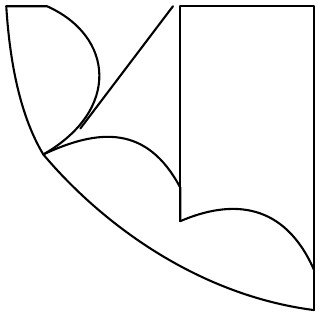
Select the correct mirror image of the given figure when the mirror is placed at MN as shown below.

  1. AOption (a)

  2. BOption (b)

  3. COption (c)

  4. DOption (d)

View answer & explanation

Correct answer

Answer: (c)C.

Why this answer is correct

The correct mirror image of the given figure is:

Hence, the correct answer is "Option 3".
Question 11

Select the set in which the numbers are related in the same way as are the numbers of the following set.

(11, 16.5, 22)

(14.5, 20, 25.5)

(NOTE: Operations should be performed on the whole numbers, without breaking down the numbers into its constituent

digits. E.g. 13 – Operations on 13 such as adding/deleting/multiplying etc. to 13 can be performed. Breaking down 13 into 1

and 3 and then performing mathematical operations on 1 and 3 is not allowed.)

  1. AOption (a)

    (14, 18.5, 23.5)

  2. BOption (b)

    (21.5, 25, 31.5)

  3. COption (c)

    (18, 23.5, 29)

  4. DOption (d)

    (24.5, 30, 36.5)

View answer & explanation

Correct answer

Answer: (c)C.

(18, 23.5, 29)

Why this answer is correct

The logic followed here is:

Logic: (2nd number × 2) - 1st number = 3rd number.

Now,

For, 11, 16.5, 22

⇒ (16.5 × 2) - 11

= 33 - 11 = 22.

For, 14.5, 20, 25.5

⇒ (20 × 2) - 14.5

= 40 - 14.5 = 25.5.

Similarly, for: 18, 23.5, 29

⇒ (23.5 × 2) - 18

= 47 - 18 = 29.

Hence, the correct answer is "Option 3".

Question 12

Select the word-pair that best represents a similar relationship to the one expressed in the pair of words given below.

(The words must be considered as meaningful English words and must NOT be related to each other based on the number of letters/number of consonants/vowels in the word)

Duleep Trophy : Cricket

  1. AOption (a)

    Burdwan Trophy : Polo

  2. BOption (b)

    Agha Khan Cup : Hockey

  3. COption (c)

    Dhyan Chand Trophy : Badminton

  4. DOption (d)

    Durand Cup : Cricket

View answer & explanation

Correct answer

Answer: (b)B.

Agha Khan Cup : Hockey

Why this answer is correct

The logic followed here is:

Logic: Sports Trophies : Sports

Here,

Duleep Trophy : Cricket → Duleep Trophy is a trophy associated with the sport of Cricket.

Similarly,

Agha Khan Cup : Hockey → Agha Khan Cup is a trophy associated with the sport of Hockey.

Hence, the correct answer is "Option 2".

Question 13

In a certain code language, 'BOOK' is written as 'ZNNI' and 'SHOP' is written as 'QFNN'. How will 'NOTES' be written in that language?

  1. AOption (a)

    LRDQN

  2. BOption (b)

    LNRDQ

  3. COption (c)

    LDNQR

  4. DOption (d)

    QDRNL

View answer & explanation

Correct answer

Answer: (b)B.

LNRDQ

Why this answer is correct

The logic followed here is:

'BOOK' is written as 'ZNNI'

And,

'SHOP' is written as 'QFNN'

Similarly,

'NOTES' is written as

Hence, "Option 2" is the correct answer.

Question 14

Two sets of numbers are given below. In each set of numbers, certain mathematical operation(s) on the first number result(s) in the second number. Similarly, certain mathematical operation(s) on the second number result(s) in the third number and so on. Which of the given options follows the same set of operations as in the given sets?

(NOTE: Operations should be performed on the whole numbers, without breaking down the numbers into their constituent digits. E.g., 13 – Operations on 13 such as adding/subtracting/multiplying to 13 can be performed. Breaking down 13 into 1 and 3 and then performing mathematical operations on 1 and 3 is not allowed.)

10 – 12 – 8 – 15; 12 – 14 – 10 – 19

  1. AOption (a)

    11 – 13 – 9 – 17

  2. BOption (b)

    8 – 6 – 10 – 18

  3. COption (c)

    6 – 8 – 12 – 16

  4. DOption (d)

    15 – 13 – 9 – 19

View answer & explanation

Correct answer

Answer: (a)A.

11 – 13 – 9 – 17

Why this answer is correct

The logic followed here is:

10 – 12 – 8 – 15

10 + 2 = 12

12 - 4 = 8

8 × 2 - 1 = 15

16 - 1 = 15

And,

12 – 14 – 10 – 19

12 + 2 = 14

14 - 4 = 10

10 × 2 - 1 = 19

20 - 1 = 19

So, checking each option one by one:

Option 1) 11 – 13 – 9 – 17

11 + 2 = 13

13 - 4 = 9

9 × 2 - 1 = 17

18 - 1 = 17

Option 2) 8 – 6 – 10 – 18

8 + 2 = 10 ≠ 6

6 - 4 = 2 ≠ 10

10 × 2 - 1 = 18

20 - 1 = 18 ≠ 19

Option 3) 6 – 8 – 12 – 16

6 + 2 = 8

8 - 4 = 4 ≠ 12

12 × 2 - 1 = 16

24 - 1 = 16 ≠ 23

Option 4) 15 – 13 – 9 – 19

15 + 2 = 17 ≠ 13

13 - 4 = 9

9 × 2 - 1 = 19

18 - 1 = 19 ≠ 17

Thus, out of all the options, '11 – 13 – 9 – 17' follows the same logic as given.

Hence, "Option 1" is the correct answer.

Question 15

Six letters U, V, W, X, Y and Z are written on different faces of a dice. Two positions of this dice are shown in the figure. Find the letter on the face opposite to V.

  1. AOption (a)

    X

  2. BOption (b)

    Y

  3. COption (c)

    Z

  4. DOption (d)

    W

View answer & explanation

Correct answer

Answer: (c)C.

Z

Why this answer is correct

The logic followed here is :-

From the given two different dices the adjacent sides are as shown below :

As U and X are common on both the dices, it is clear that the remaining will be opposites.

Opposite pairs:

V → Z

So, the opposite side of "V" will be side "Z".

Hence, the correct answer is "Option 3".

Question 16

What will come in place of the question mark (?) in the following equation if ‘+’ and ‘−’ are interchanged and ‘×’ and ‘÷’ are

interchanged?

16 ÷ 4 + 8 × 8 − 4 = ?

  1. AOption (a)

    11

  2. BOption (b)

    67

  3. COption (c)

    42

  4. DOption (d)

    36

View answer & explanation

Correct answer

Answer: (b)B.

67

Why this answer is correct

Given equation: 16 ÷ 4 + 8 × 8 − 4 = ?

Now, if ‘+’ and ‘−’ are interchanged and ‘×’ and ‘÷’ are interchanged, then:

⇒ 16 × 4 − 8 ÷ 8 + 4 = ?

⇒ 16 × 4 − 1 + 4 = ?

⇒ 64 − 1 + 4 = ?

⇒ 68 - 1 = 67.

Hence, the correct answer is "Option 2".

Question 17

Which of the following operations should be interchanged to make the following equation correct?

12 + 12 − 4 × 4 ÷ 2 = 22

  1. AOption (a)

    ÷ and +

  2. BOption (b)

    ÷ and −

  3. COption (c)

    − and +

  4. DOption (d)

    × and −

View answer & explanation

Correct answer

Answer: (b)B.

÷ and −

Why this answer is correct

Given: 12 + 12 − 4 × 4 ÷ 2 = 22

According to the question, after interchanging the signs:

Option 1): ÷ and +

12 + 12 − 4 × 4 ÷ 2 = 22 ⇒ 12 ÷ 12 − 4 × 4 + 2 = 22

⇒ 12 ÷ 12 − 4 × 4 + 2 = 22

⇒ 1 − 4 × 4 + 2 = 22

⇒ 1 + 2 − 16 = 22

⇒ 3 − 16 = 22

⇒ -13 ≠ 22 (LHS ≠ RHS)

Option  2): ÷ and −

12 + 12 − 4 × 4 ÷ 2 = 22 ⇒ 12 + 12 ÷ 4 × 4 - 2 = 22

⇒ 12 + 12 ÷ 4 × 4 - 2 = 22

⇒ 12 + 3 × 4 - 2 = 22

⇒ 12 + 12 - 2 = 22

⇒ 24 - 2 = 22

⇒ 22 = 22 (LHS = RHS)

Option  3): − and +

12 + 12 − 4 × 4 ÷ 2 = 22 ⇒ 12 - 12 + 4 × 4 ÷ 2 = 22

⇒ 12 - 12 + 4 × 4 ÷ 2 = 22

⇒ 12 - 12 + 4 × 2 = 22

⇒ 12 + 8 - 12 = 22

⇒ 20 - 12 = 22

⇒ 8 ≠ 22 (LHS ≠ RHS)

Option  4): × and −

12 + 12 − 4 × 4 ÷ 2 = 22 ⇒ 12 + 12 × 4 - 4 ÷ 2 = 22

⇒ 12 + 12 × 4 - 4 ÷ 2 = 22

⇒ 12 + 12 × 4 - 2 = 22

⇒ 12 + 48 - 2 = 22

⇒ 60 - 2 = 22

⇒ 58 ≠ 22 (LHS ≠ RHS)

Hence, "Option 2" is the correct answer.

Question 18

Six letters J, K, L, M, N and O are written on different faces of a dice. Two positions of this dice are shown in the figure below. Find the letter on the face opposite to J.

  1. AOption (a)

    M

  2. BOption (b)

    O

  3. COption (c)

    L

  4. DOption (d)

    N

View answer & explanation

Correct answer

Answer: (d)D.

N

Why this answer is correct

The logic followed here is :-

From the given two different dices the adjacent sides are as shown below :

As O is common on both the dices, it is clear that M, N, K, and J are adjacent to it, and the remaining i.e. L will be opposite to it.

Opposite pairs:

N → J

M → K

O → L

So, the opposite side of "J" will be side "N".

Hence, the correct answer is "Option 4".

Question 19

Which figure should replace the question mark (?) if the following series were to be continued?

  1. AOption (a)

  2. BOption (b)

  3. COption (c)

  4. DOption (d)

View answer & explanation

Correct answer

Answer: (a)A.

Why this answer is correct

The logic followed here is:

  1. First box series → The elements shift row wise in the clockwise direction.

2) Second box series →

One element is eliminated from the 1st row.

The number of elements is 2nd row is doubled.

One element is added to the 3rd row.

Thus, the final series is:

Hence, "Option 1" is the correct answer.

Question 20

Which of the following numbers will replace the question marks (?) in the given series?

16, 36, 64, ?, ?, 196, 256, 324

  1. AOption (a)

    81, 121

  2. BOption (b)

    100, 121

  3. COption (c)

    100, 144

  4. DOption (d)

    81, 100

View answer & explanation

Correct answer

Answer: (c)C.

100, 144

Why this answer is correct

The logic followed here is:

​

Hence, "Option 3" is the correct answer.

Question 21

Three statements are given followed by three conclusions numbered I, II and III. Assuming the statements to be true, even if they seem to be at variance with commonly known facts, decide which of the conclusions logically follow(s) from the statements.

Statements:

All cards are postcards.

Some postcards are books.

All books are novels.

Conclusions:

I. Some postcards are novels.

II. No card is a book.

III. All cards are novels.

  1. AOption (a)

    Only II and III conclusion follow

  2. BOption (b)

    Only conclusion III follows

  3. COption (c)

    Only I and II conclusion follow

  4. DOption (d)

    Only conclusion I follows

View answer & explanation

Correct answer

Answer: (d)D.

Only conclusion I follows

Why this answer is correct

The least possible Venn diagram for the given statements is as shown below :

Conclusions:

I. Some postcards are novels → Follow (As some postcards are books and all books are novels. As some part of the postcards is common with books which whole comes in novels, therefore it is false.)

II. No card is a book → Does not follow (As all cards are postcards and some postcards are books. As no direct relation is given between cards and books, therefore it is false.)

III. All cards are novels → Does not follow (As all cards are postcards, some postcards are books and all books are novels. So it is possible but not definite.)

∴ Here, Only conclusion I follows.​

Hence, the correct answer is "Option 4".

Question 22

In a certain code language, 'can we play' is coded as 'ae tc nx' and 'play in school' is coded as 'tc mn ef'. How is 'play' coded in that language?

  1. AOption (a)

    mn

  2. BOption (b)

    ef

  3. COption (c)

    ae

  4. DOption (d)

    tc

View answer & explanation

Correct answer

Answer: (d)D.

tc

Why this answer is correct

According to the given information,

Thus, according to the given codes 'tc' is the code for the word 'play'.

Hence, the correct answer is "Option 4".

Question 23

Each vowel in the word 'STAMINA' is changed to the preceding letter in the English alphabetical order and each consonant is changed to the following letter in the English alphabetical order. How many letters are there in the English alphabetical order between the letter which is the third from the right and the fourth from the left in the group of letters thus formed?

  1. AOption (a)

    Five

  2. BOption (b)

    Seven

  3. COption (c)

    Four

  4. DOption (d)

    Six

View answer & explanation

Correct answer

Answer: (a)A.

Five

Why this answer is correct

Given word: STAMINA

According to the question,

Given wordSTAMINA
Vowel → (-1) Consonant → (+1)(+1)(+1)(-1)(+1)(-1)(+1)(-1)
ResultantTUZNHOZ

Thus, the new formed letter cluster → T U Z N H O Z

Now, the number of letters are there in the English alphabetical order between the letter which is the third from the right and the fourth from the left in the group of letters thus formed:

(Left end) T U Z N H O Z (Right end)

Here, five letters i.e. I, J, K, L, and M are between H and N.

Hence, "Option 1" is the correct answer.

Question 24

Based on the English alphabetical order, three of the following four letter-clusters are alike in a certain way and thus form a group. Which is the letter-cluster that DOES NOT belong to that group?

(Note: The odd man out is not based on the number of consonants/vowels or their position in the letter-cluster.)

  1. AOption (a)

    MPT

  2. BOption (b)

    ACG

  3. COption (c)

    DGK

  4. DOption (d)

    HKO

View answer & explanation

Correct answer

Answer: (b)B.

ACG

Why this answer is correct

The logic followed here is:

Option 1) MPT

Option 2) ACG

Option 3) DGK

​Option 4) HKO

Thus, out of all 'ACG' is the odd one out.

Hence, "Option 2" is the correct answer.

Question 25

Identify the figure from the given options, which when put in place of the question mark (?), will logically complete the series.

  1. AOption (a)

  2. BOption (b)

  3. COption (c)

  4. DOption (d)

View answer & explanation

Correct answer

Answer: (a)A.

Why this answer is correct

The logic followed here is:

  1. The 3rd column elements interchange positions.

  2. The rest of the elements shift in the clockwise direction.

Thus, the final series is:

Hence, "Option 1" is the correct answer.

General Awareness (25 questions)

Question 26

Which of the following is an example of public sector industry in India?

  1. AOption (a)

    Bharat Heavy Electricals Limited

  2. BOption (b)

    Bajaj Auto

  3. COption (c)

    Dabur

  4. DOption (d)

    Tata Iron Steel Company

View answer & explanation

Correct answer

Answer: (a)A.

Bharat Heavy Electricals Limited

Why this answer is correct

The correct answer is Bharat Heavy Electricals Limited.

Key Points

  • Bharat Heavy Electricals Limited (BHEL) is one of India's largest public sector engineering and manufacturing enterprises.
  • BHEL was established in 1964 and is owned and managed by the Government of India.
  • It operates in the power, transmission, industry, transportation, renewable energy, oil & gas, and defense sectors.
  • As a public sector undertaking, BHEL plays a significant role in the industrial development and energy sector of India.

Additional Information

  • Public Sector Undertakings (PSUs)
  • PSUs are government-owned corporations or state-owned enterprises created to undertake commercial activities on behalf of the government.
  • They are usually established through a special act of parliament or a government order.
  • PSUs play a crucial role in the economic development of the country by providing essential services and infrastructure.
  • Examples of major PSUs in India include BHEL, Indian Oil Corporation (IOC), and Oil and Natural Gas Corporation (ONGC).
  • Bajaj Auto
  • Bajaj Auto is a private sector automobile company in India.
  • It is one of the largest manufacturers of two-wheelers and three-wheelers in the country.
  • Bajaj Auto is part of the Bajaj Group and was founded in 1945.
  • Dabur
  • Dabur is a private sector company specializing in healthcare, personal care, and food products.
  • It is one of the leading FMCG (Fast Moving Consumer Goods) companies in India.
  • Dabur was founded in 1884 and is known for its Ayurvedic products.
  • Tata Iron and Steel Company (TISCO)
  • TISCO, now known as Tata Steel, is a private sector steel manufacturing company in India.
  • It is part of the Tata Group and was established in 1907.
  • Tata Steel is one of the largest steel producers in the world.

Question 27

In which of the following years was Pro Kabaddi League established in India?

  1. AOption (a)

    2015

  2. BOption (b)

    2016

  3. COption (c)

    2013

  4. DOption (d)

    2014

View answer & explanation

Correct answer

Answer: (d)D.

2014

Why this answer is correct

The correct answer is 2014.

Key Points

  • The Pro Kabaddi League (PKL) was established in India in the year 2014.
  • It was inspired by the popularity of the Kabaddi tournament at the 2006 Asian Games.
  • PKL is based on the format of the Indian Premier League (IPL) for cricket.
  • It was launched by Mashal Sports, with Charu Sharma and Anand Mahindra being the key figures behind its inception.

Additional Information

  • Pro Kabaddi League (PKL)
  • The Pro Kabaddi League is a professional-level Kabaddi league in India, which started in 2014.
  • The league follows a round-robin format followed by playoffs and a final to determine the winner.
  • PKL has significantly contributed to the resurgence and popularity of Kabaddi in India.
  • It features players from India and abroad, showcasing the sport's international appeal.
  • Kabaddi
  • Kabaddi is a contact team sport that originated in ancient India.
  • The game involves two teams, each occupying opposite halves of a field, and taking turns sending a "raider" into the other half to tag and return to their half without being tackled.
  • The sport is popular in South Asia and is the national game of Bangladesh.
  • Kabaddi is also played professionally in the Pro Kabaddi League in India and various other leagues around the world.
  • Indian Premier League (IPL)
  • The Indian Premier League is a professional Twenty20 cricket league in India contested during March or April and May of every year by teams representing Indian cities.
  • The league was founded by the Board of Control for Cricket in India (BCCI) in 2008.
  • It is the most-attended cricket league in the world and ranks sixth among all sports leagues.
  • The IPL has helped popularize the T20 format and has provided a platform for many young cricketers to showcase their talent.
  • Mashal Sports
  • Mashal Sports is a sports management company based in India.
  • The company was founded by sports commentator Charu Sharma and industrialist Anand Mahindra.
  • Mashal Sports is known for organizing the Pro Kabaddi League, which has become a prominent sports league in India.
  • The company aims to elevate the status of Kabaddi and other sports in India through professional leagues and events.

Question 28

The Vedangas are Hindu auxiliary disciplines that originated in ancient times and are linked to the study of the Vedas. These are _______ in number.

  1. AOption (a)

    five

  2. BOption (b)

    seven

  3. COption (c)

    four

  4. DOption (d)

    six

View answer & explanation

Correct answer

Answer: (d)D.

six

Why this answer is correct

The correct answer is six.

Key Points

  • The Vedangas are six auxiliary disciplines associated with the study of the Vedas.
  • They were developed in ancient India to support the proper understanding and interpretation of the Vedas.
  • The six Vedangas are: Shiksha (Phonetics), Vyakarana (Grammar), Chandas (Meter), Nirukta (Etymology), Jyotisha (Astronomy), and Kalpa (Rituals).
  • Each Vedanga serves a specific purpose in ensuring the accurate preservation, recitation, and understanding of the Vedic texts.

Additional Information

  • Shiksha (Phonetics)
  • Shiksha deals with the sounds of the Sanskrit language, including the rules of pronunciation, accent, and intonation.
  • It is essential for maintaining the oral tradition of the Vedas by ensuring accurate and consistent recitation.
  • Vyakarana (Grammar)
  • Vyakarana is the study of Sanskrit grammar and linguistic analysis.
  • The most famous text of Vyakarana is Panini's Ashtadhyayi, which codifies the rules of Sanskrit grammar.
  • Chandas (Metrics)
  • Chandas is the study of poetic meters used in Vedic texts.
  • It helps in understanding the structure and rhythmic patterns of Vedic hymns.
  • Nirukta (Etymology)
  • Nirukta involves the interpretation and explanation of difficult Vedic words.
  • Yaska's Nirukta is a significant work in this field, providing meanings and contexts of Vedic terms.
  • Jyotisha (Astronomy)
  • Jyotisha is the study of astronomy and astrology as related to Vedic rituals.
  • It includes the calculation of auspicious times (muhurta) for performing Vedic rituals.
  • Kalpa (Rituals)
  • Kalpa deals with the procedures and rituals of Vedic ceremonies.
  • It includes various texts like the Shrauta Sutras, Grihya Sutras, and Dharma Sutras, which guide the performance of Vedic rituals.

Question 29

What was the actual growth rate of the first five-year plan?

  1. AOption (a)

    4.2%

  2. BOption (b)

    2.6%

  3. COption (c)

    3.6%

  4. DOption (d)

    2.1%

View answer & explanation

Correct answer

Answer: (c)C.

3.6%

Why this answer is correct

The correct answer is 3.6%.

Key Points

  • The First Five-Year Plan of India was launched in 1951 and lasted until 1956.
  • The primary objective of the First Five-Year Plan was to improve the living standards of the people of India by making judicious use of the country's resources.
  • The plan focused heavily on agriculture, irrigation, and energy to boost the economy.
  • The actual growth rate achieved during the First Five-Year Plan was 3.6% (0.036), which was more than the targeted growth rate of 2.1% (0.021).

Additional Information

  • Five-Year Plans
  • The Five-Year Plans were a series of centralized economic and social growth initiatives in India, modeled after the Soviet Union's own plans.
  • They aimed to create a balance in the country's economy and promote steady growth in various sectors such as agriculture, industry, and services.
  • The Planning Commission, an institution in the Government of India, was responsible for drafting and executing these plans.
  • The First Five-Year Plan focused mainly on the agricultural sector to address the food shortage that the country was facing post-independence.
  • Planning Commission
  • The Planning Commission was an institution in the Government of India, which formulated India's Five-Year Plans, among other functions.
  • It was established in March 1950 by a resolution of the Government of India.
  • The Planning Commission was replaced by the NITI Aayog (National Institution for Transforming India) in 2015.
  • The commission played a crucial role in allocating resources, formulating policies, and defining the direction of economic development in the country.
  • Economic Growth Rate
  • The economic growth rate is a measure of the increase in a country’s economic output and is often calculated as the percentage increase in the Gross Domestic Product (GDP).
  • It is an important indicator of economic health and is used by policymakers to gauge the effectiveness of economic policies.
  • A higher growth rate indicates a thriving economy with more jobs and higher income levels, while a lower rate may suggest economic problems.

Question 30

What are the five Fs of indirect transmission?

  1. AOption (a)

    Flies, fingers, fomites, food and fluid

  2. BOption (b)

    Fruit, fingers, flu, food and fluid

  3. COption (c)

    Flies, fingers, friends, food and fruit

  4. DOption (d)

    Flies, fingers, fomites, food and fruit

View answer & explanation

Correct answer

Answer: (a)A.

Flies, fingers, fomites, food and fluid

Why this answer is correct

The correct answer is Flies, fingers, fomites, food and fluid.

Key Points

  • Indirect transmission refers to the transfer of infectious agents to a susceptible person through a contaminated intermediate object or organism.
  • The five Fs of indirect transmission are: Flies, fingers, fomites, food, and fluid.
  • These five Fs represent the common pathways through which pathogens can be transmitted indirectly.
  • Understanding these pathways is crucial in implementing effective infection control measures to prevent the spread of diseases.

Additional Information

  • Flies: Flies can act as vectors by carrying pathogens on their bodies and contaminating food or surfaces they land on.
  • Fingers: Hands can become contaminated through contact with infected surfaces, body fluids, or during the handling of contaminated objects, leading to the spread of pathogens.
  • Fomites: Fomites are inanimate objects like doorknobs, utensils, or clothing that can harbor infectious agents and facilitate their transmission when touched by individuals.
  • Food: Contaminated food can be a source of infection if it is prepared, handled, or stored improperly, allowing pathogens to multiply and cause illness.
  • Fluid: Contaminated water or other fluids can serve as a medium for the transmission of pathogens, especially in areas with poor sanitation and hygiene practices.

Question 31

Column AColumn B
i. Annelidaa. Tapeworm
ii. Arthropodab. Sea star
iii. Echinodermatac. Ant
iv. Platyhelminthesd. Earthworm

Match the points under Column A with those under Column B.

  1. AOption (a)

    i-d, ii-c, iii-b, iv-a

  2. BOption (b)

    i-b, ii-a, iii-c, iv-d

  3. COption (c)

    i-a, ii-c, iii-b, iv-d

  4. DOption (d)

    i-a, ii-b, iii-c, iv-d

View answer & explanation

Correct answer

Answer: (a)A.

i-d, ii-c, iii-b, iv-a

Why this answer is correct

The correct answer is Option 1.

Key Points

  • Option 1 correctly matches the points under Column A with those under Column B.
  • Annelida includes segmented worms such as Earthworms.
  • Arthropoda includes insects, arachnids, and crustaceans like Ants.
  • Echinodermata includes marine animals such as Sea stars.
  • Platyhelminthes includes flatworms like Tapeworms.

Additional Information

  • Annelida:
  • Annelida, also known as segmented worms, are characterized by their segmented body structure.
  • Examples include Earthworms, Leeches, and Polychaetes.
  • They have a true coelom and a well-developed nervous system.
  • Arthropoda:
  • Arthropoda is the largest phylum in the animal kingdom, including insects, arachnids, myriapods, and crustaceans.
  • They have an exoskeleton, segmented bodies, and jointed appendages.
  • Examples include Ants, Spiders, Crabs, and Centipedes.
  • Echinodermata:
  • Echinodermata are marine animals characterized by their radial symmetry and a water vascular system.
  • Examples include Sea stars, Sea urchins, and Sea cucumbers.
  • They have a calcareous endoskeleton composed of ossicles.
  • Platyhelminthes:
  • Platyhelminthes, also known as flatworms, are characterized by their flattened body structure.
  • They are acoelomates (lack a true body cavity) and have a simple digestive system with only one opening.
  • Examples include Tapeworms, Flukes, and Planarians.

Question 32

The Election Laws Amendment Bill passed in the Parliament recently seeks to implement certain electoral reforms. One of them is the eligibility date. Till now, only one date – 1 January was considered for deciding eligibility with respect to age. What reform does the Bill seek in this regard?

  1. AOption (a)

    Introducing two dates – 1 January and 1 June

  2. BOption (b)

    Eliminating the idea of eligibility date – enrolment throughout the year

  3. COption (c)

    Introducing four dates – 1 January, 1 April, 1 July, 1 October

  4. DOption (d)

    Introducing three dates – 1 January, 1 May, 1 September

View answer & explanation

Correct answer

Answer: (c)C.

Introducing four dates – 1 January, 1 April, 1 July, 1 October

Why this answer is correct

The correct answer is Introducing four dates – 1 January, 1 April, 1 July, 1 October.

Key Points

  • The Election Laws Amendment Bill aims to introduce four cut-off dates for voter registration based on age eligibility.
  • Previously, only 1 January was considered as the cut-off date for determining age eligibility for voters.
  • The Bill proposes to add three more dates: 1 April, 1 July, and 1 October to the existing 1 January.
  • This reform will allow individuals who turn 18 by these dates to register as voters, enhancing voter inclusivity.

Additional Information

  • Electoral Roll
  • The electoral roll, also known as the voter list, is an official list of individuals who are eligible to vote in an election.
  • It is maintained by the Election Commission of India and updated periodically to include eligible voters.
  • Individuals must register to be included in the electoral roll and be eligible to vote.
  • Election Commission of India (ECI)
  • The ECI is an autonomous constitutional authority responsible for administering election processes in India.
  • It ensures free and fair elections to the Parliament, state legislatures, and the offices of the President and Vice President in India.
  • The ECI was established on 25 January 1950 under the Constitution of India.
  • Voter Registration
  • Voter registration is the process by which eligible citizens enroll themselves with the Election Commission to be able to vote.
  • It involves providing personal details and proof of eligibility such as age and residence.
  • Upon successful registration, individuals are issued a Voter ID card.

Question 33

In July 2020, which state initiated the 'Ashirwad Scheme' to extend financial support for a daughter's marriage who belongs

to a family earning a lower income?

  1. AOption (a)

    Uttar Pradesh

  2. BOption (b)

    Bihar

  3. COption (c)

    Punjab

  4. DOption (d)

    Rajasthan

View answer & explanation

Correct answer

Answer: (c)C.

Punjab

Why this answer is correct

The correct answer is Punjab.

Key Points

  • The 'Ashirwad Scheme' was launched by the state of Punjab.
  • The scheme aims to extend financial support for the marriage of daughters belonging to low-income families.
  • Under this scheme, financial assistance is provided to the families to help cover the expenses of their daughter's marriage.
  • It reflects the Punjab government's commitment to social welfare and support for financially weaker sections of the society.

Additional Information

  • Ashirwad Scheme
  • The Ashirwad Scheme is a state government initiative aimed at providing financial aid for the marriage of daughters from economically weaker families.
  • This scheme is designed to alleviate the financial burden on families during marriages, ensuring that daughters receive a dignified and respectful wedding.
  • The scheme reflects the government's focus on gender equality and support for women's rights.
  • By providing financial assistance, the scheme aims to prevent families from falling into debt due to marriage expenses.
  • Other Similar Schemes
  • Mukhyamantri Kanya Vivah Yojana (Bihar)
  • Launched by the Bihar government to provide financial assistance for the marriage of daughters from economically weaker sections.
  • The scheme offers financial aid to ensure that the marriage ceremonies are conducted with respect and dignity.
  • Kanya Vivah Yojana (Uttar Pradesh)
  • Similar to the schemes in Punjab and Bihar, Uttar Pradesh also has a scheme to support the marriage of daughters from low-income families.
  • Financial assistance is provided to help families cover the expenses of marriage ceremonies.
  • Balika Samridhi Yojana
  • Launched by the Government of India, this scheme aims at the upliftment of girl children from economically weaker sections.
  • It provides financial incentives for the education and marriage of girl children to ensure their well-being and development.

Question 34

In the state legislative assembly, the Money bill can be introduced with the prior permission of __________.

  1. AOption (a)

    Governor

  2. BOption (b)

    Auditor General

  3. COption (c)

    Finance Minister

  4. DOption (d)

    CAG

View answer & explanation

Correct answer

Answer: (a)A.

Governor

Why this answer is correct

The correct answer is Governor.

Key Points

  • The Governor is the head of a state in India.
  • The Governor's role includes giving assent to bills passed by the state legislature.
  • A Money Bill can only be introduced in the legislative assembly of a state with the prior permission of the Governor.
  • The Governor has the authority to recommend the introduction of money bills in the state legislature.

Additional Information

  • Money Bill
  • A Money Bill is defined in Article 110 of the Indian Constitution.
  • It deals with issues related to taxation, borrowing of money by the government, expenditure from the state or central consolidated fund, and other financial matters.
  • A Money Bill can be introduced only in the Lok Sabha (at the central level) or the Legislative Assembly (at the state level).
  • The Rajya Sabha (at the central level) or the Legislative Council (at the state level) can only make recommendations on a Money Bill, which the Lok Sabha or Legislative Assembly may choose to accept or reject.
  • Role of the Governor
  • The Governor is appointed by the President of India for a term of five years.
  • The Governor acts as a representative of the President in the state.
  • In addition to legislative duties, the Governor has executive and judicial functions.
  • The Governor can grant pardons, reprieves, respites, or remissions of punishment or suspend, remit or commute the sentence of any person convicted of any offense.
  • Comptroller and Auditor General (CAG)
  • The CAG is an authority established by the Constitution of India under Article 148.
  • The CAG audits all receipts and expenditure of the Government of India and the state governments, including those of bodies and authorities substantially financed by the government.
  • The CAG reports are laid before the Parliament and state legislatures.
  • Finance Minister
  • The Finance Minister is a key position in the government responsible for managing the financial resources of the country or state.
  • The Finance Minister presents the annual budget, oversees revenue collection, and manages public expenditure.
  • The Finance Minister plays a crucial role in economic planning and development.

Question 35

According to Census of India 2011, what is the gap between male and female literacy rate in India?

  1. AOption (a)

    21.59%

  2. BOption (b)

    18.30%

  3. COption (c)

    24.84%

  4. DOption (d)

    16.68%

View answer & explanation

Correct answer

Answer: (d)D.

16.68%

Why this answer is correct

The correct answer is 0.1668.

Key Points

  • According to the Census of India 2011, the literacy rate among males was 82.14% and among females was 65.46%.
  • The gap between male and female literacy rates is calculated as the difference between these two percentages.
  • The literacy rate gap is thus 82.14% - 65.46% = 16.68%.
  • This percentage gap is equivalent to 0.1668 when expressed as a decimal, which is the correct answer.

Additional Information

  • Census
  • A census is the procedure of systematically acquiring and recording information about the members of a given population.
  • It is a regularly occurring and official count of a particular population.
  • In India, the Census is conducted once every ten years.
  • The first complete census in India was conducted in 1881.
  • Literacy Rate
  • The literacy rate is defined as the percentage of people who can read and write with understanding in a given population.
  • It is an important indicator of the educational level of a population.
  • High literacy rates are often associated with higher levels of economic development.
  • Gender Disparity in Literacy
  • Gender disparity in literacy refers to the difference in literacy rates between males and females.
  • This disparity is often a result of socio-cultural factors that prioritize male education over female education.
  • Reducing this gap is crucial for achieving gender equality and empowering women.

Question 36

In which year was the Digital India mission launched?

  1. AOption (a)

    2014

  2. BOption (b)

    2016

  3. COption (c)

    2015

  4. DOption (d)

    2017

View answer & explanation

Correct answer

Answer: (c)C.

2015

Why this answer is correct

The correct answer is 2015.

Key Points

  • The Digital India mission was launched by the Government of India on 1st July 2015.
  • It aims to ensure that Government services are made available to citizens electronically by improving online infrastructure and by increasing Internet connectivity or by making the country digitally empowered in the field of technology.
  • The initiative includes plans to connect rural areas with high-speed internet networks.
  • Digital India consists of three core components: the development of secure and stable digital infrastructure, delivering government services digitally, and universal digital literacy.

Additional Information

  • Digital Infrastructure
  • One of the primary objectives of the Digital India initiative is to create a robust digital infrastructure that ensures high-speed internet connectivity across the country.
  • It involves laying optical fiber cables, promoting mobile connectivity, and establishing Wi-Fi hotspots in rural and urban areas.
  • This initiative also includes the establishment of common service centers (CSCs) that provide digital access points for various government services.
  • Governance and Services on Demand
  • Digital India aims to transform the way government services are delivered to citizens by making them available online.
  • This includes services such as online filing of taxes, applying for government schemes, accessing educational resources, and availing healthcare services.
  • The initiative promotes the use of e-governance to enhance transparency and efficiency in the delivery of public services.
  • Digital Literacy
  • Ensuring digital literacy for all citizens is a key component of the Digital India mission.
  • The initiative focuses on providing digital education and training to individuals, especially in rural areas, to empower them with the skills needed to navigate the digital world.
  • Various programs and campaigns are conducted to promote digital literacy and bridge the digital divide.

Question 37

Who among the following players is related to table tennis?

  1. AOption (a)

    Manish Narwal

  2. BOption (b)

    Manika Batra

  3. COption (c)

    K Srikanth

  4. DOption (d)

    Pankaj Advani

View answer & explanation

Correct answer

Answer: (b)B.

Manika Batra

Why this answer is correct

The correct answer is Manika Batra.

Key Points

  • Manika Batra is an Indian table tennis player, known for her significant contributions to the sport in India.
  • She won a gold medal at the 2018 Commonwealth Games in the women's singles event.
  • Manika Batra also led the Indian women's team to a historic gold medal in the team event at the 2018 Commonwealth Games.
  • She has been honored with the Arjuna Award for her achievements in table tennis.

Additional Information

  • Table Tennis:
  • Table tennis, also known as ping-pong, is a sport in which two or four players hit a lightweight ball back and forth across a table using small bats.
  • The game takes place on a hard table divided by a net. The objective is to score points by striking the ball so that the opponent fails to return it.
  • It is governed by the International Table Tennis Federation (ITTF), founded in 1926.
  • Table tennis is an Olympic sport and has several categories, including singles, doubles, and team events.
  • Other Players Mentioned:
  • Manish Narwal is a para-shooter who competes in the SH1 category.
  • K Srikanth is an Indian badminton player who has won several international titles.
  • Pankaj Advani is an Indian billiards and snooker player, known for his numerous world titles in both sports.

Question 38

Which of the following gases emits red light when electricity is passed through it?

  1. AOption (a)

    Neon

  2. BOption (b)

    Hydrogen

  3. COption (c)

    Argon

  4. DOption (d)

    Helium

View answer & explanation

Correct answer

Answer: (a)A.

Neon

Why this answer is correct

The correct answer is Neon.

Key Points

  • Neon gas emits a distinctive red-orange light when electricity is passed through it.
  • Neon is widely used in neon signs, which are often used for advertising purposes.
  • Neon is a noble gas and is chemically inert, which makes it safe for use in various applications.
  • Neon was discovered in 1898 by the British chemists Sir William Ramsay and Morris W. Travers.

Additional Information

  • Neon:
  • Neon is a chemical element with the symbol Ne and atomic number 10.
  • It is a noble gas, which means it is colorless, odorless, and inert under standard conditions.
  • Neon has a very low boiling point and is the fifth most abundant element in the universe.
  • Neon lights are created by passing an electric current through a tube filled with neon gas, causing the gas to glow brightly.
  • Other Gases Mentioned:
  • Hydrogen: A colorless, odorless gas that is the lightest and most abundant element in the universe. It is highly flammable and is used in fuel cells and as a rocket propellant.
  • Argon: A noble gas with the symbol Ar and atomic number 18. It is used in welding, incandescent light bulbs, and as a protective atmosphere for growing silicon and germanium crystals.
  • Helium: A colorless, odorless, tasteless, non-toxic, inert, monatomic gas that heads the noble gas group in the periodic table. It is used in cryogenics, as a coolant for nuclear reactors, and in lighter-than-air balloons.

Question 39

Chand Bardai's famous literary work ________, mentions Prithviraj Chauhan's love story and heroic deeds.

  1. AOption (a)

    Harakeli Nataka

  2. BOption (b)

    Abhidhana Chintamani

  3. COption (c)

    Prithviraj Raso

  4. DOption (d)

    Rajamartanda

View answer & explanation

Correct answer

Answer: (c)C.

Prithviraj Raso

Why this answer is correct

The correct answer is Prithviraj Raso.

Key Points

  • Prithviraj Raso is an epic poem written by the poet Chand Bardai.
  • This literary work narrates the life of the legendary Rajput king Prithviraj Chauhan.
  • It includes the love story of Prithviraj Chauhan and Sanyogita.
  • The poem also describes Prithviraj Chauhan's heroic deeds, battles, and his eventual capture and death.

Additional Information

  • Prithviraj Chauhan
  • He was a Rajput king of the Chauhan dynasty, who ruled the kingdom of Ajmer and Delhi in northern India during the latter half of the 12th century.
  • Prithviraj Chauhan is known for his valiant battles against the Muslim invader Muhammad Ghori.
  • He is celebrated in various folk tales and ballads for his courage and chivalry.
  • Chand Bardai
  • Chand Bardai was a court poet of Prithviraj Chauhan and a close friend.
  • He composed the epic poem Prithviraj Raso, which is considered one of the first works in the Hindi language.
  • The poem provides a detailed account of Prithviraj Chauhan's life, from his early years to his death.
  • Other Works Mentioned
  • Harakeli Nataka: A Sanskrit play written by King Bhoja of Dhar.
  • Abhidhana Chintamani: A lexicographical work by Hemachandra.
  • Rajamartanda: A commentary on the Yoga Sutras of Patanjali, attributed to King Bhoja.

Question 40

Who among the following freedom fighters is known as 'Deshbandhu'?

  1. AOption (a)

    Gopal Krishna Gokhale

  2. BOption (b)

    Bhagat Singh

  3. COption (c)

    Subhas Chandra Bose

  4. DOption (d)

    Chittaranjan Das

View answer & explanation

Correct answer

Answer: (d)D.

Chittaranjan Das

Why this answer is correct

The correct answer is Chittaranjan Das.

Key Points

  • Chittaranjan Das was a prominent Indian freedom fighter and political leader known as 'Deshbandhu', which means 'Friend of the Nation'.
  • He played a significant role in the Non-Cooperation Movement against British rule in India.
  • Chittaranjan Das was the founder of the Swaraj Party along with Motilal Nehru, which aimed at attaining self-governance within the British Empire.
  • He was also a renowned lawyer and defended Aurobindo Ghosh in the Alipore Bomb Case, further establishing his reputation as a key figure in the Indian independence movement.

Additional Information

  • Non-Cooperation Movement
  • Launched by Mahatma Gandhi in 1920, it was a significant phase of the Indian independence movement aimed at resisting British rule through nonviolent means.
  • The movement saw widespread participation across India with actions like boycotting British goods, institutions, and services.
  • Chittaranjan Das played a crucial role in galvanizing support for the movement, especially in Bengal.
  • Swaraj Party
  • Founded by Chittaranjan Das and Motilal Nehru in 1923, the Swaraj Party aimed to achieve self-governance within the British Empire.
  • The party sought to enter legislative councils through elections to obstruct and eventually end British rule from within the system.
  • This was a strategic shift from Gandhi's non-cooperation approach and aimed at more direct political engagement.
  • Alipore Bomb Case
  • In 1908, Aurobindo Ghosh and several others were arrested for their alleged involvement in a conspiracy to bomb a British magistrate's carriage.
  • Chittaranjan Das defended Aurobindo Ghosh, and his eloquent defense played a significant role in the acquittal of Ghosh.
  • This case was a landmark in the Indian legal history and highlighted the role of Indian lawyers in the freedom movement.
  • Indian National Congress
  • Established in 1885, the Indian National Congress (INC) was the principal leader of the Indian independence movement.
  • Chittaranjan Das was an active member of the INC and held significant positions, including the President of the Gaya session in 1922.
  • His contributions to the INC were vital in shaping the strategies and policies of the freedom struggle during the early 20th century.

Question 41

Buddhadev Dasgupta is famous for playing which of the following musical instruments?

  1. AOption (a)

    Sarod

  2. BOption (b)

    Sarangi

  3. COption (c)

    Bansuri

  4. DOption (d)

    Mridangam

View answer & explanation

Correct answer

Answer: (a)A.

Sarod

Why this answer is correct

The correct answer is Sarod.

Key Points

  • Buddhadev Dasgupta was an eminent Indian classical musician known for his remarkable proficiency in playing the Sarod.
  • He was born on 1 February 1933 and was a disciple of the famous Sarod player Radhika Mohan Maitra.
  • Buddhadev Dasgupta was a key figure in popularizing Sarod music across the globe and was renowned for his unique style and innovative approach.
  • He was honored with several prestigious awards, including the Sangeet Natak Akademi Award and the Padma Bhushan for his contributions to Indian classical music.

Additional Information

  • Sarod
  • The Sarod is a stringed musical instrument, used mainly in Indian classical music.
  • It is known for its deep, weighty, introspective sound.
  • The Sarod is believed to have descended from the Afghan rubab and is known for its rich and resonant sound.
  • It typically has 17 to 25 strings, with 4 to 5 main strings used for playing the melody, and the rest being drone and sympathetic strings.
  • Sarangi
  • The Sarangi is a bowed, short-necked string instrument from India and Nepal, which is used primarily in Hindustani classical music.
  • It is known for its ability to closely imitate the human voice.
  • Bansuri
  • The Bansuri is a side-blown flute found in many parts of India.
  • It is traditionally made of bamboo and has six or seven finger holes.
  • Mridangam
  • The Mridangam is a percussion instrument from India, especially South India.
  • It is the primary rhythmic accompaniment in a Carnatic music ensemble.

Question 42

Which of the following is NOT a Fundamental Duty of the Indian citizens?

  1. AOption (a)

    To develop scientific temper, humanism and the spirit of inquiry and reform.

  2. BOption (b)

    To safeguard public property and to abjure violence.

  3. COption (c)

    To cherish and follow the noble ideas that inspired our national struggle for freedom.

  4. DOption (d)

    Mandatory national service of 5 years.

View answer & explanation

Correct answer

Answer: (d)D.

Mandatory national service of 5 years.

Why this answer is correct

The correct answer is Mandatory national service of 5 years.

Key Points

  • The Fundamental Duties were incorporated in the Indian Constitution by the 42nd Amendment Act, 1976.
  • These duties are specified in Part IVA (Article 51A) of the Indian Constitution.
  • They are a set of 11 duties that are expected to be performed by the citizens of India.
  • Mandatory national service of 5 years is not included among these Fundamental Duties.

Additional Information

  • Fundamental Duties
  • The Fundamental Duties are moral obligations that are intended to promote a sense of discipline and commitment among the citizens of India.
  • These duties are modeled on the Soviet Constitution and are aimed at upholding the spirit of patriotism and unity.
  • Some of the key Fundamental Duties include respecting the Constitution, promoting harmony, protecting the environment, and safeguarding public property.
  • Though not enforceable by law, these duties serve as a constant reminder to the citizens of their responsibilities towards the nation.
  • 42nd Amendment Act, 1976
  • This amendment is also known as the "Mini-Constitution" because it brought about wide-ranging changes to the Constitution.
  • It introduced the Fundamental Duties and made several other significant changes, including the addition of the words "Socialist" and "Secular" to the Preamble.
  • The amendment also extended the term of the Lok Sabha and State Legislative Assemblies from five to six years.
  • It strengthened the role of the central government by curtailing the powers of the judiciary and state governments.
  • Part IVA of the Indian Constitution
  • Part IVA was added by the 42nd Amendment Act, 1976, and contains only one Article - Article 51A.
  • Article 51A specifies the Fundamental Duties of every citizen of India.
  • It lists 11 duties, including cherishing the noble ideals of freedom struggle, promoting scientific temper, and protecting the natural environment.
  • These duties highlight the importance of active citizenship and collective responsibility in the democratic framework of India.

Question 43

What is the product formed when zinc and sulphuric acid react?

  1. AOption (a)

    Zinc sulphate

  2. BOption (b)

    Zinc hydroxide

  3. COption (c)

    Zinc sulphide

  4. DOption (d)

    Zinc oxide

View answer & explanation

Correct answer

Answer: (a)A.

Zinc sulphate

Why this answer is correct

The correct answer is Zinc sulphate.

Key Points

  • When zinc reacts with sulphuric acid, it undergoes a chemical reaction to form zinc sulphate and hydrogen gas.
  • The balanced chemical equation for this reaction is: Zn + H2SO4 → ZnSO4 + H2.
  • Zinc sulphate is an inorganic compound with the formula ZnSO4.
  • This reaction is a typical example of a metal reacting with an acid to produce a salt and hydrogen gas.

Additional Information

  • Zinc (Zn)
  • Zinc is a transition metal with the atomic number 30.
  • It is commonly used in galvanizing to prevent rusting of steel and iron.
  • Zinc is also an essential trace element necessary for human health.
  • Sulphuric Acid (H2SO4)
  • It is a strong mineral acid with highly corrosive properties.
  • Sulphuric acid is used in a variety of industrial processes such as fertilizer production, oil refining, and chemical synthesis.
  • It is also known as oil of vitriol.
  • Chemical Reactions
  • A chemical reaction involves the transformation of reactants into products.
  • Reactions are often accompanied by the release or absorption of energy.
  • They can be categorized into different types such as synthesis, decomposition, single replacement, and double replacement reactions.
  • Safety Precautions
  • When handling sulphuric acid, it is crucial to wear appropriate safety gear including gloves, goggles, and lab coats due to its highly corrosive nature.
  • Ensure proper ventilation when conducting chemical reactions to avoid inhaling harmful gases.
  • Always add acid to water, not water to acid, to prevent exothermic reactions that can cause splashing.

Question 44

Hindustani singer Pandit Venkatesh Kumar was honoured with 'Kalidas Samman-2022' by which state government?

  1. AOption (a)

    Madhya Pradesh

  2. BOption (b)

    Maharashtra

  3. COption (c)

    Uttar Pradesh

  4. DOption (d)

    Gujarat

View answer & explanation

Correct answer

Answer: (a)A.

Madhya Pradesh

Why this answer is correct

The correct answer is Madhya Pradesh.

Key Points

  • Pandit Venkatesh Kumar is an eminent Hindustani classical singer known for his deep and soulful renditions.
  • He is particularly renowned for his expertise in the Khayal form of singing.
  • The Kalidas Samman is a prestigious arts award presented annually by the Madhya Pradesh government.
  • It is awarded to individuals for their outstanding achievements in the fields of classical music, classical dance, theatre, and visual arts.

Additional Information

  • Kalidas Samman
  • Named after the celebrated classical Sanskrit writer Kalidasa, the Kalidas Samman is one of the most respected arts awards in India.
  • It has been awarded annually since 1980 by the government of Madhya Pradesh.
  • The award carries a plaque and a cash prize, which varies from time to time.
  • Recipients of the Kalidas Samman have included some of the most distinguished artists, musicians, and performers in India.
  • Pandit Venkatesh Kumar
  • Pandit Venkatesh Kumar was born in 1953 in the Bellary district of Karnataka.
  • He has a unique style of singing which blends the Kirana and Gwalior gharanas.
  • He was trained under the tutelage of Puttaraj Gawai of the Veereshwara Punyashrama in Gadag.
  • In addition to the Kalidas Samman, he has received numerous other accolades for his contributions to Indian classical music.
  • Hindustani Classical Music
  • Hindustani classical music is one of the two main forms of Indian classical music, the other being Carnatic music.
  • It is known for its improvisational nature and its raga system, which uses a series of five or more musical notes upon which a melody is constructed.
  • Hindustani music has its origins in the Vedic ritual chants and has evolved over the centuries to include various regional and cultural influences.
  • It is traditionally performed in a solo format with instrumental accompaniment, often including a tabla and a harmonium or sarangi.

Question 45

In which form of exchange are goods used as medium of exchange?

  1. AOption (a)

    Online exchange

  2. BOption (b)

    Credit exchange

  3. COption (c)

    Currency exchange

  4. DOption (d)

    Barter exchange

View answer & explanation

Correct answer

Answer: (d)D.

Barter exchange

Why this answer is correct

The correct answer is Barter exchange.

Key Points

  • In a barter exchange, goods or services are exchanged directly for other goods or services without using a medium of exchange such as money.
  • Barter exchange is one of the oldest forms of trade and commerce, dating back to times before the invention of money.
  • This type of exchange relies on the mutual wants of the participants; each party must have something the other party wants.
  • Barter systems can be simple and direct, or they can be facilitated through barter exchanges or networks where multiple parties can trade goods and services.

Additional Information

  • Online Exchange
  • Online exchange refers to the process of exchanging goods, services, or currency over the internet.
  • This type of exchange typically involves digital platforms that facilitate the buying and selling of products or services.
  • Credit Exchange
  • Credit exchange involves the use of credit as a medium of exchange.
  • This can occur in various forms such as credit cards, loans, or other forms of deferred payment.
  • Currency Exchange
  • Currency exchange involves the conversion of one type of currency into another.
  • This process is essential for international trade and travel, allowing individuals and businesses to transact in different currencies.
  • Barter Exchange
  • Barter exchange is the direct exchange of goods and services without the use of money.
  • This system requires that the parties involved have mutually desirable goods or services to trade.
  • Barter can be bilateral (two-party) or multilateral (involving multiple parties).
  • Modern barter exchanges often use a unit of account to facilitate trades among members.

Question 46

Gangaur Festival, Pushkar Fair, Nagaur Fair and Urs Fair are the popular fairs and festivals of which state?

  1. AOption (a)

    Rajasthan

  2. BOption (b)

    Tripura

  3. COption (c)

    Punjab

  4. DOption (d)

    Maharashtra

View answer & explanation

Correct answer

Answer: (a)A.

Rajasthan

Why this answer is correct

The correct answer is Rajasthan.

Key Points

  • Rajasthan is renowned for its vibrant cultural heritage and hosts numerous traditional fairs and festivals.
  • The Gangaur Festival is celebrated primarily by women to honor the goddess Gauri, the consort of Lord Shiva, and is marked by elaborate processions and rituals.
  • Pushkar Fair, also known as the Pushkar Camel Fair, is one of the largest camel and livestock fairs in the world and attracts thousands of tourists.
  • The Urs Fair, held at Ajmer, commemorates the death anniversary of the Sufi saint Moinuddin Chishti and is a significant event for followers of Sufism and Islam.

Additional Information

  • Gangaur Festival
  • This festival is particularly significant in the state of Rajasthan and parts of Gujarat and Madhya Pradesh.
  • It is dedicated to Gauri, a manifestation of Goddess Parvati, celebrating marital fidelity and conjugal happiness.
  • Women dress in their finest clothes and jewelry, sing traditional songs, and take part in processions carrying beautifully decorated idols of Gauri.
  • Pushkar Fair
  • The Pushkar Fair is an annual multi-day livestock fair held in the town of Pushkar, Rajasthan.
  • It is one of India's largest camel, horse, and cattle fairs, combined with various other events and competitions, such as the "matka phod," "longest mustache," and "bridal competition."
  • The fair also includes cultural performances, folk dances, and music, making it a major tourist attraction.
  • Nagaur Fair
  • The Nagaur Fair, also known as the Ramdeoji Cattle Fair, is held annually in the town of Nagaur, Rajasthan.
  • It is the second-largest cattle fair in India, where animals like camels, cows, bullocks, and horses are traded.
  • The fair is also famous for its traditional folk music, dance performances, and various local sports and activities.
  • Urs Fair
  • The Urs Fair is held annually at the Dargah of Khwaja Moinuddin Chishti in Ajmer, Rajasthan.
  • This event marks the death anniversary of the saint, which is celebrated with great fervor by his followers.
  • Devotees from across the globe visit the shrine to seek blessings and participate in the Sufi music and devotional ceremonies.

Question 47

______ leaves are used to make bidis.

  1. AOption (a)

    Neem

  2. BOption (b)

    Champa

  3. COption (c)

    Betel

  4. DOption (d)

    Tendu

View answer & explanation

Correct answer

Answer: (d)D.

Tendu

Why this answer is correct

The correct answer is Tendu.

Key Points

  • Tendu leaves are primarily used to make bidis, which are a traditional type of hand-rolled cigarette in India.
  • The leaves are known for their strength and elasticity, making them ideal for rolling bidis.
  • Tendu, also known as Diospyros melanoxylon, is a tree found widely in central India.
  • The collection and sale of tendu leaves are a significant source of income for forest-dwelling communities in India.

Additional Information

  • Bidis
  • Bidis are traditional Indian cigarettes made by rolling dried tobacco flakes in a tendu leaf and securing the roll with a thread.
  • They are often cheaper and smaller than regular cigarettes, making them accessible to a larger population.
  • Despite their small size, bidis deliver a higher amount of nicotine, tar, and carbon monoxide compared to conventional cigarettes.
  • The bidi industry is labor-intensive, providing employment to millions of people, especially women and children in rural areas.
  • Tendu (Diospyros melanoxylon)
  • Tendu is a species of flowering tree in the family Ebenaceae, native to India and Sri Lanka.
  • The tree produces small, sweet fruits that are edible, but its leaves are more commercially valuable.
  • Tendu leaves are collected during the summer months and are dried and processed for use in bidi production.
  • The economic importance of tendu leaves has led to government regulation and control over their collection and trade in various states of India.

Question 48

Which of the following hills is located in the Eastern Ghats?

  1. AOption (a)

    Naga hills

  2. BOption (b)

    Khasi hills

  3. COption (c)

    Shevaroy hills

  4. DOption (d)

    Anamudi hills

View answer & explanation

Correct answer

Answer: (c)C.

Shevaroy hills

Why this answer is correct

The correct answer is Shevaroy hills.

Key Points

  • The Shevaroy hills are a prominent range of hills located in the Eastern Ghats in Tamil Nadu, India.
  • These hills are situated near the town of Yercaud, which is a popular hill station known for its scenic beauty and pleasant climate.
  • The Shevaroy hills are part of the Eastern Ghats, which is a discontinuous range of mountains along India's eastern coast.
  • The highest peak in the Shevaroy hills is Solaikaradu, which stands at an elevation of 1,620 meters (5,315 feet).

Additional Information

  • Naga hills
  • The Naga hills are located in the northeastern part of India, primarily in the state of Nagaland and partially in Myanmar.
  • They form part of the larger Patkai mountain range and are known for their rich biodiversity and cultural heritage.
  • The highest peak in the Naga hills is Mount Saramati, which stands at an elevation of 3,826 meters (12,552 feet).
  • Khasi hills
  • The Khasi hills are located in the state of Meghalaya in northeastern India.
  • They are part of the larger Garo-Khasi-Jaintia range and are known for their unique matrilineal culture and living root bridges.
  • The highest peak in the Khasi hills is Shillong Peak, which stands at an elevation of 1,965 meters (6,447 feet).
  • Anamudi hills
  • Anamudi is the highest peak in the Western Ghats and South India, located in the state of Kerala.
  • It stands at an elevation of 2,695 meters (8,842 feet) and is situated in the Eravikulam National Park.
  • Being part of the Western Ghats, it is not associated with the Eastern Ghats.

Question 49

Who established Shantiniketan and when?

  1. AOption (a)

    Mahatma Gandhi, 1910

  2. BOption (b)

    Ravindranath Tagore, 1901

  3. COption (c)

    Ravindranath Tagore, 1905

  4. DOption (d)

    Devendranath Tagore, 1915

View answer & explanation

Correct answer

Answer: (b)B.

Ravindranath Tagore, 1901

Why this answer is correct

The correct answer is Ravindranath Tagore, 1901.

Key Points

  • Rabindranath Tagore established Shantiniketan as an experimental school aimed at blending the best of Western and Indian educational systems.
  • Shantiniketan was founded in 1901 in the Birbhum district of West Bengal, India.
  • The school was later expanded and developed into Visva-Bharati University in 1921.
  • Shantiniketan became a center for cultural, artistic, and educational activities, attracting students and scholars from all over the world.

Additional Information

  • Rabindranath Tagore
  • Rabindranath Tagore was a renowned poet, writer, composer, and philosopher from India.
  • He was the first non-European to win the Nobel Prize in Literature in 1913 for his work "Gitanjali".
  • Tagore's contributions to literature, music, and art have had a profound impact on Indian culture and beyond.
  • He is often referred to as the "Bard of Bengal" and is best known for his poetry and songs, including the national anthems of India and Bangladesh.
  • Visva-Bharati University
  • Visva-Bharati University was founded by Rabindranath Tagore in 1921 as a center for higher learning and research.
  • The university is located in Shantiniketan, West Bengal, and is known for its unique approach to education, emphasizing the harmony between man and nature.
  • It offers a wide range of programs in humanities, social sciences, science, music, fine arts, and performing arts.
  • Visva-Bharati continues to attract students and scholars from around the world, maintaining its legacy as a place of cultural and intellectual exchange.
  • Shantiniketan
  • Shantiniketan, meaning "Abode of Peace", was originally an ashram built by Rabindranath Tagore's father, Maharshi Devendranath Tagore.
  • Rabindranath Tagore expanded Shantiniketan into an experimental school with an emphasis on natural surroundings, creativity, and learning through exploration.
  • Shantiniketan later evolved into Visva-Bharati University, becoming a prominent center for education and cultural activities.
  • The place remains a symbol of Tagore's vision of a holistic and inclusive education system.

Question 50

Which of the following institutes was founded by Mrinalini Sarabhai who was a Bharatanatyam and Kathakali dancer?

  1. AOption (a)

    Sri Thyagaraja College of Music and Dance

  2. BOption (b)

    Nrityanjali Institute of Performing Arts

  3. COption (c)

    Darpana Academy of Performing Arts

  4. DOption (d)

    Nalanda Nritya Kala Mahavidyalaya

View answer & explanation

Correct answer

Answer: (c)C.

Darpana Academy of Performing Arts

Why this answer is correct

The correct answer is Darpana Academy of Performing Arts.

Key Points

  • Darpana Academy of Performing Arts was founded by the renowned Bharatanatyam and Kathakali dancer Mrinalini Sarabhai.
  • The institute was established in 1949 in Ahmedabad, Gujarat, India.
  • Darpana Academy is dedicated to preserving and promoting various Indian classical dance forms, including Bharatanatyam and Kathakali.
  • The academy has grown into a multidisciplinary arts center, offering training in dance, music, theatre, and puppetry.

Additional Information

  • Mrinalini Sarabhai
  • Mrinalini Sarabhai (1918-2016) was a celebrated Indian classical dancer, choreographer, and instructor who was known for her contributions to Bharatanatyam and Kathakali.
  • She received numerous awards and honors, including the Padma Bhushan and Padma Shri, for her significant contributions to Indian classical dance.
  • Mrinalini Sarabhai was also an author and wrote several books on classical dance and Indian culture.
  • Bharatanatyam
  • Bharatanatyam is one of the oldest classical dance forms of India, originating from Tamil Nadu.
  • It is known for its fixed upper torso, bent legs, intricate footwork, and expressive hand gestures and facial expressions.
  • Bharatanatyam is traditionally performed by solo dancers, often telling stories through dance.
  • Kathakali
  • Kathakali is a classical Indian dance-drama form that originated in Kerala.
  • It is characterized by elaborate costumes, detailed makeup, and well-defined body movements, all of which are used to tell stories from Indian epics and mythology.
  • Kathakali performances are traditionally performed by male dancers, although women now also perform.

Quantitative Aptitude (25 questions)

Question 51

A person borrowed some money on simple interest. After 4 years, he returned 95\frac{9}{5} of the money to lender. What was the rate of interest?

  1. AOption (a)

    20% p.a.

  2. BOption (b)

    18% p.a.

  3. COption (c)

    17% p.a.

  4. DOption (d)

    19% p.a.

View answer & explanation

Correct answer

Answer: (a)A.

20% p.a.

Why this answer is correct

Shortcut Trick

Let the Principal be 5 units.

Amount returned = 9 units ⇒ Total Interest = 9 − 5 = 4 units.

Interest for 4 years = 4 units ⇒ Interest for 1 year = 1 unit.

Rate of Interest = (Interest for 1 year ÷ Principal) × 100.

Rate = (1 ÷ 5) × 100 = 20% p.a.

∴ The correct answer is 20% p.a.

Alternate Method

Given:

Amount (A) = 9/5 of Principal (P)

Time (T) = 4 years

Formula Used:

SI = (P × R × T) ÷ 100

Amount = P + SI

Principal = 5 units

Interest = 4 units

Total Amount Returned = 9 units

Time (T) = 4 Years

Calculations:

⇒ Let Principal (P) = x

⇒ Amount (A) = 9x/5

⇒ Simple Interest (SI) = A − P = 9x/5 − x = 4x/5

⇒ SI = (P × R × T) ÷ 100

⇒ 4x/5 = (x × R × 4) ÷ 100

⇒ 4/5 = 4R ÷ 100

⇒ 4/5 = R ÷ 25

⇒ R = (4 × 25) ÷ 5

⇒ R = 100 ÷ 5 = 20%

∴ The correct answer is 20% p.a.

Additional Information

Simple Interest (SI)

It is calculated uniformly on the original principal throughout the loan period. Formula: SI = (P × R × T) ÷ 100.

Amount Formula

The total money paid back to the lender is called the Amount. Formula: Amount = Principal + Simple Interest.

Effective Rate of Interest

In Simple Interest, the effective rate for 'T' years is simply (R × T)%. For example, 20% p.a. for 4 years means the total interest generated is 80% of the Principal.

Question 52

Every month, a man consumes 20 kg of rice and 8 kg of wheat. The price of rice is 20% of the price of wheat, resulting in a total expenditure of ₹300 per month for rice and wheat combined. If the price of wheat is increased by 20%, what percentage reduction in rice consumption is needed to maintain the same expenditure of ₹300? (Given that price of rice and consumption of wheat is constant.)

  1. AOption (a)

    40%

  2. BOption (b)

    38%

  3. COption (c)

    24%

  4. DOption (d)

    22%

View answer & explanation

Correct answer

Answer: (a)A.

40%

Why this answer is correct

Shortcut Trick

Price ratio of Rice to Wheat = 20% = 1 : 5.

Expenditure ratio (Rice : Wheat) = (20 × 1) : (8 × 5) = 20 : 40 = 1 : 2.

Wheat expenditure increases by 20%, so extra cost = 20% of 2 units = 0.4 units.

To keep total expenditure constant, rice expenditure must decrease by 0.4 units.

Since rice price is constant, % reduction in consumption = (0.4 ÷ 1) × 100 = 40%.

∴ The correct answer is 40%.

Alternate Method

Given:

Total expenditure = ₹300

Initial consumption of rice (Cr) = 20 kg

Initial consumption of wheat (Cw) = 8 kg

Price of rice (Pr) = 20% of Price of wheat (Pw) ⇒ Pw = 5 × Pr

Calculations:

⇒ Total expenditure = (Cr × Pr) + (Cw × Pw) = 300

⇒ (20 × Pr) + (8 × 5 Pr) = 300

⇒ 20 Pr + 40 Pr = 300

⇒ 60 Pr = 300 ⇒ Pr = ₹5/kg

⇒ Pw = 5 × 5 = ₹25/kg

Initial expenditures:

⇒ Wheat expenditure = 8 × 25 = ₹200

⇒ Rice expenditure = 20 × 5 = ₹100

New conditions:

⇒ Price of wheat increases by 20%

⇒ New price of wheat = 25 × 1.20 = ₹30/kg

⇒ New wheat expenditure = 8 × 30 = ₹240

⇒ New rice expenditure = 300 − 240 = ₹60 (Since total is constant at ₹300)

⇒ New rice consumption = 60 ÷ 5 = 12 kg (Since Pr is constant at ₹5/kg)

Percentage reduction in rice consumption:

⇒ Reduction = 20 − 12 = 8 kg

⇒ Percentage reduction = (8 ÷ 20) × 100 = 40%

∴ The correct answer is 40%.

Additional Information

Total Expenditure Formula

Total Expenditure = Price × Consumption. If expenditure is constant, price and consumption are inversely proportional.

Percentage Increase / Decrease

Percentage Change = (Difference ÷ Original Value) × 100. It is always calculated on the base or original value.

Constant Total Expenditure with Multiple Items

If Total Expenditure = Exp1 + Exp2 is constant, any absolute increase in Exp1 must be exactly balanced by an equal absolute decrease in Exp2.

Question 53

A thief pursued by a policeman was 150 m ahead at the start. If the ratio of the speed of the policeman to that of the thief was 5 : 4, then how far (distance in metres) could the thief go before he is caught by the policeman?

  1. AOption (a)

    350

  2. BOption (b)

    200

  3. COption (c)

    600

  4. DOption (d)

    400

View answer & explanation

Correct answer

Answer: (c)C.

600

Why this answer is correct

Shortcut Trick When the time traveled is constant, the ratio of distances covered is directly equal to the ratio of their speeds. Ratio of distances (Policeman : Thief) = Ratio of speeds = 5 : 4 Difference in distance ratio = 5 − 4 = 1 unit This 1 unit difference corresponds to the initial gap of 150 m. Distance covered by the thief = 4 units = 4 × 150 = 600 m ∴ The correct answer is 600 m.

Alternate Method Given: Initial distance between the policeman and the thief = 150 m Ratio of speeds (Policeman : Thief) = 5 : 4

Formula Used: Relative Speed (same direction) = Speed1 − Speed2 Time = Distance ÷ Speed Distance = Speed × Time

Calculations: ⇒ Let the speed of the policeman be 5x m/s and the thief be 4x m/s. ⇒ Relative speed = 5x − 4x = x m/s ⇒ Time taken by the policeman to catch the thief = Initial Distance Gap ÷ Relative speed ⇒ Catching Time = 150 ÷ x seconds ⇒ Distance covered by the thief before getting caught = Speed of thief × Catching Time ⇒ Distance = 4x × (150 ÷ x) ⇒ Distance = 4 × 150 = 600 m ∴ The correct answer is 600 m.

Additional Information

Relative Speed (Same Direction) When two objects travel in the same direction, their relative speed is the difference between their individual speeds: SR = S1 − S2 (where S1 > S2).

Relative Speed (Opposite Direction) When two objects travel towards each other, their relative speed is the sum of their individual speeds: SR = S1 + S2.

Constant Time Property If two moving bodies travel for exactly the same amount of time, the distance covered by each is directly proportional to their respective speeds (D1/D2 = S1/S2).

Question 54

The given table shows the production of iron rods by a company for a period of 6 months. Study the table and answer the question that follows:

MonthJanuaryMarchMayJulySeptemberNovember
Production6075458590108


What is the ratio of the month having the highest production to the month having the least production?

  1. AOption (a)

    9 : 5

  2. BOption (b)

    12 : 5

  3. COption (c)

    1 : 2

  4. DOption (d)

    5 : 12

View answer & explanation

Correct answer

Answer: (b)B.

12 : 5

Why this answer is correct

Given:

January Production = 60

March Production = 75

May Production = 45

July Production = 85

September Production = 90

November Production = 108

Formula used:

Ratio = Highest ProductionLowest Production\dfrac{Highest\ Production}{Lowest\ Production}

Calculations:

Highest production = 108 (November)

Lowest production = 45 (May)

⇒ Ratio = 10845\dfrac{108}{45}

⇒ Ratio = 12:5

∴ The ratio of the month having the highest production to the month having the least production is 12:5.

Question 55

Solve the following:

[(2.5+1.5)2÷4, of ,12×8−1]\left[ (2.5 + 1.5)^2 \div 4 , \text{ of } , \frac{1}{2} \times 8 - 1 \right]

  1. AOption (a)

    0

  2. BOption (b)

    81

  3. COption (c)

    27.1

  4. DOption (d)

    63

View answer & explanation

Correct answer

Answer: (d)D.

63

Why this answer is correct

Given:

[(2.5+1.5)2÷4 of 12×8−1][ (2.5 + 1.5)^2 ÷ 4 \text{ of } \frac{1}{2} × 8 - 1 ]

Formula used:

Perform operations inside brackets, then follow BODMAS (Bracket, Order, Division and Multiplication, Addition and Subtraction)

Calculation:

4 of 124 \text{ of } \frac{1}{2} = 4×124 × \frac{1}{2} = 2

(2.5+1.5)2(2.5 + 1.5)^2 = ?

⇒ (4)^2 = 16

⇒ 16 / 2

⇒ 8 × 8

⇒ 64

⇒ 64 - 1

⇒ 63

∴ The correct answer is option (4).

Question 56

Find the area of a sector with an arc length of 44 cm, which subtends a central angle of 30°.

  1. AOption (a)

    1488 cm²

  2. BOption (b)

    1584 cm²

  3. COption (c)

    1848 cm²

  4. DOption (d)

    1884 cm²

View answer & explanation

Correct answer

Answer: (c)C.

1848 cm²

Why this answer is correct

Shortcut Trick

Use the direct relationship for the area of a sector: Area = ½ × L × r

Find the radius using the arc length formula: L = (θ ÷ 360°) × 2πr

⇒ 44 = (30° ÷ 360°) × 2 × (22/7) × r ⇒ r = 84 cm

⇒ Area = ½ × 44 × 84 = 1848 cm2

∴ The correct answer is 1848 cm2.

Alternate Method

Given:

Arc length (L) = 44 cm

Central angle (θ) = 30°

Formula Used:

Length of an arc = (θ ÷ 360°) × 2πr

Area of a sector = ½ × L × r

Calculation:

⇒ L = (θ ÷ 360°) × 2πr

⇒ 44 = (30° ÷ 360°) × 2 × (22/7) × r

⇒ 44 = (1/12) × (44/7) × r

⇒ 1 = (1/12) × (1/7) × r

⇒ r = 12 × 7

⇒ r = 84 cm

Now, substitute the value of the radius into the area formula:

⇒ Area = ½ × L × r

⇒ Area = ½ × 44 × 84

⇒ Area = 22 × 84

⇒ Area = 1848 cm2

∴ The correct answer is 1848 cm2.

Additional Information

Area of a Sector

The area can also be calculated directly using the central angle: Area = (θ ÷ 360°) × πr2.

Length of an Arc

The arc length is directly proportional to the central angle subtended: L = (θ ÷ 360°) × 2πr.

Perimeter of a Sector

The total boundary length includes the arc length plus two times the radius: Perimeter = L + 2r.

Question 57

The following pie chart shows the study time of different subjects of a student in a day. Study the pie chart and answer the question.

If the student studied English for 3 hours, then he studied Mathematics for:

  1. AOption (a)

    2 hours

  2. BOption (b)

    1 hour

  3. COption (c)

    7 hours

  4. DOption (d)

    5 hours

View answer & explanation

Correct answer

Answer: (c)C.

7 hours

Why this answer is correct

Given:

Percentage of study time for English = 15%

Actual study time for English = 3 hours

Formula used:

Actual study time = (Percentage study time × Total study time) ÷ 100

Calculations:

3 = (15 × Total study time) ÷ 100

⇒ Total study time = (3 × 100) ÷ 15 = 20 hours

Actual study time for Mathematics = (35 × 20) ÷ 100 = 7 hours

Therefore, the student studied Mathematics for 7 hours.

Question 58

Two cylinders have the radii of their bases in the ratio 4 : 5 and their heights are in the ratio 5 : 7. Find the ratio of their curved surface areas.

  1. AOption (a)

    5 : 4

  2. BOption (b)

    4 : 7

  3. COption (c)

    1 : 2

  4. DOption (d)

    4 : 5

View answer & explanation

Correct answer

Answer: (b)B.

4 : 7

Why this answer is correct

Shortcut Trick

The curved surface area (CSA) of a cylinder is directly proportional to the product of its radius and height.

Ratio of CSA = (r1 × h1) : (r2 × h2)

Ratio = (4 × 5) : (5 × 7)

Ratio = 20 : 35 = 4 : 7

∴ The correct answer is 4 : 7.

Alternate Method

Given:

Ratio of radii (r1 : r2) = 4 : 5

Ratio of heights (h1 : h2) = 5 : 7

Formula Used:

Curved Surface Area (CSA) of a cylinder = 2πrh

Calculations:

⇒ Let the radii of the two cylinders be 4x and 5x respectively.

⇒ Let the heights of the two cylinders be 5y and 7y respectively.

⇒ CSA of the first cylinder = 2 × π × 4x × 5y = 40πxy

⇒ CSA of the second cylinder = 2 × π × 5x × 7y = 70πxy

⇒ Ratio of their CSAs = 40πxy ÷ 70πxy

⇒ Ratio = 4 : 7

∴ The correct answer is 4 : 7.

Additional Information

Total Surface Area of a Cylinder

Includes the curved surface area and the areas of the two circular bases. Formula: 2πr(r + h).

Volume of a Cylinder

The total 3D space enclosed by the cylinder. Formula: πr2h.

Curved Surface Area of a Cone

The surface area of the lateral or curved part of a right circular cone. Formula: πrl, where l is the slant height (l = √(r2 + h2)).

Question 59

Solve the following:

11+cos⁡θ+11−cos⁡θ=?\frac{1}{1 + \cos \theta} + \frac{1}{1 - \cos \theta} = ?

  1. AOption (a)

    2cosec2θ

  2. BOption (b)

    2sin2θ

  3. COption (c)

    2sec2θ

  4. DOption (d)

    2tan2θ

View answer & explanation

Correct answer

Answer: (a)A.

2cosec2θ

Why this answer is correct

Shortcut Trick

Substitute θ = 60° in the given expression.

⇒ 1 / (1 + cos 60°) + 1 / (1 − cos 60°) = 1 / (1 + 1/2) + 1 / (1 − 1/2)

⇒ 1 / (3/2) + 1 / (1/2) = 2/3 + 2 = 8/3

Now check Option 1: 2cosec260° = 2 × (2/√3)2 = 2 × 4/3 = 8/3.

Since it matches the required value, Option 1 is the correct answer.

∴ The correct answer is 2cosec2θ.

Alternate Method

Given:

1 / (1 + cos θ) + 1 / (1 − cos θ)

Formula Used:

(a + b)(a − b) = a2 − b2

sin2 θ + cos2 θ = 1

1 / sin θ = cosec θ

Calculations:

⇒ [ (1 − cos θ) + (1 + cos θ) ] / [ (1 + cos θ) × (1 − cos θ) ]

⇒ 2 / (1 − cos2 θ)

⇒ 2 / sin2 θ

⇒ 2cosec2 θ

∴ The correct answer is 2cosec2θ.

Additional Information

Fundamental Trigonometric Identities

⇒ sin2θ + cos2θ = 1 | sec2θ − tan2θ = 1 | cosec2θ − cot2θ = 1

Reciprocal Functions

⇒ sin θ = 1 / cosec θ | cos θ = 1 / sec θ | tan θ = 1 / cot θ

Angle Substitution Technique

For algebraic trigonometric simplifications, substituting an arbitrary angle (e.g. 30°, 45°, 60°) safely bypasses complex factorisation. Always avoid angles that result in 1/0 conditions.

Question 60

Two pipes A and B can fill a tank in 48 minutes and 66 minutes, respectively. If both the pipes are opened simultaneously,

then after how many minutes should pipe B be closed so that the tank gets filled in 32 minutes?

  1. AOption (a)

    18

  2. BOption (b)

    16

  3. COption (c)

    22

  4. DOption (d)

    20

View answer & explanation

Correct answer

Answer: (c)C.

22

Why this answer is correct

Shortcut Trick

Total capacity of tank = LCM of 48 and 66 = 528 units.

Efficiency of A = 528 ÷ 48 = 11 units/min, Efficiency of B = 528 ÷ 66 = 8 units/min.

Since the tank fills in 32 minutes, Pipe A operates for all 32 minutes.

Work done by Pipe A alone = 32 × 11 = 352 units.

Remaining work done by Pipe B = 528 − 352 = 176 units.

Time Pipe B was kept open = 176 ÷ 8 = 22 minutes.

∴ The correct answer is 22 minutes.

Alternate Method

Given:

Time taken by Pipe A = 48 minutes

Time taken by Pipe B = 66 minutes

Total time required to fill the tank = 32 minutes

PipeMinutesTotal WorkEfficiency
A4852811
B668

Calculations:

⇒ Total capacity of the tank (Total Work) = LCM of 48 and 66 = 528 units

⇒ Pipe B is closed early, meaning Pipe A runs for the entire duration of 32 minutes.

⇒ Work done by Pipe A in 32 minutes = 32 × 11 = 352 units

⇒ Remaining work to be completed by Pipe B = 528 − 352 = 176 units

⇒ Time for which Pipe B was kept open = Remaining Work ÷ Efficiency of B

⇒ Time for Pipe B = 176 ÷ 8 = 22 minutes

∴ The correct answer is 22 minutes.

Additional Information

Pipes & Cisterns Concept

This topic is similar to Time and Work. Inlets (filling pipes) perform positive work while outlets (emptying pipes) perform negative work. Total work is taken as the LCM of the time periods given.

Combined Rate

If Pipe A fills a tank in x hours and Pipe B fills it in y hours, they together will fill it in (x × y) ÷ (x + y) hours.

Working Alternately

When pipes are opened in alternate time units, find the work done in one complete cycle (usually 2 minutes or hours) and scale it up to reach near the total capacity before evaluating the final step.

Question 61

If 7 tan θ = 3, then (7 sin θ + 5 cos θ) / (7 sin θ - 2 cos θ) is:

  1. AOption (a)

    7

  2. BOption (b)

    5

  3. COption (c)

    8

  4. DOption (d)

    6

View answer & explanation

Correct answer

Answer: (c)C.

8

Why this answer is correct

Shortcut Trick

Given, 7 tan θ = 3 ⇒ tan θ = 3 / 7

Since tan θ = sin θ / cos θ, we can directly substitute sin θ = 3 and cos θ = 7 in the homogeneous expression.

⇒ (7 × 3 + 5 × 7) / (7 × 3 − 2 × 7)

⇒ (21 + 35) / (21 − 14)

⇒ 56 / 7 = 8

∴ The correct answer is 8.

Alternate Method

Given:

7 tan θ = 3 ⇒ tan θ = 3 / 7

Formula Used:

tan θ = Perpendicular / Base

sin θ = Perpendicular / Hypotenuse

cos θ = Base / Hypotenuse

Hypotenuse = √(Perpendicular2 + Base2)

Calculations:

⇒ Let Perpendicular = 3 and Base = 7.

⇒ Hypotenuse = √(32 + 72) = √(9 + 49) = √58

⇒ sin θ = 3 / √58

⇒ cos θ = 7 / √58

Now, substituting the values into (7 sin θ + 5 cos θ) / (7 sin θ − 2 cos θ):

⇒ [7 × (3 / √58) + 5 × (7 / √58)] / [7 × (3 / √58) − 2 × (7 / √58)]

⇒ [(21 + 35) / √58] / [(21 − 14) / √58]

⇒ (56 / √58) / (7 / √58)

⇒ 56 / 7 = 8

∴ The correct answer is 8.

Additional Information

Trigonometric Ratios

The primary trigonometric ratios in a right-angled triangle are sin θ = Perpendicular / Hypotenuse, cos θ = Base / Hypotenuse, and tan θ = Perpendicular / Base.

Pythagorean Theorem

In any right-angled triangle, the square of the hypotenuse is equal to the sum of the squares of the other two sides: Hypotenuse2 = Perpendicular2 + Base2.

Fundamental Identities

The foundational trigonometric identities are sin2 θ + cos2 θ = 1, sec2 θ − tan2 θ = 1, and cosec2 θ − cot2 θ = 1.

Question 62

The given pie chart shows the expenditure by a state government on various sports during a particular year.

If the total amount spent on tennis and football is ₹1,45,000, then the total amount (in ₹) spent on all the given sports is:

  1. AOption (a)

    3,10,000

  2. BOption (b)

    4,50,000

  3. COption (c)

    5,00,000

  4. DOption (d)

    4,10,000

View answer & explanation

Correct answer

Answer: (c)C.

5,00,000

Why this answer is correct

Given:

Percentage expenditure on Tennis = 14%

Percentage expenditure on Football = 15%

Total expenditure on Tennis and Football = ₹1,45,000

Formula used:

Total expenditure = (Total expenditure on Tennis and Football) ÷ (Percentage expenditure on Tennis + Percentage expenditure on Football)

Calculations:

Total expenditure = 145000 ÷ (14 + 15)

⇒ Total expenditure = 145000 ÷ 29 = ₹5000

Total expenditure on all the given sports = 5000 × 100 = ₹5,00,000

Therefore, the total expenditure on all the given sports is ₹5,00,000.

Question 63

The given pie-chart shows the percentage distribution of 20,000 employees in a company.

If 30% of the employees in department D are females, then how many male employees are there in that department?

  1. AOption (a)

    4200

  2. BOption (b)

    4500

  3. COption (c)

    5000

  4. DOption (d)

    4000

View answer & explanation

Correct answer

Answer: (a)A.

4200

Why this answer is correct

Given:

Percentage of female employees in department D = 30%

Percentage of employees in department D = 30%

Total number of employees = 20,000

Formula used:

Number of male employees = (Total employees × Percentage of male employees) ÷ 100

Calculations:

Percentage of male employees in department D = 100 - 30 = 70%

Number of employees in department D = (20000 × 30) ÷ 100 = 6000

Number of male employees in department D = (6000 × 70) ÷ 100 = 4200

Therefore, there are 4200 male employees in department D.

Question 64

In triangle ABC, the length of side BC is 2 cm less than twice the length of side AB. The length of side AC exceeds the length of side AB by 10 cm. The perimeter of the triangle is 40 cm. Determine the length (in cm) of the smallest side of the triangle.

  1. AOption (a)

    12

  2. BOption (b)

    14

  3. COption (c)

    10

  4. DOption (d)

    8

View answer & explanation

Correct answer

Answer: (d)D.

8

Why this answer is correct

Shortcut Trick

Let the length of the side AB be x cm.

From the given problem, BC = 2x − 2 and AC = x + 10.

Perimeter = AB + BC + AC ⇒ x + 2x − 2 + x + 10 = 40

⇒ 4x + 8 = 40 ⇒ 4x = 32 ⇒ x = 8 cm.

The sides of the triangle are 8 cm, 14 cm, and 18 cm. The smallest side is clearly 8 cm.

∴ The correct answer is 8 cm.

Alternate Method

Given:

Length of side BC is 2 cm less than twice the length of side AB.

Length of side AC is 10 cm more than side AB.

Perimeter of triangle = 40 cm.

Formula Used:

Perimeter of a triangle = Sum of all its three sides (AB + BC + AC)

Calculations:

Let the length of side AB be x cm.

⇒ BC = (2x − 2) cm

⇒ AC = (x + 10) cm

⇒ Perimeter = AB + BC + AC

⇒ x + (2x − 2) + (x + 10) = 40

⇒ 4x + 8 = 40

⇒ 4x = 32

⇒ x = 32 ÷ 4

⇒ x = 8 cm

Now, substitute the value of x to find the lengths of the remaining sides:

⇒ AB = 8 cm

⇒ BC = 2 × (8) − 2 = 16 − 2 = 14 cm

⇒ AC = 8 + 10 = 18 cm

Comparing all three sides (8 cm, 14 cm, and 18 cm), the length of the smallest side is AB which equals 8 cm.

∴ The correct answer is 8 cm.

Additional Information

Triangle Inequality Theorem

For any valid triangle, the sum of the lengths of any two sides must always be strictly greater than the length of the remaining third side (a + b > c).

Types of Triangles by Sides

Triangles are classified by their sides as Scalene (all 3 sides unequal), Isosceles (any 2 sides equal), and Equilateral (all 3 sides equal).

Perimeter and Semi-perimeter

The perimeter is simply the total outer boundary sum (a + b + c), while the semi-perimeter (s) used in finding area via Heron's formula is (a + b + c) ÷ 2.

Question 65

If cot4Φ − cot2Φ = 1, then the value of cos4Φ + cos2Φ is:

  1. AOption (a)

    2

  2. BOption (b)

    1

  3. COption (c)

    13\frac{1}{\sqrt{3}}

  4. DOption (d)

    32\frac{3}{2}

View answer & explanation

Correct answer

Answer: (b)B.

1

Why this answer is correct

Shortcut Trick

Given: cot4Φ − cot2Φ = 1

⇒ cot4Φ = 1 + cot2Φ = cosec2Φ

⇒ cos4Φ / sin4Φ = 1 / sin2Φ ⇒ cos4Φ = sin2Φ

⇒ cos4Φ = 1 − cos2Φ ⇒ cos4Φ + cos2Φ = 1

∴ The correct answer is 1.

Alternate Method

Given:

cot4Φ − cot2Φ = 1

Formula Used:

cosec2Φ − cot2Φ = 1

sin2Φ + cos2Φ = 1

cotΦ = cosΦ / sinΦ

cosecΦ = 1 / sinΦ

Calculations:

⇒ cot4Φ − cot2Φ = 1

⇒ cot4Φ = 1 + cot2Φ

Using the identity cosec2Φ − cot2Φ = 1,

⇒ cot4Φ = cosec2Φ

Converting cotΦ and cosecΦ to their basic sine and cosine forms,

⇒ (cos4Φ / sin4Φ) = (1 / sin2Φ)

Multiplying both sides by sin4Φ,

⇒ cos4Φ = sin4Φ / sin2Φ

⇒ cos4Φ = sin2Φ

Using the fundamental identity sin2Φ = 1 − cos2Φ,

⇒ cos4Φ = 1 − cos2Φ

Transposing cos2Φ to the left-hand side,

⇒ cos4Φ + cos2Φ = 1

∴ The correct answer is 1.

Additional Information

Pythagorean Identities

sin2θ + cos2θ = 1, sec2θ − tan2θ = 1, and cosec2θ − cot2θ = 1.

Quotient Identities

tanθ = sinθ / cosθ and cotθ = cosθ / sinθ.

Reciprocal Identities

sinθ × cosecθ = 1, cosθ × secθ = 1, and tanθ × cotθ = 1.

Question 66

The average of the squares of the first 46 natural numbers is

  1. AOption (a)

    729.5

  2. BOption (b)

    728.5

  3. COption (c)

    727.5

  4. DOption (d)

    730.5

View answer & explanation

Correct answer

Answer: (b)B.

728.5

Why this answer is correct

Shortcut Trick

Average of squares of first n natural numbers = (n + 1)(2n + 1) ÷ 6

Here, n = 46

⇒ Average = (46 + 1)(2 × 46 + 1) ÷ 6

⇒ Average = 47 × 93 ÷ 6 = 47 × 31 ÷ 2

⇒ Average = 1457 ÷ 2 = 728.5

∴ The correct answer is 728.5.

Alternate Method

Sum of squares of n terms S = n(n+1)(2n+1) ÷ 6

Divide by n

Average = (n+1)(2n+1) ÷ 6

Given:

The first 46 natural numbers.

⇒ Total terms (n) = 46

Formula Used:

Sum of squares of first n natural numbers = n(n + 1)(2n + 1) ÷ 6

Average = Sum ÷ n = (n + 1)(2n + 1) ÷ 6

Calculations:

⇒ Average = (46 + 1)(2 × 46 + 1) ÷ 6

⇒ Average = 47 × (92 + 1) ÷ 6

⇒ Average = 47 × 93 ÷ 6

⇒ Average = 47 × 31 ÷ 2

⇒ Average = 1457 ÷ 2

⇒ Average = 728.5

∴ The correct answer is 728.5.

Additional Information

Sum and Average of first n natural numbers

The sum is given by S = n(n + 1) ÷ 2, and their average is (n + 1) ÷ 2.

Sum and Average of cubes of first n natural numbers

The sum of cubes is S = [n(n + 1) ÷ 2]2, and their average is n(n + 1)2 ÷ 4.

Average of Even and Odd natural numbers

The average of the first n even natural numbers is (n + 1). The average of the first n odd natural numbers is simply n.

Question 67

Find the gain percentage, given that Siddhi sold her scooter for ₹24318, gaining 1/6th of the selling price.

  1. AOption (a)

    20%

  2. BOption (b)

    35%

  3. COption (c)

    25%

  4. DOption (d)

    5%

View answer & explanation

Correct answer

Answer: (a)A.

20%

Why this answer is correct

Shortcut Trick

Given that the gain is 1/6th of the Selling Price (SP).

Let the Selling Price (SP) be 6 units. Then, the Gain is 1 unit.

Cost Price (CP) = SP − Gain = 6 − 1 = 5 units.

Gain % = (Gain ÷ CP) × 100

⇒ Gain % = (1 ÷ 5) × 100 = 20%

∴ The correct answer is 20%.

Alternate Method

Given:

Selling Price (SP) of scooter = ₹24318

Gain = 1/6 of Selling Price

Formula Used:

Gain % = (Gain ÷ Cost Price) × 100

Cost Price (CP) = Selling Price (SP) − Gain

Calculations:

⇒ Gain = (1 ÷ 6) × 24318

⇒ Gain = ₹4053

⇒ Cost Price = SP − Gain

⇒ Cost Price = 24318 − 4053 = ₹20265

⇒ Gain % = (4053 ÷ 20265) × 100

⇒ Gain % = (1 ÷ 5) × 100

⇒ Gain % = 20%

∴ The correct answer is 20%.

Additional Information

Standard Profit Calculation Rule

Profit percentage and Loss percentage are always calculated on the Cost Price (CP) unless specifically stated to calculate on the Selling Price.

Important Relationship Formula

Selling Price (SP) = Cost Price (CP) × (100 + Profit %) ÷ 100

Ratio & Values Trick

Whenever the final answer is requested in percentage or ratio format, calculating with absolute values (like ₹24318) is unnecessary. Applying assumed base units saves significant calculation time in exams.

Question 68

For the following equations, what are the values of a and b to have infinitely many solutions?

ax + by = 2

3x - (5 - 2a)y = 6

  1. AOption (a)

    a = - 1,b = - 1

  2. BOption (b)

    a = - 1,b = 1

  3. COption (c)

    a = 1,b = - 1

  4. DOption (d)

    a = 1,b = 1

View answer & explanation

Correct answer

Answer: (c)C.

a = 1,b = - 1

Why this answer is correct

Shortcut Trick

For infinitely many solutions, the two equations must be identical when their constant terms are matched.

Multiply the first equation by 3 to match the constant 6 in the second equation:

⇒ 3ax + 3by = 6

Compare coefficients directly with the second equation 3x − (5 − 2a)y = 6:

⇒ 3a = 3 ⇒ a = 1  |  3b = −(5 − 2a) ⇒ 3b = −(5 − 2) ⇒ b = −1

∴ The correct answer is a = 1, b = −1.

Alternate Method

Given:

Equation 1: ax + by = 2

Equation 2: 3x − (5 − 2a)y = 6

Formula Used:

For two linear equations a1x + b1y = c1 and a2x + b2y = c2 to have infinitely many solutions, their corresponding coefficients must be proportional:

a1 / a2 = b1 / b2 = c1 / c2

Calculations:

⇒ Here, a1 = a, b1 = b, c1 = 2

⇒ And, a2 = 3, b2 = −(5 − 2a), c2 = 6

⇒ Applying the condition for infinite solutions: a / 3 = b / −(5 − 2a) = 2 / 6

⇒ Simplify the constant ratio: 2 / 6 = 1 / 3

⇒ Equating the x coefficients to the constant ratio: a / 3 = 1 / 3

⇒ a = 1

⇒ Equating the y coefficients to the constant ratio: b / −(5 − 2a) = 1 / 3

⇒ Substitute the value of a = 1 into the equation: b / −(5 − 2 × 1) = 1 / 3

⇒ b / −(5 − 2) = 1 / 3

⇒ b / −3 = 1 / 3

⇒ 3b = −3

⇒ b = −1

∴ The correct answer is a = 1, b = −1.

Additional Information

Unique Solution

A system of equations has a unique solution if the lines intersect at exactly one point. The mathematical condition is a1 / a2 ≠ b1 / b2.

No Solution

A system of equations has no solution if the lines are strictly parallel and never intersect. The condition is a1 / a2 = b1 / b2 ≠ c1 / c2.

Infinitely Many Solutions

A system of equations has infinitely many solutions if the two lines are coincident (overlapping each other entirely). The condition is a1 / a2 = b1 / b2 = c1 / c2.

Question 69

Which of following numbers is NOT divisible by 11?

  1. AOption (a)

    109153

  2. BOption (b)

    5445

  3. COption (c)

    128041

  4. DOption (d)

    80124

View answer & explanation

Correct answer

Answer: (c)C.

128041

Why this answer is correct

Shortcut Trick

Divisibility by 11 rule: Difference between sums of alternating digits must be a multiple of 11.

Checking 128041 directly:

Sum of alternating digits (odd positions) = 1 + 0 + 2 = 3

Sum of alternating digits (even positions) = 4 + 8 + 1 = 13

Difference = 13 − 3 = 10 (Not a multiple of 11).

∴ The correct answer is 128041.

Alternate Method

Given:

Four numbers: 109153, 5445, 128041, and 80124.

Formula Used:

A number is divisible by 11 if the difference between the sum of its digits at odd positions and the sum of its digits at even positions is exactly divisible by 11 (i.e., 0, 11, 22, etc.).

Calculation:

⇒ For 109153: Sum of odd place digits = 3 + 1 + 0 = 4; Sum of even place digits = 5 + 9 + 1 = 15.

⇒ Difference = 15 − 4 = 11 (Divisible by 11).

⇒ For 5445: Sum of odd place digits = 5 + 4 = 9; Sum of even place digits = 4 + 5 = 9.

⇒ Difference = 9 − 9 = 0 (Divisible by 11).

⇒ For 128041: Sum of odd place digits = 1 + 0 + 2 = 3; Sum of even place digits = 4 + 8 + 1 = 13.

⇒ Difference = 13 − 3 = 10 (Not divisible by 11).

⇒ For 80124: Sum of odd place digits = 4 + 1 + 8 = 13; Sum of even place digits = 2 + 0 = 2.

⇒ Difference = 13 − 2 = 11 (Divisible by 11).

∴ The correct answer is 128041.

Additional Information

Divisibility Rule of 3

A number is divisible by 3 if the sum of all its digits is exactly divisible by 3.

Divisibility Rule of 7

Double the last digit of the number and subtract it from the remaining truncated number. If the result is exactly divisible by 7, the original number is also divisible by 7.

Divisibility Rule of 9

A number is divisible by 9 if the sum of all its digits is exactly divisible by 9.

Question 70

If m + n = 24, then (m - 16)3 + (n - 8)3 is ___.

  1. AOption (a)

    0

  2. BOption (b)

    40

  3. COption (c)

    576

  4. DOption (d)

    320

View answer & explanation

Correct answer

Answer: (a)A.

0

Why this answer is correct

Shortcut Trick

Put the values of m and n such that they satisfy the given equation m + n = 24.

Let m = 16 and n = 8.

Substitute these values in the expression: (m − 16)3 + (n − 8)3

⇒ (16 − 16)3 + (8 − 8)3 = 0 + 0 = 0

∴ The correct answer is 0.

Alternate Method

Given:

m + n = 24

Formula Used:

If a + b = 0, then a3 + b3 = 0

Calculation:

We need to find the value of (m − 16)3 + (n − 8)3

Let a = m − 16 and b = n − 8

⇒ a + b = (m − 16) + (n − 8)

⇒ a + b = m + n − 24

Substitute the value of m + n = 24:

⇒ a + b = 24 − 24

⇒ a + b = 0

Since a + b = 0, we can say that a3 + b3 = 0.

⇒ (m − 16)3 + (n − 8)3 = 0

∴ The correct answer is 0.

Additional Information

Sum of Cubes Identity

a3 + b3 = (a + b)(a2 − ab + b2). If a + b = 0, the entire expression evaluates to 0.

Cube of a Binomial

(a + b)3 = a3 + b3 + 3ab(a + b). This is useful to find the sum of cubes when the sum and product of the variables are given.

Three Variables Identity

If a + b + c = 0, then a3 + b3 + c3 = 3abc. This is a frequently tested concept in competitive algebra exams.

Question 71

In triangle DEF, the bisector of angle D intersects side EF at point N. If DE = 36 cm, DF = 40 cm and EF = 38 cm, then the length (in cm) of NF is _____.

  1. AOption (a)

    16

  2. BOption (b)

    20

  3. COption (c)

    18

  4. DOption (d)

    12

View answer & explanation

Correct answer

Answer: (b)B.

20

Why this answer is correct

Shortcut Trick

According to the Angle Bisector Theorem, the ratio of the segments created on the opposite side is equal to the ratio of the adjacent sides.

EN : NF = DE : DF = 36 : 40 = 9 : 10

Total parts = 9 + 10 = 19 parts.

Given EF = 38 cm, we have 19 parts = 38 cm ⇒ 1 part = 2 cm.

The length of NF corresponds to 10 parts = 10 × 2 = 20 cm.

∴ The correct answer is 20 cm.

Alternate Method

D E F N 36 cm 40 cm

EF = 38 cm Angle Bisector

Given:

DE = 36 cm, DF = 40 cm, and EF = 38 cm.

DN is the angle bisector of angle D intersecting EF at N.

Formula Used:

Angle Bisector Theorem: The angle bisector of a triangle divides the opposite side into two segments that are proportional to the lengths of the other two sides.

Calculations:

⇒ EN / NF = DE / DF

⇒ EN / NF = 36 / 40

⇒ EN / NF = 9 / 10

⇒ Let the lengths be EN = 9x and NF = 10x

⇒ The total length of the base EF = EN + NF = 9x + 10x = 19x

⇒ We are given EF = 38 cm, therefore:

⇒ 19x = 38

⇒ x = 38 ÷ 19 = 2

⇒ Length of NF = 10x = 10 × 2 = 20 cm.

∴ The correct answer is 20 cm.

Additional Information

Internal Angle Bisector Theorem

The internal bisector of an angle of a triangle divides the opposite side internally in the ratio of the corresponding sides containing the angle. Formula: AB / AC = BD / DC.

External Angle Bisector Theorem

The external bisector of an angle of a triangle divides the opposite side externally in the ratio of the sides containing the angle. Formula: AB / AC = BE / CE (where E lies on the extended base line).

Incenter of a Triangle

The exact point where all three internal angle bisectors of a triangle intersect is known as the incenter. It acts as the center of the incircle and is equidistant from all three sides.

Question 72

The ratio between male and female members in a club is 2 : 3. If the number of male members is increased by 200, the ratio becomes 5 : 6. How many female members are there in the club?

  1. AOption (a)

    1200

  2. BOption (b)

    900

  3. COption (c)

    1400

  4. DOption (d)

    1000

View answer & explanation

Correct answer

Answer: (a)A.

1200

Why this answer is correct

Shortcut Trick

Since the number of female members remains unchanged, we make the female parts equal in both ratios.

Initial Ratio (M : F) = 2 : 3 = 4 : 6

Final Ratio (M : F) = 5 : 6

Increase in male parts = 5 − 4 = 1 part.

Given, 1 part = 200, so female members = 6 parts = 6 × 200 = 1200.

∴ The correct answer is 1200.

Alternate Method

Given:

Initial Ratio of Male to Female = 2 : 3

Let the number of male members be 2x and female members be 3x.

Increase in male members = 200

New Ratio of Male to Female = 5 : 6

Calculation:

⇒ (2x + 200) / 3x = 5 / 6

⇒ 6 × (2x + 200) = 5 × (3x)

⇒ 12x + 1200 = 15x

⇒ 15x − 12x = 1200

⇒ 3x = 1200

⇒ x = 400

⇒ Number of female members = 3x = 3 × 400 = 1200

∴ The correct answer is 1200.

Additional Information

Proportion

When two ratios are equal, they are said to be in proportion. If a:b = c:d, then the product of extremes equals the product of means (ad = bc).

Compound Ratio

The compound ratio of two or more ratios is formed by multiplying their respective antecedents and consequents. For a:b and c:d, the compound ratio is ac:bd.

Duplicate & Sub-duplicate Ratio

The duplicate ratio of a:b is a2 : b2. The sub-duplicate ratio is √a : √b.

Question 73

The MP of an article was Rs.180 and it was sold at a discount of 15%, the discount in Rs. is:

  1. AOption (a)

    12

  2. BOption (b)

    15

  3. COption (c)

    27

  4. DOption (d)

    18

View answer & explanation

Correct answer

Answer: (c)C.

27

Why this answer is correct

Shortcut Trick

Calculate 15% directly by splitting it into 10% and 5%.

10% of 180 = 18

5% of 180 = 9 (which is exactly half of 10%)

Total Discount = 18 + 9 = 27

∴ The correct answer is ₹27.

Alternate Method

Given:

⇒ Marked Price (MP) = ₹180

⇒ Discount = 15%

Formula Used:

⇒ Discount Amount = MP × (Discount % ÷ 100)

Calculations:

⇒ Discount Amount = 180 × (15 ÷ 100)

⇒ Discount Amount = 180 × 0.15

⇒ Discount Amount = 27

∴ The correct answer is ₹27.

Additional Information

Selling Price (SP)

SP = MP − Discount. This is the final price at which the article is handed over to the customer.

Successive Discounts

If two successive discounts of a% and b% are offered, the equivalent single discount is given by the formula: [a + b − (a × b) ÷ 100]%.

Base Values for Percentage Calculation

Profit and Loss percentages are always calculated on the Cost Price (CP), whereas the Discount percentage is exclusively calculated on the Marked Price (MP).

Question 74

In a garden, there are 6 daisy plants the first year. Each year, a gardener adds 3 new daisy plants. He has 26 jasmine plants the first year and loses 2 each year. When will the number of daisy plants equal to the number of jasmine plants after the first year?

  1. AOption (a)

    5 years

  2. BOption (b)

    4 years

  3. COption (c)

    2 years

  4. DOption (d)

    6 years

View answer & explanation

Correct answer

Answer: (b)B.

4 years

Why this answer is correct

Shortcut Trick

Initial difference between jasmine and daisy plants = 26 − 6 = 20

Relative change per year = Daisy (+3) − Jasmine (−2) = 5 plants per year

Years required to become equal = Initial Difference ÷ Relative Change

⇒ Time = 20 ÷ 5 = 4 years

∴ The correct answer is 4 years.

Alternate Method

Given:

Initial number of daisy plants (First year) = 6

Number of daisy plants added per year = 3

Initial number of jasmine plants (First year) = 26

Number of jasmine plants lost per year = 2

Formula Used:

Total plants after n years = Initial quantity + (Rate of change × n)

Calculations:

Let the required number of years after the first year be n.

⇒ Number of daisy plants after n years = 6 + 3n

⇒ Number of jasmine plants after n years = 26 − 2n

According to the question, both quantities become equal:

⇒ 6 + 3n = 26 − 2n

⇒ 3n + 2n = 26 − 6

⇒ 5n = 20

⇒ n = 4

∴ The correct answer is 4 years.

Additional Information

Arithmetic Progression (AP)

This problem uses the concept of an Arithmetic Progression where a constant value is added or subtracted every interval. The nth term of an AP is given by Tn = a + (n−1)d, but since we are looking at 'n' years after the first year, it functions as Tn = a + nd.

Relative Speed Concept

Similar to relative speed in distance problems, when two opposing quantities move towards each other, their progression rates are added together. Here, one quantity increases by 3 and the other decreases by 2, making the effective catch-up rate 3 + 2 = 5 units per year.

Linear Equations in One Variable

Setting two linear expressions equal to each other helps algebraically to find their intersection point, representing the exact time when both dependent variables yield the same total value.

Question 75

From a point T, the length of the tangent to a circle is 32 cm and the distance of T from the centre is 40 cm. The diameter (in cm) of the circle is:

  1. AOption (a)

    36

  2. BOption (b)

    16

  3. COption (c)

    32

  4. DOption (d)

    48

View answer & explanation

Correct answer

Answer: (d)D.

48

Why this answer is correct

Shortcut Trick

The radius, tangent, and distance to the centre form a right-angled triangle.

The ratio of Tangent to Hypotenuse (distance from centre) is 32 : 40 = 4 : 5.

This strictly follows the 3-4-5 Pythagorean triplet.

⇒ Radius = 3 parts = 3 × 8 = 24 cm.

⇒ Diameter = 2 × 24 = 48 cm.

∴ The correct answer is 48 cm.

Alternate Method

Given:

Distance of external point T from centre (OT) = 40 cm

Length of the tangent (PT) = 32 cm

Formula Used:

A tangent to a circle is perpendicular to the radius at the point of tangency.

Using Pythagoras theorem in right-angled ΔOPT:

OP2 + PT2 = OT2

O T P

40 cm 32 cm r = ?

Diameter = 2 × r

Calculations:

⇒ OP2 + 322 = 402

⇒ OP2 + 1024 = 1600

⇒ OP2 = 1600 − 1024

⇒ OP2 = 576

⇒ OP = √576 = 24 cm

⇒ Radius (OP) = 24 cm

⇒ Diameter = 2 × Radius = 2 × 24 = 48 cm

∴ The correct answer is 48 cm.

Additional Information

Tangent Theorem

A tangent to a circle is always perpendicular to the radius drawn to the point of tangency, creating a 90° angle.

Tangents from an External Point

The lengths of the two tangents drawn from a single external point to a circle are strictly equal in length.

Secant-Tangent Theorem

If a tangent segment (PT) and a secant segment (PAB) are drawn to a circle from an exterior point, then PT2 = PA × PB.

English Comprehension (25 questions)

Question 76

Select the most appropriate synonym of the underlined word.

Many people love to visit enchanting hills.

  1. AOption (a)

    alluring

  2. BOption (b)

    cool

  3. COption (c)

    risky

  4. DOption (d)

    echoing

View answer & explanation

Correct answer

Answer: (a)A.

alluring

Why this answer is correct

The correct answer is 'alluring'.


Key Points

  • The word "alluring" means powerfully and mysteriously attractive or fascinating. (मोहक)
  • The hills are described as enchanting, which means charming or delightful, similar to alluring.

​Therefore, the correct answer is 'Option 1'.

Complete Sentence: Many people love to visit alluring hills.

Additional Information

  • Cool (शांत): means moderately cold; not fitting the context of enchanting.
  • Risky (जोखिम भरा): means involving risk or danger; not fitting the context.
  • Echoing (प्रतिध्वनि): means a sound repeating; not fitting the context of enchanting.

Question 77

Select the most appropriate ANTONYM of the word in brackets to fill in the blank.

She has _____ (witty) remarks about everything.

  1. AOption (a)

    sorry

  2. BOption (b)

    whimsical

  3. COption (c)

    unamusing

  4. DOption (d)

    woeful

View answer & explanation

Correct answer

Answer: (c)C.

unamusing

Why this answer is correct

The correct answer is 'unamusing'.


Key Points

  • The word "unamusing" (मज़ेदार नहीं) means not entertaining or humorous.
  • The word "witty" (मज़ाकिया) means showing quick and inventive verbal humor.
  • Therefore, "unamusing" is the most appropriate antonym for "witty".

​Therefore, the correct answer is 'Option 3'.

Complete Sentence: She has unamusing remarks about everything.

Additional Information

  • Sorry (माफ़ करना): means feeling distress, especially through sympathy with someone else's misfortune.
  • **Whimsical (**सनकी): means playfully quaint or fanciful, especially in an appealing and amusing way.
  • Woeful (खस्ताहाल): means characterized by, expressive of, or causing sorrow or misery.

Question 78

Select the sentence that does NOT have a spelling error.

  1. AOption (a)

    The paintings are structured chronologically, starting from cubism to surealism.

  2. BOption (b)

    The artist received recognition for her impressive etchings, bucolic landscapes, and recreation of natural scenes around her.

  3. COption (c)

    The insociance of the rock star, considering the importance of the occasion, came as a shock to the audience, who had expected stressful moments.

  4. DOption (d)

    The focus of the exibition is to reinforce versatility and creative thinking.

View answer & explanation

Correct answer

Answer: (b)B.

The artist received recognition for her impressive etchings, bucolic landscapes, and recreation of natural scenes around her.

Why this answer is correct

The correct answer is Option 2.

Key Points

  • The sentence "The artist received recognition for her impressive etchings, bucolic landscapes, and recreation of natural scenes around her." does not contain any spelling error.
  • All words — recognition, impressive, etchings, bucolic, landscapes, recreation — are correctly spelled.
  • This sentence is grammatically correct and contextually meaningful.

Therefore, the correct answer is Option 2.

Additional Information

Spelling errors in other options:

  • Option 1: “surealism” → Correct spelling: surrealism (अवास्तविकता या कल्पनात्मक कला शैली)
  • Option 3: “insociance” → Correct spelling: insouciance (बेफिक्री, चिंता रहितता)
  • Option 4: “exibition” → Correct spelling: exhibition (प्रदर्शनी)

Question 79

Select the most appropriate synonym of the given word.

Repulse

  1. AOption (a)

    Repel

  2. BOption (b)

    Substitute

  3. COption (c)

    Recover

  4. DOption (d)

    Reprove

View answer & explanation

Correct answer

Answer: (a)A.

Repel

Why this answer is correct

The correct answer is: Option 1.

Key Points

  • The word "Repulse" means to drive back or repel, often used in the context of repelling an attack or an unwanted advance. (अस्वीकृति करना)
  • Example: The army was able to repulse the enemy forces after a long battle.
  • "Repel" refers to driving or forcing back, or to be distasteful or disagreeable to. (वापस धकेलना)
  • Example: The new policy is likely to repel many potential investors.
  • Hence, we can infer that the synonym of 'Repulse' is 'Repel'.

Therefore, the correct answer is: Option 1.

Additional Information

Here are the other options explained along with their Hindi meanings and example sentences:

  • Substitute (प्रतिस्थापन): A person or thing acting or serving in place of another.
  • Example: The coach used a substitute for the injured player.
  • Recover (स्वस्थ होना): To return to a normal state of health, mind, or strength.
  • Example: It took her months to recover from the surgery.
  • Reprove (डाँटना): To reprimand or censure someone.
  • Example: The teacher reproved the student for being late.

Question 80

The given sentence is divided into four segments. Select the option that has the segment with a grammatical error.

The employees were comfortable / with me and they talked about / their problems since / I has worked there as a manager.

  1. AOption (a)

    I has worked there as a manager.

  2. BOption (b)

    with me and they talked about

  3. COption (c)

    their problems since

  4. DOption (d)

    The employees were comfortable

View answer & explanation

Correct answer

Answer: (a)A.

I has worked there as a manager.

Why this answer is correct

The correct answer is Option 1.


Key Points

  • The primary issue in the sentence is the incorrect use of the verb "has" instead of "have."
  • The subject "I" requires the verb "have" to be grammatically correct.
  • The correct phrase should be "I have worked there as a manager," ensuring grammatical correctness and clarity.
  • Thus, the error is located in part 1 of the sentence.

Therefore, the correct answer is 1.


Correct Sentence: "The employees were comfortable with me and they talked about their problems since I have worked there as a manager."

Question 81

Parts of a sentence are given below in jumbled order. Select the option that arranges the parts in the correct sequence to form a meaningful sentence.

(P) the sun

(Q) to our planet, Earth

(O) provides essential energy

(R) sustaining life and warmth

  1. AOption (a)

    POQR                      

  2. BOption (b)

    QROP

  3. COption (c)

    ROQP

  4. DOption (d)

    ORPQ

View answer & explanation

Correct answer

Answer: (a)A.

POQR                      

Why this answer is correct

The correct answer is Option (1) i.e. POQR

Key Points

  • The sentence begins with the subject "The sun," which is correctly indicated by part (P).
  • Following the subject, "provides essential energy" (PO) continues the logical sequence, making it clear what the sun provides.
  • The next part, "to our planet, Earth," starts the explanation about the energy provided, indicated by (Q).
  • Ending with "sustaining life and warmth" (R) completes the sentence by stating the purpose of the energy.

Therefore, the correct answer is POQR.


Complete sentence: The sun provides essential energy to our planet, Earth sustaining life and warmth.


Additional Information

  • Option 2 (QROP): This option starts with "to our planet, Earth sustaining life and warmth the sun provides essential energy." This sequence is incomplete and does not make sense grammatically.
  • Option 3 (ROQP): This option starts with "sustaining life and warmth to our planet, Earth the sun provides essential energy," which makes the sentence incorrect as the explanation starts too early, missing contextual flow.
  • Option 4 (ORPQ): This option starts with "provides essential energy to our planet, Earth sustaining life and warmth the sun," which creates a fragmented and confusing sentence structure.

Question 82

Select the correct option to form a meaningful sentence.

I (a) / that (b) / the chef (c) / to work (d) / in (e) / the new (f) / heard (g) / restaurant (h) / is going (i) / across the road (j).

  1. AOption (a)

    a, c, g, b, h, i, f, e, d, j

  2. BOption (b)

    a, b, d, c, e, f, h, g, i, j 

  3. COption (c)

    a, b, d, c, g, e, f, h, i, j               

  4. DOption (d)

    a, g, b, c, i, d, e, f, h, j

View answer & explanation

Correct answer

Answer: (d)D.

a, g, b, c, i, d, e, f, h, j

Why this answer is correct

The correct answer is Option (4)


Key Points

  • The sentence begins with the subject "I," which is correctly indicated by part (a).
  • Following the subject, "heard that the chef" (a g b c) continues the logical sequence, making it clear what was heard.
  • The next part, "is going to work" starts the explanation about what the chef is going to do, indicated by (i d).
  • Ending with "in the new restaurant across the road" (e f h j) completes the sentence by stating where the chef is going to work.

Therefore, the correct answer is Option (4).


Complete Sentence:  I heard that the chef is going to work in the new restaurant across the road.


Additional Information

  • Option 1: This option starts with "I the chef heard that is going to work in the new restaurant across the road," which makes the sentence incorrect as the sequence is jumbled.
  • Option 2: This option starts with "I that to work the chef is going in the new restaurant across the road," which makes the sentence incorrect as the sequence is jumbled.
  • Option 3: This option starts with "I that to work the chef heard in the new restaurant is going across the road.," which makes the sentence incorrect as the sequence is jumbled.

Question 83

Select the most appropriate synonym of the word in brackets to fill in the blank.

Listening to the same lecture everyday appeared very _________ to him. (boring)

  1. AOption (a)

    monotonous

  2. BOption (b)

    furious

  3. COption (c)

    nervous

  4. DOption (d)

    monolithic

View answer & explanation

Correct answer

Answer: (a)A.

monotonous

Why this answer is correct

The correct answer is 'monotonous'.


Key Points

  • The word "monotonous" means dull, tedious, and repetitious; lacking in variety and interest. (एकसार)
  • Listening to the same lecture every day can make the experience feel very repetitive and uninteresting.

​Therefore, the correct answer is 'Option 1'.

Complete Sentence: Listening to the same lecture every day appeared very monotonous to him.

Additional Information

  • Furious (उग्र): means extremely angry.
  • Nervous (चिंतित): means easily agitated or alarmed; tending to be anxious.
  • Monolithic (एकाश्म): means large, powerful, and intractably indivisible and uniform.

Question 84

Select the most appropriate option to substitute the underlined segment in the given sentence.

My sisters wished me good luck before I went on the stage to sing.

  1. AOption (a)

    Told me to sit on the fence

  2. BOption (b)

    Told me to break a leg

  3. COption (c)

    Told me to break the ice

  4. DOption (d)

    Told me to break an arm

View answer & explanation

Correct answer

Answer: (b)B.

Told me to break a leg

Why this answer is correct

The correct answer is: Option 2.

Key Points

  • The phrase "break a leg" means to wish someone good luck, especially before a performance. (शुभकामनाएँ देना)
  • Example: Before the play started, all the actors told each other to "break a leg".
  • "Good luck" is an expression used to wish someone success. (शुभकामनाएं)
  • Example: My friends wished me good luck before my exam.

Therefore, the correct answer is: Option 2.

Additional Information

Here are the other options explained along with their Hindi meanings and example sentences:

  • Told me to sit on the fence (फैसला न कर पाना): To be undecided or not to take sides in a dispute.
  • Example: He tends to sit on the fence whenever there is a debate.
  • Told me to break the ice (बातचीत शुरू करना): To initiate conversation in a social setting.
  • Example: He tried to break the ice at the party by telling a joke.
  • Told me to break an arm (कोई अर्थ नहीं): This is not a commonly used phrase and does not make sense in this context.

Question 85

Select the most appropriate option that can substitute the underlined segment in the given sentence.

Five years later, I was eating  this same dish at the same restaurant.

  1. AOption (a)

    will have be eating

  2. BOption (b)

    has been eating

  3. COption (c)

    am eating

  4. DOption (d)

    had been eating

View answer & explanation

Correct answer

Answer: (c)C.

am eating

Why this answer is correct

The correct answer is Option 3.


Key Points

  • The key here is the phrase “Five years later,” which suggests a specific point in the future from the speaker’s perspective. This means the action is happening at that future moment.
  • The present continuous tense (am eating) is often used to describe actions happening at a specific moment in time, even in the future.
  • For example:- "Next week, I am travelling to Paris."
  • In this case, "Five years later" refers to a future point, and the action ("am eating") happens at that moment in the future.

Therefore, the correct answer is Option 3: am eating


Correct Sentence: "Five years later, I am eating this same dish at the same restaurant."


Additional Information

  • Option 1: "will have been eating" is in the future perfect continuous tense and does not match the context of the sentence, which refers to a past action.
  • Option 2: "has been eating" is in the present perfect continuous tense, which is incorrect for describing past actions.
  • Option 4: "had been eating" it suggests the action occurred before another past event. But here, we’re talking about an action in the future, so it’s not suitable.

Note: This is a PYP question, and the official answer key has marked (correct option) as the correct answer, hence we cannot make any changes to it.

Question 86

Parts of a sentence are given below in jumbled order. Arrange the parts in the correct order to form a meaningful sentence.

O. went

P. yesterday

Q. we

R. to the

S. park

  1. AOption (a)

    RQOSP

  2. BOption (b)

    OPQRS

  3. COption (c)

    PSROQ

  4. DOption (d)

    QORSP

View answer & explanation

Correct answer

Answer: (d)D.

QORSP

Why this answer is correct

The correct answer is Option (4) i.e. QORSP

Key Points

  • The sentence begins with the subject "we," which is correctly indicated by part (Q).
  • Following the subject, "went" (O) continues the logical sequence, making it clear what action is being taken.
  • The next part, "to the park," indicated by (R) and (S), completes the destination.
  • Ending with "yesterday" (P) provides the time reference.

Therefore, the correct answer is QORSP.

Additional Information

  • Option 1 (RQOSP): This option starts with "to the we went park yesterday." This sequence is grammatically incorrect and does not make sense.
  • Option 2 (OPQRS): This option starts with "went yesterday we to the park," which is also incorrect as the subject and verb are not in the correct order.
  • Option 3 (PSROQ): This option starts with "yesterday park to the we went," which disrupts the logical flow of the sentence.

Question 87

Select the INCORRECTLY spelt word in the given sentence.

One must be confident of winning and gaining one's goals and must face situations, disasters, trials and setbecks of life with confidence.

  1. AOption (a)

    Trials

  2. BOption (b)

    Disasters

  3. COption (c)

    Confident

  4. DOption (d)

    Setbecks

View answer & explanation

Correct answer

Answer: (d)D.

Setbecks

Why this answer is correct

The correct answer is option 4.

Key Points

The misspelled word is 'Setbecks'.

  • The correct spelling would be 'Setbacks'.
  • The word 'Setbacks' is a noun which means 'a reversal or check in progress'. (असफलता या बाधा)
  • For Example -
  • Despite several setbacks, she managed to complete the project on time.
  • Therefore, the correct answer would be 'Setbecks'.


Additional Information

Let's understand the meanings of the other marked words - 

  • Trials - A test of the performance, qualities, or suitability of someone or something (परीक्षण)
  • Disasters - A sudden event, such as an accident or a natural catastrophe, that causes great damage or loss of life (आपदा)
  • Confident - Feeling or showing confidence in oneself; self-assured (आत्मविश्वासी)

Question 88

Select the most appropriate ANTONYM of the given word.

Paralysed

  1. AOption (a)

    Demure

  2. BOption (b)

    Stifled

  3. COption (c)

    Sultry

  4. DOption (d)

    Healthy

View answer & explanation

Correct answer

Answer: (d)D.

Healthy

Why this answer is correct

The correct answer is: Option 4 i.e. Healthy.

Key Points

  • The word "paralysed" means unable to move or act; affected by paralysis. (असहाय)
  • Example: After the accident, he was paralysed from the waist down.
  • "Healthy" refers to being in good health, free from illness or injury. (स्वस्थ)
  • Example: She follows a balanced diet to stay healthy and fit.
  • Hence, we can infer that the opposite of 'paralysed' is 'healthy'.

Therefore, the correct answer is: Option 4 i.e. Healthy.

Additional Information

Here are the other options explained along with their Hindi meanings and example sentences:

  • Demure (संकोची): Reserved, modest, and shy.
  • Example: Her demure smile caught everyone's attention at the party.
  • Stifled (दमित): To prevent or constrain an action or emotion.
  • Example: She stifled a laugh during the serious meeting.
  • Sultry (उमस भरा): Hot and humid weather.
  • Example: The sultry summer afternoon made everyone feel lethargic.

Question 89

Select the option that can be used as a one-word substitute for the given group of words.

The list of subjects to be discussed at a meeting

  1. AOption (a)

    Minutes

  2. BOption (b)

    Objectives

  3. COption (c)

    Agenda

  4. DOption (d)

    Menu

View answer & explanation

Correct answer

Answer: (c)C.

Agenda

Why this answer is correct

The correct answer is 'Option 3'.

Key Points

  • The word "Agenda" refers to the list of subjects or topics to be discussed in a meeting.

Hence, the correct answer is 'Option 3'

Additional Information

  • Option 1: "Minutes" refers to the record of what was discussed or decided in a meeting, not the list of subjects beforehand.
  • Option 2: "Objectives" refer to the goals or aims but not the specific list of discussion topics for a meeting.
  • Option 4: "Menu" refers to a list of food items, not meeting topics.

Question 90

Select the option that expresses the given sentence in active voice.

The drug pedlar was arrested by the narcotics team.

  1. AOption (a)

    The narcotics team was arrested the drug pedlar.

  2. BOption (b)

    The narcotics team arrest the drug pedlar.

  3. COption (c)

    The narcotics team arrested the drug pedlar.

  4. DOption (d)

    The narcotics team has arrested the drug pedlar.

View answer & explanation

Correct answer

Answer: (c)C.

The narcotics team arrested the drug pedlar.

Why this answer is correct

The correct answer is Option 3.


Key Points

  • Passive voice structure: Object + was + V3 + by + Subject. (Simple past)
  • Active voice structure: Subject + V2 + Object. (Simple past)
  • The given sentence in passive voice is: "The drug pedlar was arrested by the narcotics team."
  • The active voice version is: "The narcotics team arrested the drug pedlar."

Therefore, the correct answer is Option 3.


Correct Sentence: "The narcotics team arrested the drug pedlar."


Additional Information

  • Option 1: "The narcotics team was arrested the drug pedlar." – Incorrect grammar; "was" is unnecessary.
  • Option 2: "The narcotics team arrest the drug pedlar." – Incorrect tense; it should be in the past tense.
  • Option 4: "The narcotics team has arrested the drug pedlar." – Incorrect as it changes the tense to present perfect.

Question 91

The following sentence has been divided into four segments. Identify the segment that contains an adverbial usage error.

Mr. Arun / will pay dear / for his / financial mistake.

  1. AOption (a)

    will pay dear

  2. BOption (b)

    Mr. Arun

  3. COption (c)

    for his

  4. DOption (d)

    financial mistake

View answer & explanation

Correct answer

Answer: (a)A.

will pay dear

Why this answer is correct

The correct answer is Option 1.


Key Points

  • The primary issue in the sentence is the incorrect adverbial form "dear" used in place of "dearly."
  • Adverbs are used to modify verbs, and in this case, "dearly" is the correct adverb to modify "pay."
  • The correct phrase should be "will pay dearly," ensuring grammatical correctness and clarity.
  • Thus, the error is located in part A of the sentence.

Therefore, the correct answer is Option 1.


Correct Sentence: "Mr. Arun will pay dearly for his financial mistake."

Question 92

Select the most appropriate option to fill in the blank.

We have postponed this movie outing too many times, so we are going tomorrow, come _____ or shine.

  1. AOption (a)

    rain

  2. BOption (b)

    mountain

  3. COption (c)

    hail

  4. DOption (d)

    thunder

View answer & explanation

Correct answer

Answer: (a)A.

rain

Why this answer is correct

The correct answer is 'rain'.


Key Points

  • The phrase "come rain or shine" is an idiom meaning that something will happen regardless of weather conditions or any other difficulties.
  • The correct option "rain" fits well in this context to complete the idiom accurately.

​Therefore, the correct answer is 'Option 1'.

Complete Sentence: We have postponed this movie outing too many times, so we are going tomorrow, come rain or shine.

Question 93

Parts of a sentence are given below in jumbled order. Arrange the parts in the correct order to form a meaningful sentence.

A. needs to be

B. the shelf in

C. a piece of wood

D. the kitchen

E. need to buy

F. replaced, so I will

  1. AOption (a)

    BEFCAD 

  2. BOption (b)

    ACDBFE

  3. COption (c)

    DEBACF

  4. DOption (d)

    BDAFEC 

View answer & explanation

Correct answer

Answer: (d)D.

BDAFEC 

Why this answer is correct

The correct answer is Option (4) i.e. BDAFEC

Key Points

  • The sentence begins with "the shelf in the kitchen," which is correctly indicated by part (BD).
  • Following this, "needs to be replaced, so I will" (AF) logically explains what is required.
  • Ending with**,** "need to buy a piece of wood" (EC) completes the sentence by indicating the planned action.

Therefore, the correct answer is BDAFEC.

Additional Information

  • Option 1 (BEFCAD): This option incorrectly starts with "the shelf in ," making the sentence incomplete and awkward.
  • Option 2 (ACDBFE): This option begins with "needs to be" creates a fragmented sentence with incorrect sequencing of actions.
  • Option 3 (DEBACF): This option begins with "the kitchen" and misses the subject's logical placement.

Question 94

Select the option that expresses the given sentence in passive voice.

Scientists were conducting experiments on the newly discovered species.

  1. AOption (a)

    Experiments on the newly discovered species had been conducted by the scientists.

  2. BOption (b)

    The newly discovered species has been conducting experiments by scientists.

  3. COption (c)

    The newly discovered species has been experimented on by scientists.

  4. DOption (d)

    Experiments were being conducted on the newly discovered species by scientists.

View answer & explanation

Correct answer

Answer: (d)D.

Experiments were being conducted on the newly discovered species by scientists.

Why this answer is correct

The correct answer is Option 4.


Key Points

  • Passive voice structure: The object of the active voice sentence becomes the subject of the passive voice sentence.
  • In the active voice, the sentence is: "Scientists were conducting experiments on the newly discovered species."
  • To convert to passive voice: Place the object "experiments" at the beginning.
  • Change the active verb form "were conducting" to "were being conducted" (past continuous passive).
  • Add the preposition "by" followed by the original subject "the scientists."
  • Ensure the rest of the sentence remains in its original form for clarity.

Therefore, the correct answer is Option 4.


Correct Sentence: "Experiments were being conducted on the newly discovered species by scientists."


Additional Information

  • Option 1: "Experiments on the newly discovered species had been conducted by the scientists." – Incorrect tense (past perfect passive).
  • Option 2: "The newly discovered species has been conducting experiments by scientists." – Incorrect structure and tense.
  • Option 3: "The newly discovered species has been experimented on by scientists." – Incorrect tense (present perfect passive).

Question 95

Select the most appropriate option to fill in the blanks.

He had ________ the ________ into smaller clips.

  1. AOption (a)

    clipping, clips

  2. BOption (b)

    clipping, clipped

  3. COption (c)

    clips, clipping

  4. DOption (d)

    clipped, clipping

View answer & explanation

Correct answer

Answer: (d)D.

clipped, clipping

Why this answer is correct

The correct answer is Option 4.


Key Points

  • The verb "clipped" is the past tense form of the verb "clip."
  • The sentence describes an action that has been completed in the past, so the past tense "clipped" is used.

Therefore, the correct answer is Option 4.


Complete Sentence: "He had clipped the clipping into smaller clips."


Additional Information

  • Option 1: "clipping, clips" is incorrect because "clipping" is a noun and does not fit correctly in the structure of the sentence.
  • Option 2: "clipping, clipped" is incorrect because "clipping" is a noun and does not fit correctly in the structure of the sentence.
  • Option 3: "clips, clipping" is incorrect because "clips" does not fit correctly as V5(clips) is not used after 'had'.

In the following passage, some words have been deleted. Read the passage carefully and select the most appropriate option to fill in each blank.

People often say that the stars govern their fate but they forget the fact that success or failure is the result of one’s own (1). If we sow chaff, we can’t reap grain; and the result or consequence of an action depends on what one does and to the extent he (2) it. If we work hard, we succeed only to the extent that we work. People who think that the law of karma is (3)________ may feel that if one is destined to get something he will always get it whether he strives for it or not. But experience tells us that reward and punishments are the direct result of our action. Honesty and hard work never go unrewarded and (4)________ and evil deeds never go (5)________. In fact even the law of karma, in its proper sense, means that the fruit we get is decided by whatever actions we did in the past.

Question 96

Based on Passage: View directions & passage

Select the most appropriate option to fill in blank number 1.

  1. AOption (a)

    power

  2. BOption (b)

    incidents

  3. COption (c)

    case

  4. DOption (d)

    actions

View answer & explanation

Correct answer

Answer: (d)D.

actions

Why this answer is correct

The correct answer is Option 4.


Key Points

  • The sentence talks about the result of one's actions, so the word in the blank should be "actions" to maintain the logical flow of the passage.

Therefore, the correct answer is option 4., actions.

Correct Sentence: "People often say that the stars govern their fate but they forget the fact that success or failure is the result of one’s own actions."


Additional Information

  • Option 1, "power" does not fit the context, as it would suggest that success or failure is dependent on external forces, which contradicts the passage's theme of personal responsibility.
  • Option 2, "incidents" does not fit the idea of determining success or failure based on personal effort or decisions.
  • Option 3, "case" does not align with the idea that one's success or failure is the result of their own behavior and actions.

Question 97

Based on Passage: View directions & passage

Select the most appropriate option to fill in blank number 2.

  1. AOption (a)

    does

  2. BOption (b)

    have

  3. COption (c)

    create

  4. DOption (d)

    put

View answer & explanation

Correct answer

Answer: (a)A.

does

Why this answer is correct

The correct answer is Option 1.


Key Points

  • The most appropriate word to fill in the blank is "does," as it refers to the action of performing or carrying out a task or duty. It logically completes the idea that the result of an action depends on the extent to which one performs or carries out that action.
  • "Does" is the correct verb that aligns with the structure and meaning of the sentence.


Correct Sentence: "If we sow chaff, we can’t reap grain; and the result or consequence of an action depends on what one does and to the extent he does it."

Question 98

Based on Passage: View directions & passage

Select the most appropriate option to fill in blank number 3.

  1. AOption (a)

    supreme

  2. BOption (b)

    greatest

  3. COption (c)

    more

  4. DOption (d)

    most

View answer & explanation

Correct answer

Answer: (a)A.

supreme

Why this answer is correct

The correct answer is Option 1.


Key Points

  • The word "supreme" fits best in this context because it emphasizes the all-encompassing, most important nature of the law of karma, aligning with the idea that this law governs fate in a fundamental way.
  • Other options such as "greatest," "more," or "most" do not convey the same sense of ultimate authority and universality that "supreme" does in this case.


Correct Sentence: "People who think that the law of karma is supreme may feel that if one is destined to get something he will always get it whether he strives for it or not."

Question 99

Based on Passage: View directions & passage

Select the most appropriate option to fill in blank number 4.

  1. AOption (a)

    horribly

  2. BOption (b)

    badly

  3. COption (c)

    dishonesty

  4. DOption (d)

    fairness

View answer & explanation

Correct answer

Answer: (c)C.

dishonesty

Why this answer is correct

The correct answer is Option 3.


Key Points

  • The word "dishonesty" fits best in the context of the sentence, as it contrasts with the positive concept of honesty mentioned earlier, and aligns with the theme of consequences for actions (good or bad).

therefore, the correct answer is Option 3.

Correct Sentence: "Honesty and hard work never go unrewarded and dishonesty and evil deeds never go unpunished."


Additional Information

  • Horribly: It describes the manner of deeds rather than a specific type of action.
  • Badly: It also describes the manner of deeds rather than a specific type of action.
  • Fairness:  It is not as appropriate since it does not fit with the concept of negative deeds leading to consequences.

In the following passage, some words have been deleted. Read the passage carefully and select the most appropriate option to fill in each blank.

People often say that the stars govern their fate but they forget the fact that success or failure is the result of one’s own (1). If we sow chaff, we can’t reap grain; and the result or consequence of an action depends on what one does and to the extent he (2) it. If we work hard, we succeed only to the extent that we work. People who think that the law of karma is (3)________ may feel that if one is destined to get something he will always get it whether he strives for it or not. But experience tells us that reward and punishments are the direct result of our action. Honesty and hard work never go unrewarded, and evil deeds never go (5)________. In fact even the law of karma, in its proper sense, means that the fruit we get is decided by whatever actions we did in the past.

Question 100

Based on Passage: View directions & passage

Select the most appropriate option to fill in blank number 5.

  1. AOption (a)

    unpunished

  2. BOption (b)

    vile

  3. COption (c)

    punished

  4. DOption (d)

    waste

View answer & explanation

Correct answer

Answer: (a)A.

unpunished

Why this answer is correct

The correct answer is Option 1.


Key Points

  • The word "unpunished" fits best in this context because it implies that evil deeds, no matter how they are performed, will not go without consequence. This aligns with the passage's message that good actions are rewarded, and bad actions are punished.
  • Other options such as "vile" or "punished" don't fit grammatically or contextually in the sentence, as the phrase "vile deeds never go" lacks coherence and "punished" doesn't match the structure.


Correct Sentence: "Honesty and hard work never go unrewarded and unpunished and evil deeds never go unrewarded."

100 questions in the full paper