Previous Year Paper

SSC CGL 2024 Tier-I Official Paper (Held On: 11 Sept, 2024 Shift 3) (Previous Year Paper)

Held in 2024

100 questions60 minutes
With answers
Free

Paper last updated:

Practise under exam conditions

Take this paper as a timed mock test. Review your answers after you submit.

Attempt timed test

Questions & answers

Read the paper at your pace. Open an explanation when you need it.

General Intelligence and Reasoning (25 questions)

Question 1

Select the correct mirror image of the given figure when the mirror is placed at MN.

  1. AOption (a)

  2. BOption (b)

  3. COption (c)

  4. DOption (d)

View answer & explanation

Correct answer

Answer: (d)D.

Why this answer is correct

The correct mirror image of the given combination when mirror is placed at MN is as shown below:

Detailed Explanation:

The line MN is the mirror

Option 1) The word "HfC632a" the third letter is "C". So, the mirror image should be "

" ⇒ Option 1 is eliminated.

Option 2) The word "HfC632a", the second letter is "f". So, the mirror image should be "

" ⇒ Option 2 is eliminated.

Option 3) The word "HfC632a" the fifth digit is "3". So, the mirror image should be "

" ⇒ Option 3 is eliminated.

Option 4) The word "HfC632a" so, the mirror image should be "

"⇒ Correct

Hence, the correct answer is "Option 4".

Question 2

A square is folded and cut as shown below. How will it appear when unfolded?

  1. AOption (a)

  2. BOption (b)

  3. COption (c)

  4. DOption (d)

View answer & explanation

Correct answer

Answer: (b)B.

Why this answer is correct

The figure which will look like the square when unfolded is shown below:

Thus, option Figure 2 will look like the square when unfolded.

Hence, "Option 2" is the correct answer.

Question 3

What will come in the place of the question mark (?) in the following equation, if ‘+’ and ‘−’ are interchanged and ‘×’ and ‘÷’

are interchanged?

304 × 19 − 101 + 23 ÷ 5 = ?

  1. AOption (a)

    21

  2. BOption (b)

    12

  3. COption (c)

    2

  4. DOption (d)

    6

View answer & explanation

Correct answer

Answer: (c)C.

2

Why this answer is correct

Given equation: 304 × 19 − 101 + 23 ÷ 5 = ?

According to the question, after '+' and '−' are interchanged and '×' and '÷' are interchanged:

304 × 19 − 101 + 23 ÷ 5 = ? ⇒ 304 ÷ 19 + 101 - 23 × 5 = ?

⇒ 304 ÷ 19 + 101 - 23 × 5 = ?

⇒ 16 + 101 - 23 × 5 = ?

⇒ 16 + 101 - 115 = ?

⇒ 117 - 115 = ?

⇒ 2 = ?

Hence, "Option 3" is the correct answer.

Question 4

The same operation(s) are followed in all the given number pairs except one. Find that odd number pair.

(NOTE : Operations should be performed on the whole numbers, without breaking down the numbers into its constituent

digits. E.g. 13 – Operations on 13 such as adding /deleting /multiplying etc., to 13 can be performed. Breaking down 13 into 1

and 3 and then performing mathematical operations on 1 and 3 is not allowed.)

  1. AOption (a)

    56 : 9

  2. BOption (b)

    44 : 7

  3. COption (c)

    68 : 11

  4. DOption (d)

    72 : 12

View answer & explanation

Correct answer

Answer: (d)D.

72 : 12

Why this answer is correct

The logic followed here is:

Option 1) 56 : 9

9 × 6 + 2 = 56

54 + 2 = 56

56 = 56 (LHS = RHS)

Option 2) 44 : 7

7 × 6 + 2 = 44

42 + 2 = 44

44 = 44 (LHS = RHS)

Option 3) 68 : 11

11 × 6 + 2 = 68

66 + 2 = 68

68 = 68 (LHS = RHS)

Option 4) 72 : 12

12 × 6 + 2 = 72

72 + 2 = 72

74 ≠ 72 (LHS ≠ RHS)

Thus, out of all the options, '72 : 12' is the odd one out.

Hence, "Option 4" is the correct answer.

Question 5

Three statements are given, followed by three conclusions numbered I, II and III. Assuming the statements to be true, even if

they seem to be at variance with commonly known facts, decide which of the conclusions logically follow(s) from the

statements.

Statements:

Some rats are mouse.

No mouse is a rodent.

Some rats are kittens.

Conclusions:

I. No rodent is a kitten.

II. Some rats are rodent.

III. No kitten is a mouse.

  1. AOption (a)

    Only conclusion III follows

  2. BOption (b)

    Only conclusion II follows

  3. COption (c)

    Neither conclusion follows

  4. DOption (d)

    Only conclusion I follows

View answer & explanation

Correct answer

Answer: (c)C.

Neither conclusion follows

Why this answer is correct

The least possible Venn diagram for the given statements is as shown below :

Conclusions:

(I) No rodent is a kitten→ Does not follow (As no mouse is a rodent and some rats are kittens. As no direct relation is given between rodent and Kitten, therefore it is false.)

(II) Some rats are rodent → Does not follow (As some rats are mouse and no mouse is a rodent. So it is possible but not definite.)

(III) No kitten is a mouse → Does not follow (As no mouse is a rodent and some rats are kittens. As no direct relation is given between mouse and Kitten, therefore it is false.)

∴ Here, None of the conclusions follow.

Hence, "Option 3" is the correct answer.

Question 6

Two different positions of the same dice with faces R, P, T, S, M and B are shown below. Select the letter that will be on the face opposite to the one having S.

  1. AOption (a)

    B

  2. BOption (b)

    T

  3. COption (c)

    M

  4. DOption (d)

    R

View answer & explanation

Correct answer

Answer: (a)A.

B

Why this answer is correct

The logic followed here is :-

From the given two different cubes the adjacent sides are as shown below :

As S is common on both the dices, it is clear that R, T, P, and M are adjacent to it, and the remaining i.e. B will be opposite to it.

Opposite pairs:

R → P

T → M

S → B

So, the opposite side of "S" will be side "B".

Hence, the correct answer is "Option 1".

Question 7

Four letter-clusters have been given, out of which three are alike in some manner and one is different. Select the one that is

different.

Note : The odd one out is not based on the number of consonants/vowels or their position in the letter cluster

  1. AOption (a)

    ONM

  2. BOption (b)

    BCD

  3. COption (c)

    RST

  4. DOption (d)

    JKL

View answer & explanation

Correct answer

Answer: (a)A.

ONM

Why this answer is correct

The logic followed here is:

Option 1) ONM

Option 2) BCD

Option 3) RST

Option 4) JKL

Thus, out of all the options, 'ONM' is the odd one out.

Hence, "Option 1" is the correct answer.

Question 8

Select the combination of letters that when sequentially placed in the blanks of the given series will logically complete the

series.

BYN_J_YNF_X_NFJVY_FJ

  1. AOption (a)

    FZJYN

  2. BOption (b)

    FNJYV

  3. COption (c)

    FZYVJ

  4. DOption (d)

    FJZNY

View answer & explanation

Correct answer

Answer: (a)A.

FZJYN

Why this answer is correct

Given series: BYN_J_YNF_X_NFJVY_FJ

Option 1) FZJYN → BYNFJ / ZYNFJ / XYNFJ / VYNFJ → 1st alphabet getting - 2 in each next pair.

Option 2) FNJYV → BYNFJ / NYNFJ / XYNFJ / VYVFJ → (It doesn't follow any pattern)

Option 3) FZYVJ → BYNFJ / ZYNFY / XVNFJ / VYJFJ → (It doesn't follow any pattern)

Option 4) FJZNY → BYNFJ / JYNFZ / XNNFJ / VYYFJ → (It doesn't follow any pattern)

Hence, "Option 1" is the correct answer.

Question 9

What will come in place of the question mark (?) in the following equation, if '+' and '−' are interchanged and '×' and '÷' are interchanged?

164 − 173 ÷ 110 + 140 × 5 = ?

  1. AOption (a)

    19616

  2. BOption (b)

    11619

  3. COption (c)

    19166

  4. DOption (d)

    11916

View answer & explanation

Correct answer

Answer: (c)C.

19166

Why this answer is correct

Given equation: 164 − 173 ÷ 110 + 140 × 5 = ?

According to the question, after '+' and '−' are interchanged and '×' and '÷' are interchanged:

164 − 173 ÷ 110 + 140 × 5 = ? ⇒ 164 + 173 × 110 - 140 ÷ 5 = ?

⇒ 164 + 173 × 110 - 140 ÷ 5 = ?

⇒ 164 + 173 × 110 - 28 = ?

⇒ 164 + 19030 - 28 = ?

⇒ 19194 - 28 = ?

⇒ 19166 = ?

Hence, "Option 3" is the correct answer.

Question 10

In a certain code language,

R + T means ‘R is the sister of T’.

R – T means ‘R is the father of T’.

R * T means ‘R is the wife of T’.

R ÷ T means ‘R is the mother of T’.

Based on the above, how is M related to Q if ‘M * N – P + Q ÷ R +T’?

  1. AOption (a)

    Mother’s mother

  2. BOption (b)

    Mother

  3. COption (c)

    Sister

  4. DOption (d)

    Mother’s sister

View answer & explanation

Correct answer

Answer: (b)B.

Mother

Why this answer is correct

Decoding symbols:

R is
Symbol+−*÷
MeaningSisterFatherWifeMother
to T

Given: M * N – P + Q ÷ R +T

M * N → M is the wife of N.

N – P → N is the father of P.

P + Q → P is the sister of Q.

Q ÷ R → Q is the mother of R.

R + T → R is the sister of T.

Thus, M is Q's mother.

Hence, the correct answer is "Option 2"

Question 11

In a certain code language, ‘MAN’ is coded as ‘15316’ and ‘SHE’ is coded as ‘21107’. How will ‘OUT’ be coded in that

language?

  1. AOption (a)

    152120

  2. BOption (b)

    172121

  3. COption (c)

    172322

  4. DOption (d)

    152222

View answer & explanation

Correct answer

Answer: (c)C.

172322

Why this answer is correct

The logic followed here is:

‘MAN’ is coded as ‘15316’

And,

‘SHE’ is coded as ‘21107’

Similarly,

‘OUT’ will be coded as

Hence, "Option 3" is the correct answer.

Question 12

Select the Venn diagram that best illustrates the relationship between the following classes.

Men, Engineers and Fathers

  1. AOption (a)

  2. BOption (b)

  3. COption (c)

  4. DOption (d)

View answer & explanation

Correct answer

Answer: (b)B.

Why this answer is correct

The diagram that best represents the relationship between Men, Engineers and Fathers is shown below :

Some men can be fathers and thus will be part of the father's category.

Some men can be engineers.

Some fathers can be engineers.

Hence, "Option 2" is the correct answer.

Question 13

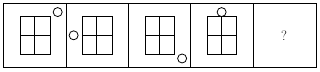
Select the figure from among the given options which when put in place of the question mark (?) will logically complete the series.

  1. AOption (a)

  2. BOption (b)

  3. COption (c)

  4. DOption (d)

View answer & explanation

Correct answer

Answer: (b)B.

Why this answer is correct

The logic followed here is:

1) The circle element shift anticlockwise alternately at corner and side of the quadrilateral element.

  1. No change in the quadrilateral element. 

Thus, the final series is:

Hence. "Option 2" is the correct answer.

Question 14

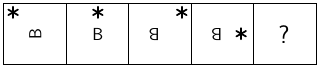
Identify the figure given in the options which when put in place of the question mark (?) will logically complete the series.

  1. AOption (a)

  2. BOption (b)

  3. COption (c)

  4. DOption (d)

View answer & explanation

Correct answer

Answer: (b)B.

Why this answer is correct

The logic followed here is:

1) The '*' element shift clockwise.

  1. The letter element rotates 90º clockwise. 

Thus, the final series is:

Hence. "Option 2" is the correct answer.

Question 15

Which of the following numbers will replace the question mark (?) in the given series?

12, 25, 49, ?, 197, 395

  1. AOption (a)

    100

  2. BOption (b)

    121

  3. COption (c)

    99

  4. DOption (d)

    96

View answer & explanation

Correct answer

Answer: (c)C.

99

Why this answer is correct

The logic followed here is:

Hence, "Option 3" is the correct answer.

Question 16

All of the letters in the word 'JUNGLE' are arranged in alphabetical order. How many letters are there in the English alphabetical series between the letter which is second from the left end and the one which is third from the right end in the new letter-cluster thus formed?

  1. AOption (a)

    Three

  2. BOption (b)

    Two

  3. COption (c)

    Five

  4. DOption (d)

    Four

View answer & explanation

Correct answer

Answer: (d)D.

Four

Why this answer is correct

Given word: JUNGLE

According to the question all the letters in the word given are arranged in English alphabetical order:

Given numbersJUNGLE
Arranged in English alphabetical orderEGJLNU

Resultant letter-cluster → E G J L N U

The letter which is second from the left end and the one which is third from the right end in the new letter-cluster thus formed:

(Left end) E G J L N U (Right end) → G and L

Thus, the number of letters according to the English alphabetical series between G an L are four i.e. H, I, J and K.

Hence, "Option 4" is the correct answer.

Question 17

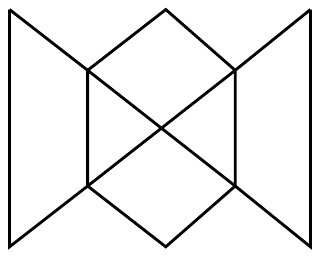
What is the number of triangles in the following figure?

  1. AOption (a)

    10

  2. BOption (b)

    11

  3. COption (c)

    8

  4. DOption (d)

    9

View answer & explanation

Correct answer

Answer: (a)A.

10

Why this answer is correct

The number of triangles in the given figure is shown below:

Thus, as marked there are a total of 10 triangles.

Hence, "Option 1" is the correct answer.

Question 18

Select the option that is related to the fifth letter-cluster in the same way as the second letter-cluster is related to the first letter-cluster and the fourth letter-cluster is related to the third letter-cluster.

OUR : NPTVQS :: BIG : ACHJFH :: FOR : ?

  1. AOption (a)

    EGNPQS

  2. BOption (b)

    GENPRS

  3. COption (c)

    EGNOQR

  4. DOption (d)

    GEPNSQ

View answer & explanation

Correct answer

Answer: (a)A.

EGNPQS

Why this answer is correct

The logic followed here is:

OUR : NPTVQS

And,

BIG : ACHJFH

Similarly,

FOR : ?

Hence, "Option 1" is the correct answer.

Question 19

Select the word pair that best represents a similar relationship to the one expressed in the pair of words given below. (The words must be considered as meaningful English words and must not be related to each other based on the number of letters/number of consonants/vowels in the word)

Calcium : Osteomalacia

  1. AOption (a)

    Stomach : Blindness

  2. BOption (b)

    Iron : Anaemia

  3. COption (c)

    Heart : Cardiovascular

  4. DOption (d)

    Lungs : Tuberculosis

View answer & explanation

Correct answer

Answer: (b)B.

Iron : Anaemia

Why this answer is correct

The logic followed here is:

Calcium : Osteomalacia

Deficiency of calcium can lead to the condition Osteomalacia. 

So, checking each option one by one:

Option 1) Stomach : Blindness → Incorrect

Blindness is typically caused by factors like eye conditions or neurological issues, not a deficiency in something directly related to the stomach.

Option 2) Iron : Anaemia → Correct

Deficiency of iron can lead to the condition Anaemia. 

Option 3) Heart : Cardiovascular → Incorrect

Cardiovascular refers to a general term for the heart’s health, but it doesn't describe a deficiency leading to a specific disease.

Option 4) Lungs : Tuberculosis → Incorrect

Tuberculosis is an infection, not a deficiency-related condition as it is caused by bacteria, not by a lack of a nutrient or mineral. 

Hence, "Option 2" is the correct answer

Question 20

Select the option in which the numbers share the same relationship as that shared by the given pair of numbers.

(NOTE: Operations should be performed on the whole numbers, without breaking down the numbers into its constituent digits. E.g. 13 – Operations on 13 such as adding/deleting/multiplying etc. to 13 can be performed. Breaking down 13 into 1 and 3 and then performing mathematical operations on 1 and 3 is not allowed.)

17 : 253

19 : 271

  1. AOption (a)

    21 : 289

  2. BOption (b)

    23 : 207

  3. COption (c)

    31 : 400

  4. DOption (d)

    32 : 387

View answer & explanation

Correct answer

Answer: (a)A.

21 : 289

Why this answer is correct

The logic followed here is:

17 : 253

17 × 9 + 100 = 253

153 + 100 = 253 

253 = 253 (LHS = RHS)

And,

19 : 271

19 × 9 + 100 = 271

171 + 100 = 271

271 = 271 (LHS = RHS)

So, checking each option one by one:

Option 1) 21 : 289

21 × 9 + 100 = 289

189 + 100 = 289

289 = 289 (LHS = RHS)

Option 2) 23 : 207

23 × 9 + 100 = 207

207 + 100 = 207 

307 ≠ 207 (LHS ≠ RHS)

Option 3) 31 : 400

31 × 9 + 100 = 400

279 + 100 = 400

379 ≠ 400 (LHS ≠ RHS)

Option 4) 32 : 387

32 × 9 + 100 = 387

288 + 100 = 387

388 ≠ 387 (LHS ≠ RHS)

Thus, out of all the options, '21 : 289' follows the same logic as given.

Hence, "Option 1" is the correct answer.

Question 21

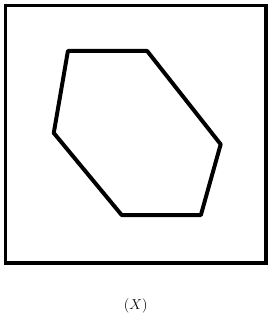
Select the option figure in which the given figure (X) is embedded (rotation is NOT allowed).

  1. AOption (a)

  2. BOption (b)

  3. COption (c)

  4. DOption (d)

View answer & explanation

Correct answer

Answer: (a)A.

Why this answer is correct

The image embedded in the given figure is as shown below :

∴ Here, the given figure is embedded in option Figure - 1.

Hence, the correct answer is "Option 1".

Question 22

Select the set in which the numbers are related in the same way as are the numbers of the following set.

(66, 57, 48)

(94, 85, 76)

(NOTE: Operations should be performed on the whole numbers, without breaking down the numbers into its constituent

digits. E.g. 13 – Operations on 13 such as adding/deleting/multiplying etc. to 13 can be performed. Breaking down 13 into 1

and 3 and then performing mathematical operations on 1 and 3 is not allowed.)

  1. AOption (a)

    (85, 77, 64)

  2. BOption (b)

    (81, 72, 63)

  3. COption (c)

    (98, 90, 83)

  4. DOption (d)

    (79, 70, 59)

View answer & explanation

Correct answer

Answer: (b)B.

(81, 72, 63)

Why this answer is correct

The logic followed here is:

(66, 57, 48)

66 + 48 = 57 × 2

114 = 114 (LHS = RHS)

And,

(94, 85, 76)

94 + 76 = 85 × 2

170 = 170 (LHS = RHS)

So, checking each option one by one:

Option 1) (85, 77, 64)

85 + 64 = 77 × 2

149 ≠ 154 (LHS ≠ RHS)

Option 2) (81, 72, 63)

81 + 63 = 72 × 2

144 = 144 (LHS = RHS)

Option 3) (98, 90, 83)

98 + 83 = 90 × 2

181 ≠ 180 (LHS ≠ RHS)

Option 4) (79, 70, 59)

79 + 59 = 70 × 2

138 ≠ 140 (LHS ≠ RHS)

Thus, out of all the options, '(81, 72, 63)' follows the same logic as given.

Hence, "Option 2" is the correct answer.

Question 23

In a certain code language, BRING is coded as '7149182' and SMILE is coded as '51291319'. What will be the code for FORGIVE?

  1. AOption (a)

    5229179156

  2. BOption (b)

    5228717156

  3. COption (c)

    5219717166

  4. DOption (d)

    5229718156

View answer & explanation

Correct answer

Answer: (d)D.

5229718156

Why this answer is correct

The logic followed here is:

BRING is coded as '7149182'

And,

SMILE is coded as '51291319'


Similarly,

FORGIVE is coded as

Hence, "Option 4" is the correct answer.

Question 24

Two sets of numbers are given below. In each set of numbers, certain mathematical operation(s) on the first number result(s) in the second number. Similarly, certain mathematical operation(s) on the second number result(s) in the third number and so on. Which of the given options follows the same set of operations as in the given sets?

(NOTE: Operations should be performed on the whole numbers, without breaking down the numbers into their constituent digits. E.g., 13 – Operations on 13 such as adding/subtracting/multiplying to 13 can be performed. Breaking down 13 into 1 and 3 and then performing mathematical operations on 1 and 3 is not allowed.)

14 – 196 – 186 – 172 ; 15 – 225 – 215 – 200

  1. AOption (a)

    9 – 81 – 71 – 62

  2. BOption (b)

    3 – 9 – 19 – 14

  3. COption (c)

    8 – 64 – 54 – 40

  4. DOption (d)

    6 – 36 – 26 – 22

View answer & explanation

Correct answer

Answer: (a)A.

9 – 81 – 71 – 62

Why this answer is correct

The logic followed here is:

14 – 196 – 186 – 172

142 = 196 → 196 - 10 = 186 → 186 - 14 = 172 

And,

15 – 225 – 215 – 200

152 = 225 → 225 - 10 = 215 → 215 - 15 = 200

So, checking each option one by one:

Option 1) 9 – 81 – 71 – 62

92 = 81 → 81 - 10 = 71 → 71 - 9 = 62

Option 2) 3 – 9 – 19 – 14

32 = 9 → 9 - 10 = (-1) → (-1) - 3 = (-4) ≠ 14

Option 3) 8 – 64 – 54 – 40

82 = 64 → 64 - 10 = 54 → 54 - 8 = 46 ≠ 40

Option 4) 6 – 36 – 26 – 22

62 = 36 → 36 - 10 = 26 → 26 - 6 = 20 ≠ 22

Thus, out of all the options, '9 – 81 – 71 – 62' follows the same logic as given.

Hence, "Option 1" is the correct answer.

Question 25

Select the option that represents the letters that, when sequentially placed from left to right in the blanks below, will

complete the letter series.

R F _ G T R _V G _ R F V _ T _ F V G T

  1. AOption (a)

    VFTGR

  2. BOption (b)

    VFTGG

  3. COption (c)

    VTTGR

  4. DOption (d)

    VFVGR

View answer & explanation

Correct answer

Answer: (a)A.

VFTGR

Why this answer is correct

Given series: R F _ G T R _V G _ R F V _ T _ F V G T

Option 1) VFTGR→ R F V G T R FV G T R F V G T R F V G T → (It follows the pattern of: RFVGT - RFVGT - RFVGT - RFVGT)

Option 2) VFTGG → R F V G T R FV G T R F V G T G F V G T→ (It doesn't follow any pattern)

Option 3) VTTGR → R F V G T R TV G T R F V G T R F V G T → (It doesn't follow any pattern)

Option 4) VFVGR → R F V G T R FV G V R F V G T R F V G T → (It doesn't follow any pattern)

Hence, "Option 1" is the correct answer.

General Awareness (25 questions)

Question 26

Who developed the theory of combustion as a chemical reaction with oxygen in the 18th century, that excluded phlogiston theory?

  1. AOption (a)

    Antoine Lavoisier

  2. BOption (b)

    Robert Boyle

  3. COption (c)

    Friedrich Wöhler

  4. DOption (d)

    Johann Becher

View answer & explanation

Correct answer

Answer: (a)A.

Antoine Lavoisier

Why this answer is correct

The correct answer is Antoine Lavoisier.

Key Points

  • Antoine Lavoisier
  • The theory of combustion as a chemical reaction with oxygen in the 18th century, which excluded the phlogiston theory, was developed by Antoine Lavoisier
  • The 18th-century chemical revolution was led by Antoine-Laurent de Lavoisier, a French nobleman, and chemist who is also known by the name Antoine Lavoisier following the French Revolution.
  • He had a significant impact on both the history of chemistry and the history of biology.
  • It is widely acknowledged that Lavoisier's major contributions to chemistry were greatly influenced by his shift from a qualitative to a quantitative approach towards the field.
  • He is well-known for his discovery of the elements carbon (1789), hydrogen (1783), and oxygen (1778) and he opposed the phlogiston theory by discovering the role of oxygen in combustion and respiration.
  • Lavoisier created the first comprehensive list of elements, contributed to the development of the metric system, and reformed chemical nomenclature.
  • He is known as the "father of modern chemistry,"

Additional Information

  • Robert Boyle (1627–1691):
  • Boyle is famous for Boyle's law, which describes the relationship between the pressure and volume of a gas.
  • He played a key role in the development of the scientific method and experimental approach to chemistry.
  • Boyle's work in The Sceptical Chymist (1661) challenged the traditional theory of alchemy and laid the foundation for modern chemical science by advocating for a more systematic, empirical approach to chemistry.
  • Friedrich Wöhler (1800–1882):
  • Wöhler is known for synthesizing urea (1828) from ammonium cyanate, a breakthrough that demonstrated that organic compounds could be synthesized from inorganic substances.
  • Johann Becher (1635–1682):
  • Becher was a German chemist who is often associated with early theories of combustion. He proposed the idea of "terra pinguis," a substance that he believed was responsible for combustion and flammability.

Question 27

What do we mean by Allen’s rule?

  1. AOption (a)

    Mammals from colder climates generally have shorter ears and limbs to minimise heat loss.

  2. BOption (b)

    Desert lizards lack the physiological ability that mammals have to deal with the high temperatures of their habitat.

  3. COption (c)

    Some plants have no leaves – they are reduced to spines – and the photosynthetic function is taken over by the flattened stems.

  4. DOption (d)

    The body compensates low oxygen availability by increasing red blood cell production, decreasing the binding affinity of haemoglobin and by increasing the breathing rate.

View answer & explanation

Correct answer

Answer: (a)A.

Mammals from colder climates generally have shorter ears and limbs to minimise heat loss.

Why this answer is correct

The correct answer is option 1

Key Points

  • Allen's Rule is a principle in biology which suggests that animals living in colder regions tend to have shorter appendages (such as ears, tails, and limbs) to conserve body heat, while animals in warmer climates tend to have longer appendages to dissipate excess heat.
  • This adaptation helps maintain thermal balance by reducing the surface area through which heat can be lost in colder environments and increasing it in hotter environments to release heat.

Additional Information

  • Statement 2 
  • Describes adaptations to high temperatures, but it is not Allen's Rule.
  • Statement 3 
  • Refers to adaptations in desert plants, such as succulents, not Allen's Rule.
  • Statement 4 
  • Describes physiological responses to high-altitude environments, such as increased red blood cell production, but again, this is unrelated to Allen's Rule.

Question 28

Which of the following schemes enables students mobility across Higher Education Institutions?

  1. AOption (a)

    National Educational Technology Forum

  2. BOption (b)

    PM Umeed scheme

  3. COption (c)

    Structured Assessment for Analysing Learning Levels (SAFAL)

  4. DOption (d)

    Academic Bank of Credits

View answer & explanation

Correct answer

Answer: (d)D.

Academic Bank of Credits

Why this answer is correct

The correct answer is Academic Bank of Credits

Key Points

  • The Academic Bank of Credits (ABC) scheme allows students to move between higher education institutions by enabling the accumulation, recognition, transfer, and redemption of credits:
  • A digital platform that stores a student's credits earned throughout their learning journey
  • Students can open accounts and use the ABC to enter and leave colleges or universities
  • Students can seamlessly integrate their skills and experiences into a credit-based system

Additional Information

  • National Educational Technology Forum (NETF):
  • The National Educational Technology Forum (NETF) is an initiative aimed at promoting the use of technology in education.
  • It is expected to provide a platform for discussions, advice, and recommendations regarding educational technology policies and innovations.
  • NETF aims to foster the integration of technology in teaching and learning to improve education quality in India.
  • PM Umeed Scheme:
  • The PM Umeed Scheme is a government initiative aimed at empowering rural women, particularly in the areas of self-help groups (SHGs).
  • Under this scheme, women are provided financial support, training, and access to resources to start small businesses and improve their economic conditions.
  • It focuses on encouraging entrepreneurship and providing socio-economic benefits to women in rural areas.
  • Structured Assessment for Analysing Learning Levels (SAFAL):
  • SAFAL is a national-level initiative launched by the government to assess the learning outcomes of students in schools.
  • The program aims to provide a structured assessment to analyze and understand the learning levels of students, identify areas for improvement, and help enhance the overall quality of education.
  • The SAFAL initiative is designed to help teachers and education policymakers by providing actionable data on student learning progress.

Question 29

Which of the following Constitutions inspired the law-making process in India?

  1. AOption (a)

    Irish Constitution

  2. BOption (b)

    British Constitution

  3. COption (c)

    US Constitution

  4. DOption (d)

    Canadian Constitution

View answer & explanation

Correct answer

Answer: (b)B.

British Constitution

Why this answer is correct

The correct answer is British Constitution

Key Points

  • The British Constitution inspired the law-making process in India. The Indian Constitution borrowed many features from the British Constitution, including:
  • Parliamentary system
  • The concept of a sovereign Parliament, with a division into two houses, the Rajya Sabha (Upper House) and the Lok Sabha (Lower House)
  • Rule of law
  • The principle of equality before the law and protection of individual rights
  • Legislative procedures
  • The procedures for passing bills and conducting debates in the Indian Parliament
  • Single citizenship
  • The concept that individuals hold citizenship of the country as a whole, not specific states or regions
  • Cabinet system
  • The idea of a Council of Ministers led by the Prime Minister exercising executive powers

Additional Information

  • Other constitutions that inspired the Indian Constitution include:
  • The Government of India Act of 1935: Inspired the federal scheme, office of the governor, judiciary, public service commissions, emergency provisions, and administrative details
  • The French Constitution: The preamble of the Indian Constitution shares similarities with the motto of the French Republic, "Liberté, égalité, fraternité" (liberty, equality, fraternity)
  • The Canadian Constitution was a major influence on the Indian Constitution, inspiring many of its principles, including the federal system of government and the protection of human rights: 
  • Federal structure
  • The Indian Constitution's federal structure, where powers are divided between the central government and the states, was inspired by the Canadian Constitution.
  • Division of powers
  • The Canadian Constitution influenced the distribution of powers between the center and the states, and the subjects each level of government can legislate on.
  • Appointment of governors
  • The Canadian Constitution inspired the provision for the President to appoint governors, who represent the central government in the states.
  • Idea of residuary powers
  • The idea of residuary powers was taken from the Canadian Constitution.
  • Irish Constitution
  • The Directive Principles of State Policy and the method of election of the President were inspired by the Irish Constitution.
  • Australian Constitution
  • The freedom of trade and commerce within the country and between the states, and the power of the national legislature to make laws for implementing treaties were inspired by the Australian Constitution.
  • United States Constitution
  • The Charter of Fundamental Rights, known as the Magna Carta of India Constitution, was inspired by the United States Constitution.
  • German Constitution
  • The emergency powers vested with the President of India were inspired by the Weimer Constitution of Germany.
  • South African Constitution
  • The legislative procedure involved in passing constitutional amendments and electing members to the upper house based on proportional representation were inspired by the South African Constitution.
  • Japanese Constitution
  • The procedure of making laws was inspired by the Japanese Constitution

Question 30

Which of the following definitions best describes the concept of microfinance?

  1. AOption (a)

    A microfinance institution is a company registered under the Companies Act, 1956, and engaged in the business of loans and advances and acquisition of shares/stocks/bonds/debentures/securities issued by the government.

  2. BOption (b)

    Microfinance is a banking service provided to unemployed or low-income individuals or groups, who otherwise would have no other access to financial services.

  3. COption (c)

    A microfinance institution is a digital-only and mobile-first bank.

  4. DOption (d)

    Microfinance refers to providing banking services to individuals living in rural areas.

View answer & explanation

Correct answer

Answer: (b)B.

Microfinance is a banking service provided to unemployed or low-income individuals or groups, who otherwise would have no other access to financial services.

Why this answer is correct

The correct answer is option 2

Key Points

  • Microfinance involves providing financial services like small loans, savings accounts, and insurance to people who do not have access to traditional banking services, particularly those in impoverished or rural areas.
  • The goal is to empower these individuals or groups by offering them the opportunity to start or expand small businesses,
  • It improve their quality of life, and reduce poverty.

Additional Information

  • The other options are incorrect or incomplete descriptions of microfinance:
  • Option 1 describes the business structure of a microfinance institution but does not fully capture the core concept of microfinance itself.
  • Option 3 describes a digital-only bank but doesn't specifically relate to microfinance.
  • Option 4 is somewhat related but does not fully explain the concept of microfinance, as it also applies to low-income or unemployed individuals, not just those in rural areas.

Question 31

Ernest Rutherford used about _______ thick gold foil for alpha scattering experiments.

  1. AOption (a)

    500 atoms

  2. BOption (b)

    1000 atoms

  3. COption (c)

    900 atoms

  4. DOption (d)

    700 atoms

View answer & explanation

Correct answer

Answer: (b)B.

1000 atoms

Why this answer is correct

The correct answer is 1000 atoms

Key Points

  • Ernest Rutherford used a gold foil that was about 1,000 atoms thick for his alpha scattering experiment.
  • Rutherford chose gold because it is malleable, which allowed him to make a very thin sheet of the metal.
  • He wanted to use the thinnest layer of metal possible so that he could get clear observations.
  • Using a different metal would not have produced accurate results.
  • In the experiment, Rutherford shot high-energy alpha particles at the gold foil and observed how the particles deflected.
  • He placed a fluorescent zinc sulfide screen around the foil to study the deflection.
  • The experiment led to the discovery of the nucleus and contradicted Thomson's atomic model.

Question 32

In May 2022, Then President Ram Nath Kovind appointed ________ as the Lieutenant Governor of Delhi.

  1. AOption (a)

    Kiran Bedi

  2. BOption (b)

    Anil Baijal

  3. COption (c)

    Vijai Kapoor

  4. DOption (d)

    Vinai Kumar Saxena

View answer & explanation

Correct answer

Answer: (d)D.

Vinai Kumar Saxena

Why this answer is correct

The correct answer is Vinai Kumar Saxena 

Key Points

  • Vinai Kumar Saxena was appointed as the Lieutenant Governor of Delhi in May 2022 by President Ram Nath Kovind.
  • Vinai Kumar Saxena is a retired Indian Administrative Service (IAS) officer of the 1983 batch from the Assam-Meghalaya cadre.
  • He has served as the Chairman of the Agricultural and Processed Food Products Export Development Authority (APEDA) and the Khadi and Village Industries Commission (KVIC) in the past.

Additional Information

  • Kiran Bedi:
  • Kiran Bedi is a retired Indian Police Service (IPS) officer, social activist, and politician.
  • She is known for being the first woman officer in the IPS.
  • She served in various high-profile positions in the police force and is recognized for her reforms in the prison system.
  • Kiran Bedi has also been involved in several social causes and was the Lieutenant Governor of Puducherry from 2016 to 2021.
  • Anil Baijal:
  • Anil Baijal is a retired Indian Administrative Service (IAS) officer and the current Lieutenant Governor of Delhi.
  • He took office in 2016, succeeding Najeeb Jung.
  • Before becoming the Lieutenant Governor, he held various important administrative positions, including Secretary in the Ministry of Home Affairs and the Ministry of Urban Development.
  • Vijai Kapoor:
  • Vijai Kapoor is a former Lieutenant Governor of Delhi who served from 1997 to 2002.
  • He is an IAS officer by training and has held several key positions in the government of India.
  • During his tenure, he played a significant role in the administration and governance of Delhi.

Question 33

How many players are there on each side of the Kabaddi Team in the field?

  1. AOption (a)

    9

  2. BOption (b)

    7

  3. COption (c)

    8

  4. DOption (d)

    10

View answer & explanation

Correct answer

Answer: (b)B.

7

Why this answer is correct

The correct answer is 7

Key Points

  • There are seven players on each side of a Kabaddi team on the field at the start of the game:
  • Number of players per team
  • 7 players per side
  • Total number of players per team
  • 12 players per team
  • Other players
  • 5 reserved players who come in when active players are out
  • Kabaddi is a contact sport that originated in Ancient India.
  • It's played across India and is the official game in the states of Punjab, Tamil Nadu, Bihar, Telangana, and Maharashtra.
  • In a Kabaddi game, players take turns chasing and trying to touch members of the opposing team without being captured.
  • The team that outs all the players on the opponent's side scores four extra points.

Question 34

Which of the following events took place in the United Provinces in February, 1922?

  1. AOption (a)

    Quit India

  2. BOption (b)

    Chauri Chaura

  3. COption (c)

    Khilafat Movement

  4. DOption (d)

    Kakori Incident

View answer & explanation

Correct answer

Answer: (b)B.

Chauri Chaura

Why this answer is correct

The correct answer is Chauri Chaura

Key Points

  • The Chauri Chaura incident took place in the United Provinces in February 1922:
  • Chauri Chaura, a small town in the Gorakhpur district of the United Provinces (now Uttar Pradesh)
  • A violent clash between Indian protesters and British police during the Non-cooperation movement
  • The police station was set on fire, killing many police officials, and hundreds of people were arrested.
  • Gandhiji called off the Non-Cooperation Movement on February 12, 1922.

Additional Information

  • Khilafat Movement
  • This movement took place from 1919 to 1924.
  • It was the first time a large number of Sindhi pirs came together to oppose British policy.
  • Kakori Incident
  • On August 9, a group of revolutionaries led by Ram Prasad Bismil robbed the Kakori Express, a train carrying government funds.
  • The revolutionaries' goal was to obtain funds for their revolutionary activities against British rule
  • Quit India Movement
  • It was a nonviolent protest movement that took place in India from 1942–1943 to demand an end to British rule:
  • The movement was planned by Mahatma Gandhi and the Indian National Congress (Congress Party).
  • It was a response to the British colonial rule that had been in place since the East India Company's territories were transferred to the Crown in 1858.

Question 35

The Mahalanobis model was the basis for which Five-Year Plan?

  1. AOption (a)

    Fourth Five-Year Plan

  2. BOption (b)

    Second Five-Year Plan

  3. COption (c)

    Sixth Five-Year Plan

  4. DOption (d)

    First Five-Year Plan

View answer & explanation

Correct answer

Answer: (b)B.

Second Five-Year Plan

Why this answer is correct

The correct answer is the Second Five-yea Plan

Key Points

  • The Mahalanobis model was the basis for the Second Five-Year Plan of India, which took place from 1956–1961:
  • The Mahalanobis model was an economic development model created by Indian statistician Prasanta Chandra Mahalanobis in 1953.
  • The model was based on an input-output model and was used to establish the plan's goals and priorities.
  • The plan's goals included: Rapid industrialization, Development of the public sector, Balanced allocation of investment between productive sectors, and A 25% increase in national income.

Additional Information

  • Second Five-Year Plan
  • The Second Five-Year Plan in India was from 1956 to 1961.
  • The plan's main objectives were to develop heavy industries and construct railway lines in the northeast.
  • Sixth Five-Year Plan
  • The Sixth Five-Year Plan in India was from 1980 to 1985.
  • The plan's objectives were to increase national income, modernize technology, and reduce poverty and unemployment.
  • First Five-Year Plan
  • The First Five-Year Plan in India was from 1951 to 1956.
  • The plan was based on the Harrod-Domar Model and focused on agriculture.

Question 36

In which state of India was the Neeru-Meeru programme introduced for construction of water harvesting structures?

  1. AOption (a)

    Andhra Pradesh

  2. BOption (b)

    Rajasthan

  3. COption (c)

    Uttar Pradesh

  4. DOption (d)

    Punjab

View answer & explanation

Correct answer

Answer: (a)A.

Andhra Pradesh

Why this answer is correct

The correct answer is Andhra Pradesh.

Key Points

  • The Neeru-Meeru (Water and You) program was launched by the Water Conservation Mission(WCM), on May 1, 2000.
  • It is a Water conservation and poverty alleviation initiative undertaken by the government of Andhra Pradesh.
  • The initiative focuses on overcoming man made-drought and water shortage in the state through the convergence of efforts of various departments at the state, district, and sub-district levels for water conservation.

Additional Information

  • Features of Neeru-Meeru are:
  • Rainwater harvesting works
  • Mobilization of financial resources
  • Prioritization of areas
  • Quality improvement
  • Water audit
  • Despite a 7% deficit in rainfall, the groundwater levels registered a rise of 0.19 to 6.34 meters in groundwater levels.
  • The process of implementing land-use practices and water management practices to protect and improve the quality of the water is called watershed management.
  • It also helps in improving natural resources within a watershed by managing the use of those land and water resources in a comprehensive manner.

Question 37

Lata Mangeshkar was honoured with the Bharat Ratna in the year _______.

  1. AOption (a)

    2001

  2. BOption (b)

    2003

  3. COption (c)

    2004

  4. DOption (d)

    2002

View answer & explanation

Correct answer

Answer: (a)A.

2001

Why this answer is correct

The correct answer is 2001

Key Points

  • Lata Mangeshkar was awarded the Bharat Ratna in 2001.
  • The Bharat Ratna is India's highest civilian honour.
  • Lata Mangeshkar was an Indian playback singer and songwriter who recorded songs in over 36 Indian languages and a few foreign languages.
  • She was known as the "Queen of Melody," "Nightingale of India," and "Voice of the Millennium".
  • She received many other awards and honours, including: 
  • Padma Bhushan: 1969
  • Dadasaheb Phalke Award: 1989
  • Padma Vibhushan: 1999
  • One Time Award for Lifetime Achievement: 2008
  • Officer of the National Order of the Legion of Honour: 2007
  • Lata Mangeshkar was born on September 28, 1929 in Indore, India and died on February 6, 2022.
  • She was the second female singer to receive the Bharat Ratna, after M. S. Subbulakshmi.

Question 38

In which of the following districts of Rajasthan are the 'Barchans' found?

  1. AOption (a)

    Udaipur

  2. BOption (b)

    Jaisalmer

  3. COption (c)

    Bhilwara

  4. DOption (d)

    Alwar

View answer & explanation

Correct answer

Answer: (b)B.

Jaisalmer

Why this answer is correct

The correct answer is Jaisalmer

Key Points

  • Barchans, or crescent-shaped sand dunes, can be found in the Jaisalmer district of Rajasthan:
  • Barchans are concentric in shape, with convex sides that face the prevailing winds.
  • They can shift when faced with strong winds from a particular direction.
  • Jaisalmer is the largest district in Rajasthan, and the third largest in India.
  • It is located in the Thar Desert, which straddles the border of India and Pakistan.

Question 39

Which of the following types of unemployment is found in India when people are employed for a certain period of a year in tourist resorts and various tourism-related activities in the mountain regions, but are unemployed in off-seasons?

  1. AOption (a)

    Seasonal unemployment

  2. BOption (b)

    Under employment

  3. COption (c)

    Disguised unemployment

  4. DOption (d)

    Cyclical unemployment

View answer & explanation

Correct answer

Answer: (a)A.

Seasonal unemployment

Why this answer is correct

The correct answer is Seasonal unemployment

Key Points

  • Seasonal unemployment is the type of unemployment that occurs when people are employed for a certain period of the year but are unemployed during other times.
  • This is the type of unemployment that occurs in India when people are employed in the tourism sector but are unemployed during the off-season.
  • Seasonal unemployment is common in industries and occupations that are subject to seasonal demand or weather, such as tourism, farming, and construction.
  • In the tourism sector, some months of the year have more tourists than others, which can lead to seasonal unemployment.

Additional Information

  • Other types of unemployment include:
  • Frictional unemployment: Occurs when someone is unemployed by choice while looking for a better job opportunity.
  • Underemployment
  • When people are employed but want or are available to work more hours.
  • This can include part-time workers who want to work full-time or people who usually work full-time but are currently working part-time.
  • Disguised unemployment
  • When people are employed but not to their full potential due to a lack of opportunities.
  • This can include people who are working below their skill set, or people who are doing part-time work but want to work full-time.
  • Disguised unemployment is also known as underemployment
  • Cyclical unemployment is a type of unemployment that occurs when the economy changes, such as during a recession or period of economic growth.
  • It's characterized by a short-term increase in unemployment, usually lasting from one month to 1.5 years.

Question 40

When was the Jawaharlal Nehru Manipur Dance Academy established?

  1. AOption (a)

    1951

  2. BOption (b)

    1953

  3. COption (c)

    1954

  4. DOption (d)

    1952

View answer & explanation

Correct answer

Answer: (c)C.

1954

Why this answer is correct

The correct answer is 1954

Key Points

  • Jawaharlal Nehru Manipur Dance Academy:
  • It is a constituent unit of the Sangeet Natak Akademi, New Delhi.
  • The institute is a premier institution for teaching Manipuri Dance and Music and allied subjects like Thang-Ta.
  • It was established in 1954.​

Additional Information​​

  • Sangeet Natak Akademi:
  • ​The Sangeet Natak Akademi was founded on 31 May 1952.
  • It is also known as the National Academy for Music, Dance, and Drama.
  • In India, it functions as the headquarters of performing arts.
  • It presents the Sangeet Natak Akademi Awards which is the highest Indian recognition given to performing/practising artists.

Question 41

'Poush Mela' is a unique festival celebrated in which of the following Indian states?

  1. AOption (a)

    Uttar Pradesh

  2. BOption (b)

    Himachal Pradesh

  3. COption (c)

    West Bengal

  4. DOption (d)

    Madhya Pradesh

View answer & explanation

Correct answer

Answer: (c)C.

West Bengal

Why this answer is correct

The correct answer is West Bengal

Key Points

  • Poush Mela is a festival celebrated in the Indian state of West Bengal:
  • Poush Mela is held in Santiniketan, in the Birbhum district of West Bengal
  • Poush Mela is held on the 7th day of the Poush month and lasts for three days.
  • However, since 2017, it has been extended to six days due to its popularity.
  • Poush Mela is a festival that marks the beginning of the harvest season.
  • It features live performances of Bengali folk music, such as baul, kirtan, and Kobigan.
  • It also displays local artisans, food, and culture.

Additional Information 

StateFestivals
Uttar PradeshHoli, Chaitra Navratri, Ram Navmi, Ganga Mahotsav, Khichdi
Himachal PradeshChait (also known as Dholru)
West BengalDurga Puja, Jamai Shashti, Poush Mela (Shantiniketan Mela Grounds)
Madhya PradeshKarma (tribal festival), Larukaz (tribal festival), Gangaur (tribal festival), Rasnava (tribal festival in Mandla district)

Question 42

According to which of the following foreign travellers, people of Delhi used to write letters containing abuses to the Sultan, therefore, in order to punish them Sultan decided to shift the capital?

  1. AOption (a)

    Isami

  2. BOption (b)

    Hasan Nizami

  3. COption (c)

    Ibn Batuta

  4. DOption (d)

    Al Biruni

View answer & explanation

Correct answer

Answer: (c)C.

Ibn Batuta

Why this answer is correct

The correct answer is Ibn Batuta

Key Points

  • Ibn Batuta visited India during the reign of Sultan Muhammad bin Tughlaq.
  • According to his accounts, the people of Delhi used to write letters containing abuses to the Sultan.
  • To punish them, the Sultan decided to shift the capital from Delhi to Devagiri, which he renamed as Daulatabad.

Additional Information

  • Hasan Nizami:
  • Hasan Nizami was a Persian historian and writer during the medieval period.
  • He is best known for his work, "Taj-ul-Maasir", a historical account of the reign of the Sultan of Delhi, Mahmud of Ghazni.
  • Nizami's work offers valuable insights into the politics, culture, and social conditions of that period.
  • Al-Biruni:
  • Abu Rayhan al-Biruni (973–1048) was a renowned Persian scholar, historian, and polymath during the Islamic Golden Age.
  • He made significant contributions to many fields, including astronomy, mathematics, physics, and geography.
  • Al-Biruni is especially famous for his works on India, including "Kitab al-Hind", in which he detailed the culture, religion, and sciences of India.
  • His scholarly approach combined a deep understanding of Indian civilization with a critical and comparative analysis.
  • Isami:
  • Isami (also known as Siyah-yi Isami) was a Persian historian and author who lived during the 14th century.
  • He is best known for his historical work "Futuh al-Salatin" (The Conquests of Kings), which provides an account of the history of the Delhi Sultanate.
  • His work is a valuable source for understanding the history of medieval India, particularly during the reign of the early Sultans

Question 43

In 2022, which of the following railway stations has been selected for the 'One Station One Product' scheme launched by Indian Railways, which identifies Kanchipuram sarees as the chosen product?

  1. AOption (a)

    Howrah

  2. BOption (b)

    Vasakhapatnam

  3. COption (c)

    Chennai Central

  4. DOption (d)

    Patna Jn

View answer & explanation

Correct answer

Answer: (c)C.

Chennai Central

Why this answer is correct

The correct answer is Chennai Central

Key Points

  • The Chennai Central railway station was selected for the 'One Station One Product' (OSOP) scheme in 2022, with Kanchipuram sarees as the chosen product.
  • The OSOP scheme was announced in the Union Budget 2022-23 to promote local products and arts, and to enhance the livelihoods of local artisans, weavers, and craftsmen.
  • The scheme aims to make railway stations promotional hubs for local products and to present unique regional products to railway travellers.
  • The OSOP scheme includes:
  • Providing sale outlets at stations nationwide
  • Allotting sale outlets through a tendering process
  • Offering uniquely designed sale outlets at stations
  • Showcasing Indigenous/local products with distinctive aesthetics
  • Some other products sold under the OSOP scheme include:
  • Tant handloom sarees and handloom textile at Howrah
  • Assamese Gamocha at Guwahati
  • Channapatna wooden toys at Bengaluru
  • Ranipet leather products
  • Thirubhuvanam sarees
  • Thanjavur painting

Question 44

With reference to Morley-Minto Reforms of 1909, consider the following statements.

a) They are also called the Indian Councils Act, 1909.

b) They increased the strength of Legislative Councils.

c) The right to separate electorate was given to the Muslims.

Which of the above statements is/are correct?

  1. AOption (a)

    b, c

  2. BOption (b)

    a, b, c

  3. COption (c)

    c, a

  4. DOption (d)

    a, b

View answer & explanation

Correct answer

Answer: (b)B.

a, b, c

Why this answer is correct

The correct answer is a,b,c

Key Points

  • The Morley-Minto Reforms of 1909, also known as the Indian Councils Act of 1909, were significant constitutional reforms introduced by the British government in India.
  • They are known for their impact on Indian politics during the colonial period.
  • Statement I: They are also called the Indian Councils Act, of 1909.
  • The statement is Correct.
  • The Morley-Minto Reforms are indeed known as the Indian Councils Act of 1909.
  • It was named after the Secretary of State for India, John Morley, and the Viceroy of India, Lord Minto.
  • Statement II They increased the strength of Legislative Councils.
  • The statement is Correct.
  • The Morley-Minto Reforms expanded the Legislative Councils at both the central and provincial levels by increasing the number of members.
  • The reforms allowed for more representation for Indians, though the majority of the seats were still held by the British.
  • Statement III: The right to separate the electorate was given to the Muslims.
  • This statement is also Correct.
  • One of the most significant provisions of the Morley-Minto Reforms was the introduction of separate electorates for Muslims.
  • This meant that Muslims could elect their own representatives to the legislative councils, and their votes would not be counted by the general electorate.
  • Hence all the statements are true

Question 45

How long will a sound wave take to travel 1.5km, which has a frequency of 5 kHz and wavelength of 6 cm?

  1. AOption (a)

    2.5 seconds

  2. BOption (b)

    50 seconds

  3. COption (c)

    5 seconds

  4. DOption (d)

    25 seconds

View answer & explanation

Correct answer

Answer: (c)C.

5 seconds

Why this answer is correct

The correct answer is 5 seconds

Key Points

  • To calculate the time it takes for a sound wave to travel a distance, we can use the formula:
  • ​Distance/ Speed of Sound
  • We are given:
  • Distance = 1.5 km = 1500 meters
  • Frequency of the sound wave = 5 kHz = 5000 Hz
  • Wavelength = 6 cm = 0.06 meters
  • First, we need to calculate the speed of sound using the formula:
  • Speed of sound=Frequency×Wavelength
  • Substituting the given values:
  • ​Speed of sound=5000Hz×0.06m=300m/s
  • Now, we can calculate the time taken for the sound wave to travel 1500 meters:
  • ​Time= 1500m/300m/s=5 Seconds

Question 46

Which Article of the Constitution of India deals with the conduct of business of the Government of a state?

  1. AOption (a)

    Article 177

  2. BOption (b)

    Article 167

  3. COption (c)

    Article 164

  4. DOption (d)

    Article 166

View answer & explanation

Correct answer

Answer: (d)D.

Article 166

Why this answer is correct

The correct answer is Article 166

Key Points

  • Article 166 of the Constitution of India deals with the conduct of business of the Government of a state:
  • All executive action of the state government must be taken in the name of the Governor.
  • The Governor makes rules for the transaction of state government business and allocates it among ministers.
  • Orders and instruments made in the name of the Governor are authenticated in a manner specified by the Governor's rules.

Additional Information 

  • Article 164
  • The Governor appoints the Chief Minister and other Ministers, who serve at the Governor's pleasure.
  • Ministers are responsible for the conduct of government business.
  • Article 167
  • The Chief Minister is responsible for providing information to the Governor about the state's administration.
  • Article 177
  • The rights of Ministers and the Advocate-General in relation to the Houses are defined

Question 47

Hariprasad Chaurasia, an Indian flutist in the Hindustani classical tradition, was awarded with which of the following awards in 2000?

  1. AOption (a)

    Padma Shri

  2. BOption (b)

    Padma Vibhushan

  3. COption (c)

    Bharat Ratna

  4. DOption (d)

    Padma Bhushan

View answer & explanation

Correct answer

Answer: (b)B.

Padma Vibhushan

Why this answer is correct

The correct answer is Padma Vibhushan

Key Points

  • In 1984 he was awarded the Sangeet Natak Akademi (National Academy of Music, Dance, and Drama) award for his outstanding contribution to music.
  • He received two of India's highest civilian honours, the Padma Bhushan (1992) and the Padma Vibhushan (2000)
  • Here are some other awards that Chaurasia received:
  • Sangeet Natak Akademi: 1984
  • Konark Samman: 1992
  • Padma Bhushan: 1992
  • Yasha Bharati Samman: 1994
  • Akshaya Samman: 2009
  • Pune Pandit Award: 2008
  • Chaurasia was born in Prayagraj on July 1, 1938.
  • He was a member of the maihar Senia gharana, a community of performers with a distinctive musical style.
  • He learned from the famous flute player Bholanath Prasanna.
  • He also formed a group called Shiv-Hari with Santoor player Shiv Kumar Sharma.

Additional Information

  • Padma Shri
  • The fourth highest civilian award, given for "distinguished service".
  • It was established in 1954 and is awarded to Indian citizens for their contributions in various fields.
  • The award is shaped like a geometric pattern on a circle, with the words "Padma" and "Shri" inscribed above and below a lotus flower in the center.
  • Padma Vibhushan
  • The second highest civilian award, given for "exceptional and distinguished service".
  • It was established in 1954.
  • Padma Bhushan
  • The third highest civilian award, given for "distinguished service of a high order".
  • It was established in 1954.
  • Bharat Ratna
  • The highest civilian award, given for exceptional service or performance in any field.
  • The Prime Minister makes recommendations to the President of India for the Bharat Ratna award, and the number of awards given in a year is limited to three.
  • The Government of India awards these civilian awards on Republic Day, January 26, each year.

Question 48

Which of the following terms is NOT related to cricket?

  1. AOption (a)

    Wide Ball

  2. BOption (b)

    Wicket

  3. COption (c)

    No Ball

  4. DOption (d)

    Deuce

View answer & explanation

Correct answer

Answer: (d)D.

Deuce

Why this answer is correct

The correct answer is Deuce

Key Points

  • The term "Deuce" is not related to cricket:
  • Deuce: A term used in badminton that refers to when both players have the same score on the game or match point.
  • For example, if the score is 20-20, the players need to score two consecutive points to win.

Additional Information

  • Wide ball: A delivery in cricket that doesn't count as one of the six deliveries in an over.
  • It also doesn't count as a ball faced by the batters.
  • Wicket: A term used in cricket
  • No ball: A term used in cricket

Question 49

Vasudeva I who issued coins in gold (dinars and quarter dinars) and copper (single denomination) was a ________ king.

  1. AOption (a)

    Shunga

  2. BOption (b)

    Vakataka

  3. COption (c)

    Shaka

  4. DOption (d)

    Kushana

View answer & explanation

Correct answer

Answer: (d)D.

Kushana

Why this answer is correct

The correct answer is Kushana

Key Points

  • Vasudeva I was one of the prominent rulers of the Kushana dynasty, which ruled over a large part of northern India and Central Asia from the 1st to 3rd centuries CE.
  • The Kushana Empire is known for its cultural and economic achievements, including the introduction of gold coins.
  • Gold Coins (Dinars):
  • Vasudeva I was known for issuing gold coins (dinars), which was a significant achievement in the history of Indian numismatics.
  • These coins often featured portraits of the king and deities, showcasing the wealth and prosperity of his reign.
  • Kushana Dynasty:
  • The Kushanas, under their ruler Kanishka, and later rulers like Vasudeva I, played a significant role in facilitating trade along the Silk Route and were instrumental in the cultural and religious syncretism between Greek, Persian, Indian, and Central Asian influences.
  • They were also patrons of Buddhism and helped spread it across Central Asia.

Additional Information

  • Shunga dynasty (c. 185–73 BCE):
  • The Shungas ruled after the Mauryan Empire and issued coins in various metals, including copper and silver.
  • They were primarily known for their patronage of Hinduism and the arts
  • They ruled from 184 AD to 75 BCE.
  • Their capital was Patliputra.
  • Vakataka dynasty (c. 250–500 CE):
  • The Vakatakas were an Indian dynasty that ruled parts of central India.
  • The Vakataka Empire was a dynasty of the Indian subcontinent, starting in the mid-3rd century CE from the Deccan.
  • It was a Brahmin dynasty.
  • It is noted that the Vakatakas were patrons of the arts, architecture, and literature.
  • Under the patronage of emperor Vakataka, Harishena, the rock-cut Buddhist viharas and chaityas of Ajanta Caves (a UNESCO World Heritage Site) were built.
  • Shaka (Scythian) dynasty (c. 1st century BCE – 4th century CE):
  • The Shakas, who were Central Asian nomads, also ruled parts of northwestern India.
  • They issued silver coins and copper coins
  • The Shaka rulers were also known as the Scythians in ancient literature.
  • They were mainly concentrated in western and central India, and their reigns overlapped with those of other regional powers like the Satavahanas, the Kushans, and the Guptas.

Question 50

What is the reason for the similar size of the vascular bundle in monocot leaves?

  1. AOption (a)

    Cubical venation

  2. BOption (b)

    Radial venation

  3. COption (c)

    Rectangular venation

  4. DOption (d)

    Parallel venation

View answer & explanation

Correct answer

Answer: (d)D.

Parallel venation

Why this answer is correct

The correct answer is Parallel Venation

Key Points

  • The reason for the similar size of the vascular bundles in monocot leaves is parallel venation.
  • The parallel venation of monocot leaves is reflected in the near similar sizes of vascular bundles, except in the main veins.
  • A vascular bundle is a part of the transport system in vascular plants.
  • It contains xylem and phloem tissues, as well as supporting and protective tissues.
  • The xylem is typically located towards the axis, while the phloem is positioned away from the axis.
  • Monocots, or monocotyledons, are a group of flowering plants that include grasses and grass-like plants.
  • The seeds of monocots typically contain only one embryonic leaf, or cotyledon.

Quantitative Aptitude (25 questions)

Question 51

Naman bought few apples for ₹720 from a shop. He negotiated the price and the shopkeeper reduced it by ₹2 per apple. Due to this Naman could buy four more apples than what he had bought earlier. How many apples did he originally buy?

  1. AOption (a)

    48

  2. BOption (b)

    44

  3. COption (c)

    36

  4. DOption (d)

    40

View answer & explanation

Correct answer

Answer: (c)C.

36

Why this answer is correct

Shortcut Trick

For constant expenditure, test the options to satisfy: Quantity × Price = 720 and (Quantity + 4) × (Price − 2) = 720.

Checking Option 3: Let Original Apples = 36.

⇒ Original Price = 720 ÷ 36 = ₹20.

⇒ New Apples = 36 + 4 = 40, and New Price = 20 − 2 = ₹18.

⇒ New Total Cost = 40 × 18 = ₹720 (Condition is perfectly satisfied).

∴ The correct answer is 36 apples.

Alternate Method

Given:

Total amount spent = ₹720

Reduction in price per apple = ₹2

Increase in number of apples = 4

Formula Used:

Total Cost = Price per apple × Number of apples

Calculations:

Let the original number of apples be x.

⇒ Original price per apple = 720 / x

⇒ New number of apples = x + 4

⇒ New price per apple = 720 / (x + 4)

According to the given condition, the difference in price is ₹2:

⇒ (720 / x) − [720 / (x + 4)] = 2

⇒ 720 × [(x + 4 − x) / (x × (x + 4))] = 2

⇒ 720 × 4 = 2x(x + 4)

⇒ 2880 = 2x2 + 8x

⇒ x2 + 4x − 1440 = 0

⇒ x2 + 40x − 36x − 1440 = 0

⇒ x(x + 40) − 36(x + 40) = 0

⇒ (x − 36)(x + 40) = 0

Since the number of apples cannot be negative, we reject x = −40.

⇒ x = 36

∴ The correct answer is 36 apples.

Additional Information

Price-Consumption Relation

Expenditure = Price × Consumption. If Expenditure is constant, Price and Consumption are inversely proportional.

Quadratic Equations

A quadratic equation ax2 + bx + c = 0 can be factored by finding two numbers that multiply to ac and add to b.

Constant Product Rule

If a product of two variables remains constant, an increase in one variable corresponds to a proportional decrease in the other variable to maintain the equilibrium.

Question 52

The tank is filled by three pipes with different uniform flow rates. While the first two pipes are operating simultaneously, they fill the tank in the same duration that the third pipe takes to fill it alone. The second pipe can fill the tank 5 hours quicker than the first pipe, yet 4 hours slower than the third pipe. What is the time (in hours) needed for the first pipe to fill the tank?

  1. AOption (a)

    18

  2. BOption (b)

    12

  3. COption (c)

    9

  4. DOption (d)

    15

View answer & explanation

Correct answer

Answer: (d)D.

15

Why this answer is correct

Shortcut Trick

Checking the given options provides the fastest solution to this problem.

If Pipe 1 takes 15 hours, Pipe 2 takes 15 − 5 = 10 hours, and Pipe 3 takes 10 − 4 = 6 hours.

Combined 1-hour work of Pipe 1 and Pipe 2 = 1/15 + 1/10 = 2/30 + 3/30 = 5/30 = 1/6.

This matches exactly with the 1-hour work of Pipe 3 alone (1/6).

∴ The correct answer is 15 hours.

Alternate Method

Given:

Let the time taken by the first pipe be x hours.

Time taken by the second pipe = (x − 5) hours.

Time taken by the third pipe = (x − 5) − 4 = (x − 9) hours.

Formula Used:

Combined work of first two pipes = Work of third pipe

PersonDaysTotal WorkEfficiency
Pipe 115302
Pipe 2103
Pipe 365

Calculations:

⇒ 1/x + 1/(x − 5) = 1/(x − 9)

⇒ (x − 5 + x) / [x × (x − 5)] = 1 / (x − 9)

⇒ (2x − 5) / (x2 − 5x) = 1 / (x − 9)

⇒ (2x − 5)(x − 9) = x2 − 5x

⇒ 2x2 − 18x − 5x + 45 = x2 − 5x

⇒ 2x2 − 23x + 45 = x2 − 5x

⇒ x2 − 18x + 45 = 0

⇒ x2 − 15x − 3x + 45 = 0

⇒ x(x − 15) − 3(x − 15) = 0

⇒ (x − 15)(x − 3) = 0

⇒ x = 15 or x = 3

Since the time for the third pipe (x − 9) cannot be negative, x = 3 is invalid.

⇒ Thus, the first pipe takes 15 hours.

∴ The correct answer is 15 hours.

Additional Information

Pipes and Cisterns Basics

If a pipe fills a tank in 'x' hours, its 1 hour work is 1/x. When multiple filling pipes operate together, their combined 1-hour work is the sum of their individual 1-hour works.

Emptying Pipes (Leakage)

If an outlet pipe empties a full tank in 'y' hours, its 1 hour work is taken as negative, i.e., −1/y.

Quadratic Equations in Work

Time can never be negative. When factoring quadratic equations for time and work problems, always discard roots that yield a negative duration for any individual component.

Question 53

In a Δ ABC, if 12\frac{1}{2} ∠A + ∠B + ∠C = 120°, then the value of 14\frac{1}{4}∠A:

  1. AOption (a)

    20°

  2. BOption (b)

    40°

  3. COption (c)

    60°

  4. DOption (d)

    30°

View answer & explanation

Correct answer

Answer: (d)D.

30°

Why this answer is correct

Shortcut Trick

We know that for any ΔABC, the sum of angles is ∠A + ∠B + ∠C = 180°.

Subtracting the given equation from the angle sum property:

⇒ (∠A + ∠B + ∠C) − ((1/2)∠A + ∠B + ∠C) = 180° − 120°

⇒ (1/2)∠A = 60° ⇒ ∠A = 120°

⇒ (1/4)∠A = 120° ÷ 4 = 30°

∴ The correct answer is 30°.

Alternate Method

Given:

In ΔABC, (1/2)∠A + ∠B + ∠C = 120°

  120°  A B C  ∠A = 120°, find (1/4)∠A

Formula Used:

Sum of interior angles in a triangle is 180°

⇒ ∠A + ∠B + ∠C = 180°   — (1)

Calculations:

We are given the equation:

⇒ (1/2)∠A + ∠B + ∠C = 120°   — (2)

Subtracting equation (2) from equation (1), we get:

⇒ (∠A + ∠B + ∠C) − ((1/2)∠A + ∠B + ∠C) = 180° − 120°

⇒ ∠A − (1/2)∠A = 60°

⇒ (1/2)∠A = 60°

⇒ ∠A = 60° × 2 = 120°

Now, we need to calculate the value of (1/4)∠A:

⇒ (1/4)∠A = 120° ÷ 4 = 30°

∴ The correct answer is 30°.

Additional Information

Angle Sum Property of a Triangle

The sum of the interior angles of any triangle is always equal to 180°. For a triangle ABC, ∠A + ∠B + ∠C = 180°.

Types of Triangles Based on Angles

  1. Acute Triangle: All three angles are strictly less than 90°.

  2. Right Triangle: Exactly one interior angle measures exactly 90°.

  3. Obtuse Triangle: Exactly one interior angle measures greater than 90° (like in this given question where ∠A = 120°).

Exterior Angle Theorem

The exterior angle formed by extending a side of a triangle is equal to the sum of the two opposite interior angles.

Question 54

Sohan borrows a sum of ₹1,41,545 at the rate of 11% per annum simple interest. At the end of the first year, he repays ₹25,490 towards return of principal amount borrowed. If Sohan clears all pending dues at the end of the second year, including interest payment that accrued during the first year, how much does he pay (in ₹) at the end of the second year?

  1. AOption (a)

    1,44,391

  2. BOption (b)

    1,36,453

  3. COption (c)

    1,41,222

  4. DOption (d)

    1,37,407

View answer & explanation

Correct answer

Answer: (a)A.

1,44,391

Why this answer is correct

Shortcut Trick

Total interest to be paid = Rate × Sum of Principal amounts for each year

⇒ Principal for 1st year (P1) = 1,41,545

⇒ Principal for 2nd year (P2) = 1,41,545 − 25,490 = 1,16,055

⇒ Total Interest = 11% × (1,41,545 + 1,16,055) = 11% × 2,57,600 = 28,336

⇒ Final Amount = Remaining Principal + Total Interest = 1,16,055 + 28,336 = 1,44,391

∴ The correct answer is ₹1,44,391.

Alternate Method

Given:

Original Principal (P) = ₹1,41,545

Rate of Interest (R) = 11% p.a.

Repayment of Principal at the end of Year 1 = ₹25,490

Year 0 P = ₹1,41,545

Year 1 − ₹25,490 (Prin.) P = ₹1,16,055

Year 2 Final Dues

Int 1 = 11% of P

Int 2 = 11% of New P

Final Payment = New P + Int 1 + Int 2

Calculations:

⇒ Interest accrued in the 1st year = (P × R × T) ÷ 100

⇒ I1 = (1,41,545 × 11 × 1) ÷ 100 = 15,569.95

⇒ Remaining Principal for the 2nd year = 1,41,545 − 25,490 = 1,16,055

⇒ Interest accrued in the 2nd year (I2) = (1,16,055 × 11 × 1) ÷ 100 = 12,766.05

⇒ Total pending interest = 15,569.95 + 12,766.05 = 28,336

⇒ Final payment at the end of 2nd year = Remaining Principal + Total Interest

⇒ Final payment = 1,16,055 + 28,336 = 1,44,391

∴ The correct answer is ₹1,44,391.

Additional Information

Simple Interest Formula

Simple Interest (SI) = (P × R × T) ÷ 100, where P is Principal, R is Rate of interest per annum, and T is Time in years.

Partial Repayment in Simple Interest

When a partial repayment is made specifically towards the principal, the interest for subsequent periods is calculated only on the remaining newly reduced principal balance.

Amount Formula

The total Amount (A) to be paid to clear a loan is the sum of the currently remaining Principal and all accumulated pending Interest (A = P + I).

Question 55

The table given here represents the distance (in km) travelled by two athletes X and Y in the same direction.

HourDistance Travelled (in Km)Distance Travelled (in Km)
XY
1st2530
2nd3545
3rd2540
4th2030
5th2520
6th2015


Y's average speed (km/hour) during the first five hours is:

  1. AOption (a)

    33

  2. BOption (b)

    31

  3. COption (c)

    34

  4. DOption (d)

    32

View answer & explanation

Correct answer

Answer: (a)A.

33

Why this answer is correct

Given:

Distance travelled by Y in the first five hours:

1st hour: 30 km

2nd hour: 45 km

3rd hour: 40 km

4th hour: 30 km

5th hour: 20 km

Formula used:

Average speed = Total distance travelled / Total time taken

Calculation:

Total distance travelled by Y in the first five hours:

Total distance = 30 + 45 + 40 + 30 + 20 = 165 km

Total time = 5 hours (since the first five hours are considered)

Average speed of Y = 165 km / 5 hours = 33 km/hour

∴ Y's average speed during the first five hours is 33 km/hour.

Question 56

Express sin 74° + tan 74° in terms of trigonometric ratios of angles between 0° and 45°.

  1. AOption (a)

    sec 16° + cot 16°

  2. BOption (b)

    cosec 16° + sec 16°

  3. COption (c)

     cosec 16° + cot 16°

  4. DOption (d)

    cos 16° + cot 16°

View answer & explanation

Correct answer

Answer: (d)D.

cos 16° + cot 16°

Why this answer is correct

Shortcut Trick

To express angles between 0° and 45°, subtract the given angle from 90° and apply the complementary trigonometric ratios.

The complement of 74° is 90° − 74° = 16°.

Convert the respective trigonometric functions: sin → cos and tan → cot.

Thus, sin 74° + tan 74° directly becomes cos 16° + cot 16°.

∴ The correct answer is cos 16° + cot 16°.

Alternate Method

Given:

Expression: sin 74° + tan 74°

Formula Used:

sin(90° − θ) = cos θ

tan(90° − θ) = cot θ

Calculations:

⇒ We can express 74° in terms of its complementary angle as (90° − 16°).

⇒ sin 74° = sin(90° − 16°)

⇒ Applying the complementary identity, sin(90° − 16°) = cos 16°

⇒ tan 74° = tan(90° − 16°)

⇒ Applying the complementary identity, tan(90° − 16°) = cot 16°

⇒ Substitute these new values back into the original expression.

⇒ sin 74° + tan 74° = cos 16° + cot 16°

∴ The correct answer is cos 16° + cot 16°.

Additional Information

Complementary Angles in Trigonometry

Two angles that sum up to exactly 90° are known as complementary. The interrelated trigonometric pairs are sine & cosine, tangent & cotangent, and secant & cosecant.

Trigonometric Signs by Quadrant

In the first quadrant, which encompasses all angles from 0° to 90°, every basic trigonometric function naturally yields a positive value.

Basic Pythagorean Identities

The foundational formulas connecting the squares of trigonometric functions are: sin2θ + cos2θ = 1, sec2θ − tan2θ = 1, and cosec2θ − cot2θ = 1.

Question 57

A cuboid of dimensions 50 cm, 150 cm, 175 cm can be divided into how many identical largest cubes?

  1. AOption (a)

    75

  2. BOption (b)

    84

  3. COption (c)

    85

  4. DOption (d)

    90

View answer & explanation

Correct answer

Answer: (b)B.

84

Why this answer is correct

Shortcut Trick

Side of the largest identical cube = HCF of dimensions = HCF(50, 150, 175) = 25 cm.

Number of cubes = Volume of Cuboid ÷ Volume of Cube

⇒ Number of cubes = (50 × 150 × 175) ÷ (25 × 25 × 25)

⇒ Number of cubes = 2 × 6 × 7 = 84.

∴ The correct answer is 84 cubes.

Alternate Method

Given:

Dimensions of the cuboid: Length (L) = 150 cm, Breadth (B) = 175 cm, Height (H) = 50 cm

Formula Used:

Side of the largest identical cube (a) = HCF(L, B, H)

Number of cubes = Volume of Cuboid ÷ Volume of Cube

Volume of Cuboid = L × B × H

Volume of Cube = a3

Calculations:

⇒ Prime factorization of 50 = 2 × 52

⇒ Prime factorization of 150 = 2 × 3 × 52

⇒ Prime factorization of 175 = 7 × 52

⇒ HCF(50, 150, 175) = 52 = 25

⇒ Side of the largest identical cube (a) = 25 cm

⇒ Volume of Cuboid = 50 × 150 × 175 cm3

⇒ Volume of Cube = 25 × 25 × 25 cm3

⇒ Number of cubes = (50 × 150 × 175) ÷ (25 × 25 × 25)

⇒ Number of cubes = (50 ÷ 25) × (150 ÷ 25) × (175 ÷ 25)

⇒ Number of cubes = 2 × 6 × 7 = 84

∴ The correct answer is 84 cubes.

Additional Information

Concept of Largest Identical Cubes

To cut a 3D figure into the minimum number of identical cubes, the size of each cube must be the largest possible. This maximum side length is always obtained by finding the Highest Common Factor (HCF) of the dimensions.

Volume Conservation Rule

When a larger object is melted, cut or recast into smaller shapes, the total volume strictly remains conserved. Hence, Total Volume = Count (n) × Volume of one small shape.

HCF (Highest Common Factor)

The highest common factor of given sets of numbers is the largest possible number that divides each of them perfectly, leaving zero remainder.

Question 58

The given table shows the number of bananas produced by five farms over 4 years.

YearLMNOP
202017,50014,18016,30017,40515,805
202111,20013,90014,60015,30416,207
202212,30017,65214,80015,15016,404
202314,65015,55817,46514,18515,450

What is the respective ratio of the dozens of bananas produced by farm M to farm P in the year 2022?

  1. AOption (a)

    1471 : 1367

  2. BOption (b)

    1230 : 1331

  3. COption (c)

    1367 : 1471

  4. DOption (d)

    1331 : 1230

View answer & explanation

Correct answer

Answer: (a)A.

1471 : 1367

Why this answer is correct

Given:

The number of bananas produced by farm M and farm P in the year 2022:

Farm M (2022): 17,652 bananas

Farm P (2022): 16,404 bananas

Formula used:

Ratio of dozens of bananas = (Number of bananas produced by M / 12) : (Number of bananas produced by P / 12)

Calculation:

Number of dozens of bananas produced by farm M in 2022:

Dozens of M = 17,652 / 12 = 1,471 dozens

Number of dozens of bananas produced by farm P in 2022:

Dozens of P = 16,404 / 12 = 1,367 dozens

Therefore, the ratio of dozens of bananas produced by farm M to farm P in 2022 is:

Ratio = 1,471 : 1,367

∴ The respective ratio of the dozens of bananas produced by farm M to farm P in 2022 is 1,471 : 1,367.

Question 59

If Ram purchases a fan, he gets 8% discount, however, if he purchases three fans he gets 6% on the first, 10% on the second and 12% on the third. If the price paid by the Ram for three fans is ₹6,800, then what will be the marked price of each fan?

  1. AOption (a)

    ₹2,400

  2. BOption (b)

    ₹2,500

  3. COption (c)

    ₹2,450

  4. DOption (d)

    ₹2,550

View answer & explanation

Correct answer

Answer: (b)B.

₹2,500

Why this answer is correct

Shortcut Trick

Total Selling Price (SP) = (100% − 6%) + (100% − 10%) + (100% − 12%) = 272% of MP

⇒ 272% of MP = ₹6,800

⇒ MP = 6800 × 100 ÷ 272

⇒ MP = ₹2,500

∴ The correct answer is ₹2,500.

Alternate Method

Given:

Discount on 1st, 2nd, and 3rd fan = 6%, 10%, and 12% respectively

Total amount paid for 3 fans = ₹6,800

Note: The 8% discount for a single fan purchase is irrelevant to this 3-fan scenario.

Formula Used:

Selling Price (SP) = Marked Price (MP) × (100 − Discount%) ÷ 100

Calculations:

Let the Marked Price of each fan be MP.

⇒ SP of 1st fan = MP × (100 − 6)% = 0.94 MP

⇒ SP of 2nd fan = MP × (100 − 10)% = 0.90 MP

⇒ SP of 3rd fan = MP × (100 − 12)% = 0.88 MP

⇒ Total SP for 3 fans = 0.94 MP + 0.90 MP + 0.88 MP = 2.72 MP

⇒ We are given that the total selling price is ₹6,800.

⇒ 2.72 MP = 6800

⇒ MP = 6800 ÷ 2.72

⇒ MP = 680000 ÷ 272 = ₹2,500

∴ The correct answer is ₹2,500.

Additional Information

Marked Price (MP) and Discount

Discount is always calculated on the Marked Price (also known as Tag Price or List Price). SP = MP − Discount.

Successive Discounts

If two successive discounts of a% and b% are given, the equivalent single discount is (a + b − a×b/100)%.

Mark-up Percentage

The percentage by which the MP is raised above the Cost Price (CP). MP = CP × (100 + Mark-up%) ÷ 100.

Question 60

A boat can go 54 km upstream in 6 hours. If the speed of the stream is 4.8 km/h, then how much time (in hours) will the boat take to cover a distance of 279 km downstream?

  1. AOption (a)

    20

  2. BOption (b)

    15

  3. COption (c)

    18

  4. DOption (d)

    16

View answer & explanation

Correct answer

Answer: (b)B.

15

Why this answer is correct

Shortcut Trick

Upstream speed (U) = 54 ÷ 6 = 9 km/h.

Downstream speed (D) = U + 2 × Stream speed = 9 + 2 × 4.8 = 18.6 km/h.

Time downstream = Distance ÷ D = 279 ÷ 18.6 = 15 hours.

∴ The correct answer is 15 hours.

Alternate Method

Given:

Distance upstream = 54 km

Time upstream = 6 hours

Speed of the stream (S) = 4.8 km/h

Distance downstream = 279 km

Formula Used:

Upstream speed (U) = Boat speed (B) − Stream speed (S)

Downstream speed (D) = Boat speed (B) + Stream speed (S)

Time = Distance ÷ Speed

Calculations:

⇒ Upstream speed (U) = 54 ÷ 6 = 9 km/h

⇒ U = B − S

⇒ 9 = B − 4.8

⇒ B = 9 + 4.8 = 13.8 km/h

⇒ Downstream speed (D) = B + S = 13.8 + 4.8 = 18.6 km/h

⇒ Time downstream = Distance ÷ Downstream speed

⇒ Time downstream = 279 ÷ 18.6 = 15 hours

∴ The correct answer is 15 hours.

Additional Information

Upstream and Downstream Speeds

When a boat travels against the flow of the river, it moves upstream (U = B − S). When it travels with the flow, it moves downstream (D = B + S).

Speed of Boat and Stream

If upstream speed (U) and downstream speed (D) are given: Speed of boat in still water (B) = (D + U) ÷ 2. Speed of stream (S) = (D − U) ÷ 2.

Distance, Speed and Time

The fundamental relation is Distance = Speed × Time. For river problems, always determine the effective speed (downstream or upstream) first.

Question 61

P and Q are centres of two circles whose radii are 7 cm and 3 cm, respectively. If the direct common tangents to the circles meet PQ extended at A, then A divides PQ ________.

  1. AOption (a)

    externally in the ratio 3 : 7

  2. BOption (b)

    internally in the ratio 3 : 7

  3. COption (c)

    externally in the ratio 7 : 3

  4. DOption (d)

    internally in the ratio 7 : 3

View answer & explanation

Correct answer

Answer: (c)C.

externally in the ratio 7 : 3

Why this answer is correct

Shortcut Trick

By the properties of common tangents to circles, the point of intersection of the direct common tangents divides the line joining their centres externally in the ratio of their radii.

⇒ Ratio = r1 : r2

⇒ Ratio = 7 : 3

Since the direct common tangents meet outside the segment connecting the centres, the division is external.

∴ The correct answer is externally in the ratio 7 : 3.

Alternate Method

Given:

Radius of the circle with centre P, r1 = 7 cm

Radius of the circle with centre Q, r2 = 3 cm

A is the point of intersection of the direct common tangents on PQ extended.

Formula Used:

For similar triangles, the ratio of their corresponding sides is always equal.

P Q A

T1 T2

7 cm 3 cm

Calculations:

Let T1 and T2 be the points of contact of the direct common tangent on the two circles.

In ΔAPT1 and ΔAQT2,

⇒ ∠A = ∠A (Common angle)

⇒ ∠PT1A = ∠QT2A = 90° (The radius is always perpendicular to the tangent at the point of contact)

⇒ ΔAPT1 ∼ ΔAQT2 (By AA similarity criterion)

Therefore, the ratio of their corresponding sides will be equal:

⇒ AP / AQ = PT1 / QT2

⇒ AP / AQ = 7 / 3

⇒ AP : AQ = 7 : 3

Since the direct common tangents meet on the line joining the centres extended beyond Q, point A lies completely outside the segment PQ.

⇒ A divides the line segment PQ externally in the ratio 7 : 3.

∴ The correct answer is externally in the ratio 7 : 3.

Additional Information

Direct Common Tangent (DCT) Intersection

The intersection point of the direct common tangents divides the line segment joining the centres of the two circles externally in the ratio of their radii (r1 : r2).

Transverse Common Tangent (TCT) Intersection

The intersection point of the transverse common tangents divides the line segment joining the centres of the two circles internally in the ratio of their radii (r1 : r2).

Length of Direct Common Tangent

The length of the DCT between two circles with centres separated by a distance d is given by: √(d2 − (r1 − r2)2).

Length of Transverse Common Tangent

The length of the TCT between two circles with centres separated by a distance d is given by: √(d2 − (r1 + r2)2).

Question 62

Consider the given table for total imports of goods of 5 companies over 5 years (in lakhs),

and answer the question that follows.

Companies/YearRSTUV
20126040154525
20133060701590
2014512555100110
20154551207065
201624356055125

If the total exports of all companies together in the year 2013 is ₹300 lakh, then the profit/loss of all companies together in year 2013 is:

(Assume: Profit = Exports - Imports)

  1. AOption (a)

    loss of ₹27 lakh

  2. BOption (b)

    loss of ₹18 lakh

  3. COption (c)

    profit of ₹30 lakh

  4. DOption (d)

    profit of ₹35 lakh

View answer & explanation

Correct answer

Answer: (d)D.

profit of ₹35 lakh

Why this answer is correct

Given:

Total imports of goods of 5 companies in 2013:

Company R: ₹30 lakh

Company S: ₹60 lakh

Company T: ₹70 lakh

Company U: ₹15 lakh

Company V: ₹90 lakh

Total exports of all companies together in 2013 = ₹300 lakh

Formula used:

Profit/Loss = Exports - Imports

Calculation:

Total imports of all companies in 2013:

Total imports = 30 + 60 + 70 + 15 + 90 = ₹265 lakh

Now, calculate the profit/loss for all companies in 2013:

Profit/Loss = Exports - Imports = ₹300 lakh - ₹265 lakh = ₹35 lakh

∴ The profit of all companies together in 2013 is ₹35 lakh.

Question 63

Simplify the following expression.

(3a+3a)(9a2−9+9a2) if a=1\left( \frac{3}{a} + 3a \right) \left( \frac{9}{a^2} - 9 + 9a^2 \right) \text{ if } a = 1

  1. AOption (a)

    27

  2. BOption (b)

    63

  3. COption (c)

    81

  4. DOption (d)

    54

View answer & explanation

Correct answer

Answer: (d)D.

54

Why this answer is correct

Shortcut Trick

Directly substitute a = 1 into the given expression.

⇒ (3/1 + 3 × 1) × (9/12 − 9 + 9 × 12)

⇒ (3 + 3) × (9 − 9 + 9)

⇒ 6 × 9 = 54

∴ The correct answer is 54.

Alternate Method

Given:

Expression: (3/a + 3a) × (9/a2 − 9 + 9a2) and a = 1

Formula Used:

x3 + y3 = (x + y)(x2 − xy + y2)

Calculations:

⇒ Let x = 3/a and y = 3a

⇒ Then x2 = 9/a2, y2 = 9a2, and xy = (3/a) × (3a) = 9

⇒ The given expression perfectly matches the standard algebraic form: (x + y)(x2 − xy + y2)

⇒ Therefore, the entire expression simplifies to x3 + y3

⇒ Substitute the values of x and y back into the simplified form:

⇒ x3 + y3 = (3/a)3 + (3a)3

⇒ (3/a)3 + (3a)3 = 27/a3 + 27a3

⇒ Now, substitute the given value of a = 1 into the simplified equation:

⇒ 27/13 + 27(1)3 = 27 + 27 = 54

∴ The correct answer is 54.

Additional Information

Sum of Cubes Identity

a3 + b3 = (a + b)(a2 − ab + b2). This identity is highly useful for simplifying large algebraic products into compact forms without expanding them.

Difference of Cubes Identity

a3 − b3 = (a − b)(a2 + ab + b2). Note that the sign of the middle term in the second bracket is opposite to the sign in the first bracket.

Substitution Method

When solving simplification questions where variables have defined numerical values, directly substituting the value before performing complex algebra often saves time and reduces calculation errors.

Question 64

The percentage distribution of expenditure over various items of Saloni's monthly income is given in the following table. Study the table carefully and answer the question that follows.

ItemsPercentage distribution
Rent30%
Food20%
Education25%
Bills20%
Miscellaneos5%

If Saloni's monthly income is ₹75,000, how much money (in ₹) does she spend on Rent and Education?

  1. AOption (a)

    42,150

  2. BOption (b)

    43,250

  3. COption (c)

    40,150

  4. DOption (d)

    41,250

View answer & explanation

Correct answer

Answer: (d)D.

41,250

Why this answer is correct

Given:

Saloni's monthly income = ₹75,000

Rent = 30%, Education = 25%

Formula used:

Amount spent on any category = (Percentage / 100) × Total income

Calculation:

Amount spent on Rent = (30 / 100) × 75,000 = ₹22,500

Amount spent on Education = (25 / 100) × 75,000 = ₹18,750

Total amount spent on Rent and Education = ₹22,500 + ₹18,750 = ₹41,250

∴ Saloni spends ₹41,250 on Rent and Education combined.

Question 65

If x + (1/9x) = 3, then the value of 9x2 + (1/9x2) is:

  1. AOption (a)

    87

  2. BOption (b)

    81

  3. COption (c)

    77

  4. DOption (d)

    79

View answer & explanation

Correct answer

Answer: (d)D.

79

Why this answer is correct

Shortcut Trick

Multiply the given equation by 3 to balance the terms: 3x + 1/(3x) = 9.

Using the algebraic identity: If a + 1/a = k, then a2 + 1/a2 = k2 − 2.

Here, treating a = 3x, we have k = 9.

Therefore, 9x2 + 1/(9x2) = 92 − 2 = 81 − 2 = 79.

∴ The correct answer is 79.

Alternate Method

Given:

x + 1/(9x) = 3

Formula Used:

(a + b)2 = a2 + b2 + 2ab

Calculations:

⇒ Multiply the given equation by 3 on both sides.

⇒ 3 × [x + 1/(9x)] = 3 × 3

⇒ 3x + 3/(9x) = 9

⇒ 3x + 1/(3x) = 9

⇒ Squaring both sides, we get:

⇒ [3x + 1/(3x)]2 = 92

⇒ (3x)2 + [1/(3x)]2 + 2 × (3x) × [1/(3x)] = 81

⇒ 9x2 + 1/(9x2) + 2 = 81

⇒ 9x2 + 1/(9x2) = 81 − 2

⇒ 9x2 + 1/(9x2) = 79

∴ The correct answer is 79.

Additional Information

Square Identity

If x + 1/x = n, then x2 + 1/x2 = n2 − 2.

Cube Identity

If x + 1/x = n, then x3 + 1/x3 = n3 − 3n.

Difference Identity

If x − 1/x = n, then x2 + 1/x2 = n2 + 2.

Question 66

Find the gain percentage, given that Siddhi sold her scooter for ₹31902 gaining 16\frac{1}{6}th of the selling price.

  1. AOption (a)

    20%

  2. BOption (b)

    30%

  3. COption (c)

    25%

  4. DOption (d)

    5%

View answer & explanation

Correct answer

Answer: (a)A.

20%

Why this answer is correct

Shortcut Trick

Given, Gain = 1/6 of Selling Price (SP).

Let SP = 6 units, then Gain = 1 unit.

Cost Price (CP) = SP − Gain = 6 − 1 = 5 units.

Gain % = (Gain ÷ CP) × 100 = (1 ÷ 5) × 100 = 20%.

∴ The correct answer is 20%.

Alternate Method

Given:

Selling Price (SP) of scooter = ₹31902

Gain = 1/6 of SP

Formula Used:

Cost Price (CP) = SP − Gain

Gain % = (Gain ÷ CP) × 100

Calculations:

⇒ Gain = 1/6 × 31902

⇒ Gain = ₹5317

⇒ CP = 31902 − 5317

⇒ CP = ₹26585

⇒ Gain % = (5317 ÷ 26585) × 100

⇒ Gain % = (1 ÷ 5) × 100 = 20%

∴ The correct answer is 20%.

Additional Information

Base of Profit and Loss

Profit and Loss percentages are always calculated on the Cost Price (CP) unless the question specifically mentions calculating it on the Selling Price.

General Formulas

Selling Price (SP) = CP × (100 + Profit%) ÷ 100

Cost Price (CP) = SP × 100 ÷ (100 + Profit%)

When Profit is a Fraction of SP

If profit is given as 1/x of SP, then CP will be (x − 1) parts. The true profit percentage will always be 1 ÷ (x − 1) × 100.

Question 67

A class of 30 students appeared in a test. The average score of 12 students is 62, and that of the rest is 74. What is the average score of the class?

  1. AOption (a)

    70.2

  2. BOption (b)

    69.2

  3. COption (c)

    68.2

  4. DOption (d)

    67.2

View answer & explanation

Correct answer

Answer: (b)B.

69.2

Why this answer is correct

Shortcut Trick

Using the net deviation method with a base average of 62:

The remaining 18 students have an average of 74, which is a deviation of +12 marks from the base.

Total positive deviation = 18 × 12 = 216 marks.

This extra score is distributed equally among all 30 students = 216 ÷ 30 = +7.2 marks.

Overall average score of the class = 62 + 7.2 = 69.2 marks.

∴ The correct answer is 69.2 marks.

Alternate Method

Given:

Total number of students in the class = 30

Average score of 12 students = 62

Number of remaining students = 30 − 12 = 18

Average score of the 18 students = 74

Formula Used:

Average = Sum of all observations ÷ Total number of observations

12 Students Avg: 62

18 Students Avg: 74

Total = 30 Students Class Avg = 69.2

Calculations:

⇒ Sum of scores of the first 12 students = 12 × 62 = 744

⇒ Sum of scores of the remaining 18 students = 18 × 74 = 1332

⇒ Total combined score of all 30 students = 744 + 1332 = 2076

⇒ Average score of the class = 2076 ÷ 30

⇒ Average score = 69.2

∴ The correct answer is 69.2 marks.

Additional Information

Weighted Average Formula

When two distinct groups of sizes n1 and n2 have individual averages of A1 and A2 respectively, the combined or weighted average is calculated as: (n1 × A1 + n2 × A2) ÷ (n1 + n2).

Net Deviation Method

To calculate averages quickly, assume a base average and find the total deviation of all other values from it. The final average equals the base average plus the net deviation divided by the total number of items.

Question 68

If p sin A - cos A = 1, then p2 - (1 + p2) cos A equals:

  1. AOption (a)

    1

  2. BOption (b)

    -1

  3. COption (c)

    2

  4. DOption (d)

    0

View answer & explanation

Correct answer

Answer: (a)A.

1

Why this answer is correct

Shortcut Trick

Put A = 90° in the given equation.

⇒ p sin 90° − cos 90° = 1 ⇒ p(1) − 0 = 1 ⇒ p = 1

Substitute p = 1 and A = 90° in the required expression:

⇒ p2 − (1 + p2) cos A = 12 − (1 + 12) × 0 = 1 − 0 = 1

∴ The correct answer is 1.

Alternate Method

Given:

p sin A − cos A = 1

Formula Used:

sin2 A = 1 − cos2 A

a2 − b2 = (a − b)(a + b)

Calculations:

⇒ p sin A = 1 + cos A

Squaring both sides:

⇒ p2 sin2 A = (1 + cos A)2

Substitute sin2 A = 1 − cos2 A:

⇒ p2 (1 − cos2 A) = (1 + cos A)2

⇒ p2 (1 − cos A)(1 + cos A) = (1 + cos A)2

Dividing by (1 + cos A) on both sides (assuming 1 + cos A ≠ 0):

⇒ p2 (1 − cos A) = 1 + cos A

⇒ p2 − p2 cos A = 1 + cos A

⇒ p2 − 1 = p2 cos A + cos A

⇒ p2 − 1 = (1 + p2) cos A

Rearranging the terms:

⇒ p2 − (1 + p2) cos A = 1

∴ The correct answer is 1.

Additional Information

Trigonometric Identities

The fundamental Pythagorean identities are: sin2 A + cos2 A = 1, sec2 A − tan2 A = 1, and cosec2 A − cot2 A = 1.

Value Putting Method

In trigonometric expressions, substituting standard angles like 0°, 30°, 45°, 60°, or 90° helps in finding unknown values rapidly, provided it does not make the expression undefined.

Algebraic Expansion

The difference of squares formula a2 − b2 = (a − b)(a + b) is commonly used to simplify trigonometric equations involving squares of sine and cosine.

Question 69

What is the ratio of the mean proportional of 1.21 and 0.09 with the mean proportional of 0.16 and 0.36?

  1. AOption (a)

    11 : 8

  2. BOption (b)

    13 : 8

  3. COption (c)

    13 : 12

  4. DOption (d)

    11 : 13

View answer & explanation

Correct answer

Answer: (a)A.

11 : 8

Why this answer is correct

Shortcut Trick

Mean proportional of two numbers a and b = √(a × b)

Required Ratio = √(1.21 × 0.09) : √(0.16 × 0.36)

⇒ (1.1 × 0.3) : (0.4 × 0.6)

⇒ 0.33 : 0.24

⇒ 33 : 24 = 11 : 8

∴ The correct answer is 11 : 8.

Alternate Method

Given:

First pair of numbers = 1.21 and 0.09

Second pair of numbers = 0.16 and 0.36

Formula Used:

Mean proportional of two numbers x and y = √(x × y)

Calculations:

⇒ Mean proportional (M1) of 1.21 and 0.09 = √(1.21 × 0.09)

⇒ M1 = √(121/100 × 9/100)

⇒ M1 = (11/10) × (3/10) = 33/100 = 0.33

⇒ Mean proportional (M2) of 0.16 and 0.36 = √(0.16 × 0.36)

⇒ M2 = √(16/100 × 36/100)

⇒ M2 = (4/10) × (6/10) = 24/100 = 0.24

⇒ Required Ratio = M1 : M2 = 0.33 : 0.24

⇒ Multiply both numbers by 100 to remove decimals = 33 : 24

⇒ Divide both values by their common factor 3 = 11 : 8

∴ The correct answer is 11 : 8.

Additional Information

Mean Proportional

For two positive numbers a and b, the mean proportional x satisfies the equation a : x = x : b, which simplifies directly to x = √(a × b).

Third Proportional

For two numbers a and b, the third proportional c satisfies the continuous proportion a : b = b : c, giving the formula c = b2 ÷ a.

Fourth Proportional

For three numbers a, b, and c, the fourth proportional d satisfies the proportion a : b = c : d, giving the formula d = (b × c) ÷ a.

Question 70

Replace * by the smallest digit so that 723*56 is divisible by 6.

  1. AOption (a)

    4

  2. BOption (b)

    3

  3. COption (c)

    2

  4. DOption (d)

    1

View answer & explanation

Correct answer

Answer: (d)D.

1

Why this answer is correct

Shortcut Trick

Divisibility by 6 requires the number to be divisible by both 2 and 3.

The last digit is 6, so the number is already divisible by 2.

Sum of digits = 7 + 2 + 3 + * + 5 + 6 = 23 + *

The next multiple of 3 after 23 is 24.

Smallest value of * = 24 − 23 = 1.

∴ The correct answer is 1.

Alternate Method

Given:

Number = 723*56

Divisor = 6

Concept Used:

A number is divisible by 6 if it is divisible by both 2 and 3.

A number is divisible by 2 if its last digit is even (0, 2, 4, 6, 8).

A number is divisible by 3 if the sum of its digits is a multiple of 3.

Calculations:

⇒ The last digit of 723*56 is 6, which is an even number. Hence, the given number is divisible by 2.

⇒ To check for divisibility by 3, calculate the sum of its digits.

⇒ Sum = 7 + 2 + 3 + * + 5 + 6

⇒ Sum = 23 + *

⇒ We need the smallest single digit (from 0 to 9) to replace * such that (23 + *) is divisible by 3.

⇒ Let us check the digits sequentially starting from 0:

⇒ If * = 0, sum = 23 + 0 = 23 (not divisible by 3)

⇒ If * = 1, sum = 23 + 1 = 24 (divisible by 3)

⇒ The smallest required digit is 1.

∴ The correct answer is 1.

Additional Information

Divisibility Rule of 3

A number is divisible by 3 if the sum of all its digits is divisible by 3.

Divisibility Rule of 4

A number is divisible by 4 if the number formed by its last two digits is divisible by 4.

Divisibility Rule of 9

A number is divisible by 9 if the sum of all its digits is a multiple of 9.

Divisibility Rule of 11

A number is divisible by 11 if the difference between the sum of digits at odd places and the sum of digits at even places is either 0 or a multiple of 11.

Question 71

Consider a triangle PQR, right-angled at R, in which PQ = 29 units, QR = 21 units, and ∠PQR = θ. Find the value of cos²θ - sin²θ.

  1. AOption (a)

    21841\frac{21}{841}

  2. BOption (b)

    1

  3. COption (c)

    20841\frac{20}{841}

  4. DOption (d)

    41841\frac{41}{841}

View answer & explanation

Correct answer

Answer: (d)D.

41841\frac{41}{841}

Why this answer is correct

Shortcut Trick

Identify the known Pythagorean triplet (20, 21, 29).

Since Hypotenuse = 29 and Base = 21, the Perpendicular must be 20.

cosθ = Base / Hypotenuse = 21/29 and sinθ = Perpendicular / Hypotenuse = 20/29.

cos2θ − sin2θ = (212 − 202) / 292 = (441 − 400) / 841 = 41/841.

∴ The correct answer is 41/841.

Alternate Method

Given:

⇒ In right-angled ΔPQR, ∠R = 90° and ∠PQR = θ

⇒ Hypotenuse PQ = 29 units

⇒ Base QR = 21 units

Formula Used:

⇒ Pythagoras Theorem: Perpendicular2 + Base2 = Hypotenuse2

⇒ cosθ = Base / Hypotenuse

⇒ sinθ = Perpendicular / Hypotenuse

Calculations:

⇒ PR2 + QR2 = PQ2

⇒ PR2 + 212 = 292

⇒ PR2 + 441 = 841

⇒ PR2 = 841 − 441 = 400

⇒ PR = √400 = 20 units (Perpendicular for ∠Q)

⇒ cosθ = 21 / 29

⇒ sinθ = 20 / 29

Now, calculate cos2θ − sin2θ:

⇒ (21 / 29)2 − (20 / 29)2

⇒ (441 / 841) − (400 / 841)

⇒ (441 − 400) / 841

⇒ 41 / 841

∴ The correct answer is 41/841.

Additional Information

Pythagoras Theorem

In a right-angled triangle, the square of the hypotenuse is equal to the sum of the squares of the other two sides: Perpendicular2 + Base2 = Hypotenuse2.

Double Angle Formula

The expression cos2θ − sin2θ is geometrically equivalent to the double angle formula for cosine, which is cos(2θ).

Common Pythagorean Triplets

Useful combinations of integers that satisfy the Pythagoras theorem include (3, 4, 5), (5, 12, 13), (8, 15, 17), (7, 24, 25), and (20, 21, 29).

Question 72

In a triangle LMN, ∠L = 118° and LM = LN. Find ∠N.

  1. AOption (a)

    42 °

  2. BOption (b)

    31 °

  3. COption (c)

    65 °

  4. DOption (d)

    62 °

View answer & explanation

Correct answer

Answer: (b)B.

31 °

Why this answer is correct

Shortcut Trick

Since LM = LN, ΔLMN is an isosceles triangle.

Angles opposite to equal sides are equal, meaning ∠M = ∠N.

Using the angle sum property of a triangle: ∠L + 2 × ∠N = 180°

118° + 2 × ∠N = 180° ⇒ 2 × ∠N = 62°

∠N = 62° ÷ 2 = 31°

∴ The correct answer is 31°.

Alternate Method

Given:

∠L = 118°

LM = LN

Formula Used:

The sum of interior angles of a triangle is 180°.

Angles opposite to equal sides of an isosceles triangle are equal.

118°

L M N

x x

Calculations:

⇒ In ΔLMN, LM = LN

⇒ ∴ ∠M = ∠N (Angles opposite to equal sides)

⇒ ∠L + ∠M + ∠N = 180°

⇒ 118° + ∠N + ∠N = 180°

⇒ 2 × ∠N = 180° − 118°

⇒ 2 × ∠N = 62°

⇒ ∠N = 62° ÷ 2 = 31°

∴ The correct answer is 31°.

Additional Information

Isosceles Triangle Property

A triangle in which any two sides are equal is an isosceles triangle. The angles opposite to the equal sides are always equal.

Angle Sum Property

The sum of all three interior angles of a triangle is strictly equal to 180°.

Exterior Angle Property

The exterior angle of a triangle is equal to the sum of the two opposite interior angles.

Question 73

A woman spends 23\frac{2}{3} of her income. If her income increases by 18% and the expenditure increases by 24%, then the percentage increase in her savings will be:

  1. AOption (a)

    6%

  2. BOption (b)

    3%

  3. COption (c)

    5%

  4. DOption (d)

    4%

View answer & explanation

Correct answer

Answer: (a)A.

6%

Why this answer is correct

Shortcut Trick

Since Expenditure = 2/3 of Income, the Ratio of Expenditure to Savings = 2 : 1.

Total Income ratio = 2 + 1 = 3.

Using the weighted average method for percentage changes (Income = Exp + Sav):

3 × 18% = 2 × 24% + 1 × x%

54% = 48% + x% ⇒ x = 6%

∴ The correct answer is 6%.

Alternate Method

Given:

Expenditure = 2/3 of Income

Income increases by 18% and Expenditure increases by 24%.

Calculations:

⇒ Let the initial income be 300 units.

⇒ Initial Expenditure = (2 ÷ 3) × 300 = 200 units

⇒ Initial Savings = 300 − 200 = 100 units

⇒ New Income = 300 + (18% of 300) = 300 + 54 = 354 units

⇒ New Expenditure = 200 + (24% of 200) = 200 + 48 = 248 units

⇒ New Savings = New Income − New Expenditure

⇒ New Savings = 354 − 248 = 106 units

⇒ Increase in Savings = 106 − 100 = 6 units

⇒ Percentage Increase = (Increase ÷ Initial Savings) × 100%

⇒ Percentage Increase = (6 ÷ 100) × 100% = 6%

∴ The correct answer is 6%.

Additional Information

Income, Expenditure & Savings Relation

Income = Expenditure + Savings. The percentage change in total income is always equal to the weighted average of the percentage changes in expenditure and savings.

Percentage Change Formula

Percentage Change = ((New Value − Old Value) ÷ Old Value) × 100. A positive result indicates an increase, while a negative result indicates a decrease.

Base Value Concept

When calculating percentage increase or decrease, the original or initial value is always taken as the base value (100%).

Question 74

In triangle ABC, two medians AD and BE intersect at G at right angles. If AD = 12 cm and BE = 9 cm, then the length of AB is equal to:

  1. AOption (a)

    14 cm

  2. BOption (b)

    16 cm

  3. COption (c)

    12 cm

  4. DOption (d)

    10 cm

View answer & explanation

Correct answer

Answer: (d)D.

10 cm

Why this answer is correct

Shortcut Trick

The centroid G divides the medians of a triangle in the ratio 2:1.

AG = (2 ÷ 3) × AD = (2 ÷ 3) × 12 = 8 cm.

BG = (2 ÷ 3) × BE = (2 ÷ 3) × 9 = 6 cm.

Since the medians intersect at right angles, ΔAGB is a right-angled triangle at G.

AB = √(AG2 + BG2) = √(82 + 62) = √100 = 10 cm.

∴ The correct answer is 10 cm.

Alternate Method

A B C D E G

8 cm 6 cm 10 cm

AB = √(8×8 + 6×6) = 10 cm

Given:

Length of median AD = 12 cm

Length of median BE = 9 cm

Medians intersect at G at right angles (∠AGB = 90°).

Formula & Properties Used:

The centroid of a triangle divides each median in a 2 : 1 ratio.

Pythagoras Theorem: Hypotenuse2 = Base2 + Perpendicular2

Calculation:

⇒ AG = (2 ÷ 3) × AD

⇒ AG = (2 ÷ 3) × 12 = 8 cm

⇒ BG = (2 ÷ 3) × BE

⇒ BG = (2 ÷ 3) × 9 = 6 cm

Since ∠AGB = 90°, we apply the Pythagoras theorem in ΔAGB:

⇒ AB2 = AG2 + BG2

⇒ AB2 = 82 + 62

⇒ AB2 = 64 + 36 = 100

⇒ AB = √100 = 10 cm

∴ The correct answer is 10 cm.

Additional Information

Centroid Ratio Property

The centroid divides each median into a 2:1 ratio, where the segment from the vertex to the centroid is twice as long as the segment from the centroid to the midpoint of the opposite side.

Right-Angled Medians Theorem

If two medians from vertices B and C intersect at 90°, the direct relation between the squares of the sides is universally given by: AB2 + AC2 = 5BC2.

Apollonius's Theorem

This fundamental theorem relates the length of a median to the triangle's side lengths. For a median AD drawn to side BC: AB2 + AC2 = 2(AD2 + BD2).

Question 75

Simplify  445×38+(312+23)×45\text{Simplify } \ 4 \frac{4}{5} \times \frac{3}{8} + \left( 3 \frac{1}{2} + \frac{2}{3} \right) \times \frac{4}{5}

  1. AOption (a)

    1577\frac{15}{77}

  2. BOption (b)

    7715\frac{77}{15}

  3. COption (c)

    310\frac{3}{10}

  4. DOption (d)

    103\frac{10}{3}

View answer & explanation

Correct answer

Answer: (b)B.

7715\frac{77}{15}

Why this answer is correct

Given:

Expression: 4 (4/5) × 3/8 + (3 (1/2) + 2/3) × 4/5.

Formula used:

Convert mixed fractions to improper fractions.

Simplify operations step-by-step.

Calculation:

Convert 4 (4/5) and 3 (1/2) to improper fractions.

4 (4/5) = 24/5, 3 (1/2) = 7/2.

Simplify the first term:

(24/5) × (3/8) = (24 × 3) / (5 × 8) = 72/40 = 9/5.

Simplify the second term inside parentheses:

(7/2) + (2/3) = (21/6) + (4/6) = 25/6.

Multiply by 4/5:

(25/6) × (4/5) = (25 × 4) / (6 × 5) = 100/30 = 10/3.

Add the results:

(9/5) + (10/3).

Find the LCM of 5 and 3: LCM = 15.

(9/5) = 27/15, (10/3) = 50/15.

Add the fractions:

(27/15) + (50/15) = 77/15.

Therefore, the simplified value is 77/15.

English Comprehension (25 questions)

Question 76

Select the correctly spelt word to fill in the blank.

All the chefs in the world are famous because of their _____________ skills.

  1. AOption (a)

    kulinary

  2. BOption (b)

    kolinary

  3. COption (c)

    culinary

  4. DOption (d)

    colinary

View answer & explanation

Correct answer

Answer: (c)C.

culinary

Why this answer is correct

The correct answer is option 3.

Key Points

  • The correct spelling is 'culinary'.
  • "Culinary" is an adjective that refers to anything related to cooking or the kitchen.

Complete Sentence: All the chefs in the world are famous because of their culinary skills.

Additional Information

Meaning of Culinary: Relating to the practice of cooking or the kitchen. (पाक-कला से संबंधित)

  • Synonyms: Gastronomic, Cooking-related
  • Usage: She enrolled in a prestigious culinary school to enhance her cooking skills.

Question 77

Select the option that will improve the underlined part of the given sentence.

When I saw him, I will ask him to return the book he borrowed.

  1. AOption (a)

    shall see him

  2. BOption (b)

    have seen him

  3. COption (c)

    had seen him

  4. DOption (d)

    see him

View answer & explanation

Correct answer

Answer: (d)D.

see him

Why this answer is correct

The correct answer is 'see him'.


Key Points

  • The sentence is in the future tense, and the correct form of the verb to use is "see him".

​Therefore, the correct answer is 'Option 4'.

Complete Sentence: When I see him, I will ask him to return the book he borrowed.

Additional Information

  • Shall see him: This is not commonly used in modern English.
  • Have seen him: This suggests a past action completed before the present.
  • Had seen him: This suggests a past action completed before another past action.

Question 78

Select the most appropriate synonym of the given word.

Paramount

  1. AOption (a)

    inferior

  2. BOption (b)

    collateral

  3. COption (c)

    supreme

  4. DOption (d)

    trivial

View answer & explanation

Correct answer

Answer: (c)C.

supreme

Why this answer is correct

The correct answer is 'supreme'.


Key Points

  • The word "supreme" means highest in rank or authority. (सर्वोच्च)
  • Paramount importance or paramount consideration means the highest priority or the utmost importance.

​Therefore, the correct answer is 'Option 3'.

Complete Sentence: The safety of the passengers is of paramount importance.

Additional Information

  • Inferior (निम्न): means lower in rank, status, or quality.
  • Collateral (संपार्श्विक): means something pledged as security for repayment of a loan.
  • Trivial (तुच्छ): means of little value or importance.

Question 79

Select the option that can be used as a one-word substitute for the given group of words.

Failing to give proper care and attention

  1. AOption (a)

    Lax

  2. BOption (b)

    Cautious

  3. COption (c)

    Wild

  4. DOption (d)

    Provident

View answer & explanation

Correct answer

Answer: (a)A.

Lax

Why this answer is correct

The correct answer is 'lax'.


Key Points

  • The word "lax" means not sufficiently strict, severe, or careful. (ढीला, लापरवाह)
  • Failing to give proper care and attention is best described by the word "lax".

​Therefore, the correct answer is 'Option 1'.

Complete Sentence: He was lax in performing his duties, which led to several mistakes.

Additional Information

  • Cautious (सावधान): means being careful to avoid potential problems or dangers.
  • Wild (जंगली): means living or growing in the natural environment; not domesticated.
  • Provident (दूरदर्शी): means making or indicative of timely preparation for the future.

Question 80

Select the most appropriate ANTONYM of the given word.

Brittle

  1. AOption (a)

    Crunchy

  2. BOption (b)

    Resilient

  3. COption (c)

    Delicate

  4. DOption (d)

    Aloof

View answer & explanation

Correct answer

Answer: (b)B.

Resilient

Why this answer is correct

The correct answer is 'Resilient'.


Key Points

  • The word "Brittle" means easily broken or shattered. (टूटने वाला)
  • The antonym of "Brittle" would be something that is flexible and not easily broken.
  • "Resilient" means able to withstand or recover quickly from difficult conditions. (लचीला)

​Therefore, the correct answer is 'Option 2'.

Complete Sentence: The material was resilient and did not break under pressure.

Additional Information

  • Crunchy (कुरकुरा): means making a sharp noise when bitten or crushed.
  • Delicate (नाज़ुक): means easily broken or damaged; fragile.
  • Aloof (अलग): means not friendly or forthcoming; cool and distant.

Question 81

Select the option that can be used as a one-word substitute for the underlined group of words.

Out of those group members, Rohan is the one who opposes others, no matter what they tell him.

  1. AOption (a)

    antagonist

  2. BOption (b)

    agonist

  3. COption (c)

    anatomist

  4. DOption (d)

    protagonist

View answer & explanation

Correct answer

Answer: (a)A.

antagonist

Why this answer is correct

The correct answer is 'antagonist'.


Key Points

  • The word "antagonist" refers to a person who actively opposes or is hostile to someone or something. (विरोधी)
  • Rohan is described as someone who opposes others in the group, making him an antagonist.

​Therefore, the correct answer is 'Option 1'.

Complete Sentence: Out of those group members, Rohan is the one who opposes others, no matter what they tell him. He is an antagonist.

Additional Information

  • Agonist (प्रतिपक्षी): means a person who is engaged in a contest, conflict, or struggle.
  • Anatomist (शरीररचना विज्ञानी): means a person who studies anatomy.
  • Protagonist (मुख्य पात्र): means the leading character or one of the major characters in a drama, movie, novel, or other fictional text.

Question 82

Select the option that expresses the given sentence in active voice.

The letter was being typed by the secretary when the phone rang.

  1. AOption (a)

    The secretary will type the letter when the phone rings.

  2. BOption (b)

    The secretary types the letter when the phone rings.

  3. COption (c)

    The secretary was typing the letter when the phone rang.

  4. DOption (d)

    The secretary is typing the letter when the phone rings.

View answer & explanation

Correct answer

Answer: (c)C.

The secretary was typing the letter when the phone rang.

Why this answer is correct

The correct answer is 'The secretary was typing the letter when the phone rang.'.


Key Points

  • In the active voice, the subject performs the action expressed by the verb. Here, "The secretary" is the subject performing the action "was typing".
  • The sentence structure changes from passive to active by making the subject (the secretary) come before the verb (was typing).
  • The other options do not match the tense and context of the original sentence.

​Therefore, the correct answer is 'Option 3'.

Complete Sentence: The secretary was typing the letter when the phone rang.

Additional Information

  • Option 1: The secretary will type the letter when the phone rings. (Incorrect tense)
  • Option 2: The secretary types the letter when the phone rings. (Incorrect tense)
  • Option 4: The secretary is typing the letter when the phone rings. (Incorrect tense)

Question 83

Select the most appropriate meaning of the given idiom.

A dime a dozen

  1. AOption (a)

    Variety of amenities

  2. BOption (b)

    Something common and not special

  3. COption (c)

    Very wealthy

  4. DOption (d)

    A fair trade

View answer & explanation

Correct answer

Answer: (b)B.

Something common and not special

Why this answer is correct

The correct answer is 'Something common and not special'.


Key Points

  • The idiom "A dime a dozen" means something that is very common and not special.
  • It implies that the item or thing in question is easy to come by and has little value due to its abundance.

​Therefore, the correct answer is 'Option 2'.

Additional Information

  • Variety of amenities: It does not fit the context of the idiom.
  • Very wealthy: It does not fit the context of the idiom.
  • A fair trade: It does not fit the context of the idiom.

Question 84

Select the most appropriate synonym of the given word.

Expertise

  1. AOption (a)

    Proficiency

  2. BOption (b)

    Ignorance

  3. COption (c)

    Clumsiness

  4. DOption (d)

    Lack

View answer & explanation

Correct answer

Answer: (a)A.

Proficiency

Why this answer is correct

The correct answer is 'proficiency'.


Key Points

  • The word "expertise" means having a high level of knowledge or skill in a particular area. (विशेषज्ञता)
  • Proficiency is a synonym for expertise, as it also means a high level of skill or competence in a particular area.

​Therefore, the correct answer is 'Option 1'.

Complete Sentence: She demonstrated a high level of proficiency in her field of expertise.

Additional Information

  • Ignorance (अज्ञानता): means lack of knowledge, understanding, or information about something.
  • Clumsiness (अनाड़ीपन): means lacking coordination or skill in movement.
  • Lack (अभाव): means the state of being without or not having enough of something.

Question 85

In the following sentence, four words are underlined out of which one word is misspelt. Identify the INCORRECTLY spelt word.

I took out a water tumbler(A) for a drink, but found the water in the metal container (B) had frozen so I couldn't quanch (C) my thirst. I ate some biscuits and offered (D) some to Hillary.

  1. AOption (a)

    C

  2. BOption (b)

    D

  3. COption (c)

    B

  4. DOption (d)

    A

View answer & explanation

Correct answer

Answer: (a)A.

C

Why this answer is correct

The correct answer is Option 1 i.e 'quanch'.

Key Points

  • The underlined word "quanch" is incorrectly spelt. The correct spelling should be "quench".
  • The correct sentence should be: "I took out a water tumbler for a drink, but found the water in the metal container had frozen so I couldn't quench my thirst. I ate some biscuits and offered some to Hillary."
  • The other underlined words, "tumbler," "container," and "offered," are spelt correctly.

Therefore, the correct answer is- Option 1.

Question 86

Parts of a sentence are given below in jumbled order. Select the option that arranges the parts in the correct sequence to

form a meaningful sentence.

(P) an open mind

(Q) seek it with

(O) for personal growth and development

(R) knowledge is a powerful tool

  1. AOption (a)

    PQRO

  2. BOption (b)

    ORPQ

  3. COption (c)

    QROP

  4. DOption (d)

    ROQP

View answer & explanation

Correct answer

Answer: (d)D.

ROQP

Why this answer is correct

The correct answer is 'option 4'.


Key Points

  • The correct sequence of the jumbled parts to form a meaningful sentence is ROQP.
  • The sentence formed is: "Knowledge is a powerful tool for personal growth and development, seek it with an open mind."

​Therefore, the correct answer is 'Option 4'.

Additional Information

  • R: "Knowledge is a powerful tool" introduces the subject.
  • O: "for personal growth and development" explains the purpose of the subject.
  • Q: "seek it with" starts the next clause explaining how to approach the subject.
  • P: "an open mind" completes the idea of the approach mentioned in Q.

Question 87

Parts of the following sentence have been given as options. Select the option that contains an error.

Solutions to the country’s interior problems are still a long way away.

  1. AOption (a)

    problems are still

  2. BOption (b)

    a long way away.

  3. COption (c)

    Solutions to

  4. DOption (d)

    the country’s interior

View answer & explanation

Correct answer

Answer: (d)D.

the country’s interior

Why this answer is correct

The correct answer is 'option 4'.


Key Points

  • The phrase "interior problems" is incorrect in this context.
  • The correct phrase should be "internal problems" because "internal" refers to issues within a country, while "interior" generally refers to physical or geographical aspects, such as the interior of a building or a country’s interior region.

​Therefore, the correct answer is 'Option 4'.

Correct Sentence: Solutions to the country's internal problems are still a long way away.

Additional Information

  • Problems are still: This part is grammatically correct and does not need any changes.
  • A long way away: This phrase is correctly used to indicate distance in terms of time or effort.
  • Solutions to: This is the correct preposition usage for introducing the problems that need solving.

Question 88

Select the most appropriate ANTONYM of the underlined word in the given sentence.

Success is not a destination, it's a journey.

  1. AOption (a)

    Sensation

  2. BOption (b)

    Opulence

  3. COption (c)

    Victory

  4. DOption (d)

    Failure

View answer & explanation

Correct answer

Answer: (d)D.

Failure

Why this answer is correct

The correct answer is 'failure'.


Key Points

  • The word "success" means the accomplishment of an aim or purpose. (सफलता)
  • The antonym of "success" is "failure" which means lack of success. (असफलता)

​Therefore, the correct answer is 'Option 4'.

Additional Information

  • Sensation (संवेदना): means a physical feeling or perception resulting from something that happens to or comes into contact with the body.
  • Opulence (धनाढ्यता): means great wealth or luxuriousness.
  • Victory (विजय): means an act of defeating an enemy or opponent in a battle, game, or other competition.

Question 89

Select the most appropriate synonym of the bold word in the following sentence.

His eloquent speech always persuades people to work for their betterment.

  1. AOption (a)

    Vague

  2. BOption (b)

    Inarticulate

  3. COption (c)

    Articulate

  4. DOption (d)

    Short

View answer & explanation

Correct answer

Answer: (c)C.

Articulate

Why this answer is correct

The correct answer is 'articulate'.


Key Points

  • The word "articulate" means having or showing the ability to speak fluently and coherently. (स्पष्ट बोलने वाला)
  • His eloquent speech shows his ability to express his thoughts clearly and effectively.

​Therefore, the correct answer is 'Option 3'.

Additional Information

  • Vague (अस्पष्ट): means unclear or not clearly expressed.
  • Inarticulate (असंगत): means unable to express one's thoughts or feelings clearly.
  • Short (छोटा): means having a small distance from end to end.

Question 90

Sentences of a paragraph are given below in jumbled order. Arrange the sentences in the correct order to form a meaningful and coherent paragraph.

A. A big fancy dress ball was arranged to celebrate their homecoming.

B. It must have been a terrible shock for a young girl.

C. They had been married a month, just home from their honeymoon.

D. Just as the guests were starting to arrive, Charnley locked himself into his bedroom and shot himself.

  1. AOption (a)

    BCDA

  2. BOption (b)

    ABCD

  3. COption (c)

    CADB

  4. DOption (d)

    DACB

View answer & explanation

Correct answer

Answer: (c)C.

CADB

Why this answer is correct

The correct answer is 'CADB'.


Key Points

  • Sentence C introduces the couple and their recent marriage.
  • Sentence A describes the homecoming celebration.
  • Sentence D describes the tragic event that occurred during the celebration.
  • Sentence B provides the concluding reaction to the event.

​Therefore, the correct answer is 'CADB'.

Question 91

Select the option that expresses the given sentence in passive voice.

He must deliver pizza.

  1. AOption (a)

    Pizza has to be delivered by him.

  2. BOption (b)

    Pizza have to be delivered by him.

  3. COption (c)

    Pizza must be delivered by him.

  4. DOption (d)

    Pizza can be delivered by him.

View answer & explanation

Correct answer

Answer: (c)C.

Pizza must be delivered by him.

Why this answer is correct

The correct answer is 'Pizza must be delivered by him.'.


Key Points

  • The given sentence is in active voice: "He must deliver pizza."
  • In passive voice, the object of the active sentence becomes the subject: "Pizza."
  • The auxiliary verb "must" remains the same in passive voice.
  • The main verb "deliver" changes to its past participle form "delivered."
  • "By him" indicates the doer of the action in passive voice.

​Therefore, the correct answer is 'Option 3'.

Complete Sentence: Pizza must be delivered by him.

Additional Information

  • Option 1: Pizza has to be delivered by him. - Incorrect, as "has to" is not equivalent to "must."
  • Option 2: Pizza have to be delivered by him. - Incorrect, as "have to" is not equivalent to "must" and "Pizza" is singular, so "has to" is required.
  • Option 4: Pizza can be delivered by him. - Incorrect, as "can" is not equivalent to "must."

Question 92

Select the most appropriate synonym of the word in brackets to fill in the blank.

The ________ (crux) of his argument was that education should continue throughout life.

  1. AOption (a)

    essence

  2. BOption (b)

    proposal

  3. COption (c)

    etiquette

  4. DOption (d)

    draft

View answer & explanation

Correct answer

Answer: (a)A.

essence

Why this answer is correct

The correct answer is 'essence'.


Key Points

  • The word "essence" means the intrinsic nature or indispensable quality of something. (सार)
  • The crux of an argument is its most important point or the essence.

​Therefore, the correct answer is 'Option 1'.

Complete Sentence: The essence of his argument was that education should continue throughout life.

Additional Information

  • Proposal (प्रस्ताव): means a plan or suggestion.
  • Etiquette (शिष्टाचार): means the customary code of polite behavior in society.
  • Draft (मसौदा): means a preliminary version of a written work.

Question 93

Select the most appropriate option to substitute the underlined segment in the given sentence.

She believed she had been blamed for the mistakes of others for what happened.

  1. AOption (a)

    Made a sceptic

  2. BOption (b)

    Made a scapegoat

  3. COption (c)

    Made a spinster

  4. DOption (d)

    Made a savage

View answer & explanation

Correct answer

Answer: (b)B.

Made a scapegoat

Why this answer is correct

The correct answer is 'Made a scapegoat'.


Key Points

  • The phrase "Made a scapegoat" means being blamed for the wrongdoings, mistakes, or faults of others. (बलि का बकरा बनाना)
  • It accurately describes the situation where someone is unfairly blamed for something that others have done.

​Therefore, the correct answer is 'Option 2'.

Complete Sentence: She believed she had been made a scapegoat for the mistakes of others for what happened.

Additional Information

  • Made a sceptic (संदेहवादी बनाना): means causing someone to doubt or question.
  • Made a spinster (कुंवारी बनाना): refers to an unmarried woman, typically an older one.
  • Made a savage (क्रूर बनाना): means causing someone to become ferocious or aggressive.

Question 94

Select the most appropriate meaning of the given idiom.

Nobody's fool

  1. AOption (a)

    Not easily deceived

  2. BOption (b)

    The wisest person

  3. COption (c)

    A complete fool

  4. DOption (d)

    All are fools

View answer & explanation

Correct answer

Answer: (a)A.

Not easily deceived

Why this answer is correct

The correct answer is 'Not easily deceived'.


Key Points

  • The phrase "nobody's fool" means someone who is not easily deceived or tricked. (कोई मूर्ख नहीं)
  • It implies a person who is wise enough to avoid being fooled by others.

​Therefore, the correct answer is 'Option 1'.

Additional Information

  • The wisest person: It does not fit the context as appropriately.
  • A complete fool: It does not fit the context as appropriately.
  • All are fools: It does not fit the context as appropriately.

Question 95

The following sentence has been split into four segments. Identify the segment that contains an error.

They secret / decided / to leave / the town.

  1. AOption (a)

    They secret

  2. BOption (b)

    decided

  3. COption (c)

    the town

  4. DOption (d)

    to leave

View answer & explanation

Correct answer

Answer: (a)A.

They secret

Why this answer is correct

The correct answer is Option 1.


Key Points

  • The primary issue in the sentence is the use of the word "secret" instead of "secretly".
  • An adverb must be used to qualify the verb 'decided'.
  • "Secret" is a noun or an adjective, but in this context, we need the adverb "secretly".
  • The correct phrase should be "They secretly", ensuring grammatical correctness and clarity.
  • Thus, the error is located in part A of the sentence.

Therefore, the correct answer is Option 1.


Correct Sentence: "They secretly decided to leave the town."

In the following passage, some words have been deleted. Read the passage carefully and select the most appropriate option to fill in each blank.

Now, we have Mr. X as the President of India. It has come as a surprise (1)______ Scheduled Tribes who are (2)______ the most marginalised groups of the country. The Adivasis of India have been (3)______ socially, economically and culturally. Despite various efforts taken by the Government of India, they are still under (4)______ and suffering. Therefore, the (5)______ a leader from a marginalised community or group does not indicate that now the entire community will be uplifted. However, this kind of move may bring certain changes in the status of the Adivasis.

Question 96

Based on Passage: View directions & passage

Select the most appropriate option to fill in blank no.1

  1. AOption (a)

     off

  2. BOption (b)

     in

  3. COption (c)

    to

  4. DOption (d)

    at

View answer & explanation

Correct answer

Answer: (c)C.

to

Why this answer is correct

The correct answer is 'to'.


Key Points

  • In the context of the sentence, "to" is used to show the relationship between the surprise and the group of Scheduled Tribes.
  • The phrase "a surprise to someone" is a correct grammatical construction.

Therefore, the correct answer is 'Option 3'.


Additional Information

  • "Off" generally indicates separation or removal and is not suitable in this context.
  • "In" indicates location or position, which does not fit the phrase "a surprise in Scheduled Tribes."
  • "At" generally indicates a specific point or location, which is also incorrect in this sentence.

Question 97

Based on Passage: View directions & passage

Select the most appropriate option to fill in blank no.2

  1. AOption (a)

    through

  2. BOption (b)

     therefore

  3. COption (c)

    onto

  4. DOption (d)

    among

View answer & explanation

Correct answer

Answer: (d)D.

among

Why this answer is correct

The correct answer is 'among'.

Key Points

  • The passage highlights the position of Scheduled Tribes in India.
  • 'Among' is used to indicate being included or surrounded by a group or category, which is appropriate here since the Scheduled Tribes are one of the most marginalized groups in India.

Therefore, the correct answer is 'Option 4'.


Additional Informations

  • Through: Refers to movement from one end of something to the other or a means of achieving something, which is incorrect in this context (के माध्यम से).
  • Therefore: Indicates a conclusion or result, which does not fit in this context (इसलिए).
  • Onto: Refers to movement to a position on a surface, which is irrelevant here (पर).

In the following passage, some words have been deleted. Read the passage carefully and select the most appropriate option to fill in each blank.

Now, we have Mr. X as the President of India. It has come as a surprise (1)______ Scheduled Tribes who are (2)______ the most marginalised groups of the country. The Adivasis of India have been (3)______ socially, economically and culturally. Despite various efforts taken by the Government of India, they are still under (4)______ and suffering. Therefore, the (5)______ a leader from a marginalised community or group does not indicate that now the entire community will be uplifted. However, this kind of move may bring certain changes in the status of the Adivasis.

Question 98

Based on Passage: View directions & passage

Select the most appropriate option to fill in blank no.3

  1. AOption (a)

     censored

  2. BOption (b)

     marginalised

  3. COption (c)

     elevated

  4. DOption (d)

     uplifted

View answer & explanation

Correct answer

Answer: (b)B.

 marginalised

Why this answer is correct

The correct answer is 'marginalised'.


Key Points

  • The passage discusses the plight of Adivasis, who have been socially, economically, and culturally disadvantaged.
  • 'Marginalised' is the most appropriate word because it means being pushed to the periphery of society and deprived of equal opportunities.

Therefore, the correct answer is 'Option 2'.


Additional Information

  • Censored (सेंसर करना): To suppress or restrict information, usually by authorities.
  • Elevated (उन्नत): Raised to a higher level or position.
  • Uplifted (उठाया गया): Improved in status or condition.

Question 99

Based on Passage: View directions & passage

Select the most appropriate option to fill in blank no.4

  1. AOption (a)

     abundance

  2. BOption (b)

    forest

  3. COption (c)

    river

  4. DOption (d)

     poverty

View answer & explanation

Correct answer

Answer: (d)D.

 poverty

Why this answer is correct

The correct answer is 'poverty'.


Key Points

  • The passage discusses the socio-economic challenges faced by the Adivasis, one of the most marginalized communities in India.
  • The appropriate noun should indicate a condition that reflects their socio-economic struggle.
  • "Poverty" fits well as it signifies the state of being extremely poor, which aligns with the context of the passage.

Therefore, the correct answer is 'Option 4'.


Additional Information

  • Abundance (प्रचुरता): Refers to a large quantity of something, which contradicts the context of economic hardship.
  • Forest (जंगल): Refers to a large area covered chiefly with trees, which is irrelevant to the socio-economic condition being described.
  • River (नदी): Refers to a large natural stream of water, which does not fit in the context of socio-economic challenges.

Question 100

Based on Passage: View directions & passage

Select the most appropriate option to fill in blank no.5

  1. AOption (a)

     rejection of

  2. BOption (b)

    president of

  3. COption (c)

     exclusion of

  4. DOption (d)

    elevation of

View answer & explanation

Correct answer

Answer: (d)D.

elevation of

Why this answer is correct

The correct answer is 'elevation of'.


Key Points

  • The passage tells us that  just because a leader from a marginalised community or group is promoted doesn't mean that the community as a whole will follow suit.
  • "Elevation of" fits the blank in this context. "elevation of" means to raise or lift something to a higher position or status. It fits contextually because it implies an increase or promotion, which is appropriate for the blank.

Therefore, the correct answer is 'Option 4'.


Additional Information

  • Rejection of (अस्वीकृति): "Rejection" means the dismissing or refusing of a proposal, idea, etc., which does not fit the context of discussing forest fire hazards.
  • President of (अध्यक्ष): "President" means the head of a society, council, or other organization, which does not reflect the idea of danger or harm.
  • Exclusion of (बहिष्कार): "Exclusion" means the process of excluding or being excluded, which does not align with describing the risk posed by forest fires.

100 questions in the full paper