Previous Year Paper

SSC CGL 2024 Tier-I Official Paper (Held On: 09 Sept, 2024 Shift 1) (Previous Year Paper)

Held in 2024

100 questions60 minutes
With answers
Free

Paper last updated:

Practise under exam conditions

Take this paper as a timed mock test. Review your answers after you submit.

Attempt timed test

Questions & answers

Read the paper at your pace. Open an explanation when you need it.

General Intelligence and Reasoning (25 questions)

Question 1

Three statements are given followed by three conclusions numbered I, II and III. Assuming the statements to be true, even if they seem to be at variance with commonly known facts, decide which of the conclusions logically follow(s) from the statements.

Statements:

No card is a parcel.

All cards are envelopes.

Some envelopes are bags.

Conclusions:

I. All envelopes can never be parcels.

II. No card is a bag.

III. At least some bags are postcards.

  1. AOption (a)

    Only I follows

  2. BOption (b)

    Only II and III follow

  3. COption (c)

    Only II follows

  4. DOption (d)

    Only I and III follow

View answer & explanation

Correct answer

Answer: (a)A.

Only I follows

Why this answer is correct

The least possible Venn diagram for the given statements is as shown below :

Conclusions:

I. All envelopes can never be parcels → Follow (As no card is a parcel and all cards are envelopes. As whole card comes in envelopes and cannot be parcel, therefore it is true.)

II. No card is a bag → Does not follow (As no card is a parcel, all cards are envelopes and some envelopes are bags. As no direct relation is given between card and bags, therefore it is possible but not definite.)

III. At least some bags are postcards → Does not follow (As no relation with postcards is given, therefore it is false).

∴ Here, Only conclusion I follows.

Hence, "Option 1" is the correct answer.

Question 2

In a certain code language, 'what where how' is written as 'aa dd ff'; 'where there that' is written as 'dd zz pp' and 'which what here' is written as 'ff kk ll'. How is 'how' written in that language?

  1. AOption (a)

    kk

  2. BOption (b)

    aa

  3. COption (c)

    ff

  4. DOption (d)

    zz

View answer & explanation

Correct answer

Answer: (b)B.

aa

Why this answer is correct

According to the given information,

Thus, according to the given codes the code 'aa' is for the word 'how'.

Hence, the correct answer is "Option 2".

Question 3

Which of the following numbers will replace the question mark (?) in the given series?

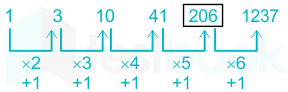
1, 3, 10, 41, ?, 1237

  1. AOption (a)

    210

  2. BOption (b)

    202

  3. COption (c)

    206

  4. DOption (d)

    200

View answer & explanation

Correct answer

Answer: (c)C.

206

Why this answer is correct

The logic followed here is:

Hence, "Option 3" is the correct answer.

Question 4

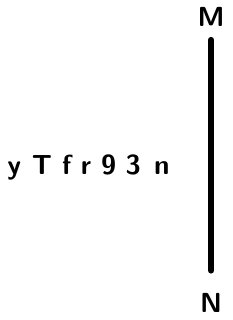
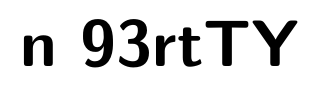
Select the correct mirror image of the given figure when the mirror is placed at MN as shown below.

MN

  1. AOption (a)

  2. BOption (b)

  3. COption (c)

  4. DOption (d)

View answer & explanation

Correct answer

Answer: (a)A.

Why this answer is correct

The mirror image of the given figure is as follow:


Hence, the correct answer is "Option 1".

Question 5

Select the option that is related to the fifth letter-cluster in the same way as the second letter-cluster is related to the first letter-cluster and the fourth letter-cluster is related to the third letter-cluster.

MEK: NVP:: GYT: TBG:: JWH:?

  1. AOption (a)

    QDS

  2. BOption (b)

    QDT

  3. COption (c)

    PCR

  4. DOption (d)

    PCS

View answer & explanation

Correct answer

Answer: (a)A.

QDS

Why this answer is correct

The logic followed here is:

MEK: NVP

And,

GYT: TBG

Similarly,

JWH:?

Hence, "Option 1" is the correct answer.
Question 6

Select the option that represents the letters that when placed from left to right in the blanks below will complete the letter series

L_P_QS_K_P_S_KP_Q_L_ _PQS

  1. AOption (a)

    KPLPQLPSKP

  2. BOption (b)

    KPLPLQLSPK

  3. COption (c)

    KPLPQQLPSK

  4. DOption (d)

    PKLPQPLSKP

View answer & explanation

Correct answer

Answer: (a)A.

KPLPQLPSKP

Why this answer is correct

Given series: L_P_QS_K_P_S_KP_Q_L_ _PQS

Option 1) KPLPQLPSKP→ LKPPQSLKPPQSLKPPQSLK PPQS → (It follows the pattern of: LKPPQS - LKPPQS - LKPPQS - LKPPQS)

Option 2) KPLPLQLSPK → LKPPQSLKPPLSQKPLQSLP KPQS → (It doesn't follow any pattern)

Option 3) KPLPQQLPSK → LKPPQSLKPPQSQKPLQPLS KPQS → (It doesn't follow any pattern)

Option 4) PKLPQPLSKP → LPPKQSLKPPQSPKPLQSLK PPQS → (It doesn't follow any pattern)

Hence, "Option 1" is the correct answer.
Question 7

What will come in the place of ‘?’ in the following equation, if ‘+’ and ‘–‘ are interchanged and ‘x’ and ‘÷’ are interchanged?

5 – 4 ÷ 9 + 80 x 10 = ?

  1. AOption (a)

    33

  2. BOption (b)

    30

  3. COption (c)

    35

  4. DOption (d)

    31

View answer & explanation

Correct answer

Answer: (a)A.

33

Why this answer is correct

Given: 5 – 4 ÷ 9 + 80 x 10 = ?

According to the question, after ‘+’ and ‘–‘ are interchanged and ‘x’ and ‘÷’ are interchanged:

5 – 4 ÷ 9 + 80 x 10 = ? ⇒ 5 + 4 x 9 – 80 ÷ 10 = ?

⇒ 5 + 4 x 9 – 80 ÷ 10 = ?

⇒ 5 + 4 x 9 – 8 = ?

⇒ 5 + 36 – 8 = ?

⇒ 41 – 8 = ?

⇒ 33 = ?

Hence, "Option 1" is the correct answer.

Question 8

The position of how many letters will remain unchanged if each of the letters in the word 'NIGHTMARES' is re-arranged in the English alphabetical order from left to right?

  1. AOption (a)

    One

  2. BOption (b)

    Three

  3. COption (c)

    Two

  4. DOption (d)

    Four

View answer & explanation

Correct answer

Answer: (d)D.

Four

Why this answer is correct

The logic followed here is:

Given word: NIGHTMARES

Thus, Four letters will remain unchanged if each of the letters in the word 'NIGHTMARES' is re-arranged in the English alphabetical order from left to right.

Hence, the correct answer is "Four".

Question 9

Identify the option figure that when put in place of the question mark (?) will logically complete the series.

  1. AOption (a)

  2. BOption (b)

  3. COption (c)

  4. DOption (d)

View answer & explanation

Correct answer

Answer: (a)A.

Why this answer is correct

The logic followed here is:

  1. All the elements shift anticlockwise including the center element.

Hence, "Option 1" is the correct answer.

Question 10

Which of the following terms will replace the question mark (?) in the given series?

YZUW, ?, QTQU, MQOT, INMS

  1. AOption (a)

    UWSV

  2. BOption (b)

    WUSV

  3. COption (c)

    UWVS

  4. DOption (d)

    USWV

View answer & explanation

Correct answer

Answer: (a)A.

UWSV

Why this answer is correct

The logic followed here is:

Hence, "Option 1" is the correct answer.

Question 11

Three statements are given followed by three conclusions numbered I, II and III. Assuming the statements to be true, even if they seem to be at variance with commonly known facts, decide which of the conclusions logically follow(s) from the statements.

Statements:

Some tears are drops.

Some drops are streams.

All streams are rivers.

Conclusions:

I. All tears can never be rivers.

II. Some drops are rivers.

III. All tears being streams is a possibility.

  1. AOption (a)

    Both I and II conclusion follow

  2. BOption (b)

    Only conclusion I follows

  3. COption (c)

    Only conclusion III follows

  4. DOption (d)

    Both II and III conclusion follow

View answer & explanation

Correct answer

Answer: (d)D.

Both II and III conclusion follow

Why this answer is correct

The least possible Venn diagram for the given statements is as shown below :

Conclusions:

I. All tears can never be rivers → Does not follow (As some tears are drops, some drops are streams and all streams are rivers. As no direct relation is given between tears and rivers, therefore it is false.)

II. Some drops are rivers → Follow (As some drops are streams and all streams are rivers. As whole streams comes in rivers and has some part common with drops, therefore it is true.)

III. All tears being streams is a possibility → Follow (As some tears are drops, some drops are streams. As no statements restricts tears from being streams, therefore it is possible.)

∴ Here, Both II and III conclusion follow.

Hence, "Option 4" is the correct answer.

Question 12

Select the correct mirror image of the given figure when the mirror is placed at MN as shown.

  1. AOption (a)

  2. BOption (b)

  3. COption (c)

  4. DOption (d)

View answer & explanation

Correct answer

Answer: (c)C.

Why this answer is correct

The mirror image of the given figure is as follow:

Hence,  the correct answer is "option 3".

Question 13

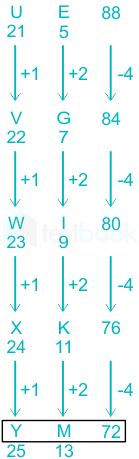
Which of the four options will replace the question mark (?) in the following series?

UE 88, VG 84, WI 80, XK76, ?

  1. AOption (a)

    YN73

  2. BOption (b)

    YM72

  3. COption (c)

    ZN71

  4. DOption (d)

    ZM72

View answer & explanation

Correct answer

Answer: (b)B.

YM72

Why this answer is correct

The logic followed here is:

Hence, "Option 2" is the correct answer.

Question 14

In a certain code language, 'NAME' is written as 'FNBO' and 'NANO' is written as 'POBO'. How will 'NAIL' be written in that language?

  1. AOption (a)

    MJOB

  2. BOption (b)

    MJBO

  3. COption (c)

    MOJB

  4. DOption (d)

    MOBJ

View answer & explanation

Correct answer

Answer: (b)B.

MJBO

Why this answer is correct

The logic followed here is:

'NAME' is written as 'FNBO'

And,

'NANO' is written as 'POBO'

Similarly,

'NAIL' will be written as

Hence, "Option 2" is the correct answer.

Question 15

Six letters Q, Z, V, T, L and A are written on different faces of a dice. Two positions of this dice are shown in the figures below. Find the letter on the face opposite to Q.

  1. AOption (a)

    T

  2. BOption (b)

    V

  3. COption (c)

    Z

  4. DOption (d)

    A

View answer & explanation

Correct answer

Answer: (a)A.

T

Why this answer is correct

The logic followed here is :-

From the given two different cubes the adjacent sides are as shown below :

As V is common on both the dices, it is clear that Q, Z, T, and L are adjacent to it, and the remaining i.e. A will be opposite to it.

Opposite pairs:

Z → L

Q → T

V → A

So, the opposite side of "Q" will be side "T".

Hence, the correct answer is "Option 1".

Question 16

In the following number-pairs, the second number is obtained by applying certain mathematical operations to the first number. In three of the four pairs, the same pattern is applied and hence they form a group. Select the number-pair that DOES NOT belong to this group.

(NOTE: Operations should be performed on the whole numbers, without breaking down the numbers into their constituent digits. E.g. 13 – Operations on 13 such as adding/subtracting/multiplying to 13 can be performed. Breaking down 13 into 1 and 3 and then performing mathematical operations on 1 and 3 is not allowed.)

  1. AOption (a)

    335 - 119

  2. BOption (b)

    358 - 152

  3. COption (c)

    317 - 101

  4. DOption (d)

    308 - 92

View answer & explanation

Correct answer

Answer: (b)B.

358 - 152

Why this answer is correct

The logic followed here is:

Option 1) 335 - 119

335 - 119 = 216

216 = 216 (LHS = RHS)

Option 2) 358 - 152

358 - 152 = 206

206 ≠ 216 (LHS ≠ RHS)

Option 3) 317 - 101

317 - 101 = 216

216 = 216 (LHS = RHS)

Option 4) 308 - 92

308 - 92 = 216

216 = 216 (LHS = RHS)

Thus, out of all the options, '358 - 152' is the odd one out.

Hence, "Option 2" is the correct answer.

Question 17

19 is related to 209 following a certain logic. Following the same logic, 27 is related to 297. To which of the following is 61 related, following the same logic?

(NOTE: Operations should be performed on the whole numbers, without breaking down the numbers into its constituent digits. E.g., 13 – Operations on 13 such as adding/deleting/multiplying etc. to 13 can be performed. Breaking down 13 into 1 and 3 and then performing mathematical operations on 1 and 3 is not allowed)

  1. AOption (a)

    653

  2. BOption (b)

    671

  3. COption (c)

    571

  4. DOption (d)

    600

View answer & explanation

Correct answer

Answer: (b)B.

671

Why this answer is correct

The logic followed here is: Multiply the number by 11.

19 is related to 209 → 19 × 11 = 209

27 is related to 297 → 27 × 11 = 297

Similarly, 61 is related: → 61 × 11 = 671

Hence, the correct answer is "671".

Question 18

Identify the figure from the given options, which when put in place of the question mark (?), will logically complete the series.

  1. AOption (a)

  2. BOption (b)

  3. COption (c)

  4. DOption (d)

View answer & explanation

Correct answer

Answer: (b)B.

Why this answer is correct

The logic followed here is:

  1. All the elements shift clockwise including the center element.

Thus, the final series is:

Hence, "Option 2" is the correct answer.

Question 19

What will come in place of the question mark (?) in the following equation, if '+' and '−' are interchanged and '×' and '÷' are interchanged?

4515 × 5 − 431 ÷ 3 + 821 = ?

  1. AOption (a)

    1575

  2. BOption (b)

    1335

  3. COption (c)

    1375

  4. DOption (d)

    1775

View answer & explanation

Correct answer

Answer: (c)C.

1375

Why this answer is correct

Given: 4515 × 5 − 431 ÷ 3 + 821 = ?

According to the question, after ‘+’ and ‘–‘ are interchanged and ‘x’ and ‘÷’ are interchanged:

4515 × 5 − 431 ÷ 3 + 821 = ? ⇒ 4515 ÷ 5 + 431 × 3 – 821 = ?

⇒ 4515 ÷ 5 + 431 × 3 – 821 = ?

⇒ 903 + 431 × 3 – 821 = ?

⇒ 903 + 1293 – 821 = ?

⇒ 2196 – 821 = ?

⇒ 1375 = ?

Hence, "Option 3" is the correct answer.

Question 20

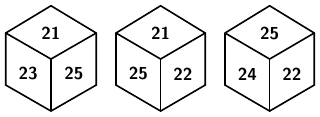
Six numbers 21, 22, 23, 24, 25 and 26 are written on different faces of a dice. Three positions of this dice are shown in the figure. Find the number on the face opposite to 24.

  1. AOption (a)

    22

  2. BOption (b)

    21

  3. COption (c)

    26

  4. DOption (d)

    25

View answer & explanation

Correct answer

Answer: (b)B.

21

Why this answer is correct

The logic followed here is :-

From the given three different cubes the adjacent sides are as shown below :

As 25 is common on both the dices I and III, it is clear that 21, 23, 22, and 24 are adjacent to it, and the remaining i.e. 26 will be opposite to it.

Opposite pairs:

23 → 22

21 → 24

25 → 26

So, the opposite side of "24" will be side "21".

Hence, the correct answer is "Option 2".

Question 21

31 is related to 152 by certain logic. Following the same logic, 47 is related to 168. To which of the following is 66 related, following the same logic? (NOTE: Operations should be performed on the whole numbers, without breaking down the numbers into its constituent digits. E.g. 13 – Operations on 13 such as adding/deleting/multiplying etc., to 13 can be performed. Breaking down 13 into 1 and 3 and then performing mathematical operations on 1 and 3 is not allowed.)

  1. AOption (a)

    180

  2. BOption (b)

    190

  3. COption (c)

    185

  4. DOption (d)

    187

View answer & explanation

Correct answer

Answer: (d)D.

187

Why this answer is correct

The logic followed here is: The difference between the numbers in both pairs is 121.

First, let's find the difference between the numbers in each pair:

For the pair 31 and 152:

152 − 31 = 121

For the pair 47 and 168:

168 − 47 = 121

Now, we need to find the number that is related to 66 following the same logic. We do this by adding 121 to 66:

66 + 121 = 187

Thus, the number that is related to 66 is 187.

Hence, the correct answer is "187".

Question 22

Select the option in which the numbers share the same relationship as that shared by the given pair of numbers.

(149, 213)

(168, 232)

(NOTE: Operations should be performed on the whole numbers, without breaking down the numbers into its constituent digits. E.g., 13 – Operations on 13 such as adding/deleting/multiplying etc. to 13 can be performed. Breaking down 13 into 1 and 3 and then performing mathematical operations on 1 and 3 is not allowed.)

  1. AOption (a)

    (162, 222)

  2. BOption (b)

    (137, 211)

  3. COption (c)

    (153, 217)

  4. DOption (d)

    (144, 198)

View answer & explanation

Correct answer

Answer: (c)C.

(153, 217)

Why this answer is correct

The logic followed here is: 2nd number - 1st number = 64.

(149, 213) → 213 - 149 = 64

(168, 232) → 232 - 168 = 64,

Let's check options one by one.

Option 1)  (162, 222) → 222 - 162 = 60 ≠ 64

Option 2)  (137, 211) → 211 - 137 = 74 ≠ 64

Option 3) (153, 217) → 217 - 153 = 64

Option 4)  (144, 198) → 198 - 144 = 54 ≠ 64

Hence, the correct answer is "(153, 217)".

Question 23

The question contains pairs of words that are related to each other in a certain way. Three of the following four word pairs are alike as these have the same relationship and thus form a group. Which word pair is the one that DOES NOT belong to that group?

(The words must be considered as meaningful English words and must not be related to each other based on the number of letters/number of consonants/vowels in the word.)

  1. AOption (a)

    Triangle - 3 sides

  2. BOption (b)

    Pentagon - 5 sides

  3. COption (c)

    Square - 4 sides

  4. DOption (d)

    Hexagon - 8 sides

View answer & explanation

Correct answer

Answer: (d)D.

Hexagon - 8 sides

Why this answer is correct

The logic followed here is: Each of the other word pairs correctly matches a polygon with the number of its sides.

  • Triangle has 3 sides
  • Pentagon has 5 sides
  • Square has 4 sides

Whenever, a Hexagon has 6 sides, not 8.

Therefore, "Hexagon - 8 sides" is the word pair that does not belong to the group.

Hence, the correct answer is "Hexagon - 8 sides".

Question 24

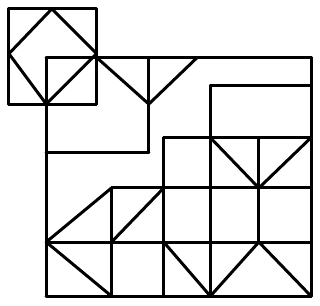
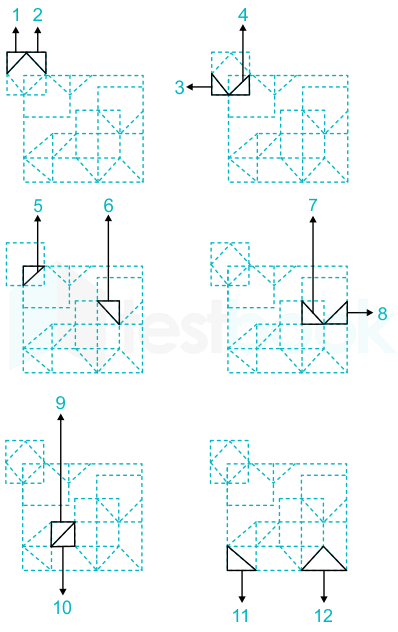
How many triangles are there in the given figure?

  1. AOption (a)

    21

  2. BOption (b)

    20

  3. COption (c)

    19

  4. DOption (d)

    18

View answer & explanation

Correct answer

Answer: (a)A.

21

Why this answer is correct

The number of triangles in the given figure is shown below:

1) Total triangles = [Number of parts × (1 + Number of parts)] ÷ 2

= [2 × (1 + 2)] ÷ 2

= [2 × 3] ÷ 2

= 6 ÷ 2

= 3

As there are 3 same types of triangles, therefore total number of triangles will be (3 × 3) = 9 

  1. As marked there are total 12 triangles.

Thus, there are total (9 + 12) = 21 triangles.

Hence, "Option 1" is the correct answer.
Question 25

In a certain code language,

'A + B' means 'A is the mother of B',

'A - B' means 'A is the father of B',

'A $ B' means 'A is the son of B',

'A % B' means 'A is the sister of B',

'A / B' means 'A is the wife of B' and

'A = B' means 'A is the brother of B'.

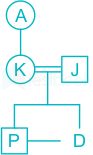
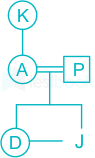
Which of the following means A is the daughter of K?

i. A + K / J - P = D

ii. J % P = K + A = D

iii. K + A / P - D % J

iv. D + K = A / P – J$

  1. AOption (a)

    ii

  2. BOption (b)

    i

  3. COption (c)

    iii

  4. DOption (d)

    iv

View answer & explanation

Correct answer

Answer: (c)C.

iii

Why this answer is correct

Decoding symbols:

A is
Symbol+-$%/=
MeaningMotherFatherSonSisterWifeBrother
to B

So,

i. A + K / J - P = D → A is mother of K who is the wife of J who is the father of P who is the brother of D.

Here, A is the mother of K.

ii. J % P = K + A = D → J is sister of P who is the brother of K who is the mother of A who is the brother of D.

Here, A is the son of k.

iii. K + A / P - D % J → K is mother of A who is the wife of P who is the father of D who is the sister of J.

Here, A is the daughter of K.

iv. D + K = A / P – J → D is mother of K who is the brother of A who is the wife of P who is the father of J.

Here, A is the sister of K.

Hence, the correct answer is "Option 3"$

General Awareness (25 questions)

Question 26

Which of the following awards was won by Lata Mangeshkar in the year 2001?

  1. AOption (a)

    Filmfare Lifetime Achievement Award

  2. BOption (b)

    Padma Vibhushan

  3. COption (c)

    Dadasaheb Phalke Award

  4. DOption (d)

    Bharat Ratna

View answer & explanation

Correct answer

Answer: (d)D.

Bharat Ratna

Why this answer is correct

The correct answer is Bharat Ratna.

Key Points

  • Lata Mangeshkar is one of the most renowned playback singers in India, known for her melodious voice and a vast repertoire of songs in various Indian languages.
  • She was awarded the Bharat Ratna, India's highest civilian award, in the year 2001 for her exceptional contribution to Indian music and arts.
  • The Bharat Ratna is awarded in recognition of exceptional service/performance of the highest order in any field of human endeavour.
  • Lata Mangeshkar is often referred to as the Swar Kokila for her contribution to Indian music over several decades.

Additional Information

  • Filmfare Lifetime Achievement Award
  • This award is presented by Filmfare as part of its annual Filmfare Awards for Hindi films.
  • It is given to individuals for their outstanding contribution to the Indian film industry over their lifetime.
  • Lata Mangeshkar received this award in 1993.
  • Padma Vibhushan
  • It is the second-highest civilian award in India, given for exceptional and distinguished service.
  • Lata Mangeshkar was honored with the Padma Vibhushan in 1999.
  • Dadasaheb Phalke Award
  • This is India's highest award in cinema, presented annually at the National Film Awards ceremony by the Directorate of Film Festivals.
  • Lata Mangeshkar received the Dadasaheb Phalke Award in 1989 for her outstanding contribution to the growth and development of Indian cinema.
  • Bharat Ratna
  • The Bharat Ratna is the highest civilian award of India, instituted in 1954.
  • It is conferred for exceptional service/performance of the highest order in any field of human endeavour.
  • The award does not carry any monetary grant or pension but is a recognition of the highest degree of service to the nation.
  • Lata Mangeshkar received the Bharat Ratna in 2001.

Question 27

Which article has a similar provision to that of Article 32 and deals with writ jurisdiction?

  1. AOption (a)

    Article 227

  2. BOption (b)

    Article 228

  3. COption (c)

    Article 225

  4. DOption (d)

    Article 226

View answer & explanation

Correct answer

Answer: (d)D.

Article 226

Why this answer is correct

The correct answer is Article 226.

Key Points

  • Article 226 of the Indian Constitution empowers the High Courts to issue certain writs.
  • This Article extends the writ jurisdiction to all cases where a fundamental right is violated, as well as other legal rights.
  • Article 226 can be invoked not only for the enforcement of fundamental rights but also for any other purpose.
  • The power conferred by Article 226 is wider in scope as compared to Article 32, which is restricted to the enforcement of Fundamental Rights only.

Additional Information

  • Article 32
  • Article 32 of the Indian Constitution provides the right to constitutional remedies, allowing individuals to move the Supreme Court directly in case of violation of fundamental rights.
  • It is known as the "heart and soul" of the Constitution as described by Dr. B.R. Ambedkar.
  • The Supreme Court can issue writs like habeas corpus, mandamus, prohibition, quo warranto, and certiorari for the enforcement of fundamental rights.
  • This Article is a crucial provision for the protection of Fundamental Rights in India.
  • Writs
  • A writ is a formal written order issued by a court.
  • Types of writs include habeas corpus (to produce the body), mandamus (to command), prohibition (to forbid), quo warranto (by what authority), and certiorari (to be informed).
  • These writs are powerful tools in the hands of the judiciary to ensure the protection of rights and to enforce public duties.
  • High Courts
  • High Courts are the principal civil courts of original jurisdiction in each state and union territory.
  • They also have appellate jurisdiction over the subordinate courts.
  • High Courts have the power to issue writs under Article 226 for the enforcement of fundamental rights and for other purposes.
  • Their jurisdiction is broader compared to the Supreme Court in terms of issuing writs.

Question 28

Who among the following formed the Bihar Provincial Kisan Sabha in 1929?

  1. AOption (a)

    Kunwar Singh

  2. BOption (b)

    JM Sengupta

  3. COption (c)

    Jayaprakash Narayan

  4. DOption (d)

    Swami Sahajanand Saraswati

View answer & explanation

Correct answer

Answer: (d)D.

Swami Sahajanand Saraswati

Why this answer is correct

The correct answer is Swami Sahajanand Saraswati.

Key Points

  • Swami Sahajanand Saraswati was a prominent peasant leader in India and was deeply involved in the peasant movement.
  • He founded the Bihar Provincial Kisan Sabha (BPKS) in 1929 to address the issues of peasants and farmers in Bihar.
  • The BPKS played a crucial role in mobilizing peasants against the zamindari system and for the rights of tenant farmers.
  • Swami Sahajanand Saraswati later became the president of the All India Kisan Sabha, a nationwide peasant organization, further amplifying his influence in the peasant movement in India.

Additional Information

  • Peasant Movement in India:
  • The peasant movement in India was a series of political movements for the rights of the agricultural workers and against the feudal land system.
  • These movements were significant in shaping the agrarian policies of the country and addressing issues like land reforms, tenancy rights, and fair wages.
  • Zamindari System:
  • The Zamindari system was a traditional land revenue system in India where landlords or zamindars collected rent from the peasants and paid a portion to the British colonial government.
  • This system led to the exploitation of peasants, high rents, and forced labor, causing widespread agrarian distress.
  • All India Kisan Sabha (AIKS):
  • The AIKS was formed in 1936 as a national organization to address the issues faced by peasants across India.
  • It worked towards the abolition of the zamindari system, fair land distribution, and better living conditions for agricultural workers.
  • Swami Sahajanand Saraswati's Contributions:
  • He was a key figure in the peasant movement and worked tirelessly for the upliftment of the agrarian community.
  • His efforts led to significant reforms in the agrarian sector, and he is remembered as a champion of peasant rights in India.

Question 29

Who founded the Prarthana Samaj in Mumbai in 1867?

  1. AOption (a)

    Atmaram Pandurang

  2. BOption (b)

    Gopal Krishna Gokhale

  3. COption (c)

    Shri Ram Bajpai

  4. DOption (d)

    Ram Mohan Roy

View answer & explanation

Correct answer

Answer: (a)A.

Atmaram Pandurang

Why this answer is correct

The correct answer is Atmaram Pandurang.

Key Points

  • Atmaram Pandurang was a social reformer and the founder of the Prarthana Samaj in Mumbai in 1867.
  • The Prarthana Samaj was a movement for religious and social reform in Maharashtra based on earlier reform movements.
  • The organization aimed to make people believe in one God and discard the caste system and superstitions.
  • Atmaram Pandurang's efforts were directed towards promoting women's education and widow remarriage and opposing child marriage.

Additional Information

  • Prarthana Samaj
  • Prarthana Samaj was inspired by the Brahmo Samaj founded by Raja Ram Mohan Roy in Bengal.
  • It was established by Atmaram Pandurang in 1867 to reform the social practices and religious beliefs of the Hindus in Maharashtra.
  • The Samaj's principles were based on the teachings of Christianity and the ancient Hindu scriptures, advocating monotheism and discarding idol worship.
  • Prominent members of the Prarthana Samaj included Justice Mahadev Govind Ranade, R.G. Bhandarkar, and N.G. Chandavarkar, who played significant roles in the social reform movements in Maharashtra.
  • Brahmo Samaj
  • Founded by Raja Ram Mohan Roy in 1828 in Kolkata, Brahmo Samaj was one of the earliest reform movements in India.
  • The Samaj aimed at purifying Hinduism and promoting monotheism, rejecting the caste system, idol worship, and rituals.
  • It played a crucial role in the abolition of the practice of Sati and child marriage, and the promotion of widow remarriage and women's education.
  • Raja Ram Mohan Roy is often called the "Father of Modern India" due to his efforts to modernize Indian society.
  • Social Reform Movements in India
  • During the 19th and early 20th centuries, India witnessed several social reform movements aimed at addressing social issues like caste discrimination, gender inequality, and religious superstitions.
  • Prominent social reformers included Raja Ram Mohan Roy, Ishwar Chandra Vidyasagar, Jyotirao Phule, and Swami Vivekananda.
  • These movements played a significant role in shaping modern Indian society by advocating for education, women's rights, and social equality.
  • The reforms laid the groundwork for India's struggle for independence and the subsequent formation of a democratic and secular nation.

Question 30

Who among the following has authored the play 'Nil Darpan'?

  1. AOption (a)

    Motilal Nehru

  2. BOption (b)

    Chittaranjan Das

  3. COption (c)

    Dinabandhu Mitra

  4. DOption (d)

    Sarojini Naidu

View answer & explanation

Correct answer

Answer: (c)C.

Dinabandhu Mitra

Why this answer is correct

The correct answer is Dinabandhu Mitra.

Key Points

  • Dinabandhu Mitra was a notable Bengali dramatist of the 19th century.
  • He wrote the play 'Nil Darpan' in 1860-61, which portrays the plight of indigo farmers under British rule in Bengal.
  • 'Nil Darpan' is considered a significant work in Bengali literature and played a crucial role in the Indigo revolt of 1859-60.
  • The play was translated into English by Reverend James Long, which led to his imprisonment and fine due to its anti-British sentiments.

Additional Information

  • Indigo Rebellion:
  • The Indigo Rebellion (or Indigo Revolt) was a peasant movement and subsequent uprising against indigo planters in Bengal in 1859-60.
  • Indigo farmers were forced to grow indigo under oppressive conditions and received meager payment.
  • The rebellion highlighted the exploitation by British planters and led to reforms in the indigo cultivation practices.
  • Bengali Literature:
  • Bengali literature is one of the richest literary traditions in the Indian subcontinent, with works dating back to the 10th century.
  • It encompasses a wide range of genres, including poetry, drama, novels, short stories, and essays.
  • Notable figures in Bengali literature include Rabindranath Tagore, Bankim Chandra Chattopadhyay, and Sarat Chandra Chattopadhyay.
  • British Colonial Rule in India:
  • British colonial rule in India lasted from 1858 to 1947, following the transfer of power from the East India Company to the British Crown after the Revolt of 1857.
  • During this period, India was subjected to economic exploitation, cultural changes, and political reorganization.
  • Significant events during British rule include the establishment of the Indian National Congress, the Partition of Bengal, and the struggle for Indian independence led by figures like Mahatma Gandhi, Jawaharlal Nehru, and Subhas Chandra Bose.

Question 31

Which of the following is a correct order of basicity?

  1. AOption (a)

    LiOH>NaOH>KOH>CsOH

  2. BOption (b)

    LiOH>KOH>CsOH>NaOH

  3. COption (c)

    KOH>CsOH>NaOH>LiOH

  4. DOption (d)

    CsOH>KOH>NaOH>LiOH

View answer & explanation

Correct answer

Answer: (d)D.

CsOH>KOH>NaOH>LiOH

Why this answer is correct

The correct answer is CsOH > KOH > NaOH > LiOH.

Key Points

  • The basicity of alkali metal hydroxides increases as we move down the group in the periodic table.
  • This is because the ionic nature and size of the cation increase as we move down the group.
  • CsOH is the most basic among the given hydroxides because cesium is at the bottom of the alkali metal group.
  • LiOH is the least basic because lithium is at the top of the alkali metal group.

Additional Information

  • Basicity:
  • Basicity refers to the ability of a substance to accept protons (H+ ions) or donate a pair of valence electrons to form a bond.
  • In the context of alkali metal hydroxides, basicity is determined by the extent to which the hydroxide ion (OH-) is available to react with acids.
  • Alkali Metal Hydroxides:
  • Alkali metal hydroxides are compounds formed by alkali metals (Group 1 elements) and hydroxide ions (OH-).
  • Examples include LiOH (Lithium Hydroxide), NaOH (Sodium Hydroxide), KOH (Potassium Hydroxide), and CsOH (Cesium Hydroxide).
  • These hydroxides are strong bases and are highly soluble in water.
  • Periodic Table Trends:
  • As we move down Group 1 in the periodic table, the size of the alkali metal cations increases.
  • This leads to a decrease in the lattice energy of the hydroxides, making them more soluble and hence more basic.
  • Ionic Nature:
  • The ionic nature of a compound refers to the extent to which it dissociates into ions in a solution.
  • Alkali metal hydroxides dissociate completely in water, releasing hydroxide ions, which contribute to their basicity.

Question 32

Mahendravarman I was the ruler of which of the following dynasties?

  1. AOption (a)

    Pandya

  2. BOption (b)

    Chola

  3. COption (c)

    Chalukya

  4. DOption (d)

    Pallava

View answer & explanation

Correct answer

Answer: (d)D.

Pallava

Why this answer is correct

The correct answer is Pallava.

Key Points

  • Mahendravarman I was a ruler of the Pallava dynasty in South India.
  • He reigned from 600–630 CE and was known for his patronage of the arts and architecture.
  • Mahendravarman I was succeeded by his son Narasimhavarman I, who continued the expansion of the Pallava dynasty.
  • Under Mahendravarman I, the Pallavas saw significant cultural and architectural advancements, including the construction of rock-cut temples.

Additional Information

  • Pallava Dynasty:
  • The Pallava dynasty was a South Indian dynasty that existed from 275 CE to 897 CE, ruling regions of present-day Tamil Nadu, Andhra Pradesh, and Karnataka.
  • The Pallavas were known for their contributions to Indian art and architecture, especially during the reigns of Mahendravarman I and Narasimhavarman I.
  • They played a significant role in the transition from rock-cut architecture to stone temples.
  • The Shore Temple at Mahabalipuram, built by Narasimhavarman II, is a UNESCO World Heritage site and an excellent example of Pallava architecture.
  • Mahendravarman I:
  • Mahendravarman I was a prominent ruler of the Pallava dynasty, known for his military and architectural achievements.
  • He converted from Jainism to Shaivism and promoted the construction of Hindu temples.
  • His reign marked the beginning of the Pallava expansion in South India, establishing their dominance in the region.
  • He is credited with the construction of several rock-cut temples, including the famous rock-cut cave temples in Mahabalipuram.
  • Chola Dynasty:
  • The Chola dynasty was another prominent South Indian dynasty that ruled from the 9th to the 13th century CE.
  • They are known for their naval prowess, extensive trade, and contributions to Tamil literature, art, and architecture.
  • Raja Raja Chola I and his son Rajendra Chola I were notable rulers who expanded the Chola empire significantly.
  • The Brihadeeswarar Temple in Thanjavur is one of the greatest architectural achievements of the Chola dynasty.
  • Pandya Dynasty:
  • The Pandya dynasty was an ancient Tamil dynasty that ruled parts of South India, primarily the region of present-day Tamil Nadu.
  • They were known for their contributions to Tamil literature and their support of the Tamil Sangam, an assembly of poets and scholars.
  • The Pandyas were also famous for their pearl fisheries along the southern coast.
  • Madurai was the capital of the Pandya kingdom and a significant cultural and religious center.

Question 33

In which city was the first golf club of India situated?

  1. AOption (a)

    Shimla

  2. BOption (b)

    Gulmarg

  3. COption (c)

    Mysore

  4. DOption (d)

    Kolkata

View answer & explanation

Correct answer

Answer: (d)D.

Kolkata

Why this answer is correct

The correct answer is Kolkata.

Key Points

  • The first golf club in India, the Royal Calcutta Golf Club, was established in Kolkata in 1829.
  • The Royal Calcutta Golf Club is also the oldest golf club outside the British Isles.
  • It was initially started to serve the British community in India during the British colonial period.
  • The club has a rich history and has hosted numerous prestigious golf tournaments over the years.

Additional Information

  • Golf in India
  • Golf was introduced to India during the British colonial period and has grown in popularity since then.
  • India has produced several notable golfers, including Jeev Milkha Singh, Anirban Lahiri, and Aditi Ashok.
  • Numerous golf courses have been established across the country, catering to both amateur and professional golfers.
  • The Indian Golf Union (IGU) is the governing body for golf in India, responsible for promoting and developing the sport.
  • The Royal Calcutta Golf Club
  • Founded in 1829, the Royal Calcutta Golf Club is located in the Tollygunge area of Kolkata.
  • The club's course is known for its challenging layout and beautiful surroundings.
  • It has hosted many national and international golf tournaments, making it a significant venue in the golfing world.
  • The club offers various facilities and amenities for its members, including a clubhouse, dining options, and recreational activities.

Question 34

What challenge does foreign investment often face in India?

  1. AOption (a)

    Excessive foreign competition

  2. BOption (b)

    Inconsistent regulatory environment

  3. COption (c)

    Lack of skilled labour

  4. DOption (d)

    Lack of consumer base

View answer & explanation

Correct answer

Answer: (b)B.

Inconsistent regulatory environment

Why this answer is correct

The correct answer is Inconsistent regulatory environment.

Key Points

  • The regulatory environment in India is often perceived as inconsistent and subject to frequent changes, making it difficult for foreign investors to plan long-term investments.
  • Issues such as complex tax laws, bureaucratic red tape, and sudden changes in policies can create uncertainty for foreign businesses.
  • The lack of a unified regulatory framework across different states in India further complicates the investment landscape for foreign companies.
  • Foreign investors may face challenges related to compliance with diverse and sometimes conflicting regulations at the central and state levels.

Additional Information

  • Foreign Direct Investment (FDI)
  • FDI refers to investments made by a company or individual in one country into business interests located in another country.
  • This type of investment generally involves a significant degree of control and influence over the foreign business.
  • FDI can provide a number of benefits to the host country, including capital inflow, technology transfer, and job creation.
  • Regulatory Environment
  • The regulatory environment encompasses the laws, regulations, and policies that govern business operations in a country.
  • A stable and predictable regulatory environment is crucial for attracting and retaining foreign investment.
  • Key regulatory aspects include taxation, labor laws, environmental regulations, and business registration processes.
  • Bureaucratic Red Tape
  • Bureaucratic red tape refers to the excessive and often unnecessary regulations and procedures that can hinder business operations.
  • It can include lengthy approval processes, complex documentation requirements, and inefficient administrative procedures.
  • Reducing bureaucratic red tape is important for creating a more business-friendly environment and encouraging investment.
  • Policy Stability
  • Policy stability refers to the consistency and predictability of government policies over time.
  • Frequent changes in policies can create uncertainty and risk for investors, making it difficult to plan and execute long-term investments.
  • Ensuring policy stability is important for building investor confidence and attracting foreign investment.

Question 35

Mohan Veena player, Pandit Vishwa Mohan Bhatt won the __________ Award in the year 1994.

  1. AOption (a)

    Sangita Kalanidhi

  2. BOption (b)

    Oscar

  3. COption (c)

    Grammy

  4. DOption (d)

    Sangeet Natak Akademi

View answer & explanation

Correct answer

Answer: (c)C.

Grammy

Why this answer is correct

The correct answer is Grammy.

Key Points

  • Pandit Vishwa Mohan Bhatt is an Indian classical musician who plays the Mohan Veena, a modified slide guitar.
  • He won the Grammy Award in 1994 for his album "A Meeting by the River" in collaboration with Ry Cooder.
  • The Grammy Awards are presented by the Recording Academy to recognize achievements in the music industry.
  • Pandit Vishwa Mohan Bhatt's Grammy win brought global recognition to Indian classical music and the Mohan Veena.

Additional Information

  • Grammy Awards
  • The Grammy Awards, or simply Grammys, are awards presented by the Recording Academy to recognize outstanding achievements in the music industry.
  • The awards were first presented in 1959, and they are considered one of the most prestigious awards in the music industry.
  • Categories include Best New Artist, Album of the Year, Record of the Year, and Song of the Year, among others.
  • The Grammy Awards ceremony is held annually, and it features performances by prominent artists, as well as the presentation of those awards that have a more popular interest.
  • Pandit Vishwa Mohan Bhatt
  • Pandit Vishwa Mohan Bhatt is a renowned Indian classical musician known for his expertise in playing the Mohan Veena.
  • The Mohan Veena is a modified version of the Hawaiian guitar, incorporating elements of the sitar and the veena to suit Indian classical music.
  • Pandit Bhatt has received numerous awards and honors for his contribution to music, including the Padma Shri and the Padma Bhushan from the Government of India.
  • His collaboration with American guitarist Ry Cooder on the album "A Meeting by the River" earned him the Grammy Award for Best World Music Album in 1994.
  • Sangeet Natak Akademi Award
  • The Sangeet Natak Akademi Award is the highest Indian recognition given to practicing artists in the field of performing arts, including music, dance, and drama.
  • It is awarded annually by the Sangeet Natak Akademi, India's National Academy of Music, Dance & Drama.
  • The award consists of a purse, a tamrapatra (a brass plaque), and a shawl.
  • Many renowned artists in India, including musicians, dancers, and theater artists, have been recipients of this prestigious award.

Question 36

Lathmar Holi is primarily celebrated in the state of:

  1. AOption (a)

    Karnataka

  2. BOption (b)

    Arunachal Pradesh

  3. COption (c)

    Uttar Pradesh

  4. DOption (d)

    Himachal Pradesh

View answer & explanation

Correct answer

Answer: (c)C.

Uttar Pradesh

Why this answer is correct

The correct answer is Uttar Pradesh.

Key Points

  • Lathmar Holi is a unique and traditional form of Holi celebration primarily observed in the towns of Barsana and Nandgaon in Uttar Pradesh.
  • This festival is celebrated a few days before the main Holi festival and involves women playfully beating men with sticks, hence the name 'Lathmar' which translates to 'beating with sticks'.
  • The celebration is rooted in the legend of Radha and Krishna, where Krishna visited Radha's village and teased her and her friends, leading to the women chasing him away with sticks.
  • The festival attracts numerous tourists and devotees who come to witness and participate in the vibrant and joyful celebrations.

Additional Information

  • Holi Festival
  • Holi, also known as the 'Festival of Colors', is an ancient Hindu festival celebrated predominantly in India and Nepal.
  • The festival signifies the victory of good over evil, the arrival of spring, and the end of winter. It also serves as a thanksgiving for a good harvest.
  • The celebrations begin with a Holika bonfire on the night before Holi, where people gather, sing, dance, and perform rituals.
  • The following day is celebrated with vibrant colors, water balloons, and traditional sweets. It is a day of festivity and joy, bringing people together to forgive and forget past grievances.
  • Radha and Krishna
  • Radha and Krishna are central figures in Hindu mythology and are considered the epitome of divine love.
  • Krishna, an incarnation of Lord Vishnu, is known for his playful and mischievous nature, while Radha symbolizes the ultimate devotee and beloved of Krishna.
  • Their love story is celebrated in various cultural and religious contexts, including dance, music, and festivals like Holi.
  • The stories of their divine love have inspired countless artistic and literary works in Indian culture.
  • Braj Region
  • Braj, also known as Brij or Braj Bhoomi, is a region in Uttar Pradesh associated with the childhood and youthful pastimes of Lord Krishna.
  • It includes important pilgrimage sites like Mathura, Vrindavan, Govardhan, Gokul, and Barsana.
  • The region is known for its rich cultural heritage, including traditional music, dance, and festivals dedicated to Krishna.
  • Braj attracts millions of devotees and tourists annually, making it a significant religious and cultural destination in India.

Question 37

When the analysis of population density is done by calculating it through net cultivated area, then the measure is termed as:

  1. AOption (a)

    Agricultural density

  2. BOption (b)

    Physiological density

  3. COption (c)

    Gross density

  4. DOption (d)

    Net density

View answer & explanation

Correct answer

Answer: (b)B.

Physiological density

Why this answer is correct

The correct answer is Physiological density.

Key Points

  • Physiological density is a measure of population density that refers to the number of people per unit area of arable land.
  • This measure provides insights into the pressure exerted by the population on the productive land area.
  • It helps in understanding the carrying capacity of the land and the potential challenges in terms of food production and resource management.
  • Physiological density is considered more meaningful than simple population density (people per total land area) because it focuses on the land that can actually support human life.

Additional Information

  • Agricultural Density
  • Agricultural density is a measure of the number of farmers per unit area of arable land.
  • This metric helps in understanding the agricultural efficiency and the potential output of the farming sector.
  • It provides insights into the level of development and technological advancement in agriculture within a region.
  • Higher agricultural density may indicate less mechanization and more labor-intensive agriculture.
  • Gross Density
  • Gross density refers to the total population divided by the total land area.
  • This measure does not differentiate between arable and non-arable land, giving an overall view of population distribution.
  • It is useful for general demographic studies and urban planning purposes.
  • However, it may not accurately reflect the actual human impact on the productive land resources.
  • Net Density
  • Net density is a less commonly used term and is not a standard measure in population geography.
  • It might refer to a refined measure of population density considering specific criteria or exclusions.
  • In most contexts, "net density" is not clearly defined or widely recognized.
  • It is important to refer to more standardized measures like physiological or agricultural density for accurate analysis.

Question 38

Which Indian among the following has his name in Time Magazine's list of '100 most influential people of 2021'?

  1. AOption (a)

    Neeraj Chopra

  2. BOption (b)

    Narendra Modi

  3. COption (c)

    Virat Kohli

  4. DOption (d)

    Amit Shah

View answer & explanation

Correct answer

Answer: (b)B.

Narendra Modi

Why this answer is correct

The correct answer is Narendra Modi.

Key Points

  • Narendra Modi has been recognized in Time Magazine's list of '100 most influential people' multiple times, including in 2021, due to his significant impact on Indian and global politics.
  • As the Prime Minister of India since 2014, Modi has implemented several major reforms and initiatives aimed at enhancing India's economic and social landscapes.
  • His notable initiatives include the Digital India campaign, Make in India, Swachh Bharat Abhiyan, and Atmanirbhar Bharat, which have been influential in shaping India's development trajectory.
  • Modi's leadership during the COVID-19 pandemic, including the rollout of the vaccination program and economic relief measures, has also been a key factor in his inclusion in the list.

Additional Information

  • Time Magazine's 100 Most Influential People
  • Time Magazine's list of the 100 most influential people is an annual ranking that recognizes the contributions and impact of various individuals across different fields.
  • The list includes leaders, innovators, artists, and icons who have made significant strides in their respective domains and have had a profound influence on the world stage.
  • Being featured in this list is considered a prestigious honor, highlighting the individual's influence and achievements on a global scale.
  • The list is divided into various categories, including leaders, pioneers, titans, artists, and icons, reflecting the diverse areas of influence and impact.
  • Narendra Modi's Major Initiatives
  • Digital India: A campaign launched to ensure the government's services are made available to citizens electronically by improving online infrastructure and increasing Internet connectivity.
  • Make in India: An initiative aimed at transforming India into a global manufacturing hub by encouraging both multinational and domestic companies to manufacture their products in India.
  • Swachh Bharat Abhiyan: A national campaign initiated to clean the streets, roads, and infrastructure of India's cities and rural areas, promoting hygiene and sanitation.
  • Atmanirbhar Bharat: A vision of making India a self-reliant nation by promoting local production and reducing dependence on imports, especially in the wake of the COVID-19 pandemic.

Question 39

Who is Union Minister of State (Independent Charge) for Science and Technology as of July 2023?

  1. AOption (a)

    Ramesh Pokhriyal

  2. BOption (b)

    Dharmendra Pradhan

  3. COption (c)

    Ashwini Vaishnaw

  4. DOption (d)

    Jitendra Singh

View answer & explanation

Correct answer

Answer: (d)D.

Jitendra Singh

Why this answer is correct

The correct answer is Jitendra Singh.

Key Points

  • Jitendra Singh is the Union Minister of State (Independent Charge) for Science and Technology as of July 2023.
  • He has been serving in this position since his appointment by the Prime Minister.
  • Jitendra Singh is also known for his roles in various other ministries, including the Ministry of Earth Sciences and the Ministry of Personnel, Public Grievances, and Pensions.
  • He has been actively involved in promoting scientific research and development in India.

Additional Information

  • Union Minister of State (Independent Charge)
  • In the Indian government, a Union Minister of State (Independent Charge) is a minister who is in charge of a ministry without an overseeing cabinet minister.
  • These ministers have the same responsibilities as cabinet ministers in their respective ministries but report directly to the Prime Minister.
  • Ministry of Science and Technology
  • This ministry is responsible for the promotion of science and technology in India.
  • It encompasses several departments, including the Department of Science and Technology (DST), the Department of Biotechnology (DBT), and the Department of Scientific and Industrial Research (DSIR).
  • The ministry aims to boost scientific research, innovation, and development in various fields such as space, biotechnology, and renewable energy.
  • Jitendra Singh
  • Jitendra Singh is an Indian politician and a member of the Bharatiya Janata Party (BJP).
  • He has held various significant positions in the government, contributing to policies and initiatives in multiple sectors.
  • He is known for his work in improving governance and administration, as well as fostering scientific advancements in the country.

Question 40

Which plateaus are very fertile because they are rich in black soil that is very good for farming?

  1. AOption (a)

    African plateau

  2. BOption (b)

    Ethiopian plateau

  3. COption (c)

    Katanga plateau

  4. DOption (d)

    Deccan lava plateau

View answer & explanation

Correct answer

Answer: (d)D.

Deccan lava plateau

Why this answer is correct

The correct answer is Deccan lava plateau.

Key Points

  • The Deccan lava plateau is known for its black soil, also called regur soil, which is ideal for growing cotton and other crops.
  • This region is one of the most fertile areas in India, making it a crucial agricultural zone.
  • The black soil in the Deccan lava plateau retains moisture, which is beneficial for farming even during dry seasons.
  • The soil is rich in essential nutrients like calcium carbonate, magnesium, potash, and lime, which support diverse agricultural activities.

Additional Information

  • Black Soil
  • Also known as regur soil, black soil is formed from volcanic rocks and lava-flow areas.
  • This type of soil is highly moisture-retentive and is rich in iron, lime, calcium, potassium, aluminum, and magnesium.
  • Black soil is predominantly found in the Deccan plateau, including parts of Maharashtra, Madhya Pradesh, Gujarat, Andhra Pradesh, and Tamil Nadu.
  • It is especially suited for growing cotton, and thus it is also called "cotton soil."
  • Deccan Plateau
  • The Deccan Plateau is a large plateau in western and southern India, covering about 500,000 square kilometers.
  • It is bounded by the Western Ghats on the west, the Eastern Ghats on the east, and the Satpura and Vindhya ranges to the north.
  • The plateau is composed of ancient crystalline, igneous, and metamorphic rocks.
  • The region experiences a semi-arid climate with distinct dry and wet seasons.
  • Fertility of Soil
  • Soil fertility refers to the ability of soil to sustain agricultural plant growth, i.e., to provide plant habitat and result in sustained and consistent yields of high quality.
  • Fertile soil contains essential nutrients for plant growth, including nitrogen, phosphorus, and potassium.
  • Other factors influencing soil fertility include soil structure, organic matter content, pH level, and moisture retention capacity.
  • In agricultural practices, soil fertility is enhanced by adding organic and inorganic fertilizers, crop rotation, and other soil management practices.

Question 41

Which of the following is NOT a condition for the President's office in India?

  1. AOption (a)

    He shall not be entitled, without payment of rent, to use his official residence.

  2. BOption (b)

    He shall not be a member of either House of the Parliament.

  3. COption (c)

    The allowances shall not be diminished during his term of office.

  4. DOption (d)

    He shall not hold any office of profit.

View answer & explanation

Correct answer

Answer: (a)A.

He shall not be entitled, without payment of rent, to use his official residence.

Why this answer is correct

The correct answer is He shall not be entitled, without payment of rent, to use his official residence..

Key Points

  • The President of India is entitled to use his official residence, Rashtrapati Bhavan, without any payment of rent.
  • According to Article 59 of the Indian Constitution, the President shall not be a member of either House of Parliament or a House of the Legislature of any State.
  • During the term of office, the President's emoluments and allowances cannot be diminished as per Article 59(3).
  • The President shall not hold any office of profit during his term as mentioned in Article 59(4).

Additional Information

  • Article 59 of the Indian Constitution
  • It outlines the conditions of the President's office in India.
  • The President shall not be a member of either House of Parliament or a House of the Legislature of any State.
  • The President shall not hold any other office of profit.
  • The President's emoluments and allowances cannot be diminished during his term of office.
  • Rashtrapati Bhavan
  • It is the official residence of the President of India.
  • Located in New Delhi, it was formerly known as the Viceroy's House.
  • Rashtrapati Bhavan includes the main building, large gardens, staff quarters, stables, and other offices.
  • Office of Profit
  • An office of profit is a position that brings financial gain, advantage, or benefit.
  • The President is not allowed to hold any office of profit to ensure independence and impartiality.

Question 42

Which of the following states is the biggest producer of Pulses?

  1. AOption (a)

    Madhya Pradesh

  2. BOption (b)

    Haryana

  3. COption (c)

    Punjab

  4. DOption (d)

    Bihar

View answer & explanation

Correct answer

Answer: (a)A.

Madhya Pradesh

Why this answer is correct

The correct answer is Madhya Pradesh.

Key Points

  • Madhya Pradesh is the largest producer of pulses in India.
  • The state contributes significantly to the total production of pulses in the country.
  • The major pulses grown in Madhya Pradesh include chickpeas (gram), pigeon peas (arhar/tur), lentils, and moong beans.
  • Madhya Pradesh has favorable climatic conditions and soil types that support the cultivation of a variety of pulses.

Additional Information

  • Pulses
  • Pulses are an important group of crops that belong to the legume family.
  • They are a rich source of protein, dietary fiber, vitamins, and minerals, making them an essential part of a balanced diet.
  • Pulses are also known for their ability to fix nitrogen in the soil, which improves soil fertility and reduces the need for chemical fertilizers.
  • Common types of pulses include chickpeas, lentils, beans, peas, and pigeon peas.
  • Agriculture in Madhya Pradesh
  • Madhya Pradesh is known as the "Heart of India" due to its geographical location.
  • The state has a diverse agro-climatic condition that supports the cultivation of a wide range of crops.
  • Apart from pulses, Madhya Pradesh is also a leading producer of wheat, soybean, and oilseeds in India.
  • The state government has implemented various agricultural schemes and policies to support farmers and enhance agricultural productivity.
  • Importance of Pulses in India
  • India is the largest producer and consumer of pulses in the world.
  • Pulses play a crucial role in ensuring food security and nutrition in the country.
  • They are a key component of the Indian diet, especially for vegetarians who rely on pulses as a primary source of protein.
  • The cultivation of pulses also contributes to sustainable agricultural practices and environmental conservation.

Question 43

__________ is an industry association and self-regulatory organisation (SRO) whose primary objective is to work towards the robust development of the microfinance sector.

  1. AOption (a)

    Self-help Group Association

  2. BOption (b)

    Microfinance Institutions Network

  3. COption (c)

    Microfinance and Investments Regulatory Authority

  4. DOption (d)

    NABARD

View answer & explanation

Correct answer

Answer: (b)B.

Microfinance Institutions Network

Why this answer is correct

The correct answer is Microfinance Institutions Network.

Key Points

  • The Microfinance Institutions Network (MFIN) is an industry association that represents the microfinance industry in India.
  • It is a self-regulatory organization (SRO) recognized by the Reserve Bank of India (RBI).
  • The primary objective of MFIN is to work towards the robust development of the microfinance sector by promoting responsible lending practices and ensuring client protection.
  • MFIN also works on policy advocacy, capacity building, and facilitating knowledge sharing among its members.

Additional Information

  • Self-help Group Association
  • Self-help groups (SHGs) are small voluntary associations of people, typically women, who come together to form a group for the purpose of savings and credit.
  • SHGs promote savings among members and use the pooled resources to provide small loans to members.
  • They play a crucial role in financial inclusion and empowerment of marginalized communities, especially women.
  • Microfinance and Investments Regulatory Authority
  • There is no known regulatory authority by this name specifically for microfinance and investments in India.
  • Microfinance institutions in India are primarily regulated by the Reserve Bank of India (RBI).
  • NABARD (National Bank for Agriculture and Rural Development)
  • NABARD is an apex development bank in India, established to provide and regulate credit and other facilities for the promotion and development of agriculture, small-scale industries, cottage and village industries, handicrafts, and other rural crafts.
  • It plays a pivotal role in the development of the rural sector in India.
  • While NABARD supports microfinance activities, it is not an industry association or SRO specifically for the microfinance sector.

Question 44

Which of the following pairs is INCORRECT regarding the grade of organisation and its example?

  1. AOption (a)

    Cellular grade organisation - Sycon

  2. BOption (b)

    Protoplasmic grade organisation - Paramecium

  3. COption (c)

    Cell-tissue grade organisation - Jellyfish

  4. DOption (d)

    Tissue-organ grade organisation - Euplectella

View answer & explanation

Correct answer

Answer: (d)D.

Tissue-organ grade organisation - Euplectella

Why this answer is correct

The correct answer is Tissue-organ grade organisation - Euplectella

Key Points

  • Cellular grade organisation refers to a level of organization where cells are functionally differentiated but do not form tissues. Sycon is an example of this grade.
  • Protoplasmic grade organisation is the simplest level of organisation where all life functions are confined within a single cell. Paramecium is an example of this grade.
  • Cell-tissue grade organisation involves groups of similar cells performing a common function. Jellyfish represent this grade.
  • Tissue-organ grade organisation refers to tissues grouped into organs, each performing different functions. 
  • ​Euplectella (Venus's flower basket) is a type of glass sponge and does not exhibit tissue-organ grade organization. Instead, it is an example of cellular grade organization, characteristic of Porifera (sponges), where the organization is primarily at the cellular level and not organized into true tissues and organs.

Additional Information

  • Cellular Grade Organisation
  • This refers to organisms whose body is made up of cells that are functionally differentiated but do not form true tissues.
  • Sponges (Porifera) like Sycon exhibit this type of organisation.
  • These organisms have a simple body structure with cells specialized for different functions such as feeding, reproduction, and protection.
  • Protoplasmic Grade Organisation
  • It is the simplest level of organization where all life functions occur within a single cell.
  • Protozoans like Paramecium demonstrate this type of organization.
  • These organisms are unicellular and perform all necessary life processes within one cell.
  • Cell-Tissue Grade Organisation
  • Organisms with this level of organisation have cells grouped into tissues.
  • Coelenterates, such as jellyfish, exhibit this type of organisation.
  • These organisms have more complex structures with different tissues performing various functions.
  • Tissue-Organ Grade Organisation
  • This level of organisation involves tissues grouped into organs, each performing specific functions.
  • Euplectella, a genus of glass sponges, is an example of cellular grade organisation grade.

Question 45

Which of the following statements best defines the monoecious?

  1. AOption (a)

    A flower with both androecium and gynoecium

  2. BOption (b)

    A flower with dioecious

  3. COption (c)

    A flower with gynoecium only

  4. DOption (d)

    A flower with androecium only

View answer & explanation

Correct answer

Answer: (a)A.

A flower with both androecium and gynoecium

Why this answer is correct

The correct answer is A flower with both androecium and gynoecium.

Key Points

  • Monoecious plants have both male (androecium) and female (gynoecium) reproductive organs in the same plant.
  • This characteristic allows monoecious plants to self-pollinate, although cross-pollination can also occur.
  • Examples of monoecious plants include maize, cucumbers, and squash.
  • Monoecious plants are different from dioecious plants, which have male and female reproductive organs on separate plants.

Additional Information

  • Androecium
  • The androecium is the male reproductive part of a flower.
  • It consists of stamens, each of which has a filament topped by an anther where pollen is produced.
  • Gynoecium
  • The gynoecium is the female reproductive part of a flower.
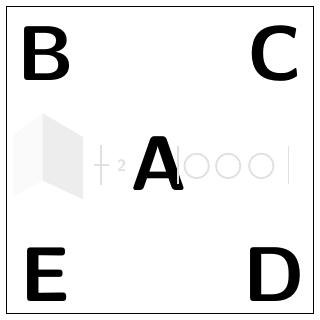
  • It consists of one or more carpels, each containing an ovary, style, and stigma.
  • The ovary contains ovules, which develop into seeds upon fertilization.
  • Dioecious
  • Dioecious plants have male and female reproductive organs on separate plants.
  • This means that a dioecious plant is either male or female, not both.
  • Examples of dioecious plants include holly, willow, and asparagus.
  • Pollination
  • Pollination is the process by which pollen is transferred from the male part of a plant to the female part, allowing fertilization to occur.
  • Pollination can be carried out by wind, water, insects, birds, and other animals.
  • Self-pollination occurs within the same flower or plant, while cross-pollination occurs between different plants.

Question 46

In which year was Project Tiger launched in India?

  1. AOption (a)

    1985

  2. BOption (b)

    1973

  3. COption (c)

    1972

  4. DOption (d)

    1970

View answer & explanation

Correct answer

Answer: (b)B.

1973

Why this answer is correct

The correct answer is 1973.

Key Points

  • Project Tiger was launched by the Government of India on 1st April 1973.
  • The aim of this initiative was to ensure a viable population of Bengal tigers in their natural habitats and to protect them from extinction.
  • This project is administered by the National Tiger Conservation Authority (NTCA).
  • Initially, nine tiger reserves were covered under this project, which has now expanded to cover more than 50 tiger reserves across India.

Additional Information

  • National Tiger Conservation Authority (NTCA)
  • The NTCA was constituted under the provisions of the Wildlife (Protection) Act, 1972, as amended in 2006, for strengthening tiger conservation.
  • It is a statutory body under the Ministry of Environment, Forest and Climate Change.
  • The NTCA is responsible for the implementation of Project Tiger to ensure the protection of tigers.
  • It regularly assesses tiger populations, habitat status, and the success of conservation efforts.
  • Wildlife (Protection) Act, 1972
  • This Act was enacted by the Indian Parliament to ensure the protection of wild animals, birds, and plants.
  • It aims to safeguard the country's ecological and environmental security.
  • The Act provides for the creation of protected areas such as national parks and wildlife sanctuaries.
  • It also lays down the legal framework for the protection and management of wildlife habitats.
  • Conservation of Bengal Tigers
  • Bengal tigers (Panthera tigris tigris) are native to the Indian subcontinent and are classified as Endangered on the IUCN Red List.
  • Efforts to conserve Bengal tigers include anti-poaching measures, habitat restoration, and community involvement.
  • India is home to more than 70% of the world's wild tiger population.
  • Effective conservation strategies have led to an increase in the tiger population in recent years.

Question 47

Which of the following decomposition reactions is NOT a redox reaction?

  1. AOption (a)

    Decomposition of dihydrogen monoxide

  2. BOption (b)

    Decomposition of sodium hydride

  3. COption (c)

    Decomposition of potassium chlorate

  4. DOption (d)

    Decomposition of calcium carbonate

View answer & explanation

Correct answer

Answer: (d)D.

Decomposition of calcium carbonate

Why this answer is correct

The correct answer is Decomposition of calcium carbonate.

Key Points

  • The decomposition of calcium carbonate (CaCO₃) results in the formation of calcium oxide (CaO) and carbon dioxide (CO₂).
  • This reaction is represented by the equation: CaCO₃ → CaO + CO₂.
  • The oxidation states of the elements do not change during this decomposition reaction, indicating it is not a redox reaction.
  • In contrast, decomposition reactions that are redox reactions involve changes in the oxidation states of the participating elements.

Additional Information

  • Decomposition Reactions
  • A decomposition reaction is a type of chemical reaction in which a single compound breaks down into two or more simpler compounds or elements.
  • These reactions often require an input of energy in the form of heat, light, or electricity.
  • Examples include the decomposition of water into hydrogen and oxygen (2H₂O → 2H₂ + O₂) and the decomposition of potassium chlorate into potassium chloride and oxygen (2KClO₃ → 2KCl + 3O₂).
  • Redox Reactions
  • Redox reactions, or oxidation-reduction reactions, involve the transfer of electrons between two substances.
  • Oxidation refers to the loss of electrons, while reduction refers to the gain of electrons.
  • In a redox reaction, one substance is oxidized (loses electrons) and another is reduced (gains electrons).
  • An example is the decomposition of sodium hydride (NaH), where NaH decomposes into sodium metal (Na) and hydrogen gas (H₂), with sodium being reduced and hydrogen being oxidized.
  • Oxidation States
  • The oxidation state (or number) of an element in a compound is a measure of the degree of oxidation of that element.
  • It is defined as the charge an atom would have if all bonds were completely ionic.
  • Changes in oxidation states during a reaction indicate a redox process.

Question 48

The head office of Board of Control for Cricket in India (BCCI) is located in ______.

  1. AOption (a)

    Mumbai

  2. BOption (b)

    Kolkata

  3. COption (c)

    New Delhi

  4. DOption (d)

    Chennai

View answer & explanation

Correct answer

Answer: (a)A.

Mumbai

Why this answer is correct

The correct answer is Mumbai.

Key Points

  • The Board of Control for Cricket in India (BCCI) is the national governing body for cricket in India.
  • The BCCI headquarters is located at the Wankhede Stadium in Mumbai, Maharashtra.
  • Mumbai is known as the cricket capital of India, having produced many legendary cricketers.
  • The BCCI was formed in December 1928 and is affiliated with the International Cricket Council (ICC).

Additional Information

  • BCCI (Board of Control for Cricket in India)
  • The BCCI is the wealthiest cricket board in the world, managing the Indian cricket team and organizing domestic and international cricket matches in India.
  • It oversees cricketing activities in India and has the authority to select players, umpires, and officials to participate in international cricket events.
  • The BCCI also organizes the Indian Premier League (IPL), one of the world's most popular and lucrative T20 cricket leagues.
  • It is responsible for developing cricket infrastructure and promoting the sport at all levels in the country.
  • Wankhede Stadium
  • Wankhede Stadium, located in Mumbai, is one of the most iconic cricket stadiums in India.
  • The stadium has hosted numerous memorable cricket matches, including the 2011 ICC Cricket World Cup final, where India emerged victorious.
  • It has a seating capacity of around 33,000 spectators and serves as the home ground for the Mumbai cricket team and the Mumbai Indians (IPL team).
  • Named after Sheshrao Krishnarao Wankhede, a politician and the then President of the Mumbai Cricket Association, the stadium was established in 1974.
  • International Cricket Council (ICC)
  • The ICC is the global governing body for cricket, responsible for overseeing and regulating the international game.
  • Headquartered in Dubai, United Arab Emirates, the ICC organizes major international cricket tournaments like the ICC Cricket World Cup, ICC T20 World Cup, and ICC Champions Trophy.
  • The ICC ensures that the rules and regulations of cricket are uniformly followed by its member countries.
  • It also appoints match officials for international matches and works towards the development and promotion of cricket worldwide.

Question 49

Who is the Chief Minister of Tamil Nadu as of July 2023?

  1. AOption (a)

    Pinarayi Vijayan

  2. BOption (b)

    M Yedurappa

  3. COption (c)

    KN Nehru

  4. DOption (d)

    MK Stalin

View answer & explanation

Correct answer

Answer: (d)D.

MK Stalin

Why this answer is correct

The correct answer is MK Stalin.

Key Points

  • M.K. Stalin is the current Chief Minister of Tamil Nadu, having assumed office on May 7, 2021.
  • He is the son of the former Chief Minister of Tamil Nadu, M. Karunanidhi.
  • Stalin is a prominent leader of the Dravida Munnetra Kazhagam (DMK) party.
  • Under his leadership, the DMK won the 2021 Tamil Nadu Legislative Assembly election, securing a majority of the seats.

Additional Information

  • Dravida Munnetra Kazhagam (DMK)
  • DMK is a major political party in the state of Tamil Nadu and the union territory of Puducherry.
  • It was founded by C.N. Annadurai in 1949 as a breakaway faction from the Dravidar Kazhagam (DK) led by Periyar E.V. Ramasamy.
  • The party's ideologies are centered on social justice, self-respect, and Tamil nationalism.
  • DMK has been a dominant force in Tamil Nadu politics, having ruled the state multiple times since its inception.
  • M.K. Stalin's Political Career
  • M.K. Stalin began his political career at an early age and has held various positions within the DMK party.
  • He has served as the Mayor of Chennai and as the Deputy Chief Minister of Tamil Nadu.
  • Stalin was appointed as the Working President of DMK in 2017, following the declining health of his father, M. Karunanidhi.
  • He played a pivotal role in leading the party to victory in the 2021 Tamil Nadu Legislative Assembly election.
  • Tamil Nadu Legislative Assembly
  • The Tamil Nadu Legislative Assembly is the unicameral legislature of the state of Tamil Nadu in India.
  • It consists of 234 members who are elected by the people of Tamil Nadu through direct elections.
  • The assembly is responsible for making laws on state subjects and has the power to pass budgets and financial bills.
  • It plays a crucial role in the governance and administration of the state.
  • 2021 Tamil Nadu Legislative Assembly Election
  • The 2021 Tamil Nadu Legislative Assembly election was held on April 6, 2021.
  • The DMK-led alliance won a decisive victory, securing 159 out of 234 seats.
  • The AIADMK, which was the ruling party at the time, managed to win only 75 seats.
  • This election marked the return of DMK to power after a decade in opposition.

Question 50

Details about Sudarshana lake is given in a rock inscription at Girnar (Junagarh), which was composed to record the achievements of the Shaka ruler ________.

  1. AOption (a)

    Rudrasimha III

  2. BOption (b)

    Rudradaman I

  3. COption (c)

    Chashtana

  4. DOption (d)

    Maues

View answer & explanation

Correct answer

Answer: (b)B.

Rudradaman I

Why this answer is correct

The correct answer is Rudradaman I.

Key Points

  • Rudradaman I was a ruler of the Western Kshatrapas, a dynasty of Saka rulers who controlled the region of western India.
  • The Sudarshana lake was a significant water reservoir in the region, and its maintenance and improvements were important for agriculture and the local economy.
  • Rudradaman I is known for his achievements in infrastructure, including the repair and maintenance of the Sudarshana lake, which is recorded in the Junagarh inscription.
  • He was one of the most prominent rulers of the Western Kshatrapas and is known for his military prowess and administrative skills.

Additional Information

  • Western Kshatrapas
  • The Western Kshatrapas were a dynasty of Saka rulers who ruled over the western and central parts of India, including Gujarat, Maharashtra, Rajasthan, and Madhya Pradesh.
  • The term "Kshatrapa" refers to "satraps" or provincial governors of the ancient Persian Achaemenid Empire, who later became independent rulers in the region.
  • The Western Kshatrapas are known for their contributions to trade, commerce, and infrastructure development in their territories.
  • They issued a large number of coins, which provide valuable information about their reigns and the socio-economic conditions of their times.
  • Sudarshana Lake
  • The Sudarshana lake was originally built during the reign of the Mauryan emperor Chandragupta Maurya and was later maintained and improved by various rulers, including Rudradaman I.
  • This lake was a significant source of irrigation and played a crucial role in supporting agriculture in the region.
  • The lake's maintenance and expansion are detailed in the Junagarh inscription, which highlights the importance of water management and infrastructure in ancient India.
  • The lake's name, "Sudarshana," means "beautiful" or "pleasant to look at," reflecting its significance and appeal.
  • Junagarh Inscription
  • The Junagarh inscription is a rock edict located in the Girnar hills near Junagarh in the state of Gujarat, India.
  • It records the achievements of Rudradaman I, particularly his efforts in repairing and maintaining the Sudarshana lake after it was damaged by floods.
  • The inscription is written in Sanskrit and is one of the earliest known examples of classical Sanskrit literature in Indian epigraphy.
  • It provides valuable historical information about the region, the rulers, and their administrative capabilities.

Quantitative Aptitude (25 questions)

Question 51

Which of the following statements is sufficient to conclude that two triangles are congruent?

  1. AOption (a)

    These have two equal sides and the same perimeter.

  2. BOption (b)

    These have the same area and the same base.

  3. COption (c)

    One side and one angle of both triangles are equal.

  4. DOption (d)

    These have the same base and the same height.

View answer & explanation

Correct answer

Answer: (a)A.

These have two equal sides and the same perimeter.

Why this answer is correct

Shortcut Trick

The perimeter of a triangle is the sum of its three sides.

If two triangles each have two equal corresponding sides (say a and b) and their total perimeters (P) are equal, the third side can be found directly.

Third side of 1st Triangle = P − (a + b)

Third side of 2nd Triangle = P − (a + b)

Since the third sides are also equal, all three corresponding sides of both triangles match.

Thus, the triangles are strictly congruent by the SSS (Side-Side-Side) rule.

∴ The correct answer is These have two equal sides and the same perimeter.

Alternate Method

a b c Perimeter = a + b + c

a b d Perimeter = a + b + d

Given:

Let the two equal corresponding sides of both triangles be a and b.

Let the unknown third side of the first triangle be c and the second triangle be d.

The perimeters of both triangles are given to be identical.

Calculations:

⇒ Perimeter of 1st Triangle = a + b + c

⇒ Perimeter of 2nd Triangle = a + b + d

Equating the two perimeters as given:

⇒ a + b + c = a + b + d

Subtracting (a + b) from both sides:

⇒ c = d

⇒ All three sides of the first triangle are precisely equal to the corresponding three sides of the second triangle (a = a, b = b, c = d).

⇒ Therefore, by the SSS (Side-Side-Side) congruence criterion, the two triangles are congruent.

Analyzing other options logically:

⇒ Same area and same base (or height): Area = 1/2 × base × height. Triangles with the same base and height will have the same area, but they can be of completely different shapes (e.g., one right-angled and one obtuse-angled). Hence, they are not necessarily congruent.

⇒ One side and one angle equal: This provides insufficient data. At least three specific matching components (like SAS, ASA, or AAS) are required to confirm congruence.

∴ The correct answer is These have two equal sides and the same perimeter.

Additional Information

Congruence Criteria for Triangles

Two triangles are strictly congruent if they satisfy any of these five standard rules: SSS (Side-Side-Side), SAS (Side-Angle-Side), ASA (Angle-Side-Angle), AAS (Angle-Angle-Side), or RHS (Right angle-Hypotenuse-Side).

Similarity vs Congruence

Congruent triangles have identical shape and size (ratio of corresponding sides is exactly 1:1). Similar triangles share the same shape but can differ in size (ratio of sides is equal but not necessarily 1). All congruent triangles are similar, but similar triangles are rarely congruent.

Base and Area Property

If two distinct triangles are situated on the same base and bounded between the same parallel lines, their areas will be exactly equal. However, their perimeter, side lengths, and interior angles can differ substantially.

Question 52

The average marks (out of 100) of boys and girls in an examination are 75 and 80, respectively. If the average marks of all the students in that examination are 78. Find the ratio of the number of boys to the number of girls.

  1. AOption (a)

     2 : 3

  2. BOption (b)

    3 : 4

  3. COption (c)

    1 : 3

  4. DOption (d)

    1 : 2

View answer & explanation

Correct answer

Answer: (a)A.

 2 : 3

Why this answer is correct

Shortcut Trick

By using the rule of Alligation:

Ratio of Boys to Girls = (Average of Girls − Overall Average) : (Overall Average − Average of Boys)

Ratio = (80 − 78) : (78 − 75)

Ratio = 2 : 3

∴ The correct answer is 2 : 3.

Alternate Method

Given:

Average marks of boys = 75

Average marks of girls = 80

Overall average marks = 78

Alligation Method

Boys

75

Girls

80

Overall

78

2

3

Ratio = 2 : 3

(80 − 78) (78 − 75)

Formula Used:

Overall Average = (Total marks of boys + Total marks of girls) ÷ Total number of students

Calculation:

Let the number of boys be x and the number of girls be y.

⇒ Total marks of boys = 75 × x

⇒ Total marks of girls = 80 × y

⇒ Total marks of all students = 78 × (x + y)

⇒ 75x + 80y = 78(x + y)

⇒ 75x + 80y = 78x + 78y

⇒ 80y − 78y = 78x − 75x

⇒ 2y = 3x

⇒ x/y = 2/3

∴ The correct answer is 2 : 3.

Additional Information

Alligation Rule

It is a method used to easily find the ratio in which two or more items or groups at given averages/prices must be mixed to produce a desired overall average.

Weighted Average

When combining two groups with different individual averages, the combined overall average is weighted by the respective number of quantities in each group: Average = (n1A1 + n2A2) ÷ (n1 + n2).

Ratio & Proportion

A ratio establishes a mathematical relationship between two quantities of the same kind, represented as a fraction. If a : b = x : y, then a/b = x/y.

Question 53

If the sum of two sides of an equilateral triangle is 16 cm, then find the third side.

  1. AOption (a)

    4 cm

  2. BOption (b)

    16 cm

  3. COption (c)

    Cannot be found

  4. DOption (d)

    8 cm

View answer & explanation

Correct answer

Answer: (d)D.

8 cm

Why this answer is correct

Shortcut Trick

In an equilateral triangle, all three sides are equal.

Sum of two sides = 16 cm

One side = 16 ÷ 2 = 8 cm

Hence, the third side is also 8 cm.

∴ The correct answer is 8 cm.

Alternate Method

A B C a a a a + a = 16 cm

Given:

The sum of two sides of an equilateral triangle = 16 cm

Property Used:

An equilateral triangle has all three sides equal in length. Let the length of each side be a.

Calculation:

⇒ a + a = 16

⇒ 2a = 16

⇒ a = 16 ÷ 2

⇒ a = 8 cm

Since all sides are equal, the third side is also equal to a.

⇒ Third side = 8 cm

∴ The correct answer is 8 cm.

Additional Information

Area of Equilateral Triangle

The area of an equilateral triangle with side a is given by Area = (√3 ÷ 4) × a2.

Height of Equilateral Triangle

The altitude or height is calculated as Height = (√3 ÷ 2) × a.

Perimeter of Equilateral Triangle

The perimeter is simply the sum of all sides, Perimeter = 3 × a.

Inradius and Circumradius

Inradius (r) = a ÷ (2√3) and Circumradius (R) = a ÷ √3.

Question 54

The following table shows the total candidates appeared and number of candidates present, in different exam centres – P, Q and R.

Study the table and answer the question that follows.

"Total' denotes total candidates applied for the centre, 'Present' denotes the candidates appeared.

In which year was the number of absentees the second highest in total of all centres?

  1. AOption (a)

    2018

  2. BOption (b)

    2017

  3. COption (c)

    2020

  4. DOption (d)

    2019

View answer & explanation

Correct answer

Answer: (d)D.

2019

Why this answer is correct

Given:

Data on candidates for centres P, Q, and R across years 2016 to 2020, with total and present candidates provided.

Formula used:

Absentees = Total - Present

Calculation:

For each year, calculate total absentees for all centres and identify the second highest.

2016:

⇒ P = 45 - 42 = 3

⇒ Q = 56 - 45 = 11

⇒ R = 55 - 50 = 5

Total Absentees = 3 + 11 + 5 = 19

2017:

⇒ P = 50 - 45 = 5

⇒ Q = 75 - 55 = 20

⇒ R = 45 - 40 = 5

Total Absentees = 5 + 20 + 5 = 30

2018:

⇒ P = 64 - 60 = 4

⇒ Q = 65 - 45 = 20

⇒ R = 65 - 55 = 10

Total Absentees = 4 + 20 + 10 = 34

2019:

⇒ P = 80 - 69 = 11

⇒ Q = 84 - 72 = 12

⇒ R = 70 - 62 = 8

Total Absentees = 11 + 12 + 8 = 31

2020:

⇒ P = 55 - 44 = 11

⇒ Q = 80 - 66 = 14

⇒ R = 90 - 85 = 5

Total Absentees = 11 + 14 + 5 = 30

The absentee totals by year are: 19 (2016), 30 (2017), 34 (2018), 31 (2019), 30 (2020).

∴ The second highest absentee total is 31 in 2019.

Question 55

Which of the following can be the value of 'k' so that the number 217924k is divisible by 6?

  1. AOption (a)

    4

  2. BOption (b)

    6

  3. COption (c)

    2

  4. DOption (d)

    0

View answer & explanation

Correct answer

Answer: (c)C.

2

Why this answer is correct

Shortcut Trick

For a number to be divisible by 6, it must be divisible by both 2 and 3.

Sum of the digits of 217924k = 2 + 1 + 7 + 9 + 2 + 4 + k = 25 + k.

To be divisible by 3, the sum (25 + k) must be a multiple of 3.

Checking the options (4, 6, 2, 0), only 25 + 2 = 27 is exactly divisible by 3.

Since the unit digit 2 is even, it is also divisible by 2.

∴ The correct answer is k = 2.

Alternate Method

Given:

Number = 217924k

The number is strictly divisible by 6.

Concept Used:

Divisibility rule of 6: A number must be completely divisible by both 2 and 3.

Divisibility rule of 2: The unit digit of the number must be an even number (0, 2, 4, 6, 8).

Divisibility rule of 3: The sum of all individual digits of the number must be divisible by 3.

Calculations:

⇒ Sum of all the digits = 2 + 1 + 7 + 9 + 2 + 4 + k

⇒ Sum of the digits = 25 + k

⇒ For the number to be divisible by 3, the value of (25 + k) must be exactly divisible by 3.

⇒ Let us substitute and check the given options for k:

⇒ Option 1: k = 4 ⇒ Sum = 25 + 4 = 29 (Not divisible by 3)

⇒ Option 2: k = 6 ⇒ Sum = 25 + 6 = 31 (Not divisible by 3)

⇒ Option 3: k = 2 ⇒ Sum = 25 + 2 = 27 (Divisible by 3)

⇒ Option 4: k = 0 ⇒ Sum = 25 + 0 = 25 (Not divisible by 3)

⇒ The only value from the options that satisfies the divisibility condition for 3 is k = 2.

⇒ Furthermore, because 2 is an even number, it inherently satisfies the divisibility rule of 2.

∴ The correct answer is k = 2.

Additional Information

Divisibility Rule of 4

A number is divisible by 4 if the two-digit number formed by its last two digits is divisible by 4.

Divisibility Rule of 8

A number is divisible by 8 if the three-digit number formed by its last three digits is exactly divisible by 8.

Divisibility Rule of 9

A number is divisible by 9 if the sum of all its digits yields a number that is divisible by 9.

Divisibility Rule of 11

A number is divisible by 11 if the numerical difference between the sum of digits at odd places and the sum of digits at even places evaluates to 0 or a multiple of 11.

Question 56

Read the given information and answer the question that follows.

The following table gives the percentage of marks obtained by seven students in six different subjects in an examination. The number in the brackets give the maximum marks in each subject.

StudentMaths (150)Chemistry (130)Physics (120)Geography (100)History (60)Computer Science (40)
Ayush905090607080
Aman1008080408070
Sajal906070709080
Rohit806580806060
Tanvi707565854070
Tarun653550778080
Muskan806585955090

If someone secured all the highest scores that have been obtained by some student or the other in the six subjects as given in the table above, what would be the exact overall percentage score obtained by that student?

  1. AOption (a)

    9116 \frac{1}{6} %

  2. BOption (b)

    95.16%

  3. COption (c)

    91%

  4. DOption (d)

    90161\over6%

View answer & explanation

Correct answer

Answer: (a)A.

9116 \frac{1}{6} %

Why this answer is correct

Identify Highest Scores in Each Subject:

From the table:

Maths: Highest score is 100% of 150 marks

Chemistry: Highest score is 80% of 130 marks

Physics: Highest score is 90% of 120 marks

Geography: Highest score is 95% of 100 marks

History: Highest score is 90% of 60 marks

Computer Science: Highest score is 90% of 40 marks

Calculate the Marks for Each Subject Based on Percentage:

Maths: 150 × 100% = 150 marks

Chemistry: 130 × 80% = 104 marks

Physics: 120 × 90% = 108 marks

Geography: 100 × 95% = 95 marks

History: 60 × 90% = 54 marks

Computer Science: 40 × 90% = 36 marks

Calculate the total obtained marks: 150 + 104 + 108 + 95 + 54 + 36 = 547

Calculate the total maximum possible marks: 150 + 130 + 120 + 100 + 60 + 40 = 600

Calculate the overall percentage:

Percentage = (547 / 600) × 100 = 9116%91 \frac{1}{6}\%

The exact overall percentage score obtained by that student would be 9116%91 \frac{1}{6}\%

Question 57

The value of sin2 30 – sin2 40 + sin2 45 – sin2 55 – sin2 35 + sin2 45 – sin2 50 + sin2 60 is:

  1. AOption (a)

    1

  2. BOption (b)

    2

  3. COption (c)

    4

  4. DOption (d)

    0

View answer & explanation

Correct answer

Answer: (d)D.

0

Why this answer is correct

Shortcut Trick

Use the complementary angle identity: sin2 θ + sin2 (90° − θ) = 1.

Group the complementary angle terms: −(sin2 40° + sin2 50°) − (sin2 35° + sin2 55°) = −1 − 1 = −2.

Sum the standard angle values: sin2 30° + sin2 45° + sin2 45° + sin2 60°.

⇒ (1/2)2 + (1/√2)2 + (1/√2)2 + (√3/2)2 = 1/4 + 1/2 + 1/2 + 3/4 = 2.

Total value = 2 − 2 = 0.

∴ The correct answer is 0.

Alternate Method

Given:

sin2 30° − sin2 40° + sin2 45° − sin2 55° − sin2 35° + sin2 45° − sin2 50° + sin2 60°

Formula Used:

sin (90° − θ) = cos θ

sin2 θ + cos2 θ = 1

sin 30° = 1/2, sin 45° = 1/√2, sin 60° = √3/2

Calculations:

⇒ Rearranging terms to group standard and complementary angles:

⇒ (sin2 30° + sin2 45° + sin2 45° + sin2 60°) − (sin2 40° + sin2 50°) − (sin2 35° + sin2 55°)

⇒ Substitute the standard trigonometric values:

⇒ Sum of standard values = (1/2)2 + (1/√2)2 + (1/√2)2 + (√3/2)2

⇒ Sum of standard values = 1/4 + 1/2 + 1/2 + 3/4 = 2

⇒ For the complementary angles, convert sine to cosine:

⇒ sin 50° = sin (90° − 40°) = cos 40°

⇒ sin 55° = sin (90° − 35°) = cos 35°

⇒ Applying the Pythagorean identity sin2 θ + cos2 θ = 1:

⇒ − (sin2 40° + cos2 40°) = −1

⇒ − (sin2 35° + cos2 35°) = −1

⇒ Combining all the calculated parts together:

⇒ Total Expression Value = 2 − 1 − 1 = 0

∴ The correct answer is 0.

Additional Information

Complementary Angle Identities

Trigonometric functions of complementary angles satisfy: sin(90° − θ) = cos θ, tan(90° − θ) = cot θ, and sec(90° − θ) = cosec θ.

Pythagorean Trigonometric Identities

The foundational identities are sin2 θ + cos2 θ = 1, 1 + tan2 θ = sec2 θ, and 1 + cot2 θ = cosec2 θ.

Standard Trigonometric Values

Frequently used standard values include sin 30° = cos 60° = 1/2, sin 45° = cos 45° = 1/√2, and sin 60° = cos 30° = √3/2.

Question 58

The value of cos229° + cos261° is :

  1. AOption (a)

    32\frac{\sqrt{3}}{2}

  2. BOption (b)

    2

  3. COption (c)

    1

  4. DOption (d)

    0

View answer & explanation

Correct answer

Answer: (c)C.

1

Why this answer is correct

Shortcut Trick

If A + B = 90°, then cos2A + cos2B = 1.

Here, A = 29° and B = 61°.

Since 29° + 61° = 90°, the condition is satisfied.

⇒ cos229° + cos261° = 1

∴ The correct answer is 1.

Alternate Method

Given:

Expression: cos229° + cos261°

Formula Used:

cos(90° − θ) = sinθ

sin2θ + cos2θ = 1

Calculations:

⇒ cos61° = cos(90° − 29°)

⇒ cos61° = sin29°

Substitute this back into the given expression:

⇒ cos229° + (sin29°)2

⇒ cos229° + sin229°

⇒ 1

∴ The correct answer is 1.

Additional Information

Complementary Angles

Two angles are complementary if their sum is 90°. The standard conversions are: sin(90° − θ) = cosθ, tan(90° − θ) = cotθ, and sec(90° − θ) = cosecθ.

Pythagorean Identities

The core identities in trigonometry are: sin2θ + cos2θ = 1, sec2θ − tan2θ = 1, and cosec2θ − cot2θ = 1.

Sum to 1 Properties

For any two angles A and B where A + B = 90°, we have the direct rules: sin2A + sin2B = 1, cos2A + cos2B = 1, tanA × tanB = 1, and cotA × cotB = 1.

Question 59

An article is marked at ₹550. If it is sold at a discount of 40%, then the selling price becomes 10% more than its cost price. What is the cost price (in ₹)?

  1. AOption (a)

    220

  2. BOption (b)

    330

  3. COption (c)

    300

  4. DOption (d)

    200

View answer & explanation

Correct answer

Answer: (c)C.

300

Why this answer is correct

Shortcut Trick

Use the direct ratio formula between Cost Price (CP) and Marked Price (MP):

CP : MP = (100 − Discount%) : (100 + Profit%)

CP : MP = (100 − 40) : (100 + 10) = 60 : 110 = 6 : 11

Given MP = 11 units = ₹550 → 1 unit = ₹50

CP = 6 units = 6 × 50 = ₹300

∴ The correct answer is ₹300.

Alternate Method

Given: Marked Price (MP) = ₹550, Discount = 40%, Profit = 10%

Formula: Selling Price (SP) = MP × (100 − Discount%)/100; Cost Price (CP) = SP × 100/(100 + Profit%)

CP

SP

MP

+10%

−40% MP = ₹550 SP = ₹330 CP = ?

⇒ Selling Price (SP) = 550 − (40% of 550)

⇒ SP = 550 − (0.40 × 550)

⇒ SP = 550 − 220 = ₹330

⇒ SP is 10% more than CP → SP = 1.10 × CP

⇒ 330 = 1.10 × CP

⇒ CP = 330 ÷ 1.1 = ₹300

∴ The correct answer is ₹300.

Additional Information

Marked Price and Selling Price

Marked Price (MP) is the tag price, and the discount is always calculated on this value to reach the Selling Price (SP = MP − Discount).

Effective Percentage Method

If two successive discounts d1% and d2% are given, the single equivalent discount is (d1 + d2 − (d1×d2)/100)%.

Mark-up Percentage

Mark-up is the increase over the CP to set the MP. Mark-up % = [(MP − CP) ÷ CP] × 100.

Question 60

The given table shows the percentage of marks obtained by three students in three different subjects in an institute.

(maximum marks are given in brackets)

StudentHistory (175)Geography (200)Botany (125)
Ram54 %87 %71 %
Mohan51 %79 %78 %
Shyam75 %49 %76%

If in order to pass the exam, a minimum of 105 marks are needed in History, how many students pass in the exam?

  1. AOption (a)

    3

  2. BOption (b)

    1

  3. COption (c)

    0

  4. DOption (d)

    2

View answer & explanation

Correct answer

Answer: (b)B.

1

Why this answer is correct

Given:

Minimum marks required to pass in History = 105

Maximum marks in History = 175

Calculation for each student:

Ram:

History percentage = 54%

Marks in History = (54 / 100) × 175 = 94.5 (rounded to 95)

Result: Ram does not pass, as 95 < 105.

Mohan:

History percentage = 51%

Marks in History = (51 / 100) × 175 = 89.25 (rounded to 89)

Result: Mohan does not pass, as 89 < 105.

Shyam:

History percentage = 75%

Marks in History = (75 / 100) × 175 = 131.25 (rounded to 131)

Result: Shyam passes, as 131 > 105.

Conclusion:

Only Shyam passes in History, so the number of students who pass the exam in History is 1.

Question 61

Fill pipe P is 21 times faster than fill pipe Q. If Q can fill a cistern in 110 minutes, find the time it takes to fill the cistern when both fill pipes are open.

  1. AOption (a)

    5 minutes

  2. BOption (b)

    4 minutes

  3. COption (c)

    3 minutes

  4. DOption (d)

    6 minutes

View answer & explanation

Correct answer

Answer: (a)A.

5 minutes

Why this answer is correct

Shortcut Trick

Since fill pipe P is 21 times faster than Q, the efficiency ratio of P to Q is 21 : 1.

Total capacity of the cistern = Efficiency of Q × Time taken by Q = 1 × 110 = 110 units.

Combined efficiency of P and Q working together = 21 + 1 = 22 units/min.

Time taken when both pipes are open = Total capacity ÷ Combined efficiency = 110 ÷ 22 = 5 minutes.

∴ The correct answer is 5 minutes.

Alternate Method

Given:

Time taken by Q to fill the cistern = 110 minutes.

Efficiency of P is 21 times the efficiency of Q.

Method Used:

Let efficiency of Q = 1 unit/min.

Then, efficiency of P = 21 units/min.

Time taken by P to fill the cistern alone = 110 ÷ 21 minutes.

PipeTime (min)Total WorkEfficiency
P110/2111021
Q1101

⇒ Combined efficiency of P and Q = 21 + 1 = 22 units/min.

⇒ Time taken by both pipes together = Total Work ÷ Combined Efficiency

⇒ Time taken = 110 ÷ 22 = 5 minutes.

∴ The correct answer is 5 minutes.

Additional Information

Inlet and Outlet Pipes

An inlet pipe fills the tank (positive efficiency), whereas an outlet pipe empties the tank (negative efficiency). The net efficiency is the algebraic sum of their individual efficiencies.

Combined Work Formula

If Pipe A fills a tank in x hours and Pipe B fills it in y hours, the time taken to fill the tank when both are opened together is given by (x × y) ÷ (x + y).

Work and Efficiency Relation

Time taken to complete a certain amount of work is inversely proportional to the efficiency of the worker or pipe. Total Work = Time × Efficiency.

Question 62

The radii of the two cones are in the ratio of 2 : 5 and their volumes are in the ratio of 3 : 5. What is the ratio of their heights?

  1. AOption (a)

    15 : 4

  2. BOption (b)

    11 : 15

  3. COption (c)

    13 : 11

  4. DOption (d)

    4 : 11

View answer & explanation

Correct answer

Answer: (a)A.

15 : 4

Why this answer is correct

Shortcut Trick

We know that for a cone, V ∝ r2 × h

⇒ Ratio of heights (h1/h2) = (V1/V2) × (r2/r1)2

⇒ h1/h2 = (3/5) × (5/2)2

⇒ h1/h2 = (3/5) × (25/4) = 75/20 = 15/4

∴ The correct answer is 15 : 4.

Alternate Method

Given:

Ratio of radii of two cones (r1 : r2) = 2 : 5

Ratio of volumes of two cones (V1 : V2) = 3 : 5

Formula Used:

Volume of a cone = 1/3 × π × r2 × h

Calculations:

⇒ Let the radii of the two cones be 2r and 5r respectively.

⇒ Let their heights be h1 and h2 respectively.

⇒ Volume of the first cone (V1) = 1/3 × π × (2r)2 × h1 = 1/3 × π × 4r2 × h1

⇒ Volume of the second cone (V2) = 1/3 × π × (5r)2 × h2 = 1/3 × π × 25r2 × h2

⇒ Ratio of their volumes = V1 / V2 = 3 / 5

⇒ (1/3 × π × 4r2 × h1) / (1/3 × π × 25r2 × h2) = 3 / 5

⇒ (4 × h1) / (25 × h2) = 3 / 5

⇒ h1 / h2 = (3 × 25) / (5 × 4)

⇒ h1 / h2 = 75 / 20 = 15 / 4

⇒ The ratio of their heights is 15 : 4.

∴ The correct answer is 15 : 4.

Additional Information

Volume of a Cone

The amount of space occupied by a cone. Formula: V = 1/3 × π × r2 × h.

Curved Surface Area (CSA)

The area of the curved surface excluding the base. Formula: CSA = π × r × l, where l = √(r2 + h2).

Total Surface Area (TSA)

The sum of the curved surface area and the base area. Formula: TSA = π × r × (r + l).

Frustum of a Cone

The lower part of a cone cut by a parallel plane. Volume = 1/3 × π × h × (R2 + r2 + R × r).

Question 63

Simplify:

x3+15x2+75x+125x2−25(x−5).\frac{x^3 + 15x^2 + 75x + 125}{x^2 - 25} (x - 5).

  1. AOption (a)

    x2 + 25

  2. BOption (b)

    x2 + 5x + 25

  3. COption (c)

    x2 + 10x + 25

  4. DOption (d)

    x2 - 25

View answer & explanation

Correct answer

Answer: (c)C.

x2 + 10x + 25

Why this answer is correct

Shortcut Trick

Recognize the numerator x3 + 15x2 + 75x + 125 as the perfect cube (x + 5)3.

Recognize the denominator x2 − 25 as the difference of squares (x − 5)(x + 5).

Expression becomes: [ (x + 5)3 ÷ ((x − 5)(x + 5)) ] × (x − 5).

Canceling common terms (x − 5) and (x + 5) yields (x + 5)2.

Expanding (x + 5)2 gives x2 + 10x + 25.

∴ The correct answer is x2 + 10x + 25.

Alternate Method

Given:

Expression: (x3 + 15x2 + 75x + 125) / (x2 − 25) × (x − 5)

Formula Used:

  1. (a + b)3 = a3 + 3a2b + 3ab2 + b3
  2. a2 − b2 = (a − b)(a + b)
  3. (a + b)2 = a2 + 2ab + b2

Calculations:

⇒ Let us factorise the numerator: x3 + 15x2 + 75x + 125

⇒ Numerator = (x)3 + 3(x)2(5) + 3(x)(5)2 + (5)3 = (x + 5)3

⇒ Factorise the denominator: x2 − 25 = (x)2 − (5)2 = (x − 5)(x + 5)

⇒ Substitute these into the given expression:

⇒ [ (x + 5)3 / ( (x − 5)(x + 5) ) ] × (x − 5)

⇒ Cancel out the common factor (x − 5) from the numerator multiplier and denominator.

⇒ The expression simplifies to: (x + 5)3 / (x + 5)

⇒ Cancel out one (x + 5) term to get: (x + 5)2

⇒ Expand using the formula (a + b)2:

⇒ (x + 5)2 = x2 + 2(x)(5) + 52 = x2 + 10x + 25

∴ The correct answer is x2 + 10x + 25.

Additional Information

Cubic Identities

Formulas for the sum and difference of cubes: a3 + b3 = (a + b)(a2 − ab + b2) and a3 − b3 = (a − b)(a2 + ab + b2).

Perfect Cube Expansions

Expanded forms: (a + b)3 = a3 + b3 + 3ab(a + b) and (a − b)3 = a3 − b3 − 3ab(a − b).

Simplification of Rational Expressions

Always factorise both the numerator and the denominator into their simplest forms before attempting to cancel common terms.

Question 64

Which of the following can be the value of k, if (88÷8×k−3×3)(62−7×5+k2)=1\frac{(88 \div 8 \times k - 3 \times 3)}{(6^2 - 7 \times 5 + k^2)} = 1

  1. AOption (a)

    1,10

  2. BOption (b)

    4,7

  3. COption (c)

    3,10

  4. DOption (d)

    2,7

View answer & explanation

Correct answer

Answer: (a)A.

1,10

Why this answer is correct

Shortcut Trick Solve the given expression directly using the BODMAS rule: ⇒ (11k − 9) ÷ (36 − 35 + k2) = 1 ⇒ (11k − 9) = (1 + k2) ⇒ k2 − 11k + 10 = 0 ⇒ (k − 10)(k − 1) = 0 ⇒ k = 1, 10 ∴ The correct answer is 1, 10.

Alternate Method Given: (88 ÷ 8 × k − 3 × 3) / (62 − 7 × 5 + k2) = 1 Method Used: According to the BODMAS rule, perform division first, then multiplication, addition, and subtraction sequentially. Calculations: ⇒ Step 1: Simplify the Numerator ⇒ Numerator = 88 ÷ 8 × k − 3 × 3 ⇒ Numerator = 11 × k − 9 = 11k − 9 ⇒ Step 2: Simplify the Denominator ⇒ Denominator = 62 − 7 × 5 + k2 ⇒ Denominator = 36 − 35 + k2 = 1 + k2 ⇒ Step 3: Substitute both simplified values back into the equation ⇒ (11k − 9) / (1 + k2) = 1 ⇒ 11k − 9 = 1 + k2 ⇒ k2 − 11k + 10 = 0 ⇒ k2 − 10k − k + 10 = 0 ⇒ k(k − 10) − 1(k − 10) = 0 ⇒ (k − 1)(k − 10) = 0 ⇒ k = 1 or k = 10 ∴ The correct answer is 1, 10.

Additional Information BODMAS Rule It dictates the correct order of mathematical operations: Brackets, Orders (powers/roots), Division, Multiplication, Addition, and Subtraction. Quadratic Equation Roots For the standard quadratic equation form ax2 + bx + c = 0, the Sum of the roots = −b/a and the Product of the roots = c/a. Nature of Roots The nature of roots is determined by the Discriminant (D = b2 − 4ac). If D > 0, roots are real and distinct. If D = 0, roots are real and equal. If D < 0, roots are imaginary.

Question 65

Let O be the centre of the circle and AB and CD are two parallel chords on the same side of the radius. OP is perpendicular to AB and OQ is perpendicular to CD. If AB = 10 cm, CD = 24 cm and PQ = 7 cm, then the diameter (in cm) of the circle is equal to:

  1. AOption (a)

    26

  2. BOption (b)

    13

  3. COption (c)

    12

  4. DOption (d)

    24

View answer & explanation

Correct answer

Answer: (a)A.

26

Why this answer is correct

Shortcut Trick

The half-lengths of the parallel chords are 10 ÷ 2 = 5 cm and 24 ÷ 2 = 12 cm.

Notice the common Pythagorean triplet (5, 12, 13) where 13 represents the hypotenuse (radius).

The distances from the centre for these chords would be 12 cm and 5 cm.

Difference in perpendicular distances = 12 − 5 = 7 cm, which perfectly matches the given PQ.

Thus, the radius is 13 cm, meaning the diameter is 2 × 13 = 26 cm.

∴ The correct answer is 26 cm.

Alternate Method

Given:

AB = 10 cm, CD = 24 cm, PQ = 7 cm

OP ⊥ AB and OQ ⊥ CD

O Q P C D A B 12 cm 5 cm 7 cm x r r

Formula Used:

A perpendicular from the centre to a chord bisects the chord into two equal halves.

Pythagoras Theorem: Hypotenuse2 = Base2 + Perpendicular2

Calculations:

⇒ AP = AB ÷ 2 = 10 ÷ 2 = 5 cm

⇒ CQ = CD ÷ 2 = 24 ÷ 2 = 12 cm

⇒ Let the radius of the circle be r and the distance OQ = x.

⇒ Since chords are on the same side of the centre, OP = OQ + PQ = x + 7

⇒ In right-angled ΔOQC: r2 = OQ2 + CQ2

⇒ r2 = x2 + 122 = x2 + 144  --- (i)

⇒ In right-angled ΔOPA: r2 = OP2 + AP2

⇒ r2 = (x + 7)2 + 52 = x2 + 14x + 49 + 25 = x2 + 14x + 74  --- (ii)

⇒ Equating (i) and (ii): x2 + 144 = x2 + 14x + 74

⇒ 14x = 144 − 74 = 70

⇒ x = 5 cm

⇒ Substitute the value of x in (i):

⇒ r2 = 52 + 144 = 25 + 144 = 169

⇒ r = √169 = 13 cm

⇒ Diameter of the circle = 2 × 13 = 26 cm

∴ The correct answer is 26 cm.

Additional Information

Perpendicular from Centre to Chord

A perpendicular drawn from the centre of a circle to any chord bisects the chord into two equal halves. This forms a right-angled triangle where the radius is the hypotenuse.

Distance Between Parallel Chords

If two parallel chords lie on the same side of the centre, the distance between them is the difference of their perpendicular distances from the centre (d = |d1 − d2|). If they lie on opposite sides, the distance is the sum (d = d1 + d2).

Pythagorean Triplets in Circle Geometry

Commonly repeating triplets like (3, 4, 5) or (5, 12, 13) or (8, 15, 17) very frequently satisfy the values of the radius, half-chord, and perpendicular distance. Spotting them saves calculation time.

Question 66

If cosecθ = 5/3, then evaluate (sec²θ - 1) × cot²θ × (1 + cot²θ).

  1. AOption (a)

    2516\frac {25}{16}

  2. BOption (b)

    916\frac {9}{16}

  3. COption (c)

    259\frac {25}{9}

  4. DOption (d)

    45\frac {4}{5}

View answer & explanation

Correct answer

Answer: (c)C.

259\frac {25}{9}

Why this answer is correct

Shortcut Trick

Given expression: (sec²θ − 1) × cot²θ × (1 + cot²θ)

Using standard trigonometric identities: sec²θ − 1 = tan²θ and 1 + cot²θ = cosec²θ

⇒ Expression = tan²θ × cot²θ × cosec²θ

Since tanθ × cotθ = 1, the expression simplifies to: 1 × cosec²θ = cosec²θ

⇒ (5/3)² = 25/9

∴ The correct answer is 25/9.

Alternate Method

Given: cosecθ = 5/3

Since cosecθ = Hypotenuse ÷ Perpendicular, let Hypotenuse = 5 and Perpendicular = 3.

By Pythagoras theorem: Base = √(5² − 3²) = √16 = 4.

From the right-angled triangle, secθ = Hypotenuse ÷ Base = 5/4

And cotθ = Base ÷ Perpendicular = 4/3

Substitute these values into the given expression: (sec²θ − 1) × cot²θ × (1 + cot²θ)

⇒ ((5/4)² − 1) × (4/3)² × (1 + (4/3)²)

⇒ (25/16 − 1) × (16/9) × (1 + 16/9)

⇒ (9/16) × (16/9) × (25/9)

⇒ 1 × (25/9) = 25/9

∴ The correct answer is 25/9.

Additional Information

Pythagorean Identities

The three primary identities are: sin²θ + cos²θ = 1, sec²θ − tan²θ = 1, and cosec²θ − cot²θ = 1.

Reciprocal Identities

Trigonometric functions are related by their reciprocals: sinθ × cosecθ = 1, cosθ × secθ = 1, and tanθ × cotθ = 1.

Quotient Identities

Tangent and cotangent ratios can be expressed as: tanθ = sinθ ÷ cosθ and cotθ = cosθ ÷ sinθ.

Question 67

The distance between the centres of two circles of radii 22 cm and 10 cm is 37 cm. If the points of contact of a direct common tangent to these circles are M and Q, then find the length of the line segment MQ.

  1. AOption (a)

    35 cm

  2. BOption (b)

    39 cm

  3. COption (c)

    29 cm

  4. DOption (d)

    25 cm

View answer & explanation

Correct answer

Answer: (a)A.

35 cm

Why this answer is correct

Shortcut Trick Length of Direct Common Tangent (DCT) = √[d2 − (R − r)2] Given: Distance (d) = 37 cm, Radii R = 22 cm, r = 10 cm ⇒ DCT = √[372 − (22 − 10)2] ⇒ DCT = √[372 − 122] = √(1369 − 144) ⇒ DCT = √1225 = 35 cm ∴ The correct answer is 35 cm.

Alternate Method

M Q O1 O2 P

22 cm 10 cm 37 cm 12 cm MQ = ?

Given: ⇒ Radius of the larger circle (R) = 22 cm ⇒ Radius of the smaller circle (r) = 10 cm ⇒ Distance between centres (d) = 37 cm

Formula Used: ⇒ Length of Direct Common Tangent (MQ) = √[d2 − (R − r)2]

Calculation: ⇒ MQ = √[372 − (22 − 10)2] ⇒ MQ = √[372 − 122] Using the identity a2 − b2 = (a − b)(a + b): ⇒ MQ = √[(37 − 12) × (37 + 12)] ⇒ MQ = √(25 × 49) ⇒ MQ = 5 × 7 = 35 cm ∴ The correct answer is 35 cm.

Additional Information Transverse Common Tangent (TCT) The length of the transverse common tangent is given by the formula: TCT = √[d2 − (R + r)2], where the tangent line crosses the line joining the centres. Number of Common Tangents If d > R + r, there are exactly 4 common tangents. If d = R + r, there are 3 common tangents. If R − r < d < R + r, there are exactly 2 common tangents. If d = R − r, there is only 1 common tangent.

Question 68

In a circular race of 840 m, A and B start running in the same direction at the same time from the same point at the speeds of 6 m/s and 12 m/s, respectively. After how much time will they meet next?

  1. AOption (a)

    140 s

  2. BOption (b)

    20 s

  3. COption (c)

    40 s

  4. DOption (d)

    70 s

View answer & explanation

Correct answer

Answer: (a)A.

140 s

Why this answer is correct

Shortcut Trick

When two persons run in the same direction, their relative speed is the difference of their speeds.

Relative speed = 12 − 6 = 6 m/s.

Time to meet next = Track length ÷ Relative speed.

Time = 840 ÷ 6 = 140 seconds.

∴ The correct answer is 140 s.

Alternate Method

Given:

⇒ Total length of the circular track = 840 m

⇒ Speed of runner A = 6 m/s

⇒ Speed of runner B = 12 m/s

Formula Used:

⇒ Time taken to meet = Distance ÷ Relative Speed

Calculation:

⇒ Since both A and B are running in the same direction, their relative speed will be the difference between their speeds.

⇒ Relative Speed = Speed of B − Speed of A

⇒ Relative Speed = 12 − 6 = 6 m/s

⇒ Time taken to meet next = 840 ÷ 6

⇒ Time = 140 s

∴ The correct answer is 140 s.

Additional Information

Meeting Anywhere on Track (First Time)

Time = Track Length ÷ Relative Speed. If moving in the same direction, RS = |S1 − S2|. If opposite, RS = S1 + S2.

Meeting at the Starting Point (First Time)

Time = LCM of the individual times taken to complete one full round = LCM(L÷S1, L÷S2).

Number of Distinct Meeting Points

If the ratio of their speeds is a : b (in simplest form), they meet at |a − b| distinct points if moving in the same direction, and (a + b) points if moving in opposite directions.

Question 69

R pays ₹100 to P with ₹5, ₹2 and ₹1 coins. The total number of coins used for paying are 40. What is the number of coins of denomination ₹5 in the payment?

  1. AOption (a)

    16

  2. BOption (b)

    17

  3. COption (c)

    18

  4. DOption (d)

    13

View answer & explanation

Correct answer

Answer: (d)D.

13

Why this answer is correct

Shortcut Trick

Assume all 40 coins are of the lowest denomination (₹1), so total value = 40 × 1 = ₹40.

Remaining value to be adjusted = 100 − 40 = ₹60.

A ₹5 coin contributes ₹4 extra and a ₹2 coin contributes ₹1 extra over the ₹1 base.

Thus, 4 × (Number of ₹5 coins) + 1 × (Number of ₹2 coins) = 60.

From the options, only 13 gives a valid value (4 × 13 = 52, which is ≤ 60). Other options exceed 60.

∴ The correct answer is 13 coins.

Alternate Method

Given:

Total amount paid = ₹100

Total number of coins = 40

Available denominations = ₹5, ₹2, and ₹1

Calculations:

Let the number of ₹5, ₹2, and ₹1 coins be x, y, and z respectively.

⇒ Total coins: x + y + z = 40 .... (Equation 1)

⇒ Total value: 5x + 2y + z = 100 .... (Equation 2)

⇒ Subtract Equation 1 from Equation 2:

⇒ (5x + 2y + z) − (x + y + z) = 100 − 40

⇒ 4x + y = 60

⇒ y = 60 − 4x

Since the number of coins cannot be negative, y ≥ 0.

⇒ 60 − 4x ≥ 0

⇒ 4x ≤ 60

⇒ x ≤ 15

Now, checking the given options for the possible value of x (₹5 coins):

⇒ Checking 16: Not possible, as x ≤ 15

⇒ Checking 17: Not possible

⇒ Checking 18: Not possible

⇒ Checking 13: Possible

Verification for x = 13:

⇒ y = 60 − 4 × 13 = 60 − 52 = 8

⇒ z = 40 − (13 + 8) = 40 − 21 = 19

⇒ Total value = (5 × 13) + (2 × 8) + (1 × 19) = 65 + 16 + 19 = ₹100 (Satisfies condition)

∴ The correct answer is 13 coins.

Additional Information

Linear Equations in Two Variables

When checking for integer solutions in linear equations (Diophantine equations), using boundary conditions (such as making sure the number of items is ≥ 0) helps eliminate incorrect options quickly.

Denomination Problems

In coin-based questions, always form two distinct equations: one representing the physical count of coins and the other representing their total financial value.

Deviation Method for Values

By assigning the minimum denomination value to all the items, the remaining residual value can be split among the higher denominations based on their difference from the base minimum value.

Question 70

In an election between two candidates, y% of the voters did not vote. 10% of the votes cast were declared invalid, while all the valid votes were cast in favour of either of the two candidates. The candidate who got 59.375% of the valid votes cast was declared elected by 2484 votes. If the number of people eligible to vote in that election was 16,000, what is the value of y?

  1. AOption (a)

    7.2

  2. BOption (b)

    8.4

  3. COption (c)

    8

  4. DOption (d)

    7.5

View answer & explanation

Correct answer

Answer: (c)C.

8

Why this answer is correct

Shortcut Trick

Winner gets 59.375% (19/32) and loser gets 40.625% (13/32) of valid votes.

Difference = 19/32 − 13/32 = 3/16 of valid votes = 2484.

Total valid votes = 2484 × 16/3 = 13248.

Total valid votes = Total Voters × (100 − y)% × 90%.

16000 × ((100 − y)/100) × (90/100) = 13248 ⇒ 144 × (100 − y) = 13248 ⇒ 100 − y = 92 ⇒ y = 8.

∴ The correct answer is y = 8.

Alternate Method

⇒ Let total eligible voters = 16,000

⇒ Total votes cast = 16,000 × ((100 − y)/100)

⇒ Total valid votes = 16,000 × ((100 − y)/100) × (90/100) = 144 × (100 − y)

⇒ Winner's share of valid votes = 59.375% = 59375/100000 = 19/32

⇒ Loser's share of valid votes = 100% − 59.375% = 40.625% = 13/32

⇒ Majority difference = 19/32 − 13/32 = 6/32 = 3/16

⇒ Majority votes = (3/16) × Valid votes = 2484

⇒ Valid votes = 2484 × (16/3) = 828 × 16 = 13,248

⇒ Equating the valid votes: 144 × (100 − y) = 13,248

⇒ 100 − y = 13,248 ÷ 144

⇒ 100 − y = 92

⇒ y = 8

∴ The correct answer is y = 8.

Additional Information

Valid vs Total Votes

In election problems, always calculate winning margins based on the correct base specified in the question. Total valid votes = Total votes cast − Invalid votes.

Successive Percentage Change

When consecutive filtering steps occur (e.g., people not voting, then invalid votes), chain the multiplying factors: Final = Initial × (1 − R1/100) × (1 − R2/100).

Fraction to Percentage Conversions

Memorizing eighths and sixteenths speeds up calculations: 1/16 = 6.25%, 3/16 = 18.75%, and 1/32 = 3.125%. Thus, 59.375% = 50% + 9.375% = 1/2 + 3/32 = 19/32.

Question 71

Mohan borrows a sum of ₹4,22,092 at the rate of 20% per annum simple interest. At the end of the first year, he repays ₹21,679 towards return of principal amount borrowed. If Mohan clears all pending dues at the end of the second year, including interest payment that accrued during the first year, how much does he pay (in ₹) at the end of the second year?

  1. AOption (a)

    556367

  2. BOption (b)

    558380

  3. COption (c)

    561347

  4. DOption (d)

    564914

View answer & explanation

Correct answer

Answer: (d)D.

564914

Why this answer is correct

Shortcut Trick

The final amount to be paid can be found by subtracting the future value of the part payment from the total future value of the original loan.

Total amount for 2 years (if no payment was made) = 422092 × (1 + 40%) = 422092 × 1.4 = ₹590928.8

Value of the 1st year repayment at the end of the 2nd year = 21679 × (1 + 20%) = 21679 × 1.2 = ₹26014.8

Remaining amount to be paid = 590928.8 − 26014.8 = ₹564914

∴ The correct answer is ₹564914.

Alternate Method

Given:

Principal (P) = ₹4,22,092

Rate (R) = 20% per annum simple interest

Principal repaid at the end of Year 1 = ₹21,679

Year 0 P = ₹4,22,092

Year 1 Paid: ₹21,679 Int 1: ₹84,418.4

Year 2 Final Dues Int 2: ₹80,082.6

20% on ₹4,22,092

20% on ₹4,00,413

New Principal = 4,22,092 − 21,679 = ₹4,00,413 Total Dues = New P + Int 1 + Int 2 = ₹5,64,914

Calculations:

⇒ Interest accrued in the 1st year = (P × R × T) ÷ 100

⇒ Interest for 1st year = (422092 × 20 × 1) ÷ 100 = ₹84,418.4

⇒ At the end of Year 1, Mohan repays ₹21,679 towards the principal. The remaining principal becomes:

⇒ New Principal for 2nd year = 422092 − 21679 = ₹4,00,413

⇒ Interest accrued in the 2nd year on the new principal = (400413 × 20 × 1) ÷ 100 = ₹80,082.6

⇒ The total amount to be paid at the end of the 2nd year consists of the new principal and the accumulated unpaid interest for both years.

⇒ Total pending interest = 84418.4 + 80082.6 = ₹1,64,501

⇒ Total amount paid at the end of the 2nd year = New Principal + Total Pending Interest

⇒ Total amount = 400413 + 164501 = ₹5,64,914

∴ The correct answer is ₹564914.

Additional Information

Simple Interest Formula

Simple interest is calculated exclusively on the principal amount. The formula is SI = (P × R × T) ÷ 100, where P is principal, R is rate, and T is time.

Merchant's Rule for Partial Payments

When partial payments are made, both the initial debt and the payments earn simple interest until the date of final settlement. Final Balance = Future Value of Debt − Future Value of Payments.

Difference Between Simple & Compound Interest

In Simple Interest, accumulated interest does not earn further interest. In Compound Interest, accrued interest is added to the principal to earn interest in subsequent periods.

Question 72

Simplify:

(x2−9)x+3\frac{(x^2 - 9)}{x + 3}

  1. AOption (a)

    x+3\quad x + 3

  2. BOption (b)

    x−3\quad x - 3

  3. COption (c)

    x2−9\quad \sqrt{x^2 - 9}

  4. DOption (d)

    x−9\quad x - 9

View answer & explanation

Correct answer

Answer: (b)B.

x−3\quad x - 3

Why this answer is correct

Shortcut Trick

The given expression is in the form of (a2 − b2) / (a + b).

We know the algebraic identity a2 − b2 = (a − b)(a + b).

Substituting x for a and 3 for b, the numerator breaks down to (x − 3)(x + 3).

Dividing by the denominator (x + 3), the common term cancels out entirely.

This leaves exactly (x − 3).

∴ The correct answer is x − 3.

Alternate Method

Given:

Expression: (x2 − 9) / (x + 3)

Formula Used:

Difference of squares: a2 − b2 = (a − b)(a + b)

Calculations:

⇒ (x2 − 9) / (x + 3)

⇒ (x2 − 32) / (x + 3)

⇒ Expand the numerator using the formula:

⇒ [(x − 3)(x + 3)] / (x + 3)

⇒ Cancel the common factor (x + 3) from both the numerator and the denominator:

⇒ x − 3

∴ The correct answer is x − 3.

Additional Information

Difference of Squares

This is one of the most frequently used identities in algebraic simplification: a2 − b2 = (a − b)(a + b).

Perfect Square Trinomials

For standard expansions: (a + b)2 = a2 + 2ab + b2 and (a − b)2 = a2 − 2ab + b2.

Sum and Difference of Cubes

Higher power factorization formulas: a3 + b3 = (a + b)(a2 − ab + b2) and a3 − b3 = (a − b)(a2 + ab + b2).

Simplification Rules

Always factorize algebraic numerators and denominators to their simplest forms before attempting to cancel or cross-multiply terms.

Question 73

Rajesh, in his printing press, got an order to print some books, out of which he completed 1727\frac{17}{27} of the order in 34 days. In how many days did he complete the entire order of printing?

  1. AOption (a)

    60

  2. BOption (b)

    20

  3. COption (c)

    54

  4. DOption (d)

    56

View answer & explanation

Correct answer

Answer: (c)C.

54

Why this answer is correct

Shortcut Trick

In the fraction 17/27, the denominator represents the total work and the numerator represents the completed work.

17 units of work take = 34 days

1 unit of work takes = 34 ÷ 17 = 2 days

Total work (27 units) takes = 27 × 2 = 54 days

∴ The correct answer is 54 days.

Alternate Method

Given:

Fraction of the order completed = 17/27

Time taken to complete this fraction of the order = 34 days

Formula Used:

Total Time = Time taken for partial work ÷ Fraction of work completed

Calculations:

⇒ Let the number of days required to complete the entire order be x days.

⇒ Complete order is considered as 1 whole unit of work.

⇒ As per the given data, 17/27 of the work is completed in 34 days.

⇒ (17/27) × x = 34

⇒ x = 34 × (27/17)

⇒ x = 2 × 27

⇒ x = 54 days

∴ The correct answer is 54 days.

Additional Information

Unitary Method

It involves finding the value of a single unit and then multiplying that unit value by the required number of units to find the total value.

Work and Time Relationship

Work done is directly proportional to the time taken (assuming constant efficiency). If a fraction of work W is completed in T days, the entire work is completed in T ÷ W days.

Fraction to Whole Conversion

The denominator of a fraction generally represents the total parts, and the numerator represents the considered parts. Equating these parts directly to the given values leads to much faster calculations.

Question 74

A grocer professes to sell rice at the cost price, but uses a fake weight of 870 g for 1 kg. Find his profit percentage (correct to two decimal places).

  1. AOption (a)

    15.11%

  2. BOption (b)

    14.94%

  3. COption (c)

    18.21%

  4. DOption (d)

    11.11%

View answer & explanation

Correct answer

Answer: (b)B.

14.94%

Why this answer is correct

Shortcut Trick

In dishonest dealer problems where goods are sold at cost price, the profit comes entirely from the false weight.

Profit % = [(True Weight − False Weight) ÷ False Weight] × 100

Here, True Weight = 1000 g and False Weight = 870 g.

Profit % = [(1000 − 870) ÷ 870] × 100

Profit % = (130 ÷ 870) × 100 = (1300 ÷ 87)% ≈ 14.94%

∴ The correct answer is 14.94%.

Alternate Method

Given:

Professed Selling Price = Cost Price

True weight for 1 kg = 1000 g

False weight used by the grocer = 870 g

Formula Used:

Profit % = [(Error) ÷ (True Value − Error)] × 100

Profit % = [(Selling Price − Cost Price) ÷ Cost Price] × 100

Calculations:

⇒ Let the cost price of 1 g of rice be ₹1.

⇒ Selling Price charged to the customer (for 1000 g) = ₹1000.

⇒ Actual Cost Price incurred by the grocer (for providing 870 g) = ₹870.

⇒ Profit = Selling Price − Cost Price

⇒ Profit = 1000 − 870 = ₹130

⇒ Profit Percentage = (Profit ÷ Cost Price) × 100

⇒ Profit Percentage = (130 ÷ 870) × 100

⇒ Profit Percentage = (1300 ÷ 87)% ≈ 14.942%

⇒ Rounding off to two decimal places, we get 14.94%.

∴ The correct answer is 14.94%.

Additional Information

Dishonest Dealer (Selling at CP)

When a dealer professes to sell items at Cost Price but uses a false weight, his profit percentage is given strictly by the error in weight over the false weight given: Profit % = [Error ÷ (True Weight − Error)] × 100.

Dishonest Dealer (Selling at Profit/Loss)

If the dealer marks up his goods by x% and also uses a false weight, the effective profit is determined using a multiplying factor: Final SP/CP ratio = [(100 + x) / 100] × [True Weight / False Weight].

Fraud During Purchasing & Selling

If a dealer cheats by x% while buying (takes more) and y% while selling (gives less), his overall profit percentage is calculated effectively by taking the ratio of the quantities exchanged: [(100 + x) ÷ (100 − y) − 1] × 100.

Question 75

The following table shows the marks (out of 100) obtained by five students in five different subjects.


Student/SubjectMathsPhysicsChemistryEnglishPhysical Education
Tarun6580758590
Rohit6976808894
Mohit7384779095
Shobhit7685768678
Sumit9088788268


Who obtained 79% marks in all the subjects taken together?

  1. AOption (a)

    Sumit

  2. BOption (b)

    Mohit

  3. COption (c)

    Rohit

  4. DOption (d)

    Tarun

View answer & explanation

Correct answer

Answer: (d)D.

Tarun

Why this answer is correct

Given:

Maths = 65

Physics = 80

Chemistry = 75

English = 85

Physical Education = 90

Formula used:

Total Marks = Maths + Physics + Chemistry + English + Physical Education

Percentage = Total MarksMaximum Marks×100\frac{\text{Total Marks}}{\text{Maximum Marks}} \times 100

Calculations:

Total Marks = 65 + 80 + 75 + 85 + 90

⇒ Total Marks = 395

Percentage = 395500×100\frac{395}{500} \times 100

⇒ Percentage = 79%

∴ Tarun obtained 79% marks in all the subjects taken together.

English Comprehension (25 questions)

Question 76

Select the option that expresses the given sentence in passive voice.

Ishika saw the tiger in the forest.

  1. AOption (a)

    The tiger saw by Ishika in the forest.

  2. BOption (b)

    The tiger was seen by the forest in Ishika.

  3. COption (c)

    The tiger was seen by Ishika in the forest.

  4. DOption (d)

    The tiger sees Ishika in the forest.

View answer & explanation

Correct answer

Answer: (c)C.

The tiger was seen by Ishika in the forest.

Why this answer is correct

The correct answer is Option 3.


Key Points

  • In passive voice, the object of the active voice sentence becomes the subject.
  • The verb "saw" in active voice is changed to "was seen" in passive voice.
  • The subject of the active voice sentence "Ishika" becomes the agent in the passive voice sentence, introduced by the preposition "by".
  • The location "in the forest" remains unchanged and is placed at the end of the sentence.

Therefore, the correct answer is Option 3.


Correct Sentence: "The tiger was seen by Ishika in the forest."


Additional Information

  • Option 1: "The tiger saw by Ishika in the forest." – Incorrect structure; the verb form "saw" does not fit in passive voice.
  • Option 2: "The tiger was seen by the forest in Ishika." – Incorrect order and context; "in Ishika" is incorrect placement.
  • Option 4: "The tiger sees Ishika in the forest." – This is in active voice, not passive.

Question 77

Select the option that expresses the opposite meaning of the underlined word.

The explosive used is of my own formulation, and I can vouch for its efficiency.

  1. AOption (a)

    Maintain

  2. BOption (b)

    Certify

  3. COption (c)

    Invalidate

  4. DOption (d)

    Witness

View answer & explanation

Correct answer

Answer: (c)C.

Invalidate

Why this answer is correct

The correct answer is: Option 3.

Key Points

  • The word "vouch" means to assert or confirm as a result of one's own experience that something is true or accurately so described. (गवाही देना)
  • Example: I can vouch for his honesty; he has always been truthful with me.
  • "Invalidate" refers to something that makes an argument, statement, or theory unsound or erroneous; to disprove or nullify. (अमान्य करना)
  • Example: The discovery of new evidence might invalidate the previous theory.

Hence, we can infer that the opposite of 'vouch' is 'invalidate'.

Additional Information

Here are the other options explained along with their Hindi meanings and example sentences:

  • Maintain (बनाए रखना): To keep in an existing state; to preserve or retain.
  • Example: It's essential to maintain a healthy lifestyle for overall well-being.
  • Certify (प्रमाणित करना): To confirm or attest, typically in writing; to officially recognize as meeting certain standards.
  • Example: The document was certified by a notary public.
  • Witness (गवाह): Someone who sees an event and can report or give evidence about it.
  • Example: She was the only witness to the accident.

Question 78

Select the most appropriate option that can substitute the underlined segment in the given sentence.

'Spy Family' is a graphic novel that is a narrative work in which the story is conveyed to the reader using uninterrupted art in a traditional comics format.

  1. AOption (a)

    sequential art in a traditional

  2. BOption (b)

    existential art in a traditional

  3. COption (c)

    sedimental art in a traditional

  4. DOption (d)

    longitudinal art in a traditional

View answer & explanation

Correct answer

Answer: (a)A.

sequential art in a traditional

Why this answer is correct

The correct answer is Option 1.


Key Points

  • The primary issue in the sentence is the use of the term "uninterrupted art."
  • The correct term should be "sequential art" which accurately describes the format of a graphic novel or traditional comics.
  • Sequential art refers to the use of a series of images to convey a story, which is a defining characteristic of graphic novels.
  • Thus, the error is located in the use of "uninterrupted art" instead of "sequential art."

Therefore, the correct answer is Option 1.


Correct Sentence: "'Spy Family' is a graphic novel that is a narrative work in which the story is conveyed to the reader using sequential art in a traditional comics format."


Additional Information

  • Option 2: "existential art in a traditional" – This term is not relevant to the context of graphic novels or traditional comics format.
  • Option 3: "sedimental art in a traditional" – This term is not relevant to the context of graphic novels or traditional comics format.
  • Option 4: "longitudinal art in a traditional" – This term is not relevant to the context of graphic novels or traditional comics format.

Question 79

Select the most appropriate synonym of the given word.

Fatal

  1. AOption (a)

    Deadly

  2. BOption (b)

    Additional

  3. COption (c)

    Jovial

  4. DOption (d)

    Easy

View answer & explanation

Correct answer

Answer: (a)A.

Deadly

Why this answer is correct

The correct answer is: Option 1.

Key Points

  • The word "fatal" means something that causes death or leads to a very serious outcome. (घातक)
  • Example: The accident proved to be fatal for the driver.
  • "Deadly" refers to something that is capable of causing death or is extremely dangerous. (मृत्युदायक)
  • Example: The venom of some snakes is deadly to humans.

Hence, we can infer that the synonym of 'fatal' is 'deadly'.

Additional Information

Here are the other options explained along with their Hindi meanings and example sentences:

  • Additional (अतिरिक्त): Something that is extra or added to what is already present.
  • Example: We need additional resources to complete this project.
  • Jovial (प्रसन्न): Cheerful and friendly.
  • Example: He was in a jovial mood at the party.
  • Easy (आसान): Something that is not difficult and requires minimal effort.
  • Example: The exam was surprisingly easy for most students.

Question 80

Select the most appropriate synonym of the given word.

Innuendo

  1. AOption (a)

    Prose

  2. BOption (b)

    Crude

  3. COption (c)

    Ragged

  4. DOption (d)

    Insinuation

View answer & explanation

Correct answer

Answer: (d)D.

Insinuation

Why this answer is correct

The correct answer is: Option 4.

Key Points

  • The word "innuendo" means an indirect or subtle reference, especially one that is disparaging or suggestive. (संकेत)
  • Example: She made an innuendo about his past, which made him uncomfortable.
  • "Insinuation" refers to an indirect or covert suggestion or hint, especially of a derogatory nature. (इशारा)
  • Example: His insinuation that I was involved in the scandal was completely baseless.
  • Hence, we can infer that the synonym of 'innuendo' is 'insinuation'.

Therefore, the correct answer is: Option 4.

Additional Information

Here are the other options explained along with their Hindi meanings and example sentences:

  • Prose (गद्य): Written or spoken language in its ordinary form, without metrical structure.
  • Example: The author's prose is clear and engaging.
  • Crude (अशिष्ट): In a natural or raw state; not yet processed or refined.
  • Example: The crude oil needs to be refined before it can be used.
  • Ragged (फटा हुआ): Rough or uneven, especially in texture or outline.
  • Example: The ragged edges of the old blanket showed how much it had been used.

Question 81

The following sentence has been divided into four segments. Identify the segment that contains an error.

Mr. Abhilash and his family / have received / no informations / about the incident.

  1. AOption (a)

    have received

  2. BOption (b)

    no informations

  3. COption (c)

    about the incident.

  4. DOption (d)

    Mr. Abhilash and his family

View answer & explanation

Correct answer

Answer: (b)B.

no informations

Why this answer is correct

The correct answer is Option 2.


Key Points

  • The word "informations" is incorrect because "information" is an uncountable noun and does not have a plural form.
  • Uncountable nouns typically do not end in "s" and are treated as singular.
  • The correct phrase should be "no information" instead of "no informations."
  • Thus, the error is located in Option 2 of the sentence.

Therefore, the correct answer is Option 2.


Correct Sentence: "Mr. Abhilash and his family have received no information about the incident."


Additional Information

  • 1) have received – This part of the sentence is grammatically correct and does not require any changes.
  • 3) about the incident. – This part of the sentence is grammatically correct and does not require any changes.
  • 4) Mr. Abhilash and his family – This part of the sentence is grammatically correct and does not require any changes.

Question 82

Select the most appropriate option to fill in the blank.

Vinod had a ______ escape in the car accident.

  1. AOption (a)

    comfortable

  2. BOption (b)

    full

  3. COption (c)

    narrow

  4. DOption (d)

    wide

View answer & explanation

Correct answer

Answer: (c)C.

narrow

Why this answer is correct

The correct answer is: Option 3.

Key Points

  • The word "narrow" means something that is limited in width, especially in relation to length. (संकीर्ण)
  • Example: The path was so narrow that only one person could walk at a time.
  • "Narrow escape" refers to a situation where someone manages to avoid danger or disaster by a very small margin. (बाल-बाल बचना)
  • Example: Vinod had a narrow escape in the car accident.

Therefore, the correct answer is: Option 3.

Additional Information

Here are the other options explained along with their Hindi meanings and example sentences:

  • Comfortable (आरामदायक): Providing physical ease and relaxation.
  • Example: The sofa is very comfortable to sit on.
  • Full (पूर्ण): Containing or holding as much or as many as possible.
  • Example: The glass is full of water.
  • Wide (चौड़ा): Of great or more than average width.
  • Example: The river is very wide at this point.

Question 83

Select the INCORRECTLY spelt word.

  1. AOption (a)

    Embarrass

  2. BOption (b)

    Connoisseur

  3. COption (c)

    Relevent

  4. DOption (d)

    Bureaucracy

View answer & explanation

Correct answer

Answer: (c)C.

Relevent

Why this answer is correct

The correct answer is: Option 3.

Key Points

  • The word "Relevent" is incorrectly spelt. The correct spelling is "Relevant". (प्रासंगिक)
  • Example: The evidence is relevant to the case.
  • "Relevant" means closely connected or appropriate to what is being done or considered. (प्रासंगिक)
  • Example: Please provide relevant details in your report.

Therefore, the correct answer is: Option 3.

Additional Information

Here are the other options explained along with their Hindi meanings and example sentences:

  • Embarrass (शर्मिंदा): It means to cause someone to feel awkward, self-conscious, or ashamed.
  • Example: She didn't want to embarrass him by correcting his mistake in public.
  • Connoisseur (पारखी): An expert judge in matters of taste.
  • Example: He is a connoisseur of fine wines.
  • Bureaucracy (नौकरशाही): A system of government in which most of the important decisions are made by state officials rather than by elected representatives.
  • Example: The bureaucracy is often blamed for inefficiency and delays in the public sector.

Question 84

Select the option that can be used as a one-word substitute for the underlined group of words.

She is proficient in speaking many languages.

  1. AOption (a)

    Monolithic

  2. BOption (b)

    Multilingual

  3. COption (c)

    Heterolinguistic

  4. DOption (d)

    Bilingual

View answer & explanation

Correct answer

Answer: (b)B.

Multilingual

Why this answer is correct

The correct answer is: Option 2.

Key Points

  • The word "Monolithic" means something large, powerful, and intractably indivisible and uniform. (एकरूप)
  • Example: The monolithic structure of the organization made it difficult to implement changes.
  • "Multilingual" refers to a person who is able to speak multiple languages fluently. (बहुभाषी)
  • Example: As a multilingual individual, she easily converses with people from different countries.
  • Hence, the word "multilingual" is the correct substitute for the phrase "proficient in speaking many languages".

Therefore, the correct answer is: Multilingual.

Additional Information

Here are the other options explained along with their Hindi meanings and example sentences:

  • Monolithic (एकरूप): Large, powerful, and intractably indivisible and uniform.
  • Example: The monolithic structure of the organization made it difficult to implement changes.
  • Heterolinguistic (विविधभाषी): Relating to or involving several languages.
  • Example: The heterolinguistic community had members speaking various native languages.
  • Bilingual (द्विभाषी): A person fluent in two languages.
  • Example: Being bilingual, he easily switches between English and Spanish.

Question 85

The following sentence has been split into four segments. Identify the segment that contains a grammatical error.

My brother performed / extremely good / in the class test / held yesterday.

  1. AOption (a)

    held yesterday

  2. BOption (b)

    in the class test

  3. COption (c)

    My brother performed

  4. DOption (d)

    extremely good

View answer & explanation

Correct answer

Answer: (d)D.

extremely good

Why this answer is correct

The correct answer is Option 4.


Key Points

  • The primary issue in the sentence is the use of the adjective "good" instead of the adverb "well."
  • Adjectives are used to describe nouns, while adverbs are used to describe verbs, adjectives, or other adverbs.
  • The correct phrase should be "extremely well," ensuring grammatical correctness and clarity.
  • Thus, the error is located in option 4 of the sentence.

Therefore, the correct answer is Option 4.


Correct Sentence: "My brother performed extremely well in the class test held yesterday."


Additional Information

  • 1: "My brother performed" – This part of the sentence is grammatically correct and does not require any changes.
  • 2: "in the class test" – This part of the sentence is grammatically correct and does not require any changes.
  • 3: "held yesterday" – This part of the sentence is grammatically correct and does not require any changes.

Question 86

Select the most appropriate synonym of the word in bold.

We'd better watch our step and not give him any excuse to harass us further.

  1. AOption (a)

    betray

  2. BOption (b)

    relish

  3. COption (c)

    soothe

  4. DOption (d)

    intimidate

View answer & explanation

Correct answer

Answer: (d)D.

intimidate

Why this answer is correct

The correct answer is: Option 4.

Key Points

  • The word "harass" means to trouble, torment, or bully someone persistently. (परेशान करना)
  • Example: He was harassed by bullies at school every day.
  • "Intimidate" refers to making someone feel frightened or overawed, especially in order to make them do what one wants. (डराना)
  • Example: The gang tried to intimidate the shop owner into paying them protection money.
  • Hence, we can infer that the synonym of 'harass' is 'intimidate'.

Therefore, the correct answer is: Option 4.

Additional Information

Here are the other options explained along with their Hindi meanings and example sentences:

  • Betray (धोखा देना): To expose someone to danger by treacherously giving information to an enemy.
  • Example: He was accused of betraying his country during the war.
  • Relish (आनंद लेना): To enjoy greatly.
  • Example: She relished the opportunity to travel and see new places.
  • Soothe (शांत करना): To gently calm someone or something.
  • Example: She tried to soothe the crying baby with a lullaby.

Question 87

Select the option that can be used as a one-word substitute for the given phrase.

A short interesting story about a real person or event

  1. AOption (a)

    Poem

  2. BOption (b)

    Sketch

  3. COption (c)

    Anecdote

  4. DOption (d)

    Narrative

View answer & explanation

Correct answer

Answer: (c)C.

Anecdote

Why this answer is correct

The correct answer is: Option 3.

Key Points

  • The word "Anecdote" means a short and amusing or interesting story about a real incident or person. (रोचक कथा)
  • Example: He told us an anecdote about his childhood that made everyone laugh.
  • "Anecdote" can also serve to illustrate a point or provide insight into a character's personality or a situation. (रोचक कथा)
  • Example: During the meeting, she shared an anecdote from her previous job to highlight the importance of teamwork.

Therefore, the correct answer is: Option 3.

Additional Information

Here are the other options explained along with their Hindi meanings and example sentences:

  • Poem (कविता): A piece of writing that partakes of the nature of both speech and song, often with a rhythmic and metaphorical style.
  • Example: She recited a beautiful poem at the gathering.
  • Sketch (रूपरेखा): A rough or unfinished drawing or painting, often made to assist in making a more finished picture.
  • Example: He showed us a sketch of the new building design.
  • Narrative (कथा): A spoken or written account of connected events; a story.
  • Example: The novel's narrative was compelling and kept me hooked till the end.

Question 88

Select the most appropriate synonym of the given word.

Toxic

  1. AOption (a)

    Laudatory

  2. BOption (b)

    Lanky

  3. COption (c)

    Lethal

  4. DOption (d)

    Licit

View answer & explanation

Correct answer

Answer: (c)C.

Lethal

Why this answer is correct

The correct answer is: Option 3.

Key Points

  • The word "toxic" means something that is poisonous or harmful to living beings. (विषैला)
  • Example: The factory was closed down due to its toxic waste polluting the river.
  • "Lethal" refers to something that is sufficient to cause death; deadly. (घातक)
  • Example: The venom of some snakes is so lethal that it can kill a human within minutes.

Hence, we can infer that a synonym of 'toxic' is 'lethal'.

Additional Information

Here are the other options explained along with their Hindi meanings and example sentences:

  • Laudatory (प्रशंसात्मक): Expressing praise.
  • Example: The laudatory reviews boosted the morale of the team.
  • Lanky (दुबला-पतला): Tall and thin, often with an awkward appearance.
  • Example: The lanky teenager towered over his peers.
  • Licit (कानूनी): Lawful or permitted by law.
  • Example: The licit trade practices ensured the company's growth.

Question 89

Select the option that can be used as a one-word substitute for the given group of words.

A person who likes to argue about anything

  1. AOption (a)

    Reticent

  2. BOption (b)

    Coward

  3. COption (c)

    Veracious

  4. DOption (d)

    Contentious

View answer & explanation

Correct answer

Answer: (d)D.

Contentious

Why this answer is correct

The correct answer is: Option 4.

Key Points

  • The word "Contentious" means a person who likes to argue about anything; someone who is prone to causing disputes or arguments. (झगड़ालू)
  • Example: John is known to be contentious, often challenging others' opinions just for the sake of argument.
  • "Contentious" refers to someone who is argumentative or likely to cause controversy. (झगड़ालू)
  • Example: The contentious lawyer was always ready to debate every point in the case.

Hence, we can infer that the correct one-word substitute for a person who likes to argue about anything is "Contentious".

Additional Information

Here are the other options explained along with their Hindi meanings and example sentences:

  • Reticent (मितभाषी): Someone who is not revealing one's thoughts or feelings readily.
  • Example: The reticent student rarely participated in class discussions.
  • Coward (कायर ): A person who lacks the courage to face danger, difficulty, opposition, pain, etc.
  • Example: He was labeled a coward for not standing up to the bully.
  • Veracious (सत्यवादी): A person who is habitually truthful and honest.
  • Example: The veracious witness provided an accurate account of the events.

Question 90

Select the most appropriate meaning of the given idiom.

To have bigger fish to fry

  1. AOption (a)

    To have an interest in cooking

  2. BOption (b)

    To know different kinds of fishing techniques

  3. COption (c)

    To take calculated risks

  4. DOption (d)

    To have bigger things to take care of than the menial task at hand

View answer & explanation

Correct answer

Answer: (d)D.

To have bigger things to take care of than the menial task at hand

Why this answer is correct

The correct answer is: Option 4.

Key Points

  • The idiom "To have bigger fish to fry" means to have more important or more interesting things to do or attend to than the current task at hand. (और भी महत्वपूर्ण काम होना)
  • Example: I can't worry about that right now; I have bigger fish to fry with this upcoming presentation.
  • "To have bigger things to take care of than the menial task at hand" implies prioritizing more significant tasks over trivial ones. (महत्वपूर्ण कार्यों को तुच्छ कार्यों से ऊपर रखना)
  • Example: She didn't attend the meeting because she had bigger things to take care of at home.

Therefore, the correct answer is: Option 4.

Additional Information

Here are the other options explained along with their Hindi meanings and example sentences:

  • Option 1: To have an interest in cooking (रसोई में रुचि रखना)
  • Example: She has a keen interest in cooking and loves trying new recipes.
  • Option 2: To know different kinds of fishing techniques (मछली पकड़ने की विभिन्न तकनीकों को जानना)
  • Example: He is an expert angler and knows different kinds of fishing techniques.
  • Option 3: To take calculated risks (सुनियोजित जोखिम उठाना)
  • Example: In business, it's often necessary to take calculated risks to achieve success.

Question 91

Select the option that expresses the given sentence in active voice.

Lovely tunes are composed by Domnica.

  1. AOption (a)

    Domnica composed lovely tunes.

  2. BOption (b)

    Domnica composes tunes lovely.

  3. COption (c)

    Domnica will compose lovely tunes.

  4. DOption (d)

    Domnica composes lovely tunes.

View answer & explanation

Correct answer

Answer: (d)D.

Domnica composes lovely tunes.

Why this answer is correct

The correct answer is Option 4.


Key Points

  • The primary task is to convert the given passive voice sentence into active voice.
  • In an active voice sentence, the subject performs the action denoted by the verb.
  • The correct active voice sentence is "Domnica composes lovely tunes."
  • The error lies in the other options, as they do not correctly convert the passive sentence to active voice.

Therefore, the correct answer is Option 4.


Correct Sentence: "Domnica composes lovely tunes."


Additional Information

  • Option 1: "Domnica composed lovely tunes." – This is in the past tense, not the present tense as required.
  • Option 2: "Domnica composes tunes lovely." – This option incorrectly places the adjective after the noun.
  • Option 3: "Domnica will compose lovely tunes." – This is in the future tense, not the present tense as required.

Question 92

Select the most appropriate synonym to replace the underlined word in the given sentence.

No altruistic act is truly sincere.

  1. AOption (a)

    philanthropic

  2. BOption (b)

    phantasmal

  3. COption (c)

    phenomenal

  4. DOption (d)

    phonotypical

View answer & explanation

Correct answer

Answer: (a)A.

philanthropic

Why this answer is correct

The correct answer is: Option 1.

Key Points

  • The word "altruistic" means showing a selfless concern for the well-being of others; unselfish. (निःस्वार्थ)
  • Example: Her altruistic nature made her volunteer at the local shelter every weekend.
  • "Philanthropic" refers to seeking to promote the welfare of others, especially by donating money to good causes; generous and benevolent. (परोपकारी)
  • Example: The billionaire's philanthropic efforts have improved the lives of many underprivileged children.
  • Hence, we can infer that the synonym of 'altruistic' is 'philanthropic'.

Therefore, the correct answer is: Option 1.

Additional Information

Here are the other options explained along with their Hindi meanings and example sentences:

  • Phantasmal (मायावी): Something that is like a phantom or ghost; illusory.
  • Example: The phantasmal figure disappeared as quickly as it appeared.
  • Phenomenal (असाधारण): Very remarkable or extraordinary.
  • Example: She has a phenomenal ability to remember even the smallest details.
  • Phonotypical (ध्वन्यात्मक): Relating to the representation of speech sounds by symbols.
  • Example: The phonotypical transcription of the word helps in its correct pronunciation.

Question 93

Select the most appropriate option to substitute the underlined segment in the given sentence.

She has been studying for two o'clock.

  1. AOption (a)

    study from two o'clock

  2. BOption (b)

    studying since two o'clock

  3. COption (c)

    study for two o'clock

  4. DOption (d)

    studying two o'clock

View answer & explanation

Correct answer

Answer: (b)B.

studying since two o'clock

Why this answer is correct

The correct answer is Option 2.


Key Points

  • The sentence requires a correct expression of time to indicate when the studying began.
  • The present perfect continuous tense (has been studying) is used to show an action that started in the past and is still continuing.
  • "Since" is used to indicate the point in time when the action started.

Therefore, the correct phrase is "studying since two o'clock".


Correct Sentence: "She has been studying since two o'clock."


Additional Information

  • Option 1: "study from two o'clock" – Incorrect, because "study from" implies a different time frame not associated with 'has been studying'.
  • Option 3: "study for two o'clock" – Incorrect, as it suggests studying in preparation for something happening at two o'clock, which is not the intended meaning.
  • Option 4: "studying two o'clock" – Incorrect, as it is grammatically incorrect and lacks the proper preposition to indicate time.

Question 94

In the following sentence, four words are underlined out of which one word is misspelt. Identify the INCORRECTLY spelt word.

After the recapture (A) of Tololing and the adjacent features, evacting (B) the enemy from this well-fortified (C) position became a priority.(D)

  1. AOption (a)

    B

  2. BOption (b)

    D

  3. COption (c)

    A

  4. DOption (d)

    C

View answer & explanation

Correct answer

Answer: (a)A.

B

Why this answer is correct

The correct answer is: Option 1.

Key Points

  • The word "evacting" is misspelt and should be "evacuating".
  • English Meaning: The act of removing people from a dangerous place to a safer place. (निकासी)
  • Hindi Meaning: निकासी
  • Example: The authorities ordered the evacuation of the town due to the approaching hurricane.
  • The correct word is "evacuating".
  • English Meaning: The act of removing people from a place of danger to a safer location. (निकासी)
  • Hindi Meaning: निकासी
  • Example: The soldiers were tasked with evacuating the civilians from the war zone.

Therefore, the correct answer is: Option 1.

Additional Information

Here are the other options explained along with their Hindi meanings and example sentences:

  • Recapture (पुनः प्राप्ति): The act of capturing something again.
  • Example: The army's recapture of the city was a significant victory.
  • Position (स्थिति): A place where someone or something is located or has been put.
  • Example: The general's position on the battlefield was strategic.
  • Priority (प्राथमिकता): The fact or condition of being regarded or treated as more important.
  • Example: Ensuring the safety of the citizens is our top priority.

Question 95

Select the word which means the same as the group of words given.

Unit of weight for precious stones

  1. AOption (a)

    Pure

  2. BOption (b)

    Reliable

  3. COption (c)

    Carat

  4. DOption (d)

    Accurate

View answer & explanation

Correct answer

Answer: (c)C.

Carat

Why this answer is correct

The correct answer is: Option 3.

Key Points

  • The word "Unit of weight for precious stones" refers to the measurement used for weighing gems like diamonds. (कीमती पत्थरों के वजन की इकाई)
  • Example: The diamond was measured to be 2 carats.
  • "Carat" is a unit of weight used for precious stones and pearls, equivalent to 200 milligrams. (कैरेट)
  • Example: The jeweler confirmed that the gemstone was a 1-carat sapphire.
  • Hence, we can infer that the word for "Unit of weight for precious stones" is "Carat".

Therefore, the correct answer is: Option 3.

Additional Information

Here are the other options explained along with their Hindi meanings and example sentences:

  • Pure (शुद्ध): Free from any contamination or impurities.
  • Example: The water from the mountain stream is pure and clean.
  • Reliable (विश्वसनीय): Consistently good in quality or performance; able to be trusted.
  • Example: He is a reliable friend who always supports me.
  • Accurate (सटीक): Correct in all details; exact.
  • Example: The scientist provided an accurate measurement of the chemical compound.

In the following passage, some words have been deleted. Read the passage carefully and select the most appropriate option to fill in each blank.

There is a saying that coming events cast their shadows before. (1), it is not universally true. Something can happen within a second, and one may not (2) it. (3), some instances show that predictions based on certain signs have gone wrong. People generally say that natural calamities can be predicted by observing the animals. But what if animals are suffering from some disease and don’t show any signs before the event appears? They may fail to make peculiar sounds or actions about the events which are going to take place. (4), some unnatural calamities that are likely to appear may forecast their shadows by some bad omens. (5)________, we should not completely cancel out the possibilities that animals can sense certain unnatural happenings.

Question 96

Based on Passage: View directions & passage

Select the most appropriate option to fill in blank number 1.

  1. AOption (a)

    Moreover

  2. BOption (b)

    Therefore

  3. COption (c)

    Furthermore

  4. DOption (d)

    However

View answer & explanation

Correct answer

Answer: (d)D.

However

Why this answer is correct

The correct answer is Option 4.


Key Points

  • The word "However" is used to introduce a statement that contrasts with or seems to contradict something that has been said previously.
  • The passage begins by presenting a common belief about forewarnings of events, but then it contrasts this by stating it is not always true. "However" is appropriate to show this contrast.
  • The other options: "Moreover", "Therefore", and "Furthermore" do not provide the necessary contrast to fit the context.

​Therefore, the correct answer is 'Option 4'.

Complete Sentence: There is a saying that coming events cast their shadows before. However, it is not universally true.


Additional Information

  • Moreover (अतिरिक्त): used to add information.
  • Therefore (इसलिए): used to introduce a logical result.
  • Furthermore (और भी): used to add more information in the same context.

Question 97

Based on Passage: View directions & passage

Select the most appropriate option to fill in blank number 2.

  1. AOption (a)

    legalise

  2. BOption (b)

    foresee

  3. COption (c)

    rescind

  4. DOption (d)

    affect

View answer & explanation

Correct answer

Answer: (b)B.

foresee

Why this answer is correct

The correct answer is Option 2.


Key Points

  • The word "foresee" means to be aware of beforehand; to predict or expect.
  • The passage is discussing events that could happen unexpectedly, and the choice of "foresee" fits the idea of something happening suddenly that one did not anticipate.
  • The other options: "legalise", "rescind", and "affect" do not fit the context of predicting or anticipating an event.

​Therefore, the correct answer is 'Option 2'.

Complete Sentence: Something can happen within a second, and one may not foresee it.


Additional Information

  • Legalise (क़ानूनी मान्यता देना): means to make something legal or permissible by law.
  • Rescind (समाप्‍त करना): means to revoke, cancel, or repeal a law, order, or agreement.
  • Affect (प्रभावित करना): means to have an effect on; to make a difference to.

Question 98

Based on Passage: View directions & passage

Select the most appropriate option to fill in blank number 3.

  1. AOption (a)

    Therefore

  2. BOption (b)

    Moreover

  3. COption (c)

    Nevertheless

  4. DOption (d)

    However

View answer & explanation

Correct answer

Answer: (b)B.

Moreover

Why this answer is correct

The correct answer is Option 2.


Key Points

  • The word 'Moreover' is used to add information or to further elaborate on a point. In this context, the sentence builds on the discussion of how predictions based on signs have gone wrong and logically extends the idea.
  • The other options do not fit the context:
  • Therefore: Suggests a conclusion, which is not the intention here.
  • Nevertheless: Indicates a contrast, which does not align with the logical progression of the argument.
  • However: Also implies a contradiction, which is unnecessary as the sentence is reinforcing the previous point.

​Therefore, the correct answer is 'Option 2'.

Complete Sentence: (3) Moreover, some instances show that predictions based on certain signs have gone wrong.

Additional Information

  • Moreover: Adds emphasis or further explanation, making it the best fit here.
  • Therefore: Implies a conclusion, which is not the purpose of this sentence.
  • Nevertheless: Indicates a contrast, which is not applicable here.
  • However: Suggests contradiction, which is unnecessary as the sentence builds on the previous idea.

Question 99

Based on Passage: View directions & passage

Select the most appropriate option to fill in blank number 4.

  1. AOption (a)

    Besides

  2. BOption (b)

    Secondly

  3. COption (c)

    Therefore

  4. DOption (d)

    Despite

View answer & explanation

Correct answer

Answer: (a)A.

Besides

Why this answer is correct

The correct answer is Option 1.


Key Points

  • The word "Besides" is used to add information that supports or elaborates on a point being made.
  • In this context, the passage is discussing various aspects and possibilities of predicting events, and "Besides" is appropriate for adding another aspect of unnatural calamities.
  • The other options:
  • Secondly: indicates a second point in a sequence, but doesn't fit the context of adding additional supportive information.
  • Therefore: is used to introduce a conclusion or result, which doesn’t fit the context here.
  • Despite: is used to indicate a contrast, which isn't suitable for adding supportive information here.

​Therefore, the correct answer is 'Option 1'.

Complete Sentence: They may fail to make peculiar sounds or actions about the events which are going to take place. Besides, some unnatural calamities..............."


Additional Information

  • Secondly (दूसरा): indicating the second point in order.
  • Therefore (इसलिए): introducing a logical conclusion.
  • Despite (इसके बावजूद): introducing a contrast.

Question 100

Based on Passage: View directions & passage

Select the most appropriate option to fill in blank number 5.

  1. AOption (a)

    However

  2. BOption (b)

    Nevertheless

  3. COption (c)

    Moreover

  4. DOption (d)

    Therefore

View answer & explanation

Correct answer

Answer: (d)D.

Therefore

Why this answer is correct

The correct answer is Option 4.


Key Points

  • The word 'Therefore' is used to indicate a conclusion or logical result. In this context, the sentence logically concludes that despite some limitations, animals may still have the ability to sense unnatural happenings.
  • The other options do not fit the context:
  • However: Indicates contrast, which is not required here.
  • Nevertheless: Shows concession or contrast, which does not align with the logical progression of the sentence.
  • Moreover: Adds information but does not lead to a conclusion, making it unsuitable here.

​Therefore, the correct answer is 'Option 4'.

Complete Sentence: (5) Therefore, we should not completely cancel out the possibilities that animals can sense certain unnatural happenings.

Additional Information

  • Therefore: Indicates a logical conclusion, making it the most appropriate choice.
  • However: Suggests a contrast, which does not fit this context.
  • Nevertheless: Shows concession or contrast, which is unnecessary here.
  • Moreover: Adds emphasis or additional points, which is not the intent of the sentence.

100 questions in the full paper