Previous Year Paper

SSC CGL 2023 Tier-I Official Paper (Held On: 18 Jul 2023 Shift 4) (Previous Year Paper)

Held in 2023

100 questions60 minutes
With answers
Free

Paper last updated:

Practise under exam conditions

Take this paper as a timed mock test. Review your answers after you submit.

Attempt timed test

Questions & answers

Read the paper at your pace. Open an explanation when you need it.

General Intelligence and Reasoning (25 questions)

Question 1

Select the option that is related to the fifth letter - cluster in the same way as the second letter - cluster is related to the first letter - cluster and the fourth letter-cluster is related to the third letter - cluster.

TABLE : FNEEY :: CROWN : OYRVH :: BEAUTY : ?

  1. AOption (a)

    YTUEJH

  2. BOption (b)

    YTUAEB

  3. COption (c)

    ZVXEJH

  4. DOption (d)

    ZUVBFC

View answer & explanation

Correct answer

Answer: (c)C.

ZVXEJH

Why this answer is correct

Here, we use the table given below:

The logic followed in the given pairs:

TABLE : FNEEY →

CROWN : OYRVH →

Similarly, for 'BEAUTY : ?' →

Here, 'BEAUTY : ZVXEJH' is the correct pair.

Hence, the correct answer is "Option (3)".

Question 2

Which of the following numbers will replace the question mark (?) in the given series?

11, ?, 20, 29, 41, 56

  1. AOption (a)

    16

  2. BOption (b)

    13

  3. COption (c)

    15

  4. DOption (d)

    14

View answer & explanation

Correct answer

Answer: (d)D.

14

Why this answer is correct

Given:

11, ?, 20, 29, 41, 56

Logic: Addition of consecutive multiple of 3.

Here, '14' is the missing term.

Hence, the correct answer is "Option (4)".

Question 3

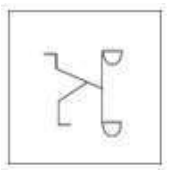
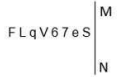
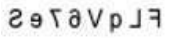
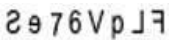
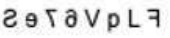
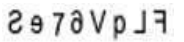
Select the correct mirror image of the given figure when the mirror is placed at the right side of the figure.

  1. AOption (a)

  2. BOption (b)

  3. COption (c)

  4. DOption (d)

View answer & explanation

Correct answer

Answer: (a)A.

Why this answer is correct

The mirror image of the given figure is:

Hence, the correct answer is "Option (1)".

Question 4

The second number in the given number-pairs is obtained by performing certain mathematical operation(s) on the first number. The same operation(s) is / are followed in all the number-pairs except one. Find that odd number - pair.

  1. AOption (a)

    7 ∶ 46

  2. BOption (b)

    13 ∶ 166

  3. COption (c)

    9 ∶ 78

  4. DOption (d)

    48 ∶ 144

View answer & explanation

Correct answer

Answer: (d)D.

48 ∶ 144

Why this answer is correct

Logic: Second no. = [(First no.)2 - 3]

Checking all the options:

(1) 7 : 46 →

⇒ [(7)2 - 3]

⇒ (49 - 3) = 46

(2) 13 : 166 →

⇒ [(13)2 - 3]

⇒ (169 - 3) = 166

(3) 9 : 78 →

⇒ [(9)2 - 3]

⇒ (81 - 3) = 78

(4) 48 : 144 →

⇒ (48 × 3) = 144

Here, in '48 : 144' different logic is followed.

Hence, the correct answer is "Option (4)".

Question 5

Priya pointed towards a man and said that he is her brother's paternal grandmother's only child. How is the man related to Priya?

  1. AOption (a)

    Brother

  2. BOption (b)

    Paternal grandfather

  3. COption (c)

    Father

  4. DOption (d)

    Son

View answer & explanation

Correct answer

Answer: (c)C.

Father

Why this answer is correct

Preparing the family tree diagram by using the following symbol:

​

As per the given information:

Here, the man is the father of Priya.

Hence, the correct answer is "Option (3)".

Question 6

Which of the following letter - clusters can replace the question mark (?) in the given series to make it logically complete?

MIT, JEQ, GAN, DWK, ?

  1. AOption (a)

    ASH

  2. BOption (b)

    YRG

  3. COption (c)

    ZRI

  4. DOption (d)

    YSJ

View answer & explanation

Correct answer

Answer: (a)A.

ASH

Why this answer is correct

Here, we use the table given below:

Given:

MIT, JEQ, GAN, DWK,?

Logic: Subtraction of (3), (4) and (3) from the position value of the first, second and third letter.

Here, 'ASH' is the next term.

Hence, the correct answer is "Option (1)".

Question 7

In a certain code language, "LAMP" is written as "66" and "OATS" is written as "53". How will "YESS" be written in that language?

  1. AOption (a)

    51

  2. BOption (b)

    55

  3. COption (c)

    45

  4. DOption (d)

    40

View answer & explanation

Correct answer

Answer: (d)D.

40

Why this answer is correct

Here, we use the table given below:

Logic: Code = (Addition of the opposite letters)

"LAMP" is written as "66" →

"OATS" is written as "53" →

Similarly, "YESS" will be coded as:

Here, 'YESS' is coded as '40'.

Hence, the correct answer is "Option (4)".

Question 8

In a certain code language, 'THIN' is coded as '1723' and 'WITH' is coded as '2417'. What is the code for 'W' in the given code language?

  1. AOption (a)

    4

  2. BOption (b)

    1

  3. COption (c)

    7

  4. DOption (d)

    2

View answer & explanation

Correct answer

Answer: (a)A.

4

Why this answer is correct

The codes for the words as per the given information:

The letters T, H and I are common in the given codes.

Here, the code for 'W' is '4'.

Hence, the correct answer is "Option (1)".

Question 9

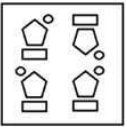
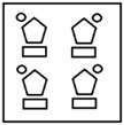
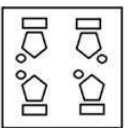
Select the figure from the options that can replace the question mark (?) and complete the given pattern.

  1. AOption (a)

  2. BOption (b)

  3. COption (c)

  4. DOption (d)

View answer & explanation

Correct answer

Answer: (a)A.

Why this answer is correct

The logic followed in the given figure series is:

From Figure (1) to (2):

The symbols move as shown below.

From Figure (2) to (3):

The symbols move as shown below.

.

From Figure (3) to (4):

The symbols move as shown below.

From Figure (4) to Answer Figure (5):

The symbols move as shown below.

Hence, the correct answer is "Option (1)".

Question 10

Select the option that is related to the fifth number in the same way as the second number is related to the first number and the fourth number is related to the third number.

9 ∶ 79 ∶∶ 11 ∶ 119 ∶∶ 7 ∶ ?

  1. AOption (a)

    41

  2. BOption (b)

    49

  3. COption (c)

    47

  4. DOption (d)

    51

View answer & explanation

Correct answer

Answer: (c)C.

47

Why this answer is correct

Given:

9 ∶ 79 ∶∶ 11 ∶ 119 ∶∶ 7 ∶ ?

Logic: Second no. = [(First no.)2 - 2]

9 : 79 →

⇒ [(9)2 - 2]

⇒ (81 - 2) = 79

11 : 119 →

⇒ [(11)2 - 2]

⇒ (121 - 2) = 119

Similarly, for '7 : ?' →

⇒ [(7)2 - 2]

⇒ (49 - 2) = 47

Here, '7 : 47' is the correct pair.

Hence, the correct answer is "Option (3)".

Question 11

Select the option that represents the correct order of the given words as they would appear in an English dictionary.

  1. Banished
  2. Bandage
  3. Bannister
  4. Bankrupt
  5. Bandwagon
  6. Banquet
  1. AOption (a)

    2, 5, 1, 3, 4, 6

  2. BOption (b)

    5, 2, 1, 4, 3, 6

  3. COption (c)

    2, 5, 1, 4, 3, 6

  4. DOption (d)

    2, 5, 4, 1, 3, 6

View answer & explanation

Correct answer

Answer: (c)C.

2, 5, 1, 4, 3, 6

Why this answer is correct

The correct order of words as they would appear in the English dictionary is:

  1. Bandage
  2. Bandwagon
  3. Banished
  4. Bankrupt
  5. Bannister
  6. Banquet

The correct order is '2, 5, 1, 4, 3, 6'.

Hence, the correct answer is "Option (3)".

Question 12

Three statements are given followed by three conclusions numbered I, II and III. Assuming the statements to be true, even if they seem to be at variance with commonly known facts, decide which of the conclusions logically follow(s) from the statements.

Statements:

All pencils are colours.

All colours are paints.

Some paints are drawings.

Conclusions:

I. Some pencils are drawings.

II. Some paints are colours.

III. Some colours are pencils

  1. AOption (a)

    Only conclusions I and III follow

  2. BOption (b)

    Only conclusions II and III follow

  3. COption (c)

    Only conclusions I and II follow

  4. DOption (d)

    All conclusions follow

View answer & explanation

Correct answer

Answer: (b)B.

Only conclusions II and III follow

Why this answer is correct

Statements:

All pencils are colours.

All colours are paints.

Some paints are drawings.

The Venn diagram as per the given statements:

Conclusions:

I. Some pencils are drawings. → not follow (Because there is no definite relation given between pencils and drawings, so it can be possible but not definitely true)

II. Some paints are colours. → Follow (All colours are paints, which means some paints are colours is definitely true)

III. Some colours are pencils → Follow (All pencils are colours, which means some colours are pencils is definitely true)

Hence, the correct answer is "Only conclusions II and III follow".

Question 13

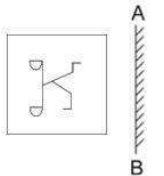
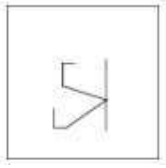
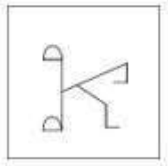
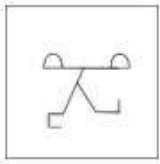
Select the correct mirror image of the given figure when the mirror is placed at AB.

  1. AOption (a)

  2. BOption (b)

  3. COption (c)

  4. DOption (d)

View answer & explanation

Correct answer

Answer: (d)D.

Why this answer is correct

The mirror image of the given figure is:

Hence, the correct answer is "Option (4)".

Question 14

Select the option that represents the letters that, when placed from left to right in the following blanks, will complete the letter - series.

Z X C _ B Z _ _ V B _ X E V _ Z _ _ V B

  1. AOption (a)

    U Y E Z B X F

  2. BOption (b)

    U X D Z B X F

  3. COption (c)

    V Y E Z B X G

  4. DOption (d)

    V X D Z B X F

View answer & explanation

Correct answer

Answer: (d)D.

V X D Z B X F

Why this answer is correct

Given:

Z X C _ B Z _ _ V B _ X E V _ Z _ _ V B

Checking all the given options:

1. U Y E Z B X F

Z X C U B / Z Y E V B / Z X E V B / Z X F V B

2. U X D Z B X F

Z X C U B / Z X D V B / Z X E V B / Z X F V B

3. V Y E Z B X G

Z X C V B / Z Y E V B / Z X E V B / Z X G V B

4. V X D Z B X F

Z X C V B / Z X D V B / Z X E V B / Z X F V B


Here, the series is completed.

Hence, the correct answer is "Option (4)".

Question 15

Select the correct mirror image of the given figure when the mirror is placed at MN as shown below.

  1. AOption (a)

  2. BOption (b)

  3. COption (c)

  4. DOption (d)

View answer & explanation

Correct answer

Answer: (a)A.

Why this answer is correct

The mirror image of the given figure is:

Hence, the correct answer is "Option (1)".

Question 16

Select the correct combination of mathematical signs to sequentially fill in the circles and to balance the given equation.

  1. AOption (a)

    ÷, ×, -, =, × 

  2. BOption (b)

    ÷, ×, =, +, +

  3. COption (c)

    +, =, ÷, ×, +

  4. DOption (d)

    ÷, ×, +, =, -

View answer & explanation

Correct answer

Answer: (d)D.

÷, ×, +, =, -

Why this answer is correct

Here, we use the BODMAS table given below:

Given:

⇒ 

(1) ÷, ×, -, =, ×

After putting the signs:

⇒ 45 ÷ 9 × 3 - 25 = 55 × 15

Apply BODMAS rule:

⇒ 5 × 3 - 25 = 55 × 15

⇒ 15 - 25 = 825

⇒ (-10) = 825

Here, the equation is not satisfied.

(2) ÷, ×, =, +, +

After putting the signs:

⇒ 45 ÷ 9 × 3 = 25 + 55 + 15

Apply BODMAS rule:

⇒ 5 × 3 = 25 + 55 + 15

⇒ 15 = 95

Here, the equation is not satisfied.

(3) +, =, ÷, ×, +

After putting the signs:

⇒ 45 + 9 = 3 ÷ 25 × 55 + 15

Apply BODMAS rule:

⇒ 54 = 0.12 × 55 + 15

⇒ 54 = 6.6 + 15

⇒ 54 = 21.6

Here, the equation is not satisfied.

(4) ÷, ×, +, =, -

After putting the signs:

⇒ 45 ÷ 9 × 3 + 25 = 55 - 15

Apply BODMAS rule:

⇒ 5 × 3 + 25 = 40

⇒ 15 + 25 = 40

⇒ 40 = 40

Here, the equation is satisfied.

Hence, the correct answer is "Option (4)".

Question 17

Select the figure that will replace the question mark (?) in the following figure series.

  1. AOption (a)

  2. BOption (b)

  3. COption (c)

  4. DOption (d)

View answer & explanation

Correct answer

Answer: (d)D.

Why this answer is correct

The logic followed in the given figure series is:

From Figure (1) to (2):

The symbols move as shown below.

From Figure (2) to (3):

The symbols move as shown below.

From Figure (3) to (4):

The symbols move as shown below.

From Figure (4) to Answer Figure (5):

The symbols move as shown below.

Hence, the correct answer is "Option (4)".

Question 18

Which two numbers and two signs should be interchanged in the following equation to make it correct?

18 - 6 + 11 × 5 + 18 = 113

  1. AOption (a)

    6 and 5, + and × 

  2. BOption (b)

    18 and 5, + and ×

  3. COption (c)

    6 and 5, - and ×

  4. DOption (d)

    18 and 5, - and ×

View answer & explanation

Correct answer

Answer: (c)C.

6 and 5, - and ×

Why this answer is correct

Here, we use the BODMAS table  given below:

Given:

18 - 6 + 11 ×\times 5 + 18 = 113

(1) 6 and 5, + and ×\times

After interchanging the respective values and signs the equation becomes:

18 - 5 ×\times 11 + 6 + 18 = 113

After applying BODMAS rule,

18 - 55 + 6 + 18 

42 - 55 = -13

it doesn't satisfy the equation.

(2) 18 and 5, + and ×\times

After interchanging the respective values and signs the equation becomes:

5 - 6 + 11 + 18 ×\times 18 = 113

After applying BODMAS rule,

5 - 6 + 11 + 324

340 - 6 = 334

It doesn't satisfy the equation.

(3) 6 and 5, - and ×\times

After interchanging the respective values and signs the equation becomes:

18 ×\times 5 + 11 - 6 + 18 = 113

After applying BODMAS rule,

90 + 11 - 6 + 18

119 - 6 = 113

Here LHS = RHS, it satisfies the equation.

(4) 18 and 5, - and ×\times

After interchanging the respective values and signs the equation becomes:

5 ×\times 6 + 11 - 18 + 18 = 113

After applying BODMAS rule,

30 + 11 - 18 + 18

49 - 18 = 31

It doesn't satisfy the equation.

Hence the correct answer is Option 3.

Question 19

Select the option that is related to the fifth term in the same way as the second term is related to the first term and the fourth term is related to the third term.

121 ∶ 10 ∶ 256 ∶ 15 ∶∶ 441 ∶ ?

  1. AOption (a)

    17

  2. BOption (b)

    20

  3. COption (c)

    21

  4. DOption (d)

    19

View answer & explanation

Correct answer

Answer: (b)B.

20

Why this answer is correct

Given:

121 ∶ 10 ∶ 256 ∶ 15 ∶∶ 441 ∶ ?

Logic: First number = (Second number + 1)2

121 : 10 →

⇒ (10 +1)2

⇒ (11)2 = 121

256 : 15 →

⇒ (15 +1)2

⇒ (16)2 = 256

Similarly, for '441 : ?'→

⇒ (x + 1)2 = 441

⇒ (x + 1) = 21

⇒ x = 20

Here, '441 : 20' is the correct pair.

Hence, the correct answer is "Option (2)".

Question 20

Select the set in which the numbers are related in the same way as are the numbers of the following sets.

(NOTE: Operations should be performed on the whole numbers, without breaking down the numbers into its constituent digits. For e.g. 13 - Operations on 13 such as adding/subtracting/multiplying etc. to 13 can be performed. Breaking down 13 into 1 and 3 and then performing mathematical operations on 1 and 3 is not allowed.)

(168, 35, 143)

(182, 65, 127)

  1. AOption (a)

    (142, 83, 69)

  2. BOption (b)

    (253, 99, 154)

  3. COption (c)

    (203, 89, 117)

  4. DOption (d)

    (159, 62, 87)

View answer & explanation

Correct answer

Answer: (a)A.

(142, 83, 69)

Why this answer is correct

Given:

(168, 35, 143)

(182, 65, 127)

Logic: Second no. = [(First no. - Third no.) + 10]

(168, 35, 143) →

⇒ [(168 - 143) + 10]

⇒ (25 + 10) = 35

(182, 65, 127) →

⇒ [(182 - 127) + 10]

⇒ (55 + 10) = 65

Checking all the given options:

1. (142, 83, 69)

⇒ [(142 - 69) + 10]

⇒ (73 + 10) = 83 = Second Number

2. (253, 99, 154)

⇒ [(253 - 154) + 10]

⇒ (99 + 10) = 109

3. (203, 89, 117)

⇒ [(203 - 117) + 10]

⇒ (86 + 10) = 96

4. (159, 62, 87)

⇒ [(159 - 87) + 10]

⇒ (72 + 10) = 82

Here, (142, 83, 69) shows a similar relation to the given set of numbers.

Hence, the correct answer is "Option (1)".

Question 21

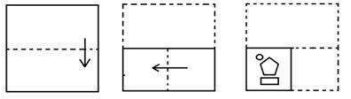
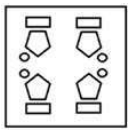
The sequence of folding a piece of paper and the manner in which the folded paper has been cut is shown below. Choose the figure that would most closely resemble the unfolded form of the paper.

  1. AOption (a)

  2. BOption (b)

  3. COption (c)

  4. DOption (d)

View answer & explanation

Correct answer

Answer: (a)A.

Why this answer is correct

Here, we unfold the paper step by step:

Step 1:

Step 2:

Hence, the correct answer is "Option (1)".

Question 22

Select the option that is related to the fifth letter - cluster in the same way as the second letter - cluster is related to the first letter - cluster and the fourth letter-cluster is related to the third letter - cluster.

BETTER : EBTTRE :: ANSWER : NAWSRE :: ACCEPT : ?

  1. AOption (a)

    CAECPT

  2. BOption (b)

    CAECTP

  3. COption (c)

    CACPET

  4. DOption (d)

    CACETP

View answer & explanation

Correct answer

Answer: (b)B.

CAECTP

Why this answer is correct

Given:

BETTER : EBTTRE :: ANSWER : NAWSRE :: ACCEPT : ?

Logic: Diagonally rearranged.

BETTER : EBTTRE →

ANSWER : NAWSRE →

Similarly, for 'ACCEPT : ?' →

Here, 'ACCEPT : CAECTP' is the correct pair.

Hence, the correct answer is "Option (2)".

Question 23

Three Statements are given followed by Three conclusions numbered I, II and III. Assuming the statements to be true, even if they seem to be at variance with commonly known facts, decide which of the conclusions logically follow(s) from the statements.

Statements:

Some sweets are chocolates.

All chocolates are cookies.

Some cookies are healthy.

Conclusions:

I. Some sweets are cookies.

II. Some cookies are chocolates.

III. Some chocolates are sweets.

  1. AOption (a)

    Both conclusions II and III follow.

  2. BOption (b)

    Both conclusions I and III follow.

  3. COption (c)

    Both conclusions I and II follow.

  4. DOption (d)

    All conclusions follow.

View answer & explanation

Correct answer

Answer: (d)D.

All conclusions follow.

Why this answer is correct

Statements:

Some sweets are chocolates.

All chocolates are cookies.

Some cookies are healthy.

The Venn diagram as per the given statements:

Conclusions:

I. Some sweets are cookies. → Follow (Some sweets are chocolates, and all chocolates are cookies, which means some sweets are cookies is definitely true)

II. Some cookies are chocolates. → Follow (All chocolates are cookies, which means some cookies are chocolates is definitely true)

III. Some chocolates are sweets. → Follow (Some sweets are chocolates, which means some chocolates are sweets is definitely true)

Hence, the correct answer is "All conclusions follow".

Question 24

Select the option that is related to the fifth letter - cluster in the same way as the second letter - cluster is related to the first letter - cluster and the fourth letter-cluster is related to the third letter - cluster.

PARROT : PTRKOM :: RECIPE : RXCBPX : RELISH : ?

  1. AOption (a)

    HJUIOK

  2. BOption (b)

    LACXIO

  3. COption (c)

    RXLBSA

  4. DOption (d)

    TFSDBM

View answer & explanation

Correct answer

Answer: (c)C.

RXLBSA

Why this answer is correct

Given:

PARROT : PTRKOM :: RECIPE : RXCBPX : RELISH : ?

Logic: 7 is subtracted from the second, fourth and sixth letter's positional value.

PARROT : PTRKOM →

RECIPE : RXCBPX →

Similarly, for 'RELISH : ?' →

Here, 'RELISH : RXLBSA' is the correct pair.

Hence, the correct answer is "Option (3)".

Question 25

Select the set in which the numbers are related in the same way as are the numbers of the given set.

(NOTE: Operations should be performed on the whole numbers, without breaking down the numbers into its constituent digits. E.g. 13 - Operations on 13 such as adding /subtracting /multiplying etc. to 13 can be performed. Breaking down 13 into 1 and 3 and then performing mathematical operations on 1 and 3 is not allowed.)

(9, 26, 53)

(8, 23, 47)

  1. AOption (a)

    (5, 14, 29)

  2. BOption (b)

    (6, 17, 36)

  3. COption (c)

    (11, 32, 56)

  4. DOption (d)

    (7, 20, 42)

View answer & explanation

Correct answer

Answer: (a)A.

(5, 14, 29)

Why this answer is correct

Given:

(9, 26, 53)

(8, 23, 47)

Logic: Third number = [(First number × 3) + Second number**]**

(9, 26, 53) →

⇒ [(9 × 3) + 26]

⇒ (27 + 26) = 53

(8, 23, 47) →

⇒ [(8 × 3) + 23]

⇒ (24 + 23) = 47

Checking all the given options:

1. (5, 14, 29)

⇒ [(5 × 3) + 14]

⇒ (15 + 14) = 29 = Third number

2. (6, 17, 36)

⇒ [(6 × 3) + 17]

⇒ (18 + 17) = 35

3. (11, 32, 56)

⇒ [(11 × 3) + 32]

⇒ (33 + 32) = 65

4. (7, 20, 42)

⇒ [(7 × 3) + 20]

⇒ (21 + 22) = 41

Here, (5, 14, 29) shows a similar relation to the given set of numbers.

Hence, the correct answer is "Option (1)".

General Awareness (25 questions)

Question 26

In which state is the Chithirai festival celebrated?

  1. AOption (a)

    Punjab

  2. BOption (b)

    Tamil Nadu

  3. COption (c)

    Rajasthan

  4. DOption (d)

    Meghalaya

View answer & explanation

Correct answer

Answer: (b)B.

Tamil Nadu

Why this answer is correct

The correct answer is Tamil Nadu.

Key Points

  • The Chithirai festival is celebrated every year at the Meenakshi Temple in Madurai, Tamil Nadu.
  • It is celebrated during the month of April for symbolizing the unity of saivitism and Vaishnavism.
  • It celebrates for fifteen days.
  • According to the Tamil calendar, Chithirai is the first month of the year.
  • On this day Lord Vishnu comes to attend the marriage ceremony of her sister and Lord Sundreshwar, which is celebrated as Chithirai.
  • During the Chithirai festival, many events take place.
  • The first event that takes place in the whole celebration of the Chithirai festival is the "Kodi Yetram".
  • In Kodi Yetram the chief priest of Meenakshi temple declares the opening of the festival by hoisting the flag on the flag post of the temple.

Additional Information

Festival NameState
Hampi FestivalKarnataka
Chhath PujaBihar, Uttar Pradesh
Karaga FestivalKarnataka
Karva ChauthPunjab, Haryana, Delhi, Uttar Pradesh
TheyyamKerala
Pariyanampetta PooramKerala
Gudi PadwaMaharashtra
Kharchi PujaTripura
LosarHimachal Pradesh, Sikkim
Chapchar KutMizoram
GangaurRajasthan
Tusu Parab or Tusu PujaJharkhand
Lohagarh MelaRajasthan
Pushkar Camel FairRajasthan
Tejaji FairRajasthan
Sawan MelaPunjab
Kang( Rath Yatra)Manipur
NuakhaiOdisha
Madai FestivalChhattisgarh

Question 27

Kalbelia dance is generally performed in which of the following states of India?

  1. AOption (a)

    Tamil Nadu

  2. BOption (b)

    Punjab

  3. COption (c)

    Rajasthan

  4. DOption (d)

    Assam

View answer & explanation

Correct answer

Answer: (c)C.

Rajasthan

Why this answer is correct

The correct answer is Rajasthan.

Key PointsKalbelia Dance: A Traditional Dance from Rajasthan

  • Kalbelia dance is a special dance from Rajasthan, India.
  • It's also called the 'Snake Charmer Dance.'
  • People from the Kalbelia tribe (The Snake Experts) perform this dance.
  • They used to catch snakes and sell their venom.
  • This unique job has influenced their dance and culture.
  • It got famous worldwide and is recognized by UNESCO since 2010.
  • The main instrument is called 'Poongi' or 'Been,' which is like a musical pipe.
  • Other instruments like drums, tambourines, and more are used.
  • Women are usually the dancers. They move like snakes while dancing. Their clothes are special: a top, a headscarf, and a long skirt.
  • The clothes are mostly black with red decorations and shiny thread patterns. They wear traditional jewelry and sometimes even mirrors on their clothes.
  • There's no school or written lessons for this dance. The knowledge is shared by talking and showing to the next generation.

Additional Information 

Folk DanceState
GhoomarRajasthan
Garba, RaasGujarat
Giddha, BhangraPunjab
LavaniMaharashtra
Kalbelia, BhavaiRajasthan
YakshaganaKarnataka
BihuAssam
JhumarJharkhand, Bihar, West Bengal
ChhauJharkhand, Odisha, West Bengal
Tamang SeloSikkim
DandiyaGujarat
TheyyamKerala
ThirayattamKerala
RouffJammu & Kashmir
Dollu KunithaKarnataka
FugdiGoa
HikatHimachal Pradesh
CherawMizoram
HojagiriTripura
Kang ChingbaManipur
JatraOdisha

Question 28

The rule of the English East India company was ended in British India under the Government of India Act, ______.

  1. AOption (a)

    1858

  2. BOption (b)

    1857

  3. COption (c)

    1859

  4. DOption (d)

    1856

View answer & explanation

Correct answer

Answer: (a)A.

1858

Why this answer is correct

the correct answer is 1858.

Key Points

  • The rule of the English East India Company ended in British India under the Government of India Act of 1858. Under this Act, the governance of India was transferred from the company to the British Crown, marking the start of the period of direct rule, also known as the British Raj.

key features of the Government of India Act of 1858:

  • End of East India Company Rule: The Act, coming into force on 2 August 1858, ended the rule of the East India Company after nearly 250 years of control over Indian territories.
  • Secretary of State for India: The Act introduced a new official post, the Secretary of State for India, who was a member of the British cabinet. He was given complete control over Indian administration and was aided by a 15-member Council of India.
  • Change in Governance Structure: The Governor-General of India, who was now also identified as the Viceroy of India, was the representative of the Crown in India and was responsible for the executive administration of the Indian provinces. This change ended the old "double government" system where the Board of Control and the Court of Directors administrating different roles.
  • Retention of Company Troops: Approximately 260,000 soldiers of the existing East India Company became soldiers of the Crown.
  • End of Doctrine of Lapse: The 1858 Act ended the much-disputed Doctrine of Lapse, introduced by Lord Dalhousie in 1848, under which the British annexed any princely state whose ruler was either "manifestly incompetent" or died without a male heir.
  • Legal Reform: With this transition, a comprehensive legal system was enforced, including the introduction of the Indian Penal Code (IPC) in 1860.
  • Civil Services: The Act opened doors to the institutionalization of the Indian Civil Services. Although Indians could sit for the civil services examinations after this Act, until 1922. Indians could appear in the Indian Civil Service Examinations which were held in England.

Additional InformationWars:

  • Anglo-Afghan Wars: These wars were fought between British India and Afghanistan. By 1858, the first of these wars (1839-1842) had already concluded with a humiliating retreat for the British. Two more Anglo-Afghan Wars would follow in the late 19th and early 20th centuries.
  • Anglo-Sikh Wars: There were two Anglo-Sikh Wars. The First Anglo-Sikh War (1845-46) and the Second Anglo-Sikh War (1848-49). As a result of these wars, the Sikh Empire was annexed by the British East India Company.
  • Burma Wars: The Second Anglo-Burmese War (1852) led to the British East India Company's annexation of the lower Burma. The third war (1885) would result in the total annexation of Burma by the British.

Social Changes:

  • Education Policies: The British tried to reform the education system, grounding it in Western philosophy and ideals. The University of Calcutta, Bombay, and Madras were established in 1857.
  • Social Reforms: Under the British rule, several old Indian social practices were challenged. For instance, the practice of Sati (the self-immolation of a widow on her husband's funeral pyre) was outlawed by Governor-General William Bentinck in 1829.
  • Religious Changes: Christian missionaries were more freely allowed to propagate Christianity, leading to a growth of this minority religion in different parts of India.
  • Infrastructure: Infrastructure, including roads and railways, telegraph and postal services were expanded, largely aimed at securing and supporting British military and administrative control.
  • Introduction of the Railways: The first passenger railway in India was opened in 1853, prior to the Government of India Act, between Bombay and Thane.

Question 29

Which of the following is a highly electropositive element that readily gives up an electron in order to obtain a stable electronic configuration?

  1. AOption (a)

    CI

  2. BOption (b)

    O

  3. COption (c)

    Na

  4. DOption (d)

    N

View answer & explanation

Correct answer

Answer: (c)C.

Na

Why this answer is correct

The correct answer is Na.

Key Points

  • Location on Periodic Table: Sodium is located in Group 1 (IA) of the periodic table, which is known as the alkali metals group. All the alkali metals are highly electropositive and show similar chemical behavior due to having one electron in their outer shell.
  • Reactivity: Sodium is highly reactive. For instance, it vigorously reacts with water to produce sodium hydroxide and hydrogen gas. It's due to its extreme reactivity that sodium is stored in oil to prevent reactions with the environment.
  • Ion Formation: Because sodium has only one electron in its outermost shell, it readily donates this electron to achieve the stable electronic configuration of the nearest noble gas, Neon. This results in a sodium ion (Na+) with a +1 charge.
  • Flame Color: Sodium ions give a distinct yellow color when heated in a flame, which is traditionally used in street lights.
  • Presence in Nature: Sodium does not occur naturally in its elemental form because of its high reactivity but is found in several minerals, including rock salt (NaCl) and soda ash (Na2CO3).
  • Biological Importance: Sodium ions play a key role in nerve impulse transmission and fluid regulation in living organisms (as part of sodium chloride or common salt which is vital for living organisms).

Additional Information

ElementGroup on Periodic TablePhysical State and AppearanceValence Electrons and Typical IonsReactivityNatural OccurrenceBiological Importance
Chlorine (Cl)Group 17 (Halogens)Greenish-yellow gas7 valence electrons; Forms Cl- ionHighly reactive; supports combustionMostly found as part of compounds such as Sodium Chloride (NaCl)Used for disinfection and as a bleaching agent
Oxygen (O)Group 16 (Chalcogens)Colorless, odorless, and tasteless gas6 valence electrons; Forms O2- ionSupports combustionComponent of the Earth's atmosphere (~21%)Essential for cellular respiration
Nitrogen (N)Group 15 (Pnictogens)Colorless, odorless, and tasteless gas5 valence electrons; Forms N3- ion or covalent bondsNot reactive at standard temperature and pressureMost abundant element in the Earth's atmosphere (~78%)Essential building block of amino and nucleic acids

Question 30

The famous scientist, Albert Einstein, was inspired by whose idea of non - violence?

  1. AOption (a)

    Mahatma Gandhi

  2. BOption (b)

    Vardhaman Mahavira

  3. COption (c)

    Gautam Buddha

  4. DOption (d)

    BR Ambedkar

View answer & explanation

Correct answer

Answer: (a)A.

Mahatma Gandhi

Why this answer is correct

The correct answer is Mahatma Gandhi.

Key Points

  • Albert Einstein was known to greatly admire the philosophy and principles advocated by Mahatma Gandhi, particularly the concept of non-violence or "ahimsa".
  • He had corresponded with Gandhi and expressed his admiration.
  • There is a famous quote attributed to Einstein about Gandhi: "Generations to come, it may well be, will scarce believe that such a man as this one ever in flesh and blood walked upon this Earth".

Additional Information

  • Vardhaman Mahavira
  • Born in 599 BCE in Kundalagrama, Bihar, in a royal family of the Kshatriya clan.
  • Mahavira means "Great Hero" – a title he earned through his teachings. He's often referred to as 'Jain' since his followers are called 'Jains'.
  • Became the 24th Tirthankara (religious teacher) of Jainism at around age 42 after 12 years of rigorous ascetic practices.
  • He propagated the principle of Ahimsa (non-violence), truth, asceticism, and righteousness.
  • His teachings included the central tenet of Jainism: the Three Jewels, or right faith, right knowledge, and right conduct.
  • Mahavira is traditionally believed to have been born in 599 BCE and to have achieved Nirvana (release from the cycle of birth and death) in 527 BCE.
  • Mahatma Gandhi
  • Born on 2nd October 1869, in Porbandar, Gujarat is celebrated as the International Day of Non-Violence.
  • Led famous movements against the British rule, such as Non-Cooperation Movement (1920-22), Civil Disobedience Movement (1930), and Quit India Movement (1942), which resulted in India's independence in 1947.
  • Assassinated on 30th January 1948, by Nathuram Godse.
  • His philosophy of peaceful resistance, known as Satyagraha, has inspired civil rights movements worldwide.
  • Gautam Buddha
  • Siddhartha Gautama, known as the Buddha, was the founder of Buddhism.
  • He was born as a prince in Lumbini (present-day Nepal) but renounced his royal life when confronted with the realities of human suffering.
  • His teachings, known as Dhamma in Buddhism, includes the Four Noble Truths and the Eightfold Path, which articulate the reality of suffering and the path to the cessation of suffering.
  • Established the Sangha, an order of monks, for the spread of his teachings.
  • Buddha is believed to have attained Nirvana (Enlightenment) under the Bodhi tree at Bodhgaya, Bihar, India.
  • B. R. Ambedkar
  • Full name Bhimrao Ramji Ambedkar, often known as Babasaheb, he was an Indian jurist, economist, and social reformer.
  • He played a pivotal role in drafting the Indian constitution and is widely known as the "Father of the Indian Constitution."
  • As a leading activist and social reformer, Ambedkar campaigned against social discrimination towards the untouchables (Dalits).
  • He led the Mahad Satyagraha on 20th March 1927 to allow untouchables to use water from a public tank in Mahad, Maharashtra.
  • As the first Minister of Law and Justice of India, he played a key role in drafting the Indian Constitution.
  • He was also the one to lead Dalit Buddhist Movement in 1956 in India for the rights and upliftment of Dalits. His death anniversary on 6th December is observed as "Mahaparinirvan Diwas" across India.

Question 31

Which of the following is INCORRECTLY matched?

  1. AOption (a)

    Mountain climate - Uttar Pradesh, Bihar and Jharkhand

  2. BOption (b)

    Tropical monsoon climate - The Western Ghats, the Malabar Coast and southern Assam

  3. COption (c)

    Tropical semi-arid (steppe) climate - Karnataka, central Maharashtra, some parts of Tamil Nadu and Andhra Pradesh

  4. DOption (d)

    Hot deserts, arid climate - Rajasthan and some parts of Gujarat

View answer & explanation

Correct answer

Answer: (a)A.

Mountain climate - Uttar Pradesh, Bihar and Jharkhand

Why this answer is correct

The correct answer is Montane climate - Uttar Pradesh, Bihar and Jharkhand.

Key Points

  • Mountain Climate: This is not exactly a category on Köppen’s climate classification but is typically characterized by cooler temperatures due to higher altitudes, and it is associated with mountainous regions.
  • Examples can be found in the Himalayan range, parts of the Andes, and the Rocky Mountains.
  • Uttar Pradesh, Bihar, and Jharkhand are not predominantly mountainous regions.
  • More accurately, the montane climate is seen in states like Himachal Pradesh, Uttarakhand, Sikkim, Arunachal Pradesh, and parts of states like Jammu & Kashmir or Ladakh, where the Himalayan range is present.

Therefore, this matching of "Montane Climate - Uttar Pradesh, Bihar, and Jharkhand" is incorrectly matched.

Additional Information

  • The Monsoon Type: Most of India (the entire North Indian plains, parts of Gujarat, Madhya Pradesh, Bihar, Jharkhand, West Bengal, Orissa, Andhra Pradesh, Tamil Nadu, and North-Eastern states) experiences this type of climate. It is characterized by the seasonal reversal of winds and a sharp contrast between the dry and wet seasons. The summers are hot, and the monsoons bring heavy rainfall.
  • Tropical Rainforest Climate: Found in the Andaman and Nicobar Islands, parts of Western Ghats, north-eastern states of India, and the Sundarbans delta. The regions experience high temperatures throughout the year, heavy annual rainfall (ranging from 200 cm to 300 cm), and high humidity.
  • Tropical Savanna Climate: Identified in most parts of the Indian peninsula, except the extreme north. Rainfall (75-150 cm per year) is concentrated in the monsoon season. Coimbatore, Karnataka, Andhra Pradesh, and central Maharashtra fall under this category.
  • Desert Climate: Predominantly seen in the north-western parts of India, including most parts of Rajasthan and areas of Gujarat, Punjab, and Haryana. The region experiences extremely low and erratic rainfall (less than 75 cm per year), high temperature variations between day and night, and extreme overall temperatures ranging from very hot in summer to very cold in winter.
  • Tropical Semi-arid (Steppe) climate: It falls under the "BSh" category in the Köppen-Geiger climate classification. This type of climate is characterized by low precipitation and high evaporation rates, and while it's hot, it's not as extreme as a desert climate. There is a noteable, but not necessarily extreme, difference between summertime and wintertime temperatures.
  • ​In India, the tropical semi-arid (steppe) climate is found mainly on the leeward side of the Western Ghats (areas in the rain shadow region), parts of Rajasthan, Punjab, Haryana, and some parts of Gujarat, Maharashtra, Karnataka,some parts of Tamil Nadu and Andhra Pradesh
  • Rainfall: Typically 25-75 cm per year). Most rainfall occurs during the area's monsoon season.
  • Temperature: Remain high throughout the year, averaging around 20-30°C. Summers can be extremely hot, and winters are mild to warm.
  • Sub-Tropical Humid Climate: Found in the northern plains of India from Punjab to West Bengal. These regions have distinct summer, monsoon, and winter seasons. Summers are very hot and winters can get fairly chilly.
  • Mountain Climate or Highland Climate: Found in the mountainous or hilly regions of India, such as the Western and Eastern Ghats, and the Himalayan range, including states like Uttarakhand, Himachal Pradesh, and Sikkim. The climate varies depending on altitude, resulting in a variety of weather conditions within a small area.
  • Coastal Climate: Characteristic of coastal regions along the Arabian Sea and the Bay Of Bengal. These areas have high temperature and rainfall throughout the year, and are prone to cyclones, particularly on the eastern coast.

Question 32

Diwan - i - Arz was essentially the department of ______ under Delhi Sultanate.

  1. AOption (a)

    financial services

  2. BOption (b)

    court ceremonies

  3. COption (c)

    military services

  4. DOption (d)

    royal karkhanas

View answer & explanation

Correct answer

Answer: (c)C.

military services

Why this answer is correct

The correct answer is Military services.

Key PointsSome key administrative departments and officials during the period of the Delhi Sultanate, especially under Balban's rule:

  • Diwan-i-Arz: It was the department of military affairs, responsible for maintaining the army, assessing taxation for military funding and dealing with all matters related to war and soldiers.
  • Diwan-i-Wizarat: Also known as the department of finance, it was in charge of the income and expenditure of the state. It collected revenues and disbursed salaries.
  • Diwan-i-Risalat: This was the department of foreign affairs, which dealt with diplomacy and protocol, as well as dispatching ambassadors to foreign states.
  • Diwan-i-Insha: It was a secretarial department, responsible for composing royal orders and correspondence.
  • Diwan-i-Qaza: It was essentially the department of justice, presided over by the chief Qazi, which dealt with judicial and legal affairs.
  • Barid-i-Mumalik: The head of the intelligence and information system established by Balban. This official was responsible for gathering and reporting all relevant information to the Sultan.
  • Naib-i-Mumalik: During Balban's rule, he introduced a new office, Naib-i-Mumalik or Naib Sultan, an office equivalent to that of a Viceroy. He himself served in this capacity under Sultan Nasiruddin.
  • Amir-i-Hajib: Sultan Balban increased the importance of the role of the Amir-i-Hajib who was the Master of Ceremonies at the court. He held an important position among the central nobility responsible for access to the Sultan.

Additional Information

SultanateRulerRuled YearsKey Departments/Initiatives
Slave DynastyQutb ud-Din Aibak1206-1210Foundation of Qutb Minar
Iltutmish1211-1236Iqta System, Administration setup
Raziya Sultan1236-1240Implemented military reforms
Khilji DynastyAlauddin Khilji1296-1316Market regulation (Diwan-i-Riyasat), Price control
Tughlaq DynastyMuhammad bin Tughlaq1325-1351Transfer of capital to Daulatabad, Token currency, Diwan I koi (agricultural department) introduced
Firoz Shah Tughlaq1351-1388Diwan-i-Khairat (Office for Charity), Diwan-i-Bandagan (Department for Slaves)
Sayyid DynastyKhizr Khan1414-1421Consolidated Muslim Rule
Lodhi DynastyBahlol Lodi1451-1489Expansion of Sultanate's territory
Sikandar Lodi1489-1517Moved capital to Agra,
Ibrahim Lodi1517-1526Last ruler before the advent of the Mughal Empire

Question 33

What is the full form of IADP?

  1. AOption (a)

    Intensive Agricultural District Programme

  2. BOption (b)

    Indian Agricultural Development Programme

  3. COption (c)

    Integrated Agricultural District Plan

  4. DOption (d)

    Intensive Agricultural Development Project

View answer & explanation

Correct answer

Answer: (a)A.

Intensive Agricultural District Programme

Why this answer is correct

The correct answer is Intensive Agricultural District Programme.

Key PointsThe Intensive Agricultural District Programme (IADP):

  • It was the first major experiment in India's agricultural sector towards increasing agricultural production after Indian independence. It was introduced in 1960 in the wake of the success of community development programmes which aimed to increase the income and improve the standard of living of farmers.
  • Objectives: The primary objective of the IADP was to increase overall agricultural production in a sustainable manner, while also increasing the incomes of farmers.
  • Select Districts: The programme was introduced in selected districts with the most potential for agricultural development. Initially, it was launched in seven districts: West Godavari (Andhra Pradesh), Thanjavur (Tamil Nadu), Ludhiana (Punjab), Pali (Rajasthan), Aligarh (Uttar Pradesh), Ganjam (Odisha) and Raipur (Madhya Pradesh).
  • Multiple Approaches: The IADP focused on a multiple approach where different facets of agriculture like high-yielding variety seeds, irrigation, use of fertilisers, consolidation of holdings, land levelling, mechanisation and plant protection measures were stressed upon.
  • Allocation of Funds: Financial assistance was provided through sources like cooperative credit institutions, commercial banks, regional rural banks etc.
  • High Yielding Varieties (HYV): The IADP gave a major push towards the use of high-yielding varieties of seeds and paved the way for the Green Revolution.
  • Agricultural Training: Training was a critical part of the IADP. This was to ensure that farmers could make the best use of improved and modern agricultural practices.
  • Evaluation and Impact: It's been noted that post-IADP there was substantial increase in agricultural productivity and income. It laid the groundwork for the Green revolution in India.

Additional Information

Program/InitiativeYear StartedObjectives
Community Development Programme (CDP)1952To initiate development at the village level incorporating measures like education, health care, housing.
Intensive Agricultural District Programme (IADP)1960To increase agricultural production using high-yielding variety seeds and advanced techniques.
High Yielding Varieties Programme (HYVP)1966To promote the use of high-yielding variety seeds, especially for food crops.
Drought Prone Areas Program (DPAP)1973To minimize the impact of droughts by promoting agricultural productivity in drought-prone areas.
Command Area Development Programme (CADP)1974To increase agricultural production by improving the irrigation efficiency.
Integrated Rural Development Program (IRDP)1978To focus on rural development including job creation, improved infrastructure, and better livelihoods.
National Agricultural Insurance Scheme (NAIS)1999To provide insurance coverage and financial support to farmers in case of natural disaster or pest attacks.
Pradhan Mantri Fasal Bima Yojana (PMFBY)2016To provide a comprehensive crop insurance scheme to secure the farmers from crop failure.
Pradhan Mantri Krishi Sinchai Yojana (PMKSY)2015To extend the coverage of irrigation, increase farm productivity and ensure better use of resources.
Soil Health Card Scheme2015To help farmers understand the health of soil and advise them on different fertilizers suitable for crops.

Question 34

Who among the following has been appointed as the new Chairperson of the National Company Law Appellate Tribunal (NCLAT), for a period of four years or until he attains the age of 70 years, whichever is the earliest in November 2021?

  1. AOption (a)

    Justice Vikram Nath

  2. BOption (b)

    Justice BV Nagarathna

  3. COption (c)

    Justice Ashok Bhushan

  4. DOption (d)

    Justice Abhay Oka

View answer & explanation

Correct answer

Answer: (c)C.

Justice Ashok Bhushan

Why this answer is correct

The correct answer is Justice Ashok Bhushan.

Key Points

  • Govt. appoints Justice Ashok Bhushan as NCLAT chairperson, Justice R. Sudhakar as NCLT president.

Additional Information

  • The National Company Law Appellate Tribunal (NCLAT) is a crucial quasi-judicial body in India. Here are some essential points about NCLAT which would be useful from an exam perspective:
  • Establishment: NCLAT was constituted under Section 410 of the Companies Act, 2013 for hearing appeals against the orders of National Company Law Tribunal(s) (NCLT).
  • Date of Creation: NCLAT was established on 1st June 2016.
  • Function: NCLAT hears appeals against the orders of NCLT under Section 61 of the Insolvency and Bankruptcy Code, 2016 (IBC). It also hears appeals against the decisions of the Insolvency and Bankruptcy Board of India.
  • Jurisdiction: In addition to company law disputes, NCLAT also hears appeals from orders issued by the Competition Commission of India (CCI).
  • Chairperson: The Chairperson of NCLAT is appointed by the President of India.
  • Members: NCLAT consists of a chairperson, judicial members, and technical members.
  • Term of Office: As per the rules, the term of office for the Chairperson and members is five years or till they attain 70 years of age, whichever is earlier [1].
  • Appeals: Orders of NCLAT can be appealed in the Supreme Court of India.
  • Significance: NCLAT plays a critical role in India's legal landscape by ensuring that companies follow laws and regulations, and it provides a vital mechanism for resolving disputes under the Companies Act, 2013 and the IBC, 2016 efficiently and quickly.

Question 35

Under which policy has the Union Ministry of Power launched a scheme for procurement of aggregate power of 4500 MW for five years?

  1. AOption (a)

    Urja Sanchay Policy

  2. BOption (b)

    Shakti Policy

  3. COption (c)

    Nai Urja Policy

  4. DOption (d)

    Gatishakti Policy

View answer & explanation

Correct answer

Answer: (b)B.

Shakti Policy

Why this answer is correct

The correct answer is Shakti Policy.

Key Points

  • Ministry of Power introduced a scheme for acquiring aggregate power of 4500 MW over five years under SHAKTI Policy.
  • The purpose is to assist states experiencing power shortages and aid power generation plants in boosting their capacities.
  • PFC Consulting Limited is the designated nodal agency responsible for the scheme's implementation.
  • Invitations for bids have been extended to supply 4500 MW of electricity, with commencement planned for April of the following year.
  • Interested utilities that have expressed intent include:
  • Gujarat Urja Vikas Nigam Ltd
  • Maharashtra State Electricity Distribution Company Ltd
  • Madhya Pradesh Power Management Company Ltd
  • New Delhi Municipal Corporation
  • Tamil Nadu Generation and Distribution Corporation Ltd.
  • Bid submission deadline is set for 21st December.
  • This marks the first instance of bidding conducted under B(v) of the SHAKTI scheme.
  • SHAKTI, short for Scheme for Harnessing and Allocating Koyala Transparently in India, was initiated in 2018.
  • Its primary aim is to provide coal to power units facing supply challenges.

Question 36

Which element was arbitrarily assigned a value of 4.0 in the 'Halogens' section in 1922 by Linus Pauling, an American scientist?

  1. AOption (a)

    Fluorine

  2. BOption (b)

    lodine

  3. COption (c)

    Astatine

  4. DOption (d)

    Bromine

View answer & explanation

Correct answer

Answer: (a)A.

Fluorine

Why this answer is correct

The correct answer is Fluorine.

Key Points

  • Fluorine is the element that was arbitrarily assigned a value of 4.0 by Linus Pauling in the 'Halogens' section in 1922.
  • Linus Pauling was an American chemist who developed the concept of electronegativity, and he assigned fluorine the highest electronegativity among all elements.

Additional InformationMajor points on electronegativity and Linus Pauling's contribution:

  • Electronegativity: Electronegativity is a measure of the ability of an atom to attract the shared pair of electrons towards itself in a covalent bond.
  • Linus Pauling: Linus Pauling, an American chemist and two-time Nobel laureate, is widely known for his work in quantum chemistry and molecular biology. He introduced the concept of electronegativity in 1932.
  • Pauling Scale: Linus Pauling proposed the most commonly used electronegativity scale, known as the Pauling scale. This scale is dimensionless and ranges from 0.7 for francium (the least electronegative element) to 4.0 for fluorine (the most electronegative).
  • Fluorine: In Pauling's scale, he arbitrarily assigned a value of 4.0 to fluorine, the highest among all elements, as it has the highest ability to attract electrons towards itself in a chemical bond.
  • Significance: Electronegativity is a critical property used to predict the nature of bonds in a molecule (whether it will be ionic, polar covalent, or nonpolar covalent) as well as the polarity of the molecule itself.

Important Points

ElementAtomic numberElectron configurationState at room temperatureKey Uses/ApplicationsOther Important Points
Bromine (Br)35[Ar] 4s2 3d10 4p5LiquidUsed in fumigants, flameproofing agents, water purification compounds.Bromine is the only non-metallic element that is liquid at room temperature.
Iodine (I)53[Kr] 5s2 4d10 5p5SolidUsed in medicine, photography, dyes. Essential nutrient for humans.In its elemental form, iodine occurs as a purple-black, shiny crystalline solid.
Astatine (At)85[Xe] 6s2 4f14 5d10 6p5SolidNo significant uses due to its high radioactivity and scarcity in nature.Astatine is the rarest naturally occurring element on the Earth's crust.

Question 37

The MITRA scheme was first announced in the Union Budget for 2021-22 to set up world-class infrastructure in which sector?

  1. AOption (a)

    Automobiles

  2. BOption (b)

    Textile industry

  3. COption (c)

    Defence manufacturing

  4. DOption (d)

    Pharmaceuticals

View answer & explanation

Correct answer

Answer: (b)B.

Textile industry

Why this answer is correct

The correct answer is Textile industry.

Key Points

  • The "MITRA" scheme was first announced in the Union Budget for 2021-22 by Finance Minister Nirmala Sitharaman focusing on the Textile sector.
  • MITRA stands for "Mega Investment Textiles Parks".
  • The scheme aims to establish world-class infrastructure in the textile industry to create employment opportunities and increase export potential.
  • The goal is to set up seven textile parks over three years, leading to a globally competitive industry equipped with cutting-edge technology and infrastructure.
  • These textiles parks will have integrated facilities and will be set up on a partnership basis between the central government, state governments, and the industry.
  • They will also include facilities for design development, testing, research & development, and warehousing.

Question 38

Where in India are the Sundari trees that provide durable and hard timber found?

  1. AOption (a)

    Tropical Deciduous Forests

  2. BOption (b)

    Mangrove Forests

  3. COption (c)

    Montane Forests

  4. DOption (d)

    Tropical Evergreen Forests

View answer & explanation

Correct answer

Answer: (b)B.

Mangrove Forests

Why this answer is correct

The correct answer is Mangrove Forests.

Key Points

  • The Sundari trees, also known by their scientific name Heritiera fomes, are found in the mangrove forests in India, specifically, the Sundarbans - one of the largest continuous mangrove forests in the world.
  • The Sundarbans, a UNESCO World Heritage Site, is named after the Sundari tree.
  • It is located in the delta region of the Padma, Meghna and Brahmaputra river basins, sprawling across Bangladesh and the Indian state of West Bengal.
  • These trees are well-adapted to the saline and waterlogged environment of the mangrove forests.
  • The Sundari tree provides high-quality timber which is durable, hard and resistant to termites, earning high commercial value.
  • However, their numbers have been declining due to climate change, rising sea levels, and logging activities, leading to conservation concerns.

Additional Information

  • India is known for its wide biodiversity and it hosts various types of forests. According to the classification done by Champion and Seth, the forests of India are divided into the following major types:
  • Tropical Evergreen Forests: Found in regions with annual rainfall above 200cm. No distinct dry season. Major states: Andaman and Nicobar Islands, parts of North Eastern states, a narrow strip of the Western slope of the Western Ghats.
  • Tropical Semi-Evergreen Forests: Found in regions with rainfall between 200cm to 100cm. Major states: Assam, West Bengal, Odisha, Bihar, Uttar Pradesh, and the plateau region of Maharashtra.
  • Tropical Moist Deciduous Forests: Rainfall between 200 cm to 70 cm. Dry season varies from 1-2 months to 6-8 months. Major states: Madhya Pradesh, Uttar Pradesh, Bihar, Maharashtra, Karnataka, and Tamil Nadu.
  • Tropical Dry Deciduous Forests: Rainfall between 100 cm to 70 cm. Major states: Punjab, Haryana, Madhya Pradesh, Rajasthan, Gujarat, Andhra Pradesh, and Tamil Nadu.
  • Tropical Thorn Forests: Found in areas with rainfall less than 70 cm. Major regions: Northwestern part of the country - Rajasthan, Gujarat, parts of Madhya Pradesh and Uttar Pradesh.
  • Montane Forests: Forests in the mountainous areas, further divided into:
  • Wet Montane Forests: Found in Western Ghats, hills of Assam, and Tamil Nadu.
  • Moist temperate Montane Forests: Areas with annual rainfall between 200 cm to 100 cm.
  • Dry temperate Montane Forests: Rainfall can go as low as 30 cm per year.
  • Littoral and Swamp Forests: These include all tidal forests in the country. Major areas: Sunderbans in West Bengal and the Andaman and Nicobar Islands.
  • Mangrove Forests: Found in intertidal zones along the coast, particularly in the Sunderbans, Andaman and Nicobar Islands, deltas of the major rivers such as the Godavari, Krishna, and Mahanadi.

Question 39

Which of the following is NOT included in domestic income?

  1. AOption (a)

    Income earned by the residents of the country

  2. BOption (b)

    Income earned by the non-residents outside the country

  3. COption (c)

    Income earned by all the employees of the country

  4. DOption (d)

    Profit of all the industries of the country

View answer & explanation

Correct answer

Answer: (b)B.

Income earned by the non-residents outside the country

Why this answer is correct

The correct answer is Income earned by the non-residents outside the country.

Key Points

  • Domestic income, also known as Gross Domestic Product, is the total income earned by all sectors (households, firms, and the government) within the geographical boundaries of a country, irrespective of whether they are residents or non-residents.
  • However, income earned by non-residents outside the country is NOT included in the domestic income. Such income is part of the national income, not domestic income.

Additional Information

  • Gross Domestic Product (GDP): This is the total monetary value of all final goods and services produced within a country's borders over a specific period, typically a year.
  • Gross National Product (GNP): It is the total market value of all final goods and services produced by residents of a country in a given period of time.
  • GNP = GDP + Net Factor Income from Abroad (NFIA)
  • Here, Net Factor Income from Abroad = Income earned by domestic factors of production from rest of the world - Income earned by factors of production of rest of the world from the domestic economy
  • Net National Product (NNP) at Factor Cost or National Income (NI): This is the GNP minus depreciation.
  • NNP or NI = GNP - Depreciation
  • Net Domestic Product (NDP): This is the GDP minus depreciation.
  • NDP = GDP - Depreciation
  • Per Capita Income: It is a measure of the amount of money earned per person in a certain area.
  • Per Capita Income = National Income / Total Population
  • Factor Income: It's the income that factors of production (land, labour, capital, and entrepreneurship) receive in return for their contribution to the production process.
  • Transfer Payments: These are payments made without the provision of goods or services in return. Examples are social security benefits, pensions, unemployment benefits, etc. Transfer payments are not included in the computation of national income as they do not involve productive activity.

Question 40

As per National Family Health Survey (NFHS-5) 2019 - 21, what percentage of women have a bank or savings account that they themselves use?

  1. AOption (a)

    68.3%

  2. BOption (b)

    78.6%

  3. COption (c)

    87.7%

  4. DOption (d)

    58.5%

View answer & explanation

Correct answer

Answer: (b)B.

78.6%

Why this answer is correct

The correct answer is 78.6%.

Key Points

  • Union Minister for Health and Family Welfare, Dr. Mansukh Mandaviya released the National Report of the fifth round of National Family Health Survey (NFHS-5).
  • The report comprises of detailed information on key domains of population, health and family welfare and associated domains like characteristics of the population; fertility; family planning; infant and child mortality; maternal and child health; nutrition and anaemia; morbidity and healthcare; women’s empowerment etc.

Additional Information

The National Family Health Survey (NFHS-5) 2019-2021 has many key findings, including: 

  • The sex ratio was 1,020 women for every 1,000 men.
  • The under-five mortality rate dropped from 50 deaths per 1,000 live births in 2015-16 to 42 deaths per 1,000 in 2019-21.
  • The infant mortality rate also declined from 41 deaths per 1,000 live births to 35 deaths per 1,000 live births.
  • The percentage of 20–24 year old girls who married before age 18 decreased from 26.8% to 23.3%.
  • The adolescent fertility rate (women aged 15–19) decreased from 51% to 43%.

Question 41

Tansen, who was included in the Navaratnas of Akbar, was an expert in playing which of the following musical instruments?

  1. AOption (a)

    Nagada

  2. BOption (b)

    Veena

  3. COption (c)

    Sarangi

  4. DOption (d)

    Rabab

View answer & explanation

Correct answer

Answer: (d)D.

Rabab

Why this answer is correct

The correct answer is Rabab.

Key Points

  • Tansen, one of the Navaratnas of Akbar's court, was a notable figure in Hindustani classical music.
  • He was an exceptional vocalist and is also known for his expertise in playing the Rudra Veena or "Rabab" an ancient Indian string instrument.

Additional InformationAkbar's Navaratnas, or Nine Jewels, were a group of nine talented individuals at the court of the Mughal Emperor Akbar. Each of them was well known for their respective skills and contributions. They were:

  • Abul Fazl (also known as Allami): The full name of Abul Fazl is Abu'l-Fazl ibn Mubarak. He was one of the most important historians during the reign of Akbar. His most known writings are the Akbarnama and the Ain-i-Akbari. Akbarnama is a historical account of Akbar's reign, and Ain-i-Akbari is a detailed document recording the administration of the empire.
  • Faizi (or Shaikh Faiz): His real name was Shaikh Faizi Sirhindi. He was a brilliant poet and scholar. He is known for his poetry collection called "Taskeen-e-ruh-o-dil" and also his interpretation of ancient texts.
  • Raja Birbal (originally named Mahesh Das): He was a poet and musician, admired for his quick wit, intelligence and his keen sense of humor. Among his notable contributions are the Birbal stories, popular folklore that's been passed down generations.
  • Raja Todar Mal (Todar Mall): He was a finance minister (Diwan-i-Ashraff) who undertook innovative measures like standardizing land measurements to improve the revenue system. He doesn't have any known books or musical contributions.
  • Tansen (originally named Ramtanu Pandey): He was associated with the Dhrupad style and a pioneer of Indian classical music. He composed many ragas which are still in use today.
  • Raja Man Singh (Man Singh I): He led many successful military campaigns for Emperor Akbar. He was influential in the administration and politics.
  • Abdul Rahim Khan-I-Khana (Rahim): He is known for his 'dohas' or couplings in Hindi. He is also known for translating Babar's memoirs, Baburnama from Chagatai language to Persian.
  • Fakir Aziao-Din: He was one of the chief advisors to Akbar and was highly respected for his wisdom and spirituality.
  • Mullah Do Piaza: His contributions are mainly in the form of folklore, with stories about his wisdom and wit being highlighted in Mughal anecdotes.

Question 42

Match the following countries with respect to their ranking on the Global Hunger Index 2022 out of 121 countries. 

CountryRank
1.Indiaa.99
2.Pakistanb.107
3.Nepalc.81
  1. AOption (a)

    1 - c, 2 - a, 3 - b

  2. BOption (b)

    1 - b, 2 - c, 3 - a

  3. COption (c)

    1 - a, 2 - b, 3 - c

  4. DOption (d)

    1 - b, 2 - a, 3 - c

View answer & explanation

Correct answer

Answer: (d)D.

1 - b, 2 - a, 3 - c

Why this answer is correct

The correct answer is 1 - b, 2 - a, 3 - c.

Key Points

  • India has been ranked 107th out of 121 countries in the 2022 Global Hunger Index (GHI) released on 14th October 2022.
  • In 2021, India was ranked 101st out of 116 countries.
  • India has fared poorer than its neighbours Pakistan (99th), Nepal (81st) and Bangladesh (84th).
  • The index calculates the hunger levels and malnutrition across the world.
  • Published by: Concern Worldwide and Welthungerhilfe.

Important Points

  • This year, the report accessed data from 136 countries but evaluated 121 of them.
  • The Global Hunger Index score is calculated on four indicators – undernourishment, child wasting (the share of children under the age of five with low weight for their height), child stunting (children under the age of five with low height for their age) and child mortality (the mortality rate of children under the age of five).
  • India’s global hunger index score is 29.1, which puts the country in the “serious” category of hunger problems.
  • In 2021, India's score was 27.5.
  • Lesser GHI score means better ranking in the index.
  • Globally, 17 countries, including China, Hungary, Montenegro, Uzbekistan, Russia and Saudi Arabia, shared the top spot.
  • No country has been placed in the extremely alarming category this year.​

Question 43

Mitochondria is NOT found in ______.

  1. AOption (a)

    yeast

  2. BOption (b)

    bacteria

  3. COption (c)

    algae

  4. DOption (d)

    fungi

View answer & explanation

Correct answer

Answer: (b)B.

bacteria

Why this answer is correct

The correct answer is bacteria.

Key Points

  • Mitochondria are not found in bacteria.
  • Bacteria are prokaryotic cells and do not contain organelles, such as mitochondria, that are found in eukaryotic cells.
  • It's interesting to note that it's widely accepted that mitochondria originated from a type of prokaryote due to a symbiotic event in the distant past, a theory known as endosymbiosis.

Additional Information​​Mitochondria:

  • Cell Organelle: Mitochondria are cell organelles in eukaryotic cells. They are not present in prokaryotic cells like bacteria.
  • Structure: Each mitochondrion is a double-membrane-bound structure with the outer membrane being smooth and the inner one thrown into folds or cristae.
  • Powerhouse of the Cell: Mitochondria are often referred to as the 'powerhouse of the cell'. They are the sites of cellular respiration and produce energy in the form of ATP (adenosine triphosphate).
  • Semi-Autonomous: Mitochondria are semi-autonomous organelles. They have their own DNA and ribosomes, meaning they can manufacture their own proteins and replicate independently of the cell in which they reside. This suggests a symbiotic origin to the mitochondria, supporting the endosymbiotic theory.
  • Number of Mitochondria: The number of mitochondria in a cell can vary greatly depending on the cell type. For example, cells with high energy needs like muscle cells have more mitochondria, while other cells may have very few.
  • Size and Shape: Mitochondria are typically rod-shaped or oval in nature. Their size ranges from 0.5 to 1.0 micrometre in diameter.
  • Role in Metabolism: Mitochondria are not only the energy factories of the cell, but also participate in other metabolic tasks such as the synthesis of certain components of blood and hormones, the metabolism of cholesterol, and the regulation of calcium concentration in the cell.
  • Cytochromes: Mitochondria contain a number of enzymes, including the cytochromes, which participate in electron transport during aerobic respiration.
  • Matrix Space: The space within the inner membrane of a mitochondrion is known as the matrix. It contains a number of enzymes, the mitochondrial DNA, ribosomes, and granules that store calcium phosphate.
  • Oxysomes or F1 Particles: The inner membrane of mitochondria bears some spherical bodies called oxysomes or F1 particles. These particles are involved directly in ATP synthesis.
  • Krebs Cycle: The process by which energy is produced in the mitochondria, the Krebs (or citric acid) cycle, is a series of biochemical reactions that generate energy through the oxidation of acetate—derived from carbohydrates, fats, and proteins—into carbon dioxide.
  • Mitochondrial Disorders: Certain genetic disorders have been linked to mutations in mitochondrial DNA. These include some forms of heart disease, diabetes, and Leigh's syndrome, a progressive neurometabolic disorder.
  • Role in Aging: Some theories suggest a role for mitochondria in the aging process. The free-radical theory of aging suggests that accumulated damage from oxidative stress (the imbalance between the production of free radicals and the ability of cells to counteract their harmful effects), largely caused by mitochondria, results in the physiological changes we associate with aging.
  • Mitophagy: The process in which defective mitochondria are destroyed by cellular machinery is termed 'mitophagy'. This is a vital process as it assists in maintaining the proper functioning of cells by removing damaged mitochondria that could potentially harm the cell.

Question 44

Which of the following pairs is/are correctly matched regarding the terminology used in the Parliament?

A. Appropriation Bill - A Money Bill passed for providing for the withdrawal or appropriation from and out of the Consolidated Fund of India

B. Demand for Grants - Earmarking of budgetary allocation for meeting only planned expenditure of a Ministry/Department

C. Short Duration Discussion - For raising a discussion on a matter of urgent public importance for which a notice has to be given by a Member and supported by 50 Members

  1. AOption (a)

    A, B and C

  2. BOption (b)

    B only

  3. COption (c)

    A only

  4. DOption (d)

    A and C only

View answer & explanation

Correct answer

Answer: (c)C.

A only

Why this answer is correct

The correct answer is A only.

Key Points

  • A. Appropriation Bill - The Appropriation Bill is indeed a Money Bill passed for providing for the withdrawal or appropriation from and out of the Consolidated Fund of India. Therefore, this option is correctly matched.
  • B. Demand for Grants and C. Short Duration Discussion - are incorrectly paired in the context provided.
  • The "Demands for Grants" are the estimates of expenditure from the Consolidated Fund of India, presented to the Lok Sabha for its approval. The demands are presented ministry-wise.
  • A "Short Duration Discussion" in the Indian parliament refers to a discussion on a matter of urgent public importance, which can be raised with prior notice, but it does not need to be supported by 50 members, so again the pairing is incorrect.
  • So, based on the given pairs, the correct answer is "A only".

Additional Information

  • Money Bill: Any bill that pertains to taxation and government finances is classified as a Money Bill under Article 110. The Speaker of the Lok Sabha holds the authority to decide whether a financial bill is a Money Bill or not. In the case of Money Bills, the Rajya Sabha (Upper House) has limited powers—all amendments recommended by Rajya Sabha are not binding on Lok Sabha.
  • Ordinance: Under Article 123, the President of India is empowered to issue ordinances when Parliament is not in session, and immediate legislative action is needed. However, such an ordinance must be approved by the Parliament within six weeks of its next session.
  • Question Hour: This is the first hour of a parliamentary sitting/session where Members of Parliament ask questions to ministers and hold them accountable for the functioning of their ministries.
  • Zero Hour: Unlike the Question Hour, the Zero Hour is not mentioned in any rules of procedure. Thus, it is an informal but powerful tool available to the members of the Parliament to raise matters of great importance without any prior notice.
  • Quorum (Article 100): This refers to the minimum number of Members of Parliament that must be present to make the proceedings of that House valid. In India, the quorum to conduct a meeting of either House of Parliament is one-tenth of the total number of seats in that House.
  • Powers, Privileges, etc. of Parliament Members (Article 105): According to this article, the Parliament and its members and committees have powers and privileges that are necessary for the exercise of their responsibilities. No Member of Parliament can be held liable in any court for anything that is said, or any vote given, in Parliament or its committee meetings.
  • Motion of No Confidence: This is a statement or vote that states or proposes that a government must be called into account. A motion of no confidence mandates the government to prove its majority in the house.
  • Private Member's Bill: Any bill introduced by a Member of Parliament who is not a minister is called a private member's bill. These bills are treated the same as other public bills, but in practicality, they have little chance of being passed due to lower precedence on the legislative agenda.
  • Cut Motions: These are objections raised in Lok Sabha to the demand made for grants, essentially objections to the amount of financial expenditure.

Question 45

Sangeet Natak Akademi Award (Akademi Puraskar) for the year 2020 was awarded to Meenakshi Chitharanjan for her contribution to which of the following?

  1. AOption (a)

    Bharatanatyam

  2. BOption (b)

    Odissi

  3. COption (c)

    Manipuri

  4. DOption (d)

    Kuchipudi

View answer & explanation

Correct answer

Answer: (a)A.

Bharatanatyam

Why this answer is correct

The correct answer is Bharatanatyam.

Key Points

  • Sangeet Natak Akademi Award (Akademi Puraskar) for the year 2020 was awarded to Meenakshi Chitharanjan for her contribution to Bharatanatyam.

Additional Information The Sangeet Natak Akademi Award, also known as the Akademi Puraskar, is the highest national recognition given to practicing artists in India. The award is bestowed by the Sangeet Natak Akademi, India's National Academy of Music, Dance & Drama, which is an autonomous body of the Ministry of Culture, Government of India.

Here are some key points about the Sangeet Natak Akademi Award:

  • Establishment: The award was established in 1952 and is conferred by the President of India.
  • Fields of Recognition: It recognizes outstanding contributions in the field of music, dance, and drama/theatre. The music category includes Carnatic music, Hindustani music, and other traditional music forms. Dance recognitions include major Indian classical dance forms and folk dances. Drama recognition spans from playwriting to acting, directing, and even puppetry.
  • Components of the Award: The award comprises a purse of Rs. 1,00,000, a citation, an angavastram (a ceremonial shawl), and a tamrapatra (a brass plaque).
  • Ustad Bismillah Khan Yuva Puraskar: This is a special award by the Sangeet Natak Akademi to recognize and encourage outstanding young talents in the field of performing arts.
  • Fellowship of the academy: The Fellowship of the Sangeet Natak Akademi, restricted to a very limited number at a given time, is the highest honour in the performing arts conferred by the Government of India.
  • Awarding Process: The General Council of the Akademi makes the final decision regarding the awardees, based on the recommendations of its advisory committees.

Question 46

Select the INCORRECT statement about Phylum Arthropoda.

  1. AOption (a)

    Class Insecta is the largest class of Phylum Arthropoda.

  2. BOption (b)

    Lignin is the main component of the exoskeletons of arthropods.

  3. COption (c)

    Over 85% of all the known animal species are arthropods.

  4. DOption (d)

    Phylum Arthropoda comprises a wide diversity of animals with hard exoskeletons and jointed appendages.

View answer & explanation

Correct answer

Answer: (b)B.

Lignin is the main component of the exoskeletons of arthropods.

Why this answer is correct

The correct answer is Lignin is the main component of the exoskeletons of arthropods.

Key Points

  • Bacteria are a separate domain of life and are not related to the phylum Arthropoda.
  • Arthropoda is the phylum that includes insects, spiders, crustaceans, and other similar creatures, all of which are multicellular and have exoskeletons, segmented bodies, and paired, jointed appendages. In contrast, bacteria are unicellular microorganisms in the domain Bacteria.

Additional InformationPhylum Arthropoda:

  • Arthropods are the most diverse group of animals, representing over 80% of known living animal species.
  • Arthropods are characterized by their jointed legs (from which their name derives: 'arthro' means jointed, 'pod' means legs) and a hard exoskeleton made primarily of chitin.
  • The exoskeleton serves as both a protective structure and a surface for muscle attachment, but it also needs to be periodically shed and regrown through a process called molting as the animal grows.
  • The specifics of the body plan vary between arthropods, but generally, they possess a segmented body divided into regions such as the head, thorax, and abdomen. Some species may have a fused head and thorax known as a cephalothorax.
  • Arthropods have specialized, paired appendages. These are often adapted for roles including sensory reception, feeding, and locomotion.
  • Arthropoda has a broad range of ecological roles, from insects pollinating flowers to spiders acting as predators.
  • Arthropoda is further divided into several subgroups or classes, like Insecta (insects), Arachnida (spiders and scorpions), Myriapoda (centipedes and millipedes), and Crustacea (crabs, lobsters, shrimp).
  • In contrast, bacteria refer to microscopic, single-celled organisms belonging to the domain Bacteria. They are completely separate from arthropods and represent one of the most basic forms of life. They have a cell wall but lack organized nuclei and other cell organelles.

Question 47

______ countries participated in the Tokyo Paralympic 2020.

  1. AOption (a)

    163

  2. BOption (b)

    161

  3. COption (c)

    164

  4. DOption (d)

    162

View answer & explanation

Correct answer

Answer: (d)D.

162

Why this answer is correct

The correct answer is 162.

Key Points

  • The Tokyo 2020 Paralympic Games, which were actually held in 2021 due to the COVID-19 pandemic, saw participation from 162 National Paralympic Committees, including a refugee team.
  • Avani Lekhara: This Indian shooter made history by becoming the first Indian woman to win a gold medal at the Paralympics. She achieved this in the women's 10m air rifle standing SH1 event, equaling the world record score of 249.6.
  • Sumit Antil: In men's javelin throw F64, Antil not only won the gold medal but also set a new world record with his throw of 68.55 meters.
  • Manish Narwal: In the mixed 50m pistol SH1 event, Narwal secured a gold medal with a Paralympic record of 218.2 points.
  • Krishna Nagar: Competing in the Men's singles SH6 category in badminton, Nagar won gold for India.
  • Pramod Bhagat: Another star in badminton, Bhagat won gold in men's singles SL3 event.
  • Singhraj Adana: Winning a bronze in the P1 men's 10m air pistol SH1, Adana followed up with a silver in the P4 mixed 50m pistol SH1 event.
  • Mariyappan Thangavelu and Sharad Kumar: In the men's high jump T42 category, Thangavelu and Kumar won silver and bronze for India respectively.
  • Devendra Jhajharia: The veteran javelin thrower won silver in the men's javelin throw F46, which was his third Paralympic medal.
  • Sundar Singh Gurjar: Along with Jhajharia in the men's javelin throw F46 category, Gurjar picked up a bronze medal.

Question 48

Who sent the Greek ambassador Megasthenes to the court of Chandragupta Maurya?

  1. AOption (a)

    Seleucus

  2. BOption (b)

    Tolmi

  3. COption (c)

    Dionysus

  4. DOption (d)

    Sikandar

View answer & explanation

Correct answer

Answer: (a)A.

Seleucus

Why this answer is correct

The correct answer is Seleucus.

Key Points

  • Megasthenes was sent to the court of Chandragupta Maurya by Seleucus I Nicator.
  • Seleucus I Nicator was one of the generals of Alexander the Great who, after Alexander's death, took control of the eastern part of his empire, which included territories in Asia Minor, Persia, and parts of India.
  • Seleucus I Nicator and Chandragupta Maurya signed a treaty, following which Megasthenes was sent as an ambassador from the Seleucid Dynasty to the Mauryan Empire.
  • Megasthenes is known for his important work "Indica," a record of his observations about India's geography, culture, and society.

Additional InformationMegasthenes wrote an account of his observations about India in his book named "Indica"..

  • Geographical Details: Megasthenes provided an account of India's geography, including its mountains, rivers, flora and fauna, and climatic conditions.
  • Description of Society: "Indica" included distinct details about social divisions, including the caste system and occupations of various groups.
  • Urban Centers: Megasthenes described the city of Pataliputra (modern Patna), capital of the Maurya empire, in detail. This gave us information about city life, architecture, and administration.
  • Administration and Military: The book portrayed the organized administrative structures and gave an account of the Mauryan army, with descriptions of elephants in warfare.
  • Customs and Practices: "Indica" included information about contemporary customs, diets, festivals, and religious practices, and reported that India had no slavery.
  • Megasthenes also provided an account of Chandragupta Maurya’s reign and wrote about the prosperity and peace within the empire.
  • It is important to note that "Indica" had some inaccuracies or exaggerations possibly due to misunderstandings or cultural differences. For example, Megasthenes reported on creatures such as giant ants that dug up gold dust and humans with no mouths, which are widely considered to be based on misunderstandings or myths.

Chandragupta Maurya (ruled c. 321–c. 297 BCE) was the founder of the Maurya Empire in India. His reign was noted for its significant expansion, political unity, administration and development of infrastructure.

  • Chandragupta Maurya overthrew the Nanda Dynasty in Magadh with the help of his advisor, Chanakya (Kautilya), and began his rule.
  • He had a vast empire that included large parts of India, extending to Persia and parts of Afghanistan in the west.
  • Chandragupta's administration was centralized. The Mauryan administration, as described in Kautilya's Arthashastra, had a highly organized bureaucratic structure with a council of ministers.
  • He had a standing army and implemented an efficient revenue collection system.
  • Chandragupta is said to have embraced Jainism towards the end of his life and undertook a fasting ritual until death, as per Jain tradition, at a place called Shravanabelagola in present-day Karnataka, India.
  • Chandragupta's rule was succeeded by his son Bindusara, and then by his famous grandson, Ashoka.

Question 49

Which of the following amendment acts included Fundamental Duties in the Constitution of India?

  1. AOption (a)

    40nd Amendment Act

  2. BOption (b)

    42nd Amendment Act

  3. COption (c)

    41st Amendment Act

  4. DOption (d)

    39th Amendment Act

View answer & explanation

Correct answer

Answer: (b)B.

42nd Amendment Act

Why this answer is correct

The correct answer is 42nd Amendment Act.

Key Points

  • The Fundamental Duties of citizens were added to the Indian Constitution by the 42nd Amendment Act in 1976, during the period of the Emergency (1975-77). This was done upon the recommendations of the Swaran Singh Committee that was constituted by the government in 1976.
  • The Committee had recommended the inclusion of a separate chapter in the Constitution on Fundamental Duties. As a result, Part IVA was inserted into the Constitution, with Article 51A defining the Fundamental Duties.
  • These Duties were designed to promote patriotism among citizens and ensure an active involvement of the citizens in the nation's democratic processes. As originally incorporated, there were ten Fundamental Duties. Here they are for reference:
  • To respect the Constitution, National Flag, and National Anthem.
  • To respect the ideals of freedom struggle.
  • To uphold and protect the sovereignty, unity, and integrity of India.
  • To defend the country and render national service when called upon.
  • To promote harmony and brotherhood among all the people.
  • To value and preserve the rich heritage of our composite culture.
  • To protect and improve the natural environment.
  • To develop the scientific temper, humanism, and the spirit of inquiry and reform.
  • To safeguard public property and to abjure violence.
  • To strive towards excellence in all spheres of individual and collective activity.
  • Later, the 86th Amendment Act in 2002 added one more duty:
  • Parent or guardian is to provide opportunities for education to their child or ward between the age of six and fourteen years.
  • However, unlike the Fundamental Rights which are enforceable by the courts, the Fundamental Duties are unenforceable by the law. The Constitution does not provide any direct mechanism for their enforcement. Nevertheless, they serve as a constant reminder to citizens of the expectations that the nation has from them and the responsibilities they need to fulfill to ensure the fruition of their rights.

Question 50

Which of the following states recognise the Dahi Handi as a sports event?

  1. AOption (a)

    Maharashtra

  2. BOption (b)

    Bihar

  3. COption (c)

    Madhya Pradesh

  4. DOption (d)

    Uttar Pradesh

View answer & explanation

Correct answer

Answer: (a)A.

Maharashtra

Why this answer is correct

The correct answer is Maharashtra.

Key Points

  • Dahi Handi is recognised as an adventure sport in the state of Maharashtra, India.
  • This decision was taken by the Maharashtra government to ensure the safety regulations are adhered to during the event, as it involves forming a human pyramid which often leads to the possibility of injuries.
  • The sport is traditionally played during the celebration of Janmashtami, the birthday of Lord Krishna, reflecting his childhood mischief of stealing curd and butter.

Additional Information

Event NameDescription
Dahi HandiAssociated with Krishna Janmashtami, this event involves forming a pyramid of people to break a pot hung high in the air, mirroring the antics of Lord Krishna in his youth. This event is particularly popular in Maharashtra.
JallikattuConducted during Pongal celebrations in Tamil Nadu, Jallikattu is a bull-taming event. It's a part of the centuries-old Tamil cultural heritage.
Rath Yatra Chariot RaceThis event occurs during the Ratha Yatra, a public procession with chariots of deities, primarily held in Odisha, dedicated to Lord Jagannath (Lord Krishna), his sister Subhadra, and his elder brother Balabhadra (Balarama).
Sikh Games or GatkaGatka is a traditional martial art associated with Sikhism, often performed during religious processions. It is also competitively performed in an arena in tournaments and events known as Sikh games.
Onam Boat RacesThese races are a part of Onam celebrations in Kerala. Snake boats (Chundan Vallam) and other types of traditional boats participate in these exhilarating races. The most famous among them is the Nehru Trophy Boat Race.
Rural Olympics in Kila RaipurThis sports festival is held annually in Kila Raipur (near Ludhiana) in Punjab, featuring rural sports like cart-racing, tug-of-war, and feats of strength and agility. Though not directly religious, it is deeply interconnected with Punjabi and Sikh culture.

Quantitative Aptitude (25 questions)

Question 51

Simplify the following expression.

[25\sqrt{25}  + 12 ÷ 3 - {20 + (16 of 8 ÷ 16) - (54 ÷ 18 of 12\frac{1}{2})}]

  1. AOption (a)

    -13

  2. BOption (b)

    12

  3. COption (c)

    22

  4. DOption (d)

    0

View answer & explanation

Correct answer

Answer: (a)A.

-13

Why this answer is correct

Calculation:

[√ 25+ 12 ÷ 3 - {20 + (16 of 8 ÷ 16) - (54 ÷ 18 of 1/2)}]

⇒[ 5 + 4 - {20 + 8 - 6}]

⇒[ 9 -22] = -13

The answer is  -13

Question 52

If a + b + c = 6 and a2 + b2 + c2 = 14, then what is the value of (a - b)2 + (b - c)2 + (c - a)2 ?

  1. AOption (a)

    -8

  2. BOption (b)

    8

  3. COption (c)

    10

  4. DOption (d)

    6

View answer & explanation

Correct answer

Answer: (d)D.

6

Why this answer is correct

Given:

a + b + c = 6 and a2 + b2 + c2 = 14,

Calculation:

Let putting a = 1 , b = 2 and c = 3 

a + b + c = 1 + 2 + 3 = 6

So the value of 

(a - b)2 + (b - c)2 + (c - a)2 .

⇒ (1 - 2)2 + (2 - 3)2 + (3- 1)2 .

⇒ 1 + 1 + 4 = 6

∴ The correct option is 4

Question 53

An amount becomes double in 8 years on simple interest. In how many years would Rs. 25,000 become Rs. 1,00,000 with the same rate of interest?

  1. AOption (a)

    32

  2. BOption (b)

    28

  3. COption (c)

    16

  4. DOption (d)

    24

View answer & explanation

Correct answer

Answer: (d)D.

24

Why this answer is correct

Shortcut Trick

In Simple Interest, the interest earned is directly proportional to the time period.

Interest required for an amount to double = P (1 time the principal)

Time taken to earn interest equal to the principal = 8 years.

New Principal = 25,000 and New Amount = 1,00,000 ⇒ Interest required = 75,000.

Since 75,000 is 3 times the principal (25,000), time required = 3 × 8 = 24 years.

∴ The correct answer is 24 years.

Alternate Method

Given:

An amount becomes double in 8 years.

New Principal (P2) = 25,000 and New Amount (A2) = 1,00,000.

Formula Used:

Simple Interest (SI) = (P × R × T) ÷ 100

Amount (A) = P + SI

P

2P

8 years SI = P

25,000

1,00,000

T years SI = 75,000 (3P)

Since SI is 3 times the Principal, Time = 3 × 8 = 24 years

Calculations:

Let the original principal be P.

⇒ Amount = 2P

⇒ SI1 = 2P − P = P

⇒ P = (P × R × 8) ÷ 100

⇒ R = 100 ÷ 8 = 12.5%

For the second case:

⇒ P2 = 25,000 and A2 = 1,00,000

⇒ SI2 = 1,00,000 − 25,000 = 75,000

⇒ 75,000 = (25,000 × 12.5 × T) ÷ 100

⇒ 75,000 = 250 × 12.5 × T

⇒ 75,000 = 3125 × T

⇒ T = 75,000 ÷ 3125 = 24 years

∴ The correct answer is 24 years.

Additional Information

Simple Interest Formula

SI = (P × R × T) ÷ 100, where P is the principal, R is the rate of interest, and T is the time period.

Amount Formula

Amount (A) = Principal (P) + Simple Interest (SI)

Shortcut for Multiples

If a sum becomes 'n' times in 'T' years at simple interest, then the Rate of Interest R = ((n − 1) × 100) ÷ T %.

Question 54

The marked price on a book is ₹1,000. In a book fair, it is available for sale with a discount scheme offering two successive discounts of 12% and 8%. What is the final selling price (in ₹) of the book for a customer (rounded off to the nearest integer)? 

  1. AOption (a)

    810

  2. BOption (b)

    790

  3. COption (c)

    825

  4. DOption (d)

    800

View answer & explanation

Correct answer

Answer: (a)A.

810

Why this answer is correct

Given:

The marked price on a book is ₹1,000. In a book fair, it is available for sale with a discount scheme offering two successive discounts of 12% and 8%

Concept used:

Profit is calculated on cost price and discount is calculated on market price.

Single discount equivalent to two successive discounts of a % and b %

= (a + b - a × b100\frac{a \space × \space b}{100} ) %

Calculation:

Here, a = 12 % , and b =  8 %

So, the single discount = (12 + 8 - 12 × 8100\frac{12 \space × \space 8}{100}) %

⇒ (20 - .96) %

⇒ 19.04 %

Selling price after getting 19% discount,

⇒ 1000 × 81 /100 = Rs 810

∴ The correct option is 1

Question 55

A and B invested money in a business in the ratio of 7 ∶  5. If 15% of the total profit goes for charity, and A's share in the profit is Rs. 5,950, then what is the total profit?

  1. AOption (a)

    Rs. 12,500

  2. BOption (b)

    Rs. 12,000

  3. COption (c)

    Rs. 10,500

  4. DOption (d)

    Rs. 11,750

View answer & explanation

Correct answer

Answer: (b)B.

Rs. 12,000

Why this answer is correct

Given:

A and B invested money in a business in the ratio of 7 ∶  5.

15% of the total profit goes for charity, and A's share in the profit is Rs. 5,950

Calculation:

The total profit of A and B will be 5950 × 12 / 7 = Rs 10200

The total profit including charity is 10200 × 100/85 = Rs 12000

∴ The correct option is 2

Question 56

A shopkeeper purchases six small cold drink bottles for ₹100. For how much should he sell one such bottle to get a profit of 20%?

  1. AOption (a)

    22

  2. BOption (b)

    20

  3. COption (c)

    21

  4. DOption (d)

    23

View answer & explanation

Correct answer

Answer: (b)B.

20

Why this answer is correct

Given:

A shopkeeper purchases six small cold drink bottles for ₹100.

Calculation:

The selling price of the cold drinks is 100 × 120/100 = Rs 120

The selling price of each bottles is 120 /6 = Rs 20

∴ The correct option is 2

Question 57

Find the value of the given expression.​

43\frac{4}{3} tan2 45° + 3 cos2 30° - 2 sec2 30° - 34\frac{3}{4} cot2 60°

  1. AOption (a)

    23\frac{2}{3}

  2. BOption (b)

    32\frac{3}{2}

  3. COption (c)

    23\frac{\sqrt2}{3}

  4. DOption (d)

    32\frac{3}{\sqrt2}

View answer & explanation

Correct answer

Answer: (a)A.

23\frac{2}{3}

Why this answer is correct

Shortcut Trick

Substitute standard trigonometric values: tan 45° = 1, cos 30° = √3/2, sec 30° = 2/√3, cot 60° = 1/√3.

Expression = (4/3)×12 + 3×(√3/2)2 − 2×(2/√3)2 − (3/4)×(1/√3)2

= 4/3 + 3×(3/4) − 2×(4/3) − (3/4)×(1/3) = 4/3 + 9/4 − 8/3 − 1/4

= (4/3 − 8/3) + (9/4 − 1/4) = −4/3 + 8/4 = −4/3 + 2 = 2/3.

∴ The correct answer is 2/3.

Alternate Method

Given: (4/3) tan2 45° + 3 cos2 30° − 2 sec2 30° − (3/4) cot2 60°

Values Used: tan 45° = 1; cos 30° = √3/2; sec 30° = 2/√3; cot 60° = 1/√3

⇒ Value = (4/3)(1)2 + 3(√3/2)2 − 2(2/√3)2 − (3/4)(1/√3)2

⇒ Value = 4/3 + 3(3/4) − 2(4/3) − (3/4)(1/3)

⇒ Value = 4/3 + 9/4 − 8/3 − 1/4

⇒ Value = (4/3 − 8/3) + (9/4 − 1/4)

⇒ Value = −4/3 + 8/4

⇒ Value = −4/3 + 2 = (−4 + 6)/3 = 2/3

∴ The correct answer is 2/3.

Additional Information

Trigonometric Ratios of Complementary Angles

tan(90° − θ) = cot θ and cos(90° − θ) = sin θ.

Pythagorean Identities

sin2θ + cos2θ = 1; 1 + tan2θ = sec2θ; 1 + cot2θ = cosec2θ.

Reciprocal Relations

sec θ = 1/cos θ and cot θ = 1/tan θ.

Question 58

Meenu is 38 years old. Her daughter is 8 years old. In how many years will Meenu be double her daughter's age?

  1. AOption (a)

    22

  2. BOption (b)

    25

  3. COption (c)

    20

  4. DOption (d)

    24

View answer & explanation

Correct answer

Answer: (a)A.

22

Why this answer is correct

Given:

Meenu is 38 years old.

Her daughter is 8 years old.

Calculation:

Let, after x years will Meenu be double her daughter's age

As per the question,

⇒ 38 + x = 2 × (8 + x)

⇒  x = 22 years

∴ The correct option is 1

Question 59

Shatabdi Express train covers 700 km in 5 hours and another 1012 km in 11 hours. What is the average speed of the train (in metres/second)?

  1. AOption (a)

    107

  2. BOption (b)

    38515385\frac{1}{5}

  3. COption (c)

    29131829\frac{13}{18}

  4. DOption (d)

    27

View answer & explanation

Correct answer

Answer: (c)C.

29131829\frac{13}{18}

Why this answer is correct

Given:

Shatabdi Express train covers 700 km in 5 hours and another 1012 km in 11 hours.

Concept used:

Distance = speed × time

Average speed = Total distance / Total time 

Calculation:

Total distance is 1012 + 700 = 1712 km

Total time is 5 + 11 = 16 hrs

Average speed = 1712 / 16

⇒ 107 km /hr

⇒ 107 × 5/18 = 29131829\frac{13}{18}m/s

∴ The correct option is 3

Question 60

In a company, a piece of work can be completed in 4, 6 and 18 days alone by R, S and T, respectively. In how many days will the work be completed if they work together? (Rounded off to 2 decimal places)

  1. AOption (a)

    3.32

  2. BOption (b)

    2.12

  3. COption (c)

    2.42

  4. DOption (d)

    3.21

View answer & explanation

Correct answer

Answer: (b)B.

2.12

Why this answer is correct

Given:

In a company, a piece of work can be completed in 4, 6 and 18 days alone by R, S and T, respectively.

Concept used:

Efficiency = (Total work / Total time taken)

Efficiency = work done in a single day 

Calculation:

Let total work is 36 units ( Lcm of 4 . 6 and18 )

The efficiency of R is

⇒ 36 / 4 = 9 unit

Again, the Efficiency of S is,

⇒ 36 / 6 = 6 unit

Again, the Efficiency of T is,

⇒ 36 / 18 = 2 unit

Total Efficiency,

⇒ 9 + 6 + 2 = 17 unit

The number of days required, 36/17 = 2.12 days

∴ The correct option is 2

Question 61

In a ΔABC, if ∠A = 90°, AC = 5 cm, BC = 9 cm, and in ΔPQR, ∠P = 90°, PR = 3 cm, QR = 8 cm, then:

  1. AOption (a)

    ΔABC ≅\cong ΔPQR

  2. BOption (b)

    ΔABC ≆\ncong ΔPQR

  3. COption (c)

    ΔABC ≠ ΔPQR 

  4. DOption (d)

    ΔABC = ΔPQR

View answer & explanation

Correct answer

Answer: (b)B.

ΔABC ≆\ncong ΔPQR

Why this answer is correct

Shortcut Trick

Compare corresponding parts of right-angled ΔABC and ΔPQR.

In ΔABC: Hypotenuse BC = 9 cm and Side AC = 5 cm.

In ΔPQR: Hypotenuse QR = 8 cm and Side PR = 3 cm.

Congruence (RHS) requires Hypotenuse 1 = Hypotenuse 2 and Side 1 = Side 2.

Since 9 ≠ 8 and 5 ≠ 3, the triangles cannot be congruent.

∴ The correct answer is ΔABC ≇ ΔPQR.

Alternate Method

Given:

ΔABC: ∠A = 90°, AC = 5 cm, BC = 9 cm (Hypotenuse)

ΔPQR: ∠P = 90°, PR = 3 cm, QR = 8 cm (Hypotenuse)

Formula Used:

RHS (Right angle-Hypotenuse-Side) Congruence Rule: Two right-angled triangles are congruent if the hypotenuse and one side of one triangle are equal to the hypotenuse and the corresponding side of the other triangle.

⇒ In ΔABC, using Pythagoras theorem: AB2 = BC2 − AC2

⇒ AB2 = 92 − 52 = 81 − 25 = 56 ⇒ AB = √56 cm ≈ 7.48 cm

⇒ In ΔPQR, using Pythagoras theorem: PQ2 = QR2 − PR2

⇒ PQ2 = 82 − 32 = 64 − 9 = 55 ⇒ PQ = √55 cm ≈ 7.41 cm

⇒ Comparing the dimensions of ΔABC and ΔPQR:

⇒ Hypotenuse: BC (9 cm) ≠ QR (8 cm) ⇒ Side 1: AC (5 cm) ≠ PR (3 cm) ⇒ Side 2: AB (√56 cm) ≠ PQ (√55 cm)

⇒ Since none of the corresponding sides are equal, the triangles are not congruent.

∴ The correct answer is ΔABC ≇ ΔPQR.

Additional Information

RHS Congruence Rule

If in two right-angled triangles, the hypotenuse and one side of one triangle are equal to the hypotenuse and one side of the other triangle, then the two triangles are congruent.

SSS Congruence Rule

Two triangles are congruent if all three sides of one triangle are equal to the corresponding three sides of the other triangle.

Congruence vs. Equality

Congruent triangles (≅) have the exact same shape and size (identical sides and angles), whereas equal triangles (=) usually refers to triangles having equal area even if shapes differ.

Question 62

The following diagram shows the rainfall over two years. Which of the following months shows the highest percentage change in rainfall?

  1. AOption (a)

    January

  2. BOption (b)

    September

  3. COption (c)

    May

  4. DOption (d)

    March

View answer & explanation

Correct answer

Answer: (d)D.

March

Why this answer is correct

Calculation:

In the given options 

The  percentage change in rainfall in January is, {(55 - 35)/35} × 100 = 57.14%

The  percentage change in rainfall in March is, {(45 - 25)/25} × 100 = 80%

The  percentage change in rainfall in september is, {(25 - 15)/15} × 100 = 66.66%

The  percentage change in rainfall in May is, {(75 - 45)/45} × 100 = 66.66%

March shows the highest percentage change in rainfall.

Question 63

If p = 2+12−1\frac{\sqrt{2}+1}{\sqrt{2}-1} and q = 2−12+1\frac{\sqrt{2}-1}{\sqrt{2}+1} then find the value of p2q+q2p\frac{p^2}{q}+\frac{q^2}{p} .

  1. AOption (a)

    200

  2. BOption (b)

    196

  3. COption (c)

    198

  4. DOption (d)

    188

View answer & explanation

Correct answer

Answer: (c)C.

198

Why this answer is correct

Given:

p = √2+1√2−1\frac{√{2}+1}{√{2}-1} and q = √2−1√2+1\frac{√{2}-1}{√{2}+1} 

Concept used:

p = 1 / q

Calculation:

p =√2+1√2−1\frac{√{2}+1}{√{2}-1} 

= (√2 + 1)2

⇒ 3 + 2√2

Again,

 q = √2−1√2+1\frac{√{2}-1}{√{2}+1} 

=  3 - 2√2

p + q = 3 + 2√2 + 3 - 2√2 = 6

pq = (3 + 2√2)(3 - 2√2) = 1

We know that, p3 + q3 = (p + q)3 - 3pq(p + q)

⇒ p3 + q3 = (6)3 - 3 × 1 × 6 = 216 - 3 × 6 = 216 - 18 = 198

Now, p2/q + q2/p = (p3 + q3)/pq = 198/1 = 198

∴ The correct option is 3

Question 64

Find the exact value of cos 120°.

  1. AOption (a)

    -0.5

  2. BOption (b)

    0

  3. COption (c)

    0.5

  4. DOption (d)

    1

View answer & explanation

Correct answer

Answer: (a)A.

-0.5

Why this answer is correct

Concept used:

Cosθ = sin (90° - θ)

In second quadrant value of cos is negative

Calculation:

Cos120° = cos (90° +30°)

⇒ - sin30° = -0.5

∴ The correct option is 1

Question 65

A cone and a cylinder with equal radii have equal volumes. The ratio of their heights is:

  1. AOption (a)

    2 ∶ 3

  2. BOption (b)

    3 ∶ 4

  3. COption (c)

    1 ∶ 2

  4. DOption (d)

    3 ∶ 1

View answer & explanation

Correct answer

Answer: (d)D.

3 ∶ 1

Why this answer is correct

Given:

A cone and a cylinder with equal radii have equal volumes. 

Formula used:

Volume of cylinder = πr2h ( r = radius, h = height)

Volume of cone =  1/3 πr2h ( r = radius, h = height)

Calculation:

Let the height of the cylinder is h1

Then the height of the cone is h2

As per the question,

⇒ πr2 h1= 1/3 πr2h2

h2 : h1 = 3 : 1

∴ The correct option is 4

Question 66

Observe the given figure. The distance between the two centers AB is 

  1. AOption (a)

    10 cm

  2. BOption (b)

    11 cm

  3. COption (c)

    13 cm

  4. DOption (d)

    12 cm

View answer & explanation

Correct answer

Answer: (c)C.

13 cm

Why this answer is correct

Formula used:

Direct common tangent = √ (distance between the two centers2 - ( r1  - r2)2

Calculation: 

Distance between the two centers is = d cm

As per the formula,

12 = √ (d2 - ( 8  - 3)2.

⇒ 144 = d2 - 25

⇒ d2 = 169

⇒ d = 13

∴ The correct option is 3

Question 67

Quantity of various food items used by a restaurant during 4 months of a year (in kg).

Month → Food Item ↓MarchAprilMayJune
A220180270320
B255320390420
C280295280315
D350310250280
E308340350365


What is the average quantity of food item C used during all the 4 months together?

  1. AOption (a)

    303.7 kg

  2. BOption (b)

    292.5 kg

  3. COption (c)

    211.8 kg

  4. DOption (d)

    253.6 kg

View answer & explanation

Correct answer

Answer: (b)B.

292.5 kg

Why this answer is correct

Calculation:

The average quantity of food item C used during all the 4 months together is ,

⇒ (280 + 295 + 280 + 315) / 4 = 292.5 kg

∴ The correct option is 2

Question 68

Find the fourth proportional of 144, 192 and 216.

  1. AOption (a)

    361

  2. BOption (b)

    288

  3. COption (c)

    324

  4. DOption (d)

    289

View answer & explanation

Correct answer

Answer: (b)B.

288

Why this answer is correct

Concept used:

If four number a,b,c,d are in proportion

Then we can say that

a / b = c / d 

⇒ a × d  = b × c

Calculation:

Let the number be x 

As per the question,

144 × x = 192 × 216

⇒ x = (192 × 216) / 144

⇒ x = 288

The fourth proportion is 288

Question 69

Simplify the following expression.

710\frac{7}{10} ÷ 37\frac{3}{7} of (2310+235)(2\frac{3}{10}+2\frac{3}{5}) + 15\frac{1}{5} ÷ 1251\frac{2}{5} - 27\frac{2}{7}

  1. AOption (a)

    −421-\frac{4}{21}

  2. BOption (b)

    521\frac{5}{21}

  3. COption (c)

    421\frac{4}{21}

  4. DOption (d)

    −521-\frac{5}{21}

View answer & explanation

Correct answer

Answer: (c)C.

421\frac{4}{21}

Why this answer is correct

Calculation:

⇒ 7/10 ÷ 37\frac{3}{7}  of (23/10 + 13/5) + 1/5 ÷ 7/5 - 2/7 

⇒ 7/10 ÷ 37\frac{3}{7}  of (49/10) + 1/5 ÷ 7/5 - 2/7 

⇒ 7/10 ÷ 37\frac{3}{7} × 49/10 + 1/5 ÷ 7/5 - 2/7 

⇒ 7/10 ÷ 21/10 + 1/5 ÷ 7/5 - 2/7 

⇒ 7/10 × 10/21 + 1/5 × 5/7 - 2/7 

⇒ 1/3 + 1/7 - 2/7 = (7 + 3 - 6)/21 = 421\frac{4}{21}

Question 70

Using tan (A - B) = tan⁡A−tan⁡B1+tan⁡Atan⁡B\frac{\tan A-\tan B}{1+\tan A \tan B}, find the value of tan15°.

  1. AOption (a)

    3\sqrt3 + 1

  2. BOption (b)

    3\sqrt3 - 1

  3. COption (c)

    2 - 3\sqrt3

  4. DOption (d)

    2 + 3\sqrt3

View answer & explanation

Correct answer

Answer: (c)C.

2 - 3\sqrt3

Why this answer is correct

Given:

tan (A - B) = tan⁡A−tan⁡B1+tan⁡Atan⁡B\frac{\tan A-\tan B}{1+\tan A \tan B},

Calculation:

 Tan15° = Tan ( 45° - 30°)

⇒  (Tan45°−Tan30°)1+Tan45°Tan30°)(Tan 45° - Tan 30°)\over 1+ Tan 45° Tan 30°)

⇒ (1−1/√3)(1+1/√3)(1 - 1/√3)\over (1 +1/√3)

⇒ (√3 - 1) / (√3 + 1) = 2 - 3\sqrt3

Question 71

Suresh and Anil are working on a special project. Suresh takes 5 hours to type 40 pages and Anil needs 6 hours to type 32 pages on a computer. How much time will it take them to type a 110 - page assignment if they work on two different computers?

  1. AOption (a)

    8 hours 15 minutes

  2. BOption (b)

    8 hours

  3. COption (c)

    7 hours 35 minutes

  4. DOption (d)

    8 hours 40 minutes

View answer & explanation

Correct answer

Answer: (a)A.

8 hours 15 minutes

Why this answer is correct

Given:

Suresh can type 40 pages in 5 hours

Anil can type 32 pages in 6 hours

Concept Used:

Total Work = Efficiency × Time Required

Calculations:

Let the total work be of 160 pages (LCM of 40 and 32)

To type 160 pages

Time required by Suresh = 5 × 4 = 20 hours

Time required by Anil = 6 × 5 = 30 hours

⇒ Efficiency of Suresh = 160/20 = 8 pages/hr

⇒ Efficiency of Anil = 160/30 = (16/3) pages/hr

Combines efficiency = 8 + (16/3) = (40/3) pages/hr

Time required by Suresh and Anil to type 110 pages

⇒ 110/(40/3) = 33/4 = 814\frac{1}{4} hours = 8 hours 15 minutes

Question 72

A thief is spotted by a policeman from a distance of 210 m. When the policeman starts the chase, the thief also starts running. If the speed of the thief is 25 km/h and that of the policeman is 32 km/h, then how far would the thief have run (in m) before he is overtaken?

  1. AOption (a)

    920

  2. BOption (b)

    480

  3. COption (c)

    1200

  4. DOption (d)

    750

View answer & explanation

Correct answer

Answer: (d)D.

750

Why this answer is correct

Shortcut Trick

When time is constant, the ratio of distances covered is equal to the ratio of speeds.

Ratio of speeds (Policeman : Thief) = 32 : 25

∴ Ratio of distances (Policeman : Thief) = 32 : 25

Difference in distance = 32 − 25 = 7 units

According to the question, 7 units = 210 m ⇒ 1 unit = 30 m

Distance covered by the thief = 25 units = 25 × 30 m = 750 m

∴ The correct answer is 750 m.

Alternate Method

Given:

Initial distance between Policeman and Thief = 210 m

Speed of Thief (vt) = 25 km/h

Speed of Policeman (vp) = 32 km/h

Formula Used:

Relative Speed = Speed1 − Speed2 (In the same direction)

Time = Distance ÷ Relative Speed

Distance = Speed × Time

Calculations:

⇒ Relative Speed = 32 km/h − 25 km/h = 7 km/h

⇒ Convert Relative Speed to m/s: 7 × (5/18) m/s

⇒ Time taken to catch the thief = 210 ÷ (7 × 5/18) seconds

⇒ Time = (210 × 18) ÷ 35 = 6 × 18 = 108 seconds

⇒ Speed of the thief in m/s = 25 × (5/18) m/s

⇒ Distance covered by the thief = Speedt × Time

⇒ Distance = (25 × 5/18) × 108

⇒ Distance = 25 × 5 × 6 = 750 m

∴ The correct answer is 750 m.

Additional Information

Relative Speed Concept

When two objects move in the same direction, relative speed is the difference between their individual speeds (S1 − S2).

Speed Conversion

To convert speed from km/h to m/s, multiply by 5/18. To convert from m/s to km/h, multiply by 18/5.

Constant Time Rule

If two objects start and stop at the same time, the distance covered by each is directly proportional to their speeds: D1/D2 = S1/S2.

Question 73

Sudhin cycled at 8.5 km/h for 4 hours, then took an auto and travelled at 20 km/h for 1.5 hours, and then walked at 4 km/h for y hours. If Sudhin's overall average speed for the entire journey was 10 km/h, what is the value of y?

  1. AOption (a)

    2

  2. BOption (b)

    1.25

  3. COption (c)

    1.5

  4. DOption (d)

    1.75

View answer & explanation

Correct answer

Answer: (c)C.

1.5

Why this answer is correct

Given:

Sudhin cycled at 8.5 km/h for 4 hours, then took an auto and travelled at 20 km/h for 1.5 hours, and then walked at 4 km/h for y hours.

Sudhin's overall average speed for the entire journey was 10 km/h.

Concept used:

Average speed = Total distance / Total time

Calculation:

Total distance covered,

​⇒ 8.5 × 4 + 20 × 1.5 + 4 × y = 64 + 4y

Total time taken,

​⇒ 4 + 1.5 + y = 5.5 + y

As per the question,

​⇒ 64 + 4y / 5.5 + y = 10

⇒  64 + 4y = 55 + 10y

⇒  6y = 9

⇒  y = 1.5 hr

∴ The correct option is 3

Question 74

Area of a sector is 1848 m2 and the central angle of the sector is 270°. Find the radius of the circle. (Take π = 22/7)

  1. AOption (a)

    784 m

  2. BOption (b)

    22 m

  3. COption (c)

    27 m

  4. DOption (d)

    28 m

View answer & explanation

Correct answer

Answer: (d)D.

28 m

Why this answer is correct

Given:

Area of a sector is 1848 m2 and the central angle of the sector is 270°

Formula used:

Area of a sector = θ/360° πr2.

Calculation: 

As per the formula,

⇒ 1848 m2 =  270°/360° πr2. 

⇒ r2 = 784

⇒  r = 28 m                                                                         

∴ The correct option is 4

Question 75

A man and a woman can finish a work together in half the time taken by a woman and a boy together. A boy can finish the work alone in 20 days and 2 women together can finish it in 30 days. In how many days will the work be finished by 4 men?

  1. AOption (a)

    2

  2. BOption (b)

    2.14

  3. COption (c)

    2.5

  4. DOption (d)

    3

View answer & explanation

Correct answer

Answer: (b)B.

2.14

Why this answer is correct

Shortcut Trick

Efficiency of 1 Boy = 3 and 1 Woman = 1 (taking Total Work = 60).

Combined efficiency of Woman & Boy = 1 + 3 = 4 units/day.

Since Man & Woman take half time, their efficiency is double: 2 × 4 = 8 units/day.

Efficiency of 1 Man = 8 − 1 = 7 units/day.

Efficiency of 4 Men = 4 × 7 = 28 units/day.

Time for 4 Men = 60 ÷ 28 ≈ 2.14 days.

∴ The correct answer is 2.14.

Alternate Method

Given:

Time for 1 Boy = 20 days.

Time for 2 Women = 30 days → 1 Woman = 30 × 2 = 60 days.

Let Total Work be the LCM of 20 and 60 = 60 units.

PersonDaysTotal WorkEfficiency
1 Boy (B)20603
1 Woman (W)601

⇒ Combined efficiency of (Woman + Boy) = 1 + 3 = 4 units/day.

⇒ Efficiency is inversely proportional to time. Given Time (M+W) = 1/2 × Time (W+B).

⇒ Efficiency (M+W) = 2 × Efficiency (W+B) = 2 × 4 = 8 units/day.

⇒ Efficiency of 1 Man (M) = Efficiency (M+W) − Efficiency (W) = 8 − 1 = 7 units/day.

⇒ Efficiency of 4 Men = 4 × 7 = 28 units/day.

⇒ Days required for 4 Men = Total Work ÷ Efficiency of 4 Men

⇒ Days = 60 ÷ 28 = 15/7 ≈ 2.14 days.

∴ The correct answer is 2.14.

Additional Information

Efficiency and Time Relationship

Efficiency is inversely proportional to the time taken to complete a work. If the time ratio is a:b, the efficiency ratio is b:a.

Combined Work Formula

If A takes 'x' days and B takes 'y' days, together they take (x × y) ÷ (x + y) days. Total work is usually taken as the LCM of individual days.

Work and Wages

Wages are distributed in the ratio of the work done or the efficiency of the individuals if they work for the same duration.

English Comprehension (25 questions)

Question 76

Select the most appropriate meaning of the underlined idiom.

Has he lost his mind? He is falling foul of everybody.

  1. AOption (a)

    Quite puzzled with

  2. BOption (b)

    Maintaining a sort of coldness

  3. COption (c)

    Having an amicable talk with

  4. DOption (d)

    Quarrelling with

View answer & explanation

Correct answer

Answer: (d)D.

Quarrelling with

Why this answer is correct

The correct answer is "Quarrelling with."

Key Points

  • In the given sentence, we are required to select the meaning of the idiom "falling out."
  • The idiom "falling foul of" means to come into conflict or disagreement with someone.
  • Example: Manufacturers may fall foul of the new government guidelines.
  • The phrase "lost his mind" suggests that the person's behavior is irrational or unreasonable.
  • Therefore, the sentence means that the person is behaving in a way that is causing conflict with others.
  • "Quarrelling" means to have an angry argument or disagreement.
  • The other options do not accurately convey the meaning of the idiom.

Hence, the correct answer is option 4.

Question 77

Select the most appropriate synonym of the underlined word.

In the 2030 Agenda for Sustainable Development, Member States express their commitment to protect the planet from degradation and take urgent action on climate change.

  1. AOption (a)

    pollution

  2. BOption (b)

    hazard

  3. COption (c)

    degeneration

  4. DOption (d)

    approval

View answer & explanation

Correct answer

Answer: (c)C.

degeneration

Why this answer is correct

The correct answer is "degeneration."

Key Points


  • Degradation involves the reduction in quality, value, or degree of something, often in relation to environments, materials, or moral integrity.
  • For example:- "The degradation of natural resources is a key environmental concern."
  • Degeneration is a process where something declines or deteriorates over time, often in terms of biological health or structure.
  • For example:- "Environmental activists  are worried about the degeneration of the planet’s natural habitats."

Hence, the correct answer is: 'Degeneration'.

Additional Information

  • Option 1 - "pollution" means the presence or introduction into the environment of a substance or thing that has harmful or poisonous effects. (किसी ऐसे पदार्थ या चीज़ की पर्यावरण में उपस्थिति या परिचय जिसका हानिकारक या जहरीला प्रभाव हो)
  • Option 2 - "hazard" means a danger or risk. (ख़तरा)
  • Option 4 - "approval" means the action of officially agreeing to or accepting something as satisfactory. (किसी बात को संतोषजनक मानकर आधिकारिक तौर पर सहमत होने या स्वीकार करने की क्रिया)

Question 78

The following sentence has been divided into parts. One of them may contain an error. Select the part that contains the error from the given options. If you don’t find any error, mark ‘No error’ as your answer.

My mother said / that Ben will done / the assignment / today.

  1. AOption (a)

    today

  2. BOption (b)

    My mother said

  3. COption (c)

    that Ben will done

  4. DOption (d)

    the assignment

View answer & explanation

Correct answer

Answer: (c)C.

that Ben will done

Why this answer is correct

The correct answer is "that Ben will done."

Key Points

  • In the given sentence, the error lies in the part "that Ben will done."
  • The verb 'done' is in the wrong tense.
  • It should be 'do' or 'will do'.
  • Since, the sentence is in future tense. We will use the formation "will+ do."
  • The correct sentence would be "My mother said that Ben will do the assignment today."

Hence, the correct answer is option 3.

Additional Information

  • Option 1: 'today' is an adverb and is placed correctly in the sentence. -
  • Option 2: 'My mother said' is a complete and correct phrase. -
  • Option 4: 'the assignment' is a noun and is placed correctly in the sentence.

Question 79

Select the most appropriate option that can substitute the underlined segment in the given sentence.

Irene went to office every single day by walk.

  1. AOption (a)

    every day single by walk

  2. BOption (b)

    every single day walk

  3. COption (c)

    every single day on foot

  4. DOption (d)

    every single day on walk

View answer & explanation

Correct answer

Answer: (c)C.

every single day on foot

Why this answer is correct

The correct answer is "every single day on foot."

Key Points

  • The original sentence is grammatically incorrect because "by walk" is not a proper English phrase.
  • The correct phrase is "on foot."
  • It means going somewhere by walking rather than travelling by car or using other transport.
  • Example: Misfortunes come on wings and depart on foot.
  • "Every single day" and "on foot" are both adverbial phrases that modify the verb "went."
  • The sentence could also be written as "Irene walked to the office every single day."

Hence, the correct answer is option 3.

Question 80

Select the most appropriate one-word substitution of the given group of words.

Something that is absolutely necessary, that you cannot do without.

  1. AOption (a)

    Insular

  2. BOption (b)

    Indispensable

  3. COption (c)

    Isolated

  4. DOption (d)

    Intolerant

View answer & explanation

Correct answer

Answer: (b)B.

Indispensable

Why this answer is correct

The correct answer is "Indispensable."

Key Points

  • In the given question the phrase can be substituted using option 2.
  • In option 2, "Indispensable" means something that is absolutely necessary, that you cannot do without.
  • It is an adjective that describes something that is essential or vital. 
  • Example: Oxygen is indispensable for human survival.
  • The other given options are not suitable for the given phrase.

Hence, the correct answer is option 2.

Additional Information

  • Insular means narrow-minded or isolated from outside influences.
  • Isolated means separated or detached from others.
  • Intolerant means unwilling to accept or respect different opinions or beliefs.

Question 81

The following sentence has been divided into parts. One of them may contain an error. Select the part that contains the error from the given options. If you don't find any error, mark 'No error' as your answer.

Mr. Ram Kumar, the cashier are / on temporary withdrawal / from service.

  1. AOption (a)

    on temporary withdrawal

  2. BOption (b)

    Mr. Ram Kumar, the cashier are

  3. COption (c)

    from service

  4. DOption (d)

    No error

View answer & explanation

Correct answer

Answer: (b)B.

Mr. Ram Kumar, the cashier are

Why this answer is correct

The correct answer is "Mr. Ram Kumar, the cashier are"

Key Points

  • In the given sentence, the error lies in the part "Mr. Ram Kumar, the cashier are."
  • Because the subject "Mr. Ram Kumar" is singular, so the verb should also be singular.
  • But the verb "are" is plural, creating a subject-verb agreement error.
  • The correct verb form to agree with a singular subject would be "is".
  • The sentence should read: "Mr. Ram Kumar, the cashier, is on temporary withdrawal from service."

Hence, the correct answer is option 2.

Question 82

The given sentence has some words with incorrect spellings. Select the most appropriate option that corrects the spellings.

The agreement was termineted by mutal consent.

  1. AOption (a)

    The agreement was terminated by mutual consent.

  2. BOption (b)

    The agreement was tarminated by mutual consent. 

  3. COption (c)

    The agriment was terminated by mutual consent.

  4. DOption (d)

    The agreement was terminated by mutual concent.

View answer & explanation

Correct answer

Answer: (a)A.

The agreement was terminated by mutual consent.

Why this answer is correct

The correct answer is "The agreement was terminated by mutual consent."

Key Points

  • In the given sentence, the error is in the words "termineted" and "mutal."
  • The correct spelling of the word is "terminated" and not "termineted".
  • "Terminated" means to end or make something end.
  • Example: They terminated the contract with that company.
  • "Mutual" is also spelled incorrectly in the given sentence.
  • "Mutual" means something shared by two or more people.
  • Example: They took the decision through mutual understanding.
  • "Consent" is spelled correctly in the given sentence.
  • The correct sentence should read as "The agreement was terminated by mutual consent."

Hence, the correct answer is option 1.

Question 83

Select the option that can be used as a one - word substitute for the given group of words.

Animal living both on land and water.

  1. AOption (a)

    Marine

  2. BOption (b)

    Amphibian

  3. COption (c)

    Arboreal

  4. DOption (d)

    Terrestrial

View answer & explanation

Correct answer

Answer: (b)B.

Amphibian

Why this answer is correct

The correct answer is: Option 2 i.e. Amphibian.

Key Points

  • The word "Amphibian" refers to animals that can live both on land and in water. (जल और थल दोनों में रहनेवाला जीव)
  • Example: Frogs and salamanders are examples of amphibians.

Therefore, the correct answer is: Amphibian.

Additional Information

Here are the other options with their meanings:

  • Marine (समुद्री): Relating to the sea; existing in or produced by the sea.
  • Example: Whales and sharks are marine creatures.
  • Arboreal (वृक्षों में रहने वाला): Living in trees.
  • Example: Many monkeys and birds are arboreal animals.
  • Terrestrial (स्थलीय): Relating to the earth or land; living or growing on land.
  • Example: Lions and elephants are terrestrial animals.

Question 84

Select the INCORRECTLY spelt word.

  1. AOption (a)

    Avarise

  2. BOption (b)

    Adverse

  3. COption (c)

    Beige 

  4. DOption (d)

    Admonish

View answer & explanation

Correct answer

Answer: (a)A.

Avarise

Why this answer is correct

The correct answer is "Avarise."

Key Points

  • In the given question, the word in option 1 is incorrect.
  • The correct spelling of the word is 'Avarice'.
  • "Avarice" means extreme greed for wealth or material gain.
  • Example: His avarice led him to embezzle company funds.
  • The words in other given options have accurate spellings.

Hence, the correct answer is option 1.

Additional Information

  • Option 2 (Adverse) means unfavorable or harmful.
  • Option 3 (Beige) is correctly spelled and means a pale sandy yellowish-brown color.
  • Option 4 (Admonish) means to warn or reprimand someone firmly.

Question 85

Select the most appropriate option that can substitute the underlined segment in the given sentence. If there is no need to substitute it, select 'No substitution'.

The company decided to sell their stake in their subsidiary, because it was under massive debts.

  1. AOption (a)

    sell their stake in its subsidiary

  2. BOption (b)

    No substitution

  3. COption (c)

    sell its stake in their subsidiary

  4. DOption (d)

    sell its stake in its subsidiary

View answer & explanation

Correct answer

Answer: (d)D.

sell its stake in its subsidiary

Why this answer is correct

The correct answer "sell its stake in its subsidiary."

Key Points

  • In the given sentence, the error lies in the use of the pronoun "their."
  • The pronoun 'their' is incorrect because it refers to the company as a plural entity.
  • "Their", is the possessive form of they, so it has to do with what belongs to, relates to, or is made or done by certain people, animals, or things.(Plural)
  • But a company is a singular entity.
  • The possessive pronoun 'its' is correct because it refers to the subsidiary, which is a singular entity.
  • The verb 'sell' is the correct form for the sentence.
  • Thus, the correct phrase will be "sell its stake in its subsidiary."

Hence, the correct answer is option 4

Question 86

Select the most appropriate option that can substitute the underlined segment in the given sentence.

In times of difficulty, she preys for an oracle to guide her.

  1. AOption (a)

    pray

  2. BOption (b)

    praise

  3. COption (c)

    price

  4. DOption (d)

    prays

View answer & explanation

Correct answer

Answer: (d)D.

prays

Why this answer is correct

The correct answer is "prays."

Key Points

  • The original sentence is in the present tense, so we need a verb that matches that tense.
  • "Pray" and "praise" are both verbs, but they don't fit the context of the sentence.
  • "Price" is a noun, not a verb.
  • "Prays" is the correct verb form in the present tense, and it fits the context of the sentence.
  • "Prays" means to speak to God or a god in order to give thanks or to ask for help.
  • Thus, the correct sentence will be:
  • In times of difficulty, she prays for an oracle to guide her.

Hence, the correct answer is option 4.

Additional Information

  • Option 1, "pray," is a verb in the infinitive form. It could be used in a sentence like "I always pray before I go to bed."
  • Option 2, "praise," is also a verb, but it means to express admiration or approval. It doesn't make sense in the context of the sentence.
  • Option 3, "price," is a noun that refers to the amount of money that something costs. - Option 5 is blank, as there is no fifth option given in the question.
  • Pray (प्रार्थना करना) - To communicate with God or a deity, typically in reverence, thanksgiving, or solicitation.
  • Example: She would pray in the chapel every evening.
  • Praise (प्रशंसा करना) - To express approval or commendation for someone or something.
  • Example: The teacher always praises students who do their work diligently.
  • Price (मूल्य) - The amount of money expected, required, or given in payment for something.
  • Example: The price of the commodity has gone up in recent months due to inflation.
  • Prays (प्रार्थना करता है) - Performs a devout or solemn act of communication with God or a deity.
  • Example: She prays for good health and prosperity every morning.

Question 87

Select the option that expresses the given sentence in passive voice.

Rahul knows Shahbaz since childhood.

  1. AOption (a)

    Shahbaz was known to Rahul since childhood.

  2. BOption (b)

    Shahbaz is known to Rahul since childhood.

  3. COption (c)

    Shahbaz known by Rahul since childhood. 

  4. DOption (d)

    Shahbaz has known Rahul since childhood.

View answer & explanation

Correct answer

Answer: (b)B.

Shahbaz is known to Rahul since childhood.

Why this answer is correct

The correct answer is "Shahbaz is known to Rahul since childhood."

Key Points

  • Passive voice means that the subject of the sentence is not performing the action, but rather receiving it.
  • She was attacked by a stranger.
  • To convert a sentence into passive voice:
  • the object of the active sentence becomes the subject of the passive sentence
  • and the verb is changed to a passive form (usually "to be" + past participle).
  • In this case, "Shahbaz" is the object of the active sentence, so it becomes the subject of the passive sentence ("Shahbaz is known"), and the verb "knows" is changed to its passive form "is known".
  • The preposition "since childhood" remains the same in both active and passive voice.
  • Thus, the sentence in passive form will be: 
  • Shahbaz is known to Rahul since childhood.

Hence, the correct answer is option 2.

Additional Information

  • Option 1, "Shahbaz was known to Rahul since childhood," is in passive voice but uses the wrong tense (past simple instead of present simple).
  • Option 3, "Shahbaz known by Rahul since childhood," is missing the auxiliary verb "is" to form a complete passive sentence.
  • Option 4, "Shahbaz has known Rahul since childhood," is in active voice and does not use the correct subject-verb-object order for a passive sentence.

Question 88

Select the most appropriate ANTONYM of the underlined word.

The love between them is blooming.

  1. AOption (a)

    Flourishing

  2. BOption (b)

    Sprouting

  3. COption (c)

    Growing

  4. DOption (d)

    Fading

View answer & explanation

Correct answer

Answer: (d)D.

Fading

Why this answer is correct

The correct answer is "Fading."

Key Points

  • Let us understand the meaning of the given and the marked words: 
  • "Blooming" means to develop good, attractive, or successful qualities (प्रस्फुटन).
  • Example:  She's in blooming health.
  • "Fading" means losing brightness, color, or strength (क्षीण).
  • ​Example: Hopes of peace settlement is fading.
  • Thus, it can be concluded that the antonym of "blooming" is "fading".
  • The love between them is not thriving or developing, but rather diminishing or weakening.
  • Grammatically, "blooming" is a present participle verb used as an adjective to describe the state of the love, while "fading" is also a present participle verb used as an adjective to describe the opposite state.

Hence, the correct answer is option 4.

Key Points

  • Option 1: "Flourishing" means thriving or prospering, which is a synonym of "blooming". (समृद्धि)
  • Option 2: "Sprouting" means beginning to grow or develop, which is a similar idea to "blooming" but not an antonym. (अंकुरित)
  • Option 3: "Growing" means increasing or expanding, which is also a similar idea to "blooming" but not an antonym. (बढ़ता हुआ)

Question 89

Select the most appropriate ANTONYM of the underlined word.

The truck was carrying a heavy load.

  1. AOption (a)

    Big

  2. BOption (b)

    Massive

  3. COption (c)

    Light

  4. DOption (d)

    Large

View answer & explanation

Correct answer

Answer: (c)C.

Light

Why this answer is correct

The correct answer is "Light."

Key Points

  • Let us understand the meaning of the given and the marked words:
  • "Heavy" means having great weight or being difficult to lift.
  • ​Example: The luggage was very heavy.
  • ​"Light" means having little weight or being easy to lift.
  • ​Example: She is a light weighted girl.
  • Thus, it is clear that the antonym of 'heavy' is 'light'.
  • In this sentence, the truck is carrying a heavy load, which means the load is difficult to lift.
  • Therefore, the opposite would be a light load, which is easy to lift.

Hence, the correct answer is option 3.

Additional Information

  • Option 1) Big: This word means large in size, not necessarily heavy in weight.
  • Option 2) Massive: This word means very large and heavy, but it is not the opposite of heavy.
  • Option 4) Large: This word means big in size, not necessarily heavy in weight.

Question 90

Select the most appropriate meaning of the given idiom.

To be in two minds

  1. AOption (a)

    To be dominated by someone else

  2. BOption (b)

    To work on somebody else's advice

  3. COption (c)

    To be in a critical state

  4. DOption (d)

    To be uncertain

View answer & explanation

Correct answer

Answer: (d)D.

To be uncertain

Why this answer is correct

The correct answer is "To be uncertain."

Key Points

  • The idiom "to be in two minds" means to be unsure or undecided about something.
  • Example:  I was in two minds whether or not to come this evening.
  • The phrase is often used when someone is struggling to make a decision between two options.
  • The idiom can also imply a sense of confusion or conflict within oneself.

Hence, the correct answer is option 4.

Additional Information

  • Option 1, "To be dominated by someone else," is not related to the meaning of the idiom.
  • Option 2, "To work on somebody else's advice," is also not related to the meaning of the idiom.
  • Option 3, "To be in a critical state," is a different idiom with a different meaning. It refers to being in a serious or dangerous condition.

Question 91

Sentences of a paragraph are given below in jumbled order. Arrange the sentences in the correct order to form a meaningful and coherent paragraph.

A. The shopman was very interested in selling this creamy box to her as he would gain a big margin.

B. The man on the counter showed her 'an exquisite little enamel box' with a very fine glaze as if baked in cream.

C. As the box was too expensive, priced twenty - eight guineas, she asked the shopkeeper to keep it for her.

D. She went inside a little antique shop in Curzon Street. This was the usual shop where the shopkeeper was ridiculously fond of serving her.

  1. AOption (a)

    DCBA

  2. BOption (b)

    ADBC

  3. COption (c)

    BDAC

  4. DOption (d)

    DBAC

View answer & explanation

Correct answer

Answer: (d)D.

DBAC

Why this answer is correct

The correct answer is "DBAC."

Key Points

  • The paragraph is about a woman visiting an antique shop and being shown an expensive enamel box by the shopkeeper.
  • Thus, the introducing sentence will be sentence D. It will be followed by the sentence B.
  • Further, the shopman is eager to sell the box as he would make a big profit.
  • Thus, sentence A will follow sentence B.
  • The woman cannot afford the box but asks the shopkeeper to keep it for her.
  • Therefore, sentence C will come at the end of the passage.
  • The paragraph is arranged in chronological order, starting with the woman entering the shop and ending with her asking the shopkeeper to keep the box.

Hence, the correct answer is option 4.

Question 92

Select the most appropriate ANTONYM of the underlined word.

I understand your plight.

  1. AOption (a)

    Predicament

  2. BOption (b)

    Dilemma

  3. COption (c)

    Quandary

  4. DOption (d)

    Advantage

View answer & explanation

Correct answer

Answer: (d)D.

Advantage

Why this answer is correct

The correct answer is "Advantage." 

Key Points

  • Let us understand the meaning if the given and the marked words:
  • 'Plight' means a difficult or unfortunate situation (दुर्दशा).
  • ​Example: They ignored the plight of the citizens.
  • ​'Advantage' means a favorable or beneficial circumstance (फ़ायदा).
  • ​Example: Despite the economic plight of the country, some industries are still experiencing an advantage in terms of profits.
  • Thus, it is clear that the antonym of 'plight' is 'advantage'.

Hence, the correct answer is option 4.

Additional Information

  • Option 1, Predicament, is a synonym of 'plight' and means a difficult or unpleasant situation (कठिन परिस्थिति).
  • Option 2, Dilemma, is a situation where a difficult choice has to be made between two or more options (दुविधा).
  • Option 3, Quandary, is a state of uncertainty or perplexity, especially regarding what to do in a difficult situation (व्याकुलता).

Question 93

Select the most appropriate synonym of the given word.

Certain

  1. AOption (a)

    Approval

  2. BOption (b)

    Definite

  3. COption (c)

    Doubtful

  4. DOption (d)

    Caution

View answer & explanation

Correct answer

Answer: (b)B.

Definite

Why this answer is correct

The correct answer is "Definite."

Key Points

  • Let us understand the meaning of the given and the marked words:
  • "Certain" means being completely sure; without any doubts.
  • Example: I am quite certain that he was the one who called me yesterday.
  • "Definite' means sure or certain, without any doubt.
  • ​Example:  I am definite that I will pass the exam.
  • Thus, it is clear that the synonym of 'certain' is 'definite'.

Hence, the correct answer is option 2.

Additional Information

  • Approval means giving permission or agreement.
  • Doubtful means uncertain or unsure.
  • Caution means warning or carefulness.

Question 94

Select the most appropriate option that can substitute the underlined segment in the given sentence. If there is no need to substitute it, select 'No substitution'.

The Karaoke programme was planned by the club was a grand success.

  1. AOption (a)

    were planned by the club

  2. BOption (b)

    No substitution

  3. COption (c)

    has been planned by the club

  4. DOption (d)

    planned by the club

View answer & explanation

Correct answer

Answer: (d)D.

planned by the club

Why this answer is correct

The correct answer is "planned by the club".

Key Points

  • The sentence is in the past tense, so the verb "planned" is correct.
  • Now, let us go through the given options:
  • "Were planned by the club" is redundant, as "planned" already implies that the club was responsible.
  • "Has been planned by the club" is incorrect, as it implies a present perfect tense instead of past tense.
  • In the given sentence, "was" is already used after the phrase. 
  • Thus, using the verb "was" twice is incorrect.
  • Thus, the correct phrase to use is "planned by the club."

Hence, the correct answer is option 4.

Question 95

Select the option that expresses the given sentence in passive voice.

They will not water the plants.

  1. AOption (a)

    The plants will not be watered by them.

  2. BOption (b)

    The plants will not be watered by us. 

  3. COption (c)

    The plants are not be watered by them.

  4. DOption (d)

    They shall not water the plants.

View answer & explanation

Correct answer

Answer: (a)A.

The plants will not be watered by them.

Why this answer is correct

The correct answer is option 1, "The plants will not be watered by them."

Key Points:

  • The sentence is in active voice, with "they" as the subject and "water" as the verb.
  • To change it to passive voice, we need to make the object (the plants) the subject and use the passive form of the verb ("will be watered").
  • The preposition "by" is used to indicate who is performing the action (in this case, "them").
  • The negative "not" stays in the same position in the sentence.

Additional Information:

  • Option 2 ("The plants will not be watered by us") changes the subject to "us" instead of "them."
  • Option 3 ("The plants are not be watered by them") has an incorrect verb form ("are" instead of "will be").
  • Option 4 ("They shall not water the plants") is in active voice and does not use the passive form of the verb.
  • Option 5 is blank.

In the following passage, some words have been deleted. Read the passage carefully and select the most appropriate option to fill in each blank.

War is mostly glorified and (1)______ by society. The real picture of warfare is as horrific and (2) ______  one can imagine. Often, soldiers who witness death - like experiences suffer from psychological disorders and are (3) ______ for the rest of their lives. Many war poems contrast all the sentimental myths about warfare by (4) ______ the harsh realities that soldiers face. The real trauma is seen in people who are left to (5) ______ for their loved ones after they are gone.

Question 96

Select the most appropriate option to fill in blank number 1.

  1. AOption (a)

    sharpened

  2. BOption (b)

    cemented

  3. COption (c)

    sacrificed

  4. DOption (d)

    eulogised

View answer & explanation

Correct answer

Answer: (d)D.

eulogised

Why this answer is correct

The correct answer is "eulogised".

Key Points

  • "Eulogised" means to praise or extol someone or something highly.
  • The word is derived from the Greek word "eulogia", meaning "praise".
  • Example: The actor was eulogised for his outstanding performance in the film.

Therefore, the correct answer is "Option 4".

Additional Information

  • Option 1, "sharpened", means to make something sharp or honed.  
  • Example: The chef sharpened his knives before starting to cook.
  • Option 2, "cemented", means to bind or join together firmly, often with cement or glue.
  • Example: The bricks were cemented together to create a sturdy wall.
  • Option 3, "sacrificed", means to give up something valuable or important for a greater cause or purpose.
  • Example: The soldiers sacrificed their lives to protect their country.

Question 97

Select the most appropriate option to fill in blank number 2.

  1. AOption (a)

    lengthening

  2. BOption (b)

    inspiring

  3. COption (c)

    devastating

  4. DOption (d)

    harkening

View answer & explanation

Correct answer

Answer: (c)C.

devastating

Why this answer is correct

The correct answer is "devastating".

Key Points

  • "Devastating" means causing great damage or destruction.(बड़ी क्षति या विनाश करना)
  • It is the most appropriate option to fill in the blank as it fits the context of the sentence.
  • The word is an adjective and is used to describe the impact of something.
  • The grammatical structure of the sentence suggests that the blank needs to be filled with an adjective.

Therefore, the correct answer is "Option 3".

Additional Information

  • Option 1, "lengthening", means making something longer and does not fit the context of the sentence. (किसी चीज़ को लंबा बनाना और वाक्य के संदर्भ में फिट नहीं होना)
  • Option 2, "inspiring", means filling someone with the urge or ability to do or feel something and does not fit the context of the sentence. (किसी को कुछ करने या महसूस करने की इच्छा या क्षमता से भरना और वाक्य के संदर्भ में फिट नहीं होना)
  • Option 4, "harkening", means listening attentively and does not fit the context of the sentence. (ध्यान से सुनना और वाक्य के संदर्भ में फिट ना होना।)

Question 98

Select the most appropriate option to fill in blank number 3.

  1. AOption (a)

    creeped

  2. BOption (b)

    shelled

  3. COption (c)

    numbed

  4. DOption (d)

    hardened

View answer & explanation

Correct answer

Answer: (c)C.

numbed

Why this answer is correct

The correct answer is "numbed".

Key Points

  • "Numbed" means to have a sensation of loss or absence of feeling or responsiveness.
  • It is the most appropriate option to fill in the blank as it fits the context of the sentence.
  • Grammatically, it is the past tense and past participle form of the verb "numb".

Therefore, the correct answer is "Option 3".

Additional Information

  • "Creeped" means to move slowly and stealthily or to cause someone to feel uneasy or scared.
  • "Shelled" means to remove the shell or outer covering of something or to bombard with shells.
  • "Hardened" means to become or make something more solid, firm, or resistant or to become or make someone less sensitive or compassionate.

Question 99

Select the most appropriate option to fill in blank number 4.

  1. AOption (a)

    exposing

  2. BOption (b)

    hardening

  3. COption (c)

    giving

  4. DOption (d)

    being

View answer & explanation

Correct answer

Answer: (a)A.

exposing

Why this answer is correct

The correct answer is "exposing".

Key Points

  • The sentence is in the present continuous tense and requires a verb that can fit in that structure.
  • "Exposing" is a present participle verb that can be used in the present continuous tense.
  • The word "being" is also a present participle verb, but it does not fit in the context of the sentence.
  • "Giving" and "hardening" are both verbs, but they do not fit in the present continuous tense structure.

Therefore, the correct answer is "Option 1".

Additional Information

  • "Givi ng" is a present participle verb that means to provide or transfer something to someone else.
  • Example: She is giving her old clothes to charity.
  • "Hardening" is a verb that means to make something more solid or less flexible.
  • Exam ple: The concrete was hardening in the sun.

Question 100

Select the most appropriate option to fill in blank number 5.

  1. AOption (a)

    think 

  2. BOption (b)

    memorise

  3. COption (c)

    mourn

  4. DOption (d)

    resist

View answer & explanation

Correct answer

Answer: (c)C.

mourn

Why this answer is correct

The correct answer is "mourn".

Key Points

  • "Mourn" means to feel or express sorrow or grief.
  • It is the most appropriate option to fill in the blank as it fits with the context of the sentence.
  • Example: After the sudden demise of her father, she took some time off to mourn his loss.

Therefore, the correct answer is "Option 3".

Additional Information

  • Option 1, "think", does not fit the context of the sentence as it does not make sense to "think" in this scenario.
  • Option 2, "memorise", is also not appropriate as it does not relate to the situation mentioned in the sentence.
  • Option 4, "resist", does not fit as it is not relevant to the context of the sentence.

100 questions in the full paper