Previous Year Paper

SSC CGL 2022 Tier-I Official Paper (Held On : 12 Dec 2022 Shift 2) (Previous Year Paper)

Held in 2022

100 questions60 minutes
With answers
Free

Paper last updated:

Practise under exam conditions

Take this paper as a timed mock test. Review your answers after you submit.

Attempt timed test

Questions & answers

Read the paper at your pace. Open an explanation when you need it.

General Intelligence and Reasoning (25 questions)

Question 1

A series is given with one term missing. Select the correct alternative from the given ones that will complete the series.

ABCD, AXUR, ATMF, APET, ?

  1. AOption (a)

    RATM

  2. BOption (b)

    ALWH

  3. COption (c)

    ALHR

  4. DOption (d)

    AMNO

View answer & explanation

Correct answer

Answer: (b)B.

ALWH

Why this answer is correct

The logic followed here is :- 

  1. First letter → No change
  2. Second letter → (4) is subtracted from the position value according to the English alphabetic series.
  3. Third letter → (8) is subtracted from the position value according to the English alphabetic series.
  4. Fourth letter → (12) is subtracted from the position value according to the English alphabetic series.

​So,​

Hence, the correct answer is "ALWH".
Question 2

Three of the following letter-clusters are alike in some manner and hence form a group. Which letter-cluster does not belong to that group?

  1. AOption (a)

    UCF

  2. BOption (b)

    ZXA

  3. COption (c)

    NJM

  4. DOption (d)

    HDX

View answer & explanation

Correct answer

Answer: (d)D.

HDX

Why this answer is correct

The logic followed here is :-

  1. First and third letters → Opposite letters according to English alphabetic series.
  2. Second and third letters → Difference between the position values according to English alphabetic series is (3).

​So,

  • UCF

​

  • ZXA

​

  • NJM

​

  • HDX

​

Thus, out of all options only 'HDX' doesn't follows the same logic as others.

Hence, the correct answer is "HDX".

Question 3

In the following question below are given some statements followed by some conclusions based on those statements. Taking the given statements to be true even if they seem to be at variance from commonly known facts. Read all the conclusions and then decide which of the given conclusion logically follows the given statements.

Statements:

I. All S are B.

II. Some B are C.

Conclusions:

I. All S are C.

II. No C is B.

III. All B are S.

  1. AOption (a)

    All conclusion follows

  2. BOption (b)

    Only conclusion I follows

  3. COption (c)

    Neither conclusion follows

  4. DOption (d)

    Only conclusion II follows

View answer & explanation

Correct answer

Answer: (c)C.

Neither conclusion follows

Why this answer is correct

The least possible Venn diagram for the given statements is as shown below :


Conclusions:

I. All S are C → Does not follow (As all S are B and some B are C. So, it is possible but not definitely true)

II. No C is B → Does not follow (As some B are C. So, as no negative or cross relation between C and B is given therefore it is definitely false)

III. All B are S → Does not follow (As all S are B. So, it is possible but not definitely true)

∴ Here, None of the conclusions I, II and III follows.

Hence, the correct answer is "Neither conclusion follows".

Question 4

Three statements are given, followed by three conclusions numbered I, II and III.Assuming the statements to be true, even if they seem to be at variance with commonly known facts, decide which of the conclusions logically follow(s) from the statements.

Statements:

No cup is a plate.

All cups are utensils.

Some bottles are cups.

Conclusions:

I. Some utensils are not plates.

II. Some bottles are not plates.

III. No bottle is a plate.

  1. AOption (a)

    Only conclusions I and II follow

  2. BOption (b)

    Only conclusions II and III follow

  3. COption (c)

    All conclusions follow

  4. DOption (d)

    Only conclusions I and III follow

View answer & explanation

Correct answer

Answer: (a)A.

Only conclusions I and II follow

Why this answer is correct

The least possible Venn diagram for the given statements is as shown below :


Conclusions:

I. Some utensils are not plates → Follow (As all cups are utensils and no cup is a plate. So, as direct negative or cross relation is given between plates and cups which whole comes in utensils therefore it is definitely true)

II. Some bottles are not plates → Follow (As some bottles are cups and no cup is a plate. So, a direct negative or cross relation is given between plates and cups which has some part common with bottles therefore it is definitely true)

III. No bottle is a plate → Does not follow (As some bottles are cups and no cup is a plate. So, as no direct negative or cross relation is given between plates and bottles therefore it is definitely false)

∴ Here, Only conclusions I and II follow.​

Hence, the correct answer is "Only conclusions I and II follow".

Additional Information

Conditions of either or case

  1. The elements should be same in both conclusions.
  2. Both conclusions should be possible but not definitely true.
  3. One of the conclusions should be negative and one of the conclusions should be positive i.e complimentary pair.
  4. Complimentary pairs :
  • ​some + no and all + some not
  • Some + Some not and All + no are not Complimentary pair.

Question 5

A # B means ‘A is the sister of B’.

A @ B means ‘A is the son of B’.

A & B means ‘A is the father of B’.

A % B means ‘A is the mother of B’.

If W @ Q % T & Y @ M % K, then how is W related to K?

  1. AOption (a)

    Father

  2. BOption (b)

    Mother’s brother

  3. COption (c)

    Father’s brother

  4. DOption (d)

    Brother

View answer & explanation

Correct answer

Answer: (c)C.

Father’s brother

Why this answer is correct

Given :

A is
Symbol#@&%
MeaningSisterSonFatherMother
to B

Given statement : W @ Q % T & Y @ M % K

So,

  • W @ Q → W is the son of Q.

  • Q % T → Q is the mother of T.

  • T & Y → T is the father of Y.

  • Y @ M → Y is the son of M.

​

  • M % K → M is the mother of K.

​

Thus, according to the final family tree, W is the paternal uncle i.e father's brother of K.

Hence, "Father’s brother" is the correct answer.

Question 6

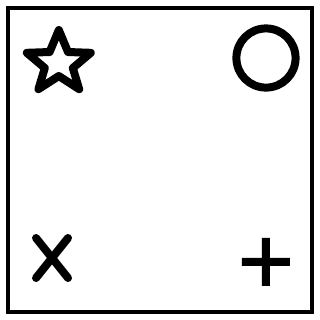
Select the figure can replace the question mark (?) in the following figure series.


  1. AOption (a)

  2. BOption (b)

  3. COption (c)

  4. DOption (d)

View answer & explanation

Correct answer

Answer: (d)D.

Why this answer is correct

The figure that will replace the question mark (?) in the following figure series is shown below:

1) For '

' element : Shifting in the clockwise direction.


2) For '

' element : Shifting in the clockwise direction.


3) For '

' element : Shifting in the clockwise direction.


4) For '

' element : Shifting in the clockwise direction.

​​

Final series is :


Hence, ‘option - (4)’ is the correct answer.

Question 7

Select the correct mirror image of the given combination when the mirror is placed at MN as shown below.

  1. AOption (a)

  2. BOption (b)

  3. COption (c)

  4. DOption (d)

View answer & explanation

Correct answer

Answer: (c)C.

Why this answer is correct

The correct mirror image of the given combination when mirror is placed at MN is as shown below:


Detailed Explanation:

  • The line MN is the mirror
  • The letter-digit cluster "ef593zpk" the first letter is "e". So, the mirror image should be "

" ⇒ Option 1 is eliminated.

  • The letter-digit cluster "ef593zpk" the fourth digit is "9". So, the mirror image should be "

" ⇒ Option 2 is eliminated..

  • The letter-digit cluster "ef593zpk" the second letter is "f". So, the mirror image should be "

" ⇒ Option 4 is eliminated.

Hence, the correct answer is "Option - (3)".

Question 8

Select the option figure in which the given figure (X) is embedded as its part (rotation is NOT allowed).

  1. AOption (a)

  2. BOption (b)

  3. COption (c)

  4. DOption (d)

View answer & explanation

Correct answer

Answer: (a)A.

Why this answer is correct

Given:

  • The image must not to be rotated


Hence, the correct answer is "Option - (1)".

Question 9

Select the option that is related to the fifth letter-cluster in the same way as the second letter-cluster is related to the first letter-cluster and the fourth letter-cluster is related to the third letter-cluster.

WITNESS : SSENTIW :: SILENCE : ECNELIS :: PROTECT : ?

  1. AOption (a)

    PROCETT

  2. BOption (b)

    TCETORP

  3. COption (c)

    CETPROT

  4. DOption (d)

    RPOTCET

View answer & explanation

Correct answer

Answer: (b)B.

TCETORP

Why this answer is correct

Logic : Letters are written in the reverse order within the word.

​​So,

  • WITNESS : SSENTIW

​​

​

And,

  • SILENCE : ECNELIS

​

​Similarly,

  • PROTECT :

​

Hence, "TCETORP" is the correct answer.

Question 10

In a certain code language, 'HABIT’ is written as 'ITAHB' and 'BASED' is written as 'EDABS'. How will 'GAMES' be written in that language

  1. AOption (a)

    ESAGM

  2. BOption (b)

    ESGAM

  3. COption (c)

    ESAMG

  4. DOption (d)

    SEAGM

View answer & explanation

Correct answer

Answer: (a)A.

ESAGM

Why this answer is correct

Logic : Letters are repositioned within the word.

  1. First letter →  Shifted to the fourth position within the word.
  2. Second letter → Shifted to the third position within the word.
  3. Third letter → Shifted to the fifth position within the word.
  4. Fourth letter → Shifted to the first position within the word.
  5. Fifth letter → Shifted to the second position within the word.

​​So,

  • 'HABIT’ is written as 'ITAHB'

​ 

​And,

  • 'BASED' is written as 'EDABS'

​ 

​Similarly,

  • 'GAMES' is written as :

​ 

Hence, "ESAGM" is the correct answer.

Question 11

Select the odd group of numbers. (NOTE: Operations should be performed on the whole numbers, without breaking down the numbers into its constituent digits. E.g.13– Operations on 13 such as adding /subtracting /multiplying etc. to 13 can be performed. Breaking down 13 into 1 and 3 and then performing mathematical operations on 1 and 3 is not allowed)

  1. AOption (a)

    (16 – 20 – 24)

  2. BOption (b)

    (23 – 27 –31)

  3. COption (c)

    (11 – 15 – 19)

  4. DOption (d)

    (12 – 14 – 18)

View answer & explanation

Correct answer

Answer: (d)D.

(12 – 14 – 18)

Why this answer is correct

The logic followed here is : (2nd number - 1st number) = (3rd number - 2nd number)

So,

  • Option - (1) : (16 – 20 – 24)

​20 - 16 = 24 - 20

4 = 4 (LHS = RHS)

  • Option - (2) : (23 – 27 –31)

​27 - 23 = 31 - 27

4 = 4 (LHS = RHS)

  • Option - (3) : (11 – 15 – 19)

​15 - 11 = 19 - 15

4 = 4 (LHS = RHS)

  • Option - (4) : (12 – 14 – 18)

​14 - 12 = 18 - 14

2 ≠ 4 (LHS ≠ RHS)

Hence, "Option - (4)" is the correct answer.

Question 12

Three different positions of the same dice are shown. Find the number on the face opposite the face showing '2'.

  1. AOption (a)

    4

  2. BOption (b)

    3

  3. COption (c)

    5

  4. DOption (d)

    6

View answer & explanation

Correct answer

Answer: (c)C.

5

Why this answer is correct

The logic followed here is:-

From the given three different cubes, figure 2 and figure 3, the adjacent sides are as shown below :

As 2 is common in both figure 2 and figure 3, it is clear that 1, 3, 4, and 6 are adjacent to it, and the remaining number i.e., 5 will be opposite to it.

Opposite pairs:

1 → 3

4 → 6

2 → 5

So, the opposite side of "2" will be side "5".

Hence, the correct answer is "5".

Question 13

Which of the following numbers will replace the question mark (?) in the given series?

25, 15, ?, −5, −15

  1. AOption (a)

    20

  2. BOption (b)

    5

  3. COption (c)

    10

  4. DOption (d)

    −1

View answer & explanation

Correct answer

Answer: (b)B.

5

Why this answer is correct

The logic followed here is : (10) is subtracted subsequently.


Hence, "5" is the correct answer.

Question 14

Select the set in which the numbers are NOT related in the same way as are the numbers of the given set.

(NOTE: Operations should be performed on the whole numbers, without breaking down the numbers into its constituent digits. E.g. 13 – Operations on 13 such as adding / subtracting / multiplying etc. to 13 can be performed. Breaking down 13 into 1 and 3 and then performing mathematical operations on 1 and 3 is not allowed)

(168, 122, 290)

  1. AOption (a)

    (198, 112, 310)

  2. BOption (b)

    (226, 148, 374)

  3. COption (c)

    (236, 118, 356)

  4. DOption (d)

    (126, 132, 258)

View answer & explanation

Correct answer

Answer: (c)C.

(236, 118, 356)

Why this answer is correct

Mistake Points The question is asking for find the Dissimilar number from the given set in the question.

So, find the Dissimilar set.

The logic followed here is : (1st number + 2nd number) = 3rd number

168 + 122 = 290

So,

  • Option - (1) : (198, 112, 310)

​198 + 112 = 310

310 = 310 (LHS = RHS)

  • Option - (2) : (226, 148, 374)

​226 + 148 = 374

374 = 374 (LHS = RHS)

  • Option - (3) : (236, 118, 356)

​236 + 118 = 354

354 ≠ 356 (LHS ≠ RHS)

  • Option - (4) : (126, 132, 258)

​126 + 132 = 258

258 = 258 (LHS = RHS)

Hence, "Option - (3)" is the correct answer.

Question 15

Which of the following interchange of numbers and mathematical signs would make the given equation correct?

72 ÷ 6 − 20 + 30 × 5 = 70

  1. AOption (a)

    5 and 20, − and ×

  2. BOption (b)

    20 and 30, × and ÷

  3. COption (c)

    5 and 70, + and −

  4. DOption (d)

    6 and 20, + and ÷

View answer & explanation

Correct answer

Answer: (a)A.

5 and 20, − and ×

Why this answer is correct

Given statement : 72 ÷ 6 − 20 + 30 × 5 = 70

According to the question, after interchanging the given signs and numbers :

So,

  • Option - (1) : 5 and 20, − and ×

Given statement : 72 ÷ 6 − 20 + 30 × 5 = 70

after interchanging the given signs and numbers :

72 ÷ 6 × 5 + 30 - 20 = 70

12 × 5 + 30 - 20 = 70

60 + 30 - 20 = 70

90 - 20 = 70

70 = 70 (LHS = RHS)

  • Option - (2) : 20 and 30, × and ÷


Given statement : 72 ÷ 6 − 20 + 30 × 5 = 70

after interchanging the given signs and numbers :

72 × 6 − 30 + 20 ÷ 5 = 70

72 × 6 − 30 + 4 = 70

432 + 4 - 30 = 70

436 - 30 = 70

406 ≠ 70 (LHS ≠ RHS)

  • Option - (3) : 5 and 70, + and −


Given statement : 72 ÷ 6 − 20 + 30 × 5 = 70

after interchanging the given signs and numbers :

72 ÷ 6 + 20 - 30 × 70 = 5

12 + 20 - 30 × 70 = 5

12 + 20 - 2100 = 5

32 - 2100 = 5

  • 2068 ≠ 5 (LHS ≠ RHS)
  • Option - (4) : 6 and 20, + and ÷


Given statement : 72 ÷ 6 − 20 + 30 × 5 = 70

after interchanging the given signs and numbers :

72 + 20 − 6 ÷ 30 × 5 = 70

72 + 20 − 0.2 × 5 = 70

72 + 20 - 1 = 70

92 - 1 = 70

91 ≠ 70 (LHS ≠ RHS)

Hence, "Option - (1)" is the correct answer.

Question 16

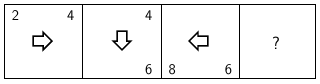
Select the figure among the given option that can replace the question mark (?) in the following series.

  1. AOption (a)

  2. BOption (b)

  3. COption (c)

  4. DOption (d)

View answer & explanation

Correct answer

Answer: (d)D.

Why this answer is correct

The figure that will replace the question mark (?) in the following figure series is shown below:

1) For '

' element : Rotating in the clockwise direction.


2) For '2' element : Shifting in the clockwise direction along with the addition of (2) subsequently. 

​

3) For '4' element : Shifting in the clockwise direction along with the addition of (2) subsequently. 

​

​​

Final series is :


Hence, ‘option - (4)’ is the correct answer.

Question 17

Select the word-pair that best represents a similar relationship to the one expressed in the pair of words given below. (The words must be considered as meaningful English words and must not be related to each other based on the number of letters/number of consonants/vowels in the word.)

Lion : Roar

  1. AOption (a)

    Hen : Crow

  2. BOption (b)

    Owl : Bleat

  3. COption (c)

    Horse : Neigh

  4. DOption (d)

    Goat : Hoot

View answer & explanation

Correct answer

Answer: (c)C.

Horse : Neigh

Why this answer is correct

The logic followed here is : Animal : Sound

  • Sound of lion is called roar.

So,

  • Option - (1) : Hen : Crow

⇒ Sound of hen is called clucking and sound of crow is called caw.

  • Option - (2) : Owl : Bleat

⇒ Sound of owl is called hoot and sound of sheep or goat is called bleat.

  • Option - (3) : Horse : Neigh

⇒ Sound of horse is called neigh.

  • Option - (4) : Goat : Hoot

⇒ Sound of goat is called bleat and sound of owl is called hoot.

Thus, out of all options only option - (3) follows the same logic as given.

Hence, "Option - (3)" is the correct answer.

Question 18

Select the correct combination of mathematical signs to sequentially replace the @ signs and to balance the given equation.

[{(14 @ 6) @ (2 @ 3)} @ (1 @ 7)] @ 2 @ 4

  1. AOption (a)

    ×, ÷, ×, ×, −, +, =

  2. BOption (b)

    −, +, ×, ×, ×, ×, =

  3. COption (c)

    ×, −, +, ×, ÷, ×, =

  4. DOption (d)

    −, +, ×, ÷, ×, ×, =

View answer & explanation

Correct answer

Answer: (d)D.

−, +, ×, ÷, ×, ×, =

Why this answer is correct

Given statement : [{(14 @ 6) @ (2 @ 3)} @ (1 @ 7)] @ 2 @ 4

According to the question, after replacing the '@' signs:

So,

  • Option - (1) : ×, ÷, ×, ×, −, +, =

[{(14 × 6) ÷ (2 × 3)} × (1 − 7)] + 2 = 4 

[{84 ÷ 6} × (-6)] + 2 = 4

[14 × (-6)] + 2 = 4

-84 + 2 = 4

-82 ≠ 4 (LHS ≠ RHS)

  • Option - (2) : −, +, ×, ×, ×, ×, =

[{(14 − 6) + (2 × 3)} × (1 × 7)] × 2 = 4

[{8 + 6} × 7] × 2 = 4

[14 × 7] × 2 = 4

98 × 2 = 4

196 ≠ 4 (LHS ≠ RHS)

  • Option - (3) : ×, −, +, ×, ÷, ×, =

[{(14 × 6) − (2 + 3)} × (1 ÷ 7)] × 2 = 4

[{84 - 5} × 0.14] × 2 = 4

[79 × 0.14] × 2 = 4

11.28 × 2 = 4

22.57 ≠ 4 (LHS ≠ RHS)

  • Option - (4) : −, +, ×, ÷, ×, ×, =

[{(14 − 6) + (2 × 3)} ÷ (1 × 7)] × 2 = 4

[{8 + 6} ÷ 7] × 2 = 4

[14 ÷ 7] × 2 = 4

2 × 2 = 4

4 = 4 (LHS = RHS)

Hence, "Option - (4)" is the correct answer.

Question 19

In a certain code language, 'ABACK’ is written as 'MECDC' and 'CABAL' is written as 'NCDCE'. How will 'EAGER' be written in that language?

  1. AOption (a)

    TGICG

  2. BOption (b)

    TGCIG

  3. COption (c)

    TCIDG

  4. DOption (d)

    TFICG

View answer & explanation

Correct answer

Answer: (a)A.

TGICG

Why this answer is correct

Logic : (2) is added to the position value according to the English alphabetic series diagonally.

​So,

  • 'ABACK’ is written as 'MECDC'

\ 

​And,

  • 'CABAL' and 'NCDCE'


​Similarly,

  • 'EAGER' is written as :

​

Hence, "TGICG" is the correct answer.

Question 20

After arranging the given words according to dictionary order, which word will come at ‘Fifth’ position?

  1. Overload
  2. Overplay
  3. Overlook
  4. Overlain
  5. Overland
  1. AOption (a)

    Overlain

  2. BOption (b)

    Overplay

  3. COption (c)

    Overload

  4. DOption (d)

    Overland

View answer & explanation

Correct answer

Answer: (b)B.

Overplay

Why this answer is correct

According to the sequence in the dictionary:

  1. Overlain
  2. Overland
  3. Overload
  4. Overlook
  5. Overplay

Hence, the correct option is "Overplay".

Question 21

Select the set in which the numbers are related in the same way as are the numbers of the following sets.

(NOTE : Operations should be performed on the whole numbers, without breaking down the numbers into its constituent digits. E.g. 13 – Operations on 13 such as adding /deleting /multiplying etc. to 13 can be performed. Breaking down 13 into 1 and 3 and then performing mathematical operations on 1 and 3 is NOT allowed)

(8, 540, 60)

(9, 70, 7)

  1. AOption (a)

    (12, 56, 60)

  2. BOption (b)

    (8, 63, 7)

  3. COption (c)

    (9, 54, 12)

  4. DOption (d)

    (9, 45, 7)

View answer & explanation

Correct answer

Answer: (b)B.

(8, 63, 7)

Why this answer is correct

The logic followed here is : (1st number × 3rd number) + 3rd number = 2nd number

Given :

  • (8, 540, 60)

​8 × 60 + 60 = 540

480 + 60 = 540

540 = 540 (LHS = RHS)

  • (9, 70, 7)​

​9 × 7 + 7 = 70

63 + 7 = 70

70 = 70 (LHS = RHS)

So,

  • Option - (1) : (12, 56, 60)​

12 × 60 + 60 = 56

720 + 60 = 56

780 ≠ 56 (LHS ≠ RHS)

  • Option - (2) : (8, 63, 7)

8 × 7 + 7 = 63

56 + 7 = 63

63 = 63 (LHS = RHS)

  • Option - (3) : (9, 54, 12)

9 × 12 + 12 = 54

108 + 12 = 54

120 ≠ 54 (LHS ≠ RHS)

  • Option - (4) : (9, 45, 7)​

9 × 7 + 7 = 45

63 + 7 = 45

70 ≠ 45 (LHS ≠ RHS)

Hence, "Option - (2)" is the correct answer.

Question 22

Which two signs should be interchanged to make the given equation correct?

34 ÷ 16 + 4 × 8 − 6 = 60

  1. AOption (a)

    − and ×

  2. BOption (b)
    • and ×
  3. COption (c)

    ÷ and −

  4. DOption (d)

    ÷ and +

View answer & explanation

Correct answer

Answer: (d)D.

÷ and +

Why this answer is correct

Given statement : 34 ÷ 16 + 4 × 8 − 6 = 60

According to the question, after interchanging the signs:

So,

  • Option - (1) : − and ×

34 ÷ 16 + 4 - 8 × 6 = 60

2.125 + 4 - 8 × 6 = 60

2.125 + 4 - 48 = 60

6.125 - 48 = 60 

-41.875 ≠ 60 (LHS ≠ RHS)

  • Option - (2) : + and ×

Given statement : 34 ÷ 16 + 4 * 8 − 6 = 60

After interchanging:

34 ÷ 16 × 4 + 8 − 6 = 60

2.125 × 4 + 8 − 6 = 60

8.5 + 8 - 6 = 60

16.5 - 6 = 60

10.5 ≠ 60 (LHS ≠ RHS)

  • Option - (3) : ÷ and −


Given statement : 34 ÷ 16 + 4 * 8 − 6 = 60

After interchanging:

34 - 16 + 4 × 8 ÷ 6 = 60

34 - 16 + 4 × 1.33 = 60

34 + 5.32 - 16 = 60

39.32 - 16 = 60

23.32 ≠ 60 (LHS ≠ RHS)

  • Option - (4) : ÷ and +


Given statement : 34 ÷ 16 + 4 * 8 − 6 = 60

After interchanging:

34 + 16 ÷ 4 × 8 − 6 = 60

34 + 4 × 8 − 6 = 60

34 + 32 - 6 = 60

66 - 6 = 60

60 = 60 (LHS = RHS)

Hence, "Option - (4)" is the correct answer.

Question 23

If A × B means that A is the father of B, A – B means that A is the mother of B, A ÷ B means that A is the brother of B then which of the following expression shows that P is the paternal uncle of R?

  1. AOption (a)

    P ÷ Q × R

  2. BOption (b)

    P ÷ Q – R

  3. COption (c)

    Q ÷ P × R

  4. DOption (d)

    P × Q ÷ R

View answer & explanation

Correct answer

Answer: (a)A.

P ÷ Q × R

Why this answer is correct

Given :

A is
Symbol×-÷
MeaningFatherMotherBrother
to B

So,

  • Option - (1) : P ÷ Q × R → P is the brother of Q who is the father of R.

Here, P is the paternal uncle of R.

  • Option - (2) : P ÷ Q – R → P is the brother of Q who is the mother of R.

Here, P is the maternal uncle of R.

  • Option - (3) : Q ÷ P × R → Q is the brother of P who is the father of R.

Here, P is the father of R.

  • Option - (4) : P × Q ÷ R → P is the father of Q who is the brother of R.

​​

Here, P is the father of R.

Thus, out of all the options only option - (1) shows that P is the paternal uncle of R.

Hence, "Option - (1)" is the correct answer.

Question 24

Which letter cluster will replace the question mark (?) to complete the given series?

VSNY, UQLU, ?, SMHM, RKFI

  1. AOption (a)

    TOJQ

  2. BOption (b)

    TOJR

  3. COption (c)

    TOKQ

  4. DOption (d)

    TPJQ

View answer & explanation

Correct answer

Answer: (a)A.

TOJQ

Why this answer is correct

The logic followed here is :-

  1. First letter → (1) is subtracted from the position value according to English alphabetic series.
  2. Second and third letter → (2) is subtracted from the position value according to English alphabetic series.
  3. Fourth letter → (4) is subtracted from the position value according to English alphabetic series.

​So,

​

Hence, the correct answer is "TOJQ".

Question 25

Select the option that is related to the third term in the same way as the second term is related to the first term and the sixth term is related to the fifth term.

14 : 400 :: 37 : ? :: 42 : 2304

  1. AOption (a)

    1333

  2. BOption (b)

    1764

  3. COption (c)

    1849

  4. DOption (d)

    1521

View answer & explanation

Correct answer

Answer: (c)C.

1849

Why this answer is correct

The logic followed here is :  (1st number + 6)2 = 2nd number

So,

  • 14 : 400

​(14+6)2(14 + 6)^2  = 400

(20)2(20)^2  = 400

400 = 400 (LHS = RHS)

​And,

  • 42 : 2304

​(42+6)2(42 + 6)^2  = 2304

(48)2(48)^2  = 2304

2304 = 2304 (LHS = RHS)

​Similarly,

  • 37 : ?

​(37+6)2(37 + 6)^2  = ?

(43)2(43)^2  = ?

1849 = ?

​Hence, "1849" is the correct answer.

General Awareness (25 questions)

Question 26

Which of the following players is associated with billiards?

  1. AOption (a)

    Neeraj Chopra

  2. BOption (b)

    Sankalp Gupta

  3. COption (c)

    Pankaj Advani

  4. DOption (d)

    Manish Narwal

View answer & explanation

Correct answer

Answer: (c)C.

Pankaj Advani

Why this answer is correct

The correct answer is Pankaj Advani

Key Points:

  • Pankaj Advani is related to Billiards and Snooker.
  • He won the world championship 23 times and also the winner of the IBSF world snooker championship 15 times.
  • He was born on 24th July 1986 at Pune, Maharashtra.
  • He is known as " Prince Boy of India " and "The Golden boy".
  • He was awarded as Padma Bhushan in 2018 and Rajiv Gandhi Khel Ratna in 2005 and 2006.
  • Padma Shri in 2009 and Arjuna award in 2004.
  • He is champion in Billiards and Snooker.
  • He is the first Indian to the won world championship in the 6-red snooker.

Additional InformationNeeraj Chopra

  • Neeraj Chopra is originally from Khandra village in Panipat, Haryana.
  • He was born on 24 December 1997. His father Satish Kumar is a farmer.
  • Neeraj Chopra is an Indian Track and field athlete and a Junior Commissioned Officer in Indian Army.
  • The distance reached by the javelin in the gold medal-winning throw by Neeraj Chopra at the Olympic games held in Tokyo in 2021 lay between 87.5 m and 88.0 m.
  • Tokyo Olympics: India's Neeraj Chopra won the gold medal in the men's javelin throw event with a throw of 87.58m in his second attempt.
  • Neeraj is the first Indian in over 120 years, and the first athlete from independent India, to win an Olympic medal in a track-and-field discipline.
  • Chopra also became the sixth Indian athlete to win an individual medal at Tokyo 2020 joining weightlifter Mirabai Chanu, shuttler PV Sindhu, boxer Lovlina Borgohain, and wrestlers Ravi Kumar Dahiya and Bajrang Punia.

Sankalp Gupta:

  • Sankalp Gupta has become India's 71st Grandmaster by scoring 6.5 points and finishing second in the GM Ask 3 round-robin event in Arandjelovac, Serbia.
  • Gupta secured the three required GM norms in just 24 days by playing three tournaments on the trot.
  • In all the three events, his rating performances were at 2599 and above.

Manish Narwal:

  • Manish Narwal (born 17 October 2001) is an Indian Para Pistol Shooter.
  • He ranks fourth in the world in Men's 10m Air Pistol SH1 according to the World Shooting Para Sports Rankings.
  • Manish is also supported by GoSports Foundation through the Para Champions Programme.
  • Shooting has inspired competition, and in several countries, rifle clubs started to form in the 19th century.

Question 27

Name an alkylbenzene widely used as a chemical intermediate in the production of phenol.

  1. AOption (a)

    Cumene

  2. BOption (b)

    Furan

  3. COption (c)

    Styrene

  4. DOption (d)

    Toluene

View answer & explanation

Correct answer

Answer: (a)A.

Cumene

Why this answer is correct

Correct Answer Cumene

Key Points

  • One alkylbenzene widely used as a chemical intermediate in the production of phenol is cumene (isopropylbenzene).
  • Cumene is oxidized to cumene hydroperoxide, which is then cleaved to phenol and acetone.
  • This process is known as the cumene process and is one of the most important methods for the commercial production of phenol.

Additional InformationFuran

  • Furan is a heterocyclic organic compound, consisting of a five-membered aromatic ring with four carbon atoms and one oxygen atom.
  • Chemical compounds containing such rings are also referred to as furans.
  • Chemical formula of Furan is C4H4O.
  • Furan is a colorless, flammable, highly volatile liquid with a boiling point close to room temperature.

Styrene:

  • Styrene is a colourless, flammable liquid, which has a sweet odour and is highly volatile.
  • Styrene is widely used to make Polystyrene/Styrofoam plastics containers as well as a number of speciality plastics and synthetic rubbers.
  • Besides, it is used to manufacture a variety of products, such as insulation, pipes, automobile parts, printing cartridges, food containers, and carpet backing.
  • It is toxic to the nervous system if ingested or inhaled, and contact with the skin and eyes can cause irritation. 
  • Chronic exposure affects the central nervous system showing symptoms such as depression, headache, fatigue, and weakness, and may cause minor effects on kidney function.
  • Acute exposure may also result in gastrointestinal effects.
  • It could also lead to cancer and depression in some cases.
  • However, EPA notes that there is no sufficient evidence despite several epidemiology studies indicating there may be an association between styrene exposure and an increased risk of leukaemia and lymphoma.
  • Recently, the tragic styrene gas leak incident in the LG Polymers plant in Visakhapatnam has affected the health of people of that area.

Toluene:

  • Toluene is also an alkylbenzene that is widely used as a chemical intermediate in the production of phenol.
  • Toluene is oxidized to benzyl alcohol, which is further oxidized to benzaldehyde.
  • Benzaldehyde is then converted to benzoic acid, which is used to produce phenol via the cumene process or other methods.
  • So toluene can also be used as a starting material in the production of phenol.

Question 28

Fundamental Duties are contained within which Article of the Constitution of India?

  1. AOption (a)

    Article 492

  2. BOption (b)

    Article 51A

  3. COption (c)

    Article 50A

  4. DOption (d)

    Article 44

View answer & explanation

Correct answer

Answer: (b)B.

Article 51A

Why this answer is correct

The correct answer is Article 51A.

**Key Points:**In the Constitution of India, fundamental duties are mentioned in article 51A.

  • There was no list of fundamental duties in the original constitution.
  • Fundamental duties were added into the Indian constitution by the 42nd constitutional amendment act 1976.
  • the 42nd constitutional amendment added part IV A and Article 51A to the Indian constitution.
  • Fundamental duties were added into the Indian constitution on the recommendation of the Swaran Singh Committee.
  • Initially, there were only 10 fundamental duties in the constitution.
  • The 86th constitutional amendment act 2002 added one more fundamental duty to the constitution.
  • Currently, there are 11 fundamental duties in the Indian constitution.
  • The idea of fundamental duties were borrowed from the Russian constitution.
  • Fundamental duties are non-justiciable in nature.

The 11 Fundamental Duties listed are:

  1. Respect the National Flag, National Anthem, and the Indian Constitution's principles and institutions.
  2. Uphold and uphold the lofty principles that motivated the nation's fight for freedom.
  3. Uphold and defend India's sovereignty, unification, and integrity.
  4. Defend the nation and perform national service as required.
  5. Promote harmony and a feeling of shared brotherhood among all Indians, notwithstanding differences in religion, language, location, or section, and condemn behaviours that are demeaning to women's dignity.
  6. Appreciate and safeguard the rich cultural history of the nation as a whole.
  7. Maintaining a healthy ecosystem, including woods, lakes, rivers, and wildlife, as well as showing compassion for all living things.
  8. Foster a humanistic outlook, a scientific mindset, and a spirit of reformation
  9. Protect public property and abstain from violence
  10. Strive for excellence in all areas of personal and group endeavour so that the country continually reaches greater heights of endeavour and success.
  11. Give his kid or ward between the ages of six and fourteen the opportunity to pursue an education. The 86th Constitutional Amendment Act of 2002 added this duty.

Question 29

Which Indian religious festival has recently been included in the representative list of intangible cultural heritage of humanity by UNESCO, an organisation of the United Nations?

  1. AOption (a)

    Durga Puja

  2. BOption (b)

    Ramnavami

  3. COption (c)

    Janmashtami

  4. DOption (d)

    Mahashtami

View answer & explanation

Correct answer

Answer: (a)A.

Durga Puja

Why this answer is correct

The correct answer is Durga Puja.

Key Points:

  • "Durga Puja in Kolkata" is now inscribed on the UNESCO Representative List of the Intangible Cultural Heritage of Humanity.
  • India now has 15 intangible cultural heritage elements on the prestigious UNESCO Representative List of ICH of Humanity.
  • In recent years, the ICH elements that saw inscriptions are Kumbh Mela (inscribed 2017), and Yoga (inscribed 2016) among others.

Additional InformationJanmashtami:

  • Janmashtami is celebrated by suspending a pot containing butter, curd, etc. high above the ground with people trying to break it by forming human pyramids.
  • Krishna Janmashtami is celebrated on Bhadrapad Krishna Ashtami.
  • It is the birth date of Lord Krishna.
  • On this day, tableaux related to Shri Krishna's life are decorated in temples.
  • After fasting for the whole day, after the birth of Shri Krishna at midnight, aarti and special pooja of Shri Krishna are performed and food is served.

Recent Additions to India's UNESCO World Heritage Sites:

  • Hoysala Temples of Karnataka: UNESCO updated India's World Heritage Sites in September 2023, adding the 12th-century Hoysala Temples of Karnataka to the prestigious list.
  • Santiniketan in West Bengal: It has also gained recognition as a UNESCO World Heritage Site in September 2023.
  • Dholavira, an ancient Harappan City: On July 27, 2021, Dholavira, an ancient Harappan City in the Rann of Kutchh, was designated as India's 40th UNESCO World Heritage Site.
  • Rudreswara Temple (Ramappa Temple): The Rudreswara Temple (Ramappa Temple) at Palampet, Warangal, Telangana, earned its place on the List of World Heritage Sites on July 25, 2021.

Question 30

Which of the following pairs of ‘Ruler – Ruling period’ is correctly matched?

I. Sher Shah Suri – 1540-1545

II. Akbar – 1556-1605

  1. AOption (a)

    Neither I nor II

  2. BOption (b)

    Only II

  3. COption (c)

    Only I

  4. DOption (d)

    Both I and II

View answer & explanation

Correct answer

Answer: (d)D.

Both I and II

Why this answer is correct

The correct answer is Both I and II

Key Points:

Sher Shah Suri:

  • Sher Shah Suri was the 6th ruler of the Suri Empire.
  • He was a Pathan from Bihar who defeated the Mughal emperor Humayun in (1530-1540) and also in (1555-1556) and founded the Suri Empire in Northern India.​
  • He ruled from 1540-1545.
  • The tomb of Sher Shah Suri is in Sasaram town, state of Bihar.
  • The "Battle of Chausa" was fought between the Mughal emperor, Humayun, and the Afghan emperor Sher Shah Suri.
  • It was fought on 26 June 1539 at Chausa, located in the southwest of Buxar, now in Bihar.
  • In this battle, Sher Shah defeated Humayun and crowned himself Farid al-Din Sher Shah.
  • The Mughal emperor Humayan again faced Sher Shah in the Battle of Kanauj and was again defeated by him.

Akbar (1542- 1605)

  • He reigned from 1556 to 1605.
  • He constructed Fatehpur Sikri and made it his capital in 1569.
  • Buland Darwaza was constructed at the gate.
  • He started a new religion Din-i Ilahi in 1581-82.
  • Abul Fazl wrote his biography titled Akbarnama.
  • Nine of his courtiers were known as Navratnas.
  • They were Todar Mal, Abul Fazal, Faizi, Birbal, Tansen, Abdur Rahim Khana-i-Khana, Mullah-do-Pyaza, Raja Man Singh, and Fakir Aziao-Din.
  • He married a Hindu princess, Harka Bai, commonly known as Jodha Bai.
  • Akbar captured the historic fortress of Chittor in 1568.
  • He abolished the pilgrimage tax by Hindus in 1563.
  • He also abolished the Jizyah tax in 1564.
  • He also introduced the Mansabdari System or the rank-holder system to organize the nobility and army.

Question 31

On 5 April 2022, who was appointed as the Chairman of the Union Public Service Commission?

  1. AOption (a)

    S Raju

  2. BOption (b)

    Suman K Bery

  3. COption (c)

    Manoj Soni

  4. DOption (d)

    Ashwin Yardi

View answer & explanation

Correct answer

Answer: (c)C.

Manoj Soni

Why this answer is correct

The correct answer is Manoj Soni.

Key Points:

  • Dr Manoj Soni has been appointed as the Chairman of the Union Public Service Commission (UPSC).
  • He is currently a member of the UPSC.
  • He served as the country's youngest Vice-Chancellor in 2005, of MS University.
  • He also served as the Vice-Chancellor of Dr. Babasaheb Ambedkar Open University in Ahmedabad between August 2009 to July 2015.

Additional InformationSuman K Bery:

  • NITI Aayog’s Vice Chairman Rajiv Kumar has stepped down after being at the helm of the institution for nearly five years.
  • Dr. Suman K Bery has been appointed new Vice Chairperson of NITI Aayog.
  • He will take charge as Vice Chairperson of NITI Aayog from 1 May 2022.
  • Suman K Bery had earlier served as Director-General of the National Council of Applied Economic Research (NCAER) in New Delhi.
  • NCAER is one of the country’s leading independent non-profit policy research institutions.

Ashwin Yardi:

  • ​Ashwin is the CEO of Capgemini Technology Services India and a member of the executive committee for the Capgemini Group.

Question 32

The Planning commission of India has divided India into how many Agro-climatic Zones?

  1. AOption (a)

    15

  2. BOption (b)

    25

  3. COption (c)

    18

  4. DOption (d)

    20

View answer & explanation

Correct answer

Answer: (a)A.

15

Why this answer is correct

The correct answer is 15.

Key Points

  • 15 agro-climatic zones (ACZ) are characterized by the Planning Commission of India.
  • As per NARP, the country is divided into 127 agro-climatic zones.
  • An Agro-climatic zone is a land unit in form of major climates that are suitable for a certain range of crops and cultivators.
  • National Agricultural Research Project (NARP) was launched by ICAR for initiating agricultural research in the agro-climatic zones of the country.
  • The purpose was to set up and upgrade a zonal research station in each agro-climatic zone for creating location-specific, need-based research targeted for specific agro-ecological situations.
  • The agro-climatic zone division helps to achieve optimum utilization in a suitable manner within the framework of resource constraints and potentials of each region.

Additional Information:

  • Planning Commission of India:
  • The Planning Commission formulated India's Five-Year Plans.
  • It was formed in March 1950.
  • It was replaced by NITI Aayog in the year 2015.
  • NITI Aayog:
  • ​NITI Aayog or National Institution for Transforming India Aayog is the replacement for the Planning Commission of India.

Question 33

Who among the following headed the National Income Committee?

  1. AOption (a)

    PC Mahalanobis

  2. BOption (b)

    VKRV Rao

  3. COption (c)

    DR Gadgil

  4. DOption (d)

    BR Ambedkar

View answer & explanation

Correct answer

Answer: (a)A.

PC Mahalanobis

Why this answer is correct

The correct answer is P.C. Mahalanobis.

Key Points:

The National Income Committee, 1949

  • After independence in August 1949, the government of India established the National Income Committee to compute the national income of the economy.
  • Prof. P.C. Mahalanobis was the chairperson of the National Income Committee.
  • Prof. D.R. Gadgil and Dr. V.K.R.V. Rao were also one of the members of this committee.
  • The first report of the committee was presented in the year 1951.
  • According to the first report, the national income of India for the year 1948-49 was Rs. 8,710 crores and the per capita income was Rs. 225.

Thus, the first official attempt to calculate the national Income of India in 1949 was made by National Income Committee that was headed by Prof. P.C. Mahalanobis.

**Additional Information:**The Central Statistical Organisation (CSO)

  • Since the year 1955, the national income estimates for India are being prepared by Central Statistical Organisation.
  • The CSO uses different methods, i.e., product method, income method, and expenditure method to estimate the national income for different sectors of the economy.

Question 34

The mass number of titanium is ____________.

  1. AOption (a)

    44.56

  2. BOption (b)

    49.82

  3. COption (c)

    41.33

  4. DOption (d)

    47.78

View answer & explanation

Correct answer

Answer: (d)D.

47.78

Why this answer is correct

Correct Answer 47.78

Key Points

  • The mass number of titanium is 48.
  • It has an atomic number of 22, which means it has 22 protons in its nucleus.
  • Its most common isotope has 26 neutrons, giving it a mass number of 48 (22 protons + 26 neutrons).
  • However, there are also other isotopes of titanium with different numbers of neutrons, which give rise to different mass numbers.

Additional Information:

  • Titanium is a chemical element with the symbol Ti and atomic number 22.
  • It is a lustrous transition metal with a silver color, low density, and high strength.
  • It is known for its excellent corrosion resistance, making it a popular choice in a variety of industries including aerospace, medical implants, and automotive.
  • Titanium was discovered in 1791 by William Gregor and was named after the Titans of Greek mythology.
  • It is the ninth most abundant element in the Earth's crust and is commonly found in minerals such as ilmenite and rutile.
  • It is also found in the sun and many other stars, as well as in meteorites and rocks from the moon.
  • Due to its desirable properties, titanium has a wide range of applications, including aircraft and spacecraft parts, medical implants, marine equipment, and sporting goods.
  • It is also used in the production of white pigments, which are used in paints, plastics, and paper.

Question 35

The _________ Cabinet approved the country’s first-of-its-kind gene bank programme in the State.

  1. AOption (a)

    Rajasthan

  2. BOption (b)

    Maharashtra

  3. COption (c)

    Andhra Pradesh

  4. DOption (d)

    Odisha

View answer & explanation

Correct answer

Answer: (b)B.

Maharashtra

Why this answer is correct

The correct answer is Maharashtra.

Key Points:

  • Maharashtra Cabinet has approved the 'Maharashtra Gene Bank', a first-of-its-kind project in India.
  • The Maharashtra Gene Bank is unique because it authenticates traditional knowledge by scientific institutions such as the Indian Institute of Science Education and Research (IISER), Pune, and the National Institute of Oceanography (NIO), Goa.

**Additional Information:**Maharashtra:

  • Chief Minister - Eknath Shinde
  • Governor - Ramesh Bais
  • Number of Districts - 36.
  • Lok Sabha seats - 48.
  • Rajya Sabha seats - 19.
  • State Animal - Indian giant squirrel.
  • State Bird - Yellow-footed green pigeon.
  • National Parks - Chandoli National Park, Gugamal National Park, Nawegaon National Park, Pench National Park, Sanjay Gandhi (Borivilli) National Park, Tadoba National Park.
  • Dams - Koyna Dam (Koyna River), Jayakwadi Dam (Godavari River), Wilson Dam (Pravara River), Vaitarna Dam (Vaitarna River), Mula Dam (Mula River).

Question 36

In which year did AEB de Chancourtois organize the elements by atomic weight, by graphing the elements around a cylinder with a circumference of 16 units, corresponding to the weight of oxygen (O)?

  1. AOption (a)

    1862

  2. BOption (b)

    1860

  3. COption (c)

    1870

  4. DOption (d)

    1868

View answer & explanation

Correct answer

Answer: (a)A.

1862

Why this answer is correct

The correct answer is 1862.

Key Points:

  • AEB de Chancourtois organized the elements by atomic weight and graphed them around a cylinder with a circumference of 16 units in the year 1862.

Alexandre-Émile-Béguyer de Chancourtois

  • The French geologist Alexandre-Émile Béguyer de Chancourtois was the first person to organize chemical elements by atomic weights.
  • In 1862, he prepared an early form of the periodic table, which he named Vis telluric (the 'telluric helix').
  • He plotted a graph of the elements around a cylinder with a circumference of 16 units corresponding to the weight of oxygen (O).

**Additional Information:**John Newlands

  • ​John Newland, an English scientist, classified the elements known at that time in ascending order of their atomic mass.
  • At the time of Newland, the number of known elements was 56.
  • He started the classification with the element hydrogen with the lowest atomic mass and ended the classification with thorium.
  • He found that every eighth element has the same properties as the first element.
  • He compared this classification to the octave of music and named it "The Law of Octaves".
  • Newland's classification is known as "Newlands' Law of Octaves".

Dmitri Mendeleev

  • ​Demitri Ivanovich Mendeleev (8 February 1834 – 2 February 1907), was a Russian chemist and inventor.
  • He proposed the periodic classification of elements.
  • Mendeleev's classification of elements is called "Mendeleev's Periodic Table".
  • Using this table, he also found out the properties of those elements which he could not discover till time.

Johann Dobereiner

  • In 1817, Johann Wolfgang Dobereiner, a German scientist, identified some groups of three elements with similar properties.
  • The triad of groups of three elements is known as Dobereiner's triad.
  • Wolfgang Dobereiner stated that the atomic mass of the middle element is approximately equal to the average of the atomic mass of the other two elements by placing the three elements of the triad in increasing order of their atomic mass.

Question 37

A booklet released by the Lok Sabha Secretariat has listed out words and expressions that would be considered unparliamentary in both the Lok Sabha and Rajya Sabha.Which of the following words is NOT declared unparliamentary?

  1. AOption (a)

    Shakuni

  2. BOption (b)

    Nautanki

  3. COption (c)

    Chakkar

  4. DOption (d)

    Girgit

View answer & explanation

Correct answer

Answer: (c)C.

Chakkar

Why this answer is correct

Correct Answer Chakkar

Key Points

  • Lok Sabha Secretariat released a list of “unparliamentary words” on July 13, 2022.
  • Some of the unparliamentary words include ‘Jumlajeevi, Covid spreader, Snoopgate, Baal buddhi”.
  • It also includes expressions like “ashamed, betrayed, hypocrisy. Abuse, drama, and incompetent.
  • The booklet was released before Monsoon Session of parliament.
  • It mentions words including Shakuni, dictatorial, taanashah, vinash purush, khoon ki kheti, Jaichand would be removed if they are used during debates or otherwise.
  • Words like Dohra Charitra, nautanki, behri Sarkar, dhindora peetna,Girgit​ will also be treated in similar manner.
  • However, chairman of Rajya Sabha and Speaker of Lok Sabha will have the last word in removing words and expressions.

Additional Information

  • Unparliamentary words are the abusive or rude words or expressions which are considered unsuitable for use in Parliament.
  • Unparliamentary words are regulated in accordance with Article 105 (2) of the Indian constitution.
  • Under article 105 (2), speech of an MP in parliament is subject to discipline of Parliamentary rules and good sense of the members.
  • Speaker or chairman of the house is empowered to keep check on it, so as to ensure that MPs does not use “defamatory or undignified unparliamentary words” inside the Parliament.
  • Rule 380 and Rule 381 of “Rules of Procedure and Conduct of Business in Lok Sabha” deal with “Expunction (removal of unparliamentary words).

Question 38

The shape of peninsular plateau in India is ______.

  1. AOption (a)

    Linear

  2. BOption (b)

    Rectangular

  3. COption (c)

    Circular

  4. DOption (d)

    Triangular

View answer & explanation

Correct answer

Answer: (d)D.

Triangular

Why this answer is correct

The correct answer is Triangular.

Key Points:

  • The shape of the Indian Peninsular Plateau is Triangular.
  • Earlier, there was a supercontinent called Pangea.
  • Panthalassa was the ancient Ocean surrounding it.
  • Pangea broke into two namely Gondwana land and Laurasia.
  • In between, there was a Sea called the Tethys Sea.
  • The northern boundary of the Peninsular Block may be taken as an irregular line running from Kachchh along the western flank of the Aravali Range near Delhi and then roughly parallel to the Yamuna and the Ganga as far as the Rajmahal Hills and the Ganga delta.
  • Apart from these, the Karbi Anglong and the Meghalaya Plateau in the northeast and Rajasthan in the west are also extensions of this block.
  • The northeastern parts are separated by the Malda fault in West Bengal from the Chotanagpur plateau.
  • In Rajasthan, the desert and other desert–like features overlay this block.
  • The Peninsula is formed essentially by a great complex of very ancient gneisses and granites, which constitutes a major part of it.

Question 39

Which of the following cities hosted the finals of IPL 2022?

  1. AOption (a)

    Kolkata

  2. BOption (b)

    Ahmedabad

  3. COption (c)

    Mumbai

  4. DOption (d)

    Hyderabad

View answer & explanation

Correct answer

Answer: (b)B.

Ahmedabad

Why this answer is correct

The correct answer is Ahmedabad

Key Points:

  • The Indian Premier League (IPL) 2022 ended with Gujarat Titans (GT) lifting the trophy by defeating inaugural champions Rajasthan Royals (RR) at the Narendra Modi Stadium, Ahmedabad.
  • The Indian Premier League (IPL) 2022, was the 15th edition of the professional Twenty20 cricket league established by the Board of Control for Cricket in India (BCCI).
  • IPL 2022 Sponsorer was TATA.

Additional Information

  • IPL 2022 Champion Title won by Gujarat Titans.
  • The Orange Cap title winner is Jos Butler (Rajasthan Royals) with Total runs: 863 runs.
  • The Purple Cap title winner is Yuzvendra Chahal (Rajasthan Royals) with total 27 Wickets.
  • BCCI president Sourav Ganguly and General Secretary Jay Shah then receive a certificate as IPL created a Guinness world record for the world’s largest cricket jersey.

Question 40

In which of the following years, did Subhas Chandra Bose refer to Mahatma Gandhi as the “Father of the Nation”?

  1. AOption (a)

    1942

  2. BOption (b)

    1944

  3. COption (c)

    1939

  4. DOption (d)

    1941

View answer & explanation

Correct answer

Answer: (b)B.

1944

Why this answer is correct

The correct answer is 1944.

  • Subhash Chandra Bose was the first person to address 'Mahatma Gandhi as the Father of the Nation'.

Key Points:

  • On July 6, 1944, Subhash Chandra Bose said in a telecast of Azad Hind Radio to Mahatma Gandhi that “the last war of independence of India has begun.
  • We want blessings of you in this holy war of liberation of the Father of the Nation.” And wish you all the best.
  • Thus, for the first time, the word 'Father of the Nation' was used by Subhash Chandra Bose.

Subhash Chandra Bose

  • He founded the Independence for India League with Jawaharlal Nehru.
  • He was the first person to address Mahatma Gandhi as the 'Father of the Nation'.
  • He was elected as the President of INC at its Haripura Session (1938) and Tripuri Session (1939) but resigned from Tripuri due to differences with Mahatma Gandhi.
  • He took the charge of Indian Army (Azad Hind Fauj) in 1943 in Singapore and set up an Indian Provisional government there.
  • Subhash Chandra Bose was the one who addressed Mahatma Gandhi as the Father of the Nation.
  • He gave the famous slogans- Dilli Chalo and Jai Hind.
  • The India Struggle was his autobiography.

Additional Information 

  • Sardar Vallabh Bhai Patel was given the title of Sardar by the women of Bardoli during the Bardoli Satyagarh.
  • Jawaharlal Nehru was called also called Pandit Nehru due to his roots with the Kashmiri Pandit community.
  • Lala Lajpat Rai was given the title of 'Punjab Kesari'.

Question 41

The Green Revolution in India started in _______________.

  1. AOption (a)

    1940s

  2. BOption (b)

    1990s

  3. COption (c)

    1950s

  4. DOption (d)

    1960s

View answer & explanation

Correct answer

Answer: (d)D.

1960s

Why this answer is correct

The correct answer is 1960s. 

Key Points:

  • The Green Revolution was started in the period 1960s.
  • It commenced in India in the year 1960s under the premiership of Congress leader Lal Bahadur Shastri.
  • It is also known as the Third Agricultural Revolution.
  • Norman Borlaug is known as the Father of the Green Revolution in the World and he received Nobel Peace Prize in the year 1970.
  • The birthplace and burial ground of the Green Revolution is Mexico because Norman Borlaug was a native of Mexico.
  • In India, Dr. M.S Swaminathan is known as the Father of the Green Revolution.
  • William S. Gaud was the first person to use the word Green Revolution and he was an administrator of the United States Agency for International Development (USAID).
  • Green Revolution is related to the increase in the production of Foodgrains, especially rice and wheat.
  • It leads to an increase in the production of food grains in the Indian states of Uttar Pradesh, Haryana, and Punjab.

Additional Information:

The following are the important revolutions in India:

RevolutionRelated to
Green RevolutionFoodgrain Production
White RevolutionMilk Production
Red RevolutionTomato and Meat
Blue RevolutionFish Production
Yellow RevolutionOil Seed
Brown RevolutionLeather, Cocoa
Black RevolutionPetroleum Production
Pink RevolutionOnion, Prawns
Golden Fibre RevolutionJute Production
Round RevolutionPotatoes Production

Image of M. S. Swaminathan:

Question 42

The Sattriya dance form was introduced in the 15th century AD by the great Vaishnava saint and reformer of Assam, ________.

  1. AOption (a)

    Chaitanya Mahaprabhu

  2. BOption (b)

    Mahapurusha Sankaradeva

  3. COption (c)

    Vallabhacharya

  4. DOption (d)

    Sant Namdev

View answer & explanation

Correct answer

Answer: (b)B.

Mahapurusha Sankaradeva

Why this answer is correct

The correct answer is Mahapurusha Sankaradeva

Key Points:

  • The great Assamese reformer and Vaishnava saint Mahapurusha Sankaradeva established the Sattriya dancing style in the 15th century A.D. as a potent means of spreading the Vaishnava religion.
  • Later, the dancing style developed and broadened as a distinct dance genre.
  • The Sattras, which are Vaishnava mathematics or monasteries, have dedicatedly nourished and protected this neo-Vaishnava treasure of Assamese dance and drama for generations.
  • This dance form has been appropriately dubbed Sattriya due to its religious nature and connection to the Sattras.

Important Points:

  • Sankaradeva invented this dance style by fusing components from many treatises, regional folk dances, and his singular perspective.
  • Ojapali and Devadasi, two dance styles with numerous classical elements, were popular in Assam before the neo-Vaishnava movement.
  • The branch of Hinduism known as Vaishnavism regards Lord Vishnu or one of his incarnations as the only true God. Vaishnavites and Vaishnavas are terms for followers of Vaishnavism.

Additional Information: Chaitanya Mahaprabhu was a native of Bengal.

  • Chaitanya was a 15th-century Indian saint.
  • He was born in Nabadwip in the Nadia district of West Bengal.
  • His entire family lived in present-day Sylhet, Bangladesh.
  • He has popularized the 'Maha Mantra' or 'Hare Krishna Mantra'.
  • He also composed a prayer of eight verses known as 'Siksastakam' in Sanskrit.
  • He founded the Gaudiya Movement or Chaitanya Movement that promotes Vaishnavism.

​Vallabhacharya (1479–1531 CE):

  • ​Vallabhacharya (1479–1531 CE), also known as Vallabha, was an Indian philosopher who founded the Krishna-centered PushtiMarg sect of Vaishnavism in the Braj region of India, and the philosophy of Shuddha Advaita. Hence the correct answer is Suddhadvaita.
  • Vallabha was born in a Telugu Tailang Brahmin family that had been living in Varanasi, who escaped to Champaran of Chhattisgarh state while expecting Vallabha, expecting a Muslim invasion, which ultimately didn't happen, during the late 15th century.
  • Vallabhacharya represented the culmination of philosophical thought during the Bhakti Movement in the Middle Ages.
  • The sect established by him is unique in its facets of devotion to Krishna, especially his child manifestation, and is enriched with the use of traditions, music and festivals.
  • Vallabha studied the Vedas and the Upanishads as a child, then travelled throughout the Indian subcontinent for over 20 years.
  • He became one of the important leaders of the devotional Bhakti movement.
  • Vallabhacharya was a devotional philosopher, who founded the Pushti sect in India. He won the title of acharya by travelling and debating Advaita scholars from a young age.

Sant Namdev:

  • Shri Sant Namdev Maharaj also transliterated as Nam Dayv, Namdeo, or Namadeva,was a Marathi Vaishnav saint from Narsi, Hingoli, Maharashtra, India within the Varkari tradition of Hinduism.
  • He was born into what is generally recognised as a Shudra caste, variously recorded as shimpi (tailor) in the Marathi language and as Chhipa, Chhimpa, Chhimba, chimpi (calico-printer) in northern India.
  • Namdev was influenced by Vaishnavism and became widely known in India for his devotional songs set to music (bhajan-kirtans).
  • His philosophy contains both nirguna brahman and saguna brahman elements, with monistic themes.
  • Namdev's legacy is remembered in modern times in the Varkari tradition, along with those of other gurus, with masses of people walking together in biannual pilgrimages to Pandharpur in Maharashtra.
  • He is also recognised in the North Indian traditions of the Dadu Panthis, Kabir Panthis and Sikhs.
  • Some hymns of Shri Sant Namdev are included in the Guru Granth Sahib.

Thus, Sant Namdev was a tailor by profession.

Question 43

T Balasaraswati, a ___________ dancer was also an actress.

  1. AOption (a)

    Bharatanatyam

  2. BOption (b)

    Kuchipudi

  3. COption (c)

    Manipuri

  4. DOption (d)

    Kathakali

View answer & explanation

Correct answer

Answer: (a)A.

Bharatanatyam

Why this answer is correct

Correct Answer Bharatanatyam

The famous dancer T Balasaraswati was an exponent of Bharatanatyam.

Key Points

  • Bharatanatyam a classical dance style that originated in Tamil Nadu's South Indian state, making this dance style well known in various parts of India and many parts of the world.
  • In 1957 she was awarded the Padma Bhushan and in 1977 the Padma Vibhushan.
  • She received the Sangeetha Kalasikhamani Award from The Indian Fine Arts Society, Chennai, in 1981.
  • She was the only non-western dancer included in a Dance Heritage Coalition compilation, "The Irreplaceable Treasures of Dance in America: The First 100" (2000).
  • Satyajit Ray, Bengali film director, made a documentary film on Balasaraswati called Bala (1976).

Additional InformationClassical dance

  • Classical dances are performed by professional or highly trained dancers who have studied their form for many years.
  • There are eight classical Dances in India.
  • Classical dance expresses a story or theme and this form of art lies in the religious Hindu music theatre styles. It represents the culture.
  • They are
  • Kathak from North India,
  • Sattriya of Assam,
  • Bharatnatyam of Tamil Nadu,
  • Kuchipudi of Andhra Pradesh,
  • Kathakali and Mohiniaattam of Kerala,
  • Manipuri of Northeast India, and
  • Odissi of Odisha.
  • It is the right way to connect with your feelings, coordinate and move the movement skills and build strength and stability in your body.

Question 44

Who runs the government at the national level under the parliamentary system?

  1. AOption (a)

    The President and Council of Ministers

  2. BOption (b)

    The Prime Minister and Council of Ministers

  3. COption (c)

    The Prime Minister

  4. DOption (d)

    The President

View answer & explanation

Correct answer

Answer: (b)B.

The Prime Minister and Council of Ministers

Why this answer is correct

The correct answer is The Prime Minister and Council of Ministers

Key Points:

  • The Parliamentary System of government in India is taken from the British(UK)​constitution.

The parliamentary system of government(PSA): 

  • PSA means that the executive government branch of which has the indirect or any direct support of the parliament.
  • This direct or indirect support is generally shown by a vote of confidence.
  • The relationship between the legislature and the executive branch in any parliamentary system is called responsible government.

Council of Ministers: 

  • Under PSA, we may see the Council of Ministers which is headed by the honorable Prime Minister to provide advice to the President to maintain his necessary work accordingly.
  • The Prime Minister is appointed by the President, who also appoints the governor of states, and other ministers after taking advice from the Prime Minister.
  • The Council of Ministers is also responsible to the Lok Sabha.
  • Article 74 of the Constitution of India provides for a Council of Ministers.

Additional InformationParliamentary System

  • The Constitution of India provides for a parliamentary form of government, both at the Centre and in the states.
  • Articles 74 and 75 deal with the parliamentary system at the Centre and Articles 163 and 164 in the states.
  • The features or principles of parliamentary government in India are:
  • Nominal and Real Executives- The President is the nominal executive (de jure executive or titular executive) while the Prime Minister is the real executive (de facto executive).
  • Majority Party Rule- The political party which secures majority seats in the Lok Sabha forms the government.
  • Collective Responsibility- This is the bedrock principle of parliamentary government. The ministers are collectively responsible to the Parliament in general and to the Lok Sabha in particular (Collective Responsibility Article 75).
  • Double Membership- The ministers are members of both the legislature and the executive.
  • Dissolution of the Lower House- The lower house of the Parliament (Lok Sabha) can be dissolved by the President on the recommendation of the Prime Minister.

Question 45

Identify the INCORRECT pair.

  1. AOption (a)

    Ustad Allarakha Khan – Tabla

  2. BOption (b)

    Ravi Shankar – Sitar

  3. COption (c)

    Mogubai Kurdikar – Vocal

  4. DOption (d)

    Ustad Vilayat Khan – Sarod

View answer & explanation

Correct answer

Answer: (d)D.

Ustad Vilayat Khan – Sarod

Why this answer is correct

Correct Answer Ustad Vilayat Khan – Sarod

Key Points:

  • Ustad Vilayat Khan was a prominent Sitar player.
  • He was born on 28 August 1928 in Gouripur in East Bengal, now Bangladesh.
  • He invented a new technique of playing Sitar with the left hand which lasts for longer consistency.
  • He also invented many Ragas enriching Indian Music.
  • Mogubai Kurdikar (15 July 1904 – 10 February 2001) was a renowned Indian classical vocalist of the Jaipur-Atrauli Gharana

Additional InformationImportant Instruments and Related Personalities:

InstrumentsRelated Personality
SantoorPt. Shiv Kumar Sharma, Bhajan Sopori
SarodAmjad Ali khan, Sharan Rani, Ali Akbar Khan, Buddhadev Dasgupta
SitarPt. Ravi Shankar, Anushka Shankar, Mushtaq Ali Khan,Ustad Vilayat Khan
SarangiShakoor Khan, Pt. Ram Narayan, Ustad Binda Khan
VeenaZia Mohiuddin Dagar, Emani Sankara Shastri
ViolinMS Gopalakrishnan, M Chandrashekhar
GuitarBraj Bhushan Kabra
MandolinU Srinivas
ShehnaiUstad Bismillah Khan, Ali Ahmad Hussain
FluteHari Prasad Chaurasiya, Pannalal Ghosh
TablaZakir Hussain, Allah Rakha Khan, Pt. Krishan Maharaj
MrindagamKV Prasad, SV Rajarao, Palghat Mani Iyer
KanjraPuddukkoti Dakshinmurthi Pillai
GhatamTH Vinayakaram, EM Subramaniam
PakhawajTotaram Sharma, Pt. Ayodhya Prasad, Gopal das

Question 46

In 1498, Vasco da Gama, a Portuguese explorer had discovered a route to ______.

  1. AOption (a)

    India

  2. BOption (b)

    Australia

  3. COption (c)

    China

  4. DOption (d)

    Japan

View answer & explanation

Correct answer

Answer: (a)A.

India

Why this answer is correct

The correct answer is India.

Key Points:

  • Vasco da Gama, a Portuguese explorer, discovered the sea route to India in 1498.

Vasco Da Gama:

  • Vasco Da Gama came to India (Calicut) during the reign of the Hindu ruler of Calicut Zamorin in 1498 AD.
  • The Cape route was discovered from Europe to India by Vasco da Gama.
  • The discovery of the sea route led to the establishment of trading stations at Calicut, Cochin, and Cannanore.
  • Cochin (1502 AD) was the early capital of the Portuguese in India( later on replaced by Goa).
  • The first Governor of Portuguese in India was Francisco Almeida (1509 AD).
  • He introduced "The Policy of Blue Water".

Additional Information

CountriesYear of Arrival
Portuguese1498
English1608
Dutch1602
Danish1616
French1664

Question 47

El-Nino develops in which of these oceans?

  1. AOption (a)

    Arctic Ocean

  2. BOption (b)

    Indian Ocean

  3. COption (c)

    Atlantic Ocean

  4. DOption (d)

    Pacific Ocean

View answer & explanation

Correct answer

Answer: (d)D.

Pacific Ocean

Why this answer is correct

The correct answer is Pacific Ocean.

Key Points:

EL- NINO:

  • El Nino (Spanish for Christ Child) is the occasional development of warm ocean surface waters along the coast of Ecuador and Peru in South America.
  • Even though El Nino occurs in the Pacific Ocean, it often reduces the number of hurricanes that form in the Atlantic Ocean. Conversely, La Niña events tend to be related to an increase in the number of Atlantic hurricanes.
  • Recently this development has been used for forecasting climatic conditions in different parts of the world.
  • The El Nino normally occurs around Christmas, roughly every 2 to 7 years, and lasts usually for a few weeks to a few months.
  • El Nino event is related to two important atmospheric circulation systems:  
  • Hadley Circulation: It features air rising near the Equator, flowing poleward at a height of 10 to 15 kilometers above the earth’s surface, descending in the subtropics, and then returning equatorward near the surface.
  • Walker Circulation: There is a stable low-pressure system above the western Pacific near South East Asia and a high-pressure system in the central Pacific.
  • This results in a constant westward flow of air masses from the area of high pressure to the area of low pressure. At higher altitudes, this air then flows directly eastward, oblique to the Hadley Circulation.
  • Due to the combined components of Walker Circulation and Hadley Circulation, there is a strong prevailing wind toward the west in the lower layers of the atmosphere, which maintains the stable coastal upwelling system off the coast in western South America.
  • El Nino and the Indian Monsoon rains are inversely related.

​

Question 48

The border line which separate Indian and Pakistan is known as ______.

  1. AOption (a)

    Lahore line

  2. BOption (b)

    McMahon line

  3. COption (c)

    Radcliffe line

  4. DOption (d)

    Delhi line

View answer & explanation

Correct answer

Answer: (c)C.

Radcliffe line

Why this answer is correct

The correct answer is Radcliffe Line.

Key Points:

  • The Radcliffe Line became the international border between India and Pakistan (which also included what is now Bangladesh) during the partition of India.
  • Sir Cyril Radcliffe, drew the Radcliffe line which divides India and Pakistan.
  • The Radcliffe Line was declared as the boundary between India and Pakistan On 17th August 1947, following the Partition of India.
  • The line is named after Sir Cyril Radcliffe who was commissioned to equitably divide 4,50,000 km sq of territory with 88 million people.
  • Sir Radcliffe arrived in India on 8th July 1947 and was given five weeks to work on the border.
  • Upon meeting with Mountbatten, Radcliffe traveled to Lahore and Kolkata to meet his Boundary Commission members, who were primarily Jawaharlal Nehru representing the Congress and Muhammad Ali Jinnah representing the Muslim League.
  • Both parties were keen that the boundary be finalized by 15th August 1947, in time for the British to leave India.
  • As requested by both Nehru and Jinnah, Radcliffe completed the boundary line a few days before Independence, but due to some political reasons the Radcliffe Line was only formally revealed on 17th August 1947.

**Additional Information:**Durand LIne:-

  • Its devides Pakistan and Afganistan Borders.
  • The Durand line came into existence on November 12, 1893, when the border which was used to separate the British and the Afghanistan territories came to life.

McMohan Line:- 

  • The McMahon Line marks the boundary between the China-occupied territory of the East-Himalayan region and the Indian regions.
  • This region is a mountainous place of high altitudes.
  • This line was determined by Sir Henry McMahon, a British Foreign Secretary in British India, and it is called the McMahon Line after his name.
  • The total length of this line is 890 kilometers.

Siegfried Line - The boundary line is between France and Germany.

  • It was built as an extension of the Hindenburg defensive line on the western front of World War I by the Weimar Republic and later the Third Reich of Germany in the 1930s

Question 49

Identify animals that are NOT triploblastic.

  1. AOption (a)

    Molluscs

  2. BOption (b)

    Chordates

  3. COption (c)

    Coelenterates

  4. DOption (d)

    Platyhelminthes

View answer & explanation

Correct answer

Answer: (c)C.

Coelenterates

Why this answer is correct

The correct answer is Coelenterates

**Key Points:**Triploblastic animals

  • Triploblastic animals create the endoderm, ectoderm, and mesoderm, the three basic germ layers.
  • True organs, different muscle types, bone, connective tissue, the circulatory system, the notochord, and other structures can be produced by the mesoderm.
  • Animal endoderm that is triploblastic includes the lungs, stomach, colon, liver, urinary bladder, etc.
  • Ectoderm produces the epidermis, lens of the eye, brain, spinal cord, and other tissues.
  • The triploblastic creatures are bilaterally symmetrical.
  • When compared to diploblastic animals, triploblastic animals are much more diversified.
  • Animals like Platyhelminthes, annelids, arthropods, mollusks, echinoderms, and chordates are examples of triploblastic organisms.

Platyhelminthes:

  • ​The flatworms, also known as Platyhelminthes, are a group of soft-bodied, generally basic bilaterian, unsegmented invertebrates.

Echinodermata:

  • ​Any member of phylum Echinodermata is an echinoderm.
  • The adult sea lilies, also known as the "stone lilies," brittle stars, starfish, sea urchins, sand dollars, and sea cucumbers are distinguishable by their (often five-point) radial symmetry.

Chordata: 

  • ​An animal belonging to the phylum Chordata is a chordate.
  • Five synapomorphies, or basic physical traits, that set chordates apart from all the other taxa are present in all chordates at some point during their larval or adult stages.

Question 50

Which of the following statement is correct with respect to the Shaka dynasty?

I. Some kingdoms of Shakas lasted for about 500 years.

II. The Shakas were followed by the Kushanas about 2200 years ago.

  1. AOption (a)

    Neither I nor II

  2. BOption (b)

    Only I

  3. COption (c)

    Both I and II

  4. DOption (d)

    Only II

View answer & explanation

Correct answer

Answer: (b)B.

Only I

Why this answer is correct

Correct Answer Only I

Key Points

  • The Saka Era was probably established by King Maeus around the second century A.D.
  • The Shakas who were also known as the Indo-Scythians were a group of Iranian nomadic people who invaded India by destroying the Indo-Greeks in North-West India.
  • The Shakas brought the larger part of the country under their control.
  • The most famous Shaka ruler in India was Rudradaman who ruled from 130 A.D to 150 A.D.
  • There were five branches of Shakas who settled and established rule in different regions of the North and North-Western parts of the Indian subcontinent.
  • The Saka era came to an end with the defeat of the last Shaka ruler, Rudrasimha III by Chandragupta-II of the Gupta dynasty.

Additional Information

  • In and around the 2nd century B.C., the central Asian nomadic people called ‘Yueh-chi’ or ‘Yuezhi’ pushed the Shakas out of their homes and forced them to invade India from the northwestern border of present-day China.
  • The descendants in later times came to be known as Kushana.
  • The Shakas invaded Parthia and Bactria and they defeated the Parthian King.
  • The five branches of the Shakas settled in the following places,
  1. Afghanistan
  2. Punjab with Taxila as capital
  3. Mathura
  4. Western India
  5. Upper Deccan with Ujian as their capital.​

Rudradaman I :

  • He is considered the greatest of the Saka rulers.
  • He is from the Western Kshatrapa dynasty.
  • He was the grandson of Chastana.
  • His kingdom included Konkan, Narmada valley, Kathiawar, other parts of Gujarat, and Malwa.
  • He conducted the repair work of the Sudarshana Lake at Kathiawar.
  • He supported Sanskrit literature and cultural arts.
  • It was during Rudradaman’s reign that Yavaneshwara, the Greek writer lived in India and translated the Yavanajataka from Greek to Sanskrit.

Quantitative Aptitude (25 questions)

Question 51

If sin2 θ − 3 sin θ + 2 = 0, then find the value of θ (0° ≤ θ ≤ 90°).

  1. AOption (a)

    45°

  2. BOption (b)

    0°

  3. COption (c)

    60°

  4. DOption (d)

    90°

View answer & explanation

Correct answer

Answer: (d)D.

90°

Why this answer is correct

Given:

sin2 θ − 3 sin θ + 2 = 0

Concept used:

  1. -1 ≤ sin θ ≤ 1 2. sin 90° = 1

Calculation:

sin2 θ − 3 sin θ + 2 = 0

⇒ sin2 θ − 2 sin θ - sin θ + 2 = 0

⇒ sin θ(sin θ - 2) - 1(sin θ - 2) = 0

⇒ (sin θ - 2) (sin θ - 1) = 0

So, sin θ = 1 (∵ sin θ ≠ 2)

⇒ sin θ = sin 90°

⇒ θ = 90°

∴ The value of θ is 90°.

Question 52

The LCM of 1.2 and 2.7 is:

  1. AOption (a)

    5.4

  2. BOption (b)

    10.8

  3. COption (c)

    1.08

  4. DOption (d)

    32.4

View answer & explanation

Correct answer

Answer: (b)B.

10.8

Why this answer is correct

Shortcut Trick

To find the LCM of 1.2 and 2.7, first equalize the decimal places.

Multiply both numbers by 10 to convert them into integers: 12 and 27.

Find the LCM of these integers: LCM(12, 27) = 108.

Now, divide the result by 10 to restore the decimal point: 108 ÷ 10 = 10.8.

∴ The correct answer is 10.8.

Alternate Method

Given: The numbers are 1.2 and 2.7.

Formula Used: LCM of fractions = LCM(Numerators) ÷ HCF(Denominators)

⇒ Convert decimals to simplest fractions: 1.2 = 12/10 and 2.7 = 27/10.

⇒ Here, Numerators = 12, 27 and Denominators = 10, 10.

⇒ LCM(12, 27):

⇒ 12 = 22 × 31

⇒ 27 = 33

⇒ LCM = 22 × 33 = 4 × 27 = 108.

⇒ HCF(10, 10) = 10.

⇒ LCM of decimals = 108 ÷ 10 = 10.8.

∴ The correct answer is 10.8.

Additional Information

LCM of Fractions

The Least Common Multiple is calculated as LCM of numerators divided by HCF of denominators.

HCF of Fractions

The Highest Common Factor is calculated as HCF of numerators divided by LCM of denominators.

Product Rule

For any two numbers a and b, the product of the numbers equals the product of their HCF and LCM: a × b = HCF(a, b) × LCM(a, b).

Question 53

The radius of a right circular cylinder is four times of its height. If the height of the cylinder is 14 cm, then what is the volume of cylinder?

  1. AOption (a)

    15468 cm3

  2. BOption (b)

    14262 cm3

  3. COption (c)

    137984 cm3

  4. DOption (d)

    11296 cm3

View answer & explanation

Correct answer

Answer: (c)C.

137984 cm3

Why this answer is correct

Shortcut Trick

Volume of the cylinder = π × r2 × h = (22 / 7) × 56 × 56 × 14

This simplifies to: 22 × 56 × 56 × 2

We can instantly find the answer by checking the unit digit of this product.

Unit digit product = 2 × 6 × 6 × 2 = 144, which ends in 4.

Looking at the given options, only 137984 has a unit digit of 4.

∴ The correct answer is 137984 cm3.

Alternate Method

Given:

Height of the cylinder (h) = 14 cm

Radius of the cylinder (r) = 4 × height = 4 × 14 = 56 cm

Formula Used:

Volume of a right circular cylinder = π × r2 × h

r = 56 cm

h = 14 cm Right Circular Cylinder

Calculations:

⇒ Volume = (22 / 7) × (56)2 × 14

⇒ Volume = (22 / 7) × 56 × 56 × 14

⇒ Volume = 22 × 56 × 56 × 2

⇒ Volume = 44 × 3136

⇒ Volume = 137984 cm3

∴ The correct answer is 137984 cm3.

Additional Information

Curved Surface Area (CSA) of a Cylinder

The curved surface area includes only the outer side surface of the cylinder, excluding the top and bottom circular bases. Formula: CSA = 2 × π × r × h

Total Surface Area (TSA) of a Cylinder

The total surface area includes the curved surface area plus the area of both the top and bottom solid bases. Formula: TSA = 2 × π × r × (r + h)

Volume of a Cone

A cone with the same base radius and height as a corresponding cylinder will always have exactly one-third of the cylinder's volume. Formula: Volume = (1 / 3) × π × r2 × h

Question 54

What is the rate of interest per annum for simple interest at which Rs. 880 amounts to Rs. 913 in 112\frac{1}{2} years?

  1. AOption (a)

    2232\frac{2}{3}%

  2. BOption (b)

    2142\frac{1}{4}%

  3. COption (c)

    2122\frac{1}{2}%

  4. DOption (d)

    2132\frac{1}{3}%

View answer & explanation

Correct answer

Answer: (c)C.

2122\frac{1}{2}%

Why this answer is correct

Given:

Principal of Rs. 880 amounts to Rs. 913 in 112\frac{1}{2} i.e. 1.5 years.

Concept used:

Simple Interest, SI = (P × R × T)/100

Amount = P + SI

where

P = Principal amount

R = Rate of interest per year

T = Time in years

Calculation:

Let the rate of interest be R% p.a.

​According to the concept,

880 + (880 × R × 1.5)/100 = 913

⇒ (880 × R × 1.5)/100 = 913 - 880

⇒ R = (33 × 100) ÷ (880 × 1.5)

⇒ R = 2.5

⇒ R = 2122\frac{1}{2}

∴ The rate of interest is 2122\frac{1}{2}%.

Question 55

A number is decreased by 20% to get another number. The number so obtained is increased by 200% to get a third number. The difference of the third number and the original number is what percentage more or less than the difference of second and the third number?

  1. AOption (a)

    More, 15.7 Percent

  2. BOption (b)

    Less, 15.7 Percent

  3. COption (c)

    More, 12.5 Percent

  4. DOption (d)

    Less, 12.5 Percent

View answer & explanation

Correct answer

Answer: (d)D.

Less, 12.5 Percent

Why this answer is correct

Given:

A number is decreased by 20% to get another number.

The number so obtained is increased by 200% to get a third number.

Concept used:

Incremented/Reduced value = Initial value (1 ± change%)

Calculation:

Let the first number be Q.

Second number = Q(1 - 20%) = 0.8Q

Third number = 0.8Q(1 + 200%) = 2.4Q

The difference between the third number and the original number = 2.4Q - Q = 1.4Q

The difference between the second and third number = 2.4Q - 0.8Q = 1.6Q

Now, % less = 1.6Q−1.4Q1.6Q×100%\frac {1.6Q - 1.4Q}{1.6Q} \times 100\% = 12.5%

∴ The difference between the third number and the original number is 12.5% less than the difference between the second and the third number.

Question 56

Any six-digit number that is formed by repeating a three-digit number, is always divisible by:

  1. AOption (a)

    111

  2. BOption (b)

    1001

  3. COption (c)

    19

  4. DOption (d)

    101

View answer & explanation

Correct answer

Answer: (b)B.

1001

Why this answer is correct

Calculation:

Let the three digits be P, Q, and R.

Then, the number = PQRPQR

​According to the concept,

P × 100000 + Q × 10000 + R × 1000 + P × 100 + Q × 10 + R × 1 = PQRPQR

⇒ 100100P + 10010Q + 1001R = PQRPQR

⇒ 1001(100P + 10Q + R) = PQRPQR

⇒ PQRPQR = 1001 × k (letting (100P + 10Q + R) = k)

Hence, the number is divisible by 1001.

∴ Any six-digit number that is formed by repeating a three-digit number, is always divisible by 1001.

Question 57

The printed price of a TV set is ₹14,500. It is sold for ₹10,000 with two consecutive discounts. If the first discount is 10%, then what is the second discount?

  1. AOption (a)

    23.37%

  2. BOption (b)

    25.37%

  3. COption (c)

    20.37%

  4. DOption (d)

    27.37%

View answer & explanation

Correct answer

Answer: (a)A.

23.37%

Why this answer is correct

Given:

The printed price of a TV set is ₹14,500. It is sold for ₹10,000 with two consecutive discounts.

The first discount is 10%.

Concept used:

Selling Price = Marked Price × (1 - Discount%)

Calculation:

The price becomes after the first discount = 14500 × (1 - 10%) = Rs. 13050

Let the second discount be R%.

​According to the concept,

13050(1 - R/100) = 10000

⇒ (1 - R/100) = 10000/13050

⇒ (1 - R/100) = 200/261

⇒ R/100 = 1 - 200/261

⇒ R/100 = 61/261

⇒ R = 6100/261

⇒ R = 23.371 ≈ 23.37

∴ The second discount is 23.37%.

Question 58

If a+1a=5a + \frac{1}{a} = 5  , then what is the value of a3+1a3{a^3} + \frac{1}{{{a^3}}}?

  1. AOption (a)

    110

  2. BOption (b)

    15

  3. COption (c)

    105

  4. DOption (d)

    –10

View answer & explanation

Correct answer

Answer: (a)A.

110

Why this answer is correct

Given:

a+1a=5a + \frac{1}{a} = 5

Concept used:

(a + b)3 = a3 + 3ab(a + b) + b3

Calculation: 

a+1a=5a + \frac{1}{a} = 5

⇒ (a+1a)3=53(a + \frac{1}{a})^3 = 5^3

⇒ a3+1a3+3(a+1a)=53a^3 + \frac{1}{a^{3}} + 3(a + \frac {1}{a}) = 5^3

⇒ a3+1a3+3×5=125a^3 + \frac{1}{a^{3}} + 3 \times 5 = 125

⇒ a3+1a3=125−15a^3 + \frac{1}{a^{3}} = 125 - 15

⇒ a3+1a3=110a^3 + \frac{1}{a^{3}} = 110

∴ The value of a3+1a3{a^3} + \frac{1}{{{a^3}}} is 110.

Question 59

The area of a triangle is 96 cm2 and the ratio of its sides is 6 ∶ 8 ∶ 10. What is the perimeter of the triangle?

  1. AOption (a)

    48 cm

  2. BOption (b)

    56 cm

  3. COption (c)

    64 cm

  4. DOption (d)

    44 cm

View answer & explanation

Correct answer

Answer: (a)A.

48 cm

Why this answer is correct

Given:

The area of a triangle is 96 cm2 and the ratio of its sides is 6 ∶ 8 ∶ 10.

Concept used:

Area of a triangle = S(S−A)(S−B)(S−C)\sqrt {S (S - A) (S - B) (S - C)} (S = Semi-perimeter = (A + B + C)/2, where A, B, C are the measure of the sides of the triangle)

Calculation:

Let the sides of the triangle be 6k, 8k, and 10k respectively.

Perimeter of the triangle = (6k + 8k + 10k) = 24k

Semi-perimeter = 24k/2 = 12k

​According to the concept,

12k(12k−6k)(12k−8k)(12k−10k)=96\sqrt {12k (12k - 6k) (12k - 8k) (12k - 10k) } = 96

⇒ 12k×6k×4k×2k=96\sqrt {12k \times 6k \times 4k \times 2k} = 96

⇒ 144×4×k4=96\sqrt {144 \times 4 \times k^4} = 96

⇒ 24k2 = 96

⇒ k2 = 96/24

⇒ k2 = 4

⇒ k = 2

⇒ 24k = 48

∴ The perimeter of the triangle is 48 cm.

 Alternate Method

The ratio of sides of the triangle is 6 ∶ 8 ∶ 10, [ as we know 6, 8, 10 are Pythagorean triplets]

Let the sides of the triangle be 6k, 8k, and 10k respectively.

So, the triangle is a right-angle triangle, area = 1/2 × base × height  

⇒ 1/2 × 6k × 8k = 96 

⇒ k2 = 4 

⇒ k = 2

So, the perimeter of the triangle is ⇒ (6k + 8k + 10k) = 24k = 24 × 2 = 48 cm

Question 60

The radii of the ends of a frustum of a cone 7 cm high are 5 cm and 3 cm. Find its volume correct to one decimal place. (use π=227\pi = \frac{{22}}{7})

  1. AOption (a)

    345.6 cm3

  2. BOption (b)

    359.3 cm3

  3. COption (c)

    379.3 cm3

  4. DOption (d)

    369.3 cm3

View answer & explanation

Correct answer

Answer: (b)B.

359.3 cm3

Why this answer is correct

Shortcut Trick

आयतन V = (1/3) × π × h × (R2 + r2 + R × r)

V = (1/3) × (22/7) × 7 × (52 + 32 + 5 × 3)

V = (22/3) × (25 + 9 + 15) = (22/3) × 49

V = 1078 / 3 ≈ 359.3 cm3

∴ The correct answer is 359.3 cm3.

Alternate Method

दिया गया है:

ऊंचाई (h) = 7 cm

बड़ी त्रिज्या (R) = 5 cm

छोटी त्रिज्या (r) = 3 cm

प्रयुक्त सूत्र:

शंकु के छिन्नक का आयतन = (1/3)πh(R2 + r2 + Rr)

गणना:

⇒ आयतन = (1/3) × (22/7) × 7 × (52 + 32 + 5 × 3)

⇒ आयतन = (22/3) × (25 + 9 + 15)

⇒ आयतन = (22/3) × 49

⇒ आयतन = 1078 / 3

⇒ आयतन = 359.333...

∴ The correct answer is 359.3 cm3.

Additional Information

शंकु के छिन्नक की तिर्यक ऊँचाई (Slant Height)

तिर्यक ऊँचाई l = √[h2 + (R − r)2] द्वारा ज्ञात की जाती है।

छिन्नक का वक्र पृष्ठीय क्षेत्रफल (CSA)

वक्र पृष्ठीय क्षेत्रफल = π × l × (R + r) वर्ग इकाई।

छिन्नक का कुल पृष्ठीय क्षेत्रफल (TSA)

कुल पृष्ठीय क्षेत्रफल = πl(R + r) + πR2 + πr2 वर्ग इकाई।

Question 61

A boat covers a certain distance against the stream in 9 hours 36 min and it covers the same distance along the stream in 6 hours. What is the ratio of the speed of the boat in still water to that of the stream?

  1. AOption (a)

    13 ∶ 3

  2. BOption (b)

    9 ∶ 2

  3. COption (c)

    11 ∶ 6

  4. DOption (d)

    8 ∶ 5

View answer & explanation

Correct answer

Answer: (a)A.

13 ∶ 3

Why this answer is correct

Given:

A boat covers a certain distance against the stream in 9 hours 36 min and it covers the same distance along the stream in 6 hours.

Concept used:

1. Distance = Speed × Time 2. While rowing upstream, the upstream speed is the difference between the speed of the boat in still water and the speed of the flow. 3. While rowing downstream, the downstream speed is the addition of the speed of the boat in still water and the speed of the flow.

Calculation:

Let the speed of the boat in still water and the speed of the stream be S and R km/h respectively.

9 hours 36 minutes = 9 + 36/60 = 9.6 hours

Let the distance be D km.

Upstream speed = (S - R) km/h

Downstream speed = (S + R) km/h

​According to the question,

DS−R=9.6\frac {D}{S - R} = 9.6      ....(1)

DS+R=6 \frac {D}{S + R} = 6     ....(2)

(1) ÷ (2),

S+RS−R=9.66\frac {S + R}{S - R} = \frac {9.6}{6}

⇒ 6S + 6R = 9.6S - 9.6R

⇒ 3.6S = 15.6R

⇒ S/R = 15.6/3.6

⇒ S : R  = 13 : 3

∴ The ratio of the speed of the boat in still water to that of the stream is 13 : 3.

 Alternate Method

We know, 9 hours 36 min = 576 min and 6 hour = 360 min

Through upstream (U) and downstream(D) distance is constant, then time ∝ 1/speed

Time ratio of U : D = 576 : 360 = 8 : 5, then Speed ratio of U : D = 5 : 8

Speed of boat = (D speed + U speed)/2 = (8 + 5)/2 = 13/2 

Speed of stream =  (D speed - U speed)/2 = (8 - 5)/2 = 3/2

So, Speed of boat : Speed of stream = 13/2 : 3/2 = 13 : 3

Question 62

Raju, Shobh and Mohan can do a work in 15 days, 20 days and 25 days respectively. In how many days,will the work be finished, if they do it on alternate days, Starting from Raju?

  1. AOption (a)

    1591015\frac{9}{{10}} days

  2. BOption (b)

    1871018\frac{7}{{10}} days

  3. COption (c)

    2171021\frac{7}{{10}} days

  4. DOption (d)

    1891018\frac{9}{{10}} days

View answer & explanation

Correct answer

Answer: (d)D.

1891018\frac{9}{{10}} days

Why this answer is correct

Given:

Raju, Shobh and Mohan can do a work in 15 days, 20 days and 25 days respectively.

Concept used:

Total work = Efficiency (Work done per day) × Total time taken

Calculation:

Let the total work be 300 units.

Efficiency of A (Raju) = 300/15 = 20 units/day

Efficiency of B (Shobh)  = 300/20 = 15 units/day

Efficiency of C (Mohan)  = 300/25 = 12 units/day

In three days, working on alternate days, they complete = (20 + 15 + 12) = 47 units of work

In such a manner, total work in 6 such sets of 3 days = 47 × 6 = 282 units

Remaining work = 300 - 282 = 18 units

Time taken to complete 18 units of work by A = 1820=910 days\frac {18}{20} = \frac {9}{10}\ days

Total time taken = 6 × 3 + 910\frac {9}{10} = 1891018\frac{9}{{10}} days

∴ The total time taken to complete the work is 1891018\frac{9}{{10}} days.

Question 63

What is the value of a2 + b2 + c2 - 2ab - 2bc + 2ca ?

  1. AOption (a)

    (2a + b + c)2

  2. BOption (b)

    (a – b + c)2

  3. COption (c)

    (a – b – 2c)2

  4. DOption (d)

    (a + 2b – c)2

View answer & explanation

Correct answer

Answer: (b)B.

(a – b + c)2

Why this answer is correct

Given:

a2 + b2 + c2 - 2ab - 2bc + 2ca

Concept used:

(a + b + c)2 = a2 + b2 + c2 + 2ab + 2bc + 2ca

Calculation:

a2 + b2 + c2 - 2ab - 2bc + 2ca

⇒ a2 + (-b)2 + c2 + 2a(-b) + 2(-b)c + 2ca

⇒ (a + (-b) + c)2

⇒ (a – b + c)2

∴ The value of a2 + b2 + c2 - 2ab - 2bc + 2ca is (a – b + c)2.

Question 64

A jeep travels to a place 300 km away at an average speed of 60 km/h and returns at a speed of 30 km/h. What is the average speed (in km/h) for the whole journey?

  1. AOption (a)

    75

  2. BOption (b)

    80

  3. COption (c)

    40

  4. DOption (d)

    60

View answer & explanation

Correct answer

Answer: (c)C.

40

Why this answer is correct

Given:

A jeep travels to a place 300 km away at an average speed of 60 km/h and returns at a speed of 30 km/h. 

Concept used:

When the distance is constant, the average speed = 2xy/x+y (where x and y are the two speeds at which the same distance has been covered.)

Calculation:

Here, the travelled distance is the same i.e. 300 km.

​According to the concept,

The average speed for the whole journey

⇒ (2 × 60 × 30) ÷ (60 + 30)

⇒ 3600 ÷ 90

⇒ 40 km/h

∴ The average speed for the whole journey is 40 km/h.

Question 65

The table given below shows the number of people in different states.

StateNumber of people
F474
G500
H444
I495
J580

What is the average number of people in all the states?

  1. AOption (a)

    396.5

  2. BOption (b)

    482.5

  3. COption (c)

    498.6

  4. DOption (d)

    476.6

View answer & explanation

Correct answer

Answer: (c)C.

498.6

Why this answer is correct

Calculation:

Now, the average number of people in all the states

⇒ (474 + 500 + 444 + 495 + 580)/5

⇒ 498.6

∴ The average number of people in all the states is 498.6.

Question 66

The average age of a man and his son is 55 years. The ratio of their ages is 7 ∶ 4,respectively. What will be the ratio of their ages after 6 years?

  1. AOption (a)

    1 ∶ 2

  2. BOption (b)

    12 ∶ 7

  3. COption (c)

    25 ∶ 17

  4. DOption (d)

    38 ∶ 23

View answer & explanation

Correct answer

Answer: (d)D.

38 ∶ 23

Why this answer is correct

Given:

The average age of a man and his son is 55 years.

The ratio of their ages is 7 ∶ 4 and respectively. 

Calculation:

Let the age of the man and his son be 7x and 4x respectively.

​According to the question,

(7x + 4x) = 55 × 2

⇒ 11x = 110

⇒ x = 10

Now, the ratio of their ages after 6 years

⇒ (7 × 10 + 6) : (4 × 10 + 6)

⇒ 76 : 46 = 38 : 23

∴ The ratio of their ages after 6 years is 38 : 23.

Question 67

△\triangleABC is a right-angle triangle at B and tan A = 34\frac{3}{4}, then sin A + sin B + sin C will be equal to:

  1. AOption (a)

    245\frac{4}{5}

  2. BOption (b)

    2252\frac{2}{5}

  3. COption (c)

    3153\frac{1}{5}

  4. DOption (d)

    1151\frac{1}{5}

View answer & explanation

Correct answer

Answer: (b)B.

2252\frac{2}{5}

Why this answer is correct

Given:

ΔABC is a right-angle triangle at B and tan A = 34\frac{3}{4}

Concept used:

  1. tan θ = Height ÷ Base
  2. sin θ = Height ÷ Hypotenuse 3. Pythagoras theorem states that “In a right-angled triangle, the square of the hypotenuse side is equal to the sum of squares of the other two sides“.

Calculation:

tan A = 34\frac{3}{4}

⇒ BCAB\frac {BC}{AB} = 34\frac{3}{4}

⇒ BC : AB = 3 : 4

Let the measure of BC and AB be 3k and 4k respectively.

​According to the concept,

AC2 = (3k)2+(4k)2\sqrt { (3k)^2 + (4k)^2 } = 5k

Now, sin A + sin B + sin C

⇒ BCAC+sin 90∘+ABAC\frac {BC}{AC} + sin\ 90^\circ + \frac {AB}{AC}

⇒ BC+ABAC+1\frac {BC + AB}{AC} + 1

⇒ 3k+4k5k+1\frac {3k + 4k}{5k} + 1

⇒ 75+1\frac {7}{5} + 1

⇒ 125\frac {12}{5} = 2252\frac{2}{5}

∴ The value of sin A + sin B + sin C is 2252\frac{2}{5}.

Question 68

A dishonest dealer professes to sell his goods at cost price but uses a false weight and thus gains 15%. For a kilogram, he uses a weight of _________ (rounded off to one digit after decimal).

  1. AOption (a)

    833.3 gm

  2. BOption (b)

    876.7 gm

  3. COption (c)

    869.6 gm

  4. DOption (d)

    898.33 gm

View answer & explanation

Correct answer

Answer: (c)C.

869.6 gm

Why this answer is correct

Shortcut Trick

For a dishonest dealer selling at cost price, the gain percentage is given by:

Gain% = [Error ÷ (True Value − Error)] × 100

Let the false weight used be x grams. Then Error = (1000 − x) grams.

15 = [(1000 − x) ÷ x] × 100

15x = 100000 − 100x ⇒ 115x = 100000

x = 100000 ÷ 115 ≈ 869.6 gm

∴ The correct answer is 869.6 gm.

Alternate Method

Given: Gain% = 15%, True Weight = 1000 gm.

Formula: Gain% = [(True Weight − False Weight) ÷ False Weight] × 100

⇒ Let the False Weight be W.

⇒ 15 = [(1000 − W) ÷ W] × 100

⇒ 15 ÷ 100 = (1000 − W) ÷ W

⇒ 3 ÷ 20 = (1000 − W) ÷ W

⇒ 3W = 20000 − 20W

⇒ 23W = 20000

⇒ W = 20000 ÷ 23 = 869.565... gm

⇒ Rounding off to one decimal place, we get 869.6 gm.

∴ The correct answer is 869.6 gm.

Additional Information

Dishonest Dealer Concept

When a dealer sells at Cost Price but uses less weight, the Profit Percentage is calculated on the actual quantity delivered to the customer.

Effective Profit

If a dealer also marks up the price by k% and uses less weight, the net profit is calculated by combining both factors using the ratio method.

Question 69

Study the given graph and table and answer the following question.

Data of different states regarding population of states in the year 1998

Total population of the given states = 32760000

StateSex and literacy wise Population Ratio
SexLiteracy
MFLiterateIlliterate
Arunachal Pradesh5327
Madhya Pradesh3114
Delhi2321
Goa3532
Bihar3441
Uttar Pradesh3272
Telangana3494

What was the number of males in Bihar in the year 1998?

  1. AOption (a)

    13,44,500

  2. BOption (b)

    16,44,400

  3. COption (c)

    14,44,400

  4. DOption (d)

    15,44,400

View answer & explanation

Correct answer

Answer: (d)D.

15,44,400

Why this answer is correct

Calculation:

Now, the number of males in Bihar in the year 1998

⇒ 32760000 × 11% × 3/(3 + 4)

⇒ 1544400

∴ The number of males in Bihar in the year 1998 is 15,44,400.

Question 70

If x8+8x=1\frac{x}{8} + \frac{8}{x} = 1, then the value of x3 is :

  1. AOption (a)

    -256

  2. BOption (b)

    -512

  3. COption (c)

    256

  4. DOption (d)

    512

View answer & explanation

Correct answer

Answer: (b)B.

-512

Why this answer is correct

Given:

x8+8x=1\frac{x}{8} + \frac{8}{x} = 1

Concept used:

a3 + b3 = (a + b)(a2 - ab + b2)

Calculation:

x8+8x=1\frac{x}{8} + \frac{8}{x} = 1

⇒ x2+648x=1\frac {x^2 + 64}{8x} = 1

⇒ (x2 - 8x + 64) = 0

⇒ (x + 8)(x2 - 8x + 64) = 0 × (x + 8)

⇒ (x3 + 83) = 0

⇒ x3 = -512

∴ The value of x3 is -512.

Question 71

A coconut tree swings with the wind in such a manner that the angle covered by its trunk is 18 degrees. If the topmost portion of the tree covers a distance of 44 metres,find the length of the tree.

  1. AOption (a)

    120 metres

  2. BOption (b)

    210 metres

  3. COption (c)

    140 metres

  4. DOption (d)

    70 metres

View answer & explanation

Correct answer

Answer: (c)C.

140 metres

Why this answer is correct

Given:

A coconut tree swings with the wind in such a manner that the angle covered by its trunk is 18 degrees.

The topmost portion of the tree covers a distance of 44 metres.

Concept used:

  1. Lenght of a Arc = 2πR × θ360\frac {θ}{360} (R = Radius and θ = Angle of the sector) 2. π = 22/7

Calculation:

Let the length of the tree be L metres.

​According to the question,

2π × L × 18360\frac {18}{360} = 44

⇒ 447\frac {44}{7} × L × 18360\frac {18}{360} = 44

⇒ L = 140

∴ The length of the tree is 140 metres.

Question 72

The following table shows the exports of three companies P, Q and R from 2015 to 2019.

Company/ years ⇒20152016201720182019
P20001000200030004000
Q40005000400050003000
R30002000400040005000

Which of the following years has the highest total exports from the three companies together?

  1. AOption (a)

    2019

  2. BOption (b)

    2017

  3. COption (c)

    2015

  4. DOption (d)

    2016

View answer & explanation

Correct answer

Answer: (a)A.

2019

Why this answer is correct

Calculation:

Total exports of 2015 = 2000 + 4000 + 3000 = 9000

Total exports of 2016 = 1000 + 5000 + 2000 = 8000

Total exports of 2017 = 2000 + 4000 + 4000 = 10000

Total exports of 2018 = 3000 + 5000 + 4000 = 12000

Total exports of 2019 = 4000 + 3000 + 5000 = 12000

∴ In the following years given in the options, 2019 has the highest total exports from the three companies together.

Question 73

If C1, C2 be the centres of two circles and r1, r2 be the respective radii such that the distance between the centres is equal to the sum of the radii of the two circles, find the number of common tangents.

  1. AOption (a)

    4

  2. BOption (b)

    2

  3. COption (c)

    1

  4. DOption (d)

    3

View answer & explanation

Correct answer

Answer: (d)D.

3

Why this answer is correct

Given:

C1, C2 be the centres of two circles and r1, r2 be the respective radii such that the distance between the centres is equal to the sum of the radii of the two circles

Calculation:

Distance between two centres C1 and C2, d = r1 + r2

Since d = r1 + r2, two circles will touch each other externally.

​According to the figure, the number of common tangents = 3

∴ The number of common tangents is 3.

Question 74

1+sin⁡θcos⁡θ\frac{{1 + \sin \theta }}{{\cos \theta }} is equal to which of the following (where θ≠π2\theta \ne \frac{\pi }{2})?

  1. AOption (a)

    1+cos⁡θsin⁡θ\frac{{1 + \cos \theta }}{{\sin \theta }}

  2. BOption (b)

    tan⁡θ+1tan⁡θ−1\frac{{\tan \theta + 1}}{{\tan \theta - 1}}

  3. COption (c)

    tan⁡θ−1tan⁡θ+1\frac{{\tan \theta - 1}}{{\tan \theta + 1}}

  4. DOption (d)

    cos⁡θ1−sin⁡θ\frac{{\cos \theta }}{{1 - \sin \theta }}

View answer & explanation

Correct answer

Answer: (d)D.

cos⁡θ1−sin⁡θ\frac{{\cos \theta }}{{1 - \sin \theta }}

Why this answer is correct

Given:

1+sin⁡θcos⁡θ\frac{{1 + \sin \theta }}{{\cos \theta }}

Concept used:

  1. a2 - b2 = (a + b)(a - b)
  2. sin2 θ + cos2 θ = 1

Calculation:

1+sin⁡θcos⁡θ\frac{{1 + \sin θ }}{{\cos θ }}

⇒ (1+sin⁡θ)(1−sin⁡θ)cosθ×(1−sin⁡θ)\frac{(1 + \sin θ)(1 - \sin θ)}{cos θ \times (1 - \sin θ)}

⇒ (1−sin⁡2θ)cosθ×(1−sin⁡θ)\frac{(1 - \sin^2 θ)}{cos θ \times (1 - \sin θ)}

⇒ cos2θcosθ×(1−sin⁡θ)\frac{cos^2 θ }{cos θ \times (1 - \sin θ)}

⇒ cos⁡θ1−sin⁡θ\frac{{\cos θ }}{{1 - \sin θ }}

∴ 1+sin⁡θcos⁡θ\frac{{1 + \sin θ }}{{\cos θ }} is equal to cos⁡θ1−sin⁡θ\frac{{\cos θ }}{{1 - \sin θ }}.

Question 75

Study the given graph and answer the following question.

If 35% of the lecturers recruited in state B in the year 2021 were male, what was the number of females in state B in that year?

  1. AOption (a)

    3845

  2. BOption (b)

    3575

  3. COption (c)

    3590

  4. DOption (d)

    5500

View answer & explanation

Correct answer

Answer: (b)B.

3575

Why this answer is correct

Calculation:

Number of lecturers recruited in state B in 2021 = 5500

Number of male lecturers among them = 5500 × 35% = 1925

Now, the number of female lecturers among them = 5500 - 1925 = 3575

∴ The number of female lecturers of state B in that year was 3575.

English Comprehension (25 questions)

Question 76

Rearrange the parts of the sentence in correct order.

Peer pressure

P. when it comes to choosing the right

Q. course and, therefore, career path

R. and lack of guidance are some of

S. the reasons for indecisiveness

  1. AOption (a)

    SPQR

  2. BOption (b)

    QSPR

  3. COption (c)

    RSPQ

  4. DOption (d)

    PQRS

View answer & explanation

Correct answer

Answer: (c)C.

RSPQ

Why this answer is correct

The correct answer is option 3) i.e. "RSPQ." 


Key Points 

  • In the abovementioned paragraph, there is a chronological sequence of the sentences.
  • Sentence R is the first part of the sentence as it begins with 'Peer pressure' and 'lack of guidance' which are relevant and sets the tone for the discussion. These two factors are stated as reasons for indecisiveness.
  • Sentence S is the second part of the sentence as it begins with 'the reasons for indecisiveness', which is a continuation of the first sentence, explaining what causes indecisiveness. Thus it establishes a relation with the previous sentence.
  • The only option that shows such an arrangement is Option 3.
  • Sentence P is the third part of the sentence as it begins with 'when it comes to choosing the right'. This sentence adds information to the discussion, stating that indecisiveness is often observed when people are trying to select the right course of study, which is an important factor in determining their career path.
  • Sentence Q is the last part of the sentence is 'course and career path'. It wraps up the paragraph by reiterating the main topic of discussion and making it clear that the paragraph is focused on the decision-making process related to one's career path.
  • Thus, the correct answer is Option 3.


The correct order is: 

Peer pressure

R. and lack of guidance are some of

S. the reasons for indecisiveness

P. when it comes to choosing the right

Q. course and, therefore, career path

Question 77

Select the most appropriate ANTONYM of the word ‘STRANGE’ from the given sentence.

The intriguing journal took a back place once more to the more mundane events at the Ouray inn.

  1. AOption (a)

    Events

  2. BOption (b)

    Intriguing

  3. COption (c)

    Mundane

  4. DOption (d)

    Place

View answer & explanation

Correct answer

Answer: (c)C.

Mundane

Why this answer is correct

The correct answer is option 3), i.e., 'Mundane.'


Key Points   

  • Let's look at the meaning of the given word:
  • Strange - unusual or surprising. (अजीब, विचित्र)
  • ​Let's look at the meanings of the other given options:​
  • Events - something that happens or takes place. (घटनाएं)
  • Intriguing - unusual, fascinating or interesting. (अजीब, दिलचस्प, रोचक)
  • Mundane - dull or ordinary. (सामान्य, रोचक या उत्तेजक नहीं)
  • Place - a particular position or area. (स्थान)
  • Hence from the given meanings, we find that 'Strange' and 'Mundane' are antonyms.
  • So, the correct answer is option 3.

Question 78

Select the sentences that contains no spelling errors.

  1. AOption (a)

    People suffering from edzema have allergies with red and itchy skin.

  2. BOption (b)

    People suffering from ekzema have allergies with red and itchy skin.

  3. COption (c)

    People suffering from eczema have allergies with red and itchy skin.

  4. DOption (d)

    People suffering from ekezema have allergies with red and itchy skin.

View answer & explanation

Correct answer

Answer: (c)C.

People suffering from eczema have allergies with red and itchy skin.

Why this answer is correct

The correct answer is option 3), i.e., "eczema."


Key Points  

  • We can note that the spelling of 'eczema' is wrong in option 1 (edzema), option 2 (ekzema), and option 4 (ekezema).
  • 'eczema' means 'a medical condition in which patches of skin become rough and inflamed with blisters which cause itching and bleeding.'
  • Example:
  • Cases of asthma and eczema are also rising by about 5 percent every year.
  • Therefore, 'eczema' is correctly spelt among the given options.
  • Hence, option 3 is the correct answer.​

Question 79

Select the option that expresses the given sentence in active voice.

Three novels and two story books had been written by him before 2020.

  1. AOption (a)

    He has been writing three novels and two story books before 2020.

  2. BOption (b)

    He had been writing three novels and two story books before 2020.

  3. COption (c)

    He had written three novels and two story books before 2020.

  4. DOption (d)

    He wrote three novels and two story books before 2020.

View answer & explanation

Correct answer

Answer: (c)C.

He had written three novels and two story books before 2020.

Why this answer is correct

The correct answer is option 3) i.e. 'He had written three novels and two story books before 2020.'

Key Points 

  • The given sentence is in the passive voice. We have to change the sentence into the active form.
  • The given sentence is written in 'past perfect tense' form.
  • The structure of these kinds of sentences is:
  • Passive Voice:  Object + had + been + V3 + by + Subject
  • Active Voice: Subject + had + V3 + Object.
  • Let’s see another example:
  • Passive voice: The book had been ordered by him.
  • Active voice: He had ordered the book.
  • The object of the given sentence is 'Three novels and two story books' and the subject of the given sentence is 'him.'
  • The subject 'him' will be changed into 'He.'
  • So, in the active voice, the position of ‘object’ and ‘subject’ will be interchanged and 'by' will be removed.
  • Also here, 'had been written' will be changed into 'had written.'
  • The remaining part will not be changed.


Correct Sentence: He had written three novels and two story books before 2020.

Question 80

Select the most appropriate synonym of the given word.

Irrevocable

  1. AOption (a)

    Unmediated

  2. BOption (b)

    Congruent

  3. COption (c)

    Irreversible

  4. DOption (d)

    Irresponsive

View answer & explanation

Correct answer

Answer: (c)C.

Irreversible

Why this answer is correct

The correct answer is option 3), i.e., 'Irreversible.'


Key Points   

  • Let's look at the meanings of the given word and marked option:
  • Irrevocable - not able to be changed or reversed. (अपरिवर्तनीय)
  • Irreversible - not able to be undone or reversed. (अपरिवर्तनीय)
  • ​Let's look at the meanings of the other given options:​
  • Unmediated - without the intervention of a mediator or intermediary. (अंतरवर्ती के बिना)
  • Congruent - in agreement or harmony. (समानुपातिक)
  • Irresponsive - not reacting to something. (असंवेदनशील)
  • Clearly, the word 'Irreversible' is closest in meaning to the given word 'Irrevocable.'
  • Therefore, the correct synonym of the given word is option 3.

Question 81

Select the most appropriate option to fill in the blank.

The sergeant could not stand the weather because it was __________ cold.

  1. AOption (a)

    bitterly

  2. BOption (b)

    carefully

  3. COption (c)

    smoothly

  4. DOption (d)

    cautiously

View answer & explanation

Correct answer

Answer: (a)A.

bitterly

Why this answer is correct

The correct answer is option 1), i.e., 'bitterly.'

Key Points  

  • Let's look at the meaning of the words given in the options:
  • ​Bitterly - extreme condition; with intense or strong feeling. (तीखे रूप से, खट्टे से)
  • Carefully - with attention to detail or taking care. (सावधानी से, सतर्कता से)
  • Smoothly - without any problems or difficulties. (आसानी से, सुगमता से)
  • Cautiously - in a careful and deliberate manner. (सावधानीपूर्वक, होशियारी से)
  • The correct option to fill in the blank is "bitterly", as it suggests that the weather was extremely cold and unpleasant.
  • The word "bitterly" is an adverb that is used to emphasize the intensity of an unpleasant feeling, such as cold.
  • Therefore, the correct answer is Option 1.
  • Another example:
  • It was bitterly cold now and the ground was frozen hard.


Complete Sentence: The sergeant could not stand the weather because it was bitterly cold.

Question 82

The following sentence has been divided into segments. One of them may contain an error. Select the segment that contains the error from the given options. If you don’t find any error, mark ‘No error’ as your answer.

No talking / at the dinner table / is an absolute rule.

  1. AOption (a)

    No talking

  2. BOption (b)

    No Error

  3. COption (c)

    at the dinner table

  4. DOption (d)

    is an absolute rule.

View answer & explanation

Correct answer

Answer: (b)B.

No Error

Why this answer is correct

The correct answer is 'No error'.

Key Points 

  • There is no error in the sentence.
  • "No talking at the dinner table is an absolute rule" seems to be grammatically correct and free from errors.
  • The sentence structure is sound, and it effectively conveys the message that there is a rule prohibiting talking at the dinner table.
  • "No talking" functions as the subject complement, and "is" serves as the linking verb connecting the subject "no talking" to the predicate "an absolute rule." Therefore, there is no apparent error in this sentence.

Question 83

Select the most appropriate meaning of the underlined idiom.

The sailor tells great tales of adventure that you should take with a grain of salt.

  1. AOption (a)

    Great admiration

  2. BOption (b)

    Great patriotism

  3. COption (c)

    Not take too seriously

  4. DOption (d)

    Be afraid to refrain from

View answer & explanation

Correct answer

Answer: (c)C.

Not take too seriously

Why this answer is correct

The correct answer is option 3), i.e., "Not take too seriously."


Key Points   

  • Let’s look at the meaning of the given idiom/ phrase:
  • The phrase 'take with a grain of salt' means 'to not take something too seriously or to be skeptical about it.' (किसी बात को बहुत गंभीरता से न लेना या उसके बारे में संदेह करना)
  • Example:
  • ​His statement must be taken with a grain of salt.
  • The context of the sentence is that what the sailor is saying might not be completely accurate or truthful, so you should be cautious and not believe everything he says without question.
  • Hence, the only possible answer is option 3, 'Not take too seriously,' which exactly resembles the meaning of the given idiom/ phrase.


Correct meaning: Not take too seriously​.**

Question 84

Rearrange the parts of the sentence in correct order.

Birds’ heart, lungs and

P. uptake and intensive exertion compared

Q. to humans, which enables them to function

R. efficiently at these very high altitudes

S. muscles are more efficient for oxygen

  1. AOption (a)

    QRPS

  2. BOption (b)

    PRQS

  3. COption (c)

    SPQR

  4. DOption (d)

    QSRP

View answer & explanation

Correct answer

Answer: (c)C.

SPQR

Why this answer is correct

The correct answer is option 3) i.e. "SPQR." 


Key Points 

  • In the abovementioned paragraph, there is a chronological sequence of the sentences.
  • Sentence S is the first part of the sentence as it begins with the 'Birds’ heart, lungs and' so we have to use a word related to birds body which is 'muscles.' The sentence starts with the topic of discussion - the efficiency of birds' heart, lungs, and muscles in high-altitude environments. It states that birds' muscles are more efficient for oxygen uptake.
  • Sentence P is the second part of the sentence as it begins with 'uptake and intensive exertion' and then continues by stating that birds' muscles are more efficient for oxygen uptake and intensive exertion compared to humans. Thus it establishes a relation with the previous sentence.
  • The only option that shows such an arrangement is Option 3.
  • Sentence Q is the third part of the sentence as it raises the question that what is the function of the efficiency of oxygen uptake and intensive exertion. Thus it builds a relationship with the previous and upcoming parts.
  • Sentence R is the last part of the sentence as it concludes by stating the answer to the previous question that this efficiency is what enables birds to function efficiently at these very high altitudes, emphasizing the significance of their unique physiological adaptations.
  • Thus, the correct answer is Option 3.


The correct order is: 

Birds’ heart, lungs and

S. muscles are more efficient for oxygen

P. uptake and intensive exertion compared

Q. to humans, which enables them to function

R. efficiently at these very high altitudes

Question 85

Select the option that can be used as a one-word substitute for the given group of words.

Something that is capable of being accomplished

  1. AOption (a)

    Feasible

  2. BOption (b)

    Untenable

  3. COption (c)

    Irrevocable

  4. DOption (d)

    Eligible

View answer & explanation

Correct answer

Answer: (a)A.

Feasible

Why this answer is correct

The correct answer is option 1), i.e., 'Feasible.'

Key Points 


  • Let's look at the meaning of the marked option:
  • Feasible - capable of being done, effected, or accomplished. (संभव)
  • Example:
  • Your new business proposal sounds quite feasible.
  • ​Let's look at the meanings of the other given options:​
  • Untenable - not able to be maintained or defended against attack or objection. (असमर्थ, अस्थिर)
  • Irrevocable - not able to be changed, reversed, or recovered; final. (अपरिवर्तनीय)
  • Eligible - having the right to do or obtain something; satisfying the appropriate conditions. (योग्य)
  • Hence, from the given meanings, we find that 'Feasible' is the correct one-word substitute.
  • So, the correct answer is option 1.

Question 86

Select the option that expresses the given sentence in passive voice.

They were preparing banners with different designs for the sports meet.

  1. AOption (a)

    Banners were being prepared by them with different designs for the sports meet.

  2. BOption (b)

    Banners have prepared by them with different designs for the sports meet.

  3. COption (c)

    Banners had been prepared by them with different designs for the sports meet.

  4. DOption (d)

    Banners were prepared by them with different designs for the sports meet.

View answer & explanation

Correct answer

Answer: (a)A.

Banners were being prepared by them with different designs for the sports meet.

Why this answer is correct

The correct answer is option 1) i.e. 'Banners were being prepared by them with different designs for the sports meet.'

Key Points

  • The given sentence is in the active voice. We have to change the sentence into passive form.
  • The given sentence is written in 'past continuous tense.'
  • The structure of these kinds of sentences is:
  • Active Voice: Subject + was/were + (verb+ing) + Object.
  • Passive Voice:  Object + was/were + being + V3 + by (preposition) + Subject.
  • Let’s see another example:
  • Active voice: They were organising the party.
  • Passive voice: The party was being organised by them.
  • The subject of the given sentence is 'They' and the object of the given sentence is 'banners'.
  • The subject 'They' will be changed into 'them'.
  • So, in the passive voice, the position of ‘subject’ and ‘object’ will be interchanged and 'by' will be added.
  • Also here, 'were preparing' will be changed into 'were being prepared'.
  • The remaining portion will not be changed.


Correct Sentence: Banners were being prepared by them with different designs for the sports meet.

Question 87

Select the most appropriate meaning of the underlined idiom in the given sentence.

The anxious duke was found strolling in the garden to and fro.

  1. AOption (a)

    From north to south

  2. BOption (b)

    From west to east

  3. COption (c)

    Forward and backward

  4. DOption (d)

    Upward and downward

View answer & explanation

Correct answer

Answer: (c)C.

Forward and backward

Why this answer is correct

The correct answer is option 3), i.e., "Forward and backward."


Key Points   

  • Let’s look at the meaning of the given idiom/ phrase:
  • The phrase 'to and fro' means 'to move back and forth, or moving in opposite directions repeatedly.' (आगे और पीछे जाना, या बार-बार विपरीत दिशाओं में जाना)
  • Example:
  • ​**He hopped to and fro between London and Paris for business.
  • The context of the given sentence is that the anxious duke was walking back and forth in the garden.
  • Hence, the only possible answer is option 3, 'Forward and backward,' which exactly resembles the meaning of the given idiom/ phrase.


Correct meaning: Forward and backward​.**

Question 88

The question below consists of a set of labeled sentences. Out of the four options given, select the most logical order of the sentences to form a coherent paragraph.

P. Basically, “smart farming” is applying information and data technologies for optimizing complex farming systems.

Q. With these tools, farmers can monitor field conditions without going to the field.

R. The focus is on access to data and how farmers can use the collected information intelligently.

S. The technology used in smart farming range from IoT and robotics to drones and AI.

  1. AOption (a)

    RSQP

  2. BOption (b)

    PQSR

  3. COption (c)

    PRSQ

  4. DOption (d)

    SPQR

View answer & explanation

Correct answer

Answer: (c)C.

PRSQ

Why this answer is correct

The correct answer is option 3) i.e. "PRSQ." 


Key Points 

  • In the abovementioned paragraph, there is a chronological sequence of the sentences.
  • Sentence P is the first sentence as it begins with 'Basically, “smart farming”' and introduces the topic of the paragraph, which is "smart farming." It defines what smart farming is and how it uses information and data technologies.
  • Sentence R is the second sentence as it builds upon the first sentence and explains the purpose that the focus of smart farming is on access to data and how farmers can use the collected information intelligently.
  • The only option that shows such an arrangement is Option 3.
  • Sentence S is the third sentence as it elaborates on the technology used in smart farming, which includes IoT, robotics, drones, and AI. This provides more context and helps the reader understand what specific technologies are used in smart farming.
  • Sentence Q is the final sentence provides an example of how the technology is used in smart farming. It explains how farmers can monitor field conditions without going to the field. This sentence provides a practical example of how smart farming works, making it an appropriate conclusion to the paragraph.
  • Thus, the correct answer is Option 3.


The correct order is: 

P. Basically, “smart farming” is applying information and data technologies for optimizing complex farming systems.

R. The focus is on access to data and how farmers can use the collected information intelligently.

S. The technology used in smart farming range from IoT and robotics to drones and AI.

Q. With these tools, farmers can monitor field conditions without going to the field.

Question 89

Select the most appropriate ANTONYM of the given word.

Encourage

  1. AOption (a)

    Boost

  2. BOption (b)

    Inspire

  3. COption (c)

    Energise

  4. DOption (d)

    Dishearten

View answer & explanation

Correct answer

Answer: (d)D.

Dishearten

Why this answer is correct

The correct answer is option 4), i.e., 'Dishearten.'

Key Points 


  • Let's look at the meaning of the given word and the marked option:
  • Encourage - give support, confidence, or hope to (someone). (प्रोत्साहित करना)
  • Dishearten - cause (someone) to lose determination or confidence. (निराश करना)
  • ​Let's look at the meanings of the other given options:​
  • Boost - help or encourage (something) to increase or improve. (बढ़ावा देना)
  • Inspire - fill (someone) with the urge or ability to do or feel something, especially to do something creative. (प्रेरित करना)
  • Energise - give vitality and enthusiasm to. (ऊर्जा प्रदान करना)
  • Hence from the given meanings, we find that 'Encourage' and 'Dishearten' are antonyms.
  • So, the correct answer is option 4.

Question 90

Select the option that can be used as a one-word substitute for the given group of words.

The scientific study of plants and their structure

  1. AOption (a)

    Plantation

  2. BOption (b)

    Environment

  3. COption (c)

    Biology

  4. DOption (d)

    Botany

View answer & explanation

Correct answer

Answer: (d)D.

Botany

Why this answer is correct

The correct answer is option 4), i.e., 'Botany.'

Key Points 


  • Let's look at the meaning of the marked option:
  • Botany - the scientific study of plants, including their physiology, structure, genetics, ecology, and economic importance. (वनस्पतिशास्त्र)
  • Example:
  • He taught Irene botany and natural history.
  • ​Let's look at the meanings of the other given options:​
  • Plantation - an estate on which crops such as coffee, sugar, and tobacco are cultivated by resident labour. (बगीचा)
  • Environment - the surroundings or conditions in which a person, animal, or plant lives or operates. (परिवेश)
  • Biology - the study of living organisms. (जीवविज्ञान)
  • Hence, from the given meanings, we find that 'Botany' is the correct one-word substitute.
  • So, the correct answer is option 4.

Question 91

The following sentence has been split into four segments. Identify the segment thatcontains a grammatical error.

The number of students / attending their classes / are constantly decreasing / in our university.

  1. AOption (a)

    The number of students

  2. BOption (b)

    attending their classes

  3. COption (c)

    in our university

  4. DOption (d)

    are constantly decreasing

View answer & explanation

Correct answer

Answer: (d)D.

are constantly decreasing

Why this answer is correct

The erroneous part is option 4) i.e. 'are constantly decreasing.'


Key Points 

  • The error lies in the part 'are constantly decreasing.'
  • According to the rules of subject-verb agreement, a singular subject requires a singular verb.
  • In the given sentence, "the number of students" is a singular subject and requires a singular verb but the verb "are" in the segment "are constantly decreasing" is plural.
  • To correct this error, we need to use a singular verb form such as "is" instead of "are."
  • Example:
  • The number of workers in our factory is more than 300.
  • Therefore in the given sentence, we need to use 'is' in place of 'are' to make the sentence grammatically correct.
  • Hence, the correct answer is option 4.


Correct sentence: The number of students attending their classes is constantly decreasing in our university.

Question 92

Select the INCORRECTLY spelt word in the following sentence.

The problematic and convoluted situation concerning Rakhtim’s job is likely to exhilarate in the forseeable future.

  1. AOption (a)

    convoluted

  2. BOption (b)

    forseeable

  3. COption (c)

    problematic

  4. DOption (d)

    exhilarate

View answer & explanation

Correct answer

Answer: (b)B.

forseeable

Why this answer is correct

The correct answer is option 2), i.e., "forseeable."


Key Points  

  • The correct spelling is 'foreseeable' and let's look at the meaning.
  • foreseeable - capable of being anticipated or predicted. (पूर्वदृष्टियों से देखा जा सकने वाला)
  • Example:
  • The situation is likely to continue for the foreseeable future.
  • Therefore, 'forseeable' is incorrectly spelt among the given options.
  • Hence, option 2 is the correct answer.​

​

Additional Information 

  • Let's know the meaning of the other options:
  • ​convoluted - extremely complex and difficult to follow or understand. (जटिल)
  • problematic - causing or likely to cause problems. (विवादास्पद, जटिल)
  • exhilarate - make (someone) feel very happy, animated, or elated. (उत्साहित करना)

Question 93

Select the most appropriate ANTONYM of the given word.

Appropriate

  1. AOption (a)

    Transparent

  2. BOption (b)

    Improper

  3. COption (c)

    Salient

  4. DOption (d)

    Disturbing

View answer & explanation

Correct answer

Answer: (b)B.

Improper

Why this answer is correct

The correct answer is option 2), i.e., 'Improper .'


Key Points   

  • Let's look at the meaning of the given word:
  • Appropriate - suitable or proper in the circumstances. (उचित)
  • Improper - not in accordance with accepted rules or standards. (अनुचित)
  • ​Let's look at the meanings of the other given options:​
  • Transparent - allowing light to pass through so that objects behind can be distinctly seen. (पारदर्शी)
  • Salient - most noticeable or important. (म��त्वपूर्ण)
  • Disturbing - causing anxiety or concern; upsetting. (चिंताजनक)
  • Hence from the given meanings, we find that 'Appropriate ' and 'Improper ' are antonyms.
  • So, the correct answer is option 2.

Question 94

A sentence has been given with a blank to be filled with an appropriate word. Choose the correct alternative.

Kajol is one age-defying beauty and her sari collection is worth _________.

  1. AOption (a)

    bookmarking

  2. BOption (b)

    repudiating

  3. COption (c)

    flirting

  4. DOption (d)

    renouncing

View answer & explanation

Correct answer

Answer: (a)A.

bookmarking

Why this answer is correct

The correct answer is option 1), i.e., 'bookmarking.'

Key Points  

  • Let's look at the meaning of the words given in the options:
  • ​bookmarking - saving or marking a website or page for future reference or easy access. (बुकमार्क बनाना)
  • repudiating - refuse to accept or be associated with. (अस्वीकार करना)
  • flirting - behave as though attracted to or trying to attract someone, but for amusement rather than with serious intentions. (नज़रअंदाज़ करना)
  • renouncing - formally declare one's abandonment of (a claim, right, or possession). (त्याग करना)
  • n the context of the sentence, it implies that Kajol's sari collection is so impressive that it is worth marking or saving for future reference.
  • According to the above-mentioned points, the most appropriate word to fill in the blank is "bookmarking."
  • Therefore, the correct answer is Option 1.
  • Another example:
  • I often find myself bookmarking interesting articles and websites so that I can revisit them later.


Complete Sentence: Kajol is one age-defying beauty and her sari collection is worth bookmarking.

Question 95

Select the correct indirect form of the given sentence.

Ramita said, “I wish I didn’t have to meet my step-mother.”

  1. AOption (a)

    Ramita said she wished she hadn’t have to meet her step-mother.

  2. BOption (b)

    Ramita said she wished she didn’t meet her step-mother.

  3. COption (c)

    Ramita said she wished she didn’t have to meet her step-mother.

  4. DOption (d)

    Ramita said she wished hadn’t met her step-mother.

View answer & explanation

Correct answer

Answer: (c)C.

Ramita said she wished she didn’t have to meet her step-mother.

Why this answer is correct

The correct answer is option 3) i.e. 'Ramita said she wished she didn’t have to meet her step-mother.'

Key Points  

  • The given sentence is in Direct Speech. As per the given directions, we have to change it into Indirect Speech.
  • The given sentence is an optative sentence.
  • The process of transformation is as follows:
  • The comma and inverted commas will be removed.
  • In the Indirect speech 'said' will not be changed because the reporting verb has no object.
  • The indirect speech will begin like 'Ramita said.'
  • The Tense used in the sentence after wish/ if only, etc. does not change in indirect speech.
  • ​Example:- 
  • She said to him, “Wish you were here.”
  • She wished that he was there.
  • Hence**, 'didn’t have to'** will be as it is in the indirect speech.
  • Here the pronoun 'I' will be changed into 'she' twice.
  • The pronoun 'my' will be changed into 'her' twice.
  • The present form of the verb 'wish' will be changed into the past form 'wished.'
  • The remaining part will not change.
  • Finally, the indirect speech is 'Ramita said she wished she didn’t have to meet her step-mother.'
  • ​So, the correct answer is option 3.

Correct Sentence: Ramita said she wished she didn’t have to meet her step-mother.

Confusion Points

  • The modal verb "didn't have to" in the direct speech remains the same in the indirect speech because it refers to a present or future action that has not yet occurred at the time of reporting.
  • Therefore, "didn't have to" does not change to "had not."

In the following passage, some words have been deleted. Read the passage carefully and select the most appropriate option to fill in each blank.

Music can improve mood, decrease pain and anxiety, and facilitate opportunities for emotional expression. Research (1)______ that music can benefit our physical and mental health in numerous ways. Music can (2)______ the brain’s production of the hormone dopamine. This increased dopamine production helps (3)________ feelings of anxiety and depression. Music is processed directly by the amygdala, which is the part of the brain (4)________ in mood and emotions. By reducing stress levels and providing a strong competing stimulus to the pain (5)________ that enter the brain, music therapy can assist in pain management.

Question 96

Based on Passage: View directions & passage

Select the most appropriate option to fill in blank 1.

  1. AOption (a)

    interprets

  2. BOption (b)

    suggests

  3. COption (c)

    dreams

  4. DOption (d)

    focuses

View answer & explanation

Correct answer

Answer: (b)B.

suggests

Why this answer is correct

The correct answer is option 2) i.e. 'suggests.'


Key Points 

  • Let's look at the meaning of the words given in the options:
  • ​interprets - to explain the meaning of something (व्याख्या करना)
  • suggests - to propose an idea or plan for consideration (सुझाव देना)
  • dreams - a series of thoughts, images, and sensations occurring in a person's mind during sleep (सपना)
  • focuses - to concentrate attention or effort on something (ध्यान केंद्रित करना)
  • Let's look at the sentence: "Research ___________ that music can benefit our physical and mental health in numerous ways."
  • The sentence talks about how research has shown or proposed the benefits of music on physical and mental health, so "suggests" fits well in the context.
  • According to the above-mentioned points, the most appropriate option to fill in the blank is "suggests" to make the sentence meaningfully correct.
  • Therefore, the correct answer is Option 2.

​

Complete passage: Music can improve mood, decrease pain and anxiety, and facilitate opportunities for emotional expression. Research (1) suggests that music can benefit our physical and mental health in numerous ways. Music can (2) boost the brain’s production of the hormone dopamine. This increased dopamine production helps (3) relieve feelings of anxiety and depression. Music is processed directly by the amygdala, which is the part of the brain (4) involved in mood and emotions. By reducing stress levels and providing a strong competing stimulus to the pain (5) signals that enter the brain, music therapy can assist in pain management.

Question 97

Based on Passage: View directions & passage

Select the most appropriate option to fill in blank 2.

  1. AOption (a)

    provide

  2. BOption (b)

    furnish

  3. COption (c)

    exhaust

  4. DOption (d)

    boost

View answer & explanation

Correct answer

Answer: (d)D.

boost

Why this answer is correct

The correct answer is option 4) i.e. 'boost.'


Key Points 

  • Let's look at the meaning of the words given in the options:
  • ​provide - to give something to someone or make it available to them (प्रदान करना)
  • furnish - to provide something that is needed (सज्जित करना)
  • exhaust - to use up completely (खत्म कर देना)
  • boost - to improve or increase something (बढ़ावा देना)
  • Let's look at the sentence: "Music can ___________ the brain’s production of the hormone dopamine."
  • The sentence mentions how music can increase the brain's production of dopamine, which helps in reducing feelings of anxiety and depression, so "boost" is the most appropriate option here.
  • According to the above-mentioned points, the most appropriate option to fill in the blank is "boost" to make the sentence meaningfully correct.
  • Therefore, the correct answer is Option 4.

​

Complete passage: Music can improve mood, decrease pain and anxiety, and facilitate opportunities for emotional expression. Research (1) suggests that music can benefit our physical and mental health in numerous ways. Music can (2) boost the brain’s production of the hormone dopamine. This increased dopamine production helps (3) relieve feelings of anxiety and depression. Music is processed directly by the amygdala, which is the part of the brain (4) involved in mood and emotions. By reducing stress levels and providing a strong competing stimulus to the pain (5) signals that enter the brain, music therapy can assist in pain management.

Question 98

Based on Passage: View directions & passage

Select the most appropriate option to fill in blank 3.

  1. AOption (a)

    intensify

  2. BOption (b)

    amend

  3. COption (c)

    enhance

  4. DOption (d)

    relieve

View answer & explanation

Correct answer

Answer: (d)D.

relieve

Why this answer is correct

The correct answer is option 4) i.e. 'relieve.'


Key Points 

  • Let's look at the meaning of the words given in the options:
  • ​intensify - to become or make something stronger or more extreme (तीव्र करना)
  • amend - to make changes to a document or plan (संशोधित करना)
  • enhance - to improve the quality or value of something (उन्नत करना)
  • relieve - to make a problem or difficult situation less severe or reduce (राहत देना)
  • Let's look at the sentence: "This increased dopamine production helps _________ feelings of anxiety and depression."
  • The sentence talks about how increased dopamine production can help in reducing feelings of anxiety and depression, so "relieve" fits well in the context.
  • According to the above-mentioned points, the most appropriate option to fill in the blank is "relieve" to make the sentence meaningfully correct.
  • Therefore, the correct answer is Option 4.

​

Complete passage: Music can improve mood, decrease pain and anxiety, and facilitate opportunities for emotional expression. Research (1) suggests that music can benefit our physical and mental health in numerous ways. Music can (2) boost the brain’s production of the hormone dopamine. This increased dopamine production helps (3) relieve feelings of anxiety and depression. Music is processed directly by the amygdala, which is the part of the brain (4) involved in mood and emotions. By reducing stress levels and providing a strong competing stimulus to the pain (5) signals that enter the brain, music therapy can assist in pain management.

Question 99

Based on Passage: View directions & passage

Select the most appropriate option to fill in blank 4.

  1. AOption (a)

    involved

  2. BOption (b)

    concerned

  3. COption (c)

    obsessed

  4. DOption (d)

    accompanied

View answer & explanation

Correct answer

Answer: (a)A.

involved

Why this answer is correct

The correct answer is option 1) i.e. 'involved.'


Key Points 

  • Let's look at the meaning of the words given in the options:
  • ​involved - to be connected or associated with something (जुड़ा हुआ)
  • concerned - worried or anxious about something (चिंतित)
  • obsessed - having an excessive and unhealthy preoccupation with something or someone (अधिक चिंतित)
  • accompanied - to go somewhere with someone (साथ जाना)
  • Let's look at the sentence: "Music is processed directly by the amygdala, which is the part of the brain __________ in mood and emotions."
  • The sentence mentions the amygdala, which is the part of the brain associated with mood and emotions, so "involved" is the most appropriate option here.
  • According to the above-mentioned points, the most appropriate option to fill in the blank is "involved" to make the sentence meaningfully correct.
  • Therefore, the correct answer is Option 1.

​

Complete passage: Music can improve mood, decrease pain and anxiety, and facilitate opportunities for emotional expression. Research (1) suggests that music can benefit our physical and mental health in numerous ways. Music can (2) boost the brain’s production of the hormone dopamine. This increased dopamine production helps (3) relieve feelings of anxiety and depression. Music is processed directly by the amygdala, which is the part of the brain (4) involved in mood and emotions. By reducing stress levels and providing a strong competing stimulus to the pain (5) signals that enter the brain, music therapy can assist in pain management.

Question 100

Based on Passage: View directions & passage

Select the most appropriate option to fill in blank 5.

  1. AOption (a)

    deter

  2. BOption (b)

    signals

  3. COption (c)

    deform

  4. DOption (d)

    substance

View answer & explanation

Correct answer

Answer: (b)B.

signals

Why this answer is correct

The correct answer is option 2) i.e. 'signals.'


Key Points 

  • Let's look at the meaning of the words given in the options:
  • ​deter - to discourage someone from doing something (भयभीत करना)
  • signals - an event, action or message that is a sign that something will happen (संकेत)
  • deform - to change the natural shape or appearance of something (विकृत करना)
  • substance - a particular type of matter with uniform properties (पदार्थ)
  • Let's look at the sentence: "By reducing stress levels and providing a strong competing stimulus to the pain ___________ that enter the brain, music therapy can assist in pain management."
  • In the context of the given passage, "signals" refers to the neural signals or messages that are transmitted through the nervous system to the brain, particularly those related to the perception of pain. By providing a strong competing stimulus to these pain signals, music therapy can assist in pain management.
  • According to the above-mentioned points, the most appropriate option to fill in the blank is "signals" to make the sentence meaningfully correct.
  • Therefore, the correct answer is Option 2.

​

Complete passage: Music can improve mood, decrease pain and anxiety, and facilitate opportunities for emotional expression. Research (1) suggests that music can benefit our physical and mental health in numerous ways. Music can (2) boost the brain’s production of the hormone dopamine. This increased dopamine production helps (3) relieve feelings of anxiety and depression. Music is processed directly by the amygdala, which is the part of the brain (4) involved in mood and emotions. By reducing stress levels and providing a strong competing stimulus to the pain (5) signals that enter the brain, music therapy can assist in pain management.

100 questions in the full paper