Previous Year Paper

SSC CGL 2021 Tier-I (Held On : 21 April 2022 Shift 1) (Previous Year Paper)

Held in 2021

100 questions60 minutes
With answers
Free

Paper last updated:

Practise under exam conditions

Take this paper as a timed mock test. Review your answers after you submit.

Attempt timed test

Questions & answers

Read the paper at your pace. Open an explanation when you need it.

General Intelligence and Reasoning (25 questions)

Question 1

Four letter-clusters have been given, out of which three are alike in some manner and one is different. Select the letter-cluster that is different.

  1. AOption (a)

    EVAF

  2. BOption (b)

    CXBH

  3. COption (c)

    TGLQ

  4. DOption (d)

    KPUZ

View answer & explanation

Correct answer

Answer: (b)B.

CXBH

Why this answer is correct

The position of letters according to the English alphabet series:

1) 

2) 

3) 

4) 

Hence, the correct answer is "CXBH".

Question 2

Which two signs should be interchanged to make the given equation correct?

16 − 18 × 216 ÷ 432 + 40 = 20

  1. AOption (a)

    × and ÷

  2. BOption (b)

    ÷ and −

  3. COption (c)

    × and +

  4. DOption (d)
    • and −
View answer & explanation

Correct answer

Answer: (a)A.

× and ÷

Why this answer is correct

Given: 16 − 18 × 216 ÷ 432 + 40 = 20

Option 1) × and ÷

After interchanging the mathematical sign we get:

⇒ 16 − 18 ÷ 216 × 432 + 40 = 20

⇒ 16 -  (1/12)× 432 + 40 = 20

⇒ 16 - 36 + 40 = 20

⇒ 56 - 36 = 20

⇒ 20 = 20

⇒ LHS = RHS

Option 2) ÷ and -

After interchanging the mathematical sign we get:

⇒ 16 ÷ 18 × 216 - 432 + 40 = 20 

⇒ 0.888 × 216 - 432 + 40 = 20

⇒ 192 - 432 + 40 = 20

⇒ 232 - 432 = 20

⇒ - 200 ≠ 20

⇒ LHS ≠ RHS

Option 3) × and +

After interchanging the mathematical sign we get:

⇒ 16 − 18 + 216 ÷ 432 × 40 = 20 

⇒ 16 - 18 + 0.5 × 40 = 20

⇒ 16 - 18 + 20 = 20

⇒ 36 - 18 = 20

⇒ 18 ≠ 20

⇒ LHS ≠ RHS

Option 4) + and −

After interchanging the mathematical sign we get:

⇒ 16 + 18 × 216 ÷ 432 - 40 = 20

⇒ 16 + 18 × 0.5 - 40 = 20

⇒ 16 + 9 - 40 = 20

⇒ 25 - 40 = 20

⇒ - 15 ≠ 20

⇒ LHS ≠ RHS

Hence, the correct answer is "Option 1".

Question 3

Eight friends, A, B, C, D, E, F, G and H, are sitting in two lines of four persons each. Both the lines are facing each other. A is facing D. E is to the immediate left of G. H is to the immediate right of B. C is facing G. F is facing H. B is to the immediate right of the person who is facing G. D is to the immediate left of F. Which four persons are sitting in the same line?

  1. AOption (a)

    A, B, C, H

  2. BOption (b)

    C, D, E, F

  3. COption (c)

    B, C, D, H

  4. DOption (d)

    A, C, F, G

View answer & explanation

Correct answer

Answer: (a)A.

A, B, C, H

Why this answer is correct

Given: Eight friends, A, B, C, D, E, F, G and H, are sitting in two lines of four persons each. Both the lines are facing each other. 

1. E is to the immediate left of G and C is facing G.

2. B is to the immediate right of the person who is facing G.

3. H is to the immediate right of B.

  1. F is facing H.

5.  D is to the immediate left of F and  A is facing D.

Therefore, A, H,B and C are sitting in same line.

Hence, the correct answer is "A, B, C, H'.

Question 4

Select the option that is related to the third number in the same way as the second number is related to the first number.

13 ∶ 1331 ∶∶ 17 ∶ ?

  1. AOption (a)

    1453

  2. BOption (b)

    3375

  3. COption (c)

    1829

  4. DOption (d)

    2642

View answer & explanation

Correct answer

Answer: (b)B.

3375

Why this answer is correct

The pattern followed here is:

Logic: (First number - 2)3 =  Second number

  1. 13 : 1331

⇒ (13 - 2) = (11)3 = 1331

Similarly,

  1. 17 : /

⇒ (17 - 2) = (15)3 = 3375

Hence, the correct answer is "3375".

Question 5

Select the letter from among the given options that can replace the question mark (?) in the following series.

E, F, I, N, U, ?

  1. AOption (a)

    A

  2. BOption (b)

    N

  3. COption (c)

    Z

  4. DOption (d)

    D

View answer & explanation

Correct answer

Answer: (d)D.

D

Why this answer is correct

The pattern followed here is:

Hence, the correct answer is "D".

Question 6

Read the given statements and conclusions carefully. Assuming that the information given in the statements is true even if it appears to be at variance with commonly known facts decide which of the given conclusions logically follow(s) from the statements.

Statements:

All peelers are funnels.

Some peelers are spatulas.

Conclusions:

I. Some peelers are not funnels.

II. Some spatulas are peelers.

  1. AOption (a)

    Only conclusion I follows.

  2. BOption (b)

    Both conclusions I and II follow.

  3. COption (c)

    Only conclusion II follows.

  4. DOption (d)

    Neither conclusion I nor II follows.

View answer & explanation

Correct answer

Answer: (c)C.

Only conclusion II follows.

Why this answer is correct

The least possible Venn diagram is given below:

Conclusions:

I. Some peelers are not funnels → Does not follow → (As all peelers are funnels. So some peelers are not funnels is not true)

II. Some spatulas are peelers → Follow → (As all peelers are funnels and some peelers are spatulas. So some spatulas are peelers is definite true)

Hence, the correct answer is "Only conclusion II follows".

Question 7

The sequence of folding a piece of paper (figure i) and the manner in which the folded paper has been cut (figure ii) is shown in the following figures. Select the option that would most closely resemble the unfolded form of figure (ii).

  1. AOption (a)

  2. BOption (b)

  3. COption (c)

  4. DOption (d)

View answer & explanation

Correct answer

Answer: (a)A.

Why this answer is correct

The paper will unfold in following step.

Hence, the correct answer is "Option 1".

Question 8

Select the option that is embedded in the given figure (X) (rotation is NOT allowed).

  1. AOption (a)

  2. BOption (b)

  3. COption (c)

  4. DOption (d)

View answer & explanation

Correct answer

Answer: (d)D.

Why this answer is correct

Given:


Hence, the correct answer is "Option 4".

Question 9

Select the correct option that indicates the arrangement of the given words in the order in which they appear in an English dictionary.

  1. Serenity
  2. Serpent
  3. Serviceable
  4. Sericulture
  5. Serotonin
  1. AOption (a)

    1, 4, 5, 2, 3

  2. BOption (b)

    2, 4, 5, 3, 1

  3. COption (c)

    3, 4, 5, 2, 1

  4. DOption (d)

    1, 4, 2, 5, 3

View answer & explanation

Correct answer

Answer: (a)A.

1, 4, 5, 2, 3

Why this answer is correct

According to the sequence in dictionary.

1. Serenity 4. Sericulture 5. Serotonin 2. Serpent 3. Serviceable

Hence, the correct answer is "1, 4, 5, 2, 3".

Question 10

Three different positions of the same dice are shown. Study the same and identify which of the following statements is correct.

  1. AOption (a)

    5 is opposite to 2

  2. BOption (b)

    6 is opposite to 1

  3. COption (c)

    1 is opposite to 4

  4. DOption (d)

    3 is opposite to 6

View answer & explanation

Correct answer

Answer: (b)B.

6 is opposite to 1

Why this answer is correct

In the first and second dice 1 and 2 are common in both dice.

So, here 3 is opposite to 5.

In the second and third dice 5 and 2 are common in both dice.

So, here 1 is opposite to 6.

Opposite face pairs are.

3 → 5

1 → 6

2 → 4

Hence, the correct answer is "6 is opposite to 1".

Question 11

Select the number from among the given options that can replace the question mark (?) in the following series.

7, 16, 41, 94, 251, ?

  1. AOption (a)

    468

  2. BOption (b)

    486

  3. COption (c)

    568

  4. DOption (d)

    586

View answer & explanation

Correct answer

Answer: (c)C.

568

Why this answer is correct

The logic here followed is

Hence, the correct answer is "568".

Question 12

Select the figure from among the given options that can replace the question mark (?) in the following series.

  1. AOption (a)

  2. BOption (b)

  3. COption (c)

  4. DOption (d)

View answer & explanation

Correct answer

Answer: (d)D.

Why this answer is correct

The pattern followed here is:

  1. The given figure series is rotate 135º anticlockwise in every next figure.

  2. In the second figure star shift towards the first position then in third figure triangle shift toward the first position and at last figure square shift toward the first position.

Hence, the correct answer is "Option 4".

Question 13

Select the number from among the given options that can replace the question mark (?) in the following series.

1, 1, 2, 2, 6, 10, 42, ?, 1806

  1. AOption (a)

    1203

  2. BOption (b)

    1302

  3. COption (c)

    1010

  4. DOption (d)

    1389

View answer & explanation

Correct answer

Answer: (c)C.

1010

Why this answer is correct

The logic followed here is :

103 + 10 = 1010

Hence, the correct answer is "1010".

Question 14

Select the option that is related to the third letter-cluster in the same way as the second letter-cluster is related to the first letter-cluster.

JST : HPX :: PWJ : ?

  1. AOption (a)

    MSR

  2. BOption (b)

    NTN

  3. COption (c)

    MTN

  4. DOption (d)

    NSP

View answer & explanation

Correct answer

Answer: (b)B.

NTN

Why this answer is correct

The position of letters according to the English alphabet series:

  1. JST : HPX

Similarly, 

  1. PWJ : ?

Hence, the correct answer is "NTN".

Question 15

‘A # B’ means ‘A is the sister of B’;

‘A $ B’ means ‘A is the father of B’.

‘A @ B’ means ‘A is the wife of B’.

‘A % B’ means ‘A is the brother of B’.

Which of the following options means ‘J is the father of R’$?

  1. AOption (a)

    C @ J % K M # R

  2. BOption (b)

    C @ J K \% M # R

  3. COption (c)

    J @ C K \% M # R

  4. DOption (d)

    C @ R K \% M # J

View answer & explanation

Correct answer

Answer: (b)B.

C @ J K \% M # R

Why this answer is correct

Family Chart:

Given:

‘A # B’ means ‘A is the sister of B’;

‘A $ B’ means ‘A is the father of B’.

‘A @ B’ means ‘A is the wife of B’.

‘A % B’ means ‘A is the brother of B’

Let us first decode the given symbols and then draw a family tree.

J is
Symbol#$@%
MeaningSisterFatherWifeBrother
Of R

Given: ‘J is the father of R’

Let us check each option one by one.

Option 1) C @ J % K $ M # R

Here, we can see J is maternal uncle of R → So it is False.

Option 2) C @ J $ K % M # R

Here, we can see that J is the father of R → So it is True.

Option 3) J @ C $ K % M # R

Here, we can see that J is father of R→ So it is False.

Option 4) C @ R $ K % M # J

Here, we can see that the gender of J is unknown so we can't decide that what is relation between J and R → So it is False.

Hence, the correct answer is "Option 2".

Question 16

If A denotes ‘addition’, B denotes ‘multiplication’, C denotes ‘subtraction’, and D denotes ‘division’, then what will be the value of the following expression?

(45 D 9) B 5 A 8 B (7 A 3 C 6) C (28 D (4 D 4))

  1. AOption (a)

    29

  2. BOption (b)

    38

  3. COption (c)

    82

  4. DOption (d)

    32

View answer & explanation

Correct answer

Answer: (a)A.

29

Why this answer is correct

BODMAS Rule:

Let us Decode the given sign:

SymbolMathematical Sign
A+
B×
C-
D÷

Given: (45 D 9) B 5 A 8 B (7 A 3 C 6) C (28 D (4 D 4))

⇒ (45 ÷ 9) × 5 + 8 × (7 + 3 - 6) - (28 ÷ (4 ÷ 4))

⇒ 5 × 5 + 8 × 4 - 28

⇒ 25 + 32 - 28

⇒ 57 - 28

⇒ 29

Hence, the correct answer is "29".

Question 17

In a certain code language, 'TULIPS' is written as ‘GFORKH’. How will 'GARDEN' be written in that language?

  1. AOption (a)

    TZIWVM

  2. BOption (b)

    SZIXVM

  3. COption (c)

    TBIWVK

  4. DOption (d)

    TZIWUM

View answer & explanation

Correct answer

Answer: (a)A.

TZIWVM

Why this answer is correct

The position of letters according to the English alphabet series:

'TULIPS' is written as ‘GFORKH’

Similarly, 

'GARDEN' be written as '?'

Hence, the correct answer "TZIWVM".

Question 18

The ratio of the sum of and the difference between two numbers is 6 ∶ 5. Find the ratio of these two numbers.

  1. AOption (a)

    11 ∶ 1

  2. BOption (b)

    3 ∶ 2

  3. COption (c)

    2 ∶ 3

  4. DOption (d)

    7 ∶ 5

View answer & explanation

Correct answer

Answer: (a)A.

11 ∶ 1

Why this answer is correct

Let, the two numbers be 'a' and 'b' respectively.

According to the question (a + b) : (a - b) = 6 : 5

i.e., (a + b)/ (a - b) = 6/5

⇒ 5(a + b) = 6(a - b)

⇒ 5a + 5b = 6a - 6b

⇒ 11b - 1a

⇒ a/b = 11/1

i.e., a : b = 11 : 1

Hence, the correct answer is "11 : 1".

Question 19

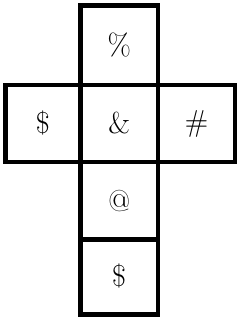
Two orientations of a dice are shown. This dice can be obtained by folding which of the option figures along the lines?

  1. AOption (a)

  2. BOption (b)

  3. COption (c)

  4. DOption (d)

View answer & explanation

Correct answer

Answer: (d)D.

Why this answer is correct

The logic followed here is:

From the given two different cubes the adjacent sides are as shown below :

As is common on both the dice. It is clear that &, @, # and \% are adjacent to it remaining number i.e., is will be opposite to G.

Opposite pairs: 

@ → %

& → #

$ → G

Let check each option one by one.

Option 1) 

Here,$ is opposite to # so it is False.

Option 2) 

Here, & is opposite to $ so it is False.

Option 3)

Here, & is opposite to @ so it is False.

Option 4)

Here, all the sign are correctly opposite according to the given dice so it is True.

Hence, the correct answer is "Option 4".$

Question 20

Select the letter-cluster from among the given options that can replace the question mark (?) in the following series.

CALI, ZEGO, WIBU, TMWA, ?

  1. AOption (a)

    QSPF

  2. BOption (b)

    QPSF

  3. COption (c)

    QRQE

  4. DOption (d)

    QQRE

View answer & explanation

Correct answer

Answer: (d)D.

QQRE

Why this answer is correct

The position of letters according to the English alphabet series:

The pattern followed here is:

Here, Option 3 is not the correct answer because they does not follow the complete logic.

Hence, the correct answer is "QQRE".

Question 21

Select the correct water image of the given combination.

  1. AOption (a)

  2. BOption (b)

  3. COption (c)

  4. DOption (d)

View answer & explanation

Correct answer

Answer: (d)D.

Why this answer is correct

The correct water image of the given combination is as shown below :-


Detailed Explanation:-

  • The word is "

" the second number is "9". So, the correct water image is "

" → Option 1 is eliminated.

  • The fourth number is "1". So, the correct water image is "

" → Option 2 is eliminated.

  • The second last letter is "g". So, the correct water image is "

" → Option 3 is eliminated.

Hence, the correct answer is "Option 4".

Question 22

In a certain code language, 'GANGA' is coded as 21-3-42-21-3 and 'KOSHI' is coded as 33-45-57-24-27. How will 'GOMTI' be coded in that language?

  1. AOption (a)

    21-45-39-60-27

  2. BOption (b)

    21-30-39-40-18

  3. COption (c)

    14-30-39-40-18

  4. DOption (d)

    14-45-26-60-27

View answer & explanation

Correct answer

Answer: (a)A.

21-45-39-60-27

Why this answer is correct

The position of letters according to the English alphabet series:

Logic: Every alphabet is multiply with × 3 = Code

'GANGA' is coded as 21-3-42-21-3

And,

'KOSHI' is coded as 33-45-57-24-27

Similarly,

'GOMTI' be coded '?'

Hence, the correct answer is "21-45-39-60-27".

Question 23

Select the Venn diagram that best represents the relationship between the following.

India, Delhi, Assam, Guwahati

  1. AOption (a)

  2. BOption (b)

  3. COption (c)

  4. DOption (d)

View answer & explanation

Correct answer

Answer: (c)C.

Why this answer is correct

Given: India, Delhi, Assam, Guwahati

  • India is the country.
  • Delhi and Assam in the two state of India.
  • Guwahati is the city of Assam.

According to the given information least possible Venn diagram is given below:

Hence, the correct answer is "Option 3".

Question 24

Study the given pattern carefully and select the number from among the given options that can replace the question mark (?) in it.

131652
152490
2336?
  1. AOption (a)

    108

  2. BOption (b)

    207

  3. COption (c)

    117

  4. DOption (d)

    81

View answer & explanation

Correct answer

Answer: (b)B.

207

Why this answer is correct

The logic followed here is 

Row wise : (second number ÷ 4) × First number = Third number

Row 1: (16 ÷ 4) × 13 = 4 × 13 = 52 

Row 2:  (24 ÷ 4) × 15 = 6 × 15 = 90

Row 3:  (36 ÷ 4) × 23 = 9 × 23 = 207

Hence, the correct answer "207".

Question 25

In a certain code language, ‘are you ready’ is written as ‘541’, ‘we are going’ is written as ‘261’, and ‘she is ready’ is written as ‘498’. How will ‘you’ be written in that language?

  1. AOption (a)

    5

  2. BOption (b)

    1

  3. COption (c)

    4

  4. DOption (d)

    6

View answer & explanation

Correct answer

Answer: (a)A.

5

Why this answer is correct

Explanation:

The data can be represented as follow:

CodeWord
are1
ready4
you5

'you' will be coded as '5'.

Hence, the correct answer is "5".

General Awareness (25 questions)

Question 26

Ashokan Minor Rock Edicts are found in different parts of India. Which of the following is NOT a find spot of Ashokan Minor Rock Edicts in Karnataka?

  1. AOption (a)

    Maski

  2. BOption (b)

    Gavimath

  3. COption (c)

    Rupnath

  4. DOption (d)

    Brahmagiri

View answer & explanation

Correct answer

Answer: (c)C.

Rupnath

Why this answer is correct

The correct answer is Rupnath.

Key Points

  • Rupnath inscription is near Kaimur hills, Jabalpur, Madhya Pradesh.
  • Maski inscription is in the Raichur district, Karnataka.
  • Gavimath is in Koppal district, Karnataka.
  • Brahmagiri inscription is in Chitradurga district, Karnataka.
  • Minor Rock Edicts of Ashoka:
  • These rock inscriptions are from the earliest part of the Edicts of Ashoka.
  • They predate Ashoka's Major Rock Edicts.
  • These are the first edicts in the Indian language of Emperor Ashoka, written in the Brahmi script.
  • The Kandahar Bilingual Rock Inscription, in Greek and in Aramaic, is the **first known inscription of Ashoka.**​

Important Points

  • The Rock Edicts were the first tangible evidence of, how Buddhism spread.
  • These edicts were deciphered by the British archaeologist and historian James Prinsep.
  • They were kept in public places and along trade routes so that the maximum number of people would read them.
  • There are 33 inscriptions classified into the following categories:
  • Major rock edicts
  • Minor rock edicts
  • Separate rock edicts
  • Major pillar edicts
  • Minor pillar edicts

Additional Information

  • Ashoka
  • Son of Bindusara and a Mauryan ruler.
  • ​He was one of the greatest rulers known in the history of India.
  • He has his inscriptions were carved on pillars, as well as on rock surfaces to connect with people.
  • The Kalinga War in 261 B.C changed his heart and he started following Buddhism.
  • Dhamma is a set of edicts that formed a policy of the Mauryan emperor Ashoka.

Question 27

The Vernacular Press Act of 1878 was repealed during the tenure of Viceroy _________.

  1. AOption (a)

    Lord Dufferin

  2. BOption (b)

    Lord Ripon

  3. COption (c)

    Lord Lansdowne

  4. DOption (d)

    Lord Northbrook

View answer & explanation

Correct answer

Answer: (b)B.

Lord Ripon

Why this answer is correct

The correct answer is Lord Ripon.

Key Points

  • Lord Rippon repealed the Vernacular Press Act of 1878.
  • The viceroy feared that the act may produce resentment among Indians.
  • **The act can become one of the catalysts giving rise to India's growing independence movement.**​

Important Points

  • Vernacular Press Act:
  • Passed in 1878, to restrict the freedom of the press of Indian languages.
  • Lord Lytton was highly criticized for the Second Anglo-Afghan War (1878–80).
  • Aim to prevent the vernacular press to express criticism of British policies under him.
  • It was nicknamed the ‘Gagging Act’.
  • The act empowered the Government:
  • to issue search warrants.
  • enter newspaper premises even without court orders.
  • The law was **repealed by Lytton’s successor, Lord Ripon.**​

Additional Information

  • Lord Rippon (1880-1884):
  • ​Repeal of the Vernacular Press Act (1882) took place.
  • The first Factory Act, 1881.
  • The appointment of the education commission under the chairmanship of Sir William Hunter (1882).
  • Resolution on Local Self Government (1882) passed.
  • The IIbert bill controversy (1883-1884).​
  • Lord Dufferin
  • Governor General of India and Viceroy from 1884 to 1888.
  • During his tenure, the Third Burmese war occurs.
  • Lord Dufferin favour the formation of the Indian National Congress in 1885.
  • ​Lord Lansdowne
  • Governor General and Viceroy of India from 1888 to 1893.
  • During his tenure, the Indo-Afghan border (Durand Line) was demarcated.
  • The Indian Council Act, of 1892 was enacted.
  • A system of indirect elections started in India.
  • Lord Northbrook
  • India’s Viceroy from 1872 to1876.
  • The important events during his reign:
  • Deposition of Gaikwad of Baroda in 1875.
  • Visit of Prince of Wales,
  • Famine in Bihar.
  • Kuka Movement in Punjab.

Question 28

Sri Akal Takht Sahib is located within the _________ complex.

  1. AOption (a)

    Patna Sahib

  2. BOption (b)

    Golden Temple

  3. COption (c)

    Gurudwara Bangla Sahib

  4. DOption (d)

    Paonta Sahib

View answer & explanation

Correct answer

Answer: (b)B.

Golden Temple

Why this answer is correct

The correct answer is Golden Temple.

Key Points

  • The Akal Takht is one of five takhts ( which means "seats of power" ) of the Sikhs.
  • It is located in the Golden Temple complex in Amritsar, Punjab, India.
  • The three Takhts are in Punjab: - 
  • Akal Takht in Amritsar.
  • Sri Keshgarh Sahib in Anandpur.
  • Sri Damdama Sahib at Talwandi Sabo Bhatinda district.
  • The other two of the five Takhts are:
  • Takht Sri Patna Sahib, Patna in Bihar.
  • **Takht Sri Hazoor Sahib at Nanded in Maharashtra.**​

Additional Information

  • ​​Patna Sahib​
  • Takht Sri Patna Sahib also known as Harmandir Sahib, is a Gurdwara in Patna, Bihar, India.
  • It was to commemorate the birthplace of Guru Gobind Singh, the tenth Guru of the Sikhs on December 1666.
  • It was built by Maharaja Ranjit Singh (1780-1839), the first Maharaja of the Sikh Empire.
  • Golden Temple
  • The Harmandir Sahib, or Golden Temple, in Amritsar, Punjab, India.
  • The first Harmandir Sahib was built in 1604 by Guru Arjan, the fifth Sikh Guru.
  • A central religious place of the Sikhs.
  • It is a symbol of human brotherhood and equality.
  • Gurudwara Bangla Sahib​
  • ​Gurudwara Bangla Sahib is situated in Delhi City.
  • Built in the sacred visit of Sri Guru Harikrishna Ji to Delhi.
  • Paonta Sahib
  • Gurudwara in Paonta Sahib is in the district of Sirmour, Himachal Pradesh.
  • This Gurdwara was built in memory of Guru Gobind Singh Ji, the tenth guru of Sikhs.
  • The Dasam Granth was written here by Guru Gobind Singh Ji.

Question 29

Solids like fats, grease and oil that float on top of liquid wastewater is called _________.

  1. AOption (a)

    compost

  2. BOption (b)

    peat

  3. COption (c)

    sludge

  4. DOption (d)

    urea

View answer & explanation

Correct answer

Answer: (c)C.

sludge

Why this answer is correct

The correct answer is sludge.

Key Points

  • Floatable materials like fats, grease, and oil that float on top of liquid wastewater are called sludge.
  • The process of skimming is used to remove these materials and make water fit for use.
  • Skimming tank:
  • A chamber used for sludge removal where matter like oil, fat, grease, etc. floats on the surface.
  • They then remain on the surface of the wastewater (Sewage) until removed.
  • While the liquid flows out continuously under partitions or baffles.​

Important Points

  • Sewage treatment:
  • Process of removing contaminants from municipal wastewater.
  • Wastewater contains mainly household sewage plus some industrial wastewater.
  • Sewage treatment units are **normally designed for 15-20 years.**​

Additional Information

  • Compost
  • ​Compost is decomposed organic material.
  • Made with materials such as leaves, shredded twigs, and kitchen scraps from plants.
  • It is a great material for garden soil.
  • Peat​
  • ​Peat is the surface organic layer of soil.
  • It consists of partially decomposed organic matter, derived mostly from plant material.
  • It forms due to accumulation under conditions of waterlogging, oxygen deficiency, high acidity, and nutrient deficiency.
  • Urea​
  • ​Urea is a source of Nitrogen, an essential nutrient crucial for crop growth and development.
  • Urea is the most important nitrogenous fertilizer in the country.
  • It also has industrial applications such as the production of plastics and as a nutritional supplement for cattle.

Question 30

Which of the following states has the lowest female sex ratio according to the 2011 Census?

  1. AOption (a)

    Uttar Pradesh

  2. BOption (b)

    Punjab

  3. COption (c)

    Haryana

  4. DOption (d)

    Sikkim

View answer & explanation

Correct answer

Answer: (c)C.

Haryana

Why this answer is correct

The correct answer is Haryana.

Key Points

  • Haryana has India's lowest sex ratio, a number of 879 females to 1000 males.
  • Puducherry and Kerala where there are more women than men.
  • Kerala has India's highest sex ratio and the figure shows a number of 1084 females to 1000 males.
Name of state or Union TerritorySex Ratio  (as per Census 2011)
Kerala1084
Puducherry1038
Tamil Nadu995
Andhra Pradesh992
Chhattisgarh991
Manipur987
Meghalaya986
Odisha978
Mizoram975
Himachal Pradesh974
Karnataka968
Goa968
Uttrakhand963
Tripura961
Assam954
Jharkhand947
West Bengal947
Lakshadweep946
Nagaland931
Madhya Pradesh930
Rajasthan926
Maharashtra925
Arunachal Pradesh920
Gujarat918
Bihar916
Uttar Pradesh908
Punjab893
Sikkim889
Jammu& Kashmir883
Andaman & Nicobar islands878
Haryana879
NCT of Delhi866
Chandigarh818
Dadra and Nagar Haveli775
Daman and Diu618
India943

Important Points

  • Census 2011 highlights: 
  • India’s population growth rate is 17.64 percent in the decade 2001-11,
  • The slowest rate of growth this past century, as per data put out by the registrar-general of the census.
  • India’s population in 2011 is estimated to be 1.21 billion, comprising 624 million males and 587 million females.
  • While the gender imbalance in the population remains.
  • India’s female population grew by 18.12% over the past decade against 17.19% for males.
  • India’s literacy rate has gone up from 64.83% in 2001 to 74.04% in 2011.
  • Literates constitute 74 percent of the total population aged seven and above.
  • The sex ratio, that is the number of females per 1,000 males, has improved to 940 from 933 a decade ago.
  • The child sex ratio is 914, the lowest since independence.​

Additional Information

  • The first synchronous census was taken under British rule on February 17, 1881, by W.C. Plowden (Census Commissioner of India).
  • It has been conducted by the Registrar General and Census Commissioner of India.
  • Shri Vivek Joshi is the present Registrar General and Census Commissioner, Ministry of Home Affairs.

Question 31

A ‘gnomon’ is a part of a ________.

  1. AOption (a)

    telescope

  2. BOption (b)

    transformer

  3. COption (c)

    bolometer

  4. DOption (d)

    sundial

View answer & explanation

Correct answer

Answer: (d)D.

sundial

Why this answer is correct

The correct answer is sundial.

Key Points

  • The gnomon is the part of a sundial that casts the shadow.
  • It is probably also the world's oldest astronomical instrument.
  • It is like a pole stuck in the sand.
  • It has been used to measure the passage of time by nomadic cultures of the Sahara for centuries.
  • The gnomon may be a rod, wire, or elaborately decorated metal casting.
  • It has to be parallel to the axis of the Earth's rotation for the sundial to be accurate throughout the year.

Additional Information

  • Telescope
  • ​Used to form magnified images of distant objects.
  • Most important investigative instrument in astronomy.
  • Galileo applied the telescope to the study of extraterrestrial bodies.
  • Transformer 
  • An electrical device designed to convert alternating current from one voltage to another.
  • It can be designed to "step up" or "step down" voltages.
  • Works on the magnetic induction principle.
  • Bolometer
  • ​The bolometer is a device used for detecting and measuring the heat and radiation of Microwave energy or RF.
  • It uses the temperature-sensitive resistive element whose resistance changes with the temperature.
  • The Thermistor and Barretter are examples of the commonly used resistive element.

Question 32

Who among the following was the first Indian Governor of Reserve Bank of India?

  1. AOption (a)

    CD Deshmukh

  2. BOption (b)

    HVR Lengar

  3. COption (c)

    PC Bhattacharya

  4. DOption (d)

    LK Jha

View answer & explanation

Correct answer

Answer: (a)A.

CD Deshmukh

Why this answer is correct

The correct answer is CD Deshmukh.

Key Points

  • Chintaman Dwarkanath Deshmukh, a member of the Indian Civil Service, was the first Indian Governor RBI.
  • His association with the Bank commenced in 1939 when he was appointed Government's liason officer.
  • He later served as Secretary and thereafter in 1941 as Deputy Governor of the Bank.
  • The first governor of RBI was the **British banker Osborne Smith.**​
  • Shaktikant Das is currently serving as the 25th governor of the Reserve Bank of India.

Important Points

  • ​RBI
  • ​The Reserve Bank of India was set up on the basis of the recommendations of the Hilton Young Commission.
  • The Reserve Bank of India Act, 1934 provides the statutory basis for the functioning of the Bank.
  • RBI commenced operations on April 1, 1935.
  • The Reserve Bank of India was nationalized with effect on 1st January 1949.
  • Nationalized on the basis of the Reserve Bank of India (Transfer to Public Ownership) Act, 1948.
  • Central Bank of India.

Additional Information

  • HVR Lengar
  • "H. V. R." Lengar was the sixth Governor of the Reserve Bank of India.
  • Served from 1 March 1957 to 28 February 1962.
  • Member of the Indian Civil Service.
  • Also served as the Chairman of the State Bank of India, before his appointment as the Governor of the Reserve Bank.
  • PC Bhattacharya
  • He was a member of the Indian Audit and Account Service.
  • Served as Secretary in the Finance Ministry.
  • Later as Chairman of the State Bank of India prior to his appointment as Governor, RBI.
  • The introduction of the Credit Authorisation Scheme as an instrument of Credit Regulation,
  • The **devaluation of the Rupee in 1966.**f
  • Key measures taken under him include import liberalization and elimination of export subsidies.
  • LK Jha​
  • A member of the Indian Civil Service.
  • Also served as Secretary to the Prime Minister, prior to his appointment as Governor.
  • During his tenure, social controls over commercial banks were introduced as an experiment in 1968.
  • A National Credit Council was established.
  • 14 major commercial banks were nationalized in 1969.

Question 33

In order to get clean drinking water disinfectant is used after filtration. Disinfectant, however, is NOT used for removing:

  1. AOption (a)

    bacteria

  2. BOption (b)

    viruses

  3. COption (c)

    minerals

  4. DOption (d)

    parasites

View answer & explanation

Correct answer

Answer: (c)C.

minerals

Why this answer is correct

The correct answer is minerals.

Key Points

  • The goal of disinfection of public water supplies is:
  • elimination of the pathogens such as bacteria, viruses, and parasites that are responsible for waterborne diseases.
  • Chlorine and chloramine are the major disinfectants used in public water systems.
  • Chlorine kills pathogens such as bacteria and viruses by breaking the chemical bonds in their molecules.
  • **Boiling water is the most effective way to disinfect water.**​

Important Points

  • Need for disinfection of drinking water.
  • Water from lakes, rivers, streams and many groundwater sources may contain disease-causing “germs.”
  • The germs, called pathogens, can lead to water-borne infections.
  • Water-borne illnesses can lead to serious complications, including death.
  • Water-borne infections can spread when an animal or human feces containing these pathogens get into drinking water.
  • These pathogens may include bacteria, viruses, or parasites (e.g., Campylobacter, Salmonella, Giardia, and Cryptosporidium).
  • Disinfection kills or removes pathogens from drinking water, reducing health risks.
  • One can disinfect water by adding chemicals, using heat, using ultraviolet (UV) radiation, and filtration.

Question 34

The _________ considers a marriage as complete and binding at the completion of the Saptapadi ritual.

  1. AOption (a)

    Indian Christian Marriage Act, 1862

  2. BOption (b)

    Hindu Marriage Act, 1955

  3. COption (c)

    Parsi Marriage and Divorce Act, 1936

  4. DOption (d)

    Muslim Personal Law (Shariat) Application Act, 1937

View answer & explanation

Correct answer

Answer: (b)B.

Hindu Marriage Act, 1955

Why this answer is correct

The correct answer is Hindu Marriage Act, 1955.

Key Points

  • Section 7 in The Hindu Marriage Act, 1955 says:-
  • A Hindu marriage may be solemnized in accordance with the customary rites and ceremonies of either party.
  • Rites and ceremonies include the saptapadi.
  • It is a ritual of taking seven steps by the bridegroom and the bride jointly before the sacred fire.
  • The **marriage becomes complete and binding when the seventh step is taken.**​

Important Points

  • The Saptapadi ceremony:
  • Establishes the commitment the couple makes to each other during the Hindu wedding ceremony.
  • Saptapadi quite literally translates from Sanskrit to ‘seven steps’.
  • The couple takes seven full circles, walking clockwise around the ceremonial fire.
  • **Circles represent the seven principles and promises they make to each other.**​
  • ​Hindu Marriage Act, 1955
  • India is mainly a Hindu-dominated country.
  • Therefore, Hindu marriages are mainly governed by “The Hindu Marriage Act, 1955.”
  • ​The Act came into force on May 18, 1955
  • It is applicable to the whole of India except the state of Jammu & Kashmir.

Additional Information

  • ​​Indian Christian Marriage Act, 1862:
  • Act consolidates the law related to the solemnizing of Indian Christian Marriage.
  • Enacted on 18th July 1872.
  • Applicable to the whole of India except Cochin, Manipur, and  Jammu & Kashmir.
  • The act contains 88 Sections in 8 Parts and 4 Schedules. ​
  • Parsi Marriage and Divorce Act, 1936:
  • ​Parsis are governed in the matters of marriage and divorce by the Parsi Marriage and Divorce Act, 1936.
  • The Act is divided into six chapters.
  • It deals with marriage between Parsis, matrimonial courts, matrimonial suits, children of the parties, and miscellaneous provisions.
  • Section 2(7) of the Act says a ‘Parsi’ means a Parsi Zoroastrian.
  • Muslim Personal Law (Shariat) Application Act, 1937​
  • ​The Muslim Personal Law (Shariat) Application Act was passed in 1937.
  • The aim was to formulate an Islamic law code for Indian Muslims.
  • For the Muslims on the other hand, the writings in the Quran would be of foremost importance.
  • Shariat Application Act, 1937 mandates aspects of Muslim social life such as marriage, divorce, inheritance, and family relations.
  • The Act lays out that in matters of a personal dispute the State shall not interfere.

Question 35

As of April 2021, _________ held the record for the highest individual Women’s ODI cricket score by an Indian player. She was also the only Indian spinner to take six women’s ODI wickets.

  1. AOption (a)

    Radha Yadav

  2. BOption (b)

    Punam Raut

  3. COption (c)

    Taniya Bhatia

  4. DOption (d)

    Deepti Sharma

View answer & explanation

Correct answer

Answer: (d)D.

Deepti Sharma

Why this answer is correct

The correct answer is Deepti Sharma.

Key Points

  • India woman cricketer Deepti Sharma recorded the highest individual score for India in women's One-day Internationals.
  • The 19-year-old achieved the milestone with a magnificent 188 off 160 balls.
  • It happened during a Women's Quadrangular Series ODI match against Ireland at Senwes Park in Potchefstroom, South Africa.
  • Her 160-ball entertaining knock was studded with 27 boundaries and 2 sixes.
  • Overall, she is just behind Australia's Belinda Clark.
  • Belinda Clark had scored an unbeaten 229 against Denmark during a Women's World Cup match in 1997 in Mumbai.
  • **In 2016, Sharma recorded her best ODI bowling figures as she picked up six wickets against Sri Lanka in Ranchi.**​

Additional Information

  • Indian Women Cricket Team
  • Women’s Cricket Association of India was formed in 1973.
  • Indian women’s cricket team played their first Test match against West Indies in 1976 at M.Chinnaswamy Stadium, Bangalore.
  • Their first Test victory came two years later against West Indies at the Moin-ul-Haq Stadium in Patna.
  • Indian team played their first ODI against England in 1978 at Eden Gardens, Kolkata.
  • Their first T20I match was also against England in 2006 at the County Cricket Ground, Derby.
  • The Indian team is one of the top teams today in Asia and the world.
  • Also known as "Women in Blue".

Question 36

​The Government of India imposed an Agriculture and Infrastructure Development Cess of __________ per litre on petrol through Union Budget 2021-22.

  1. AOption (a)

    Rs. 2.5

  2. BOption (b)

    Rs. 3

  3. COption (c)

    Rs. 3.5

  4. DOption (d)

    Rs. 4

View answer & explanation

Correct answer

Answer: (a)A.

Rs. 2.5

Why this answer is correct

The correct answer is Rs. 2.5.

Key Points

  • According to the Budget for 2021-22, a Rs 2.5 per liter Agriculture and Infrastructure Development Cess has been imposed on petrol and Rs 4 on diesel.
  • Other items on which cess has been imposed as per Budget 2021-22:
  • 30 percent agriculture infra cess on Kabuli chana.
  • 50 percent on Bengal gram/chickpeas.
  • 10 percent on peas.
  • 20 percent on lentils (masoor).
  • 5 percent on cotton.
  • 2.5 percent imposed on gold, silver, and dore bars.
  • 35 percent imposed on apples.
  • 5 percent on specified fertilizer.
  • 1.5 percent on coal, lignite, and peat.
  • 100 percent agriculture infra cess on alcoholic beverages.
  • 17.5 percent has been imposed on crude palm oil.
  • 20 percent have also been imposed on **crude soyabean.**​

Important Points 

  • Key highlights of Budget 2021-22:
  • ‘Operation Green Scheme’ to be extended to 22 perishable products, to boost value addition in agriculture and allied products.
  • To double the Micro Irrigation Fund to Rs. 10,000 crores.
  • Rural Infrastructure Development Fund to be enhanced to Rs. 40,000 crores from Rs. 30,000 crores.
  • Agricultural credit target enhanced to Rs. 16.5 lakh crore in FY22 - animal husbandry, dairy, and fisheries to be the focus areas.
  • To increase the permissible FDI limit from 49% to 74% and allow foreign ownership and control with safeguards.
  • Under the Rs. 5.35 lakh crore Bharatmala Pariyojana, more than 13,000 km length of roads worth Rs. 3.3 lakh crore was awarded for construction.
  • Rs. 2,87,000 crore over 5 years for Jal Jeevan Mission (Urban) - to be launched with an aim to provide:
  • 2.86 crore household tap connections.
  • Universal water supply in all 4,378 Urban Local Bodies.
  • Liquid waste management in 500 AMRUT cities.
  • Mega Investment Textiles Parks (MITRA) scheme, in addition to PLI.
  • 7 Textile Parks to be established over 3 years.
  • Rs. 64,180 crore outlay over 6 years for PM AtmaNirbhar Swasth Bharat Yojana.
  • Rs. 35,000 crores for COVID-19 vaccine in 2021-22.
  • ​Rs. 2,23,846 crore outlay for Health and Wellbeing in 2021-22 as against Rs. 94,452 crores in 2020-21 an increase of 137%

Additional Information

  • Highlights of Budget 2022-23.
  • India’s economic growth is estimated at 9.2% to be the highest among all large economies.
  • 60 lakh new jobs are to be created under the productivity-linked incentive scheme in 14 sectors.
  • PLI Schemes have the potential to create an additional production of Rs 30 lakh crore.
  • Entering Amrit Kaal, the 25-year-long lead-up to India @100, the budget provides the impetus for growth along with four priorities:
  • PM Gati Shakti
  • Inclusive Development
  • Productivity Enhancement & Investment, Sunrise opportunities, Energy Transition, and Climate Action.
  • Financing of investments
  • National Highways Network to be expanded by 25000 Km in 2022-23.
  • Rs. 2.37 lakh crore direct payment to 1.63 crore farmers for procurement of wheat and paddy.
  • Rs. 48,000 crores allocated for completion of 80 lakh houses in 2022-23 under PM Awas Yojana.
  • Introduction of Digital Rupee by the Reserve Bank of India starting 2022-23.
  • ​Total expenditure in 2022-23 is estimated at Rs. 39.45 lakh crore.
  • Total receipts other than borrowings in 2022-23 are estimated at Rs. 22.84 lakh crore.
  • The fiscal deficit in 2022-23 is estimated at 6.4% of GDP.

Question 37

Which of the following Amendments of the Constitution of India was enacted in 1993 to constitutionally recognise municipal governments?

  1. AOption (a)

    71st Constitutional Amendment Act (CAA), 1988

  2. BOption (b)

    72nd Constitutional Amendment Act (CAA), 1989

  3. COption (c)

    74th Constitutional Amendment Act (CAA), 1992

  4. DOption (d)

    73rd Constitutional Amendment Act (CAA), 1990

View answer & explanation

Correct answer

Answer: (c)C.

74th Constitutional Amendment Act (CAA), 1992

Why this answer is correct

The correct answer is 74th Constitutional Amendment Act (CAA), 1992.

Key Points

  • 74th Constitutional Amendment Act (CAA), 1992, added Part IXA to the Constitution.
  • It was enacted in 1993 to constitutionally recognize municipal governments.
  • It made municipal governments a formal part of the three-tier governing system, along with the Union Government and the State Governments.
  • While this Act mandated the setting up of municipal governments in urban areas.
  • State governments have been assigned the role to detail the constitution of municipal corporations through their respective Municipal Acts.
  • According to the 74th CAA, urban areas would be governed by one of the three mentioned types of urban local governments namely:
  • the Nagar Panchayat,
  • Municipal Council,
  • Municipal Corporation based on the size of the area.
  • Nagar Panchayats were to administer areas in transition from rural to urban areas.
  • Municipal councils administer small urban areas.
  • Municipal corporations for larger urban areas.
  • The Act mentioned that the areas to be defined as ‘transitional’, ‘smaller urban areas, and **‘larger urban areas were to be specified by the State Governors.**​

Additional Information

  • ​71st Constitutional Amendment Act (CAA), 1992
  • ​The amendment enables the inclusion of Nepali, Manipuri, and Konkani into the Constitution's Eighth Schedule.
  • The number of languages in the Eighth Schedule ascends to 18 with the inclusion of these three languages.
  • 72nd Constitutional Amendment Act (CAA), 1992
  • ​To make temporary provision for the determination of the number of seats reserved for the Scheduled Tribes in the State assembly of Tripura.
  • The re-adjustment of seats is made on the basis of the first census after the year 2000 under article 170 of the Constitution.
  • 73rd Constitutional Amendment Act (CAA), 1992
  • ​The Constitution (73rd Amendment) Act, 1992 has added a new part IX consisting of 16 Articles and the Eleventh Schedule to the Constitution.
  • The 73rd Amendment envisages the Gram Sabha as the foundation of the Panchayat Raj System to perform functions and powers entrusted to it by the State Legislatures.

Question 38

The picture that won the World Press Photo of the Year 2021 contest is titled ‘_________’.

  1. AOption (a)

    The First Embrace

  2. BOption (b)

    Emancipation Memorial Debate

  3. COption (c)

    Straight Voice

  4. DOption (d)

    Crying Girl on the Border

View answer & explanation

Correct answer

Answer: (a)A.

The First Embrace

Why this answer is correct

The correct answer is The First Embrace.

Key Points

  • The independent jury of the 2021 Photo Contest selected Mads Nissen’s photograph The First Embrace as the World Press Photo of the Year.

  • In the winning image, Rosa Luzia Lunardi (85) is embraced by nurse Adriana Silva da Costa Souza, at Viva Bem care home, Sao Paulo, Brazil, on 5 August 2020.

  • The winners were announced at an online Awards Show on 15 April 2021.

Additional Information

  • The World Press Photo Foundation presents the awards in the following categories:
  • World Press Photo of the Year.
  • World Press Photo Story of the Year.
  • World Press Photo Interactive of the Year.
  • World Press Photo Online Video of the Year.
  • ​It all began in 1955 when a group of Dutch photographers organized an international contest (“World Press Photo”) to expose their work to a global audience.
  • The World Press Photo Contest recognizes the best photojournalism and documentary photography.
  • ​​Amber Bracken's picture, entitled Kamloops Residential School, has been named World Press Photo of the Year, 2022.

Question 39

Who was the Australian Open Women’s Singles champion in 2021?

  1. AOption (a)

    Venus Williams

  2. BOption (b)

    Serena Williams

  3. COption (c)

    Naomi Osaka

  4. DOption (d)

    Jennifer Brady

View answer & explanation

Correct answer

Answer: (c)C.

Naomi Osaka

Why this answer is correct

The correct answer is Naomi Osaka.

Key Points

  • Naomi Osaka won her fourth Grand Slam title, adding a second Australian Open to her twin US Open triumphs.
  • She won the title after beating USA's Jennifer Brady 6-4, 6-3 in the 2021 Australian Open women's singles final in Melbourne.
  • Osaka became the first woman since Monica Seles, and the first player since Roger Federer to win her first four Grand Slam finals.
  • Novak Djokovic defended the men's singles title as he claimed his 18th Grand Slam title, defeating Daniil Medvedev.

Important Points 

  • Grand Slams of Tennis:
  • ​The Grand Slam itinerary consists of:
  • the Australian Open in mid-January,
  • the French Open (also known as Roland Garros) from around late May to early June,
  • Wimbledon in June–July, and
  • the US Open in August–September.
  • Each tournament is played over a two-week period.
  • Rafael Nadal is the winner of **most Grand Slams titles with 22 titles to his name.**​

Additional Information

  • Rafael Nadal defeated Daniil Medvedev, to win the men's singles tennis title at the 2022 Australian Open.
  • Ashleigh Barty defeated Danielle Collins to win the women's singles tennis title at the 2022 Australian Open.

Question 40

Who among the following Indian artists won the ‘Joan Miro Prize’ for the year 2019?

  1. AOption (a)

    Nalini Malani

  2. BOption (b)

    Jogen Chowdhury

  3. COption (c)

    Anjolie Ela Menon

  4. DOption (d)

    Jiten Thukral

View answer & explanation

Correct answer

Answer: (a)A.

Nalini Malani

Why this answer is correct

The correct answer is Nalini Malani.

Key Points

  • Indian contemporary artist Nalini Malani has won the Joan Miro Prize for 2019.
  • The award is named after Spanish painter and sculptor Joan Miro, one of the most influential artists of the 20th century.
  • The award is given by Fundacio Joan Miro, the Spanish art museum along with the bank La Caixa.
  • La Caixa will provide Malani with **a €70,000 (Rs. 54.5 lakh) award.**​

Additional Information

  • Joan Miro Prize
  • ​The Joan Miro Prize is awarded every two years by the Fundacio Joan Miro and Obra Social "la Caixa".
  • Recognizes present-day work by artists who show the same spirit of exploration, innovation, commitment, and freedom that characterized Joan Miro's life and work.
  • First awarded in 2007, the prize is conferred by an international panel of judges made up of acclaimed professionals in the field of contemporary creation.
  • "la Caixa" Foundation provides a cash prize of €70,000.
  • Foundation also covers the cost of producing a monographic exhibition of the work by the winning artist, to be held at Fundació Joan Miro.
  • Winners of the Awards so far:
  • 2019: Nalini Malani
  • 2017: Kader Attia
  • 2015: Ignasi Aballí
  • 2013: Roni Horn
  • 2011: Mona Hatoum
  • 2009: Pipilotti Rist
  • 2007: Olafur Eliasson

Question 41

Which of the following is more suitable than the others for the growth of cashew nut?

  1. AOption (a)

    Black cotton soil

  2. BOption (b)

    Alluvial soil

  3. COption (c)

    Red laterite soil

  4. DOption (d)

    Arid soil

View answer & explanation

Correct answer

Answer: (c)C.

Red laterite soil

Why this answer is correct

The correct answer is Red laterite soil.

Key Points

  • Red laterite soil is most suitable for growing cashew nuts.
  • Red laterite soils are formed due to the weathering of laterite rocks.
  • Laterite soils are rich in iron and aluminium content.
  • Usually rusty-red in color due to the high iron oxide content.
  • It is suitable for building purposes.
  • Red laterite soils in Tamil Nadu, Andhra Pradesh and Kerala are more suitable for tea plantations.

Additional Information

  • Black soil
  • It is well suited for the cultivation of cotton so it is also called cotton soil.
  • It is also called ‘Regur Soil’ or the ‘Black Cotton Soil’.
  • It is formed by the disintegration of basalt.
  • Alluvial soils
  • ​These are the most extensive soil type in India.
  • Alluvial soils are formed from the sediments deposited by the rivers.
  • It is rich in potash and poor in nitrogen and organic matter.
  • Alluvial soils are most suitable for growing wheat, rice, maize, sugarcane, pulses, etc.
  • Red and yellow soils
  • These are derived from granites, gneisses, and other metamorphic rocks.
  • The soil looks reddish in color due to a wide diffusion of iron in crystalline.
  • These are metamorphic rocks and it looks yellow when it occurs in a hydrated form.
  • Red and yellow soils are most suitable for growing wheat, cotton, pulses, tobacco, millets, oilseeds, potato, etc.
  • Arid Soils 
  • ​Arid soil is unsuitable for cultivation.
  • Arid soil is generally sandy in texture and saline in nature.
  • It restricts the filtration of water.

Question 42

Which of the following statements was quoted by Subhash Chandra Bose?

  1. AOption (a)

    Live as if you were to die tomorrow. Learn as if you were to live forever.

  2. BOption (b)

    The best way to find yourself is to lose yourself in the service of others.

  3. COption (c)

    Give me blood and I will give you freedom.

  4. DOption (d)

    First, they ignore you, then they laugh at you, then they fight you, then you win.

View answer & explanation

Correct answer

Answer: (c)C.

Give me blood and I will give you freedom.

Why this answer is correct

The correct answer is Give me blood and I will give you freedom.

Key Points

  • ‘Give me blood, and I shall give you freedom’ is a slogan given by Subhash Chandra Bose in Burma in 1944 to members of the Indian National Army.
  • Mahatma Gandhi said, “Live as if you were to die tomorrow. Learn as if you were to live forever.”
  • Mahatma Gandhi observed, “that the best way to find yourself is to lose yourself in the service of others.”
  • In other words, placing the needs of others before your own is an important step on the journey of self-discovery.
  • Mahatma Gandhi has said, "First, they ignore you, then they laugh at you, then they fight you and then you win".

Additional InformationFamous Slogans by Indian Freedom Fighters:

Slogan/Phrasegiven by
Karo Ya Maro(Do or die)Yusuf Meherally
, Popularized by Mahatma Gandhi
Tum Mujhe Khoon Do, Me Tumhe Ajadi Dunga(Give me blood and I will give you freedom)Subhash Chandra Bose
Inqlaab Zindabad (Long Live the Revolution)Shaheed Bhagat Singh
Sare Jahan Se Achha Hindustan HamaraMuhammad Iqbal
Jan Gan Man Adhinayak Jai HeRavindra Nath Tagore
Desh Bachao, Desh BanaoP.V. Narsimha Rao
Kam Adhik Batain KamSanjay Gandhi
Swraj Hamara Janm Sidh Adhikar Hai(Swaraj is my birthright and I shall have it.)Bal Gangadhar Tilak
Vande MatramBakim Chandra Chatarji
Quit IndiaMahatma Gandhi
Maro Firangi KoMangal Pandey
Jai Jawan, Jai Kisaan(Hail the soldier, Hail the farmer)Lal Bahadur Shastri
Shramev JaiyteMrs. Indira Gandhi
Dilli ChaloShubhash Chandra Bose
Poorna SwarajJawaharlal Nehru
Desh Ki Puja Hi Ram Ki Puja HaiMadanlal Dhingra
Kar Mat DoSardar Vallabh Bhai Patel
Sampurn KrantiJaiprakash Narayan
Kashmir ChaloDr. Murli Manohar Joshi
He RamMahatma Gandhi
Jai JagatBinova Bhave
Samrajyavad Ka Nash HoBhagat Singh
Simon Commission Vapas JaaoLala Lajpat Rai
Vijyai Vishv Tiranga PyaraShyamlal Gupta
Jai HindSubhash Chandra Bose

Question 43

In which of the following dances do dancers balance pots containing lit lamps on their heads?

  1. AOption (a)

    Dhangari Gaja dance

  2. BOption (b)

    Koli dance

  3. COption (c)

    Tamasha dance

  4. DOption (d)

    Chari dance

View answer & explanation

Correct answer

Answer: (d)D.

Chari dance

Why this answer is correct

The correct answer is Chari dance.

Key Points

  • Chari dance is one of the popular folk dances in Rajasthan India.
  • In chari dance, women hold chari or pots on their heads, and a lighted lamp is then placed in the pot.
  • The famous Chari dance belongs to Gujjar community of Kishangarh and only women perform in this dance.
  • These ladies carry brass pots on their heads balancing them to perfection.
  • These pots are kept ignited with the cotton seeds dipped in oil.
  • These lit pots display beautiful effects in the dark night.
  • This dance does not have any particular movements except balancing the pots on their heads.
  • This dance is also known as a welcome dance and is a sign of goodness.
  • It can also be **considered the traditional fire dance of Rajasthan.**​

Additional Information

  • ​​Dhangari Gaja dance​
  • It is a folk dance of Maharashtra.
  • Dhangari Gaja dance is performed in traditional Marathi dresses - dhoti, angarakha, and pheta with colorful handkerchiefs.
  • The Dhangars of the Sholapur district of Maharashtra herd in green pastures for grazing their cattle.
  • They become acquainted with nature.
  • They honor God Biruba once every year when they return home.
  • They spend their time with their families and beloved ones.
  • And this is the time when the Dhangari Gaja dance is performed to please their God for His blessings.
  • Koli dance​
  • ​Koli is the dance form of the Koli fisher folk of Maharashtra.
  • The community has its own distinct identity and lively dances.
  • The dance incorporates elements that this community is most familiar with - sea and fishing.
  • The dance is performed by both men and women divided into two groups
  • Fishermen stand in two rows holding oars in their hands.
  • The dancers move in unison, portraying the movement of the rowing of a boat.
  • Tamasha dance​
  • Kolhati and Mahar communities are associated with Tamasha.
  • Tamasha is generally started with a devotional song and is followed by the dramatic sequence known as 'Gaulan'.
  • Love songs like lavanis are the spirit of Tamasha and are very much popular.
  • Musical instruments like:
  • dholki drum, tuntuni (a single string instrument), manjeera cymbals, daf are used to increase the aestheticism of the dance.

Question 44

As per WHO (World Health Organization), which of the following is NOT an example of disinfection by-products formed at traditional drinking water treatment plants?

  1. AOption (a)

    Titania

  2. BOption (b)

    Bromate

  3. COption (c)

    Chlorite

  4. DOption (d)

    Chlorate

View answer & explanation

Correct answer

Answer: (a)A.

Titania

Why this answer is correct

The correct answer is Titania.

Key Points

  • Bromate, Chlorite, and Chlorate are examples of disinfection by-products formed at traditional drinking water treatment plants.
  • Hence Titania is  NOT an example of disinfection by-products formed at traditional drinking water treatment plants.
  • Water treatment plants add chlorine to drinking water to kill or inactivate harmful organisms in a process called “disinfection.”
  • During this process, chlorine also reacts with naturally occurring organic matter that may be present in drinking water.
  • Disinfection by-products (DBPs) are intermediate compounds formed after the chemical treatment of water for the removal of geogenic and microbial contaminants.
  • Chemicals such as chlorine, ozone, ultraviolet radiation, and hydrogen peroxide are commonly used for the purpose of disinfection of water.​​

Important Points

  • Pure titanium dioxide OR Titania is a fine, white powder that provides a bright, white pigment.
  • It is used as a water treatment agent and is not a disinfection agent.
  • Used in paints, coatings, adhesives, paper, plastics and rubber, printing inks, coated fabrics, and textiles, as well as ceramics, toothpaste, soap, water treatment agents, and pharmaceuticals.

Additional InformationDisinfection byproducts of various disinfectants:

Disinfectantinorganic disinfection byproductsnon-halogenic disinfection byproducts
Chlorine (Cl2)/ underchloric acid (HOCl)chlorate (particularly the application of hypochlorite)aldehydes, alkanic acids, benzene, carboxylic acids
Chlorine dioxide (ClO2)chlorite, chlorateunknown
Chloramines (NH3Cl etc.)nitrite, nitrate, chlorate, hydrazinealdehydes, ketones
ozone (O3)chlorate, iodate, bromate, hydrogen peroxide, underbromic acid, epoxy, ozonatesaldehydes, ketones, ketoacids, carboxylic acids

Question 45

Under the National Urban Sanitation Policy, a city that scores points between 34 and 66 and needs considerable improvement is colour-coded ________.

  1. AOption (a)

    blue

  2. BOption (b)

    black

  3. COption (c)

    green

  4. DOption (d)

    red

View answer & explanation

Correct answer

Answer: (b)B.

black

Why this answer is correct

The correct answer is black.

Key Points

  • Under the National Urban Sanitation Policy, a city that scores points between 34 and 66 and needs considerable improvement is color-coded as black.
  • The comparative rating of cities is based on 19 sanitation indicators.
  • It is currently being carried out in 441 cities and towns with a population of more than 100,000.
  • The indicators are based on output/process/outcome levels.
  • Cities will be rated on parameters such as:
  • complete elimination of open defecation.
  • elimination of open scavenging.
  • safe collection and disposal of total human excreta.
  • On the basis of the rating, cities will be classified as Red, Black, Blue, or Green to denote increasing achievement of good environmental and health outcomes (red being the lowest and green the highest).
City Colour Codes: Categories
CategoryDescriptionPoints
RedNeeding immediate remedial action< 33
BlackNeeding considerable improvement< 34 < 66
BlueRecovering but still diseased< 67 < 90
GreenHealthy and Clean city< 91 < 100
  • Each year if the city improves its ratings, it will be recognized and awarded “Nirmal Shahar Puraskar”.
  • The cities are divided into north, south, east and northeast, west and central, and south-central.

Additional Information

  • National Urban Sanitation Policy
  • ​The National Urban Sanitation Policy was launched in 2008 by the Ministry of Urban Development of India.
  • It emphasizes the need of:
  • defining integrated city-wide sanitation plans including institutional strengthening.
  • awareness generation, behavioural changes.
  • pro-poor approaches.
  • cost-effective technologies aiming at developing state sanitation strategies
  • city sanitation plans should lead to open defecation-free cities.
  • sanitary and safe disposal of all human and liquid wastes.

Question 46

Who among the following became a part of the Constituent Assembly from Madras Constituency in 1946?

  1. AOption (a)

    Ammu Swaminathan

  2. BOption (b)

    Kamla Chaudhry

  3. COption (c)

    Hansa Jivraj Mehta

  4. DOption (d)

    Begum Aizaz Rasul

View answer & explanation

Correct answer

Answer: (a)A.

Ammu Swaminathan

Why this answer is correct

The correct answer is Ammu Swaminathan.

Key Points

  • Ammu Swaminathan was elected to the Constituent Assembly from the Madras Constituency in 1946.
  • She spoke on fundamental rights and directive principles.
  • Ammu Swaminathan was born in 1894 in Palakkad, Kerala.
  • In 1917, she worked with Kamaladevi Chattopadhyay, Annie Besant, Muthulakshmi Reddy, and others to set up the Women’s India Association (WIA) at Adyar, Madras.
  • Swaminathan was involved in the Quit India Movement in 1942 which led to her imprisonment a year later.
  • Post-independence **she was elected to the first Lok Sabha in 1952 and subsequently to the Rajya Sabha in 1954.**​

Important Points

  • Kamla Chaudhry
  • Kamla Chaudhry was one of those 15 women who were a part of the Constituent Assembly.
  • She was also a talented short story writer and freedom fighter.
  • Kamla actively took part in the Civil Disobedience Movement of 1930.
  • She was jailed several times for her participation in the movement for independence.
  • During the movement, she joined Indian National Congress.
  • She was the senior Vice-Chairperson during the fifty-fourth session of the All India Congress Committee.
  • Hansa Jivraj Mehta​
  • ​Mehta was one of the 15 women framers of the Indian Constitution.
  • She was elected to the Constituent Assembly from Bombay under a Congress Party ticket.
  • In the Assembly, she strongly argued in favor of women’s rights and intervened in debates on uniform civil code and reservations.
  • Mehta participated in the non-cooperation and swadeshi movements.
  • Her involvement with India’s freedom struggle got her arrested in 1932.
  • Begum Aizaz Rasul
  • ​Rasul stepped into electoral politics in 1937 when she was elected as a member of the U.P. Legislative Assembly.
  • She continued to be a member of the U.P. Assembly until 1951.
  • Rasul was among the very few women, legislators to be elected from a non-reserved province in British India- a remarkable achievement.
  • She was a strong opponent of **reservation for minorities in legislative assemblies, the partition of India, and feudal practices like the zamindari system. **​

Additional Information

  • Formation of the constituent assembly
  • ​Under the Cabinet Mission Plan of 1946, elections were held for the Constituent Assembly.
  • The members were elected by the members of the provincial assemblies by the method of a single transferable vote of proportional representation.
  • In the beginning, there were 389 members. But after the partition of the country into India and Pakistan, the number came down to 299
  • 229 were from the British Indian provinces while the remaining 70 were from the princely states.
  • The seats to the British Indian provinces and princely states were allotted in the proportion of their respective population and were to be divided among Muslims, Sikhs and the rest of the communities.

Question 47

The Annapurna peak belongs to which region of the Himalayas?

  1. AOption (a)

    Kumaon

  2. BOption (b)

    Garhwal

  3. COption (c)

    Bhutan

  4. DOption (d)

    Nepal

View answer & explanation

Correct answer

Answer: (d)D.

Nepal

Why this answer is correct

The correct answer is Nepal.

Key Points

  • Mount Annapurna is the tenth highest mountain in the world at 8,091 meters (26,545 ft).
  • It is in the Annapurna massif of Nepal Himalayas.
  • It includes many peaks over 7,000 meters.
  • The massif is bounded by the Kali Gandaki Gorge to the west, the Marshyangdi River in the north and east, and Pokhara Valley in the south.
  • At the western end, the massif encloses a high basin called the Annapurna Sanctuary.
  • In 1950, Maurice Herzogled a French expedition to its summit, making it the first of the eight thousand to be successfully climbed.
  • The Annapurna peaks are among the world's most dangerous mountains to climb.
  • The mountain is named after Annapurna, the Hindu goddess of food and nourishment, who is said to reside there.
  • The name Annapurna is derived from the Sanskrit language—"purna" means filled and "anna" means food.
  • Annapurna is located on the border of Myagdi and Kaski districts in Gandaki province of Nepal.

Important Points 

  • The Himalayas is divided longitudinally into 4 divisions from west to east:
  • The Kashmir /Punjab/ Himachal Himalayas
  • The Kumaun Himalayas
  • The Central/ Nepal Himalayas
  • The Assam/ Eastern Himalayas

Additional Information

  • The Kashmir /Punjab/ Himachal Himalayas
  • It lies between the Indus River and Sutlej.
  • A significant portion of the Himalayas lies in Jammu and Kashmir and Himachal Pradesh.
  • This is also known as Punjab Himalayas.
  • It is characterized by high snow-covered peaks, deep valleys, and High Mountain passes.
  • The range stretches for 700km in length and 500 km in width.
  • It has a height of 3000 m with a large number of glaciers.
  • The Kashmir valley which belongs to this division is surrounded by the Greater Himalayas and the Lesser Himalayas.
  • Important passes of the Kashmir Himalayas:
  • Pir panjal, Banihal, Zoji La, Burzil, Khardungla, Pensi- La, Umasi-La and Qara-Tagh-La.
  • The important snow-capped peaks are Nanda Devi, Trisul, Nunkun, Kamath, and Nanga-Parbat.
  • The Kangra valley, Kullu- Manali lies Himachal Division.
  • The important passes are the Rohtang pass, Bara-Lacha, and Shipki La.
  • The Kumaun Himalayas
  • This division lies between the Satluj and Kali Rivers.
  • The highest peak in this division is Nanda Devi.
  • Important peaks are Nanda Devi, Trisul, Kedarnath, Kamet, Badrinath, and Gangotri.
  • Pindari, Gangotri, and Milam are important glaciers in this division.
  • The major hill stations are Mussorie, Nainital, Ranikhet, Almora, and Bageshwar.
  • The important passes are Thaga La, Muling La, Mana, Mangsha Dhura, and Lipu Lekh.
  • The Central/ Nepal Himalayas
  • ​This division stretches from the Kali River to the Tista River.
  • The major part of it lies in Nepal except for the extreme eastern part- Sikkim Himalayas.
  • The important peaks are the Mt. Everest, Kanchenjunga, Makalu, Dhaula Giri, Annapurna.
  • Nathu La and Jelep La are the important passes in this region.
  • The Assam/ Eastern Himalayas
  • This division lies between Tista and the Brahmaputra River (Dihang).
  • It occupies the state of Arunachal Pradesh in India and Bhutan.
  • On the southern border of Arunachal Pradesh, it takes a southerly turn.
  • Ranges in the North-South direction pass through Nagaland, Manipur, Mizoram, and Tripura called Purvanchal.
  • The Himalayas rise very rapidly in the plains of Assam and narrow at the foothills of Shiwaliks.
  • It comprises many hills called Aka hills, Dafla hills, Miri hills, Abor hills, Mishmi hills, and Namcha Barwa.
  • The important passes in this region are Bomdi La, Yonggyap, Diphu, Pangsau, Tse La, Dihang, Debang, Tunga, and Bom La.

Question 48

Which of the following persons was named as Dean of Harvard Business School in October 2020?

  1. AOption (a)

    Sanjit Roy

  2. BOption (b)

    Nitin Nohria

  3. COption (c)

    Srikant Datar

  4. DOption (d)

    Achyuta Samanta

View answer & explanation

Correct answer

Answer: (c)C.

Srikant Datar

Why this answer is correct

The correct answer is Srikant Datar.

Key Points

  • Indian-origin academician Srikant Datar has been named as Dean of Harvard Business School.
  • He succeeded Nitin Nohria.
  • He became the second consecutive dean hailing from India to lead the prestigious 112-year-old institution.
  • In 2021, he was awarded the Padma Shri, the fourth-highest civilian award in India.
  • **He has served as Senior Associate Dean for University Affairs for Research, Executive Education, and administration.**​

Additional Information

  • Sanjit Roy
  • Sanjit Roy is a social activist and teacher.
  • He is the founder and director of Barefoot College in Rajasthan, India.
  • It is a non-governmental organization offering practical training to poor and rural communities.
  • In 2010, Roy was selected as one of TIME Magazine's 100 most influential figures for his work within rural communities.
  • Skills taught in college such as solar engineering have been adopted in over 50 of the world’s least developed countries.
  • Nitin Nohria​
  • ​Nitin Nohria served as the tenth dean of Harvard Business School from 2010-2020.
  • He previously served as co-chair of the Leadership Initiative, Senior Associate Dean of Faculty Development, and Head of the Organizational Behavior unit.
  • Achyuta Samanta​
  • ​Prof. Achyuta Samanta is an educationist, humanitarian, and statesman.
  • He founded a University in 2004, KIIT, Kalinga Institute of Industrial Technology.
  • He also founded the Kalinga Institute of Social Sciences (KISS) for providing education to indigenous boys and girls, free of cost.

Question 49

Adar Poonawalla launched the Clean City initiative in Pune in the year _________.

  1. AOption (a)

    2010

  2. BOption (b)

    2012

  3. COption (c)

    2018

  4. DOption (d)

    2015

View answer & explanation

Correct answer

Answer: (d)D.

2015

Why this answer is correct

The correct answer is 2015.

Key Points

  • Adar Poonawalla launched the Clean city initiative in January 2015.
  • The sole purpose of improving the environment and waste management in the city of Pune his home base.
  • The initiative is an environmentally sustainable initiative, undertaken by the Serum Institute of India.
  • Mr. Adar Poonawalla started this initiative as a contribution toward social responsibility.
  • His vision for a clean city began in 2014 when he found garbage piling up and being dumped across the city.
  • He realized that if India’s image had to be improved a drastic change would be required with good management, local government support, and substantial funding.
  • He has pledged to fund in his capacity Rs. 100 Crore. for this initiative.

Additional Information

  • Adar Poonawalla
  • Chief Executive Officer (CEO) of the Serum Institute of India (SII)
  • A private family-owned business founded in 1966 by his father Dr. Cyrus Poonawalla.
  • SII is the world’s largest vaccine manufacturer by the number of doses produced and sold a year (1.5bn).
  • In 2017, he was appointed by the Indian Prime Minister as Brand Ambassador for Swachh Bharat, a country-wide campaign initiated by the Government of India to improve waste management.

Question 50

The Fiscal Responsibility and Budget Management Act 2003 set a target to limit India’s fiscal deficit up to ________ of the GDP by 2021.

  1. AOption (a)

    5%

  2. BOption (b)

    3%

  3. COption (c)

    2%

  4. DOption (d)

    6%

View answer & explanation

Correct answer

Answer: (b)B.

3%

Why this answer is correct

The correct answer is 3%.

Key Points

  • Targets and fiscal indicators under FRBM Act 2003:-
  • The government is required to limit the fiscal deficit to 3% of the GDP by March 31, 2021.
  • The government is required to limit the debt of the central government to 40% of the GDP by the year 2024-25.
  • ​The FRBM rules mandate four fiscal indicators to be projected in the medium-term fiscal policy statement.
  • These are:
  • Revenue deficit as a percentage of GDP.
  • The revenue deficit should be completely eliminated by March 31, 2009.
  • The minimum annual reduction target was 0.5% of GDP.
  • Fiscal deficit as a percentage of GDP.
  • The fiscal deficit should be reduced to 3% of GDP by March 31, 2009.
  • The minimum annual reduction target was 0.3% of GDP.
  • Tax revenue as a percentage of GDP.
  • Total outstanding liabilities as a percentage of GDP.
  • The **FRBM Act set targets for fiscal deficit and revenue deficit.**​

Additional Information

  • The Fiscal Responsibility and Budget Management Act (FRBM Act), 2003,
  • Establishes financial discipline to reduce the fiscal deficit.
  • The FRBM Bill was introduced by the then finance minister, Yashwant Sinha, in 2000.
  • The Bill, approved by the Union Cabinet in 2003, became effective on July 5, 2004.
  • The FRBM Act aims to introduce transparency in India's fiscal management systems.
  • The FRBM Act aimed to introduce a more equitable distribution of India's debt over the years.
  • It is an Act to provide:
  • the responsibility of the Central Government to ensure inter-generational equity in fiscal management.
  • long-term macroeconomic stability by removing fiscal impediments in the effective conduct of monetary policy.
  • prudential debt management is consistent with fiscal sustainability.
  • limits on the Central Government borrowings and debt.
  • greater transparency in fiscal operations of the Central Government.​

Quantitative Aptitude (25 questions)

Question 51

The following histogram shows the marks scored by 40 students in a test of 30 marks. A student has to score a minimum of 10 marks to pass the test.

What is the percentage of students who passed the test?

  1. AOption (a)

    66.66%

  2. BOption (b)

    72%

  3. COption (c)

    75%

  4. DOption (d)

    30%

View answer & explanation

Correct answer

Answer: (c)C.

75%

Why this answer is correct

Given:

MarksNumber of student
0 - 52
5 - 108
10 - 157
15 - 208
20 - 2510
25 - 305

Formula used:

Percentage = (Given value/Total value)× 100

Calculation:

According to the question,

A student has to score a minimum of 10 marks to pass the test.

Number of student scored minimum 10 marks to pass the test 7, 8. 10 and 5

⇒ 7 + 8 + 10 + 5 = 30

Percentage = (Number of student scored 10 marks minimum/Total number of student)× 100

⇒ Percentage = (30/40)× 100 

⇒ 75%

∴ The percentage of students who passed the test is 75%.

Question 52

Find the value of the following expression:

(7.03)3−0.027(7.03)2+2.109+(0.3)2\frac{(7.03)^{3}-0.027}{(7.03)^{2}+2.109+(0.3)^{2}}

  1. AOption (a)

    7.06

  2. BOption (b)

    6.73

  3. COption (c)

    7

  4. DOption (d)

    7.33

View answer & explanation

Correct answer

Answer: (b)B.

6.73

Why this answer is correct

Givan:

( 7.03 )3 - 0.027 / ( 7.03 )2 +2.109 + ( 0.3 )2

Formula used:

( a3 - b3 ) = (a - b ) ( a2 + ab + b2) 

Calculation:

According to the question

⇒ ( 7.03 )3 - ( 0.3 )3 /( 7.03 )2 + 2.109 + ( 0.3 )2

According to the formula 

⇒ ( 7.03 - 0.3 ) { ( 7.03 )2 + 7.03 × 0.3 + ( 0.3 )2 } / ( 7.03 )2 + 2.109 +( 0.3 )2

⇒ (7.03 - 0.3 ) = 6.73

∴ ( 7.03)3 - 0.027 / ( 7.03 )2 + 2.109 + ( 0.3 )2  is 6.73.

Question 53

A person's salary was decreased by 50% and subsequently increased by 50%. By what much percent does his salary increase or decrease?

  1. AOption (a)

    Increase 20%

  2. BOption (b)

    Decrease 18%

  3. COption (c)

    Decrease 25%

  4. DOption (d)

    Increase 15%

View answer & explanation

Correct answer

Answer: (c)C.

Decrease 25%

Why this answer is correct

Given:

Person salary was decreased by 50% and subsequently increased by 50%

Formula used:

Decreased by x% = ( x - x / 100 ) × 100 

Increased by x% = ( X + x / 100 ) × 100

Calculation:

Let the original salary be Rs.100

According to the question 

The salary was increased by 50%.

⇒  New salary  = 100 + 50% of 100 

⇒ New salary = Rs.150 

NOW,

The salary was decreased by 50%

⇒ Final salary = 150 × 50 /100  = 75 

Decreased in salary = Original salary - Final salary 

⇒ Decreased in salary = 100 - 75 = 25

∴ Required percentage = ( 25 /100 ) × 100 = 25%

Shortcut TrickLet the salary be 1000 

Salry decrease by 50% = 1000 × 50/100

= 500

Then increase 500 × (150/100) = 750

Net loss salary decrease = 1000 - 750 = 250

Net% loss = (250/1000) × 100 = 25%

Question 54

In a ΔABC, D, E and F are the mid-points of side BC, CA and AB respectively. If BC = 25.6 cm, CA = 18.8 cm and AB = 20.4 cm, what is the perimeter (in cm) of the ΔDEF?

  1. AOption (a)

    30.6

  2. BOption (b)

    36.8

  3. COption (c)

    32.4

  4. DOption (d)

    34.4

View answer & explanation

Correct answer

Answer: (c)C.

32.4

Why this answer is correct

Given:

In a ΔABC, D, E, and F are the mid-points of side BC, CA, and AB respectively.

BC = 25.6 cm, CA = 18.8 cm and AB = 20.4 cm

Concept used:

Midpoint theorem - The line segment in a triangle joining the midpoint of two sides of the triangle is said to be parallel to its third side and is also half of the length of the third side.

Calculation:

E and F are the mid point of the side AC and AB 

⇒ AE = EC and AF = FB

⇒ AE/EC = AF/FB

By mid point theorem 

⇒ EF = BC/2

⇒ EF = 25.6/2

⇒ EF = 12.8 cm

Similerly,

DE = AB/2

⇒ DE = 20.4/2 

⇒ DE = 10.2 cm

FD = AC/2 

⇒ FD = 18.8/2

⇒ FD = 9.4 cm

The perimeter (in cm) of the ΔDEF

⇒ DE + EF + FD 

⇒ 10.2 + 12.8 + 9.4

⇒ 32.4 cm

∴ The perimeter (in cm) of the ΔDEF is 32.4 cm.

Question 55

From a ship's masthead 180 m high, the angle of depression of a boat is observed to be 60°. Find the distance (in m) of the boat from the ship.

  1. AOption (a)

    1803\sqrt{3}

  2. BOption (b)

    603\sqrt{3}

  3. COption (c)

    360

  4. DOption (d)

    180

View answer & explanation

Correct answer

Answer: (b)B.

603\sqrt{3}

Why this answer is correct

Given:

Height = 180 m

The angle of depression = 60o

Formula used:

Tan 60o = √3

Tan θ = Perpendicular/Base

Calculation: 

According to the question,

Tan 60o = AB/BC 

⇒ √3 = 180 m/BC 

⇒ BC = 180/√3

⇒ BC = 180 × √3/(√3 × √3)

⇒ BC = 60√3 m

∴ The distance (in m) of the boat from the ship is 60 √3.

Question 56

In triangle ABC, the bisector of angle BAC meets BC at point D in such a way that AB = 10 cm, AC = 15 cm and BD = 6 cm. Find the length of BC (in cm).

  1. AOption (a)

    15

  2. BOption (b)

    11

  3. COption (c)

    17

  4. DOption (d)

    9

View answer & explanation

Correct answer

Answer: (a)A.

15

Why this answer is correct

Given:

In triangle ABC, the bisector of angle BAC meets BC at point D in such a way that AB = 10 cm, AC = 15 cm and BD = 6 cm.

Formula used:

If bisector of ∠ A is Δ ABC meets BC in D

Then, DC/BD = AC/AB

Calculation:

According to the question,

If bisector of ∠ A is Δ ABC meets BC in D

Then, DC/BD = AC/AB

⇒ DC/BD = AC/AB 

⇒ DC/BD = 15x/10x

⇒ DC/6 = 15/10

⇒ DC = 9 cm

BC = BD + DC 

⇒ BC = 6 + 9 = 15 cm

∴ The length of BC (in cm) is 15.

Question 57

If 5x - 14x\frac{1}{4x} = 6, x > 0, then find the value of 25x2 −116x2-\frac{1}{16x^{2}}.

  1. AOption (a)

    246\sqrt{246}

  2. BOption (b)

    36

  3. COption (c)

    631\sqrt{31}

  4. DOption (d)

    641\sqrt{41}

View answer & explanation

Correct answer

Answer: (d)D.

641\sqrt{41}

Why this answer is correct

Given:

5x - 1/4x= 6, x > 0,

Formula used:

( a - b )2 = a2 + b2 - 2ab 

( a + b )2 = a2 + b2 + 2ab 

( a2 - b2 ) = ( a - b ) ( a + b )

Calculation:

5x - 1/4x  = 6 

Squaring  both sides 

⇒ ( 5x - 1/4x )2 = 62 

⇒ 25x2+ 1/16x2 - 2 × 5x × 1/4x = 36

⇒ 25x2+ 1/16x2 = 36 + 5/2

⇒ 25x2 + 1/16x2 = 77/2

According to the question

⇒ ( 5x + 1/4x )2 = 25x2 + 1/16x2 + 2 × 5x × 1/4x 

⇒ ( 5x + 1/4x )2 = 77/2 + 5/2 

⇒ ( 5x + 1/4x )2  = 82/2 = 41 

⇒ ( 5x  + 1/4x ) = √41 

(a - b )(a + b ) = a2 - b2 

⇒ ( 5x -1/4x )( 5x + 1/4x ) = 25x2 - 1/16x2 

⇒ 6 × √41 = 6√41

∴ ( 5x2 - 1/16x2) = 6√41.

Question 58

A household appliances company offers two successive discounts of 20% and 35% on the sale of a food processor. What is the final sale price (in Rs, to the nearest rupee) of a food processor costing Rs. 4580?

  1. AOption (a)

    3664

  2. BOption (b)

    2519

  3. COption (c)

    2382

  4. DOption (d)

    2977

View answer & explanation

Correct answer

Answer: (c)C.

2382

Why this answer is correct

Given:

Successive discounts of 20% and 35%.

Cost price = Rs. 4580 

Calculation:

Successive discount = 20 + 35 - (20 × 35)/100

⇒ Total discount = 55 - 7 = 48%

According to the question,

Sale price = 4580 × (100 - 48)/100

⇒ Sale price = 4580 × 52/100

⇒ Sale price = 2381.6

⇒ Sale price = Rs. 2382

∴ The final sale price (in Rs, to the nearest rupee) is 2382.

Question 59

Find the sum of the greatest and the smallest number which may replace k in the number 3281k6 to make the number divisible by 6.

  1. AOption (a)

    9

  2. BOption (b)

    5

  3. COption (c)

    4

  4. DOption (d)

    8

View answer & explanation

Correct answer

Answer: (d)D.

8

Why this answer is correct

Given:

The sum of the greatest and the samallest number may replace k in

The number 3281k6  to make the number divisible by 6 

Formula used:

Divisible = sum of the digits 

Calculation:

If the number is divisible by 6 then it is also divisible by 2 and 3 

Last number is even so the number id divisible by 2

Divisible by 3 = 3 + 2 + 8 + 1 + K + 6 

⇒ 20 + K 

Put  K = 1 (minimum)

⇒  20 + 1 = 21 divisible by 3 

Put K = 7 ( maximum)

⇒ 20 + 7 = 27 divisible by 3

 Sum = minimum + maximum 

⇒ Sum = 1 + 7 = 8 

∴ The sum of the greatest and the smallest number is 8.

Question 60

The sides of a triangular field are 360 m, 480 m and 600 m. Its area is equal to the area of a square field. What is the side (in m) of the square field?

  1. AOption (a)

    1206\sqrt{6}

  2. BOption (b)

    1603\sqrt{3}

  3. COption (c)

    1203\sqrt{3}

  4. DOption (d)

    1606\sqrt{6}

View answer & explanation

Correct answer

Answer: (a)A.

1206\sqrt{6}

Why this answer is correct

Given:

The sides of a triangular field are 360 m, 480 m and 600 m.

Its area is equal to the area of a square field.

Formula used:

Area of triangle = 1/2(Base × Height)

Area of square = Side2

Calcuation:

The sides of a triangular field are 360 m, 480 m and 600 m.

Triplet of triangle = (360 m, 480 m, and 600 m)

⇒ (600)2 = (360) + (480)2

⇒ 360000 = 129600 + 230400

⇒ 360000 = 360000

It means height = 480 and base = 360, and 600 = Hypotenuse

Area of triangle = 1/2(360 × 480)

⇒ 86400 cm2

According to the question,

Its area is equal to the area of a square field.

⇒ side2 = 86400

⇒ side = 120√6 cm

∴ The side (in m) of the square field is 120√6.

Question 61

The following bar graph shows receipts and expenditure by a business firm over 5 years. Gain = Receipts - Expenditure.

In which year did the company gain the minimum amount?

  1. AOption (a)

    2018

  2. BOption (b)

    2019

  3. COption (c)

    2017

  4. DOption (d)

    2016

View answer & explanation

Correct answer

Answer: (b)B.

2019

Why this answer is correct

Calculation:

YearsReceiptsExpenditureGain = Receipts - Expenditure
2016545154 - 51 = 3
2017646064 - 60 = 4
2018807580 - 75 = 5
2019828082 - 80 = 2
2020938793 - 87 = 6

According to the question,

The company gain the minimum amount = 82 - 80 = 2 

2019 year the company gain the minimum amount.

Question 62

Performance of 1800 students in grades has been shown in the following pie chart.

The number of students getting grade B is what percentage of the number of students getting grade A?

  1. AOption (a)

    90%

  2. BOption (b)

    85%

  3. COption (c)

    95%

  4. DOption (d)

    97%

View answer & explanation

Correct answer

Answer: (a)A.

90%

Why this answer is correct

Given:

The number of students getting grade B is 27%

The number of students getting grade A is 30%

Formula used:

Percentage = (given value/comparession value)× 100

Calculation:

According to the question,

Percentage = (given value/comparession value)× 100

⇒ Percentage = (grade B is 27%/grade A is 30%)× 100

⇒ Percentage = (27/30)× 100

⇒ Percentage = 90%

∴ The required answer is 90%.

Question 63

Anil lent a sum of Rs. 5,000 on simple interest for 10 years in such a way that the rate of interest is 6% per annum for the first 2 years, 8% per annum for the next 2 years and 10% per annum beyond 4 years. How much interest (in Rs.) will he earn at the end of 10 years?

  1. AOption (a)

    3,500

  2. BOption (b)

    4,400

  3. COption (c)

    4,200

  4. DOption (d)

    5,000

View answer & explanation

Correct answer

Answer: (b)B.

4,400

Why this answer is correct

Given:

Anil lent a sum of Rs. 5,000 on simple interest for 10 years

Rate = 6% for first 2 years, 8% for next 2 years, and 10% per annum by 4 years

Formula used:

Simple interest(S.I) = Principal(P) × rate(R) × Time(T)

Calculation:

Interest earn ( 10 years ) = 6% for 2 years + 8% for next 2 year + 10% for further 6 years

⇒ Interest earn = 6 × 2 + 8 × 2 + 10 × 6

⇒ Interest earn =12% + 16% + 60% 

⇒ Interest earn = 88%

⇒ 88% of 5000 = 88 × 5000 /100 = 4400.

∴ He earn at the end of 10 years is Rs. 4400.

Question 64

The distance between two stations A and B is 200 km. A train runs from A to B at a speed of 75 km/h, while another train runs from B to A at a speed of 85 km/h. What will be the distance between the two trains (in km) 3 minutes before they meet?

  1. AOption (a)

    8

  2. BOption (b)

    5

  3. COption (c)

    10

  4. DOption (d)

    6

View answer & explanation

Correct answer

Answer: (a)A.

8

Why this answer is correct

Given: 

The distance between two stations A and B is 200 km.

A train runs from A to B at a speed of 75 km/h, another train runs from

B to A at a speed of 85 km/h

Formula used:

Distance = Speed × time 

Relative speed = speed of train A + speed of train B

Calculation:

⇒ Speed of train A = 75 km/hr

⇒ Speed of train B = 85 km/hr

⇒ Relative speed = 75 + 85  = 160 km/hr

⇒ Distance = speed × time

⇒ 200 = 160 × t 

⇒ T = 5/4 hr

⇒ T = 5/4 × 60 

⇒ Total time = 75 min 

⇒ Distance traveled in 72 min 

⇒ Distance traveled = 160 × (72/60) = 192

∴ Distance between trains = 200 - 192 is 8km.

Shortcut Trick Relative speed = 75 + 85 = 160 km/hr.

Distance travelled in 3 min = 3/60 × 160 = 8KM

Distance between trains 3 min before they meet will be equal to the total distance traveled by both the trains in 3 min

∴ Distance between trains = 8km.

Question 65

Find the value of the following expression:

413+313×145÷334×(614 of 1115)23÷56×23\frac{4 \frac{1}{3}+3 \frac{1}{3} \times 1 \frac{4}{5} \div 3 \frac{3}{4} \times\left(6 \frac{1}{4} \text { of } 1 \frac{1}{15}\right)}{\frac{2}{3} \div \frac{5}{6} \times \frac{2}{3}}

  1. AOption (a)

    18\frac{1}{8}

  2. BOption (b)

    2818\frac{1}{8}

  3. COption (c)

    1212\frac{1}{2}

  4. DOption (d)

    28938\frac{3}{8}

View answer & explanation

Correct answer

Answer: (b)B.

2818\frac{1}{8}

Why this answer is correct

Given:

413+313×145÷334×(614 of 1115)23÷56×23\frac{4 \frac{1}{3}+3 \frac{1}{3} \times 1 \frac{4}{5} \div 3 \frac{3}{4} \times\left(6 \frac{1}{4} \text { of } 1 \frac{1}{15}\right)}{\frac{2}{3} \div \frac{5}{6} \times \frac{2}{3}}

Concept used:

Calculation:

413+313×145÷334×(614 of 1115)23÷56×23\frac{4 \frac{1}{3}+3 \frac{1}{3} \times 1 \frac{4}{5} \div 3 \frac{3}{4} \times\left(6 \frac{1}{4} \text { of } 1 \frac{1}{15}\right)}{\frac{2}{3} \div \frac{5}{6} \times \frac{2}{3}}

⇒ 133+103×95÷154×(254 of 1615)23÷56×23\frac{\frac{13}{3}+\frac{10}{3} \times \frac{9}{5} \div \frac{15}{4} \times\left(\frac{25}{4} \text { of } \frac{16}{15}\right)}{\frac{2}{3} \div \frac{5}{6} \times \frac{2}{3}}

⇒ 133+103×95÷154×20323÷56×23\frac{\frac{13}{3}+\frac{10}{3} \times \frac{9}{5} \div \frac{15}{4} \times\frac{20}{3} }{\frac{2}{3} \div \frac{5}{6} \times \frac{2}{3}}

⇒ 133+103×95×415×20323×65×23\frac{\frac{13}{3}+\frac{10}{3} \times \frac{9}{5} \times \frac{4}{15} \times\frac{20}{3} }{\frac{2}{3} \times \frac{6}{5} \times \frac{2}{3}}

⇒ 133+323815\frac{\frac{13}{3}+\frac{32}{3}}{\frac{8}{15}}

⇒ 2258{\frac{225}{8}}

⇒ 2818{28\frac{1}{8}}

∴ The required answer is 2818{28\frac{1}{8}}.

Question 66

If A = 30°, what is the value of: [8sin⁡A+11cosec⁡A−cot⁡2A]10cos⁡2A\frac{\left[8 \sin \mathrm{A}+11 \operatorname{cosec} \mathrm{A}-\cot ^{2} \mathrm{A}\right]}{10 \cos 2 \mathrm{A}}?

  1. AOption (a)

    345\frac{4}{5}

  2. BOption (b)

    425\frac{2}{5}

  3. COption (c)

    515\frac{1}{5}

  4. DOption (d)

    435\frac{3}{5}

View answer & explanation

Correct answer

Answer: (d)D.

435\frac{3}{5}

Why this answer is correct

Given:

A = 30° 

[8sin⁡A+11cosec⁡A−cot⁡2A]10cos⁡2A\frac{\left[8 \sin \mathrm{A}+11 \operatorname{cosec} \mathrm{A}-\cot ^{2} \mathrm{A}\right]}{10 \cos 2 \mathrm{A}}

Formula used:

sin 30 = 1/2 , cosece30° = 2 , cot30° = √3 , cos60° = 121\over2

Calculation:

 [8sin⁡A+11cosec⁡A−cot⁡2A]10cos⁡2A\frac{\left[8 \sin \mathrm{A}+11 \operatorname{cosec} \mathrm{A}-\cot ^{2} \mathrm{A}\right]}{10 \cos 2 \mathrm{A}} 

⇒ 8sin30+11cosec30−cot23010cos2×30{8sin30 + 11cosec30-cot^230}\over10cos2\times30

⇒ 8×12+11×2−(3)210×12{8\times{1\over2}+11\times2-(\sqrt3)^2}\over{10\times{1\over2}} = 4+22−35{4+22-3}\over{5} = 23523\over5 

∴ The value of [8sin⁡A+11cosec⁡A−cot⁡2A]10cos⁡2A\frac{\left[8 \sin \mathrm{A}+11 \operatorname{cosec} \mathrm{A}-\cot ^{2} \mathrm{A}\right]}{10 \cos 2 \mathrm{A}} is 435{4}{3\over5}.

Question 67

A shopkeeper bought toffees at a rate of 10 for Rs. 15 and sold them at a rate of 16 for Rs. 40. Find his profit percentage. (correct to two decimal places)

  1. AOption (a)

    65.05%

  2. BOption (b)

    50.55%

  3. COption (c)

    33.33%

  4. DOption (d)

    66.67%

View answer & explanation

Correct answer

Answer: (d)D.

66.67%

Why this answer is correct

Given:

A shopkeeper bought toffees at a rate of 10 for Rs. 15

And sold them at a rate of 16 for Rs. 40 

Formula used:

Profit% = (SP - CP)/CP × 100

SP = Selling Price, CP = Cost Price

Calculation:

According to the question, 

                        quantity          rate 

CP                       10                15      ----(1)

SP                        16                40      ----(2)

Quantity same 

Multiply by 8 in equation 1, and multiply by 5 in equation 2

⇒ CP                   80                  120

⇒ SP                    80                  200

80 toffees CP is 120, and SP is 200

⇒ Profit% = (200 - 120)/120 × 100

⇒ Profit% = 66.67%

∴ The profit percentage is 66.67%       

 Shortcut Trick

We know, CP×Quantityprice=SP×Quantityprice\frac{CP × Quantity}{price} = \frac{SP × Quantity}{price}  

⇒ CP×1015=SP×1640\frac{CP × 10}{15} = \frac{SP × 16}{40} ⇒ CPSP=610\frac{CP}{SP} = \frac{6}{10} 

⇒ Profit% = (10−6)6\frac{(10 - 6)}{6} × 100 = 66.67%

Question 68

Three positive numbers are in the ratio 2 ∶ 3 ∶ 4. The sum of their squares is 2349. The average of the first two numbers is:

  1. AOption (a)

    27.5

  2. BOption (b)

    22.5

  3. COption (c)

    36

  4. DOption (d)

    81

View answer & explanation

Correct answer

Answer: (b)B.

22.5

Why this answer is correct

Given: 

Three positive numbers are in the ratio 2 ∶ 3 ∶ 4.

The sum of their squares is 2349.

The average of the first two numbers 

Calculation:

Let the numbers be 2x, 3x, 4x 

⇒ 4x2 + 9x2 + 16x2 = 2349

⇒ 29x2 = 2349 

⇒ x = √2349/29

⇒ √81 = 9

⇒  x = 9

⇒ Two numbers = 2x, 3x = 18 and 27

⇒ The average of the first two numbers = (18 + 27)/2 = 22.5

∴ The average of the first two numbers is 22.5.

Question 69

If (2 cos A + 1) (2 cos A - 1) = 0, 0° < A ≤ 90°, then find the value of A.

  1. AOption (a)

    60°

  2. BOption (b)

    45°

  3. COption (c)

    90°

  4. DOption (d)

    30°

View answer & explanation

Correct answer

Answer: (a)A.

60°

Why this answer is correct

Given:

(2 cos A + 1 ) (2 cos A - 1 ) = 0 

Calculation: 

(2 cos A + 1 ) (2 cos A - 1 ) = 0 

⇒ (2 cos A + 1 ) = 0 or (2 cos A - 1 ) = 0 

Case:1  2 cos A + 1 = 0

⇒ 2 cos A = - 1 

⇒ cos A = - 1/2 = A = 240o

This is not possible because 0° < A ≤ 90°,

Case:2  2 cos A - 1 = 0 

⇒ 2 cos A = 1 

⇒ cos A =1/2

⇒ A = 60o

∴ The value of A is 60o.

Additional Information Formula Used:

(a + b)(a - b) = a2 - b2

Calculation:

(2 cos A + 1 ) (2 cos A - 1 ) = 0 

⇒ (2 cosA)2 - (1)2 = 0

⇒ 4cos2A - 1 = 0

⇒ 4cos2A = 1

⇒ cos2A = 1/4

⇒ cos A = 1/2

⇒ A = 60° 

∴ The value of A is 60o.

Question 70

The radii of two concentric circles with centre O are 26 cm and 16 cm. Chord AB of the larger circle is tangent to the smaller circle at C and AD is a diameter. What is the length of CD?

  1. AOption (a)

    38 cm

  2. BOption (b)

    42 cm

  3. COption (c)

    35 cm

  4. DOption (d)

    36 cm

View answer & explanation

Correct answer

Answer: (a)A.

38 cm

Why this answer is correct

Given:

The radii of two concentric circles with center O are 26 cm and 16 cm.

Chord AB of the larger circle is tangent to the smaller circle at C and AD is a diameter. 

Formula used:

Hypotnuese2 = Perpendicular2 + Base2 

If a line divides any two sides in the same ratio (AO/OB = AC/CB) then the line is parallel to the third line.

DB parallel to OC

BD = 2 OC

Calculation:

According to the question, 

OA = OD = 26 cm

OC = 16 cm

If a line divides any two sides in the same ratio (AO/OD = AC/CB) then the line is parallel to the third line.

DB parallel to OC

BD = 2 OC

BD = 2 × OC 

⇒ BD = 2 × 16 = 32 cm.

In Δ AOC 

⇒ OA2 = OC2 + AC2 

⇒ 262 = 162 + AC2

⇒ AC = √420 cm

⇒ AC = BC = √420 cm.  

In Δ BCD 

⇒ CD2 = BD2 + BC2 

⇒ CD2 = 322 + √4202

⇒ CD2 = 1024 + 420

⇒ CD = √1444

⇒ CD = 38 cm

∴ The length of the CD is 38 cm.

Question 71

A and B working alone can complete a work in 8 days and 12 days, respectively. They started working together, but A left 2 days before completion of the work. In how many days was the work completed?

  1. AOption (a)

    6

  2. BOption (b)

    5

  3. COption (c)

    8

  4. DOption (d)

    10

View answer & explanation

Correct answer

Answer: (a)A.

6

Why this answer is correct

Shortcut Trick

Total Work = LCM(8, 12) = 24 units.

Efficiency: A = 3, B = 2.

When someone leaves before completion, add their potential work: 24 + (A × 2) = 24 + 6 = 30 units.

Total days = Adjusted Work ÷ Total Efficiency = 30 ÷ (3 + 2) = 6 days.

∴ The correct answer is 6 days.

Alternate Method

Given: A = 8 days, B = 12 days. A left 2 days before the end.

PersonDaysTotal WorkEfficiency
A8243
B122

Let the total time to complete the work be x days.

⇒ A worked for (x − 2) days and B worked for x days.

⇒ 3 × (x − 2) + 2 × x = 24

⇒ 3x − 6 + 2x = 24

⇒ 5x = 30

⇒ x = 6

∴ The correct answer is 6 days.

Additional Information

Leaving Before Completion Rule

If a person leaves n days before completion, add (Efficiency × n) to the total work and divide by the combined efficiency of all persons involved initially.

Work and Efficiency

Efficiency is inversely proportional to the Time Taken. Total Work = Efficiency × Time.

Alternate Day Work

For alternate work, calculate the cycle efficiency (sum of efficiencies in one round) and divide the total work by this sum.

Question 72

Find the smallest number which should be added to the smallest number divisible by 6, 9 and 15 to make it a perfect square.

  1. AOption (a)

    21

  2. BOption (b)

    9

  3. COption (c)

    19

  4. DOption (d)

    10

View answer & explanation

Correct answer

Answer: (d)D.

10

Why this answer is correct

Given:

The smallest number which should be added to the smallest number divisible by 6, 9 and 15 to make it a perfect square.

Concept used:

Use the LCM(Least Common Multiple) method

Calculation:

According to the question,

LCM of (6, 9 and 15) = 90

According to the option,

Option 4 = 10 should add the 90 gives perfect square

⇒ 90 + 10 = 100

⇒ 100 is the perfect squre number.

∴ 10 is the smallest should be added to the smallest number divisible by 6, 9 and 15 to make it a perfect square.

Question 73

O is the centre of a circle of radius 10 cm. P is a point outside the circle and PQ is a tangent to the circle. What is the length (in cm) of PQ if the length OP is 26 cm?

  1. AOption (a)

    24

  2. BOption (b)

    25

  3. COption (c)

    2194\sqrt{194}

  4. DOption (d)

    20

View answer & explanation

Correct answer

Answer: (a)A.

24

Why this answer is correct

Given:

O is the centre of a circle of radius 10 cm.

P is a point outside the circle and PQ is a tangent to the circle.

Formula used:

Hypotenuse2 = Perpendicular2 + Base2

Calculation:

According to the Question,

PQ2 = OP2 - OQ2

⇒ PQ2 = 262 - 102

⇒ PQ2 = 676 - 100

⇒ PQ2 = 576

⇒ PQ = 24 cm

∴ The length (in cm) of PQ is 24 cm.

Question 74

The breakup of the total number of employees of a company working in different offices (A to E), in degrees, is given in the pie chart.

The total number of employees = 2400.

If 40% of the number of employees in office A are shifted equally to offices B and E, then what will be the sum of the number of employees in B and C?

  1. AOption (a)

    648

  2. BOption (b)

    735

  3. COption (c)

    545

  4. DOption (d)

    72

View answer & explanation

Correct answer

Answer: (a)A.

648

Why this answer is correct

Given:

The total number of employees = 2400.

If 40% of the number of employees in office A are shifted equally to offices B and E

Calculation:

40% of the number of employees in office A 

⇒ (126/360)(40/100)× 2400

⇒ 336

A = 336/2 = 168 are shifted equally to offices B and E

Value of B = 2400 × (18/360)

⇒ 120 

⇒ 120 + 168 = 288

Value of C = 2400 × (54/360)

⇒ 360 

Sum of the number of employees in B and C

⇒ 288 + 360

⇒ 648

∴ The sum of the number of employees in B and C will be 648.

Question 75

Person A started a business by investing Rs. 65,000. After a few months, B joined him by investing Rs. 50,000. Three months after the joining of B, C joined the two with an investment of Rs. 55,000. At the end of the year, A got 50% of profit as his share. For how many months did A alone finance the business?

  1. AOption (a)

    4

  2. BOption (b)

    2

  3. COption (c)

    5

  4. DOption (d)

    3

View answer & explanation

Correct answer

Answer: (d)D.

3

Why this answer is correct

Given:

Person A started a business by investing Rs. 65,000.

After a few months, B joined him by investing Rs. 50,000.

Three months after the joining of B, C joined the two with an investment of Rs. 55,000.

A got 50% of profit as his share.

Formula used:

Profit ratio = Investment1 × Time1 : Investment2 × Time2 : ........... Investmentn × Timen

Calculation:

Let B invest the amount after x months

A invest for 12 month

B invest for (12 - x)

​⇒ (12 - x) months

Three months after the joining of B, C joined the two with an investment of Rs. 55,000.

C invest for (12 - x - 3)

⇒ (9 - x)

Profit share = A : B : C

Profit share = 65,000 × 12 : 50,000 × (12 - x) : 55,000 × (9 - x)

⇒ 156 : 10(12 - x) : 11(9 - x)

A got 50% of profit as his share

⇒ 156/(156 + 120 - 10x + 99 - 11x) = 1/2

⇒ 312 = 375 - 21x

⇒ 21x = 63

⇒ x = 3 month 

∴ A alone finance the business for 3 month.

English Comprehension (25 questions)

Question 76

The following sentence has been split into four segments. Identify the segment that contains a grammatical error.

Paul was / bited by a dog / when he / was a child.

  1. AOption (a)

    bited by a dog

  2. BOption (b)

    was a child

  3. COption (c)

    when he

  4. DOption (d)

    Paul was

View answer & explanation

Correct answer

Answer: (a)A.

bited by a dog

Why this answer is correct

The correct answer is 'bited by a dog'.

Key Points

  • The erroneous part of the sentence is bited by a dog.
  • The sentence explains how the subject (Paul) was bit by a dog as a child.
  • The action performed by the dog is explained by the verb bite which means (of a person or animal) use the teeth to cut into or through something.
  • Since the action occurred in the past, the past participle form bitten should be used.
  • Bited is an incorrect word as the verb bite cannot be conjugated to form bited.
  • Thus, the error lies in the part bited by a dog, which makes option 1 the correct answer.

Correct sentence - Paul was / bitten by a dog / when he / was a child.

Question 77

Select the most appropriate synonym of the given word.

Honest

  1. AOption (a)

    Secretive

  2. BOption (b)

    Sincere

  3. COption (c)

    Strange

  4. DOption (d)

    Daring

View answer & explanation

Correct answer

Answer: (b)B.

Sincere

Why this answer is correct

The correct answer is 'Sincere'.

Key Points 

  • Honest is an adjective which means free of deceit; truthful and sincere.
  • The meaning of the given options are as follows - 
  • Secretive - (of a person or an organization) inclined to conceal feelings and intentions or not to disclose information. (अपने विचारों, भावनाओं, कार्यों आदि को छिपाने की प्रवृत्ति या पसंद करना)
  • Sincere - free from pretense or deceit; proceeding from genuine feelings. (ढोंग या छल से मुक्त; वास्तविक भावनाओं से आगे बढ़ना)
  • Strange - unusual or surprising; difficult to understand or explain. (असामान्य या आश्चर्यजनक)
  • Daring - (of a person or action) adventurous or audaciously bold. (ऐसे काम करने का साहस जो खतरनाक हो सकता है)
  • From the above meanings it is evident that sincere is the correct synonym for the word honest.
  • Hence, option 2 is the correct answer.

Question 78

Select the most appropriate meaning of the given idiom.

To sit on the fence

  1. AOption (a)

    Take a high seat

  2. BOption (b)

    Avoid taking sides

  3. COption (c)

    Place something on a barrier

  4. DOption (d)

    Occupy a bench next to a boundary

View answer & explanation

Correct answer

Answer: (b)B.

Avoid taking sides

Why this answer is correct

The correct answer is 'Avoid taking sides'.

Key Points 

  • To sit on the fence is an idiom that means to remain neutral or to refuse to take sides in a dispute.
  • ​Example - When two heavyweights have an argument, it's best to sit on the fence and not make either of them turn against you.
  • So, avoid taking sides is the most appropriate meaning of the given idiom.
  • Hence, option 2 is the correct answer.

Question 79

Select the option that can be used as a one-word substitute for the given group of words.

A person above a hundred years in age

  1. AOption (a)

    Centenarian

  2. BOption (b)

    Venerable

  3. COption (c)

    Geriatric

  4. DOption (d)

    Aged

View answer & explanation

Correct answer

Answer: (a)A.

Centenarian

Why this answer is correct

The correct answer is 'Centenarian'.

Key Points 

  • Let us look into the meaning of the words in the options - 
  • Centenarian- a person who is a hundred or more years old.
  • Venerable - accorded a great deal of respect, especially because of age, wisdom, or character.
  • Geriatric - relating to old people, especially with regard to their healthcare.
  • Aged - having lived for a specified length of time; of a specified age.
  • From the above meanings it is clear that centenarian is the best word to substitute the given group of words.
  • Hence, option 1 is the correct answer.

Question 80

Select the most appropriate meaning of the given idiom.

Hit a brick wall

  1. AOption (a)

    Fight a powerful foe

  2. BOption (b)

    Demolish a brick wall

  3. COption (c)

    Not able to make any progress

  4. DOption (d)

    Use physical force

View answer & explanation

Correct answer

Answer: (c)C.

Not able to make any progress

Why this answer is correct

The correct answer is 'Not able to make any progress'.

Key Points 

  • Hit a brick wall is an idiom that means unable to continue or make progress because of a hindrance. (रुकावट के कारण आगे बढ़ने या प्रगति करने में असमर्थ)
  • ​Example - Our project was going well, but we hit a brick wall when our funding was suddenly cut.
  • So, not able to make any progress is the most appropriate meaning of the given idiom.
  • Hence, option 3 is the correct answer.

Question 81

The following sentence has been divided into parts. One of them may contain a grammatical error. Select the part that contains the error from the given options. If you don’t find any error, mark ‘No error’ as your answer.

They ordered the whole area / to be disinfected / on the earliest.

  1. AOption (a)

    No error

  2. BOption (b)

    to be disinfected

  3. COption (c)

    They ordered the whole area

  4. DOption (d)

    on the earliest

View answer & explanation

Correct answer

Answer: (d)D.

on the earliest

Why this answer is correct

The correct answer is 'on the earliest'.

Key Points

  • The erroneous part of the given sentence is 'on the earliest'.
  • On is a preposition of time used with dates and named days of the week.
  • Earliest implies an end point of time. Hence, the preposition 'on' cannot be used with it.
  • The correct preposition to be used here is 'at'.
  • 'At the earliest' is a phrase that is used to indicate the earliest possible time when something will happen or be done.
  • For Example - The job will not be finished until next year at the earliest.
  • Thus, option 4 is the correct answer.

Correct sentence - They ordered, "the whole area / to be disinfected / at the earliest".

Additional Information

The prepositions of time - 

  • “At” is used in reference to specific times on the clock or points of time in the day. - The train arrives at 3:30.
  • “In” usually refers to period of time. - I was born in 1986.
  • “On” is used with dates and named days of the week. - She's working on Monday.
  • "By" is used specifically with an end point of time and it means no later than. - The show should be finished by 9pm.

Question 82

Select the most appropriate ANTONYM of the given word.

Frenzy

  1. AOption (a)

    Rage

  2. BOption (b)

    Craze

  3. COption (c)

    Fury

  4. DOption (d)

    Calm

View answer & explanation

Correct answer

Answer: (d)D.

Calm

Why this answer is correct

The correct answer is 'Calm'.

Key Points 

  • Frenzy is a noun that means a state or period of uncontrolled excitement or wild behaviour.
  • The meanings of the given options are as follows - 
  • Rage - violent uncontrollable anger (क्रोधोन्‍माद (उग्र क्रोध जिसे नियंत्रित करना कठिन हो)).
  • Craze - enthusiasm for a particular activity or object which appears suddenly and achieves widespread but short-lived popularity (किसी बात में प्रायः अस्‍थायी या अल्‍पकालिक परंतु गहरी दिलचस्‍पी; सनक, धुन).
  • Fury - wild or violent anger (रोष).
  • Calm - not showing or feeling nervousness, anger, or other strong emotions (शांत, चुपचाप).
  • From the above meanings, it is evident that Calm is the correct antonym for the word Frenzy.
  • Hence, option 4 is the correct answer.

Question 83

Select the option that expresses the given sentence in active voice.

Rishabh was declared fit to play the next match.

  1. AOption (a)

    Rishabh declared them fit to play the next match.

  2. BOption (b)

    They had declared Rishabh fit to play the next match.

  3. COption (c)

    They will declare Rishabh fit to play the next match.

  4. DOption (d)

    They declared Rishabh fit to play the next match.

View answer & explanation

Correct answer

Answer: (d)D.

They declared Rishabh fit to play the next match.

Why this answer is correct

The correct answer is 'They declared Rishabh fit to play the next match.'

Key Points

  • The given sentence is in passive voice. As per the question we have to change it into active voice.
  • The structure of the given sentence is as follows:
  • Subject (objective case) + was + past participle + by Object (subjective case) (Passive voice) + adjunct
  • Subject + past participle + Object (Active voice) + adjunct
  • Example: 
  • A large house was built by her.(Passive voice)
  • She built a large house. (Active voice)
  • The subject of the given sentence is ‘Rishabh’.
  • The object of the given subject is ‘they’.
  • The subject will be put in place of the object and the object will be put in place of the subject.
  • "was declared" will be changed to "declared".
  • Adjunct is a word or phrase that constitutes an optional element or is considered of secondary importance in a sentence
  • In the given sentence, to play the next match. is the adjunct.
  • Correct sentence - They declared Rishabh fit to play the next match.

Additional Information

  • We do not use an object in the passive sentences wherein in active sentences the subject is unknown or is not required to be written i.e. it is understood from the very sentence like someone, somebody, nobody, people etc.

Question 84

The following sentence has been divided into parts. One of them contains an error. Select the part that contains the error from the given options.

You and I / have submitted / your work / on time.

  1. AOption (a)

    on time

  2. BOption (b)

    You and I

  3. COption (c)

    your work

  4. DOption (d)

    have submitted

View answer & explanation

Correct answer

Answer: (c)C.

your work

Why this answer is correct

The correct answer is 'your work'.

Key Points

  • The erroneous part of the given sentence is 'your work'.
  • You and I implies that the work was a group effort.
  • Your is the possessive form of the pronoun you. Your is used as a second-person possessive adjective. This means that the word your is always followed by a noun which belongs to or is associated with you.
  • But the sentence implies that the work does not belong to a single person.
  • Hence, the error lies in using the possessive determiner your before work.
  • So, option 3 is the correct answer.

Correct sentence - You and I / have submitted / our work / on time. "or" You and I / have submitted / the work / on time.

Question 85

Select the most appropriate synonym of the given word.

Imbue

  1. AOption (a)

    Remove

  2. BOption (b)

    Deprive

  3. COption (c)

    Clear

  4. DOption (d)

    Instill

View answer & explanation

Correct answer

Answer: (d)D.

Instill

Why this answer is correct

The correct answer is 'Instill'.

Key Points

  • Imbue is a verb which means inspire or permeate with (a feeling or quality).
  • The meaning of the given options are as follows - 
  • Remove - take (something) away or off from the position occupied.
  • Deprive - prevent (a person or place) from having or using something.
  • Clear - easy to perceive, understand, or interpret.
  • Instill - gradually but firmly establish (an idea or attitude) in a person's mind.
  • From the above meanings it is evident that instill is the correct synonym for the word imbue.
  • Hence, option 4 is the correct answer.

Question 86

Select the most appropriate option to fill in the blank.

The new Vande Bharat trains will have some additional ________ such as emergency windows for evacuation, disaster lights etc.

  1. AOption (a)

    qualities

  2. BOption (b)

    features

  3. COption (c)

    pieces

  4. DOption (d)

    types

View answer & explanation

Correct answer

Answer: (b)B.

features

Why this answer is correct

The correct answer is 'features'.

Key Points

  • Let us look at the meaning of the given options - 
  • qualities - the standard of something as measured against other things of a similar kind; the degree of excellence of something.(गुण, विशेषताएँ, स्वभाव)
  • features - a distinctive attribute or aspect of something.(विशेषताएँ, लक्षण)
  • pieces - a portion of an object or of material, produced by cutting, tearing, or breaking the whole.(टुकड़े)
  • types - a category of people or things having common characteristics.(प्रकार, क़िस्म)
  • From the given sentence, we can conclude that the given blank needs a word that would point out the 'additional' properties of the mentioned trains.
  • So, the most appropriate option to fill in the blank based on the above meanings is features.
  • Thus,option 2 is the correct answer.

Question 87

Select the most appropriate option that can substitute the underlined segment in the given sentence. If there is no need to substitute it, select ‘No substitution required’.

Whom was the person that you wanted me to contact there?

  1. AOption (a)

    No substitution required

  2. BOption (b)

    Whom is the person

  3. COption (c)

    Whom were the persons

  4. DOption (d)

    Who is the person

View answer & explanation

Correct answer

Answer: (d)D.

Who is the person

Why this answer is correct

The correct answer is 'Who is the person'.

Key Points

  • There are two errors in the underlined part of the given sentence.
  • Error 1
  • Whom is an objective pronoun. Whom is always working as an object in a sentence.
  • When an interrogative sentence, can be answered with an objective pronoun (him, her, or them), we can use whom or whomever.
  • ​Example - Q: Whom did he tell? A: He told her. [The answer is in the objective case: “her” is the object of the verb “told.”]
  • But in the given sentence this rule does not apply.
  • The given interrogative sentence can be answered with a subject pronoun (he, she, it, or they), so we need to use who or whoever.
  • Error 2
  • ​Was is used with the past tense, but the question is being asked in the present tense.
  • So, was should be replaced with is.
  • From the above explanation, we get that the underlined part in the given sentence should be replaced with Who is the person.

Correct sentence - Who is the person that you wanted me to contact there?

Question 88

The following sentence has been split into four segments. Identify the segment that contains a grammatical error.

I did not / buy neither / of the / two dresses.

  1. AOption (a)

    I did not

  2. BOption (b)

    two dresses

  3. COption (c)

    of the

  4. DOption (d)

    buy neither

View answer & explanation

Correct answer

Answer: (d)D.

buy neither

Why this answer is correct

The correct answer is 'buy neither'.

Key Points

  • The erroneous part of the given sentence is buy neither.
  • The  given sentence is a negative sentence.
  • In a negative sentence, neither is combined with a positive verb and comes first in the sentence and is followed by the verb. The subject comes third.
  • Example - Mary did not pass the exam. Neither did John.
  • It is wrong to combine neither with a negative verb. - John did not neither is incorrect.
  • This same rule applies in the given sentence as it is incorrect to combine neither with the negative verb did not buy.
  • So, the error lies in the part buy neither, making option 4 the correct answer.
  • To make the given sentence correct, we need to use either.
  • Either is combined with a negative verb and comes last in the sentence or clause. - Mary did not pass the exam. John did not either.

Correct sentence - I did not / buy either / of the / two dresses.

Question 89

Select the most appropriate option to substitute the underlined segment in the given sentence. If there is no need to substitute it, select ‘No substitution required’.

If Vinay has the book why he is not giving you?

  1. AOption (a)

    No substitution required

  2. BOption (b)

    is he not giving it to you

  3. COption (c)

    he is not gave to you

  4. DOption (d)

    he not giving it to you

View answer & explanation

Correct answer

Answer: (b)B.

is he not giving it to you

Why this answer is correct

The correct answer is 'is he not giving it to you'.

Key Points

  • The underlined part has an error in it and hence needs to be replaced.
  • The underlined part is missing an object pronoun and hence is erroneous.
  • Since the object of the sentence is book, the correct object pronoun for the word is it.
  • Now, both options 2 and 4 have used the object pronoun it.
  • But option 4 lacks the linking verb is.
  • Hence, option 2 is the correct answer.

Correct sentence - If Vinay has the book why is he not giving it to you?

Question 90

Sentences of a paragraph are given below in jumbled order. Arrange the sentences in the correct order to form a meaningful and coherent paragraph.

A. The British were exploiting the indigo farmers in the area.

B. He lived in the district until the exploitation of the farmers was successfully stopped.

C. Gandhiji’s Satyagraha for India’s Independence began with the famous ‘Champaran movement’ in Bihar.

D. So, Gandhiji visited Motihari, the district headquarters of Champaran, in 1917 to protest against the British.

  1. AOption (a)

    CABD

  2. BOption (b)

    ACBD

  3. COption (c)

    ADBC

  4. DOption (d)

    CADB

View answer & explanation

Correct answer

Answer: (d)D.

CADB

Why this answer is correct

The correct answer is 'CADB'.

Key PointsWhile arranging the parts of the passage, we should find some grammatical or contextual connections between them. Also, the first sentence of a passage is usually independent and introduces a topic. The second one provides more information about it. 

  • Sentence C is the independent sentence and introduces the topic which relates Gandhiji's Satyagraha and how it began.
  • So, sentence C is the first sentence after rearrangement and mentions the Champaran movement.
  • Sentence A describes why the movement began by pointing out how the British were exploiting the indigo farmers. So, sentence A  comes in the second position. Hence, A follows C.
  • Sentence D which explains the outcome of the exploitation which points towards Gandhiji visiting to protest should come after sentence A, to maintain continuity on the topic.
  • Sentence B is the concluding statement of the passage as it provides further information regarding how the exploitation was stopped.

Thus, the correct order after rearrangement is option 4 i.e. CADB.

So, the correct paragraph is : (C) Gandhiji’s Satyagraha for India’s Independence began with the famous ‘Champaran movement’ in Bihar. (A) The British were exploiting the indigo farmers in the area. (D) So, Gandhiji visited Motihari, the district headquarters of Champaran, in 1917 to protest against the British. (B) He lived in the district until the exploitation of the farmers was successfully stopped.

Question 91

Select the INCORRECTLY spelt word.

  1. AOption (a)

    Voluntary

  2. BOption (b)

    Disparity

  3. COption (c)

    Convincing

  4. DOption (d)

    Continuanse

View answer & explanation

Correct answer

Answer: (d)D.

Continuanse

Why this answer is correct

The erroneous spelling is 'Continuanse'.

Key Points

  • The erroneous spelling is Continuanse.
  • The correct spelling for the word is continuance which means the state of remaining in existence or operation.
  • The meanings of the other options are as follows: 
  • Voluntary - done, given, or acting of one's own free will.
  • Disparity - a great difference.
  • Convincing - capable of causing someone to believe that something is true or real.

Hence, option 4 is the correct answer.

Question 92

Select the option that expresses the given sentence in passive voice.

She baked a large blueberry cake.

  1. AOption (a)

    A large blueberry cake was being baked by her.

  2. BOption (b)

    A large blueberry cake was baked by her.

  3. COption (c)

    A large blueberry cake has been baked by her.

  4. DOption (d)

    A large blueberry cake is baked by her.

View answer & explanation

Correct answer

Answer: (b)B.

A large blueberry cake was baked by her.

Why this answer is correct

The correct answer is 'A large blueberry cake was baked by her.'.

Key Points

  • The given sentence is in active voice. As per the question we have to change it into passive voice.
  • The structure of the given sentence is as follows:
  • Subject + past participle + Object (Active voice)
  • Subject (objective case) + was + past participle + by Object (subjective case) (Passive voice)
  • Example: 
  • She built a large garden. (Active voice)
  • A large garden was built by her. (Passive voice)
  • The subject of the given sentence is ‘she’.
  • The object of the given subject is ‘a large blueberry cake’.
  • The subject will be put in place of the object and the object will be put in place of the subject.
  • The pronoun she will be changed to her.
  • baked will be changed to was baked.

Correct sentence - A large blueberry cake was baked by her.

Question 93

Select the option that can be used as a one-word substitute for the given group of words.

A person who collects or studies stamps

  1. AOption (a)

    Collector

  2. BOption (b)

    Philatelist

  3. COption (c)

    Hoarder

  4. DOption (d)

    Numismatist

View answer & explanation

Correct answer

Answer: (b)B.

Philatelist

Why this answer is correct

The correct answer is 'Philatelist'.

Key Points 

  • Let us look into the meaning of the words in the options - 
  • Collector - a person who collects things of a specified type, professionally or as a hobby.
  • Philatelist - a person who studies or collects postage stamps.
  • Hoarder - a person who hoards things.
  • Numismatist - a person who studies or collects coins, medals, etc.
  • From the above meanings, it is clear that philatelist is the best word to substitute the given group of words.
  • Hence, option 2 is the correct answer.

Question 94

Select the option that expresses the given sentence in reported speech.

Mother said to her, “I expected a better result from you.”

  1. AOption (a)

    Mother told her that she was expecting a better result from you.

  2. BOption (b)

    Mother told her that she expected a better result from you.

  3. COption (c)

    Mother told her that she expected a better result from her.

  4. DOption (d)

    Mother told her that she had expected a better result from her.

View answer & explanation

Correct answer

Answer: (d)D.

Mother told her that she had expected a better result from her.

Why this answer is correct

The correct answer is 'Mother told her that she had expected a better result from her.'

Key Points

  • The given sentence is an assertive sentence.
  • While changing the narration of an assertive sentence, we need to follow steps - 
  • The reporting verb said changes to told. ( This is because we use told when we normally say who is spoken to which in this case is me. In other assertive sentences which does not have a direct personal object, the reporting verb said remains unchanged.)
  • The conjunction 'that' is used in place of commas and inverted commas.
  • Both the first person I and the second person you in the direct speech should be changed to third person she and her respectively.
  • The simple past tense verb expected is changed to past perfect tense had expected.
  • Eventually, we will get the final sentence- Mother told her that she had expected a better result from her.
  • Hence, option 4 is the correct answer.

Question 95

Select the most appropriate ANTONYM of the given word.

GRACEFUL

  1. AOption (a)

    Awkward

  2. BOption (b)

    Polite

  3. COption (c)

    Refined

  4. DOption (d)

    Dignified

View answer & explanation

Correct answer

Answer: (a)A.

Awkward

Why this answer is correct

The correct answer is 'Awkward'.

Key Points 

  • Graceful is an adjective that means having or showing grace or elegance.
  • The meaning of the given options is as follows - 
  • Awkward - not smooth or graceful; ungainly.
  • Polite - having or showing behavior that is respectful and considerate of other people.
  • Refined - with impurities or unwanted elements having been removed by processing.
  • Dignified - having or showing a composed or serious manner that is worthy of respect.
  • From the above meanings, it is evident that awkward is the correct antonym for the word graceful.
  • Hence, option 1 is the correct answer.

In the following passage, some words have been deleted. Select the most appropriate option to fill in each blank.

(1) ______ changes in science and technology lead to modernisation of technology as well as upgradation of knowledge. In order to upgrade or modernise technology, management must (2) ______ employees to accept new technology. (3) ______ training of staff becomes necessary to update their knowledge and to (4) ______ their skills. This is possible only (5) ______ effective communication between the management and the employees.

Question 96

Based on Passage: View directions & passage

Select the most appropriate option for blank 1.

  1. AOption (a)

    No

  2. BOption (b)

    Ultimate

  3. COption (c)

    Slow

  4. DOption (d)

    Rapid

View answer & explanation

Correct answer

Answer: (d)D.

Rapid

Why this answer is correct

The correct answer is 'Rapid'.

Key Points

  • Let us look into the meaning of the given options -  
  • No - not at all; to no extent.
  • Ultimate - the best achievable or imaginable of its kind.
  • Slow - taking a long time to perform a specified action.
  • Rapid - happening in a short time or at a great rate.
  • The given blank needs an adjective to describe the noun changes.
  • Off the given options, only "rapid" is an adjective.
  • Also from the above meanings it is clear that Rapid is the appropriate word for the given blank.
  • Hence, option 4 is the correct answer.

Correct passage - (1) Rapid changes in science and technology lead to modernisation of technology as well as upgradation of knowledge. In order to upgrade or modernise technology, management must (2) persuade employees to accept new technology. (3) Regular training of staff becomes necessary to update their knowledge and to (4) enhance their skills. This is possible only (5) through effective communication between the management and the employees.

Question 97

Based on Passage: View directions & passage

Select the most appropriate option for blank 2.

  1. AOption (a)

    deactivate

  2. BOption (b)

    dissuade

  3. COption (c)

    discourage

  4. DOption (d)

    persuade

View answer & explanation

Correct answer

Answer: (d)D.

persuade

Why this answer is correct

The correct answer is 'persuade'.

Key Points

  • Let us look into the meaning of the given options -  
  • deactivate - make (something) inactive by disconnecting or destroying it.
  • dissuade - persuade (someone) not to take a particular course of action.
  • discourage - cause (someone) to lose confidence or enthusiasm.
  • persuade - induce (someone) to do something through reasoning or argument.
  • The given blank needs a word that would explain the coaxing done towards the employees.
  • From the above meanings it is clear that persuade is the appropriate word for the given blank.
  • Hence, option 4 is the correct answer.

Correct passage - (1) Rapid changes in science and technology lead to modernisation of technology as well as upgradation of knowledge. In order to upgrade or modernise technology, management must (2) persuade employees to accept new technology. (3) Regular training of staff becomes necessary to update their knowledge and to (4) enhance their skills. This is possible only (5) through effective communication between the management and the employees.

Question 98

Based on Passage: View directions & passage

Select the most appropriate option for blank 3.

  1. AOption (a)

    Irregular

  2. BOption (b)

    Intermittent

  3. COption (c)

    Regular

  4. DOption (d)

    Improper

View answer & explanation

Correct answer

Answer: (c)C.

Regular

Why this answer is correct

The correct answer is 'Regular'.

Key Points

  • Let us look into the meaning of the given options -  
  • Irregular- occurring at uneven or varying rates or intervals.
  • Intermittent - occurring at irregular intervals; not continuous or steady.
  • Regular - done or happening frequently.
  • Improper - not in accordance with accepted standards, especially of morality or honesty.
  • The given blank needs a word that would reflect the constant training that is necessary for the staff.
  • From the above meanings it is clear that Regular is the appropriate word for the given blank.
  • Hence, option 3 is the correct answer.

Correct passage - (1) Rapid changes in science and technology lead to modernisation of technology as well as upgradation of knowledge. In order to upgrade or modernise technology, management must (2) persuade employees to accept new technology. (3) Regular training of staff becomes necessary to update their knowledge and to (4) enhance their skills. This is possible only (5) through effective communication between the management and the employees.

Question 99

Based on Passage: View directions & passage

Select the most appropriate option for blank 4.

  1. AOption (a)

    imitate

  2. BOption (b)

    enhance

  3. COption (c)

    hamper

  4. DOption (d)

    decrease

View answer & explanation

Correct answer

Answer: (b)B.

enhance

Why this answer is correct

The correct answer is 'enhance'.

Key Points

  • Let us look into the meaning of the given options -  
  • imitate - take or follow as a model.
  • enhance - intensify, increase, or further improve the quality, value, or extent of.
  • hamper - hinder or impede the movement or progress of.
  • decrease - make or become smaller or fewer in size, amount, intensity, or degree.
  • The given blank needs a word that would describe the effect of the regular training.
  • From the above meanings it is clear that enhance is the appropriate word for the given blank.
  • Hence, option 2 is the correct answer.

Correct passage - (1) Rapid changes in science and technology lead to modernisation of technology as well as upgradation of knowledge. In order to upgrade or modernise technology, management must (2) persuade employees to accept new technology. (3) Regular training of staff becomes necessary to update their knowledge and to (4) enhance their skills. This is possible only (5) through effective communication between the management and the employees.

Question 100

Based on Passage: View directions & passage

Select the most appropriate option for blank 5.

  1. AOption (a)

    through

  2. BOption (b)

    by

  3. COption (c)

    throughout

  4. DOption (d)

    with

View answer & explanation

Correct answer

Answer: (a)A.

through

Why this answer is correct

The correct answer is 'through'.

Key Points

  • The given blank needs a preposition that would explains  how effective communication helps bettering the staff.
  • So, through which means by means of (a process or intermediate stage) is the correct word for the given blank.
  • Hence, option 1 is the correct answer.

Correct passage - (1) Rapid changes in science and technology lead to modernisation of technology as well as upgradation of knowledge. In order to upgrade or modernise technology, management must (2) persuade employees to accept new technology. (3) Regular training of staff becomes necessary to update their knowledge and to (4) enhance their skills. This is possible only (5) through effective communication between the management and the employees.

100 questions in the full paper