Search Previous Year Questions

Find real questions from previous competitive exam papers with answers and solutions.

Browse complete papers
1440 matching questions · Page 4
Clear

Question 31

UPSSSC Stenographer 2025• Full Test

What is the main source of groundwater recharge ?

  1. AOption (a)

    Snowmelt

  2. BOption (b)

    Ocean currents

  3. COption (c)

    River water

  4. DOption (d)

    Rainwater infiltration

  5. EOption (e)

    None of the above

View answer & explanation

Correct answer

Answer: (d)D.

Rainwater infiltration

Why this answer is correct

The correct answer is Rainwater infiltration.

Key Points

  • Rainwater infiltration is the primary source of groundwater recharge, where rainwater percolates through soil and rocks, reaching underground aquifers.
  • Groundwater recharge occurs when precipitation exceeds surface runoff and evaporation, allowing water to seep through permeable layers of soil and bedrock.
  • The amount of groundwater recharge depends on factors like soil type, vegetation cover, land slope, and intensity of rainfall.
  • Rainwater harvesting systems can enhance groundwater recharge by directing rainwater into recharge wells or pits.
  • Proper management of rainwater infiltration is critical to sustaining groundwater levels, especially in areas prone to water scarcity.

Additional Information

  • Snowmelt
  • Snowmelt contributes to surface water sources such as rivers and streams, which can indirectly recharge groundwater in some areas.
  • It plays a significant role in water supply systems in regions with high snowfall, such as the Himalayas or the Alps.
  • However, its contribution to groundwater recharge is limited compared to direct rainwater infiltration.
  • Ocean currents
  • Ocean currents are large-scale movements of seawater driven by factors like wind, temperature, salinity differences, and Earth's rotation.
  • They play a crucial role in regulating global climate and distributing heat but do not contribute to groundwater recharge.
  • These currents are part of the hydrosphere and have no direct interaction with underground aquifers.
  • River water
  • River water can contribute to groundwater recharge in areas where rivers lose water to the surrounding aquifers (referred to as "losing streams").
  • This process is more localized and depends on the geological conditions of the riverbed.
  • However, river water recharge is secondary compared to rainwater infiltration, which is more widespread.
Question 32

UPSSSC Stenographer 2025• Full Test

Which of the following are mentioned as common mineral acid that are very corrosive in their concentrated form?

  1. AOption (a)

    Acetic acid, citric acid, tartaric acid

  2. BOption (b)

    Carbonic acid, phosphoric acid, boric acid

  3. COption (c)

    Sulphuric acid, hydrochloric acid, nitric acid

  4. DOption (d)

    Formic acid, lactic acid, malic acid

  5. EOption (e)

    None of the above

View answer & explanation

Correct answer

Answer: (c)C.

Sulphuric acid, hydrochloric acid, nitric acid

Why this answer is correct

The correct answer is Sulphuric acid, hydrochloric acid, nitric acid.

Key Points

  • Sulphuric acid (H2SO4), hydrochloric acid (HCl), and nitric acid (HNO3) are mineral acids that are highly corrosive in their concentrated form.
  • These acids are widely used in chemical industries for various purposes such as manufacturing fertilizers, dyes, explosives, and pharmaceuticals.
  • Sulphuric acid is known as the "king of chemicals" due to its extensive industrial applications, including battery production and petroleum refining.
  • Hydrochloric acid is a strong acid commonly used in cleaning processes, metal pickling, and the production of organic compounds.
  • Nitric acid is used in the production of explosives, fertilizers (such as ammonium nitrate), and as a strong oxidizing agent in laboratories.

Additional Information

  • Acetic acid, citric acid, tartaric acid (Option 1):
  • These are organic acids primarily found in natural sources and are used in food and beverage industries.
  • Acetic acid is a key component of vinegar and is used as a food preservative.
  • Citric acid, found in citrus fruits, is used in food flavoring and as a preservative.
  • Tartaric acid is commonly used in baking and as a stabilizer in food products.
  • Unlike mineral acids, these organic acids are generally less corrosive and milder.
  • Carbonic acid, phosphoric acid, boric acid (Option 2):
  • These acids are weaker compared to the concentrated forms of mineral acids.
  • Carbonic acid is formed when carbon dioxide dissolves in water and is responsible for the fizz in carbonated drinks.
  • Phosphoric acid is used in the food industry (e.g., cola beverages) and in fertilizers.
  • Boric acid is used as an antiseptic and in the manufacture of glass and ceramics.
  • Formic acid, lactic acid, malic acid (Option 4):
  • These are organic acids and are primarily found in biological systems.
  • Formic acid is found in ant venom and is used in leather processing.
  • Lactic acid is produced in muscles during anaerobic respiration and is used in food fermentation processes.
  • Malic acid is found in apples and is used as a flavor enhancer in food products.

Question 33

UPSSSC Stenographer 2025• Full Test

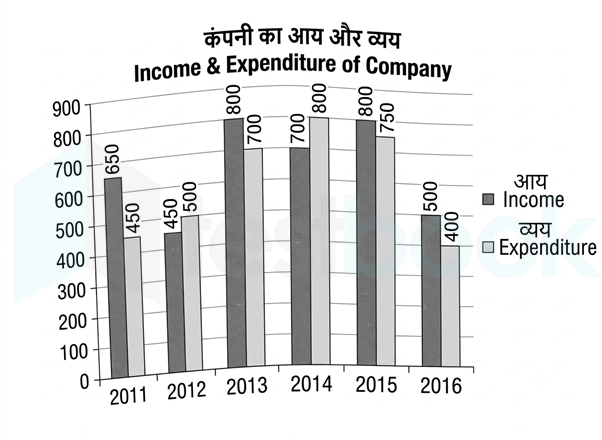
Direction : Study the graph and answer the questions given below. The bar graph shows the income and expenditure of a company from 2011 to 2016 (in crore Rs.).

By what percent total income from 2011 to 2013 is less than total expenditure from 2013 to 2015?

  1. AOption (a)

    \(15 \frac{4}{9}\)%

  2. BOption (b)

    \(25 \frac{5}{9}\)%

  3. COption (c)

    \(15 \frac{5}{9}\)%

  4. DOption (d)

    \(25 \frac{4}{9}\)%

  5. EOption (e)

    None of the above

View answer & explanation

Correct answer

Answer: (c)C.

\(15 \frac{5}{9}\)%

Why this answer is correct

Given:

From the bar graph (values in crore Rs.)

Income: 2011 = 650, 2012 = 450, 2013 = 800

Expenditure: 2013 = 700, 2014 = 800, 2015 = 750

Formula used:

Percentage less = (Difference / Reference value) × 100

Calculation:

Total income from 2011 to 2013

⇒ 650 + 450 + 800 = 1900

Total expenditure from 2013 to 2015

⇒ 700 + 800 + 750 = 2250

Difference = 2250 − 1900 = 350

Percentage by which income is less = (350 / 2250) × 100 = \(15 \frac{5}{9}\)%

∴ Total income from 2011 to 2013 is \(15 \frac{5}{9}\)% less than total expenditure from 2013 to 2015.

Question 34

UPSSSC Stenographer 2025• Full Test

Direction : Study the graph and answer the questions given below. The bar graph shows the income and expenditure of a company from 2011 to 2016 (in crore Rs.).

If the profit of the company increased by 25% and income increased by 20% in 2017 than 2016, what is the expenditure (in crore Rs.) of the company in 2017?

  1. AOption (a)

    475

  2. BOption (b)

    550

  3. COption (c)

    425

  4. DOption (d)

    450

  5. EOption (e)

    None of the above

View answer & explanation

Correct answer

Answer: (a)A.

475

Why this answer is correct

Given:

Income in 2016 = 500 crore

Expenditure in 2016 = 400 crore

Profit in 2016 = 500 − 400 = 100 crore

In 2017: Income increased by 20%

Profit increased by 25%

Formula used:

New value = Old value × (1 + percentage / 100)

Expenditure = Income − Profit

Calculation:

Income in 2017 = 500 × (1 + 20/100)

⇒ 500 × 1.2 = 600

Profit in 2017 = 100 × (1 + 25/100)

⇒ 100 × 1.25 = 125

Expenditure in 2017 = 600 − 125 = 475

∴ The expenditure of the company in 2017 is 475 crore rupees.

Question 35

UPSSSC Stenographer 2025• Full Test

Direction : Study the graph and answer the questions given below. The bar graph shows the income and expenditure of a company from 2011 to 2016 (in crore Rs.).

What is the overall profit (in crore Rs.) is earned by the company from 2013 to 2015 ?

  1. AOption (a)

    200

  2. BOption (b)

    100

  3. COption (c)

    150

  4. DOption (d)

    50

  5. EOption (e)

    None of the above

View answer & explanation

Correct answer

Answer: (d)D.

50

Why this answer is correct

Given:

2013 → Income = 800, Expenditure = 700

2014 → Income = 700, Expenditure = 800

2015 → Income = 800, Expenditure = 750

Formula used:

Profit / Loss = Income − Expenditure

Calculation:

Profit in 2013 = 800 − 700 = 100

Loss in 2014 = 700 − 800 = −100

Profit in 2015 = 800 − 750 = 50

Overall profit from 2013 to 2015 = 100 − 100 + 50 = 50

∴ The overall profit earned by the company from 2013 to 2015 is 50 crore rupees.

Question 36

UPSSSC Stenographer 2025• Full Test

Direction : Study the graph and answer the questions given below. The bar graph shows the income and expenditure of a company from 2011 to 2016 (in crore Rs.).

The profit earned by the company in 2016 is what percentage more than profit earned by the company in 2015?

  1. AOption (a)

    50%

  2. BOption (b)

    150%

  3. COption (c)

    200%

  4. DOption (d)

    100%

  5. EOption (e)

    None of the above

View answer & explanation

Correct answer

Answer: (d)D.

100%

Why this answer is correct

Given:

Income in 2015 = 800 crore 

Expenditure in 2015 = 750 crore  

Income in 2016 = 500 crore 

Expenditure in 2016 = 400 crore 

Formula used:

Profit = Income − Expenditure

Percentage more = (Difference / Original profit) × 100

Calculation:

Profit in 2015 = 800 − 750 = 50

Profit in 2016 = 500 − 400 = 100

Difference in profit = 100 − 50 = 50

Percentage more = (50 / 50) × 100 = 100%

∴ The profit earned by the company in 2016 is 100% more than the profit earned in 2015.

Question 37

UPSSSC Stenographer 2025• Full Test

Direction : Study the graph and answer the questions given below. The bar graph shows the income and expenditure of a company from 2011 to 2016 (in crore Rs.).

What is the average profit (in crore Rs.) earned by the company in odd years among the given years?

  1. AOption (a)

    150

  2. BOption (b)

    116.66

  3. COption (c)

    126.66

  4. DOption (d)

    100

  5. EOption (e)

    None of the above

View answer & explanation

Correct answer

Answer: (b)B.

116.66

Why this answer is correct

Given:

Odd years among given years = 2011, 2013, 2015

From the bar graph (values in crore Rs.)

2011 → Income = 650, Expenditure = 450

2013 → Income = 800, Expenditure = 700

2015 → Income = 800, Expenditure = 750

Formula used:

Profit = Income − Expenditure

Average profit = (Sum of profits) ÷ Number of years

Calculation:

Profit in 2011 = 650 − 450 = 200

Profit in 2013 = 800 − 700 = 100

Profit in 2015 = 800 − 750 = 50

Total profit in odd years = 200 + 100 + 50 = 350

Average profit = 350 ÷ 3 = 116.66

∴ The average profit earned by the company in odd years is 116.66 crore rupees.

Question 38

UPSSSC Stenographer 2025• Full Test

The chemical reaction between quicklime and water to form slaked lime is characterized by

  1. AOption (a)

    A change in colors

  2. BOption (b)

    The formation of a precipitates

  3. COption (c)

    A decrease in temperature

  4. DOption (d)

    A rise in temperature

  5. EOption (e)

    None of the above

View answer & explanation

Correct answer

Answer: (d)D.

A rise in temperature

Why this answer is correct

The correct answer is A rise in temperature.

Key Points

  • The reaction between quicklime (calcium oxide, CaO) and water (H2O) is an exothermic reaction, meaning it releases a significant amount of heat.
  • The chemical equation for the reaction is: CaO + H2O → Ca(OH)2 + Heat. Here, calcium hydroxide (slaked lime) is formed as the product.
  • The release of heat during this reaction causes the temperature to rise significantly, which is a key characteristic of this process.
  • This reaction is widely used in construction, particularly in preparing lime mortar, as the heat generation helps in setting and hardening.
  • Because of the heat produced, the reaction is considered hazardous if not handled properly, as it can cause burns or other safety issues.

Additional Information

  • Quicklime (CaO) is an important industrial chemical used in various applications such as construction, agriculture, and chemical processes.
  • Its reaction with water to form slaked lime (Ca(OH)2) is a fundamental chemical process that demonstrates the principles of exothermic reactions.

Question 39

UPSSSC Stenographer 2025• Full Test

Which Mauryan official is credited with constructing the Sudarshan Lake as mentioned in the Girnar Rock Inscription of Rudradaman ?

  1. AOption (a)

    Pushyagupta

  2. BOption (b)

    Bhadrabahu

  3. COption (c)

    Tushaspha

  4. DOption (d)

    Chanakya

  5. EOption (e)

    None of the above

View answer & explanation

Correct answer

Answer: (a)A.

Pushyagupta

Why this answer is correct

The correct answer is Pushyagupta.

Key Points

  • The Sudarshan Lake was originally constructed by Pushyagupta, a provincial governor (Vaishya) of the Mauryan Empire during the reign of Chandragupta Maurya.
  • The lake is mentioned in the Girnar Rock Inscription, attributed to Rudradaman I, a ruler of the Western Kshatrapas.
  • This irrigation lake played a vital role in supporting agriculture and water management in the region of Junagadh (modern-day Gujarat).
  • Rudradaman I later repaired and expanded the lake in 150 CE after it was damaged due to natural calamities.
  • The Sudarshan Lake highlights the Mauryan Empire’s advanced knowledge of engineering and water resource management systems.

Additional Information

  • Bhadrabahu:
  • Bhadrabahu was a Jain monk and spiritual leader during the Mauryan period.
  • He is known for his association with Chandragupta Maurya and is believed to have influenced the emperor to embrace Jainism.
  • Bhadrabahu is not connected with the construction of Sudarshan Lake or any engineering projects.
  • Tushaspha:
  • Tushaspha was a Greek or Persian officer in the Mauryan administration, serving as a provincial governor under Chandragupta Maurya.
  • He is known for his administrative contributions but is not associated with the Sudarshan Lake.
  • Chanakya:
  • Chanakya, also known as Kautilya or Vishnugupta, was the chief advisor and mentor of Chandragupta Maurya.
  • He is famous for his treatise, Arthashastra, which provides insights into economics, politics, and statecraft.
  • While Chanakya played a pivotal role in establishing the Mauryan Empire, he is not related to the construction of Sudarshan Lake.

Question 40

UPSSSC Stenographer 2025• Full Test

The perimeter of a rectangle is 13 cm, and its width is \(2 \frac{3}{4}\)cm. Its length is

  1. AOption (a)

    \(3 \frac{1}{4}\) cm

  2. BOption (b)

    \(1 \frac{3}{4}\) cm

  3. COption (c)

    \(3 \frac{3}{4}\) cm

  4. DOption (d)

    \(5 \frac{1}{2}\) cm

  5. EOption (e)

    None of the above

View answer & explanation

Correct answer

Answer: (c)C.

\(3 \frac{3}{4}\) cm

Why this answer is correct

Given:

Perimeter of rectangle = 13 cm

Width = \(2 \frac{3}{4}\) cm = 11/4 cm

Formula used:

Perimeter of rectangle = 2 × (Length + Width)

Calculation:

⇒ 2 × (L + 11/4) = 13

⇒ L + 11/4 = 13/2

⇒ L = 13/2 − 11/4

⇒ L = (26 − 11)/4

⇒ L = 15/4

⇒ L = \(3 \frac{3}{4}\) cm

∴ The length of the rectangle is \(3 \frac{3}{4}\) cm.