Search Previous Year Questions

Find real questions from previous competitive exam papers with answers and solutions.

Leave the keyword blank to browse saved questions for your selected exam, newest papers first. Add a keyword, year or topic to narrow the results.

Browse complete papers
Showing 10 question(s)
Clear

Question 631

SBI Clerk 2025• Numerical Ability

Directions: Read the data carefully and answer the following questions. 

The line graph given below shows the total number of folded and unfolded umbrellas sold by five shops. 
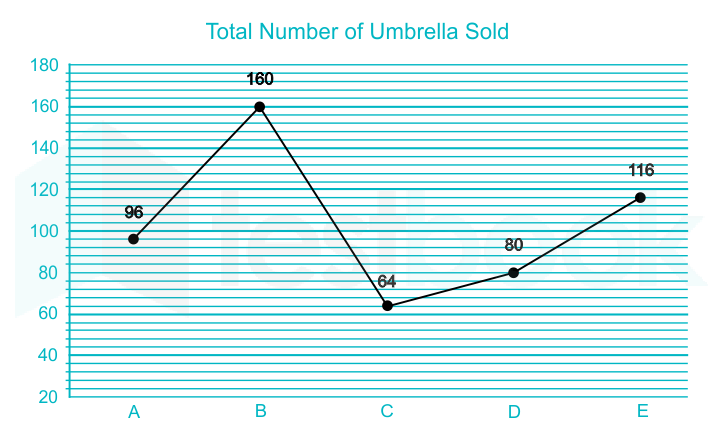
Total number of umbrellas sold by shops C and D together is what percentage of the number of umbrellas sold by shop B?

  1. AOption (a)

    80%

  2. BOption (b)

    85%

  3. COption (c)

    90%

  4. DOption (d)

    95%

  5. EOption (e)

    None of these

View answer & explanation

Correct answer

Answer: (c)C.

90%

Why this answer is correct

From the data:

Shop C: 64 umbrellas

Shop D: 80 umbrellas

Total umbrellas sold by C and D:

Total C + D = 64 + 80 = 144

From the data:

Shop B: 160 umbrellas

Now, let's calculate the percentage.

We use the formula:

Percentage = Part / Whole × 100

Here:

Part = Total umbrellas sold by C and D = 144

Whole = Umbrellas sold by B = 160

Substitute the values:

Percentage = 144 / 160× 100

Simplify:

Percentage = 0.9 × 100 = 90%

Thus, the total number of umbrellas sold by shops C and D together is 90% of the number of umbrellas sold by shop B.

Question 632

SBI Clerk 2025• Numerical Ability

Directions: Read the data carefully and answer the following questions. 

The line graph given below shows the total number of folded and unfolded umbrellas sold by five shops. 

The ratio of total number of folded to unfolded umbrellas sold by shop A is 5:3. If 2/3 rd of unfolded umbrellas are black in colour and 3/4th of folded umbrellas are black in colour, then find the number of black colour umbrellas sold by shop A.

  1. AOption (a)

    45

  2. BOption (b)

    91

  3. COption (c)

    69

  4. DOption (d)

    57

  5. EOption (e)

    73

View answer & explanation

Correct answer

Answer: (c)C.

69

Why this answer is correct

Total umbrellas sold by Shop A.

From the data:

Total umbrellas sold by Shop A = 96

The ratio of folded to unfolded umbrellas is 5:3.

Let:

Folded umbrellas = 5x 

Unfolded umbrellas = 3x 

Total umbrellas:

5x + 3x = 8x

Given that the total umbrellas sold by Shop A is 96:

8x = 96

x = 12

Now:

Folded umbrellas = 5x = 5 × 12 = 60 

Unfolded umbrellas = 3x = 3 × 12 = 36 

3/4th of folded umbrellas are black.

Black folded umbrellas:

3/4 × 60 = 45

2/3th of unfolded umbrellas are black.

Black unfolded umbrellas:

2/3 × 36 = 24

Total black umbrellas sold by Shop A.

Total black umbrellas = Black folded umbrellas + Black unfolded umbrellas

Total black umbrellas = 45 + 24 = 69

Thus, the number of black umbrellas sold by Shop A is 69.

Question 633

SBI Clerk 2025• Numerical Ability

Directions: Read the data carefully and answer the following questions. 

The line graph given below shows the total number of folded and unfolded umbrellas sold by five shops. 

If the number of unfolded umbrellas sold by shop D are 55% of the total number of umbrellas sold by D and the total number of unsold folded umbrellas in shop D are 5/9 th of the total number of folded umbrellas sold by shop D, then find the total number of unsold folded umbrellas in shop D.

  1. AOption (a)

    10

  2. BOption (b)

    5

  3. COption (c)

    20

  4. DOption (d)

    15

  5. EOption (e)

    25

View answer & explanation

Correct answer

Answer: (c)C.

20

Why this answer is correct

From the data, the total number of umbrellas sold by Shop D is 80.

It is given that the number of unfolded umbrellas sold by Shop D is 55% of the total umbrellas sold by Shop D. 

Unfolded umbrellas sold by D = 55% × 80 = 0.55 × 80 = 44

The total umbrellas sold by Shop D consist of folded and unfolded umbrellas. Therefore:

Folded umbrellas sold by D = Total umbrellas sold by D - Unfolded umbrellas sold by D

Folded umbrellas sold by D = 80 - 44 = 36

It is given that the total number of unsold folded umbrellas in Shop D is 5/9 of the total number of folded umbrellas sold by Shop D. 

Unsold folded umbrellas in D = 5 / 9 × Folded umbrellas sold by D

Unsold folded umbrellas in D = 5 / 9 × 36 = 20

The total number of unsold folded umbrellas in Shop D is 20.

Question 634

SBI Clerk 2025• Numerical Ability

Directions: Read the data carefully and answer the following questions. 

The line graph given below shows the total number of folded and unfolded umbrellas sold by five shops. 

What is the average of total number of umbrellas sold by A, C and E together? 

  1. AOption (a)

    78

  2. BOption (b)

    92

  3. COption (c)

    60

  4. DOption (d)

    75

  5. EOption (e)

    80

View answer & explanation

Correct answer

Answer: (b)B.

92

Why this answer is correct

From the data:

Shop A: 96 umbrellas

Shop C: 64 umbrellas

Shop E: 116 umbrellas

Total umbrellas A + C + E = 96 + 64 + 116

Total umbrellas A + C + E = 276

The average is calculated by dividing the total number of umbrellas by the number of shops 3 in this case:

Average = (Total umbrellas A + C + E) / Number of shops

Average = 276 / 3 = 92

Thus, the average of the total number of umbrellas sold by shops A, C, and E is 92.

Question 635

SBI Clerk 2025• Numerical Ability

Directions: Read the data carefully and answer the following questions. 

The line graph given below shows the total number of folded and unfolded umbrellas sold by five shops. 

If the ratio of folded to unfolded umbrellas sold by Shop B is 3:5, and the ratio of folded to unfolded umbrellas sold by Shop D is 1:3, then the total number of folded umbrellas sold by Shop B and Shop D together is:

  1. AOption (a)

    80

  2. BOption (b)

    90

  3. COption (c)

    100

  4. DOption (d)

    120

  5. EOption (e)

    110

View answer & explanation

Correct answer

Answer: (a)A.

80

Why this answer is correct

Total umbrellas sold by Shop B = 160

Ratio of folded to unfolded umbrellas = 3:5

Let the number of folded umbrellas = 3x 

Let the number of unfolded umbrellas = 5x 

Total umbrellas = 3x + 5x = 8x 

So, 8x = 160 

Solving for x:

x = 160 / 8 = 20

Folded umbrellas sold by Shop B:

3x = 3 × 20 = 60

Total umbrellas sold by Shop D = 80

Ratio of folded to unfolded umbrellas = 1:3

Let the number of folded umbrellas = y 

Let the number of unfolded umbrellas = 3y 

Total umbrellas = y + 3y = 4y 

So, 4y = 80 

Solving for y:

y = 80 / 4 = 20

Folded umbrellas sold by Shop D:

y = 20

Folded umbrellas Shop B = 60

Folded umbrellas Shop D = 20

Total folded umbrellas:

60 + 20 = 80

Thus, the correct answer is 80.

Question 636

SBI Clerk 2025• Numerical Ability

The average of two numbers m and n is 36. The ratio of 80% of m to (n+13) is 9:10. Find the value of m.

  1. AOption (a)

    45

  2. BOption (b)

    50

  3. COption (c)

    55

  4. DOption (d)

    60

  5. EOption (e)

    65

View answer & explanation

Correct answer

Answer: (a)A.

45

Why this answer is correct

Shortcut Trick

Sum of m and n = 36 × 2 = 72. So, n = 72 − m.

Ratio equation: (0.8m) / (72 − m + 13) = 9/10.

8m = 9 × (85 − m) ⇒ 8m = 765 − 9m ⇒ 17m = 765.

m = 765 ÷ 17 = 45.

∴ The correct answer is 45.

Alternate Method

Given:

Average of m and n = 36

Ratio [80% of m] : [n + 13] = 9 : 10

Calculations:

⇒ (m + n) / 2 = 36

⇒ m + n = 72

⇒ n = 72 − m

⇒ 80% of m = 0.8m = 4m/5

⇒ (4m/5) / (n + 13) = 9/10

⇒ (4m/5) / (72 − m + 13) = 9/10

⇒ (4m) / [5 × (85 − m)] = 9/10

⇒ 40m = 45 × (85 − m)

⇒ 8m = 9 × (85 − m)

⇒ 8m = 765 − 9m

⇒ 17m = 765

⇒ m = 45

∴ The correct answer is 45.

Additional Information

Average Concept

Average is the sum of observations divided by the number of observations. For two numbers, Average = (m + n) ÷ 2.

Percentage to Fraction Conversion

To simplify calculations, convert percentages to fractions: 80% = 80/100 = 4/5 or 0.8.

Ratio and Proportion

If a:b = c:d, then a/b = c/d. This allows for cross-multiplication to solve for unknown variables.

Question 637

SBI Clerk 2025• Numerical Ability

X, Y, and Z entered into a partnership and invested their amounts for time periods in the ratio 3:4:6 respectively. The ratio of their investments was 4:6:5 respectively. If X's share out of the profit was Rs 18,000, what was the total profit?

  1. AOption (a)

    Rs 90,000

  2. BOption (b)

    Rs 96,000

  3. COption (c)

    Rs 99,000

  4. DOption (d)

    Rs 1,02,000

  5. EOption (e)

    Rs 1,06,000

View answer & explanation

Correct answer

Answer: (c)C.

Rs 99,000

Why this answer is correct

Shortcut Trick

Profit ratio is calculated as (Investment × Time).

Profit Ratio X : Y : Z = (4 × 3) : (6 × 4) : (5 × 6) = 12 : 24 : 30.

Simplified Profit Ratio = 2 : 4 : 5.

X's share (2 units) = Rs 18,000 ⇒ 1 unit = Rs 9,000.

Total profit (2 + 4 + 5 = 11 units) = 11 × 9,000 = Rs 99,000.

∴ The correct answer is Rs 99,000.

Alternate Method

Given → Investment ratio = 4 : 6 : 5 | Time ratio = 3 : 4 : 6 | X's profit = Rs 18,000. Formulas: Profit = Investment × Time | Total Profit = Sum of individual profit shares.

⇒ Calculate profit ratio for X, Y, and Z: (4 × 3) : (6 × 4) : (5 × 6) = 12 : 24 : 30. ⇒ Reducing the ratio by dividing by 6: 2 : 4 : 5. ⇒ Let the profit shares be 2k, 4k, and 5k. ⇒ Given X's share 2k = 18,000 ⇒ k = 9,000. ⇒ Total Profit = 2k + 4k + 5k = 11k. ⇒ Total Profit = 11 × 9,000 = 99,000.

∴ The correct answer is Rs 99,000.

Additional Information

Partnership Basics

In a partnership, the profit is distributed in the ratio of the product of Capital (Investment) and Time. If time is constant, profit is proportional to investment.

Ratio of Investments

If profits (P) and time (T) are known, the investment (I) ratio can be found using I = P ÷ T.

Question 638

SBI Clerk 2025• Numerical Ability

A shopkeeper marks up the cost price of an item by 50% and then gives a 20% discount on the marked price. If the profit earned by the shopkeeper is ₹660, what is the difference between the profit and the discount given?

  1. AOption (a)

    ₹440

  2. BOption (b)

    ₹540

  3. COption (c)

    ₹330

  4. DOption (d)

    ₹280

  5. EOption (e)

    None of these

View answer & explanation

Correct answer

Answer: (c)C.

₹330

Why this answer is correct

Shortcut Trick

Let the Cost Price (CP) be 100 units.

Marked Price (MP) = 100 + 50% of 100 = 150 units.

Selling Price (SP) = 150 − 20% of 150 = 150 − 30 = 120 units.

Profit = SP − CP = 120 − 100 = 20 units. Given 20 units = ₹660, so 1 unit = ₹33.

Discount = MP − SP = 150 − 120 = 30 units.

Difference between Discount and Profit = 30 − 20 = 10 units = 10 × 33 = ₹330.

∴ The correct answer is ₹330.

Alternate Method

Given: Markup% = 50%, Discount% = 20%, Profit = ₹660. Formulas: Profit = SP − CP | SP = MP × (100 − D%) ÷ 100 | MP = CP × (100 + Markup%) ÷ 100.

⇒ Let CP = x. Then MP = 1.5x and SP = 0.8 × 1.5x = 1.2x. ⇒ Profit = 1.2x − x = 0.2x. Given 0.2x = 660 ⇒ x = 3300. ⇒ Profit = 0.2 × 3300 = ₹660. ⇒ Discount = MP − SP = 1.5x − 1.2x = 0.3x = 0.3 × 3300 = ₹990. ⇒ Difference = 990 − 660 = ₹330.

∴ The correct answer is ₹330.

Additional Information

Markup and Profit Relationship

Net Profit% can be calculated using the successive percentage formula: Net% = m − d − (m × d)/100, where m is markup% and d is discount%.

Relation between CP and MP

The ratio of CP to MP is given by: CP/MP = (100 − Discount%)/(100 + Profit%).

Question 639

SBI Clerk 2025• Numerical Ability

A mixture initially contains 'x' liters of milk and 15 liters of water. 18 liters of milk are then added to the mixture. The resulting mixture has a milk to water ratio of 6:1.  What is the value of 'x'?

  1. AOption (a)

    60 litres

  2. BOption (b)

    72 litres

  3. COption (c)

    84 litres

  4. DOption (d)

    90 litres

  5. EOption (e)

    None of these

View answer & explanation

Correct answer

Answer: (b)B.

72 litres

Why this answer is correct

Shortcut Trick

Ratio of Milk to Water = 6 : 1

Given Water = 15 litres (1 unit = 15 litres)

Total Milk (final) = 6 × 15 = 90 litres

Initial Milk (x) = Final Milk − Added Milk = 90 − 18 = 72 litres

∴ The correct answer is 72 litres.

Alternate Method

Given:

Initial Milk = x litres, Initial Water = 15 litres

Milk added = 18 litres

Final Ratio (Milk : Water) = 6 : 1

Calculations:

⇒ (Initial Milk + Added Milk) ÷ Water = 6 ÷ 1

⇒ (x + 18) ÷ 15 = 6 ÷ 1

⇒ x + 18 = 15 × 6

⇒ x + 18 = 90

⇒ x = 90 − 18

⇒ x = 72

∴ The correct answer is 72 litres.

Additional Information

Ratio and Proportion

A ratio compares two quantities. If a : b = c : d, then product of extremes (a×d) equals product of means (b×c).

Mixture Problems

When only one component is added to a mixture, the quantity of the other component remains constant in terms of absolute units.

Unitary Method

Find the value of one unit by dividing the given total by its ratio share, then multiply to find other values.

Question 640

SBI Clerk 2025• Numerical Ability

Directions: Read the data carefully and answer the following questions. 

Three individuals, A, B, and C, were given a set of questions. They attempted some of them. The number of questions attempted by B is 50% of the total questions he was given. A was given 20 fewer questions than B. C was given 130 questions. The combined number of questions attempted by A and C is 145. The total number of questions given to all three is twice the total number of questions they attempted. Additionally, the number of questions attempted by B and C is the same.

Find the ratio of the number of questions attempted by A to the number of questions given to B.

  1. AOption (a)

    11:34

  2. BOption (b)

    13:35

  3. COption (c)

    12:29

  4. DOption (d)

    13:37

  5. EOption (e)

    11:36

View answer & explanation

Correct answer

Answer: (e)E.

11:36

Why this answer is correct

General Solution:

Let:

GA : Questions given to A

GB : Questions given to B

GC : Questions given to C

AA : Questions attempted by A

AB : Questions attempted by B

AC : Questions attempted by C

B attempted 50% of the questions he was given:

AB = 0.5 × GB

A was given 20 fewer questions than B:

GA = GB - 20

C was given 130 questions:

GC = 130

Combined questions attempted by A and C is 145:

AA + AC = 145

Total questions given to all three is twice the total questions they attempted:

GA + GB + GC = 2 × (AA + AB + AC)

Number of questions attempted by B and C is the same:

AB = AC

From Equation 1:

AB = 0.5 × GB

From Equation 3:

GC = 130

From Equation 2:

GA = GB - 20

From Equation 4:

AA + AC = 145

From Equation 5:

GA + GB + GC = 2 × (AA + AB + AC)

Substitute GA = GB - 20 and GC = 130 into Equation 5:

GB - 20 + GB + 130 = 2 × (AA + AB + AC)

Simplify:

2GB + 110 = 2 × (AA + AB + AC)

GB + 55 = AA + AB + AC

From Equation 4:

AA + AC = 145

From Equation 6:

AB = AC

Substitute AB = AC into GB + 55 = AA + AB + AC:

GB + 55 = AA + AB + AC

GB + 55 = AA + 2AC

From Equation 4:

AA = 145 - AC

Substitute AA = 145 - AC into GB + 55 = AA + 2AC:

GB + 55 = 145 - AC + 2AC

Simplify:

GB + 55 = 145 + AC

GB = 90 + AC

From Equation 1:

AB = 0.5 × GB

From Equation 6:

AB = AC

So:

AC = 0.5 × GB

Substitute AC = 0.5 × GB into GB = 90 + AC:

GB = 90 + 0.5 × GB

Subtract 0.5 × GB from both sides:

0.5 × GB = 90

GB = 180

Now, find AC:

AC = 0.5 × GB = 0.5 × 180 = 90

From Equation 6:

AB = AC = 90

From Equation 4:

AA = 145 - AC = 145 - 90 = 55

From Equation 2:

GA = GB - 20 = 180 - 20 = 160

From Equation 3:

GC = 130

Thus,

PersonGivenAttempted
A16055
B18090
C13090


Calculations:

Questions attempted by A: 55

Questions given to B: 180

The ratio of AA to GB is:

AA / GB = 55 / 180

Divide both numerator and denominator by 5 to simplify:

55 / 180 = 11 / 36

Thus, the ratio of the number of questions attempted by A to the number of questions given to B is: 11:36