Search Previous Year Questions

Find real questions from previous competitive exam papers with answers and solutions.

Leave the keyword blank to browse saved questions for your selected exam, newest papers first. Add a keyword, year or topic to narrow the results.

Browse complete papers
Showing 10 question(s)
Clear

Question 531

SBI Clerk 2025• Numerical Ability

Rahul spends 20% of his monthly salary on food. He spends 25% on furniture, 30% on rent and remaining on books. find the amount Rahul spend on books and furniture together if Rahuls's salary is 20% less than john's salary which is equal to Rs. 12000 per month.

  1. AOption (a)

    4800

  2. BOption (b)

    2400

  3. COption (c)

    3400

  4. DOption (d)

    2800

  5. EOption (e)

    4400

View answer & explanation

Correct answer

Answer: (a)A.

4800

Why this answer is correct

Shortcut Trick

John salary = ₹12000. Rahul salary = 80% of 12000 = ₹9600.

Spent on Food (20%) + Furniture (25%) + Rent (30%) = 75%.

Remaining for Books = 100% − 75% = 25%.

Total for Books + Furniture = 25% + 25% = 50%.

Required Amount = 50% of ₹9600 = ₹4800.

∴ The correct answer is ₹4800.

Alternate Method

Given: John salary = ₹12000, Rahul salary = 20% less than John, Expenses: Food = 20%, Furniture = 25%, Rent = 30%.

Calculations:

⇒ Rahul salary = 12000 − (20% of 12000)

⇒ Rahul salary = 12000 − 2400 = ₹9600

⇒ Percentage spent on Books = 100 − (20 + 25 + 30) = 25%

⇒ Total % for Books and Furniture = 25% + 25% = 50%

⇒ Required Amount = 50% of 9600 = 9600 ÷ 2 = ₹4800

∴ The correct answer is ₹4800.

Additional Information

Percentage Change

To find a value x% less than a base B, use the formula: B × (100 − x)/100.

Successive Percentage Expenditure

If expenses are given as a % of the 'total' salary, they are additive. If given as % of 'remaining', they are multiplicative.

Base Value Concept

Always identify the correct base (Rahul's salary vs John's salary) before applying percentage calculations.
Question 532

SBI Clerk 2025• Numerical Ability

A and B together can finish a work in 15 days. B and C take 18 days to finish the work. A, B and C can complete the work in 10 days. If A’s wage is Rs. 600 then, what is wage of B?

  1. AOption (a)

    450

  2. BOption (b)

    300

  3. COption (c)

    200

  4. DOption (d)

    500

  5. EOption (e)

    750

View answer & explanation

Correct answer

Answer: (b)B.

300

Why this answer is correct

Shortcut Trick

Total Work (LCM of 15, 18, 10) = 90 units.

Efficiency of (A+B+C) = 90 ÷ 10 = 9 units/day.

Efficiency of (B+C) = 90 ÷ 18 = 5 units/day ⇒ Efficiency of A = 9 − 5 = 4 units.

Efficiency of (A+B) = 90 ÷ 15 = 6 units/day ⇒ Efficiency of B = 6 − 4 = 2 units.

Wage ratio = Efficiency ratio ⇒ A : B = 4 : 2 = 2 : 1.

If 2 units = ₹600, then 1 unit (B’s wage) = ₹300.

∴ The correct answer is ₹300.

Alternate Method

Given: Time taken by (A+B) = 15 days, (B+C) = 18 days, (A+B+C) = 10 days. A’s wage = ₹600.

Formula: Efficiency = Total Work ÷ Time; Wage ∝ Efficiency.

PersonDaysTotal WorkEfficiency
A + B15906
B + C185
A + B + C109

⇒ Efficiency of A = Efficiency(A+B+C) − Efficiency(B+C) = 9 − 5 = 4

⇒ Efficiency of B = Efficiency(A+B) − Efficiency(A) = 6 − 4 = 2

⇒ Wage is distributed in the ratio of efficiencies of A : B = 4 : 2 = 2 : 1

⇒ Since A’s wage (2 units) = ₹600

⇒ B’s wage (1 unit) = 600 ÷ 2 = ₹300

∴ The correct answer is ₹300.

Additional Information

Work and Wages Relationship

Wages are always distributed in the ratio of work done. If all persons work for the same duration, the wage ratio is identical to their efficiency ratio.

LCM Method for Total Work

Total work is assumed as the Least Common Multiple (LCM) of the individual days to ensure efficiencies are whole numbers, simplifying calculations.

Efficiency of Individual in a Group

Efficiency of one person can be found by subtracting the combined efficiency of others from the total combined efficiency: Eff(A) = Eff(A+B+C) − Eff(B+C).

Question 533

SBI Clerk 2025• Numerical Ability

The average weight of 60 children of a class is 56.2 kg. When three more children with weight 62.3 kg, 59.7 kg, and 59.5 kg join the class, what is the average weight of the 63 children in the class?

  1. AOption (a)

    56.40

  2. BOption (b)

    59.45

  3. COption (c)

    45.76

  4. DOption (d)

    59.76

  5. EOption (e)

    57.76

View answer & explanation

Correct answer

Answer: (a)A.

56.40

Why this answer is correct

Shortcut Trick

Initial average = 56.2 kg.

Calculate deviations of new weights from 56.2: (62.3 − 56.2) + (59.7 − 56.2) + (59.5 − 56.2) = 6.1 + 3.5 + 3.3 = 12.9 kg.

Net change in average = Total Deviation ÷ Total children = 12.9 ÷ 63 ≈ 0.20 kg.

New average = 56.2 + 0.20 = 56.40 kg.

∴ The correct answer is 56.40 kg.

Alternate Method

Given: Initial average weight of 60 children = 56.2 kg. Weights of 3 new children = 62.3 kg, 59.7 kg, and 59.5 kg.

Formula Used: Average = (Sum of all observations) ÷ (Total number of observations)

⇒ Total weight of 60 children = 60 × 56.2 = 3372 kg.

⇒ Total weight of 63 children = 3372 + 62.3 + 59.7 + 59.5

⇒ Total weight of 63 children = 3372 + 181.5 = 3553.5 kg.

⇒ New Average = 3553.5 ÷ 63

⇒ New Average = 56.408... ≈ 56.40 kg.

∴ The correct answer is 56.40 kg.

Additional Information

Deviation Method for Average

New Average = Old Average + (Sum of deviations ÷ New total count). This avoids large multiplications.

Weighted Average

When two groups are combined, Combined Average = (n1x1 + n2x2) ÷ (n1 + n2), where n is the count and x is the average.

Question 534

SBI Clerk 2025• Numerical Ability

Rs. 600 was invested at 12% per annum simple interest and a certain sum of money invested at 10% per annum simple interest. If the sum of the interests on both the sums after 6 years is Rs. 640, the latter sum of money is

  1. AOption (a)

    Rs. 346.66

  2. BOption (b)

    Rs. 356.66

  3. COption (c)

    Rs. 436.66

  4. DOption (d)

    Rs. 456.66

  5. EOption (e)

    Rs. 465.66

View answer & explanation

Correct answer

Answer: (a)A.

Rs. 346.66

Why this answer is correct

Shortcut Trick

Total Interest = ₹640

Interest from First Sum = 600 × 12% × 6 = ₹432

Interest from Second Sum = 640 − 432 = ₹208

Second Sum = (208 × 100) ÷ (10 × 6) = 2080 ÷ 6 = ₹346.66

∴ The correct answer is ₹346.66.

Alternate Method

Given:

Principal 1 (P1) = ₹600, Rate 1 (R1) = 12%, Time (T) = 6 years

Rate 2 (R2) = 10%, Total Simple Interest (SItotal) = ₹640

Formula Used:

Simple Interest (SI) = (P × R × T) ÷ 100

⇒ SI1 = (600 × 12 × 6) ÷ 100

⇒ SI1 = 6 × 12 × 6 = ₹432

⇒ SI2 = SItotal − SI1

⇒ SI2 = 640 − 432 = ₹208

⇒ SI2 = (P2 × 10 × 6) ÷ 100

⇒ 208 = (P2 × 60) ÷ 100

⇒ P2 = (208 × 100) ÷ 60

⇒ P2 = 2080 ÷ 6 = ₹346.66

∴ The correct answer is ₹346.66.

Additional Information

Simple Interest Property

Simple interest remains constant every year because it is always calculated on the original Principal amount.

Amount Formula

Total Amount (A) = Principal (P) + Simple Interest (SI). In this question, the interest was additive.

Question 535

SBI Clerk 2025• Numerical Ability

Present age of Ankit is thrice the present age of his son. If 4 years ago the ratio of their age is 13 : 3. What is present age of Ankit?

  1. AOption (a)

    30 years

  2. BOption (b)

    25 years

  3. COption (c)

    60 years

  4. DOption (d)

    45 years

  5. EOption (e)

    65 years

View answer & explanation

Correct answer

Answer: (a)A.

30 years

Why this answer is correct

Shortcut Trick

Ratio of Ankit : Son now is 3 : 1 (Difference = 2 units).

Ratio 4 years ago was 13 : 3 (Difference = 10 units).

Equating differences: Multiply present ratio by 5 → 15 : 5.

Change in units: 15 − 13 = 2 units → 4 years. So, 1 unit = 2 years.

Ankit's present age = 15 × 2 = 30 years.

∴ The correct answer is 30 years.

Alternate Method

Given: Present age ratio is 3 : 1. Ratio 4 years ago was 13 : 3.

Let the present age of the son be x and Ankit be 3x.

⇒ (3x − 4) / (x − 4) = 13 / 3

⇒ 3 × (3x − 4) = 13 × (x − 4)

⇒ 9x − 12 = 13x − 52

⇒ 13x − 9x = 52 − 12

⇒ 4x = 40

⇒ x = 10

⇒ Ankit's present age = 3x = 3 × 10 = 30 years.

∴ The correct answer is 30 years.

Additional Information

Concept of Age Difference

The difference between the ages of two people always remains constant regardless of the number of years passed.

Ratio Balancing Method

To solve age ratio problems quickly, multiply the ratios such that the difference between the parts (e.g., 15−5=10 and 13−3=10) becomes equal.

Question 536

SBI Clerk 2025• Numerical Ability

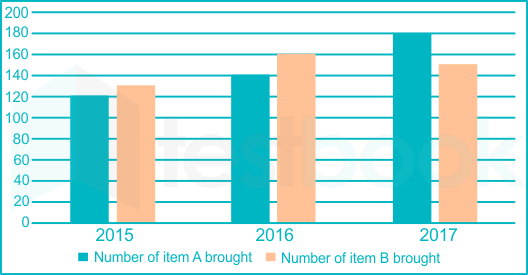
The given bar graphs shows the number of items brought by A and B in the year 2015, 2016 and 2017.

Out of total number of item brought by A in 2016, 2/7th item is plastic item. Find the number of plastic items brought by A in 2016?

  1. AOption (a)

    10

  2. BOption (b)

    20

  3. COption (c)

    60

  4. DOption (d)

    80

  5. EOption (e)

    40

View answer & explanation

Correct answer

Answer: (e)E.

40

Why this answer is correct

Calculations:

Total number of items brought by A in 2016 = 140 

Number of plastic items brought by A = 140 × 2 /7 = 40

Question 537

SBI Clerk 2025• Numerical Ability

The given bar graphs shows the number of items brought by A and B in the year 2015, 2016 and 2017.

Find the ratio between total number of items brought by A and B together in the year 2015 and 2016?

  1. AOption (a)

    5:6

  2. BOption (b)

    2:3

  3. COption (c)

    4:5

  4. DOption (d)

    4:9

  5. EOption (e)

    8:7

View answer & explanation

Correct answer

Answer: (a)A.

5:6

Why this answer is correct

Calculations:

Total number of items brought by A and B in 2015 = 120 + 130 = 250

Total number of items brought by A and B in 2016 = 140 + 160 = 300

Required ratio = 250 : 300 = 5:6

Question 538

SBI Clerk 2025• Numerical Ability

The given bar graphs shows the number of items brought by A and B in the year 2015, 2016 and 2017.

Number of items brought by C in the year 2016 is 45 more than the average number of items brought by A and B in same year. Find the number of items brought by C in the year 2016?

  1. AOption (a)

    215

  2. BOption (b)

    205

  3. COption (c)

    235

  4. DOption (d)

    195

  5. EOption (e)

    265

View answer & explanation

Correct answer

Answer: (d)D.

195

Why this answer is correct

Calculations:

Total number of items brought by A and B in 2016 = 140 + 160 = 300

Average number of items brought by A and B in 2016 = 300/2 = 150

Number of items brought by C in the year 2016:

= 150 + 45 = 195

Question 539

SBI Clerk 2025• Numerical Ability

The given bar graphs shows the number of items brought by A and B in the year 2015, 2016 and 2017.

Number of items brought by A and B in 2018 is 25% and 20% more than the previous year respectively. Find the total item brought by A and B together in the year 2018?

  1. AOption (a)

    205

  2. BOption (b)

    405

  3. COption (c)

    415

  4. DOption (d)

    395

  5. EOption (e)

    385

View answer & explanation

Correct answer

Answer: (b)B.

405

Why this answer is correct

Calculations:

Number of items brought by A in 2017 = 180

Number of items brought by B in 2017 = 150

Total item brought by A and B together in the year 2018 is:

[180 × 125/100] + [150 ×120/100] = 225 + 180 = 405

Question 540

SBI Clerk 2025• Numerical Ability

The given bar graphs shows the number of items brought by A and B in the year 2015, 2016 and 2017.

Total number of items brought by A in the year 2015 and 2016 together is how much less than the number of item brought by B in same year?

  1. AOption (a)

    68

  2. BOption (b)

    66

  3. COption (c)

    30

  4. DOption (d)

    45

  5. EOption (e)

    48

View answer & explanation

Correct answer

Answer: (c)C.

30

Why this answer is correct

Calculations:

Total number of items brought by A in the year 2015 and 2016 together = 120 + 140 = 260

Total number of items brought by B in the year 2015 and 2016 together = 130 + 160 = 290

So, required difference is 290 – 260 = 30