Search Previous Year Questions

Find real questions from previous competitive exam papers with answers and solutions.

Showing 10 question(s)
Clear

Question 31

SBI Clerk 2025• Numerical Ability

The ratio of the present ages of Gauravi and Gitika is 5 :3 respectively. If the sum of their ages seven years ago was 66 years, then find the present age of Gitika.

  1. AOption (a)

    27 years

  2. BOption (b)

    24 years

  3. COption (c)

    36 years

  4. DOption (d)

    33 years

  5. EOption (e)

    30 years

View answer & explanation

Correct answer

Answer: (e)E.

30 years

Why this answer is correct

Shortcut Trick

Sum of present ages = 66 + (7 × 2) = 80 years.

Total ratio parts = 5 + 3 = 8 units.

8 units = 80 years → 1 unit = 10 years.

Gitika's present age = 3 × 10 = 30 years.

∴ The correct answer is 30 years.

Alternate Method

Given: Ratio of present ages of Gauravi and Gitika = 5 : 3.

Calculation:

⇒ Let the present ages be 5x and 3x.

⇒ Sum of ages 7 years ago = (5x − 7) + (3x − 7) = 66

⇒ 8x − 14 = 66

⇒ 8x = 80

⇒ x = 10

⇒ Gitika's present age = 3x = 3 × 10 = 30 years.

∴ The correct answer is 30 years.

Additional Information

Age Sum Translation

If the sum of ages of 'n' people is S years now, the sum 't' years ago was S − (n × t).

Ratio and Proportion in Ages

The difference between the ages of two people remains constant regardless of the number of years passed.

Future Age Calculation

If current age is X, age after 'n' years will be X + n. Sum of ages after 'n' years for 'm' people increases by m × n.
Question 32

SBI Clerk 2025• Numerical Ability

Raman started business with Rs. 8000 and after 3 months Lakhan joined the business with some amount. After a year, the profit is divided in the ratio 32 : 21. Find the contribution of Lakhan in the business.

  1. AOption (a)

    Rs. 6000

  2. BOption (b)

    Rs. 9000

  3. COption (c)

    Rs. 7500

  4. DOption (d)

    Rs. 7000

  5. EOption (e)

    Rs. 8500

View answer & explanation

Correct answer

Answer: (d)D.

Rs. 7000

Why this answer is correct

Shortcut Trick

Ratio of Profit = (Capital1 × Time1) : (Capital2 × Time2)

Given: Raman (C1=8000, T1=12) and Lakhan (C2=x, T2=9).

Profit Ratio = (8000 × 12) : (x × 9) = 32 : 21.

Simplifying: 96000 : 9x = 32 : 21 ⇒ 96000 ÷ 9x = 32 ÷ 21.

x = (96000 × 21) ÷ (32 × 9) = 3000 × 7 ÷ 3 = 7000.

∴ The correct answer is Rs. 7000.

Alternate Method

Given → Raman Capital = Rs. 8000, Raman Time = 12 months, Lakhan Time = (12 − 3) = 9 months, Profit Ratio = 32 : 21. Formulas: Profit = Capital × Time | Capital = Profit ÷ Time

⇒ Let Lakhan contribution be x. ⇒ Profit of Raman = 8000 × 12 = 96000 units. ⇒ Profit of Lakhan = x × 9 = 9x units. ⇒ 96000 ÷ 9x = 32 ÷ 21. ⇒ 32 × 9x = 96000 × 21. ⇒ 288x = 2016000. ⇒ x = 2016000 ÷ 288 = 7000.

∴ The correct answer is Rs. 7000.

Additional Information

Partnership Basics

In a partnership, the profit is distributed in the ratio of the product of investment and time duration.

Investment Time

If a person joins 'n' months after the start for a year, their money is invested for (12 − n) months.

Question 33

SBI Clerk 2025• Numerical Ability

Two cars are running at the speed of 60 km/hr and 35 km/hr respectively and the distance between them is 50 km. find the time taken by fast car to catch the slow car, if both cars are running in the same direction.

  1. AOption (a)

    2.5 hours

  2. BOption (b)

    2 hours

  3. COption (c)

    1.5 hours

  4. DOption (d)

    3 hours

  5. EOption (e)

    1 hour

View answer & explanation

Correct answer

Answer: (b)B.

2 hours

Why this answer is correct

Shortcut Trick

Relative Speed in same direction = Difference of speeds = 60 − 35 = 25 kmph.

Time taken to catch = Distance ÷ Relative Speed.

Time = 50 ÷ 25 = 2 hr.

∴ The correct answer is 2 hr.

Alternate Method

Given:

Speed of Fast Car (S1) = 60 km/hr

Speed of Slow Car (S2) = 35 km/hr

Initial Distance (D) = 50 km

Formula Used:

Relative Speed (Same Direction) = S1 − S2

Time = Distance ÷ Relative Speed

Calculations:

⇒ Relative Speed = 60 km/hr − 35 km/hr = 25 km/hr

⇒ Time taken = 50 km ÷ 25 km/hr

⇒ Time taken = 2 hr

∴ The correct answer is 2 hr.

Additional Information

Relative Speed in Opposite Direction

When two objects move towards each other, their relative speed is the sum of their individual speeds: SR = S1 + S2.

Unit Conversion

To convert km/hr to m/s, multiply by 5/18. To convert m/s to km/hr, multiply by 18/5.

Average Speed

If a certain distance is covered at S1 and the same distance at S2, the average speed is (2 × S1 × S2) ÷ (S1 + S2).

Question 34

SBI Clerk 2025• Numerical Ability

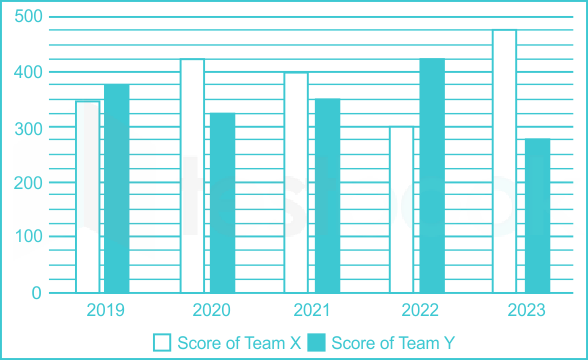
There are two teams X and Y. The bar graph shows the score of two teams in five different years [ 2019, 2020, 2021, 2022 and 2023]

Find the ratio of the combined score of Team X (2020 + 2021) to the combined score of Team Y (2020 + 2021)?

  1. AOption (a)

    6:1

  2. BOption (b)

    5:2

  3. COption (c)

    4:5

  4. DOption (d)

    11:9

  5. EOption (e)

    12:7

View answer & explanation

Correct answer

Answer: (d)D.

11:9

Why this answer is correct

​Calculation

Team X (2020 + 2021) = 425 + 400 = 825

Team Y (2020 + 2021) = 325 + 350 = 675

Ratio = 825 : 675

Both numbers are divisible by 75. 825 / 75 = 11 and 675 / 75 = 9.

→ 11 : 9

Question 35

SBI Clerk 2025• Numerical Ability

There are two teams X and Y. The bar graph shows the score of two teams in five different years [ 2019, 2020, 2021, 2022 and 2023]

Find the difference between Team Y’s score and Team X’s score in 2022 and 2023 together?

  1. AOption (a)

    72

  2. BOption (b)

    77

  3. COption (c)

    75

  4. DOption (d)

    25

  5. EOption (e)

    76

View answer & explanation

Correct answer

Answer: (c)C.

75

Why this answer is correct

​Calculation

Team Y (2022) = 425, and Team Y (2023) = 275

Team X (2022) = 300 Team X ( 2023) = 475

Difference = [475 + 300] – [ 425 + 275] = 775 – 700 = 75

Question 36

SBI Clerk 2025• Numerical Ability

There are two teams X and Y. The bar graph shows the score of two teams in five different years [ 2019, 2020, 2021, 2022 and 2023]

What percentage of the total combined score (Team X + Team Y) for 2021 was contributed by Team X.

  1. AOption (a)

    55%

  2. BOption (b)

    53.33%

  3. COption (c)

    66%

  4. DOption (d)

    22%

  5. EOption (e)

    33.33

View answer & explanation

Correct answer

Answer: (b)B.

53.33%

Why this answer is correct

​Calculation

Team X (2021) = 400, Team Y (2021) = 350

Total = 400 + 350 = 750

Percentage = (400 / 750) × 100 = 53.33%

Question 37

SBI Clerk 2025• Numerical Ability

There are two teams X and Y. The bar graph shows the score of two teams in five different years [ 2019, 2020, 2021, 2022 and 2023]

What percentage Team Y’s score in 2019 was greater than Team X’s score?

  1. AOption (a)

    7.14%

  2. BOption (b)

    12.5%

  3. COption (c)

    22.5%

  4. DOption (d)

    20%

  5. EOption (e)

    6%

View answer & explanation

Correct answer

Answer: (a)A.

7.14%

Why this answer is correct

​Calculation

Difference = 375 – 350 = 25

Percentage = (25 / 350) × 100 = 7.14%

Question 38

SBI Clerk 2025• Numerical Ability

There are two teams X and Y. The bar graph shows the score of two teams in five different years [ 2019, 2020, 2021, 2022 and 2023]

Suppose that in 2024 Team X’s score increases by 20% over its 2023 score, while Team Y’s score decreases by 10% compared to its 2021 score. Find the difference between score of team X and Y in 2024?

  1. AOption (a)

    245

  2. BOption (b)

    255

  3. COption (c)

    355

  4. DOption (d)

    455

  5. EOption (e)

    625

View answer & explanation

Correct answer

Answer: (b)B.

255

Why this answer is correct

Calculation

Team X (2023) = 475 → 20% increase = 475 + 95 = 570

Team Y (2021) = 350 → 10% decrease = 350 – 35 = 315

Difference = 570 – 315 = 255

Question 39

SBI Clerk 2025• Numerical Ability

The average marks of A, B and C is 45 while the average marks of B, C and D is 40. If the sum of marks of A and D is 75, find the marks A got in the examination.

  1. AOption (a)

    45 marks

  2. BOption (b)

    30 marks

  3. COption (c)

    40 marks

  4. DOption (d)

    35 marks

  5. EOption (e)

    50 marks

View answer & explanation

Correct answer

Answer: (a)A.

45 marks

Why this answer is correct

Shortcut Trick

Difference in Total Marks = (45 − 40) × 3 = 15 marks.

Since A, B, C and B, C, D are compared, (A − D) = 15.

Given (A + D) = 75.

Solving for A: A = (Sum + Difference) ÷ 2 = (75 + 15) ÷ 2 = 45.

∴ The correct answer is 45 marks.

Alternate Method

Given:

Average of A, B, C = 45 marks

Average of B, C, D = 40 marks

Sum of A and D = 75 marks

Calculations:

⇒ Total marks (A + B + C) = 45 × 3 = 135 --- (Eq 1)

⇒ Total marks (B + C + D) = 40 × 3 = 120 --- (Eq 2)

⇒ Subtracting Eq 2 from Eq 1: (A + B + C) − (B + C + D) = 135 − 120

⇒ A − D = 15 --- (Eq 3)

⇒ Given: A + D = 75 --- (Eq 4)

⇒ Adding Eq 3 and Eq 4: 2A = 90

⇒ A = 90 ÷ 2 = 45

∴ The correct answer is 45 marks.

Additional Information

Average Concept

Average = (Sum of all observations) ÷ (Total number of observations). Sum = Average × Number of terms.

Linear Equations Trick

If x + y = S and x − y = D, then x = (S + D) ÷ 2 and y = (S − D) ÷ 2.

Weighted Average

Combined Average = (n1A1 + n2A2) ÷ (n1 + n2), used when two groups are merged.

Question 40

SBI Clerk 2025• Numerical Ability

A and B together can do a piece of work in 18 days, B and C in 24 days, and A and C in 36 days. The number of days, all of them working together take to complete the work, is

  1. AOption (a)

    18

  2. BOption (b)

    16

  3. COption (c)

    17

  4. DOption (d)

    15

  5. EOption (e)

    20

View answer & explanation

Correct answer

Answer: (b)B.

16

Why this answer is correct

Shortcut Trick

Combined efficiency of 2(A + B + C) = Efficiency(A+B) + Efficiency(B+C) + Efficiency(A+C)

Total Work = LCM(18, 24, 36) = 72 units.

Efficiencies: (A+B) = 4, (B+C) = 3, (A+C) = 2. Sum = 9 units.

Efficiency of (A+B+C) = 9 ÷ 2 = 4.5 units.

Time taken = 72 ÷ 4.5 = 16 days.

∴ The correct answer is 16 days.

Alternate Method

Given: Time taken by (A + B) = 18 days, (B + C) = 24 days, and (A + C) = 36 days.

Formula Used: Efficiency = Total Work ÷ Time Taken

PersonDaysTotal WorkEfficiency
A + B18724
B + C243
A + C362

⇒ Adding the efficiencies: (A + B) + (B + C) + (A + C) = 4 + 3 + 2

⇒ 2(A + B + C) = 9

⇒ Efficiency of (A + B + C) = 9/2 = 4.5

⇒ Time taken by (A + B + C) = Total Work ÷ Efficiency

⇒ Time = 72 ÷ 4.5 = 16 days

∴ The correct answer is 16 days.

Additional Information

Work and Efficiency Relationship

Efficiency is inversely proportional to the time taken to complete the work. If time increases, efficiency decreases.

Individual Efficiency Calculation

To find the efficiency of A alone: Efficiency(A) = Efficiency(A+B+C) − Efficiency(B+C).

Total Work Assumption

Total work is usually taken as the LCM of the number of days to keep efficiency values as integers or simple decimals.