Search Previous Year Questions

Find real questions from previous competitive exam papers with answers and solutions.

Showing 10 question(s)
Clear

Question 131

SBI Clerk 2025• Numerical Ability

The average expenditure of a man for the first 4 months of a year is Rs. 3000 and for the next eight months it is Rs. 2000. He saves Rs. 8000 during the year. His average monthly income is

  1. AOption (a)

    Rs.3600

  2. BOption (b)

    Rs.3300

  3. COption (c)

    Rs.3000

  4. DOption (d)

    Rs.2800

  5. EOption (e)

    Rs.3500

View answer & explanation

Correct answer

Answer: (c)C.

Rs.3000

Why this answer is correct

Shortcut Trick

Total Expenditure = (4 × 3000) + (8 × 2000) = 12000 + 16000 = ₹28000.

Total Income = Total Expenditure + Total Savings = 28000 + 8000 = ₹36000.

Average Monthly Income = Total Income ÷ 12 = 36000 ÷ 12 = ₹3000.

∴ The correct answer is ₹3000.

Alternate Method

Given:

Average Expenditure (Months 1-4) = ₹3000

Average Expenditure (Months 5-12) = ₹2000

Total Savings for 12 months = ₹8000

Formula Used:

Total Income = Total Expenditure + Savings

Average Monthly Income = Total Income ÷ 12

Calculations:

⇒ Total Expenditure = (4 × 3000) + (8 × 2000)

⇒ Total Expenditure = 12000 + 16000 = ₹28000

⇒ Total Income = 28000 + 8000 = ₹36000

⇒ Average Monthly Income = 36000 ÷ 12

⇒ Average Monthly Income = ₹3000

∴ The correct answer is ₹3000.

Additional Information

Income-Expenditure Relation

Income is always the sum of Expenditure and Savings. Income = Expenditure + Savings.

Average Income Formula

Average Monthly Income = (Total Annual Expenditure + Total Annual Savings) ÷ 12.

Weighted Average

If expenditure varies, total expenditure = Σ(Number of months × Average expenditure of those months).
Question 132

SBI Clerk 2025• Numerical Ability

A sells goods to B at a profit of 25%, B sells it to C at a profit of 20%, C sells it to D at a loss of 30%, if D pay Rs.2,100 for it, Find the difference between cost price of B and C.

  1. AOption (a)

    Rs.400

  2. BOption (b)

    Rs.550

  3. COption (c)

    Rs.450

  4. DOption (d)

    Rs.500

  5. EOption (e)

    None of these

View answer & explanation

Correct answer

Answer: (d)D.

Rs.500

Why this answer is correct

Shortcut Trick

Successive multiplier method: Let CP of A be x.

x × 1.25 × 1.20 × 0.70 = 2100.

x × (5/4) × (6/5) × (7/10) = 2100 ⇒ x × 21/20 = 2100 ⇒ x = 2000.

CP of B = SP of A = 2000 × 1.25 = 2500.

CP of C = SP of B = 2500 × 1.20 = 3000.

Difference = 3000 − 2500 = 500.

∴ The correct answer is Rs.500.

Alternate Method

Given → Profit A = 25%, Profit B = 20%, Loss C = 30%, Final Price (D) = Rs.2,100. Formulas: SP = CP × (100 + P%)/100 | SP = CP × (100 − L%)/100.

⇒ Let CP of A = 100 units. ⇒ CP of B (SP of A) = 100 + 25% of 100 = 125 units. ⇒ CP of C (SP of B) = 125 + 20% of 125 = 125 + 25 = 150 units. ⇒ CP of D (SP of C) = 150 − 30% of 150 = 150 − 45 = 105 units. ⇒ Given 105 units = Rs.2,100 ⇒ 1 unit = Rs.20. ⇒ CP of B = 125 × 20 = Rs.2,500. ⇒ CP of C = 150 × 20 = Rs.3,000. ⇒ Difference = 3000 − 2500 = Rs.500.

∴ The correct answer is Rs.500.

Additional Information

Successive Percentage Changes

When a value is changed multiple times, the final value is CP × (1 ± r1/100) × (1 ± r2/100)...

Chain Rule in Transactions

The selling price for one person becomes the cost price for the next person in the transaction chain.

Question 133

SBI Clerk 2025• Numerical Ability

The ratio of ages of A and B is 2 : 5. The ratio of ages of B and C is 8 : 11. If the sum of the ages of A and C is 71 years, find the age of B. 

  1. AOption (a)

    42 years

  2. BOption (b)

    45 years

  3. COption (c)

    36 years

  4. DOption (d)

    40 years

  5. EOption (e)

    38 years

View answer & explanation

Correct answer

Answer: (d)D.

40 years

Why this answer is correct

Shortcut Trick

Combine the ratios: A : B = 2 : 5 and B : C = 8 : 11.

Equalize B by multiplying first ratio by 8 and second by 5 → A : B : C = 16 : 40 : 55.

Sum of A and C parts = 16 + 55 = 71 units.

Given 71 units = 71 years → 1 unit = 1 year.

Age of B = 40 units = 40 years.

∴ The correct answer is 40 years.

Alternate Method

Given:

Ratio of A : B = 2 : 5

Ratio of B : C = 8 : 11

Sum of ages of A and C = 71 years

Formula Used:

If A : B = a : b and B : C = c : d, then A : B : C = (a × c) : (b × c) : (b × d)

Calculations:

⇒ To combine ratios, make B common: A : B = (2 × 8) : (5 × 8) = 16 : 40

⇒ B : C = (8 × 5) : (11 × 5) = 40 : 55

⇒ A : B : C = 16 : 40 : 55

⇒ Let ages be 16x, 40x, and 55x

⇒ Sum of A and C = 16x + 55x = 71x

⇒ 71x = 71

⇒ x = 1

⇒ Age of B = 40x = 40 × 1 = 40 years

∴ The correct answer is 40 years.

Additional Information

Compound Ratio

When two or more ratios are multiplied together, the result is the compound ratio. For A:B and C:D, the compound ratio is (A×C):(B×D).

Ratio Proportion Property

If a/b = c/d, then a×d = b×c (Product of extremes = Product of means).

Ages after 'n' years

If current age is x, then age after n years is x + n and age n years ago was x − n.

Question 134

SBI Clerk 2025• Numerical Ability

Container A contains [4x + 5] litres milk and [x + 10] litres water. Difference between milk and water in container A is y. Container B contains [x + y] litres of milk and water in a ratio of 4:3. Ratio of milk and water in container A is 9:4. Difference between milk and water in container B is z.

Find the value of x?

  1. AOption (a)

    12

  2. BOption (b)

    15

  3. COption (c)

    16

  4. DOption (d)

    18

  5. EOption (e)

    10

View answer & explanation

Correct answer

Answer: (e)E.

10

Why this answer is correct

Common Calculation

Ratio of milk to water = 9:4

(4x + 5)/(x + 10) = 9/4

4(4x + 5) = 9(x + 10)

16x + 20 = 9x + 90

16x - 9x = 90 - 20

7x = 70

=> x = 10

Question 135

SBI Clerk 2025• Numerical Ability

Container A contains [4x + 5] litres milk and [x + 10] litres water. Difference between milk and water in container A is y. Container B contains [x + y] litres of milk and water in a ratio of 4:3. Ratio of milk and water in container A is 9:4. Difference between milk and water in container B is z.

Find the value of z?

  1. AOption (a)

    9

  2. BOption (b)

    7

  3. COption (c)

    5

  4. DOption (d)

    6

  5. EOption (e)

    11

View answer & explanation

Correct answer

Answer: (c)C.

5

Why this answer is correct

Common Calculation

Ratio of milk to water = 9:4

(4x + 5)/(x + 10) = 9/4

4(4x + 5) = 9(x + 10)

16x + 20 = 9x + 90

16x - 9x = 90 - 20

7x = 70

=> x = 10

y = Milk - Water = (4x + 5) - (x + 10) = 3x - 5 = 3(10) - 5 = 25

Total mixture = x + y = 10 + 25 = 35 litres

Milk:Water ratio = 4:3

Milk = (4/7) × 35 = 20 litres

Water = (3/7) × 35 = 15 litres

Difference z = 20 - 15 = 5 litres

Question 136

SBI Clerk 2025• Numerical Ability

5 men and 6 women can finish a work in 12 days whereas 8 men and 4 women can finish the same work in 8 days. How long will 15 men and 18 women can complete the whole work?

  1. AOption (a)

    4

  2. BOption (b)

    5

  3. COption (c)

    6

  4. DOption (d)

    7

  5. EOption (e)

    8

View answer & explanation

Correct answer

Answer: (a)A.

4

Why this answer is correct

Shortcut Trick

Observe the proportionality between the first group and the target group.

First Group: 5 men + 6 women → 12 days

Target Group: 15 men + 18 women = 3 × (5 men + 6 women)

Since the number of workers is multiplied by 3, the time taken will be divided by 3 (inverse proportion).

New Time = 12 ÷ 3 = 4 days.

∴ The correct answer is 4 days.

Alternate Method

PersonDaysTotal WorkEfficiency
5M + 6W12W
8M + 4W8W

Step 1: Find the relation between Men (M) and Women (W)

⇒ (5M + 6W) × 12 = (8M + 4W) × 8

⇒ (5M + 6W) × 3 = (8M + 4W) × 2

⇒ 15M + 18W = 16M + 8W

⇒ 1M = 10W

Step 2: Calculate Total Work in terms of Women

⇒ Total Work = (5 × 10W + 6W) × 12

⇒ Total Work = 56W × 12 = 672W

Step 3: Efficiency of 15 men and 18 women

⇒ Efficiency = 15M + 18W = 15 × (10W) + 18W = 150W + 18W = 168W

Step 4: Calculate Time Required

⇒ Time = Total Work ÷ Efficiency

⇒ Time = 672W ÷ 168W = 4 days

∴ The correct answer is 4 days.

Additional Information

Chain Rule Formula

The general formula is M1D1H1/W1 = M2D2H2/W2, where M is persons, D is days, H is hours, and W is work.

Inverse Proportionality

Time taken to complete a work is inversely proportional to the efficiency or the number of workers. If workers become 'n' times, time becomes 1/n.

Efficiency Comparison

To solve group work problems, always equate the total work (M1D1 = M2D2) to find the ratio of individual efficiencies.

Question 137

SBI Clerk 2025• Numerical Ability

The speed of a boat in still water is 16 kmph. It travels 12 km upstream in 2 hours. In how much time will it travel 52 km downstream?

  1. AOption (a)

    3 hours

  2. BOption (b)

    4 hours

  3. COption (c)

    1.5 hours

  4. DOption (d)

    2 hours

  5. EOption (e)

    5 hours

View answer & explanation

Correct answer

Answer: (d)D.

2 hours

Why this answer is correct

Shortcut Trick

Upstream speed = 12 / 2 = 6 kmph.

Stream speed = Still water speed − Upstream speed = 16 − 6 = 10 kmph.

Downstream speed = Still water speed + Stream speed = 16 + 10 = 26 kmph.

Downstream time = 52 / 26 = 2 hours.

∴ The correct answer is 2 hr.

Alternate Method

Given:

Speed of boat in still water (u) = 16 kmph

Upstream distance = 12 km, Upstream time = 2 hours

Downstream distance = 52 km

Formula Used:

Speed = Distance ÷ Time

Upstream Speed (vu) = u − v (where v is stream speed)

Downstream Speed (vd) = u + v

⇒ Upstream speed = 12 / 2 = 6 kmph

⇒ 16 − v = 6

⇒ v = 16 − 6 = 10 kmph (Speed of stream)

⇒ Downstream speed = u + v = 16 + 10 = 26 kmph

⇒ Time to travel 52 km downstream = 52 / 26 = 2 hours

∴ The correct answer is 2 hr.

Additional Information

Still Water Speed Calculation

Still water speed (u) = 1/2 × (Downstream Speed + Upstream Speed).

Stream Speed Calculation

Stream speed (v) = 1/2 × (Downstream Speed − Upstream Speed).

Relative Speed Concept

In downstream, the stream helps the boat (add speeds); in upstream, the stream opposes the boat (subtract speeds).

Question 138

SBI Clerk 2025• Numerical Ability

The ratio of saving of Kunal and Karan is 1 : 3. If the saving of Kunal is Rs 28,000 less than the saving of Karan. Find the total saving of Kunal and Karan.

  1. AOption (a)

    Rs.24,000

  2. BOption (b)

    Rs.52,000

  3. COption (c)

    Rs.56,000

  4. DOption (d)

    Rs 78,000

  5. EOption (e)

    Rs 23,540

View answer & explanation

Correct answer

Answer: (c)C.

Rs.56,000

Why this answer is correct

Shortcut Trick

Ratio of saving (Kunal : Karan) = 1 : 3

Difference in ratio units = 3 − 1 = 2 units

Given 2 units = ₹28,000 ⇒ 1 unit = ₹14,000

Total saving (1 + 3) = 4 units = 4 × ₹14,000 = ₹56,000

∴ The correct answer is ₹56,000.

Alternate Method

Given: Saving ratio of Kunal and Karan = 1 : 3

Formula: Value of one unit = Actual Difference ÷ Difference in Ratio

⇒ Let saving of Kunal = 1x and Karan = 3x

⇒ 3x − 1x = 28,000

⇒ 2x = 28,000

⇒ x = 14,000

⇒ Total saving = 1x + 3x = 4x

⇒ Total saving = 4 × 14,000 = 56,000

∴ The correct answer is ₹56,000.

Additional Information

Ratio and Proportion Basics

If a : b is the ratio of two quantities, the total sum is represented by (a + b) units and the difference by |a − b| units.

Income, Expenditure and Saving Relation

Income = Expenditure + Savings. This fundamental formula is widely used in financial ratio problems.

Unitary Method in Ratios

To find the actual value of any part, divide the known total or difference by its corresponding ratio units to find the value of 1 unit.

Question 139

SBI Clerk 2025• Numerical Ability

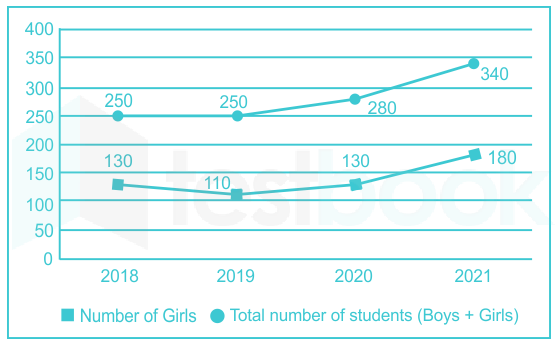
The line graph shows the total number of students [ Boys and Girls] and number of girls in a school in four different years [ 2018, 2019, 2020 and 2021].

Ratio of number of boys in the school on 2021 and 2022 is 2:3. Number of girls on 2022 is 10% less than the number of boys. Find the number of girls on 2022?

  1. AOption (a)

    214

  2. BOption (b)

    220

  3. COption (c)

    230

  4. DOption (d)

    226

  5. EOption (e)

    216

View answer & explanation

Correct answer

Answer: (e)E.

216

Why this answer is correct

Common Calculation

YearNumber of GirlsNumber of Boys
2018130250 – 130 = 120
2019110250 – 110 = 140
2020130280 – 130 = 150
2021180340 – 180 = 160

Calculation

Ratio of boys in 2021 and 2022 = 2:3;

Girls in 2022 are 10% less than boys.

Boys 2022 = 160 × (3/2) = 240

Girls 2022 = 240 × 0.9 = 216

Answer: 216 girls

Question 140

SBI Clerk 2025• Numerical Ability

The line graph shows the total number of students [ Boys and Girls] and number of girls in a school in four different years [ 2018, 2019, 2020 and 2021].

Difference between number of boys in 2020 and 2019 is 5×. Find the value of 7× + 22?

  1. AOption (a)

    35

  2. BOption (b)

    65

  3. COption (c)

    36

  4. DOption (d)

    75

  5. EOption (e)

    95

View answer & explanation

Correct answer

Answer: (c)C.

36

Why this answer is correct

Common Calculation

YearNumber of GirlsNumber of Boys
2018130250 – 130 = 120
2019110250 – 110 = 140
2020130280 – 130 = 150
2021180340 – 180 = 160

Calculation

Given: Difference between boys in 2020 and 2019 = 5x

Difference = 150 − 140 = 10

5x = 10 → x = 2

7x + 22 = 7 × 2 + 22 = 36

Answer: 36