Search Previous Year Questions

Find real questions from previous competitive exam papers with answers and solutions.

Leave the keyword blank to browse saved questions for your selected exam, newest papers first. Add a keyword, year or topic to narrow the results.

Browse complete papers
Showing 10 question(s)
Clear

Question 161

RPF SI 2022• CBT

Sankar and Vishnu work alternately in a tailoring shop on an order of stitching 21 suits. Sankar starts the work, stitches 3 suits in two days, and takes a break, during which Vishnu stitches 3 suits in three days, and then takes a break. This pattern is repeated till all the 21 suits are stitched. How many days did it take the duo to complete the work?

  1. AOption (a)

    18 days

  2. BOption (b)

    15 days

  3. COption (c)

    17 days

  4. DOption (d)

    16 days

View answer & explanation

Correct answer

Answer: (c)C.

17 days

Why this answer is correct

Shortcut Trick

Work done in 1 cycle (2 days of Sankar + 3 days of Vishnu) = 3 + 3 = 6 suits.

In 3 cycles: 3 × 6 = 18 suits are completed in 3 × 5 = 15 days.

Remaining suits = 21 − 18 = 3 suits.

Sankar completes these 3 suits in exactly 2 days.

Total time = 15 + 2 = 17 days.

∴ The correct answer is 17 days.

Alternate Method

Given:

Total work = 21 suits.

Sankar stitches 3 suits in 2 days → Efficiency = 3/2 = 1.5 suits/day.

Vishnu stitches 3 suits in 3 days → Efficiency = 3/3 = 1 suit/day.

Days taken by Sankar to finish 21 suits alone = 21 ÷ 1.5 = 14 days.

Days taken by Vishnu to finish 21 suits alone = 21 ÷ 1 = 21 days.

PersonDays to finish 21 suitsTotal Work (LCM)Efficiency (Units/Day)
Sankar14423
Vishnu212

Calculations:

⇒ Target work in units = (21/21) × 42 = 42 units (since Vishnu takes 21 days for 21 suits).

⇒ Work done by Sankar in 2 days = 2 × 3 = 6 units (stitching 3 suits).

⇒ Work done by Vishnu in 3 days = 3 × 2 = 6 units (stitching 3 suits).

⇒ Total work in 1 cycle (5 days) = 6 + 6 = 12 units (stitching 6 suits).

⇒ Work in 3 cycles (15 days) = 12 × 3 = 36 units (stitching 18 suits).

⇒ Remaining work = 42 − 36 = 6 units.

⇒ Sankar takes 6 ÷ 3 = 2 days to finish the remaining 6 units.

⇒ Total time taken = 15 + 2 = 17 days.

∴ The correct answer is 17 days.

Additional Information

Alternate Work Concept

In alternate work, tasks are performed in cycles. The total time is the sum of the time taken in complete cycles plus the time taken by the person whose turn is next to finish the residual work.

Efficiency Formula

Efficiency = Total Work ÷ Time Taken. For fractional days, the work done is Efficiency × Time.

Work Equality

If M1D1H1/W1 = M2D2H2/W2, it can be used to find unknown variables when work or number of people change.
Question 162

RPF SI 2022• CBT

A statement is given below, followed by four conclusions given in the options. Find out which conclusion is true based on the given statement.

Statement:  Q > A ≥ Z > X < R ≤ H < M

  1. AOption (a)

    Z > X ≥ M

  2. BOption (b)

    Q > M > H

  3. COption (c)

    Q > X > A

  4. DOption (d)

    M > R > X

View answer & explanation

Correct answer

Answer: (d)D.

M > R > X

Why this answer is correct

Given Statement: Q > A ≥ Z > X < R ≤ H < M

Now,

Options:

(i) Z > X ≥ M → False (Z > X < R ≤ H < M No relation can be established between X and M)

(ii) Q > M > H → False (Q > A ≥ Z > X < R ≤ H < M No relation can be established between Q and M)

(iii) Q > X > A → False ​(Q > A ≥ Z > X It gives Q > A > X)

(iv) M > R > X → True (X < R ≤ H < M It gives M > R > X)

Here, Only Option iv is true.

Hence, the correct answer is "Option 4".

Question 163

RPF SI 2022• CBT

Select the number from among the given options that can replace the question mark (?) in the following series.

1, 0, 2, 1, 3, 2, 4, 5, 5, 26, ?, 677

  1. AOption (a)

    47

  2. BOption (b)

    26

  3. COption (c)

    52

  4. DOption (d)

    6

View answer & explanation

Correct answer

Answer: (d)D.

6

Why this answer is correct

The logic followed here is:

So, '6' will be the missing number in the given series.

Hence, the correct answer is "Option 4".

Question 164

RPF SI 2022• CBT

How many airlines were nationalised under The Air Corporation Act, 1953?

  1. AOption (a)

    13

  2. BOption (b)

    09

  3. COption (c)

    11

  4. DOption (d)

    18

View answer & explanation

Correct answer

Answer: (b)B.

09

Why this answer is correct

The correct answer is 09.

Key Points

  • 9 airlines were nationalised under The Air Corporation Act, 1953.
  • The Air Corporation Act, 1953 was enacted in India to provide for the nationalisation of certain air transport companies.
  • The Act authorised the Central Government to acquire the assets, properties, rights, and liabilities of the existing air transport companies and to transfer them to a newly created corporation called Air India International Limited.
  • The nationalised airlines under the Act included Tata Airlines, Air India Limited, Air Services of India Limited, Airways (India) Limited, Bharat Airways Limited, Deccan Airways Limited, Himalayan Aviation Limited, Kalinga Airlines, and Indian National Airways Limited.

Additional Information

  • According to market share, IndiGo is the largest airline in India.
  • This low-cost airline flies to more than 100 locations in India and beyond on more than 1,700 flights per day.
  • The company's main office is in Gurgaon, Haryana, India.

Question 165

RPF SI 2022• CBT

An article is marked 50% above its cost price. If the shopkeeper gives two successive discounts of 10% and 25%, and still earns a profit of ₹15, then the cost price of the article is:

  1. AOption (a)

    ₹1,600

  2. BOption (b)

    ₹1,200

  3. COption (c)

    ₹1,750

  4. DOption (d)

    ₹1,500

View answer & explanation

Correct answer

Answer: (b)B.

₹1,200

Why this answer is correct

Shortcut Trick

Let Cost Price (CP) be 100 units.

Marked Price (MP) = 100 + 50% of 100 = 150 units.

Successive discount = a + b − (ab ÷ 100) = 10 + 25 − (10 × 25 ÷ 100) = 35 − 2.5 = 32.5%.

Selling Price (SP) = 150 × (100 − 32.5) ÷ 100 = 150 × 0.675 = 101.25 units.

Profit = 101.25 − 100 = 1.25 units. Given 1.25 units = &8377;15.

CP = (15 ÷ 1.25) × 100 = 12 × 100 = &8377;1,200.

∴ The correct answer is &8377;1,200.

Alternate Method

Given: Markup = 50%, Discounts = 10% and 25%, Profit = &8377;15.

Formulas: SP = MP × (100 − D1)% × (100 − D2)% | Profit = SP − CP.

⇒ Let CP = x.

⇒ MP = x × (150 ÷ 100) = 1.5x.

⇒ SP = 1.5x × (90 ÷ 100) × (75 ÷ 100) = 1.5x × 0.9 × 0.75 = 1.0125x.

⇒ Profit = 1.0125x − x = 0.0125x.

⇒ 0.0125x = 15.

⇒ x = 15 ÷ 0.0125 = 1,200.

∴ The correct answer is &8377;1,200.

Additional Information

Marked Price & Discount

Marked Price is the price displayed on the label. Discount is always calculated on the MP. SP = MP − Discount.

Successive Discounts

When multiple discounts are given, the second is applied to the price after the first discount. Total D% = a + b − (ab ÷ 100).

Question 166

RPF SI 2022• CBT

Which of the following is an artificial ecosystem that is manmade?

  1. AOption (a)

    Lake

  2. BOption (b)

    Crop field

  3. COption (c)

    Forest

  4. DOption (d)

    Pond

View answer & explanation

Correct answer

Answer: (b)B.

Crop field

Why this answer is correct

The correct answer is Crop field.

Key Points

  • An artificial ecosystem is a man-made ecosystem that is created by humans for various purposes.
  • A crop field is an example of an artificial ecosystem because it is created by humans for the purpose of growing crops.
  • Crop fields are referred to as artificial ecosystems due to the manipulation of various biotic and abiotic elements.
  • Farmers make use of the connection between producers and abiotic variables.

Additional Information

  • A natural ecosystem is a free-living community of both living and non-living things found in the wild.
  • All of the components work together as a single entity through chemical, biological, and physical processes.
  • A lake, forest, and pond are natural ecosystems that are not man-made.
  • A lake is a large body of water that is surrounded by land.
  • It is formed naturally.
  • A forest is a large area that is covered with trees and other vegetation.
  • A pond is a small body of water that is formed naturally and is not created by humans.

Question 167

RPF SI 2022• CBT

Raghav's average earning per month in the first three months of a year was ₹45,000. In April, his earning was \(33 \frac{1}{3} %\) more than the average earning in the first three months. If his average earning per month for the whole year is ₹45,300, then what will be Raghav's average earning (in ₹) per month from May to December?

  1. AOption (a)

    43,575

  2. BOption (b)

    43,450

  3. COption (c)

    43,425

  4. DOption (d)

    43,580

View answer & explanation

Correct answer

Answer: (a)A.

43,575

Why this answer is correct

Shortcut Trick

Base average (first 3 months) = 45,000

April earning = 45,000 × (1 + 1/3) = 60,000

Using Deviation Method relative to yearly average 45,300:

Net deviation (Jan-Apr) = [3 × (45,000 − 45,300)] + [1 × (60,000 − 45,300)] = −900 + 14,700 = +13,800

Avg (May-Dec) = 45,300 − (13,800 ÷ 8) = 45,300 − 1,725 = 43,575

∴ The correct answer is ₹43,575.

Alternate Method

Given:

Average (Jan-Mar) = ₹45,000

April earning = 33 1/3% more than ₹45,000

Yearly Average (12 months) = ₹45,300

Formula Used:

Total Earning = Average × Number of months

Calculations:

⇒ Total for Jan-Mar = 3 × 45,000 = ₹1,35,000

⇒ April Earning = 45,000 × (1 + 1/3) = 45,000 + 15,000 = ₹60,000

⇒ Total for Jan-Apr = 1,35,000 + 60,000 = ₹1,95,000

⇒ Total for the year (12 months) = 12 × 45,300 = ₹5,43,600

⇒ Total for May-Dec = 5,43,600 − 1,95,000 = ₹3,48,600

⇒ Average (May-Dec) = 3,48,600 ÷ 8

⇒ Average (May-Dec) = ₹43,575

∴ The correct answer is ₹43,575.

Additional Information

Weighted Average Concept

The combined average of two groups is given by (n1x1 + n2x2) ÷ (n1 + n2), where n is the count and x is the average.

Percentage to Fraction Conversion

Values like 33.33% or 33 1/3% are exactly equal to 1/3. For "more than", use the multiplier (1 + 1/3) = 4/3.

Deviation Rule

The sum of deviations of all observations from the mean is always zero. This is the fastest way to find a missing group average.

Question 168

RPF SI 2022• CBT

If \(x+\frac{1}{x}=3\), then \(x^2+\frac{1}{x^2}\) is:

  1. AOption (a)

    6

  2. BOption (b)

    9

  3. COption (c)

    7

  4. DOption (d)

    8

View answer & explanation

Correct answer

Answer: (c)C.

7

Why this answer is correct

Shortcut Trick

For any algebraic expression of the form x + 1/x = k, the value of x2 + 1/x2 is given by the formula k2 − 2.

Here, the given value k = 3.

∴ x2 + 1/x2 = 32 − 2

⇒ 9 − 2 = 7

∴ The correct answer is 7.

Alternate Method

Given: x + 1/x = 3

Formula Used: (a + b)2 = a2 + b2 + 2ab

Calculations:

Squaring both sides of the given equation:

⇒ (x + 1/x)2 = 32

⇒ x2 + (1/x)2 + 2 × x × (1/x) = 9

⇒ x2 + 1/x2 + 2 = 9

⇒ x2 + 1/x2 = 9 − 2

⇒ x2 + 1/x2 = 7

∴ The correct answer is 7.

Additional Information

Square Identity with Subtraction

If x − 1/x = k, then the value of x2 + 1/x2 is k2 + 2.

Cubic Identity

If x + 1/x = k, then the value of x3 + 1/x3 is k3 − 3k.

Higher Power Relation

If x + 1/x = k, the value of x4 + 1/x4 can be found by squaring the result of (x2 + 1/x2) and subtracting 2.

Question 169

RPF SI 2022• CBT

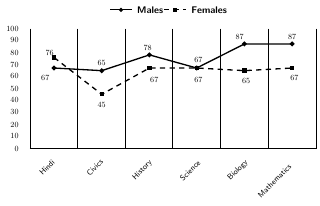
Study the given graph and answer the question that follows.

The graph presents total number of students who opted for different subjects in a college.

What is the difference between the total number of students who have opted for 'Biology and Mathematics' & total number of students who have opted for 'Civics and History'?

  1. AOption (a)

    49

  2. BOption (b)

    50

  3. COption (c)

    52

  4. DOption (d)

    51

View answer & explanation

Correct answer

Answer: (d)D.

51

Why this answer is correct

Calculation

The total number of students who have opted for 'Biology and Mathematics = 87 + 65 + 87 + 67 = 306

The total number of students who have opted for 'Civics and History' = 65 + 45 + 78 + 67 = 255

Difference = 306 - 255 = 51

The answer is 51.

Question 170

RPF SI 2022• CBT

Consider the below statements and identify the correct answer.

Statement - I: Keeping food in air-tight containers helps to slow down oxidation.

Statement - II: Chips manufacturers usually flush bags of chips with gas such as oxygen to prevent the chips from getting oxidised.

  1. AOption (a)

    Statement-I is true, and Statement-II is false.

  2. BOption (b)

    Both the statements are true.

  3. COption (c)

    Both the statements are false.

  4. DOption (d)

    Statement-I is false, and Statement-II is true.

View answer & explanation

Correct answer

Answer: (a)A.

Statement-I is true, and Statement-II is false.

Why this answer is correct

The correct answer is Statement-I is true, and Statement-II is false.

Key Points

  • Keeping food in air-tight containers helps to slow down oxidation as it reduces the exposure of the food to air, which is necessary for oxidation to occur.
  • Chips manufacturers usually flush bags of chips with gas such as nitrogen instead of oxygen to prevent the chips from getting oxidized.
  • This is because nitrogen is an inert gas and does not react with the chips, thus preventing oxidation.
  • Statement-I is true as keeping food in air-tight containers does slow down oxidation.
  • Statement-II is false as chips manufacturers usually flush bags of chips with nitrogen to prevent oxidation, not oxygen.

Additional Information

  • The loss of electrons by a molecule, atom, or ion during a reaction is called oxidation.
  • A molecule, atom, or ion undergoes oxidation when its oxidation status increased.
  • Oxidation is a chemical process in which oxygen reacts with other substances, such as food, and causes a change in their chemical composition.
  • Air-tight containers prevent the entry of oxygen into the container and thus slow down oxidation.