Search Previous Year Questions

Find real questions from previous competitive exam papers with answers and solutions.

Leave the keyword blank to browse saved questions for your selected exam, newest papers first. Add a keyword, year or topic to narrow the results.

Browse complete papers
Showing 10 question(s)
Clear

Question 151

Nainital Bank Clerk 2019• Quantitative Aptitude

In the given question, two equations numbered l and II are given. Solve both the equations and mark the appropriate answer.

I. 4x2 + 12x + 9 = 0

II. 2y2 + 3y + 1 = 0

  1. AOption (a)

    x < y

  2. BOption (b)

    x > y

  3. COption (c)

    x ≤ y

  4. DOption (d)

    x ≥ y

  5. EOption (e)

    x = y or the relation between x and y can't be established.

View answer & explanation

Correct answer

Answer: (a)A.

x < y

Why this answer is correct

Calculation:

I. 4x2 + 12x + 9 = 0

⇒ 4x2 + 6x + 6x + 9 = 0

⇒ 2x(2x + 3) + 3(2x + 3) = 0

⇒ (2x + 3) (2x + 3) = 0

⇒ x = -3/2, -3/2

II. 2y2 + 3y + 1

⇒ 2y2 + 2y + 1y + 1 = 0

⇒ 2y(y + 1) + 1 (y + 1) = 0

⇒ (2y + 1) (y + 1) = 0

⇒ y = -1/2 , -1

Comparison between X and Y (via tabulation):

Value of xValue of yRelation
-3/2-1/2x < y
-3/2-1x < y
-3/2-1/2x < y
-3/2-1x < y

∴ x < y

Question 152

Nainital Bank Clerk 2019• Quantitative Aptitude

In the given question, two equations numbered l and II are given. Solve both the equations and mark the appropriate answer.

I. x2 – 19x + 90 = 0

II. 2y2 – 11y – 63 = 0

  1. AOption (a)

    x > y`

  2. BOption (b)

    x < y

  3. COption (c)

    x ≥ y

  4. DOption (d)

    x ≤ y

  5. EOption (e)

    x = y or relationship between x and y cannot be established

View answer & explanation

Correct answer

Answer: (c)C.

x ≥ y

Why this answer is correct

Calculation:

I. x2 – 19x + 90 = 0

⇒ x2 – 10x – 9x + 90 = 0

⇒ x(x – 10) – 9(x – 10) = 0

⇒ (x – 9) (x – 10) = 0

⇒ x = 9, 10

II. 2y2 – 11y – 63 = 0

⇒ 2y2 – 18y + 7y – 63 = 0

⇒ 2y(y – 9) + 7(y – 9) = 0

⇒ (2y + 7) (y – 9) = 0

⇒ y = -7/2, 9

Comparison between X and Y (via tabulation):

Value of xValue of yRelation
9-7/2x > y
99x = y
10-7/2x > y
109x > y


∴ x ≥ y

Question 153

Nainital Bank Clerk 2019• Quantitative Aptitude

In the given question, two equations numbered l and II are given. Solve both the equations and mark the appropriate answer.

I. x2 + 11x + 28 = 0

II. y2 + 14y + 24 = 0

  1. AOption (a)

    x > y

  2. BOption (b)

    x < y

  3. COption (c)

    x ≥ y

  4. DOption (d)

    x ≤ y

  5. EOption (e)

    x = y or relation between x and y can not be established.

View answer & explanation

Correct answer

Answer: (e)E.

x = y or relation between x and y can not be established.

Why this answer is correct

Given:

I. x2 + 11x + 28 = 0

II. y2 + 14y + 24 = 0

Calculation:

From I,

x2 + 11x + 28 = 0

⇒ x2 + 7x + 4x + 28 = 0

⇒ x(x + 7) + 4(x + 7) = 0

⇒ (x + 7)(x + 4) = 0

Taking,

⇒ (x + 7) = 0 or (x + 4) = 0

⇒ x = -7 or -4

From II,

y2 + 14y + 24 = 0

⇒ y2 + 12y + 2y + 24 = 0

⇒ y(y + 12) + 2(y + 12) = 0

⇒ (y + 12)(y + 2) = 0

Taking,

⇒ (y + 12) = 0 or (y + 2) = 0

⇒ y = -12 or -2

Comparison between x and y (via Tabulation):

Value of xValue of yRelation
-7-12x > y
-7-2x < y
-4-12x > y
-4-2x < y


∴ x = y or relation between x and y can not be established.

Question 154

Nainital Bank Clerk 2019• Quantitative Aptitude

In the given question, two equations numbered l and II are given. Solve both the equations and mark the appropriate answer.

I. x2 - 8x + 15 = 0

II. y2 - 9y + 14 = 0

  1. AOption (a)

    x > y

  2. BOption (b)

    x < y

  3. COption (c)

    x ≥ y

  4. DOption (d)

    x ≤ y

  5. EOption (e)

    x = y or relation between x and y can not be established.

View answer & explanation

Correct answer

Answer: (e)E.

x = y or relation between x and y can not be established.

Why this answer is correct

Given: 

I. x2 - 8x + 15 = 0

II. y2 - 9y + 14 = 0

Calculation:

From I,

x2 - 8x + 15 = 0

⇒ x2 - 5x - 3x + 15 = 0

⇒ x(x - 5) - 3(x - 5) = 0

⇒ (x - 5)(x - 3) = 0

Taking,

⇒ (x - 5) = 0 or (x - 3) = 0

⇒ x = 5 or 3

From II,

y2 - 9y + 14 = 0

⇒ y2 - 7y - 2y + 14 = 0

⇒ y(y - 7) - 2(y - 7) = 0

⇒ (y - 7)(y - 2) = 0

Taking,

⇒ (y - 7) = 0 or (y - 2) = 0

⇒ y = 7 or 2

Comparison between x and y (via Tabulation):

Value of xValue of yRelation
57x < y
52x > y
37x < y
32x > y


∴ x = y or relation between x and y can not be established.

Question 155

Nainital Bank Clerk 2019• Quantitative Aptitude

In the given question, two equations numbered l and II are given. Solve both the equations and mark the appropriate answer.

I. x2 - 22x + 105 = 0

II. y2 - 6y - 247 = 0

  1. AOption (a)

    x > y

  2. BOption (b)

    x < y

  3. COption (c)

    x ≥ y

  4. DOption (d)

    x ≤ y

  5. EOption (e)

    x = y or relationship between x and y cannot be established.

View answer & explanation

Correct answer

Answer: (e)E.

x = y or relationship between x and y cannot be established.

Why this answer is correct

Given:

x2 - 22x + 105 = 0

y2 - 6y - 247 = 0

Calculation:

From I,

x2 - 22x + 105 = 0

⇒ x2 - 15x - 7x + 105 = 0

⇒ x(x - 15) - 7(x - 15) = 0

⇒ (x - 7)(x - 15) = 0

⇒ x = 7, 15

From II,

y2 - 6y - 247 = 0

⇒ y2 - 19y + 13y - 247 = 0

⇒ y(y - 19) + 13(y - 19) = 0

⇒ (y + 13)(y - 19) = 0

⇒ y = -13, 19

Comparison between x and y (via Tabulation):

Value of xValue of yRelation
7-13x > y
719x < y
15-13x > y
1519x < y


∴ The relationship between x and y cannot be established.

Question 156

Nainital Bank Clerk 2019• Quantitative Aptitude

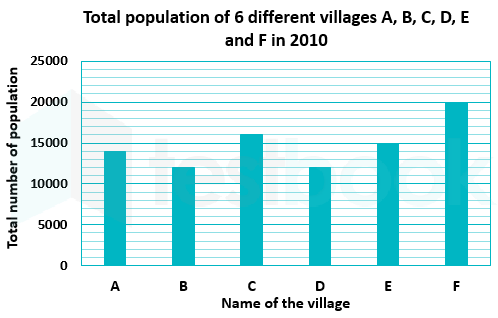
Directions: Study the following bar graph carefully to answer the following questions.

The bar graph shows the total population of 6 different villages A, B, C, D, E and F in 2010.

What is the average population of villages A, C, E and F together?

  1. AOption (a)

    16250

  2. BOption (b)

    15000

  3. COption (c)

    16000

  4. DOption (d)

    15625

  5. EOption (e)

    16500

View answer & explanation

Correct answer

Answer: (a)A.

16250

Why this answer is correct

Given:

The population of village A = 14000

The population of village C = 16000

The population of village E = 15000

The population of village F = 20000

Formula Used:

Average = (Sum of observations)/(Number of observations)

Calculation:

Sum of population of villages A, C, E and F together = 14000 + 16000 + 15000 + 20000

⇒ 65000

Required average = 65000/4

⇒ 16250

∴ The average population of villages A, C, E and F together will be 16250.

Question 157

Nainital Bank Clerk 2019• Quantitative Aptitude

Directions: Study the following bar graph carefully to answer the following questions.

The bar graph shows the total population of 6 different villages A, B, C, D, E and F in 2010.

The ratio of male and female in village D is 5 : 3. Then what will be the difference between the number of males and females in village D?

  1. AOption (a)

    3500

  2. BOption (b)

    3000

  3. COption (c)

    3100

  4. DOption (d)

    4000

  5. EOption (e)

    4500

View answer & explanation

Correct answer

Answer: (b)B.

3000

Why this answer is correct

Given:

The population of village D = 12000

The ratio of male and female in village D = 5 : 3

Calculation:

Let the number of male and female in village D be 5x and 3x respectively.

According to the question,

5x + 3x = 12000

⇒ 8x = 12000

⇒ x = 1500

The number of male in village D = 5 × 1500

⇒ 7500

The number of female in village D = 3 × 1500

⇒ 4500

The required difference = 7500 - 4500

⇒ 3000

∴ The difference between the number of males and females in village D will be 3000.

Question 158

Nainital Bank Clerk 2019• Quantitative Aptitude

Directions: Study the following bar graph carefully to answer the following questions.

The bar graph shows the total population of 6 different villages A, B, C, D, E and F in 2010.

What will be the ratio between the population of villages B and C together and Villages D and E together?

  1. AOption (a)

    2 : 3

  2. BOption (b)

    3 : 4

  3. COption (c)

    28 : 27

  4. DOption (d)

    27 : 28

  5. EOption (e)

    3 : 5

View answer & explanation

Correct answer

Answer: (c)C.

28 : 27

Why this answer is correct

Given:

The population of village B = 12000

The population of village C = 16000

The population of village E = 15000

The population of village D = 12000

Calculation:

The population of villages B and C together = 12000 + 16000

⇒ 28000

The population of villages D and E together = 12000 + 15000

⇒ 27000

The required ratio = 28000/27000

⇒ 28 : 27

∴ The ratio between the population of villages B and C together and Villages D and E together will be 28 : 27.

Question 159

Nainital Bank Clerk 2019• Quantitative Aptitude

Directions: Study the following bar graph carefully to answer the following questions.

The bar graph shows the total population of 6 different villages A, B, C, D, E and F in 2010.

The population of village E is what percent more than that of village B?

  1. AOption (a)

    30%

  2. BOption (b)

    40%

  3. COption (c)

    20%

  4. DOption (d)

    25%

  5. EOption (e)

    35%

View answer & explanation

Correct answer

Answer: (d)D.

25%

Why this answer is correct

Given:

The population of village B = 12000

The population of village E = 15000

Formula Used:

Percentage Increase = {(Increase in value)/(Base value)} × 100

Calculation:

Increase in population = 15000 - 12000

⇒ 3000

Percentage Increase = {(Increase in population)/(Base value)} × 100

⇒ (3000/12000) × 100

⇒ 25%

∴ The population of village E is 25% more than that of village B.

Question 160

Nainital Bank Clerk 2019• Quantitative Aptitude

Directions: Study the following bar graph carefully to answer the following questions.

The bar graph shows the total population of 6 different villages A, B, C, D, E and F in 2010.

The population of village B is what percent of the population of village C?

  1. AOption (a)

    100%

  2. BOption (b)

    125%

  3. COption (c)

    65%

  4. DOption (d)

    50%

  5. EOption (e)

    75%

View answer & explanation

Correct answer

Answer: (e)E.

75%

Why this answer is correct

Given:

The population of village B = 12000

The population of village C = 16000

Calculation:

Required percentage = (12000/16000) × 100

⇒ (3/4) × 100

⇒ 75%

∴ The population of village B is 75% of the population of village C.