Search Previous Year Questions

Find real questions from previous competitive exam papers with answers and solutions.

Leave the keyword blank to browse saved questions for your selected exam, newest papers first. Add a keyword, year or topic to narrow the results.

Browse complete papers
Showing 10 question(s)
Clear

Question 151

LIC ADO 2022• Quantitative Aptitude

Directions: Answer the questions based on the information given below.

Four different warehouses displaced two different types of 'quantities' (P and Q) in the month of March. The line graph below shows the total number of 'quantities' displaced by each warehouse and the number of 'P' type of 'quantities' displaced by the same warehouse.
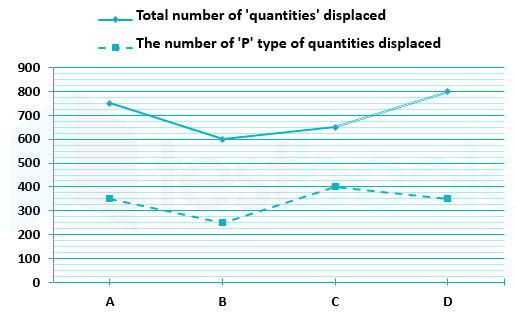
What is the average number of 'Q' type of 'quantities' displaced by warehouses 'B', 'C', and 'D'?

  1. AOption (a)

    340

  2. BOption (b)

    350

  3. COption (c)

    360

  4. DOption (d)

    370

  5. EOption (e)

    380

View answer & explanation

Correct answer

Answer: (b)B.

350

Why this answer is correct

Putting all the values in a table we get

WarehouseTotal displaced quantities (P + Q)Displaced quantities of 'P' typeDisplaced quantities of 'Q' type
A750350750 - 350 = 400
B600250600 - 250 = 350
C650400650 - 400 = 250
D800350800 - 350 = 450
Total280013501450


Average number of 'Q' type of 'quantities' displaced by warehouses 'B', 'C', and 'D' = (350 + 250 + 450)/3 = 350

Hence, the correct answer is 350.

Question 152

LIC ADO 2022• Quantitative Aptitude

Directions: Answer the questions based on the information given below.

Four different warehouses displaced two different types of 'quantities' (P and Q) in the month of March. The line graph below shows the total number of 'quantities' displaced by each warehouse and the number of 'P' type of 'quantities' displaced by the same warehouse.

If each 'P' type of displaced 'quantity' costs Rs. 275 to a warehouse then find the total cost beared by all four warehouses from selling all 'P' type of quantities?

  1. AOption (a)

    Rs. 371250

  2. BOption (b)

    Rs. 372250

  3. COption (c)

    Rs. 373250

  4. DOption (d)

    Rs. 374250

  5. EOption (e)

    Rs. 375250

View answer & explanation

Correct answer

Answer: (a)A.

Rs. 371250

Why this answer is correct

Putting all the values in a table we get

WarehouseTotal displaced quantities (P + Q)Displaced quantities of 'P' typeDisplaced quantities of 'Q' type
A750350750 - 350 = 400
B600250600 - 250 = 350
C650400650 - 400 = 250
D800350800 - 350 = 450
Total280013501450


The total cost beared by all four warehouses from selling all 'P' type of quantities = 275 × 1350 = 371250 Rs.

Hence, the correct answer is 371250 Rs.

Question 153

LIC ADO 2022• Quantitative Aptitude

Directions: Answer the questions based on the information given below.

Four different warehouses displaced two different types of 'quantities' (P and Q) in the month of March. The line graph below shows the total number of 'quantities' displaced by each warehouse and the number of 'P' type of 'quantities' displaced by the same warehouse.

If the number of 'Q' type of displaced 'quantities' for warehouse 'E' is 62.5% more than the number of 'Q' type of quantities displaced by warehouse 'A' and the number of 'P' type of displaced 'quantities' for warehouse 'E' is 250 more than the number of 'Q' type of quantities displaced by the same warehouse then find the total number of quantities displaced by warehouse 'E'?

  1. AOption (a)

    1150

  2. BOption (b)

    1250

  3. COption (c)

    1350

  4. DOption (d)

    1450

  5. EOption (e)

    1550

View answer & explanation

Correct answer

Answer: (e)E.

1550

Why this answer is correct

Putting all the values in a table we get

WarehouseTotal displaced quantities (P + Q)Displaced quantities of 'P' typeDisplaced quantities of 'Q' type
A750350750 - 350 = 400
B600250600 - 250 = 350
C650400650 - 400 = 250
D800350800 - 350 = 450
Total280013501450


The number of 'Q' type of displaced 'quantities' for warehouse 'E' = (13/8) × 400 = 650

The number of 'P' type of displaced 'quantities' for warehouse 'E' = 650 + 250 = 900

Total number of quantities displaced by warehouse 'E' = 650 + 900 = 1550

Hence, the correct answer is 1550.

Question 154

LIC ADO 2022• Quantitative Aptitude

Directions: Answer the questions based on the information given below.

Four different warehouses displaced two different types of 'quantities' (P and Q) in the month of March. The line graph below shows the total number of 'quantities' displaced by each warehouse and the number of 'P' type of 'quantities' displaced by the same warehouse.

The total number of 'P' type of quantities displaced by warehouses 'A', 'C', and 'D' are approximately what percentage of the total number of quantities displaced by all four warehouses?

  1. AOption (a)

    36%

  2. BOption (b)

    37%

  3. COption (c)

    38%

  4. DOption (d)

    39%

  5. EOption (e)

    40%

View answer & explanation

Correct answer

Answer: (d)D.

39%

Why this answer is correct

Putting all the values in a table we get

WarehouseTotal displaced quantities (P + Q)Displaced quantities of 'P' typeDisplaced quantities of 'Q' type
A750350750 - 350 = 400
B600250600 - 250 = 350
C650400650 - 400 = 250
D800350800 - 350 = 450
Total280013501450


The total number of 'P' type of quantities displaced by warehouses 'A', 'C', and 'D' = (350 + 400 + 350) = 1100

Required percentage = (1100/2800) × 100 = 39.28 ~ 39%

Hence, the correct answer is 39%.

Question 155

LIC ADO 2022• Quantitative Aptitude

Directions: Answer the questions based on the information given below.

Four different warehouses displaced two different types of 'quantities' (P and Q) in the month of March. The line graph below shows the total number of 'quantities' displaced by each warehouse and the number of 'P' type of 'quantities' displaced by the same warehouse.

Out of the total number of quantities displaced by all four warehouses 42.85% are returned back due to some defects then find the total number of quantities that are accepted and not returned back to all four warehouses?

  1. AOption (a)

    1200

  2. BOption (b)

    1400

  3. COption (c)

    1600

  4. DOption (d)

    1800

  5. EOption (e)

    2000

View answer & explanation

Correct answer

Answer: (c)C.

1600

Why this answer is correct

Putting all the values in a table we get

WarehouseTotal displaced quantities (P + Q)Displaced quantities of 'P' typeDisplaced quantities of 'Q' type
A750350750 - 350 = 400
B600250600 - 250 = 350
C650400650 - 400 = 250
D800350800 - 350 = 450
Total280013501450


The total number of quantities that are accepted and not returned back to all four warehouses = (4/7) × 2800 = 1600

Hence, the correct answer is 1600.

Question 156

LIC ADO 2022• Quantitative Aptitude

The ratio of present ages of A and B is 7 : 8. After 6 years from now, the ratio of their ages will be 8 : 9. If C's present age is 10 years more than the present age of A, then the present age (in years) of C is:

  1. AOption (a)

    59

  2. BOption (b)

    56

  3. COption (c)

    45

  4. DOption (d)

    52

  5. EOption (e)

    55

View answer & explanation

Correct answer

Answer: (d)D.

52

Why this answer is correct

Shortcut Trick

Ratio of A : B is 7 : 8 (Present) and 8 : 9 (After 6 years).

Change in ratio units for both is 8 − 7 = 1 unit and 9 − 8 = 1 unit.

Since the time gap is 6 years, 1 unit → 6 years.

A's present age = 7 units × 6 = 42 years.

C's present age = 42 + 10 = 52 years.

∴ The correct answer is 52 years.

Alternate Method

Given: Present age ratio A : B = 7 : 8. After 6 years, ratio A : B = 8 : 9. C = A + 10.

Calculation:

⇒ Let present ages of A and B be 7x and 8x.

⇒ (7x + 6) ÷ (8x + 6) = 8 ÷ 9

⇒ 9 × (7x + 6) = 8 × (8x + 6)

⇒ 63x + 54 = 64x + 48

⇒ 64x − 63x = 54 − 48

⇒ x = 6

⇒ A's present age = 7 × 6 = 42 years

⇒ C's present age = 42 + 10 = 52 years

∴ The correct answer is 52 years.

Additional Information

Age Difference Property

The difference between ages of two people remains constant regardless of the number of years passed.

Ratio Balancing Method

If the difference in ratio parts is not equal, multiply the ratios by the difference of the other ratio to balance them before solving.

Linear Equation in Ages

For any 'n' years after/before, add/subtract 'n' to the current age variables to form the equation: (Ax + n) / (Bx + n) = New Ratio.

Question 157

LIC ADO 2022• Quantitative Aptitude

Arvind gives 50% of his money to his son, 30% to his wife, and 62.5% of the remaining money is donated to a trust. He is left with 15,000 Rs. now. How much money did he have in the beginning?

  1. AOption (a)

    Rs. 2,05,000

  2. BOption (b)

    Rs. 2,25,000

  3. COption (c)

    Rs. 2,10,000

  4. DOption (d)

    Rs. 2,00,000

  5. EOption (e)

    Rs. 1,90,000

View answer & explanation

Correct answer

Answer: (d)D.

Rs. 2,00,000

Why this answer is correct

Shortcut Trick

Let the Initial Amount be X.

Total percentage given to Son and Wife = 50% + 30% = 80%. Remaining = 20%.

Donation to trust = 62.5% of 20% = 5/8 × 20% = 12.5%. Final remaining = 20% − 12.5% = 7.5%.

7.5% of X = 15,000 ⇒ (3/40) × X = 15,000 ⇒ X = 2,00,000.

∴ The correct answer is ₹2,00,000.

Alternate Method

Given: Son = 50%, Wife = 30%, Trust = 62.5% of remaining, Left = ₹15,000.

Calculations:

⇒ Let total money = 100 units

⇒ Spent on Son and Wife = 50 + 30 = 80 units

⇒ Remaining money = 100 − 80 = 20 units

⇒ Donation to trust = 62.5% of 20 = (5/8) × 20 = 12.5 units

⇒ Final remaining amount = 20 − 12.5 = 7.5 units

⇒ 7.5 units = 15,000

⇒ 1 unit = 15,000 ÷ 7.5 = 2,000

⇒ Total money (100 units) = 100 × 2,000 = 2,00,000

∴ The correct answer is ₹2,00,000.

Additional Information

Percentage to Fraction Conversion

62.5% can be written as 5/8 and 12.5% as 1/8 to speed up calculations in competitive exams.

Successive Percentage Remainder

When spending from the 'remaining' amount, multiply the initial value by the remaining fractions: Final = Initial × (1 − r1) × (1 − r2).

Question 158

LIC ADO 2022• Quantitative Aptitude

Akshay invested Rs. 24,000 in a business. After few months Bikash joined with a capital of Rs. 18,000. After a year, profit is divided into ratio 16 : 7. After how many months, did Bikash join the business?

  1. AOption (a)

    3 months

  2. BOption (b)

    4 months

  3. COption (c)

    5 months

  4. DOption (d)

    6 months

  5. EOption (e)

    7 months

View answer & explanation

Correct answer

Answer: (c)C.

5 months

Why this answer is correct

Shortcut Trick

Profit ratio is the product of Capital and Time ratios.

Capital ratio (Akshay : Bikash) = 24,000 : 18,000 = 4 : 3.

Time ratio = Profit ratio ÷ Capital ratio.

Time ratio = (16 ÷ 4) : (7 ÷ 3) = 4 : (7/3) = 12 : 7.

Since Akshay invested for 12 months, Bikash invested for 7 months.

Bikash joined after = 12 − 7 = 5 months.

∴ The correct answer is 5 months.

Alternate Method

Given → Akshay Capital = Rs. 24,000, Bikash Capital = Rs. 18,000, Akshay Time = 12 months, Profit Ratio = 16 : 7. Formulas: Profit Ratio = (C1 × T1) : (C2 × T2).

⇒ Let Bikash invested for t months. ⇒ (24,000 × 12) ÷ (18,000 × t) = 16 ÷ 7. ⇒ (4 × 12) ÷ (3 × t) = 16 ÷ 7. ⇒ 48 ÷ 3t = 16 ÷ 7. ⇒ 16 ÷ t = 16 ÷ 7. ⇒ t = 7 months. ⇒ Bikash joined after = 12 − 7 = 5 months.

∴ The correct answer is 5 months.

Additional Information

Partnership Basics

In a partnership, the profit is distributed among partners in the ratio of their investment multiplied by the duration of investment.

Joining vs Duration

If a person joins after 'x' months in a one-year business, the investment duration is (12 − x) months.

Question 159

LIC ADO 2022• Quantitative Aptitude

Two pipes can fill a tank in 12 hours and 15 hours respectively, while the third pipes can empty it in 18 hours. If first two pipes fill the tank for 5 hours then, time taken to empty the tank by third pipe ?

  1. AOption (a)

    13.5 hours

  2. BOption (b)

    12.5 hours

  3. COption (c)

    11.5 hours

  4. DOption (d)

    15.5 hours

  5. EOption (e)

    14.5 hours

View answer & explanation

Correct answer

Answer: (a)A.

13.5 hours

Why this answer is correct

Shortcut Trick

Efficiency of Pipe A = 15, Pipe B = 12, Pipe C = −10 (Total Work 180).

Water filled in 5 hours by (A + B) = (15 + 12) × 5 = 135 units.

Time taken by Pipe C to empty this water = 135 ÷ 10 = 13.5 hours.

∴ The correct answer is 13.5 hr.

Alternate Method

Given: Filling time of Pipe 1 = 12 hr, Pipe 2 = 15 hr. Emptying time of Pipe 3 = 18 hr.

Formula Used: Efficiency = Total Work ÷ Time

PersonDaysTotal WorkEfficiency
Pipe 11218015
Pipe 21512
Pipe 318−10

⇒ Combined efficiency of first two pipes = 15 + 12 = 27 units/hr.

⇒ Work done in 5 hours = 27 × 5 = 135 units.

⇒ Time taken by third pipe to empty = 135 ÷ 10 = 13.5 hours.

∴ The correct answer is 13.5 hr.

Additional Information

Negative Efficiency

In Pipes and Cisterns, an outlet or leak is represented by negative efficiency as it reduces the total volume of water.

LCM Method for Total Work

Taking the Least Common Multiple of individual times as the total capacity of the tank simplifies calculations to integers.

Emptying the Filled Part

If a tank is partially filled and then only the outlet pipe is opened, the time taken is calculated based on the current volume of water, not the full capacity.

Question 160

LIC ADO 2022• Quantitative Aptitude

A train covers 400 km at a uniform speed. If the speed had been 10 km/h more, it would have taken 2 hours less for the same journey. What is the usual time taken (in hours) by it to complete the journey?

  1. AOption (a)

    12

  2. BOption (b)

    15

  3. COption (c)

    8

  4. DOption (d)

    10

  5. EOption (e)

    14

View answer & explanation

Correct answer

Answer: (d)D.

10

Why this answer is correct

Shortcut Trick

Let the usual speed be S. Distance (D) = 400 km. Speed increase (x) = 10 km/h. Time difference (t) = 2 hours.

Using the formula: Distance = [S × (S + x) / x] × t

⇒ 400 = [S × (S + 10) / 10] × 2

⇒ 2000 = S(S + 10). By observation, S = 40 km/h (as 40 × 50 = 2000).

⇒ Usual Time = Distance ÷ Usual Speed = 400 ÷ 40 = 10 hours.

∴ The correct answer is 10 hours.

Alternate Method

Given: Total Distance = 400 km, Speed difference = 10 km/h, Time difference = 2 hours.

Formula Used: Time = Distance / Speed

⇒ Let usual speed be x km/h.

⇒ 400/x − 400/(x + 10) = 2

⇒ 400 [(x + 10 − x) / (x(x + 10))] = 2

⇒ 400 [10 / (x2 + 10x)] = 2

⇒ 4000 = 2(x2 + 10x)

⇒ x2 + 10x − 2000 = 0

⇒ x2 + 50x − 40x − 2000 = 0 ⇒ (x + 50)(x − 40) = 0

⇒ x = 40 km/h (Speed cannot be negative).

⇒ Usual Time = 400 / 40 = 10 hours.

∴ The correct answer is 10 hours.

Additional Information

Speed-Time Relation

For a constant distance, speed is inversely proportional to time (S ∝ 1/T). If speed increases, time decreases.

General Distance Formula

Distance = [Product of Speeds / Difference of Speeds] × Time Difference. This is useful for all 'late/early' or speed-change problems.

Average Speed

When a journey is split into two equal distances with speeds V1 and V2, Average Speed = 2V1V2 / (V1 + V2).