Search Previous Year Questions

Find real questions from previous competitive exam papers with answers and solutions.

Leave the keyword blank to browse saved questions for your selected exam, newest papers first. Add a keyword, year or topic to narrow the results.

Browse complete papers
Showing 10 question(s)
Clear

Question 91

KVS TGT 2023• Subject Specific

The softness of a sound wave is determined by its :

  1. AOption (a)

    Speed

  2. BOption (b)

    Amplitude

  3. COption (c)

    Frequency

  4. DOption (d)

    Wavelength

View answer & explanation

Correct answer

Answer: (b)B.

Amplitude

Why this answer is correct

The correct answer is Amplitude.

Key Points

  • The softness of a sound is determined basically by its amplitude.
  • The amplitude of the sound wave depends upon the force with which an object is made to vibrate.

 Additional Information

  • Phase specifies the location or timing of a point within a wave cycle of a repetitive waveform.
  • A time period (denoted by 'T') is the time taken for one complete cycle of vibration to pass a given point.
  • Oscillation is defined as the process of repeating variations of any quantity or measure about its equilibrium value in time.

Question 92

KVS TGT 2023• Subject Specific

Which one of the following is a fundamental conservation law?

  1. AOption (a)

    Conservation of energy

  2. BOption (b)

    Conservation of momentum

  3. COption (c)

    Conservation of mass

  4. DOption (d)

    Conservation of mechanical energy

View answer & explanation

Correct answer

Answer: (a)A.

Conservation of energy

Why this answer is correct

The correct answer is Conservation of energy.

Key Points

  • The conservation of energy is a fundamental principle in physics, stating that the total energy of an isolated system remains constant over time.
  • This principle implies that energy can neither be created nor destroyed, but it can be transformed from one form to another.
  • Energy transformation examples include converting kinetic energy to thermal energy or potential energy to kinetic energy.
  • The conservation of energy is a cornerstone of classical mechanics, thermodynamics, and quantum mechanics.
  • This law is crucial for understanding a wide range of physical phenomena and engineering applications, from the motion of planets to the functioning of engines.

 Additional Information

  • Conservation of momentum
  • The conservation of momentum states that the total momentum of an isolated system remains constant if no external forces act on it.
  • This principle is essential in collision analysis and rocket propulsion.
  • Conservation of mass
  • The conservation of mass states that mass in an isolated system is neither created nor destroyed by chemical reactions or physical transformations.
  • It is a fundamental concept in chemistry and fluid dynamics.
  • Conservation of mechanical energy
  • The conservation of mechanical energy is a specific case of the conservation of energy, applicable when only conservative forces are acting.
  • It states that the sum of kinetic and potential energy remains constant in an isolated system.

Question 93

KVS TGT 2023• Subject Specific

A 4 kg object is moving at a speed of 5 m/s. The constant force needed to stop the object in 5 × 10⁻⁴ s will be:

  1. AOption (a)

    +4×10+4 N in the direction of motion.

  2. BOption (b)

    +20 N in the direction of motion.

  3. COption (c)

    +100 N in the opposite direction of motion.

  4. DOption (d)

    +4×10⁴ N in the opposite direction of motion.

View answer & explanation

Correct answer

Answer: (d)D.

+4×10⁴ N in the opposite direction of motion.

Why this answer is correct

Concept:

Kinematics is the study of the motion of a system of bodies without directly considering the forces or potential fields affecting the motion.

Calculation:

Apply the equation of kinematic

v = u + at

Acceleration, 

a = \({v-u \over t}\)

= \({5 \over 5 \times 10^{-4}}\)

Force = mass × acceleration

= 4 × 104 N.

The correct answer is option (4).

Question 94

KVS TGT 2023• Subject Specific

All the following masses are possible for an individual Carbon atom except one. The impossible one is :

  1. AOption (a)

    12.00000 u

  2. BOption (b)

    12.01115 u

  3. COption (c)

    13.00335 u

  4. DOption (d)

    14.00324 u

View answer & explanation

Correct answer

Answer: (a)A.

12.00000 u

Why this answer is correct

Correct answer: 1)

Concept:

  • Allotropes of carbon are diamond, graphite, and buckminsterfullerene.
  • The physical properties of these allotropes vary with their form.
  • Carbon has an oxidation state of +4 as it is tetravalent and can form four covalent bonds.
  • In carbon monoxide and in carbonyl complexes, the oxidation state of carbon is +2.
  • Hence, the atomic mass of carbon is 12 g/mol.

Explanation:

  • Natural carbon is formed by 98.93% of isotope C-12 with a mass of 12.01115 units, and 1.07% of isotope C-13 with a mass of 13.003355 units.
  • Mass of one atom of carbon−14 is  14.0032420u.
  • 14.00324 u is not possible for carbon atoms.

Conclusion:

Thus, The impossible mass of a Carbon atom is 12.00000 u.

Question 95

KVS TGT 2023• Subject Specific

On heating, Cl2O7, decomposes to form Cl2 and O2. What is the ratio of Chlorine to Oxygen molecules in the product?

  1. AOption (a)

    2 : 7

  2. BOption (b)

    2 : 14

  3. COption (c)

    3 : 7

  4. DOption (d)

    7 : 2

View answer & explanation

Correct answer

Answer: (a)A.

2 : 7

Why this answer is correct

Correct answer: 1)

Concept:

  • A decomposition reaction occurs when one reactant breaks down into two or more products. This can be represented by the general equation: AB → A + B.
  • The speed at which the decomposition occurs called the "rate of decomposition", depends on the temperature, moisture, and chemical composition of the organic matter.

Explanation:

  • The decomposition of  Cl2O7, to form Cl2 and O2
  • 2Cl2O7,→ 2Cl2 +7O2
  • So the ratio of chlorine to oxygen will be 2:7.

Conclusion:

Thus, the ratio of Chlorine to Oxygen molecules in the product is 2:7.

Question 96

KVS TGT 2023• Subject Specific

The scattering of α-particles by thin metal foils establishes that :

  1. AOption (a)

    The mass and positive charge of an atom are concentrated in a nucleus.

  2. BOption (b)

    Electrons are fundamental particles of all matter.

  3. COption (c)

    All electrons have the same charge.

  4. DOption (d)

    Atoms are electrically neutral.

View answer & explanation

Correct answer

Answer: (a)A.

The mass and positive charge of an atom are concentrated in a nucleus.

Why this answer is correct

Correct answer: 1)

Concept:

  • In Rutherford's alpha scattering experiment, when we pass the alpha particle on gold foil there are a few observations which are recorded as;
  • Most of the particles remain undeflected
  • Some of the particles are deflected through a small angle.
  • Very few particles are deflected by 1800 and came back

Explanation:

From Rutherford's alpha scattering experiment, it is concluded that:

  • Atom has most space as empty.
  • A very small mass is concentrated in a small area called a nucleus.
  • The mass of an atom is concentrated at the central nucleus and the remaining part is empty.
  • Therefore, when sent through the metal foil, the positively charged alpha particles go straight through the foil.

Conclusion:

Thus, the scattering of α-particles by thin metal foils establishes that the mass and positive charge of an atom are concentrated in a nucleus.

Question 97

KVS TGT 2023• Subject Specific

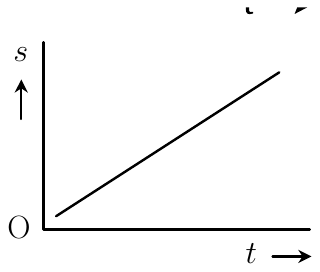
Which one of the following graphs cannot be a correct displacement(s) - time(t) variation for the motion of a particle?

  1. AOption (a)

  2. BOption (b)

  3. COption (c)

  4. DOption (d)

View answer & explanation

Correct answer

Answer: (a)A.

Why this answer is correct

Concept:

  • Displacement is the change in position of an object.
  • SI unit is meter(m).
  • The slope of displacement - time graph gives velocity.
  • The area under the velocity-time graph gives displacement and the area under the acceleration - time graph gives the change in velocity.
  • Velocity: The rate of change of displacement of a body is called the velocity of that body.
  • Velocity is a vector quantity that has both magnitudes as well as directions.
  • Acceleration: The rate of change of velocity is called the acceleration of the body.
  • Acceleration is also a vector quantity.
  • The slope of any velocity-time graph gives an acceleration of the body.
  • Distance: The total path length between two points is called distance.

Explanation:

  • Displacement time graph is the plot of motion of an object (s - Y-axis) against time (t - X-axis).
  • Graph 3) is represents a diagonally straight line which means that the object is in uniform motion with time.
  • Graphs 2) and 4) represent the non-uniform motion of the object, while a horizontal line parallel to the X axis shows that there is no motion in the object with time.

⇒ there is no change in position with respect to time, object is at rest.

∴ The correct answer is option 1)

Question 98

KVS TGT 2023• Subject Specific

The workdone needed to move a body of 2.0 kg from an elevation of 1 m to an elevation of 10 m, against the gravitational field of the earth is: (take g = 10 m/s²)

  1. AOption (a)

    20 J

  2. BOption (b)

    180 J

  3. COption (c)

    200 J

  4. DOption (d)

    220 J

View answer & explanation

Correct answer

Answer: (b)B.

180 J

Why this answer is correct

Concept:

Energy is always conserved. Hence work done equals a change in potential energy.

Calculation:

W = mg(h2 - h1)

W = 2 × 10 × (10 - 1)

W = 180 J

Question 99

KVS TGT 2023• Subject Specific

A bullet having a speed of 160 m/s passes through a plank of wood. After passing through the plank, its speed is 140 m/s. Another bullet, of the same mass and size but travelling at 60 m/s, is fired at the plank. Assuming that the resistance of the plank is independent of the speed of the bullet, the second bullet's speed after tunneling through will be nearly equal to :

  1. AOption (a)

    24 m/s

  2. BOption (b)

    40 m/s

  3. COption (c)

    49 m/s

  4. DOption (d)

    60 m/s

View answer & explanation

Correct answer

Answer: (b)B.

40 m/s

Why this answer is correct

Given:

Initial speed of the first bullet, u1 = 160 m/s

Final speed of the first bullet, v1 = 140 m/s

Initial speed of the second bullet, u2 = 60 m/s

Formula Used:

Change in speed for the first bullet:

Δv1 = u1 - v1

Change in speed for the second bullet:

Δv2 = u2 - v2

Since the resistance is the same for both bullets, Δv1 = Δv2

Calculation:

We have,

⇒ Δv1 = 160 - 140 = 20 m/s

For the second bullet,

⇒ Δv2 = Δv1

⇒ Δv2 = 20 m/s

The final speed of the second bullet, v2

⇒ v2 = u2 - Δv2

⇒ v2 = 60 m/s - 20 m/s

⇒ v2 = 40 m/s

∴ The second bullet's speed after passing through plank is equal to 40 m/s.

Question 100

KVS TGT 2023• Subject Specific

A boy throws a 0.2 kg stone from the top of a 15 m cliff with a speed of 20 m/s in downwards direction. The kinetic energy of the stone when it lands in a river below will be: (Take g = 10 m/s²)

  1. AOption (a)

    0

  2. BOption (b)

    30 J

  3. COption (c)

    40 J

  4. DOption (d)

    70 J

View answer & explanation

Correct answer

Answer: (d)D.

70 J

Why this answer is correct

Concept:

  • The Law of Conservation of Energy states that the total energy of an isolated system remains conserved (constant), that is, it can neither be created nor be destroyed but it can be transformed from one form to another
  • Energy always transforms from one form to another in this case energy is been transformed in the following order
  • Potential energy is converted to kinetic energy & heat produce because of air resistance as it falls and as it hits the ground it been wasted as sound and heat energy.
  • One of the most common examples of the Law of Conservation of Energy is: water is stored at a height with some potential energy, when the water starts flowing downward then its potential energy is converted into kinetic energy.
  • \(Kinetic;Energy = \frac{1}{2}m{v^2}\)
  • \(Potential;Energy = mgh\)

Change in Gravitational potential energy = Kinetic Energy.

Calculation:


Initial Kinetic Energy

\(KE_{\text{initial}} = \frac{1}{2} \cdot m \cdot u^2\)

\(KE_{\text{initial}} = \frac{1}{2} \cdot 0.2 \cdot 20^2 = 40 , J\)

Potential Energy at the Top

\(PE = m \cdot g \cdot h\)

\(PE = 0.2 \cdot 10 \cdot 15 = 30 , J\)

Total Kinetic Energy at the River Level

When the stone hits the river, the total kinetic energy is:

\(KE_{\text{total}} = KE_{\text{initial}} + PE\)

\(KE_{\text{total}} = 40 , J + 30 , J = 70 , J\)

∴ The kinetic energy of the stone when it lands in the river is 70 J