Search Previous Year Questions

Find real questions from previous competitive exam papers with answers and solutions.

Showing 10 question(s)
Clear

Question 81

JEE Main 2025• Chemistry Section A

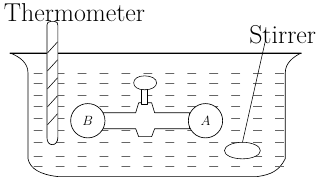
Two vessels A and B are connected via stopcock. The vessel A is filled with a gas at a certain pressure. The entire assembly is immersed in water and is allowed to come to thermal equilibrium with water. After opening the stopcock the gas from vessel A expands into vessel B and no change in temperature is observed in the thermometer. Which of the following statement is true?

  1. AOption (a)

    dw≠0 dw \neq 0

  2. BOption (b)

    dq≠0dq \neq 0

  3. COption (c)

    dU≠0dU \neq 0

  4. DOption (d)

    The pressure in the vessel B before opening the stopcock is zero. 

View answer & explanation

Correct answer

Answer: (d)D.

The pressure in the vessel B before opening the stopcock is zero. 

Why this answer is correct

CONCEPT:

Free Expansion of Gas and Thermodynamic Changes

  • When a gas expands into a vacuum (free expansion), there is no external pressure opposing the expansion, i.e., Pext = 0.
  • In free expansion:
  • No work is done by the gas (dw = 0) because the external pressure is zero.
  • No heat is exchanged with the surroundings (dq = 0) if the system is insulated or thermally isolated.
  • For an ideal gas undergoing free expansion, the internal energy (ΔU) remains unchanged since internal energy depends only on temperature and temperature is constant.

EXPLANATION:

  • In the problem, two vessels A and B are connected with a stopcock.
  • Initially, vessel A contains gas at certain pressure, and vessel B is evacuated (pressure in B is zero).
  • Upon opening the stopcock, gas expands freely into vessel B (vacuum), so Pext = 0.
  • Since the assembly is immersed in water and allowed to equilibrate, temperature remains constant.
  • Therefore, no work is done (dw = 0), no heat is exchanged (dq = 0), and internal energy change is zero (ΔU = 0).

Hence, the pressure in vessel B before opening the stopcock must be zero.

The correct answer is The pressure in the vessel B before opening the stopcock is zero.

Question 82

JEE Main 2025• Chemistry Section A

A solution is made by mixing one mole of volatile liquid A with 3 moles of volatile liquid B. The vapour pressure of pure A is 200 mm Hg and that of the solution is 500 mm Hg. The vapour pressure of pure B and the least volatile component of the solution, respectively, are :

  1. AOption (a)

    1400 mm Hg, A 

  2. BOption (b)

    1400 mm Hg, B 

  3. COption (c)

    600 mm Hg, B

  4. DOption (d)

    600 mm Hg, A 

View answer & explanation

Correct answer

Answer: (d)D.

600 mm Hg, A 

Why this answer is correct

CONCEPT:

Raoult's Law and Vapor Pressure of Solutions

  • Raoult's law states that the total vapor pressure of an ideal solution is the sum of the partial vapor pressures of each component.
  • The partial vapor pressure of each component is equal to the vapor pressure of the pure component multiplied by its mole fraction in the solution.
  • Mathematically, Ptotal = PΔ0 × XΔ + PB0 × XB
  • The component with the higher vapor pressure is the more volatile component.
  • The least volatile component has the lower vapor pressure.

EXPLANATION:

  • Given:
  • Moles of volatile liquid Δ = 1
  • Moles of volatile liquid B = 3
  • Vapor pressure of pure Δ (PΔ0) = 200 mm Hg
  • Total vapor pressure of solution (Psolution) = 500 mm Hg
  • Mole fractions:
  • XΔ = 1 / (1 + 3) = 1/4 = 0.25
  • XB = 3 / (1 + 3) = 3/4 = 0.75
  • Therefore, vapor pressure of pure B is 600 mm Hg.
  • Comparing vapor pressures:
  • PΔ0 = 200 mm Hg
  • PB0 = 600 mm Hg

B has the higher vapor pressure, so B is the more volatile component.

Δ, having the lower vapor pressure, is the least volatile component.

Therefore, the vapor pressure of pure B is 600 mm Hg, and the least volatile component of the solution is A.

Question 83

JEE Main 2025• Chemistry Section A

CaCO3(s) + 2HCl(aq) → CaCl2(aq) + CO2(g) H2O(l) Consider the above reaction, what mass of CaCl2 will be formed if 250 mL of 0.76 M HCl reacts with 1000 g of CaCO3 ?

(Given : Molar mass of Ca, C, O, H and Cl are 40, 12, 16, 1 and 35.5 g mol–1, respectively)

  1. AOption (a)

    3.908 g 

  2. BOption (b)

    2.636 g

  3. COption (c)

    10.545 g 

  4. DOption (d)

    5.272 g

View answer & explanation

Correct answer

Answer: (c)C.

10.545 g 

Why this answer is correct

CONCEPT:

Stoichiometry and Limiting Reactant in Chemical Reactions

CaCO3(s) + 2HCl(aq) → CaCl2(aq) + CO2(g) + H2O(l)

  • The reaction between calcium carbonate and hydrochloric acid is a typical acid-carbonate reaction:
  • Mole ratio between CaCO3 and HCl is 1:2.
  • The limiting reactant determines the amount of product formed.
  • Molar masses are used to convert between moles and grams.

EXPLANATION:

  • Given:
  • Mass of CaCO3 = 1000 g
  • Concentration of HCl = 0.76 M (moles per liter)
  • Volume of HCl = 250 mL = 0.250 L
  • Molar masses (g/mol): Ca = 40, C = 12, O = 16, H = 1, Cl = 35.5
  • Calculate moles of CaCO3:

Molar mass of CaCO3 = 40 + 12 + (16 × 3) = 100 g/mol

Moles of CaCO3 = 1000 g / 100 g/mol = 10 mol

  • Calculate moles of HCl:

Moles of HCl = Molarity × Volume = 0.76 mol/L × 0.250 L = 0.19 mol

  • Determine limiting reactant:
  • Reaction requires 2 moles of HCl per mole of CaCO3.
  • Moles of HCl required for 10 moles CaCO3 = 10 × 2 = 20 moles.
  • Available moles of HCl = 0.19 moles < 20 moles required, so HCl is limiting reactant.
  • Calculate moles of CaCl2 formed (equal to moles of CaCO3 reacted):

Moles of CaCl2 formed = moles of HCl / 2 = 0.19 / 2 = 0.095 mol

  • Calculate molar mass of CaCl2:

Ca = 40, Cl = 35.5 × 2 = 71, Total = 40 + 71 = 111 g/mol

  • Calculate mass of CaCl2 produced:

Mass = moles × molar mass = 0.095 × 111 = 10.545 g

Therefore, the mass of CaCl2 formed is 10.545 g.

Question 84

JEE Main 2025• Chemistry Section A

If equal volumes of AB2 and XY (both are salts) aqueous solutions are mixed, which of the following combination will give a precipitate of AY2 at 300 K? 

(Given Ksp (at 300 K) for AY2 = 5.2 × 10⁻⁷)

  1. AOption (a)

    3.6 × 10⁻³ M AB2 , 5.0 × 10⁻⁴ M XY

  2. BOption (b)

    2.0 × 10⁻⁴ M AB2 , 0.8 × 10⁻³ M XY

  3. COption (c)

    2.0 × 10⁻² M AB2 , 2.0 × 10⁻² M XY

  4. DOption (d)

    1.5 × 10⁻⁴ M AB2 , 1.5 × 10⁻³ M XY

View answer & explanation

Correct answer

Answer: (c)C.

2.0 × 10⁻² M AB2 , 2.0 × 10⁻² M XY

Why this answer is correct

When equal volumes are mixed molarity reduce to half.

CONCEPT:

  • When two salt solutions AB2 and XY are mixed, precipitation of AY2 will occur if the ionic product (Qsp) exceeds the solubility product constant (Ksp).
  • Qsp is calculated as:

Qsp = [A+][Y−]2

  • Since equal volumes of solutions are mixed, the concentration of ions is halved due to dilution.

EXPLANATION:

For precipitation QSP=[A+2][Y−]2>KSP (1),QSP=(1.8×10⁻³)(52×10−4)2<KSP (2),QSP=(10−4)(0.4×10⁻³)2<KSP (3),QSP=(10−2)(10−2)2>KSP (4),QSP=(1.52×10⁻⁴)(1.52×10⁻³)2<KSP\text{For precipitation } Q_{SP} = [A^{+2}] [Y^-]^2 > K_{SP} \ (1) , Q_{SP} = (1.8 \times 10^{-3}) \left( \frac{5}{2} \times 10^{-4} \right)^2 < K_{SP} \ (2) , Q_{SP} = (10^{-4}) (0.4 \times 10^{-3})^2 < K_{SP} \ (3) , Q_{SP} = (10^{-2}) (10^{-2})^2 > K_{SP} \ (4) , Q_{SP} = \left( \frac{1.5}{2} \times 10^{-4} \right) \left( \frac{1.5}{2} \times 10^{-3} \right)^2 < K_{SP}

Conclusion:

Only option 3 gives Qsp > Ksp, so precipitation of AY2 occurs.

Question 85

JEE Main 2025• Chemistry Section A

Among SO2 , NF3 , NH3 , XeF2 , ClF3 and SF4 , the hybridization of the molecule with non-zero dipole moment and highest number of lone-pairs of electrons on the central atom is

  1. AOption (a)

    sp<sub>3</sub>

  2. BOption (b)

    dsp2

  3. COption (c)

    sp3d2

  4. DOption (d)

    sp3d

View answer & explanation

Correct answer

Answer: (d)D.

sp3d

Why this answer is correct

CONCEPT:

Hybridization, Molecular Geometry, and Dipole Moment

  • Hybridization describes the mixing of atomic orbitals on the central atom to form new hybrid orbitals in a molecule.
  • The presence of lone pairs affects molecular geometry and the resultant dipole moment.
  • Dipole moment depends on the geometry and the difference in electronegativities; molecules with symmetrical geometry or lone pairs arranged symmetrically often have zero dipole moment.
  • Hybridizations considered here are sp², sp³, sp³d, and sp³d² corresponding to trigonal planar, tetrahedral, trigonal bipyramidal, and octahedral geometries, respectively.
  • Lone pairs on the central atom create asymmetry, often leading to non-zero dipole moments.

EXPLANATION:

MoleculeHybridizationDipole MomentLone Pairs on Central Atom
SO2sp²
Non-zero1
NF3sp³
Non-zero1
NH3sp³
Non-zero1
XeF2sp³dZero3
ClF3sp³dNon-zero2
SF4sp³dNon-zero1
  • Among molecules with non-zero dipole moment, ClF3 has the highest number of lone pairs (2) on the central atom.
  • Its hybridization is sp³d.

Therefore, the correct answer is: sp³d (Option 4).

Question 86

JEE Main 2025• Chemistry Section A

Given below are two statements :

Statement (I) : Vanillin 

will react with NaOH and also with Tollen’s reagent. 

Statement (II) : Vanillin 

will undergo self aldol condensation very easily. In the light of the above statements, choose the most appropriate answer from the options given below : 

  1. AOption (a)

    Statement I is incorrect but Statement II is correct

  2. BOption (b)

    Statement I is correct but Statement II is incorrect

  3. COption (c)

    Both Statement I and Statement II are incorrect

  4. DOption (d)

    Both Statement I and Statement II are correct 

View answer & explanation

Correct answer

Answer: (b)B.

Statement I is correct but Statement II is incorrect

Why this answer is correct

CONCEPT:

  • Vanillin is an aromatic aldehyde with a phenolic -OH group and a methoxy (-OCH3) group attached to the benzene ring.
  • The phenolic group (-OH attached to benzene) is acidic and soluble in NaOH due to phenol's acidic nature.
  • Tollen's reagent detects aldehyde groups (-CHO) by oxidizing them to carboxylic acids, giving a silver mirror. Vanillin contains an aldehyde group, so it reacts with Tollen's reagent.
  • Self-aldol condensation requires the presence of acidic alpha-hydrogen atoms adjacent to the carbonyl group to form enolate ions under basic conditions.
  • Vanillin lacks alpha-hydrogen atoms adjacent to the aldehyde group because the carbonyl carbon is directly bonded to the aromatic ring, thus it does not undergo self-aldol condensation easily.

EXPLANATION:

​

Phenolic group soluble in NaOH   

Benzaldehyde derivative react with Tollen’s reagent.

Vanillin does not give self-aldol reaction due to lack of acidic H for condensation. 

  • Statement I: Vanillin will react with NaOH due to the acidic phenolic -OH group which forms phenolate ions soluble in NaOH.
  • It also reacts with Tollen's reagent because of the aldehyde (-CHO) group, which is oxidized to carboxylate ions, producing the silver mirror effect.
  • Statement II: Vanillin will not undergo self-aldol condensation easily because it lacks acidic alpha-hydrogens required to form the enolate ion necessary for aldol condensation.

Therefore, Statement I is correct but Statement II is incorrect.

Question 87

JEE Main 2025• Chemistry Section A

Identify the correct statement among the following:

  1. AOption (a)

    All naturally occurring amino acids except glycine contain one chiral centre. 

  2. BOption (b)

    All naturally occurring amino acids are optically active. 

  3. COption (c)

    Glutamic acid is the only amino acid that contains a –COOH group at the side chain.

  4. DOption (d)

    Amino acid, cysteine easily undergo dimerization due to the presence of free SH group. 

View answer & explanation

Correct answer

Answer: (d)D.

Amino acid, cysteine easily undergo dimerization due to the presence of free SH group. 

Why this answer is correct

CONCEPT:

  • Most naturally occurring amino acids contain one chiral center, except glycine, which has two hydrogen atoms attached to the alpha carbon, making it achiral.
  • Some amino acids, like isoleucine and threonine, contain two chiral centers.
  • Optical activity arises from chirality, so glycine is optically inactive, whereas other amino acids with chiral centers are optically active.
  • Glutamic acid and aspartic acid both contain a –COOH group in their side chains (carboxylic acid groups), so glutamic acid is not unique in this feature.
  • Cysteine contains a thiol (-SH) group in its side chain, which can form disulfide bonds by dimerization or oxidation, contributing to protein structure stabilization.

EXPLANATION:

  • Statement 1: Incorrect. While most amino acids have one chiral center, isoleucine has two chiral centers, and glycine has none.
  • Statement 2: Incorrect. Glycine is achiral and thus optically inactive.
  • Statement 3: Incorrect. Both glutamic acid and aspartic acid have –COOH groups on their side chains.
  • Statement 4: Correct. Cysteine contains a free thiol (-SH) group that readily undergoes dimerization to form disulfide bonds.

Therefore, the correct statement is: Amino acid cysteine easily undergoes dimerization due to the presence of free SH group.

Question 88

JEE Main 2025• Chemistry Section A

The correct order of basic nature on aqueous solution for the bases NH3 , H2 N–NH2 , CH3 CH2 NH2 , (CH3CH2 )2NH and (CH3CH2)3 N is :

  1. AOption (a)

    NH3<H2N–NH2<(CH3CH2)3N<CH3CH2NH2<(CH3CH2)2NH

  2. BOption (b)

    NH3<H2N-NH2,<CH3CH2NH2<(CH3CH2),NH<(CH3CH2)3N

  3. COption (c)

    H2N–NH2<NH3<(CH3CH2)3N<CH3CH2NH2<(CH3CH2)2NH

  4. DOption (d)

    NH2–NH2,<NH3<CH3CH2NH2<(CH3CH2)3N<(CH3CH2)2NH

View answer & explanation

Correct answer

Answer: (d)D.

NH2–NH2,<NH3<CH3CH2NH2<(CH3CH2)3N<(CH3CH2)2NH

Why this answer is correct

CONCEPT:

  • The basicity of amines in aqueous solution depends on the availability of the lone pair of electrons on the nitrogen atom to accept a proton (H+).
  • Alkyl groups like ethyl (CH3CH2–) are electron-donating via +I (inductive) effect, which increases electron density on nitrogen and hence increases basicity.
  • However, steric hindrance and solvation effects influence basicity. Primary and secondary amines are generally more basic than tertiary amines in aqueous solution due to better solvation of the protonated form.
  • Hydrazine (H2N–NH2) shows slightly different basicity due to electron interaction between the two nitrogen atoms.

EXPLANATION:

  • NH3 (Ammonia): Least basic among the given due to no alkyl groups.
  • H2N–NH2 (Hydrazine): Slightly more basic than NH3 because the lone pair on one nitrogen can be delocalized to some extent.
  • CH3CH2NH2 (Ethylamine, primary amine): More basic due to +I effect of ethyl group increasing electron density.
  • (CH3CH2)2NH (Diethylamine, secondary amine): Generally most basic as two alkyl groups donate electrons, increasing basicity.
  • (CH3CH2)3N (Triethylamine, tertiary amine): Less basic than secondary amine because of steric hindrance and poor solvation.

Therefore, the correct order of basicity is:

NH2–NH2,<NH3<CH3CH2NH2<(CH3CH2)3N<(CH3CH2)2NH

Question 89

JEE Main 2025• Chemistry Section A

Given below are two statements :

Statement (I) : The metallic radius of Al is less than that of Ga.

Statement (II) : The ionic radius of Al3+ is less than that of Ga3+.

In the light of the above statements, choose the most appropriate answer from the options given below :

  1. AOption (a)

    Both Statement I and Statement II are incorrect  

  2. BOption (b)

    Statement I is incorrect but Statement II is correct

  3. COption (c)

    Statement I is correct but Statement II is incorrect 

  4. DOption (d)

    Both Statement I and Statement II are correct

View answer & explanation

Correct answer

Answer: (b)B.

Statement I is incorrect but Statement II is correct

Why this answer is correct

ONCEPT:

  • Metallic radius refers to the size of an atom in a metallic state, influenced by electron shielding and effective nuclear charge.
  • Gallium (Ga) has filled 3d10 subshell electrons that poorly shield the nucleus, leading to a stronger effective nuclear charge on the outer electrons, causing contraction in atomic size.
  • Due to this d-electron poor shielding, Ga has a smaller metallic radius than Al, despite being below it in the periodic table.
  • Ionic radius depends on the number of electrons and nuclear charge after ionization. Both Al3+ and Ga3+ lose three electrons.
  • Since Ga has more protons and poor shielding, its ionic radius is larger than that of Al3+.

EXPLANATION:

\implies \text{The metallic radius order of Al & Ga is} \ \mathrm{B} < \mathrm{Ga} < \mathrm{Al} < \mathrm{In} < \mathrm{Tl} \ \underbrace{\mathrm{Ga} < \mathrm{Al}}_{\text{(due to poor shielding of d-subshell electrons)}} \ \implies \text{The ionic radius order of } \mathrm{Al}^{+3} & \mathrm{Ga}^{+3} \text{ is} \ \mathrm{B}^{+3} < \mathrm{Al}^{+3} < \mathrm{Ga}^{+3} < \mathrm{In}^{+3} < \mathrm{Tl}^{+3}

  • Statement I: Metallic radius of Al is less than that of Ga — This is incorrect. The order is Ga < Al due to d-electron poor shielding in Ga causing contraction.
  • Statement II: Ionic radius of Al3+ is less than Ga3+ — This is correct. Ga3+ has larger ionic radius because the poor shielding effect expands the size compared to Al3+.

Therefore, the correct answer is: Statement I is incorrect but Statement II is correct.

Question 90

JEE Main 2025• Chemistry Section A

Given below are two statements :

Statement (I) : In octahedral complexes, when Δo\Delta_o < P high spin complexes are formed. When Δo\Delta_o > P low spin complexes are formed. Statement (II) : In tetrahedral complexes because of Δo\Delta_o < P, low spin complexes are rarely formed. In the light of the above statements, choose the most appropriate answer from the options given below :

  1. AOption (a)

    Statement I is correct but Statement II is incorrect. 

  2. BOption (b)

    Both Statement I and Statement II are incorrect 

  3. COption (c)

    Statement I is incorrect but Statement II is correct 

  4. DOption (d)

    Both Statement I and Statement II are correct 

View answer & explanation

Correct answer

Answer: (d)D.

Both Statement I and Statement II are correct 

Why this answer is correct

CONCEPT:

  • In coordination chemistry, Δo (octahedral crystal field splitting energy) is the energy difference between the higher and lower sets of d-orbitals in an octahedral complex.
  • P refers to the pairing energy, which is the energy required to pair two electrons in the same orbital.
  • For octahedral complexes (coordination number 6):
  • If Δo < P, electrons prefer to occupy higher energy orbitals unpaired → high spin complexes.
  • If Δo > P, electrons pair in lower energy orbitals → low spin complexes.
  • In tetrahedral complexes (coordination number 4):
  • The crystal field splitting energy Δt is smaller than Δo and always less than the pairing energy (Δt < P).
  • Therefore, tetrahedral complexes are almost always high spin because electrons occupy orbitals singly to minimize pairing.
  • Low spin tetrahedral complexes are rare.

Explanation:-

  • Statement I: Correct. It accurately describes the relationship between Δo and P in octahedral complexes and the formation of high spin or low spin complexes.
  • Statement II: Correct. It correctly states that because Δo < P in tetrahedral complexes, low spin complexes are rarely formed.

Therefore, both Statement I and Statement II are correct.