Search Previous Year Questions

Find real questions from previous competitive exam papers with answers and solutions.

Showing 10 question(s)
Clear

Question 71

JEE Main 2026• Physics Section B

In single slit diffraction pattern, the wavelength of light used is 628 nm and slit width is 0.2 mm, the angular width of central maximum is α×10−2 \alpha \times 10^{-2}

degrees. The value of α \alpha is______.

View answer & explanation

Correct answer

Answer: 36Answer: 36

Why this answer is correct

Sol.  Angular width of central maxima θcm=2λd \theta_{cm} = \frac{2\lambda}{d}

= 2×628×10−90.2×10−3 \frac{2 \times 628 \times 10^{-9}}{0.2 \times 10^{-3}} rad.

= (628×10−5)×180π (628 \times 10^{-5}) \times \frac{180}{\pi} degrees

≈36×10−2 \approx 36 \times 10^{-2} degrees

∴ \therefore Answer : α=36 \alpha = 36

Question 72

JEE Main 2026• Physics Section B

A vessel contains 0.15 m3 of a gas at pressure 8 bar and temperature 140°C with cp=3R c_p = 3R and cv=2R c_v = 2R . It is expanded adiabatically till pressure falls to 1 bar. The work done during this process is ____ kJ. (R is gas constant)

View answer & explanation

Correct answer

Answer: 120Answer: 120

Why this answer is correct

Sol.  γ=CpCv=32 \gamma = \frac{C_p}{C_v} = \frac{3}{2}

∵P1V1γ=P2V2γ \because P_1 V_1^\gamma = P_2 V_2^\gamma

⇒V2=(P1P2)1/γV1 \Rightarrow V_2 = \left( \frac{P_1}{P_2} \right)^{1/\gamma} V_1

⇒V2=(81)2/3×0.15 \Rightarrow V_2 = \left( \frac{8}{1} \right)^{2/3} \times 0.15

⇒V2=0.6 m3 \Rightarrow V_2 = 0.6 \text{ m}^3

∵W=P1V1−P2V2γ−1 \because W = \frac{P_1 V_1 - P_2 V_2}{\gamma - 1}

= (8×0.15−1×0.61.5−1)×105=1.2×10⁵ \left( \frac{8 \times 0.15 - 1 \times 0.6}{1.5 - 1} \right) \times 10^5 = 1.2 \times 10^5

⇒W=120 kJ \Rightarrow W = 120 \text{ kJ}

Question 73

JEE Main 2026• Physics Section B

1 μ \mu C charge moving with velocity

v⃗=(i^−2j^+3k^) m/s \vec{v} = (\hat{i} - 2\hat{j} + 3\hat{k}) \text{ m/s} in the region of magnetic field B⃗=(2i^+3j^−5k^) T \vec{B} = (2\hat{i} + 3\hat{j} - 5\hat{k}) \text{ T} . The magnitude of force acting on it is α×10−6 N \sqrt{\alpha} \times 10^{-6} \text{ N} . The value of α \alpha is ____.

View answer & explanation

Correct answer

Answer: 171Answer: 171

Why this answer is correct

Sol.  F⃗=q(v⃗×B⃗) \vec{F} = q(\vec{v} \times \vec{B})

= 1×10⁻⁶∣i^j^k^ 1−23 23−5∣ 1 \times 10^{-6} \begin{vmatrix} \hat{i} & \hat{j} & \hat{k} \ 1 & -2 & 3 \ 2 & 3 & -5 \end{vmatrix}

= 10−6[i^+11j^+7k^] 10^{-6} [\hat{i} + 11\hat{j} + 7\hat{k}]

⇒F⃗=171×10−6 N \Rightarrow \vec{F} = \sqrt{171} \times 10^{-6} \text{ N}

∴α=171 \therefore \alpha = 171

Question 74

JEE Main 2026• Physics Section B

A uniform wire of length l l of weight w is suspended from the roof with a weight of W at the other end. The stress in the wire at l3 \frac{l}{3} distance

from the top is (WA+2γwA) \left( \frac{W}{A} + \frac{2}{\gamma} \frac{w}{A} \right) , where, A is the cross sectional area of the wire. The value of γ \gamma is______.

View answer & explanation

Correct answer

Answer: 6Answer: 6

Why this answer is correct

Sol.  

σ=TA=W+w3A \sigma = \frac{T}{A} = \frac{W + \frac{w}{3}}{A}

⇒σ=WA+26wA \Rightarrow \sigma = \frac{W}{A} + \frac{2}{6} \frac{w}{A}

∴γ=6 \therefore \gamma = 6

Question 75

JEE Main 2026• Physics Section B

A tube is filled with water and a wooden cube 10 cm × \times 10cm × \times 10cm is placed in the water. The

wooden cube is found to float on the water with a part of it submerged in water. When a metal coin is

placed on the wooden cube, the submerged part is increased by 3.87 cm. The mass of the metal coin

is ____ gram. (Take water density as 1g/cm3 and density of wood as 0.4 g/cm3)

View answer & explanation

Correct answer

Answer: 387Answer: 387

Why this answer is correct

Sol.  

Weight of coin = Additional upthrust

⇒mcg=ρlVaddg \Rightarrow m_c g = \rho_l V_{add} g

⇒mc=1×3.87×(10)2 \Rightarrow m_c = 1 \times 3.87 \times (10)^2

⇒mc=387 gram \Rightarrow m_c = 387 \text{ gram}

Question 76

JEE Main 2025• Chemistry Section A

Designate whether each of the following compounds is aromatic or not aromatic.

  1. AOption (a)

    e, g aromatic and a, b, c, d, f, h not aromatic

  2. BOption (b)

    b, e, f, g aromatic and a, c, d, h not aromatic 

  3. COption (c)

     a, b, c, d aromatic and e, f, g, h not aromatic 

  4. DOption (d)

    a, c, d, e, h aromatic and b, f, g not aromatic 

View answer & explanation

Correct answer

Answer: (d)D.

a, c, d, e, h aromatic and b, f, g not aromatic 

Why this answer is correct

CONCEPT:

Aromaticity and Hückel's Rule

  • Aromatic compounds are cyclic, planar molecules with a conjugated π-electron system.
  • They must follow Hückel’s rule: a compound is aromatic if it contains (4n + 2) π-electrons, where n is a non-negative integer (n = 0, 1, 2, ...).
  • The compound must be fully conjugated (i.e., every atom in the ring has a p-orbital) and must be planar to allow continuous overlap of p-orbitals.

EXPLANATION:

  • (a) Cyclopentadienyl cation: Has 6 π-electrons → follows Hückel’s rule → Aromatic
  • (b) Cyclopentadienyl anion: Has 4 π-electrons → does not satisfy (4n + 2) rule → Not Aromatic
  • (c) 4-membered ring with 6 π-electrons → satisfies Hückel’s rule → Aromatic
  • (d) 4-membered ring with 6 π-electrons (similar to c) → Aromatic
  • (e) Cycloheptatrienyl cation (tropylium ion) → has 6 π-electrons → Aromatic
  • (f) Cycloheptatrienyl anion: Has 8 π-electrons → does not follow Hückel’s rule → Not Aromatic
  • (g) 4n π-electron system (non-planar rectangle) → Not Aromatic
  • (h) Cyclopropyl cation: Has 2 π-electrons → satisfies Hückel’s rule for n = 0 → Aromatic

Therefore, the correct answer is: a, c, d, e, h are aromatic and b, f, g are not aromatic.

Question 77

JEE Main 2025• Chemistry Section A

An optically active alkyl halide C4 H9 Br [A] reacts with hot KOH dissolved in ethanol and forms alkene [B] as major product which reacts with bromine to give dibromide [C]. The compound [C] is converted into a gas [D] upon reacting with alcoholic NaNH2 . During hydration 18 gram of water is added to 1 mole of gas [D] on warming with mercuric sulphate and dilute acid at 333 K to form compound [E]. The IUPAC name of compound [E] is :  

  1. AOption (a)

    But-2-yne 

  2. BOption (b)

    Butan-2-ol 

  3. COption (c)

    Butan-2-one 

  4. DOption (d)

    Butan-1-al 

View answer & explanation

Correct answer

Answer: (c)C.

Butan-2-one 

Why this answer is correct

CONCEPT:

Reaction Pathway Involving Alkyl Halide → Alkyne → Ketone

  • Alkyl halides can undergo elimination reactions with alcoholic KOH to form alkenes.
  • Alkenes react with bromine to give vicinal dibromides (bromination across the double bond).
  • Vicinal dibromides treated with strong bases like NaNH2 in alcohol can undergo double elimination to yield alkynes.
  • Alkynes undergo hydration in the presence of H2SO4 and HgSO4 to yield ketones (Markovnikov addition of water).

EXPLANATION:

  • Given compound [A] is an optically active C4H9Br, most likely 2-bromobutane.
  • On treatment with hot alcoholic KOH, [A] undergoes dehydrohalogenation to give but-2-ene [B].
  • [B] reacts with Br2 to form vicinal dibromide [C], i.e., 2,3-dibromobutane.
  • [C] reacts with alcoholic NaNH2 to undergo two eliminations, forming but-2-yne [D].
  • [D] undergoes hydration with dilute H2SO4 and HgSO4 at 333 K to form butan-2-one [E].

Therefore, the IUPAC name of compound [E] is Butan-2-one.

Question 78

JEE Main 2025• Chemistry Section A

The property/properties that show irregularity in first four elements of group-17 is/are :

(A) Covalent radius

(B) Electron affinity

(C) Ionic radius

(D) First ionization energy

Choose the correct answer from the options given below:

  1. AOption (a)

    B and D only

  2. BOption (b)

    A and C only

  3. COption (c)

    B only

  4. DOption (d)

    A, B, C and D

View answer & explanation

Correct answer

Answer: (c)C.

B only

Why this answer is correct

CONCEPT:

Trends in Group-17 Elements (Halogens)

  • The halogens include Fluorine (F), Chlorine (Cl), Bromine (Br), and Iodine (I).
  • Covalent Radius: Increases down the group due to the addition of new shells (F < Cl < Br < I).
  • Ionic Radius: Also increases as you go down the group (F− < Cl− < Br− < I−).
  • First Ionization Energy: Decreases down the group due to increasing atomic size (F > Cl > Br > I).
  • Electron Affinity: Typically increases down the group, but fluorine shows an irregularity—it has lower electron affinity than chlorine despite being smaller.

EXPLANATION:

  • Electron Affinity: The irregularity arises because fluorine is very small, and adding an extra electron leads to high electron–electron repulsion, reducing the energy released.
  • All other properties—covalent radius, ionic radius, and first ionization energy—follow regular trends down the group without deviation in the first four elements.

Therefore, the correct answer is: B only

Question 79

JEE Main 2025• Chemistry Section A

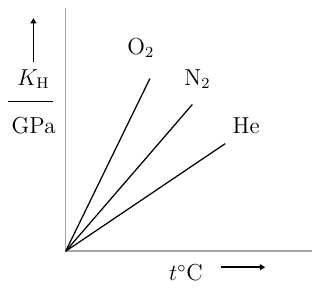
Which of the following graph correctly represents the plots of KH at 1 bar gases in water versus temperature ?

  1. AOption (a)

  2. BOption (b)

  3. COption (c)

  4. DOption (d)

View answer & explanation

Correct answer

Answer: (d)D.

Why this answer is correct

CONCEPT:

Henry’s Law and Temperature Dependence

  • Henry’s Law Constant (KH): It relates the solubility of a gas in a liquid to the pressure of the gas above the liquid.
  • According to Henry's Law: C = KH × P, where C is the concentration (solubility), P is the partial pressure, and KH is Henry’s constant.
  • Temperature Dependence: Solubility of gases in liquids generally decreases with increase in temperature, hence KH values typically increase with temperature.
  • The increase in KH with temperature is not linear and varies for different gases. Light gases like He show a steeper increase.

EXPLANATION:

  • Among the options, only graph 4 shows the correct qualitative trend: Henry’s constant (KH) increases with temperature for all gases.
  • Also, gases like He (non-polar and light) exhibit lower solubility and hence higher KH, followed by N2 and CH4.
  • This trend is consistent with the observation that lighter gases have higher Henry’s constants and are less soluble in water.

Therefore, the correct answer is: Option 4

Question 80

JEE Main 2025• Chemistry Section A

According to Bohr’s model of hydrogen atom, which of the following statement is incorrect? 

  1. AOption (a)

    Radius of 3rd orbit is nine times larger than that of 1st orbit.

  2. BOption (b)

    Radius of 8th orbit is four times larger than that of 4th orbit.

  3. COption (c)

    Radius of 6th orbit is three time larger than that of 4th orbit.

  4. DOption (d)

    Radius of 4th orbit is four times larger than that of 2nd orbit.

View answer & explanation

Correct answer

Answer: (c)C.

Radius of 6th orbit is three time larger than that of 4th orbit.

Why this answer is correct

CONCEPT:

Bohr’s Model and Radius of Electron Orbits

r ∝ n²

rₙ = r₁ × n²

  • According to Bohr’s model of the hydrogen atom, the radius of the nth orbit is proportional to the square of the principal quantum number n:
  • This means the radius of orbit n can be expressed as:
  • where r₁ is the radius of the first orbit (ground state).

EXPLANATION:

  • Radius of 3rd orbit relative to 1st orbit:

r₃ / r₁ = (3)² / (1)² = 9 / 1 = 9

Statement 1 is correct.

  • Radius of 8th orbit relative to 4th orbit:

r₈ / r₄ = (8)² / (4)² = 64 / 16 = 4

Statement 2 is correct.

  • Radius of 6th orbit relative to 4th orbit:

r₆ / r₄ = (6)² / (4)² = 36 / 16 = 2.25

Statement 3 says “three times larger”, but the actual ratio is 2.25.

Therefore, Statement 3 is incorrect.

  • Radius of 4th orbit relative to 2nd orbit:

r₄ / r₂ = (4)² / (2)² = 16 / 4 = 4

Statement 4 is correct.

Therefore, the incorrect statement is: Radius of 6th orbit is three times larger than that of 4th orbit (Option 3).