Search Previous Year Questions

Find real questions from previous competitive exam papers with answers and solutions.

Showing 10 question(s)
Clear

Question 51

JEE Main 2026• Physics Section A

A particle is rotating in a circular path and at any instant its motion can be described as θ=5t440−t33 \theta = \frac{5t^4}{40} - \frac{t^3}{3} .

The angular acceleration of the particle after 10 seconds is ________ rad/s2 rad/s^2 .

  1. AOption (a)

    150

  2. BOption (b)

    120

  3. COption (c)

    130

  4. DOption (d)

    170

View answer & explanation

Correct answer

Answer: (c)C.

130

Why this answer is correct

θ=5t440−t33 \theta = \frac{5t^4}{40} - \frac{t^3}{3}

dθdt=540(4t3)−3t23=t32−t2 \frac{d\theta}{dt} = \frac{5}{40}(4t^3) - \frac{3t^2}{3} = \frac{t^3}{2} - t^2

α=d2θdt2=3t22−2t \alpha = \frac{d^2\theta}{dt^2} = \frac{3t^2}{2} - 2t

at t = 10

α=32(10)2−2×10=130rad/sec2 \alpha = \frac{3}{2}(10)^2 - 2 \times 10 = 130 rad/sec^2

Question 52

JEE Main 2026• Physics Section A

A parallel plate air capacitor has a capacitance C. When it is half filled as show in figure with a dielectric constant K = 5, the percentage increase in the capacitance is ________.

  1. AOption (a)

    33.34

  2. BOption (b)

    66.67

  3. COption (c)

    200

  4. DOption (d)

    400

View answer & explanation

Correct answer

Answer: (b)B.

66.67

Why this answer is correct

Initial capacitance

Ci=Aϵ0d=C C_i = \frac{A \epsilon_0}{d} = C

Final capacitance

C1=Aϵ0×5d2=10C C_1 = \frac{A \epsilon_0 \times 5}{\frac{d}{2}} = 10C

C2=Aϵ0d2=2C C_2 = \frac{A \epsilon_0}{\frac{d}{2}} = 2C

Cf=C1C2C1+C2=10×210+2C=53C C_f = \frac{C_1 C_2}{C_1 + C_2} = \frac{10 \times 2}{10 + 2} C = \frac{5}{3} C

% increase = 53C−CC×100=66.67 \frac{\frac{5}{3} C - C}{C} \times 100 = 66.67

Question 53

JEE Main 2026• Physics Section A

Heat is supplied to a diatomic gas at constant pressure. Then the ratio of ΔQ:ΔU:ΔW \Delta Q : \Delta U : \Delta W is______.

  1. AOption (a)

    2 : 3 : 5

  2. BOption (b)

    5 : 3 : 2

  3. COption (c)

    2 : 5 : 7

  4. DOption (d)

    7 : 5 : 2

View answer & explanation

Correct answer

Answer: (d)D.

7 : 5 : 2

Why this answer is correct

ΔQp=nCpΔT=72nRΔT \Delta Q_p = nC_p \Delta T = \frac{7}{2} nR \Delta T

ΔU=nCvΔT=52nRΔT \Delta U = nC_v \Delta T = \frac{5}{2} nR \Delta T

W = nRΔT nR \Delta T

ΔQ:ΔU:W::7:5:2 \Delta Q : \Delta U : W :: 7 : 5 : 2

Question 54

JEE Main 2026• Physics Section A

Two charged conducting spheres S1 and S2 of radii 8 cm and 18 cm are connected to each other by a wire. After equilibrium is established, the ratio of

electric fields on S1 and S2 spheres are ES1 and ES2 respectively. The value of ES1ES2 \frac{E_{S1}}{E_{S2}} is ________.

  1. AOption (a)

    32 \frac{3}{2}

  2. BOption (b)

    23 \frac{2}{3}

  3. COption (c)

    49 \frac{4}{9}

  4. DOption (d)

    94 \frac{9}{4}

View answer & explanation

Correct answer

Answer: (d)D.

94 \frac{9}{4}

Why this answer is correct

V1=V2 V_1 = V_2

\frac{kQ_1}{8} = \frac{kQ_2}{18} \quad \left{ V_{\text{surface}} = \frac{kQ}{R} \right}

Q1Q2=49 \frac{Q_1}{Q_2} = \frac{4}{9}

\frac{E_{S_1}}{E_{S_2}} = \frac{kQ_1}{r_1^2} \frac{r_2^2}{kQ_2} \quad \left{ E_{\text{surface}} = \frac{kQ}{R^2} \right}

=Q1Q2(r2r1)2=49(94)2=94 = \frac{Q_1}{Q_2} \left( \frac{r_2}{r_1} \right)^2 = \frac{4}{9} \left( \frac{9}{4} \right)^2 = \frac{9}{4}

Question 55

JEE Main 2026• Physics Section A

The equation of a plane progressive wave is given by

y=5cos⁡π(200t−x150) y = 5 \cos \pi \left( 200t - \frac{x}{150} \right) where x and y are in cm and

t is in second. The velocity of the wave is ________ m/s

  1. AOption (a)

    120

  2. BOption (b)

    150

  3. COption (c)

    200

  4. DOption (d)

    300

View answer & explanation

Correct answer

Answer: (d)D.

300

Why this answer is correct

v=coeff of tcoeff of x=2001150×100=300m/s v = \frac{\text{coeff of t}}{\text{coeff of x}} = \frac{200}{\frac{1}{150} \times 100} = 300\text{m/s}

Question 56

JEE Main 2026• Physics Section A

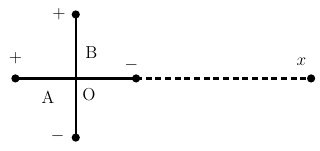
Two short electric dipoles A and B having dipole moment p1 and p2 respectively are placed with their axis mutually perpendicular as shown in the figure. The resultant electric field at a point x is making an angle of 60° with the line joining points O and x. The ratio of the dipole moments p2 / p1 is ________.

  1. AOption (a)

    32 \frac{\sqrt{3}}{2}

  2. BOption (b)

    23 2\sqrt{3}

  3. COption (c)

    13 \frac{1}{\sqrt{3}}

  4. DOption (d)

    3 \sqrt{3}

View answer & explanation

Correct answer

Answer: (b)B.

23 2\sqrt{3}

Why this answer is correct

E⃗A=2kp1x3(−i^) \vec{E}_A = \frac{2kp_1}{x^3} (-\hat{i}) {Axial point}

E⃗B=kp2x3(−j^) \vec{E}_B = \frac{kp_2}{x^3} (-\hat{j}) {Equatorial point}

Now : tan⁡θ=∣E⃗BE⃗A∣ \tan \theta = \left| \frac{\vec{E}_B}{\vec{E}_A} \right|

⇒tan⁡60∘=p22p1 \Rightarrow \tan 60^\circ = \frac{p_2}{2p_1}

⇒p2p1=23 \Rightarrow \frac{p_2}{p_1} = 2\sqrt{3}

Question 57

JEE Main 2026• Physics Section A

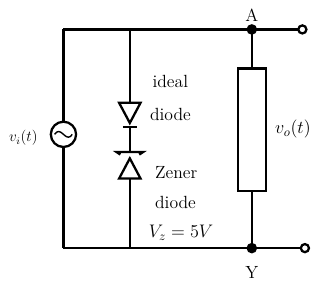
For the given circuit (shown in part (A)) the time dependent input voltage vin(t) and corresponding output vo(t) are shown in part (B) and part (C), respectively. Identify the components that are used in the circuit between points X and Y.

(A) Circuit used

Part(B) : Input voltage

Part(C) : Output voltage

  1. AOption (a)

  2. BOption (b)

  3. COption (c)

  4. DOption (d)

View answer & explanation

Correct answer

Answer: (b)B.

Why this answer is correct

will be updated soon.

Question 58

JEE Main 2026• Physics Section A

When a coil is placed in a time dependent magnetic field the power dissipated in it is P. The number of turns, area of the coil and radius of the coil wire are N, A and r respectively. For a second coils number of turns, area of the coil and radius of the coil wire are 2N, 2A and 3r respectively. When the first coil is

replaced with second coil the power dissipated in it is

2αP \sqrt{2} \alpha P . The value of α \alpha is ________.

  1. AOption (a)

    36

  2. BOption (b)

    1282 128\sqrt{2}

  3. COption (c)

    16

  4. DOption (d)

    64

View answer & explanation

Correct answer

Answer: (a)A.

36

Why this answer is correct

Sol. Power dissipated : P=ε2R P = \frac{\varepsilon^2}{R}

Induced emf ε=−NAdBdt \varepsilon = -NA \frac{dB}{dt}

Resistance of coil : R=ρℓπr2 R = \rho \frac{\ell}{\pi r^2}

Now : ℓ=N(2πRcoil) \ell = N(2\pi R_{coil})

Also : A=πRcoil2⇒Rcoil=Aπ A = \pi R_{coil}^2 \Rightarrow R_{coil} = \sqrt{\frac{A}{\pi}}

Thus ; R=ρN(2π)Aππr2 R = \frac{\rho N(2\pi) \sqrt{\frac{A}{\pi}}}{\pi r^2}

P=N2A2(dBdt)22ρNr2Aπ⇒P∝NA3/2r2......(1) P = \frac{N^2 A^2 \left( \frac{dB}{dt} \right)^2}{\frac{2\rho N}{r^2} \sqrt{\frac{A}{\pi}}} \Rightarrow P \propto NA^{3/2}r^2 ......(1)

P′∝(2N)(2A)3/2(3r)2......(2) P' \propto (2N)(2A)^{3/2}(3r)^2 ......(2)

(2)(1):P′P=362⇒P′=(2)(36)P \frac{(2)}{(1)} : \frac{P'}{P} = 36\sqrt{2} \Rightarrow P' = (\sqrt{2})(36)P

Thus : α=36 \alpha = 36

Question 59

JEE Main 2026• Physics Section A

Two identical long current carrying wires are bent into the shapes shown in the following figures. If the magnitude of magnetic fields at the centres P and Q of a semicircular arc are B1 B_1 and B2 B_2  respectively, then the ratio B1B2 \frac{B_1}{B_2} is ________.

  1. AOption (a)

    2+π1+π \frac{2 + \pi}{1 + \pi}

  2. BOption (b)

    1+π1−π \frac{1 + \pi}{1 - \pi}

  3. COption (c)

    2+π1−π \frac{2 + \pi}{1 - \pi}

  4. DOption (d)

    1+π2−π \frac{1 + \pi}{2 - \pi}

View answer & explanation

Correct answer

Answer: (a)A.

2+π1+π \frac{2 + \pi}{1 + \pi}

Why this answer is correct

Sol. B1=μ0I4πr×2+μ0I4r=μ0I4r(2π+1) B_1 = \frac{\mu_0 I}{4\pi r} \times 2 + \frac{\mu_0 I}{4r} = \frac{\mu_0 I}{4r} \left( \frac{2}{\pi} + 1 \right)

B2=μ0I4πr+μ0I4r=μ0I4r(1π+1) B_2 = \frac{\mu_0 I}{4\pi r} + \frac{\mu_0 I}{4r} = \frac{\mu_0 I}{4r} \left( \frac{1}{\pi} + 1 \right)

B1B2=2+π1+π \frac{B_1}{B_2} = \frac{2 + \pi}{1 + \pi}

Question 60

JEE Main 2026• Physics Section A

For a thin symmetric prism made of glass (refractive index 1.5), the ratio of incident angle and minimum deviation will be ________.

  1. AOption (a)

    3 : 4

  2. BOption (b)

    3 : 2

  3. COption (c)

    2 : 1

  4. DOption (d)

    1 : 2

View answer & explanation

Correct answer

Answer: (b)B.

3 : 2

Why this answer is correct

Sol. We have for thin prism minimum deviation :

δm=(μ−1)A \delta_m = (\mu - 1)A

⇒δm=(1.5−1)A⇒δm=A2 \Rightarrow \delta_m = (1.5 - 1)A \Rightarrow \delta_m = \frac{A}{2}

Also, i=A+δm2⇒i=A+A22⇒i=3A4 i = \frac{A + \delta_m}{2} \Rightarrow i = \frac{A + \frac{A}{2}}{2} \Rightarrow i = \frac{3A}{4}

Thus iδm=32 \frac{i}{\delta_m} = \frac{3}{2}