Search Previous Year Questions

Find real questions from previous competitive exam papers with answers and solutions.

Leave the keyword blank to browse saved questions for your selected exam, newest papers first. Add a keyword, year or topic to narrow the results.

Browse complete papers
Showing 10 question(s)
Clear

Question 211

JEE Main 2025• Physics Section A

A closed organ and an open organ tube filled by two different gases having same bulk modulus but different densities ρ1 and ρ2 respectively. The frequency of 9th harmonic of closed tube is identical with 4th harmonic of open tube. If the length of the closed tube is 10 cm and the density ratio of the gases is ρ1 : ρ2 = 1 : 16, then the length of the open tube is :

  1. AOption (a)

    207 cm\frac{20}{7} \mathrm{~cm}

  2. BOption (b)

    157 cm\frac{15}{7} \mathrm{~cm}

  3. COption (c)

    209 cm\frac{20}{9} \mathrm{~cm}

  4. DOption (d)

    159 cm\frac{15}{9} \mathrm{~cm}

View answer & explanation

Correct answer

Answer: (c)C.

209 cm\frac{20}{9} \mathrm{~cm}

Why this answer is correct

Calculation:

9th harmonic of closed pipe = 9V14ℓ1\frac{9 V_{1}}{4 \ell_{1}}

4th harmonic of open pipe = \(\frac{2 \mathrm{~V}{2}}{\ell{2}}\)

∴ \(\frac{9 \mathrm{~V}{1}}{4 \ell{1}}=\frac{2 \mathrm{~V}{2}}{\ell{2}}\)

∴ 94ℓ1 Bρ1=2ℓ2 Bρ2⇒ℓ2ℓ1=89ρ1ρ2\frac{9}{4 \ell_{1}} \sqrt{\frac{\mathrm{~B}}{\rho_{1}}}=\frac{2}{\ell_{2}} \sqrt{\frac{\mathrm{~B}}{\rho_{2}}} \Rightarrow \frac{\ell_{2}}{\ell_{1}}=\frac{8}{9} \sqrt{\frac{\rho_{1}}{\rho_{2}}}

ℓ2=ℓ1×89×14=209 cm\ell_{2}=\ell_{1} \times \frac{8}{9} \times \frac{1}{4}=\frac{20}{9} \mathrm{~cm}

Question 212

JEE Main 2025• Physics Section A

A uniform circular disc of radius ‘R’ and mass ‘M’ is rotating about an axis perpendicular to its plane and passing through its centre. A small circular part of radius R/2 is removed from the original disc as shown in the figure. Find the moment of inertia of the remaining part of the original disc about the axis as given above. 

  1. AOption (a)

    732MR2\frac{7}{32} \mathrm{MR}^{2}

  2. BOption (b)

    932MR2\frac{9}{32} \mathrm{MR}^{2}

  3. COption (c)

    1732MR2\frac{17}{32} \mathrm{MR}^{2}

  4. DOption (d)

    1332MR2\frac{13}{32} \mathrm{MR}^{2}

View answer & explanation

Correct answer

Answer: (d)D.

1332MR2\frac{13}{32} \mathrm{MR}^{2}

Why this answer is correct

Calculation:

I=MR22−[M4(R2)22+M4(R2)2]\mathrm{I}=\frac{\mathrm{MR}^{2}}{2}-\left[\frac{\frac{\mathrm{M}}{4}\left(\frac{\mathrm{R}}{2}\right)^{2}}{2}+\frac{\mathrm{M}}{4}\left(\frac{\mathrm{R}}{2}\right)^{2}\right]

I=1332MR2\mathrm{I}=\frac{13}{32} \mathrm{MR}^{2}

Question 213

JEE Main 2025• Physics Section A

A small point of mass m is placed at a distance 2R from the centre ‘O’ of a big uniform solid sphere of mass M and radius R. The gravitational force on ‘m’ due to M is F1 . A spherical part of radius R/3 is removed from the big sphere as shown in the figure and the gravitational force on m due to remaining part of M is found to be F2. The value of ratio F1 : F2 is  

  1. AOption (a)

    16 : 9

  2. BOption (b)

    11 : 10

  3. COption (c)

    12 : 11

  4. DOption (d)

    12 : 9

View answer & explanation

Correct answer

Answer: (c)C.

12 : 11

Why this answer is correct

Calculation: 

F1=GMm(2R)2...(1)\mathrm{F}_{1}=\frac{\mathrm{GMm}}{(2 \mathrm{R})^{2}}\quad\quad...(1)

F2=GMm(2R)2−(G(M27)m(4R3)2)\mathrm{F}_{2}=\frac{\mathrm{GMm}}{(2 \mathrm{R})^{2}}-\left(\frac{\mathrm{G}\left(\frac{\mathrm{M}}{27}\right) \mathrm{m}}{\left(\frac{4 \mathrm{R}}{3}\right)^{2}}\right)

F2=1148GMmR2...(2)\mathrm{F}_{2}=\frac{11}{48} \frac{\mathrm{GMm}}{\mathrm{R}^{2}}\quad\quad...(2)

F1 : F2 = 12 : 11

Question 214

JEE Main 2025• Physics Section A

The work functions of cesium (Cs) and lithium (Li) metals are 1.9 eV and 2.5 eV, respectively. If we incident a light of wavelength 550 nm on these two metal surface, then photo-electric effect is possible for the case of

  1. AOption (a)

    Li only

  2. BOption (b)

    Cs only

  3. COption (c)

    Neither Cs nor Li

  4. DOption (d)

    Both Cs and Li

View answer & explanation

Correct answer

Answer: (b)B.

Cs only

Why this answer is correct

CONCEPT:

  • Photoelectric effect: When the light of a sufficiently small wavelength is incident on the metal surface, electrons are ejected from the metal instantly. This phenomenon is called the photoelectric effect.

Photo-electric cell

  • The photo-electric cell works on the principle of the photoelectric effect.
  • The photo-electric cell consists of an evacuated glass tube containing two electrodes emitter (C) and Collector (A).
  • The emitter is always kept at a negative potential.
  • The collector is made of a metal rod and is always kept at a positive potential.
  • When the light of frequency more than the threshold frequency of material of emitter is made incident on the emitter, photo-emission takes place.
  • Then the photo­electrons are attracted to the collector which is positive with respect to the emitter. Thus current flows in the circuit. If the intensity of incident radiation is increased the photoelectric current increases.

Calculation:

The energy of incident light is E = 1240λ=1240550≃2.25\frac{1240}{\lambda}=\frac{1240}{550} \simeq 2.25 eV

Thus it is less than 2.5 eV (Li) and greater than 1.9 eV (Cs).

Photoelectric effect only can be possible for Cs.

Question 215

JEE Main 2025• Physics Section A

If B is magnetic field and μ0 is permeability of free space, then the dimensions of (B/μ0) is

  1. AOption (a)

    MT–2A–1

  2. BOption (b)

    L–1 A

  3. COption (c)

    LT–2A–1

  4. DOption (d)

    ML2T–2A–1

View answer & explanation

Correct answer

Answer: (b)B.

L–1 A

Why this answer is correct

Explanation:

We know that 

B = μ0ni

[Bμ0]=[ni]=L−1 A1\left[\frac{\mathrm{B}}{\mu_{0}}\right]=[\mathrm{ni}]=\mathrm{L}^{-1} \mathrm{~A}^{1}

Question 216

JEE Main 2025• Physics Section A

A bob of mass m is suspended at a point O by a light string of length l and left to perform vertical motion (circular) as shown in figure. Initially, by applying horizontal velocity v0 at the point ‘A’. the string becomes slack when, the bob reaches at the point ‘D’. The ratio of the kinetic energy of the bob at the points B and C is ______. 

  1. AOption (a)

    2

  2. BOption (b)

    1

  3. COption (c)

    4

  4. DOption (d)

    3

View answer & explanation

Correct answer

Answer: (a)A.

2

Why this answer is correct

Cakculation:

\(\frac{1}{2} \mathrm{mv}{\mathrm{A}}^{2}=\frac{1}{2} \mathrm{mv}{\mathrm{B}}^{2}+\mathrm{mgh}\)

⇒ 12m(5gℓ)=12mvB2+mgℓ2\frac{1}{2} m(5 g \ell)=\frac{1}{2} \mathrm{mv}_{\mathrm{B}}^{2}+\mathrm{mg} \frac{\ell}{2}

⇒ 5mgℓ2−mgℓ2=KEB\frac{5 \mathrm{mg} \ell}{2}-\frac{\mathrm{mg} \ell}{2}=\mathrm{KE}_{\mathrm{B}}

⇒ KEB=2mgℓ\mathrm{KE}_{\mathrm{B}}=2 \mathrm{mg} \ell

\(\frac{1}{2} \mathrm{mv}{\mathrm{C}}^{2}=\frac{1}{2} \mathrm{mv}{\mathrm{D}}^{2}+\mathrm{mg} \frac{\ell}{2}\)

⇒ \(\mathrm{KE}{\mathrm{C}}=\frac{1}{2} \mathrm{mg} \ell+\mathrm{mg} \frac{\ell}{2}=\mathrm{mg} \ell \Rightarrow \frac{\mathrm{KE}{\mathrm{B}}}{\mathrm{KE}_{\mathrm{C}}}=2\)

Question 217

JEE Main 2025• Physics Section A

Given below are two statements :

Statement-I : The equivalent emf of two nonideal batteries connected in parallel is smaller than either of the two emfs.

Statement-II : The equivalent internal resistance of two nonideal batteries connected in parallel is smaller than the internal resistance of either of the two batteries.

In the light of the above statements, choose the correct answer from the options given below.

  1. AOption (a)

    Statement-I is true but Statement-II is false

  2. BOption (b)

    Both Statement-I and Statement-II are false

  3. COption (c)

    Both Statement-I and Statement-II are true

  4. DOption (d)

    Statement-I is false but Statement-II is true

View answer & explanation

Correct answer

Answer: (d)D.

Statement-I is false but Statement-II is true

Why this answer is correct

CONCEPT:

Cell:

  • The cell converts chemical energy into electrical energy.
  • Cells are of two types:
  1. Primary cell: This type of cell cannot be recharged.
  2. Secondary cell: This type of cell can be recharged.
  • For a cell of emf E and internal resistance r,

⇒ E - V = Ir

Where I = current, and V = potential difference across external resistance

Cells in series:

  • If the number of cells are connected end to end that the positive terminal of one cell is connected to the negative terminal of the succeeding cell then it is called a series arrangement of cells.
  • The equivalent emf of cells in series arrangement is given as,

⇒ Eeq = E1 + E2 +...+ En

  • The equivalent internal resistance of cells in a series arrangement is given as,

⇒ req = r1 + r2 +...+ rn

Cells in parallel:

  • If the number of cells is connected such that the positive terminals are connected together at one point and the negative terminals of these cells are connected together at another point then it is called a parallel arrangement of cells.
  • The equivalent emf of cells in a parallel arrangement is given as,

⇒Eeq=E1/r1+E2/r2+E3/r3+...+En/rn1/r1+1/r2+1/r3+...+1/rn⇒ E_{eq}=\frac{E_1/r_1+E_2/r_2+E_3/r_3+...+E_n/r_n}{1/r_1+1/r_2+1/r_3+...+1/r_n}

  • The equivalent internal resistance of cells in a parallel arrangement is given as,

⇒1req=1r1+1r2+1r3+...+1rn⇒ \frac{1}{r_{eq}}=\frac{1}{r_1}+\frac{1}{r_2}+\frac{1}{r_3}+...+\frac{1}{r_n}

Calculation:

= ε1r1+ε2r21r1+1r2=ε\rm \frac{\frac{\varepsilon_{1}}{r_{1}}+\frac{\varepsilon_{2}}{r_{2}}}{\frac{1}{r_{1}}+\frac{1}{r_{2}}}=\varepsilon

Question 218

JEE Main 2025• Physics Section A

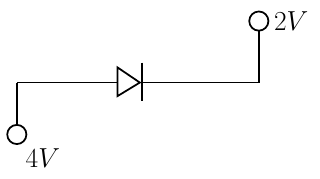
Which of the following circuits represents a forward biased diode ? 

(A) 

(B) 

(C) 

(D) 

(E) 

Choose the correct answer from the options given below :

  1. AOption (a)

    (B), (D) and (E) only 

  2. BOption (b)

    (A) and (D) only

  3. COption (c)

    (B), (C) and (E) only

  4. DOption (d)

    (C) and (E) only

View answer & explanation

Correct answer

Answer: (c)C.

(B), (C) and (E) only

Why this answer is correct

Explanation:

Forward Biased:

  • The diode is said to be forward-biased when the P region is connected to a more positive terminal and N region is connected to the negative terminal of the battery.
  • A forward-biased diode offers very little resistance to the flow of current and hence a large current flow through the diode.
  • When forward biased, the diode acts as an ON switch.

Reversed Biased:

  • A diode is said to be reversed biased when the P terminal is connected to lower potential than the N terminal
  • A reverse-biased diode offers very large resistance to the flow of current and hence a small minority of current flows through the diode

How to identify forward and reversed biased diode:

  1. If the input voltage is greater than the other end voltage, then it is forward-biased and vice-versa.
  2. If the voltage at the p-section is greater than the n-section, then is forward biased and vice-versa.

Question 219

JEE Main 2025• Physics Section A

A parallel-plate capacitor of capacitance 40μF is connected to a 100 V power supply. Now the intermediate space between the plates is filled with a dielectric material of dielectric constant K = 2. Due to the introduction of dielectric material, the extra charge and the change in the electrostatic energy in the capacitor, respectively, are - 

  1. AOption (a)

    2 mC and 0.2 J

  2. BOption (b)

    8 mC and 2.0 J

  3. COption (c)

    4 mC and 0.2 J 

  4. DOption (d)

    2 mC and 0.4 J 

View answer & explanation

Correct answer

Answer: (c)C.

4 mC and 0.2 J 

Why this answer is correct

CONCEPT:

Capacitor:

  • The capacitor is a device in which electrical energy can be stored.
  • In a capacitor two conducting plates are connected parallel to each other and carrying charges of equal magnitudes and opposite sign and separated by an insulating medium.
  • The space between the two plates can either be a vacuum or an electric insulator such as glass, paper, air, or semi-conductor called a dielectric.​

​Parallel plate capacitor:

  • A parallel plate capacitor consists of two large plane parallel conducting plates separated by a small distance.
  • The space between the two plates can either be a vacuum or an electric insulator such as glass, paper, air, or semi-conductor called a dielectric.​
  • The electric field intensity at the outer region of the parallel plate capacitor is always zero whatever be the charge on the plate.
  • The electric field intensity in the inner region between the plates of a parallel plate capacitor remains the same at every point.
  • The electric field intensity in the inner region between the plates of a parallel plate capacitor is given as,

⇒E=σϵo=QAϵo\Rightarrow E=\frac{σ}{\epsilon_o}=\frac{Q}{A\epsilon_o}

  • The potential difference between the plates is given as,

⇒V=QdAϵo\Rightarrow V=\frac{Qd}{A\epsilon_o}

  • The capacitance C of the parallel plate capacitor is given as,

⇒C=QV=Aϵod\Rightarrow C=\frac{Q}{V}=\frac{A\epsilon_o}{d}

Where A = area of the plates, d = distance between the plates, Q = charge on the plates, and σ = surface charge density

Calculation:

Δq = (KC - C)V

= 40 × 10-6 × 100

= 4000 × 10-3 = 4mC

ΔU=12C′V2−12CV2=12( K−1)CV2\Delta \mathrm{U}=\frac{1}{2} \mathrm{C}^{\prime} \mathrm{V}^{2}-\frac{1}{2} \mathrm{CV}^{2}=\frac{1}{2}(\mathrm{~K}-1) \mathrm{CV}^{2}

= 12CV2(2−1)\frac{1}{2} \mathrm{CV}^{2}(2-1)

= 12CV2=12×40×10−6×10000\frac{1}{2} \mathrm{CV}^{2}=\frac{1}{2} \times 40 \times 10^{-6} \times 10000

= 0.2 J

Question 220

JEE Main 2025• Physics Section A

Given is a thin convex lens of glass (refractive index μ) and each side having radius of curvature R. One side is polished for complete reflection. At what distance from the lens, an object be placed on the optic axis so that the image gets formed on the object itself.

  1. AOption (a)

    R/μ

  2. BOption (b)

    R/(2μ–3)

  3. COption (c)

    μR

  4. DOption (d)

    R/(2μ–1)

View answer & explanation

Correct answer

Answer: (d)D.

R/(2μ–1)

Why this answer is correct

Calculation:

Peq = 2Pℓ + Pm

\(-\frac{1}{\mathrm{f}{\mathrm{Q}}}=\frac{2}{\mathrm{f}{\ell}}-\frac{1}{\mathrm{f}_{\mathrm{m}}}\)

= 4(μ−1)R−2−R=1R(4μ−4+2)\frac{4(\mu-1)}{R}-\frac{2}{-R}=\frac{1}{R}(4 \mu-4+2)

−1feq=1R(4μ−2)-\frac{1}{\mathrm{f}_{\mathrm{eq}}}=\frac{1}{\mathrm{R}}(4 \mu-2)

⇒ 1feq=−1R(4μ−2)\frac{1}{f_{e q}}=\frac{-1}{R}(4 \mu-2)

feq=R2\mathrm{f}_{\mathrm{eq}}=\frac{\mathrm{R}}{2}

R = 2feq=−2(R4μ−2)=−R(2μ−1)2 f_{\mathrm{eq}}=-2\left(\frac{\mathrm{R}}{4 \mu-2}\right)=\frac{-\mathrm{R}}{(2 \mu-1)}