Search Previous Year Questions

Find real questions from previous competitive exam papers with answers and solutions.

Leave the keyword blank to browse saved questions for your selected exam, newest papers first. Add a keyword, year or topic to narrow the results.

Browse complete papers
Showing 10 question(s)
Clear

Question 201

JEE Main 2025• Physics Section A

Given below are two statements :

Statement I : In a vernier callipers, one vernier scale division is always smaller than one main scale division.

Statement II : The vernier constant is given by one main scale division multiplied by the number of vernier scale division.

In the light of the above statements, choose the correct answer from the options given below.

  1. AOption (a)

    Both Statement I and Statement II are false.

  2. BOption (b)

    Statement I is true but Statement II is false.

  3. COption (c)

    Both Statement I and Statement II are true.

  4. DOption (d)

    Statement I is false but Statement II is true. 

View answer & explanation

Correct answer

Answer: (b)B.

Statement I is true but Statement II is false.

Why this answer is correct

Concept:

Vernier Caliper

  • Vernier Caliper is a precision instrument that can be used to measure internal and external distances accurately.
  • A vernier caliper consists of two main parts:
  • the main scale engraved on a solid L-shaped frame and the vernier scale that can slide along the main scale.
  • It works on the principle of vernier and can measure the dimensions to an accuracy of 0.02 mm.

Parts of a Vernier caliper:

  • Outside jaws: Used to measure the external diameter or width of an object
  • Inside jaws: Used to measure the internal diameter of an object
  • Locking screw: to lock the jaws
  • Adjusting screw: to take an accurate measurement of the workpiece.


Explanation:

In general one vernier scale division is smaller than one main scale division but in some modified cases it may be not correct.

Also least count is given by one main scale division / number of vernier scale division for normal vernier calliper.

Question 202

JEE Main 2025• Physics Section A

A line charge of length ′a′2\frac{\mathrm{'a'}}{2} is kept at the center of an edge BC of a cube ABCDEFGH having edge length ‘a’ as shown in the figure. If the density of line is λC per unit length, then the total electric flux through all the faces of the cube will be ____. (Take, ∈0 as the free space permittivity) 

  1. AOption (a)

    λa8∈0\frac{\lambda \mathrm{a}}{8 \in_{0}}

  2. BOption (b)

    λa16ϵ0\frac{\lambda \mathrm{a}}{16 \epsilon_{0}}

  3. COption (c)

    λa2ϵ0\frac{\lambda \mathrm{a}}{2 \epsilon_{0}}

  4. DOption (d)

    λa4∈0\frac{\lambda \mathrm{a}}{4 \in_{0}}

View answer & explanation

Correct answer

Answer: (a)A.

λa8∈0\frac{\lambda \mathrm{a}}{8 \in_{0}}

Why this answer is correct

Calculation:

Total charge inside the cube

= λa24=λa8\frac{\lambda \frac{\mathrm{a}}{2}}{4}=\frac{\lambda \mathrm{a}}{8}

∴ \(\phi=\frac{\mathrm{q}{\mathrm{in}}}{\varepsilon{0}}=\frac{\lambda \mathrm{a}}{8 \varepsilon_{0}}\)

Question 203

JEE Main 2025• Physics Section A

Sliding contact of a potentiometer is in the middle of the potentiometer wire having resistance RP = 1Ω as shown in the figure. An external resistance of Re = 2Ω is connected via the sliding contact. The curent through the circuit is

  1. AOption (a)

    0.3 A

  2. BOption (b)

    1.35 A

  3. COption (c)

    1.0 A

  4. DOption (d)

    0.9 A

View answer & explanation

Correct answer

Answer: (c)C.

1.0 A

Why this answer is correct

Calculation:

The circuit can be considered as 

∴ Req = 0.5 + 0.5×22+0.5=(510+1025)Ω\frac{0.5 \times 2}{2+0.5}=\left(\frac{5}{10}+\frac{10}{25}\right) \Omega

= 4550=910=0.9\frac{45}{50}=\frac{9}{10}=0.9

∴ i = 0.90.9=1 A\frac{0.9}{0.9}=1 \mathrm{~A}

Question 204

JEE Main 2025• Physics Section A

Given below are two statements : one is labelled as Assertion (A) and the other is labelled as Reason (R).

Assertion (A) : If Young’s double slit experiment is performed in an optically denser medium than air, then the consecutive fringes come closer.

Reason (R) : The speed of light reduces in an optically denser medium than air while its frequency does not change.

In the light of the above statements, choose the most appropriate answer from the options given below :

  1. AOption (a)

    Both (A) and (R) are true and (R) is the correct explanation of (A) 

  2. BOption (b)

    (A) is false but (R) is true.

  3. COption (c)

    Both (A) and (R) are true but (R) is not the correct explanation of (A) 

  4. DOption (d)

    (A) is true but (R) is false.

View answer & explanation

Correct answer

Answer: (a)A.

Both (A) and (R) are true and (R) is the correct explanation of (A) 

Why this answer is correct

CONCEPT:

Young's double-slit experiment

  • Young’s double-slit experiment helped in understanding the wave nature of light.
  • The original Young’s double-slit experiment used diffracted light from a single monochromatic source of light.
  • The light that comes from the monochromatic source is passed into two slits to be used as two coherent sources.
  • At any point on the screen at a distance ‘y’ from the center, the waves travel distances l1 and l2 to create a path difference of Δl at that point.
  • If there is a constructive interference on the point then the bright fringe occurs.
  • If there is a destructive interference on the point then the dark fringe occurs.
  • The distance of the nth bright fringe from the central fringe is given as,

⇒y=nλDd⇒ y=\frac{nλ D}{d}

Where d = distance between slits, D = distance between slits and screen, and λ = wavelength

​

Explanation:

β (fringe width) = λD d\frac{λ \mathrm{D}}{\mathrm{~d}}

In denser medium, λ ↓ ⇒ β ↓

⇒ fringe come closer 

Also, µ = cV\frac{c}{V}  ⇒ V = cμ\frac{c}{μ}

Frequency remains same, 

⇒ μ = λvac. fλmed f\frac{\lambda_{\text {vac. }} \mathrm{f}}{\lambda_{\text {med }} \mathrm{f}} ⇒ λmed \lambda_{\text {med }} = λvac.μ\frac{\lambda_{\mathrm{vac} .}}{\mu}

Question 205

JEE Main 2025• Physics Section A

Two spherical bodies of same materials having radii 0.2 m and 0.8 m are placed in same atmosphere. The temperature of the smaller body is 800 K and temperature of bigger body is 400 K. If the energy radiate from the smaller body is E, the energy radiated from the bigger body is (assume, effect of the surrounding to be negligible)

  1. AOption (a)

    256 E

  2. BOption (b)

    E

  3. COption (c)

    64 E

  4. DOption (d)

    16 E 

View answer & explanation

Correct answer

Answer: (b)B.

E

Why this answer is correct

Calculation:

We know that

dθdt=σeAT4⇒P∝AT4\frac{\mathrm{d} \theta}{\mathrm{dt}}=\sigma \mathrm{eAT}^{4} \Rightarrow \mathrm{P} \propto \mathrm{AT}^{4}

\(\frac{\mathrm{P}{\text {smaller }}}{\mathrm{P}{\text {larger }}}=\frac{(0.2)^{2} \times 800^{4}}{(0.8)^{2} \times 400^{4}}\)

116×16=1\frac{1}{16} \times 16=1

∴ Plarger = Psmaller 

Question 206

JEE Main 2025• Physics Section A

An amount of ice of mass 10–3 kg and temperature –10°C is transformed to vapour of temperature 110° by applying heat. The total amount of work required for this conversion is,

(Take, specific heat of ice = 2100 Jkg–1K–1, specific heat of water = 4180 Jkg–1K–1, specific heat of steam = 1920 Jkg–1K–1, Latent heat of ice = 3.35 × 10⁵ Jkg–1 and Latent heat of steam = 2.25 × 10⁶ Jkg–1)

  1. AOption (a)

    3022 J

  2. BOption (b)

    3043 J

  3. COption (c)

    3003 J

  4. DOption (d)

    3024 J 

View answer & explanation

Correct answer

Answer: (b)B.

3043 J

Why this answer is correct

Calculation:

ΔQ1=m×S1×ΔT=10−3×2100×10=21 J\rm\Delta Q_{1}=m \times S_{1} \times \Delta T=10^{-3} \times 2100 \times 10=21 \mathrm{~J}

\(\rm\Delta \mathrm{Q}{2}=\mathrm{m} \times \mathrm{L}{\mathrm{f}}=10^{-3} \times 3.35 \times 10^{5}=335 \mathrm{~J}\)

ΔQ3=m×Sw×ΔT=10−3×4180×100=418 J\rm\Delta Q_{3}=m \times S_{w} \times \Delta T=10^{-3} \times 4180 \times 100=418 \mathrm{~J}

\(\rm \Delta \mathrm{Q}{4}=\mathrm{m} \times \mathrm{L}{\mathrm{v}}=10^{-3} \times 2.25 \times 10^{6}=2250 \mathrm{~J}\)

ΔQ5=m×Sv×ΔT=10−3×1920×10=19.2 J\rm\Delta Q_{5}=\mathrm{m} \times \mathrm{S}_{\mathrm{v}} \times \Delta \mathrm{T}=10^{-3} \times 1920 \times 10=19.2 \mathrm{~J}

ΔQnet=3043.2 J\rm \Delta Q_{\mathrm{net}}=3043.2 \mathrm{~J}

Question 207

JEE Main 2025• Physics Section A

An electron in the ground state of the hydrogen atom has the orbital radius of 5.3 × 10⁻¹¹ m while that for the electron in third excited state is 8.48 × 10⁻¹⁰ m. The ratio of the de Broglie wavelengths of electron in the ground state to that in excited state is

  1. AOption (a)

    4

  2. BOption (b)

    9

  3. COption (c)

    3

  4. DOption (d)

    16

View answer & explanation

Correct answer

Answer: (a)A.

4

Why this answer is correct

Concept:

de Broglie wavelength:

  • Louis de Broglie theorized that not only light possesses both wave and particle properties, but rather particles with mass - such as electrons - do as well.
  • The wavelength of material waves is also known as the de Broglie wavelength.
  • de Broglie wavelength can be calculated from Planks constant h divided by the momentum of the particle.

λ=hmv\lambda = \frac {h}{mv}

where λ is de Broglie wavelength, h is Plank's constant, and mv is the momentum.

  • If different particles have the same velocity, then the wavelength is inversely proportional to the mass of that particle.

Calculation:

λ=hmv\lambda=\frac{\mathrm{h}}{\mathrm{mv}}

mvr=nh2π\mathrm{mvr}=\frac{\mathrm{nh}}{2 \pi}

mv=nh2πr\mathrm{mv}=\frac{\mathrm{nh}}{2 \pi \mathrm{r}}

λ=2πrhnh\lambda=\frac{2 \pi \mathrm{rh}}{\mathrm{nh}}

λ∝rn\lambda \propto \frac{\mathrm{r}}{\mathrm{n}}

λ1λ4=r1n4n1r4=5.3×10−11×41×84.8×10−11\frac{\lambda_{1}}{\lambda_{4}}=\frac{r_{1} n_{4}}{n_{1} r_{4}}=\frac{5.3 \times 10^{-11} \times 4}{1 \times 84.8 \times 10^{-11}}

λ1λ4=14\frac{\lambda_{1}}{\lambda_{4}}=\frac{1}{4}

Question 208

JEE Main 2025• Physics Section A

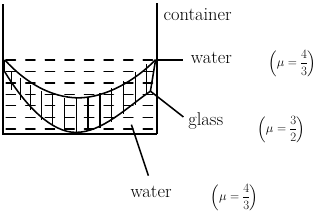
In the diagram given below, there are three lenses formed. Considering negligible thickness of each of them as compared to [R1] and [R2], i.e., the radii of curvature for upper and lower surfaces of the glass lens, the power of the combination is 

  1. AOption (a)

    \(-\frac{1}{6}\left(\frac{1}{\left|\mathrm{R}{1}\right|}+\frac{1}{\left|\mathrm{R}{2}\right|}\right)\)

  2. BOption (b)

    \(-\frac{1}{6}\left(\frac{1}{\left|\mathrm{R}{1}\right|}-\frac{1}{\left|\mathrm{R}{2}\right|}\right)\)

  3. COption (c)

    \(\frac{1}{6}\left(\frac{1}{\left|\mathrm{R}{1}\right|}+\frac{1}{\left|\mathrm{R}{2}\right|}\right)\)

  4. DOption (d)

    16(1∣R1∣−1∣R2∣)\frac{1}{6}\left(\frac{1}{\left|R_{1}\right|}-\frac{1}{\left|R_{2}\right|}\right)

View answer & explanation

Correct answer

Answer: (b)B.

\(-\frac{1}{6}\left(\frac{1}{\left|\mathrm{R}{1}\right|}-\frac{1}{\left|\mathrm{R}{2}\right|}\right)\)

Why this answer is correct

Calculation:

⇒ peq = p1 + p2 + p3  

⇒ p1 = (13∣R1∣)\left(\frac{1}{3\left|\mathrm{R}_{1}\right|}\right)

⇒ p2 = (12)(1−∣R1∣−1−∣R2∣)\left(\frac{1}{2}\right)\left(\frac{1}{-\left|R_{1}\right|}-\frac{1}{-\left|R_{2}\right|}\right)

⇒ p2 = \(\frac{1}{2}\left(\frac{1}{\left|\mathrm{R}{2}\right|}-\frac{1}{\left|\mathrm{R}{1}\right|}\right)\)

⇒ p3 = \(\left(\frac{1}{3}\right)\left(\frac{1}{-\left|\mathrm{R}{2}\right|}-\frac{1}{\infty}\right)=-\frac{1}{3\left|\mathrm{R}{2}\right|}\)

⇒ peq = \(\frac{1}{3}\left(\frac{1}{\left|\mathrm{R}{1}\right|}-\frac{1}{\left|\mathrm{R}{2}\right|}\right)-\frac{1}{2}\left(\frac{1}{\left|\mathrm{R}{1}\right|}-\frac{1}{\left|\mathrm{R}{2}\right|}\right)\)

=  \(-\frac{1}{6}\left(\frac{1}{\left|\mathrm{R}{1}\right|}-\frac{1}{\left|\mathrm{R}{2}\right|}\right)\)

Question 209

JEE Main 2025• Physics Section A

An electron is made to enters symmetrically between two parallel and equally but oppositely charged metal plates, each of 10 cm length. The electron emerges out of the field region with a horizontal component of velocity 106 m/s. If the magnitude of the electric between the plates is 9.1 V/cm, then the vertical component of velocity of electron is

(mass of electron = 9.1 × 10⁻³¹ kg and charge of electron = 1.6 × 10⁻¹⁹ C)

  1. AOption (a)

    1 × 10⁶ m/s

  2. BOption (b)

    0

  3. COption (c)

    16 × 106 m/s

  4. DOption (d)

    16 × 104 m/s

View answer & explanation

Correct answer

Answer: (d)D.

16 × 104 m/s

Why this answer is correct

Calculation:

⇒ t = ℓVx=10×10−2106=10−7\frac{\ell}{V_{x}}=\frac{10 × 10^{-2}}{10^{6}}=10^{-7}

⇒ Vy = uy + ayt

⇒ Vy = 0 + eE m×10−7\frac{\mathrm{eE}}{\mathrm{~m}} × 10^{-7}

⇒ Vy = 1.6×10−199.1×10−31×9.1×10−2×10−7\frac{1.6 × 10^{-19}}{9.1 × 10^{-31}} × 9.1 × 10^{-2} × 10^{-7}

⇒ Vy =  16 × 104

Question 210

JEE Main 2025• Physics Section A

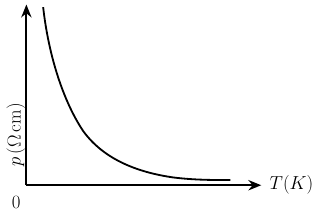
Which of the following resistivity (ρ) v/s temperature (T) curves is most suitable to be used in wire bound standard resistors? 

  1. AOption (a)

  2. BOption (b)

  3. COption (c)

  4. DOption (d)

View answer & explanation

Correct answer

Answer: (a)A.

Why this answer is correct

Explanation:

Resistivity is independent of temperature for wire-bound resistors