Search Previous Year Questions

Find real questions from previous competitive exam papers with answers and solutions.

Leave the keyword blank to browse saved questions for your selected exam, newest papers first. Add a keyword, year or topic to narrow the results.

Browse complete papers
Showing 10 question(s)
Clear

Question 161

JEE Main 2025• Chemistry Section A

Given below are two statements :

Statement I : One mole of propyne reacts with excess of sodium to liberate half a mole of H2 gas.

Statement II : Four g of propyne reacts with NaNH2 to liberate NH3 gas which occupies 224 mL at STP.

In the light of the above statements, choose the most appropriate answer from the options given below:

  1. AOption (a)

    Statement I is correct but Statement II is incorrect.

  2. BOption (b)

    Both Statement I and Statement II are incorrect

  3. COption (c)

    Statement I is incorrect but Statement II is correct

  4. DOption (d)

    Both Statement I and Statement II are correct.

View answer & explanation

Correct answer

Answer: (a)A.

Statement I is correct but Statement II is incorrect.

Why this answer is correct

CONCEPT:

Reactions of Propyne with Sodium and Sodium Amide

  • When alkynes react with metallic sodium in the presence of liquid ammonia, they release hydrogen gas. The number of moles of H2 gas liberated depends on the available acidic hydrogen atoms in the molecule.
  • Reaction with sodium amide (NaNH2) leads to the formation of a sodium salt of the alkyne and releases ammonia (NH3) gas. This reaction is used to identify terminal alkynes.

EXPLANATION:

  • Statement I: One mole of propyne (CH3–C≡CH) reacts with an excess of sodium (Na) to liberate 0.5 moles of hydrogen gas (H2), as each terminal hydrogen in the alkyne contributes to the reaction. This statement is correct.
  • Statement II: Four grams of propyne contain 0.1 moles of propyne (molecular weight = 40 g/mol). When reacted with NaNH2, this amount of propyne will release 0.1 moles of NH3 gas, which occupies 2240 mL at STP (not 224 mL as stated). Hence, this statement is incorrect.
  • 440=0.1 mole 0.1 mole2240 mole\frac{4}{40}=0.1 \text { mole } \quad \frac{0.1 \mathrm{~mole}}{2240 \mathrm{~mole}}
  • Statement I is correct but Statement II is incorrect

Therefore, Statement I is correct, but Statement II is incorrect.

Question 162

JEE Main 2025• Chemistry Section A

A vessel at 1000 K contains CO2 with a pressure of 0.5 atm. Some of CO2 is converted into CO on addition of graphite. If total pressure at equilibrium is 0.8 atm, then KP is :

  1. AOption (a)

    0.18 atm

  2. BOption (b)

    1.8 atm

  3. COption (c)

    0.3 atm

  4. DOption (d)

    3 atm

View answer & explanation

Correct answer

Answer: (b)B.

1.8 atm

Why this answer is correct

CONCEPT:

Equilibrium Constant (KP) for Gas Reactions

  • The equilibrium constant, KP, is calculated using the partial pressures of the gases involved in the reaction at equilibrium.
  • For a reaction:

aA(g) + bB(g) ⇌ cC(g) + dD(g)

KP = (PC)c (PD)d / (PA)a (PB)b

where P represents the partial pressure of the gases at equilibrium.

  • Pure solids and liquids do not appear in the expression for KP.

EXPLANATION:

  • The given reaction is:

CO2(g) + C(s) ⇌ 2CO(g)

  • CO2 is the reactant gas.
  • Graphite (C) is a solid and does not appear in KP expression.
  • CO is the product gas.
  • Initial pressure of CO2 is 0.5 atm.
  • Let 'x' be the pressure change due to the conversion of CO2 to CO at equilibrium:
  • Pressure of CO2 at equilibrium: (0.5 - x) atm
  • Pressure of CO at equilibrium: 2x atm
  • CO2( g)+C( s)⇌2CO( g) 0.5− 0.5−x2x\begin{array}{lc} \mathrm{CO}_{2}(\mathrm{~g})+\mathrm{C}(\mathrm{~s}) & \rightleftharpoons 2 \mathrm{CO}(\mathrm{~g}) \ 0.5 & - \ 0.5-\mathrm{x} & 2 \mathrm{x} \end{array}
  • Given: Total pressure at equilibrium is 0.8 atm:
  • (0.5 - x) + 2x = 0.8
  • Solving for x: 0.5 + x = 0.8
  • x = 0.3
  • Equilibrium pressures:
  • PCO2 = 0.5 - 0.3 = 0.2 atm
  • PCO = 2(0.3) = 0.6 atm
  • Plugging these values into the KP expression:
  • KP = (PCO)2 / (PCO2)
  • KP = (0.6)]2 / 0.2
  • KP = 0.36 / 0.2
  • KP = 1.8 atm

Therefore, the correct answer is 1.8 atm

Question 163

JEE Main 2025• Chemistry Section A

The IUPAC name of the following compound is :​

  1. AOption (a)

    2-Carboxy-5-methoxycarbonylhexane.

  2. BOption (b)

    Methyl-6-carboxy-2,5-dimethylhexanoate.

  3. COption (c)

    Methyl-5-carboxy-2-methylhexanoate.

  4. DOption (d)

    6-Methoxycarbonyl-2,5-dimethylhexanoic acid.

View answer & explanation

Correct answer

Answer: (d)D.

6-Methoxycarbonyl-2,5-dimethylhexanoic acid.

Why this answer is correct

CONCEPT:

IUPAC Nomenclature of Organic Compounds

  • The IUPAC name of a compound is determined based on the longest carbon chain containing the principal functional group.
  • Priority is given to functional groups in the following order: carboxylic acid (-COOH) > ester (-COOR) > ketone (-C=O) > alcohol (-OH) > amine (-NH2) > alkene > alkyne > alkane.
  • Substituents are named and numbered to give the lowest possible position numbers to the functional groups and substituents.

EXPLANATION:

  • The given compound contains two functional groups:
  • A carboxylic acid (-COOH) group, which has the highest priority.
  • An ester group (-COOCH3) as a substituent.
  • The longest carbon chain containing the carboxylic acid group has six carbons (hexane). The main chain is numbered from the carboxylic acid carbon to give substituents the lowest possible numbers.
  • The substituents on the chain are:
  • A methoxycarbonyl (-COOCH3) group at position 6.
  • Methyl groups at positions 2 and 5.
  • The compound's name is written as: 6-Methoxycarbonyl-2,5-dimethylhexanoic acid.

Therefore, the IUPAC name of the compound is: 6-Methoxycarbonyl-2,5-dimethylhexanoic acid.

Question 164

JEE Main 2025• Chemistry Section A

Which of the following electrolyte can be sued to obtain H2S2O8 by the process of electrolysis?

  1. AOption (a)

    Dilute solution of sodium sulphate

  2. BOption (b)

    Dilute solution of sulphuric acid

  3. COption (c)

    Concentrated solution of sulphuric acid 

  4. DOption (d)

    Acidified dilute solution of sodium sulphate.

View answer & explanation

Correct answer

Answer: (c)C.

Concentrated solution of sulphuric acid 

Why this answer is correct

CONCEPT:

Electrolysis of Sulfuric Acid

  • During electrolysis, an electrolyte is decomposed into its constituent ions through the application of an electrical current.
  • H2S2O8 (peroxodisulfuric acid) can be produced by the electrolysis of concentrated sulfuric acid solutions.
  • At the anode, the half-reaction is:

2 HSO4- → H2S2O8 + 2e-

EXPLANATION:

  • To efficiently produce H2S2O8, a concentrated solution of sulfuric acid is required because:
  • In a concentrated solution, the concentration of HSO4- ions is high enough to facilitate the formation of peroxodisulfuric acid at the anode.
  • Dilute solutions of sulfuric acid or sodium sulfate do not provide the necessary ion concentrations for this reaction.

Therefore, the correct answer is: (3) Concentrated solution of sulfuric acid.

Question 165

JEE Main 2025• Chemistry Section A

The compounds which give positive Fehling’s test are : 

(A) 

(B) 

(C) HOCH2–CO–(CHOH)3–CH2–OH

(D) 

(E) 

Choose the CORRECT answer from the options given below :

  1. AOption (a)

    (A), (C) and (D) Only

  2. BOption (b)

    (A), (D) and (E) Only

  3. COption (c)

    (C), (D) and (E) Only

  4. DOption (d)

    (A), (B) and (C) Only

View answer & explanation

Correct answer

Answer: (c)C.

(C), (D) and (E) Only

Why this answer is correct

CONCEPT:

Fehling's Test

  • Fehling's test is used to detect the presence of reducing sugars and aldehydes.
  • Compounds with an aldehyde group (-CHO) or α-hydroxy ketones give a positive Fehling's test, resulting in the formation of a red precipitate of cuprous oxide (Cu2O).
  • Ketones and aromatic aldehydes (like benzaldehyde) generally do not give a positive Fehling's test.

EXPLANATION:

  • Compound (A): Benzaldehyde (C6H5CHO) is an aromatic aldehyde and does not give a positive Fehling's test.
  • Compound (B): Acetophenone (C6H5COCH3) is a ketone and does not give a positive Fehling's test.
  • Compound (C): Glucose derivative (HOCH2–CO–(CHOH)3–CH2OH) contains an α-hydroxy aldehyde functional group and gives a positive Fehling's test.
  • Compound (D): Propionaldehyde (CH3CH2CHO) is an aliphatic aldehyde and gives a positive Fehling's test.
  • Compound (E): Phenylacetaldehyde (C6H5CH2CHO) is an aliphatic aldehyde and gives a positive Fehling's test.

Therefore, the compounds (C), (D), and (E) give a positive Fehling's test.

Question 166

JEE Main 2025• Chemistry Section A

In which of the following complexes the CFSE, Δ0 will be equal to zero?

  1. AOption (a)

    [Fe(NH3)6]Br2

  2. BOption (b)

    [Fe(en)3]Cl3

  3. COption (c)

    K4[Fe(CN)6]

  4. DOption (d)

    K3[Fe(SCN)6]

View answer & explanation

Correct answer

Answer: (d)D.

K3[Fe(SCN)6]

Why this answer is correct

CONCEPT:

Crystal Field Stabilization Energy (CFSE)

  • CFSE is the energy difference between the energy of an electron configuration in the ligand field and in an isotropic field.
  • It depends on:
  • The splitting of d-orbitals (t2g and eg) in the crystal field.
  • The number of electrons in these orbitals.
  • CFSE is calculated as:

CFSE = [(number of electrons in t2g) × (-0.4Δ0)] + [(number of electrons in eg) × (+0.6Δ0)]

EXPLANATION:

For complex K3 [Fe(SCN)6] 

Calculation of CFSE

= (–0.4 × 3 + 0.6 × 2) Δ0

= 0 Δ0

  • [Fe(NH3)6]Br2:
  • Fe2+ (d6) forms a high-spin complex due to NH3 being a weak field ligand. This results in CFSE ≠ 0.
  • [Fe(en)3]Cl3:
  • Fe3+ (d5) forms a low-spin complex due to en (ethylenediamine) being a strong field ligand. CFSE ≠ 0.
  • K4[Fe(CN)6]:
  • Fe2+ (d6) forms a low-spin complex due to CN- being a strong field ligand. CFSE ≠ 0.
  • K3[Fe(SCN)6]:
  • SCN- is a weak field ligand, and Fe3+ (d5) forms a high-spin complex. The electron configuration is t2g3 eg2, resulting in:
  • CFSE = [-0.4(3) + 0.6(2)]Δ0
  • CFSE = 0

Therefore, in K3[Fe(SCN)6], the CFSE (Δ0) is equal to zero.

Question 167

JEE Main 2025• Chemistry Section A

Arrange the following solutions in order of their increasing boiling points.

(i) 10–4 M NaCl

(ii) 10–4 M Urea

(iii) 10–3 M NaCl

(iv) 10–2 M NaCl

  1. AOption (a)

    (ii) < (i) < (iii) < (iv)

  2. BOption (b)

    (ii) < (i) ≅ (iii) < (iv) 

  3. COption (c)

    (i) < (ii) < (iii) < (iv)

  4. DOption (d)

    (iv) < (iii) < (i) < (ii) 

View answer & explanation

Correct answer

Answer: (a)A.

(ii) < (i) < (iii) < (iv)

Why this answer is correct

CONCEPT:

Boiling Point Elevation

  • The boiling point elevation (ΔTb) of a solution is directly proportional to the molal concentration (m) of the solute and the van't Hoff factor (i).
  • The formula is given by:

ΔTb = i × Kb × m

where Kb is the ebullioscopic constant of the solvent.

  • For ionic compounds, the van't Hoff factor (i) represents the number of particles the compound dissociates into in solution.
  • For non-electrolytes like urea, i = 1.

EXPLANATION:

ΔTb = i Kb . m . ∝ i.C.

where C = concentration 

Optionsi.C.
(i)2 × 10⁻⁴
(ii)1 × 10–4
(iii)2 × 10⁻³
(iv)2 × 10⁻²


B.P. order (ii) < (i) < (iii) < (iv)

Therefore, the correct answer is (ii) < (i) < (iii) < (iv).

Question 168

JEE Main 2025• Chemistry Section A

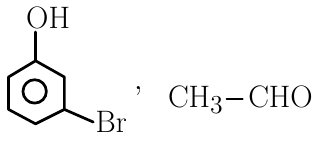
The products formed in the following reaction sequence are : 

  1. AOption (a)

  2. BOption (b)

  3. COption (c)

  4. DOption (d)

View answer & explanation

Correct answer

Answer: (c)C.

Why this answer is correct

CONCEPT:

Aromatic Substitution and Diazotization

  • Bromination in AcOH: Bromine in acetic acid selectively introduces a bromine atom at the para position relative to the nitro group (-NO2) due to its electron-withdrawing nature.
  • Reduction: The nitro group (-NO2) is reduced to an amino group (-NH2) using Sn and HCl.
  • Diazotization: Amino groups react with NaNO2 and HCl at low temperatures (273 K) to form diazonium salts (-N2+).
  • Reaction with Ethanol: Diazonium salts react with ethanol (EtOH) to form aldehydes, specifically acetaldehyde (CH3CHO), as a product of the Etard reaction mechanism.

EXPLANATION:

  • Step 1: Bromination
  • The nitrobenzene reacts with Br2 in acetic acid (AcOH) to produce para-bromo nitrobenzene.
  • Step 2: Reduction
  • Para-bromo nitrobenzene is reduced with Sn and HCl to form para-bromo aniline (p-bromoaniline).
  • Step 3: Diazotization
  • p-Bromoaniline reacts with NaNO2 and HCl at 273 K to form para-bromo benzene diazonium chloride.
  • Step 4: Reaction with Ethanol
  • The diazonium salt reacts with ethanol (EtOH), forming para-bromo benzene and acetaldehyde (CH3CHO).

Therefore, the products formed are para-bromo benzene and acetaldehyde (CH3CHO).

Question 169

JEE Main 2025• Chemistry Section A

From the magnetic behaviour of [NiCl4]2– (paramagnetic) and [Ni(CO)4] (diamagnetic), choose the correct geometry and oxidation state.

  1. AOption (a)

    [NiCl4]2– : NiII, square planar

    [Ni(CO)4] : Ni(0), square planar

  2. BOption (b)

    [NiCl4]2–  : NiII, tetrahedral

    [Ni(CO)4] : Ni(0), tetrahedral

  3. COption (c)

    [NiCl4]2–  : NiII, tetrahedral

    [Ni(CO)4]  : NiII, square planar

  4. DOption (d)

    [NiCl4]2–  : Ni(0), tetrahedral

    [Ni(CO)4]  : Ni(0), square planar

View answer & explanation

Correct answer

Answer: (b)B.

[NiCl4]2–  : NiII, tetrahedral

[Ni(CO)4] : Ni(0), tetrahedral

Why this answer is correct

CONCEPT:

Magnetic Behaviour and Geometries

  • The magnetic behaviour of a complex can often be used to infer its geometry and the oxidation state of the central metal ion.
  • [NiCl4]2−:
  • Ni2+ has the electronic configuration [Ar] 3d8.
  • In a tetrahedral field, the 3d orbitals do not experience significant splitting, retaining unpaired electrons and leading to a paramagnetic nature.
  • This suggests a tetrahedral geometry.
  • [Ni(CO)4]:
  • Ni in zero oxidation state (Ni(0)) has the electronic configuration [Ar] 3d10.
  • In a tetrahedral field, the d orbitals become fully paired in the presence of strong field ligands (like CO), leading to a diamagnetic nature.
  • This suggests a tetrahedral geometry.

EXPLANATION:

  • [NiCl4]2−:
  • Oxidation state of Ni is +2.
  • Ni2+ electronic configuration: [Ar] 3d8.
  • If the geometry is tetrahedral, the hybridization is sp3.
  • With 2 unpaired electrons, it exhibits paramagnetism.
  • [Ni(CO)4]:
  • Oxidation state of Ni is 0.
  • Ni(0) electronic configuration: [Ar] 3d10.
  • If the geometry is tetrahedral, the hybridization is sp3.
  • With no unpaired electrons, it exhibits diamagnetism.

Therefore, the correct answer is [NiCl4]2−: Ni2+, tetrahedral, [Ni(CO)4]: Ni(0), tetrahedral

Question 170

JEE Main 2025• Chemistry Section A

The incorrect statements regarding geometrical isomerism are :

(A) Propene shows geometrical isomerism.

(B) Trans isomer has identical atoms/groups on the opposite sides of the double bond.

(C) Cis-but-2-ene has higher dipole moment than trans-but-2-ene.

(D) 2-methylbut-2-ene shows two geometrical isomers.

(E) Trans-isomer has lower melting point that cis isomer.

Choose the CORRECT answer from the options given below :

  1. AOption (a)

    (A), (D) and (E) only 

  2. BOption (b)

    (C), (D) and (E) only

  3. COption (c)

    (B) and (C) only

  4. DOption (d)

    (A) and (E) only

View answer & explanation

Correct answer

Answer: (a)A.

(A), (D) and (E) only 

Why this answer is correct

CONCEPT:

Geometrical Isomerism

  • Geometrical isomerism (cis-trans isomerism) occurs in compounds with restricted rotation around a double bond or in cyclic structures.
  • Cis-isomer: Identical groups are on the same side of the double bond.
  • Trans-isomer: Identical groups are on opposite sides of the double bond.
  • Properties such as dipole moment and melting point differ for cis and trans isomers:
  • Cis-isomers usually have higher dipole moments due to group orientation.
  • Trans-isomers generally have higher melting points due to better packing in the solid state.

EXPLANATION:

  • (A) Propene does not show geometrical isomerism:
  • Geometrical isomerism requires two different groups on each carbon of the double bond, which propene (CH3–CH=CH2) lacks.

Incorrect

  • (B) Trans-isomer has identical groups on opposite sides:
  • This is true; geometrical isomers differ based on the position of groups around the double bond.

Correct

  • (C) Cis-but-2-ene has a higher dipole moment than trans-but-2-ene:

(dipole moment only)

  • In cis-isomer, the dipoles of substituent groups add up, while in trans-isomer, the dipoles cancel out.

Correct

  • (D) 2-Methylbut-2-ene shows two geometrical isomers:

 (does not show GI) 

  • This is incorrect as 2-methylbut-2-ene does not have two different groups on each carbon of the double bond.

Incorrect

  • (E) Trans-isomer has a lower melting point than cis-isomer:

 (Melting point) 

  • Trans-isomers generally have a higher melting point due to better packing in the solid state.

Incorrect

Therefore, the incorrect statements are: (A), (D), and (E).