Search Previous Year Questions

Find real questions from previous competitive exam papers with answers and solutions.

Leave the keyword blank to browse saved questions for your selected exam, newest papers first. Add a keyword, year or topic to narrow the results.

Browse complete papers
Showing 10 question(s)
Clear

Question 121

JEE Main 2025• Mathematics Section B

Let [.] denote the greatest integer function. If \int_{0}^{3} \left[ \frac{1}{e^{x-1}} \right] dx = \alpha - \log_e 2, \text{ then } \alpha^3 \text{ is equal to } ____.

View answer & explanation

Correct answer

Answer: 8Answer: 8

Why this answer is correct

Concept:

Greatest Integer Function and Definite Integral:

  • The greatest integer function, denoted by [x], gives the largest integer less than or equal to x.
  • To integrate a greatest integer function, divide the integral into intervals where the function is constant.
  • The function inside the integral is f(x) = [1 / ex−1] = [e1−x].
  • We need to evaluate ∫₀³ [e1−x] dx = α − logₑ2.


Calculation:

f(x) = [e1−x] is a decreasing function

f(0) = [e1] = [2.718] = 2

f(1−ln2) = e1−(1−ln2) = eln2 = 2

⇒ boundary point

f(x) = 2 for x ∈ [0, 1−ln2)

f(1) = [e0] = [1] = 1

f(x) = 1 for x ∈ [1−ln2, 1)

f(x) < 1 for x ≥ 1 ⇒ [f(x)] = 0

Now break the integral accordingly:

∫₀³ [e1−x] dx = ∫₀1−ln2 2 dx + ∫1−ln21 1 dx + ∫₁³ 0 dx

⇒ 2(1 − ln2) + (1 − (1 − ln2)) + 0

⇒ 2 − 2ln2 + ln2 = 2 − ln2

Given: ∫₀³ [e1−x] dx = α − ln2

Comparing both sides:

α − ln2 = 2 − ln2 ⇒ α = 2

Now, α3 = 23 = 8

∴ The value of α3 is 8.
Question 122

JEE Main 2025• Mathematics Section B

Let ƒ : R→RR \rightarrow R be a thrice differentiable odd function satisfying ƒ'(x)≥\ge0, ƒ'(x)=ƒ(x),ƒ(0)=0,ƒ'(0)=3. Then 9ƒ(loge3) is equal to _____.

View answer & explanation

Correct answer

Answer: 36Answer: 36

Why this answer is correct

Concept:

Second-Order ODE and Initial Conditions:

  • When f''(x)= f(x), multiplying both sides by f'(x) and integrating yields a first integral.
  • Use the given initial conditions f(0)=0 and f'(0)=3 to determine the constant of integration.


Calculation:

Start from the differential equation:

f′′(x)=f(x)f''(x)=f(x)

Multiply both sides by f'(x) and integrate:

f′(x),f′′(x)=f′(x),f(x);  ⟹  ;∫f′(x)f′′(x),dx=∫f′(x)f(x),dxf'(x),f''(x)=f'(x),f(x) ;\implies;\int f'(x)f''(x),dx=\int f'(x)f(x),dx

(f′(x))22=(f(x))22+C;  ⟹  ;(f′(x))2=(f(x))2+C′\frac{(f'(x))^2}{2}=\frac{(f(x))^2}{2}+C ;\implies;(f'(x))^2=(f(x))^2+C'

Apply initial conditions x=0:

(f′(0))2=(f(0))2+C′;  ⟹  ;32=02+C′;  ⟹  ;C′=9(f'(0))^2=(f(0))^2+C';\implies;3^2=0^2+C';\implies;C'=9

Thus:

(f′(x))2=(f(x))2+9;  ⟹  ;f′(x)=(f(x))2+9(f'(x))^2=(f(x))^2+9 ;\implies;f'(x)=\sqrt{(f(x))^2+9}

Separate variables y=f(x):

∫dyy2+9=∫dx;  ⟹  ;ln⁡∣y+y2+9∣=x+C\int\frac{dy}{\sqrt{y^2+9}}=\int dx ;\implies;\ln\bigl|y+\sqrt{y^2+9}\bigr|=x+C

Use f(0)=0 to find C:

ln⁡∣9∣=0+C;  ⟹  ;ln⁡3=C\ln\bigl|\sqrt{9}\bigr|=0+C;\implies;\ln3=C

Hence:

ln⁡∣y+y2+9∣=x+ln⁡3;  ⟹  ;y+y2+9=3ex\ln\bigl|y+\sqrt{y^2+9}\bigr|=x+\ln3 ;\implies;y+\sqrt{y^2+9}=3e^x

At x=ln3), let y=f(ln3). Then:

f(ln⁡3)+(f(ln⁡3))2+9=3eln⁡3=9f(\ln3)+\sqrt{(f(\ln3))^2+9}=3e^{\ln3}=9

Set y=f(ln3):

y+y2+9=9;  ⟹  ;y2+9=9−y;  ⟹  ;y2+9=(9−y)2=81−18y+y2y+\sqrt{y^2+9}=9 ;\implies;\sqrt{y^2+9}=9-y ;\implies;y^2+9=(9-y)^2=81-18y+y^2

Solve for y:

9=81−18y;  ⟹  ;18y=72;  ⟹  ;y=49=81-18y ;\implies;18y=72 ;\implies;y=4

Therefore:

f(ln⁡3)=4;  ⟹  ;9,f(ln⁡3)=9×4=36f(\ln3)=4 ;\implies;9,f(\ln3)=9\times4=36

Hence, the correct answer is 36.

Question 123

JEE Main 2025• Mathematics Section B

If the area of the region 

(x,y):∣4−x2∣≤y≤x2,y≤4,x≥0 is (802α−β),α,β∈N, then α+β is equal to{(x, y) : |4 - x^2| \le y \le x^2, y \le 4, x \ge 0} \ \text{is } \left( \frac{80\sqrt{2}}{\alpha} - \beta \right), \alpha, \beta \in \mathbf{N}, \text{ then } \alpha + \beta \text{ is equal to}

View answer & explanation

Correct answer

Answer: 22Answer: 22

Why this answer is correct

Concept:

Area of Region:

  • The area between curves can be found by integrating the difference of the functions over the given interval.
  • Use definite integrals and apply limits appropriately to find the enclosed area.

Calculation:

Given region: (x,y):∣4−x2∣≤y≤x2,y≤4,x≥0 {(x,y): |4 - x^2| \leq y \leq x^2, y \leq 4, x \geq 0}

Area calculation involves three integrals:

A=∫044+y,dy−∫024−y,dy−∫24y,dy A = \int_0^4 \sqrt{4 + y} , dy - \int_0^2 \sqrt{4 - y} , dy - \int_2^4 \sqrt{y} , dy

Evaluating each integral:

∫044+y,dy=[23(4+y)3/2]04=23(83/2−43/2) \int_0^4 \sqrt{4 + y} , dy = \left[ \frac{2}{3} (4 + y)^{3/2} \right]_0^4 = \frac{2}{3} \left( 8^{3/2} - 4^{3/2} \right)

∫024−y,dy=[23(4−y)3/2]02=23(23/2−43/2) \int_0^2 \sqrt{4 - y} , dy = \left[ \frac{2}{3} (4 - y)^{3/2} \right]_0^2 = \frac{2}{3} \left( 2^{3/2} - 4^{3/2} \right)

∫24y,dy=[23y3/2]24=23(43/2−23/2) \int_2^4 \sqrt{y} , dy = \left[ \frac{2}{3} y^{3/2} \right]_2^4 = \frac{2}{3} \left( 4^{3/2} - 2^{3/2} \right)

Substitute the values:

A=23(162−8)+23(22−8)−23(8−22) A = \frac{2}{3} (16 \sqrt{2} - 8) + \frac{2}{3} (2 \sqrt{2} - 8) - \frac{2}{3} (8 - 2 \sqrt{2})

=402−483=8026−16 = \frac{40 \sqrt{2} - 48}{3} = \frac{80 \sqrt{2}}{6} - 16

Given: 802α−β=8026−16 \frac{80 \sqrt{2}}{\alpha} - \beta = \frac{80 \sqrt{2}}{6} - 16

Comparing terms,

α=6,β=16 \alpha = 6, \quad \beta = 16

α+β=6+16=22 \alpha + \beta = 6 + 16 = 22

Hence, the correct answer is 22.

Question 124

JEE Main 2025• Mathematics Section B

Three distinct numbers are selected randomly from the set {1,2,3,……,40}. If the probability, that the selected numbers are in an increasing G.P. is mn,\frac{m}{n}, gcd(m,n) = 1, then m + n is equal to ____.

View answer & explanation

Correct answer

Answer: 4949Answer: 4949

Why this answer is correct

Given:

Three distinct numbers are selected randomly from the set {1,2,3,…,40}.

The selected numbers are in increasing Geometric Progression (G.P.).

The probability of this event is m/n where      \gcd(m,n) = 1

gcd(m,n) 4= 1.

Calculation: 

Total number of ways to select 3 distinct numbers from 40 numbers = (403) = 9880

Let the three numbers in increasing G.P. be: a, ar, ar2, where a, r ∈ N 


r>1 (since increasing).

Since all numbers are distinct integers between 1 and 40,

⇒ 1 ≤ a< ar < ar2 ≤ 40

Since r is the common ratio, for the sequence to be an increasing G.P. with integers,  r must be a positive integer greater than 1

For  r=2:

⇒ a ≤ 4022=10\frac{40}{2^2} = 10 

So possible a=1,2,…,10 → 10 sequences

For r = 3

⇒ a ≤ 40/9 ≈ 4

So Possible a= 1, 2, 3, 4 → 4 sequences

For r = 4

⇒ a ≤ 40/16 = 2.5

Possible  a = 1, 2

a= 1,2 → 2 sequences

For r = 5

⇒ a ≤ 40/25 = 1.6 

Possible  a = 1

a=1 → 1 sequence

For r = 6 

⇒ a ≤ 40/36 = 1.11

Possible a= 1 → 1 sequence

For r ≥7 a ≤ 40r2\frac{40}{r^2}​ < 1, no sequences.

Total number of favorable sequences = 10 + 4 + 2 + 1 + 1 = 18

⇒ Now P = 18(340)=189880=94940\frac{18}{(^{40}_3)} = \frac{18}{9880} = \frac{9}{4940}

Here, gcd(94940) = 1 so

⇒ m/n = 9/4940

and m + n  = 9 + 4940 = 4949

Hence, the Correct answer is 4949.

Question 125

JEE Main 2025• Mathematics Section B

The absolute difference between the squares of the radii of the two circles passing through the point (–9, 4) and touching the lines x + y = 3 and x – y = 3, is equal to _____.

View answer & explanation

Correct answer

Answer: 768Answer: 768

Why this answer is correct

Concept:

Circle Equation and Radius:

  • The radius of a circle touching a line can be found using the perpendicular distance from the center to the line.
  • The circle equation is (x−a)2+(y−b)2=r2 (x - a)^2 + (y - b)^2 = r^2 , where (a,b) (a,b) is the center and r r is the radius.

Calculation:

Center of circle is (a,0) (a, 0) .

Radius r r is distance from center to line x+y=3 x + y = 3 :

r=∣a−0−32∣=∣a−32∣ r = \left| \frac{a - 0 - 3}{\sqrt{2}} \right| = \left| \frac{a - 3}{\sqrt{2}} \right|

Equation of circle:

(x−a)2+y2=(a−32)2 (x - a)^2 + y^2 = \left( \frac{a - 3}{\sqrt{2}} \right)^2

Circle passes through point (−9,4) (-9,4) :

(−9−a)2+42=(a−3)22 (-9 - a)^2 + 4^2 = \frac{(a - 3)^2}{2}

Expanding and simplifying:

(a+9)2+16=(a−3)22 (a + 9)^2 + 16 = \frac{(a - 3)^2}{2}

2(a2+18a+81+8)=a2−6a+9 2(a^2 + 18a + 81 + 8) = a^2 - 6a + 9

2a2+36a+194=a2−6a+9 2a^2 + 36a + 194 = a^2 - 6a + 9

a2+42a+185=0 a^2 + 42a + 185 = 0

Factorizing:

(a+37)(a+5)=0  ⟹  a=−37,−5 (a + 37)(a + 5) = 0 \implies a = -37, -5

Calculating radii:

r1=∣−37−32∣=402=202 r_1 = \left| \frac{-37 - 3}{\sqrt{2}} \right| = \frac{40}{\sqrt{2}} = 20\sqrt{2}

r2=∣−5−32∣=82=42 r_2 = \left| \frac{-5 - 3}{\sqrt{2}} \right| = \frac{8}{\sqrt{2}} = 4\sqrt{2}

Absolute difference between squares of radii:

∣r12−r22∣=∣(202)2−(42)2∣=∣800−32∣=768 |r_1^2 - r_2^2| = |(20\sqrt{2})^2 - (4\sqrt{2})^2| = |800 - 32| = 768

Hence, the correct answer is 768.

Question 126

JEE Main 2025• Physics Section A

A light wave is propagating with plane wave fronts of the type x + y + z = constant. The angle made by the direction of wave propagation with the x-axis is : 

  1. AOption (a)

    cos⁡−1(13)\cos^{-1}\left(\frac{1}{\sqrt{3}}\right)

  2. BOption (b)

    cos⁡−1(23)\cos^{-1}\left(\frac{2}{3}\right)

  3. COption (c)

    cos⁡−1(13)\cos^{-1}\left(\frac{1}{3}\right)

  4. DOption (d)

    cos⁡−1(23)\cos^{-1}\left(\sqrt{\frac{2}{3}}\right)

View answer & explanation

Correct answer

Answer: (a)A.

cos⁡−1(13)\cos^{-1}\left(\frac{1}{\sqrt{3}}\right)

Why this answer is correct

Calculation:

The direction of propagation of light is perpendicular to the wave front and is symmetric about x, y, and z axis.

Angle made by the light with x, y & z axis is same.

Thus, cosα = cosβ = cosγ (α, β, and γ are the angles made by light with x, y, and z axes respectively)

Also, cos²α + cos²β + cos²γ = 1 [Sum of direction cosines]

⇒ α = cos⁻¹(1/√3)

Question 127

JEE Main 2025• Physics Section A

The equation for real gas is given by (P+aV2)(V−b)=RT \left( P + \frac{a}{V^2} \right)(V - b) = RT  , where P,V,T and R are the pressure, volume, temperature and gas constant, respectively. The dimension of ab–2 is equivalent to that of :

  1. AOption (a)

    Planck's constant 

  2. BOption (b)

    Compressibility 

  3. COption (c)

    Strain 

  4. DOption (d)

    Energy density

View answer & explanation

Correct answer

Answer: (d)D.

Energy density

Why this answer is correct

Calculation:

(P + a/V²)(V - b) = RT

Therefore, [a] = [P][V²] = M L⁻¹ T⁻² L⁶ = M L⁵ T⁻²

[b] = [V] = L³

[ab⁻²] = M L⁵ T⁻² L⁻⁶ = M L⁻¹ T⁻²

⇒ Dimension of energy density

Question 128

JEE Main 2025• Physics Section A

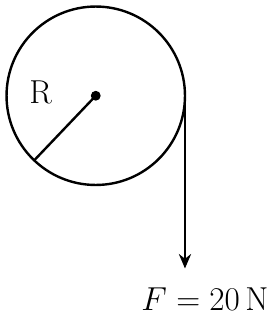
A cord of negligible mass is wound around the rim of a wheel supported by spokes with negligible mass. The mass of wheel is 10 kg and radius is 10 cm and it can freely rotate without any friction. Initially the wheel is at rest. If a steady pull of 20 N is applied on the cord, the angular velocity of the wheel, after the cord is unwound by 1 m, would be : 

  1. AOption (a)

     20 rad/s  

  2. BOption (b)

    30 rad/s 

  3. COption (c)

    10 rad/s 

  4. DOption (d)

    0 rad/s

View answer & explanation

Correct answer

Answer: (a)A.

 20 rad/s  

Why this answer is correct

Calculation:

WF = 20 × 1 = 20 J

Therefore, ΔKE = 20 J = (1/2) I ω²

I = M R² = 10 × 0.1² = 0.1 kg m²

Therefore, 20 = (1/2) × 0.1 × ω²

Implying, ω = 20 rad/sec

Question 129

JEE Main 2025• Physics Section A

A slanted object AB is placed on one side of convex lens as shown in the diagram. The image is formed on the opposite side. Angle made by the image with principal axis is : 

  1. AOption (a)

    −α2-\frac{\alpha}{2}

  2. BOption (b)

    −45∘-45^\circ

  3. COption (c)

    +45∘ +45^\circ

  4. DOption (d)

    −α-\alpha

View answer & explanation

Correct answer

Answer: (b)B.

−45∘-45^\circ

Why this answer is correct

Calculation:

Location of image of A :-

(1/v) - (1/u) = (1/f)

⇒ (1/v) - (1/(v - 30)) = (1/20)

⇒ (1/v) = (1/60)

⇒ v = 60 cm

The magnification m = 2.

Since the size of the object is small with respect to the location, hence

dv = m² du ⇒ dv = 4 × 1 = 4 cm

hi = m h0 ⇒ hi(dy) = 2 × 2 = 4 cm

Therefore, Angle made with principle a×is = -45°

Question 130

JEE Main 2025• Physics Section A

Consider two infinitely large plane parallel conducting plates as shown below. The plates are uniformly charged with a surface charge density +σ and −2σ+\sigma \text{ and } -2\sigma.The force experienced by a point charge +q placed at the mid point between two plates will be 

  1. AOption (a)

    σq4ϵ0\frac{\sigma q}{4 \epsilon_0} \qquad

  2. BOption (b)

    3σq2ϵ0\frac{3\sigma q}{2 \epsilon_0}

  3. COption (c)

    3σq4ϵ0 \frac{3\sigma q}{4 \epsilon_0} \qquad

  4. DOption (d)

    σq2ϵ0\frac{\sigma q}{2 \epsilon_0}

View answer & explanation

Correct answer

Answer: (b)B.

3σq2ϵ0\frac{3\sigma q}{2 \epsilon_0}

Why this answer is correct

Calculation:

Given:

Surface charge density on Plate 1, σ1 = +σ

Surface charge density on Plate 2, σ2 = -2σ

Point charge, q = +q at midpoint between plates

Distance between plates = d (charge at midpoint, so at d/2 from each plate)

Electric field due to Plate 1 (positive charge):

⇒ E1 = σ / (2ε0) directed away from Plate 1

Electric field due to Plate 2 (negative charge):

⇒ E2 = 2σ / (2ε0) = σ / ε0, directed toward Plate 2 (since negative charge)

Since charge q is at midpoint, the net electric field Enet is vector sum:

⇒ Enet = E1 (rightward) + E2 (rightward, since Plate 2's field points toward it)

⇒ Enet = (σ / 2ε0) + (σ / ε0) = (3σ) / (2ε0)

Force on point charge q:

⇒ F = q × Enet

⇒ F = q × (3σ) / (2ε0)

∴ Force on charge q = (3σ q) / (2ε0)