Search Previous Year Questions

Find real questions from previous competitive exam papers with answers and solutions.

Leave the keyword blank to browse saved questions for your selected exam, newest papers first. Add a keyword, year or topic to narrow the results.

Browse complete papers
Showing 8 question(s)
Clear

Question 41

JEE Advanced 2025• Physics

A cube of unit volume contains 35 × 107 photons of frequency 1015 Hz. If the energy of all the photons is viewed as the average energy being contained in the electromagnetic waves within the same volume, then the amplitude of the magnetic field is 𝛼 × 10−9 T. Taking permeability of free space μ0 = 4π × 10−7 Tm/A, Planck’s constant ℎ = 6 × 10⁻³⁴ Js and π = \(\frac{22}{7}\), the value of 𝛼 is ________.

View answer & explanation

Correct answer

Answer: 22.98Answer: 22.98

Why this answer is correct

Calculation:

Given:

Number of photons per unit volume: 35 × 107

Frequency: 1015 Hz

Planck’s constant: h = 6 × 10⁻³⁴ Js

Permeability of free space: μ0 = 4π × 10−7 Tm/A

〈u〉 = Energy per photon × Number of photons = h ν × n

〈u〉 = 6 × 10−34 × 1015 × 35 × 107

⇒〈u〉 = B02 / 2μ0 ⇒ B0 = √(2 μ0 〈u〉)

⇒ B0 = {2 × 4π × 10−7 × 35 × 107 × 6 × 10−34 × 1015}1/2

⇒ B0 = 22.978 × 10⁻⁹ T

Final Answer: α = 22.978

Question 42

JEE Advanced 2025• Physics

Two identical plates P and Q, radiating as perfect black bodies, are kept in vacuum at constant absolute temperatures TP and TQ, respectively, with TQ < TP, as shown in Fig. 1. The radiated power transferred per unit area from P to Q is 𝑊0. Subsequently, two more plates, identical to P and Q, are introduced between P and Q, as shown in Fig. 2. Assume that heat transfer takes place only between adjacent plates. If the power transferred per unit area in the direction from P to Q (Fig. 2) in the steady state is 𝑊𝑆, then the ratio \(\frac{W_{0}}{W_{S}}\) is _______

View answer & explanation

Correct answer

Answer: 3Answer: 3

Why this answer is correct

Calculation:

From Fig. 1:

W0 = σ A (TP4 - TQ4)

From Fig. 2 (two intermediate screens inserted):

WS = σ (TP4 - T14) = σ (T14 - T24) = σ (T24 - TQ4)

⇒ Each step has the same energy flow, so:

3WS = σ (TP4 - TQ4) = W0

⇒ ½W0 / WS = 3

Final Answer: 3.00

Question 43

JEE Advanced 2025• Physics

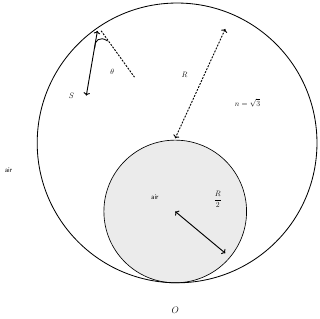
A solid glass sphere of refractive index 𝑛 = √3 and radius 𝑅 contains a spherical air cavity of radius \(\frac{\mathrm{R}}{2}\), as shown in the figure. A very thin glass layer is present at the point O so that the air cavity (refractive index 𝑛 = 1) remains inside the glass sphere. An unpolarized, unidirectional and monochromatic light source 𝑆 emits a light ray from a point inside the glass sphere towards the periphery of the glass sphere. If the light is reflected from the point O and is fully polarized, then the angle of incidence at the inner surface of the glass sphere is 𝜃. The value of sin 𝜃 is _______

View answer & explanation

Correct answer

Answer: 0.75Answer: 0.75

Why this answer is correct

Calculation:

θB = tan-1(n) = tan-1(√3) = 60°

r = ∠BCD = 60°, i = ∠BCE = 30°

AE = 3R / 4, AD = R ⇒ sin(θ) = AE / AD = 3 / 4 = 0.75

For light to be fully polarized at point O, it must be incident at Brewster’s angle:

For refraction at C (glass to air interface):

Since CE is the angle bisector of ∠BCE, it is perpendicular to BD.

In triangle geometry:

Final Answer: sin(θ) = 0.75

Question 44

JEE Advanced 2025• Physics

A single slit diffraction experiment is performed to determine the slit width using the equation, \(\frac{b d}{D}\) = mλ, where 𝑏 is the slit width, 𝐷 the shortest distance between the slit and the screen, 𝑑 the distance between the 𝑚th diffraction maximum and the central maximum, and λ is the wavelength. D and 𝑑 are measured with scales of least count of 1 cm and 1 mm, respectively. The values of λ and m are known precisely to be 600 nm and 3, respectively. The absolute error (in 𝜇m) in the value of 𝑏 estimated using the diffraction maximum that occurs for 𝑚 = 3 with 𝑑 = 5 mm and 𝐷 = 1 m is _______

View answer & explanation

Correct answer

Answer: 75.6Answer: 75.6

Why this answer is correct

Calculation:

Given the diffraction condition: b = mλ (D / d)

To find absolute error in b, use error propagation:

Δb = mλ (D Δd + d ΔD) / d2

Substitute values:

m = 3, λ = 600 × 10−9 m, D = 1 m, ΔD = 1 × 10⁻² m, d = 5 × 10⁻³ m, Δd = 1 × 10⁻³ m

⇒ Δb = 3 × 600 × 10−9 (1 × 1 × 10−3 + 5 × 10−3 × 10−2) / (5 × 10⁻³)2

⇒Δb = 1800 × 10−9 × 42 = 75.6 × 10⁻⁶ m

Final Answer: Δb = 75.6 μm

Question 45

JEE Advanced 2025• Physics

Consider an electron in the 𝑛 = 3 orbit of a hydrogen-like atom with atomic number 𝑍. At absolute temperature 𝑇, a neutron having thermal energy 𝑘B𝑇 has the same de Broglie wavelength as that of this electron. If this temperature is given by T = \(\frac{Z^{2} h^{2}}{\alpha \pi^{2} a_{0}^{2} m_{N} k_{B}}\),  (where ℎ is the Planck’s constant, 𝑘𝐵 is the Boltzmann constant, 𝑚N is the mass of the neutron and 𝑎0 is the first Bohr radius of hydrogen atom) then the value of 𝛼 is _______

View answer & explanation

Correct answer

Answer: 72Answer: 72

Why this answer is correct

Calculation:

Given:

Electron is in n = 3 orbit of a hydrogen-like atom with atomic number Z

Neutron has thermal energy kB T

de Broglie wavelengths are equal: λelectron = λneutron

For electron:

λ = 2πr / n = 2π / n × (n2 / Z) a0 = (2πn / Z) a0

For n = 3:

λ = 6π / Z a0

For thermal neutron:

λ = h / √(2mN kB T)

Equating both:

h / √(2mN kB T) = 6π / Z a0

⇒ √(2mN kB T) = Z h / 6π a0

⇒ 2mN kB T = (Z2 h2) / (36π2 a02)

⇒ T = (Z2 h2) / (72π2 a02 mN kB)

⇒α  = 72

Question 46

JEE Advanced 2025• Physics

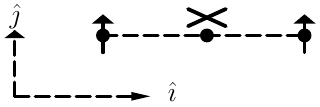
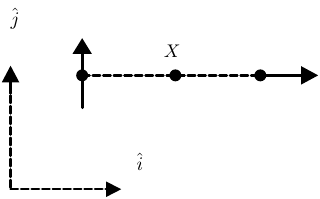
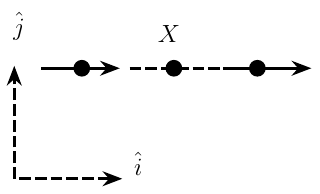
List-I shows four configurations, each consisting of a pair of ideal electric dipoles. Each dipole has a dipole moment of magnitude 𝑝, oriented as marked by arrows in the figures. In all the configurations the dipoles are fixed such that they are at a distance 2𝑟 apart along the 𝑥 direction. The midpoint of the line joining the two dipoles is 𝑋. The possible resultant electric fields \(\vec{E}\) at 𝑋 are given in List-II. Choose the option that describes the correct match between the entries in List-I to those in List-II. 

List-IList-II
(P)(1)\(\vec{E}\) = 0
(Q)(2)\(\vec{E}\) = \(-\frac{p}{2 \pi \epsilon_{0} r^{3}} \hat{\mathrm{j}}\)
(R)(3)\(\vec{E}\) = \(-\frac{p}{4 \pi \epsilon_{0} r^{3}}(\hat{\mathrm{i}}-\hat{\mathrm{j}})\)
(S)(4)\(\vec{E}\) = \(=\frac{p}{4 \pi \epsilon_{0} \mathrm{r}^{3}}(2 \hat{\mathrm{i}}-\hat{\mathrm{j}})\)
(5)\(\vec{E}\) = \(\frac{p}{\pi \epsilon_{0} \mathrm{r}^{3}} \hat{\mathrm{i}}\)
  1. AOption (a)

    P→3, Q→1, R→2, S→4

  2. BOption (b)

    P→4, Q→5, R→3, S→1

  3. COption (c)

    P→2, Q→1, R→4, S→5

  4. DOption (d)

    P→2, Q→1, R→3, S→5

View answer & explanation

Correct answer

Answer: (c)C.

P→2, Q→1, R→4, S→5

Why this answer is correct

Calculation:

The electric field due to a dipole at a point in space depends on the position relative to the dipole. It is typically expressed in terms of:

E = (1 / 4πε0) × (p / r3)

Pointwise Breakdown:

For P:

E = (1 / 4πε0) × (p / r3) × 2(-↓) = - (p / 2πε0 r3) ↓

For Q:

E = 0

(This is typically the center of the dipole, where the fields cancel.)

ForcR:

E = (p / 4πε0 r3) × (2→ - ↓)

For S:

E = 2 × (p / 4πε0 r3) × 2(→) = - (p / πε0 r3) →

(Note: The final expression has a negative sign, which likely comes from vector direction considerations.)

Question 47

JEE Advanced 2025• Physics

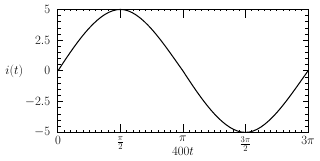
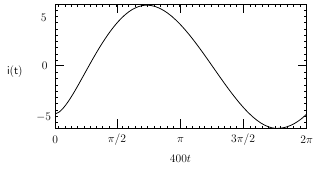
A circuit with an electrical load having impedance 𝑍 is connected with an AC source as shown in the diagram. The source voltage varies in time as V(𝑡) = 300 sin(400𝑡) V, where 𝑡 is time in s. List-I shows various options for the load. The possible currents i(𝑡) in the circuit as a function of time are given in List-II. 

Choose the option that describes the correct match between the entries in List-I to those in List-II. 

List-IList-II
(P)(1)
(Q)(2)
(R)(3)
(S)(4)
(5)
  1. AOption (a)

    P→3, Q→5, R→2, S→1

  2. BOption (b)

    P→1, Q→5, R→2, S→3

  3. COption (c)

    P→3, Q→4, R→2, S→1

  4. DOption (d)

    P→1, Q→4, R→2, S→5

View answer & explanation

Correct answer

Answer: (a)A.

P→3, Q→5, R→2, S→1

Why this answer is correct

Calculation:

Given Expressions for  (P), (Q), (R), and (S):

(P): Given voltage: vz = 10 sin(400t)   (volts)

Impedance: Z = R   ⇒   Purely resistive

(Q): Z = jωL,   ω = 400,   L = x   (inductive)

Voltage: V = 6 sin(400t - 53°)   V

(R): Z = jωL + R = 50 + j10,   ⇒   |Z| = √(502 + 102) = √2600

Voltage: V = 6 sin(400t + 53°)   V

(Phase shift is positive, indicating a capacitive nature.)

(S): Z = jωL + R = 60 + j60,   ⇒   |Z| = √(602 + 602) = 60√2

Voltage: V = 300 sin(400t) / 60√2 = 5 sin(400t)

Question 48

JEE Advanced 2025• Physics

List-I shows various functional dependencies of energy (𝐸) on the atomic number (𝑍). Energies associated with certain phenomena are given in List-II.

Choose the option that describes the correct match between the entries in List-I to those in List-II. 

List-IList-II
(P)E ∝ Z2(1)energy of characteristic x-rays
(Q)E ∝ (Z – 1)2(2)electrostatic part of the nuclear binding energy for stable nuclei with mass numbers in the range 30 to 170
(R)E ∝ Z (Z – 1)(3)energy of continuous x-rays
(S)E is practically independent of 𝑍(4)average nuclear binding energy per nucleon for stable nuclei with mass number in the range 30 to 170
(5)energy of radiation due to electronic transitions from hydrogen-like atoms
  1. AOption (a)

    P→4, Q→3, R→1, S→2  

  2. BOption (b)

    P→5, Q→2, R→1, S→4

  3. COption (c)

    P→5, Q→1, R→2, S→4  

  4. DOption (d)

    P→3, Q→2, R→1, S→5

View answer & explanation

Correct answer

Answer: (c)C.

P→5, Q→1, R→2, S→4  

Why this answer is correct

Calculation:

For (P): E ∝ Z2

Energy of radiation due to electronic transition in hydrogen-like atoms.

Ex- In hydrogen-like atoms, energy levels are given by: En = -13.6 Z2 / n2 eV, so energy difference scales with Z2.

for (Q): E ∝ (Z - 1)2

Energy of Kα characteristic X-rays.

Ex- Moseley’s law: ν ∝ (Z - 1)2 accounts for the screening effect of inner electrons.

For (R): E ∝ Z(Z - 1)

Coulombic repulsion energy among protons in a nucleus.

Ex- Total Coulomb energy scales like: ECoulomb ∝ Z(Z - 1) / R (where R ∝ A1/3).

For (S): Binding energy per nucleon is nearly constant for nuclei with mass number 30 < A < 170.

This is a well-known trend and is maximum around iron (A ≈ 56).

Page 5
Next