Search Previous Year Questions

Find real questions from previous competitive exam papers with answers and solutions.

Leave the keyword blank to browse saved questions for your selected exam, newest papers first. Add a keyword, year or topic to narrow the results.

Browse complete papers
Showing 10 question(s)
Clear

Question 31

JEE Advanced 2025• Mathematics

Let ℝ denote the set of all real numbers. For a real number x, let [x] denote the greatest integer less than or equal to x. Let n denote a natural number.

Match each entry in List-I to the correct entry in List-II and choose the correct option. 

List-IList-II
(P)The minimum value of n for which the function ƒ(x) = \(\left[\frac{10 x^{3}-45 x^{2}+60 x+35}{n}\right]\) is continuous on the interval [1, 2], is(1)8
(Q)The minimum value of n for which g(x) = (2n2 - 13n - 15)(x3 + 3x), x c, is an increasing function on ℝ, is(2)9
(R)The smallest natural number n which is greater than 5, such that x = 3 is a point of local minima of h(x) = (x2 – 9)n(x2 + 2x + 3), is(3)5
(S)Number of x0 ∈ ℝ such that ' \(l(x)=\sum_{k=0}^{4}\left(\sin |x-k|+\cos \left|x-k+\frac{1}{2}\right|\right), x \in \mathbb{R},\) is NOT differentiable at x0, is(4)6
(5)10
  1. AOption (a)

    (P)→(1), (Q)→(3), (R)→(2), (S)→(5)

  2. BOption (b)

    (P)→(2), (Q)→(1), (R)→(4), (S)→(3)

  3. COption (c)

    (P)→(5), (Q)→(1), (R)→(4), (S)→(3)

  4. DOption (d)

    (P)→(2), (Q)→(3), (R)→(1), (S)→(5)

View answer & explanation

Correct answer

Answer: (b)B.

(P)→(2), (Q)→(1), (R)→(4), (S)→(3)

Why this answer is correct

Concept:

  • The question involves testing continuity of rational functions, minima of polynomial functions, and differentiability of composite trigonometric and floor functions.
  • Continuity requires the numerator and denominator to cancel out the points where the denominator becomes zero.
  • For finding the minima, the first derivative is used to locate critical points, and the second derivative test confirms whether the point is a minima.
  • Non-differentiability occurs where absolute functions like sin |x - k| cause sharp turns (cusps).


Calculation:

P) Let k(x) = 10x3 - 45x2 + 60x + 35

⇒ k′(x) = 30x2 - 90x + 60 = 30(x - 1)(x - 2)

⇒ k(x) is continuous in [1, 2]

⇒ [k(1), k(2)] are same integer for all x ∈ [1, 2]

⇒ Minimum value of n = 9     

(P → 2)

Q) g(x) = (2n2 - 13n - 15) / (n2 + 3x)

⇒ (2n2 - 13n - 15) / (n2 + 3x) ≥ 0 for g(x) ≥ 0 for g(x) = mix of n & x

⇒ Minimum value of n is 5     

(Q → 1)

R) h(x) = (x2 - 9)2(x2 + 2x + 3)

⇒ h(x) has a local minima at x = 3 for n = 6

⇒ (3 + δ) h(3 + δ) (δ is a small positive real number)

⇒ has local minimum at x = 3 for n = 6

⇒ (R → 4)

S) g(x) = sin |x - k| + cos |x - k - 1/2| + sin |x - k - 1| + cos |x - k - 3/2| + ⋯ + sin |x - 4| + cos |x - 9/2|

as sin |x - k| is non-differentiable at x = k    

but, cos |x - λ| is differentiable at x = λ

⇒ g(x) is non-differentiable at x0 = 0, 1, 2, 3, 4 (5 points)

⇒ (S → 3)

∴ The correct matching is P → 2, Q → 1, R → 4, S → 3.

Hence, Option 2 is the correct answer.

Question 32

JEE Advanced 2025• Mathematics

Let \(\vec{w}=\hat{i}+\hat{j}-2 \hat{k}\), and \(\overrightarrow{\mathrm{u}} \) and \( \overrightarrow{\mathrm{v}}\)  be two vectors such that \(\vec{u} \times \vec{v}=\vec{w} \) and \(\vec{v} \times \vec{w}=\vec{u} \). Let α, β, γ and t be real numbers such that 

\(\vec{u}=α \hat{i}+β \hat{j}+γ \hat{k},-t α+β+γ=0, α-t β+γ=0, \text { and } α+β-t γ=0 .\)

Match each entry in List-I to the correct entry in List-II and choose the correct option.

List-IList-II
(P)\(|\vec{v}|^{2}\) is equal to (1)0
(Q)If α = √3 then γ2 is equal to(2)1
(R)If α = √3 then (β + γ )2 is equal to(3)2
(S)If α = √2 then t + 3 is equal to(4)3
(5)5
  1. AOption (a)

    (P)→(2), (Q)→(1), (R)→(4), (S)→(5)

  2. BOption (b)

    (P)→(2), (Q)→(4), (R)→(3), (S)→(5)

  3. COption (c)

    (P)→(2), (Q)→(1), (R)→(4), (S)→(3)

  4. DOption (d)

    (P)→(5), (Q)→(4), (R)→(1), (S)→(3)

View answer & explanation

Correct answer

Answer: (a)A.

(P)→(2), (Q)→(1), (R)→(4), (S)→(5)

Why this answer is correct

Concept:

  • The vectors u̅, v̅, and w̅ are mutually perpendicular vectors.
  • Given u̅ × v̅ = w̅ and v̅ × w̅ = u̅, these satisfy the cross-product properties of mutually orthogonal vectors.
  • The magnitudes and dot products follow the identity: (v̅ × w̅) × v̅ = w̅
  • Applying vector triple product:
  • w̅(v̅ · v̅) − v̅(v̅ · w̅) = w̅
  • w̅(|v̅|² − 1) − v̅(v̅ · w̅) = 0̅
  • For non-zero w̅, we conclude |v̅|² = 1 and v̅ · w̅ = 0.


Calculation:

Given,

w̅ = î + ĵ − 2k̂

αa + βb + γc equations:

⇒ -tα + β + γ = 0 ..........(i)

⇒ α − tβ + γ = 0 ..........(ii)

⇒ α + β − tγ = 0 ..........(iii)

Subtract (ii) − (iii):

⇒ α(1 + t) + β(1 + t) = (t + 1)γ

Subtract (iii) − (i):

⇒ β(1 + t) + γ(1 + t) = (t + 1)α

Subtract (i) − (ii):

⇒ α(1 + t) + γ(1 + t) = (t + 1)β

Either t = −1 or α = β = γ:

⇒ √(α² + β² + γ²) = √6

Let α = √2, then:

⇒ tα − α = −α − tα

⇒ t = 2

For α = √3:

⇒ t = −1

⇒ α + β + γ = 0

⇒ α + β − 2γ = 0

⇒ γ = 0

Calculating List-I:

Q) If α = √3, then γ² = 0 ⇒ 1

P) |w̅|² = |î + ĵ − 2k̂|² = 1 + 1 + 4 ⇒ 6

But as per List-II options, for |v̅|² = 1 ⇒ (P) → 2

R) If α = √3, then (β² + γ²) = 3 ⇒ (R) → 4

S) If α = √2, then t + 3 = 2 + 3 = 5 ⇒ (S) → 5

∴ Final Matching is: (P) → 2, (Q) → 1, (R) → 4, (S) → 5.

Correct option: (1)

Question 33

JEE Advanced 2025• Physics

The center of a disk of radius r and mass m is attached to a spring of spring constant k, inside a ring of radius R > r as shown in the figure. The other end of the spring is attached on the periphery of the ring. Both the ring and the disk are in the same vertical plane. The disk can only roll along the inside periphery of the ring, without slipping. The spring can only be stretched or compressed along the periphery of the ring, following the Hooke’s law. In equilibrium, the disk is at the bottom of the ring. Assuming small displacement of the disc, the time period of oscillation of center of mass of the disk is written as T = \(\frac{2 \pi}{ω}\). The correct expression for ω is (g is the acceleration due to gravity): 

  1. AOption (a)

    \(\sqrt{\frac{2}{3}\left(\frac{g}{R-r}+\frac{k}{m}\right)}\)

  2. BOption (b)

    \(\sqrt{\frac{2 g}{3(R-r)}+\frac{k}{m}}\)

  3. COption (c)

    \(\sqrt{\frac{1}{6}\left(\frac{g}{R-r}+\frac{k}{m}\right)}\)

  4. DOption (d)

    \(\sqrt{\frac{1}{4}\left(\frac{g}{R-r}+\frac{k}{m}\right)}\)

View answer & explanation

Correct answer

Answer: (a)A.

\(\sqrt{\frac{2}{3}\left(\frac{g}{R-r}+\frac{k}{m}\right)}\)

Why this answer is correct

Calculation:

From conservation of energy:

Total mechanical energy = Translational KE + Rotational KE + Spring PE + Gravitational PE

⇒ (1/2) m v2 + (1/2) (ICM + m(R − r)2) θ̇2 + (1/2) k ((R − r) θ)2 + mg (R − r)(1 − cosθ) = Constant

For rolling without slipping v = (R-r)θ̇ = rϕ̇   

Total energy:

E = (1/2) m(R−r)2θ̇2 + (1/2)((1/2)mr2 + m(R−r)2)θ̇2 + (1/2)k(R−r)2θ2 + mg(R−r)(1−cosθ) = constant

Differentiating w.r.t time:

⇒ [ (3/4) m(R−r)2 + (1/4) m r2 ] θ̈ + [ k(R−r)2/2 + mg(R−r) ] θ = 0

⇒ θ̈ + ω2θ = 0

⇒ ω2 = [k(R−r)2/2 + mg(R−r)] / [ (3/4) m(R−r)2 + (1/4) m r2 ]

Neglecting r2 as r << (R−r):

⇒ ω = √[(2/3)(k/m + g/(R−r))] ϕ 

Therefore, correct option is A.

Question 34

JEE Advanced 2025• Physics

In a scattering experiment, a particle of mass 2m collides with another particle of mass m, which is initially at rest. Assuming the collision to be perfectly elastic, the maximum angular deviation θ of the heavier particle, as shown in the figure, in radians is: 

  1. AOption (a)

    π

  2. BOption (b)

    tan-1\(\left(\frac{1}{2}\right)\)

  3. COption (c)

    \(\frac{\pi}{3}\)

  4. DOption (d)

    \(\frac{\pi}{6}\)

View answer & explanation

Correct answer

Answer: (d)D.

\(\frac{\pi}{6}\)

Why this answer is correct

Calculation:

From the conservation of momentum:

2m v1 = 2m v1f cos θ + 2m v2f cos ϕ     (i)

2m v1f sin θ = m v2f sin ϕ     (ii)

Using conservation of kinetic energy:

1/2 (2m) v12 + 1/2 m (0)2 = 1/2 (2m) v1f2 + 1/2 m v2f2     (iii)

⇒ 2 v12 = 2 v1f2 + v2f2     (iv)

From equations (i), (ii), and (iii), we get:

3 v1f2 − 4 v1 v1f cos θ + v2f2 = 0

⇒ (−4 v1 cos θ)2 − 4(3)(v12) ≥ 0

cos2 θ ≥ 3/4

⇒ cos θ ≥ √3/2

⇒ θ = π / 6

Therefore, the correct option is D: π / 6.

Question 35

JEE Advanced 2025• Physics

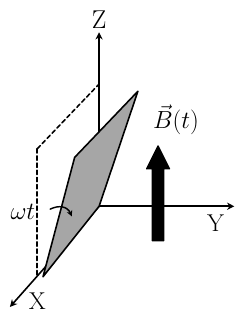
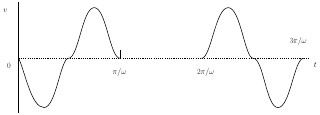
A conducting square loop initially lies in the XZ plane with its lower edge hinged along the X-axis. Only in the region y ≥ 0, there is a time dependent magnetic field pointing along the Z-direction, \(\vec{B}(t)=B_{0}(\cos ω t) \hat{K}\) where B0 is a constant. The magnetic field is zero everywhere else. At time t = 0, the loop starts rotating with constant angular speed ω about the X axis in the clockwise direction as viewed from the +X axis (as shown in the figure). Ignoring self-inductance of the loop and gravity, which of the following plots correctly represents the induced e.m.f. (V) in the loop as a function of time:

  1. AOption (a)

  2. BOption (b)

  3. COption (c)

  4. DOption (d)

View answer & explanation

Correct answer

Answer: (a)A.

Why this answer is correct

Calculation:

The induced emf is given by: ε = -dϕ/dt

The magnetic flux ϕ is: ϕ = B ⋅ A = B A sin(ωt)

For y ≥ 0: B = B0 cos(ωt)

For y ≤ 0: B = 0

For rotation from t = 0 to t = T/2: The loop will be in the magnetic field, and thus there will be flux. But for t ≥ T/2, there is no flux, and hence no induced emf.

Thus, for 0 ≤ t ≤ T/2:

The flux is: ϕ = (A B0)/2 sin(2ωt)

Induced emf: ε = -dϕ/dt = -ω B0 cos(2ωt) A

⇒

Question 36

JEE Advanced 2025• Physics

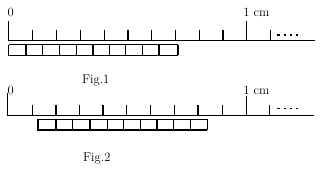
Figure 1 shows the configuration of main scale and Vernier scale before measurement. Fig. 2 shows the configuration corresponding to the measurement of diameter D of a tube. The measured value of D is: 

  1. AOption (a)

    0.12 cm 

  2. BOption (b)

    0.11 cm 

  3. COption (c)

    0.13 cm  

  4. DOption (d)

    0.14 cm 

View answer & explanation

Correct answer

Answer: (c)C.

0.13 cm  

Why this answer is correct

Calculation:

 1 MSD = 0.1 cm

7 MSD = 10 VSD

∴ VC = 1 MSD − 1 VSD = (3/10) MSD = 0.03 cm

Measured value

= MSR + VSR = 0.1 + 0.03 = 0.13 cm

Therefore, the measured value of diameter D is 0.13 cm, which corresponds to option C.

Question 37

JEE Advanced 2025• Physics

A conducting square loop of side L, mass M and resistance R is moving in the XY plane with its edges parallel to the X and Y axes. The region y ≥ 0 has a uniform magnetic field, \(\vec{B}=B_{0} k\). The magnetic field is zero everywhere else. At time t = 0, the loop starts to enter the magnetic field with an initial velocity \(v_{0} \hat{\jmath}\) m/s, as shown in the figure. Considering the quantity K = \(\frac{B_{0}^{2} L^{2}}{R M}\) in appropriate units, ignoring self-inductance of the loop and gravity, which of the following statements is/are correct:  

  1. AOption (a)

    If v0 = 1.5KL, the loop will stop before it enters completely inside the region of magnetic field.

  2. BOption (b)

    When the complete loop is inside the region of magnetic field, the net force acting on the loop is zero.  

  3. COption (c)

    If v0 = \(\frac{K L}{10}\), the loop comes to rest at t = \(\left(\frac{1}{K}\right) \ln \left(\frac{5}{2}\right)\).

  4. DOption (d)

    If v0 = 3KL, the complete loop enters inside the region of magnetic field at time t = \(\left(\frac{1}{K}\right) \ln \left(\frac{3}{2}\right)\).

View answer & explanation

Correct answer

Answer: (a)A.

If v0 = 1.5KL, the loop will stop before it enters completely inside the region of magnetic field.

Why this answer is correct

Calculation:

For x < L

i = B0 l v / R

mv dv/dx = B02 l2 / R v ⇒ ∫v<sub>0</sub>v v dv = −(B02 l2) / (mR) ∫0x dx ⇒ v = v0 − kx

Also, dv/dt = −kv ⇒ ∫v<sub>0</sub>v (dv / v) = −k ∫0t dt ⇒ v = v0 e−kt ⇒ t = 1 / k ln(v0 / v) = 1 / k ln(v0 / (v0 − kx))

If v0 > KL, the loop will fully enter the region of the magnetic field after time:

t = 1 / k ln(v0 / (v0 − KL))

and continue to move with velocity:

v = v0 − KL

Question 38

JEE Advanced 2025• Physics

Length, breadth and thickness of a strip having a uniform cross section are measured to be 10.5 cm, 0.05 mm, and 6.0 µm, respectively. Which of the following option(s) give(s) the volume of the strip in cm3 with correct significant figures:

  1. AOption (a)

    3.2 × 10⁻⁵ 

  2. BOption (b)

    32.0 × 10⁻⁶ 

  3. COption (c)

    3.0 × 10⁻⁵ 

  4. DOption (d)

    3 × 10⁻⁵

View answer & explanation

Correct answer

Answer: (a)A.

3.2 × 10⁻⁵ 

Why this answer is correct

Explanation:

The number of significant figures in the result must be equal to the number of significant figures in the measured value with the least number of significant figures.

For example, in the measured value 0.05 mm, there is only 1 significant figure.

Question 39

JEE Advanced 2025• Physics

Consider a system of three connected strings, S1 , S2 and S3 with uniform linear mass densities μ kg/m, 4μ kg/m and 16μ kg/m, respectively, as shown in the figure. S1 and S2 are connected at the point P, whereas S2 and S3 are connected at the point Q, and the other end of S3 is connected to a wall. A wave generator O is connected to the free end of S1 . The wave from the generator is represented by y = y0 cos(ωt − kx) cm, where y0 , ω and k are constants of appropriate dimensions. Which of the following statements is/are correct:

  1. AOption (a)

    When the wave reflects from P for the first time, the reflected wave is represented by  y = α1y0 cos(ωt + kx + π) cm, where α1 is a positive constant.

  2. BOption (b)

    When the wave transmits through P for the first time, the transmitted wave is represented by y = α2y0 cos(ωt - kx) cm, where α2 is a positive constant.

  3. COption (c)

    When the wave reflects from Q for the first time, the reflected wave is represented by y = α3y0 cos(ωt - kx + π) cm, where α3 is a positive constant.

  4. DOption (d)

    When the wave transmits through Q for the first time, the transmitted wave is represented by y = α4y0 cos(ωt - 4kx) cm, where α4 is a positive constant.

View answer & explanation

Correct answer

Answer: (a)A.

When the wave reflects from P for the first time, the reflected wave is represented by  y = α1y0 cos(ωt + kx + π) cm, where α1 is a positive constant.

Why this answer is correct

Calculation:

At point P, the wave moves from a lighter string (μ) to a denser string (4μ), hence:

y = α1 y0 cos(ωt + kx + π)

y = α2 y0 cos(ωt - kx)

Reflected wave: undergoes a phase change of π, so the equation becomes:

Transmitted wave: enters the denser medium, no phase change, so:

At point Q, the wave again moves from 4μ to 16μ (denser), so:

y = α3 y0 cos(ωt - kx + π)

y = α4 y0 cos(ωt - 4kx)

Reflected wave: undergoes a phase change of π, becomes:

Transmitted wave: in a medium with 4× linear mass density → the wave number becomes 4k:

Thus, options A and D are correct.

Question 40

JEE Advanced 2025• Physics

A person sitting inside an elevator performs a weighing experiment with an object of mass 50 kg. Suppose that the variation of the height y (in m) of the elevator, from the ground, with time t (in s) is given by y = \(8\left[1+\sin \left(\frac{2 π t}{T}\right)\right]\), where T = 40π s. Taking acceleration due to gravity, g = 10 m/s2,  the maximum variation of the object's weight (in N) as observed in the experiment is _______.

View answer & explanation

Correct answer

Answer: 2Answer: 2

Why this answer is correct

Calculation:

Given:

y = 8(1 + sin(t / 20))

Differentiate to find acceleration:

Velocity: ẏ = 8 / 20 cos(t / 20)

Acceleration: ÿ = -8 / 202 cos(t / 20)

Weight in elevator is given by:

W = m(g + ÿ)

Maximum variation in weight occurs due to the maximum value of ÿ:

Max variation in W = 2m(8 / 202) = 2(50)(8 / 400) = 2 N