Search Previous Year Questions

Find real questions from previous competitive exam papers with answers and solutions.

Leave the keyword blank to browse saved questions for your selected exam, newest papers first. Add a keyword, year or topic to narrow the results.

Browse complete papers
Showing 10 question(s)
Clear

Question 1

JEE Advanced 2025• Chemistry

The heating of NH4NO2 at 60–70ºC and NH4NO3 at 200–250ºC is associated with the formation of nitrogen containing compounds X and Y, respectively. X and Y, respectively, are

  1. AOption (a)

    N2 and N2O

  2. BOption (b)

    NH3 and NO2

  3. COption (c)

    NO and N2O

  4. DOption (d)

    N2 and NH3

View answer & explanation

Correct answer

Answer: (a)A.

N2 and N2O

Why this answer is correct

CONCEPT:

Decomposition of Ammonium Nitrate (NH4NO3)

  • Ammonium nitrate (NH4NO3) undergoes decomposition when heated at different temperatures. The products of this decomposition depend on the temperature range at which the heating occurs.
  • At temperatures between 60°C and 70°C, NH4NO3 decomposes to form nitrogen (N2) and water (H2O).
  • At higher temperatures, around 200°C to 250°C, NH4NO3 decomposes to form nitrogen dioxide (NO2) and water (H2O), along with other nitrogen compounds.

EXPLANATION:

  • The decomposition of NH4NO3 at lower temperatures (60°C-70°C) leads to the formation of nitrogen (N2) and water:

2 NH4NO3 → N2 + 4 H2O

  • At higher temperatures (200°C-250°C), NH4NO3 decomposes to form nitrogen dioxide (NO2) and water:

2 NH4NO3 → 2 NO2 + 2 H2O

  • Therefore, the compounds formed at these two temperature ranges are nitrogen (N2) and nitrogen dioxide (NO2), respectively.

Therefore, the correct answer is A) N2 and N2O.
Question 2

JEE Advanced 2025• Chemistry

The correct order of the wavelength maxima of the absorption band in the ultraviolet-visible region for the given complexes is

  1. AOption (a)

    [Co(CN)6]3– < [Co(NH3)6]3+ < [Co(NH3)5(H2O)]3+ < [Co(NH3)5(Cl)]2+

  2. BOption (b)

    [Co(NH3)5(Cl)]2+ < [Co(NH3)5(H2O)]3+ < [Co(NH3)6]3+ < [Co(CN)6]3–

  3. COption (c)

    [Co(CN)6]3– < [Co(NH3)5(Cl)]2+ < [Co(NH3)5(H2O)]3+ < [Co(NH3)6]3+ 

  4. DOption (d)

    [Co(NH3)6]3+ < [Co(CN)6]3– < [Co(NH3)5(Cl)]2+ < [Co(NH3)5(H2O)]3+

View answer & explanation

Correct answer

Answer: (a)A.

[Co(CN)6]3– < [Co(NH3)6]3+ < [Co(NH3)5(H2O)]3+ < [Co(NH3)5(Cl)]2+

Why this answer is correct

CONCEPT:

Absorption Band Maxima and Ligand Field Theory

  • The absorption band maxima in the ultraviolet-visible region of transition metal complexes are influenced by the ligand field around the metal ion.
  • According to ligand field theory, the nature of the ligands affects the splitting of the d-orbitals in the metal center, which determines the energy gap between the higher and lower d-orbitals. This energy gap corresponds to the absorption of light in the visible or ultraviolet region.
  • Ligands that create a stronger ligand field (such as cyanide) cause a larger splitting of the d-orbitals, leading to absorption at lower wavelengths (higher energy). On the other hand, ligands that create a weaker field (such as chloride or water) lead to smaller splittings, resulting in absorption at higher wavelengths (lower energy).

EXPLANATION:

  • For the given complexes, the ligand field strengths are as follows:
  • [Co(CN)6]3– (cyanide) is the strongest field ligand, leading to a larger splitting of the d-orbitals.
  • [Co(NH3)6]3+ (ammonia) is a moderate field ligand, causing moderate splitting.
  • [Co(NH3)5(H2O)]3+ (water) creates a weaker ligand field compared to ammonia.
  • [Co(NH3)5(Cl)]2+ (chloride) also creates a weaker field, but stronger than water.
  • The absorption maxima for these complexes would follow this order:
  • [Co(CN)6]3– (strongest field, highest absorption energy, shortest wavelength)
  • [Co(NH3)6]3+ (moderate field strength, intermediate absorption energy)
  • [Co(NH3)5(Cl)]2+ (weaker field than ammonia, lower absorption energy)
  • [Co(NH3)5(H2O)]3+ (weakest field, lowest absorption energy, longest wavelength)
  • Thus, the correct order of the wavelength maxima of the absorption band is:
  • Option 1: [Co(CN)6]3– < [Co(NH3)6]3+ < [Co(NH3)5(H2O)]3+ < [Co(NH3)5(Cl)]2+

Therefore, the correct answer is Option 1: [Co(CN)6]3– < [Co(NH3)6]3+ < [Co(NH3)5(H2O)]3+ < [Co(NH3)5(Cl)]2+.

Question 3

JEE Advanced 2025• Chemistry

One of the products formed from the reaction of permanganate ion with iodide ion in neutral aqueous medium is

  1. AOption (a)

    I2

  2. BOption (b)

    \(\mathrm{IO}_{3}^{-}\)

  3. COption (c)

    \(\mathrm{IO}_{4}^{-}\)

  4. DOption (d)

    \(\mathrm{IO}_{2}^{-}\)

View answer & explanation

Correct answer

Answer: (b)B.

\(\mathrm{IO}_{3}^{-}\)

Why this answer is correct

CONCEPT:

Reaction of Permanganate Ion with Iodide Ion in Neutral Aqueous Medium

  • The reaction of permanganate ion (MnO4–) with iodide ion (I–) in a neutral aqueous medium leads to the reduction of the permanganate ion and the oxidation of iodide ion.
  • In a neutral medium, the permanganate ion is reduced to MnO2 (manganese dioxide), and iodide ions are oxidized to form iodate ions (IO3–).
  • The balanced chemical equation for this reaction is as follows:
  • 2MnO4– + 2I– + 2H2O → 2MnO2 + 2OH– + I2 (in acidic medium)
  • In a neutral medium, the final product of iodide oxidation is IO3– (iodate ion). Therefore, the permanganate ion is reduced to MnO2 while iodide ion is oxidized to iodate (IO3–).

EXPLANATION:

  • In neutral aqueous medium, the iodide ion (I–) is oxidized by permanganate to form iodate (IO3–), which is the main product of the reaction.
  • The reduction of permanganate results in the formation of manganese dioxide (MnO2), which is a solid product.
  • Thus, the correct product formed from the reaction of permanganate ion with iodide ion in neutral aqueous medium is IO3–.
  • Hence, the correct answer is IO3– (Iodate ion).

Therefore, the correct answer is IO3–.

Question 4

JEE Advanced 2025• Chemistry

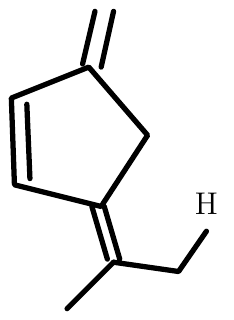
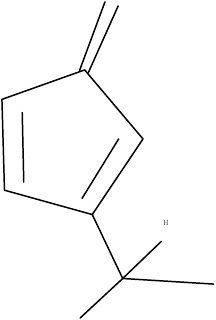
Consider the depicted hydrogen (H) in the hydrocarbons given below. The most acidic hydrogen (H) is

  1. AOption (a)

  2. BOption (b)

  3. COption (c)

  4. DOption (d)

View answer & explanation

Correct answer

Answer: (b)B.

Why this answer is correct

CONCEPT:

Acidity of Hydrogens in Hydrocarbons

  • The acidity of a hydrogen in hydrocarbons is determined by the stability of the conjugate base formed when the hydrogen is removed. The more stabilized the conjugate base, the more acidic the hydrogen.
  • Factors that stabilize the conjugate base include:
  • Resonance stabilization (where the negative charge can be delocalized).
  • Inductive effects (where electron-withdrawing groups increase acidity).
  • Aromatic stabilization (where the conjugate base benefits from the stability of an aromatic ring).

EXPLANATION:

  • Option 1: A cyclohexene derivative where the hydrogen is on a carbon in the ring. This structure doesn’t provide significant stabilization of the conjugate base, so the hydrogen is less acidic.
  • Option 2: This structure has a hydrogen attached to a carbon next to an electronegative group, which can stabilize the conjugate base via inductive effects or resonance. This makes the hydrogen more acidic.
  • Option 3: This is a substituted benzene ring with a hydrogen attached to a carbon. The conjugate base here is stabilized by resonance from the aromatic ring, making it more acidic than Option 1.
  • Option 4: This structure has a hydrogen attached to a carbon next to a conjugated system, which can help stabilize the conjugate base, increasing the acidity of the hydrogen compared to Option 1.
  • Among these options, the hydrogen in Option 2 is the most acidic because it is adjacent to a group that can stabilize the conjugate base through inductive or resonance effects.

Therefore, the most acidic hydrogen is in Option 2.

Question 5

JEE Advanced 2025• Chemistry

Regarding the molecular orbital (MO) energy levels for homonuclear diatomic molecules, the INCORRECT statement(s) is(are) 

  1. AOption (a)

    Bond order of Ne2 is zero.

  2. BOption (b)

    The highest occupied molecular orbital (HOMO) of F2 is σ-type.

  3. COption (c)

    Bond energy of \(\mathrm{O}_{2}^{+}\) is smaller than the bond energy of O2.

  4. DOption (d)

    Bond length of Li2 is larger than the bond length of B2

View answer & explanation

Correct answer

Answer: (a)A.

Bond order of Ne2 is zero.

Why this answer is correct

CONCEPT:

Molecular Orbitals (MOs) in Homonuclear Diatomic Molecules

  • The bond order is determined by the difference between the number of electrons in bonding molecular orbitals and antibonding molecular orbitals. The formula for bond order is:

Bond Order = (Number of electrons in bonding MOs - Number of electrons in antibonding MOs) / 2

  • The highest occupied molecular orbital (HOMO) refers to the highest energy molecular orbital that contains electrons, which may be either a bonding (σ-type) or an antibonding (σ* or π*) orbital, depending on the molecule.
  • The bond energy of a molecule is influenced by the bond order, with a higher bond order generally corresponding to higher bond energy.
  • The bond length is related to the bond order—higher bond order molecules generally have shorter bond lengths.

EXPLANATION:

  • Statement 1: Bond order of Ne2 is zero.

  • This statement is correct. In Ne2, the number of electrons in bonding and antibonding orbitals is the same, leading to a bond order of zero.

  • Statement 2: The highest occupied molecular orbital (HOMO) of F2 is σ-type.

  • This statement is incorrect. In F2, the HOMO is of π-type (π2p), not σ-type. The π-type orbitals are higher in energy than the σ-type orbitals in F2 due to the overlap and energy levels in the molecular orbital diagram.

  • ​

  • Statement 3: Bond energy of O2+ is smaller than the bond energy of O2.

  • This statement is correct. O2+ has a bond order of 2.5, while O2 has a bond order of 2. A higher bond order typically leads to a stronger bond and therefore higher bond energy, meaning the bond energy of O2 is greater than that of O2+.

  • Statement 4: Bond length of Li2 is larger than the bond length of B2.

  • This statement is incorrect. While the bond order in Li2 is 1, and in B2 it is also 1, Li2 has a larger bond length because lithium atoms are larger than boron atoms. However, the bond lengths are comparable based on their atomic sizes, and the bond order is the same.

Therefore, the incorrect statement is Option 2 and 3.

Question 6

JEE Advanced 2025• Chemistry

The pair(s) of diamagnetic ions is(are) 

  1. AOption (a)

    La3+, Ce4+

  2. BOption (b)

    Yb2+, Lu3+  

  3. COption (c)

    La2+, Ce3+ 

  4. DOption (d)

    Yb3+, Lu2+

View answer & explanation

Correct answer

Answer: (a)A.

La3+, Ce4+

Why this answer is correct

CONCEPT:

Diamagnetism in Ions

  • Diamagnetism is the property of a substance to create an opposing magnetic field when subjected to an external magnetic field. This happens when all the electrons in an atom or ion are paired, which leads to no unpaired electrons in the electron configuration.
  • Ions that are diamagnetic have only paired electrons, meaning there are no unpaired electrons in their molecular orbitals or atomic orbitals.
  • In contrast, paramagnetic ions have at least one unpaired electron, leading to a net magnetic moment.

EXPLANATION:

  • Option 1: La3+ and Ce4+
  • Both La3+ and Ce4+ have fully paired electrons in their electron configurations. La3+ has the electron configuration [Xe] 4f0, and Ce4+ has the configuration [Xe] 4f0 as well. Thus, they are both diamagnetic.
  • Option 2: Yb2+ and Lu3+
  • Yb2+ has the electron configuration [Xe] 4f13 and Lu3+ has the configuration [Xe] 4f0. Yb2+ has all paired electrons, and Lu3+ has paired electrons as well. Therefore, both ions are diamagnetic.
  • Option 3: La2+ and Ce3+
  • La2+ has an electron configuration of [Xe] 4f1, and Ce3+ has [Xe] 4f1 as well. Both ions have unpaired electrons, making them paramagnetic, not diamagnetic.
  • Option 4: Yb3+ and Lu2+
  • The neutral ytterbium atom has the configuration [Xe] 4f¹⁴ 5d¹ 6s².

The neutral lutetium atom has the configuration [Xe] 4f¹⁴ 5d¹ 6s².

Therefore, the correct diamagnetic ions are found in Option 1, Option 2

Question 7

JEE Advanced 2025• Chemistry

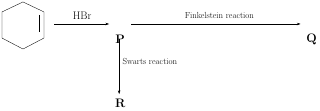
For the reaction sequence given below, the correct statement(s) is(are) 

(In the options, X is any atom other than carbon and hydrogen, and it is different in P, Q and R)

  1. AOption (a)

    C–X bond length in P, Q and R follows the order Q > R > P.  

  2. BOption (b)

     C–X bond enthalpy in P, Q and R follows the order R > P > Q.

  3. COption (c)

    Relative reactivity toward SN2 reaction in P, Q and R follows the order P > R > Q.

  4. DOption (d)

    pKa value of the conjugate acids of the leaving groups in P, Q and R follows the order R > Q > P.

View answer & explanation

Correct answer

Answer: (a)A.

C–X bond length in P, Q and R follows the order Q > R > P.  

Why this answer is correct

CONCEPT:

Finkelstein and Swarts Reactions

  • The Finkelstein reaction involves the exchange of halides in a polar solvent, typically acetone, where an alkyl halide reacts with a metal halide (e.g., NaI in acetone) to produce a new halide.
  • The Swarts reaction is a halogen exchange reaction where alkyl halides react with halogens in the presence of a metal (e.g., fluorine) to give the corresponding fluoroalkane.
  • In the given reaction sequence, P, Q, and R differ in their X substituent (which is not carbon or hydrogen, and it varies in P, Q, and R).
  • The bond length, enthalpy, reactivity, and pKa of conjugate acids can be affected by the type of halogen (X) attached to the molecule.

EXPLANATION:

  • Statement 1: C–X bond length in P, Q, and R follows the order Q > R > P.
  • This is incorrect. The C–X bond length is typically longer in halides where the halogen atom is larger. Hence, for halides, I > Br > Cl, meaning the bond length order is Q (I) > P (Br) > R (F).
  • Statement 2: C–X bond enthalpy in P, Q, and R follows the order R > P > Q.
  • This statement is correct. The bond dissociation enthalpy is highest for the C–F bond (due to strong bond strength), followed by C–Cl and then C–Br. Hence, the bond enthalpy order is C–F > C–Cl > C–Br.
  • Statement 3: Relative reactivity toward SN2 reaction in P, Q, and R follows the order P > R > Q.
  • This is incorrect. In an SN2 reaction, the reactivity decreases as the halogen size increases, meaning that alkyl fluorides are the most reactive, followed by alkyl bromides and iodides.
  • Statement 4: pKa value of the conjugate acids of the leaving groups in P, Q, and R follows the order R > Q > P.
  • This is correct. The conjugate acid of iodide (HI) has the lowest pKa (strongest acid), followed by HBr, and then HF (weakest acid). Therefore, the pKa order is HI < HBr < HF.

Therefore, the correct statements is Option 2 i.e  C–X bond enthalpy in P, Q and R follows the order R > P > Q..

Question 8

JEE Advanced 2025• Chemistry

In an electrochemicalcell, dichromate ions in aqueous acidic medium are reduced to Cr3+. The current (in amperes) that flows through the cell for 48.25 minutes to produce 1 mole of Cr3+ is _______.

Use: 1 Faraday = 96500 C mol–1  

View answer & explanation

Correct answer

Answer: 100Answer: 100

Why this answer is correct

CONCEPT:

Electrochemical Reaction and Current Calculation

It = nF

  • The reaction involves the reduction of dichromate ions (Cr₂O₇²⁻) in an aqueous acidic medium to Cr³⁺. The number of moles of electrons required for the reduction of 1 mole of Cr³⁺ is 3 moles, as per the balanced reaction.
  • Faraday’s law relates the amount of charge passed in an electrochemical reaction to the number of moles of electrons involved and the current flowing through the circuit:
  • Where:
  • I = Current (in amperes)
  • t = Time (in seconds)
  • n = Number of moles of electrons (3 moles for Cr³⁺)
  • F = Faraday’s constant = 96,500 C/mol

EXPLANATION:

  • We are given that 3 moles of electrons are required to produce 1 mole of Cr³⁺.
  • The time (t) is provided as 48.25 minutes, which needs to be converted to seconds:
  • t = 48.25 × 60 = 2,895 seconds.
  • We can now calculate the current (I) using the formula:

I = (3 × 96,500) / (48.25 × 60)

I = 100.0 A

  • Therefore, the current required for the electrochemical reaction to produce 1 mole of Cr³⁺ in 48.25 minutes is 100.0 A.

Therefore, the current is 100.0 A.

Question 9

JEE Advanced 2025• Chemistry

At 25°C, the concentration of H+ ions in 1.00 × 10⁻³ M aqueous solution of a weak monobasic acid having acid dissociation constant (Ka) = 4.00 × 10⁻¹¹ is X × 10–7 M. The value of X is _______.

Use: Ionic product of water (Kw) = 1.00 × 10⁻¹⁴ at 25°C

View answer & explanation

Correct answer

Answer: 2.2350000000000003Answer: 2.2350000000000003(±0.0050000000000001155)

Why this answer is correct

CONCEPT:

Weak Acid Dissociation and Hydrogen Ion Concentration

  • For weak acids, the dissociation can be represented as:

HA ⇌ H+ + A−

  • The dissociation constant (Ka) is given by:

Ka = [H+][A−] / [HA]

  • We are also given that the concentration of H^+ is 1.00\( \times 10^{-4} \), M and the acid dissociation constant Ka = 4.0\( \times 10^{-10} \), M .
  • We can use the ionic product of water, Kw = 1.00 \(\times 10^{-14} , M^2\) at 25°C, to find the concentration of X , which is A- in the solution.

EXPLANATION:

  • The dissociation equation for the weak acid is:

HA ⇌ H+ + A−

So, the concentration of [H^+] is \(1.00 \times 10^{-4} , M ,\) and we want to find the concentration of A^- , which is represented as X .

  • We can write the equation for K_a as:

\(Ka = \dfrac{[H+][A−]}{[HA]}\)

Substitute the known values:

\(4.00 \times 10^{-10} = \dfrac{(1.00 \times 10^{-4})(X)}{(1.00 \times 10^{-4} - X)}\)

  • We also know that the product of hydrogen ions and hydroxide ions in water is

 \( K_w = 1.00 \times 10^{-14} \), and since the concentration of H+ is \(1.00 \times 10^{-4} , M ,\), we can calculate the concentration of OH^- :

\([OH−] = \dfrac{K_w}{[H+]} = \dfrac{1.00 \times 10^{-14}}{1.00 \times 10^{-4}} = 1.00 \times 10^{-10} , M\)

  • Now we use this to solve for X . Using approximation (since X is much smaller than \(1.00 \times 10^{-4} , M ,\) we get:

\(X = 2.24 \times 10^{-4} M\)

Therefore, the value of X is 2.24 × 10⁻⁴ M.

Question 10

JEE Advanced 2025• Chemistry

Molar volume (Vm) of a van der Waals gas can be calculated by expressing the van der Waals equation as a cubic equation with Vm as the variable. The ratio (in mol dm−3) of the coefficient of \(V_{m}^{2}\) to the coefficient of Vm for a gas having van der Waals constants a = 6.0 dm6 atm mol−2 and b = 0.060 dm3 mol−1 at 300 K and 300 atm is _______.

Use: Universal gas constant (R) = 0.082 dm3 atm mol−1 K−1

View answer & explanation

Correct answer

Answer: -7.1Answer: -7.1

Why this answer is correct

CONCEPT:

Van der Waals Equation and Molar Volume

  • The Van der Waals equation for real gases is given by:

(P + a/V²) * (V - b) = RT

where:

  • P is the pressure,
  • V is the volume,
  • R is the universal gas constant,
  • T is the temperature,
  • a and b are Van der Waals constants that account for intermolecular forces and the finite volume of gas molecules, respectively.
  • The ratio of the coefficients of V2 to V can be derived from the cubic form of the equation for molar volume (V) of the gas.
  • We are given the values for the Van der Waals constants a = 6.0 dm6 atm mol−2 and b = 0.060 dm3 mol−1

EXPLANATION:

  • The Van der Waals equation can be rewritten as:

P + (a/V²) = (RT / (V - b))

  • For calculating the ratio of the coefficients of V^2 and V in the cubic equation, we rearrange the equation as:

P(V - b) + a/V² = RT

  • The molar volume of the gas is related to this equation, and the coefficients of V2 and V can be derived by comparing terms after expansion of the equation into a cubic form.
  • After substituting the given values for the constants:

a = 6.0, b = 0.060, R = 0.0821 dm³·atm/mol·K, and T = 300 K

  • Ratio of coefficient of Vn to Vn:

(Pb + RT) / a = (300 x 0.06 + 0.082 x 300) / 6

= -7.1

Therefore, the ratio of the coefficients of V^2 to V is -7.1.

Previous
Page 1