Search Previous Year Questions

Find real questions from previous competitive exam papers with answers and solutions.

Browse complete papers
1305 matching questions · Page 4
Clear

Question 31

IBPS Probationary Officer (PO) 2026• Quantitative Aptitude• Quantitative Aptitude

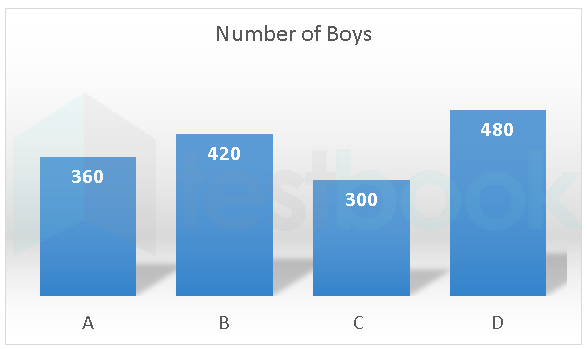
Directions : Study the bar graph and the accompanying table carefully and answer the questions that follow. The bar graph shows the number of Boys studying in four schools, namely A, B, C and D. The table shows the difference between the number of Boys and Girls in each school.
Table

SchoolDifference between Boys and Girls
A40
B84
C60
D120

Note

In Schools A and D, the number of Boys is more than the number of Girls.

In Schools B and C, the number of Girls is more than the number of Boys.

If the number of Girls in School A increases by 25% and the number of Boys in School B decreases by 20%, then what will be the ratio of Girls in School A to Boys in School B?

  1. AOption (a)

    25:19

  2. BOption (b)

    25:21

  3. COption (c)

    25:24

  4. DOption (d)

    5:4

  5. EOption (e)

    5:6

View answer & explanation

Correct answer

Answer: (b)B.

25:21

Why this answer is correct

Common Calculation

Given:

SchoolBoysDifferenceRelation
A36040Boys are more
B42084Girls are more
C30060Girls are more
D480120Boys are more

Formula:

Girls = Boys − Difference (when Boys are more)

Girls = Boys + Difference (when Girls are more)

Calculation:

⇒ Girls in School A = 360 – 40 = 320

⇒ Girls in School B = 420 + 84 = 504

⇒ Girls in School C = 300 + 60 = 360

⇒ Girls in School D = 480 – 120 = 360

Given:

Girls in School A = 320

Boys in School B = 420

Formula:

New Value

= Original Value × (100 ± Percentage)/100

Required Ratio

= New Girls : New Boys

Calculation:

⇒ New Girls in School A = 320 × 125/100 = 400

⇒ New Boys in School B = 420 × 80/100 = 336

⇒ Required Ratio = 400 : 336 = 25 : 21

∴ Answer = 25 : 21

Question 32

IBPS Probationary Officer (PO) 2026• Quantitative Aptitude• Quantitative Aptitude

Directions : Study the bar graph and the accompanying table carefully and answer the questions that follow. The bar graph shows the number of Boys studying in four schools, namely A, B, C and D. The table shows the difference between the number of Boys and Girls in each school.

Table

SchoolDifference between Boys and Girls
A40
B84
C60
D120

Note

In Schools A and D, the number of Boys is more than the number of Girls.

In Schools B and C, the number of Girls is more than the number of Boys.

Girls in School B are approximately what percent more than the Girls in School A?

  1. AOption (a)

    45.5%

  2. BOption (b)

    50%

  3. COption (c)

    55%

  4. DOption (d)

    57.5%

  5. EOption (e)

    62.5%

View answer & explanation

Correct answer

Answer: (d)D.

57.5%

Why this answer is correct

Common Calculation

Given:

SchoolBoysDifferenceRelation
A36040Boys are more
B42084Girls are more
C30060Girls are more
D480120Boys are more

Formula:

Girls = Boys − Difference (when Boys are more)

Girls = Boys + Difference (when Girls are more)

Calculation:

⇒ Girls in School A = 360 – 40 = 320

⇒ Girls in School B = 420 + 84 = 504

⇒ Girls in School C = 300 + 60 = 360

⇒ Girls in School D = 480 – 120 = 360

Given:

Girls in School A = 320

Girls in School B = 504

Formula:

Required Percentage

= (Difference/Base Quantity) × 100

Calculation:

⇒ Difference = 504 – 320 = 184

⇒ Required Percentage = (184/320) × 100 = 57.5%

∴ Answer = 57.5%

Question 33

IBPS Probationary Officer (PO) 2026• Quantitative Aptitude• Quantitative Aptitude

Directions : Study the bar graph and the accompanying table carefully and answer the questions that follow. The bar graph shows the number of Boys studying in four schools, namely A, B, C and D. The table shows the difference between the number of Boys and Girls in each school.

Table

SchoolDifference between Boys and Girls
A40
B84
C60
D120

Note

In Schools A and D, the number of Boys is more than the number of Girls.

In Schools B and C, the number of Girls is more than the number of Boys.

If 40 boys are transferred from School D to School C, then what will be the ratio of Boys in School C to Boys in School D?

  1. AOption (a)

    17:18

  2. BOption (b)

    17:20

  3. COption (c)

    17:22

  4. DOption (d)

    22:25

  5. EOption (e)

    25:27

View answer & explanation

Correct answer

Answer: (c)C.

17:22

Why this answer is correct

Common Calculation

Given:

SchoolBoysDifferenceRelation
A36040Boys are more
B42084Girls are more
C30060Girls are more
D480120Boys are more

Formula:

Girls = Boys − Difference (when Boys are more)

Girls = Boys + Difference (when Girls are more)

Calculation:

⇒ Girls in School A = 360 – 40 = 320

⇒ Girls in School B = 420 + 84 = 504

⇒ Girls in School C = 300 + 60 = 360

⇒ Girls in School D = 480 – 120 = 360

Given:

Boys in School C = 300

Boys in School D = 480

Transferred Boys = 40

Formula:

New Number of Boys

= Original Number of Boys ± Transferred Boys

Required Ratio

= New Boys in School C : New Boys in School D

Calculation:

⇒ New Boys in School C = 300 + 40 = 340

⇒ New Boys in School D = 480 – 40 = 440

⇒ Required Ratio = 340 : 440 = 17 : 22

∴ Answer = 17 : 22

Question 34

IBPS Probationary Officer (PO) 2026• Quantitative Aptitude• Quantitative Aptitude

Directions : Study the bar graph and the accompanying table carefully and answer the questions that follow. The bar graph shows the number of Boys studying in four schools, namely A, B, C and D. The table shows the difference between the number of Boys and Girls in each school.

Table

SchoolDifference between Boys and Girls
A40
B84
C60
D120

Note

In Schools A and D, the number of Boys is more than the number of Girls.

In Schools B and C, the number of Girls is more than the number of Boys.

The total number of Girls in Schools B and C together is what percent of the total number of Boys in Schools A and D together?

  1. AOption (a)

    92%

  2. BOption (b)

    96%

  3. COption (c)

    103%

  4. DOption (d)

    111%

  5. EOption (e)

    121%

View answer & explanation

Correct answer

Answer: (c)C.

103%

Why this answer is correct

Common Calculation

Given:

SchoolBoysDifferenceRelation
A36040Boys are more
B42084Girls are more
C30060Girls are more
D480120Boys are more

Formula:

Girls = Boys − Difference (when Boys are more)

Girls = Boys + Difference (when Girls are more)

Calculation:

⇒ Girls in School A = 360 – 40 = 320

⇒ Girls in School B = 420 + 84 = 504

⇒ Girls in School C = 300 + 60 = 360

⇒ Girls in School D = 480 – 120 = 360

Given:

Girls in Schools B and C

Boys in Schools A and D

Formula:

Required Percentage

= (Required Quantity/Base Quantity) × 100

Calculation:

⇒ Total Girls in Schools B and C = 504 + 360 = 864

⇒ Total Boys in Schools A and D = 360 + 480 = 840

⇒ Required Percentage = (864/840) × 100 = 102.86% ≈ 103%

∴ Answer = 103%

Question 35

IBPS Probationary Officer (PO) 2026• Quantitative Aptitude• Quantitative Aptitude

Directions : Study the bar graph and the accompanying table carefully and answer the questions that follow. The bar graph shows the number of Boys studying in four schools, namely A, B, C and D. The table shows the difference between the number of Boys and Girls in each school.

Table

SchoolDifference between Boys and Girls
A40
B84
C60
D120

Note

In Schools A and D, the number of Boys is more than the number of Girls.

In Schools B and C, the number of Girls is more than the number of Boys.

By how many does the average number of students in Schools B and D exceed the average number of students in Schools A and C?

  1. AOption (a)

    200

  2. BOption (b)

    204

  3. COption (c)

    207

  4. DOption (d)

    209

  5. EOption (e)

    212

View answer & explanation

Correct answer

Answer: (e)E.

212

Why this answer is correct

Common Calculation

Given:

SchoolBoysDifferenceRelation
A36040Boys are more
B42084Girls are more
C30060Girls are more
D480120Boys are more

Formula:

Girls = Boys − Difference (when Boys are more)

Girls = Boys + Difference (when Girls are more)

Calculation:

⇒ Girls in School A = 360 – 40 = 320

⇒ Girls in School B = 420 + 84 = 504

⇒ Girls in School C = 300 + 60 = 360

⇒ Girls in School D = 480 – 120 = 360

Given:

Students in Schools B and D

Students in Schools A and C

Formula:

Average

= Sum of Students/Number of Schools

Required Difference

= Average of (B & D) − Average of (A & C)

Calculation:

⇒ Average Students in Schools B and D = (924 + 840)/2 = 1764/2 = 882

⇒ Average Students in Schools A and C = (680 + 660)/2 = 1340/2 = 670

⇒ Required Difference = 882 – 670 = 212

∴ Answer = 212

Question 36

IBPS Probationary Officer (PO) 2026• Quantitative Aptitude• Quantitative Aptitude

Directions : Study the bar graph and the accompanying table carefully and answer the questions that follow. The bar graph shows the number of Boys studying in four schools, namely A, B, C and D. The table shows the difference between the number of Boys and Girls in each school.

Table

SchoolDifference between Boys and Girls
A40
B84
C60
D120

Note

In Schools A and D, the number of Boys is more than the number of Girls.

In Schools B and C, the number of Girls is more than the number of Boys.

What is the ratio of the total number of students in Schools A and C together to the total number of students in Schools B and D together?

  1. AOption (a)

    27:32

  2. BOption (b)

    32:45

  3. COption (c)

    45:57

  4. DOption (d)

    57:59

  5. EOption (e)

    None

View answer & explanation

Correct answer

Answer: (e)E.

None

Why this answer is correct

Common Calculation

Given:

SchoolBoysDifferenceRelation
A36040Boys are more
B42084Girls are more
C30060Girls are more
D480120Boys are more

Formula:

Girls = Boys − Difference (when Boys are more)

Girls = Boys + Difference (when Girls are more)

Calculation:

⇒ Girls in School A = 360 – 40 = 320

⇒ Girls in School B = 420 + 84 = 504

⇒ Girls in School C = 300 + 60 = 360

⇒ Girls in School D = 480 – 120 = 360

Given:

Total Students in Schools A and C

Total Students in Schools B and D

Formula:

Required Ratio

= Total Students in Schools A and C : Total Students in Schools B and D

Calculation:

⇒ Total Students in Schools A and C = 680 + 660 = 1340

⇒ Total Students in Schools B and D = 924 + 840 = 1764

⇒ Required Ratio = 1340 : 1764 = 335 : 441

Question 37

IBPS Probationary Officer (PO) 2026• Quantitative Aptitude• Quantitative Aptitude

A vessel contains 140 litres of a mixture of milk and water in the ratio 4: 3. From the mixture, 25% of the total quantity of water is removed. After that, a quantity of pure milk equal to the quantity of water removed is added to the vessel. Find the final ratio of milk to water.

  1. AOption (a)

    17:9

  2. BOption (b)

    19:9

  3. COption (c)

    19:11

  4. DOption (d)

    20:9

  5. EOption (e)

    21:10

View answer & explanation

Correct answer

Answer: (b)B.

19:9

Why this answer is correct

Initial milk = 140 x 4/7 = 80 litres

Initial water = 140 x 3/7 = 60 litres

Water removed = 25% of 60 = 15 litres

Therefore, remaining water = 60 – 15 = 45 litres

An equal quantity, that is 15 litres of milk, is added.

Final milk = 80 + 15 = 95 litres

Required ratio = 19:9

Question 38

IBPS Probationary Officer (PO) 2026• Quantitative Aptitude• Quantitative Aptitude

A shopkeeper purchased an article for ₹1,500. He marked the article 40% above its cost price and offered a discount of 15% on the marked price. If he had sold the article for ₹90 less, then find the profit percentage earned by him. 

  1. AOption (a)

    13%

  2. BOption (b)

    14%

  3. COption (c)

    15%

  4. DOption (d)

    16%

  5. EOption (e)

    18%

View answer & explanation

Correct answer

Answer: (a)A.

13%

Why this answer is correct

Cost Price = ₹1,500

Marked Price = 1500 x 140% = ₹ 2100

Selling Price after 15% discount = 2100 x 85% = ₹1785

New Selling Price = 1785 – 90 = ₹ 1695

Profit = ₹1695 – 1500 = ₹195

Profit percentage = (195/1500) x 100 = 13%

Question 39

IBPS Probationary Officer (PO) 2026• Quantitative Aptitude• Quantitative Aptitude

A person spends 20% of his monthly income on house rent. From the remaining amount, he spends 25% on food. He then spends 20% of the amount left on education and 12.5% of the remaining amount on transportation. After making all these expenditures, he is left with ₹25,200. Find the monthly income of the person. 

  1. AOption (a)

    ₹54,000

  2. BOption (b)

    ₹56,000

  3. COption (c)

    ₹60,000

  4. DOption (d)

    ₹64,000

  5. EOption (e)

    ₹72,000

View answer & explanation

Correct answer

Answer: (c)C.

₹60,000

Why this answer is correct

Let the monthly income be ₹100x

Amount spent on house rent = 20% of 100x = 20x

Remaining amount = 100x - 20x = 80x

Amount spent on food = 25% of 80x = 20x

Remaining amount = 80x - 20x = 60x

Amount spent on education = 20% of 60x = 12x

Remaining amount = 60x – 12x = 48x

Amount spent on transportation = 12.5% of 48x = 6x

Final remaining amount = 48x – 6x = 42x

According to the question

42x = 25,200

so, x = 600

Therefore, monthly income = 100x = 100 x 600 = ₹60,000

Question 40

IBPS Probationary Officer (PO) 2026• Quantitative Aptitude• Quantitative Aptitude

The ratio of the length to breadth of a rectangle is 3:2. The ratio of its perimeter to area is 1:6. If the length of the rectangle is equal to the side of an equilateral triangle, find the area of the triangle.

  1. AOption (a)

    150√3 cm²

  2. BOption (b)

    180√3 cm²

  3. COption (c)

    200√3 cm²

  4. DOption (d)

    225√3 cm²

  5. EOption (e)

    250√3 cm²

View answer & explanation

Correct answer

Answer: (d)D.

225√3 cm²

Why this answer is correct

Let the length and breadth of the rectangle be 3xcm and 2xcm.

Perimeter = 2(3x + 2x) = 10x

Area = 3x × 2x = 6x²

According to the question:

10x/(6x²) = 1/6

Or, 5/3x = 1/6

Or, 30 = 3x

So, x = 10

Therefore, the length of the rectangle= 3x = 30 cm

Hence, the side of the equilateral triangle is 30cm.

Area = √3/4 × 30² =√3/4 × 900 = 225√3 cm²