Search Previous Year Questions

Find real questions from previous competitive exam papers with answers and solutions.

Browse complete papers
1305 matching questions · Page 10
Clear

Question 91

IBPS Probationary Officer (PO) 2026• Quantitative Aptitude• Quantitative Aptitude

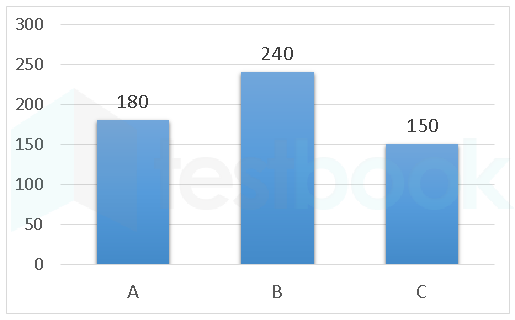
Direction: The bar graph shows the difference between the number of Purses and Suitcases manufactured by three companies (A, B, and C), while the table shows the ratio of (Purse + Suitcase) : Suitcase for each company. Study the information carefully and answer the questions based on it.

Difference between the number of Purses and Suitcases manufactured by three companies
Table

Company(Purse + Suitcase) : Suitcase
A8 : 5
B9 : 5
C11 : 8

If the number of Purses manufactured by Company C is doubled, then the ratio of the total number of Purses manufactured by all three companies to the total number of Suitcases manufactured by all three companies becomes:

  1. AOption (a)

    47:54

  2. BOption (b)

    50:63

  3. COption (c)

    47:63

  4. DOption (d)

    23:31

  5. EOption (e)

    25:36

View answer & explanation

Correct answer

Answer: (c)C.

47:63

Why this answer is correct

Common Solution:

Given:

CompanyDifference (Purse − Suitcase)(Purse + Suitcase) : Suitcase
A1808 : 5
B2409 : 5
C15011 : 8

Company A

Given,

P − S = 180

(P + S) : S = 8 : 5

⇒ P + S = (8/5)S

⇒ P = (8/5 − 1)S = (3/5)S

Now,

P – S = (3/5)S – S = (−2/5)S

Since the difference between the two quantities is 180,

S − P = 180

⇒ (2/5)S = 180

⇒ S = 180 × (5/2) = 450

P = (3/5) × 450 = 270

Company B

Given,

P − S = 240

(P + S) : S = 9 : 5

⇒ P + S = (9/5)S

⇒ P = (9/5 − 1)S = (4/5)S

Now,

S – P = S − (4/5)S = (1/5)S

Since the difference is 240,

⇒ (1/5)S = 240

⇒ S = 240 × 5 = 1,200

P = (4/5) × 1,200 = 960

Company C

Given,

P − S = 150

(P + S) : S = 11 : 8

⇒ P + S = (11/8)S

⇒ P = (11/8 − 1)S = (3/8)S

Now,

S – P = S − (3/8)S = (5/8)S

Since the difference is 150,

⇒ (5/8)S = 150

⇒ S = 150 × (8/5) = 240

P = (3/8) × 240 = 90

Final Table

CompanyPursesSuitcases
A270450
B9601,200
C90240
Total1,3201,890


⇒ Total Purses = 270 + 960 + 90 = 1,320

⇒ Total Suitcases = 450 + 1,200 + 240 = 1,890

Solution

Given:

Company C Purses = 90

Formula:

Ratio = First Quantity : Second Quantity

Calculation:

⇒ New Purses of Company C = 90 × 2 = 180

⇒ New total Purses = 270 + 960 + 180 = 1,410

⇒ Required ratio = 1,410 : 1,890 = 47 : 63

∴ Answer = 47 : 63

Question 92

IBPS Probationary Officer (PO) 2026• Quantitative Aptitude• Quantitative Aptitude

Direction: The bar graph shows the difference between the number of Purses and Suitcases manufactured by three companies (A, B, and C), while the table shows the ratio of (Purse + Suitcase) : Suitcase for each company. Study the information carefully and answer the questions based on it.

Difference between the number of Purses and Suitcases manufactured by three companies

Table

Company(Purse + Suitcase) : Suitcase
A8 : 5
B9 : 5
C11 : 8

The total number of Suitcases manufactured by Companies A and C together is what percent of the total number of Purses manufactured by all three companies?

  1. AOption (a)

    45.5%

  2. BOption (b)

    50%

  3. COption (c)

    52.3%

  4. DOption (d)

    55%

  5. EOption (e)

    60%

View answer & explanation

Correct answer

Answer: (c)C.

52.3%

Why this answer is correct

Common Solution:

Given:

CompanyDifference (Purse − Suitcase)(Purse + Suitcase) : Suitcase
A1808 : 5
B2409 : 5
C15011 : 8

Company A

Given,

P − S = 180

(P + S) : S = 8 : 5

⇒ P + S = (8/5)S

⇒ P = (8/5 − 1)S = (3/5)S

Now,

P – S = (3/5)S – S = (−2/5)S

Since the difference between the two quantities is 180,

S − P = 180

⇒ (2/5)S = 180

⇒ S = 180 × (5/2) = 450

P = (3/5) × 450 = 270

Company B

Given,

P − S = 240

(P + S) : S = 9 : 5

⇒ P + S = (9/5)S

⇒ P = (9/5 − 1)S = (4/5)S

Now,

S – P = S − (4/5)S = (1/5)S

Since the difference is 240,

⇒ (1/5)S = 240

⇒ S = 240 × 5 = 1,200

P = (4/5) × 1,200

= 960

Company C

Given,

P − S = 150

(P + S) : S = 11 : 8

⇒ P + S = (11/8)S

⇒ P = (11/8 − 1)S = (3/8)S

Now,

S – P = S − (3/8)S = (5/8)S

Since the difference is 150,

⇒ (5/8)S = 150

⇒ S = 150 × (8/5) = 240

P = (3/8) × 240 = 90

Final Table

CompanyPursesSuitcases
A270450
B9601,200
C90240
Total1,3201,890


⇒ Suitcases manufactured by Companies A and C = 450 + 240 = 690

⇒ Total Purses manufactured by all companies = 270 + 960 + 90 = 1,320

Solution

Given:

Suitcases (A & C) = 690

Total Purses = 1,320

Formula:

Percentage = (Required Value ÷ Total Value) × 100

Calculation:

⇒ Percentage = (690 ÷ 1,320) × 100 = 52.27% ≈ 52.3%

∴ Answer = 52.3%

Question 93

IBPS Probationary Officer (PO) 2026• Quantitative Aptitude• Quantitative Aptitude

Direction: The bar graph shows the difference between the number of Purses and Suitcases manufactured by three companies (A, B, and C), while the table shows the ratio of (Purse + Suitcase) : Suitcase for each company. Study the information carefully and answer the questions based on it.

Difference between the number of Purses and Suitcases manufactured by three companies

Table

Company(Purse + Suitcase) : Suitcase
A8 : 5
B9 : 5
C11 : 8

What is the ratio of the total number of Purses manufactured by Companies A and B together to the total number of Suitcases manufactured by Companies B and C together?

  1. AOption (a)

    41:48

  2. BOption (b)

    43:48

  3. COption (c)

    5:6

  4. DOption (d)

    7:8

  5. EOption (e)

    13:15

View answer & explanation

Correct answer

Answer: (a)A.

41:48

Why this answer is correct

Common Solution:

Given:

CompanyDifference (Purse − Suitcase)(Purse + Suitcase) : Suitcase
A1808 : 5
B2409 : 5
C15011 : 8

Company A

Given,

P − S = 180

(P + S) : S = 8 : 5

⇒ P + S = (8/5)S

⇒ P = (8/5 − 1)S = (3/5)S

Now,

P – S = (3/5)S – S = (−2/5)S

Since the difference between the two quantities is 180,

S − P = 180

⇒ (2/5)S = 180

⇒ S = 180 × (5/2) = 450

P = (3/5) × 450 = 270

Company B

Given,

P − S = 240

(P + S) : S = 9 : 5

⇒ P + S = (9/5)S

⇒ P = (9/5 − 1)S = (4/5)S

Now,

S – P = S − (4/5)S = (1/5)S

Since the difference is 240,

⇒ (1/5)S = 240

⇒ S = 240 × 5 = 1,200

P = (4/5) × 1,200 = 960

Company C

Given,

P − S = 150

(P + S) : S = 11 : 8

⇒ P + S = (11/8)S

⇒ P = (11/8 − 1)S = (3/8)S

Now,

S – P = S − (3/8)S = (5/8)S

Since the difference is 150,

⇒ (5/8)S = 150

⇒ S = 150 × (8/5) = 240

P = (3/8) × 240 = 90

Final Table

CompanyPursesSuitcases
A270450
B9601,200
C90240
Total1,3201,890


⇒ Purses manufactured by Companies A and B = 270 + 960 = 1,230

⇒ Suitcases manufactured by Companies B and C = 1,200 + 240 = 1,440

Solution

Given:

Purses (A & B) = 1,230

Suitcases (B & C) = 1,440

Formula:

Ratio = First Quantity : Second Quantity

Calculation:

⇒ Required ratio = 1,230 : 1,440 = 41 : 48

∴ Answer = 41 : 48

Question 94

IBPS Probationary Officer (PO) 2026• Quantitative Aptitude• Quantitative Aptitude

Direction: The bar graph shows the difference between the number of Purses and Suitcases manufactured by three companies (A, B, and C), while the table shows the ratio of (Purse + Suitcase) : Suitcase for each company. Study the information carefully and answer the questions based on it.

Difference between the number of Purses and Suitcases manufactured by three companies

Table

Company(Purse + Suitcase) : Suitcase
A8 : 5
B9 : 5
C11 : 8

The number of Purses manufactured by Company B is what percent more than the combined number of Purses manufactured by Companies A and C?

  1. AOption (a)

    120%

  2. BOption (b)

    130%

  3. COption (c)

    133 1/3%

  4. DOption (d)

    166 2/3%

  5. EOption (e)

    175%

View answer & explanation

Correct answer

Answer: (d)D.

166 2/3%

Why this answer is correct

Common Solution:

Given:

CompanyDifference (Purse − Suitcase)(Purse + Suitcase) : Suitcase
A1808 : 5
B2409 : 5
C15011 : 8

Company A

Given,

P − S = 180

(P + S) : S = 8 : 5

⇒ P + S = (8/5)S

⇒ P = (8/5 − 1)S = (3/5)S

Now,

P – S = (3/5)S – S = (−2/5)S

Since the difference between the two quantities is 180,

S − P = 180

⇒ (2/5)S = 180

⇒ S = 180 × (5/2) = 450

P = (3/5) × 450 = 270

Company B

Given,

P − S = 240

(P + S) : S = 9 : 5

⇒ P + S = (9/5)S

⇒ P = (9/5 − 1)S = (4/5)S

Now,

S – P = S − (4/5)S = (1/5)S

Since the difference is 240,

⇒ (1/5)S = 240

⇒ S = 240 × 5 = 1,200

P = (4/5) × 1,200 = 960

Company C

Given,

P − S = 150

(P + S) : S = 11 : 8

⇒ P + S = (11/8)S

⇒ P = (11/8 − 1)S = (3/8)S

Now,

S – P = S − (3/8)S = (5/8)S

Since the difference is 150,

⇒ (5/8)S = 150

⇒ S = 150 × (8/5) = 240

P = (3/8) × 240 = 90

Final Table

CompanyPursesSuitcases
A270450
B9601,200
C90240
Total1,3201,890


⇒ Purses manufactured by Companies A and C = 270 + 90 = 360

⇒ Purses manufactured by Company B = 960

Solution

Given:

Company B = 960

Companies A and C = 360

Formula:

Percentage = (Difference ÷ Original Value) × 100

Calculation:

⇒ Difference = 960 – 360 = 600

⇒ Percentage = (600 ÷ 360) × 100 = 166⅔%

∴ Answer = 166(2/3)%

Question 95

IBPS Probationary Officer (PO) 2026• Quantitative Aptitude• Quantitative Aptitude

Direction: The bar graph shows the difference between the number of Purses and Suitcases manufactured by three companies (A, B, and C), while the table shows the ratio of (Purse + Suitcase) : Suitcase for each company. Study the information carefully and answer the questions based on it.

Difference between the number of Purses and Suitcases manufactured by three companies

Table

Company(Purse + Suitcase) : Suitcase
A8 : 5
B9 : 5
C11 : 8

If the number of Purses manufactured by Company B increases by 25%, then by how many does the new number of Purses exceed the number of Suitcases manufactured by the same company?

  1. AOption (a)

    0

  2. BOption (b)

    120

  3. COption (c)

    180

  4. DOption (d)

    240

  5. EOption (e)

    300

View answer & explanation

Correct answer

Answer: (a)A.

0

Why this answer is correct

Common Solution:

Given:

CompanyDifference (Purse − Suitcase)(Purse + Suitcase) : Suitcase
A1808 : 5
B2409 : 5
C15011 : 8

Company A

Given,

P − S = 180

(P + S) : S = 8 : 5

⇒ P + S = (8/5)S

⇒ P = (8/5 − 1)S = (3/5)S

Now,

P – S = (3/5)S – S = (−2/5)S

Since the difference between the two quantities is 180,

S − P = 180

⇒ (2/5)S = 180

⇒ S = 180 × (5/2) = 450

P = (3/5) × 450 = 270

Company B

Given,

P − S = 240

(P + S) : S = 9 : 5

⇒ P + S = (9/5)S

⇒ P = (9/5 − 1)S = (4/5)S

Now,

S – P = S − (4/5)S = (1/5)S

Since the difference is 240,

⇒ (1/5)S = 240

⇒ S = 240 × 5 = 1,200

P = (4/5) × 1,200

= 960

Company C

Given,

P − S = 150

(P + S) : S = 11 : 8

⇒ P + S = (11/8)S

⇒ P = (11/8 − 1)S = (3/8)S

Now,

S – P = S − (3/8)S = (5/8)S

Since the difference is 150,

⇒ (5/8)S = 150

⇒ S = 150 × (8/5) = 240

P = (3/8) × 240 = 90

Final Table

CompanyPursesSuitcases
A270450
B9601,200
C90240
Total1,3201,890


⇒ Purses manufactured by Company B = 960

⇒ Suitcases manufactured by Company B = 1,200

Solution

Given:

Purses = 960

Increase = 25%

Suitcases = 1,200

Formula:

Increase = (Percentage ÷ 100) × Original Value

Calculation:

⇒ Increase = (25 ÷ 100) × 960 = 240

⇒ New Purses = 960 + 240 = 1,200

⇒ Difference = 1,200 − 1,200 = 0

∴ Answer = 0

Question 96

IBPS Probationary Officer (PO) 2026• Quantitative Aptitude• Quantitative Aptitude

Direction: The bar graph shows the difference between the number of Purses and Suitcases manufactured by three companies (A, B, and C), while the table shows the ratio of (Purse + Suitcase) : Suitcase for each company. Study the information carefully and answer the questions based on it.

Difference between the number of Purses and Suitcases manufactured by three companies

Table

Company(Purse + Suitcase) : Suitcase
A8 : 5
B9 : 5
C11 : 8

The average number of Purses manufactured by Companies A, B, and C is approximately what percent of the average number of Suitcases manufactured by these three companies?

  1. AOption (a)

    65%

  2. BOption (b)

    68%

  3. COption (c)

    70%

  4. DOption (d)

    72%

  5. EOption (e)

    75%

View answer & explanation

Correct answer

Answer: (c)C.

70%

Why this answer is correct

Common Solution:

Given:

CompanyDifference (Purse − Suitcase)(Purse + Suitcase) : Suitcase
A1808 : 5
B2409 : 5
C15011 : 8

Company A

Given,

P − S = 180

(P + S) : S = 8 : 5

⇒ P + S = (8/5)S

⇒ P = (8/5 − 1)S

= (3/5)S

Now,

P – S = (3/5)S – S = (−2/5)S

Since the difference between the two quantities is 180,

S − P = 180

⇒ (2/5)S = 180

⇒ S = 180 × (5/2) = 450

P = (3/5) × 450 = 270

Company B

Given,

P − S = 240

(P + S) : S = 9 : 5

⇒ P + S = (9/5)S

⇒ P = (9/5 − 1)S = (4/5)S

Now,

S – P = S − (4/5)S = (1/5)S

Since the difference is 240,

⇒ (1/5)S = 240

⇒ S = 240 × 5 = 1,200

P = (4/5) × 1,200 = 960

Company C

Given,

P − S = 150

(P + S) : S = 11 : 8

⇒ P + S = (11/8)S

⇒ P = (11/8 − 1)S = (3/8)S

Now,

S – P = S − (3/8)S = (5/8)S

Since the difference is 150,

⇒ (5/8)S = 150

⇒ S = 150 × (8/5) = 240

P = (3/8) × 240 = 90

Final Table

CompanyPursesSuitcases
A270450
B9601,200
C90240
Total1,3201,890


⇒ Total Purses = 270 + 960 + 90 = 1,320

⇒ Average Purses = 1,320 ÷ 3 = 440

⇒ Total Suitcases = 450 + 1,200 + 240 = 1,890

⇒ Average Suitcases = 1,890 ÷ 3 = 630

Solution

Given:

Average Purses = 440

Average Suitcases = 630

Formula:

Percentage = (Required Value ÷ Total Value) × 100

Calculation:

⇒ Percentage

= (440 ÷ 630) × 100 = 69.84% ≈ 70%

∴ Answer = 70%

Question 97

IBPS Probationary Officer (PO) 2026• Quantitative Aptitude• Quantitative Aptitude

The perimeter of a rectangle is 56 cm and its area is 180 cm². If the side of an equilateral triangle is equal to the difference between the length and breadth of the rectangle, then find the area of the equilateral triangle.

  1. AOption (a)

    12√3 cm²

  2. BOption (b)

    16√3 cm²

  3. COption (c)

    20√3 cm²

  4. DOption (d)

    18√3 cm²

  5. EOption (e)

    14√3 cm²

View answer & explanation

Correct answer

Answer: (b)B.

16√3 cm²

Why this answer is correct

Shortcut Trick

Perimeter = 56 ⇒ l + b = 28  |  Area = lb = 180

(l − b)2 = (l + b)2 − 4lb = 784 − 720 = 64 ⇒ l − b = 8

Side of equilateral triangle = 8 cm

Area = √3/4 × 82 = √3/4 × 64 = 16√3 cm2

∴ The correct answer is 16√3 cm2.

Alternate Method

Given:

Perimeter of rectangle = 56 cm ⇒ 2(l + b) = 56 ⇒ l + b = 28

Area of rectangle = lb = 180 cm2

Side of equilateral triangle = l − b

Formula used:

(l − b)2 = (l + b)2 − 4lb

Area of equilateral triangle = √3/4 × a2 where a = side

Calculations:

Step 1: Find l + b and lb

⇒ 2(l + b) = 56 ⇒ l + b = 28

⇒ lb = 180

Step 2: Find l − b using identity

⇒ (l − b)2 = (l + b)2 − 4lb

⇒ (l − b)2 = 282 − 4 × 180

⇒ (l − b)2 = 784 − 720 = 64

⇒ l − b = √64 = 8 cm

Step 3: Find l and b (for verification)

⇒ l + b = 28 and l − b = 8

⇒ 2l = 36 ⇒ l = 18 cm

⇒ b = 28 − 18 = 10 cm

⇒ Verification: lb = 18 × 10 = 180 

Step 4: Find area of equilateral triangle

⇒ Side a = l − b = 8 cm

⇒ Area = √3/4 × a2

⇒ Area = √3/4 × 82

⇒ Area = √3/4 × 64

⇒ Area = 16√3 cm2

⇒ Area ≈ 16 × 1.732 = 27.71 cm2

∴ The correct answer is 16√3 cm2.

Additional Information

Key Identity: (l − b)2 = (l + b)2 − 4lb

This identity is the fastest way to find l − b when sum and product are known — no need to solve a quadratic. Similarly (l + b)2 = (l − b)2 + 4lb. In rectangle problems: always extract l+b from perimeter and lb from area first, then use this identity to find l−b directly.

Equilateral Triangle — All Formulas

For equilateral triangle with side a: Area = √3/4 × a2 | Height = √3/2 × a | Perimeter = 3a | Inradius = a/(2√3) | Circumradius = a/√3. For a = 8: Area = 16√3 ≈ 27.71 cm2 | Height = 4√3 ≈ 6.93 cm.

Rectangle — Diagonal Formula

Diagonal of rectangle d = √(l2 + b2).

Note:

l2 + b2 =

Question 98

IBPS Probationary Officer (PO) 2026• Quantitative Aptitude• Quantitative Aptitude

In an election between two candidates, 20% of the total voters did not cast their votes. Out of the total votes casted, 10% votes were declared invalid. The winning candidate got 60% of the valid votes and won by 11,520 votes. Find the total number of voters on the voting list.

  1. AOption (a)

    60000

  2. BOption (b)

    65000

  3. COption (c)

    70000

  4. DOption (d)

    75000

  5. EOption (e)

    80000

View answer & explanation

Correct answer

Answer: (e)E.

80000

Why this answer is correct

Shortcut Trick

Let total voters = 100

Votes cast = 80 | Valid votes = 80 × 90% = 72

Winner = 60% of 72 = 43.2 | Loser = 40% of 72 = 28.8

Margin = 43.2 − 28.8 = 14.4 units ≡ 11520 votes

Total voters = (11520 ÷ 14.4) × 100 = 80000

∴ The correct answer is 80,000 voters.

Alternate Method

Given:

Total voters on list = N (to find)

Voters who did NOT vote = 20% of N

Votes cast = 80% of N

Invalid votes = 10% of votes cast

Valid votes = 90% of votes cast = 90% of 80% of N = 72% of N

Winner got = 60% of valid votes

Loser got = 40% of valid votes

Winning margin = 11,520 votes

Formula used:

Valid votes = 80% × 90% × N = 0.72N

Winning margin = (60% − 40%) of valid votes = 20% of valid votes

N = Margin ÷ (20% of 72% of N) × N

Total Voters = N (100%) Voting List Votes Cast = 80% of N = 0.80N Not Voted 20% Valid Votes = 72% of N = 0.72N Invalid 8% Winner 60% = 43.2% of N Loser 40% = 28.8% of N Margin = 20% of 72% of N = 14.4% of N = 11520

Calculations:

Let total voters = N

⇒ Votes cast = 80% of N = 0.80N

⇒ Valid votes = 90% of votes cast = 90% of 0.80N = 0.72N

⇒ Winner votes = 60% of valid = 60% of 0.72N = 0.432N

⇒ Loser votes = 40% of valid = 40% of 0.72N = 0.288N

⇒ Winning margin = Winner − Loser = 0.432N − 0.288N = 0.144N

⇒ 0.144N = 11520

⇒ N = 11520 ÷ 0.144

⇒ N = 11520 × 1000 ÷ 144

⇒ N = 11520000 ÷ 144

⇒ N = 80,000

Verification:

⇒ Votes cast = 80% of 80000 = 64000

⇒ Valid votes = 90% of 64000 = 57600

⇒ Winner = 60% of 57600 = 34560

⇒ Loser = 40% of 57600 = 23040

⇒ Margin = 34560 − 23040 = 11520 

∴ The correct answer is 80,000 voters.

Additional Information

Election Problem — Quick Margin Formula

Winning margin = (Winner% − Loser%) of valid votes = (60% − 40%) = 20% of valid votes. Since valid votes = 72% of N: margin = 20% of 72% of N = 14.4% of N. Setting 14.4% of N = 11520 gives N directly. This chain percentage method is the fastest approach for election problems.

Chain Percentage — Successive Application

When percentages are applied one after another: 80% of 90% of N = 0.80 × 0.90 × N = 0.72N. Always multiply the decimal factors together first before applying to N. Chain: 100% → 80% (voted) → 72% (valid) → 43.2% (winner) → 28.8% (loser) → 14.4% (margin).

Working with 100 as Base — Assumption Method

Assume total = 100. Compute all values numerically: valid = 72, winner = 43.2, loser = 28.8, margin = 14.4. Then scale: actual margin/assumed margin = actual total/assumed total ⇒ N = 11520/14.4 × 100 = 80000. This avoids algebra entirely and works for all percentage-chain problems.

Vote Share vs Winning Margin

If winner gets p% of valid votes: loser gets (100−p)%. Margin = (2p − 100)% of valid votes. Here p = 60%: margin = (120−100)% = 20% of valid votes. If winner gets 55%: margin = 10% of valid votes. If winner gets 75%: margin = 50% of valid votes — these ratios are useful for quick mental calculation.

Question 99

IBPS Probationary Officer (PO) 2026• Quantitative Aptitude• Quantitative Aptitude

A shopkeeper marks up an article by 25% above the Cost Price and allows a 12% discount on the Marked Price. What is the overall profit percentage earned by the shopkeeper?

  1. AOption (a)

    8%

  2. BOption (b)

    10%

  3. COption (c)

    12%

  4. DOption (d)

    14%

  5. EOption (e)

    16%

View answer & explanation

Correct answer

Answer: (b)B.

10%

Why this answer is correct

Shortcut Trick

Net effect = (1 + 25/100) × (1 − 12/100) × 100 − 100

= 1.25 × 0.88 × 100 − 100

= 110 − 100 = 10%

∴ The correct answer is 10% profit.

Alternate Method

Given:

Mark up = 25% above CP

Discount = 12% on Marked Price (MP)

Find: Overall profit %

Formula used:

MP = CP × (100 + markup%) ÷ 100

SP = MP × (100 − discount%) ÷ 100

Profit % = (SP − CP) ÷ CP × 100

Direct formula: Profit % = (1 + m/100)(1 − d/100) × 100 − 100

where m = markup% and d = discount%

CP ₹100 +25% markup MP ₹125 −12% discount SP ₹110 Overall Profit = 110 − 100 = ₹10 = 10% base final SP disc=₹15 Profit = 10%

Calculations:

Let CP = ₹100

⇒ MP = CP + 25% of CP = 100 + 25 = ₹125

⇒ Discount = 12% of MP = 12% of 125 = ₹15

⇒ SP = MP − Discount = 125 − 15 = ₹110

⇒ Profit = SP − CP = 110 − 100 = ₹10

⇒ Profit % = (10 ÷ 100) × 100 = 10%

Using direct formula:

⇒ Profit % = (1 + 25/100) × (1 − 12/100) × 100 − 100

⇒ = (125/100) × (88/100) × 100 − 100

⇒ = (125 × 88) ÷ 100 − 100

⇒ = 11000 ÷ 100 − 100

⇒ = 110 − 100 = 10%

∴ The correct answer is 10% profit.

Additional Information

Direct Formula — Profit% with Markup and Discount

Profit % = (1 + m/100)(1 − d/100) × 100 − 100 where m = markup% and d = discount%. If result is positive ⇒ profit | negative ⇒ loss. Breakeven condition: m/100 × d/100 = (m − d)/100 ⇒ md = 100(m−d). For m=25, d=12: 25×12=300 ≠ 100(13)=1300 ⇒ profit exists.

When Does Profit = Loss = 0 (Breakeven)?

SP = CP when (1+m/100)(1−d/100) = 1. This gives d = 100m/(100+m). For m=25%: breakeven discount = 100×25/125 = 20%. So if discount is exactly 20% on 25% markup ⇒ no profit no loss. Any discount below 20% gives profit | above 20% gives loss.

Successive Percentage Change Shortcut

Net % change for two successive changes a% and b%: net = a + b + ab/100. Here a = +25 (markup) and b = −12 (discount): net = 25 − 12 + (25 × −12)/100 = 13 − 3 = 10%. This is the fastest mental math shortcut — no need to compute MP and SP separately.

Markup vs Profit — Key Difference

Markup is always calculated on CP | Discount is always calculated on MP | Profit/Loss is always calculated on CP. Markup % ≠ Profit % when discount is given. Here markup = 25% but profit = only 10% after 12% discount. Always trace CP → MP → SP to avoid confusion between markup and profit.

Question 100

IBPS Probationary Officer (PO) 2026• Quantitative Aptitude• Quantitative Aptitude

500 ml of mixture 'A' containing milk and water in the ratio 7:3 is mixed with another mixture 'B' containing 100 ml of milk and some quantity of water. If the ratio of milk to water in the final mixture is 5:2 respectively, then find the ratio of the quantity of milk to water in mixture 'B'.

  1. AOption (a)

    10:3

  2. BOption (b)

    20:7

  3. COption (c)

    13:4

  4. DOption (d)

    16:5

  5. EOption (e)

    27:10

View answer & explanation

Correct answer

Answer: (a)A.

10:3

Why this answer is correct

Shortcut Trick

Mixture A (500 ml): Milk = 7/10 × 500 = 350 ml | Water = 150 ml

Mixture B: Milk = 100 ml | Water = w ml

Final mixture: Milk = 350 + 100 = 450 ml | Water = 150 + w ml

Ratio 5:2 ⇒ 450/(150 + w) = 5/2 ⇒ 900 = 750 + 5w ⇒ w = 30 ml

Mixture B ratio = 100 : 30 = 10 : 3

∴ The correct answer is Milk : Water in B = 10 : 3.

Alternate Method

Given:

Mixture A = 500 ml | Milk : Water = 7 : 3

Mixture B = 100 ml milk + w ml water (unknown)

Final mixture ratio = Milk : Water = 5 : 2

Formula used:

Milk in A = 7/(7+3) × 500 = 350 ml

Water in A = 3/(7+3) × 500 = 150 ml

Final Milk / Final Water = 5/2

Mixture A 500 ml | 7:3 Milk = 350 ml Water = 150 ml + Mixture B (100 + w) ml Milk = 100 ml Water = w ml = Final Mix 5 : 2 M=450 W=180 450 / (150 + w) = 5/2 ⇒ 900 = 750 + 5w ⇒ w = 30 ml Total water in final = 150 + 30 = 180 ml ✓  |  Check: 450/180 = 5/2 ✓ Mixture B: Milk = 100 ml | Water = 30 ml Milk : Water in B = 100 : 30 = 10 : 3

Calculations:

Step 1: Find milk and water in Mixture A

⇒ Milk in A = 7/(7+3) × 500 = 7/10 × 500 = 350 ml

⇒ Water in A = 3/10 × 500 = 150 ml

Step 2: Set up final mixture

⇒ Total Milk = 350 + 100 = 450 ml

⇒ Total Water = 150 + w ml

Step 3: Apply final ratio condition

⇒ Milk / Water = 5/2

⇒ 450 / (150 + w) = 5/2

⇒ 2 × 450 = 5 × (150 + w)

⇒ 900 = 750 + 5w

⇒ 5w = 900 − 750 = 150

⇒ w = 30 ml

Step 4: Find ratio in Mixture B

⇒ Milk in B = 100 ml | Water in B = 30 ml

⇒ Milk : Water = 100 : 30 = 10 : 3

Verification:

⇒ Final milk = 450 | Final water = 150 + 30 = 180

⇒ 450 : 180 = 5 : 2 

∴ The correct answer is Milk : Water in Mixture B = 10 : 3.

Additional Information

Alligation Method — When to Use

Alligation is used when two mixtures of known concentrations are mixed to get a target concentration. Cross-multiply: (Cfinal − CB) : (CA − Cfinal) gives ratio of quantities. Here since quantity of B is unknown but its milk is fixed, the direct equation method is faster than alligation.

Replacement Method in Mixtures

When x litres of a mixture is replaced with pure milk repeatedly n times: Final milk concentration = (1 − x/V)n where V = total volume. After 1 replacement: milk fraction changes. After n replacements use the power formula. This is different from mixing two separate mixtures.

Mixing Three Mixtures

For three mixtures A, B, C: Final milk = milkA + milkB + milkC | Final water = waterA + waterB + waterC. Always find individual components first then add. Never directly add the ratios — always convert ratio to actual quantities using total volume.

Common Mistake — Ratio vs Quantity

Ratios cannot be added directly: 7:3 + 5:2 ≠ 12:5. Always convert to actual quantities first. Milk in A = 350 (not 7) | Water in A = 150 (not 3). Only after finding actual ml of each component can you add and find the final ratio. This is the most common error in mixture problems.