Search Previous Year Questions

Find real questions from previous competitive exam papers with answers and solutions.

Browse complete papers
1235 matching questions · Page 3
Clear

Question 21

GATE EE 2023• Electrical Engineering

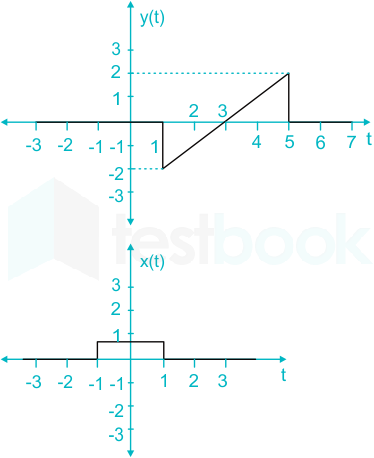
For the signals 𝑥(𝑡)and 𝑦(𝑡) shown in the figure, 𝑧(𝑡) = 𝑥(𝑡) ∗ 𝑦(𝑡) is maximum at 𝑡 = 𝑇1. Then 𝑇1 in seconds is ___________ (Round off to the nearest integer). 
View answer & explanation

Correct answer

Answer: 4Answer: 4

Why this answer is correct

Given signal y(t) and x(t) is shown in figure below,

Given: z(t) = x(t)*y(t) = \(\int_{-\infty}^{\infty} y(τ) x(t-τ) d τ\)

x(t - τ) can be plotted as shown below,

Maximum value of convolution will be obtained when positive portion of y(τ) is multiplied with x(t - τ)

∴ 1 + t = 5

t = 4 sec

At t = 4 sec, maximum value of convolution will be obtained.
Question 22

GATE EE 2023• Electrical Engineering

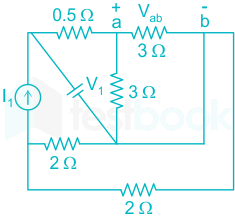
For the circuit shown in the figure, V1 = 8 V, DC and I1 = 8 A, DC. The voltage Vab in Volts is _________ (Round off to 1 decimal place).

View answer & explanation

Correct answer

Answer: 6Answer: 6(±0.09999999999999964)

Why this answer is correct


Circuit can be redrawn

By applying voltage division rule, we can get

\(V_{a b}=8 \times \frac{1.5}{1.5+0.5}=6 \mathrm{~V}\)

Question 23

GATE EE 2023• Electrical Engineering

A 50 Hz, 275 kV line of length 400 km has the following parameters:

Resistance, R = 0.035 Ω/km;

Inductance, L = 1 mH /km;

Capacitance, C = 0.01 μF/km;

The line is represented by the nominal-π model. With the magnitudes of the sending end and the receiving end voltages of the line (denoted by VS and VR, respectively) maintained at 275 kV, the phase angle difference (θ) between VS and VR required for maximum possible active power to be delivered to the receiving end, in degree is _____________ (Round off to 2 decimal places).

View answer & explanation

Correct answer

Answer: 83.5Answer: 83.5(±0.5)

Why this answer is correct

For nominal π model:

B = Z = [R + j(2π + L)]l

= [0.035 + j(2π × 50 × 1 × 10-3)] × 400

= 126.44 ∠83.642° = |B|∠β

\(P_R=\left|\frac{V_S V_R}{B}\right| \cos (β-δ)-\left|\frac{A V_R^2}{B}\right| \cos (β-\alpha)\)

\(\frac{2 P_R}{2 δ}=0\) ⇒ δ = β

At δ = β ⇒ \(\left(P_R\right)_{\max }=\left|\frac{V_S V_R}{B}\right|-\left|\frac{A V_R^2}{B}\right| \cos (\beta-\alpha)\)

For maximum PR occur at

δ = β = 83.64° = θ

Question 24

GATE EE 2023• Electrical Engineering

In the following differential equation, the numerically obtained value of y(t), at t = 1, is _______________ (Round off to 2 decimal places). 

\(\rm \frac{dy}{dt}=\frac{e^{-at}}{2+at}\), 𝛼 = 0.01 and 𝑦(0) = 0

View answer & explanation

Correct answer

Answer: 0.5Answer: 0.5(±0.020000000000000018)

Why this answer is correct

Given: \(\frac{d y}{d t}=\frac{e^{-α t}}{2+α t}\)    ...(i)

α = 0.01

y(0) = 0 (initial)

\(f(t, y)=\frac{d y}{d t}=\frac{e^{-0.01 t}}{2+0.01 t}\)

Euler's method: Step size h = t (given)

y1 = y0 + hf(t, y) (at t0 = 0, y0 = 0)

\(=0+1\left[\frac{e^{-0.01 \times 0}}{2+0.01 \times 0}\right] \)

\(=0+1 \times \frac{1}{2}=\frac{1}{2}=0.5\)

So, at t = 1, y1 = 0.5

Question 25

GATE EE 2023• Electrical Engineering

Three points in the x-y plane are (-1, 0.8), (0, 2.2) and (1, 2.8). The value of the slope of the best fit straight line in the least square sense is ____________ (Round off to 2 decimal places).

View answer & explanation

Correct answer

Answer: 1Answer: 1(±0.10000000000000003)

Why this answer is correct

Given that:

X-101
Y0.82.22.8


Best fit of straight line (y = ax + b) by least square.

Approximation given by normal equations

∑yi = a ∑xi + bn   ...(i)

∑xiyi = a ∑\(x_i^2\) + b ∑xi   ...(ii)

xy\(x_i^2\)xy
-10.81-0.8
02.200
12.812.8
∑xi = 0∑yi = 5.8∑x2 = 2∑xy = 2


Substituting values in eqn.

(1) and (2)

5.8 = a(0) + 3b   ...(iii)

2 = a(2) + 0(b)    ...(iv)

Solving we get, a = 1, \(b = \frac{5.8}{3}\) = 1.93

 ∴ Slope of best fit y = ax + b is 'a' = 1

Question 26

GATE EE 2023• Electrical Engineering

The magnitude and phase plots of an LTI system are shown in the figure. The transfer function of the system is

  1. AOption (a)

    2.51 e-0.032s

  2. BOption (b)

    \(\rm \frac{e^{-2.514s}}{s+1}\)

  3. COption (c)

    1.04 e-2.514s

  4. DOption (d)

    2.51 e-1.047s

View answer & explanation

Correct answer

Answer: (d)D.

2.51 e-1.047s

Why this answer is correct

The transfer function, TF = Ke-sT<sub>d</sub> (tranportation lag)

Given magnitude, M = 8 dB = 20 log [K]

K = 2.511

and angle at ω = 1 rad/sec = -60°

Angle, \(\phi=-\omega T_\alpha \times \frac{180^{\circ}}{\pi}\)

\(60^{\circ}=-1 \times T_d \times \frac{180^{\circ}}{\pi}\)

Td = 1.047

So, required transfer function

TF = 2.511e-1.047s

Question 27

GATE EE 2023• Electrical Engineering

Consider the OP AMP based circuit shown in the figure. Ignore the conduction drops of diodes D1 and D2. All the components are ideal and the breakdown voltage of the Zener is 5 V. Which of the following statements is true? 

  1. AOption (a)

    The maximum and minimum values of the output voltage VO are +15 V and -10 V, respectively.

  2. BOption (b)

    The maximum and minimum values of the output voltage VO are +5 V and -15 V, respectively.

  3. COption (c)

    The maximum and minimum values of the output voltage VO are +10 V and -5 V, respectively

  4. DOption (d)

    The maximum and minimum values of the output voltage VO are +5 V and -10 V, respectively.

View answer & explanation

Correct answer

Answer: (d)D.

The maximum and minimum values of the output voltage VO are +5 V and -10 V, respectively.

Why this answer is correct


For positive half cycle the diodes D1 and Dz are forward bias and D2 is reverse biased and the circuit is shown below,

When Vin = 10V,

\(V_0=\frac{-R}{R} \times 10=-10 \mathrm{~V}\)

∴ V0 will be -10 V.

For negative half cycle, diode D2 is forward bias and D1, Dz is reverse bias. Zenor diode is in breakdown region and the circuit is shown below,

∴ V0 = 5 V

∴ \(V_{0_{\max }}\) = 5 V and \(V_{0_{\max }}\) = -10 V

Hence, the correct option is (D).

Question 28

GATE EE 2023• Electrical Engineering

Consider a lead compensator of the form

\(\rm K(s)=\frac{1+\frac{s}{a}}{1+\frac{s}{β a}}\), β > 1, α > 0

The frequency at which this compensator produces maximum phase lead is 4 rad/s. At this frequency, the gain amplification provided by the controller, assuming asymptotic Bode-magnitude plot of 𝐾(𝑠), is 6 dB. The values of 𝑎, 𝛽, respectively, are

  1. AOption (a)

    1, 16

  2. BOption (b)

    2, 4

  3. COption (c)

    3, 5

  4. DOption (d)

    2.66, 2.25

View answer & explanation

Correct answer

Answer: (b)B.

2, 4

Why this answer is correct

\( \mathrm{TF}=\frac{1+\frac{s}{α}}{1+\frac{s}{α β}}, α>0, β>1 \)

\( \mathrm{TF}=\frac{s+α}{(s+α β)} \)

Given: \( ω_m=√{α(α β)}=4\)

α√β = 4   ...(1)

Given at ω = ωm

\( x =\frac{1}{β} \)

Amplification, \(M =10 \log _{10} \frac{1}{x}=6\)

10 log10 (β) = 6

β = 4

and \(\alpha = \frac{4}{\sqrt 4} = 2\)

Question 29

GATE EE 2023• Electrical Engineering

A 3-phase, star-connected, balanced load is supplied from a 3-phase, 400 V (rms), balanced voltage source with phase sequence R-Y-B, as shown in the figure. If the wattmeter reading is −400 W and the line current is 𝐼𝑅 = 2 A (rms), then the power factor of the load per phase is

  1. AOption (a)

    Unity

  2. BOption (b)

    0.5 leading

  3. COption (c)

    0.866 leading

  4. DOption (d)

    0.707 lagging

View answer & explanation

Correct answer

Answer: (c)C.

0.866 leading

Why this answer is correct

Given: Vline = 400 Volt ⇒ Y - connected

Vphase = \(\frac{V_{\text {ine }}}{√{3}}=\frac{400}{√{3}}\)

Iline = Iphase = 2 Amp

Wattmeter reading = -400 Watt

This Wattmeter connection is related to reactive power measurement by single wattmeter method.

So, Wattmeter reading = \(=\sqrt{3} \cdot V_{\mathrm{ph}} \cdot I_{\mathrm{ph}} \sin (ϕ) \)

\(-400 \text { Watt } =\sqrt{3} \times \frac{400}{\sqrt{3}} \times 2 \times \sin (ϕ) \)

\(\sin (ϕ) =-\frac{1}{2} \)

⇒ \(ϕ =\sin ^{-1}\left(-\frac{1}{2}\right)=-30^{\circ} \) ⇒ Leading

P.f. of load = cos(ϕ) = cos (-30°)

P.f. = 0.866 leading

Question 30

GATE EE 2023• Electrical Engineering

An 8 bit ADC converts analog voltage in the range of 0 to +5 V to the corresponding digital code as per the conversion characteristics shown in figure. For 𝑉𝑖𝑛 = 1.9922 𝑉, which of the following digital output, given in hex, is true ?

  1. AOption (a)

    64H

  2. BOption (b)

    65H

  3. COption (c)

    66H

  4. DOption (d)

    67H

View answer & explanation

Correct answer

Answer: (c)C.

66H

Why this answer is correct

Vin = 1.992 V, 

n = 8

Vfs = 5 V

We know, from graph

Step size = \( \frac{V_{f s}}{2^n-1} \ \)

Step size = \( \frac{5}{2^8-1}=\frac{5}{255}\)

Analog input = Step size × (decimal equivalent of binary code)

\( 1.992 =\frac{5}{255} \times D \)

\(D =\frac{1.992 \times 255}{5}=(101.592)_{10}\)

For decimal equivalent of 101, 

Analog input = \(\frac{5}{255} \times 101=1.980\)

Here 1.98 is less than 1.992 so, we have to take decimal equivalent as 102

For (102)10 Analog input = \(\frac{5}{255} \times 102=2\)

2 is near about 1.992 so, decimal equivalent will 102 in hexadecimal, (102)10 = 66 H