Search Previous Year Questions

Find real questions from previous competitive exam papers with answers and solutions.

Browse complete papers
1690 matching questions · Page 7
Clear

Question 61

GATE CE 2024• General Aptitude

The chart given below compares the Installed Capacity (MW) of four power generation technologies, T1, T2, T3 and T4 and their Electricity Generation (MWh) in a time of 1000 hours (h).

The capacity factor of a power generation technology is:

Capacity factor = \(\rm \frac{Electricity\ Generation\ (MWh)} {Installed\ Capacity\ (MW) × 1000 (h) }\)

Which one of the given technologies has the highest Capacity Factor?

  1. AOption (a)

    T3

  2. BOption (b)

    T4

  3. COption (c)

    T2

  4. DOption (d)

    T1

View answer & explanation

Correct answer

Answer: (d)D.

T1

Why this answer is correct

Explanation:

Capacity factor of T1 = \(\left(\frac{10000}{20}\right) \times \frac{1}{1000}=0.5\)

Capacity factor of T2 = \(\left(\frac{9000}{30}\right) \times \frac{1}{1000}=0.3\)

Capacity factor of T3 = \(\left(\frac{7000}{15}\right) \times \frac{1}{1000}=0.47\)

Capacity factor of T4 = \(\left(\frac{12000}{40}\right) \times \frac{1}{1000}=0.3\)

Hence, the capacity of power generation technology T1 (0.5) is highest.

Question 62

GATE CE 2024• General Aptitude

Three distinct sets of indistinguishable twins are to be seated at a circular table that has 8 identical chairs. Unique seating arrangements are defined by the relative positions of the people.

How many unique seating arrangements are possible such that each person is sitting next to their twin?

  1. AOption (a)

    28

  2. BOption (b)

    14

  3. COption (c)

    10

  4. DOption (d)

    12

View answer & explanation

Correct answer

Answer: (d)D.

12

Why this answer is correct

Explanation:

Step-by-Step Calculation:

  1. Treat each twin pair as a unit → We have 3 units to arrange.
  2. Circular arrangement of 3 units →(3−1)! = 2! = 2.
  3. Arrangement of distinct twin pairs →3! ways.
  4. Twins within each pair are indistinguishable → No extra arrangement needed.
  5. Empty seats are fixed automatically.

Final Answer:

(3−1)!×3! = 2! × 6 = 12

Question 63

GATE CE 2024• General Aptitude

In the 4 × 4 array shown below, each cell of the first three columns has either a cross (X) or a number, as per the given rule. 

112
2X3
2X4
12X

Rule: The number in a cell represents the count of crosses around its immediate neighboring cells (left, right, top, bottom, diagonals).

As per this rule, the maximum number of crosses possible in the empty column is

  1. AOption (a)

    0

  2. BOption (b)

    1

  3. COption (c)

    3

  4. DOption (d)

    2

View answer & explanation

Correct answer

Answer: (d)D.

2

Why this answer is correct

Explanation:

Step-by-Step Analysis

  • Cell (1,4): The number 2 at (1,3) means it already has 2 Xs in its vicinity, so (1,4) cannot be X.
  • Cell (2,4): The number 3 at (2,3) already has X at (2,2) and (3,2), so (2,4) can be X.
  • Cell (3,4): The number 4 at (3,3) means it needs 4 Xs in its vicinity. Since it has Xs at (3,2) and (2,2), placing an X at (3,4) would fulfill the condition.
  • Cell (4,4): The X at (4,3) satisfies all conditions, meaning (4,4) cannot be X.
112X
2X31
2X42
12XX

Hence, the maximum number of Xs in the last column is 2.

Question 64

GATE CE 2024• General Aptitude

During a half-moon phase, the Earth-Moon-Sun from a right triangle. If the Moon-Earth-Sun angle at this half-moon phase is measured to be 89.85°, the ratio of the Earth-Sun and Earth-Moon distances is closest to

  1. AOption (a)

    328

  2. BOption (b)

    238

  3. COption (c)

    382

  4. DOption (d)

    283

View answer & explanation

Correct answer

Answer: (c)C.

382

Why this answer is correct

Explanation:

The distance from the earth to the moon

= 240000 mile (estimated)

\(\rm \cos 89.85=\frac{240000}{S E} \)

SE = 91673351.94 mile

\(\rm \frac{E S}{E M}=\left(\frac{91673351.94}{240000}\right)=381.97=382\)

Question 65

GATE CE 2024• General Aptitude

In the given text, the blanks are numbered (i)–(iv). 

Select the best match for all the blanks. 

From the ancient Athenian arena to the modern Olympic stadiums, athletics     (i)     the potential for a spectacle. The crowd     (ii)     with bated breath as the Olympian artist twists his body, stretching the javelin behind him. Twelve strides in, he begins to cross-step. Six cross-steps     (iii)     in an abrupt stop on his left foot. As his body     (iv)     like a door turning on a hinge, the javelin is launched skyward at a precise angle.

  1. AOption (a)

    (i) holds (ii) waits (iii) culminate (iv) pivots

  2. BOption (b)

    (i) hold (ii) wait (iii) culminate (iv) pivots

  3. COption (c)

    (i) hold (ii) waits (iii) culminates (iv) pivot

  4. DOption (d)

    (i) holds (ii) wait (iii) culminates (iv) pivot

View answer & explanation

Correct answer

Answer: (a)A.

(i) holds (ii) waits (iii) culminate (iv) pivots

Why this answer is correct

Explanation:

According to subject-verb agreement,

singular noun takes singular verb and plural noun takes plural verb.

“athletics” is placed as a game (singular common noun) so singular verb form is used.

‘crowd” is a singular noun, so singular verb form is used.

“cross-steps” is a plural form of noun, so it will be followed with a plural form of verb.

“his body” is a singular noun so singular form of verb is used.

Hence, option a is correct.

Question 66

GATE CE 2024• Civil Engineering

Which one of the following products is NOT obtained in anaerobic decomposition of glucose?

  1. AOption (a)

    H2S

  2. BOption (b)

    CO2

  3. COption (c)

    H2O

  4. DOption (d)

    CH4

View answer & explanation

Correct answer

Answer: (a)A.

H2S

Why this answer is correct

Explanation:

Anaerobic decomposition of glucose occurs in the absence of oxygen, leading to the production of:

  • Carbon dioxide (CO₂)
  • Methane (CH₄)
  • Water (H₂O) (as a byproduct in some cases)

However, Hydrogen sulfide (H₂S) is not a direct product of anaerobic glucose decomposition. H₂S is typically produced by sulfate-reducing bacteria when they break down sulfur-containing compounds, which is a different biochemical process.

Question 67

GATE CE 2024• Civil Engineering

The following figure shows a plot between shear stress and velocity gradient for materials/fluids Q, R, S and T.

Which one of the following options is CORRECT?

  1. AOption (a)

    P → Real solid; Q → Ideal Bingham plastic S → Newtonian fluid; T → Ideal Fluid

  2. BOption (b)

    P → Real solid; Q → Newtonian Fluid  R → Ideal Bingham Plastic; T → Ideal Fluid

  3. COption (c)

    P → Ideal Fluid; Q → Ideal Bingham Plastic R → Non-Newtonian Fluid; S → Newtonian Fluid

  4. DOption (d)

    P → Ideal Fluid; Q → Ideal Bingham Plastic R → Non-Newtonian Fluid; T → Real solid

View answer & explanation

Correct answer

Answer: (a)A.

P → Real solid; Q → Ideal Bingham plastic S → Newtonian fluid; T → Ideal Fluid

Why this answer is correct

Explanation:

  • Various types of newtonian & non-newtonian fluids are shown in the figure.
  • Fluids which obeys Newton's law of viscosity \(\left(\tau=\mu \frac{d u}{d y}\right)\) are called Newtonian Fluids and those fluids which do not obey this rule are called Non-Newtonian Fluids.
  • General relationship between shear stress and velocity gradient is given by \(\tau=A\left(\frac{d u}{d y}\right)^n+B\)
  • In the figures shown above, slope of the curve is called apparent viscosity.
  • Fluid for which apparent viscosity increases with du/dy are called Dilatant.
  • Dilatant fluids are also called shear thickening fluids. Examples of dilatant fluids are solution with suspended starch or sand, sugar in water.
  • Fluids for which apparent viscosity decreases with du/dy are called Pseudo Plastic.
  • Pseudo plastic fluid are also called shear thinning fluid. Examples are paints, polymer solutions, blood, paper pulp, syrup, molasses, milk, gelatine.
  • Bingham Plastic (ideal plastic) fluids require a certain minimum shear stress ty (yield stress) before they start flowing. Examples: tooth paste, sewage sludge, drilling mud have time dependent Newtonian Behaviour.

Question 68

GATE CE 2024• Civil Engineering

The second derivative of a function f is computed using the fourth-order Central Divided Difference method with a step length h.

The CORRECT expression for the second derivative is

  1. AOption (a)

    \(\frac{1}{12 h^2}\left[-f_{i+2}+16 f_{i+1}-30 f_i+16 f_{i-1}-f_{i-2}\right]\)

  2. BOption (b)

    \(\frac{1}{12 h^2}\left[-f_{i+2}+16 f_{i+1}-30 f_i+16 f_{i-1}+f_{i-2}\right]\)

  3. COption (c)

    \(\frac{1}{12 h^2}\left[-f_{i+2}-16 f_{i+1}+30 f_i-16 f_{i-1}-f_{i-2}\right]\)

  4. DOption (d)

    \(\frac{1}{12 h^2}\left[\mathrm{f}_{\mathrm{i}+2}+16 \mathrm{f}_{\mathrm{i}+1}-30 \mathrm{f}_{\mathrm{i}}+16 \mathrm{f}_{\mathrm{i}-1}-\mathrm{f}_{\mathrm{i}-2}\right]\)

View answer & explanation

Correct answer

Answer: (a)A.

\(\frac{1}{12 h^2}\left[-f_{i+2}+16 f_{i+1}-30 f_i+16 f_{i-1}-f_{i-2}\right]\)

Why this answer is correct

Explanation:

The fourth-order Central Divided Difference formula for the second derivative of a function \( f(x) \) is given by:

\( f''(x) = \frac{1}{12h^2} \left[ -f_{i+2} + 16f_{i+1} - 30f_i + 16f_{i-1} - f_{i-2} \right] \)

Now, comparing this with the given options:

  • \( (a) \quad \frac{1}{12h^2} \left[ f_{i+2} + 16f_{i+1} - 30f_i + 16f_{i-1} - f_{i-2} \right] \) (Incorrect sign for \( f_{i+2} \))
  • \( (b) \quad \frac{1}{12h^2} \left[ -f_{i+2} - 16f_{i+1} + 30f_i - 16f_{i-1} - f_{i-2} \right] \) (Incorrect sign for several terms)
  • \( (c) \quad \frac{1}{12h^2} \left[ -f_{i+2} + 16f_{i+1} - 30f_i + 16f_{i-1} + f_{i-2} \right] \) (Incorrect sign for \( f_{i-2} \))
  • \( (d) \quad \frac{1}{12h^2} \left[ -f_{i+2} + 16f_{i+1} - 30f_i + 16f_{i-1} - f_{i-2} \right] \) (Correct expression)

Thus, the correct answer is option (d).

Question 69

GATE CE 2024• Civil Engineering

The longitudinal sections of a runway have gradients as shown in the table.

End of end for sections or runway (m)Graident (%)
0 to 200+1.0
200 to 600-1.0
600 to 1200+0.8
1200 to 1600+0.2
1600 to 2000-0.5

Consider the reduced level (RL) at the starting point of the runway as 100 m. The effective gradient of the runway is

  1. AOption (a)

    0.18%

  2. BOption (b)

    0.02%

  3. COption (c)

    0.35%

  4. DOption (d)

    0.28%

View answer & explanation

Correct answer

Answer: (d)D.

0.28%

Why this answer is correct

Explanation:

End-to-end section of runway (m)Gradient (%)RL (m)
0100 (given)
200+1\(100+200 \times \frac{1}{100}=102\)
600-1\(102-400 \times \frac{1}{100}=98\)
1200+0.8\(98+600 \times \frac{0.8}{100}=102.8\)
1600+0.2\(102.8+400 \times \frac{0.2}{100}=103.6\)
2000-0.5\(103.6-400 \times \frac{0.5}{100}=101.6\)

The effective gradient is given by

\(=\frac{103.6-98}{2000} \times 100=0.28 %\)

Question 70

GATE CE 2024• Civil Engineering

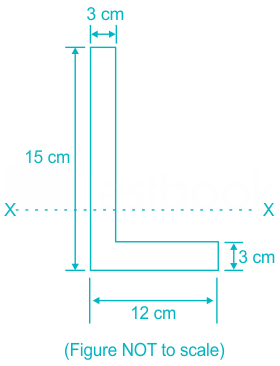
The steel angle section shwon in the figure has elastic section modulus of 150.92 cm3 about the horizontal X-X axis, which passes through the centroid of the section.

The shape factor of the section is ________- (rounded off to 2 decimal places)

View answer & explanation

Correct answer

Answer: 1.79Answer: 1.79

Why this answer is correct

Explanation:

Given data:

Elastic section modulus = 150.92 cm3

Shape factor \(=\frac{Z_p}{Z_e}\)

Plastic Section Modulus is given by:

\(Z_p =\frac{A}{2}\left(\bar{y}_1+\bar{y}_2\right)\)

\(=\frac{2 \times 12 \times 3}{2}(6+1.5)=270\)

The shape Factor is given by:

\(S F =\frac{270}{150.92}=1.79\)