Search Previous Year Questions

Find real questions from previous competitive exam papers with answers and solutions.

Browse complete papers
1690 matching questions · Page 5
Clear

Question 41

GATE CE 2024• Civil Engineering

The total primary consolidation settlement (Sc) of a building constructed on a 10 m thick saturated clay layer is estimated to be 50 mm. After 300 days of the construction of the building, primary consolidation settlement was reported as 10 mm. The additional time (in days) required to achieve 50% of Sc will be _____ (rounded off to the nearest integer).

View answer & explanation

Correct answer

Answer: 1575Answer: 1575

Why this answer is correct

Explanation:

Give data:

(Sc) Ultimate primary consolidation settlement = 50mm

(Si) Consolidation settlement after 300 day = 10mm

(U) degree of consolidation at 10mm settlement

\(\rm U_{1}=\frac{S_{\mathrm{i}} \times 100}{S_{c}}=\frac{10}{50} \times 100=20 %\)

(t1) time to achieve 10mm settlement = 300 days

Given, (U2) degree of consolidation = 50%

The time factor is given by

\(\rm \therefore \quad T_{v}=\frac{C_{v} t}{d^{2}}\)

Tv ∝ t

where, (Tv) time factor and (t) time needed to achieve a particular degree of consolidation

\(\rm \frac{T_{v 1}}{T_{v 2}}=\frac{t_{1}}{t_{2}}\)

\(\rm \therefore \quad T_{v}=\frac{\pi}{4}\left(U^{2}\right)\) for U ≤ 60% 

So, 

\(\rm \frac{\left(U_{1}\right)^{2}}{\left(U_{2}\right)^{2}}=\frac{t_{1}}{t_{2}}\)

\(\rm \frac{(20)^{2}}{(50)^{2}}=\frac{300}{t_{2}}\)

(t2) time needed to achieve 50% degree of consolidation = 1875 days

Hence, additional time needed = 1875 – 300 = 1575 days
Question 42

GATE CE 2024• Civil Engineering

What are the eigenvalues of the matrix \(\left[\begin{array}{lll} 2 & 1 & 1 \ 1 & 4 & 1 \ 1 & 1 & 2 \end{array}\right]\) ?

  1. AOption (a)

    –5, –1, 2

  2. BOption (b)

    –5, 1, 2 

  3. COption (c)

    1, 3, 4 

  4. DOption (d)

    1, 2, 5

View answer & explanation

Correct answer

Answer: (d)D.

1, 2, 5

Why this answer is correct

Solution:

To calculate the eigenvalues of the given matrix:

Given Data:

\( A = \begin{bmatrix} 2 & 1 & 1 \ 1 & 4 & 1 \ 1 & 1 & 2 \end{bmatrix} \)

Step 1: Write the characteristic equation

\( \text{det}(A - \lambda I) = 0 \)

Subtract \( \lambda \) along the diagonal elements:

\( \text{det} \begin{bmatrix} 2-\lambda & 1 & 1 \ 1 & 4-\lambda & 1 \ 1 & 1 & 2-\lambda \end{bmatrix} = 0 \)

Step 2: Expand the determinant

Expand using the first row:

\( (2-\lambda) \cdot \text{det} \begin{bmatrix} 4-\lambda & 1 \ 1 & 2-\lambda \end{bmatrix} - 1 \cdot \text{det} \begin{bmatrix} 1 & 1 \ 1 & 2-\lambda \end{bmatrix} + 1 \cdot \text{det} \begin{bmatrix} 1 & 4-\lambda \ 1 & 1 \end{bmatrix} = 0 \)

Simplify the determinant step-by-step to get the cubic equation:

\( -\lambda^3 + 9\lambda^2 - 26\lambda + 30 = 0 \)

Step 3: Solve the cubic equation

Using numerical methods or a solver, the roots of the equation are:

\( \lambda_1 = 5, , \lambda_2 = 1, , \lambda_3 = 2 \)

The eigenvalues of the matrix are 5, 1, and 2.

Question 43

GATE CE 2024• Civil Engineering

Activated carbon is used to remove a pollutant from wastewater in a mixed batch reactor, which follows first-order reaction kinetics.

At a reaction rate of 0.38/day, the time (in days) required to remove the pollutant by 95% is _____ (rounded off to 1 decimal place).

View answer & explanation

Correct answer

Answer: 7.9Answer: 7.9

Why this answer is correct

Explanation:

Now,

No = Number of pollutant present in waste water intially i.e. at t = 0

Nt = Number of pollutant present in waste water at time, ‘t’

Treatment of activated carbon to remove pollutant in mixed batch reactor follows 1st order kinetics.

i.e.  Nt = Noe-kt …(i)

As, removal efficiency at any time ‘t’ = 95%

i.e. \(\rm \frac{N_{o}-N_{t}}{N_{o}} \times 100=95 \)

So, \(\rm \frac{N_{t}}{N_{o}}=0.05\)

On putting in eq.

(i) So, 0.05 = e–0.38t

On solving,

t = 7.88 days ≈ 7.9 days

Question 44

GATE CE 2024• Civil Engineering

A water treatment plant treats 25 MLD water with a natural alkalinity of 4.0 mg/L (as CaCO3). It is estimated that, during coagulation of this water, 450 kg/day of calcium bicarbonate (Ca(HCO3)2) is required based on the alum dosage.

Consider the atomic weights as: Ca - 40, H - 1, C - 12, O - 16.

The quantity of pure quick lime, CaO (in kg) required for this process per day is _____ (rounded off to 2 decimal places).

View answer & explanation

Correct answer

Answer: 99.54Answer: 99.54

Why this answer is correct

Explanation:

Natural alkalinity = 4 mg/l as CaCO3

Alkalinity req = \(\rm \left(\frac{450 \times 10^{3} \mathrm{~g} / \text { day }}{25 \times 10^{6} l / \mathrm{d} \times \text { eq wt of } \mathrm{CO}\left(\mathrm{HCO}_{3}\right)_{2}} \times \text { eq wt of } \mathrm{CaCO}_{3}\right)\) \(\times 10^{3} \frac{\mathrm{mg}}{\mathrm{l}} \mathrm{as\ CaCO}_{3}\)

\(=\frac{450 \times 10^{3} \times 10^{3}}{25 \times 10^{6} \times 81} \times 50\)

\(=\frac{450 \times 50}{25 \times 81}=11.11 \mathrm{mg} / \mathrm{l\ as\ CaCO}_{3}\)

Alkalinity needed to be provided through outside source is

= (11.11 – 4) = 7.11 mg/l as CaCO3 

= \(\frac{7.11}{50}\) milieq/l

CaO required is

= \(\frac{7.11}{50}\) milieq/l

\(=\left[\frac{7.11}{50} \times \text { eq. wt\ of } \mathrm{CaO}\right] \frac{\mathrm{mg}}{\mathrm{l}} \)

\(\rm =\left[\frac{7.11}{50} \times 28\right] \frac{\mathrm{mg}}{\mathrm{l}} \times 25 \times 10^{6} l / \mathrm{d}\)

= 99.54 kg/d

Question 45

GATE CE 2024• Civil Engineering

The following data is obtained from an axle load survey at a site:

Average rear axle load = 12000 kg

Number of commercial vehicles = 800 per day

The pavement at this site would be reconstructed over a period of 5 years from the date of survey. The design life of the reconstructed pavement is 15 years. Use the standard axle load as 8160 kg and the annual average vehicle growth rate as 4.0%. Assume that Equivalent Wheel Load Factor (EWLF) and Vehicle Damage Factor (VDF) are equal.

The cumulative standard axle (in msa) for the pavement design is ______ (rounded off to 2 decimal places).

View answer & explanation

Correct answer

Answer: 33.27Answer: 33.27

Why this answer is correct

Explanation:

Vehicle Damage Factor:

\(\text { VDF }=\mathrm{EWLF} =\left(\frac{\text { Axle load }}{\text { Standard axle load }}\right)^{4} \)

\(=\left(\frac{12000}{8160}\right)^{4}=4.677 \)

A = P(1 + r)x

= 800(1.04)5 = 973.322 

The cumulative standard axle (in msa) for the pavement design is

\(\rm C S A =\frac{365 A\left((1+r)^{n}-1\right)}{r} L D F \times V D F \) 

where assuming LDF to be 1

CSA \(=\frac{365 \times 973.322\left[1.04^{15}-1\right]}{0.04} \times 1 \times 4.677\)

CSA = 33.27 msa

Question 46

GATE CE 2024• Civil Engineering

A soil sample was consolidated at a cell pressure of 20 kPa and a back pressure of 10 kPa for 24 hours during a consolidated undrained (CU) triaxial test. The cell pressure was increased to 30 kPa on the next day and it resulted in the development of pore water pressure of 1 kPa. The soil sample failed when the axial stress was gradually increased to 50 kPa. The pore water pressure at failure was recorded as 21 kPa. The value of Skempton’s pore pressure parameter B for the soil sample is _______ (rounded off to 2 decimal places). 

View answer & explanation

Correct answer

Answer: 0.1Answer: 0.1

Why this answer is correct

Explanation:

When the cell pressure was increased to 30 kPa

Δσ3 = (30 – 20) = 10 kPa

Δu1 = 1 kPa

The value of Skempton’s pore pressure parameter B for the soil sample is

\(\rm B=\frac{\Delta \mathrm{u}_{1}}{\Delta \sigma_{3}}=\frac{1}{10}=0.1\)

B = 0.1

Question 47

GATE CE 2024• Civil Engineering

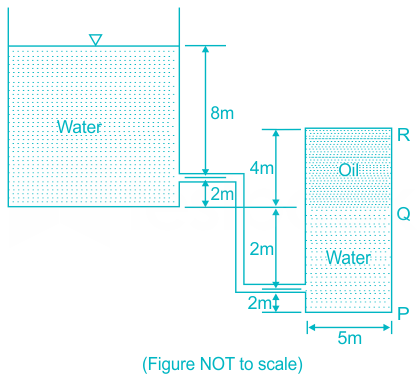
A 5 m × 5 m closed tank of 10 m height contains water and oil and is connected to an overhead water reservoir as shown in the figure. Use γw = 10 kN/m3 and specific gravity of oil = 0.8.

The total force (in kN) due to pressure on the side PQR of the tank is (rounded off to the nearest integer).

View answer & explanation

Correct answer

Answer: 5580Answer: 5580

Why this answer is correct

Explanation:

Considering PQR

PR + 4 × (0.8γw) = 10γw

⇒ PR = (10 3.2)γw = 6.8γw

Now, 

Considering force prism QRST 

\(\rm F_{1}=\frac{(6.8+10)}{2} \gamma_{w} \times 4 \times 5=168 \gamma_{w}=1680 \mathrm{kN}\)

Considering force prism PQTU 

\(\rm F_{2}=\frac{(10+16)}{2} \gamma_{w} \times 6 \times 5=3900 \mathrm{kN}\)

So, F = F1 + F2 = 1680 + 3900 = 5580 kN

Question 48

GATE CE 2024• Civil Engineering

A infinite slope is made up of cohesionless soil with seepage parallel to and up to the sloping surface. The angle of slope is 30° with respect to horizontal ground surface. The unit weights of the saturated soil and water are 20 kN/m3 and 10 kN/m3, respectively.

The minimum angle of shearing resistance of the soil (in degrees) for the critically stable condition of the slope is ______ (rounded off to the nearest integer).

View answer & explanation

Correct answer

Answer: 49Answer: 49

Why this answer is correct

Explanation:

Seepage is occuring upto the ground surface 

Given, (γsat) saturated unit weight = 20 kN/m3

(γW) unit weight of water = 10 kN/m3

(β) slope angle = 30° 

(ϕ) angle of shearing resistance of soil = ?

The water table is at the ground surface & seepage is occurring so, 

(FOS) factor of safety = \(\rm \frac{\gamma_{\text {sub }}}{\gamma_{\text {sat }}} \frac{\tan \phi}{\tan \beta}\)

For critical conditions, 

\(\rm \text { FOS }=1=\left(\frac{\gamma_{\mathrm{sat}}-\gamma_{\mathrm{w}}}{\gamma_{\mathrm{sat}}}\right) \times \frac{\tan \phi}{\tan \beta}\)

\(1=\left(\frac{20-10}{20}\right) \times \frac{\tan \phi}{\tan 30^{\circ}}\)

The angle of shearing resistance (ϕ) = 49.106° = 49°

Question 49

GATE CE 2024• Civil Engineering

A 2 m × 2 m tank of 3 m height has inflow, outflow and stirring mechanisms. Initially, the tank was half-filled with fresh water. At t = 0, an inflow of a salt solution of concentration 5 g/m3 at the rate of 2 litre/ s and an outflow of the well stirred mixture at the rate of 1 litre/s are initiated. This process can be modelled using the following differential equation:

\(\rm \frac{d m}{d t}+\frac{m}{6000+t}=0.01\)

where, m is the mass (grams) of the salt at time t (seconds). The mass of the salt (in grams) in the tank at 75% of its capacity is ______ (rounded off to 2 decimal places).

View answer & explanation

Correct answer

Answer: 25Answer: 25

Why this answer is correct

Explanation:

We know that 

\(\rm \frac{d x}{d t}+P x=Q\)

\(\rm \Rightarrow \quad \frac{\mathrm{dm}}{\mathrm{dt}}+\mathrm{Pm} =Q \)

\(\rm P =\frac{1}{6000+t}\)

Q = 0.01 

Integration factor

(I.F.) = \(\rm e^{\int P\ d t}=e^{\int \frac{1}{6000+t} d t}\)

= eln(6000+t) = 6000 + t

⇒ m.(I.F.) = ∫Q.(I.F.)dt + C

m(6000 + t) = ∫0.01(6000 + t)dt + C

\(\rm m(6000+t)=0.01\left[6000 t+\frac{t^{2}}{2}\right]+C\)

at t = 0, m = 0

[Since there is Fresh water in tank initially]

⇒ C = 0

⇒ \(\mathrm{m}=\frac{0.01\left(6000 \mathrm{t}+\frac{\mathrm{t}^{2}}{2}\right)}{(6000+\mathrm{t})}\)

From volume balance

Accumulation = Inflow – Ourtflow

2 × 2 ×(3 × 0.25)m3 = \(\rm (2-1) \frac{l}{5} \times \mathrm{t}_{\mathrm{sec}} \times 10^{-3} \frac{\mathrm{~m}^{3}}{l}\)

⇒ t = 3000 sec. 

Hence, at 3000 sec. i.e. when tank is 75% full.

\(\mathrm{m}=\frac{0.01\left(6000 \times 3000+\frac{(3000)^{2}}{2}\right)}{6000+3000}\)

m = 0.01[2000 + 500]

m = 25 gram

Question 50

GATE CE 2024• Civil Engineering

The return period of a large earthquake for a given region is 200 years. Assuming that earthquake occurrence follows Poisson’s distribution, the probability that it will be exceeded at least once in 50 years is ________ %. (rounded off to the nearest integer).

View answer & explanation

Correct answer

Answer: 22Answer: 22

Why this answer is correct

Explanation:

As per given data:

T = 200 yrs

\(\lambda=\frac{1}{200}\)

Probability of non occurrence in 50 years

= e-λt  = 0.7788

Probability of occurrence atleast once

= 1 – 0.7788 = 0.2212 ≃ 22.12%