Search Previous Year Questions

Find real questions from previous competitive exam papers with answers and solutions.

Browse complete papers
1690 matching questions · Page 4
Clear

Question 31

GATE CE 2024• Civil Engineering

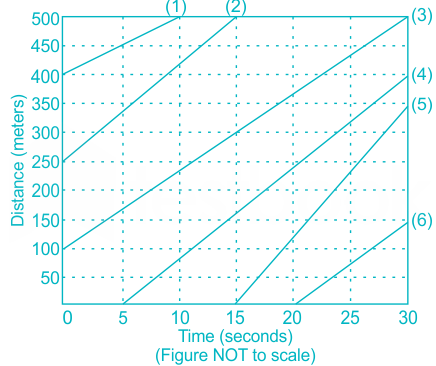
The figure presents the trajectories of six vehicles within a time-space domain. The number in the parentheses represents unique identification of each vehicle. 
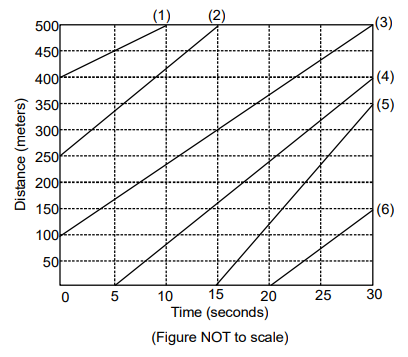
The mean speed (in km/hr) of the vehicles in the entire time-space domain is _____ (rounded off to the nearest integer).

View answer & explanation

Correct answer

Answer: 57Answer: 57

Why this answer is correct

Explanation:

As per given data:

The distance traveled by each vehicle

Vehicle (1) ends at about 100 meters.

Vehicle (2) ends at about 250 meters.

Vehicle (3) ends at about 400 meters.

Vehicle (4) ends at about 400 meters.

Vehicle (5) ends at about 350 meters.

Vehicle (6) ends at about 150 meters.

The mean speed is given by

\(\text { Mean speed } =\frac{\text { Total distance travelled }}{\text { Total time taken }} \)

Mean Speed \(=\frac{100+250+400+400+350+150}{10+15+30+25+15+10}\)

Mean Speed = 15.714 m/sec = 56.57 km/h ≃ 57 km/h
Question 32

GATE CE 2024• Civil Engineering

The initial cost of an equipment is Rs. 1,00,000. Its salvage value at the end of accounting life of 5 years is Rs. 10,000. The difference in depreciation (in Rs.) computed using ‘double-declining balance method’ and ‘straight line method’ of depreciation in Year-2 is _______ (in positive integer). 

View answer & explanation

Correct answer

Answer: 6000Answer: 6000

Why this answer is correct

Explanation:

As per given data:

Initial cost = 100000

Salvage value = 10,000

Accounting life = 5 years

(i) Depreciation using straight-line method

Annual depreciation 

\(=\frac{\text { Initial cost }- \text { Salvage value }}{\text { Accounting life or Service life }} \)

\(=\frac{100000-10000}{5}=18000\)

(ii) Depreciation using double declining balance method

In this method, the asset is assumed to loose its value by a fixed factor of the book value i.e. double the straight line rate.

Fixed factor for double declining balance method = FDDB

\(\rm \text { FDDB }=\frac{2}{n} \), here n = 5 years

\(\rm \therefore \quad F D D B=\frac{2}{5}=0.4\)

Depreciation for the first year = FDDB × Initial cost

= 0.4 × 100000 = 40000

Book value at the end of 1st year = Initial cost – Depreciation

= 100000 – 40000 = 60000

Depreciation for 2nd year = 60000 × 0.4 = 24000

Difference in depreciation between double declining balance and straight-line method

= 24000 – 18000 = 6000

Question 33

GATE CE 2024• Civil Engineering

A spillway has unit discharge of 7.5 m3/s/m. The flow depth at the downstream horizontal apron is 0.5 m. The tail water depth (in meters) required to form a hydraulic jump is _____ (rounded off to 2 decimal places).

View answer & explanation

Correct answer

Answer: 4.55Answer: 4.55

Why this answer is correct

Explanation:

As per given data:

Discharge = 7.5 m3/sec/m

Flow depth at downstream horizontal apron (y1) = 0.5 m.

\(\rm v_{1}=\frac{q}{y_{1}}=\frac{7.5}{0.5}=15 \mathrm{~m} / \mathrm{s}\)

Initial Froude number (Fr1)

= \(\rm \frac{v_{1}}{\sqrt{g y_{1}}}=\frac{15}{\sqrt{9.81 \times 0.5}}\)

= 6.7729 > 1

Let y2 be the sequent depth corresponding to initial depth y1 = 0.5 m

\(\frac{\mathrm{y}_{2}}{\mathrm{y}_{1}}=\frac{1}{2}\left[\sqrt{1+8 \mathrm{Fr}_{1}^{2}-1}\right] \)

or \(\frac{\mathrm{y}_{2}}{\mathrm{y}_{1}}=\frac{1}{2}\left[\sqrt{1+8 \times 6.7729^{2}}-1\right] \)

or \(\frac{\mathrm{y}_{2}}{\mathrm{y}_{1}}=9.0914\) 

∴y2 = 0.5 × 9.0914 = 4.5457

So, tail water depth after rounding off 2 decimal places = 4.55 m.

Question 34

GATE CE 2024• Civil Engineering

A bird is resting on a point P at a height of 8 m above the Mean Sea Level (MSL). Upon hearing a loud noise, the bird flies parallel to the ground surface and reaches a point Q which is located at a height of 3 m above MSL. The ground surface has a falling gradient of 1 in 2. Ignoring the effects of curvature and refraction, the horizontal distance (in meters) between points P and Q is _____ (in integer). 

View answer & explanation

Correct answer

Answer: 10Answer: 10

Why this answer is correct

Explanation:

Given Data:

Initial height of the bird at point P = 8 m above MSL.

Final height of the bird at point Q = 3 m above MSL.

Ground surface gradient = 1 in 2.

Step 1: Determine the change in height

Calculate the height difference between points P and Q:

Height difference = Height at P - Height at Q = 8 m - 3 m = 5 m.

Step 2: Calculate the horizontal distance using the gradient

Using the gradient of 1 in 2, where for every 1 m drop in height, the horizontal distance is 2 m:

Horizontal distance = Height difference × Gradient = 5 m × 2 = 10 m.

Conclusion: The horizontal distance between points P and Q where the bird flies parallel to the ground is 10 meters.

Question 35

GATE CE 2024• Civil Engineering

The ordinates of a 1-hour unit hydrograph (UH) are given below.

Time (hours)Ordinates of 1-hour UH (m3/s)
00
113
250
380
495
585
655
735
815
910
103
110

These ordinates are used to derive a 3-hour UH. The peak discharge (in m3/s) for the derived 3-hour UH is _______ (rounded off to the nearest integer).

View answer & explanation

Correct answer

Answer: 87Answer: 87

Why this answer is correct

Explanation:

Question 36

GATE CE 2024• Civil Engineering

A flow velocity field \(\rm \vec{V}: \vec{V}(x, y)\) for a fluid is represented by

\(\rm \vec{V}=3 \hat{i}+(5 x) \hat{j}\)

In the context of the fluid and flow, which one of the following statements is CORRECT?

  1. AOption (a)

    The fluid is incompressible and the flow is rotational.

  2. BOption (b)

    The fluid is incompressible and the flow is irrotational.

  3. COption (c)

    The fluid is compressible and the flow is irrotational. 

  4. DOption (d)

    The fluid is compressible and the flow is rotational.

View answer & explanation

Correct answer

Answer: (a)A.

The fluid is incompressible and the flow is rotational.

Why this answer is correct

Explanation:

As per Given data:

\(\rm \vec{v}=3 \hat{i}+(5 x) \hat{j}\)

Here, u = 3, v = (5x)

Check for incompressibility 

\(\rm \frac{\partial u}{\partial x}+\frac{\partial v}{\partial y}=\frac{\partial(3)}{\partial x}+\frac{\partial(5 x)}{\partial y}=0\)

Since, \(\rm \frac{\partial u}{\partial x}+\frac{\partial v}{\partial y}=0\)

Fluid is incompressible.

Check for rotationality

\(\rm \omega_{z}=\frac{1}{2}\left[\frac{\partial v}{\partial x}-\frac{\partial u}{\partial y}\right]\)

\(\rm =\frac{1}{2}\left[\frac{\partial(5 x)}{\partial x}-\frac{\partial(3)}{\partial y}\right] \)

\( =\frac{1}{2}[5-0]=2.5 \neq 0\)

So, flow is rotational.

Question 37

GATE CE 2024• Civil Engineering

A vector field \(\rm \vec p\) and a scalar field r are given by

\(\rm \vec{{p}}= \left(2 x^{2}-3 x y+z^{2}\right) \hat{i}+\left(2 y^{2}-3 y z+x^{2}\right) \hat{j} \) \(\rm +\left(2 z^{2}-3 x z+x^{2}\right) \hat{k}\)

r = 6x2 + 4y2 – z2 – 9xyz – 2xy + 3xz – yz

Consider the statements P and Q.

P: Curl of the gradient of the scalar field r is a null vector.

Q: Divergence of curl of the vector field \(\rm \vec p\) is zero.

Which one of the following options is CORRECT?

  1. AOption (a)

    Both P and Q are FALSE

  2. BOption (b)

    Both P and Q are TRUE

  3. COption (c)

    P is TRUE and Q is FALSE

  4. DOption (d)

    P is FALSE and Q is TRUE 

View answer & explanation

Correct answer

Answer: (b)B.

Both P and Q are TRUE

Why this answer is correct

Solution:

To verify the given statements about vector fields and scalar fields:

Given Data:

Scalar field \( r \) and vector field \( \mathbf{p} \) are defined as follows:

\( r = 6x^2 + 4y^2 - z^2 - 9yz - 2xy + 3xz - yz \)

\( \mathbf{p} = (2x^2 - 3xy + z^2) \mathbf{i} + (2y^2 - 3yz + x^2) \mathbf{j} + (2z^2 - 3xz + x^2) \mathbf{k} \)

Step 1: Analyze Statement P (Curl of the gradient of the scalar field \( r \) is a null vector)

Compute the gradient of scalar field \( r \):

\( \nabla r = (12x - 2y + 3z) \mathbf{i} + (8y - 10z - x) \mathbf{j} + (-2z - 9y + 3x) \mathbf{k} \)

Compute the curl of this gradient vector:

\( \nabla \times (\nabla r) = (0, 0, 0) \) (Since the curl of any gradient is always zero.)

Statement P is confirmed true.

Step 2: Analyze Statement Q (Divergence of curl of the vector field \( \mathbf{p} \) is zero)

Compute the curl of vector field \( \mathbf{p} \):

\( \nabla \times \mathbf{p} = (3y, 5z, 4x) \)

Compute the divergence of this curl vector:

\( \nabla \cdot (\nabla \times \mathbf{p}) = 0 \) (As the divergence of any curl is always zero.)

Statement Q is confirmed true.

Conclusion: Both statements P and Q are true based on vector calculus identities.

Correct Option: Both P and Q are true.

Question 38

GATE CE 2024• Civil Engineering

For assessing the compliance with the emissions standards of incineration plants, a correction needs to be applied to the measured concentrations of air pollutants. The emission standard (based on 11% Oxygen) for HCl is 50 mg/Nm3 and the measured concentrations of HCl and Oxygen in flue gas are 42 mg/Nm3 and 13%, respectively.

Assuming 21% oxygen in air, the CORRECT statement is:

  1. AOption (a)

    No compliance, as the Oxygen is greater than 11% in the flue gas.

  2. BOption (b)

    Compliance is there, as the corrected HCl emission is lesser than the emission standard.

  3. COption (c)

    Compliance is there, as there is no need to apply the correction since Oxygen is greater than 11% and HCl emission is lesser than the emission standard. 

  4. DOption (d)

    No compliance, as the corrected HCl emission is greater than the emission standard. 

View answer & explanation

Correct answer

Answer: (d)D.

No compliance, as the corrected HCl emission is greater than the emission standard. 

Why this answer is correct

Explanation:

Given data

Emission standard (based on 11% oxygen)

For HCl = 50 mg/Nm3

The measured concentration of HCl and oxygen in flue gas are 42 mg/Nm3 and 13% respectively.

As per CPCB,

The calculated emission concentration at the standard percentage oxygen concentration (ES)

\(\mathrm{ES}=\frac{21-\mathrm{OS}}{21-\mathrm{OM}} \times \mathrm{EM}\)

EM = Measured emission concentration at the standard percentage oxygen concentration

OS = Standard oxygen concentration

OM = Measured oxygen concentration

So, 

\(\mathrm{ES}=\frac{21-11}{21-13} \times 42=52.5 \mathrm{mg} / \mathrm{Nm}^{3}>50 \mathrm{mg} / \mathrm{Nm}^{3}\)

Here, no compliance as the corrected HCl emission is greater than the emission standard.

Question 39

GATE CE 2024• Civil Engineering

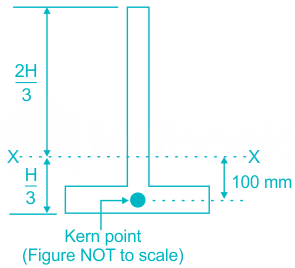
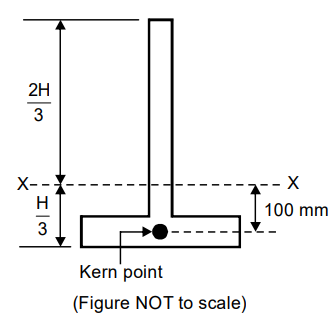
An inverted T-shaped concrete beam (B1) in the figure, with centroidal axis X–X, is subjected to an effective prestressing force of 1000 kN acting at the bottom kern point of the beam cross-section. Also consider an identical concrete beam (B2) with the same grade of concrete but without any prestressing force. 

The additional cracking moment (in kN.m) that can be carried by beam B1 in comparison to beam B2 is _________ (rounded off to the nearest integer).

View answer & explanation

Correct answer

Answer: 300Answer: 300

Why this answer is correct

Explanation:

The resultant stress at the bottom fibre in beam B,

\(\rm =\frac{P}{A}+\frac{P e}{Z_{b}}-\frac{M_{1}}{Z_{b}}\)

\(\rm =\frac{1000 \times 10^{3}}{A}+\frac{1000 \times 10^{3}}{Z_{b}}-\frac{M_{1}}{Z_{b}}\)

For no crack, stress at bottom = fcr

\(\rm \Rightarrow \frac{1000 \times 10^{3}}{A}+\frac{1000 \times 10^{3} \times 100}{Z_{b}}-\frac{M_{1}}{Z_{b}}=-f_{c r} \quad \ldots \text { (i) }\)

The resultant stress at the bottom fibre in beam B2 i.e.

when no prestressing force is here = \(\rm -\frac{M_2}{Z_b}\)

For no crack, stress at bottom = fcr

\(\Rightarrow-\frac{\mathrm{M}_{2}}{\mathrm{Z}_{\mathrm{b}}}=-\mathrm{f}_{\mathrm{cr}} \ldots \text { (ii) }\)

Also, for beam B1, without the moment M1

\(\rm \frac{P}{A}-\frac{P e}{Z_{t}}=0 \)

\(\rm \Rightarrow \frac{1}{A}-\frac{e}{Z_{t}}=0\)

\(\rm \Rightarrow \frac{1}{A}=\frac{e}{Z_{t}} \)

\(\rm \Rightarrow A=\frac{Z_{t}}{e} \)

\(\rm \frac{Z_{b}}{Z_{t}}=\frac{\left(l / y_{b}\right)}{\left(1 / y_{t}\right)}=\frac{y_{t}}{y_{b}}=\frac{2 H}{3(H / 3)}=2 \)

\(\rm \Rightarrow Z_{t}=0.5 Z_{b} \)

\(\rm \Rightarrow A=\frac{0.5 Z_{b}}{e}\)

Adding equation (i) and (ii) 

\(\rm \Rightarrow \frac{1000 \times 10^{3}}{A}+\frac{1000 \times 10^{3} \times 100}{Z_{b}}-\frac{M_{1}}{Z_{b}}+\frac{M_{2}}{Z_{b}}=0 \)

\(\rm \Rightarrow \frac{1000 \times 10^{3} \times 100}{0.5 Z_{b}}+\frac{1000 \times 10^{3}}{Z_{b}}-\frac{\left(M_{1}-M_{2}\right)}{Z_{b}}=0\)

⇒ M1 – M2 = 300 kN.m

Question 40

GATE CE 2024• Civil Engineering

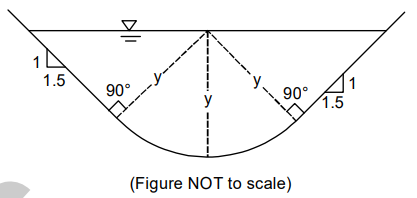
A standard round bottom triangular canal section as shown in the figure has a bed slope of 1 in 200. Consider the Chezy’s coefficient as 150 m1/2/s. 

The normal depth of flow, y (in meters) for carrying a discharge of 20 m3/s is _____ (rounded off to 2 decimal places).

View answer & explanation

Correct answer

Answer: 1.1Answer: 1.1

Why this answer is correct

Explanation:

As per given data

cot θ = 1.5

θ = 0.588 rad

Area (A) = y2(θ + cot θ)

⇒ A = 2.088y2

p = 2y(θ + cot θ)

⇒ R = \(\rm \frac{y}{2}\)

The chezy’s equation is given by: 

\(\rm Q =A V=A \times C \sqrt{R S} \)

⇒ \(\rm 20 =2.088 y^{2} \times 150 \sqrt{\frac{y}{2} \times \frac{1}{200}} \)

⇒ \(\rm y^{5 / 2} =\frac{20 \times 2 \times 10}{2.088 \times 150}\)

⇒ y = 1.102m