Search Previous Year Questions

Find real questions from previous competitive exam papers with answers and solutions.

Browse complete papers
1690 matching questions · Page 3
Clear

Question 21

GATE CE 2024• Civil Engineering

As per the International Civil Aviation Organization (ICAO), the basic runway length is increased by x(%) for every y (m) raise in elevation from the Mean Sea Level (MSL). The values of x and y, respectively, are

  1. AOption (a)

    5% and 200 m

  2. BOption (b)

    7% and 300 m

  3. COption (c)

    10% and 1000 m

  4. DOption (d)

    4% and 500 m

View answer & explanation

Correct answer

Answer: (b)B.

7% and 300 m

Why this answer is correct

Explanation:

Basic Runway length:

It is the length of runway under the following assumed conditions at the aircraft

(i) Airport altitude at sea level.

(ii) Temperature at the airport is standard (15° C)

(iii) Runway is leveled in the longitudinal direction.

(iv) No wind is blowing on runway.

(v) Aircraft is loaded to its full loading capacity.

(vi) There is no wind blowing enroute to the destination.

(vii) Enroute temperature is standard.

Correction for Elevation, Temperature and Gradient:

(i) Correction for Elevation: Basic runway length is increased at the rate of 7% per 300 m rise in elevation above the mean sea level.

(ii) Correction for Temperature: 

Airport reference temperature = \({T_a} + \frac{{{T_m} - {T_a}}}{3}\)

Where, Ta = Monthly mean of average daily temperature

Tm = Monthly mean of the maximum daily temmperature for the same month of the year

Total correction for elevation plus temperature ⇒ 35% of basic runway length

(c) Correction for Gradient:

(i) Steeper gradient results in greater consumption of energy and as such longer length of runway is required to attain the desired ground speed.

(ii) After having been corrected for elevation and temperature should be further increased at the rate of 20% for every 1% of effective gradient.

Question 22

GATE CE 2024• Civil Engineering

A 30 cm diameter well fully penetrates an unconfined aquifer of saturated thickness 20 m with hydraulic conductivity of 10 m/day. Under the steady pumping rate for a long time, the drawdowns in two observation wells located at 10 m and 100 m from the pumping well are 5 m and 1 m, respectively. The corresponding pumping rate (in m3/day) from the well is ______ (rounded off to 2 decimal places).

View answer & explanation

Correct answer

Answer: 1855Answer: 1855(±3)

Why this answer is correct

Explanation:

Given data:

The radius of well (rw) = 15 cm

Hydraulic conductivity (k) = 10 m/day

(r1) distance of first observation well = 10m

(r2) distance of second observation well = 100m

(S1) drawdown in first observation well = 5m

(S2) drawdown in second observation well = 1m

(H) thickness of unconfined aquifer/initial water table height = 20m

(Q) puming rate/discharge (m3/day) = ?

(h1) height of water table at r1 = H – S1 = 20 – 5 = 15 m

(h2) height of water table at r2 = H – S2 = 20 – 1 = 19m

The corresponding pumping rate (in m3/day) from the well is

\(\mathrm{Q}=\frac{\pi \mathrm{k}\left(\mathrm{~h}_{2}^{2}-\mathrm{h}_{1}^{2}\right)}{\ln \left(\frac{\mathrm{r}_{2}}{r_{1}}\right)}\)

\(\mathrm{Q}=\frac{\pi \times 10\left(19^{2}-15^{2}\right)}{\ln \frac{100}{10}}=1855.55\)

Question 23

GATE CE 2024• Civil Engineering

The following table gives various components of Municipal Solid Waste (MSW) and a list of treatment/separation techniques.

Component of MSWTreatment/separation technique
P.Ferrous metalsi.Incineration
Q.Aluminum and copperii.Rapid composting
R.Food wasteiii.Eddy current separator
S.Cardboardiv.Magnetic separator

The CORRECT match is

  1. AOption (a)

    P - iv, Q - iii, R - i, S - ii

  2. BOption (b)

    P - iii, Q - iv, R - i, S - ii

  3. COption (c)

    P - iv, Q - iii, R - ii, S - i

  4. DOption (d)

    P - iii, Q - iv, R - ii, S - i 

View answer & explanation

Correct answer

Answer: (c)C.

P - iv, Q - iii, R - ii, S - i

Why this answer is correct

Explanation:

Ferrous metals (P) → Magnetic separator (iv)

  • Ferrous metals (like iron and steel) are separated using a magnetic separator.

Aluminum and copper (Q) → Eddy current separator (iii)

  • Non-ferrous metals (like aluminum and copper) are separated using eddy current separators.

Food waste (R) → Rapid composting (ii)

  • Organic waste like food is treated using rapid composting.

Cardboard (S) → Incineration (i)

  • Cardboard can be incinerated as part of waste-to-energy processes.

Question 24

GATE CE 2024• Civil Engineering

Concrete of characteristic strength 30 MPa is required. If 40 specimens of concrete cubes are to be tested, the minimum number of specimens having at least 30 MPa strength should be

  1. AOption (a)

    38

  2. BOption (b)

    39

  3. COption (c)

    35

  4. DOption (d)

    37

View answer & explanation

Correct answer

Answer: (a)A.

38

Why this answer is correct

Explanation:

Given data:

Characteristic strength = 30 MPa

No. of cubes = 40

Hence, Characteristic strength is the strength below which not more than 5% of the test results are expected to fall.

95% of the test results are having strength ≥ characteristic strength.

0.95 × 40 = 38

38 = 38

The minimum number of specimens having at least 30 MPa strength is = 38

Question 25

GATE CE 2024• Civil Engineering

Consider a balanced doubly-reinforced concrete section. If the material and other sectional properties remain unchanged, for which of the following cases will the section becomes under-reinforced?

  1. AOption (a)

    Area of tension reinforcement is decreased.

  2. BOption (b)

    Area of compression reinforcement is decreased. 

  3. COption (c)

    Area of tension reinforcement is increased. 

  4. DOption (d)

    Area of compression reinforcement is increased.

View answer & explanation

Correct answer

Answer: (a)A.

Area of tension reinforcement is decreased.

Why this answer is correct

Explanation:

1. Understanding Under-Reinforced Sections (Reference: Limit State Design of Reinforced Concrete by Varghese & IS 456:2000)

  • A balanced section is when both concrete in compression and steel in tension reach their limit state at the same time.
  • A section becomes under-reinforced when steel in tension yields before the concrete in compression fails. This makes the failure ductile, which is desirable for safety.

2. Effect of Changes in Reinforcement Area

  • Decreasing the area of tension reinforcement

Correct (Under-Reinforced) → Less steel means it reaches yield stress earlier, leading to ductile failure.

  • Decreasing the area of compression reinforcement

Incorrect (Not necessarily Under-Reinforced) → This affects compression strength, but the section may still remain balanced or shift towards an over-reinforced state.

  • Increasing the area of tension reinforcement

Incorrect (Over-Reinforced) → More steel means higher resistance, making the section over-reinforced.

  • Increasing the area of compression reinforcement

Correct (Under-Reinforced) → Adding compression reinforcement improves the compression zone, making the steel in tension yield earlier, shifting failure towards a ductile mechanism.

Question 26

GATE CE 2024• Civil Engineering

The number of trains and their corresponding speeds for a curved Broad Gauge section with 437 m radius are

  • 20 trains travel at a speed of 40 km/hr
  • 15 trains travel at a speed of 50 km/hr
  • 12 trains travel at a speed of 60 km/hr
  • 8 trains travel at a speed of 70 km/hr
  • 3 trains travel at a speed of 80 km/hr

If the gauge (center-to-center distance between the rail heads) is taken as 1750 mm, the required equilibrium cant (in mm) will be ________ (rounded off to the nearest integer).

View answer & explanation

Correct answer

Answer: 88Answer: 88

Why this answer is correct

Explanation:

Given data:

  • 20 trains travel at a speed of 40 km/hr
  • 15 trains travel at a speed of 50 km/hr
  • 12 trains travel at a speed of 60 km/hr
  • 8 trains travel at a speed of 70 km/hr
  • 3 trains travel at a speed of 80 km/hr

The velocity is given by:

\(\rm V_{e q}=\frac{20 \times 40+15 \times 50+12 \times 60+8 \times 70+3 \times 80}{20+15+12+8+3}\) = 52.93 km/hr

The equilibrium cant is given by

= \(\rm \frac{GV_{e q}^{2}}{127 R}\) = \(\rm \frac{1.75 \times 52.93^{2}}{127 \times 437}\)= 0.08834 m ≈ 88.3 mm

Closest integer = 88 mm < 165 mm

Question 27

GATE CE 2024• Civil Engineering

Find the correct match between the plane stress states and the Mohr’s circles.

P.I.
Q.II.
R.III.
S.IV.
  1. AOption (a)

    P - I, Q - IV, R - III, S - II

  2. BOption (b)

    P - III, Q - II, R - I, S - IV

  3. COption (c)

    P - I, Q - II, R - III, S - IV

  4. DOption (d)

    P - III, Q - IV, R - I, S - II

View answer & explanation

Correct answer

Answer: (d)D.

P - III, Q - IV, R - I, S - II

Why this answer is correct

Explanation:

Step 1: Understanding the Given Stress States

  • P: Pure shear stress (equal and opposite shear forces) → Mohr’s circle should be symmetric about the τ-axis.
  • Q: Equal biaxial tension (same normal stress in both directions) → Mohr’s circle should be centered at the same positive stress value.
  • R: Uniaxial tensile stress in one direction → Mohr’s circle should have one normal stress component.
  • S: Equal biaxial compression (same normal stress in both directions but negative) → Mohr’s circle should be a point on the σ-axis.

Step 2: Matching with Mohr’s Circles

  • P (Pure shear) → III (Circle symmetric about τ-axis).
  • Q (Equal biaxial tension) → IV (Circle centered at positive σ with equal principal stresses).
  • R (Uniaxial tension) → I (Circle with normal stress +10).
  • S (Equal biaxial compression) → II (Single point on σ-axis at -10).

Question 28

GATE CE 2024• Civil Engineering

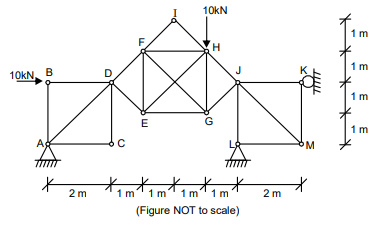
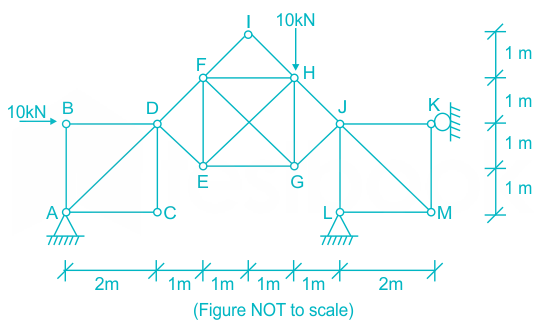
The plane truss shown in the figure has 13 joints and 22 members. The truss is made of a homogeneous, prismatic, linearly elastic material.

All members have identical axial rigidity. A to M indicate the joints of the truss. The truss has pin supports at joints A and L and roller support at joint K. The truss is subjected to a 10 kN vertically downward force at joint H and a 10 kN horizontal force in the rightward direction at joint B as shown.

The magnitude of the reaction (in kN) at the pin support L is _____ (rounded off to 1 decimal place).

View answer & explanation

Correct answer

Answer: 7.5Answer: 7.5

Why this answer is correct

Explanation:

As per given data:

Using equilibrium equations

∑FV = 0 ⇒ RA + RL – 10 = 0 …(i) 

∑FH = 0 ⇒ HA + HL - RK + 10 = 0 …(ii) 

 …(iii)

BM at D = 0 ⇒ RA × 2 – HA × 2 = 0 …(iv)

BM at J = 0 ⇒ HL × 2 = 0 …(v)

From (v), HL = 0

From (iv), RA = HA

From (ii), RA + 0 – RK + 10 = 0 ⇒ RK = RA + 10

From (iii), 70 – 6RL – 2(RA + 10) = 0

⇒ 50 – 6RL – 2RA = 0 …(α)

From (i),  2RA + 2RL – 20 = 0 …(β) 

30 – 4RL = 0 ⇒ RL = 7.5 kN

Question 29

GATE CE 2024• Civil Engineering

A homogeneous shaft PQR with fixed supports at both ends is subjected to a torsional moment T at point Q, as shown in the figure. The polar moments of inertia of the portions PQ and QR of the shaft with circular cross-sections are J1 and J2, respectively. The torsional moment reactions at the supports P and R are TP and TR, respectively.

If TP/TR = 4 and J1/J2 = 2, the ratio of the length L1/L2 is

  1. AOption (a)

    4.00

  2. BOption (b)

    0.25

  3. COption (c)

    0.50

  4. DOption (d)

    2.00

View answer & explanation

Correct answer

Answer: (c)C.

0.50

Why this answer is correct

Explanation:

As per given data:

\(\rm \frac{T_{P}}{T_{R}}=4\ &\ \frac{J_{1}}{J_{2}}=2\)

As P & R are fixed supports,

Hence, 

|ϕQP| = |ϕRQ|

\(\rm \frac{T_{\mathrm{P}} \times \mathrm{L}_{1}}{J_{1} \times G_{1}}=\frac{T_{R} \times L_{2}}{G_{2} \times J_{2}}\)

\(\rm \Rightarrow \frac{L_{1}}{L_{2}}=\frac{T_{R}}{T_{P}} \times \frac{J_{1}}{J_{2}} \times\left(\frac{G_{P}}{G_{2}}\right)^{1}\)

\(\rm \frac{L_{1}}{L_{2}}=\frac{1}{4} \times 2=\frac{1}{2}=0.50\)

Question 30

GATE CE 2024• Civil Engineering

The free mean speed is 60 km/hr on a given road. The average space headway at jam density on this road is 8 m. For a linear speed-density relationship, the maximum flow (in veh/hr/lane) expected on the road is

  1. AOption (a)

    2075

  2. BOption (b)

    938

  3. COption (c)

    1038

  4. DOption (d)

    1875

View answer & explanation

Correct answer

Answer: (d)D.

1875

Why this answer is correct

CONCEPT:

The relationship between speed ( u )  and density ( k ) is given by the

\({\bf{u}} = {{\bf{u}}_{\bf{f}}} - \left( {\frac{{{{\bf{v}}_{\bf{f}}}}}{{{{\bf{k}}_{\bf{j}}}}}} \right) \times {\bf{k}}\)

u - Mean speed at density k ( m/s )

k- Density of stream ( veh/km )

uf - Free mean speed

kj – Jam density

Relation between flow, speed, and density is given by,

q = k × u

q – Flow given in veh/hr

Space headway is defined as the distance between corresponding points of two successive vehicles at any given time. It can also be taken as the average space occupied by each vehicle.

\({\bf{k}} = \frac{{1000}}{{{\bf{Space}};{\bf{headway}}}}\)

At capacity or maximum flow,

\({{\rm{k}}_0} = \frac{{{{\rm{k}}_{\rm{j}}}}}{2}\)

\({u_0} = \frac{{{{\rm{u}}_{\rm{f}}}}}{2}\)

\({{\bf{q}}_{{\bf{max}}}} = {{\bf{k}}_0} \times {{\bf{u}}_0} = \frac{{{{\bf{k}}_{\bf{j}}} \times {{\bf{u}}_{\bf{f}}}}}{4}\)

qmax – Maximum flow or flow at capacity

k0, u0 – Density and speed at capacity

Calculation:

\(\rm q_{\max }=\frac{V_{f} K_{j}}{4}=\frac{60 \times \frac{1000}{8}}{4}=1875 \mathrm{veh} / \mathrm{hr}\)