Search Previous Year Questions

Find real questions from previous competitive exam papers with answers and solutions.

Browse complete papers
1690 matching questions · Page 1
Clear

Question 1

GATE CE 2024• Civil Engineering

If the number of sides resulting in a closed traverse is increased from three to four, the sum of the interior angles increases by

  1. AOption (a)

    360° 

  2. BOption (b)

    180° 

  3. COption (c)

    270°

  4. DOption (d)

    90°

View answer & explanation

Correct answer

Answer: (b)B.

180° 

Why this answer is correct

Explanation:

The sum of the interior angle is given by

= (2n – 4) × 90

For 3 sides, the sum of the interior angle is

= (2×3 – 4) × 90 = 180°

For 4 sides, the sum of the interior angle is

= (2×4 – 4) × 90 = 360°

Hence, the sum of the interior angles increases by 

= 360° - 180° = 180°
Question 2

GATE CE 2024• Civil Engineering

The second-order differential equation in an unknown function u: u(x, y) is defined as

\(\rm \frac{\partial^{2} u}{\partial x^{2}}=2\)

Assuming g : g(x), f : f(y) and h : h(y), the general solution of the above differential equation is

  1. AOption (a)

    u = x2 + x f(y) + g(x)

  2. BOption (b)

    u = x2 + f(y) + y g(x)

  3. COption (c)

    u = x2 + f(y) + g(x)

  4. DOption (d)

    u = x2 + x f(y) + h(y)

View answer & explanation

Correct answer

Answer: (d)D.

u = x2 + x f(y) + h(y)

Why this answer is correct

Explanation:

As per given equation

\(\rm \frac{\partial^{2} u}{\partial x^{2}}=2\) …(i)

\(\rm \frac{\partial}{\partial x}\left(\frac{\partial u}{\partial x}\right)=2\)

Integrating both sides with respect to x

\(\rm \frac{\partial u}{\partial x}=2 x+f(y)\)

Again integrating with respect to x

u = x2 + xf(y) + f(y)

u = x2 + xf(y) + h(y)

Question 3

GATE CE 2024• Civil Engineering

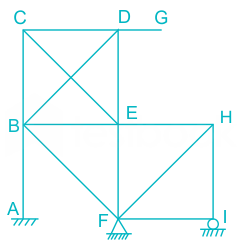
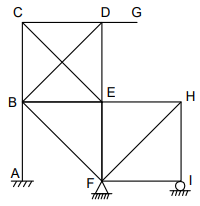
​The plane frame shown in the figure has fixed support at joint A, hinge support at joint F, and roller support at joint I. In the figure, A to I indicate joints of the frame. 

If the axial deformations are neglected, the degree of kinematic indeterminacy is ________ (in integer).

View answer & explanation

Correct answer

Answer: 13Answer: 13

Why this answer is correct

Explanation:

As per given data:

From the inextensibility of BF & BA,

ΔBx = 0 ΔBy = 0

From the inextensibility of BE and EF,

ΔΕx = 0 ΔΕy =0

From the inextensibility of CE and BC

ΔCx = 0 ΔCy = 0

From the inextensibility of BD and CD,

ΔDx = 0 ΔDy = 0

From the inextensibility of DG,

ΔGx = 0

From the inextensibility of EH and HF,

ΔΗx = 0 ΔΗy = 0

From inextensibility FI,

ΔIx = 0

⇒ If at joint (F), FB, FE, FH, FI are rigidly connected then possible displacements at F = θF.

If at joint I, FI and IH are rigidly connected, possible displacements at I = θI. 

Hence unknown joint displacements are

θB, θC, θD, θE, θF, θG, ΔGy, θH, θI

⇒ Dk = 9

However, if somebody assumes all members at joint (F) to be connected with pin then at (F) we have unknown joint displacements as θFB, θFE, θFH, θFI.

Similarly, if at joint I if somebody assumes FI and HI to be pin connected then unknown joint displacements at I are θIF, θIH.

Hence, Dk will increase by 4.

⇒ Dk = 9 + 4 = 13

Question 4

GATE CE 2024• Civil Engineering

The number of degrees of freedom for a natural open channel flow with a mobile bed is 

  1. AOption (a)

    3

  2. BOption (b)

    5

  3. COption (c)

    2

  4. DOption (d)

    4

View answer & explanation

Correct answer

Answer: (d)D.

4

Why this answer is correct

Explanation:

The degrees of freedom (DOF) in an open channel flow system refer to the number of independent variables required to describe the flow conditions.

For a natural open channel flow with a mobile bed, the key parameters influencing the system are:

  1. Flow depth (y)
  2. Velocity (V)
  3. Slope of the bed (S)
  4. Sediment concentration (C)

Since these four variables are independently adjustable in a mobile bed channel, the number of degrees of freedom is 4.

Question 5

GATE CE 2024• Civil Engineering

Which one of the following statements related to bitumen is FALSE?

  1. AOption (a)

    Ductility test is carried out on bitumen to test its adhesive property and ability to stretch. 

  2. BOption (b)

    Flash point of bitumen is the lowest temperature at which application of a test flame causes vapours of the bitumen to catch an instant fire in the form of flash under specified test conditions. 

  3. COption (c)

    Kinematic viscosity is a measure of resistance to the flow of molten bitumen under gravity.

  4. DOption (d)

    Softer grade bitumen possesses higher softening point than hard grade bitumen.

View answer & explanation

Correct answer

Answer: (d)D.

Softer grade bitumen possesses higher softening point than hard grade bitumen.

Why this answer is correct

Explanation:

Ductility Test (True)

  • The ductility test measures the ability of bitumen to stretch under tensile stress, assessing adhesiveness and flexibility.

Flash Point (True)

  • The flash point is the minimum temperature at which bitumen vapors ignite momentarily when exposed to a flame.

Kinematic Viscosity (True)

  • Kinematic viscosity represents the resistance to flow under gravity, crucial for evaluating bitumen’s workability at different temperatures.

Softening Point of Bitumen (False)

  • Softer grade bitumen has a lower softening point, meaning it softens at a lower temperature compared to harder grades.
  • Harder bitumen has a higher softening point, making it more resistant to deformation at high temperatures.
  • Thus, this statement is incorrect.

Question 6

GATE CE 2024• Civil Engineering

The elements that DO NOT increase the strength of structural steel are

  1. AOption (a)

    Carbon

  2. BOption (b)

    Manganese

  3. COption (c)

    Chlorine

  4. DOption (d)

    Sulphur

View answer & explanation

Correct answer

Answer: (a)A.

Carbon

Why this answer is correct

Explanation:

Carbon (C) (Increases Strength)

  • Strengthens steel by increasing hardness and tensile strength.
  • However, excessive carbon reduces ductility and weldability.

Manganese (Mn) (Increases Strength)

  • Improves strength, toughness, and wear resistance.
  • Helps in deoxidation and grain refinement.

Chlorine (Cl) (Does Not Increase Strength)

  • Harmful impurity in steel.
  • Causes corrosion and brittleness, reducing strength.

Sulphur (S) (Does Not Increase Strength)

  • Weakens steel by making it brittle and reducing ductility.
  • Increases machinability but is considered an undesirable impurity in structural steel.

Question 7

GATE CE 2024• Civil Engineering

A surveyor observes a zenith angle of 93°00′00′′ during a theodolite survey. The corresponding vertical angle is 

  1. AOption (a)

    +87°00′00′′

  2. BOption (b)

    -03°00′00′′

  3. COption (c)

    +03°00′00′′

  4. DOption (d)

    -87°00′00′′

View answer & explanation

Correct answer

Answer: (b)B.

-03°00′00′′

Why this answer is correct

Explanation:

Zenith angle (Z) is measured from the vertical (0° at zenith downward to 180° at nadir).

Vertical angle (V) is measured from the horizontal (0° at the horizon, +ve above, -ve below).

Conversion Formula: V=90∘−Z

Given Data:

Zenith Angle (Z) = 93°00'00"

Using the formula: 

V=90∘−93∘=−3∘00′00"

Question 8

GATE CE 2024• Civil Engineering

A car is travelling at a speed of 60 km/hr on a section of a National Highway having a downward gradient of 2%. The driver of the car suddenly observes a stopped vehicle on the car path at a distance 130 m ahead, and applies brake. If the brake efficiency is 60%, coefficient of friction is 0.7, driver’s reaction time is 2.5 s, and acceleration due to gravity is 9.81 m/s2, the distance (in meters) required by the driver to bring the car to a safe stop lies in the range

  1. AOption (a)

    75 to 79

  2. BOption (b)

    33 to 37

  3. COption (c)

    41 to 45

  4. DOption (d)

    126 to 130

View answer & explanation

Correct answer

Answer: (a)A.

75 to 79

Why this answer is correct

Explanation:

  • Speed of the car: 60 km/hr
  • Downward gradient of the highway: 2%
  • Distance to the stopped vehicle: 130 m
  • Brake efficiency: 60%
  • Coefficient of friction: 0.7
  • Driver's reaction time: 2.5 seconds
  • Acceleration due to gravity: 9.81 m/s²

The distance (in meters) required by the driver to bring the car to a safe stop is

\(\mathrm{SSD} =\mathrm{vt}_{\mathrm{r}}+\frac{\mathrm{v}^{2}}{2 \mathrm{~g}(\mu-0.01 \mathrm{n})} \)

SSD = \(\left(\frac{5}{18} \times 60\right) \times 2.5+\frac{\left(\frac{5}{18} \times 60\right)^{2}}{2 \times 9.81(0.6 \times 0.7-0.01 \times 2)}\)

SSD = 41.67 + 35.4 = 77.07 m

Question 9

GATE CE 2024• Civil Engineering

The smallest positive root of the equation x5 – 5x4 – 10x3 + 50x2 + 9x – 45 = 0 lies in the range

  1. AOption (a)

    6 ≤ x ≤ 8

  2. BOption (b)

    10 ≤ x ≤ 100

  3. COption (c)

    2 ≤ x ≤ 4

  4. DOption (d)

    0 ≤ x ≤ 2

View answer & explanation

Correct answer

Answer: (d)D.

0 ≤ x ≤ 2

Why this answer is correct

Explanation:

The given equation is

x5 – 5x4 – 10x3 + 50x2 + 9x – 45 = 0

Now, 

f(0) = 0 – 45 = Negative

f(2) = 25 – 5 × 24 – 10 × 23 + 50 × 22 + 9 × 2 – 45

= 32 – 65 – 80 + 200 + 18 – 45

= 60 = Positive

Hence, If f(x) is continuous on [a, b] and f(a) and f(b) are of opposite sign then there exist atleast one point c on [a, b] such that f(c) = 0 so atleast one root lying between (0, 2).

Question 10

GATE CE 2024• Civil Engineering

For the following partial differential equation,

\(\rm x \frac{\partial^{2} f}{\partial x^{2}}+y \frac{\partial^{2} f}{\partial y^{2}}=\frac{x^{2}+y^{2}}{2}\)

Which of the following option(s) is/are CORRECT?

  1. AOption (a)

    hyperbolic for x < 0 and y > 0

  2. BOption (b)

    elliptic for x > 0 and y > 0

  3. COption (c)

    elliptic for x = 0 and y > 0

  4. DOption (d)

    parabolic for x > 0 and y > 0

View answer & explanation

Correct answer

Answer: (a)A.

hyperbolic for x < 0 and y > 0

Why this answer is correct

Explanation:

The most general case of second-order partial differential equation

\(\rm A \frac{\partial^{2} u}{\partial x}+B \frac{\partial^{2} u}{\partial x \partial y}+C \frac{\partial^{2} u}{\partial y^{2}}+D \frac{\partial u}{\partial x}+E \frac{\partial u}{\partial y}+f u=G\) …(i)

Given that the partial differential equation is

\(\rm x \frac{\partial^{2} f}{\partial x^{2}}+y \frac{\partial^{2} f}{\partial y^{2}}=\frac{x^{2}+y^{2}}{2}\) …(ii)

Now, Comparing (i) and (ii)

A = x and B = 0, C = y

Discrimanant = B2 – 4AC = 0 – 4 × x × y = –4xy

–4yx > 0 if x < 0 and y > 0

So, the given equation is hyperbolic if x < 0 and y > 0.

Similarly, we can prove if x > 0, y > 0 given partial differential equation is elliptic also.

Previous
Page 1