Search Previous Year Questions

Find real questions from previous competitive exam papers with answers and solutions.

Leave the keyword blank to browse saved questions for your selected exam, newest papers first. Add a keyword, year or topic to narrow the results.

Browse complete papers
Showing 10 question(s)
Clear

Question 591

DSSSB Junior Assistant (LDC) 2025• Numerical Ability & Data Interpretation 2

Directions: The given pie chart shows the distribution (in degrees) of cars sold of different models by a company in 2015 - 16.
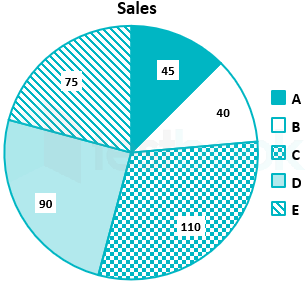
If the number of cars sold of model D is 40500, then how many more cars of model E are sold than that of A?

  1. AOption (a)

    8100

  2. BOption (b)

    16200

  3. COption (c)

    24300

  4. DOption (d)

    13500

View answer & explanation

Correct answer

Answer: (d)D.

13500

Why this answer is correct

Total number of cars sold = 40500 × (360/90) = 162000

Difference in numbers of cars of E and A sold = (75 - 45)/360 × 162000 = 13500

Question 592

DSSSB Junior Assistant (LDC) 2025• Numerical Ability & Data Interpretation 2

Directions: The given pie chart shows the distribution (in degrees) of cars sold of different models by a company in 2015 - 16.

If the number of cars sold of model D is 40500, then what is the ratio between the number of cars sold of model D and E?

  1. AOption (a)

    9 : 5

  2. BOption (b)

    6 : 5

  3. COption (c)

    11 : 9

  4. DOption (d)

    9 : 7

View answer & explanation

Correct answer

Answer: (b)B.

6 : 5

Why this answer is correct

Total number of cars sold = 40500 × (360/90) = 162000

Ratio between the number of cars sold of model D and E = 90/75 = 6 : 5

Question 593

DSSSB Junior Assistant (LDC) 2025• Numerical Ability & Data Interpretation 2

Directions: The given pie chart shows the distribution (in degrees) of cars sold of different models by a company in 2015 - 16.

If the number of cars sold of model D is 72900, what is the total number of cars sold of all the models together by the company?

  1. AOption (a)

    291600

  2. BOption (b)

    208100

  3. COption (c)

    162000

  4. DOption (d)

    214160

View answer & explanation

Correct answer

Answer: (a)A.

291600

Why this answer is correct

Total number of cars sold = 72900 × (360/90) = 291600

Question 594

DSSSB Junior Assistant (LDC) 2025• Numerical Ability & Data Interpretation 2

Susan can type 12 pages in 6 minutes. Mary can type 6 pages in 12 minutes. Working together, how many pages can they type in 32 minutes?

  1. AOption (a)

    80

  2. BOption (b)

    65

  3. COption (c)

    70

  4. DOption (d)

    75

View answer & explanation

Correct answer

Answer: (a)A.

80

Why this answer is correct

Given : 

Susan can type 12 pages in 6 minutes.

Mary can type 6 pages in 12 minutes. 

Formula Used : 

Work Done = Time × Efficiency

Calculation : 

Efficiency of Susan = 2

Efficiency of Mary = 0.5

No of pages = (2 + 0.5) × 32 min 

⇒ 2.5 × 32 min

⇒ 25/10 × 32 min

⇒ 80

∴ The correct answer is 80.

Question 595

DSSSB Junior Assistant (LDC) 2025• Numerical Ability & Data Interpretation 2

A single discount equivalent to three successive discounts of 10%, 12% and 15% is:

  1. AOption (a)

    32.68%

  2. BOption (b)

    33.55%

  3. COption (c)

    30.87%

  4. DOption (d)

    31.87%

View answer & explanation

Correct answer

Answer: (a)A.

32.68%

Why this answer is correct

Shortcut Trick

Let the Marked Price (MP) be 100.

Successive discount multiplier = (1 − 10÷100) × (1 − 12÷100) × (1 − 15÷100)

⇒ 0.90 × 0.88 × 0.85 = 0.6732

Selling Price (SP) = 100 × 0.6732 = 67.32

Single Equivalent Discount = 100 − 67.32 = 32.68%

∴ The correct answer is 32.68%.

Alternate Method

Given → Discounts: d1 = 10%, d2 = 12%, d3 = 15%. Formulas: Successive Discount = a + b − (a × b) ÷ 100

⇒ Step 1: Combine 10% and 12% ⇒ 10 + 12 − (10 × 12) ÷ 100 = 22 − 1.2 = 20.8% ⇒ Step 2: Combine 20.8% and 15% ⇒ 20.8 + 15 − (20.8 × 15) ÷ 100 ⇒ 35.8 − (312 ÷ 100) = 35.8 − 3.12 ⇒ 32.68%

∴ The correct answer is 32.68%.

Additional Information

Successive Discount Concept

When multiple discounts are applied, each subsequent discount is calculated on the reduced price. The order of discounts does not change the final result.

Fraction Method

10% = 1/10 (10→9), 12% = 3/25 (25→22), 15% = 3/20 (20→17). Multiply ratios: (10×25×20) : (9×22×17) = 5000 : 3366. Discount = (1634/5000) × 100 = 32.68%.

Question 596

DSSSB Junior Assistant (LDC) 2025• Numerical Ability & Data Interpretation 2

A person got a 10% increase in his salary. If his salary was Rs. 50000, then the new salary is: 

  1. AOption (a)

    Rs. 55000

  2. BOption (b)

    Rs. 60000

  3. COption (c)

    Rs. 45000

  4. DOption (d)

    Rs. 65000

View answer & explanation

Correct answer

Answer: (a)A.

Rs. 55000

Why this answer is correct

Concept use:

To calculate the new salary after a percentage increase, we can use the formula:

New Salary = Old Salary + (Old Salary x Percentage Increase)

Where:

Old Salary = Rs. 50,000

Percentage Increase = 10% (or 0.10 in decimal form)

Calculation:


New Salary = 50,000 + (50,000 x 0.10)

New Salary = 50,000 + 5,000

New Salary = Rs. 55,000

Hence, the new salary after a 10% increase is Rs. 55,000.

Question 597

DSSSB Junior Assistant (LDC) 2025• Numerical Ability & Data Interpretation 2

P, Q and R can complete a piece of work in 10 days, 15 days and 20 days, respectively. If they work together, in how many days can they finish the same work?

  1. AOption (a)

    \(4\frac{8}{13}\)

  2. BOption (b)

    \(4\frac{3}{7}\)

  3. COption (c)

    \(4\frac{7}{13}\)

  4. DOption (d)

    \(4\frac{5}{7}\)

View answer & explanation

Correct answer

Answer: (a)A.

\(4\frac{8}{13}\)

Why this answer is correct

Given:

A can do the work in 10 days

B can do the work in 15 days

C can do the work in 20 days

Formula used:

Work done = Time taken × Efficiency

Time taken ∝ 1/Efficiency

Calculation:

1st day work by A = 1/10

2nd day work by B = 1/15

3rd day work by  C = 1/20

Total work completed in 3 days

⇒ 1/10 + 1/15 + 1/20

⇒ (6 + 4 + 3)/60 = 13/60

Time taken to complete the work

⇒ 60/13

⇒ 4(8/13)

They finish the same work in 4(8/13) days.

TimeTotal work (LCM of time)Efficiency
A106
B15604
C203


Work done together in 1 day is:

⇒ 6 + 4 + 3 = 13

Total time required to complete the work ⇒ 60/13

⇒ \(4\frac{8}{13}\) days

Question 598

DSSSB Junior Assistant (LDC) 2025• Numerical Ability & Data Interpretation 2

The simple interest on an amount for 6 years at 4% p.a. is ₹7,500 less than the simple interest on the same amount for 11 years. Find the amount.

  1. AOption (a)

    ₹38,000

  2. BOption (b)

    ₹37,500

  3. COption (c)

    ₹37,000

  4. DOption (d)

    ₹38,500

View answer & explanation

Correct answer

Answer: (b)B.

₹37,500

Why this answer is correct

Shortcut Trick

Interest difference % = (11 years − 6 years) × 4% = 5 × 4% = 20%.

Given that 20% of the Amount (Principal) = ₹7,500.

Total Amount (100%) = 7,500 × (100 ÷ 20) = 7,500 × 5 = ₹37,500.

∴ The correct answer is ₹37,500.

Alternate Method

Given: Rate (R) = 4% p.a., Time1 (T1) = 6 years, Time2 (T2) = 11 years, SI difference = ₹7,500.

Formula Used: Simple Interest (SI) = (P × R × T) ÷ 100

⇒ SI2 − SI1 = 7500

⇒ [(P × 4 × 11) ÷ 100] − [(P × 4 × 6) ÷ 100] = 7500

⇒ (44P ÷ 100) − (24P ÷ 100) = 7500

⇒ 20P ÷ 100 = 7500

⇒ P ÷ 5 = 7500

⇒ P = 7500 × 5

⇒ P = 37500

∴ The correct answer is ₹37,500.

Additional Information

Simple Interest Concept

Simple interest is calculated only on the Principal amount for the entire duration. Formula: SI = P × R × T ÷ 100.

Direct Proportionality

When Principal (P) and Rate (R) are constant, the Simple Interest is directly proportional to the Time (T). Doubling the time doubles the interest.

Total Amount (Maturity)

The total amount (A) after T years is the sum of Principal and Interest: A = P + SI = P[1 + (RT ÷ 100)].

Question 599

DSSSB Junior Assistant (LDC) 2025• Numerical Ability & Data Interpretation 2

A room is in the shape of a cube and the length of the longest rod placed in it is 12√3 m. The area of the floor is:

  1. AOption (a)

    36 sq. m

  2. BOption (b)

    144 sq. m

  3. COption (c)

    64 sq. m

  4. DOption (d)

    96 sq. m

View answer & explanation

Correct answer

Answer: (b)B.

144 sq. m

Why this answer is correct

Given:

length of the longest rod placed in it = 12√3 m.

Formula used:

Diagonal of cube = a√3

Area of floor = a2

Calculation Used:

Length of the longest rod of cube = Diagonal of cube = \(√ {3{a^2}} ;;;;\)

⇒ 12√3 = a√3

⇒ a = 12 m

Area of floor = a2

⇒ Area of floor = 122  = 144 m2.

∴ The area of the floor is 144 m2.

Question 600

DSSSB Junior Assistant (LDC) 2025• Numerical Ability & Data Interpretation 2

What will be the compound interest on an amount of ₹ 8,000 for 3 months at 5% per annum, if the interest is payable quarterly?

  1. AOption (a)

    ₹100

  2. BOption (b)

    ₹150

  3. COption (c)

    ₹80

  4. DOption (d)

    ₹120

View answer & explanation

Correct answer

Answer: (a)A.

₹100

Why this answer is correct

Shortcut Trick

For quarterly compounding, the Time is 1 period (3 months = 1 quarter).

Rate for 1 quarter = 5% ÷ 4 = 1.25%.

Compound Interest = 1.25% of ₹ 8,000.

⇒ 8000 × (1.25/100) = 80 × 1.25 = ₹ 100.

∴ The correct answer is ₹ 100.

Alternate Method

Given:

Principal (P) = ₹ 8,000

Rate (R) = 5% per annum

Time (T) = 3 months

Formula Used:

For quarterly compounding: Rate (r) = R/4 and n = T(in years) × 4

Amount (A) = P(1 + r/100)n

Calculations:

⇒ r = 5/4 = 1.25%

⇒ n = (3/12) × 4 = 1 quarter

⇒ A = 8000 × (1 + 1.25/100)1

⇒ A = 8000 × (101.25/100)

⇒ A = 80 × 101.25 = ₹ 8,100

⇒ Compound Interest (CI) = A − P

⇒ CI = 8100 − 8000 = ₹ 100

∴ The correct answer is ₹ 100.

Additional Information

Quarterly Compounding Rule

When interest is compounded quarterly, the annual rate is divided by 4 and the number of years is multiplied by 4.

Half-Yearly Compounding

When interest is compounded half-yearly, the annual rate is divided by 2 and the time in years is multiplied by 2.

CI for 1st Period

For the very first compounding period, the Simple Interest and Compound Interest are always equal.