Search Previous Year Questions

Find real questions from previous competitive exam papers with answers and solutions.

Showing 10 question(s)
Clear

Question 391

DSSSB Junior Assistant (LDC) 2025• Numerical Ability & Data Interpretation 2

Direction: The pie chart below shows fund allocated to a village for different areas covered under a special village development scheme of Rs. 1200 Crore. Answer the question below on the basis of the details given in the following pie chart.
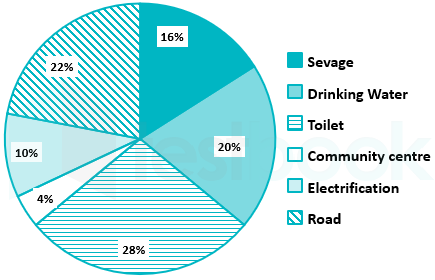
What is the total fund allocation for Drinking Water and Toilet together?

  1. AOption (a)

    Rs. 676 Crore

  2. BOption (b)

    Rs. 576 Crore

  3. COption (c)

    Rs. 588 Crore 

  4. DOption (d)

    Rs. 598 Crore

View answer & explanation

Correct answer

Answer: (b)B.

Rs. 576 Crore

Why this answer is correct

As per pie chart,

Percentage fund allotted for Drinking water = 20%

Percentage fund allotted for Toilet = 28%

The total fund allocation for Drinking Water and Toilet together = 20 + 28 = 48%

Fund allocated to a village under a special village development scheme = Rs. 1200 Crore

The total fund allocation for Drinking Water and Toilet together = 

= 1200 × (48/100)

= 576

∴ The total fund allocation for Drinking Water and Toilet together is Rs. 576.

Question 392

DSSSB Junior Assistant (LDC) 2025• Numerical Ability & Data Interpretation 2

Rs. 6000 is lent at the rate of 20 percent per annum on compound interest (compounded half yearly). What will be the compound interest of 18 months?

  1. AOption (a)

    Rs. 1825

  2. BOption (b)

    Rs. 1986

  3. COption (c)

    Rs. 1876

  4. DOption (d)

    Rs. 2036

View answer & explanation

Correct answer

Answer: (b)B.

Rs. 1986

Why this answer is correct

Given:

Principal = Rs. 6000

Rate = 20%

Time = 18 months

Concept Used:

A = P ×  (1 + r/n)(nt)

Where:

A = Amount

P = Principal

r = Annual interest rate 

n = Number of times the interest is compounded per year

t = Time period (in years)

Calculation:

The interest is compounded half-yearly, so n = 2 (twice a year).

The time period (t) is 18 months, which is equivalent to 1.5 years.

Rate, r = 20% = 0.20

Let's substitute these values into the formula:

A = 6000 ×  (1 + 0.20/2)(2 × 1.5)

⇒ 6000 ×  (1 + 0.10)3

⇒  6000 ×  1.103

⇒  6000 ×  1.331

⇒ A = Rs. 7986

Compound interest = A - P

⇒  7986 - 6000

⇒  Rs. 1986

Therefore, the compound interest for 18 months at a rate of 20% per annum, compounded half-yearly, would be Rs. 1986.

∴ Option 2 is the correct answer.

Question 393

DSSSB Junior Assistant (LDC) 2025• Numerical Ability & Data Interpretation 2

A person incurs a loss of 20% by selling a watch for Rs. 2400 . What was its cost price?

  1. AOption (a)

    Rs 2400

  2. BOption (b)

    Rs 2000

  3. COption (c)

    Rs 3000

  4. DOption (d)

    Rs 3200

View answer & explanation

Correct answer

Answer: (c)C.

Rs 3000

Why this answer is correct

Given:

Selling Price (SP) = Rs. 2400

Loss Percentage = 20%

Formula Used:

Cost Price (CP) = SP / (1 - Loss Percentage)

Calculation:

Loss Percentage = 20% = 20/100 = 0.2

CP = 2400 / (1 - 0.2)

CP = 2400 / 0.8

⇒ CP = 2400 × (1/0.8)

⇒ CP = 2400 × (10/8)

⇒ CP = 2400 × (5/4)

⇒ CP = 2400 × 1.25

⇒ CP = 3000

The cost price of the watch is Rs. 3000.

Question 394

DSSSB Junior Assistant (LDC) 2025• Numerical Ability & Data Interpretation 2

A retailer gets a discount of 40% on the printed price of an article. If the retailer sells it at the printed price, then his gain percentage is:

  1. AOption (a)

    3723%37 \frac{2}{3} \%

  2. BOption (b)

    6623%66 \frac{2}{3} \%

  3. COption (c)

    6613%66 \frac{1}{3} \%

  4. DOption (d)

    3313%33 \frac{1}{3} \%

View answer & explanation

Correct answer

Answer: (b)B.

6623%66 \frac{2}{3} \%

Why this answer is correct

Given:

A retailer gets a discount of 40% on the printed price of an article. 

Calculation:

Let assume marked price of an article = 100

After 40% discount on the marked price,

Cost price for the retailer = 40% of Marked price

= 60% of 100

= 60

So, cost price = Rs. 60

Now the retailer is selling at the marked price,

So, profit of the retailer = 100−6060×100\dfrac{100-60}{60} \times 100

= 4060×100\dfrac{40}{60} \times 100

= 6623%66 \frac{2}{3} \%

So, the percentage of profit of the retailer is 6623%66 \frac{2}{3} \%.

Question 395

DSSSB Junior Assistant (LDC) 2025• Numerical Ability & Data Interpretation 2

What value should come in place of the questions mark (?) in the following questions?

16 × 12 - 672 ÷ 21 = ? - 211

  1. AOption (a)

    381

  2. BOption (b)

    371

  3. COption (c)

    392

  4. DOption (d)

    347

View answer & explanation

Correct answer

Answer: (b)B.

371

Why this answer is correct

Calculation : 

⇒ 16 × 12 - 672 ÷ 21 = ? - 211

⇒ 192 - 32 = x - 211

⇒ 160 = x - 211

⇒ x = 211 + 160 

⇒ x = 371

Question 396

DSSSB Junior Assistant (LDC) 2025• Numerical Ability & Data Interpretation 2

P is 5 years older than Q who is twice as old as R. If the total of the ages of P, Q and R be 55 years, then how old is P ?

  1. AOption (a)

    10 years

  2. BOption (b)

    15 years

  3. COption (c)

    20 years

  4. DOption (d)

    25 years

View answer & explanation

Correct answer

Answer: (d)D.

25 years

Why this answer is correct

Shortcut Trick

Let R's age be 1 unit.

Then Q's age = 2 units, and P's age = 2 units + 5 years.

Total = (1 + 2 + 2) units + 5 = 55 years

⇒ 5 units = 50 years ⇒ 1 unit = 10 years.

P's age = 2 units + 5 = 2 × 10 + 5 = 25 years.

∴ The correct answer is 25 years.

Alternate Method

Given:

Total age of P, Q, and R = 55 years

R

x

Q

2x

P

2x

+5

Total = 55

Let the age of R be x years.

Q is twice as old as R ⇒ Q = 2x

P is 5 years older than Q ⇒ P = 2x + 5

Calculations:

According to the sum of their ages:

⇒ P + Q + R = 55

⇒ (2x + 5) + 2x + x = 55

⇒ 5x + 5 = 55

⇒ 5x = 50

⇒ x = 10

Age of P = 2x + 5 = 2(10) + 5 = 25 years.

∴ The correct answer is 25 years.

Additional Information

Constant Age Difference

The age difference between any two individuals always remains constant over time. If A is 5 years older than B today, A will be 5 years older than B after 10 years as well.

Past and Future Ages

If the current age of a person is x, their age n years ago was (x − n) and their age n years from now will be (x + n).

Question 397

DSSSB Junior Assistant (LDC) 2025• Numerical Ability & Data Interpretation 2

A pipe can fill a tank in 8 hours. Another pipe can empty the filled tank in 16 hours. If both the pipes are opened simultaneously, then the time (in hours) in which the tank will be three-fourth filled, is:

  1. AOption (a)

    12

  2. BOption (b)

    36

  3. COption (c)

    24

  4. DOption (d)

    48

View answer & explanation

Correct answer

Answer: (a)A.

12

Why this answer is correct

Shortcut Trick

Net efficiency = Filling rate − Emptying rate.

Let Total capacity (LCM of 8 and 16) = 16 units.

Filling pipe efficiency = 16 ÷ 8 = 2; Emptying pipe efficiency = 16 ÷ 16 = 1.

Combined efficiency = 2 − 1 = 1 unit/hour.

Time for 3/4 filled = (3/4 × 16) ÷ 1 = 12 hours.

∴ The correct answer is 12 hours.

Alternate Method

Given: Filling time = 8 hours, Emptying time = 16 hours.

Formula Used: Work = Efficiency × Time; Net Efficiency = (1/Filling time) − (1/Emptying time).

Pipe TypeTime (hrs)Total Capacity (LCM)Efficiency
Filling Pipe816 units+2
Emptying Pipe16−1

⇒ Combined efficiency of both pipes = 2 − 1 = 1 unit/hour.

⇒ Target volume to be filled = 3/4 × Total Capacity

⇒ Target volume = 3/4 × 16 = 12 units.

⇒ Time taken = Target volume ÷ Combined efficiency

⇒ Time taken = 12 ÷ 1 = 12 hours.

∴ The correct answer is 12 hours.

Additional Information

Pipes and Cisterns Concept

Filling pipes (inlets) have positive efficiency, while emptying pipes (outlets) have negative efficiency.

Net Work Formula

If pipe A fills in 'x' hours and pipe B empties in 'y' hours, net work in 1 hour = (1/x − 1/y). If x < y, the tank will eventually fill.

Fractional Filling

To find time for a specific fraction of the tank, multiply the total fill time by that fractional value.

Question 398

DSSSB Junior Assistant (LDC) 2025• Numerical Ability & Data Interpretation 2

A bag contains 50 paise, 25 paise, and 10 paise coins in the proportion of 3 ∶ 4 ∶ 5. The total value of these coins is Rs.12. Find the number of 25 paise coins.

  1. AOption (a)

    8

  2. BOption (b)

    16

  3. COption (c)

    24

  4. DOption (d)

    25

View answer & explanation

Correct answer

Answer: (b)B.

16

Why this answer is correct

Calculation:

Let 50 paise, 25 paise, and 10 paise coins are

in ratio 3x ,4x & 5x respectively.

Total Value of 50 paise coins = 50100\frac{50}{100}× 3x = 3x/2

Total Value of 25 paise coins = 25100\frac{25}{100}× 4x = x

Total Value of 10 paise coins = 10100\frac{10}{100}× 5x = x/2

Total Value of coins is Rs. 12

⇒ 3x/2 + x + x/2 = 12

⇒ 6x/2 = 12

⇒ x = 4

⇒ Number of 25 paise coins =  4x = 4 × 4 = 16

∴ The correct answer is 16

Question 399

DSSSB Junior Assistant (LDC) 2025• Numerical Ability & Data Interpretation 2

The capacity of a water tank is 900 liters. If its height is 5 m, what is the surface area required to place the tank?

  1. AOption (a)

    4500 m2

  2. BOption (b)

    1800 cm2

  3. COption (c)

    580 m2

  4. DOption (d)

    360 m2

View answer & explanation

Correct answer

Answer: (b)B.

1800 cm2

Why this answer is correct

Given 

The capacity of water tank = 900 liters 

Height = 5 m

Formula Used 

Volume = Area × Height

1 m3 = 1000 liters

1000 cm3 = 1 litre

Calculation 

Capacity of the tank = 900 litre = 900 × 1000 cm3 = 900000 cm3

Capacity of tank = Surface Area × 5 

⇒ 900000 = Area × 500

⇒ Area = 1800 cm2

∴ The area of surface tank is 1800 cm2

Question 400

DSSSB Junior Assistant (LDC) 2025• Numerical Ability & Data Interpretation 2

If 6 men and 8 boys can complete a work in 10 days and 26 men and 48 boys can do it in 2 days, then find the ratio of capacity of a man to that of a boy.  

  1. AOption (a)

    2 ∶ 1

  2. BOption (b)

    6 ∶ 5

  3. COption (c)

    4 ∶ 3

  4. DOption (d)

    3 ∶ 2

View answer & explanation

Correct answer

Answer: (a)A.

2 ∶ 1

Why this answer is correct

Calculation:

Let efficiency of 1 man and 1 boy be x and y respectively.

According to the question

(6x + 8y) × 10 = (26x + 48y) × 2

⇒ 60x + 80y = 52x + 96y

⇒ 60x – 52x = 96y – 80y

⇒ 8x = 16y

∴ x : y = 2 : 1