Search Previous Year Questions

Find real questions from previous competitive exam papers with answers and solutions.

Showing 10 question(s)
Clear

Question 381

DSSSB Junior Assistant (LDC) 2025• Numerical Ability & Data Interpretation 1

A and B can do a piece of work in 36 days. B and C can do it in 60 days. A and C can do it in 45 days. In what time can A alone do it?

  1. AOption (a)

    75 days 

  2. BOption (b)

    60 days

  3. COption (c)

    50 days

  4. DOption (d)

    40 days

View answer & explanation

Correct answer

Answer: (b)B.

60 days

Why this answer is correct

Given:

A and B can do a piece of work in 36 days,

B and C can do the same work in 60 days,

A and C can do the same work in 45 days.

Concept used:

Efficiency = 1/(Total time)

Calculation:

(A + B)’s 1 day work = 1/36      ----(i) 

(B + C)’s 1 day work = 1/60      ----(ii) 

(C + A)’s 1 day work = 1/45      ----(iii)

From equations (i), (ii) and (iii),

2(A + B + C)’s 1 day work = 1/36 + 1/60 + 1/45

⇒ (5 + 3 + 4)/180 = 1/15

⇒ (A + B + C)’s 1 day work = 1/(15 × 2) = 1/30      ----(iv)

From equations (ii) and (iv) we get

A’s 1 day work = 1/30 – 1/60 = 1/60 = 1/60

Time taken by A alone to complete the work = 60

∴ A alone can complete the same work in 60 days
Question 382

DSSSB Junior Assistant (LDC) 2025• Numerical Ability & Data Interpretation 1

In a school, the total number of boys is 20% more than the total number of girls. What is the ratio of the number of boys to that of girls in the school?

  1. AOption (a)

    6 ∶ 5

  2. BOption (b)

    4 ∶ 5

  3. COption (c)

    5 ∶ 3

  4. DOption (d)

    5 ∶ 6

View answer & explanation

Correct answer

Answer: (a)A.

6 ∶ 5

Why this answer is correct

Given:

In a school, the total number of boys is 20% more than the total number of girls.

Formula Used:

Let the number of girls be G.

Number of boys = G + 20% of G

Calculation:

Number of boys = G + 0.2 × G

⇒ Number of boys = 1.2G

The ratio of the number of boys to that of girls = 1.2G : G

⇒ 1.2GG\dfrac{1.2G}{G}

⇒ 1.2 : 1

⇒ 6 : 5

∴ The correct answer is option 1.

Question 383

DSSSB Junior Assistant (LDC) 2025• Numerical Ability & Data Interpretation 1

The average of five numbers, where the difference between any two consecutive numbers is 5, is 215. Find the least number.

  1. AOption (a)

    225

  2. BOption (b)

    215

  3. COption (c)

    220

  4. DOption (d)

    205

View answer & explanation

Correct answer

Answer: (d)D.

205

Why this answer is correct

Given:

The difference between any two consecutive numbers is 5.

The average of the five numbers is 215.

Calculation:

Let the first number = x

Second number = x + 5

Third number = x + 10

Fourth number = x + 15

Fifth number = x + 20

Average = (x + x + 5 + x + 10 + x + 15 + x + 20) / 5 = 215

⇒ (5x + 50) / 5 = 215

⇒ 5x + 50 = 215 × 5

⇒ 5x + 50 = 1075

⇒ 5x = 1075 - 50 = 1025

⇒ x = 1025 / 5

⇒ x = 205

The least number is 205.

Question 384

DSSSB Junior Assistant (LDC) 2025• Numerical Ability & Data Interpretation 1

The volume of the hemisphere is 486π cm³. If the radius is tripled, then what will be its curved surface area (in cm²)?

  1. AOption (a)

    1455π 

  2. BOption (b)

    1025π

  3. COption (c)

    1458π

  4. DOption (d)

    1546π

View answer & explanation

Correct answer

Answer: (c)C.

1458π

Why this answer is correct

Given:

Volume of the hemisphere = 486π cm3

Formula Used:

Volume of a hemisphere = (2/3)πr3

Curved Surface Area (CSA) of a hemisphere = 2πr2

Calculation:

Given Volume,

(2/3)πr3 = 486π

⇒ r3 = (3/2) × 486

⇒ r3 = 729

⇒ r = 9 cm

If the radius is tripled, new radius = 3r = 3 × 9 = 27 cm

Curved Surface Area (CSA) = 2π(27)2

⇒ CSA = 2π × 729

⇒ CSA = 1458π cm2

The correct answer is option 3.

Question 385

DSSSB Junior Assistant (LDC) 2025• Numerical Ability & Data Interpretation 1

Three numbers are in the ratio 3 ∶ 5 ∶ 7. If LCM of the numbers is 25200, then what is the sum of smallest and largest number? 

  1. AOption (a)

    1200 

  2. BOption (b)

    2400 

  3. COption (c)

    3600 

  4. DOption (d)

    2880 

View answer & explanation

Correct answer

Answer: (b)B.

2400 

Why this answer is correct

Shortcut Trick

Ratio of numbers = 3 : 5 : 7 (all are co-prime)

LCM = Product of Ratios × HCF

25200 = (3 × 5 × 7) × HCF ⇒ 25200 = 105 × HCF

HCF = 25200 ÷ 105 = 240

Sum of smallest (3) and largest (7) = (3 + 7) × HCF = 10 × 240 = 2400

∴ The correct answer is 2400.

Alternate Method

Given: Ratio = 3 : 5 : 7, LCM = 25200

Formula Used: Numbers are ax, bx, cx where x is HCF. LCM of (ax, bx, cx) = x × LCM(a, b, c)

Let the numbers be 3x, 5x, and 7x, where x is the HCF.

⇒ LCM(3x, 5x, 7x) = x × 3 × 5 × 7 = 105x

⇒ 105x = 25200

⇒ x = 25200 ÷ 105

⇒ x = 240

⇒ Smallest number = 3x = 3 × 240 = 720

⇒ Largest number = 7x = 7 × 240 = 1680

⇒ Sum = 720 + 1680 = 2400

∴ The correct answer is 2400.

Additional Information

HCF and LCM Relation

For two numbers a and b, Product of numbers = HCF × LCM. For more than two numbers, this direct product rule does not apply.

Co-prime Numbers

If numbers are co-prime (HCF = 1), then their LCM is simply the product of the numbers.

Ratio and HCF

If the ratio of numbers is a : b : c and their HCF is x, then the numbers are ax, bx, and cx.

Question 386

DSSSB Junior Assistant (LDC) 2025• Numerical Ability & Data Interpretation 2

Find the length of the bridge in which a train 140 m long travelling at 54 kmph can cross in 30 seconds.

  1. AOption (a)

    300 m

  2. BOption (b)

    310 m

  3. COption (c)

    330 m

  4. DOption (d)

    340 m

View answer & explanation

Correct answer

Answer: (b)B.

310 m

Why this answer is correct

Given:

Length of train = 140 m

Speed of train = 54 km/hr = 54 × (5/18) = 15 m/sec

Time required to cover the bridge = 30seconds

Concept Used:

Distance covered = Speed × Time

1 km/hr = 5/18 m/sec

Calculation:

Let, the length of the bridge is x m

To cross the bridge the train have to cross (140 + x) m

Accordingly,

140 + x = 15 × 30

⇒ x = 450 - 140

⇒ x = 310

∴ The length of the bridge is 310 m.

Question 387

DSSSB Junior Assistant (LDC) 2025• Numerical Ability & Data Interpretation 2

If an employee’s income is ₹72,000, the amount he spends is 40% higher than his savings. Therefore, his savings (in ₹) is:

  1. AOption (a)

    30000

  2. BOption (b)

    34000

  3. COption (c)

    32000

  4. DOption (d)

    28000

View answer & explanation

Correct answer

Answer: (a)A.

30000

Why this answer is correct

Shortcut Trick

Let the Savings be 100%. Then Expenditure = 100% + 40% = 140%.

Ratio of Savings : Expenditure = 100 : 140 = 5 : 7

Total Income = Savings + Expenditure = 5 + 7 = 12 units.

Given 12 units = ₹72,000 ⇒ 1 unit = ₹6,000

Savings = 5 units = 5 × 6,000 = ₹30,000

∴ The correct answer is ₹30000.

Alternate Method

Given:

Total Income = ₹72,000

Expenditure is 40% higher than Savings.

Formula Used:

Income = Expenditure + Savings

Calculations:

⇒ Let his Savings be x.

⇒ Expenditure = x + (40% of x) = x + 0.4x = 1.4x

⇒ Total Income = x + 1.4x = 2.4x

⇒ According to the question, 2.4x = 72000

⇒ x = 72000 ÷ 2.4

⇒ x = 720000 ÷ 24

⇒ x = 30000

∴ The correct answer is ₹30000.

Additional Information

Income, Expenditure & Savings

The fundamental equation of personal finance is: Income = Expenditure + Savings. Any total change in income is always equal to the sum of the changes in expenditure and savings.

Ratio Method for Percentages

When a value is P% higher than another, their ratio becomes (100 + P) : 100. This heavily simplifies calculations by avoiding decimals and allowing you to solve the question completely using proportional unit parts.

Base Value Identification

It is crucial to identify the correct base. Here, Expenditure is 40% higher than Savings, meaning Savings is the base (100%). Misinterpreting the base value is the most common error in percentage problems.

Question 388

DSSSB Junior Assistant (LDC) 2025• Numerical Ability & Data Interpretation 2

When 80% of a number is added to 80, the result is the same number. Find the number.

  1. AOption (a)

    420

  2. BOption (b)

    380

  3. COption (c)

    320

  4. DOption (d)

    400

View answer & explanation

Correct answer

Answer: (d)D.

400

Why this answer is correct

Given:

When 80% of a number is added to 80, the result is the same number.

Formula used:

Let the number be x.

0.8x + 80 = x

Calculations:

0.8x + 80 = x

⇒ x - 0.8x = 80

⇒ 0.2x = 80

⇒ x = 400

∴ The correct answer is option (4).

Question 389

DSSSB Junior Assistant (LDC) 2025• Numerical Ability & Data Interpretation 2

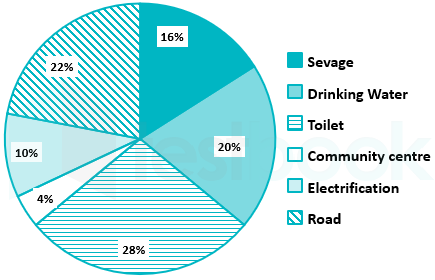
Direction: The pie chart below shows fund allocated to a village for different areas covered under a special village development scheme of Rs. 1200 Crore. Answer the question below on the basis of the details given in the following pie chart.

What is the total fund allocation for Road and Sevage construction together?

  1. AOption (a)

    Rs. 456 Crore

  2. BOption (b)

    Rs. 466 Crore

  3. COption (c)

    Rs. 468 Crore

  4. DOption (d)

    Rs. 492 Crore

View answer & explanation

Correct answer

Answer: (a)A.

Rs. 456 Crore

Why this answer is correct

As per pie chart,

Percentage fund allotted for Sevage = 16%

Percentage fund allotted for Road = 22%

Total percentage fund allocated for Sevage and Road area = 16 + 22 = 38%

Fund allocated to a village under a special village development scheme = Rs. 1200 Crore

The total fund allocation for Road and Sevage construction together

= 1200 × (38/100) = 456

∴ the total fund allocation for Road and Sevage construction together is Rs.456 crore.

Question 390

DSSSB Junior Assistant (LDC) 2025• Numerical Ability & Data Interpretation 2

Direction: The pie chart below shows fund allocated to a village for different areas covered under a special village development scheme of Rs. 1200 Crore. Answer the question below on the basis of the details given in the following pie chart.

Find the total budget for electrification?

  1. AOption (a)

    Rs. 60 Crore

  2. BOption (b)

    Rs. 100 Crore

  3. COption (c)

    Rs. 10 Crore

  4. DOption (d)

    Rs. 120 Crore

View answer & explanation

Correct answer

Answer: (d)D.

Rs. 120 Crore

Why this answer is correct

As per pie chart,

Percentage fund allotted for electrification = 10%

Fund allocated to a village under a special village development scheme = Rs. 1200 Crore

Total budget for electrification =

= 1200 × (10/100)

= 120

∴ total budget for electrification is Rs. 120 crore.