Search Previous Year Questions

Find real questions from previous competitive exam papers with answers and solutions.

Leave the keyword blank to browse saved questions for your selected exam, newest papers first. Add a keyword, year or topic to narrow the results.

Browse complete papers
Showing 10 question(s)
Clear

Question 21

DSSSB Assistant Superintendent 2026• Arithmetical and Numerical Ability 2

A merchant announces 25% discount on the price of a shirt. If one needs to have a total rebate of Rs. 875 and the price of each shirt is Rs. 250. then how many shirts should the person purchase?

  1. AOption (a)

    15

  2. BOption (b)

    9

  3. COption (c)

    14

  4. DOption (d)

    12

View answer & explanation

Correct answer

Answer: (c)C.

14

Why this answer is correct

Given:

The merchant gives a discount of 25% on each shirt having cost price of Rs 250

Calculations:

Discount of each shirt = 25% of 250 = 62.5 rupees

He wants a total of 875 rupees as a discount.

So,

Number of shirts he purchased × discount on each shirt = Total discount

Number of shirts × 62.5 = 875

The number of shirts = 875/62.5 = 14

∴ The correct choice will be option 3.
Question 22

DSSSB Assistant Superintendent 2026• Arithmetical and Numerical Ability 2

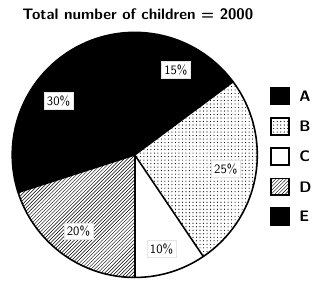
Study the following pie-charts carefully to answer the questions.

If 70 percent children from village D go to school then what is the number of children attending school from village D ?

  1. AOption (a)

    280

  2. BOption (b)

    400

  3. COption (c)

    320

  4. DOption (d)

    360

View answer & explanation

Correct answer

Answer: (a)A.

280

Why this answer is correct

Total number of children in the village D = (20/100) × 2000 = 400

As 70% of the children attend school form village D, we have:

∴ Number of children attending school from village D = (70/100) × 400 = 280

Question 23

DSSSB Assistant Superintendent 2026• Arithmetical and Numerical Ability 2

A shopkeeper sold two articles for Rs. 10591 each. On one he gained 19% and on the other he lost 11%. What was his overall gain or loss percent (correct to one decimal place)?

  1. AOption (a)

    Profit 1.8%

  2. BOption (b)

    Loss 2.7%

  3. COption (c)

    Loss 10%

  4. DOption (d)

    Profit 5%

View answer & explanation

Correct answer

Answer: (a)A.

Profit 1.8%

Why this answer is correct

Given:

Selling price of each articles = Rs. 10591

Gain = 19%

Loss = 11%

Calculation:

SP of each articles = Rs. 10591

CP of first article = Rs. (10591 × 100/119)

⇒Rs. 8900

CP of second article = Rs. (10591 × 100/89)

⇒ 11900

Total SP of both the article = 10591 × 2 = 21182

Total CP of both the article = 8900 + 11900 = 20800

Total Gain = 21182 – 20800 = 382

Gain percentage = (382/20800 × 100)

⇒ 1.83%

∴ His overall Profit percentage is 1.8%

Question 24

DSSSB Assistant Superintendent 2026• Arithmetical and Numerical Ability 2

Express the following into a vulgar fraction.

\(0.2\overline{34}+0.\overline{29}\)

  1. AOption (a)

    \(\frac{29}{55}\)

  2. BOption (b)

    \(\frac{25}{99}\)

  3. COption (c)

    \(\frac{29}{99}\)

  4. DOption (d)

    \(\frac{23}{90}\)

View answer & explanation

Correct answer

Answer: (a)A.

\(\frac{29}{55}\)

Why this answer is correct

Concept Used:

A vulgar fraction, common fraction or fraction is a fraction written in the usual way which is one number (integer) above another (integer) separated by a line.

Calculation:

\(0.2\overline{34}+0.\overline{29}\)

Convert \(0.2\overline{34}\) into a vulgar fraction

x = 234 - 2 /990 = 232/990

Convert \(0.\overline{29}\) into a vulgar fraction

y = 29/99

Add the fractions

(232/990) + (29/99)

Find LCM of 990 and 99, which is 990:

(232/990) + (290/990) = 522/990

Simplify:

522/990 = 29/55

Final Answer:

29/55.

Question 25

DSSSB Assistant Superintendent 2026• Arithmetical and Numerical Ability 2

A bus travels half of the distance with a speed of 48 km/hr and remaining half of the distance with a speed of 72 km/hr and reached its destination in 2.5 hrs. How much distance did the bus travel to reach its destination?

  1. AOption (a)

    96 km

  2. BOption (b)

    120 km

  3. COption (c)

    144 km

  4. DOption (d)

    180 km

View answer & explanation

Correct answer

Answer: (c)C.

144 km

Why this answer is correct

When a moving body travels at two different speeds of x km/hr and y km/hr, the average speed of the journey = 2xy/(x + y)

Let x = 48 km/hr. and y = 72 km/hr.

⇒ Average speed of the bus = (2 × 48 × 72)/(48 + 72) = 6912/120 = 57.6 km/hr.

Time taken in journey = 2.5 hrs.

∵ Average speed = Total distance travelled/Total time taken

∴ Distance travelled by bus = 57.6 × 2.5 = 144 km

Question 26

DSSSB Assistant Superintendent 2026• Arithmetical and Numerical Ability 2

If Ram purchases a fan, he gets 8% discount, however, if he purchases three fans he gets 6% on the first, 10% on the second and 12% on the third. If the price paid by the Ram for three fans is ₹6,800, then what will be the marked price of each fan?

  1. AOption (a)

    ₹2,400

  2. BOption (b)

    ₹2,500

  3. COption (c)

    ₹2,450

  4. DOption (d)

    ₹2,550

View answer & explanation

Correct answer

Answer: (b)B.

₹2,500

Why this answer is correct

Shortcut Trick

Total Selling Price (SP) = (100% − 6%) + (100% − 10%) + (100% − 12%) = 272% of MP

⇒ 272% of MP = ₹6,800

⇒ MP = 6800 × 100 ÷ 272

⇒ MP = ₹2,500

∴ The correct answer is ₹2,500.

Alternate Method

Given:

Discount on 1st, 2nd, and 3rd fan = 6%, 10%, and 12% respectively

Total amount paid for 3 fans = ₹6,800

Note: The 8% discount for a single fan purchase is irrelevant to this 3-fan scenario.

Formula Used:

Selling Price (SP) = Marked Price (MP) × (100 − Discount%) ÷ 100

Calculations:

Let the Marked Price of each fan be MP.

⇒ SP of 1st fan = MP × (100 − 6)% = 0.94 MP

⇒ SP of 2nd fan = MP × (100 − 10)% = 0.90 MP

⇒ SP of 3rd fan = MP × (100 − 12)% = 0.88 MP

⇒ Total SP for 3 fans = 0.94 MP + 0.90 MP + 0.88 MP = 2.72 MP

⇒ We are given that the total selling price is ₹6,800.

⇒ 2.72 MP = 6800

⇒ MP = 6800 ÷ 2.72

⇒ MP = 680000 ÷ 272 = ₹2,500

∴ The correct answer is ₹2,500.

Additional Information

Marked Price (MP) and Discount

Discount is always calculated on the Marked Price (also known as Tag Price or List Price). SP = MP − Discount.

Successive Discounts

If two successive discounts of a% and b% are given, the equivalent single discount is (a + b − a×b/100)%.

Mark-up Percentage

The percentage by which the MP is raised above the Cost Price (CP). MP = CP × (100 + Mark-up%) ÷ 100.

Question 27

DSSSB Assistant Superintendent 2026• Arithmetical and Numerical Ability 2

The initial ratio of sugar and flour in a recipe was 17:28 With 27 kg of the recipe, Sunita added more flour to make the sugar to flour ratio 2:5 How much flour did Sunita later add?

  1. AOption (a)

    8.1 Kg

  2. BOption (b)

    8.5 Kg

  3. COption (c)

    8.7 Kg

  4. DOption (d)
    1. Kg
View answer & explanation

Correct answer

Answer: (c)C.

8.7 Kg

Why this answer is correct

Shortcut Trick

Initial Ratio of Sugar : Flour = 17 : 28 (Total units = 17 + 28 = 45)

Given 45 units = 27 kg → 1 unit = 27 ÷ 45 = 0.6 kg

To keep Sugar constant at 17 units, multiply final ratio (2 : 5) by 8.5 → 17 : 42.5

Extra Flour added = 42.5 − 28 = 14.5 units

Quantity of added Flour = 14.5 × 0.6 = 8.7 kg

∴ The correct answer is 8.7 kg.

Alternate Method

Given: Initial Sugar : Flour = 17 : 28, Total Weight = 27 kg, Final Ratio = 2 : 5.

⇒ Total initial units = 17 + 28 = 45 units

⇒ Quantity of Sugar = (17 ÷ 45) × 27 = 10.2 kg

⇒ Quantity of Flour = (28 ÷ 45) × 27 = 16.8 kg

⇒ Let added Flour be x kg. New ratio of Sugar : Flour is 2 : 5

⇒ 10.2 ÷ (16.8 + x) = 2 ÷ 5

⇒ 5 × 10.2 = 2 × (16.8 + x)

⇒ 51 = 33.6 + 2x

⇒ 2x = 51 − 33.6 = 17.4

⇒ x = 17.4 ÷ 2 = 8.7 kg

∴ The correct answer is 8.7 kg.

Additional Information

Ratio Constant Property

When one component is added to a mixture, the quantity of the other component remains unchanged. Use this to equate the constant part across different ratios.

Unitary Method in Ratios

Always find the value of 1 unit by dividing the total weight by the sum of ratio parts (Total weight ÷ (a + b)).

Question 28

DSSSB Assistant Superintendent 2026• Arithmetical and Numerical Ability 2

The LCM of 94, 188 and 235 is:

  1. AOption (a)

    705

  2. BOption (b)

    1880

  3. COption (c)

    940

  4. DOption (d)

    470

View answer & explanation

Correct answer

Answer: (c)C.

940

Why this answer is correct

Shortcut Trick

Identify the highest common factor: All numbers are multiples of 47.

94 = 47 × 2, 188 = 47 × 4, 235 = 47 × 5.

LCM = 47 × LCM(2, 4, 5) = 47 × 20.

LCM = 940.

∴ The correct answer is 940.

Alternate Method

Given: Numbers are 94, 188, and 235.

Formula Used: Prime Factorization Method for LCM.

⇒ 94 = 21 × 471

⇒ 188 = 22 × 471

⇒ 235 = 51 × 471

⇒ LCM = 22 × 51 × 471

⇒ LCM = 4 × 5 × 47

⇒ LCM = 20 × 47 = 940.

∴ The correct answer is 940.

Additional Information

LCM (Least Common Multiple)

The smallest positive integer that is divisible by each of the given numbers. It is calculated by taking the highest power of every prime factor present.

HCF and LCM Relation

For two numbers a and b, the product of the numbers is equal to the product of their HCF and LCM: a × b = HCF(a, b) × LCM(a, b).

Prime Factorization

Expressing a number as a product of prime numbers to easily find common divisors or multiples.

Question 29

DSSSB Assistant Superintendent 2026• Arithmetical and Numerical Ability 2

Rohan borrows Rs. 6,000 from Mohit at 3% per annum on simple interest. He pays Rs. 240 as interest, when will he pay the debt?

  1. AOption (a)

    14 months

  2. BOption (b)

    15 months

  3. COption (c)

    16 months

  4. DOption (d)

    18 months

View answer & explanation

Correct answer

Answer: (c)C.

16 months

Why this answer is correct

GIVEN:

P = Rs. 6,000, R = 3%, SI = Rs. 240, T = ?

FORMULAE USED:

SI = PRT/100

CALCULATION:

⇒ 240 = 6000 × T × 3%

⇒ 240 = 180T

⇒ T = 4/3 years

⇒ T = (4/3) × 12 months

⇒ T = 16 months

∴ Rohan will pay the debt after 16 months.

Question 30

DSSSB Assistant Superintendent 2026• Arithmetical and Numerical Ability 2

The incomes of A and B are in the ratio of 3 ∶ 2 and their expenditures are Rs 14,000 and Rs. 10,000 respectively. If A saves Rs. 4000, then B s savings will be

  1. AOption (a)

    Rs. 4000

  2. BOption (b)

    Rs. 2000

  3. COption (c)

    Rs. 3000

  4. DOption (d)

    RS. 5000

View answer & explanation

Correct answer

Answer: (b)B.

Rs. 2000

Why this answer is correct

Let the incomes of A and B be 3x and 2x respectively.

Income = expenditure + savings

3x = 14000 + 4000

⇒ x = 6000

2x = 12000

Savings of B = 12000 – 10,000 = 2000