Search Previous Year Questions

Find real questions from previous competitive exam papers with answers and solutions.

Showing 10 question(s)
Clear

Question 171

CSIR ASO 2024• Test

Directions: First read the passage and then answer the questions based on it.

I was very fond of the old soldier in our little town. He had only one leg, having lost the other somewhere in Assam in 1942. He used to tell me about his adventures. He told me that he had run away from home to join the army. He had experienced his first battle in the Libyan desert. Out of his dozens of war stories, the one I liked best was the one of his escape from a Japanese prison-of-war camp in Burma. He told me again and again how he walked two hundred miles in two weeks. On the way he was bitten on the toe by a poisonous snake and he had to cut off part of the toe in order to survive. But by the time he got to an Indian Camp the wound had turned septic and the leg had to be amputated. He is, however, quite contented with his lot.

The soldier's leg had to be amputated because 

  1. AOption (a)

    he had walked 200 miles in two weeks

  2. BOption (b)

    he was wounded in war

  3. COption (c)

    the wounded toe turned septic 

  4. DOption (d)

    he was shot in the leg while escaping from the Japanese camp

View answer & explanation

Correct answer

Answer: (c)C.

the wounded toe turned septic 

Why this answer is correct

The correct answer is "the wounded toe turned septic". 

Key Points

  • The passage mentions that after being bitten on the toe by a snake, the soldier had to cut off part of his toe to survive. However, by the time he reached an Indian camp, the wound had turned septic.
  • Therefore, the amputation of the soldier's leg is directly attributed to the septic condition of the wound, not to the long journey or any injury sustained in war or during his escape.
  • Therefore, the correct answer is "Option 3".

Additional Information

  • Option 1: "he had walked 200 miles in two weeks"- The walking might have exacerbated the condition, but the amputation was a result of the septic condition of his wound, not directly from the long walk.
  • Option 2: "he was wounded in war"- The soldier was wounded by a snake bite, not in a war injury.
  • Option 4: "he was shot in the leg while escaping from the Japanese camp"- The passage does not mention any incident where the soldier was shot in the leg during his escape.
Question 172

CSIR ASO 2024• Test

Directions: First read the passage and then answer the questions based on it.

I was very fond of the old soldier in our little town. He had only one leg, having lost the other somewhere in Assam in 1942. He used to tell me about his adventures. He told me that he had run away from home to join the army. He had experienced his first battle in the Libyan desert. Out of his dozens of war stories, the one I liked best was the one of his escape from a Japanese prison-of-war camp in Burma. He told me again and again how he walked two hundred miles in two weeks. On the way he was bitten on the toe by a poisonous snake and he had to cut off part of the toe in order to survive. But by the time he got to an Indian Camp the wound had turned septic and the leg had to be amputated. He is, however, quite contented with his lot.

The old soldier, according to the author, was 

  1. AOption (a)

    unhappy about his life

  2. BOption (b)

    satisfied with his lot

  3. COption (c)

    angry about his fate

  4. DOption (d)

    disgusted with his misfortune

View answer & explanation

Correct answer

Answer: (b)B.

satisfied with his lot

Why this answer is correct

The correct answer is "satisfied with his lot". 

Key Points

  • The last line of the passage clearly states that the soldier was "quite contented with his lot," meaning that he was satisfied with his life's circumstances.
  • Despite all the challenges and trials, including losing his leg, the soldier seemed to have a positive or at least a content outlook on life.
  • Therefore, the correct answer is "Option 2".

Additional Information

  • Option 1: "unhappy about his life" - The passage doesn't suggest that the old soldier was unhappy with his life, but rather indicates that he was content or satisfied.
  • Option 3: "angry about his fate"- The passage doesn't suggest the soldier was angry about his fate. There's no indication of any anger or resentment.
  • Option 4: "disgusted with his misfortune" - Again, the passage does not suggest any feeling of disgust from the soldier regarding his misfortune. Instead, he appears to accept his circumstances.

Question 173

CSIR ASO 2024• Test

Directions: First read the passage and then answer the questions based on it.

I was very fond of the old soldier in our little town. He had only one leg, having lost the other somewhere in Assam in 1942. He used to tell me about his adventures. He told me that he had run away from home to join the army. He had experienced his first battle in the Libyan desert. Out of his dozens of war stories, the one I liked best was the one of his escape from a Japanese prison-of-war camp in Burma. He told me again and again how he walked two hundred miles in two weeks. On the way he was bitten on the toe by a poisonous snake and he had to cut off part of the toe in order to survive. But by the time he got to an Indian Camp the wound had turned septic and the leg had to be amputated. He is, however, quite contented with his lot.

The story of the old soldier that the author liked most was that about 

  1. AOption (a)

    his running away from home to join the army

  2. BOption (b)

    his first battle in the Libyan desert

  3. COption (c)

    the loss of his leg in Assam

  4. DOption (d)

    his escape from a Japanese prison of-war camp

View answer & explanation

Correct answer

Answer: (d)D.

his escape from a Japanese prison of-war camp

Why this answer is correct

The correct answer is "his escape from a Japanese prison of-war camp". 

Key Points

  • The passage explicitly states "Out of his dozens of war stories, the one I liked best was the one of his escape from a Japanese prison-of-war camp in Burma."
  • The author clearly favored this tale above the others because of its intense and dramatic circumstances, as well as the courage and resourcefulness demonstrated by the soldier.
  • Therefore, the correct answer is "Option 4".

Additional Information

  • Option 1: "his running away from home to join the army"- While this is an interesting part of the soldier's history, the author does not specifically indicate liking this part the most.
  • Option 2: "his first battle in the Libyan desert"- Similarly, the author does not single this out as the best-liked story.
  • Option 3: "the loss of his leg in Assam"- The passage does not clarify that the author particularly likes this traumatic event.

Question 174

CSIR ASO 2024• Test

Directions: First read the passage and then answer the questions based on it.

I was very fond of the old soldier in our little town. He had only one leg, having lost the other somewhere in Assam in 1942. He used to tell me about his adventures. He told me that he had run away from home to join the army. He had experienced his first battle in the Libyan desert. Out of his dozens of war stories, the one I liked best was the one of his escape from a Japanese prison-of-war camp in Burma. He told me again and again how he walked two hundred miles in two weeks. On the way he was bitten on the toe by a poisonous snake and he had to cut off part of the toe in order to survive. But by the time he got to an Indian Camp the wound had turned septic and the leg had to be amputated. He is, however, quite contented with his lot.

Why did the old soldier repeatedly tell that he walked two hundred miles? 

  1. AOption (a)

    He ran away from home to join the army

  2. BOption (b)

    He had to cross the Libyan desert

  3. COption (c)

    He had to escape from a prison-of- war camp

  4. DOption (d)

    He was a strong soldier

View answer & explanation

Correct answer

Answer: (c)C.

He had to escape from a prison-of- war camp

Why this answer is correct

The correct answer is "He had to escape from a prison-of- war camp".

Key Points

  • The story about walking two hundred miles is directly associated with his escape from the prison camp, as indicated in the passage: "the one I liked best was the one of his escape from a Japanese prison-of-war camp in Burma. He told me again and again how he walked two hundred miles in two weeks."
  • The text indicates that the old soldier repeatedly told the story of walking two hundred miles as part of his escape from a Japanese prison-of-war camp in Burma.
  • From the above explanation it is clear that the correct answer is "Option 3".

Question 175

CSIR ASO 2024• Test

Directions: First read the passage and then answer the questions based on it.

I was very fond of the old soldier in our little town. He had only one leg, having lost the other somewhere in Assam in 1942. He used to tell me about his adventures. He told me that he had run away from home to join the army. He had experienced his first battle in the Libyan desert. Out of his dozens of war stories, the one I liked best was the one of his escape from a Japanese prison-of-war camp in Burma. He told me again and again how he walked two hundred miles in two weeks. On the way he was bitten on the toe by a poisonous snake and he had to cut off part of the toe in order to survive. But by the time he got to an Indian Camp the wound had turned septic and the leg had to be amputated. He is, however, quite contented with his lot.

The author was very fond of the old soldier because 

  1. AOption (a)

    He had lost one of his legs in war 

  2. BOption (b)

    He used to tell the author about his adventures

  3. COption (c)

    He was contented with his lot

  4. DOption (d)

    He had been to many countries

View answer & explanation

Correct answer

Answer: (b)B.

He used to tell the author about his adventures

Why this answer is correct

The correct answer is "He used to tell the author about his adventures". 

Key Points

  • In the text, there is a close connection between the author's fondness for the old soldier and his tales of adventure.
  • The author mentions that the old soldier "used to tell me about his adventures" and specifically singles out one story: the one about the old soldier's escape from a Japanese prison-of-war camp in Burma.
  • The author's interest and admiration for the old soldier's adventuresome past is further shown by mention of the fact that they are fond of a specific story and listen to it again and again.
  • The particular adventures that the soldier recounts, the various hardships he overcomes, and his capacity to tell these stories in a fascinating way, together seem to form the basis of the author's affection for him.
  • Therefore, the author's fondness for the old soldier appears to stem from the adventurous stories the old soldier tells, not solely because of the soldier's personal circumstances or experiences, as suggested by the other answer choices.

Hence, the correct answer is "Option 2".

Question 176

CSIR ASO 2024• Test

A conical cap has base diameter as 32 cm. If the height of the cap is 12 cm, determine the cost of painting the curved surface of the cap at the rate of 77 paise per cm2 (in rupees).

  1. AOption (a)

    800.4

  2. BOption (b)

    125.5

  3. COption (c)

    774.4

  4. DOption (d)

    245

View answer & explanation

Correct answer

Answer: (c)C.

774.4

Why this answer is correct

GIVEN:

Diameter of the conical cap = 32 cm

Height = 12 cm

Cost of painting is 77 paise per cm2

CONCEPT:

Slant height to be found for CSA

FORMULA USED:

l2 = r2 + h2

Curved surface area = πrl

CALCULATION:

Given the diameter of the conical cap = 32 cm

⇒ radius r = 16 cm.

Slant height l can be found as

⇒ l2 = 162 + 122

⇒ l2 = 256 + 144

⇒ l2 = 400

⇒ l = 20

⇒ Curved surface area that need to be painted = πrl = π × (16) × (20) = 320 π

Cost of painting is 77 paise per cm2

Hence,

Cost for painting 320 π cm2

⇒ 77 × 320 π cm2 paise

⇒ 77 × (320) × (22/7)

⇒ 77440 paise

⇒ 774.4 rupees

∴ Cost of the paiting the curved surface area of the cap os Rs. 774.4

Question 177

CSIR ASO 2024• Test

A motorboat goes 10 km upstream and the same distance back to the starting point. The speed of the motorboat in still water is 22 km/h and the speed of the stream is 2 km/h. Find the total time taken by the boat.

  1. AOption (a)

    45 min

  2. BOption (b)

    52 min

  3. COption (c)

    55 min

  4. DOption (d)

    58 min

View answer & explanation

Correct answer

Answer: (c)C.

55 min

Why this answer is correct

Given:

Speed of River = 2 kmph

Distance upstream = 10 km

Speed of boat = 22 kmph

Formula Used:

Distance = T (x2 – y2)/ 2x

Calculations:

Let the time taken be T hours.

Speed of stream (y) = 2 kmph

Upstream speed = 20 kmph

Downstream speed = 24 kmph

According to the formula,

Distance = T (x2 – y2)/ 2x

⇒ 10 = T × (222 – 22)/ 2 × 22

⇒ 440 = T(480)

⇒ T = 440/480 = 11/12 hour

⇒ 11/12 hour → 11/12 × 60 = 55 minutes.

∴ The answer is 55 minutes.

Question 178

CSIR ASO 2024• Test

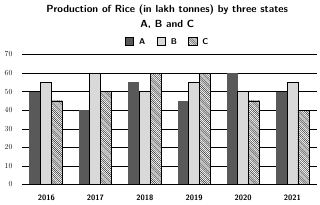
Select the correct statement with respect to the below bar graph.  

  1. AOption (a)

    Rice production by A in 2016 is less than the rice production by C in 2020.  

  2. BOption (b)

    B produced more rice than A and C in 2018.  

  3. COption (c)

    The highest production of rice was in the year 2017.  

  4. DOption (d)

    Rice production by B in 2017 is equal to the rice production by A in 2020.  

View answer & explanation

Correct answer

Answer: (d)D.

Rice production by B in 2017 is equal to the rice production by A in 2020.  

Why this answer is correct

Calculation:

Statement 1:

Rice production by A in the year 2016 = 50 lakh tonnes

Rice production by C in the year 2020 = 45 lakh tonnes

Statement 1 is incorrect.

Statement 2:

Rice production by B in the year 2018 = 50 lakh tonnes

Rice production by A in the year 2018 = 55 lakh tonnes

Rice production by C in the year 2018 = 60 lakh tonnes

Statement 2 is incorrect.

Statement 3:

Rice production in the year 2017 = 40 + 60 + 50 = 150 lakh tonnes

Rice production in the year 2018 = 55 + 50 + 60 = 165 lakh tonnes

Statement 3 is incorrect.

Statement 4:

Rice production by B in the year 2017 = 60 lakh tonnes

Rice production by A in the year 2020 = 60 lakh tonnes

Statement 4 is correct.

∴ The correct option is 4.

Question 179

CSIR ASO 2024• Test

What value should come in place of question mark (?) in the following question?

(37 × 3) + 1024\sqrt{1024} = ? - (17 × 4) + 729\sqrt{729} - 66

  1. AOption (a)

    250 

  2. BOption (b)

    240 

  3. COption (c)

    260 

  4. DOption (d)

    255

View answer & explanation

Correct answer

Answer: (a)A.

250 

Why this answer is correct

Calculation

⇒ (37 × 3) + 1024\sqrt{1024} = ? - (17 × 4) + 729\sqrt{729} - 66

⇒ 111 + 32 = ? - 68 + 27 - 66

⇒ 143 = ? - 68 + 27 - 66

⇒ ? = 143 + 134 - 27

⇒ ? = 277 - 27

⇒ ? = 250

The answer is 250.

Question 180

CSIR ASO 2024• Test

The compound interest on a sum for 2 years at the rate of 32 percent per annum (compounded annually) is Rs. 6681.6. What is the sum?

  1. AOption (a)

    Rs. 8700 

  2. BOption (b)

    Rs. 9000

  3. COption (c)

    Rs. 8600

  4. DOption (d)

    Rs. 8400

View answer & explanation

Correct answer

Answer: (b)B.

Rs. 9000

Why this answer is correct

Given:

Rate of interest = 32%

Time =  2 years

Compound interest = 6681.6

Formula used:

CI = P[1 + (R/100)]T - P

Where, CI = Compound interest

R = Rate of interest

P = Principle and T = Time

Calculation:

⇒ 6681.6 = P[1 + (32/100)]2 - P

⇒ 6681.6 = P × (132/100)2 - P

⇒ 6681.6 = P × (1.32 × 1.32) - P

⇒ 6681.6 = 1.7424 × P - P

⇒ 6681.6 = 0.7424P

⇒ P = 6681.6/0.7424 = 9000

Hence, the value of the principle is Rs. 9000.