Search Previous Year Questions

Find real questions from previous competitive exam papers with answers and solutions.

Leave the keyword blank to browse saved questions for your selected exam, newest papers first. Add a keyword, year or topic to narrow the results.

Browse complete papers
Showing 10 question(s)
Clear

Question 561

Bihar Jeevika 2025• Test

A machine was bought for Rs. 1,500 and a repairing charge of Rs. 100 was paid afterwards. At what price should it be sold to gain a profit of 25%?

  1. AOption (a)

    Rs. 2,040

  2. BOption (b)

    Rs. 1,960

  3. COption (c)

    Rs. 2,000

  4. DOption (d)

    Rs. 1, 920

View answer & explanation

Correct answer

Answer: (c)C.

Rs. 2,000

Why this answer is correct

Shortcut Trick

Total effective Cost Price (CP) = 1500 + 100 = Rs. 1,600.

To gain 25% Profit, the Selling Price (SP) is 125% of the CP.

SP = 1,600 × (125/100) = 1,600 × (5/4).

SP = 400 × 5 = Rs. 2,000.

∴ The correct answer is Rs. 2,000.

Alternate Method

Given:

Purchase price of the machine = Rs. 1,500

Repairing charge paid = Rs. 100

Desired Profit percentage = 25%

Formula used:

Total CP = Purchase Price + Overhead Expenses

Selling Price (SP) = CP × [1 + (Profit% / 100)]

Calculations:

⇒ Total Cost Price = 1,500 + 100 = Rs. 1,600

⇒ Profit amount = 25% of 1,600

⇒ Profit amount = (25 / 100) × 1,600 = 400

⇒ Selling Price = Total Cost Price + Profit

⇒ Selling Price = 1,600 + 400 = Rs. 2,000

∴ The correct answer is Rs. 2,000.

Additional Information

Overhead Expenses

Expenses like repairs, freight, or transportation are always added to the purchase price to calculate the effective Cost Price.

Profit and Loss Percentage

Profit % = (Profit ÷ CP) × 100 | Loss % = (Loss ÷ CP) × 100. Both are always calculated on the Cost Price unless stated otherwise.

Fraction Conversion

To simplify calculations, use fraction equivalents: 25% = 1/4, 20% = 1/5, 50% = 1/2.
Question 562

Bihar Jeevika 2025• Test

If a shopkeeper sells an item at Rs. 2,700, he makes 8% profit. If he sells the item at Rs. 3,000 what will be the percentage of profit?

  1. AOption (a)

    12

  2. BOption (b)

    20

  3. COption (c)

    10

  4. DOption (d)

    25

View answer & explanation

Correct answer

Answer: (b)B.

20

Why this answer is correct

Shortcut Trick

The ratio of the selling prices is directly proportional to (100 + Profit%):

₹2,700 → (100 + 8) = 108%

₹1 → 108 ÷ 2700 %

₹3,000 → (108 ÷ 2700) × 3000 = 120%

New Profit % = 120% − 100% = 20%

∴ The correct answer is 20%.

Alternate Method

Given:

First Selling Price (SP1) = ₹2,700

First Profit (P1) = 8%

Second Selling Price (SP2) = ₹3,000

Formula Used:

Cost Price (CP) = [Selling Price × 100] ÷ [100 + Profit %]

Profit % = [(SP − CP) ÷ CP] × 100

Calculations:

⇒ CP = (2700 × 100) ÷ (100 + 8)

⇒ CP = 270000 ÷ 108

⇒ CP = ₹2,500

⇒ New Profit = SP2 − CP = 3000 − 2500

⇒ New Profit = ₹500

⇒ New Profit % = (500 ÷ 2500) × 100

⇒ New Profit % = (1 ÷ 5) × 100 = 20%

∴ The correct answer is 20%.

Additional Information

Relationship between SP and CP

When there is a profit, SP = CP + Profit. When there is a loss, SP = CP − Loss. Both profit and loss percentages are calculated on the Cost Price.

Direct Proportion Method

If CP remains constant, the ratio of selling prices is equal to the ratio of their respective percentage values: SP1 / (100 ± P/L1) = SP2 / (100 ± P/L2).

Marked Price and Discount

Selling Price can also be calculated using Marked Price (MP) and Discount%: SP = MP × (100 − Discount%) ÷ 100.

Question 563

Bihar Jeevika 2025• Test

There were two candidates in an election, 10% of voters did not vote and 48 votes were found invalid. The winning candidate got 53% of all the voters in the list  and won by 304 votes. Find the total number of votes enrolled.

  1. AOption (a)

    1600

  2. BOption (b)

    1230

  3. COption (c)

    4561

  4. DOption (d)

    1653

View answer & explanation

Correct answer

Answer: (a)A.

1600

Why this answer is correct

Given:

There were two candidates in an election, 10% of voters did not vote and 48 votes were found invalid. The winning candidate got 53% of the total votes and won by 304 votes.

Concept used:

Percentage

Calculation:

Let the total number of voters be 100x

10% of voters did not vote 

Number of voters who vote = 100x - 10x = 90x

48 votes were found invalid

Valid votes = 90x - 48

Votes gained by the winning candidate = \(\frac{{53}}{{100}} \times 100x = 53x\)

Votes gained by the loosing candidate = 90x - 48 - 53x

⇒ 37x - 48

As per the question,

⇒ 53x - (37x - 48) = 304

⇒ 16x = 304 - 48

⇒ 16x = 256

⇒ x = 16

∴ Total number of voters = 100x = 1600

Alternate Method 

Let total number of votes be 100 units,

10% voters did not cast their vote

⇒ Votes polled = 90 units

The winning candidate got 53% of all the voters in the list and won by 304 votes,

⇒ Winning candidate got = 53 units votes

⇒ Other candidate got = 37 units votes

⇒ Difference in votes = 53 units votes - 37 units votes = 304 - 48 = 256 votes

⇒ 16 units = 256

∴ 100 units votes = 256/16 × 100 = 1600 votes

∴ Total number of voters = 1600.

Question 564

Bihar Jeevika 2025• Test

A bus goes from Noida to Kanpur at the speed of 40 km/hr and comes from Kanpur to Noida at the speed of 60 km/hr. The average speed of the bus is:

  1. AOption (a)

    24 km/hr

  2. BOption (b)

    22 km/hr

  3. COption (c)

    25 km/hr

  4. DOption (d)

    48 km/hr

View answer & explanation

Correct answer

Answer: (d)D.

48 km/hr

Why this answer is correct

Given,

The bus goes from Noida to Kanpur with a speed of = 40 km/hr

The bus comes from Kanpur to Noida with a speed of = 60 km/hr

Formula:

Average speed = Total Distance/total time

Calculation:

Let the total distance between Noida to Kanpur be LCM(40, 60) = 120 km

Time is taken by bus from Noida to Kanpur with the speed of 40 km/hr

120/40 = 3 hrs

Time taken by bus from Kanpur to Noida with the speed of 60 km/hr

120/60 = 2 hrs

Total time = 2 + 3 = 5 hrs

Total distance = 120 + 120 = 240 km

Average speed = 240/5 = 48 km/hr

∴ The average speed is 48 km/h

Average speed = 2xy/(x + y)

Average speed = (2 × 40 × 60)/(40 + 60) = 48 km/hr

Average speed = 240/5 = 48 km/hr

∴ The average speed is 48 km/h

Question 565

Bihar Jeevika 2025• Test

A train moving at a speed of 63 km/hr enters a railway station and crosses the platform in 20 s. If the length of the train is 100 m, what is the length of the platform?

  1. AOption (a)

    150 m

  2. BOption (b)

    200 m

  3. COption (c)

    250 m

  4. DOption (d)

    300 m

View answer & explanation

Correct answer

Answer: (c)C.

250 m

Why this answer is correct

Shortcut Trick

Convert Speed to m/s: 63 × 5/18 = 17.5 m/s.

Total Distance (Train + Platform) = Speed × Time = 17.5 × 20 = 350 m.

Platform Length = Total Distance − Train Length = 350 − 100 = 250 m.

∴ The correct answer is 250 m.

Alternate Method

Given:

• Speed of the train = 63 km/hr

• Time taken to cross the platform = 20 s

• Length of the train (Lt) = 100 m

Formula:

Total Distance = Length of Train + Length of Platform = Speed × Time

Calculations:

⇒ Speed in m/s = 63 × (5/18) m/s

⇒ Speed = 7 × (5/2) = 17.5 m/s

⇒ Let Platform Length be Lp

⇒ Total Distance = Lt + Lp = 100 + Lp

⇒ 100 + Lp = 17.5 × 20

⇒ 100 + Lp = 350

⇒ Lp = 350 − 100

⇒ Lp = 250 m

The calculated length of the platform is 250 m, which corresponds to Option (3).

∴ The correct answer is 250 m.

Additional Information

Unit Conversion

To convert speed from km/hr to m/s, multiply by 5/18. To convert m/s to km/hr, multiply by 18/5.

Crossing Stationary Objects

When a train crosses a platform, bridge, or tunnel, the total distance covered is (Length of train + Length of the object).

Relative Speed

If two objects move in the opposite direction, relative speed = S1 + S2. In the same direction, relative speed = |S1 − S2|.

Question 566

Bihar Jeevika 2025• Test

The average age of 16 boys is 14. if a new one is included, then the average becomes 15. What is the age of the new boy?

  1. AOption (a)

    21

  2. BOption (b)

    31

  3. COption (c)

    11

  4. DOption (d)

    32

View answer & explanation

Correct answer

Answer: (b)B.

31

Why this answer is correct

Given:

The average age of 16 boys is 14.

A new is included, then the average becomes 15

Concept:

Average age = Total age / Number of people 

Calculation:

Total age of the 16 boys = 16 × 14

⇒ 224 years.

After the addition of the new boy,

The total of (16 + 1) age will be,

⇒ 17 × 15 = 255 years.

So, the age of the new boy is (255 - 224) = 31 years.

The age of the new boy is 31 years.

Alternate Method 

Given:

The average age of 16 boys is 14.

A new is included, then the average becomes 15

Calculation: 

The total increase in the sum of the ages = 16 × 1

⇒ 16 years.

So, the age of the new boy is (16 + 15) = 31 years

The age of the new boy is 31 years.

Question 567

Bihar Jeevika 2025• Test

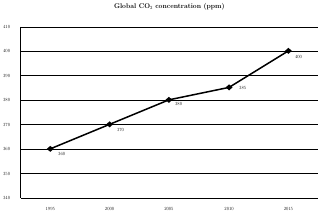
Based on the given graph, what is the percentage change in CO2 concentration from year 1995 to 2015?

  1. AOption (a)

    11.00%

  2. BOption (b)

    11.31%

  3. COption (c)

    11.26%

  4. DOption (d)

    11.11%

View answer & explanation

Correct answer

Answer: (d)D.

11.11%

Why this answer is correct

From the graph:

CO2 concentration in the year 1995 = 360

CO2 concentration in the year 2015 = 400

Hence,

Percentage change = [(400 – 360)/360] × 100

⇒ 40/360 × 100

⇒ 1/9 × 100 = 11.11%

∴ The percentage change in CO2 concentration is 11.11%.

Question 568

Bihar Jeevika 2025• Test

The line chart given below shows the ratio of imports to exports for a country for 5 consecutive years Y1, Y2, Y3, Y4 and Y5.

the imports for year Y5 is Rs. 76000 crore, then what will be exports (in crores) for the year Y5?

  1. AOption (a)

    Rs. 82000 crore

  2. BOption (b)

    Rs. 80000 crore

  3. COption (c)

    Rs. 84000 crore

  4. DOption (d)

    Rs. 78000 crore

View answer & explanation

Correct answer

Answer: (b)B.

Rs. 80000 crore

Why this answer is correct

Calculation:

From the line chart,

Ratio of imports to exports in year Y5 = 0.95

⇒ Imports/Exports = 0.95

⇒ 76000/Exports = 0.95 = 95/100 = 19/20

⇒ Exports = 76000 × 20/19

∴ Exports = Rs. 80000 crore

Question 569

Bihar Jeevika 2025• Test

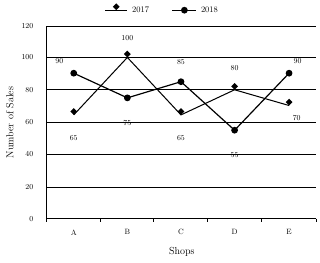
The given line graph shows the sales of massage machines from five different shops A, B, C, D and E in the years 2017 and 2018

What are the total sales from the shops A, B and C together for both the years?

  1. AOption (a)

    475

  2. BOption (b)

    500

  3. COption (c)

    480

  4. DOption (d)

    300

View answer & explanation

Correct answer

Answer: (c)C.

480

Why this answer is correct

Calculation:

⇒ total sales from the shops A for both the years = (65 + 90) = 155

⇒ total sales from the shops B for both the years = (100 + 75) = 175 

⇒ total sales from the shops C for both the years = (65 + 85) = 150  

∴ total sales from the shops A, B and C together for both the years = (155 + 175 + 150) = 480

Question 570

Bihar Jeevika 2025• Test

Select the option that is related to the third letter-cluster in the same way as the second letter-cluster is related to the first letter-cluster.

MNTK : HIOF :: RUNA : ?

  1. AOption (a)

    MPIV

  2. BOption (b)

    NPIU

  3. COption (c)

    MPJV

  4. DOption (d)

    VZSF

View answer & explanation

Correct answer

Answer: (a)A.

MPIV

Why this answer is correct

Given: MNTK : HIOF :: RUNA : ?

The logic follows here is:

Similarly, 

Hence, MPIV is the correct answer.