Search Previous Year Questions

Find real questions from previous competitive exam papers with answers and solutions.

Leave the keyword blank to browse saved questions for your selected exam, newest papers first. Add a keyword, year or topic to narrow the results.

Browse complete papers
Showing 10 question(s)
Clear

Question 421

Bihar Jeevika 2025• Test

A sum of ₹12,500 amounts to ₹15,500 in 4 years at the rate of simple interest. What is the rate of interest?

  1. AOption (a)

    3%

  2. BOption (b)

    4%

  3. COption (c)

    5%

  4. DOption (d)

    6%

View answer & explanation

Correct answer

Answer: (d)D.

6%

Why this answer is correct

Given:

Principal (P) = 12,500

Amount (A): 15,500

Time (t) = 4 year

Formula used:

\(S.I. = \frac{P \times R \times t}{100}\)

S.I = Amount - Principal

Calculation:

⇒ S.I. = 15,500 - 12,500

⇒ S.I. = 3,000

⇒ \(3,000 = \frac{12,500 \times R \times 4}{100}\)

⇒ \(R = \frac{3000 \times 100}{12,500 \times 4}\)

⇒ R = 6%

∴ correct answer is 6%

Question 422

Bihar Jeevika 2025• Test

Y has to score 40% marks to pass the exam. He gets 20 marks and fails by 40 marks. The maximum mark of the exam is?

  1. AOption (a)

    100

  2. BOption (b)

    200

  3. COption (c)

    150

  4. DOption (d)

    250

View answer & explanation

Correct answer

Answer: (c)C.

150

Why this answer is correct

Given:

Y has to score 40% marks to pass.

He gets 20 marks and fails by 40 marks

Calculation:

Let the maximum marks be x

According to the question,

⇒ 40 + 20 = 0.4 x 

⇒ 0.4 x = 60 = 150

∴  The maximum mark of the exam is 150,

Question 423

Bihar Jeevika 2025• Test

The average of the first five natural numbers is 3. Find a new average after adding the number 2.

  1. AOption (a)

    2.83

  2. BOption (b)

    2.6

  3. COption (c)

    2.5

  4. DOption (d)

    2

View answer & explanation

Correct answer

Answer: (a)A.

2.83

Why this answer is correct

Shortcut Trick

Sum of the first 5 natural numbers = 5 × 3 = 15

New sum after adding the number 2 = 15 + 2 = 17

New total number of observations = 5 + 1 = 6

New average = 17 ÷ 6 ≈ 2.83

∴ The correct answer is 2.83.

Alternate Method

Given:

Average of the first five natural numbers = 3

The new number to be added = 2

Formula Used:

Average = Sum of all observations ÷ Total number of observations

Calculations:

⇒ The first five natural numbers are 1, 2, 3, 4, and 5.

⇒ Initial Sum = 1 + 2 + 3 + 4 + 5 = 15

⇒ Total count of numbers initially = 5

⇒ New Sum after adding the number 2 = 15 + 2 = 17

⇒ New total count of numbers = 5 + 1 = 6

⇒ New Average = New Sum ÷ New Count

⇒ New Average = 17 ÷ 6 = 2.833...

⇒ New Average ≈ 2.83

∴ The correct answer is 2.83.

Additional Information

Average Formula

Average = Sum of all observations ÷ Total number of observations.

Sum of First 'n' Natural Numbers

The sum of the first 'n' natural numbers can be directly calculated using the formula: S = n × (n + 1) ÷ 2.

Combined Average

When combining multiple groups or adding new values, the new average is evaluated as (Total Old Sum + New Values Sum) ÷ (Total Old Count + New Count).

Question 424

Bihar Jeevika 2025• Test

A shirt was marked at Rs. 1600. During a Diwali festival offer, 10% discount was allowed on it. What will be the selling price of the shirt?

  1. AOption (a)

    Rs. 1540

  2. BOption (b)

    Rs. 1400

  3. COption (c)

    Rs. 1440

  4. DOption (d)

    Rs. 1240

View answer & explanation

Correct answer

Answer: (c)C.

Rs. 1440

Why this answer is correct

Shortcut Trick

Marked Price (MP) = Rs. 1600

Discount% = 10%

Multiplier for SP = (100 − 10) ÷ 100 = 0.9

Selling Price (SP) = 1600 × 0.9 = 1440

∴ The correct answer is Rs. 1440.

Alternate Method

Given: Marked Price = Rs. 1600, Discount Rate = 10%

Formulas: Discount = MP × (Discount% ÷ 100) | SP = MP − Discount

⇒ Discount = 1600 × (10 ÷ 100) = Rs. 160

⇒ Selling Price (SP) = 1600 − 160

⇒ Selling Price (SP) = Rs. 1440

∴ The correct answer is Rs. 1440.

Additional Information

Marked Price (MP)

The price printed on an item or the label price is called the Marked Price. Discounts are always calculated on this value.

Selling Price (SP)

The actual price at which the item is sold to the customer after deducting the discount from the MP.

Question 425

Bihar Jeevika 2025• Test

The ages of four individuals are in the ratio 2 : 3 : 4 : 5, and the total of their ages is 140 years. Find the difference in age between the youngest and the oldest person.

  1. AOption (a)

    25 years

  2. BOption (b)

    30 years

  3. COption (c)

    35 years

  4. DOption (d)

    40 years

View answer & explanation

Correct answer

Answer: (b)B.

30 years

Why this answer is correct

Given:

Ratio of ages = 2 : 3 : 4 : 5

Total age = 140 years

Formula Used:

Age of individual = (Ratio part of individual / Sum of ratio parts) × Total age

Calculations:

Sum of ratio parts = 2 + 3 + 4 + 5

⇒ Sum of ratio parts = 14

Age of youngest person (2 parts) = \(\dfrac{2}{14}\) × 140

⇒ Age of youngest person = 2 × 10

⇒ Age of youngest person = 20 years

Age of oldest person (5 parts) = \(\dfrac{5}{14}\) × 140

⇒ Age of oldest person = 5 × 10

⇒ Age of oldest person = 50 years

Difference in age = Age of oldest person - Age of youngest person

⇒ Difference in age = 50 - 20

⇒ Difference in age = 30 years

∴ The difference in age between the youngest and the oldest person is 30 years.

Question 426

Bihar Jeevika 2025• Test

The ratio of weekly incomes of A and B is 9 : 7 and the ratio of their expenditures is 4 : 3. If each saves Rs. 200 per week, then the sum of their weekly incomes is

  1. AOption (a)

    Rs. 3,200

  2. BOption (b)

    Rs. 4,200

  3. COption (c)

    Rs. 4,800

  4. DOption (d)

    Rs. 5,600

View answer & explanation

Correct answer

Answer: (a)A.

Rs. 3,200

Why this answer is correct

Shortcut Trick

Multiply the expenditure ratio by 2 to equalise the differences between the ratios.

Income ratio = 9 : 7

Expenditure ratio = (4 : 3) × 2 = 8 : 6

Savings in parts = Income − Expenditure = (9 − 8) = 1 part for A and (7 − 6) = 1 part for B.

Given 1 part = Rs. 200.

Sum of their incomes = (9 + 7) parts = 16 × 200 = Rs. 3200.

∴ The correct answer is Rs. 3200.

Alternate Method

Given:

Ratio of incomes of A and B = 9 : 7

Ratio of expenditures of A and B = 4 : 3

Savings of each per week = Rs. 200

Income = Expenditure + Savings

A:

Income: 9x

Exp: 9x − 200 200

B:

Income: 7x

Exp: 7x − 200 200

Exp Ratio → (9x − 200) : (7x − 200) = 4 : 3

Formula Used:

Income = Expenditure + Savings

Calculations:

⇒ Let the incomes of A and B be 9x and 7x respectively.

⇒ Expenditure of A = (9x − 200)

⇒ Expenditure of B = (7x − 200)

⇒ According to the given data, (9x − 200) / (7x − 200) = 4 / 3

⇒ 3 × (9x − 200) = 4 × (7x − 200)

⇒ 27x − 600 = 28x − 800

⇒ 28x − 27x = 800 − 600

⇒ x = 200

⇒ Sum of their weekly incomes = 9x + 7x = 16x

⇒ 16 × 200 = Rs. 3200

∴ The correct answer is Rs. 3200.

Additional Information

Ratio Balancing Method

When a constant value is added or subtracted from two terms of a ratio, the difference between the terms must remain constant. Equalise the difference between parts to solve directly without equations.

Cross-Multiplication Trick

For initial ratio a : b, changed to c : d by adding/subtracting x and y: the value of 1 part = (c × y − d × x) ÷ (a × d − b × c).

Income, Expenditure & Savings

The fundamental relation is always Income = Expenditure + Savings. This applies equivalently to monthly, weekly or annual data as long as units remain consistent.
Question 427

Bihar Jeevika 2025• Test

A bag contains Rs. 1 and 50 paise coins and the ratio of their value is 30 : 11. The total number of coins are 520. Find the number of 50 paise coins?

  1. AOption (a)

    210

  2. BOption (b)

    220

  3. COption (c)

    200

  4. DOption (d)

    400

View answer & explanation

Correct answer

Answer: (b)B.

220

Why this answer is correct

Given

Bag contains Rs. 1, 50 paise, coins

The ratio of value is 30 : 11

The total no. of coins are 520

Concept used

Ratio concept used

Calculation

Value of Rs. 1 and 50 paise coins = 30 : 11

Number of coins = 30 : 22

⇒ 52 part = 520

⇒ 1p = 10

⇒ 22p = 10 × 22

⇒ 220

Calculation:

Rs. 1 = 100 paise 

Let the total number of 100 paise coins be x

Then 50 paise coins are 520 – x

According to the question,

⇒ 100x/50(520 – x) = 30/11

⇒ 11 × 100x = 30 × 50(520 – x)

⇒ 1,100x = 7,80,000 – 1,500x

⇒ 2,600x = 7,80,000

⇒ x = 7,80,000/2,600

⇒ x = 300

50 paise coins,

⇒ 520 – 300 = 220

∴ 50 paise coins are 220.

Question 428

Bihar Jeevika 2025• Test

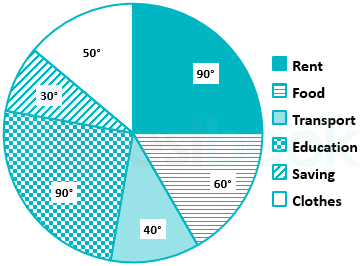
The following pie chart shows the distribution of expenses (in degrees) of a family during 2016. Total income of the family in 2016 = Rs. 1080000

How much they spend (in Rs.) on clothes?

  1. AOption (a)

    150000

  2. BOption (b)

    180000

  3. COption (c)

    200000

  4. DOption (d)

    240000

View answer & explanation

Correct answer

Answer: (a)A.

150000

Why this answer is correct

Total expense = 360°

Expense on clothes = 50°

Let, expense on cloth = Rs. x

According to problem,

⇒ 50/360 = x/108000

⇒ x = 1080000 × 5/36

⇒ x = 150000

∴ They spent on cloths = Rs. 150000

Question 429

Bihar Jeevika 2025• Test

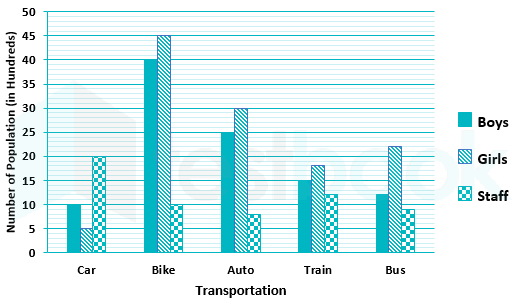
Direction: Read the following graph carefully and answer the questions that follow: The graph shows the number of Boys, Girls and Staff of a college who are using different types of transportations.

What is the average number of Cars used by three category of people?

  1. AOption (a)

    1123

  2. BOption (b)

    1266

  3. COption (c)

    1234

  4. DOption (d)

    1167

View answer & explanation

Correct answer

Answer: (d)D.

1167

Why this answer is correct

Given:

BoysGirlsStaff
Car10520
Bike404510
Auto25308
Train151812
Bus12229

Formula used:

Average = Sum of observation/Total number of observation

Calculation:

Total cars used by three types of people's = 1000 + 500 + 2000 = 3500

∴ Required average = 3500/3 = 1166.66 ≈ 1167

Question 430

Bihar Jeevika 2025• Test

A series is given with one term missing. Select the correct alternative from the given ones that will complete the series.

XPC, QHT, JZK, CRB, ?

  1. AOption (a)

    YMV

  2. BOption (b)

    VJS

  3. COption (c)

    WKT

  4. DOption (d)

    XLU

View answer & explanation

Correct answer

Answer: (b)B.

VJS

Why this answer is correct

According to the English alphabets and their positional values: 

The pattern followed in the given series is:  

  • First alphabet is decreased to 7 positional values.
  • Second alphabet is decreased to 8 positional values.
  • Third alphabet is decreased to 9 positional values.

Hence the correct answer is option 2).