Search Previous Year Questions

Find real questions from previous competitive exam papers with answers and solutions.

Showing 10 question(s)
Clear

Question 31

AIIMS BSc Nursing 2025• Chemistry

What will be the oxidation number of the elements in O3,P4 O_3, P_4 and S8 S_8 ?

  1. AOption (a)

    -1, 0, +1

  2. BOption (b)

    1, +1, -2

  3. COption (c)

    0, 0, 0

  4. DOption (d)

    -2, 1, 0

View answer & explanation

Correct answer

Answer: (c)C.

0, 0, 0

Why this answer is correct

CONCEPT:

Oxidation State of Elements in Free State

  • The oxidation number of an atom in an element in its free or uncombined state (elemental form) is always zero.
  • This rule applies to all allotropic forms of an element, whether they are monoatomic, diatomic, or polyatomic molecules.

EXPLANATION:

  • In the given molecules:
  • O3 O_3 (Ozone): Ozone is an allotrope of oxygen. Since it consists only of oxygen atoms in their elemental form, the oxidation number of O is 0.
  • P4 P_4 (White Phosphorus): This is the elemental form of phosphorus. Because it is not combined with any other distinct element, the oxidation number of P is 0.
  • S8 S_8 (Sulfur): This is a polyatomic allotropic form of sulfur. Since it is composed solely of sulfur atoms, the oxidation number of S is 0.
  • In all these instances, the atoms are bonded to other atoms of the same element. Due to the lack of difference in electronegativity between identical atoms, the shared electrons are not shifted toward any particular atom, resulting in an oxidation state of zero.

Therefore, the oxidation numbers of the elements in O3,P4 O_3, P_4 , and S8 S_8 are 0, 0, and 0.

Question 32

AIIMS BSc Nursing 2025• Chemistry

Which of the following is true for an adiabatic process

  1. AOption (a)

    ΔH=0\Delta H = 0

  2. BOption (b)

    ΔW=0\Delta W = 0

  3. COption (c)

    ΔQ=0\Delta Q = 0

  4. DOption (d)

    ΔV=0\Delta V = 0

View answer & explanation

Correct answer

Answer: (c)C.

ΔQ=0\Delta Q = 0

Why this answer is correct

CONCEPT:

Adiabatic Process

  • An adiabatic process is a thermodynamic process in which there is no exchange of heat or mass between a system and its surroundings.
  • In an adiabatic process, the system is often thermally insulated, ensuring that the total heat content remains constant throughout the change.
  • According to the definition, the heat transfer (Q) is zero.

EXPLANATION:

  • The First Law of Thermodynamics is given by the equation:

ΔU = Q - W

Where ΔU is the change in internal energy, Q is the heat added to the system, and W is the work done by the system.

  • For an adiabatic process, the defining characteristic is that no heat is transferred into or out of the system.
  • Therefore, for an adiabatic process:

ΔQ = 0

  • Let us evaluate the other options:
  • ΔH = 0: This refers to an isoenthalpic process, where enthalpy remains constant.
  • ΔW = 0: This refers to a process where no work is done, typically occurring in isochoric processes where volume is constant.
  • ΔV = 0: This refers to an isochoric process, where the volume of the system does not change.

Therefore, for an adiabatic process, ΔQ = 0 is the correct condition.

Question 33

AIIMS BSc Nursing 2025• Chemistry

What products are obtained from the hydrolysis of lactose?

  1. AOption (a)

    Glucose + Galactose

  2. BOption (b)

    Glucose + Glucose

  3. COption (c)

    Glucose + Fructose

  4. DOption (d)

    Lactose + Lactose

View answer & explanation

Correct answer

Answer: (a)A.

Glucose + Galactose

Why this answer is correct

CONCEPT:

Hydrolysis of Disaccharides

  • Disaccharides are carbohydrates that yield two monosaccharide molecules upon hydrolysis with dilute acids or specific enzymes.
  • Lactose, also known as milk sugar, is a disaccharide found naturally in milk.
  • The process of hydrolysis breaks the glycosidic bond that holds the two monosaccharide units together by adding a water molecule.

EXPLANATION:

  • Lactose (C12H22O11) is a reducing sugar composed of two different monosaccharide units.
  • It consists of one molecule of β-D-galactose and one molecule of β-D-glucose.
  • These units are joined by a β(1→4) glycosidic linkage between the C1 of galactose and the C4 of glucose.
  • When lactose undergoes hydrolysis, either catalyzed by the enzyme lactase or by dilute acid, the glycosidic bond is cleaved.
  • The chemical reaction is represented as:

Lactose + H2O → D-Glucose + D-Galactose

  • As a result, the products obtained are glucose and galactose.

Hence, the products obtained from the hydrolysis of lactose are Glucose and Galactose.

Question 34

AIIMS BSc Nursing 2025• Chemistry

What is the electronic configuration of palladium?

  1. AOption (a)

    Kr 5s24d85s^2 4d^8

  2. BOption (b)

    Kr 5s14d95s^1 4d^9

  3. COption (c)

    Kr 4d104d^{10}

  4. DOption (d)

    Kr 5s24d105s^2 4d^{10}

View answer & explanation

Correct answer

Answer: (c)C.

Kr 4d104d^{10}

Why this answer is correct

CONCEPT:

Electronic Configuration of Transition Metals

  • Electronic configuration represents the distribution of electrons of an atom in its atomic orbitals.
  • According to the Aufbau principle, electrons occupy orbitals in the order of increasing energy (1s, 2s, 2p, 3s, 3p, 4s, 3d, 4p, 5s, 4d...).
  • Transition metals (d-block elements) often show anomalous electronic configurations. This occurs because the energy difference between the (n-1)d and ns orbitals is very small, and stability is gained by having half-filled or completely filled d-subshells.

EXPLANATION:

  • Palladium (Pd) has an atomic number of 46.
  • The nearest preceding noble gas is Krypton (Kr), which has an atomic number of 36. This accounts for the first 36 electrons: [Kr].
  • Subtracting the noble gas core from the total atomic number: 46 - 36 = 10 electrons remaining to be filled.
  • Based on the standard Aufbau filling order, one would expect the configuration to be [Kr] 5s2 4d8.
  • However, Palladium is a unique case in the 4d transition series. It achieves maximum stability by completely filling the 4d subshell.
  • To achieve this, both electrons from the 5s orbital are moved to the 4d orbital, resulting in a 4d10 5s0 configuration.
  • This makes Palladium the only element in the periodic table with a closed-shell configuration in its ground state among the transition elements of its period (having an empty outer s-orbital).
  • The final electronic configuration is: Kr 4d10.

Therefore, the electronic configuration of palladium is Kr 4d10.

Question 35

AIIMS BSc Nursing 2025• Chemistry

If 200 ml aqueous solution of 10 g NaOH is prepared then find the molarity of the resulting solution?

  1. AOption (a)

    1.25 M

  2. BOption (b)

    1.5 M

  3. COption (c)

    1.66 M

  4. DOption (d)

    12.5 M

View answer & explanation

Correct answer

Answer: (a)A.

1.25 M

Why this answer is correct

CONCEPT:

Molarity (M)

  • Molarity is the concentration of a solution expressed as the number of moles of solute per liter of solution.
  • The formula for calculating molarity is:

Molarity (M) = Moles of solute (n) / Volume of solution in liters (V)

  • The number of moles (n) is calculated using the formula:

n = Mass of solute / Molar mass of solute

EXPLANATION:

  • Step 1: Calculate the molar mass of NaOH
  • Atomic mass of Sodium (Na) = 23 g/mol
  • Atomic mass of Oxygen (O) = 16 g/mol
  • Atomic mass of Hydrogen (H) = 1 g/mol
  • Molar mass of NaOH = 23 + 16 + 1 = 40 g/mol
  • Step 2: Calculate the number of moles of NaOH
  • Given mass of NaOH = 10 g
  • Number of moles (n) = 10 g / 40 g/mol
  • n = 0.25 moles
  • Step 3: Convert the volume of the solution to liters
  • Given volume = 200 mL
  • Volume in liters (V) = 200 / 1000 = 0.2 L
  • Step 4: Calculate the Molarity
  • Molarity (M) = n / V
  • M = 0.25 moles / 0.2 L
  • M = 1.25 M

Therefore, the molarity of the resulting solution is 1.25 M.

Question 36

AIIMS BSc Nursing 2025• Chemistry

Atomic radii and ionic radius of lanthanoid series increases from La La to lu lu due to?

  1. AOption (a)

    Lanthanoid contraction

  2. BOption (b)

    Actenoid contraction

  3. COption (c)

    Intermolecular bonding

  4. DOption (d)

    None

View answer & explanation

Correct answer

Answer: (a)A.

Lanthanoid contraction

Why this answer is correct

CONCEPT:

Lanthanoid Contraction

  • Lanthanoid contraction refers to the steady decrease in the size of atoms and trivalent ions (M3+) of the lanthanoid elements as the atomic number increases.
  • This trend is observed throughout the series from Lanthanum (Z=57) to Lutetium (Z=71).

EXPLANATION:

  • As we move across the lanthanoid series from La La to Lu Lu , the atomic number and nuclear charge increase by one unit at each successive element.
  • The additional electrons are filled into the inner 4f subshell. Due to the diffuse nature and peculiar shape of f-orbitals, 4f electrons have a very poor shielding effect.
  • This poor shielding effect is unable to effectively counteract the increasing nuclear charge. Consequently, the effective nuclear charge experienced by the outer electrons increases.
  • The increased nuclear pull causes the electron cloud to contract, resulting in a progressive decrease in the atomic and ionic radii across the series.
  • Because the radii decrease (contract) rather than increase as we move from La La to Lu Lu , the premise of the question is factually incorrect.

Therefore, the atomic and ionic radii of the lanthanoid series decrease across the series due to lanthanoid contraction, making None the correct choice.

Question 37

AIIMS BSc Nursing 2025• Chemistry

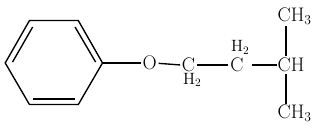
 IUPAC Name?

  1. AOption (a)

    (isopentyloxy)benzene

  2. BOption (b)

    (3-Methylbutoxy)benzene

  3. COption (c)

    (2-Methylbutoxy)benzene

  4. DOption (d)

    Butanoic acid(3-Methylbutyl)benzene

View answer & explanation

Correct answer

Answer: (b)B.

(3-Methylbutoxy)benzene

Why this answer is correct

CONCEPT:

IUPAC Nomenclature of Ethers

  • Ethers are named as alkoxy derivatives of the parent hydrocarbon.
  • The larger carbon-containing part is selected as the parent chain, while the smaller part attached through oxygen is named as an alkoxy substituent.
  • When an alkoxy group is attached directly to a benzene ring, the compound is named as alkoxybenzene.
  • The alkyl group attached to oxygen in the given structure is 3-methylbutyl (isopentyl).
  • Therefore, the corresponding alkoxy substituent is 3-methylbutoxy.

EXPLANATION:

  • The given compound contains a benzene ring attached to an oxygen atom, indicating an aromatic ether.
  • The group attached through oxygen is:

–CH2–CH2–CH(CH3)2

  • Numbering the alkyl chain from the carbon attached to oxygen:
  • Carbon-1: CH2
  • Carbon-2: CH2
  • Carbon-3: CH bearing a methyl group
  • Carbon-4: Terminal CH3
  • The alkyl part is therefore 3-methylbutyl.
  • As an alkoxy substituent, it becomes 3-methylbutoxy.
  • Since this substituent is attached directly to a benzene ring, the IUPAC name is:

(3-Methylbutoxy)benzene

  • This compound is also commonly known as isopentyloxybenzene or isoamyloxybenzene.

Therefore, the IUPAC name of the given compound is (3-Methylbutoxy)benzene.

Question 38

AIIMS BSc Nursing 2025• Chemistry

Which of the following compounds does not give Friedel-Crafts reaction?

  1. AOption (a)

    Benzene

  2. BOption (b)

    Chloro Benzene

  3. COption (c)

    Benzoic Acid

  4. DOption (d)

    Phenol

View answer & explanation

Correct answer

Answer: (c)C.

Benzoic Acid

Why this answer is correct

CONCEPT:

Friedel-Crafts Reaction

  • Friedel-Crafts reactions (alkylation and acylation) are types of electrophilic aromatic substitution reactions that require an electron-rich aromatic ring to proceed effectively.
  • Substances containing strongly deactivating groups (electron-withdrawing groups) generally do not undergo Friedel-Crafts reactions.
  • Deactivating groups, such as –COOH, –NO2, –SO3H, and –CN, withdraw electron density from the benzene ring through resonance (–M effect) and inductive (–I effect) mechanisms, making the ring too electron-deficient to react with the electrophile.

EXPLANATION:

  • In the given compounds:
  • Benzene: It is the simplest aromatic ring and readily undergoes Friedel-Crafts reactions in the presence of a Lewis acid catalyst like anhydrous AlCl3.
  • Chlorobenzene: The chlorine atom is deactivating due to its –I effect, but it also has a +M effect. While it reacts slower than benzene, it still undergoes Friedel-Crafts reactions and directs the incoming group to the ortho and para positions.
  • Benzoic Acid: This compound contains the carboxylic acid group (–COOH), which is a strongly deactivating group. It significantly reduces the electron density of the aromatic ring, preventing electrophilic attack. Furthermore, the AlCl3 catalyst coordinates with the oxygen atoms of the –COOH group, which further deactivates the system and consumes the catalyst.
  • Phenol: The –OH group is a strong activating group. Although it can react with AlCl3 to form a phenolate-type complex which hinders the reaction, Friedel-Crafts reactions are still possible under certain conditions, unlike with strongly deactivated rings.

Therefore, benzoic acid does not give Friedel-Crafts reaction.

Question 39

AIIMS BSc Nursing 2025• Chemistry

The number of unpaired electrons in the paramagnetic complex Ion [FeF6]3− [FeF_{6}]^{3-} is ?

  1. AOption (a)

    2

  2. BOption (b)

    3

  3. COption (c)

    4

  4. DOption (d)

    5

View answer & explanation

Correct answer

Answer: (d)D.

5

Why this answer is correct

CONCEPT:

Crystal Field Theory and Electronic Configuration

  • The number of unpaired electrons in a coordination complex is determined by the oxidation state of the central metal ion and the strength of the surrounding ligands.
  • Weak Field Ligands (WFL): According to the spectrochemical series, ligands like F- are weak field ligands. They do not cause pairing of electrons in the d-orbitals, leading to high-spin complexes.
  • Octahedral Splitting: In an octahedral field, the d-orbitals split into two sets: t2g (lower energy) and eg (higher energy).

EXPLANATION:

  • Step 1: Determine the oxidation state of Iron (Fe).
  • Let the oxidation state of Fe be x.
  • The charge on the fluoride ligand (F) is -1.
  • For the complex [FeF6]3-: x + 6(-1) = -3
  • x - 6 = -3 ⇒ x = +3
  • So, the metal ion is Fe3+.
  • Step 2: Write the electronic configuration of Fe3+.
  • Atomic number of Iron (Fe) is 26.
  • Ground state configuration: [Ar] 3d6 4s2
  • Fe3+ configuration: [Ar] 3d5 (three electrons removed: two from 4s and one from 3d).
  • Step 3: Analyze the ligand strength and electron distribution.
  • F- is a weak field ligand.
  • Since it is a weak field ligand, the crystal field splitting energy (Δo) is less than the pairing energy (P).
  • Therefore, the 5 electrons in the 3d subshell will occupy the orbitals singly following Hund's rule.
  • Configuration: t2g3 eg2
  • Step 4: Count the unpaired electrons.
  • The distribution is: 3 electrons in t2g and 2 electrons in eg.
  • All 5 electrons are unpaired.

Therefore, the number of unpaired electrons in the complex ion [FeF6]3- is 5.

Question 40

AIIMS BSc Nursing 2025• Chemistry

Which of the following is not a nucleophile?

  1. AOption (a)

    BF3 BF_{3}

  2. BOption (b)

    NH3 NH_{3}

  3. COption (c)

    C2H5O− C_{2}H_{5}O^{-}

  4. DOption (d)

    All of these

View answer & explanation

Correct answer

Answer: (a)A.

BF3 BF_{3}

Why this answer is correct

CONCEPT:

Nucleophiles and Electrophiles

  • Nucleophile: A nucleophile is an electron-rich chemical species that has the ability to donate an electron pair to an electron-deficient species (an electrophile) to form a chemical bond. Nucleophiles can be neutral molecules containing lone pairs of electrons or negatively charged ions. Examples include NH3,H2O,OH−, NH_{3}, H_{2}O, OH^{-}, and CN− CN^{-} .
  • Electrophile: An electrophile is an electron-deficient chemical species that accepts an electron pair from a nucleophile. These species typically have an incomplete octet or carry a positive charge. Examples include BF3,AlCl3, BF_{3}, AlCl_{3}, and H+ H^{+} .

EXPLANATION:

  • BF3 BF_{3} (Boron trifluoride):
  • In BF3 BF_{3} , the central boron atom forms three covalent bonds with three fluorine atoms.
  • Since boron has 3 valence electrons, the total number of electrons in its outermost shell after bonding is 6.
  • Because it has an incomplete octet (less than 8 electrons), it is electron-deficient and acts as a Lewis acid or an electrophile. Therefore, it cannot act as a nucleophile.
  • NH3 NH_{3} (Ammonia):
  • The nitrogen atom in ammonia has five valence electrons. It uses three electrons to bond with hydrogen atoms, leaving one lone pair of electrons.
  • This lone pair can be donated to an electrophile, making NH3 NH_{3} a nucleophile.
  • C2H5O− C_{2}H_{5}O^{-} (Ethoxide ion):
  • The ethoxide ion carries a formal negative charge on the oxygen atom.
  • This makes the species highly electron-rich, allowing it to act as a strong nucleophile by donating an electron pair.

Therefore, BF3 BF_{3} is not a nucleophile.