Search Previous Year Questions

Find real questions from previous competitive exam papers with answers and solutions.

Showing 10 question(s)
Clear

Question 241

AIIMS BSc Nursing 2023• Chemistry

Which of the following is a chemical property?

  1. AOption (a)

    Melting point

  2. BOption (b)

    Boiling point

  3. COption (c)

    Density

  4. DOption (d)

    Combustibility

View answer & explanation

Correct answer

Answer: (d)D.

Combustibility

Why this answer is correct

CONCEPT:

Chemical vs Physical Properties

  • Chemical properties are characteristics of a substance that become evident during a chemical reaction; they include reactivity, combustibility, and acidity.
  • Physical properties can be observed or measured without changing the composition of matter; they include melting point, boiling point, and density.

EXPLANATION:

  • Among the given options:
  • Melting point, boiling point, and density are physical properties because they can be observed without altering the chemical structure of the substance.
  • Combustibility is a chemical property because it describes how a substance reacts with oxygen to produce heat and light during combustion.
  • Therefore, the correct answer is:
  • Option 1, 2, and 3 are physical properties.
  • Option 4 (Combustibility) is a chemical property.

Therefore, the option that is a chemical property is Combustibility.

Question 242

AIIMS BSc Nursing 2023• Chemistry

The IUPAC name of the following compound is

  1. AOption (a)

    5-oxo Hexanoic acid

  2. BOption (b)

    methyl Butanoic ketone

  3. COption (c)

    4-oxo Pentanoic acid

  4. DOption (d)

    None of the above

View answer & explanation

Correct answer

Answer: (a)A.

5-oxo Hexanoic acid

Why this answer is correct

CONCEPT:

Priority Order of Functional Groups

  • In IUPAC nomenclature, functional groups are ranked by priority to determine their naming order when multiple groups are present in a compound.
  • The priority of functional groups is determined by their reactivity and their importance in the structure of organic compounds.
  • The priority order of functional groups, from highest to lowest, is as follows:
  • COOH (Carboxyl group) > SO3H (Sulfonic acid) > COOR (Ester) > COCl (Acyl chloride) > CONH2 (Amide) > CN (Nitrile) > HC=O (Aldehyde) > C=O (Ketone) > OH (Hydroxyl group) > NH2 (Amino group) > C=C (Alkene) > C-C (Alkane)

EXPLANATION:

  • For a compound with a carboxylic acid group and a keto group:
  • The main chain should include the carboxylic acid, and the keto group should be indicated by its position.
  • The correct IUPAC name for a compound with a carboxylic acid on the first carbon and a keto group on the fourth carbon is 4-oxo Pentanoic acid.

Therefore, the correct IUPAC name of the compound is 5-oxo Pentanoic acid, which corresponds to option 1.

Question 243

AIIMS BSc Nursing 2023• Chemistry

The correct order of metallic character is

  1. AOption (a)

    B > Al > Mg > K 

  2. BOption (b)

    Al > Mg > B > K

  3. COption (c)

    Mg > Al > K > B

  4. DOption (d)

    K > Mg > Al > B

View answer & explanation

Correct answer

Answer: (d)D.

K > Mg > Al > B

Why this answer is correct

CONCEPT:

Metallic Character

  • Metallic character refers to the ability of an element to lose electrons and form positive ions (cations).
  • Elements with higher metallic character are generally found on the left side of the periodic table and towards the bottom.
  • Metallic character increases down a group and decreases across a period from left to right.

EXPLANATION:

  • Potassium (K) is in Group 1, which has the highest metallic character.
  • Magnesium (Mg) is in Group 2, which also has high metallic character but less than Group 1.
  • Aluminum (Al) is in Group 13, which has moderate metallic character.
  • Boron (B) is in Group 13, but it is a metalloid with much lower metallic character compared to Al.
  • Considering the position in the periodic table and the trend of metallic character:
  • K has the highest metallic character.
  • Mg has less metallic character than K but more than Al.
  • Al has less metallic character than Mg but more than B.
  • B has the lowest metallic character among the given elements.

Therefore, the correct order of metallic character is: K > Mg > Al > B.

Question 244

AIIMS BSc Nursing 2023• Chemistry

Which of the following is the most stable carbocation?

  1. AOption (a)

    CH3CH2CH2+

  2. BOption (b)

    CH3CH+CH3

  3. COption (c)

    (CH3)3C+

  4. DOption (d)

    CH3 CH2+

View answer & explanation

Correct answer

Answer: (c)C.

(CH3)3C+

Why this answer is correct

CONCEPT:

Carbocation Stability

  • Carbocations are positively charged carbon species which are intermediates in many organic reactions.
  • The stability of carbocations depends on the number of alkyl groups attached to the positively charged carbon atom and the ability of adjacent atoms or groups to donate electron density to the positively charged carbon.
  • Alkyl groups stabilize carbocations through hyperconjugation and inductive effects, while resonance and other stabilizing interactions can also play significant roles.

EXPLANATION:

  • CH3CH2CH2+ is a primary carbocation.
  • CH3CH+CH3 is a secondary carbocation.
  • (CH3)3C+ is a tertiary carbocation.
  • CH3CH2+ is an ethyl carbocation, which is also a primary carbocation.
  • The stability order of carbocations is typically: tertiary > secondary > primary > methyl.
  • This is because tertiary carbocations have three alkyl groups that can donate electron density through hyperconjugation and inductive effects, making them more stable.

Therefore, the most stable carbocation among the given options is (CH3)3C+ (tertiary carbocation).

Question 245

AIIMS BSc Nursing 2023• Chemistry

The correct order of electronegativity among the following options is:

  1. AOption (a)

    N > P ≃ As > Sb

  2. BOption (b)

    N > P > As > Sb

  3. COption (c)

    N = P > As > Sb

  4. DOption (d)

    Sb > As > P > N

View answer & explanation

Correct answer

Answer: (b)B.

N > P > As > Sb

Why this answer is correct

CONCEPT:

Electronegativity

  • Electronegativity is a measure of the tendency of an atom to attract a bonding pair of electrons.
  • The electronegativity of an element is influenced by its atomic number and the distance at which its valence electrons reside from the charged nucleus.
  • In the periodic table, electronegativity generally increases across a period from left to right and decreases down a group.

EXPLANATION:

  • The given elements are nitrogen (N), phosphorus (P), arsenic (As), and antimony (Sb).
  • As we move down Group 15 in the periodic table, the electronegativity decreases due to the increasing atomic radius and shielding effect.
  • Therefore, the correct order of electronegativity from highest to lowest is:
  • Nitrogen (N) has the highest electronegativity among the given elements.
  • Phosphorus (P) comes next.
  • Arsenic (As) follows phosphorus.
  • Antimony (Sb) has the lowest electronegativity among the given elements.

Therefore, the correct order of electronegativity among the given options is N > P > As > Sb

Question 246

AIIMS BSc Nursing 2023• Chemistry

How many moles of CH4 are required to produce 110 gram of CO2 by combustion?

  1. AOption (a)

    1.5

  2. BOption (b)

    3.5

  3. COption (c)

    5.5

  4. DOption (d)

    2.5

View answer & explanation

Correct answer

Answer: (d)D.

2.5

Why this answer is correct

CONCEPT:

Combustion of Methane (CH4)

  • The combustion of methane (CH4) in the presence of oxygen (O2) produces carbon dioxide (CO2) and water (H2O).
  • The balanced chemical equation for the combustion of methane is:

CH4 + 2O2 → CO2 + 2H2O

EXPLANATION:

  • First, determine the molar mass of CO2:
  • Carbon (C) = 12.01 g/mol
  • Oxygen (O) = 16.00 g/mol
  • Molar mass of CO2 = 12.01 + (2 x 16.00) = 44.01 g/mol
  • Next, calculate the number of moles of CO2 produced from 110 grams of CO2:
  • Moles of CO2 = Mass / Molar mass
  • = 110 g / 44.01 g/mol
  • = 2.5 moles of CO2
  • According to the balanced chemical equation, 1 mole of CH4 produces 1 mole of CO2.
  • Therefore, to produce 2.5 moles of CO2, we need 2.5 moles of CH4.

Therefore, 2.5 moles of CH4 are required to produce 110 grams of CO2 by combustion.

Question 247

AIIMS BSc Nursing 2023• Chemistry

Identify the non reducing sugar among the given options.

  1. AOption (a)

    Glucose

  2. BOption (b)

    Sucrose 

  3. COption (c)

    Fructose 

  4. DOption (d)

    Lactose

View answer & explanation

Correct answer

Answer: (b)B.

Sucrose 

Why this answer is correct

CONCEPT:

Reducing and Non-Reducing Sugars

  • Sugars are classified as reducing or non-reducing based on their ability to donate electrons to other molecules and become oxidized.
  • Reducing sugars have a free aldehyde or ketone group that can be oxidized, while non-reducing sugars do not.

EXPLANATION:

  • Glucose is a reducing sugar because it has a free aldehyde group.
  • Fructose is a reducing sugar because it has a free ketone group.
  • Lactose is a reducing sugar because it contains glucose and galactose units, both of which have free aldehyde groups.
  • Sucrose is a non-reducing sugar because it does not have a free aldehyde or ketone group. The glycosidic bond between glucose and fructose in sucrose prevents the free aldehyde or ketone groups from being exposed.

Therefore, among the given options, sucrose is the non-reducing sugar.

Question 248

AIIMS BSc Nursing 2023• Chemistry

Select the correct pair of bond oder.

  1. AOption (a)

    NO+:1,CO:3,O22−:3\mathrm{NO}^{+}: 1, \mathrm{CO}: 3, \mathrm{O}_{2}{ }^{2-}: 3

  2. BOption (b)

    NO+:3,CO:3,O22−:1\mathrm{NO}^{+}: 3, \mathrm{CO}: 3, \mathrm{O}_{2}{ }^{2-}: 1

  3. COption (c)

    \(\mathrm{O}{3}: 2, \mathrm{NO}^{+}: 2, \mathrm{O}{2}^{2-}: 2\)

  4. DOption (d)

    CO:2,NO+:3,O22−:4\mathrm{CO}: 2, \mathrm{NO}^{+}: 3, \mathrm{O}_{2}^{2-}: 4

View answer & explanation

Correct answer

Answer: (b)B.

NO+:3,CO:3,O22−:1\mathrm{NO}^{+}: 3, \mathrm{CO}: 3, \mathrm{O}_{2}{ }^{2-}: 1

Why this answer is correct

CONCEPT:

Bond Order in Molecules

B.O. = (Number of bonding electrons - Number of anti-bonding electrons) / 2

  • Bond order is defined as the number of chemical bonds between a pair of atoms. In molecular orbital theory, bond order (B.O.) can be calculated using the formula:
  • For molecules with multiple bonds or resonance structures, bond order is often fractional, representing an average of bond strengths.
  • Let’s consider the molecules provided and calculate their bond orders:

EXPLANATION:​

  • NO+ (Nitrosonium ion):
  • NO has 11 electrons, but NO+ has one less electron due to the positive charge.
  • The bond order of NO+ is 3, as it has a triple bond with 10 bonding electrons and 4 anti-bonding electrons.
  • CO (Carbon Monoxide):
  • CO has 10 electrons in the bonding molecular orbitals and 4 electrons in the anti-bonding molecular orbitals.
  • The bond order of CO is 3, indicating a triple bond between C and O.
  • O22− (Peroxide ion):
  • O22− has 12 electrons in bonding orbitals and 6 electrons in anti-bonding orbitals.
  • The bond order for O22− is 1, indicating a single bond between the oxygen atoms.
  • The correct pair of bond orders is option 2: NO+: 3, CO: 3, O22−: 1.

Question 249

AIIMS BSc Nursing 2023• Chemistry

Which of the following option is correct according to its geometry?

  1. AOption (a)

    CH Br3-Trigonal planar

  2. BOption (b)

    CO2-V shape

  3. COption (c)

    BF3-Trigonal planar

  4. DOption (d)

    H2S-Linear

View answer & explanation

Correct answer

Answer: (c)C.

BF3-Trigonal planar

Why this answer is correct

CONCEPT:

Molecular Geometry

  • Molecular geometry refers to the three-dimensional arrangement of the atoms that constitute a molecule.
  • The geometry of a molecule can be determined using the VSEPR (Valence Shell Electron Pair Repulsion) theory, which states that electron pairs around a central atom will arrange themselves to minimize repulsion.

EXPLANATION:

    1. CHBr3: The central atom is carbon, which forms four bonds with one hydrogen and three bromine atoms. The molecular geometry is tetrahedral, not trigonal planar.
    1. CO2: The central atom is carbon, which forms two double bonds with two oxygen atoms. The molecular geometry is linear, not V shape.
    1. BF3: The central atom is boron, which forms three single bonds with three fluorine atoms. The molecular geometry is trigonal planar. This is the correct option.
    1. H2S: The central atom is sulfur, which forms two single bonds with two hydrogen atoms and has two lone pairs of electrons. The molecular geometry is bent or V-shaped, not linear.

Therefore, the correct option according to its geometry is: 3) BF3 - Trigonal planar.

Question 250

AIIMS BSc Nursing 2023• Chemistry

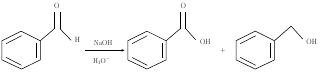
Identify the following reaction

  1. AOption (a)

    Wurtz reaction

  2. BOption (b)

    Stephen reaction

  3. COption (c)

    Cannizzaro reaction

  4. DOption (d)

    Sandmeyer's reaction

View answer & explanation

Correct answer

Answer: (c)C.

Cannizzaro reaction

Why this answer is correct

CONCEPT:

Cannizzaro Reaction

  • The Cannizzaro reaction is a chemical reaction that involves the base-induced disproportionation of an aldehyde lacking an alpha hydrogen atom.
  • In this reaction, one molecule of the aldehyde is reduced to the corresponding alcohol, while another molecule is oxidized to the corresponding carboxylic acid.

EXPLANATION:

  • In the given reaction:

2 R-CHO + NaOH → R-CH2OH + R-COONa

    • In the presence of a strong base like NaOH, two molecules of the aldehyde react.
  • One aldehyde molecule is reduced to the corresponding alcohol (R-CH2OH).
  • The other aldehyde molecule is oxidized to the corresponding carboxylate ion (R-COONa).

Therefore, the given reaction is an example of the Cannizzaro reaction.