Search Previous Year Questions

Find real questions from previous competitive exam papers with answers and solutions.

Showing 10 question(s)
Clear

Question 231

AIIMS BSc Nursing 2023• Chemistry

Find molarity of 10 g NaOH in 200 ml of water.

  1. AOption (a)

    2.50 M

  2. BOption (b)

    1.25 M

  3. COption (c)

    1 M

  4. DOption (d)

    3 M

View answer & explanation

Correct answer

Answer: (b)B.

1.25 M

Why this answer is correct

CONCEPT:

Molarity (M)

  • Molarity is a measure of the concentration of a solute in a solution, or of any chemical species in terms of amount of substance in a given volume. It is defined as the number of moles of solute divided by the volume of the solution in liters.
  • The formula for molarity is:

M = moles of soluteliters of solutionmoles of soluteliters of solutionmoles of soluteliters of solution

EXPLANATION:

  • First, calculate the moles of NaOH:
  • Molecular weight of NaOH = 23 (Na) + 16 (O) + 1 (H) = 40 g/mol
  • Moles of NaOH = massmolecular weightmassmolecular weightmassmolecular weight
  • = 10 g40 g/mol10 g40 g/mol10 g40 g/mol
  • = 0.25 mol
  • Next, convert the volume of the solution from milliliters to liters:
  • Volume = 200 ml = 200/1000 = 0.2 L
  • Finally, calculate the molarity:
  • M = moles of soluteliters of solutionmoles of soluteliters of solutionmoles of soluteliters of solution
  • = 0.25 mol0.2 L0.25 mol0.2 L0.25 mol0.2 L
  • = 1.25 M

Therefore, the molarity of 10 g NaOH in 200 ml of water is 1.25 M.
Question 232

AIIMS BSc Nursing 2023• Chemistry

What is the order of melting point of group 18 elements?

  1. AOption (a)

    He < Ne < Ar < Kr < Xe

  2. BOption (b)

    He < Ar < Ne < Kr < Xe

  3. COption (c)

    Xe < Kr < Ar < Ne < He

  4. DOption (d)

    ​Xe < Ar < Ne < Kr < He

View answer & explanation

Correct answer

Answer: (a)A.

He < Ne < Ar < Kr < Xe

Why this answer is correct

CONCEPT:

Melting Points of Group 18 Elements

  • Group 18 elements, also known as noble gases, have weak van der Waals forces between their atoms.
  • The melting points of these elements generally increase with an increase in atomic number.
  • This trend is due to the increase in the size of the atoms and the corresponding increase in the strength of van der Waals forces.

EXPLANATION:

  • Considering the noble gases in Group 18:

He, Ne, Ar, Kr, Xe

  • As we move down the group from helium (He) to xenon (Xe):
  • The atomic size increases.
  • The van der Waals forces between the atoms become stronger.
  • As a result, the melting points increase.
  • The order of melting points from lowest to highest is:
  • He < Ne < Ar < Kr < Xe

Therefore, the correct order of melting points of Group 18 elements is: He < Ne < Ar < Kr < Xe.

Question 233

AIIMS BSc Nursing 2023• Chemistry

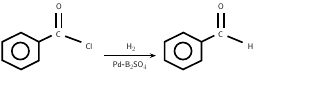
Identify the name of the reaction

  1. AOption (a)

    Rosenmund reduction

  2. BOption (b)

    Cannizzaro reaction 

  3. COption (c)

    Kolbe electrolysis 

  4. DOption (d)

    Stephen reaction

View answer & explanation

Correct answer

Answer: (a)A.

Rosenmund reduction

Why this answer is correct

CONCEPT:

Identification of Organic Reactions

  • In organic chemistry, specific reactions are named after their discoverers or developers. These named reactions often describe a particular type of transformation or chemical process.
  • Understanding the type of reaction allows chemists to predict the products and conditions needed for the reaction.

EXPLANATION:

  • Rosenmund reduction: This reaction involves the reduction of acyl chlorides to aldehydes using hydrogen gas over a palladium-on-barium sulfate (Pd/BaSO4) catalyst.

  • Cannizzaro reaction: This reaction involves the base-induced disproportionation of a non-enolizable aldehyde to yield a primary alcohol and a carboxylic acid.

  • Kolbe electrolysis: This reaction involves the electrochemical decarboxylation of carboxylic acids to form alkanes.

  • Stephen reaction: This reaction involves the reduction of nitriles to imines, which are then hydrolyzed to aldehydes using stannous chloride (SnCl2) and hydrochloric acid (HCl).

Therefore, depending on the context of the reaction being identified, one can refer to the descriptions above to determine the correct name of the reaction.

Question 234

AIIMS BSc Nursing 2023• Chemistry

Which is the first artificial sweetening agent?

  1. AOption (a)

    Aspartame 

  2. BOption (b)

    Sucralose

  3. COption (c)

    Saccharin

  4. DOption (d)

    Alitame

View answer & explanation

Correct answer

Answer: (c)C.

Saccharin

Why this answer is correct

CONCEPT:

Artificial Sweetening Agents

  • Artificial sweeteners are sugar substitutes that provide a sweet taste like that of sugar while containing significantly less food energy.
  • These sweeteners are used in various food and beverage products to reduce calorie content.
  • Some common artificial sweeteners include Aspartame, Sucralose, Saccharin, and Alitame.

EXPLANATION:

  • The first artificial sweetening agent discovered was Saccharin.
  • Saccharin was discovered in 1879 by Constantin Fahlberg, a chemist working on coal tar derivatives at Johns Hopkins University.
  • Its discovery was accidental when Fahlberg noticed a sweet taste on his hands after a day in the laboratory and traced it back to the compound he was working on.

Therefore, the first artificial sweetening agent is Saccharin.

Question 235

AIIMS BSc Nursing 2023• Chemistry

What is the hybridisation of Br in BrF5 and BrF3 respectively?

  1. AOption (a)

    sp2 and sp3d2

  2. BOption (b)

    sp3d2 and sp3d

  3. COption (c)

    sp3 and d2sp3

  4. DOption (d)

    sp3d2 and d2 sp3

View answer & explanation

Correct answer

Answer: (b)B.

sp3d2 and sp3d

Why this answer is correct

CONCEPT:

Hybridization

  • Hybridization is the concept of mixing atomic orbitals to form new hybrid orbitals suitable for the pairing of electrons to form chemical bonds in valence bond theory.
  • The type of hybridization can be determined by the steric number, which is the sum of the number of atoms bonded to the central atom and the number of lone pairs on the central atom.

EXPLANATION:

  • For BrF5:

  • The central atom, Br, is bonded to 5 F atoms and has 1 lone pair of electrons.

  • The steric number = 5 (bonded atoms) + 1 (lone pair) = 6.

  • Hybridization with a steric number of 6 is sp3d2.

  • For BrF3:

  • The central atom, Br, is bonded to 3 F atoms and has 2 lone pairs of electrons.

  • The steric number = 3 (bonded atoms) + 2 (lone pairs) = 5.

  • Hybridization with a steric number of 5 is sp3d.

Therefore, the hybridization of Br in BrF5 and BrF3 is sp3d2 and sp3d respectively.

Question 236

AIIMS BSc Nursing 2023• Chemistry

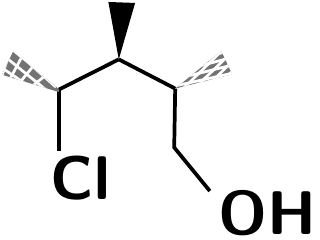
The IUPAC nomenclature of the following compound

  1. AOption (a)

    2-Chloro-3,4-dimethyl Penton-1-ol.

  2. BOption (b)

    4-Chloro-2,3-dimethyl Penton-1-ol

  3. COption (c)

    4-Chloro-2,3,4-trimethylbutanol.

  4. DOption (d)

    None of these

View answer & explanation

Correct answer

Answer: (b)B.

4-Chloro-2,3-dimethyl Penton-1-ol

Why this answer is correct

CONCEPT:

IUPAC Nomenclature of Organic Compounds

  • The IUPAC nomenclature system is used to assign systematic names to organic compounds based on their structure, functional groups, and the number of carbon atoms in the longest chain.
  • The process involves identifying the longest continuous carbon chain that contains the functional group (in this case, the hydroxyl group, -OH), numbering the chain such that the functional group receives the lowest possible number, and then naming the substituents and their positions on the chain.
  • When multiple substituents are present, they are listed alphabetically in the name.

EXPLANATION:

  • The given compound contains a hydroxyl group (-OH) and a chlorine atom (Cl), as well as two methyl groups attached to a pentane chain.
  • The longest chain in the compound contains 5 carbon atoms, so it is based on pentane.
  • Starting from the left, we give the hydroxyl group the lowest possible number (position 1), and the chlorine atom is attached to carbon 2. The methyl groups are located at carbon 3 and carbon 4.
  • The correct IUPAC name for this compound is 4-Chloro-3,4-dimethylpentan-1-ol, based on the positions of the substituents and the functional group.

Thus, the correct answer is: 4-Chloro-3,4-dimethylpentan-1-ol.

Question 237

AIIMS BSc Nursing 2023• Chemistry

\(\mathrm{CH}{3} \mathrm{CH}{2} \mathrm{CH}_{2} \mathrm{COONa} \xrightarrow[\Delta]{\text { soda lime }}\)

  1. AOption (a)

    CH3 CH2 CH2 CH3

  2. BOption (b)

    CH3 CH2 CH3

  3. COption (c)

    CH3-CH3

  4. DOption (d)

    CH3CH2CH2COOH

View answer & explanation

Correct answer

Answer: (b)B.

CH3 CH2 CH3

Why this answer is correct

CONCEPT:

Decarboxylation Reaction

  • Decarboxylation is a chemical reaction that removes a carboxyl group and releases carbon dioxide (CO2). Usually, decarboxylation refers to a reaction of carboxylic acids, removing a carbon atom from a carbon chain.
  • When a carboxylic acid is heated in the presence of soda lime (a mixture of sodium hydroxide (NaOH) and calcium oxide (CaO)), the carboxyl group (-COOH) is removed as carbon dioxide (CO2), and the remaining alkyl chain forms a hydrocarbon.

EXPLANATION:

  • In the given reaction:

CH3CH2CH2COONa → CH3CH2CH3 + CO2 (in the presence of soda lime and heat)

  • The compound CH3CH2CH2COONa (sodium butanoate) undergoes decarboxylation.
  • During the decarboxylation reaction, the -COONa group is removed and replaced by a hydrogen atom.
  • The product formed is propane (CH3CH2CH3).

Therefore, the correct answer is CH3CH2CH3.

Question 238

AIIMS BSc Nursing 2023• Chemistry

The number of lone pair on central atom in BrF5 and SF4 are:

  1. AOption (a)

    1 and 1

  2. BOption (b)

    1 and 2

  3. COption (c)

    2 and 1 

  4. DOption (d)

    2 and 2

View answer & explanation

Correct answer

Answer: (a)A.

1 and 1

Why this answer is correct

CONCEPT:

Lone Pairs on Central Atom

  • The number of lone pairs on the central atom in a molecule can be determined using the valence shell electron pair repulsion (VSEPR) theory.
  • Lone pairs are non-bonding pairs of electrons that are found on the central atom.
  • To determine the number of lone pairs, we need to know the total number of valence electrons around the central atom and how many of these are used for bonding with other atoms.

EXPLANATION:

  • For BrF5:

  • Bromine (Br) has 7 valence electrons.

  • Fluorine (F) has 7 valence electrons and there are 5 fluorine atoms.

  • In BrF5, bromine forms 5 single bonds with 5 fluorine atoms.

  • Each single bond uses 1 pair of electrons, so 5 bonds use 5 pairs (10 electrons).

  • Therefore, bromine has 7 - 5 = 2 electrons (or 1 pair) left as lone pairs.

  • For SF4:

  • Sulfur (S) has 6 valence electrons.

  • Fluorine (F) has 7 valence electrons and there are 4 fluorine atoms.

  • In SF4, sulfur forms 4 single bonds with 4 fluorine atoms.

  • Each single bond uses 1 pair of electrons, so 4 bonds use 4 pairs (8 electrons).

  • Therefore, sulfur has 6 - 4 = 2 electrons (or 1 pair) left as lone pairs.

Therefore, the number of lone pairs on the central atom in BrF5 and SF4 are 1 and 1, respectively.

Question 239

AIIMS BSc Nursing 2023• Chemistry

Which of the following is not a property of chemisorption? 

  1. AOption (a)

    Highly specific

  2. BOption (b)

    High enthalpy of adsorption

  3. COption (c)

    Irreversible

  4. DOption (d)

    Lack of specificity

View answer & explanation

Correct answer

Answer: (d)D.

Lack of specificity

Why this answer is correct

CONCEPT:

Chemisorption

  • Chemisorption, or chemical adsorption, involves the formation of a chemical bond between the adsorbate and the surface of the adsorbent.
  • This type of adsorption is typically highly specific to the adsorbate and adsorbent involved.
  • Chemisorption usually has a high enthalpy of adsorption due to the chemical bond formation.
  • It is generally irreversible because the process involves breaking and forming of chemical bonds.

EXPLANATION:

  • We know that chemisorption involves specific interactions between the adsorbate and the surface, which means it is highly specific.
  • It also has a high enthalpy of adsorption due to the formation of strong chemical bonds.
  • Additionally, chemisorption is generally irreversible because breaking these bonds requires significant energy.
  • Therefore, the statement "Lack of specificity" does not describe chemisorption.

Therefore, the correct answer is Lack of specificity.

Question 240

AIIMS BSc Nursing 2023• Chemistry

Which of the following is not an isotope of hydrogen? 

  1. AOption (a)

    Protium 

  2. BOption (b)

    Dubnium 

  3. COption (c)

    Deutrium 

  4. DOption (d)

    Tritium

View answer & explanation

Correct answer

Answer: (b)B.

Dubnium 

Why this answer is correct

EXPLANATION:

Isotopes of Hydrogen

  • Isotopes are variants of a particular chemical element which differ in neutron number, and consequently in nucleon number.
  • Hydrogen has three main isotopes:
  • Protium (1H): It has 1 proton and 0 neutrons.
  • Deuterium (2H or D): It has 1 proton and 1 neutron.
  • Tritium (3H or T): It has 1 proton and 2 neutrons.
  • Among these, the correct answer is:
  • Dubnium (2): It is not an isotope of hydrogen.
  • Dubnium is a chemical element with the symbol Db and atomic number 105, which is entirely different from hydrogen.

Therefore, Dubnium is not an isotope of hydrogen.