SBI Probationary Officer (PO) Β· Topic Collection

Quantitative Aptitude PYQs

Arithmetic, number systems, percentages, ratios, profit and loss, time and work, algebra, geometry, mensuration, and trigonometry.

1345 Total Questions41 Official PapersYears: 2018–2025Search in Quantitative Aptitude
Showing questions 81–100 of 1345Page 5 of 68
SBI PO Prelims Memory Based Paper (Held On: 4 August 2025 Shift 3) (Previous Year Paper)Β·Quantitative Aptitude
View full paper

Question 81

SBI Probationary Officer (PO) 2025β€’ Quantitative Aptitudeβ€’ Quantitative Aptitude

Read the data carefully and answer the following questions.

The table given below shows the number of articles printed by three printers on four different days.

DaysPrinter APrinter BPrinter C
Monday360480300
TuesdayX + 40Y βˆ’ X180
Wednesday420360360
Thursday600420Y

Β 

Note:

(i) The ratio of the total number of articles printed by Printer A to that by Printer C on Monday and Thursday together is 8: 5.

(ii) The average number of articles printed by Printer B on Tuesday and Wednesday together is 300.

If the number of articles printed by printer D on Wednesday is 'X + Y', then find the difference between the number of articles printed by printer C and D on Wednesday.

  1. AOption (a)

    60

  2. BOption (b)

    0

  3. COption (c)

    120

  4. DOption (d)

    40

  5. EOption (e)

    30

View answer & explanation

Correct answer

Answer: (b)B.

0

Why this answer is correct

From the given data:

Total A on Monday and Thursday = 360 + 600 = 960

Total C on Monday and Thursday = 300 + Y

ATQ,

960 Γ· (300 + Y) = (8/5)

300 + Y = (960 Γ— 5) Γ· 8

300 + Y = 600

Y = 300

Total B on Tuesday and Wednesday = 300 Γ— 2 = 600

(Y βˆ’ X) + 360 = 600

300 βˆ’ X + 360 = 600

660 βˆ’ X = 600

X = 60

Using X = 60 and Y = 300:

Printer D on Wednesday = X + Y = 60 + 300 = 360

Printer C on Wednesday = 360

Required Difference = 360 βˆ’ 360 = 0

SBI PO Prelims Memory Based Paper (Held On: 4 August 2025 Shift 3) (Previous Year Paper)Β·Quantitative Aptitude
View full paper

Question 82

SBI Probationary Officer (PO) 2025β€’ Quantitative Aptitudeβ€’ Quantitative Aptitude

In 2017, Ashish, Rajnish and Manish had salaries in the ratio (7/10) :(5/6) :(4/5) . In 2018, their salaries increased by 7000, 5000 and 8000 respectively. The ratio of the salaries of Ashish, Rajnish and Manish in 2018 is 7:8:8. What was the salary of Manish in 2017?

  1. AOption (a)

    48000

  2. BOption (b)

    60000

  3. COption (c)

    72000

  4. DOption (d)

    80000

  5. EOption (e)

    Cannot be determined

View answer & explanation

Correct answer

Answer: (c)C.

72000

Why this answer is correct

Ratio in 2017 = (7/10) :(5/6) ):(4/5) = 21:25:24

Let their salaries in 2017 be 21x, 25x, and 24x respectively.

In 2018: (21x + 7000) :(25x + 5000) :(24x + 8000) = 7:8:8

So, (21x + 7000) /(25x + 5000) = (7/8)

Or, 8 X (21x + 7000) = 7 X (25x + 5000)

Or, 168x + 56000 = 175x + 35000

Or, 7x = 21000

Or, x = 3000

Salary of Manish in 2017 = 24x = 24Β Γ—Β 3000 = 72000

SBI PO Prelims Memory Based Paper (Held On: 4 August 2025 Shift 3) (Previous Year Paper)Β·Quantitative Aptitude
View full paper

Question 83

SBI Probationary Officer (PO) 2025β€’ Quantitative Aptitudeβ€’ Quantitative Aptitude

Read the data carefully and answer the following questions.

The table given below shows the number of articles printed by three printers on four different days.

DaysPrinter APrinter BPrinter C
Monday360480300
TuesdayX + 40Y βˆ’ X180
Wednesday420360360
Thursday600420Y

Β 

Note:

(i) The ratio of the total number of articles printed by Printer A to that by Printer C on Monday and Thursday together is 8: 5.

(ii) The average number of articles printed by Printer B on Tuesday and Wednesday together is 300.

Number of articles printed by printer C on Monday is what percentage of the number of articles printed by printer A on Wednesday?

  1. AOption (a)

    70%

  2. BOption (b)

    75%

  3. COption (c)

    71(3/7)%

  4. DOption (d)

    72.5%

  5. EOption (e)

    80%

View answer & explanation

Correct answer

Answer: (c)C.

71(3/7)%

Why this answer is correct

From the given data:

Total A on Monday and Thursday = 360 + 600 = 960

Total C on Monday and Thursday = 300 + Y

ATQ,

960 Γ· (300 + Y) = (8/5)

300 + Y = (960 Γ— 5) Γ· 8

300 + Y = 600

Y = 300

Total B on Tuesday and Wednesday = 300 Γ— 2 = 600

(Y βˆ’ X) + 360 = 600

300 βˆ’ X + 360 = 600

660 βˆ’ X = 600

X = 60

Using X = 60 and Y = 300:

Printer A on Tuesday = X + 40 = 60 + 40 = 100

Printer B on Tuesday = Y βˆ’ X = 300 βˆ’ 60 = 240

Printer C on Thursday = Y = 300

Calculation:

From the given data:

Number of articles printed by Printer C on Monday = 300

Number of articles printed by Printer A on Wednesday = 420

Required percent = (300/420) x 100 = 71.43%

SBI PO Prelims Memory Based Paper (Held On: 4 August 2025 Shift 3) (Previous Year Paper)Β·Quantitative Aptitude
View full paper

Question 84

SBI Probationary Officer (PO) 2025β€’ Quantitative Aptitudeβ€’ Quantitative Aptitude

Read the data carefully and answer the following questions.

The table given below shows the number of articles printed by three printers on four different days.

DaysPrinter APrinter BPrinter C
Monday360480300
TuesdayX + 40Y βˆ’ X180
Wednesday420360360
Thursday600420Y

Β 

Note:

(i) The ratio of the total number of articles printed by Printer A to that by Printer C on Monday and Thursday together is 8: 5.

(ii) The average number of articles printed by Printer B on Tuesday and Wednesday together is 300.

What is the ratio of the number of articles printed by printer B and C on Thursday respectively?Β 

  1. AOption (a)

    5:7

  2. BOption (b)

    6:5

  3. COption (c)

    3:2

  4. DOption (d)

    7:5

  5. EOption (e)

    8:5

View answer & explanation

Correct answer

Answer: (d)D.

7:5

Why this answer is correct

From the given data:

Total A on Monday and Thursday = 360 + 600 = 960

Total C on Monday and Thursday = 300 + Y

ATQ,

960 Γ· (300 + Y) = (8/5)

300 + Y = (960 Γ— 5) Γ· 8

300 + Y = 600

Y = 300

Using Y = 300:

Printer B on Thursday = 420

Printer C on Thursday = 300

Required ratio = 420: 300 = 7: 5

SBI PO Prelims Memory Based Paper (Held On: 4 August 2025 Shift 3) (Previous Year Paper)Β·Quantitative Aptitude
View full paper

Question 85

SBI Probationary Officer (PO) 2025β€’ Quantitative Aptitudeβ€’ Quantitative Aptitude

Read the data carefully and answer the following questions.

The table given below shows the number of articles printed by three printers on four different days.

DaysPrinter APrinter BPrinter C
Monday360480300
TuesdayX + 40Y βˆ’ X180
Wednesday420360360
Thursday600420Y

Β 

Note:

(i) The ratio of the total number of articles printed by Printer A to that by Printer C on Monday and Thursday together is 8: 5.

(ii) The average number of articles printed by Printer B on Tuesday and Wednesday together is 300.

If the sum of the number of articles printed by printer A on Thursday and Friday together is 1120, then find the number of articles printed by printer A on Friday.

  1. AOption (a)

    480

  2. BOption (b)

    520

  3. COption (c)

    560

  4. DOption (d)

    500

  5. EOption (e)

    540

View answer & explanation

Correct answer

Answer: (b)B.

520

Why this answer is correct

From the given data:

Number of articles printed by Printer A on Thursday = 600

Sum of the number of articles printed by Printer A on Thursday and Friday together = 1120

ATQ,

Thursday + Friday = 1120

600 + Friday = 1120

Friday = 1120 βˆ’ 600

Friday = 520

SBI PO Prelims Memory Based Paper (Held On: 4 August 2025 Shift 3) (Previous Year Paper)Β·Quantitative Aptitude
View full paper

Question 86

SBI Probationary Officer (PO) 2025β€’ Quantitative Aptitudeβ€’ Quantitative Aptitude

The question consists of two statements numbered I and II given below it. You have to decide whether the data provided in the statements are sufficient to answer the question.

What is the ratio of Milk to Water in the final mixture?

Statement I. Initially the ratio of Milk to Water is 7 : 5 and when 'x' litres of Milk and '2x' litres of Water are added, then the amount of Water becomes 12 litres more than the amount of Milk.

Statement II. Initially the difference between the amount of Milk and Water in the mixture is 8 litres.

  1. AOption (a)

    The data in statement I alone are sufficient to answer the question, while the data in statement II alone is not sufficient to answer the question.

  2. BOption (b)

    The data in statement II alone are sufficient to answer the question, while the data in statement I alone is not sufficient to answer the question.

  3. COption (c)

    The data either in statement I alone or in statement II alone is sufficient to answer the question.

  4. DOption (d)

    The data given in both statements I and II together is not sufficient to answer the question.

  5. EOption (e)

    The data in both statements I and II together is necessary to answer the question.

View answer & explanation

Correct answer

Answer: (e)E.

The data in both statements I and II together is necessary to answer the question.

Why this answer is correct

From I:

Initial Milk = 7y, Initial Water = 5y

Final Milk = 7y + x, Final Water = 5y + 2x

(5y + 2x) – (7y + x) = 12

So, x – 2y = 12

Values cannot be determined from I alone.

From II:

Initial Milk - Initial Water = 8

7y – 5y = 8

2y = 8

So, y = 4

Value of x cannot be determined from II alone.

On combining statements I and II:

x – 2(4) = 12

so, x = 20

Final Milk = 7 x 4 + 20 = 48

Final Water = 5 x 4 + 2 x 20 = 60

Required ratio = 48:60 = 4:5

Hence, option E.

SBI PO Prelims Memory Based Paper (Held On: 4 August 2025 Shift 3) (Previous Year Paper)Β·Quantitative Aptitude
View full paper

Question 87

SBI Probationary Officer (PO) 2025β€’ Quantitative Aptitudeβ€’ Quantitative Aptitude

The question consists of two statements numbered I and II given below it. You have to decide whether the data provided in the statements are sufficient to answer the question.

What is the total distance covered by the boat in 3 hours while moving upstream?

Statement I: Time taken by the boat to cover 80 km while floating along the stream is 6 times the time taken by the boat to cover 40 km in downstream.

Statement II: Time taken by the boat to cover 240 km in downstream is 3 hours.

  1. AOption (a)

    The data in statement I alone are sufficient to answer the question, while the data in statement II alone is not sufficient to answer the question.

  2. BOption (b)

    The data in statement II alone are sufficient to answer the question, while the data in statement I alone is not sufficient to answer the question.

  3. COption (c)

    The data either in statement I alone or in statement II alone is sufficient to answer the question.

  4. DOption (d)

    The data given in both statements I and II together is not sufficient to answer the question.

  5. EOption (e)

    The data in both statements I and II together is necessary to answer the question.

View answer & explanation

Correct answer

Answer: (e)E.

The data in both statements I and II together is necessary to answer the question.

Why this answer is correct

From I:

Speed while floating = Speed of stream (S)

Speed downstream = D

(80/S) = 6 x (40/D)

Or, (80/S) = (240/D)

Or, D = 3S

Or, V + S = 3S

Or, V = 2S

Upstream speed U = V - S = S

From II:

D = (240/3) = 80 km/h

On combining I and II:

3S = 80

Or, S = 80/3 km/h

So, U = 80/3 km/h

So, required distance = (80/3) xΒ 3 = 80 km

Hence, option e.

SBI PO Prelims Memory Based Paper (Held On: 4 August 2025 Shift 3) (Previous Year Paper)Β·Quantitative Aptitude
View full paper

Question 88

SBI Probationary Officer (PO) 2025β€’ Quantitative Aptitudeβ€’ Quantitative Aptitude

Three taps A, B and C can fill a tank in 6 hr, 9 hr and 18 hr respectively. After (1/3)rd of the tank is filled, tap C is closed. Rest of the tank is filled by A and B together. Total time taken to fill the tank is?

  1. AOption (a)

    3(2/5) hours

  2. BOption (b)

    3 hours

  3. COption (c)

    2(2/5) hours

  4. DOption (d)

    4 hours

  5. EOption (e)

    2 hours

View answer & explanation

Correct answer

Answer: (a)A.

3(2/5) hours

Why this answer is correct

Let total capacity of tank = LCM (6, 9, 18) = 18 units.

Efficiency of A = 3 units/hr

Efficiency of B = 2 units/hr

Efficiency of C = 1 unit/hr

Total efficiency = 3 + 2 + 1 = 6 units/hr

1/3rd of the tank = 18 x 1/3 = 6 units

Time taken to fill 6 units by A, B and C = 6/6 = 1 hr

Remaining tank = 18 – 6 = 12 units

Time taken by A and B to fill remaining tank = 12 Γ· (3 + 2) = 12/5 = 2(2/5) hours

Total time taken = 1 + 2(2/5) = 3(2/5) hour

SBI PO Prelims Memory Based Paper (Held On: 4 August 2025 Shift 3) (Previous Year Paper)Β·Quantitative Aptitude
View full paper

Question 89

SBI Probationary Officer (PO) 2025β€’ Quantitative Aptitudeβ€’ Quantitative Aptitude

Ram sold a dining table at a loss of 8%. In order to earn a profit of 4%, he has to sell the table for Rs. 360 more than the previous selling price. What is the cost price of the table?

  1. AOption (a)

    Rs. 3000

  2. BOption (b)

    Rs. 2800

  3. COption (c)

    Rs. 3200

  4. DOption (d)

    Rs. 2900

  5. EOption (e)

    Rs. 3100

View answer & explanation

Correct answer

Answer: (a)A.

Rs. 3000

Why this answer is correct

Let cost price be Rs. x

Selling price at 8% loss = 0.92x

Selling price at 4% profit = 1.04x

ATQ,

1.04x – 0.92x = 360

0.12x = 360

So, x = 360/0.12 = 3000

SBI PO Prelims Memory Based Paper (Held On: 4 August 2025 Shift 3) (Previous Year Paper)Β·Quantitative Aptitude
View full paper

Question 90

SBI Probationary Officer (PO) 2025β€’ Quantitative Aptitudeβ€’ Quantitative Aptitude

Ramesh alone started a business with an investment of Rs. 12,000 and after 6 months, Mohit joined him with an investment of Rs. 16,000. If at the end of 18 months from the start, the difference between the profit shares of Ramesh and Mohit is Rs. 3,000, then what is the total profit from the business?

  1. AOption (a)

    Rs. 39,000

  2. BOption (b)

    Rs. 45,000

  3. COption (c)

    Rs. 42,000

  4. DOption (d)

    Rs. 48,000

  5. EOption (e)

    Rs. 51,000

View answer & explanation

Correct answer

Answer: (e)E.

Rs. 51,000

Why this answer is correct

Profit share ratio of Ramesh to Mohit = (12000 Γ— 18) : (16000 Γ— 12)

= (12 Γ— 18) : (16 Γ— 12) = 18 : 16 = 9 : 8

Let the profits of Ramesh and Mohit be 9x and 8x, respectively.

So, 9x βˆ’ 8x = 3000

Or, x = 3000

Total profit = 9x + 8x = 17x

So, required total profit = 17 Γ— 3000 = Rs. 51,000

SBI PO Prelims Memory Based Paper (Held On: 4 August 2025 Shift 1) (Previous Year Paper)Β·Quantitative Aptitude
View full paper

Question 91

SBI Probationary Officer (PO) 2025β€’ Quantitative Aptitudeβ€’ Quantitative Aptitude

Directions: Study the following information carefully and answer the questions.

A survey was conducted among 100 people to analyze their preferences for three beverages: Coffee (C), Milk (M), and Tea (T). The number of people who like only Tea is 10. The number of people who like all three beverages is 16. The number of people who like only Coffee is 20% more than those who like only Tea. The number of people who like only Milk is equal to the number who like both Coffee and Tea but not Milk. The number of people who like both Milk and Tea but not Coffee is half of those who like both Coffee and Milk but not Tea, which is 24.

If each person who likes exactly one beverage pays β‚Ή15, those who like exactly two pay β‚Ή25, and those who like all three pay β‚Ή35, what is the total collection?

  1. AOption (a)

    β‚Ή2370

  2. BOption (b)

    β‚Ή2450

  3. COption (c)

    β‚Ή2310

  4. DOption (d)

    β‚Ή2630

  5. EOption (e)

    None of these

View answer & explanation

Correct answer

Answer: (c)C.

β‚Ή2310

Why this answer is correct

General Solution:

Let’s define the following sets:

  • Only C (Coffee)Β = A
  • Only M (Milk)Β = B
  • Only T (Tea)Β = C
  • C ∩ M only (not T)Β = D
  • C ∩ T only (not M)Β = E
  • M ∩ T only (not C)Β = F
  • C ∩ M ∩ T (all three)Β = G

We are given:

  1. Only Tea (C)Β = 10

β‡’ C = 10
2. All three (G)Β = 16 3. Only Coffee (A)Β = 20% more than only Tea

β‡’ A = 10 + 20% of 10 = 10 + 2 =Β 12
4. Only Milk (B) = C ∩ T only (not M) = E

β‡’ B = E
5. M ∩ T only (F) = Half of C ∩ M only (D)

β‡’ F = Β½ Γ— D

And D = 24

β‡’ F = 12

So far we have:

  • A = 12
  • B = E (unknown)
  • C = 10
  • D = 24
  • E = B
  • F = 12
  • G = 16

Now, total number of people = 100

Sum of all individual segments of the Venn diagram =

A + B + C + D + E + F + G

= 12 + B + 10 + 24 + B + 12 + 16

= (12 + 10 + 24 + 12 + 16) + 2B = 74 + 2B

Set that equal to total surveyed:

74 + 2B = 100

β‡’ 2B = 26

β‡’Β B = 13

Then E = 13

Thus,

RegionCount
Only Coffee (A)12
Only Milk (B)13
Only Tea (C)10
Coffee ∩ Milk only (D)24
Coffee ∩ Tea only (E)13
Milk ∩ Tea only (F)12
All three (C ∩ M ∩ T) (G)16
Total100

Β 

Calculations:

Only one = 12 + 13Β + 10 = 35Β people β†’ β‚Ή15 Γ— 35Β = β‚Ή525

Exactly two = 24 + 13Β + 12 = 49Β people β†’ β‚Ή25 Γ— 49Β = β‚Ή1225

All three = 16 people β†’ β‚Ή35 Γ— 16 = β‚Ή560

Total = 525 + 1225 + 560 = β‚Ή2310

Hence, the correct answer isΒ β‚Ή2310.

SBI PO Prelims Memory Based Paper (Held On: 4 August 2025 Shift 1) (Previous Year Paper)Β·Quantitative Aptitude
View full paper

Question 92

SBI Probationary Officer (PO) 2025β€’ Quantitative Aptitudeβ€’ Quantitative Aptitude

Directions: Study the following information carefully and answer the questions.

A survey was conducted among 100 people to analyze their preferences for three beverages: Coffee (C), Milk (M), and Tea (T). The number of people who like only Tea is 10. The number of people who like all three beverages is 16. The number of people who like only Coffee is 20% more than those who like only Tea. The number of people who like only Milk is equal to the number who like both Coffee and Tea but not Milk. The number of people who like both Milk and Tea but not Coffee is half of those who like both Coffee and Milk but not Tea, which is 24.

What is the percentage of people who like Tea?

  1. AOption (a)

    51%

  2. BOption (b)

    60%

  3. COption (c)

    66%

  4. DOption (d)

    70%

  5. EOption (e)

    None of these

View answer & explanation

Correct answer

Answer: (a)A.

51%

Why this answer is correct

General Solution:

Let’s define the following sets:

  • Only C (Coffee)Β = A
  • Only M (Milk)Β = B
  • Only T (Tea)Β = C
  • C ∩ M only (not T)Β = D
  • C ∩ T only (not M)Β = E
  • M ∩ T only (not C)Β = F
  • C ∩ M ∩ T (all three)Β = G

We are given:

  1. Only Tea (C)Β = 10

β‡’ C = 10
2. All three (G)Β = 16 3. Only Coffee (A)Β = 20% more than only Tea

β‡’ A = 10 + 20% of 10 = 10 + 2 =Β 12
4. Only Milk (B) = C ∩ T only (not M) = E

β‡’ B = E
5. M ∩ T only (F) = Half of C ∩ M only (D)

β‡’ F = Β½ Γ— D

And D = 24

β‡’ F = 12

So far we have:

  • A = 12
  • B = E (unknown)
  • C = 10
  • D = 24
  • E = B
  • F = 12
  • G = 16

Now, total number of people = 100

Sum of all individual segments of the Venn diagram =

A + B + C + D + E + F + G

= 12 + B + 10 + 24 + B + 12 + 16

= (12 + 10 + 24 + 12 + 16) + 2B = 74 + 2B

Set that equal to total surveyed:

74 + 2B = 100

β‡’ 2B = 26

β‡’Β B = 13

Then E = 13

Thus,

RegionCount
Only Coffee (A)12
Only Milk (B)13
Only Tea (C)10
Coffee ∩ Milk only (D)24
Coffee ∩ Tea only (E)13
Milk ∩ Tea only (F)12
All three (C ∩ M ∩ T) (G)16
Total100

Β 

Calculations:

People who like Tea =

Only Tea = 10

Tea & Coffee only = 13

Tea & Milk only = 12

All three = 16

Total = 10 + 13Β + 12 + 16 = 51

Percentage = (51Β / 100) Γ— 100 = 51%

Hence, the correct answer is 51%.

SBI PO Prelims Memory Based Paper (Held On: 4 August 2025 Shift 1) (Previous Year Paper)Β·Quantitative Aptitude
View full paper

Question 93

SBI Probationary Officer (PO) 2025β€’ Quantitative Aptitudeβ€’ Quantitative Aptitude

Directions: Study the following information carefully and answer the questions.

A survey was conducted among 100 people to analyze their preferences for three beverages: Coffee (C), Milk (M), and Tea (T). The number of people who like only Tea is 10. The number of people who like all three beverages is 16. The number of people who like only Coffee is 20% more than those who like only Tea. The number of people who like only Milk is equal to the number who like both Coffee and Tea but not Milk. The number of people who like both Milk and Tea but not Coffee is half of those who like both Coffee and Milk but not Tea, which is 24.

The number of people who likeΒ at most two beveragesΒ is what percentage of the total respondents?

  1. AOption (a)

    92%

  2. BOption (b)

    83%

  3. COption (c)

    84%

  4. DOption (d)

    85%

  5. EOption (e)

    None of these

View answer & explanation

Correct answer

Answer: (c)C.

84%

Why this answer is correct

General Solution:

Let’s define the following sets:

  • Only C (Coffee) = A
  • Only M (Milk) = B
  • Only T (Tea) = C
  • C ∩ M only (not T) = D
  • C ∩ T only (not M) = E
  • M ∩ T only (not C) = F
  • C ∩ M ∩ T (all three) = G

We are given:

  1. Only Tea (C) = 10

β‡’ C = 10
2. All three (G) = 16 3. Only Coffee (A) = 20% more than only Tea

β‡’ A = 10 + 20% of 10 = 10 + 2 = 12
4. Only Milk (B) = C ∩ T only (not M) = E

β‡’ B = E
5. M ∩ T only (F) = Half of C ∩ M only (D)

β‡’ F = Β½ Γ— D

And D = 24

β‡’ F = 12

So far we have:

  • A = 12
  • B = E (unknown)
  • C = 10
  • D = 24
  • E = B
  • F = 12
  • G = 16

Now, total number of people = 100

Sum of all individual segments of the Venn diagram =

A + B + C + D + E + F + G

= 12 + B + 10 + 24 + B + 12 + 16

= (12 + 10 + 24 + 12 + 16) + 2B = 74 + 2B

Set that equal to total surveyed:

74 + 2B = 100

β‡’ 2B = 26

β‡’ B = 13

Then E = 13

Thus,

RegionCount
Only Coffee (A)12
Only Milk (B)13
Only Tea (C)10
Coffee ∩ Milk only (D)24
Coffee ∩ Tea only (E)13
Milk ∩ Tea only (F)12
All three (C ∩ M ∩ T) (G)16
Total100

Β 

Calculations:

Total respondents = 100

We are to find how many people like at most two beverages, i.e., not all three.

From the previous data:

People who like all three beverages = 16

So, people who like at most two beverages = 100 – 16 = 84

Required % = (84 / 100) Γ— 100 = 84%

Hence, the correct answer is 84%.

SBI PO Prelims Memory Based Paper (Held On: 4 August 2025 Shift 1) (Previous Year Paper)Β·Quantitative Aptitude
View full paper

Question 94

SBI Probationary Officer (PO) 2025β€’ Quantitative Aptitudeβ€’ Quantitative Aptitude

Directions: Study the following information carefully and answer the questions.

A survey was conducted among 100 people to analyze their preferences for three beverages: Coffee (C), Milk (M), and Tea (T). The number of people who like only Tea is 10. The number of people who like all three beverages is 16. The number of people who like only Coffee is 20% more than those who like only Tea. The number of people who like only Milk is equal to the number who like both Coffee and Tea but not Milk. The number of people who like both Milk and Tea but not Coffee is half of those who like both Coffee and Milk but not Tea, which is 24.

Find the ratio of people who like only Coffee and only Milk to those who like both Milk and Tea but not Coffee.

  1. AOption (a)

    35:33

  2. BOption (b)

    34:31

  3. COption (c)

    17:12

  4. DOption (d)

    25:12

  5. EOption (e)

    25:22

View answer & explanation

Correct answer

Answer: (d)D.

25:12

Why this answer is correct

General Solution:

Let’s define the following sets:

  • Only C (Coffee)Β = A
  • Only M (Milk)Β = B
  • Only T (Tea)Β = C
  • C ∩ M only (not T)Β = D
  • C ∩ T only (not M)Β = E
  • M ∩ T only (not C)Β = F
  • C ∩ M ∩ T (all three)Β = G

We are given:

  1. Only Tea (C)Β = 10

β‡’ C = 10
2. All three (G)Β = 16 3. Only Coffee (A)Β = 20% more than only Tea

β‡’ A = 10 + 20% of 10 = 10 + 2 =Β 12
4. Only Milk (B) = C ∩ T only (not M) = E

β‡’ B = E
5. M ∩ T only (F) = Half of C ∩ M only (D)

β‡’ F = Β½ Γ— D

And D = 24

β‡’ F = 12

So far we have:

  • A = 12
  • B = E (unknown)
  • C = 10
  • D = 24
  • E = B
  • F = 12
  • G = 16

Now, total number of people = 100

Sum of all individual segments of the Venn diagram =

A + B + C + D + E + F + G

= 12 + B + 10 + 24 + B + 12 + 16

= (12 + 10 + 24 + 12 + 16) + 2B = 74 + 2B

Set that equal to total surveyed:

74 + 2B = 100

β‡’ 2B = 26

β‡’Β B = 13

Then E = 13

Thus,

RegionCount
Only Coffee (A)12
Only Milk (B)13
Only Tea (C)10
Coffee ∩ Milk only (D)24
Coffee ∩ Tea only (E)13
Milk ∩ Tea only (F)12
All three (C ∩ M ∩ T) (G)16
Total100

Β 

Calculations:

We are given:

People who like only Coffee = 12

People who like only Milk = 13

People who like both Milk and Tea but not Coffee = 12

So,

Required Ratio = (Only Coffee + Only Milk) : (Milk ∩ Tea only)

= (12 + 13) : 12

= 25 : 12

Hence, the correct answer is 25:12.

SBI PO Prelims Memory Based Paper (Held On: 4 August 2025 Shift 1) (Previous Year Paper)Β·Quantitative Aptitude
View full paper

Question 95

SBI Probationary Officer (PO) 2025β€’ Quantitative Aptitudeβ€’ Quantitative Aptitude

Directions: Study the following information carefully and answer the questions.

A survey was conducted among 100 people to analyze their preferences for three beverages: Coffee (C), Milk (M), and Tea (T). The number of people who like only Tea is 10. The number of people who like all three beverages is 16. The number of people who like only Coffee is 20% more than those who like only Tea. The number of people who like only Milk is equal to the number who like both Coffee and Tea but not Milk. The number of people who like both Milk and Tea but not Coffee is half of those who like both Coffee and Milk but not Tea, which is 24.

What is the difference between the number of people who like exactly two beverages and those who like only one beverage?

  1. AOption (a)

    14

  2. BOption (b)

    17

  3. COption (c)

    8

  4. DOption (d)

    9

  5. EOption (e)

    16

View answer & explanation

Correct answer

Answer: (a)A.

14

Why this answer is correct

General Solution:

Let’s define the following sets:

  • Only C (Coffee)Β = A
  • Only M (Milk)Β = B
  • Only T (Tea)Β = C
  • C ∩ M only (not T)Β = D
  • C ∩ T only (not M)Β = E
  • M ∩ T only (not C)Β = F
  • C ∩ M ∩ T (all three)Β = G

We are given:

  1. Only Tea (C)Β = 10

β‡’ C = 10
2. All three (G)Β = 16 3. Only Coffee (A)Β = 20% more than only Tea

β‡’ A = 10 + 20% of 10 = 10 + 2 =Β 12
4. Only Milk (B) = C ∩ T only (not M) = E

β‡’ B = E
5. M ∩ T only (F) = Half of C ∩ M only (D)

β‡’ F = Β½ Γ— D

And D = 24

β‡’ F = 12

So far we have:

  • A = 12
  • B = E (unknown)
  • C = 10
  • D = 24
  • E = B
  • F = 12
  • G = 16

Now, total number of people = 100

Sum of all individual segments of the Venn diagram =

A + B + C + D + E + F + G

= 12 + B + 10 + 24 + B + 12 + 16

= (12 + 10 + 24 + 12 + 16) + 2B = 74 + 2B

Set that equal to total surveyed:

74 + 2B = 100

β‡’ 2B = 26

β‡’Β B = 13

Then E = 13

Thus,

RegionCount
Only Coffee (A)12
Only Milk (B)13
Only Tea (C)10
Coffee ∩ Milk only (D)24
Coffee ∩ Tea only (E)13
Milk ∩ Tea only (F)12
All three (C ∩ M ∩ T) (G)16
Total100

Β 

Calculations:

Exactly two beverages = 24 (C∩M) + 13 (C∩T) + 12 (M∩T) = 49

Only one beverage = 12 (C) + 13 (M) + 10 (T) = 35

Difference = 49 – 35 = 14

Hence, the correct answer is 14.

SBI PO Prelims Memory Based Paper (Held On: 4 August 2025 Shift 1) (Previous Year Paper)Β·Quantitative Aptitude
View full paper

Question 96

SBI Probationary Officer (PO) 2025β€’ Quantitative Aptitudeβ€’ Quantitative Aptitude

Mr. Sharma spends 12% of his monthly salary on education and Γ—% on groceries. If the amount spent on education is β‚Ή7,200, and his total monthly eΓ—penditure (including education and groceries) is 60% of his salary, what is the value of Γ—?

  1. AOption (a)

    48%

  2. BOption (b)

    55%

  3. COption (c)

    30%

  4. DOption (d)

    34%

  5. EOption (e)

    None of these

View answer & explanation

Correct answer

Answer: (a)A.

48%

Why this answer is correct

Shortcut Trick

12% of Salary = β‚Ή7,200

β‡’ 1% of Salary = 7200 Γ· 12 = β‚Ή600

Total expenditure (Education + Groceries) = 60% of Salary

β‡’ 12% + x% = 60%

β‡’ x% = 60% βˆ’ 12% = 48%

∴ The correct answer is 48%.

Alternate Method

Given:

Education Expenditure = 12% of Salary = β‚Ή7,200

Total Expenditure = 60% of Salary

Formula:

Total Expenditure = Education % + Groceries %

Calculations:

β‡’ Let Total Salary be S.

β‡’ (12/100) Γ— S = 7200

β‡’ S = (7200 Γ— 100) Γ· 12

β‡’ S = 600 Γ— 100 = β‚Ή60,000

β‡’ Total Expenditure = 60% of 60,000 = 36,000

β‡’ Groceries Expenditure = Total βˆ’ Education

β‡’ Groceries Expenditure = 36,000 βˆ’ 7,200 = β‚Ή28,800

β‡’ x = (28,800 Γ· 60,000) Γ— 100

β‡’ x = 288 Γ· 6 = 48

∴ The correct answer is 48%.

Additional Information

Percentage Change

Percentage change = (Change / Original Value) Γ— 100. Useful for finding growth in salary or expenses.

Savings Calculation

Savings = Total Salary βˆ’ Total Expenditure. In this case, savings would be 40% of the salary.

Base Change Rule

When multiple percentages are calculated on the same base (Total Salary), they can be added or subtracted directly.

SBI PO Prelims Memory Based Paper (Held On: 4 August 2025 Shift 1) (Previous Year Paper)Β·Quantitative Aptitude
View full paper

Question 97

SBI Probationary Officer (PO) 2025β€’ Quantitative Aptitudeβ€’ Quantitative Aptitude

A and B together can complete a piece of work in 2t days. A alone can complete the same work in 5 days, and B alone can complete it in 5t days. In how many days will they complete the work together?

  1. AOption (a)

    1 day

  2. BOption (b)

    2Β days

  3. COption (c)

    3Β days

  4. DOption (d)

    4Β days

  5. EOption (e)

    5Β days

View answer & explanation

Correct answer

Answer: (c)C.

3Β days

Why this answer is correct

Shortcut Trick

For two people A and B, combined time = (Product of times) Γ· (Sum of times).

2t = (5 Γ— 5t) Γ· (5 + 5t)

2 = 25 Γ· (5 + 5t) β‡’ 10 + 10t = 25 β‡’ 10t = 15 β‡’ t = 1.5

Combined time = 2t = 2 Γ— 1.5 = 3 days.

∴ The correct answer is 3 days.

Alternate Method

Given:

Time taken by A = 5 days

Time taken by B = 5t days

Time taken by A + B = 2t days

Formula Used:

1/Ttotal = 1/TA + 1/TB

Calculations:

β‡’ 1/(2t) = 1/5 + 1/(5t)

β‡’ 1/(2t) βˆ’ 1/(5t) = 1/5

β‡’ (5 βˆ’ 2) / (10t) = 1/5

β‡’ 3 / (10t) = 1/5

β‡’ 10t = 15

β‡’ t = 1.5

β‡’ Time taken by A and B together = 2t = 2 Γ— 1.5

β‡’ Time taken = 3 days

∴ The correct answer is 3 days.

Additional Information

Efficiency and Time Relation

Efficiency is inversely proportional to the time taken to complete a work. Efficiency = Total Work Γ· Time.

Pipes and Cisterns

The same logic applies where filling pipes have positive efficiency and leakage/outlet pipes have negative efficiency.

SBI PO Prelims Memory Based Paper (Held On: 4 August 2025 Shift 1) (Previous Year Paper)Β·Quantitative Aptitude
View full paper

Question 98

SBI Probationary Officer (PO) 2025β€’ Quantitative Aptitudeβ€’ Quantitative Aptitude

A container has 80 liters of milk. A certain amount of the mixture is removed and replaced with water. This process is repeated once more. After the two replacements, the concentration of milk in the mixture becomes 96.04%.Β What quantity of the mixture was replaced each time?

  1. AOption (a)

    2.4 litres

  2. BOption (b)

    1.6 litres

  3. COption (c)

    2.1 litres

  4. DOption (d)

    1.8 litres

  5. EOption (e)

    None of these

View answer & explanation

Correct answer

Answer: (b)B.

1.6 litres

Why this answer is correct

Shortcut Trick

Ratio of Final Milk to Initial Milk after 2 operations = (√0.9604) = 0.98

Remaining fraction = (Total βˆ’ Replaced) Γ· Total β‡’ 0.98 = (80 βˆ’ x) Γ· 80

x = 80 Γ— (1 βˆ’ 0.98) = 80 Γ— 0.02 = 1.6 litres

∴ The correct answer is 1.6 litres.

Alternate Method

Given: Initial quantity (C) = 80 litres, Number of operations (n) = 2, Final concentration = 96.04%.

Formula Used: Final Quantity = Initial Quantity Γ— [1 βˆ’ (x/C)]n

β‡’ 0.9604 Γ— 80 = 80 Γ— [1 βˆ’ (x/80)]2

β‡’ 0.9604 = [1 βˆ’ (x/80)]2

β‡’ √0.9604 = 1 βˆ’ (x/80)

β‡’ 0.98 = 1 βˆ’ (x/80)

β‡’ x/80 = 1 βˆ’ 0.98

β‡’ x/80 = 0.02

β‡’ x = 80 Γ— 0.02 = 1.6 litres

∴ The correct answer is 1.6 litres.

Additional Information

Successive Replacement Formula

For n repeated operations of removing x units and replacing with water: Final Milk = Initial Milk Γ— (1 βˆ’ x/Total)n.

Alligation Rule

Used when two mixtures are mixed; for successive dilutions, the geometric ratio method (Shortcut Trick) is faster.

Percentage to Decimal

Always convert percentage concentrations to decimals for easy square root calculation: 96.04% = 0.9604.

SBI PO Prelims Memory Based Paper (Held On: 4 August 2025 Shift 1) (Previous Year Paper)Β·Quantitative Aptitude
View full paper

Question 99

SBI Probationary Officer (PO) 2025β€’ Quantitative Aptitudeβ€’ Quantitative Aptitude

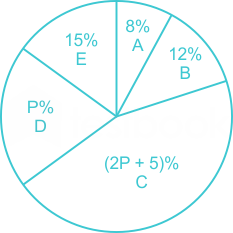
The pie chart shows the percentage distribution of total number manufactured in five different factories [A, B, C, D and E]. Total number of items manufactured by all five factories is 1200.

In Factory C, 20% of the items were defective, while in Factory D, 25% fewer defective items were produced than in Factory C. In Factory B, the number of defective items was [2/9]th the sum of defective items in C and D together. What is the total of non-defective item in factory B, C and D together?

  1. AOption (a)

    756

  2. BOption (b)

    693

  3. COption (c)

    558

  4. DOption (d)

    783

  5. EOption (e)

    963

View answer & explanation

Correct answer

Answer: (b)B.

693

Why this answer is correct

Common Calculation –

According the question,

[ 8% + 12% + (2P + 5) % + P% + 15 %] = 100%

So, 2P + 5 + P = 100 – 15 – 12 – 8 = 65

Or, 3P = 60

Or, P = 60/3 = 20

So, Percentage distribution of number of items manufactured in factories A, B, C, D and E is 8%, 12%, [2 Γ— 20 + 5] =45%, 20% and 15% respectively.

So, Item manufactured in factory A is 1200 Γ— 8 /100 = 96

Similarly, we can calculate the number of items manufactured by others factory also, which is given in the table.

Β 

FactoryNumber of items manufactured
A96
B144
C540
D240
E180

Calculation

Factory C = 540

β†’ 20% defective = 20% of 540 = 108

Factory D = 240

β†’ defective items = 25% less than 108

 ⇒ 108 – 25% of 108 = 108 – 27 = 81

Factory B = 144 β†’ defective items = (2/9) of (108 + 81) = (1/4) of 189 = 42

Non-defective in:

C = 540 – 108 = 432

D = 240 – 81 = 159

B = 144 – 42 = 102

Total non- defective is = 432 + 159 + 102 = 693

SBI PO Prelims Memory Based Paper (Held On: 4 August 2025 Shift 1) (Previous Year Paper)Β·Quantitative Aptitude
View full paper

Question 100

SBI Probationary Officer (PO) 2025β€’ Quantitative Aptitudeβ€’ Quantitative Aptitude

The pie chart shows the percentage distribution of total number manufactured in five different factories [A, B, C, D and E]. Total number of items manufactured by all five factories is 1200.

Find the ratio of items manufactured by Factory A and E combined to those manufactured by B and D combined?

  1. AOption (a)

    23:32

  2. BOption (b)

    17:19

  3. COption (c)

    23:29

  4. DOption (d)

    28:39

  5. EOption (e)

    37:47

View answer & explanation

Correct answer

Answer: (a)A.

23:32

Why this answer is correct

Common Calculation –

According the question,

[ 8% + 12% + (2P + 5) % + P% + 15 %] = 100%

So, 2P + 5 + P = 100 – 15 – 12 – 8 = 65

Or, 3P = 60

Or, P = 60/3 = 20

So, Percentage distribution of number of items manufactured in factories A, B, C, D and E is 8%, 12%, [2 Γ— 20 + 5] =45%, 20% and 15% respectively.

So, Item manufactured in factory A is 1200 Γ— 8 /100 = 96

Similarly, we can calculate the number of items manufactured by others factory also, which is given in the table.

Β 

FactoryNumber of items manufactured
A96
B144
C540
D240
E180

Calculation

Total in A and E = A + E = 96 + 180 = 276

Total in B and D = B + D = 144 + 240 = 384

Ratio = 276 : 384 =23 : 32

How should I prepare for Quantitative Aptitude in SBI Probationary Officer (PO)?

Solving previous year questions by topic helps identify recurring concepts, question patterns, and frequently asked sub-topics. Attempt each question, review the step-by-step explanation, and note down key formulas or facts for quick revision before the exam.